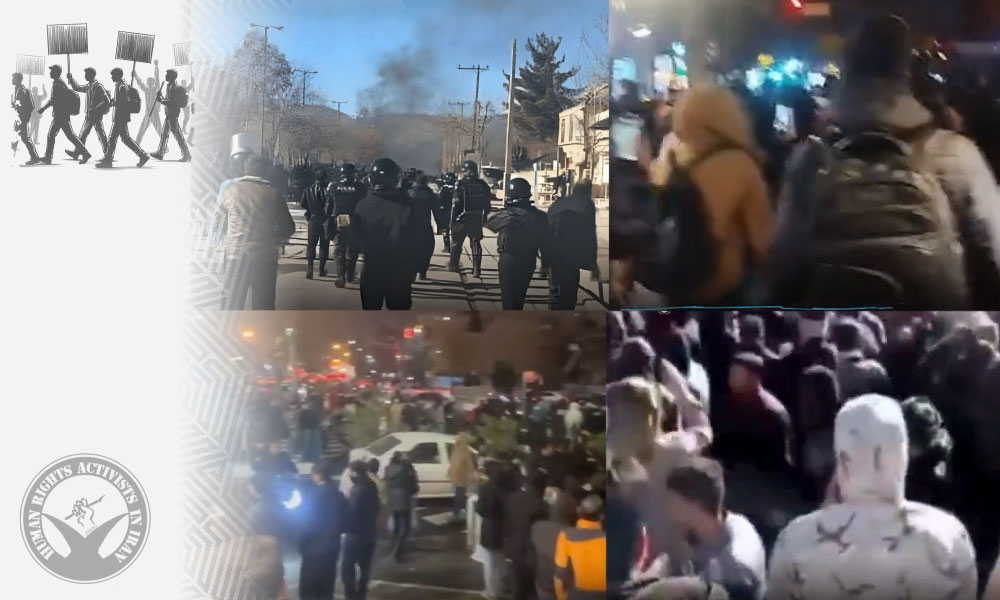
Six Citizens Arrested in Gachsaran, Hamedan, and Malekshahi During Protests

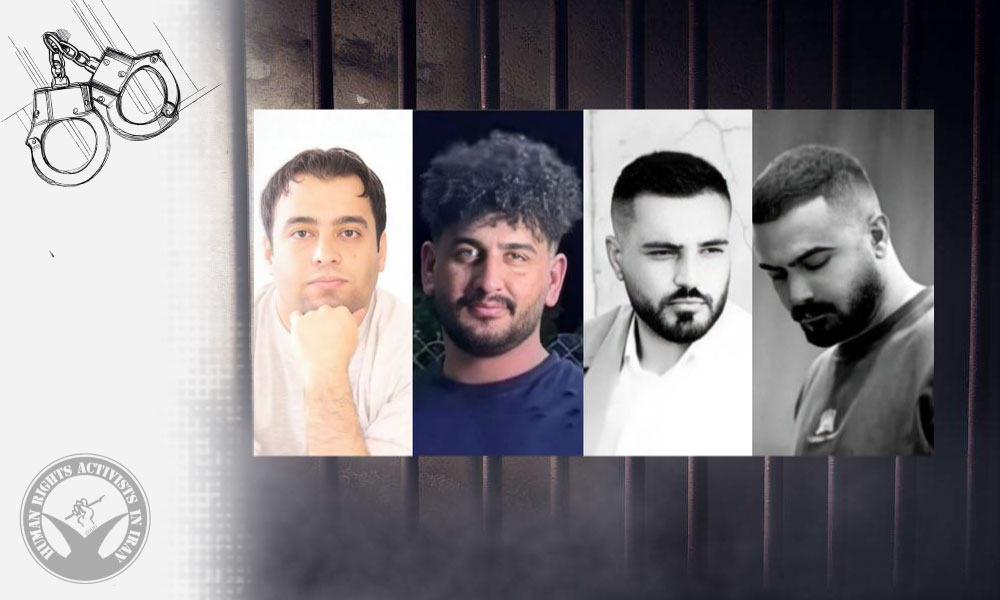
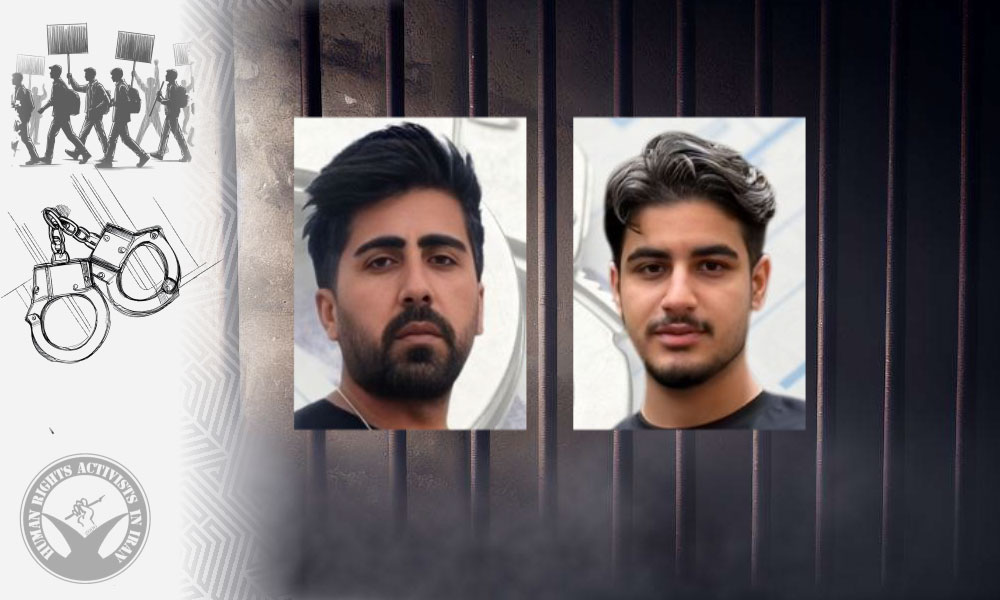
HRANA – Ali Bijani Banari, Alireza Maki Zadeh Banari, Mohsen Sabzi Zadeh Banari, Sajad Nazemkani, a pharmacist, Hassan Maili, and Ayoub Karimi were arrested during nationwide protests in the cities of Gachsaran, Hamedan, and Malekshahi.

Based on information received by HRANA, Ali Bijani Banari, Alireza Maki Zadeh Banari, Mohsen Sabzi Zadeh Banari, and Sajad Nazemkani, four protesters residing in Gachsaran, were arrested in the city on January 3. Additionally, the arrest of Hassan Maili, a resident of Hamedan, took place on Sunday, January 4, after security forces searched his home.

The Kurdpa news outlet also reported that earlier today, a citizen identified as Ayoub Karimi was arrested in Malekshahi County.

As of the time of this report, no information has been obtained regarding the charges against these citizens or their place of detention.

It is worth noting that gatherings and strikes by shopkeepers and bazaar merchants began in Tehran on Sunday, December 28. After two days, the protests expanded beyond markets and commercial centers. With students, citizens, and various social groups joining, these demonstrations have become among the most widespread protests in recent years. For more information, readers may refer to HRANA’s detailed report on the eighth day of protests, published last night.

19 Prisoners Executed in Multiple Prisons

HRANA – On Sunday, January 4, the death sentences of 16 prisoners, previously convicted on charges related to drug offenses and murder, were carried out in various prisons across Iran. Additionally, on January 3, the death sentences of three prisoners convicted of murder and moharebeh (enmity against God) through armed robbery were carried out in Adelabad Prison in Shiraz.

The identities of the 16 prisoners executed at dawn on Sunday, January 4, have been confirmed by HRANA as follows:

  • • Aydin Salavati, executed on drug-related charges in Tabriz Prison

  • • Ebrahim Bazvand, executed on murder charges in Tabriz Prison

  • • Nima (last name unknown), executed in Bandar Abbas Prison

  • • Saeed Rostami, executed in Qazvin Prison

  • • Amin Elahi, executed on murder charges in Qom Prison

  • • Arman Nazari, executed on drug-related charges in Semnan Prison

  • • Vali Karambeigi, executed on murder charges in Borujerd Prison

  • • Sajad Golmohammadi, executed on murder charges in Ardabil Prison

  • • Kazem Sourian, executed on murder charges in Khorramabad Prison

  • • Soroush Khani, executed on murder charges in Karaj Penitentiary

  • • Mohsen Qaedrahmat, executed on murder charges in Aligudarz Prison

  • • Shakaram Masti, executed on murder charges in Kermanshah Prison

  • • Hamid Reza Moradi, executed on murder charges in Dezful Prison

  • • Asghar Babaei, executed on drug-related charges in Hamedan Prison

  • • Noureddin Eidizadeh, executed on murder charges in Nahavand Prison

  • • Ahmad Saki, executed on drug-related charges in Nahavand Prison

Additionally, three prisoners were executed on January 3 in Adelabad Prison in Shiraz. The identities of two of them have been confirmed by HRANA as Asghar Shahi and Khalil Rahmani. Mr. Rahmani had been arrested and sentenced to death on charges of murder, while Mr. Shahi and the third prisoner had been sentenced to death on charges of moharebeh through armed robbery.

As of the time of this report, the executions have not been officially announced by prison authorities or relevant state institutions.

According to the annual report on the state of human rights in Iran, published by the Statistics, Publications, and Documentation Unit of the Human Rights Activists in Iran, at least 2,063 people were executed in Iran during the one-year period from January 1, 2025, to January 1, 2026. Based on this report, the number of executions more than doubled compared to 2024. In many cases, due to secrecy surrounding executions, prisoners were denied the right to a final visit with their families.

Detailed Report on the Eighth Day of Protests; 222 Locations Across the Country Witness Demonstrations

HRANA- Protests and strikes in various cities across Iran entered their eighth day. An assessment of updated and verified data indicates that despite intensified security measures, increased deployment of law enforcement and security forces, and the continuation of on-the-ground crackdowns in some areas, the geographical spread of the protests has been maintained, and various forms of protest actions continue in different parts of the country. Over the past eight days, at least 222 locations in 78 cities across 26 provinces have witnessed protests. During these events, at least 990 citizens have been arrested, and at least 19 protesters have lost their lives.

Protests that initially began with strikes and labor and trade gatherings have continued into the eighth consecutive day, taking the form of street demonstrations, limited sectoral actions, and student protests at some universities.

Background of the Protests

The protests emerged in a context where economic pressures on broad segments of society have reached a critical stage, and clear signs of disruption in the cycle of daily livelihoods are visible. Repeated surges in exchange rates, prolonged market instability, and the continuous decline in purchasing power have darkened and rendered unpredictable the economic outlook for households and trade activists alike, turning financial insecurity into a widespread experience.

In the days leading up to the start of the protests, reports indicated that exchange rates had crossed new thresholds, alongside a downturn in the capital market and capital outflows. Analysts have interpreted this trend as a shift of liquidity toward safer markets such as gold and foreign currency, and a decline in public trust in economic policies. At the grassroots level, the consequences have included the closure or partial shutdown of trade units, increasing difficulty in sustaining small businesses, and the spread of protest and strike waves in various cities, protests rooted not in a single short-term factor, but in the long-term accumulation of livelihood pressures and the erosion of hope for improved conditions.

Protests Day 8

Geography of the Protests

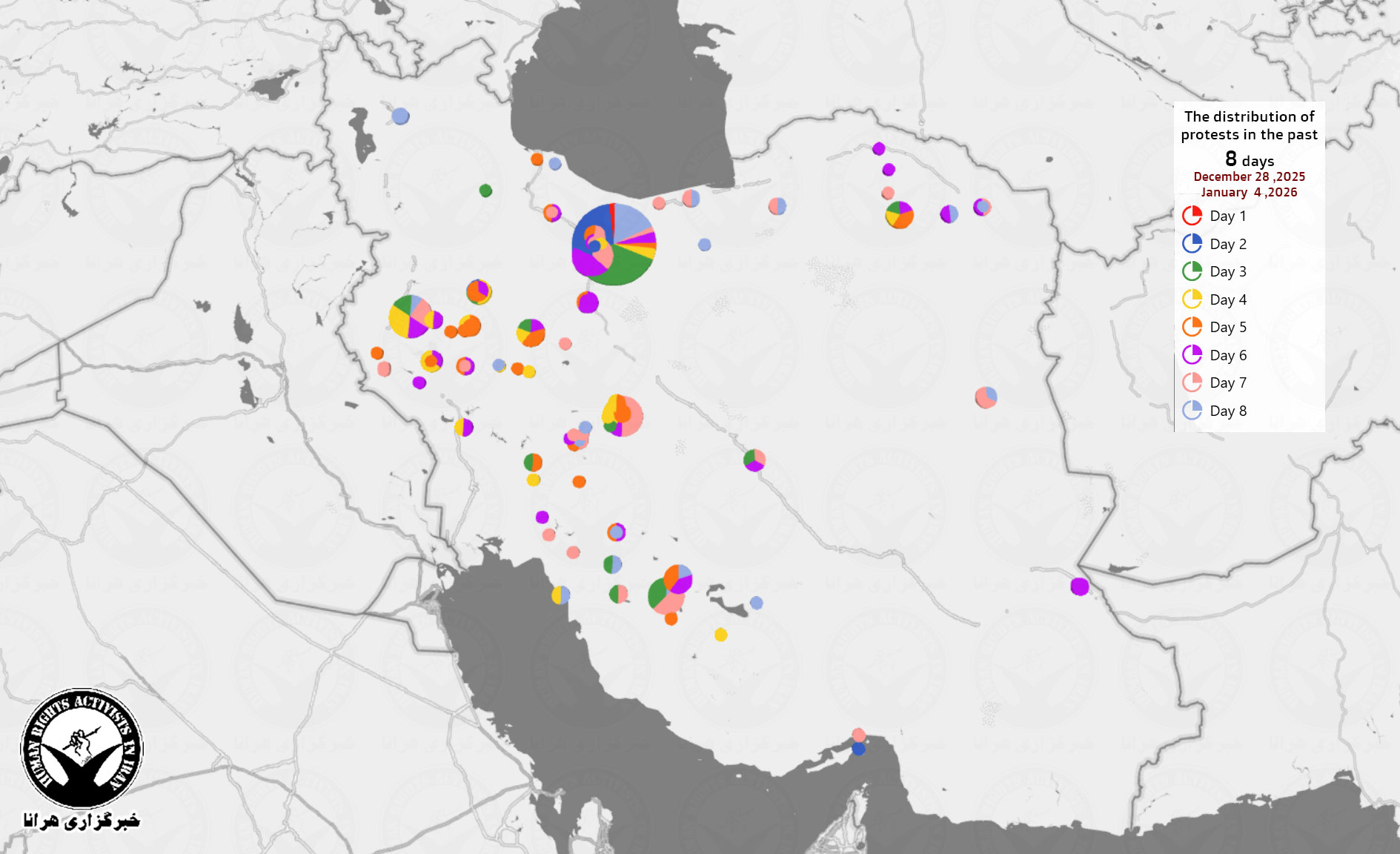
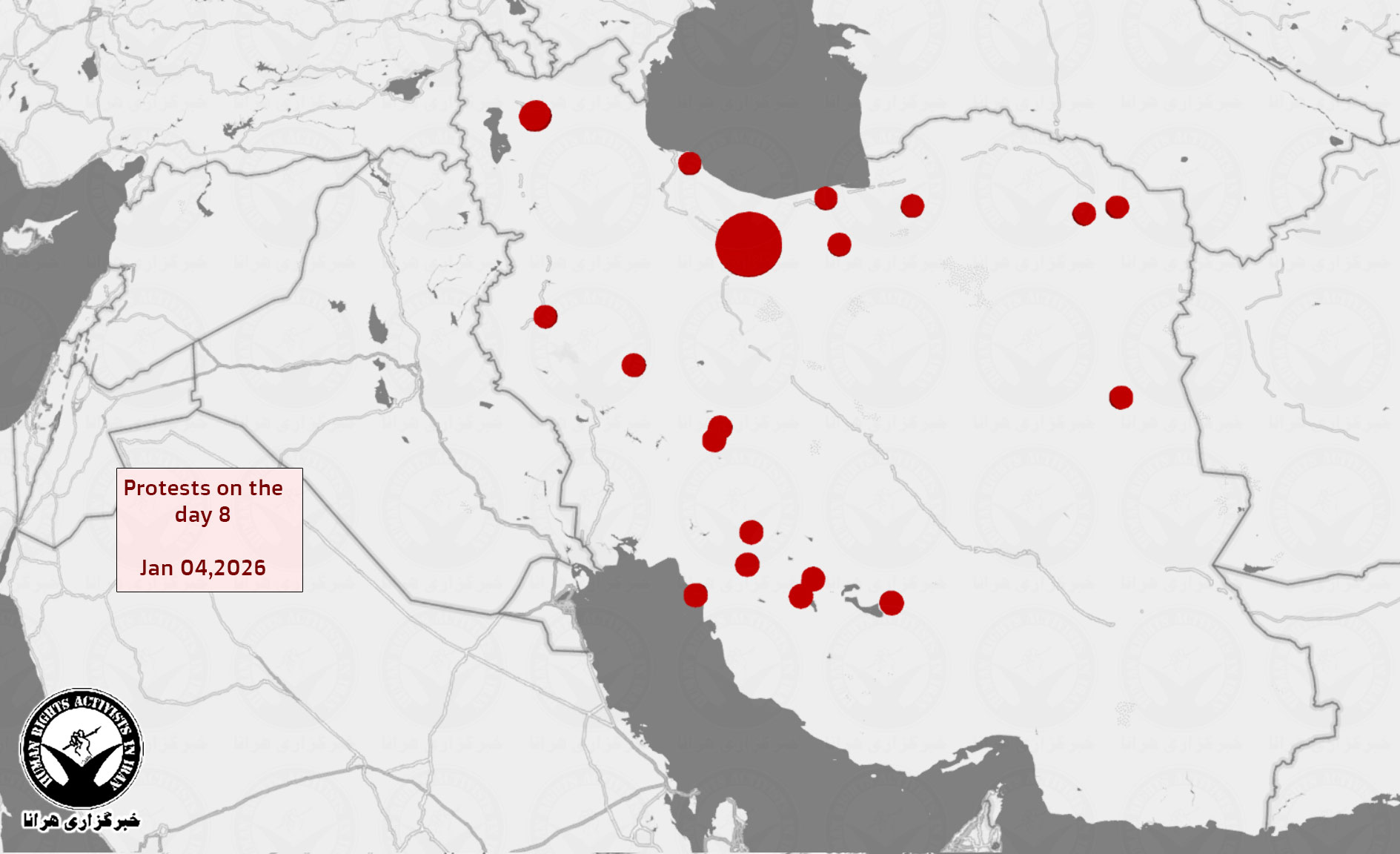
According to updated and aggregated information, over the past eight days at least 222 locations across Iran have witnessed protests, street demonstrations, or labor and trade strikes. These protests have been reported in a total of 26 provinces, and during this period, 17 universities have also seen student protest activities.

Over the past 24 hours alone, at least 20 cities, including Shiraz, Zarqan, Qazvin, Joveyn, Yazd, Bandar Abbas, Birjand, Behbahan, Karaj, Sureshjan, Sari, Tehran, Gachsaran, Mahallat, Khorramabad, Shahroud, Likak, Hafshejan, Dorud, Marvdasht, Tabriz, Kermanshah, Saman, Yasuj, Nurabad-e Mamasani, Mashhad, Mehdi Shahr (Sangsar), Lahijan, Mashkan, Rudsar, Neyshabur, and Bushehr, have experienced street protests, protest gatherings, labor strikes, student demonstrations, as well as the imposition of heightened security atmospheres in some areas.

An examination of the geographical distribution of the protests shows that these activities have not been limited to major metropolitan centers, but have also encompassed smaller cities and various regions across the country, indicating the horizontal spread of the protests and the participation of diverse social groups in this wave of dissent.

Protests map- Only Day 8

Forms of Protest and Slogans

A review of verified videos and reports shows that the eighth day of protests, similar to previous days, lacked a single unifying محور and encompassed a wide range of demands. Slogans chanted at gatherings ranged from livelihood and economic grievances to criticism of governance practices, restrictions on individual and social freedoms, and calls for justice.

Within the framework of its human rights mandate, HRANA focuses its reporting on slogans and demands that are directly related to violations of, or calls for, human rights, fundamental freedoms, and civil rights. The persistence of these demands across different parts of the country reflects the depth of public discontent and the overlap of economic, social, and political grievances within the current protest movement.

Conduct of Law Enforcement-Security Forces and Details of Violence

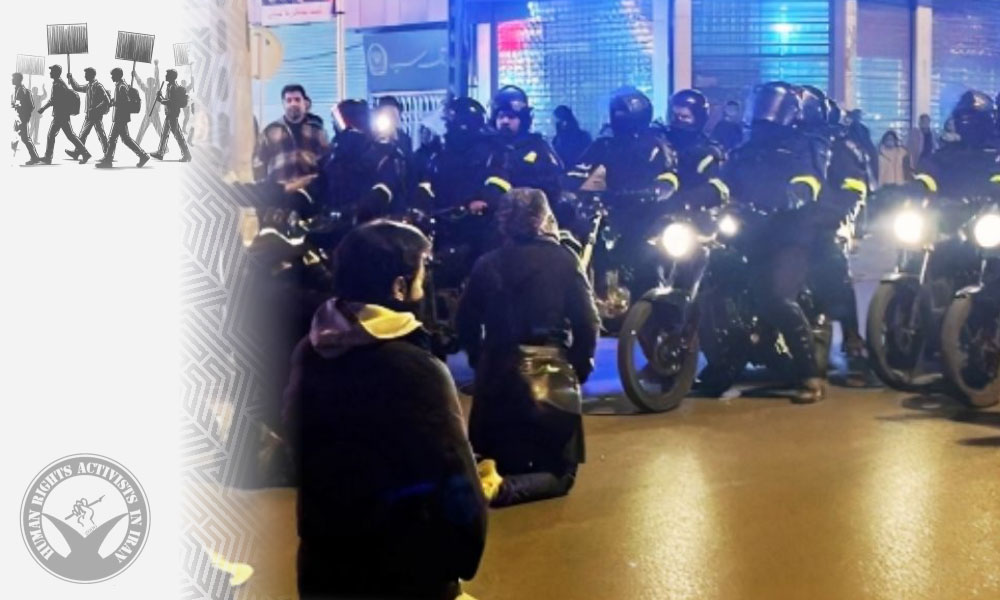
On the eighth day of nationwide protests, reports and published videos continued to point to a prevailing security atmosphere and the use of repressive measures by law enforcement and security forces to prevent the formation or spread of protest gatherings. Images released from various cities show violent crackdown, gunfire, the use of tear gas, and the arrest of protesters.

Meanwhile, state broadcaster IRIB aired a video of a forced confession by a citizen accused of setting fire to one of the agents—footage whose recording conditions remain unclear.

In addition, official accounts provided by local authorities regarding some of the fatalities have been met with skepticism by eyewitnesses and contradicted by unofficial reports. Details surrounding these deaths remain under review and subject to further verification.

Fatalities and Injuries

According to updated information from HRANA, the deaths of at least 20 people during the eight days of protests have been confirmed. One of the deceased was affiliated with law enforcement-security forces. At least 51 cases of citizen injuries have also been recorded so far, most of them resulting from pellet and plastic bullets.

Supplementing reports from previous days, new field investigations by this human rights organization confirm the deaths of Reza Azimzadeh, Mehdi Emami-Pour, Latif Karimi, Soroush Soleimani, Rasoul Kadiourian, Reza Kadiourian, Hossein Rabiei, and Amir Mohammad Kouhkan.

HRANA has also received concerning reports of the beating of Nasser Rezaei Ahangarany, a lawyer, by security forces on Saturday evening, January 3, during protests in Khorramabad.

Separately, Kurdpa News Agency, which covers developments in Kurdish regions, reported that at least 30 people were injured during protests in Malekshahi the previous day.

Arrests

Over the past eight days of protests, at least 990 protesting citizens have been arrested, although the actual number of detainees is estimated to be significantly higher.

Individual arrests with confirmed identities on the eighth day:

  1. 1. Full name: Salman Mardani
    Place of arrest: Dehloran
    Date of arrest: January 3, 2026
    Current status: Detained

  2. 2. Full name: Pouria Aliyari, student
    Place of arrest: Esfarayen
    Date of arrest: January 3, 2026
    Current status: Detained

  3. 3. Full name: Parsa Loghmani, student
    Place of arrest: Babol
    Date of arrest: January 3, 2026
    Current status: Released

  4. 4. Full name: Erfan Dehghani Iraj
    Place of arrest: Tehran
    Date of arrest: January 3, 2026
    Current status: Released

  5. 5. Full name: Asghar Shakeri
    Place of arrest: Mashhad
    Date of arrest: December 31, 2025
    Current status: Detained

  6. 6. Full name: Fariba Hosseini
    Place of arrest: Shiraz
    Date of arrest: January 3, 2026
    Current status: Detained

  7. 7. Full name: Javad Soltani Kalateh
    Place of arrest: Sabzevar
    Date of arrest: January 2, 2026
    Current status: Detained

  8. 8. Full name: Abolfazl Imani, 17-year-old minor
    Place of arrest: Sabzevar
    Date of arrest: January 2, 2026
    Current status: Detained

  9. 9. Full name: Saeed Shiei, 17-year-old minor
    Place of arrest: Sabzevar
    Date of arrest: January 2, 2026
    Current status: Detained

  10. 10. Full name: Jalal Lotfi
    Place of arrest: Sabzevar
    Date of arrest: January 3, 2026
    Current status: Detained

  11. 11. Full name: Ali Amanabadi
    Place of arrest: Neyshabur
    Date of arrest: January 3, 2026
    Current status: Detained

  12. 12. Full name: Zahra Izadi Nia
    Place of arrest: Yasuj
    Date of arrest: January 2, 2026
    Current status: Detained

  13. 13. Full name: Hasti Ghorbani, 16-year-old minor
    Place of arrest: Mashhad
    Date of arrest: Unknown
    Current status: Detained

  14. 14. Full name: Alireza Yazdani
    Place of arrest: Tehran
    Date of arrest: January 2, 2026
    Current status: Detained

  15. 15. Full name: Mahan Mohammadi
    Place of arrest: Tehran
    Date of arrest: January 2, 2026
    Current status: Detained

  16. 16. Full name: Sajad Ravad
    Place of arrest: Behbahan
    Date of arrest: January 4, 2026
    Current status: Detained

  17. 17. Full name: Shahrokh Shojaei
    Place of arrest: Behbahan
    Date of arrest: January 3, 2026
    Current status: Detained

  18. 18. Full name: Abolfazl Tayebi
    Place of arrest: Behbahan
    Date of arrest: January 1, 2026
    Current status: Detained

  19. 19. Full name: Sina Dehdashti, 16-year-old minor
    Place of arrest: Behbahan
    Date of arrest: January 1, 2026
    Current status: Detained

  20. 20. Full name: Artin Estadayan, 16-year-old minor
    Place of arrest: Behbahan
    Date of arrest: January 1, 2026
    Current status: Released after submission of a salary slip

  21. 21. Full name: Saber Vafaian-Nejad, 15-year-old minor
    Place of arrest: Behbahan
    Date of arrest: January 1, 2026
    Current status: Detained

  22. 22. Full name: Maryam Zarei
    Place of arrest: Yazd
    Date of arrest: Recent days
    Current status: Detained

  23. 23. Full name: Sara Nosrati, 17-year-old minor
    Place of arrest: Yazd
    Date of arrest: Recent days
    Current status: Detained

  24. 24. Full name: Reyhaneh Zarei
    Place of arrest: Yazd
    Date of arrest: Recent days
    Current status: Detained

  25. 25. Full name: Farzaneh Golestani
    Place of arrest: Yazd
    Date of arrest: Recent days
    Current status: Detained

  26. 26. Full name: Ahmadreza Khosravi, minor
    Place of arrest: Shushtar
    Date of arrest: January 3, 2026
    Current status: Detained

  27. 27. Full name: Emad Ghorbani, minor
    Place of arrest: Shushtar
    Date of arrest: January 3, 2026
    Current status: Detained

  28. 28. Full name: Sajad Khorshidi
    Place of arrest: Ilam
    Date of arrest: January 3, 2026
    Current status: Detained

  29. 29. Full name: Abolfazl Saki
    Place of arrest: Ilam
    Date of arrest: January 3, 2026
    Current status: Detained

  30. 30. Full name: Alireza Momeni
    Place of arrest: Ilam
    Date of arrest: January 3, 2026
    Current status: Detained

  31. 31. Full name: Alireza Momeni, student
    Place of arrest: Ilam
    Date of arrest: January 4, 2026
    Current status: Detained

  32. 32. Full name: Faizeh Rashidi
    Place of arrest: Badreh
    Date of arrest: January 3, 2026
    Current status: Detained

  33. 33. Full name: Siroos Azarmehr
    Place of arrest: Isfahan
    Date of arrest: Recent days
    Current status: Detained

  34. 34. Full name: Saman Shahamat
    Place of arrest: Isfahan
    Date of arrest: Recent days
    Current status: Detained

  35. 35. Full name: Payam Aminzadeh
    Place of arrest: Isfahan
    Date of arrest: Recent days
    Current status: Detained

  36. 36. Full name: Siroos Javidy
    Place of arrest: Isfahan
    Date of arrest: Recent days
    Current status: Detained

  37. 37. Full name: Fatemeh Zarei
    Place of arrest: Mashhad
    Date of arrest: January 2, 2026
    Current status: Detained

  38. 38. Full name: Elaheh Khazaei
    Place of arrest: Shahriar
    Date of arrest: Recent days
    Current status: Detained

  39. 39. Full name: Setayesh Khazaei
    Place of arrest: Shahriar
    Date of arrest: Recent days
    Current status: Detained

  40. 40. Full name: Nazanin Khazaei
    Place of arrest: Shahriar
    Date of arrest: Recent days
    Current status: Detained

  41. 41. Full name: Mehdi Hasanpour
    Place of arrest: Neqab
    Date of arrest: January 4, 2026
    Current status: Detained

  42. 42. Full name: Negar (Aram) Iranmanesh
    Place of arrest: Yasuj
    Date of arrest: January 4, 2026
    Current status: Detained

  43. 43. Full name: Pouya Naderi
    Place of arrest: Abdanan
    Date of arrest: January 3, 2026
    Current status: Detained

  44. 44. Full name: Abdollah Ahmadi
    Place of arrest: Abdanan
    Date of arrest: January 4, 2026
    Current status: Detained

  45. 45. Full name: Mehdi Sheikhi
    Place of arrest: Abdanan
    Date of arrest: January 4, 2026
    Current status: Detained

  46. 46. Full name: Amir Eisa Zadeh
    Place of arrest: Darreh Shahr
    Date of arrest: January 3, 2026
    Current status: Detained

  47. 47. Full name: Mohammad Bashir Hashemian
    Place of arrest: Darreh Shahr
    Date of arrest: January 3, 2026
    Current status: Detained

  48. 48. Full name: Mehdi Hashemian
    Place of arrest: Darreh Shahr
    Date of arrest: January 3, 2026
    Current status: Detained

  49. 49. Full name: Ahmad Hasanvand Amouzadeh
    Place of arrest: Darreh Shahr
    Date of arrest: January 3, 2026
    Current status: Detained

  50. 50. Full name: Bahador Amouzadeh
    Place of arrest: Darreh Shahr
    Date of arrest: January 3, 2026
    Current status: Detained

  51. 51. Full name: Ahmad Haqnazari
    Place of arrest: Sarableh
    Date of arrest: January 2, 2026
    Current status: Detained

  52. 52. Full name: Reza Bagheri Nejad
    Place of arrest: Sarableh
    Date of arrest: January 2, 2026
    Current status: Detained

  53. 53. Full name: Shahin Qasr Beigi
    Place of arrest: Sarableh
    Date of arrest: January 4, 2026
    Current status: Detained

  54. 54. Full name: Salal Sadeghi
    Place of arrest: Shabab
    Date of arrest: January 3, 2026
    Current status: Detained

  55. 55. Full name: Iraj Rostami Mehr
    Place of arrest: Shabab
    Date of arrest: January 3, 2026
    Current status: Detained

  56. 56. Full name: Samyar Motallebi, student
    Place of arrest: Tehran
    Date of arrest: Recent days
    Current status: Detained

  57. 57. Full name: Ramin Pourasal, student
    Place of arrest: Tehran
    Date of arrest: Recent days
    Current status: Detained

  58. 58. Full name: Ehsan Masoudi, student
    Place of arrest: Tehran
    Date of arrest: Recent days
    Current status: Detained

  59. 59. Full name: Meysam Behzadi
    Place of arrest: Kermanshah
    Date of arrest: January 3, 2026
    Current status: Detained

  60. 60. Full name: Ehsan Hayati
    Place of arrest: Kermanshah
    Date of arrest: January 1, 2026
    Current status: Detained

  61. 61. Full name: Mohammad Ziyadi
    Place of arrest: Kermanshah
    Date of arrest: January 3, 2026
    Current status: Detained

  62. 62. Full name: Rahim Mohammadvali
    Place of arrest: Hersin
    Date of arrest: January 2, 2026
    Current status: Detained

  63. 63. Full name: Ali Cheraghi
    Place of arrest: Hersin
    Date of arrest: January 2, 2026
    Current status: Detained

  64. 64. Full name: Milad Alibeygi
    Place of arrest: Hersin
    Date of arrest: January 2, 2026
    Current status: Detained

  65. 65. Full name: Saeed Darvishi
    Place of arrest: Eslamabad-e Gharb
    Date of arrest: January 3, 2026
    Current status: Detained

  66. 66. Full name: Yousef Salkhordeh
    Place of arrest: Gilan-e Gharb
    Date of arrest: January 3, 2026
    Current status: Detained

  67. 67. Full name: Delaram Kazemi
    Place of arrest: Gilan-e Gharb
    Date of arrest: January 2, 2026
    Current status: Released

Group Arrests or Arrests Without Confirmed Identities (Eighth Day)

  • Arrest of several individuals in Yazd, detained for activity on social media

  • Arrest of one individual in Marlik, Malard,  presented as a “leader of the protests”

  • Arrest of one individual in Shiraz’s Maali Abad neighborhood, detained after being beaten by security forces

  • Arrest of four citizens in Qazvin,  described as “instigators of the protests”

  • Arrest of several protesters in Zanjan, labeled as “agents of unrest”

  • Arrest of 71 individuals, including one woman, in Yazd over recent days

  • Arrest of 30 individuals on the previous night in Jafarabad neighborhood, Kermanshah

  • Arrest of 150 individuals in Isfahan and their transfer to the city’s prison

  • Arrest of 24 individuals in Shiraz and their transfer to Adelabad Prison

  • Arrest of three individuals in Shiraz and Tehran

  • Arrest of one individual in Rezvanshahr

  • Arrest of 30 individuals in Behbahan


International Reactions

The escalation of violence and repression in Iran has also sparked international concern. In a statement quoted from its spokesperson, the European Union’s External Action Service expressed concern over violence against Iranian protesters and called on Iran’s security forces to exercise restraint in dealing with participants in peaceful demonstrations. The statement described the protests as “reflecting the demands of many Iranians” and emphasized that developments across Iran are being closely monitored. It further stated: “We are concerned by reports of deaths and injuries and call on Iranian security forces to show maximum restraint in responding to peaceful protests. Authorities have acknowledged socio-economic challenges, and addressing these challenges must take place through inclusive dialogue, not violence.”

A diplomatic source at France’s Ministry of Foreign Affairs, expressing regret over the killing of protesters, called for full transparency and for Iran to respect its international commitments.

Amnesty International Australia called for an immediate halt to violence, the release of political prisoners, an end to executions, and a stop to the use of lethal weapons against protesters.

The Association of Families of Flight PS752 Victims, in a statement published on Friday, January 3, declared solidarity with protesters in Iran and called for an immediate end to the violent suppression of protests, accountability regarding those killed, injured, and detained, and respect for the right to protest and freedom of expression.

Domestic (Governmental) Reactions

Today, the commander of Iran’s national police (FARAJA) announced that what he described as “targeted arrests of leaders” had begun over the past two nights. Ahmadreza Radan claimed that those arrested were accused of inciting citizens and receiving foreign currency in exchange for their actions.

Meanwhile, official media and channels affiliated with security institutions continue to describe protests in various cities as “riots,” accusing protesters of ties to foreign actors and opposition groups. This narrative, presented without clear evidence, seeks to deny the livelihood-based and protest-driven nature of citizens’ demands and attribute the protests to external interference.

Mohammad Ja’far Montazeri, head of Iran’s Supreme Court, said the recent protests were unrelated to the will of the people and dismissed threats by U.S. President Donald Trump regarding support for the Iranian people as ineffective. Alaeddin Boroujerdi, a member of parliament’s National Security Commission, warned the United States that any action would result in its regional interests being targeted. Qassem Ravanbakhsh, a member of parliament from Qom, described Trump’s support for protesters as foreign interference and rejected it. In contrast, Ahmad Naderi, a member of parliament’s presidium, assessed the protests as stemming from runaway inflation and economic mismanagement by the government. At the same time, the police commander of Yazd Province reported the identification and arrest of administrators of several social media pages linked to the protests.

The Iran Reform Front reacted to the recent protests, stating that the government’s approach of avoiding violence and listening to protesters’ voices is a positive—though insufficient—step toward rebuilding public trust. It emphasized that the protests in Iran have entirely domestic roots and can only be pursued through peaceful means.

Ali Rabiei, the president’s social affairs aide, said in response to the protests: “Iran today stands at one of the most complex junctures in its history, a moment shaped not only by external pressures, but by the accumulation of economic imbalances, erosion of social capital, and policy mistakes over past decades.”

Finally, the Workers’ House of Iran, in a statement reacting to the protests, declared that the people of Iran have the right to protest their livelihood and economic conditions, and that this right is legitimate, legal, and social. It added that workers across the country have repeatedly raised their demands in professional and peaceful ways.

Domestic Reactions (Civil Society, Trade Groups, and Public Figures)

The Kermanshah Bar Association, in a statement responding to the popular protests, described the purpose of governments and political, administrative, and military institutions as “serving the interests of the people” in areas such as the economy, security, healthcare, and education. It emphasized that despite nearly five decades since the revolution, the Islamic Republic has failed to achieve a large portion of these objectives. The statement said that Iran has, over these years, become a “poor and isolated” country, and that the “widespread poverty and misery of the people,” alongside the “expansion of corruption,” are clear signs of the inefficiency of the governing system. The Hersin Teachers’ Association also issued a statement supporting the protests, declaring that under current conditions, no option remains other than street protests.

Separately, the Hersin Teachers’ Association reiterated its support for the protests, stating that there is no alternative but to take to the streets.

Labor organizations, retirees’ groups, and social associations, in a joint reaction to the protests, said in a statement that runaway inflation has broken the backs of the majority of the population. Wages and salaries that fall below the poverty line and the cost-of-living basket, privatization, repression, imprisonment, executions, and war-driven policies have pushed people’s lives to the brink of collapse. Society has reached a boiling point, and nationwide protests are a direct reflection of this critical situation.

The Islam Abad-e Gharb Teachers’ Association, expressing support for the protests, stated that given the livelihood problems facing working and retired teachers and various segments of society under the current dire economic conditions, it fully supports the rightful protests of different social groups across the country and will stand alongside them.

A number of male and female athletes, including members of national teams and club teams, also voiced their support for the popular protests through public messages.

Conclusion

The ongoing protests, which began at Tehran’s bazaar, have entered their eighth day marked by geographical expansion, increased public participation, and an intensified presence of security forces. The combination of livelihood and political demands, rising arrests, and authorities’ attempts to simultaneously manage the crisis through economic and security measures highlight the state’s heightened sensitivity to the continuation of these protests.

HRANA continues to collect, verify, and complete information related to these protests and will publish follow-up reports should the demonstrations continue or expand.

Detailed Report on the Seventh Day of Protests; Increase in the Arrest of Teenagers and Broadcast of Forced Confessions

HRANA – Protests and strikes in cities across Iran entered their seventh day today, January 3. Analysis of updated and verified data indicates that despite an intensified security climate, the expanded presence of law enforcement-security forces, and continued on-the-ground confrontations in some areas, the nationwide scope of the protests has remained extensive, with demonstrations continuing in diverse forms. Over the past seven days, protests have been recorded at least 174 locations in 60 cities across 25 provinces. During this period, at least 582 individuals were arrested, and at least 15 protesting citizens lost their lives.

Protests that initially began with strikes and trade-related gatherings continued into their seventh consecutive day, taking the form of street demonstrations, limited trade actions, and student protests at several universities. As on previous days, reports indicated that law enforcement–security forces resorted to violence, employed crowd-control measures, carried out arrests, and imposed a heightened security atmosphere in a number of cities.

Background of the Protests

The protests emerged in a context where economic pressures on broad segments of society have reached a critical stage, and clear signs of disruption in the cycle of daily livelihoods are visible. Repeated surges in exchange rates, prolonged market instability, and the continuous decline in purchasing power have darkened and rendered unpredictable the economic outlook for households and trade activists alike, turning financial insecurity into a widespread experience.

In the days leading up to the start of the protests, reports indicated that exchange rates had crossed new thresholds, alongside a downturn in the capital market and capital outflows. Analysts have interpreted this trend as a shift of liquidity toward safer markets such as gold and foreign currency, and a decline in public trust in economic policies. At the grassroots level, the consequences have included the closure or partial shutdown of trade units, increasing difficulty in sustaining small businesses, and the spread of protest and strike waves in various cities, protests rooted not in a single short-term factor, but in the long-term accumulation of livelihood pressures and the erosion of hope for improved conditions.

Geography of the Protests

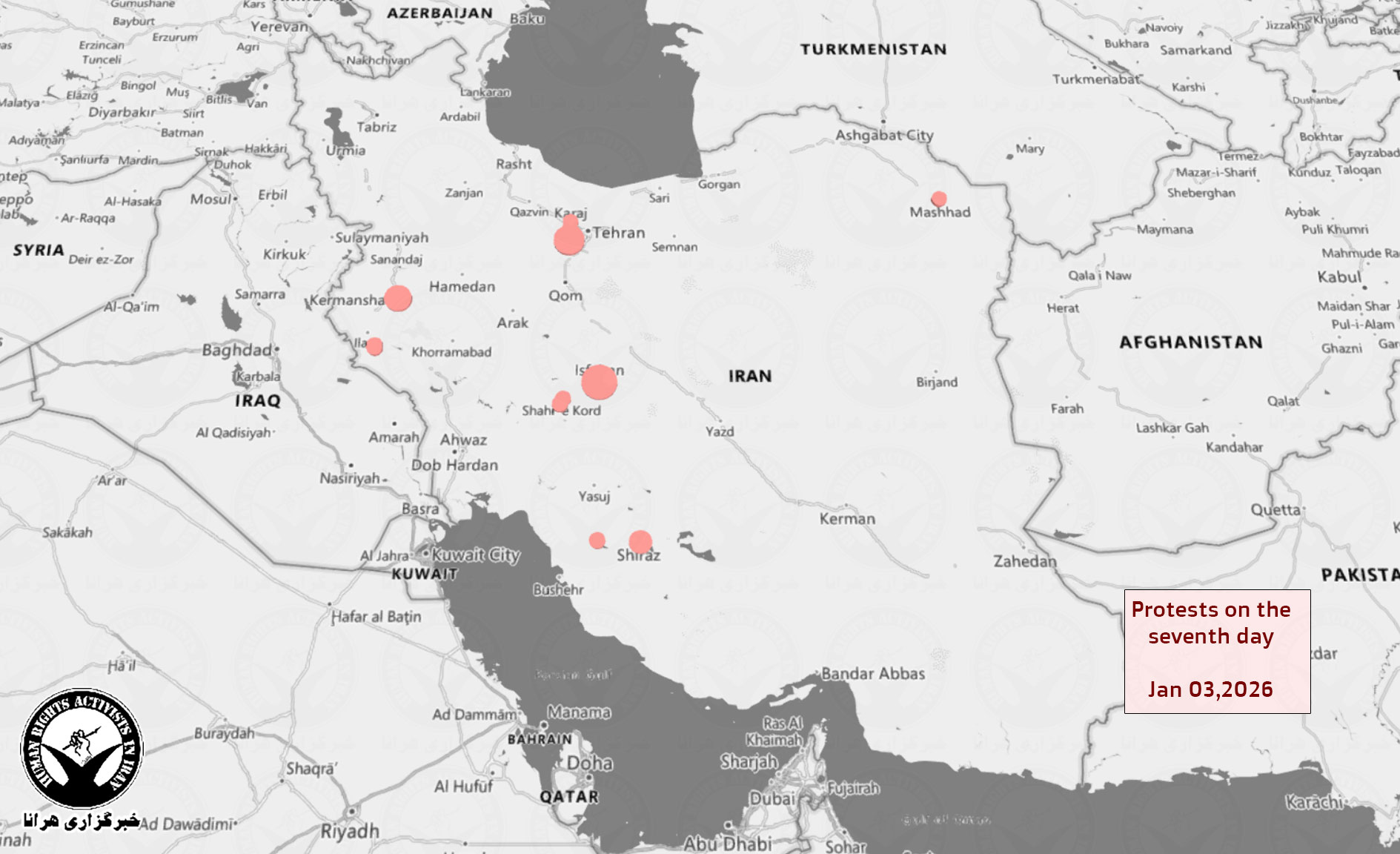
Based on updated and aggregated information, at least 174 locations in Iran have witnessed protests, street gatherings, or trade strikes over the past seven days. These protests have been reported across 25 provinces, and during this period, 18 universities have also seen student protest activities.

In the past 24 hours, which constitute the seventh day of protests, protest gatherings were recorded in 12 cities across 8 provinces, including Kazerun, Malekshahi, Kermanshah, Shiraz, Mashhad, Arkavaz, Isfahan, Tehran, Hafshejan, Karaj, Shahrekord, and Fardis. Among these, two protest actions on the seventh day were reported by university communities, falling within the same 18 universities included in the cumulative seven-day statistics. Available data indicate that despite daily fluctuations in the intensity and spread of protests, universities have continued to serve as one of the focal points of dissent.

An examination of the geographic distribution of protests shows that these activities have not been limited to major metropolitan areas, but have also encompassed smaller cities and various regions of the country, reflecting the horizontal expansion of the protests and the participation of diverse social groups in this wave of demonstrations.

According to verified reports up to the time of publication, a total of 174 protests have been reported over the past seven days in 60 cities across 25 provinces. Eighteen student gatherings at 15 universities are also included in these figures.
Methods of Protest and Slogans

A review of verified videos and reports indicates that, as in previous days, the protests on the seventh day reflected a broad spectrum of demands. The slogans voiced during these gatherings ranged from livelihood and economic grievances to criticism of governance, opposition to restrictions on individual and social freedoms, and calls for justice.

In some gatherings, protests took the form of trade strikes, the closure of commercial units, or short-term street assemblies, while in others, limited and dispersed marches were reported. The repetition and prevalence of these themes across different cities indicate that the boundary between trade-related and everyday demands and political demands has become blurred, and that the ongoing protests have taken shape on the basis of accumulated, multilayered grievances.

Within the framework of its human rights mission, HRANA focuses its reporting on slogans and demands that are directly related to violations of or calls for human rights, fundamental freedoms, and citizens’ civil rights. The persistence of these demands in various parts of the country reflects the depth of public discontent and the overlap of economic, social, and political demands within the context of the ongoing protests.
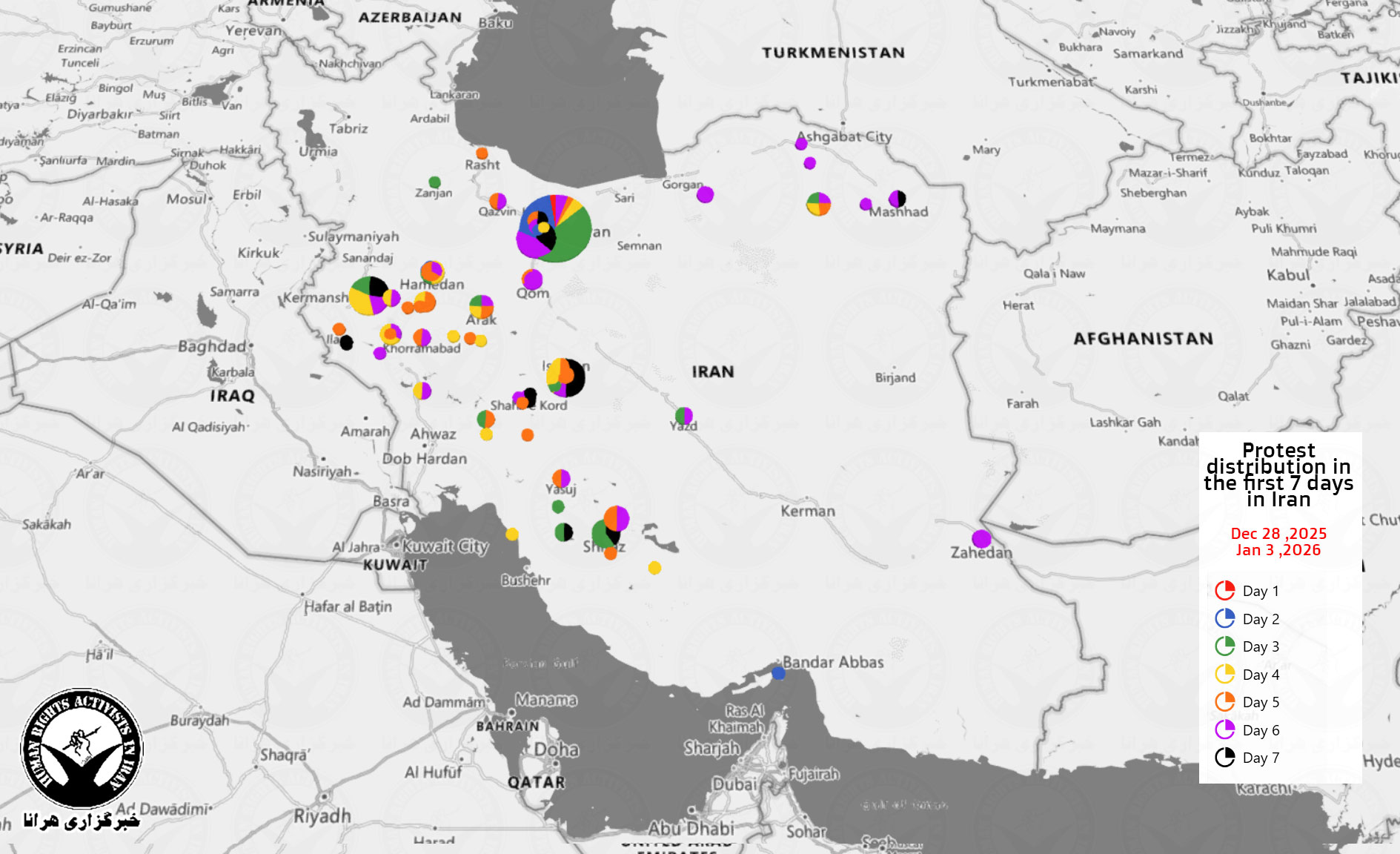
Conduct of Law Enforcement-Security Forces and Details of Violence

On the seventh day of nationwide protests, published reports and videos continue to indicate the persistence of a heavy security atmosphere and the use of repressive measures by law enforcement- security forces to prevent the formation or expansion of protest gatherings. Videos released from various cities show violent confrontations, gunfire, the use of tear gas, and the arrest of protesters.

In a number of cities, reports have emerged of citizens being injured as a result of gunfire by law enforcement-security forces. In some cases, citizens have refrained from seeking medical treatment out of fear of arrest. Videos have also been published showing the violent arrest of citizens, including women protesters, in public spaces, indicating the use of physical force during arrests.

Field reports suggest that in some cities, protest gatherings have extended into symbolic spaces or main thoroughfares, prompting law enforcement-security forces to use crowd-control tools to disperse protesters. At the same time, the widespread deployment of security forces in main streets, squares, and around sensitive urban centers has been reported, with the security atmosphere intensifying in parts of these cities.

Alongside these developments, official accounts provided by local authorities regarding some of the deaths have been met with doubt by eyewitnesses and contradicted by unofficial reports. Details surrounding the circumstances of these deaths remain under review and subject to verification.

Fatalities

According to updated information from HRANA, the deaths of at least 16 people during the seven days of protests have been confirmed. Among the fatalities, at least one was a member of law enforcement-security forces, while the remaining cases involve protesting citizens.

In several instances, official narratives presented by authorities have conflicted with eyewitness accounts and unofficial information, and details regarding how these individuals lost their lives are still being investigated and verified. For example, on the evening of Friday, January 2, 2026, during popular protests in the city of Qom, one protester lost their life. While the Provincial Security Council confirmed the death of this citizen, it claimed that the individual died as a result of the explosion of fireworks they were carrying. However, eyewitnesses have challenged the official account, stating that the protester’s death occurred as a result of actions by security forces present at the scene.

Separately, the political and security deputy governor of Qom reported the death of a 17-year-old teenager from Qom during protests the previous night, claiming that the teenager was killed by gunfire from protesters.

HRANA has also been able to confirm the identities of two other protesting citizens who died as a result of violence by law enforcement–security forces: Amirhossein Bayati in Hamedan and Ahad Ebrahim-Pour in Delfan.

The agency emphasizes that due to severe restrictions on information, security pressure on families, and a closed media environment, the number of fatalities may increase or details in some cases may change. This section will be updated if new information becomes available.

Arrests and Security Pressures

Over the past seven days of protests, at least 582 protesting citizens have been arrested, although the actual number of detainees is estimated to be significantly higher.

Simultaneously with street protests by citizens, reports received by HRANA from Karaj Central Prison indicate that prisoners in Wards 15 and 16 were forcibly transferred to other wards by prison authorities, and these two wards have been designated to hold detainees from the recent protests.

Today, HRANA also received reports from Qom Prison indicating that approximately 200 detained citizens have been transferred to this facility. These individuals were arrested during the protests, and HRANA is currently investigating their identities.

Meanwhile, reports from Yasuj indicate that at least 81 people have been arrested in recent days, 70 of whom are under the age of 18 and have been transferred to the Juvenile Rehabilitation Center and Yasuj Prison. Eleven other detainees remain held in security detention facilities.

According to published information, a significant portion of those arrested are teenagers. In Sabzevar, Zahra Mahdavi, Faraz Ziaei, Meysam Zakeri, Nazanin Zahra Mousavi, Saba Mahroomi, and Houman Balashabadi, all 17 years old, were arrested and transferred to the Mashhad Juvenile Rehabilitation Center. In Izeh, Shahpour Alborzi and Hessam Mohammadi, both 16 years old, were arrested by security forces. In Yasuj, Ilya Akvanian, a 15-year-old teenager, was also arrested.

Intelligence forces of the IRGC in Isfahan arrested two teenage girls during yesterday’s protests in the city. At the same time, a video of their forced confessions was published, though it is unclear under what conditions it was recorded. In the video, the two teenagers claim they received money from an individual to participate in street protests.

As arrests continued, a number of students and citizens were detained in various cities. Majid Jamshidzadeh, an undergraduate industrial design student at Iran University of Science and Technology, was arrested in Tehran and transferred to an unknown location. Amir Mohammad Rostami, an architecture student approximately 26 years old, was arrested during protests in Nazi Abad, Tehran, and was beaten at the time of arrest. Mohammad Saebi, a former member of the University of Tehran’s student trade council, was arrested by security forces in Yazd. Amirhossein Khaleghi, a law student at Rajaee University in Qazvin, was arrested at Khayyam Square in Qazvin, and Yousef Rezaei, a petroleum engineering student in Yasuj, was also arrested in the city. No information is available regarding the location of detention or charges against these two students. In addition, Erfan Tajabadi, Erfan Abed in Sabzevar, and Pouria Keyshams, Arman Soleimani, Nemat Heydari, and Mohammad Karimi in Masjed Soleyman; Peyman Yousefi in Dezful; and Parsa Akaber in Yasuj are among other reported detainees.

In Mashhad, Mohammad Taheri Parsa; in Nahavand, Amir Mohammad Khazaei and Alireza Khazaei; in Kashmar, Reza Abdi; and in Esfarayen, Ali Ghavidel, Abbas Beidi, Arian Heydari, Issa Shakouri, Peyman Mirzaei, and Alireza Ja’fari were arrested. In Kermanshah, Sepideh Kermanshahi, Setareh Mohammadi, Sayeh Shooshtari Kermanshahi, and Reza Shooshtari were among those detained and later released on bail. In Dehloran, Reza Seifi and Ilya Ghasemi were arrested, while in Darreh Shahr, Mohammad Taha Zeynivand, Peyman Hassanvand, Amin Shokri-Pour, Shahrooz Shokri-Pour, and Esmail Zohrabi were detained. In Zahedan, Zobair Barahoui, Hanif Barahoui, Omar Gamshadzehi, Ehsan Naroui, and Abdulrahman Naroui were arrested, and in Gachsaran, Mohammad Miri was also listed among detainees.

Additionally, Soheila Hejab, a civil activist, was violently arrested in Fardis, Karaj, and transferred to Kachouei Prison. Her physical condition has been reported as poor. In Harsin, four citizens, Yousef Safari, Peyman Hosseini, Morteza Hosseini, and Ehsan Hosseini, were arrested on the evening of January 1 and transferred to the IRGC detention facility in Kermanshah. Reza Abdi, 35 years old, from Kashmar and the father of two children, was also arrested today by agents of the Ministry of Intelligence in the city due to his online activities.

With the identification of six additional citizens, Mohammadreza Borichi, Kian Salarnejad, Zobair Barahoui, Hanif Barahoui, Omar Gamshadzehi, Ehsan Naroui, and Abdulrahman Naroui, the number of detainees from yesterday’s protest gathering in Zahedan has risen to 10. Previously, the arrest of three others had been reported. Among them, Kian Salarnejad is a student of industry and mining engineering at the University of Sistan and Baluchestan.

In most of these cases, no information has been released regarding the detainees’ place of detention or the charges against them.

Kurdpa News Agency published the identities of 47 citizens arrested in Kermanshah and Ilam provinces. Among them are four teenagers, Fardin Hatami, Reza Khosravi, Mohammadjavad Zarei, and Abolfazl Zarei, from Moromori in Abdanan, as well as Mohammadmehdi Karami, a 17-year-old teenager arrested in Harsin. According to the report, Arshia Joushan and Omid Beiranvand were arrested in Dehloran. In the same city, Kourosh Nouri along with Alireza Salehi, Farzad Shokri, Milad Kiadi, Omid Malekmohammadi, Sharif Azad, Shayan Momeni, Amirhossein Alizadeh, Fardin Aghaei, Ali-Mohammad Heyati, Abolfazl Jamkhaneh, Sajjad Azad, Abdullah Azad, Erfan Farahmand, Alireza Rahmani, and Amirreza Rahmani were also arrested. Meanwhile, additional arrests were reported in other cities in Ilam Province, including Abolfazl Ghasemi, Sattar Zeidi, Reza Heydari, Saman Gholami, and Shayan Aslmarz in Darreh Shahr, and Rahim Sadeghi in Sarableh, who was transferred to an unknown location. In Kermanshah Province, Younes Jamshidi, Milad Shirazi, and Navid Rostami were arrested, and in Harsin, Rahman Azarang, Sajjad Kakaei, Shapour Rashidi, and Mehdi Bali were arrested along with Mohammadmehdi Karami. Later, Zahed Afshari, Yousef Kakavand, and Noureddin Mousazadeh were also arrested. In Sarpol-e Zahab, seven citizens, Mehdi Karimi, Jabbar Jamshidi, Ghaem Badri, Masoud Aghaei, Ahad Moradi, Esfandiar Sarvari, and Askar Najafi, were arrested by plainclothes security forces and transferred to unknown locations.

During the protests in Esfarayen, Ali Ghavidel, Abbas Beidi, Arian Heydari, Issa Shokouri, Nader Tavakoli, and Peyman Mirzaei were arrested by security forces on the evening of 11 Dey. It has also been reported that Alireza Jafari was arrested today in the city. Additionally, Mohsen Heydarbigy, Morad Haseli, Amin Nourmanesh, and Farhad Mohammad Rashid were arrested in Badreh County.

As part of continued responses by security institutions, the police commander of Shushtar announced the arrest of several protesters during Thursday night protests in the city, claiming that “a handgun, 12 machete blades, and a magazine blade” were seized from them. At the same time, the IRGC “Ruhollah” Public Relations Office in Markazi Province announced the arrest of two citizens by IRGC intelligence agents, alleging that they were “administrators of two hostile and riot-inciting channels.” Images published by state broadcaster IRIB show IRGC intelligence taking control of two Telegram groups and posting messages threatening members with identification and arrest.

Separately, the Public and Revolutionary Prosecutor of Chardavol announced the arrest of several citizens during last night’s protests in Sarableh, stating that others had been identified and “would be arrested today and tomorrow.” Mohammad Sohrabzadeh described these citizens as “organized elements” and claimed they had engaged in “gunfire” during the protests, without specifying their identities or number.

Meanwhile, the IRGC Abolfazl Public Relations Office in Lorestan reported the arrest of three citizens in Khorramabad, alleging that they were in contact with an overseas media outlet with the aim of “destroying public property.” The identities of the detainees were not disclosed, and a video of their forced confessions was released. Another video of a forced confession by a detained citizen was also published by media outlets close to security institutions. In the video, recorded under unclear conditions, a young man expresses regret over posting protest-related content on his personal Instagram account.

Reactions

On the seventh day of protests, Ali Khamenei, the Supreme Leader of the Islamic Republic of Iran, in his first remarks since the start of the new wave of nationwide protests, emphasized the need to confront what he described as “riots.” He stated that protest, in his view, is acceptable and that dialogue with protesters is possible, but added that “a rioter must be put in their place,” stressing that dialogue with “rioters” is futile. In another part of his remarks, he referred to recent protests by shopkeepers and bazaar merchants, describing the bazaar as “one of the most loyal segments to the system.” He claimed that the Islamic Republic cannot be confronted in the name of the bazaar and alleged that some individuals are exploiting the economic demands of merchants to undermine and destabilize the country. He also described sharp fluctuations in exchange rates and the devaluation of the national currency as “unnatural,” attributing them to “the enemy.”

Today, Mai Sato, the UN Special Rapporteur on the situation of human rights in Iran, warned about the escalation of confrontations by security forces against protesters in various parts of the country. She stated that signs of a growing pattern of confrontation and violence nationwide are evident. Emphasizing the need to respect citizens’ fundamental rights, she called on Iranian authorities to uphold freedom of expression, freedom of association, and the right to peaceful assembly, and to refrain from using excessive force against protesters. Sato also warned that a repetition of violent crackdowns similar to those during the “Woman, Life, Freedom” movement could have serious consequences for the country’s civic space, stressing that citizens must be able to express peaceful protests without fear of repression.

Amnesty International also expressed serious concern over reports of protesters being killed in Iran and urged Iranian authorities to respect the rights to freedom of expression and peaceful assembly, and to refrain from using violence and unlawful lethal force against protesters.

Conclusion

The ongoing protests, which began in Tehran’s Grand Bazaar, have entered their seventh day marked by expanded geographic spread, increased public participation, and an intensified security presence. The combination of livelihood and political demands, the rise in arrests, and authorities’ efforts to simultaneously manage the crisis through economic and security measures underscore the government’s heightened sensitivity to the continuation of these protests.

HRANA continues to collect, verify, and complete information related to these protests and will publish supplementary reports should the gatherings persist or expand.


Arrest of 81 Teenagers in Kohgiluyeh and Boyer-Ahmad and 200 Citizens in Qom During Protests

HRANA– During nationwide protests in various cities, 81 teenagers were arrested by security forces. Of these, 70 have been transferred to the Juvenile Rehabilitation Center and Yasuj Prison, while 11 others are being held in detention facilities of security institutions in Yasuj. Additionally, simultaneous with a protest gathering in Qom County, 200 citizens were arrested and transferred to Qom Prison.

Based on information received by HRANA, following protests in Kohgiluyeh and Boyer-Ahmad Province, 81 teenagers were arrested by security forces. Among them, 70 were transferred to the Juvenile Rehabilitation Center and Yasuj Prison, and 11 others are being held in detention facilities of security institutions in Yasuj.
Meanwhile, media outlets close to security institutions reported the arrest of 200 citizens in Qom. These individuals were transferred to the city’s prison after their arrest.

Further details in this regard, including the identification of those detained, are still under review by HRANA.

It is worth noting that gatherings and strikes by shopkeepers and bazaar merchants, which began on Sunday in Tehran, expanded beyond bazaars and commercial centers as of Tuesday, January 30. With the participation of students, citizens, and various social groups, these protests have become one of the most widespread demonstrations of recent years. For more information, you may refer to HRANA’s detailed report on the sixth day, published last night.

Subscribe to Our Newsletter

Now is definitely not the time to stop reading!

Detailed Report on the Sixth Day of Protests: Violence by Security Forces and an Increase in the Arrest of Protesters

Protests and strikes by shopkeepers and citizens in various cities across Iran entered their sixth day today. Over the past six days, at least 113 locations across the country, in 46 cities spanning 22 provinces, have witnessed protests. During these protests, dozens of people were arrested and at least eight protesters lost their lives.

HRANA – Protests and strikes by shopkeepers and citizens in various cities across Iran entered their sixth day today. Over the past six days, at least 113 locations across the country, in 46 cities spanning 22 provinces, have witnessed protests. During these protests, dozens of people were arrested and at least eight protesters lost their lives.

The widespread protests that began on Monday, December 29, with gatherings and strikes by bazaar merchants in Tehran continued today, Friday, January 2, for a sixth consecutive day. The protests have been accompanied in some cities by an intensified security presence, violence, and arrests of citizens. Demonstrations persisted in cities including Neyshabur, Sabzevar, Esfarayen, Mashhad, Hamedan, Fardis, Gohardasht, Khorramabad, Qazvin, Tehran, Fuladshahr, Zahedan, Marvdasht, Parand, Hafshejan, Joneqan, Yasuj, and Qom. Reports were also published today indicating the use of violence by security and law enforcement forces. As protests continued, the scope of arrests expanded, with reports collected of dozens of protesting citizens being detained.

Background to the Protests

The new wave of protests has emerged amid unprecedented economic pressure on various segments of society, alongside simultaneous signs of structural erosion in the country’s livelihood system. The rapid rise in foreign currency prices, chronic market instability, and the continued devaluation of the national currency have made the economic outlook extremely uncertain for citizens and trade activists.

In the days leading up to the protests, the exchange rate surpassed 140,000 tomans, while the capital market experienced a significant outflow of capital and declines in indices. According to analysts, these developments reflect a large-scale shift of capital toward lower-risk assets such as foreign currency and gold, and signal declining public confidence in economic policies. The direct consequences have included the closure or partial shutdown of trade units, the inability of small businesses to continue operating, and the expansion of protests and strikes in cities across the country.

Geography of the Protests

Based on collected information, gatherings and protests on the sixth day were reported in 17 cities across 13 provinces. Protests continued in cities including Sabzevar, Esfarayen, Neyshabur, Mashhad, Hafshejan, Joneqan, Hamedan, Fardis, Tehran, Parand, Gohardasht, Zahedan, Marvdasht, Fooladshahr, Yasuj, Qazvin, and Qom.

In Zahedan, protesting citizens took to the streets after Friday prayers and chanted protest slogans. These gatherings mainly took place on University Street and Khayyam Street.

Marvdasht also witnessed protest gatherings today. In the morning, during the burial ceremony of one of those killed in the protests, citizens chanted protest slogans, and several hours later, protest gatherings formed on Enghelab Street in the city.

Meanwhile, a video from the burial ceremony of Dariush Ansari Bakhtiarvand in Fuladshahr has been published, showing a large turnout of citizens. This protesting citizen was shot by law enforcement–security forces on Wednesday evening, December 31, after participating in popular protests, and lost his life.

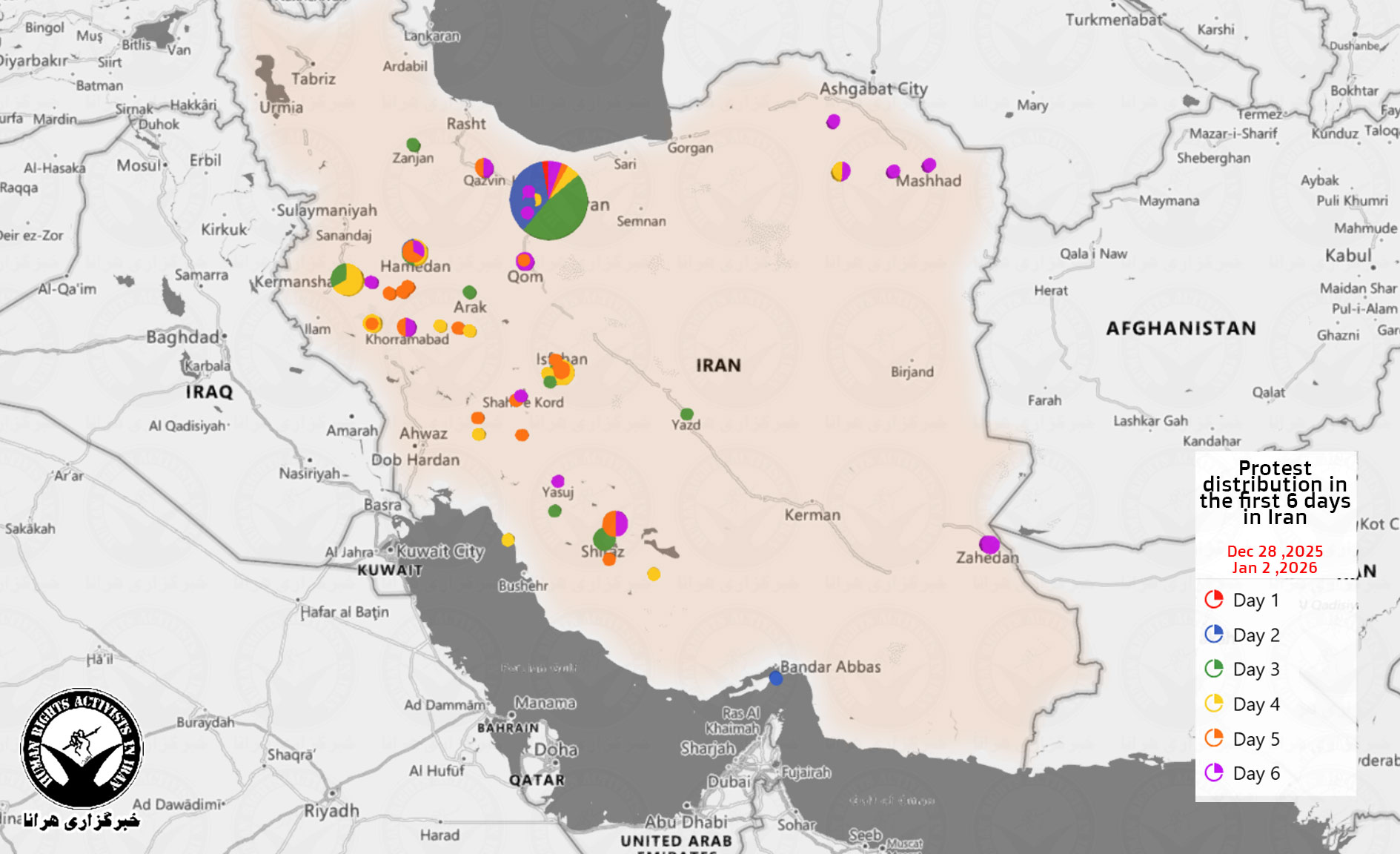
According to verified reports up to the time of publication, a total of 113 protests have been recorded over the past six days in 46 cities across 22 provinces. Fifteen student gatherings at 13 universities are also included in this figure.

Protest distribution day 6

Methods of Protest and Slogans

Based on reviews of videos and verified reports, the slogans chanted were largely centered on livelihood, economic, and political demands rooted in citizens’ fundamental rights. These slogans included criticism of the power structure, objections to restrictions on individual and social freedoms, demands for justice, and opposition to the prevailing economic and living conditions.

At the same time, in some gatherings, slogans with more diverse themes were also heard, reflecting the heterogeneous range of views and tendencies among protesters. Within the framework of its human rights mission, HRANA focuses its reporting on slogans and demands that are directly related to violations of, or demands for, human rights, fundamental freedoms, and civil rights.

On the sixth day of protests, scenes of dissent extended to cemeteries, where citizens chanted protest slogans during the burial ceremonies of two individuals killed in the protests. In the streets as well, protesting citizens held gatherings while chanting slogans.

The persistence and repetition of these slogans across different cities indicate an overlap between labor, livelihood, and political demands within the context of the ongoing protests, and reflect the depth of accumulated grievances in Iranian society.

Conduct of Law Enforcement-Security Forces and Details of Violence

On the sixth day of widespread protests across various Iranian cities, reports and videos indicated the continued securitized atmosphere and the use of repressive measures by law enforcement and security forces to prevent the formation and spread of protest gatherings. In one such case, a video from the city of Qom showed agents using tear gas to disperse citizens. Hours later, another video from the same city was published in which a citizen is seen holding a cartridge casing attributed to a pellet gun used by anti-riot forces, stating that it belonged to pellet “No. 5.”

In Tehran, a video from protests in the Narmak neighborhood shows anti-riot forces using violence in an attempt to arrest a female protester. Field reports also indicate that today, Friday, security forces used violence to arrest a number of protesters during demonstrations in Zahedan.

Continuing acts of violence included the killing of Khodadad Shirvani, a resident of Marvdasht, who was shot by security forces yesterday after participating in popular protests and lost his life. His burial ceremony was held today, Friday, with a large turnout of citizens, during which attendees chanted protest slogans.

At the same time, a protest gathering in Yasuj was also met with suppression by law enforcement and security forces. According to a video published by BBC Persian, agents used tear gas to disperse protesters, and the sound of gunfire can also be heard in the footage. Reports have also emerged of the use of tear gas during nighttime protests in Fardis and Khorramabad.

In the cities of Hafshejan and Joneqan, protest gatherings were likewise accompanied by the presence of law enforcement forces. Mehr News Agency reported that “law enforcement officers, by being present at the scene, took action to manage the gathering.”

Additionally, a video published from protests in Kuhdasht, dating back to Wednesday, December 31, shows a protesting citizen who was seriously injured in the right leg, with those present attempting to stop the bleeding.

It has also been reported that during the nighttime protests on January 1 in Marvdasht, Fars Province, a passing vehicle was targeted by gunfire from security forces. According to the published video, a Pride car entering a main boulevard from a side street, an area filled with anti-riot forces and vehicles, was shot at close range and without prior warning by one of the agents. After the shooting, another agent intervened and instructed the driver to leave the area.

Finally, channels close to security institutions reported today the death of a Basij member during the recent protests in the city of Harsin. The individual was identified as Ali Azizi.

Arrests and Security Pressures

Today, HRANA received reports regarding the transfer of 15 detained women to Evin Prison. These women, who were arrested during the recent protests, are reportedly mostly injured and were therefore transferred to the prison infirmary upon arrival. Their identities are still under investigation.

According to additional information received, Fardin Moslemi and Mahan Khoobani, both 16 years old, were arrested by security forces in the cities of Gachsaran and Yasuj and transferred to an unknown location. Fardin Moslemi was arrested in the early hours of today, Friday, January 2, by IRGC Intelligence forces in Gachsaran, while Mahan Khoobani was arrested yesterday in Yasuj.

HRANA has also learned that Misagh Kooch Peydeh and Amir Nodehi, residents of Tehran, as well as Salman Ghodrati, a resident of Bojnord, have been arrested. According to this report, Messrs. Nodehi and Ghodrati were arrested yesterday, Thursday, by security forces.

Meanwhile, the Public and Revolutionary Prosecutor of Izeh announced the arrest of a number of citizens during last night’s protests in the city. Published reports also indicate that today, Friday, security agents arrested at least five individuals during protests by citizens in Zahedan.

In addition, reports have been received of the arrest of at least 16 citizens in the cities of Tehran, Kermanshah, and Ilam. The identities of these individuals have been reported as: Iman Ali-Moradi, Ali Najafi, Mohammad Hasanvand, Bijan Karimian, Mohammad Javad Zarei, Akbar Darvishi, Aref Darvishi, Mohammad Havasi, Sepehr Salehi, Amir Raoufi, Ehsan Maleki, Milad Kiadi, Farzad Shokri, Abolfazl Shadfar, Moein Maleki, and Yazdan Bakhti. These arrests took place on December 31 and January 1.

The chief justices of Lorestan and Isfahan provinces also announced that a number of protesting citizens were arrested in recent days in the counties of Azna, Delfan, and Isfahan.

In the same context, a channel close to security institutions published two separate videos of forced confessions by a detained citizen in Amol. In these videos, whose recording conditions are unclear, a young man with a fully visible face expresses remorse for publishing calls for protests. The same channel also released a video of the arrest of a citizen on January 2 in Khorramabad, claiming that weapons and ammunition were discovered in his possession. According to the report, this arrest was carried out by agents of the Abolfazl Corps of the IRGC in Lorestan Province.

State broadcaster IRIB also released videos containing forced confessions of several citizens, announcing their arrest during protests in Kermanshah. At least four citizens can be seen in these videos. Mehr News Agency likewise published a video of a forced confession by a citizen arrested yesterday on Motahhari Street in Khorramabad; the circumstances under which these videos were recorded remain unknown.

Subsequently, the Public and Revolutionary Prosecutor of Izeh once again announced the arrest of a number of citizens during last night’s protests in the city.

Meanwhile, Tasnim News Agency reported that several protesters were arrested during demonstrations in Qazvin on charges described as belonging to “saboteur elements.” According to the agency, one individual allegedly involved in publishing protest calls online was also arrested.

HRANA has also learned that on December 31 and January 1, a number of citizens in Gorgan were arrested for publishing calls for protests.

The Public and Revolutionary Prosecutor of Hamedan also announced today the arrest of several citizens during protests in the city, without providing details regarding their identities or the exact timing of their arrests.

Ashraf Montazeri, daughter of Ayatollah Montazeri, stated that her daughter and grandchild were arrested during street protests and released after one day on bail.

Fars News Agency also reported the arrest of a citizen in Isfahan, claiming that he “intended to join the gathering with a handgun and carry out anti-security and sabotage actions.” According to the outlet, the arrest took place on Thursday, January 1.

Additionally, media outlets close to security institutions, without naming individuals, reported the arrest of three citizens, including a teenager, in the cities of Isfahan, Khorramabad, and Amol during the ongoing protests.

In the final hours of today, the Public Relations Office of the Rouhollah Corps of the IRGC in Markazi Province announced the arrest of the administrators of two Telegram channels in the cities of Saveh and Arak, claiming that these channels played a role in the “management and direction of protesters.”

Meanwhile, Amirkabir Newsletter reported that Amirhossein Keshavarz, a student activist, was arrested by security forces. According to the report, agents went to his residence today, arrested him, and transferred him to an unknown location.

Reactions

As nationwide protests entered their sixth day, officials of the Islamic Republic and media outlets affiliated with official and security institutions, alongside continued on-the-ground repression, have sought to reinforce a dominant narrative centered on “foreign interference” and “national security,” while sidelining protesters’ demands.

At the political level, Abbas Araghchi, Iran’s foreign minister, reacting to support expressed by Donald Trump for protesters, described the stance as “irresponsible and dangerous,” claiming that such statements target Iran’s sovereignty and that the Islamic Republic’s armed forces are “ready to respond.” At the same time, Mohammad Bagher Ghalibaf, the Speaker of Parliament, and Alireza Salimi, a member of the parliamentary presidium, issued threatening warnings that any “foreign interference” would be met with a “regret-inducing” response.

In this context, Iran’s Supreme National Security Council sent a letter to domestic media outlets, urging them to condemn Trump’s support for protesters and, by drawing a “clear line with the enemy,” refrain from what it described as “raw, emotional, or tension-inducing dissemination.” The council also praised media outlets that it said had “contributed to stability,” reflecting intensified control and guidance of the media narrative on the sixth day of protests.

In the judicial and security sphere, officials such as Saeed Shahvarai, Chief Justice of Lorestan Province, announced the arrest of protesters in cities including Azna and Delfan, without providing transparent details regarding charges or judicial procedures. At the same time, some pro-government religious figures, including Hossein Nouri Hamedani, while implicitly acknowledging economic pressures, sought to reduce the roots of the crisis to “mismanagement” and avoided linking the protests to the political structure.

At the international level, Volker Türk, the United Nations High Commissioner for Human Rights, expressed concern over developments in Iran, stating that reports of violence against protesters are being followed “closely,” and called on Iranian authorities to respect citizens’ fundamental rights, including freedom of expression, peaceful assembly, and association. This position was expressed amid numerous reports of shootings, arrests, and an intense security atmosphere across various Iranian cities.

State-affiliated media, in their coverage of the sixth day, focused on emphasizing external threats, warning the United States and Israel, and promoting the narrative that protests are being directed by “hostile groups”—a narrative that does not align with field evidence or the breadth of protesters’ demands.

Conclusion

The ongoing protests, which began in Tehran’s Grand Bazaar, entered their sixth day with expanded geographic scope, increased public participation, and an intensified presence of security forces. The combination of livelihood and political demands, the rise in arrests, and officials’ efforts to simultaneously contain the crisis through economic and security measures reflect the authorities’ high sensitivity to the continuation of these protests.

HRANA continues to collect, verify, and complete information related to these protests and will publish supplementary reports should the gatherings persist or expand.

Two Citizens Arrested in Tehran During Protests

HRANA – Amir Nodehi and Misagh Kooch Peydeh, residents of Tehran, were separately arrested by security forces in the city during the ongoing protests and transferred to an unknown location.

Amir Nodehi, 23, originally from Sabzevar and residing in Tehran, was arrested by security forces on Thursday, January 1, during protests by citizens in Tehran.

Misagh Kooch Peydeh was also arrested in recent days amid the Tehran protests and transferred to an undisclosed location. Earlier last year, he had been arrested by the Chalus Cyber Police (FATA) and, following his detention, was transferred to Nowshahr Prison by order of the prosecutor. He was later released from the prison on bail of 3 billion tomans.

Mr. Kooch Peydeh was tried on February 16, 2025, on charges including insulting Islamic sanctities, insulting the founder of the Islamic Republic, insulting officials and agents, spreading false information, and disturbing public opinion.

Mahsa Zarei Arrested by Security Forces in Kermanshah

HRANA News Agency — Today, Friday, January 2, 2026, Mahsa Zarei, a citizen from Kermanshah, was arrested by security forces in the city and transferred to an unknown location.

Based on this report by Kolbar News, Ms. Zarei was arrested at her workplace by security forces without the presentation of a judicial warrant. Following her arrest, she was transferred to an undisclosed location.

As of the time of this report, no information is available regarding the reasons for her arrest, her place of detention, or the charges brought against her.

Mahsa Zarei, a citizen from Kermanshah, had previously been arrested in May of this year due to her activities.

Two Citizens, Including a Teenager, Arrested in Gachsaran and Yasuj

HRANA – During protests in the cities of Gachsaran and Yasuj, two citizens, including a teenager, were arrested by security forces and transferred to an unknown location.

Their identities have been confirmed by HRANA as Fardin Moslemi and Mahan Khoobani, 16 years old, from Yasuj.

Based on information received by HRANA, Mr. Fardin Moslemi was arrested in the early hours of Friday, January 2, 2026, by IRGC Intelligence forces in the city of Gachsaran. Mahan Khoobani was also arrested yesterday in Yasuj by security agents.

As of now, there is no information regarding the whereabouts of these protesting citizens.

It is worth noting that Fardin Moslemi Asl, a resident of Dehdasht County, had previously been summoned on December 13, 2025, to Branch Three of the Investigative Prosecutor’s Office of Boyer-Ahmad County.

It should also be noted that gatherings and strikes by shopkeepers and bazaar merchants, which began in Tehran on Sunday, December 28, expanded beyond bazaars and commercial centers starting Tuesday, December 30, 2025. With the participation of students, citizens, and various social groups, these protests have become one of the most widespread demonstrations in recent years. For more information, readers may refer to HRANA’s detailed report on the fifth day of protests, published late last night.

13 Azerbaijani-Turk Activists Sentenced to Prison

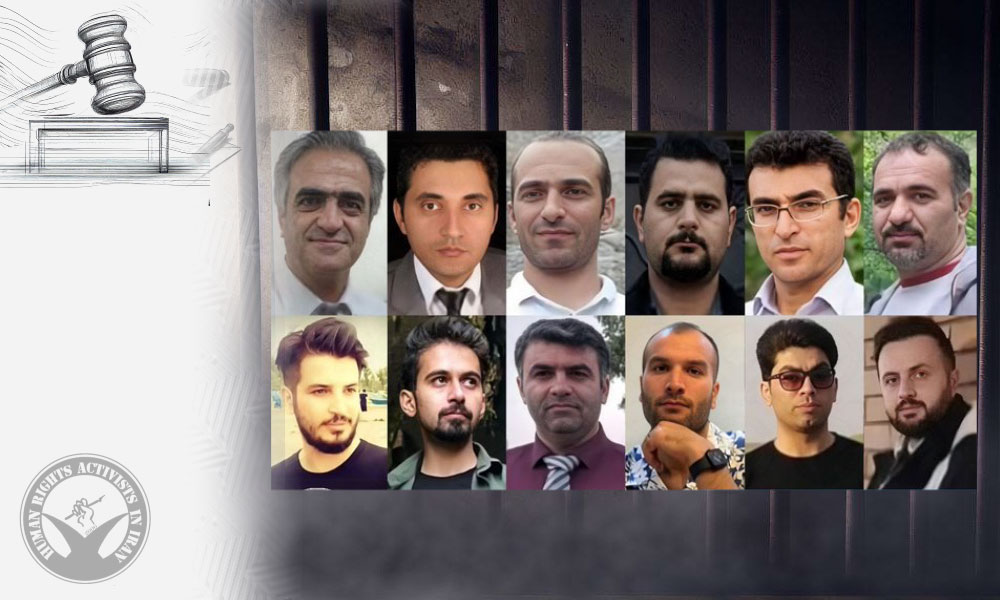
HRANA – 13 Azerbaijani-Turk activists have been collectively sentenced to 85 years and 9 months in prison by Branch Two of the Revolutionary Court of Tabriz.

Based on the ruling, Yoroush Mehrali Beiglou was sentenced to six years and two months in prison on the charge of forming an illegal group, and three years and seven months for assembly and collusion against national security. The other twelve defendants, Hamed Yeganehpour, Ebrahim Avaz-zadeh, Araz Ebrahimnejad, Hossein Azadi, Amirhossein Aghaei, Nasser Razmjou, Davoud Shiri, Javad Soodbar, Mehrdad Ghaderi, Ali Babaei, Morteza Nourmohammadi, and Mohammadreza Movahed, were each sentenced to two years and nine months for membership in an illegal group and three years and seven months for assembly and collusion against national security.

The verdict was delivered in person to the case lawyer, Asghar Mohammadi. None of the defendants have received a physical copy of the ruling or an electronic version through Iran’s Sana judicial system.

Court hearings addressing the charges against these Azerbaijani-Turk activists were held in June of this year. Preliminary investigation sessions had previously taken place in January and February 2025 at Branch 15 of the Public and Revolutionary Prosecutor’s Office in Tabriz.

Yoroush Mehrali Beiglou was transferred to Tabriz Prison in February 2024 and released shortly afterward on bail. He had been arrested earlier, in November 2023, in Jolfa County and transferred to The Ministry of Intelligence’s detention facility in Tabriz. He has a prior history of arrest and conviction related to his activities.

Hamed Yeganehpour, a resident of Maragheh, was arrested by security forces in Tabriz in November 2023 and released the following month from The Ministry of Intelligence’s detention facility in Tabriz.

Araz Ebrahimnejad was arrested in September 2023, transferred to Tabriz Prison, and released on bail in December 2023.

Ebrahim Avaz-zadeh was arrested in October 2023 in Tehran and released on bail from Tabriz Prison in December 2023.

Nasser Razmjou was also arrested by security forces in October 2023 and released on bail from Tabriz Prison in early December 2023.

According to the annual statistical report by HRA’s Department of Statistics and Publications, 302 individuals were arrested in 2025 on the basis of their ethnic status or national minority identity. Arrests of ethnic minority citizens increased by 15.2% compared to the previous one-year period. At least 186 of these arrests were carried out without a judicial warrant. Although in many cases the specific charges and reasons for arrest were not disclosed, given the past record of security agencies, it is likely that these individuals were detained due to activities related to ethnic rights.