Execution of Five Prisoners in Arak, Zanjan, and Meshgin Shahr Prisons

HRANA – Five prisoners who had previously been sentenced to death in separate cases on charges related to drug offenses and murder were executed in prisons in Arak, Zanjan, and Meshgin Shahr.

According to HRANA, citing Iran Human Rights Organization, at dawn on Wednesday, September 30, a prisoner was executed in Arak Prison.

The prisoner has been identified as Abbas Amirgheshlaghi, 27, and unmarried.

Mr. Amirgheshlaghi was reportedly arrested approximately three years ago on charges related to drug offenses and was subsequently sentenced to death by the Revolutionary Court.

Zanjan Prison: Three Prisoners Executed

According to Iran Human Rights Organization, the three prisoners, who had been sentenced to death in separate cases, were hanged at dawn on Sunday, September 27, in Zanjan Prison.

They have been identified as Fateh Shafiei, 33, a resident of Zanjan and father of one; Hassan Mahdipour, 30, from Mianeh; and Aref Dorosti, 51, from Karaj and father of three.

According to the report, Mr. Shafiei and Mr. Dorosti were arrested approximately three years ago, while Mr. Mahdipour was arrested approximately two years ago, all on charges related to drug offenses. They were subsequently sentenced to death by the Revolutionary Court.

Report on the Execution of a Prisoner in Meshgin Shahr Prison

Iran Human Rights Organization also reported the execution of another prionser in Meshgin Shahr Prison.

The prisoner, who was hanged at dawn on Sunday, August 9, has been identified as Mostafa Bikas, 35, a father of three and a resident of one of the villages in Meshgin Shahr.

The report states that Mr. Bikas was arrested approximately six years ago on a murder charge and was subsequently sentenced to death by the Criminal Court.

As of the time of this report, the executions of these prisoners have not been announced by prison officials or the relevant authorities.

According to HRA’s Annual Report, in 2025 at least 2,063 citizens, including 61 women and 2 juvenile offenders, were executed. Of these, the sentences of 11 individuals were carried out in public. During the same period, 172 other individuals were sentenced to death.

Two Prisoners, Including Child Marriage Victim, Executed

HRANA – On Saturday, August 8, two prisoners, including a woman who was a victim of child marriage, were executed in Choobindar Prison in Qazvin and Zanjan Prison. Both prisoners had previously been sentenced to death on murder charges.

According to HRANA, citing the Iran Human Rights Organization, on Saturday, August 8, 2026, a female prisoner who was a victim of child marriage was executed in Choobindar Prison in Qazvin.

She was identified as Marzieh Nayeri, 24, from a village located between Qazvin and Karaj.

According to the report, six years ago, when Nayeri was 17, her family forced her to marry a man named Davoud. In early October five years ago, when Ms. Nayeri was 18, her husband returned home with one of his associates, a man named Alireza. According to the account presented in the case, Alireza approached her in the presence of her husband and attempted to sexually assault her. In self-defense, Nayeri struck Alireza with a kitchen knife, injuring him. She then killed her husband with the same knife. Following the incident, she went to her brother’s home, and four days later, he turned her over to the police.

The report further states that during the judicial proceedings, Nayeri said that she had previously been subjected to repeated attempted sexual assaults by her husband’s friends and that she used the knife on the day of the incident to defend herself. However, Alireza, who survived the stab wound, denied her account in court and claimed that Ms. Nayeri had been involved with another person and had intended to kill her husband. The court rejected her claim of self-defense and ultimately sentenced Marzieh Nayeri to death. The victim’s next of kin also declined to grant forgiveness.

Prisoner Executed in Zanjan

According to another report by the Iran Human Rights Organization, a prisoner was executed in Zanjan Prison.

The prisoner, who was hanged at dawn on Saturday, August 8, was identified as Yousef Bagheri, 30, from Zanjan.

According to the report, Mr. Bagheri was arrested approximately three years ago after committing murder during an altercation. He was subsequently sentenced to death by judicial authorities.

As of the time of this report, the executions of these two prisoners have not been officially announced by prison officials or other relevant authorities.

According to HRA’s Annual Report, in 2025 at least 2,063 citizens, including 61 women and 2 juvenile offenders, were executed. Of these, the sentences of 11 individuals were carried out in public. During the same period, 172 other individuals were sentenced to death.

Assets of 52 Citizens Seized in Zanjan; Seven Arrested

HRANA – The Judiciary’s Media Center announced the seizure of assets belonging to 52 citizens in Zanjan Province. Seven of the individuals, who reside in Iran, have been arrested.

According to Mizan News Agency, the Chief Justice of Zanjan Province announced the confiscation of assets belonging to a number of citizens in the province.

According to the report, the assets of 52 individuals described as “linked to networks cooperating with the enemy” were seized by judicial order. The confiscated assets include bank holdings, cash and foreign currency, movable and immovable property, and gold. Seven of these individuals have been arrested, while the remaining owners are reportedly residing outside the country.

The report states that of the total confiscations, 33 cases were in the city of Zanjan, 15 in Abhar, and three in Khorramdarreh. In addition, the assets of another individual with property in Tehran and Khodabandeh County were also seized.

The Chief Justice of Zanjan Province claimed that the measure was carried out within the framework of “protecting public rights” and based on laws related to “espionage and cooperation with the Zionist regime.” He added that the cases against these individuals are under investigation.

The report did not disclose the identities of the individuals, the exact timing of the arrests, the locations where the detainees are being held, or details of the charges brought against them.

Following the start of military attacks on Iran, Gholamhossein Mohseni Ejei, head of the judiciary, announced that judicial orders had been issued to confiscate and seize assets linked to what he described as “elements cooperating with the enemy inside and outside the country.” He also threatened these individuals with execution, stating: “One of the punishments prescribed in this regard is execution, and following investigations, one of the legal punishments will be applied to the individuals concerned.”

Following the issuance of this directive by the judiciary, the “Saham” smart financial inquiry system was launched. Through this system, prosecutor’s offices and courts across the country are now able to quickly and online identify citizens’ assets and property and take the necessary steps to confiscate them.

Report on the Arrest and Broadcast of Forced Confessions of a Woman in Zanjan

HRANA – A woman in Zanjan has been arrested on charges including insulting religious sanctities, communicating with foreign-based media outlets, and allegedly sending military images and information to those outlets. Simultaneously, a video purportedly showing the woman’s forced confessions has been released, although the circumstances under which the footage was recorded remain unclear.

According to a report by Mehr News Agency, a woman was arrested in Zanjan. Based on the report, the arrest was carried out on charges of insulting religious sanctities, communicating with the media outlets Manoto and Iran International, and sending military images and information to these outlets.

A video containing the forced confessions of this citizen has also been published, though it remains unclear under what circumstances the recording was obtained.

The report does not mention the identity of the arrested individual, the date of her arrest, or the location where she is being held.

It should be noted that protests and strikes by shopkeepers and bazaar merchants began in Tehran on Sunday, December 28, 2025, and within two days spread beyond markets and commercial centers. With the participation of students, citizens, and various social groups, these protests became one of the largest protest movements of recent years. Following the crackdown by security and law enforcement forces, thousands were killed or injured, and tens of thousands were arrested or summoned by security agencies. For more information, readers may refer to HRANA’s comprehensive report titled “Crimson Winter,” documenting the first fifty days following the outbreak of Iran’s nationwide protests.

Day 29 of U.S. and Israeli Attacks on Iran: Strikes on Hundreds of Targets in Residential Areas

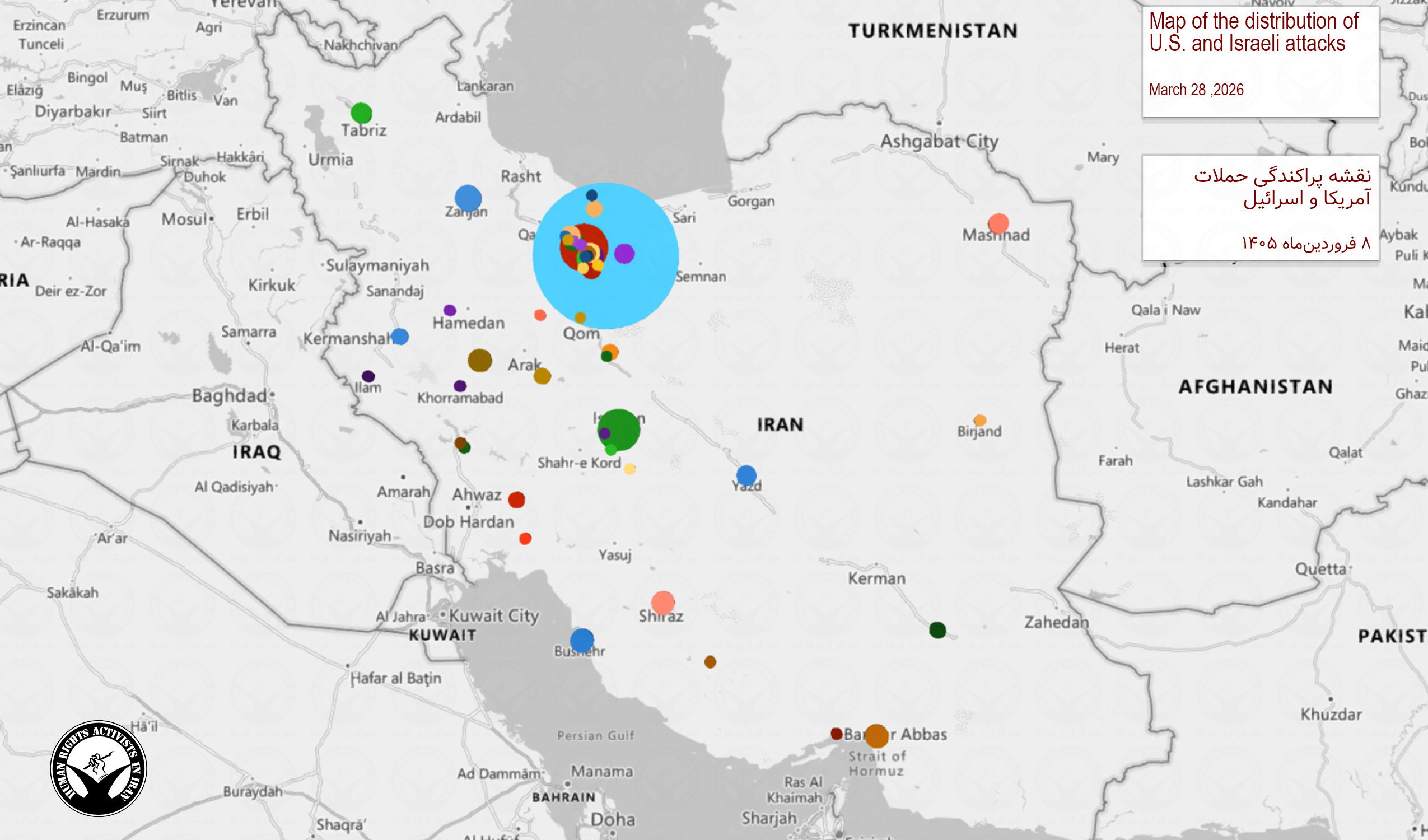
HRANA– In the last 24 hours, and as of March 28, 2026, at 17:00 ET, HRANA has recorded at least 701 attacks across 278 incidents in 21 provinces, resulting in a total of at least 173 casualties (killed and injured, both civilian and military). The attacks over the past day, in terms of number, rank among the highest recorded since the beginning of the war. Of these, 74% of the strikes occurred in Tehran. Various locations in urban and residential areas have borne the brunt of the attacks.

According to information recorded and verified by HRANA, from the first minutes of the day until the end of March 28, 2026 (Tehran time), at least 24 civilians were killed and 88 civilians were injured.

Aggregated data since the beginning of the conflict on February 28, 2026, based on incidents recorded in the incident tab and using minimum values for figures marked “more than”:

• Civilian fatalities: 1,551 people (including at least 236 children)

• Military fatalities: 1,208 people

• Unclassified fatalities (civilian/military): 702 people

Note on Official Statements: Alongside HRANA’s independent reports, several aggregated official statistics were also published today by state media, including:

The Ministry of Health announced: “So far, more than 230 children have been killed and around 1,800 children have been injured. According to this report, 244 women, 214 children under 18, and 17 children under 5 have been killed. Healthcare worker fatalities: 24.”
The head of the Center for Information and Public Relations of the Ministry of Education stated: “Since the beginning of the Zionist-American war against our country, 252 students and teachers have been killed, and 184 members of the education community have been injured.”
The Ministry of Health reported the latest casualty figures as of day 29 of the war: “Currently hospitalized: 831 individuals; treated and discharged: 24,175 individuals.”

As these figures have been presented in aggregate form and cannot be precisely matched to specific events, they have not been included in the event-based calculations reflected in HRANA’s independent reporting section of this overview, and are mentioned here solely as a record of official statements.

1. Overview of Incidents in the Last 24 Hours

In the last 24 hours, incidents were reported across multiple provinces, reflecting a geographically dispersed pattern of hostilities. In a large portion of the incidents, the method/type of attack has not yet been confirmed and has been recorded as “undetermined.” In cases where the attack type was identifiable, airstrikes and drone attacks were reported.

Preliminary analysis indicates that Tehran Province, with a 74% share, ranks at the top of the list of provinces that have been targeted. Alborz Province, with a significant gap from Tehran Province, comes in second with an 11% share, while Isfahan Province ranks third with a 5% share. Following these are Khuzestan Province, Yazd Province, Zanjan Province, and East Azerbaijan Province, respectively.

Map of Attacks Day 29

2. List of Objects Reported Hit

In the past 24 hours, the recorded attacks have damaged 29 distinct objects or facilities. These include a range of different types of targets. In some cases, damage caused by nearby strikes or secondary consequences of the attacks has also been reported.

Examples of targets recorded over the past 24 hours:

• Shahid Kobraei Army Base (Aran va Bidgol)

• Headquarters of the 44th Artillery Group (Isfahan)

• Headquarters of the Asef Brigade (Minab)

• Amir al-Momenin Headquarters (Isfahan)

• Technical Center affiliated with the Defense Industries (Tehran)

For a number of the listed targets, the exact nature of the target (civilian/military/dual-use) is still under review, and classifications may be revised as additional information becomes available.

Facilities Protected Under International Humanitarian Law:

Under international humanitarian law, medical facilities, educational institutions, humanitarian facilities, religious sites, and emergency service centers are among the many objects that maintain special protected status and are afforded special protection. In the past 24 hours, HRANA has preliminarily recorded the following cases:

• A building at Iran University of Science and Technology (Tehran)

• Shahid Aabsalan Clinic (Minab)

• A 10,000-cubic-meter water reservoir (Haftgel)

• A four-story residential building (Savojbolagh)

• A livestock farm in Shahabiyeh village (Khomein)

3. Civilian Casualties

In the past 24 hours, at least 24 civilian citizens, including 8 children and 6 women, have been killed, and 88 civilians, including 3 children and 3 women, have been injured. All classifications are preliminary and may be updated if new information becomes available.

4. Military Casualties

During the reporting period, 41 military personnel were killed. Military casualties are generally reported in the context of attacks on Army and Islamic Revolutionary Guard Corps (IRGC) bases. Where possible, organizational affiliation and operational context are being assessed; however, not all details have yet been independently verified.

In some incidents, individuals have been killed in the vicinity of military targets; however, their official status has not yet been definitively determined. These cases remain under review, and if reliable information indicating a different status becomes available, the classification may be revised accordingly.

It is believed that military casualties are significantly higher than the figures reported in these reports. However, due to the sensitive nature of military information and the limited access of human rights groups and media to locations where military forces are present, this section largely reflects reports of senior officers or military personnel who were present in urban areas.

5. Confirmed but Unspecified Casualties

In the past 24 hours, seven deaths and 13 injuries have been reported but remain classified as undetermined. This means that HRANA News Agency has not yet been able to establish with sufficient certainty whether these individuals were civilians or military personnel.

A Note on HRANA Methodology

Note that, in line with HRANA policy, this report reflects only incidents that occurred within the territorial borders of Iran.

The information contained in this report is compiled through HRANA’s established documentation network. Data is collected from a combination of field reports, local contacts, medical and emergency sources, civil society networks, and open source materials, including publicly available images, videos, and official statements where relevant. Each reported incident is logged and assessed through an internal review process before publication.

Given the evolving nature of hostilities, information is gathered on a rolling basis and reflects the status of documentation at the time of publication.

The figures presented in this report may not reflect the full scope of harm. Ongoing hostilities, damage to infrastructure, communication disruptions, restricted access to affected areas, and security risks for sources may limit the ability to document incidents comprehensively.

Delays in medical reporting, difficulties in confirming identities, and restricted access to certain provinces may result in temporary undercounting. As access improves or additional evidence emerges, casualty figures and incident classifications may be revised accordingly.

HRANA remains committed to transparency, methodological rigor, and the continual updating of its findings as new verified information becomes available.

Subscribe to Our Newsletter

Now is definitely not the time to stop reading!

At Least 10 Prisoners Executed On Drug-Related Charges and Murder

HRANA – At dawn today, the death sentences of at least 10 prisoners were carried out in the prisons of Gorgan, Qaemshahr, Dorud, Isfahan, Neyshabur, Kerman, Kashan, Saveh, Quchan, and Zanjan. These prisoners had previously been sentenced to death on charges related to drug offenses and murder.

Based on information received by HRANA, Ilya Saei was executed in Gorgan Prison; Navid Shahsavar in Qaemshahr Prison; Ali Safar Goodarzi in Dorud Prison; Saman Joozi in Isfahan Prison; Yaghoub Shafieizadeh in Neyshabur Prison; Heshmat Shokri in Kerman Prison; Sultan-Morad Shabani in Kashan Prison; and Keyvan Aminpour in Saveh Prison. These individuals had previously been arrested in separate cases on murder charges and sentenced to death by criminal courts.

Meanwhile, the executions of Siavash Amouzad in Quchan Prison and Roozbeh Zamani in Zanjan Prison were carried out on charges related to drug offenses.

As of the time of this report, prison officials and relevant authorities have not officially announced these executions.

According to HRA’s annual report, at least 2,063 individuals were executed in Iran during 2025. This represents a 119% increase in executions compared to 2024. In many of these cases, due to secrecy, prisoners were even deprived of the right to a final visit with their families.

Twenty Prisoners Executed on Murder and Drug-Related Charges

HRANA- Over the course of today and yesterday, at least twenty prisoners were executed in various prisons across Iran on charges related to murder and drug-related offenses.

The names of those executed yesterday are as follows:

On murder charges:

  • • Khaled Hosseini – Nowshahr Prison

  • • Mehdi Jafarian – Ardabil Prison

  • • Abbas Khordbin – Semnan Prison

  • • Shah Mirza Ghaedrahmati – Borujerd Prison

On drug-related charges:

  • • Rahman Najafi – Arak Prison

  • • Nezam Tajik, an Afghan national – Bandar Abbas Prison

  • • Younes Bagheri – Tabriz Prison

  • • Parsa Taghizadeh – Qazvin Prison

  • • Danial Abdi – Qom Prison

  • • Hamid Kariyabi – Naein Prison

Today, February 9, the death sentences of ten additional prisoners were carried out in various prisons:

On murder charges:

  • • Shayan Tojihi – Qaemshahr Prison

  • • Rouzbeh Amanatdoust – Quchan Prison

  • • Mohammad Zalitabar – Gorgan Prison

  • • Abedin Ahmadi – Neyshabur Prison

  • • Mohsen Rezaei – Dorud Prison

  • • Karim Javadi – Zanjan Prison

  • • Shahla Dowlatabadi – Kerman Prison

  • • Hooshang Shokouhi – Saveh Prison

On drug-related charges:

  • • Keyvan Akbari – Isfahan Prison

  • • Seyed Ali Kalami – Kashan Prison

As of the time of this report, the executions of these prisoners have not been officially announced by prison authorities or relevant institutions.

According to HRANA’s annual report, in 2025, at least 2,063 people were executed in Iran. Based on this data, the implementation of death sentences has increased by 119% compared to 2024. In many of these executions, due to secrecy, prisoners were denied even a final visit with their families.

Nationwide Protests: 140 Protesters Arrested in Various Cities

HRANA – State media reported the arrest of additional protesters: 85 protesting citizens were detained in Zanjan Province, 12 in Tehran, and 43 in Yazd Province. At the same time, forced confessions by six of those detained in Tehran have been released, though it is unclear under what conditions they were recorded.

In a statement, the Zanjan Provincial Intelligence Department described these citizens as “leaders of the protests” and claimed that “firearms and incendiary materials” were discovered in their possession.

Meanwhile, the Young Journalists Club reported the arrest of 12 citizens in Tehran’s Sattarkhan district. This outlet has published a video containing confessions by six of these individuals, though it is not known under what circumstances the footage was obtained.

The Commander of the Law Enforcement Forces of Yazd Province also announced that 43 individuals described as the “main agents behind announcing and disseminating widespread calls on social media” were arrested during the protests by the FATA Police and the Intelligence Organization of the Yazd Provincial Law Enforcement Command.

These reports do not mention the identities of those arrested or their places of detention.

It is worth noting that gatherings and strikes by shopkeepers and bazaar merchants began in Tehran on Sunday, December 28, and after two days expanded beyond bazaars and commercial centers. With the participation of students, citizens, and various social groups, these protests have become one of the most widespread demonstrations of recent years. For more information, readers can refer to HRANA’s detailed report published last night on the thirty-third day since the start of the protests.

At least 12 Prisoners Executed on Murder and Drug-Related Charges

HRANA – At dawn today, Monday, January 26, 2026, the death sentences of 10 prisoners, previously convicted on charges related to drug offenses and murder, were carried out in the prisons of Nowshahr, Neyshabur, Zanjan, Saveh, Isfahan, Gorgan, Dorud, Kashan, and Kerman. Additionally, at dawn yesterday, two prisoners were hanged in Zahedan Prison.

Based on information received by HRANA, Javad Sha’bani was executed in Nowshahr Prison, Ehsan Kamareh’i in Neyshabur Prison, Mohammad Gharacheh in Zanjan Prison, Saeid Ghasemi in Saveh Prison, Ashkan Khodayari along with another prisoner in Isfahan Prison, Rahman Nobakht in Gorgan Prison, and Saman Sarlak in Dorud Prison, all on murder charges. Additionally, Amir Hossein Faghani in Kashan Prison and Dariush Mehrani in Kerman Prison were executed on charges related to drug offenses.

Separately, at dawn yesterday, two prisoners identified as Mohammad Nouhani and Ali Moradi were executed in Zahedan Prison in separate cases on murder charges.

Further details, including the identity of the other prisoner executed in Isfahan Prison, are still under investigation.

As of the time of this report, these executions have not been officially announced by prison authorities or relevant institutions.

According to HRA’s annual report on the human rights situation in Iran, at least 2,063 people were executed in Iran during the one-year period from January 1, 2025, to January 1, 2026, representing a 119% increase compared to 2024. In many of these cases, due to secrecy, prisoners were even denied the right to a final visit with their families.

From the Streets to Universities: Iran’s Protests Enter Their Eleventh Day

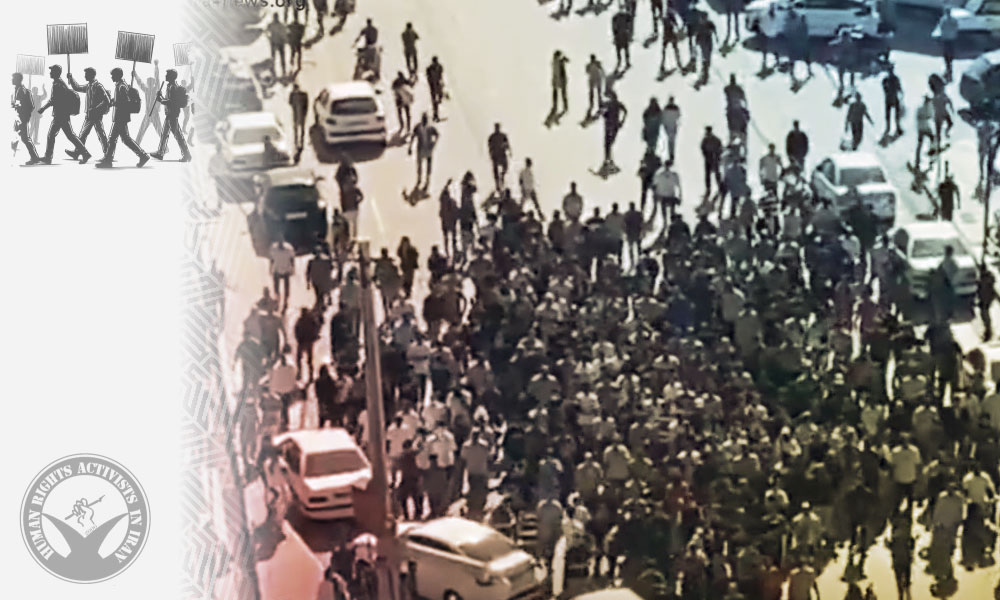
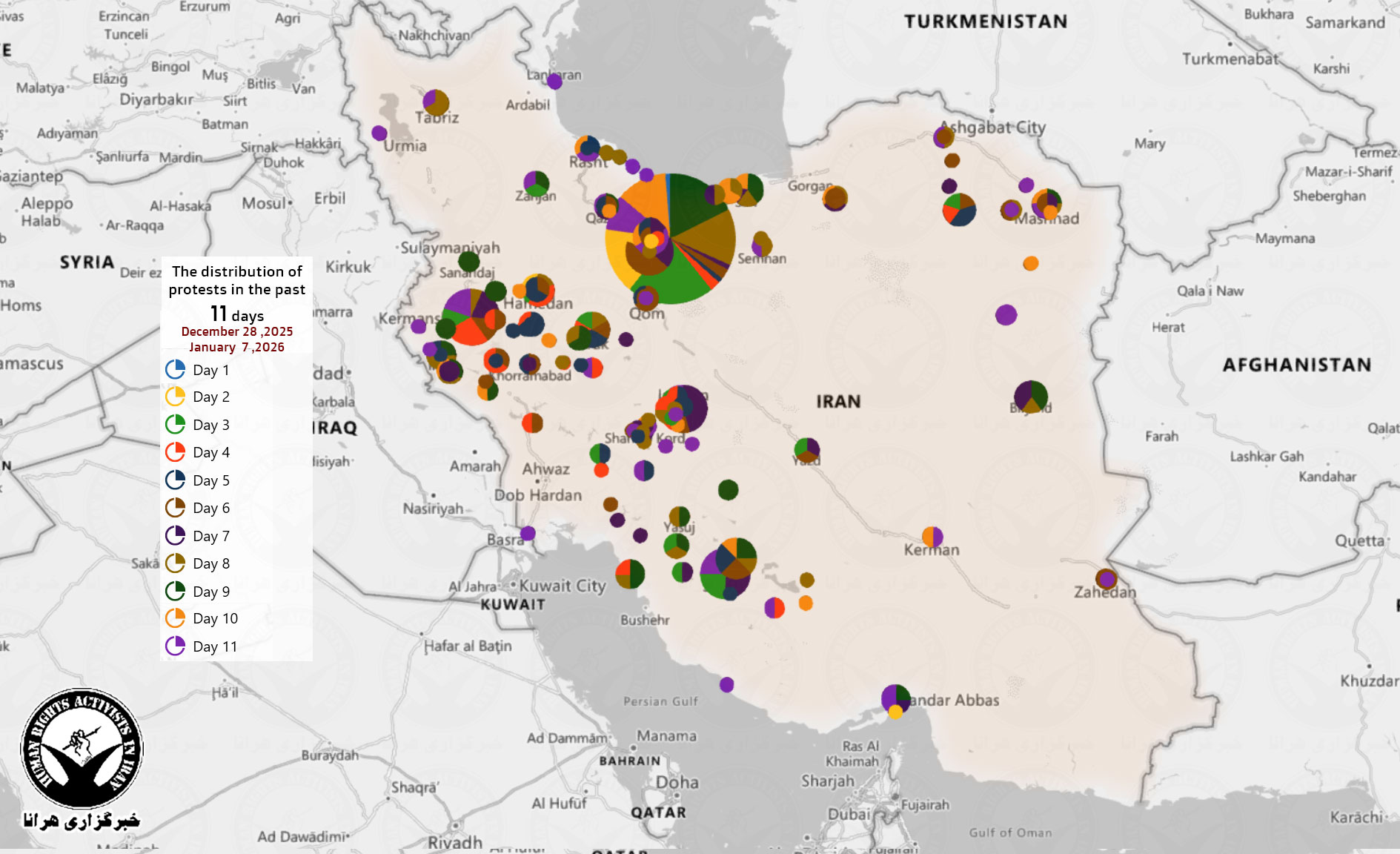
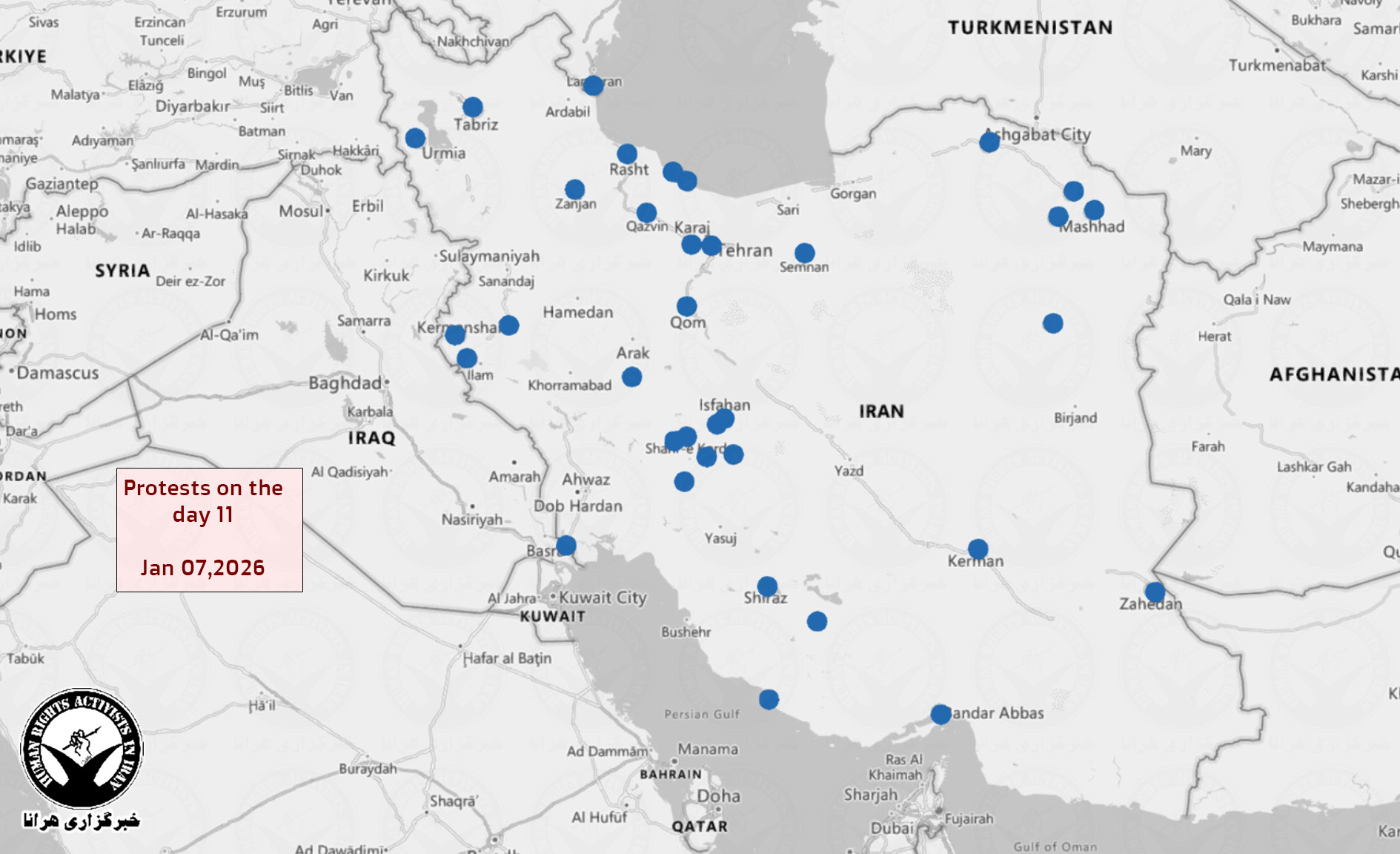
HRANA –The eleventh day of nationwide protests in Iran, on Wednesday, January 7, 2026, unfolded amid heightened security measures and ongoing arrests. Despite these pressures, demonstrations continued across multiple parts of the country. At least 37 cities witnessed protests in the form of street gatherings, protest actions, or labor strikes, spanning 24 provinces, a scale that underscores the sustained nationwide character of the unrest.

At the same time, 10 universities joined the protest movement, highlighting the continued and active role of academic institutions. With the inclusion of data from the eleventh day, a total of 348 protest sites, including 45 universities across 111 cities in 31 provinces, have experienced protests over the past eleven days.

Protests in Iran have now entered their eleventh day. The geographic scope of the recent unrest has made it one of the most widespread protest waves in recent years in terms of spatial distribution.

Background of the Protests

The protests on the eleventh day emerged against a backdrop in which the economic crisis and livelihood instability have gone beyond the stage of warning. Rapidly rising prices, the continuous devaluation of the national currency, and the inability of a large segment of society to meet basic needs have turned economic pressure into a daily reality for millions of citizens. Under such conditions, protest is no longer merely an emotional reaction to an isolated event, but rather a reflection of the long-term erosion of public trust in economic and administrative policies.

On the eleventh day, the simultaneous presence of street protests, active participation by universities, and signs of labor-related discontent demonstrated that the scope of protests has expanded beyond livelihood demands and now reflects deeper dissatisfaction with governance practices, the lack of accountability, and the closure of legal avenues for protest. The persistence of demonstrations, despite widespread arrests and security pressure, indicates that a significant portion of society now views the cost of protest as lower than the cost of silence and inaction.
nationwide protests Day 11

Geographic Scope and Focal Points of the Protests

According to recorded data, protests on the eleventh day took place in 37 cities across 24 provinces. These figures indicate an increase in the number of protesting cities compared to previous days. Provincial dispersion has remained high, reflecting the diffuse nature of the protests rather than their concentration in a few specific locations.

From a cumulative perspective, over the past eleven days, at least 111 cities in 31 provinces have witnessed protests at least once. This breadth demonstrates that the protests are not confined to specific ethnic or economic regions; rather, they have emerged across diverse urban and provincial contexts and continue in a networked and sustained manner.

Cities including Gonabad, Isfahan, Shahrza, Tehran, Shiraz, Falavarjan, Bandar Abbas, Zanjan, Kermanshah, Qazvin, Qom, Bojnord, Semnan, Nishapur, Mashhad, Kerman, Lordegan, Pordanjan, Fasa, Chaboksar, Asaluyeh, Tabriz, Rasht, Karaj, Abadan, Borujen, Urmia, Shahrekord, Gilangharb, Zahedan, Fardis, Astara, Aligudarz, Holeylan, Tonekabon, Chenaran, and Gorgan were among those where protests were reported today.
Universities and the Role of Students

On the eleventh day, 10 universities were reported as active protest sites. With these cases included, the total number of universities that have witnessed protests over the past eleven days has reached 35. The continued presence of universities in this wave of protests highlights the persistence of student discontent and the role of universities as spaces for the production and reproduction of protest.

Alongside their sectoral and educational demands, students have increasingly reacted to broader economic and political issues. This trend has strengthened the connection between campus-based and street protests, preventing the isolation of dissent within a single sphere.

Forms of Protest and Slogans

On the eleventh day of protests, methods of protest action remained diverse. Street gatherings, protest presence in urban centers, and protest activities within universities were among the main forms of expression. This diversity indicates that, despite security pressure, the protests have not been confined to a single, easily controllable pattern and continue to reproduce themselves in various forms.

The slogans and messages voiced during the gatherings continued to combine livelihood demands with structural criticism. Rising prices, declining purchasing power, and economic pressure formed the core of many slogans, alongside chants criticizing inefficiency, the lack of responsiveness to public demands, and the overall state of governance. This simultaneity suggests that, in the minds of protesters, the economic crisis and the governance crisis are understood as two facets of a single issue.

Arrests and Intensification of Security Measures

The eleventh day of protests was accompanied by the continuation and consolidation of the authorities’ security-oriented approach. According to aggregated data, a total of 2,217 people have been arrested or identified over the past eleven days. Of these, 558 were individual arrests, while 1,659 were recorded as group arrests or cases without confirmed identities, an approach that reflects security forces’ efforts to exert on-the-ground control through large-scale operations with limited transparency.

On the eleventh day alone, at least 140 people were arrested or identified. Although this figure represents a decrease compared to the tenth day, it still reflects a high level of security intervention and indicates that, despite a relative stabilization in the number of gatherings, the policy of preemptive suppression of protesters continues.

Reports indicate that some of these arrests were carried out not only at protest sites but also through summonses, on-the-ground identification, and follow-up actions, an approach aimed not merely at dispersing gatherings, but at exerting psychological pressure and long-term deterrence.

Arrests of Children, Adolescents, and Students

One of the most concerning features of the current wave of protests is the substantial number of individuals under the age of 18 among those arrested. According to recorded data, 165 detainees over the past eleven days were minors. This figure underscores both the active participation of adolescents and school students in the protests and the intensity of the security forces’ crackdown on this age group.

In addition, 46 students have been arrested during the eleven days of protests. The simultaneous arrest of students alongside the continuation of campus protests indicates that universities remain among the most sensitive centers of dissent and continue to be closely monitored and pressured by security institutions.

Alongside these cases, 40 televised confessions by detained protesters have been broadcast so far. Human rights observers view the continued airing of these confessions, typically recorded under detention and without free access to legal counsel, as a tool for instilling public fear and legitimizing the suppression of protests.

Fatalities and Victims of the Protests

Based on available data, 38 people have lost their lives over the eleven days of protests. This figure includes:

• 29 protesting civilians
• 4 law enforcement-security personnel
• 5 protesters under the age of 18

The presence of children among those killed once again raises serious concerns about the manner in which security forces have responded to the protests and whether the principle of proportionality in the use of force has been observed.

In addition to the fatalities, numerous reports have emerged of citizens being injured during street clashes and security operations. However, due to limited access to field information, the exact number of injured individuals is still being compiled.

Summonses and Security Pressure Beyond the Streets

On the eleventh day, security pressure was not limited to the streets. Reports indicate that a number of citizens were summoned to security institutions. Among them was Keyumars Amiri Kolehjoei, known as Lak-Amir, a Lak poet and journalist from Kermanshah province, who was summoned to security bodies on that day.

Such summonses, often carried out without formally announcing charges, are considered part of a strategy of covert pressure aimed at containing influential cultural, media, and social voices. The objective of this approach is seen as limiting independent narratives of the protests and constraining the space for free reporting and expression.

Internet Disruptions and Communication Restrictions

As protests continued on the eleventh day, reports emerged of internet disruptions in several Iranian cities. These disruptions were mainly reported in the form of reduced speeds, unstable connections, and temporary interruptions in access to online services.

An examination of the pattern of these restrictions indicates that internet disruptions were implemented in a targeted and localized manner, often occurring in cities that witnessed protest gatherings or university activities. This approach has also been observed during previous waves of protests and is typically employed to limit coordination, information-sharing, and the dissemination of protest footage.

Nevertheless, the continued flow of news and the publication of reports from inside the country suggest that, despite causing disruptions, these restrictions have not been able to completely halt the circulation of information.

Reactions

Domestic Reactions (Governmental)

Following statements by Donald Trump and Benjamin Netanyahu regarding the protests in Iran, the Secretariat of the Supreme Defense Council of the Islamic Republic issued a statement describing the rhetoric and threats as “beyond mere verbal positioning” and characterizing them as part of “hostile behavior.” The statement emphasized that any aggression or continuation of hostile actions would be met with a “proportionate, decisive, and determining response,” placing responsibility for the consequences on those designing and issuing the threats. In this context, officials also sought to elevate the issue from the level of “political commentary” to that of a “security cost,” highlighting regional consequences in an effort to send a deterrent message.

At the same time, following the positions taken by Donald Trump and Benjamin Netanyahu and the release of the statement by the Supreme Defense Council Secretariat, some figures close to the official power structure adopted even harsher rhetoric. Among them:

Ali Larijani, in a message, condemned what he described as U.S. interference in an “internal matter” and issued warnings, in a threatening tone, about the consequences of adventurism.

Mohammad Bagher Ghalibaf explicitly spoke of “threatening American centers and forces” in the region and sought to convey the message that any action or escalation of intervention would be met with a “response.”

Such positions may indicate an attempt by the authorities to reframe the protests from a socio-economic crisis into a national security issue—shifting the narrative focus from “street demands” to a “confrontation with foreign intervention.”

Domestic Reactions (Civil, Labor, and Public Figures)

On the other hand, reactions were not limited to politicians and security officials. According to reports, associations in the field of visual arts, including organizations of painters, graphic designers, photographers, sculptors, and ceramic artists, issued a joint statement condemning the suppression of protests. Referring to economic and political pressures and widespread social despair, the statement emphasized that “any violence and repression against the people’s right to protest” is condemned.

Additionally, 555 teacher union activists issued a similar letter declaring their solidarity with the protesters and their demands.

The significance of these reactions on the eleventh day lies in the fact that they demonstrate how professional and cultural sectors are increasingly aligning themselves with the protest narrative.

After several days of silence, Amirhossein Ghiasi (blogger and media figure) issued a clear statement declaring that he, too, is a protester. He described his silence as the result of psychological pressure, family concerns, and an inability to express what he described as what was “in his heart.” The entry of public figures into explicit positions is considered, from a newsworthiness perspective, an important indicator for measuring the expansion of social sympathy with the protests.

Arrests

Individual Arrests with Confirmed Identities

  1. 1. Shahab Barati – Place of arrest: Mashhad (Razavi Khorasan province) – Place of detention: Unknown – Current status: Detained – Source: HRANA

  2. 2. Davoud Hosseinpour – Place of arrest: Lordegan (Chaharmahal and Bakhtiari province) – Place of detention: Unknown – Current status: Detained – Source: HRANA

  3. 3. Rouhollah Khaledi – Place of arrest: Lordegan (Chaharmahal and Bakhtiari province) – Place of detention: Unknown – Current status: Detained – Source: HRANA

  4. 4. Abolfazl Aghaei – Place of arrest: Khorramabad (Lorestan province) – Place of detention: Unknown – Current status: Detained – Source: HRANA. Notable point: Under 18 years old

  5. 5. Ara Salahi – Place of arrest: Rasht (Gilan province) – Place of detention: Unknown – Current status: Detained – Source: HRANA

  6. 6. Mikaeil Mansouri – Place of arrest: Yasuj (Kohgiluyeh and Boyer-Ahmad province) – Place of detention: Unknown – Current status: Detained – Source: HRANA

  7. 7. Sara Rahmati – Place of arrest: Yasuj – Place of detention: Unknown – Current status: Detained – Source: HRANA

  8. 8. Shayan Parmokhber – Place of arrest: Yasuj – Place of detention: Unknown – Current status: Detained – Source: HRANA

  9. 9. Elaheh Hosseinnejad – Place of arrest: Yasuj – Place of detention: Unknown – Current status: Detained – Source: HRANA

  10. 10. Omid Khodarahmi – Place of arrest: Yasuj – Place of detention: Unknown – Current status: Detained – Source: HRANA

  11. 11. Ashkan Rasouli – Place of arrest: Yasuj – Place of detention: Unknown – Current status: Detained – Source: HRANA

  12. 12. Meraj Abbasnejad – Place of arrest: Yasuj – Place of detention: Unknown – Current status: Detained – Source: HRANA

  13. 13. Ali Akbar Ahmadzadeh – Place of arrest: Yasuj – Place of detention: Unknown – Current status: Detained – Source: HRANA

  14. 14. Peyman Azarzadeh – Place of arrest: Yasuj – Place of detention: Unknown – Current status: Detained – Source: HRANA

  15. 15. Mani Armaghanizadeh – Place of arrest: Yasuj – Place of detention: Unknown – Current status: Detained – Source: HRANA

  16. 16. Hossein Haghighi – Place of arrest: Yasuj – Place of detention: Unknown – Current status: Detained – Source: HRANA

  17. 17. Moslem Parzadar – Place of arrest: Yasuj – Place of detention: Unknown – Current status: Detained – Source: HRANA

  18. 18. Ahmad Abdollahpour – Place of arrest: Yasuj – Place of detention: Unknown – Current status: Detained – Source: HRANA

  19. 19. Parsa Akbar – Place of arrest: Yasuj – Place of detention: Unknown – Current status: Detained – Source: HRANA

  20. 20. Kiarash Ansari – Place of arrest: Yasuj – Place of detention: Unknown – Current status: Detained – Source: HRANA

  21. 21. Shahla Ansarian – Place of arrest: Yasuj – Place of detention: Unknown – Current status: Detained – Source: HRANA

  22. 22. Elham Siavoshi – Place of arrest: Yasuj – Place of detention: Unknown – Current status: Detained – Source: HRANA

  23. 23. Razieh Khahesh – Place of arrest: Yasuj – Place of detention: Unknown – Current status: Detained – Source: HRANA

  24. 24. Reza Mansourian – Place of arrest: Behbahan (Khuzestan province) – Current status: Released – Source: HRANA

  25. 25. Hossein Afrasiabi – Place of arrest: Behbahan – Current status: Released – Source: HRANA

  26. 26. Ali Alinejad – Place of arrest: Behbahan – Current status: Released – Source: HRANA

  27. 27. Ahmad Akhash – Place of arrest: Behbahan – Current status: Released – Source: HRANA

  28. 28. Abbas Ahmadi – Place of arrest: Behbahan – Current status: Released – Source: HRANA

  29. 29. Abolfazl Ahmadi – Place of arrest: Behbahan – Current status: Released – Source: HRANA

  30. 30. Abolfazl Tayebi – Place of arrest: Behbahan – Current status: Released – Source: HRANA

  31. 31. Abolfazl Safari – Place of arrest: Behbahan – Current status: Released – Source: HRANA

  32. 32. Maziar Karami – Place of arrest: Behbahan – Current status: Released – Source: HRANA

  33. 33. Ali Afrasiabi – Place of arrest: Behbahan – Place of detention: Unknown – Current status: Detained – Source: HRANA

  34. 34. Parsa Ghasemi – Place of arrest: Behbahan – Place of detention: Unknown – Current status: Detained – Source: HRANA

  35. 35. Majid Zamenpisheh – Place of arrest: Behbahan – Place of detention: Unknown – Current status: Detained – Source: HRANA

  36. 36. Mohammad Shokri – Place of arrest: Behbahan – Place of detention: Unknown – Current status: Detained – Source: HRANA

  37. 37. Unidentified individual – Place of arrest: Baharestan (Tehran province) – Place of detention: Unknown – Current status: Detained – Source: Iran International

  1. 38. Hamid Rahmati – Place of arrest: Tehran – Place of detention: Randan, Shahrza – Current status: Detained – Source: Coordination Council of Iranian Teachers’ Trade Associations. Notable point: Teacher

  1. 39. Abolfazl Rahimi-Shad – Place of arrest: Tehran – Place of detention: Unknown – Current status: Detained – Source: Coordination Council of Iranian Teachers’ Trade Associations. Notable point: Teacher

  1. 40. Milad Kakavand – Place of arrest: Tehran – Place of detention: Unknown – Current status: Detained – Source: Amir Kabir Newsletter. Notable point: Student

  1. 41. Javad Pashaei – Place of arrest: Unknown – Place of detention: Unknown – Current status: Detained – Source: Kurdpa

  2. 42. Reza Nazarali – Place of arrest: Unknown – Place of detention: Unknown – Current status: Detained – Source: Kurdpa

  3. 43. Unidentified individual – Place of arrest: Najafabad (Isfahan province) – Place of detention: Unknown – Current status: Detained – Source: Fars News Agency. Notable point: Forced confessions broadcast

  1. 44. Raham Darvishi – Place of arrest: Aligudarz (Lorestan province) – Place of detention: Unknown – Current status: Detained – Source: Coordination Council of Iranian Teachers’ Trade Associations. Notable point: Under 18

  1. 45. Benyamin Mousavi – Place of arrest: Izeh (Khuzestan province) – Place of detention: Unknown – Current status: Detained – Source: Coordination Council of Iranian Teachers’ Trade Associations. Notable point: Under 18

  1. 46. Mojtaba Jouyi – Place of arrest: Shushtar – Place of detention: Unknown – Current status: Detained – Source: Coordination Council of Iranian Teachers’ Trade Associations. Notable point: Under 18

  1. 47. Mahan Soleimani – Place of arrest: Shushtar – Place of detention: Unknown – Current status: Detained – Source: Coordination Council of Iranian Teachers’ Trade Associations. Notable point: Under 18

  1. 48. Mohammad Mehdi Yeganeh – Place of arrest: Tehran – Place of detention: Transferred to Qezel Hesar Prison, Karaj – Current status: Detained – Source: Coordination Council of Iranian Teachers’ Trade Associations. Notable point: Under 18

  1. 49. Amirsam Houshyar – Place of arrest: Tehran – Place of detention: Unknown – Current status: Detained – Source: Coordination Council of Iranian Teachers’ Trade Associations

  2. 50. Sonia Zolfaghari – Place of arrest: Bojnord (North Khorasan province) – Place of detention: Unknown – Current status: Detained – Source: Coordination Council of Iranian Teachers’ Trade Associations

  3. 51. Ebrahim Baba-Ahmadi – Place of arrest: Shushtar – Place of detention: Unknown – Current status: Detained – Source: Coordination Council of Iranian Teachers’ Trade Associations

  4. 52. Foad Nikpey – Place of arrest: Marivan (Kurdistan province) – Place of detention: Unknown – Current status: Detained – Source: Coordination Council of Iranian Teachers’ Trade Associations. Notable point: Under 18

  1. 53. Saman Nikpendar – Place of arrest: Sabzevar (Razavi Khorasan province) – Place of detention: Unknown – Current status: Detained – Source: Coordination Council of Iranian Teachers’ Trade Associations. Notable point: Under 18

  1. 54. Raman Eghbali – Place of arrest: Sanandaj (Kurdistan province) – Place of detention: Unknown – Current status: Detained – Source: Coordination Council of Iranian Teachers’ Trade Associations. Notable point: Under 18

  1. 55. Alireza Besatzadeh – Place of arrest: Sarpol-e Zahab (Kermanshah province) – Place of detention: Unknown – Current status: Detained – Source: Kolbar News

  2. 56. Amirreza Soleimani – Place of arrest: Tehran – Place of detention: Unknown – Current status: Detained – Source: Kolbar News. Notable point: Under 18

Group Arrests or Arrests Without Identity Confirmation

  1. 1. 60 citizens – Place of arrest: Varamin (Tehran province) – Place of detention: Unknown – Current status: Detained

  2. 2. Four citizens – Place of arrest: Galikesh (Golestan province) – Place of detention: Unknown – Current status: Detained

  3. 3. Ten citizens – Place of arrest: Unknown – Place of detention: Unknown – Current status: Released

  4. 4. Three citizens – Province of arrest: Fars – Place of detention: Unknown – Current status: Released. Notable point: Under 18 years of age

  5. 5. Two citizens – Place of arrest: Baharestan (Tehran province) – Place of detention: Unknown – Current status: Detained. Notable point: Forced confessions broadcast

Conclusion

The eleventh day of nationwide protests can be described as a day marked by the continuation of demonstrations alongside the consolidation of repression. Although the number of protesting cities has declined compared to some peak days, the wide provincial dispersion, the continued presence of universities, the high number of arrests, and the ongoing security summonses indicate that the protests have entered a phase that is attritional yet sustained.

The combination of economic crisis, livelihood pressure, widespread security crackdowns, and communication restrictions does not point to an imminent de-escalation of the protests. In this context, the unrest is continuing not in an explosive manner, but as a prolonged and multilayered condition—one whose consequences will be felt beyond the streets, across social, cultural, and political spheres.