
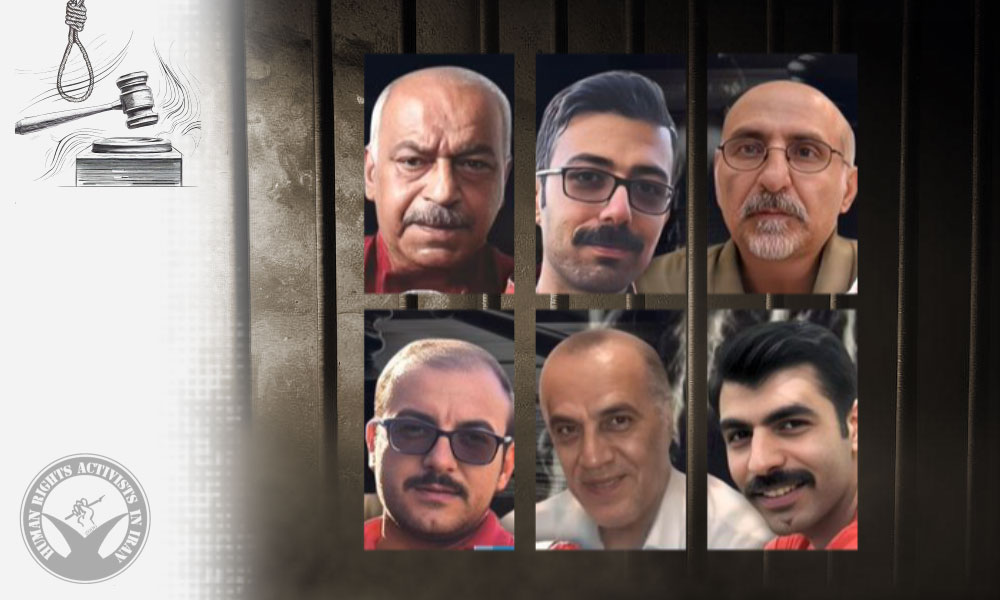
Six Political Prisoners Re-Sentenced to Death after Retrial

HRANA – Political prisoners Akbar Daneshvar Kar, Seyed Mohammad Taghavi Sang-Dehi, Babak Alipour, Pouya Ghobadi Bistouni, Vahid Bani-Amerian, and Seyed Abolhassan Montazer have once again been sentenced to death by Judge Iman Afshari.

The initial death sentences for Daneshvar Kar, Taghavi Sang-Dehi, Alipour, Ghobadi Bistouni, Bani-Amrian, and Montazer had been issued on the charge of baghi (armed rebellion) through alleged membership in anti-government groups. These sentences were overturned by the Supreme Court in August this year, and the case was sent back for reconsideration.

In November, the six prisoners were retried in Branch 26 of the Tehran Revolutionary Court, presided over by Judge Iman Afshari. Ultimately, on Sunday, December 7, their death sentences were issued once more and formally communicated to their lawyers.

In addition to the charge of baghi, the prisoners were also sentenced to prison terms and internal exile on charges including assembly and collusion to disrupt national security, property destruction, forming unlawful groups, and illegal border crossing.

Babak Alipour was arrested by security forces in Tehran in the fall of 2023, and Vahid Bani-Amerian was arrested in December 2023. On February 23, 2024, Pouya Ghobadi and Seyed Mohammad Taghavi were arrested in Chaldoran County and transferred to Maku Prison, before being moved to Evin Prison on March 1, 2024. Akbar Daneshvar had also been previously arrested by security forces and transferred to Evin Prison. These individuals were formally charged in May 2024 in Branch 5 of the Tehran Prosecutor’s Office and were subsequently transferred to Ghezel Hesar Prison in the summer of that year.

Seyed Mohammad Taghavi, a political prisoner from the 1980s, as well as Vahid Bani-Amerian, Pouya Ghobadi, and Babak Alipour, all have prior records of arrest and imprisonment related to their activities.

Seyed Mohammad Taghavi Detained for Over Four Months Facing Political Charges

Seyed Mohammad Taghavi, who is accused of Baghi (armed rebellion), remains in legal limbo in Evin Prison more than four months after his arrest. Since Monday, July 1st, this political detainee has been moved to solitary confinement in the Ministry of Intelligence’s detention facility, known as Ward 209 of Evin Prison, as a punitive measure ordered by Judge Iman Afshari.

A source close to his family confirmed this news to HRANA, stating: “Mr. Taghavi had previously protested against the fabricated charges against him and did not attend the court session due to the lack of a lawyer. On Monday, July 1st, he was punitively transferred to one of the solitary cells in Ward 209 of Evin Prison by the order of Judge Iman Afshari, the head of Branch 26 of the Revolutionary Court of Tehran.”

On February 23, 2024, security forces arrested Taghavi in Chaldoran in West Azerbaijan Province and transferred him to Maku Prison. He was then moved to Evin Prison after seven days.

Finally, on May 14th of this year, Mr. Taghavi, along with five other political detainees, was charged in a joint case by Branch 5 of the Public and Revolutionary Prosecutor’s Office of Tehran, presided over by Investigator Alizadeh, on suspicion of membership in one of the opposition groups and accused of Baghi.

On Monday, June 24th of this year, Taghavi and other defendants in this case were summoned to Branch 26 of the Revolutionary Court of Tehran, presided over by Judge Iman Afshari. However, he was not sent to court by the order of the head of Evin Prison due to his refusal to wear prison clothes at the court.

Seyed Mohammad Taghavi, 57, is a former political prisoner from the 1980s, holding a bachelor’s degree in Graphic Design from Tehran University, and has a history of previous convictions and imprisonment.

Reports from the Department of Statistics and Publication of HRA in 2023 indicate a total of 193 cases in which Branch 26 of the Tehran Revolutionary Court, presided over by Judge Iman Afshari, has been involved in issuing verdicts that infringe upon the human rights of defendants.