The end of large-scale hostilities has not brought an end to Iran’s wartime security regime. Instead, arrests, prosecutions, censorship and restrictions on lawyers, journalists and civil society actors increasingly suggest that exceptional measures adopted during the 2026 conflict are becoming part of the country’s ordinary machinery of repression.
When the United States and Israel launched military operations against Iran on February 28, 2026, beginning what Iranian officials and some commentators have called the “Ramadan War,” the conflict immediately transformed not only Iran’s external security environment but also its domestic political landscape. Months later, evidence documented by international human rights organizations indicates that the government has used the language of national security and wartime necessity to dramatically narrow an already restricted civic space.
Amnesty International reported in May that more than 6,000 people had been arbitrarily arrested since the beginning of the conflict, including protesters, journalists, lawyers, human rights defenders, dissidents and members of ethnic and religious minorities. It documented accelerated prosecutions, harsh prison sentences, asset seizures and cases involving allegations of torture, enforced disappearance and coerced confessions.
The scale of repression cannot be understood solely as a temporary reaction to military threats. Many of those targeted have no apparent connection to military activity. Instead, reporting indicates that authorities have pursued familiar categories of civil society actors — journalists, lawyers, students, labor activists, women’s rights advocates and families seeking accountability for people killed or detained — through the expanded vocabulary of wartime security.
The pattern also predates the war. Nationwide protests beginning in December 2025 had already produced mass arrests, enforced disappearances and allegations of torture and unlawful killings. Human Rights Watch reported in February that detainees faced serious risks of secret detention, unfair trials and execution, while independent lawyers attempting to represent politically sensitive defendants were frequently obstructed.
The war appears to have intensified that infrastructure rather than created it.
National Security as a Permanent Exception
International human rights law allows governments some latitude to respond to genuine security emergencies. It does not, however, provide governments with an unrestricted power to suspend fundamental rights whenever authorities invoke war or national security.
Iran is a state party to the International Covenant on Civil and Political Rights. The Covenant protects, among other rights, liberty and security of person, fair-trial guarantees, freedom of expression, peaceful assembly and freedom of association. Restrictions on expression, for example, must be prescribed by law and necessary for a legitimate purpose; national security cannot function as a blanket justification for suppressing criticism or independent reporting.
This distinction is particularly important when national-security offenses are broadly defined. Iranian authorities have long used charges such as “propaganda against the system,” “assembly and collusion against national security,” espionage-related offenses and other vaguely framed accusations against peaceful critics. In a wartime environment, the boundary between genuine security investigations and punishment of protected expression becomes even more consequential.
Amnesty has reported that Iranian judicial authorities also developed mechanisms to identify and seize the assets of people accused of cooperation with “enemy states” or “hostile media.” Such measures can affect not only individuals accused of criminal conduct but also journalists and members of the diaspora, further increasing the cost of communicating with independent media or international organizations.
The chilling effect extends beyond imprisonment. When journalists fear that reporting may be interpreted as collaboration, lawyers risk prosecution for publicly discussing their clients’ cases, and families fear consequences for speaking about detained relatives, repression operates before an arrest ever occurs.
Lawyers and Journalists Under Pressure
The targeting of lawyers is particularly damaging because it weakens the safeguards available to everyone else caught in the security apparatus.
Human Rights Watch has documented how defendants in national-security cases can be denied meaningful access to independent counsel, particularly during the investigative phase. Iranian criminal procedure also restricts the choice of lawyers in certain security-related cases.
Amnesty reported that lawyers Amir Raisian and Milad Panahipour were summoned and accused of offenses including “spreading lies” and “propaganda against the system” after publicly raising due-process concerns regarding a client facing the risk of execution.
Journalists face parallel pressures. In August, photojournalist Yalda Moaiery was reportedly sentenced to 15 years in prison and prohibited from artistic, cultural and public activities and social-media use. Reporting on her case stated that proceedings were conducted in absentia without adequate notification.
Authorities have simultaneously moved toward tighter control over communication with media outside Iran. Proposed legislation reported in August would expose individuals to criminal penalties for unauthorized engagement with foreign media, potentially reaching interviews, images and other forms of information-sharing.
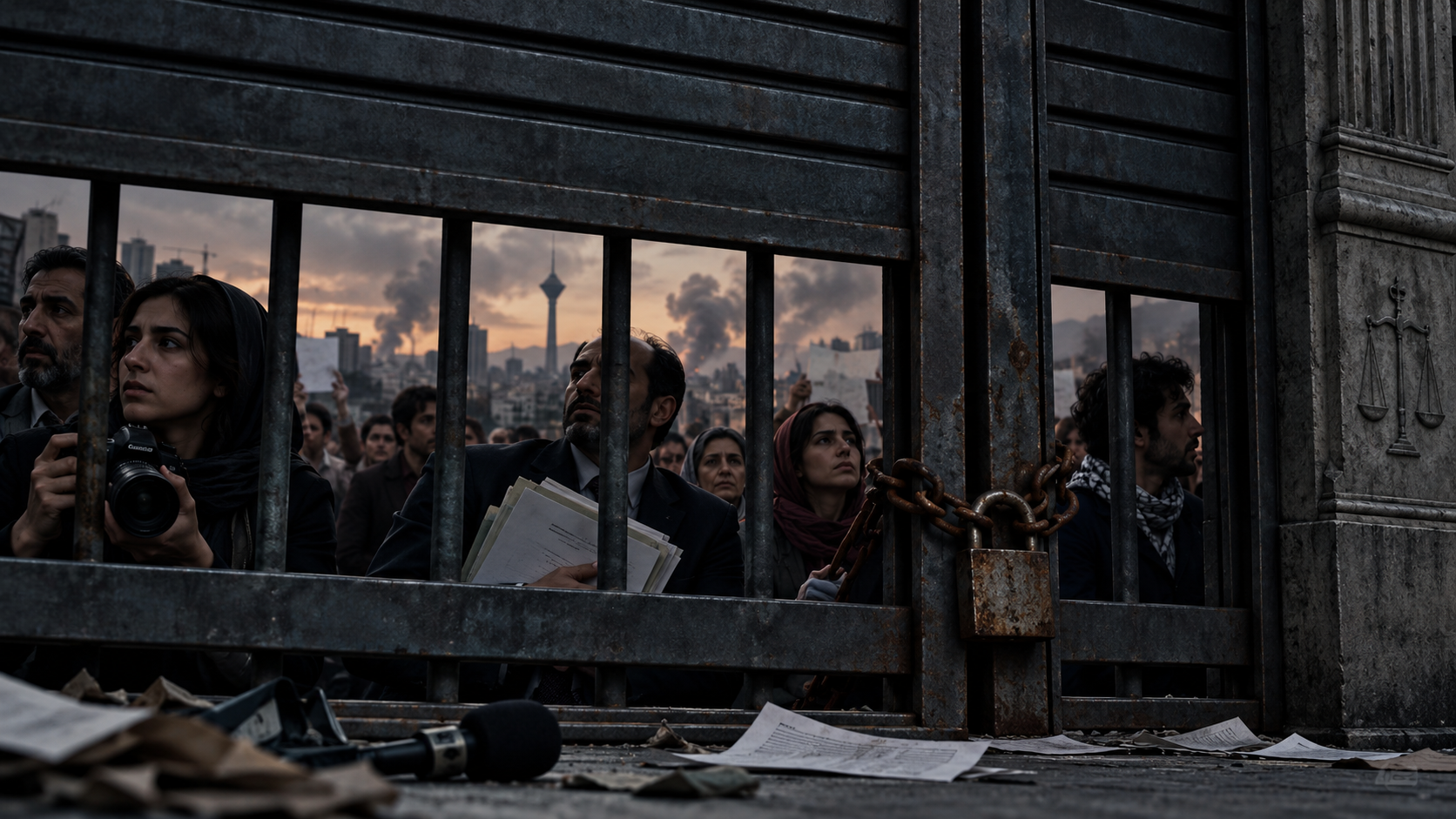
Together, these measures target the institutions through which abuses normally become visible: documentation, legal representation, journalism and communication with the outside world.
From Wartime Repression to a Closed Civic Space
The most significant question now is whether emergency repression is becoming institutionalized.
By September, the UN Independent International Fact-Finding Mission was describing the repression following the December 2025 protests as extreme and ongoing. Its latest findings concluded that there were reasonable grounds to believe that serious violations committed during the crackdown amounted, in multiple respects, to crimes against humanity. The Mission examined evidence including witness testimony, videos, photographs, medical records and satellite imagery.
These findings concern the protest crackdown as well as a broader continuum of repression that has continued through the war period. They also underline an important legal principle: an armed conflict does not extinguish a state’s human rights obligations toward people under its jurisdiction.
Iranian civilians therefore face two distinct legal realities. They may suffer from unlawful conduct committed by foreign belligerents during armed conflict while simultaneously being subjected to serious violations by their own government. Indeed, the UN Fact-Finding Mission has addressed alleged violations by both sides rather than treating one category as cancelling out the other.
That distinction is essential. Condemning unlawful foreign attacks does not require overlooking domestic repression, just as documenting violations by Iranian authorities does not diminish the protection owed to Iranian civilians under international humanitarian law.
What has emerged after the Ramadan War is therefore not simply a post-war security campaign. It is a deeper contraction of Iran’s civic space in which wartime concepts — enemy collaboration, hostile media, espionage and national security — increasingly intersect with ordinary journalism, legal advocacy, peaceful dissent and civil society activity.
The danger is that measures presented as exceptional may become permanent.
For Iran’s civil society, the critical post-war struggle may consequently be fought not only over who remains imprisoned, but over whether independent lawyers can defend them, journalists can report their cases, families can speak publicly, organizations can document abuses, and citizens can communicate without being treated as potential security threats.
Those are not peripheral freedoms. They are the infrastructure of civil society itself.
By: Keyvan Rafiee