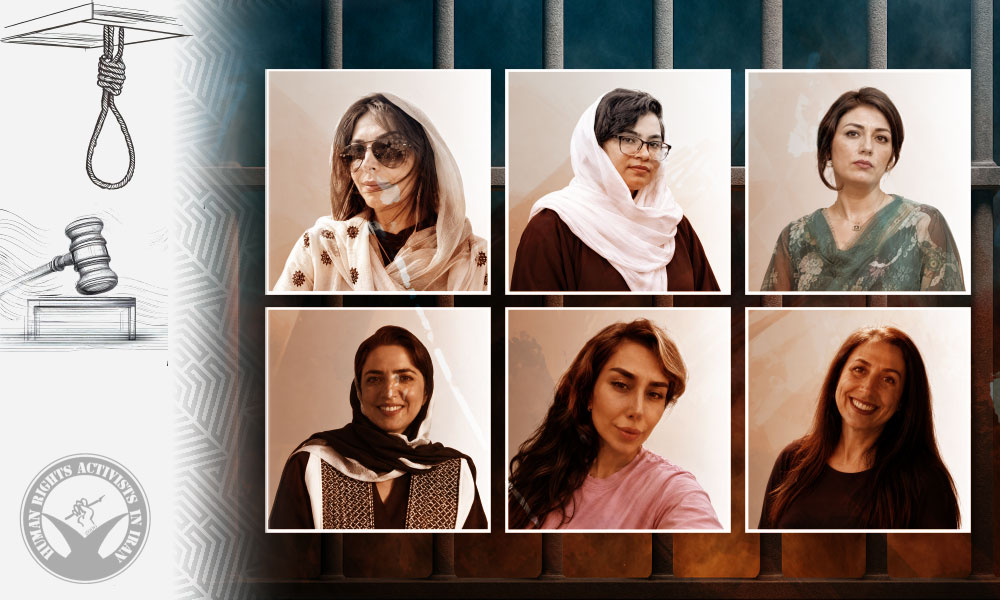
Escalation of Judicial Crackdown on Protesters: A Review of the Most Significant Cases from the Past Two Weeks

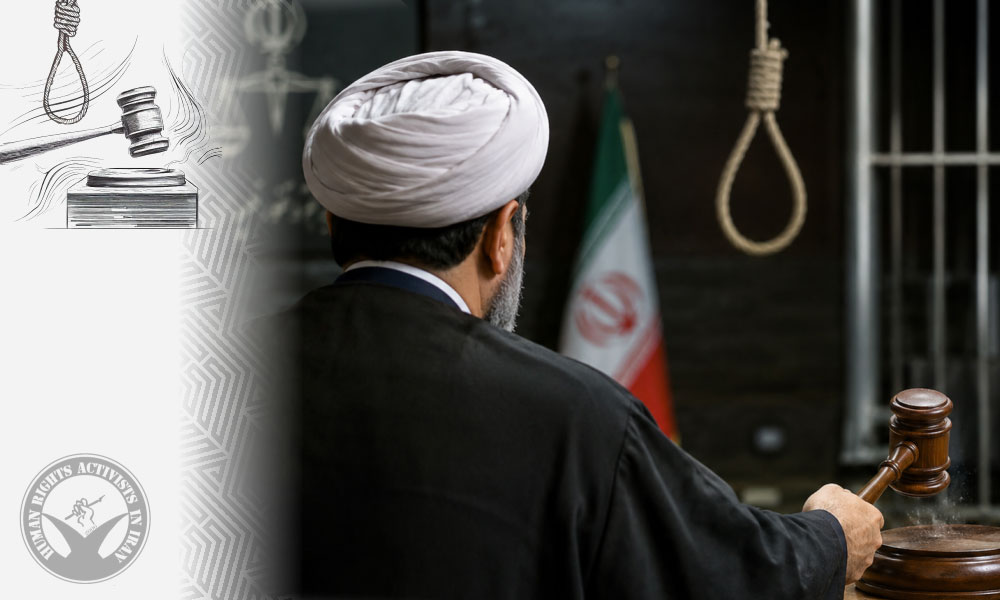
HRANA – Over the past two weeks, Iranian authorities have sharply escalated the use of capital punishment in cases linked to the January 2026 protests and politically motivated or national security prosecutions. Death sentences have been issued, upheld, and carried out across multiple cities, signaling an intensification of the judiciary’s crackdown on protesters and other defendants facing political and security-related charges.

According to HRANA, over the past two weeks, judicial proceedings in a number of cases related to the January 2026 protests and other security-related cases have entered a new phase, marked by the issuance and implementation of death sentences, the commencement of trials, and growing concerns over the condition of detainees.

The cases reviewed by HRANA span Isfahan, Shahrud, Mashhad, Tehran, Shiraz, Mahallat, Karaj, and Tabriz. They are accompanied by persistent allegations of fair trial violations, including denial of effective access to legal counsel, forced confessions, court hearings held inside prisons or conducted remotely, and a lack of transparency regarding the evidence relied upon by the courts. HRANA’s findings indicate that at least seven prisoners in protest- and security-related cases were executed during this period.

This report examines the most prominent recent cases that have resulted in death sentences or executions, or in which defendants are facing charges such as “enmity against God” (moharebeh) and “spreading corruption on earth” (efsad-e fel-arz). In cases where the available information is based solely on reports received by HRANA, the agency explicitly notes this and continues its independent investigation into the details of each case, including judicial proceedings, defendants’ access to legal counsel, and the evidence relied upon by the courts.

Several of these cases have drawn particular attention not only because of the number of defendants and the severity of the sentences, but also due to questions surrounding the judicial process. Reported concerns in some of these cases include restrictions on defense lawyers’ access to case files, court sessions held remotely or inside prisons, the failure to provide some families with the full text of court verdicts, and allegations that confessions were obtained under coercion.

Among these, the cases known as the “Alikhani Square” case and the “Isfahan Shohada Square” case have emerged as some of the most prominent during this period due to the harsh sentences imposed, the large number of defendants, and unresolved concerns regarding the judicial process. Meanwhile, the issuance of death sentences and the continuation of proceedings in similar cases in Shahrud, Mashhad, Shandiz, Shiraz, Mahallat, Tehran, and Malekan indicate that this pattern is not confined to a single city or a single case.

Below are the details of the cases for which HRANA has independently gathered and verified information, including the charges brought against the defendants, the course of judicial proceedings, and the status of the sentences from issuance through implementation.


Isfahan

The “Alikhani Square” Case: Death Sentences Issued and Carried Out Against Several Detainees

In this case, 59 individuals arrested during the January 2026 protests in Isfahan have been tried. According to information received by HRANA, 14 of them have been sentenced to death. HRANA has so far verified the identities of 12 of those sentenced to death.

The case was opened in connection with events that took place on January 8, 2026 in Alikhani Square in Isfahan, where the judiciary has alleged that police forces were attacked, public property was damaged, and violent acts were committed. The defendants face charges including “enmity against God” (moharebeh), destruction of public property, offenses related to attacks on law enforcement officers, and the killing of four members of the police force.

HRANA has verified the identities of the 12 defendants sentenced to death as Alireza Sepahi, Abolfazl Sepahi, Erfan Esfandiari, Gol Mohammad Mohammadi, Ghaem Hosseini, Sharvin Bagherian, Amirhossein Safari, Amirhossein Maleki, Ali Dashti, Abolfazl Ebrahimi, Alireza Raeisi, and Amirhossein Ebrahimi Analoucheh.

In the early hours of July 19, the death sentences of Erfan Esfandiari and Gol Mohammad Mohammadi were carried out. Subsequently, the transfer of Alireza Sepahi and Abolfazl Sepahi to solitary confinement has heightened concerns that the death sentences of the remaining condemned prisoners in this case may soon be implemented.

The handling of this case has raised serious concerns regarding compliance with fair trial standards. According to information received by HRANA, court hearings were conducted via video conference, and lawyers and the families of some defendants were denied access to the complete case files and the full text of the court’s verdicts. Additionally, some defendants were reportedly subjected to pressure and torture during interrogations in order to compel them to admit to the charges against them.

The “Shohada Square” Case

This case stems from the January 2026 protests in Isfahan and involves 16 defendants currently facing judicial proceedings. It relates to incidents that occurred in the vicinity of Shohada Square in Isfahan, near several shoe stores, during which two individuals were killed.

The charges brought against most of the defendants include “enmity against God” (moharebeh) through carrying bladed weapons, destruction of public property amounting to moharebeh, assembly and collusion, and propaganda against the state. Two of the defendants are charged with complicity in moharebeh and complicity in the destruction of public property.

HRANA has verified the identities of 12 of the defendants: Ahmadreza Saeedi, Navid Elyasi, Abolfazl Dadgostar, Mehdi Mansouri, Hamed Mehralian, Mehdi Asadi, Milad Booari, Mehrdad Booari, Ali Booari, Taraneh Rahimi, Romina Rahimi, and Setayesh Saedi.

The handling of this case has also raised concerns regarding judicial procedure. Although the case was formally registered with Branch 5 of the Isfahan Revolutionary Court, the defendants’ charges have been adjudicated by judges from Branch 1 of the Revolutionary Court in the same city. Hearings have been held inside Dastgerd Prison in Isfahan before Judge Morteza Barati and Judge Mohammadreza Tavakkoli, with a representative of the prosecutor’s office also present.

The defendants are being held in Dastgerd and Dowlatabad Prisons in Isfahan. Their defense lawyers have stated that they were not granted full access to the case files prior to the hearings. Additionally, some defendants were reportedly subjected to torture during interrogations.

It is also noteworthy that the indictment issued against these defendants does not contain any specific charge related to the killing of the two individuals who died during the Shohada Square incidents. According to information received by HRANA, no evidence has been presented demonstrating the defendants’ direct involvement in those deaths.

Execution of the Death Sentence of Mohammad Amini Dehaghani

The case of Mohammad Amini Dehaqani is related to the January 2026 protests in Dehaqan County, Isfahan Province. According to the judiciary’s media outlet, he was sentenced to death on charges of “setting fire to the Dehaqan governor’s office and police station by throwing Molotov cocktails” and “destroying public property in Imam Hossein Square” in the city. His death sentence was carried out on July 15, 2026, at Isfahan Prison.

According to publicly available information, the execution was carried out following judicial proceedings and the confirmation of the final verdict by the Supreme Court. HRANA has not yet been able to independently verify the details of the case, the judicial process, the evidence relied upon by the court, or the defendant’s legal defense. Further investigation into the case is ongoing.

Death Sentence Issued for Mahnam Navab Safavi

The case of Mahnam Navab Safavi, a 22-year-old rapper from Isfahan, is related to the nationwide protests of 2026. He was arrested on January 10, 2026, and was subsequently sentenced to death by Branch 5 of the Isfahan Revolutionary Court.

The charges brought against him include “enmity against God” (moharebeh) through the destruction of public property in the Sheikh Sadough area of Isfahan, “propaganda against the state,” “assembly and collusion,” “encouraging people to kill one another,” and “writing slogans.”

According to information received by HRANA, he is currently being held in Dastgerd Prison in Isfahan. HRANA has also received information indicating that he was subjected to forced confessions during his detention and that his trial was conducted remotely. HRANA is continuing to investigate the details of the case, the judicial proceedings, the defendant’s access to legal counsel, and the evidence relied upon by the court.

Kermanshah

Execution of the Death Sentences of Two Defendants Convicted of “Armed Rebellion”

This case dates back to 2017 and concerns allegations of membership in an armed group and activities against the Islamic Republic. The judiciary’s media outlet claimed that Mohi al-Din Abdollahi and Hossein Palani were “members of a group affiliated with ISIS” who intended to carry out armed operations inside Iran. According to this claim, following court proceedings, the Tehran Revolutionary Court sentenced both men to death on the charge of “armed rebellion against the Islamic Republic of Iran” (baghi).

After the Supreme Court upheld the verdicts, the death sentences of the two prisoners were carried out in the early hours of July 14, 2026, at Dizelabad Prison in Kermanshah.

The judiciary’s media outlet stated that, following the completion of the investigation and the issuance of the indictment, the case was referred to the Tehran Revolutionary Court, which ultimately issued the death sentences.

Soroush Karami Remains in Judicial Limbo on the Charge of “Enmity Against God”

The case of Soroush Karami, a resident of Kermanshah, is related to the January 2026 protests in Kermanshah. He was arrested during the protests on January 8, 2026, and has been charged with “enmity against God” (moharebeh). His case is currently under review by Branch 16 of the Public and Revolutionary Prosecutor’s Office in Kermanshah.

He was transferred from a security detention facility to Kermanshah Central Prison (Dizelabad) and is currently being held in solitary confinement in the prison’s security ward.

Soroush Karami has been denied access to legal counsel since the time of his arrest.

Karaj

Execution of Aref Khoshkar

The case of Aref Khoshkar was related to the nationwide protests of 2022 in Tehran. He was arrested during protests in the Fallah neighborhood and sentenced to death by the Revolutionary Court on charges including “enmity against God through carrying and using a weapon,” “the killing of a member of the Basij,” and “assembly and collusion against national security.”

Aref Khoshkar’s death sentence was carried out on July 15, 2026, at Ghezel Hesar Prison in Karaj, after his family’s efforts to halt the execution and a meeting aimed at obtaining the victim’s family’s consent proved unsuccessful.

According to information received by HRANA, Aref Khoshkar’s lawyer had previously pointed to ambiguities in the case, stating that there were no surveillance cameras at the site of the killing and that there was insufficient evidence linking the charges to his client.

Execution of Mehdi Khanki

The case of Mehdi Khanki, age 26, was related to the January 2026 protests in Karaj. According to the Judiciary Media Center, he had been sentenced to death on charges including “operational activities in support of Israel, the United States, and hostile groups” and “manufacturing, procuring, and possessing firearms and military ammunition, and using them.”

He was arrested by security forces at his residence in Karaj on February 10, 2026. After the Supreme Court upheld his sentence, he was executed on Wednesday, July 15, 2026, at Ghezel Hesar Prison in Karaj.

According to the judiciary, the case was heard by a branch of the Karaj Revolutionary Court, which issued the death sentence. HRANA has not yet been able to independently examine the details of the case, the evidence relied upon by the court, or the judicial proceedings. Further investigation into the matter is ongoing.

Shahrud: Death Sentence Issued for Arvin Kheirkhahan

The case of Arvin Kheirkhahan, aged approximately 20, is related to the January 2026 protests in Shahrud. He was arrested during the protests and is currently being held in Shahrud Prison.

He has been sentenced to death on charges of “enmity against God” (moharebeh) and “corruption on earth” (efsad-e fel-arz). His case has now been referred to the Supreme Court for review. To date, no detailed information has been made public regarding the branch handling the case, his access to legal counsel, or the details of the judicial proceedings.

Mashhad: Majid Nikandish Sentenced to Death

The case of Majid Nikandish, a 25-year-old resident of Quchan, is related to the January 2026 protests in Mashhad. He was arrested during the protests and is currently being held in Vakilabad Prison in Mashhad.

He was tried by Branch 1 of the Mashhad Revolutionary Court, presided over by Judge Gholamreza Akbari, and sentenced to death on the charge of “enmity against God” (moharebeh). According to information received by HRANA, he remains detained in Vakilabad Prison. HRANA has also received information indicating that he was subjected to forced confessions during his detention. The organization is continuing to investigate the details of the case, the judicial proceedings, and other aspects of his prosecution.

Shandiz: Mehdi Zarif Sentenced to Death

The case of Mehdi Zarif, aged 22, is related to the January 2026 protests in Shandiz. He was arrested in Shandiz on January 10, 2026.

He has been sentenced to death on charges including the destruction of public property. His death sentence has been upheld by the Supreme Court. According to information received by HRANA, he was subjected to forced confessions during interrogation.

Tehran: Mohammadreza Abdollahpour

The case of Mohammadreza Abdollahpour, one of those arrested during the 2026 nationwide protests, involves charges including “espionage” and the killing of a police officer during the January 9, 2026 protests in Tehran’s Saadat Abad district.

Following his arrest, he has spent more than five months in detention and remains held at Ghezel Hesar Prison in Karaj without a verdict having been issued.

According to information received by HRANA, court hearings in his case were held in April–May 2026, but no judgment has yet been issued. A source close to his family also stated that he has been denied access to a lawyer of his own choosing.

At present, little additional information is available regarding the judicial proceedings in this case. It is only known that Mohammadreza Abdollahpour’s trial sessions have been held, but no verdict has yet been issued.

The following cases are based on information that is still under review. HRANA is currently verifying the details of these cases, including the judicial proceedings, the legal status of the defendants, and other relevant aspects.


Shahrud: Protester Morteza Zamani Sentenced to Death

The case of Morteza Zamani, a 27-year-old resident of Shahrud, is related to the January 2026 protests in the city. He was arrested on January 8, 2026, during protests on Istgah Street in Shahrud and was subsequently transferred to Shahrud Prison.

Morteza Zamani has been sentenced to death on the charge of “enmity against God” (moharebeh) through the destruction and arson of public property.

No detailed information is currently available regarding the specifics of the case, the judicial proceedings, or his access to legal counsel. HRANA’s investigation into these matters is ongoing.

Shiraz: Two Citizens Sentenced to Death in Connection with the January Protests

The case of two citizens in Shiraz is related to the January 2026 protests. In this case, both defendants were sentenced to death by Branch 1 of the Shiraz Revolutionary Court.

The charges brought against them include “enmity against God” (moharebeh) through setting fire to public places and burning a Quran, as well as “acting against national security by sheltering protesters.” Their death sentences were issued more than two months ago.

The two defendants have been identified as 23-year-old Mojtaba Dehbandi and 27-year-old Kianoush Hamzehei Kazerouni. Following their arrest, they were transferred to Adelabad Prison in Shiraz.

The death sentences were issued at the trial court level and are not yet final. HRANA’s investigation into the details of the judicial proceedings, the defendants’ access to legal counsel, and the evidence relied upon by the court is ongoing.

Malekan: Ehsan Khodadadi

The case of Ehsan Khodadadi, a 32-year-old resident of Malekan, has been under investigation since June 2025 in connection with national security charges. The central allegations in the case involve claims that he sent the location of an Iranian Air Force facility in Tabriz, attempted to establish contact with Mossad, and transmitted information to the Iran International television network.

Ehsan Khodadadi has now been sentenced to death by Branch 1 of the Tabriz Revolutionary Court, presided over by Judge Reza Abdi. He was convicted on charges of “corruption on earth” (efsad-e fel-arz) through espionage for the benefit of the Israeli regime, “security, cultural, media, and propaganda activities for Israel,” “cooperation with hostile states,” “propaganda against the state,” and “cooperation through providing information to media outlets opposed to the regime.”

He is currently being held in Tabriz Prison. Reports have alleged that Ehsan Khodadadi was subjected to pressure, torture, and forced confessions during interrogation. HRANA has not been able to independently verify these claims. HRANA’s investigation into the details of the case, the judicial proceedings, the defendant’s access to legal counsel, and the evidence relied upon by the court is ongoing.

Tehran: Two Defendants Sentenced to Death in Connection with the January 2026 Protests

The case of three individuals arrested during the January 2026 protests in Tehran has resulted in severe sentences, including two death penalties. They were arrested on January 11, 2026, and their case was subsequently heard by Branch 15 of the Tehran Revolutionary Court, presided over by Judge Abolghasem Salavati.

The charges brought against the defendants include “attacking a mosque with Molotov cocktails,” “participation in unlawful gatherings,” and “assembly and collusion.”

The defendants have been identified as Mehdi Nazer, Mahnaz Chardouli, and Atefeh Nazer. Mehdi Nazer and Mahnaz Chardouli were each sentenced to death and 10 years’ imprisonment, while Atefeh Nazer was sentenced to 10 years’ imprisonment.

Lordegan: Ali Rahimi-Rigi Faces Political and Security Charges

The case of Ali Rahimi-Rigi, a 31-year-old detainee arrested during the January 2026 protests, stems from events related to those protests. He faces a range of charges, including “enmity against God” (moharebeh), “corruption on earth” (efsad-e fel-arz), possession and carrying of firearms and ammunition, destruction of property, unlawful assembly, propaganda against the state, assembly and collusion against national security, brandishing a weapon, and disrupting public order. He is currently being held in Lordegan Prison.

No detailed information has been made public regarding the branch handling his case, his access to legal counsel, or the evidence relied upon by the court. HRANA’s investigation into the details of the judicial proceedings is ongoing.

Mahallat: Five Protest Detainees Sentenced to Death

Five individuals arrested during the January 2026 protests in Mahallat, Markazi Province, have been sentenced to death by a judicial authority on the charge of “enmity against God” (moharebeh). Their death sentences were issued at the trial court level and are not yet final.

The defendants have been identified as Erfan Khalili, Ali Akbar Mahlouji, Hessam Isaei, Hossein Shokouhi, and Abolghasem Kazem Aslani. They are currently being held in Arak Prison.

HRANA’s investigation into the judicial proceedings, the defendants’ access to legal counsel, and the evidence relied upon by the court is ongoing.

Arak: 18-Year-Old Mahan Rahmati Faces Charge of “Enmity Against God”

The case of Mahan Rahmati, a resident of Arak born in January 2008, is related to the January 2026 protests. He has been charged with “enmity against God” (moharebeh), an offense that may carry the death penalty. He remains in detention, and recent information has heightened concerns regarding both the judicial proceedings in his case and the conditions of his detention.

No detailed information has been made public regarding the branch handling his case, his access to legal counsel, or the evidence relied upon by the court. HRANA’s investigation into the details of the judicial process is ongoing.

Overall, during the past two weeks, at least 50 individuals arrested in connection with the January 2026 protests have either been executed, sentenced to death, had their death sentences upheld, or faced charges such as “enmity against God” (moharebeh) and “corruption on earth” (efsad-e fel-arz), offenses that can carry the death penalty. The cases of a number of these individuals remain under investigation or judicial review, and complete information regarding the legal proceedings and court rulings is not yet available.

Background: The January 2026 Protests

It should be noted that protests and strikes by shopkeepers and bazaar merchants began in Tehran on Sunday, December 28, 2025, and within two days spread beyond markets and commercial centers. With the participation of students, citizens, and various social groups, these protests became one of the largest protest movements of recent years. Following the crackdown by security and law enforcement forces, thousands were killed or injured, and tens of thousands were arrested or summoned by security agencies. For more information, readers may refer to HRANA’s comprehensive report titled “Crimson Winter,” documenting the first fifty days following the outbreak of Iran’s nationwide protests.

Ten-Day Report on the New Wave of Attacks on Iran: Human Casualties and Disruption of Critical Infrastructure

HRANA – From the beginning of the new wave of U.S. attacks on Iran on July 8 through July 17, HRANA documented at least 376 incidents related to these attacks across 54 locations in 15 provinces nationwide.

The collected data indicates that a significant portion of the attacks has been concentrated in southern Iran, particularly along the coasts of the Persian Gulf and the Gulf of Oman. Military bases and defense facilities have been among the announced or reported targets. However, ports, piers, fishing vessels, bridges, railway lines, airports, telecommunications towers, and a number of infrastructures related to water, food, communications, transportation, and local economies have also been targeted or damaged as a result of the attacks.

Based on the cases that HRANA has documented and verified as of the time of publication, at least 48 people have been reported killed and 68 injured. In one of the most severe reported incidents, a one-year-old child in Bandar Abbas lost one hand after being struck by shrapnel, and the child’s condition has been reported as critical.

The head of the Ministry of Health’s Public Relations and Information Center has also announced that the number of people injured in the attacks has exceeded 400, while 38 people have lost their lives. The official did not specify whether these figures include military personnel, civilians, or both groups, nor whether they represent all casualties or only those registered at medical facilities. The discrepancy between HRANA’s figures and the official statistics underscores the challenges of verification under the current circumstances. Given the ongoing attacks and restrictions on access to information, the actual number of casualties may be higher than the documented figures.

This report does not assess the competing claims made by the parties regarding the nature or use of the targeted sites, nor does it evaluate the legal legitimacy of the military operations. Instead, it focuses on the documented consequences of these attacks for the civilian population, including access to essential services, transportation, communications, livelihoods, and the economic security of local communities.

About the Data and Counting Methodology

All documented incidents, including attacks, projectile impacts, explosions, and other events related to aerial operations, have been included in the overall incident count. Therefore, the registration of 376 incidents does not necessarily mean that 376 separate attacks or military operations took place. Multiple incidents may correspond to different waves of a single attack, multiple impacts within the same area, or separate reports concerning the same operation.

Because the attacks are ongoing, access to some affected areas remains restricted, communications have been disrupted, and information continues to emerge gradually, the figures presented in this report represent minimum confirmed counts and remain subject to revision. In cases where there was a possibility of overlap, duplicate counting, or insufficient information, HRANA refrained from reporting definitive figures and included only those cases that could be verified to a reasonable degree.

Key Findings

Between July 8 and July 17 :

• At least 376 incidents related to the attacks were documented across 15 provinces.

• These incidents were reported in 54 geographic locations, including 45 cities and urban areas, four counties, one district, and four islands.

• At least 48 people have been reported killed and 68 injured.

• Among the victims documented by HRANA, 20 civilians have been reported killed and 46 civilians injured.

• At least 40 fishing vessels were damaged or completely destroyed.

• A number of bridges, railway lines, airports, telecommunications towers, piers, water facilities, and food storage centers sustained damage.

• The highest concentration of reported incidents was recorded in Bandar Abbas, Qeshm, Bushehr, Sirik, Chabahar, Choghadak, and Konarak.

Geographic Distribution and Concentration of Attacks in Southern Iran

An analysis of the collected data indicates that the provinces of Hormozgan, Bushehr, Khuzestan, and Sistan and Baluchestan have been among the principal geographic focal points of this new wave of attacks.

Bandar Abbas recorded the highest number of reported incidents. It was followed by Qeshm, Bushehr, Sirik, Chabahar, Choghadak, and Konarak among the most frequently affected locations. The concentration of incidents in cities, ports, islands, and coastal areas indicates that the coastlines of the Persian Gulf and the Gulf of Oman have been among the primary operational theaters of these attacks.

The high concentration of naval, air, and air defense bases in southern Iran may be one factor behind the focus of the attacks in these areas. At the same time, the presence of civilian populations, commercial ports, fishing piers, industrial facilities, transportation routes, and public service infrastructure has meant that the consequences of the attacks have extended well beyond military installations.

The attacks have not been confined to southern Iran. Incidents have also been documented in the provinces of Tehran, Isfahan, Semnan, Lorestan, Ilam, and several other provinces.

Casualties and Human Impact

According to data documented and verified by HRANA, at least 48 people have been reported killed in the course of the attacks. Of these, 20 were civilians and 28 were military personnel.

In addition, at least 68 people have been reported injured, including 46 civilians and 22 military personnel.

Among the documented cases, the injury of a one-year-old child in Bandar Abbas stands out as one of the most alarming humanitarian consequences reported. The child lost one hand after being struck by shrapnel, and the child’s condition has been reported as critical.

In several other cases, deaths or injuries have been confirmed, but insufficient information was available regarding the exact number of victims, their identities, or whether they were civilians or military personnel. These cases have not been included in HRANA’s final statistics pending further verification.

Meanwhile, the head of the Ministry of Health’s Public Relations and Information Center announced that, as of 6:30 a.m. on July 17 (Europe time), more than 400 people had been injured as a result of the attacks, while 38 people had lost their lives.

According to these official figures, the injured included 22 women and 9 individuals under the age of 18, while the fatalities included three women and one person under the age of 18. The official also stated that 37 of the injured remained hospitalized.

The Ministry of Health did not specify whether these figures refer solely to civilians or also include military casualties. It is also unclear whether the reported numbers represent all casualties or only those who were transported to medical facilities.

Accordingly, the official figures and HRANA’s findings should be regarded as two separate datasets, likely based on different methodologies and scopes, and should not be combined without additional corroborating information.

Major Targets and Damaged Infrastructure

The documented targets during this reporting period can be classified into four main categories:

1. Military and Defense Facilities

A significant portion of the documented incidents involved military bases and defense installations. Reported targets included Army naval and air force bases, Islamic Revolutionary Guard Corps (IRGC) headquarters and command centers, air defense systems, military garrisons, barracks, troop deployment sites, and coastal control centers.

Notable documented examples include:

• The First Naval District of the Army;

• Shahid Abdolkarimi Base;

• Bandar Abbas Air Base;

• The Konarak Naval Military Zone;

• An IRGC headquarters in Saravan;

• A number of IRGC command centers and facilities;

• Naein Military Base;

• Military and air defense facilities in the provinces of Bushehr, Hormozgan, Tehran, Isfahan, and Sistan and Baluchestan.

Independent and comprehensive information is not yet available regarding the extent of the damage, the operational status of these facilities following the attacks, or the number of personnel present at the time.

2. Ports, Piers, and the Maritime Economy

One of the most prominent patterns documented during this period is the damage inflicted on infrastructure associated with maritime activities and the coastal economy.

Reportedly affected infrastructure includes:

• Sirik Commercial Pier;

• Fishing piers in Sirik and Bandar Abbas;

• Bonood Pier in Asaluyeh;

• Shahid Beheshti Port in Chabahar;

• Shahid Kalantari Port in Chabahar;

• Sirik Commercial Port;

• A Maritime Traffic Control Center;

• Fishing boats and traditional fishing vessels operating along the southern coastline.

Based on the information collected, at least 40 fishing vessels were burned, severely damaged, or sunk.

The damage to piers and fishing vessels extends far beyond the destruction of property. It may disrupt the livelihoods of fishermen, port workers, truck drivers, local merchants, vessel repair workers, and families whose incomes depend on the maritime economy for an extended period.

A comprehensive assessment of the number of people who have lost their jobs or sources of income, the financial cost of the damage, and the duration of disruptions to port and pier operations is not yet available.

3. Transportation and Communications

A number of transportation and communications infrastructure sites were also damaged during the attacks. Documented cases include:

• Iranshahr Airport;

• Semnan Airport;

• The Aq-Tappeh Khan Railway Bridge on the Tehran–Mashhad railway line;

• The Bandar Abbas railway junction;

• Several bridges in Khamir County;

• Telecommunications towers in eastern Hormozgan Province;

• Several additional telecommunications towers in other parts of the country.

Damage to bridges, railways, and airports can disrupt the movement of civilians, the transport of patients, emergency response efforts, the delivery of food and medicine, and broader supply chains.

Even where a transportation route or facility also serves a military function, civilian populations and the distribution networks for essential goods may depend on the same infrastructure. The destruction or closure of these routes can restrict public access to food, medicine, healthcare services, hygiene supplies, and other basic necessities.

In the city of Veysian, in Lorestan Province, one of the attacks disrupted landline telephone, mobile phone, and internet services in the Veysian District and Mamulan County. In Bandar Abbas, damage to a telecommunications tower was also accompanied by a power outage in the Tappeh Allah Akbar area.

Disruptions to communications can affect more than daily life. They may also limit people’s ability to contact emergency services, receive security warnings, check on the safety of family members, and document conditions in affected areas.

4. Water, Food, and Industrial Facilities

Some infrastructure related to essential needs and economic activity was also among the documented sites damaged during the attacks, including:

• Hendijan Water Pumping Station;

• Hoveyzeh Wheat Storage Silo;

• Souza Fish Meal Factory on Qeshm Island;

• A bottled water factory in Dehloran.

Damage to water facilities may disrupt local residents’ access to drinking water and municipal water services. Damage to wheat storage silos may also affect the storage and distribution of food supplies, particularly if transportation routes and supply chains are disrupted at the same time.

Factories and processing facilities are also major sources of employment for local workers. The suspension of their operations may result in reduced production, temporary or prolonged unemployment, and loss of household income.

At present, there is insufficient information regarding the extent of the damage, the duration of operational disruptions, the number of affected workers, or the potential environmental consequences.

Impact of the Attacks on Civilians’ Daily Lives

The humanitarian consequences of the attacks extend beyond the number of people killed and injured. Damage to or the disruption of critical infrastructure can affect a broad range of people’s everyday needs.

Damage to roads, bridges, and railway lines may slow or halt the transportation of food, medicine, fuel, medical supplies, and other essential goods. The destruction of piers and fishing vessels may threaten the livelihoods and food security of coastal communities. Disruptions to telecommunications may make it more difficult to contact emergency services and access information. Damage to water facilities and food storage infrastructure may also have more direct consequences for public health and well-being.

Damage to homes, vehicles, vessels, businesses, and other private property may also impose significant financial burdens on families through the loss of assets and the reduction or loss of income.

These consequences may persist even after the attacks have ended, particularly in areas where rebuilding infrastructure, replacing equipment, and restoring economic activity will require substantial time and resources.

The Need to Distinguish Military Claims from Humanitarian Consequences

The United States has stated that some of the targeted sites served dual-use functions, were being used for military purposes, or played a role in Iran’s military logistics network. Iranian officials have likewise presented differing accounts and claims regarding the nature of the targets and the consequences of the attacks.

In this report, HRANA is not in a position to confirm or reject the operational or military claims made by either party. Nor does the report reach conclusions regarding the legality or illegality of any specific attack.

Nevertheless, regardless of the parties’ competing claims, it is essential to examine the actual impact of the attacks on civilian life. A road, bridge, airport, port, or telecommunications network may, irrespective of any alleged military use, also be indispensable for the movement of civilians, the distribution of food and medicine, access to healthcare facilities, and the continuation of economic activity.

For this reason, documenting damage to infrastructure should be accompanied by an assessment of its consequences for local populations, public services, and access to essential needs.

Conclusion

The data documented by HRANA between July 8 and July 17 indicates that the latest wave of U.S. attacks on Iran has affected a broad geographic area, with its primary concentration in the country’s south, particularly along the coasts of the Persian Gulf and the Gulf of Oman.

Bandar Abbas, Qeshm, Bushehr, Sirik, Chabahar, Choghadak, and Konarak were among the locations with the highest number of reported incidents. In these areas, in addition to military bases and facilities, damage was documented to piers, fishing vessels, port infrastructure, maritime traffic control facilities, and communications, transportation, and public service infrastructure.

According to HRANA’s current data, at least 48 people have been reported killed and 68 injured. Among them, 20 civilians have been reported killed and 46 civilians injured. The Ministry of Health has also reported more than 400 injuries and 38 fatalities, although insufficient detail has been released to allow a direct comparison between the official figures and HRANA’s data.

The available findings indicate that the consequences of the attacks have extended beyond direct casualties and damage to military facilities, affecting transportation, communications, water and food supply, the maritime economy, local industries, and the livelihoods of civilians.

Given the continuation of the attacks, restricted access to affected areas, and the lack of complete information regarding some incidents, the figures and findings presented in this report should be regarded as minimum documented counts as of July 17. A more comprehensive assessment of the humanitarian, economic, and infrastructural consequences will require continued verification, greater access to local information, and independent assessment of the condition of public services and affected communities.

The current wave of attacks forms part of the broader conflict that began on February 28, 2026, with the start of U.S. and Israeli military operations against Iran and Iran’s subsequent retaliatory attacks. Following mediation by Pakistan, Iran and the United States reached a temporary memorandum of understanding on June 17, providing for a cessation of military operations and the start of a 60-day process aimed at continuing negotiations and reaching a final agreement. However, the arrangement remained in effect for less than a month. Over the past ten days, with both sides accusing the other of violating the agreement, military attacks and tensions have resumed on a sustained basis.

This report focuses on the incidents and humanitarian consequences of this latest phase of the conflict following the temporary agreement. HRANA has previously published a comprehensive report examining the course of the war since February 28, the scope of the attacks, and their humanitarian and infrastructural consequences. Readers seeking a fuller background on the conflict may refer to HRANA’s comprehensive report on the war.

Who is Responsible for the Sharp Rise in Political and Security-Related Executions Following the January 2026 Protests in Iran?

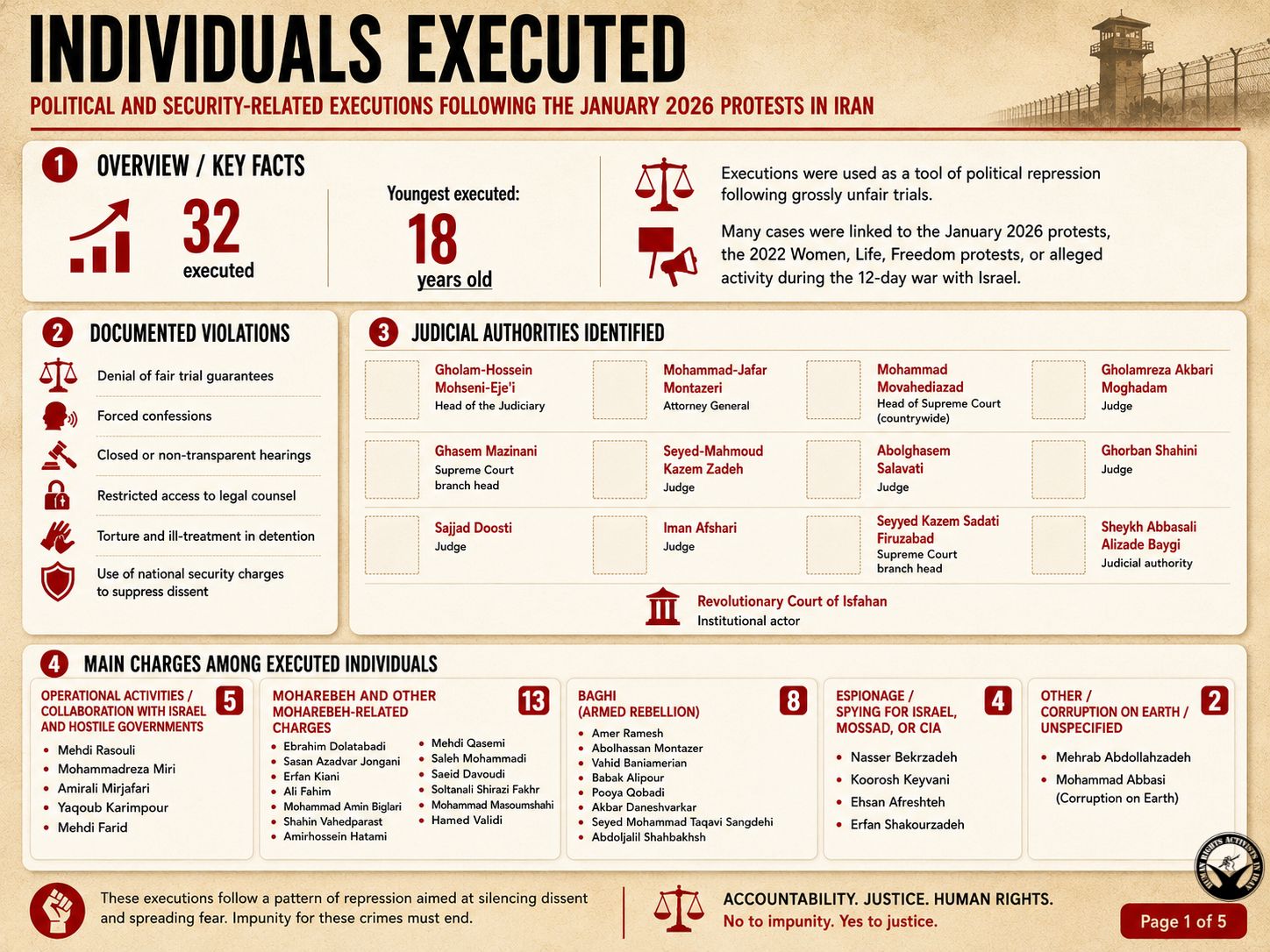
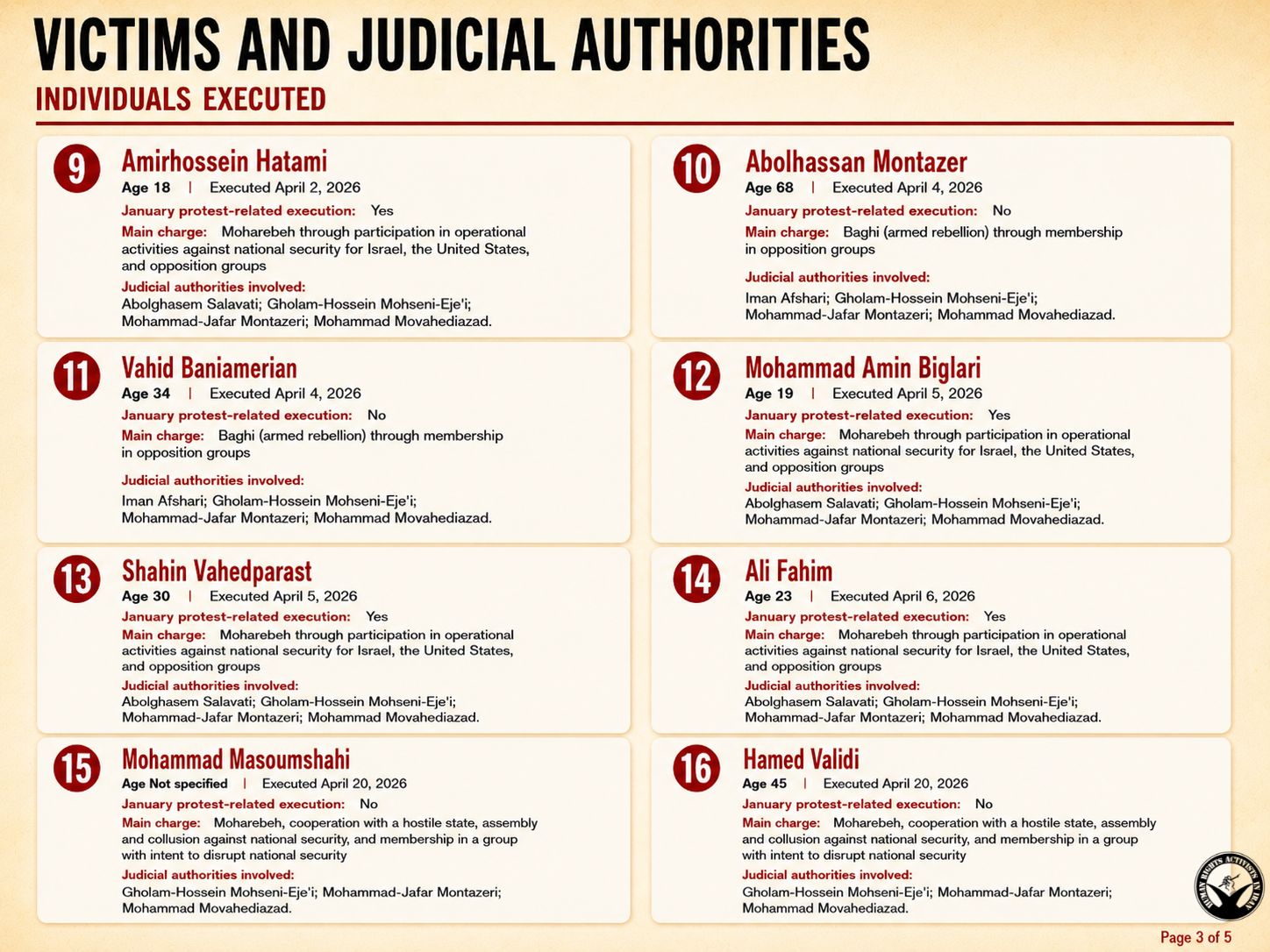
HRANA – Since March 2026, Iran has witnessed a sharp escalation in executions on political and security-related charges, as 40 people were executed between March 18 and June 3.

In response to this surge, Spreading Justice examined the officials and institutions responsible for facilitating these executions. While such executions continue beyond the reporting period, this report focuses on the two months between March 18 and May 18, 2026, during which at least 32 individuals were executed following grossly unfair trials. The youngest among them, Amirhossein Hatami, was only 18 years old. Although limited in its temporal scope, the findings reflect a broader and ongoing pattern, with executions on political and security-related charges continuing at an alarming pace.

A significant number of those executed were accused of involvement in the January 2026 protests, known as the Dey Protests, which began on December 28, 2025, and rapidly spread across the country amid widespread public anger over economic collapse, corruption, and state repression. Demonstrations continued for weeks despite a violent regime crackdown involving mass arrests and the widespread use of lethal force, resulting in the deaths of at least 7,007 individuals in conduct likely amounting to crimes against humanity. The same period also saw the highest recorded number of forced confessions in recent years, surpassing 350 documented cases.

Others executed during this period were accused of involvement in the 2022 Women, Life, Freedom protests or alleged activity connected to the 12-day war with Israel in June 2025.

Comparatively, according to HRA documentation, between March 18 and May 18, 2025, a total of 198 individuals were executed in Iran, compared to 65 executions during the same period in 2026. However, only 8 individuals were executed on political and security-related charges in 2025, underscoring the sharp escalation in the use of executions as a tool of political repression in 2026.

Spreading Justice has identified the judicial authorities responsible for issuing these arbitrary death sentences. These individuals have long-standing records of involvement in violations of the right to life and the systematic denial of fair trial guarantees Among them, Judge Iman Afshari has played a particularly central role. During this same period, Afshari sentenced at least eight individuals to death on political and security-related charges, including:

Ehsan Hosseinipour Hessarlou ( Sentence upheld)
Matin Mohammadi ( Sentence upheld)
Erfan Amiri ( Sentence upheld)
Maryam Hodavand ( Sentence upheld)
Mohammadreza Majidi-Asl ( Sentence overturned)
Bita Hemmati ( Sentence overturned)
Behrouz Zamaninejad
Kourosh Zamaninejad

Afshari is also implicated in at least six additional cases outlined below that resulted in arbitrary executions.

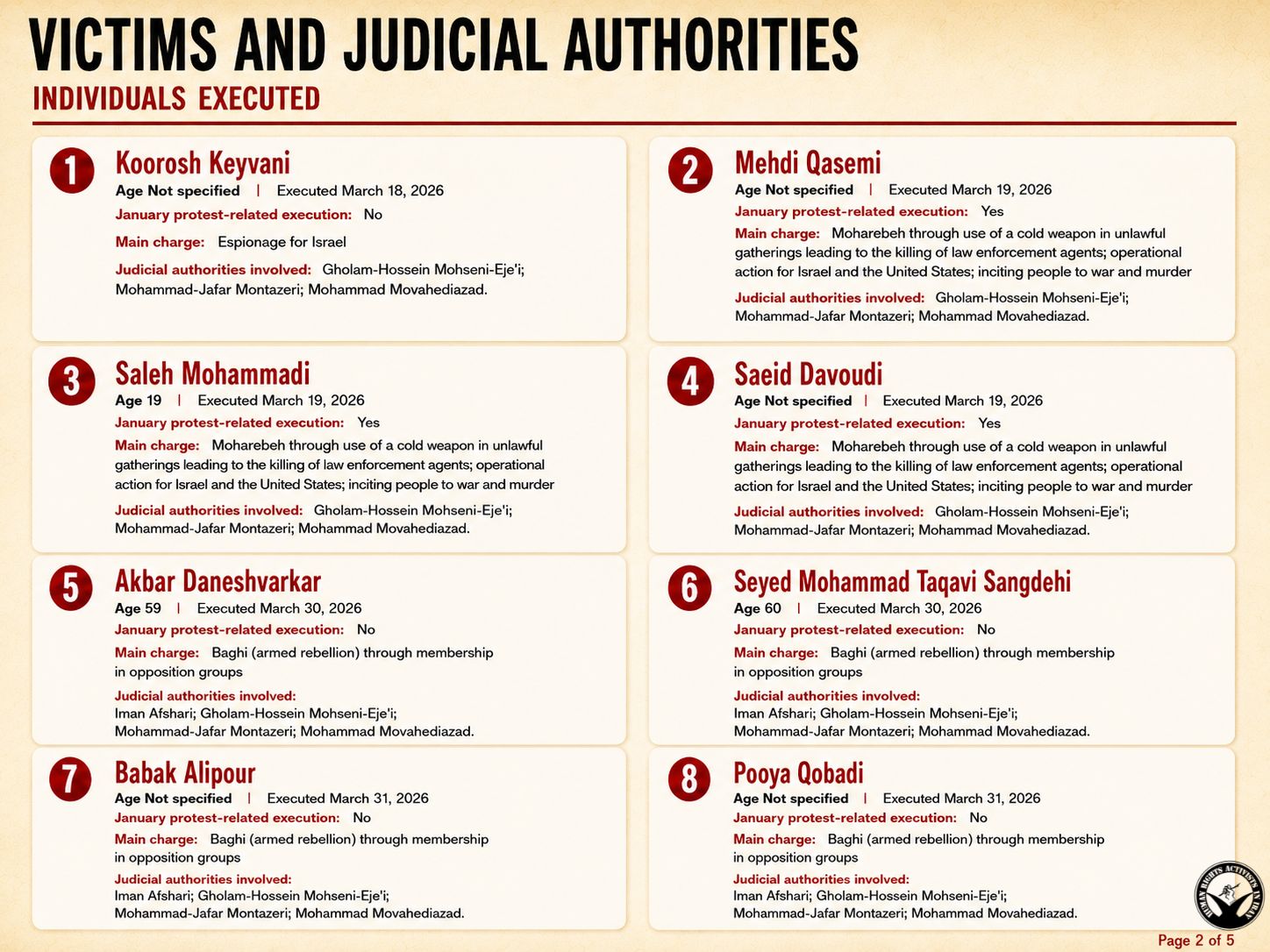
The following list includes 14 individuals who were executed between March 18 and May 18, 2026, in connection with their participation in the January 2026 Dey Protests.

VictimIndividuals Involved in Violations of the Right to Life
Mehdi Ghasemi

Age: Not specified
Date of Execution: March 19, 2026
Charge: Moharebeh through use of a bladed weapon in unlawful gatherings leading to the killing of law enforcement agents; operational action for Israel and the United States; inciting people to war and murder

Gholam-Hossein Mohseni-Eje’i
Mohammad-Jafar Montazeri
Mohammad Movahediazad
Saleh Mohammadi
Age: 19
Date of Execution: March 19, 2026
Charge: Moharebeh through use of a bladed weapon in unlawful gatherings leading to the killing of law enforcement agents; operational action for Israel and the United States; inciting people to war and murder
Gholam-Hossein Mohseni-Eje’i
Mohammad-Jafar Montazeri
Mohammad Movahediazad
Saeed Davoudi

Age: Not specified
Date of Execution: March 19, 2026
Charge: Moharebeh through use of a bladed weapon in unlawful gatherings leading to the killing of law enforcement agents; operational action for Israel and the United States; inciting people to war and murder
Gholam-Hossein Mohseni-Eje’i
Mohammad-Jafar Montazeri
Mohammad Movahediazad
Amirhossein Hatami

Age: 18
Date of Execution: April 2, 2026
Charge: Moharebeh through participation in operational activities against national security for Israel, the United States, and opposition groups

Abolghasem Salavati
Gholam-Hossein Mohseni-Eje’i
Mohammad-Jafar Montazeri
Mohammad Movahediazad
Mohammad-Amin Biglari

Age: 19
Date of Execution: April 5, 2026
Charge: Moharebeh through participation in operational activities against national security for Israel, the United States, and opposition groups

Abolghasem Salavati
Gholam-Hossein Mohseni-Eje’i
Mohammad-Jafar Montazeri
Mohammad Movahediazad
Shahin Vahedparast

Age: 30
Date of Execution: April 5, 2026
Charge: Moharebeh through participation in operational activities against national security for Israel, the United States, and opposition groups

Abolghasem Salavati
Gholam-Hossein Mohseni-Eje’i
Mohammad-Jafar Montazeri
Mohammad Movahediazad
Ali Fahim

Age: 23
Date of Execution: April 6, 2026
Charge: Moharebeh through participation in operational activities against national security for Israel, the United States, and opposition groups

Abolghasem Salavati
Gholam-Hossein Mohseni-Eje’i
Mohammad-Jafar Montazeri
Mohammad Movahediazad
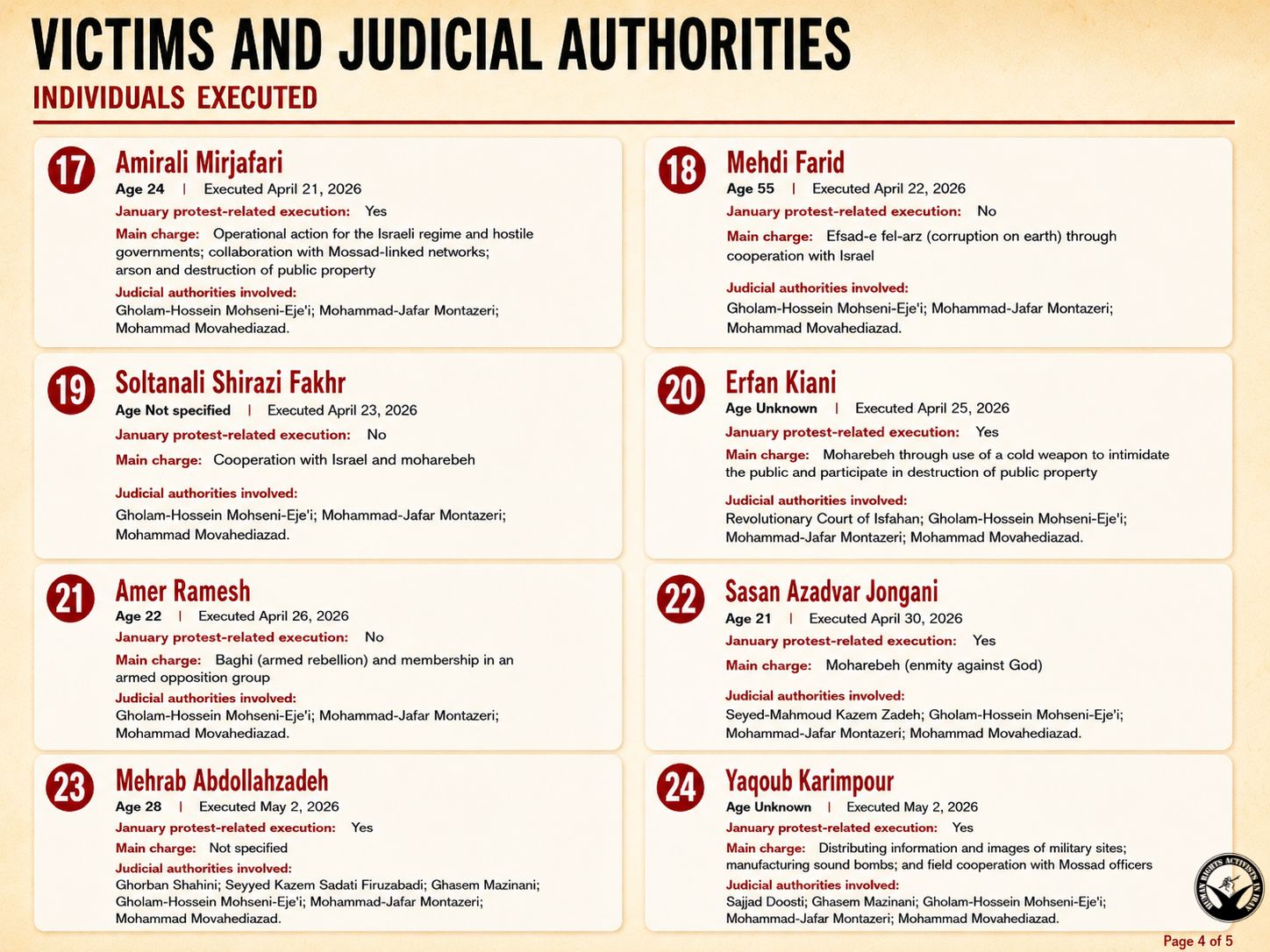
Amirali Mirjafari

Age: 24
Date of Execution: April 21, 2026
Charge: Operational action for the Israeli regime and hostile governments; collaboration with Mossad-linked networks; arson and destruction of public property

Gholam-Hossein Mohseni-Eje’i
Mohammad-Jafar Montazeri
Mohammad Movahediazad
Erfan Kiani

Age: Not specified
Date of Execution: April 25, 2026
Charge: Moharebeh through use of a bladed weapon to intimidate the public and participate in destruction of public property

Revolutionary Court of Isfahan
Gholam-Hossein Mohseni-Eje’i
Mohammad-Jafar Montazeri
Mohammad Movahediazad
Sasan Azadvar Junaqani

Age: 21
Date of Execution: April 30, 2026
Charge: Moharebeh (enmity against God)

Seyed-Mahmoud Kazem Zadeh
Gholam-Hossein Mohseni-Eje’i
Mohammad-Jafar Montazeri
Mohammad Movahediazad
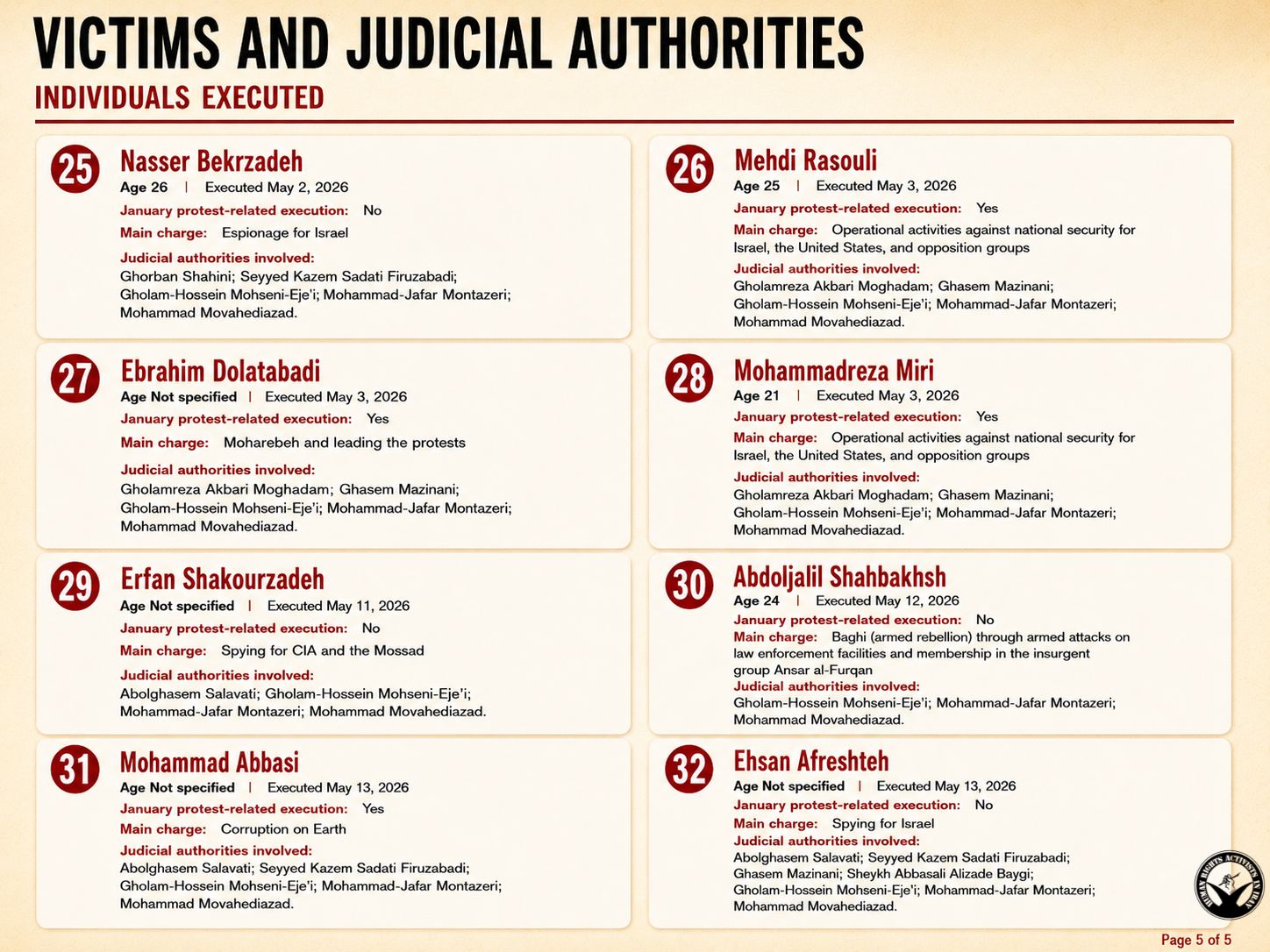
Mehdi Rasouli

Age: 25
Date of Execution: May 3, 2026
Charge: Operational activities against national security for Israel, the United States, and opposition groups

Gholamreza Akbari Moghadam
Ghasem Mazinani
Gholam-Hossein Mohseni-Eje’i
Mohammad-Jafar Montazeri
Mohammad Movahediazad
Ebrahim Dolatabadi
Age: Not specified
Date of Execution: May 3, 2026
Charge: Moharebeh and leading the protests
Gholamreza Akbari Moghadam
Ghasem Mazinani
Gholam-Hossein Mohseni-Eje’i
Mohammad-Jafar Montazeri
Mohammad Movahediazad
Mohammadreza Miri

Age: 21
Date of Execution: May 3, 2026
Charge: Operational activities against national security for Israel, the United States, and opposition groups

Gholamreza Akbari Moghadam
Ghasem Mazinani
Gholam-Hossein Mohseni-Eje’i
Mohammad-Jafar Montazeri
Mohammad Movahediazad
Mohammad Abbasi

Age: Not specified
Date of Execution: May 13, 2026
Charge: Moharebeh (enmity against God)

Abolghasem Salavati
Seyyed Kazem Sadati Firuzabad
Gholam-Hossein Mohseni-Eje’i
Mohammad-Jafar Montazeri
Mohammad Movahediazad


During this period, 18 individuals were also executed on political and security-related charges. However, these charges were not connected to the January protests. Instead, these individuals were executed for their alleged involvement in the 2022 Women, Life, Freedom protests and alleged activity during the 12-day war with Israel.

VictimIndividuals Involved in Violations of the Right to Life
Kourosh Keyvani

Age: Not specified
Date of Execution: March 18, 2026
Charge: Espionage for Israel

Gholam-Hossein Mohseni-Eje’i
Mohammad-Jafar Montazeri
Mohammad Movahediazad
Akbar Daneshvar-Kar
Age: 59
Date of Execution: March 30, 2026
Charge: Baghi (armed rebellion) through membership in opposition groups
Iman Afshari
Gholam-Hossein Mohseni-Eje’i
Mohammad-Jafar Montazeri
Mohammad Movahediazad
Seyed Mohammad Taghavi-Sangdehi

Age: 60
Date of Execution: March 30, 2026
Charge: Baghi (armed rebellion) through membership in opposition groups

Iman Afshari
Gholam-Hossein Mohseni-Eje’i
Mohammad-Jafar Montazeri
Mohammad Movahediazad
Babak Alipour

Age: Not specified
Date of Execution: March 31, 2026
Charge: Baghi (armed rebellion) through membership in opposition groups

Iman Afshari
Gholam-Hossein Mohseni-Eje’i
Mohammad-Jafar Montazeri
Mohammad Movahediazad
Pouya Ghobadi

Age: Not specified
Date of Execution: March 31, 2026
Charge: Baghi (armed rebellion) through membership in opposition groups

Iman Afshari
Gholam-Hossein Mohseni-Eje’i
Mohammad-Jafar Montazeri
Mohammad Movahediazad
Abolhassan Montazer

Age: 68
Date of Execution: April 4, 2026
Charge: Baghi (armed rebellion) through membership in opposition groups

Iman Afshari
Gholam-Hossein Mohseni-Eje’i
Mohammad-Jafar Montazeri
Mohammad Movahediazad
Vahid Baniamerian

Age: 34
Date of Execution: April 4, 2026
Charge: Baghi (armed rebellion) through membership in opposition groups

Iman Afshari
Gholam-Hossein Mohseni-Eje’i
Mohammad-Jafar Montazeri
Mohammad Movahediazad
Mohammad Masoum Shahi

Age: Not specified
Date of Execution: April 20, 2026
Charge: Moharebeh, cooperation with a hostile state, assembly and collusion against national security, and membership in a group with intent to disrupt national security

Gholam-Hossein Mohseni-Eje’i
Mohammad-Jafar Montazeri
Mohammad Movahediazad
Hamed Validi

Age: 45
Date of Execution: April 20, 2026
Charge: Moharebeh, cooperation with a hostile state, assembly and collusion against national security, and membership in a group with intent to disrupt national security

Gholam-Hossein Mohseni-Eje’i
Mohammad-Jafar Montazeri
Mohammad Movahediazad
Mehdi Farid

Age: 55
Date of Execution: April 22, 2026
Charge: Efsad-e fel-arz (corruption on earth) through cooperation with Israel

Gholam-Hossein Mohseni-Eje’i
Mohammad-Jafar Montazeri
Mohammad Movahediazad
Soltanali Shirzadi Fakhr

Age: Not specified
Date of Execution: April 23, 2026
Charge: Cooperation with Israel and moharebeh

Gholam-Hossein Mohseni-Eje’i
Mohammad-Jafar Montazeri
Mohammad Movahediazad
Amer Ramesh

Age: 22
Date of Execution: April 26, 2026
Charge: Baghi (armed rebellion) and membership in an armed opposition group

Gholam-Hossein Mohseni-Eje’i
Mohammad-Jafar Montazeri
Mohammad Movahediazad
Mehrab Abdollahzadeh

Age: 28
Date of Execution: May 2, 2026
Charge: Corruption on Earth

Ghorban Shahini
Seyyed Kazem Sadati Firuzabad
Ghasem Mazinani
Gholam-Hossein Mohseni-Eje’i
Mohammad-Jafar Montazeri
Mohammad Movahediazad
Yaghoub Karimpour

Age: Not specified
Date of Execution: May 2, 2026
Charge: Distributing information and images of military sites. Manufacturing sounds bombs, and field cooperation with Mossad Officers

Sajjad Doosti
Ghasem Mazinani
Gholam-Hossein Mohseni-Eje’i
Mohammad-Jafar Montazeri
Mohammad Movahediazad
Naser Bekrzadeh

Age: 26
Date of Execution: May 2, 2026
Charge: Espionage for Israel

Ghorban Shahini
Seyyed Kazem Sadati Firuzabad
Gholam-Hossein Mohseni-Eje’i
Mohammad-Jafar Montazeri
Mohammad Movahediazad
Erfan Shakourzadeh

Age: Not specified
Date of Execution: May 11, 2026
Charge: Spying for CIA and The Mossad

Abolghasem Salavati
Gholam-Hossein Mohseni-Eje’i
Mohammad-Jafar Montazeri
Mohammad Movahediazad
Abdoljalil Shahbakhsh

Age: 24
Date of Execution: May 12, 2026
Charge: Baghi (armed rebellion) through armed attacks on law enforcement facilities and membership in the insurgent group Ansar al-Furqan

Gholam-Hossein Mohseni-Eje’i
Mohammad-Jafar Montazeri
Mohammad Movahediazad
Ehsan Afrashteh

Age: Not specified
Date of Execution: May 13, 2026
Charge: Spying for Israel

Abolghasem Salavati
Seyyed Kazem Sadati Firuzabad
Ghasem Mazinani
Sheykh Abbasali Alizade Baygi
Gholam-Hossein Mohseni-Eje’i
Mohammad-Jafar Montazeri
Mohammad Movahediazad

Download All Slide Files in PDF Format

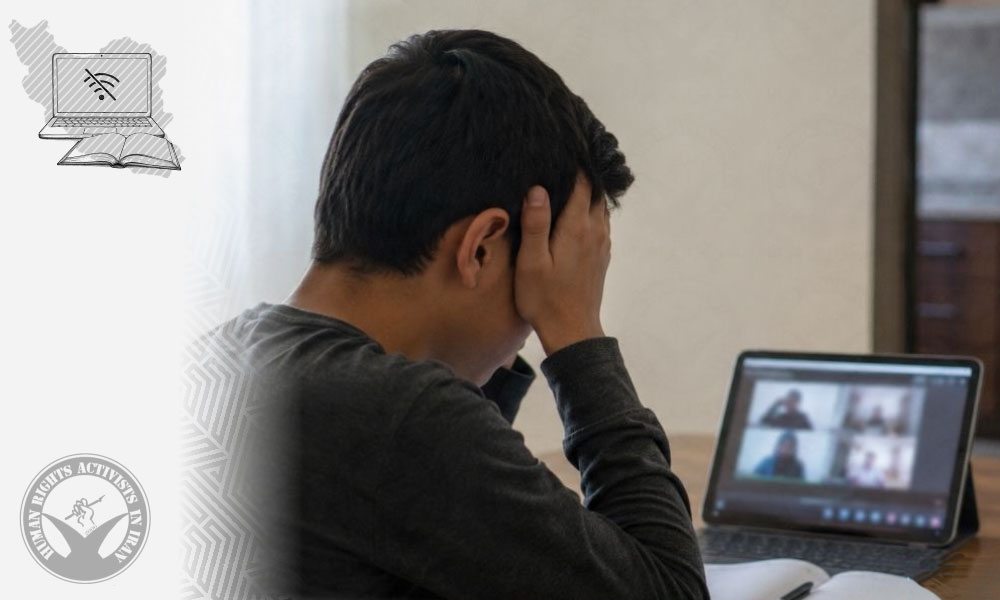
A Report on the Poor Quality of Virtual Education and Deprivation of Access to Learning

HRANA – While virtual education was initially intended as a temporary solution to allow students to continue their studies during the wartime crisis, many families and teachers now say that rather than serving as a sustainable substitute for in-person schooling, it has led to a severe decline in the quality of education.

The following report, prepared by HRANA based on interviews with students’ families, teachers, school administrators, and education experts, examines the deepening crisis of remote education in Iran. The report explores how widespread internet disruptions, inadequate educational infrastructure, limited access to digital equipment, mounting economic pressure on families, and the absence of coherent planning for an uncertain future have severely undermined access to effective education across the country.

Many of the individuals interviewed by HRANA say that education in recent months has effectively been left adrift amid internet outages, unstable educational platforms, and contradictory decisions by officials. According to them, this situation has not only reduced the quality of learning but has also raised serious concerns about students’ educational future.

After schools were closed due to wartime conditions, education initially continued through an application called Shad. However, widespread disruptions in the platform forced many schools to move classes to another application called Rubika, a platform which, according to families and teachers, also suffers from numerous problems. Many students say that online classes either fail to open altogether or experience constant interruptions in audio and video during sessions. Some educational files fail to upload, and in certain cases, even sending a simple video or audio file can take hours.

It is around 10 a.m., and a science class at a middle school has just begun, but the teacher’s voice keeps cutting in and out. Several students repeatedly write in the class group chat: “We can’t hear anything,” “The image isn’t loading,” “The file won’t open.” A few minutes later, the class becomes inaccessible, and attempts to reconnect begin again. One parent says this happens almost every day.

She says:

“Some days, the children spend more time clicking the refresh button than actually studying, just hoping the class will reconnect. In the end, the class is left unfinished because either the teacher gets exhausted or the internet cuts out.”

The mother of an elementary school student says her child has effectively lost concentration and connection with schoolwork:

“Most of the class time, the children are saying things like ‘Ma’am, the sound cut out’ or ‘The image isn’t loading.’ Sometimes the class doesn’t open at all. In the end, half the lesson remains unfinished.”

She says many families have been forced to increase spending on internet access and mobile phones so their children can attend classes, yet despite this, the quality of education remains poor.

In some areas, the problem is not limited to software disruptions; restricted or weak internet access has also caused some students to effectively fall behind in the educational process. A high school teacher says some of her students can only join classes using their parents’ mobile phones, and if the parents are at work, those students are effectively deprived of attending class that day.

She says:

“We send files, but many students either don’t have suitable internet access or can’t open the files at all. Some only mark their attendance and then leave the class completely because the phone doesn’t belong to them.”

According to her, virtual education in recent weeks has become more like attendance registration than real learning:

“Sometimes at the end of class I ask the students if they understood anything. They stay silent. Some of them don’t even know what the teacher taught because half the class was disconnected.”

In some households, several students are forced to share a single mobile phone in order to attend classes. Some parents also say that due to economic hardship, they cannot afford suitable phones or reliable internet access, placing additional pressure on students.

The father of one student in southern Tehran says:

“We have three school-age children, but only one relatively functional phone at home. When their classes are held at the same time, one or two of them are effectively deprived of attending lessons.”

In some areas, power outages have further compounded the problems of online education. Families say there have been many instances where students were disconnected from online classes or exams due to electricity cuts and internet shutdowns.

An eleventh-grade student says:

“Sometimes it takes half an hour just to enter the class. And when we finally connect, the teacher says there’s no time and rushes through the lesson. In the end, we don’t understand anything.”

At the same time, amid the ongoing disruptions, some schools attempted to hold limited in-person classes to compensate for students’ academic decline. However, according to families, these decisions were also accompanied by confusion and contradictory restrictions.

Several families say that during meetings, schools asked parents to provide written consent for remedial classes to be held outside the formal school environment, since the Ministry of Education had not authorized in-person classes inside schools.

One parent of an elementary school student says that during one of these meetings, it was suggested that classes be held at the local mosque or that families collectively rent a location for lessons.

She says:

“They asked us to let the children attend classes twice a week for two hours each time so they wouldn’t fall too far behind in their studies, but many families opposed the idea.”

According to her, families’ concerns are not limited to education alone; wartime conditions and insecurity have also made many unwilling to send their children to locations outside school premises.

“Some families said they would not allow their children to attend classes in mosques or unspecified places. Everyone is afraid of the situation. Private homes are also completely unsuitable for holding classes for such a large number of students.”

Following these disagreements, some schools, with the agreement of a number of parents, decided to hold limited classes at centers run by the Institute for the Intellectual Development of Children and Young Adults. However, these classes were also suspended after only a few sessions.

One teacher at a girls’ school in Tehran says that schools were later informed that no in-person classes should be held anywhere:

“We were told that under no circumstances were we allowed to hold in-person classes, neither inside the school nor anywhere else. They emphasized that education must remain entirely virtual.”

Some teachers say that even school principals often do not know exactly which directives are supposed to be implemented. Circulars change constantly, and decisions are sometimes completely reversed within just a few days.

One administrator at a private school says:

“One day they tell us to hold limited in-person classes, and two days later they call and tell us to cancel them immediately. Neither the families nor the schools know what they’re supposed to do.”

At the same time, some teachers report educational pressure and unofficial directives aimed at ensuring all students pass to the next grade, a development that has further deepened concerns about declining educational standards.

One high school teacher, who asked not to be named, says schools have recently been instructed that students at all grade levels must be promoted, even if their academic performance is weak.

She says:

“Some teachers were told that if a student fails, the teacher themselves would have to hold remedial summer classes until the student passes. In practice, it means no one is supposed to fail.”

According to her, under such conditions, assessing students’ actual learning has become nearly impossible:

“When a student hasn’t had proper classes, real exams, or full access to education, how can anyone know what level they’re really at? But in the end, we’re still expected to pass everyone.”

Some families say their children have lost motivation to study in recent months. The mother of a ninth-grade student says her son spends hours in front of a mobile phone but ultimately learns very little from class:

“At the end of the night, when I ask him what he learned today, he says, ‘Nothing, the internet kept disconnecting and the teacher couldn’t teach.’”

Another parent says:

“Children used to have school, recess, friends, and teachers. Now their entire school has turned into a mobile phone screen that constantly freezes.”

Educational experts have warned for years about the consequences of unstable education, but families say their concern today is not merely declining grades, but the deterioration of real learning quality. According to them, many students are advancing to higher grades without properly learning foundational concepts.

One elementary school teacher says some of her students are now struggling even with reading and writing, yet will likely still be promoted to the next grade:

“A child who still hasn’t fully learned this year’s lessons is going to move up to the next grade. This problem isn’t just about this year, its effects may only become visible years later.”

Some psychologists and education activists have also warned about the psychological consequences of the current situation. They say the combination of insecurity, prolonged isolation, unstable education, and economic pressure could have long-term effects on students’ concentration, motivation, and mental health.

One educational counselor in Tehran says:

“We’re not only facing academic decline. Some students have developed feelings of exhaustion, hopelessness, and constant anxiety. For some children, school no longer has the meaning it once did.”

While officials describe the continuation of virtual education as a solution for overcoming the crisis, many families and teachers say what is actually taking place is more a form of minimum crisis management than real education. Students whose classes are disrupted by internet outages, interrupted audio and video, unopened files, and contradictory educational decisions are now expected to advance to higher grades without proper evaluation.

For many families, the concern is not simply falling behind in a few subjects. They say the real issue is a generation of students who, during one of the most important periods of their education, have lost access to regular and effective learning, a generation that now experiences school mainly through a mobile phone screen; a screen on which classes sometimes fail to load, the teacher’s voice cuts out, and in the end, the only thing left from a school day is a recorded attendance mark.

At night, in many homes, students still try to download files sent by teachers or watch videos that fail to load. Some parents sit beside their children in hopes that an online class might finally proceed without interruption, while others simply hope the school year ends as soon as possible.

Overall, at a time when the country’s formal education system remains caught between closures, virtual learning, and bans on in-person classes, many students are experiencing not education itself, but a state of educational uncertainty, an uncertainty whose real consequences may only become clear years from now.

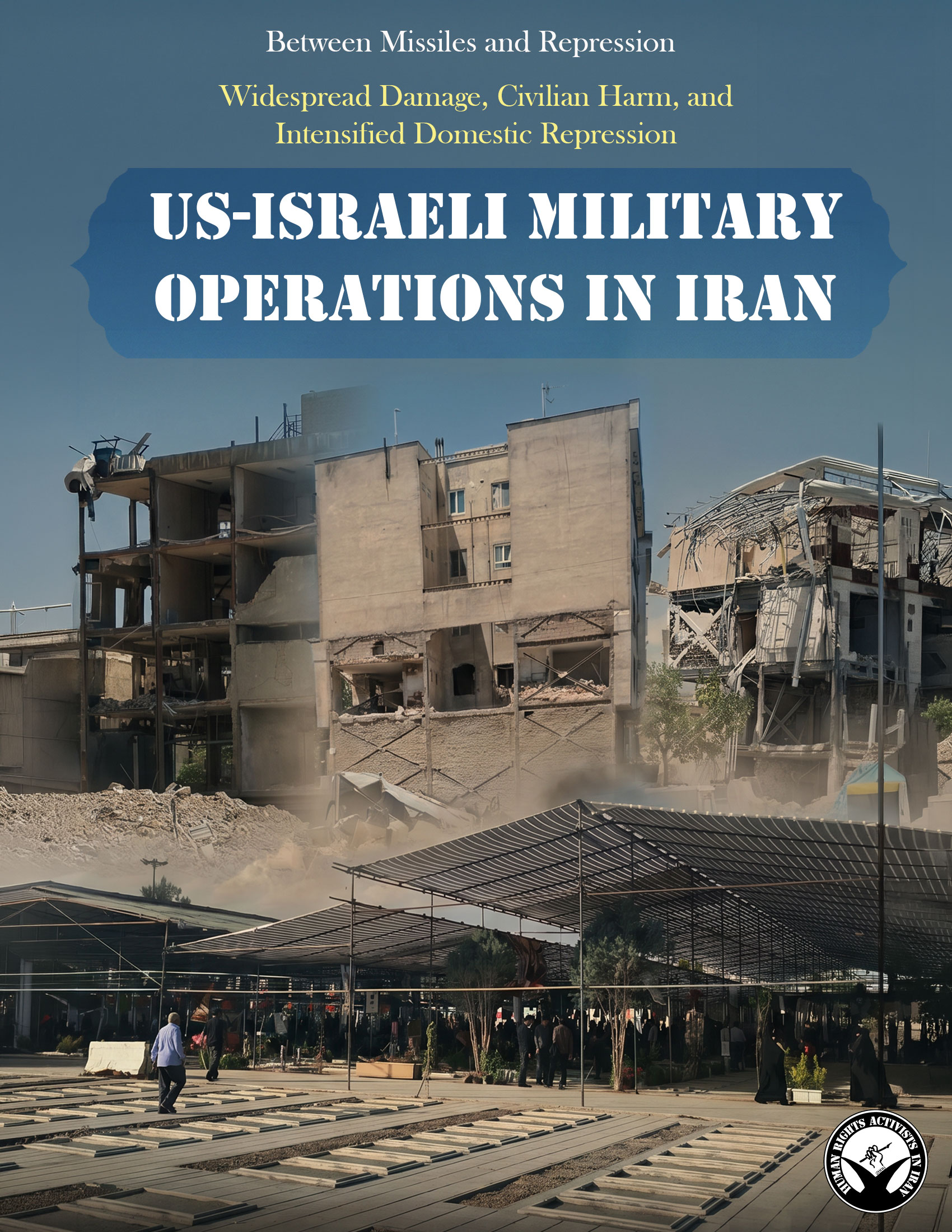
Between Missiles and Repression; HRA Releases New Report on US/Israeli Operations in Iran

HRANA – Today, Human Rights Activists in Iran (HRA) released a new report examining the US and Israeli military campaign in Iran between 28 February and 8 April 2026. The report documents 6,324 unique incidents comprising 12,798 distinct attacks, based on 177 verified sources, including open-source reporting and HRA’s in-country network.

It is important to note that the report is not intended to provide a comprehensive account of the conflict. Rather, its findings are limited to incidents documented and verified within HRA’s dataset.

Methodology

HRA relies on two primary and parallel workflows to document the scale of destruction and associated civilian harm.

First, HRA systematically collects open-source information, which is cross-checked against credible external reporting and corroborated through its established in-country network.

Second, HRA receives direct reports from its network, which are independently verified through additional contacts or cross-referenced with open-source material. In all cases, inclusion requires corroboration from at least two independent sources, with consistency in key details such as time, location, and nature of the incident.

HRA also separately preserves official narratives and state-reported figures, which are not incorporated into verified casualty counts. Incident data and casualty figures presented in the report represent documented minimums only and do not capture the full scope of harm.

Key Findings

◾️HRA documented 6,324 unique incidents comprising 12,798 distinct attacks between 28 February and 8 April 2026. Within HRA’s dataset, 77 percent of incidents involved civilian harm or damage to civilian objects.
◾️Of HRA’s verified incidents, Tehran province accounted for 44.85 percent of documented incidents, followed by Isfahan (10.5 percent), Khuzestan (6.74 percent), and Alborz (6.23 percent), indicating that some of Iran’s most densely populated provinces experienced a disproportionate concentration of attacks and civilian harm.
◾️
HRA documented at least 3,636 fatalities, including 1,701 civilians, 1,221 military personnel, and 714 individuals whose identity or status could not be confirmed. These figures should be understood as minimums.
◾️
HRA verified the deaths of 307 children and injuries to 2,213 children as a result of the attacks. HRA documented attacks affecting schools, sports facilities, parks, and residential areas where children were present, a majority on the first day of the conflict.

The report identifies several patterns that raise serious concerns under international humanitarian law, including:

◽️apparent failures in target verification,
◽️use of artificial intelligence with minimal human oversight,
◽️
inadequate and inaccessible warnings,
◽️
the use of large explosive weapons in populated areas,
◽️
Repeated or “double-tap” strikes,
◽️
attacks targeting widespread civilian infrastructure

Public rhetoric by senior US and Israeli officials also raised concerns, particularly statements suggesting disregard for rules of engagement and direct threats directed at civilian infrastructure.

◾️HRA independently verified damage to the following (noncomprehensive):

▫️108 educational facilities
▫️50 healthcare facilities
▫️122 cultural and religious sites
▫️381 industrial and commercial facilities
▫️173 electricity generation and distribution sites
▫️191 judicial and law enforcement facilities

HRA additionally documented conduct by Iranian authorities that increased civilian exposure to harm.

At the same time, Iranians experienced a convergence of harm through increased domestic repression. At least 4,023 individuals were arrested on accusations including espionage, threats to national security, or sharing information related to the conflict. Conditions inside detention facilities sharply deteriorated, while authorities expanded checkpoints, intensified movement restrictions, and imposed a prolonged internet blackout that reduced national connectivity to approximately 1 percent of normal levels. Between 28 February and 13 May, HRA documented 50 executions, including 32 carried out on political and security-related grounds. HRA also documented increased child presence at Basij checkpoints following an IRGC recruitment campaign targeting children as young as 12 years old.

Annexes

The report annexes include:

◾️a detailed list and analysis of weapons and munitions documented during the conflict, prepared with the support of HRA’s internal weapons specialist,
◾️casualty documentation,
◾️
detainee documentation,
◾️
and a compilation of HRA’s ground reporting, open-source verification, and exclusive visual documentation

Click on the image to download the full report

Subscribe to Our Newsletter

Now is definitely not the time to stop reading!

Alarming Figures: 70% of Post-War Executions Involve Political Prisoners; A Comprehensive List of the Sentenced and Executed

List of 16 protesters sentenced to death
1. Mohammad Abbasi
Arrest Date: January 22, 2026
Place of Arrest: Malard
Sentencing Judge: Abolghasem Salavati
Branch: Branch 15, Tehran Revolutionary Court
Charge: Moharebeh (enmity against God)
Latest Case Status: Sentence upheld by the Supreme Court
Place of Detention: Ghezel Hesar Prison, Karaj
2. Abolfazl Salehi Siavashani
Arrest Date: January 2026
Place of Arrest: Karaj
Sentencing Judge: Abolghasem Salavati
Branch: Branch 15, Tehran Revolutionary Court
Charge: Moharebeh through participation in operational activities against national security, including collaboration with Israel, the United States, and opposition groups; entering classified military sites with intent to remove weapons and ammunition; destruction and arson of state property with intent to oppose the Islamic Republic
Latest Case Status: Death sentence issued at the initial trial (not final)
Place of Detention: Ghezel Hesar Prison, Karaj
3. Bita Hemmati
Arrest Date: January 9, 2026
Place of Arrest: Tehran
Sentencing Judge: Iman Afshari
Branch: Branch 26, Tehran Revolutionary Court
Charge: Operational action in favor of a hostile state (United States) and hostile groups
Latest Case Status: Death sentence issued at the initial trial (not final)
Place of Detention: Unknown
4. Mohammadreza Majidi-Asl
Arrest Date: January 9, 2026
Place of Arrest: Tehran
Sentencing Judge: Iman Afshari
Branch: Branch 26, Tehran Revolutionary Court
Charge: Operational action in favor of a hostile state (United States) and hostile groups
Latest Case Status: Death sentence issued at the initial trial (not final)
Place of Detention: Unknown
5. Kourosh Zamani-Nejad
Arrest Date: January 9, 2026
Place of Arrest: Tehran
Sentencing Judge: Iman Afshari
Branch: Branch 26, Tehran Revolutionary Court
Charge: Operational action in favor of a hostile state (United States) and hostile groups
Latest Case Status: Death sentence issued at the initial trial (not final)
Place of Detention: Unknown
6. Behrouz Zamani-Nejad
Arrest Date: January 9, 2026
Place of Arrest: Tehran
Sentencing Judge: Iman Afshari
Branch: Branch 26, Tehran Revolutionary Court
Charge: Operational action in favor of a hostile state (United States) and hostile groups
Latest Case Status: Death sentence issued at the initial trial (not final)
Place of Detention: Unknown
7. Ehsan Hosseinipour Hesarlou
Arrest Date: January 2026 (Dey 1404)
Place of Arrest: Pakdasht County
Sentencing Judge: Iman Afshari
Branch: Branch 26, Tehran Revolutionary Court
Charge: Acting against internal security through effective participation in unrest; assembly and collusion against national security; involvement in the murder of two individuals; intentional arson of Seyed al-Shohada Mosque; destruction of public property
Latest Case Status: Death sentence issued at the initial trial (not final)
Place of Detention: Khorin Prison
8. Matin Mohammadi
Arrest Date: January 2026
Place of Arrest: Pakdasht County
Sentencing Judge: Iman Afshari
Branch: Branch 26, Tehran Revolutionary Court
Charge: Acting against internal security through effective participation in unrest; assembly and collusion against national security; involvement in the murder of two individuals; intentional arson of Seyed al-Shohada Mosque; destruction of public property
Latest Case Status: Death sentence issued at the initial trial (not final)
Place of Detention: Khorin Prison
9. Erfan Amiri
Arrest Date: January 2026
Place of Arrest: Pakdasht County
Sentencing Judge: Iman Afshari
Branch: Branch 26, Tehran Revolutionary Court
Charge: Acting against internal security through effective participation in unrest; assembly and collusion against national security; involvement in the murder of two individuals; intentional arson of Seyed al-Shohada Mosque; destruction of public property
Latest Case Status: Death sentence issued at the initial trial (not final)
Place of Detention: Khorin Prison
10. Maryam Hodavand
Arrest Date: January 2026
Place of Arrest: Pakdasht County
Sentencing Judge: Iman Afshari
Branch: Branch 26, Tehran Revolutionary Court
Charge: Acting against internal security through effective participation in unrest; assembly and collusion against national security; involvement in the قتل of two individuals; intentional arson of Seyed al-Shohada Mosque; destruction of public property
Latest Case Status: Death sentence issued at the initial trial (not final)
Place of Detention: Evin Prison
Additional Info: 45 years old, mother of two
11. Masih Abbaskhani Davanlou
Arrest Date: February 2026
Place of Arrest: Sari
Sentencing Judge: Unknown
Branch: Judicial authorities of Sari (unspecified)
Charge: Identified as a leader of protests and responsible for the death of a Basij member named Amin Ziaei on January 7, 2026 (18 Dey 1404)
Latest Case Status: Death sentence issued at the initial trial (not final)
Place of Detention: Sari Prison
Additional Info: Forced confessions broadcast on state media
12. Farzad Moradi
Arrest Date: January 27, 2026
Place of Arrest: Izeh
Sentencing Judge: Unknown
Branch: Ahvaz Revolutionary Court (unspecified)
Charge: Moharebeh and forming an armed group
Latest Case Status: Death sentence issued
Place of Detention: Sheiban Prison, Ahvaz
13. Shahab Dadkhah
Arrest Date: January 2026
Place of Arrest: Shiraz
Sentencing Judge: Unknown
Branch: Shiraz Revolutionary Court (unspecified)
Charge: Setting fire to a base and killing a special forces officer
Latest Case Status: Death sentence issued (not final)
Place of Detention: Adel-Abad Prison, Shiraz
14. Majid Nasiri
Arrest Date: January 2026
Place of Arrest: Shiraz
Sentencing Judge: Unknown
Branch: Shiraz Revolutionary Court (unspecified)
Charge: Setting fire to a base and killing a special forces officer
Latest Case Status: Death sentence issued (not final)
Place of Detention: Adel-Abad Prison, Shiraz
15. Unidentified (co-defendant of Majid Nasiri and Shahab Dadkhah)
Arrest Date: January 2026
Place of Arrest: Shiraz
Sentencing Judge: Unknown
Branch: Shiraz Revolutionary Court (unspecified)
Charge: Setting fire to a base and killing a special forces officer
Latest Case Status: Death sentence issued (not final)
Place of Detention: Adel-Abad Prison, Shiraz
16. Ali Pishevarzadeh
Arrest Date: January 8, 2026
Place of Arrest: Rasht
Sentencing Judge: Unknown
Branch: Rasht Revolutionary Court (unspecified)
Charge: Moharebeh through setting fire to a mosque and the Rasht bazaar
Latest Case Status: Death sentence issued (not final)
Place of Detention: Lakan Prison, Rasht


List of 10 protesters who were executed
1. Mehdi Ghasemi
Arrest Date: mid-January 2026
Place of Arrest: Qom
Sentencing Judge: Unknown
Branch: Judicial authorities of Qom
Charge: Moharebeh (enmity against God) through use of a cold weapon in unlawful gatherings leading to the killing of law enforcement agents; operational action for Israel and the hostile government of the United States and affiliated actors; inciting people to war and murder with intent to disrupt national security
Execution Date: March 19, 2026
Place of Execution: Public execution in Qom
2. Saleh Mohammadi
Arrest Date: January 15, 2026
Place of Arrest: Qom
Sentencing Judge: Unknown
Branch: Judicial authorities of Qom
Charge: Moharebeh (enmity against God) through use of a cold weapon in unlawful gatherings leading to the killing of law enforcement agents; operational action for Israel and the hostile government of the United States and affiliated actors; inciting people to war and murder with intent to disrupt national security
Execution Date: March 19, 2026
Place of Execution: Public execution in Qom
3. Saeed Davoudi
Arrest Date: Late January 2026 (late Dey 1404)
Place of Arrest: Qom
Sentencing Judge: Unknown
Branch: Judicial authorities of Qom
Charge: Moharebeh (enmity against God) through use of a cold weapon in unlawful gatherings leading to the killing of law enforcement agents; operational action for Israel and the hostile government of the United States and affiliated actors; inciting people to war and murder with intent to disrupt national security
Execution Date: March 19, 2026
Place of Execution: Public execution in Qom
4. Amirhossein Hatami
Arrest Date: January 8, 2026
Place of Arrest: Tehran
Sentencing Judge: Abolghasem Salavati
Branch: Branch 15, Tehran Revolutionary Court
Charge: Moharebeh (enmity against God) through participation in operational activities against national security for Israel, the United States, and opposition groups; entering classified military sites to remove weapons; destruction and arson of state property
Execution Date: April 2, 2026
Place of Execution: Ghezel Hesar Prison, Karaj
5. Mohammadamin Biglari
Arrest Date: January 8, 2026
Place of Arrest: Tehran
Sentencing Judge: Abolghasem Salavati
Branch: Branch 15, Tehran Revolutionary Court
Charge: Moharebeh (enmity against God) through participation in operational activities against national security for Israel, the United States, and opposition groups; entering classified military sites to remove weapons; destruction and arson of state property
Execution Date: April 5, 2026
Place of Execution: Ghezel Hesar Prison, Karaj
6. Shahin Vahedparast
Arrest Date: January 8, 2026
Place of Arrest: Tehran
Sentencing Judge: Abolghasem Salavati
Branch: Branch 15, Tehran Revolutionary Court
Charge: Moharebeh (enmity against God) through participation in operational activities against national security for Israel, the United States, and opposition groups; entering classified military sites to remove weapons; destruction and arson of state property
Execution Date: April 5, 2026 (16 Farvardin 1405)
Place of Execution: Ghezel Hesar Prison, Karaj
7. Ali Fahim
Arrest Date: January 8, 2026
Place of Arrest: Tehran
Sentencing Judge: Abolghasem Salavati
Branch: Branch 15, Tehran Revolutionary Court
Charge: Moharebeh (enmity against God) through participation in operational activities against national security for Israel, the United States, and opposition groups; entering classified military sites to remove weapons; destruction and arson of state property
Execution Date: April 6, 2026
Place of Execution: Ghezel Hesar Prison, Karaj
8. Amirali Mirjafari
Arrest Date: January 2026
Place of Arrest: Tehran
Sentencing Judge: Unknown
Branch: Judicial authorities of Tehran
Charge: Operational action for the Israeli regime and hostile governments; collaboration with Mossad-linked networks; arson of Qolhak Grand Mosque; destruction of public property; blocking roads; attacking security forces with cold weapons
Execution Date: April 21, 2026
Place of Execution: Unknown
9. Erfan Kiani
Arrest Date: January 2026
Place of Arrest: Isfahan
Sentencing Judge: Unknown
Branch: Isfahan Revolutionary Court
Charge: Moharebeh (enmity against God) through use of a cold weapon (machete) to intimidate the public, create insecurity, incite violence, and participate in destruction of public property
Execution Date: April 25, 2026
Place of Execution: Unknown
10. Sasan Azadvar Junaqani
Arrest Date: January 1, 2026
Place of Arrest: Isfahan
Sentencing Judge: Seyed Mahmoud Kazemzadeh, with special advisor Mohammad Vakili
Branch: Branch 1 of the Isfahan Revolutionary Court
Charge: Moharebeh (enmity against God)
Execution Date: April 30, 2026
Place of execution: Dastgerd Prison, Isfahan


Since January 2026, at least 12 other political or security prisoners have also been executed.
1. Kourosh Keyvani (Iranian-Swedish dual national)
Arrest Date: June 16, 2025 (26 Khordad 1404)
Place of Arrest: Savojbolagh
Sentencing Judge: Unknown
Branch: Tehran Revolutionary Court
Charge: Espionage for Israel
Execution Date: March 18, 2026 (27 Esfand 1404)
Place of Execution: Unknown
2. Akbar Daneshvarkar
Arrest Date: 2023
Place of Arrest: Unknown
Sentencing Judge: Iman Afshari
Branch: Branch 26, Tehran Revolutionary Court
Charge: Baghi (armed rebellion) through membership in opposition groups (People’s Mojahedin Organization of Iran)
Execution Date: March 30, 2026 (10 Farvardin 1405)
Place of Execution: Ghezel Hesar Prison, Karaj
3. Seyed Mohammad Taghavi-Sangdehi
Arrest Date: March 2024 (Esfand 1402)
Place of Arrest: Chaldoran County
Sentencing Judge: Iman Afshari
Branch: Branch 26, Tehran Revolutionary Court
Charge: Baghi (armed rebellion) through membership in opposition groups (People’s Mojahedin Organization of Iran)
Execution Date: March 30, 2026 (10 Farvardin 1405)
Place of Execution: Ghezel Hesar Prison, Karaj
4. Babak Alipour
Arrest Date: January 2024 (Dey 1402)
Place of Arrest: Tehran
Sentencing Judge: Iman Afshari
Branch: Branch 26, Tehran Revolutionary Court
Charge: Baghi (armed rebellion) through membership in opposition groups (People’s Mojahedin Organization of Iran)
Execution Date: March 31, 2026 (11 Farvardin 1405)
Place of Execution: Ghezel Hesar Prison, Karaj
5. Pouya Ghabadi
Arrest Date: March 2024 (Esfand 1402)
Place of Arrest: Chaldoran County
Sentencing Judge: Iman Afshari
Branch: Branch 26, Tehran Revolutionary Court
Charge: Baghi (armed rebellion) through membership in opposition groups (People’s Mojahedin Organization of Iran)
Execution Date: March 31, 2026 (11 Farvardin 1405)
Place of Execution: Ghezel Hesar Prison, Karaj
6. Abolhassan Montazer
Arrest Date: January 2024 (Dey 1402)
Place of Arrest: Tehran
Sentencing Judge: Iman Afshari
Branch: Branch 26, Tehran Revolutionary Court
Charge: Baghi (armed rebellion) through membership in opposition groups (People’s Mojahedin Organization of Iran)
Execution Date: April 4, 2026 (15 Farvardin 1405)
Place of Execution: Ghezel Hesar Prison, Karaj
7. Vahid Baniamerian
Arrest Date: January 2024 (Dey 1402)
Place of Arrest: Tehran
Sentencing Judge: Iman Afshari
Branch: Branch 26, Tehran Revolutionary Court
Charge: Baghi (armed rebellion) through membership in opposition groups (People’s Mojahedin Organization of Iran)
Execution Date: April 4, 2026 (15 Farvardin 1405)
Place of Execution: Ghezel Hesar Prison, Karaj
8. Mohammad Masoum Shahi
Date of arrest: May 13, 2025
Place of arrest: Tehran
Sentencing judge: Unknown
Branch: Karaj Revolutionary Court
Charges: Moharebeh (enmity against God), cooperation with a hostile state, assembly and collusion against national security, and membership in a group with the intent to disrupt national security
Date of execution: April 20, 2026
Place of execution: Unknown
9. Hamed Validi
Date of arrest: May 13, 2025
Place of arrest: Tehran
Sentencing judge: Unknown
Branch: Karaj Revolutionary Court
Charges: Moharebeh (enmity against God), cooperation with a hostile state, assembly and collusion against national security, and membership in a group with the intent to disrupt national security
Date of execution: April 20, 2026
Place of execution: Unknown
10. Mehdi Farid
Arrest Date: Winter 2023 (1401)
Place of Arrest: Tehran
Sentencing Judge: Unknown
Branch: Unknown
Charge: Efsad-e fel-arz (corruption on earth) through cooperation with Israel
Execution Date: April 22, 2026 (2 Ordibehesht 1405)
Place of Execution: Unknown
11. Soltanali Shirzadi Fakhr
Arrest Date: Unknown
Place of Arrest: Unknown
Sentencing Judge: Unknown
Branch: Unknown
Charge: Cooperation with Israel and Moharebeh (enmity against God)
Execution Date: April 23, 2026 (3 Ordibehesht 1405)
Place of Execution: Unknown
12. Amer Ramesh
Arrest Date: October 2024 (Mehr 1403)
Place of Arrest: Chabahar
Sentencing Judge: Unknown
Branch: Zahedan Revolutionary Court
Charge: Baghi (armed rebellion) and membership in an armed opposition group (Jaish al-Adl)
Execution Date: April 26, 2026 (6 Ordibehesht 1405)
Place of Execution: Zahedan Prison


Regarding the nationwide protests of January 2026

It should be noted that protests and strikes by shopkeepers and bazaar merchants began in Tehran on Sunday, December 28, 2025, and within two days spread beyond markets and commercial centers. With the participation of students, citizens, and various social groups, these protests became one of the largest protest movements of recent years. Following the crackdown by security and law enforcement forces, thousands were killed or injured, and tens of thousands were arrested or summoned by security agencies. For more information, readers may refer to HRANA’s comprehensive report titled “Crimson Winter,” documenting the first fifty days following the outbreak of Iran’s nationwide protests.

International Workers’ Day: A Year in Review of Iranian Workers’ Conditions

HRANA – May 1st marks International Workers’ Day, offering another opportunity to reflect on the condition of the country’s labor community and their numerous challenges, particularly regarding wages and salaries, unpaid wages, workplace safety, and the right to form labor unions.

According to a report by HRA’s Statistics and Documents Center, based on a review of labor-related reports published over the past 12 months (from May 1, 2025 to April 28, 2026), at least 5,019 workers were reported injured or killed in workplace incidents during this period by media outlets or organizations active in this field.

At least 586 workers lost their lives in workplace incidents during this period. Authorities and relevant institutions reported 284 deaths in 10 official reports, while independent organizations collected and updated 302 additional cases of worker fatalities that had not been mentioned in official statements.

At least 4,433 workers were also injured in workplace accidents. In 9 official reports or statements at national and provincial levels, authorities announced that 3,846 individuals had been injured. In addition, 587 other cases were documented and reported by civil or labor organizations.

Despite the significance of these figures, it should be noted that, due to the lack of transparency in reporting by responsible institutions and officials, the majority of workplace incidents go unreported in the media.

Most workers in Iran operate under conditions lacking job security and adequate insurance coverage. A shortage of inspectors and weak safety infrastructure have created serious challenges in the registration and prevention of occupational accidents.

As shown in the chart below, based on the data collected by HRA’s Statistics And Documents Center, the causes of these incidents are distributed as follows: 20.28% construction-related accidents, 15.91% falls from height, 15.21% struck by hard objects, 11.89% fires, 7.69% mining incidents, 7.17% traffic accidents, 5.94% electrocutions, 3.32% explosions, 2.97% gas poisoning, 2.45% accidents in wells, 2.27% in factories, 2.10% poisoning, 1.05% drowning, 0.52% heatstroke, 0.52% smoke inhalation, 0.52% in petrochemical and refinery sectors, and 0.17% agricultural accidents.

Workplace Accident Categorization Chart

According to data compiled by HRA’s Statistics and Documents Center, at least 613 months of unpaid wages have been recorded across 119 industrial and service units.

Breakdown of Wage Arrears by Sectors

Based on reports collected by this organization’s statistics department, 51% of wage arrears are related to government entities, 25% to private sector organizations, 13% to the energy sector, and 11% remain unspecified.

Estimates indicate a high level of protest activity within the labor community; however, over the past year, only a portion of these protests, specifically 682 labor gatherings and 691 guild-related gatherings, have been reported by media outlets or civil society organizations. Compared to the previous year, guild-related gatherings decreased by 39.6%, while labor gatherings declined by 7.5%.

Among the most significant events in Iran over the past year were protests by workers of the Middle East Sugarcane Agro-Industry Company, the Karkheh Mianab Sugarcane Agro-Industry Company, railway technical and infrastructure workers, the National Iranian Steel Industrial Group, the Qalat Ghareh Oil Company, as well as guild-related protests by teachers, retirees, and Social Security pensioners.

Over the past 12 months, various cities across Iran have witnessed diverse forms of protest actions by workers. A wide range of workers have taken to the streets due to non-payment of their monthly wages and the neglect of their insurance-related demands. Some of these workers have gone on strike and protested after going as long as 30 months without receiving their pay. In total, 383 labor strikes and 39 guild-related strikes took place. Labor strikes decreased by 72.1%, while guild-related strikes declined by 43.4%.

Workers’ ability to organize in Iran to pursue their demands faces legal challenges and state repression. Repression, obstruction, and the refusal to recognize the rights of trade unions and independent labor organizations, along with the imprisonment and issuance of prison sentences for several labor activists, as well as restrictions on the right to protest, have contributed to the fragmentation and disorganization of some labor gatherings and protests.

In Iran, labor organizations do not exist in the conventional global sense, and independent groups such as the Syndicate of Workers of the Tehran and Suburbs Bus Company, the Haft Tappeh Sugarcane Workers’ Syndicate, the Coordinating Council of Teachers’ Union Organizations, and the Free Union of Iranian Workers face security and political charges.

Many workers have been arrested or sentenced on charges such as organizing peaceful gatherings and protesting low wages. Over the past 12 months, at least 10 workers and labor activists have been arrested. Among the most notable cases are the arrests of several workers from the Isfahan Steel Company and five workers from the Middle East Sugar Factory in Shush.

It is also worth noting that Sharifeh Mohammadi and Mehran Raouf are among the prominent labor activists currently imprisoned, alongside union activists such as Asghar Amirzadegan, Ahmad Alizadeh, and Mohammad Hassan Davoudi.

In addition, one can point to the sentencing of two labor activists to a total of 75 months of discretionary imprisonment and fines amounting to 30 million tomans, two cases of self-immolation, the trial of two individuals, the summoning of nine individuals to judicial and security authorities, the closure of 10 factories, 2,922 cases of dismissal and workforce reduction, 114,954 cases of unemployment, 839,953 instances of workers lacking insurance coverage, and 3,806 cases of employment uncertainty.

Furthermore, in the area of unions and union/guild activities, a total of 40 arrests of union activists, 317 months of discretionary imprisonment and 3 months of suspended sentences, 24 cases of deprivation of social rights, 148 lashes, fines totaling 359.1 million tomans, and 120 months of internal exile for 67 union activists were reported. Additionally, there was 1 case of travel ban, 16 trials in judicial authorities, 43 summonses to judicial-security bodies, 195 cases of business closures (sealings), 18 cases of dismissal and workforce reduction, at least 105 months of unpaid wages, 407 cases of forced retirement, 8 house searches, 4 sentence enforcements, 2 cases of physical assault, and 1 case of self-immolation.

Over the past year, teachers and education sector workers, both active and retired, across various cities and provinces in the country staged protest gatherings and strikes in response to the failure to address their demands. In total, 40 gatherings were recorded. Over the past year, 32 cases of arrest, 37 summonses, 16 trials in judicial authorities, 4 instances of sentence enforcement, 18 cases of dismissal, workforce reduction, and bans from teaching, as well as 7 cases of forced retirement among teachers, were documented.

Additionally, 64 teachers and activists in this field were sentenced to a total of 269 months of discretionary imprisonment and 3 months of suspended sentences, 74 lashes, 23 cases of deprivation of social rights, and fines amounting to 359.1 million tomans.

The head of the National Association of Union Organizations of Construction Workers reported a worsening state of uncertainty and deteriorating living conditions for this group due to wartime circumstances. Akbar Shokat stated: “The most important issue for construction workers is employment. Many of them work on a daily wage basis and rely on just a few days of work per week to cover their living expenses. However, under current conditions, even these limited opportunities have declined, and their livelihoods are facing serious challenges. Wartime conditions have led to the closure of many workshops, and rising prices—especially in the steel sector—have further reduced employment in this field.”

A workers’ representative in the Supreme Labor Council announced that the cost of a basic livelihood basket for a worker’s household this year has reached approximately 40 to 45 million tomans per month, while the minimum income of workers is around 15 million tomans. This highlights a significant gap between income and living expenses. According to Mohammadreza Tajik, to bridge this gap, the minimum wage would need to increase by 17 million tomans to reach around 31 million tomans. Even with a 100% wage increase, workers’ livelihood problems would not be fully resolved, and wage-setting should be based on preserving purchasing power rather than merely percentage increases.

The executive secretary of the Workers’ House in Rey, referring to the sharp rise in healthcare costs and deficiencies in the supplementary insurance of the Social Security Organization, stated that in recent months, increasing imposed and unlawful medical expenses have become a problem worse than the illness itself for many retirees and workers. Mohammadali Torkashvand added that the ability to pay for medical expenses has become impossible for many. He further noted that the “Obligation Plan” of the Social Security Organization, one of its core responsibilities, has not been properly implemented for years. If properly enforced, there would be no need for supplementary insurance, and many healthcare-related problems of retirees would be resolved.

The executive secretary of the Workers’ House in Qazvin stated that today, workers remain hungry despite working double shifts. Wages are not aligned with current inflation, and with daily price changes, 70 to 80 percent of workers’ income is spent on food. Eydali Karimi added that housing allowance is only 900,000 tomans, while in many cases, an entire worker’s salary is spent on rent. Workers and retirees are also under severe pressure from medical costs, with even a simple surgery now costing over 100 million tomans.

Ali Moghaddasi-Zadeh, head of the Coordinating Council of Islamic Labor Councils of South Khorasan, stated that in mining cities such as Tabas and Eastern Alborz, there are still no Social Security hospitals. According to him, this has forced mine workers, who earn very low wages, to bear heavy medical costs in public and private hospitals in the event of accidents. Moghaddasi-Zadeh identified the main cause of this situation as the “existing Social Security law,” explaining: “According to current regulations, a dedicated hospital will not be built until the number of insurance booklets reaches 100,000, whereas in Tabas alone, at least 11,000 workers and their families require insurance services.” He emphasized that this law must be revised so that workers can access Social Security healthcare services in their place of residence.

The prohibition of child labor and the provision of free education for children, the establishment of the highest safety standards in work environments, and the removal of discriminatory laws against women and migrant workers are among the key demands of the labor community.

Despite being described as the cheapest labor force in the country, Iranian women workers face worse employment conditions than men and receive fewer legal protections, rights, and benefits.

At the same time, women workers have less bargaining power compared to their male counterparts. Moreover, production and industrial units show less willingness to hire married women, and in some cases employ single women under commitments not to marry or become pregnant.

The situation of women workers in small workshops is significantly worse. Women make up half of the workforce in brick kilns, where they work under extremely harsh conditions.

In Iran, International Workers’ Day arrives at a time when the privatization of factories and state-owned companies continues without regard for the long-term interests of workers, a trend that has led to widespread labor protests.

World Day for Safety and Health at Work: One-Year Statistical Report on Workplace Accidents in Iran

HRANA – On the occasion of World Day for Safety and Health at Work, the Human Rights Activists in Iran have examined the situation of workplace accidents caused by unsafe environments or working conditions over the period from 3 May 2025 to 27 April 2026.

According to data compiled by the organization’s statistics department, during this period, at least 586 workers lost their lives and at least 4,424 workers were injured due to workplace accidents resulting from unsafe environments or working conditions.

In 2003, the International Labour Organization (ILO), after extensive review, designated April 28 as World Day for Safety and Health at Work. The aim is to raise awareness about occupational safety and health, with an emphasis on preventing workplace accidents and diseases. In effect, it is an international campaign highlighting the importance of improving workplace safety and its impact on reducing work-related fatalities. Accordingly, governments are required to develop systematic policies and programs to monitor and enforce compliance with occupational safety and health regulations. It is also noteworthy that since 1996, labor unions worldwide have marked this day as a global day of remembrance for workers killed or injured on the job.

According to HRA’s Statistics And Documents Center, based on reports published over the past 12 months, the deaths of at least 586 workers due to workplace accidents linked to unsafe conditions have been reported by media outlets or relevant organizations.

In addition, 4,424 cases of work-related injuries have been reported and compiled by the organization’s statistics department.

Among the most tragic and notable incidents of the past year are: the deaths of 9 workers in a fire at an industrial workshop in Borkhar, located in Isfahan province; the poisoning of 17 workers by carbon monoxide gas in a cold storage facility in Fariman, Razavi Khorasan Province; the death and injury of 13 workers in a fire at the Kaveh Methanol Petrochemical plant; and the death and injury of 3 miners following a coal mine collapse in Nahroudbar, located in Mazandaran Province.

Based on the data collected by HRA’s Statistics And Documents Center, the causes of these incidents are distributed as follows: 20.28% construction-related accidents, 15.91% falls from height, 15.21% struck by hard objects, 11.89% fires, 7.69% mining incidents, 7.17% traffic accidents, 5.94% electrocutions, 3.32% explosions, 2.97% gas poisoning, 2.45% accidents in wells, 2.27% in factories, 2.10% poisoning, 1.05% drowning, 0.52% heatstroke, 0.52% smoke inhalation, 0.52% in petrochemical and refinery sectors, and 0.17% agricultural accidents.

Workplace Accident Categorization ChartWorkplace Accident Categorization Chart

A Statistical Overview of Human Rights Violations in Iran in the Hijri Year 1404

HRANA – The year 1404 (Hijri calendar) paints a stark picture of ongoing human rights violations in Iran. The ongoing threat to freedom of thought and expression, bloody crackdown on peaceful protesters, increasing pressure on ethnic groups and religious minorities, the prosecution and harassment of human rights activists, the execution of juveniles, the issue of child labor, violations of women’s rights, and the poor conditions of detention centers and prisons are only some examples of the daily violations of human rights in Iran.

The comprehensive report by HRA’s Statistics and Documentation Center, presented below, outlines a deeply concerning human rights situation in Iran over the past year.

During this period (March 21, 2025 to March 20, 2026), a total of 78,907 citizens were arrested in Iran on ideological or political grounds, or in clear violation of fundamental human rights principles. Notably, 78,126 of these arrests were linked to cases involving freedom of thought and expression.

During the same period, the nationwide protests between December 2025 and February 2026 can be regarded as one of the most complex and multi-layered waves of unrest in the past two decades. These demonstrations differed markedly from previous protests in their geographical reach, the extent of repression, and the nature of the government’s response.

Taken together, these developments point to one of the most significant periods of repression in recent years, particularly in terms of the scale of arrests. However, due to internet shutdowns during the protests and subsequent restrictions, the actual number of arrests is likely higher than recorded, with some cases remaining outside statistical coverage due to limited access to information. For more details, refer to HRANA’s comprehensive report titled “Crimson Winter,” which documents the first fifty days after the start of Iran’s nationwide protests.

Freedom of Thought and Expression

In 1404, at least 78,126 individuals were arrested for expressing their thoughts and opinions, of whom at least 228 were detained without a judicial warrant. Additionally, there were 250 cases of physical assault, 126 trials, 75 home searches, 15 instances of publications being declared criminal, 26 cases of internet filtering, 1 case of confiscation of a home and property, 793 protest gatherings, 11,744 summonses to security and judicial bodies, and 74 cases of prison sentences being carried out.

Over the past year, in violation of citizens’ right to freedom of expression, Iran’s judiciary issued a total of at least 13,812 months of imprisonment for 332 individuals. Of this amount, 13,173 months were discretionary prison sentences, and 639 months were suspended sentences. Notably, 1,693 months of these sentences were issued by appellate courts and 816 months by the Supreme Court.

In addition, 64 individuals were fined a total of 2,640.8 million tomans, 13 individuals were sentenced to 624 lashes, 13 individuals were sentenced to 492 months of exile, and 46 individuals were sentenced to deprivation of social rights.

Over the past year, Iran witnessed nationwide protests between December 2025 and February 2026, widely known as the January protests, which are considered one of the most widespread, complex, and multi-layered waves of unrest in the past two decades. These protests differed significantly from previous movements not only in terms of their geographical scope, intensity of violence, and scale of repression, but also in their underlying dynamics, the composition of participants, and the nature of the government’s response.

According to aggregated data from HRANA, during these protests, the number of confirmed fatalities reached 6,724 protesters, including 236 children. In addition to these confirmed figures, 11,744 cases remain under review, with the verification process still ongoing. Furthermore, at least 25,877 individuals sustained severe injuries, and the total number of arrests has been reported at 53,777.

Overall, 203 cities across all 31 provinces of the country witnessed protests on 682 occasions. In some cases, due to the heavy presence and strict control of security and military forces, protesters were unable to take to the streets, and demonstrations took other forms. Based on the 2016 census, the population of these 203 cities is estimated at 44,866,746—accounting for more than half of the country’s total population.

In addition to 627 instances of widespread street protests, 36 universities also became sites of student demonstrations, with 55 protest gatherings recorded across academic settings.

Annual Statistical Comparison of Arrests in the Past Five Years (Freedom of Thought and Expression)
YearNumber of ArrestsArrests per
Million People
Percentage Change
Compared to Previous Year
14001,41916+ %5,405
140128,64732+ %172,7
14022,49638.6+ %3,030
14031,30014.2+ %5,909
140478,126845,4

Workers’ Rights

Over the past year, a total of 1,709 reports were recorded related to labor rights, based on which 20 individuals were arrested. Additionally, 2 workers or labor activists were sentenced to a combined 75 months of discretionary imprisonment and fines totaling 30 million tomans. It is also noteworthy that 9 summonses to security and judicial authorities, 5 interrogations, 2 trials, 2 cases of self-immolation, 724 protests, and 390 strikes were recorded.

In 1404, reports of delayed or unpaid wages amounted to at least 672 months across 188 industrial and service units. Additionally, there were 2,457 dismissals or layoffs, 658 cases of unemployment, 560 months without work insurance coverage, 9 factory closures, and 2,259 workers left in uncertain conditions.

Workers’ Rights-1404

Trade and Labor Unions

In 1404, a total of 914 reports related to trade and unions groups were recorded by HRA’s Statistics and Documentation Center. According to these reports, a total of 39 union activists were arrested. Additionally, there were 44 summonses to judicial and security authorities, 191 cases of business closures (sealed premises), 2 instances of physical assault, 1 license revocation, 17 trials in judicial bodies, 4 interrogations by security institutions, 18 dismissals or layoffs, 407 cases of forced retirement, 757 protests, at least 41 strikes, at least 105 months of delayed wages, 4 home searches, and 4 cases of prison sentences being carried out.

Furthermore, 46 individuals were sentenced to a total of 347 months of imprisonment, including 344 months of discretionary sentences and 3 months of suspended sentences. Of this total, 89 months were issued by appellate courts. In addition, 2 individuals were sentenced to 120 months of exile, 2 individuals to 148 lashes, and 27 individuals were fined a total of 359.1 million tomans.

Trade and Labor Unions-1404

Prisoners’ Rights

Regarding prisoners’ rights in 1404, documented violations included 25 cases of physical assault against prisoners, 182 instances of denial or lack of access to medical care for prisoners and detainees, 307 transfers to solitary confinement, and 172 hunger strikes by prisoners and detainees.

Additionally, there were 38 cases of forced transfers, 187 instances of threats and pressure against political and ideological prisoners, 28 cases of denial of visitation, 14 deaths due to illness, 17 suicides, and 4 cases of murder of prisoners.

Further violations included 108 cases of denial of access to legal counsel, 256 instances of deprivation of the right to phone contact, 14 cases of failure to separate prisoners based on charges, 2,520 cases of detention in inappropriate conditions, 398 instances of forced confessions, and 11 cases of denial of medical leave.

Moreover, 716 cases of enforced disappearance (lack of information on detainees’ whereabouts) and 1,390 cases of detainees being kept in uncertain or unresolved legal status were documented.

Prisoners’ Rights-1404

Executions

As in previous decades following the 1979 revolution, executions remain one of the most prominent manifestations of human rights violations in Iran. In 1404, at least 2,488 individuals were executed, including 63 women and 2 juvenile offenders. Of these, 13 executions were carried out in public.

During the same period, 130 individuals, including 10 women and 1 juvenile offender, were sentenced to death, of whom 4 were sentenced to public execution. It should also be noted that, within this timeframe, the initial death sentences of an additional 45 individuals were upheld by the Supreme Court.

Annual Statistical Comparison of Executions in the Past Five Years
YearNumber of
Executions
Executions
per Million People
Percentage Change
Compared to Previous Year
14003514.0+ %608.8
14016206.9+ %301.2
14027718.5+ %222.6
1403106912.0+ %132.7
1404248826.94


Execution Rate by Province (Executions Per 100,000 People)
ProvincePopulationNumber of
Executions
Execution
Rate
Razavi Khorasan7,109,0002353.31
Alborz3,028,0002006.61
Isfahan5,429,0001783.28
Fars5,136,0001492.9
Lorestan1,792,0001307.26
Khuzestan5,115,0001292.52
Kerman3,413,0001012.96
Hamedan1,769,000985.54
East Azerbaijan4,092,000842.05
South Khorasan845,000799.35
Markazi1,472,000795.37
Qom1,454,000795.43
Sistan and
Baluchestan
3,280,000762.32
Yazd1,314,000755.71
Gilan2,569,000742.88
Semnan787,000729.15
Mazandaran3,415,000681.99
West Azerbaijan3,529,000651.84
Kermanshah1,999,000623.1
Qazvin1,346,000584.31
Zanjan1,119,000534.74
Golestan2,016,000512.53
North Khorasan875,000434.91
Kohgiluyeh and
Boyer-Ahmad
759,000435.67
Bushehr1,277,000413.21
Hormozgan2,018,000391.93
Ilam597,000294.86
Kurdistan1,689,000281.66
Ardabil1,299,000221.69
Chaharmahal and
Bakhtiari
997,000191.91
Annual Statistical Comparison of Arrests in the Past Five Years (Ethnic Minorities’ Rights)
YearNumber of ArrestsArrests per
Million People
Percentage Change
Compared to Previous Year
14003584.05– %42.1
14012424.73– %14.4
14023714.09– %44.2
14033323.63– %37.6
14042072.24


Ethnic Minorities’ Rights-1404

Religious Minority Rights

In 1404, a total of 190 reports on violations of religious minority rights in Iran were recorded, according to which 169 citizens were arrested. Additionally, a total of 6,927 months of discretionary imprisonment and 798 months of suspended sentences were issued for 95 individuals. Of this total, 3,837 months were handed down by lower courts and 3,888 months by appellate courts.

Furthermore, 26 individuals were fined a total of 4,739 million tomans, and 9 individuals were sentenced to 288 months of exile.

In addition, 141 summonses to judicial and security authorities, 37 trials, 51 interrogations, 1 case of cemetery destruction, 126 home searches, 33 travel bans, 40 cases of prison sentences being carried out, 33 cases of confiscation of homes and property, and 10 cases of prevention of economic activity were reported.

Annual Statistical Comparison of Arrests in the Past Five Years (Religious Minorities’ Rights)
YearNumber of ArrestsArrests per
Million People
Percentage Change
Compared to Previous Year
1400670.76+ %152.2
14011751.95– %3.4
14021481.63+ %14.1
14031241.35+ %36.2
14041691.83
Judicial Authorities Issuing the Most Sentences in Religious Minorities’ Rights
Judge NameCourt BranchNumber
of Cases
Prison Sentences
(Months)
Fine
(Million
Toman)
SabzevariBranch 2 of Revolutionary Court, Karaj880
Abbasali HouzanBranch 36 of the Court of Appeals, Tehran Province81002910
Ashkan RameshBranch 1 of Revolutionary Court, Varamin5495
Abolghasem SalavatiBranch 15 of Revolutionary Court, Tehran5660
Hassan FathnejadBranch 3 of Revolutionary Court, Tabriz22882000


Religious Minority Rights

Protests and Strikes

At least 2,551 protest gatherings took place across Iran. These included 724 labor protests, 757 guild and trade union gatherings, 793 protests related to freedom of thought and expression, 40 demonstrations concerning the right to education, and 32 related to environmental issues.

Additionally, 205 protest gatherings were held across all 31 provinces by citizens—many of them defrauded investors or individuals whose civil rights had been violated. Alongside these demonstrations, at least 41 union strikes and 390 labor strikes were also recorded.

Killing of Citizens

Throughout 1404, a total of 32,820 citizens were targeted by gunfire from military forces. Of these, 6,822 lost their lives, including 15 Kolbars (border porters), 23 Sookhtbars (fuel carriers), and 6,784 other citizens.

Additionally, 25,998 citizens were injured as a result of indiscriminate shootings by military personnel, including 22 Kolbars, 25,963 ordinary citizens, and 13 Sookhtbars.

It should also be noted that 8 other Kolbars were affected by environmental and geographical conditions, such as hypothermia, pursuit by military forces, and falls from height, resulting in 4 being injured and 4 losing their lives. Moreover, 84 Sookhtbars were involved in incidents during pursuits by military forces, of whom 76 were killed and 8 injured.

Furthermore, during the war involving the United States and Israel against Iran, which began on February 28, 2026 (9 Esfand 1404), an attack on the “Shajareh Tayyebeh” girls’ school in Minab resulted in the deaths of a number of students. According to reported figures, at least 168 people were killed and 95 others injured in this attack.

Since the onset of these hostilities, the number of civilian casualties has reached 1,369, including at least 207 children. Additionally, the status of 627 other individuals remains unclear, as it has not been determined whether they were civilians or military personnel.

Killing of Citizens-1404

Landmine and Explosion Victims

Landmines left over from past conflicts continue to threaten the lives of residents in border regions each year. The Iranian government also continues to produce and deploy anti-personnel mines and, contrary to international conventions, maintains that their use is the only effective way to secure the country’s long borders.

According to data from the past year, at least 19 citizens lost their lives due to landmine explosions in border areas, while 20 others were injured.

Landmine and Explosion Victims-1404

Flogging and Amputation Sentences

The International Covenant on Civil and Political Rights explicitly prohibits the use of degrading punishments that violate human dignity, such as flogging and amputation. Nevertheless, according to data collected in 1404, sentences of flogging were carried out for at least 2 defendants, who had been collectively sentenced by Iranian judicial authorities to 48 lashes.

In addition, the judiciary issued sentences totaling 3,684 lashes for at least 82 individuals. Furthermore, amputation sentences were carried out for 6 defendants who had been convicted by Iranian courts, while 5 others were also sentenced to amputation.

Flogging and Amputation Sentences-1404

Arrests

Over the past year, the arrest of 78,907 citizens in Iran represents a clear violation of the rights to freedom of expression, political freedom, and other fundamental human rights. Among these, 78,126 cases were directly related to the exercise of freedom of thought and expression.

Other notable cases include the arrest of 20 workers and labor activists, 343 individuals under the age of 18, 39 union activists, 169 members of religious minorities, and 207 individuals from ethnic minority backgrounds.

Regarding the latter group, although the charges against 234 individuals remain unclear, these arrests have been classified as violations of ethnic and national minority rights based on available indicators and the documented pattern of conduct by security institutions.

Additionally, at least 3 arrests were recorded for non-compliance with compulsory hijab and for women singing in public spaces.

Statistical Comparison of Arrests over the Past Five Years
YearNumber of ArrestsArrests per
Million People
Percentage Change
Compared to Previous Year
1400188421.3+ %4,088
140129,95033.4+ %163.4
14023,86442.7+ %1,942
14032,49127.2+ %3,067
140478,907847.5

Arrests-1404

Convictions

In 1404, judicial authorities across the country issued rulings in 483 cases, sentencing defendants in political or security-related cases to a total of 20,832 months of discretionary imprisonment and 1,440 months of suspended sentences. Of this total, 15,585 months were issued by lower courts, 5,847 months by appellate courts, and 840 months by the Supreme Court.

In addition, the judiciary imposed fines totaling 7,409.8 million tomans, as well as 3,684 lashes, 59 travel bans, 101 cases of deprivation of social rights, and 900 months of internal exile.

Five-year comparison of convictions based on the number of individuals
YearNumber of individuals
Convicted
Percentage Change
Compared to Previous Year
1400310+ %55.8
14011,075– %55
1402843– %42.7
1403744– %35
1404483
Five-Year Comparison of Convictions Based on the Total Months of Imprisonment Issued
YearNumber of months of
imprisonment
Percentage Change
Compared to Previous Year
140013,316+ %67.2
140133,671– %33.8
140233,790– %34
140327,857– %20
140422,272

Convictions-1404

Judicial officials with the highest number of sentences issued over the past year
PictureJudge NameCourt BranchNumber
of Cases
Prison Sentences
(Months)
Fine
(Million
Toman)
Iman AfshariIman AfshariBranch 36 of Revolutionary Court, Tehran17705313.3
AnsariAli AnsariBranch 101 of Criminal Court No. 2, Oshnavieh15326
Abbasali HouzanBranch 36 of the Court of Appeals, Tehran Province1313711110
Ehsan Adibi MehrBranch 1 of Revolutionary Court, Ahvaz11720
SabzevariBranch 2 of Revolutionary Court, Karaj11172
SalavatiAbolghasem SalavatiBranch 15 of Revolutionary Court, Tehran111296
Yaser GuzaliBranch 1 of Revolutionary Court, Mahabad9268
VelaeiBranch 101 of Criminal Court No. 2, Miandoab927
Ahad SiamiBranch 2 of Revolutionary Court, Mahabad6720
Ashkan RameshBranch 1 of Revolutionary Court, Varamin5495

In conclusion, it should be noted that the statistics presented in this report cannot be considered a complete reflection of the human rights situation in Iran. This is due to the fact that the Iranian government does not allow independent human rights organizations to operate freely or access necessary sources.

Therefore, these findings should be regarded as a minimum estimate of the human rights situation in Iran, based solely on data reported by civil institutions, including HRANA, and compiled and documented by the organization’s Statistics Center.

For further information, readers are encouraged to consult the organization’s 2025 annual report, which has been recently published.

The Crimson Winter: A 50 Day Record of Iran’s 2025–2026 Nationwide Protests

HRANA- Published today, this comprehensive report examines developments during the first fifty days following the eruption of nationwide protests in Iran on December 28, 2025, providing a detailed account of the unfolding events and the state response from December 2025 through February 2026.

Compiled through a coordinated, multi team documentation effort across HRA’s news agency HRANA, Spreading Justice, the Pasdaran Documentation Project, and the Statistics Department, the roughly 1,350 page report preserves a structured record of the opening phase of Iran’s 2025–2026 nationwide protests and the state response.

The findings are derived from more than 143,330 HRANA reports drawn from confidential and open sources, collected, verified, and analyzed during the 50-day window.

Download the full report in PDF format.

Why this report, and why now?

Large scale protest cycles generate two parallel dynamics: an unprecedented volume of documentation and a coordinated effort by state authorities to restrict communications, shape narratives, and intimidate sources. In this environment, the central risk is not only undercounting violations, but losing the ability to verify identities, locations, dates, and patterns while evidence remains recoverable.

This report adopts a disciplined human rights methodology centered on documenting minimum verifiable cases rather than publishing maximal estimates. It presents findings that can be substantiated through corroborated evidence, even where the broader scale of violations likely exceeds what can be confirmed in real time. The publication is intended both as a public record and as an archival foundation for legal analysis and future accountability processes.

What the report contains

The report maps the first fifty days of protests by addressing core accountability questions:

1. How did protests evolve and spread geographically

2. How did state forces respond, and through what structures

3. What forms of harm occurred

4. How did blackout conditions affect the availability, quality, and verification of information

5. How was content authenticated and cross checked in an environment shaped by surveillance, source risk, and restricted access

6. How were risks from manipulated, fabricated, or AI generated content identified and mitigated within the verification process

7. How can documented patterns be legally characterized

8. How can records, especially identities of victims and detainees, be preserved without increasing risk

Sections analyze protest trends and geography, university mobilization, slogans, the structure and tools of repression, patterns of violations including killings, injuries, arrests, coerced confessions, pressure on families, and attacks on medical neutrality, as well as legal analysis, international responses, and how HRA documentation initiatives mobilized.

At the center of the report are two core pillars: the verified accounting of those killed, including children, and the documented accounting of detainees, including minors, students, and individuals subjected to group arrests.
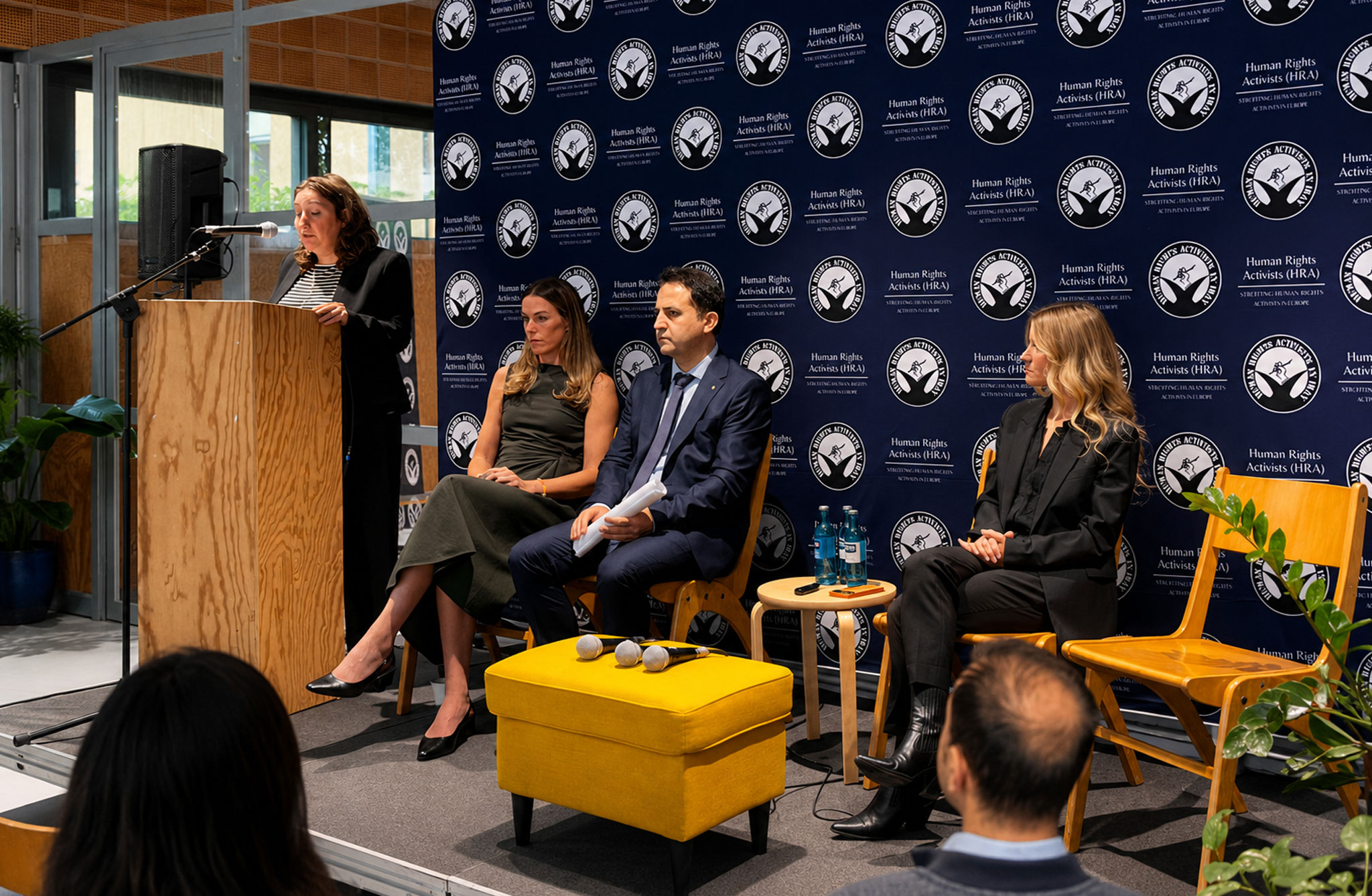
Key Findings

Geographic scope

• Total protest locations: 682

• Unique cities: 203

• Unique provinces: 31

The geographic distribution demonstrates that both protest activity and state response were nationwide in scope.

Student mobilization

• University protests documented: 55

• Protesting universities: 36

Universities emerged as central civic spaces within the broader protest movement and the state response.

Fatalities: scale and composition

Across the first fifty days covered by this report, consolidated documentation records:

• Protesters killed: 6,488

• Children killed, counted separately and not included among protesters: 236

• Civilians killed, non-protester: 76

• Military and government forces killed: 207

• Total fatalities: 7,007

An additional 11,744 cases remain under review and are not included in confirmed totals. Separately, HRA documented eight civilian deaths resulting from clashes between civilians in public. The categorical separation is deliberate. Distinguishing protesters, children, non-protester civilians, and government or pro-government fatalities prevents analytical conflation and enables clearer legal and statistical interpretation. The figures reflect a minimum verifiable record compiled under conditions where comprehensive access is not possible.
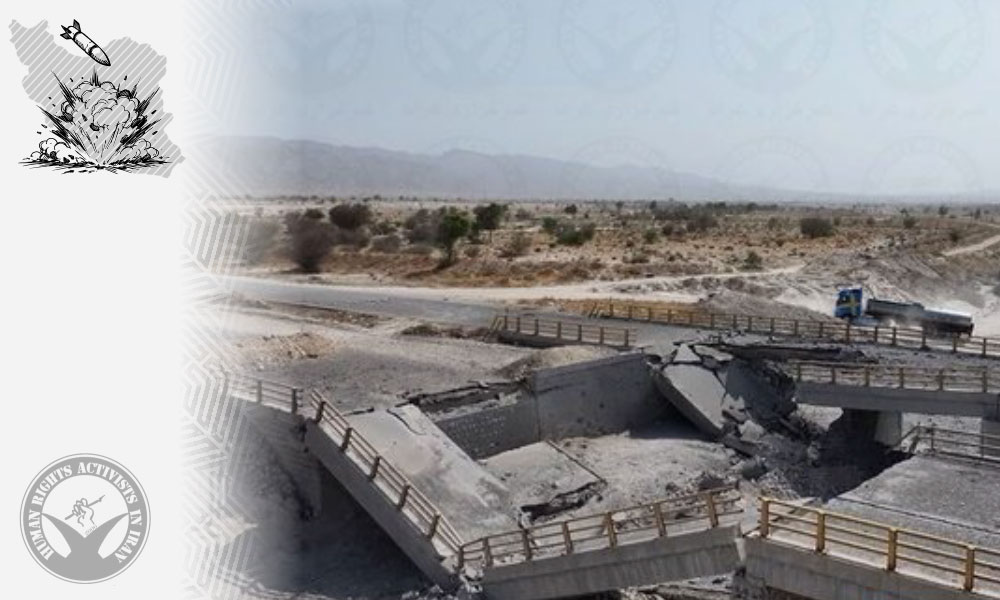
Injuries

• Injured military and security forces: 4,884

• Injured civilians: 25,846

These figures contextualize the breadth of harm beyond confirmed fatalities and illustrate the overall magnitude of violence.

Arrests

• Total arrests: 53,777

• Children, teenagers, and school students arrested: 555

• University students arrested: 147

Arrest figures include both individually identified cases and verified group arrests, reflecting documentation realities in which names are often unavailable or unsafe to publish.

Forced confessions

• Documented forced confessions: 369

The report treats coerced confessions as a systematic instrument of intimidation and narrative control within a heavily surveilled and restricted media environment.

Summonses

• Documented summonses: 11,053

Summonses function as a parallel mechanism of legal pressure, extending state control beyond those formally detained.

The List of the Deceased: Methodology and Protection

Appendix A contains the list of the deceased. Publication decisions are governed by a protection centered framework that weighs the public interest in disclosure against the risk of retaliation for relatives, witnesses, and HRANA’s network.

Where names are published, they are paired, where possible, with core identifiers including age, location, and documentation anchors used in verification. Entries are also paired with sources. Where a third-party source is listed as the primary source, HRANA has independently verified the information through its reporting network.


Where publication would create unacceptable risk, cases are reflected in verified totals and preserved within secure documentation systems for accountability purposes.

The list is the product of a structured, cross-checked verification methodology designed to preserve an accurate public record without increasing danger to those inside the country.

Legal Assessment and Accountability Relevance

The report includes a preliminary legal assessment, framing documented patterns as potential violations of international human rights law and, where applicable thresholds are met, international criminal law.

Patterns of lethal force, mass arrests, coerced confessions, and related violations are analyzed against legal standards governing the right to life, due process, freedom of expression and assembly, and protections against torture and cruel, inhuman, or degrading treatment.

By grounding its legal analysis with verified names, dates, locations, and corroborated patterns, the report connects documentation to concrete pathways for accountability.