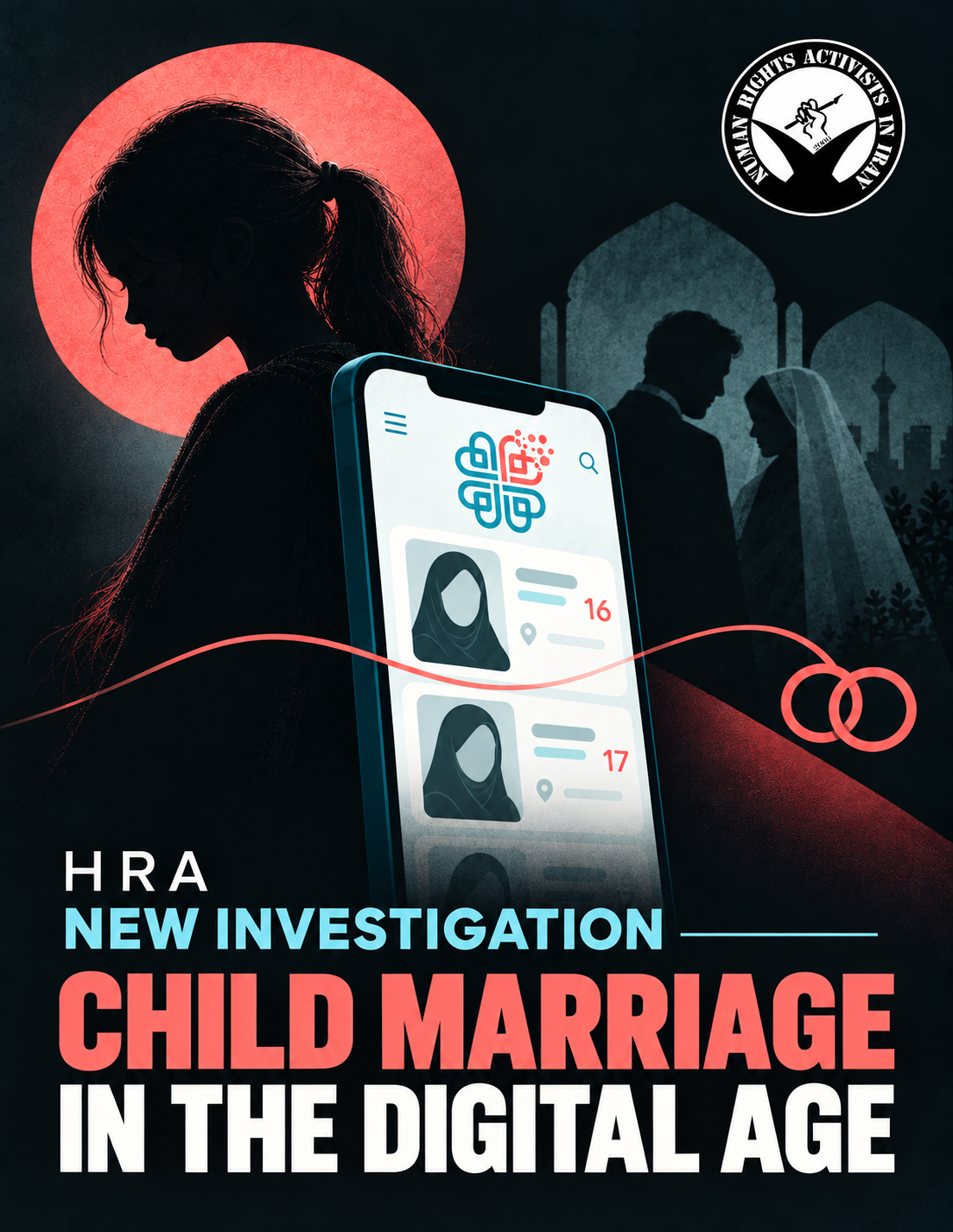
HRANA News Agency – A new investigation by Human Rights Activists (HRA) documents how Iran’s “Adam and Eve” matchmaking platform allows minors to be presented as prospective spouses, while operating within a broader system of state licensing, promotion, financial incentives, and institutional support. The report also examines the role of international technology companies—including Google and Meta—in distributing and promoting services that may expose children to marriage, exploitation, and other forms of harm.
Human Rights Activists (HRA) has published a new investigative report, Child Marriage in the Digital Age, examining how digital matchmaking services in Iran are creating new pathways through which child marriage can be facilitated and normalized.
The investigation focuses on Adam and Eve (Adam va Hava), a government-licensed Iranian matchmaking platform, but places the service within a much wider legal, political, financial, and technological ecosystem. The report examines Iran’s marriage laws and demographic policies, the state system for licensing and monitoring matchmaking services, state-media promotion, financial support for marriage initiatives, institutional links surrounding the platform, and the role played by international technology companies in providing access to and visibility for the service.
The investigation comes amid the rapid expansion of officially authorized matchmaking platforms in Iran. Iranian authorities reported only one licensed matchmaking platform in 2020. By 2023, the number had risen to 33, and by early 2025 more than 200 such services were reportedly operating with government authorization. This growth has taken place alongside state policies intended to encourage earlier marriage, higher fertility, and population growth.
Children Displayed as Prospective Spouses
Among the report’s most significant findings is evidence that minors can enter—and be publicly displayed within—the Adam and Eve matchmaking system.
Although the platform’s terms state that female users must be over 15 and male users over 18 to create accounts, HRA found that the system accepted a birth year corresponding to an age as low as 12, without presenting an age-specific warning or barrier. The platform also permits parents to establish matchmaking profiles for their children, creating another avenue through which minors can be entered into the system.
The platform’s search system allows users to filter prospective spouses beginning at age 13. When HRA searched for girls between 13 and 17 on October 5, 2026, the search returned the platform’s maximum display limit of 100 profiles, suggesting that additional profiles may exist beyond those shown. The results included girls as young as 13 and 14. The report also documents a marriage announcement published by Adam and Eve involving a 16-year-old bride and a 23-year-old groom.
The concerns extend beyond age eligibility. Users complete extensive questionnaires containing information about their location, education, religious beliefs, political views, dress and physical appearance, lifestyle, interactions with the opposite sex, and expectations for a future spouse. The platform also includes self-assessment questions addressing characteristics including physical appearance and sexual desire.
HRA found that information relating to minors could be browsed without logging in and observed no apparent distinction between how the platform displayed information belonging to children and adults. The report further documents how abbreviated matchmaking profiles—including information relating to minors—have been disseminated through messaging channels as advertisements for prospective spouses.
A Broader State Policy Framework
HRA’s investigation argues that the concerns surrounding Adam and Eve cannot be understood solely as the conduct of a private matchmaking company.
Iranian law itself permits marriage below 18. Article 1041 of the Civil Code permits marriage from age 13 for girls and 15 for boys, while marriages below those ages can also take place with guardian consent and court approval. Iran therefore has no absolute minimum age below which marriage is prohibited.
At the same time, the 2021 Law on the Protection of the Family and Youthful Population established a regulatory framework for licensing spouse-selection services and forms part of a broader pronatalist policy intended to reduce the average age of marriage and encourage childbirth.
The report documents several dimensions of state involvement: legal authorization of matchmaking platforms; regulatory monitoring of their activities; promotion through state media; and financial incentives supporting marriage and population policies.
Licensed spouse-finding platforms reportedly submit monthly information to the Ministry of Sports and Youth concerning new registrations, including applicants’ ages and marriages facilitated. According to the report, this means authorities are positioned to receive information concerning the ages of individuals using licensed services—an especially important issue where children are being displayed as prospective spouses.
State television has also actively promoted Adam and Eve. The report documents multiple appearances on Islamic Republic of Iran Broadcasting (IRIB), including calls encouraging young people to register with the platform.
Financial support forms another component of this framework. The report notes that government bodies are required to allocate portions of their budgets to organizations pursuing objectives such as facilitating marriage, encouraging childbirth, and strengthening families. According to figures cited in the investigation, a related 2025 budget line totaled approximately 180 billion tomans, while Adam and Eve reportedly received 17 billion tomans in March 2025 through registrations and marriages involving under-20 and under-15 age groups.
Institutional and Security Connections
The investigation also traces the organizational networks surrounding Adam and Eve.
The platform operates as an initiative of the Imam Reza Society, founded and led by Hossein Yekta, whom the report identifies as a senior Islamic Revolutionary Guard Corps (IRGC) commander. Yekta has publicly supported the platform and appeared in promotional material connected to it. He has also been sanctioned by the European Union and several European countries in relation to serious human rights violations.
The report goes on to document personnel and organizational connections involving the Imam Reza Society, Astan Quds Razavi-linked institutions, members of Adam and Eve’s leadership and academic structures, and other individuals with backgrounds in state and security institutions.
Taken together, HRA concludes that the facilitation of child marriage through Adam and Eve should not be viewed merely as an isolated failure of private-sector regulation. Rather, the platform functions within an environment of legal authorization, government oversight, state-media promotion, financial incentives, and institutional connections that collectively encourage earlier marriage and family formation.
The Role of Google and Meta
A major part of the report concerns the responsibilities of international technology companies whose services help distribute or promote Adam and Eve.
The Android application has been distributed through Google Play, where the report states it has received more than 100,000 downloads. Despite its matchmaking function and the evidence concerning minors, the application was listed with an “Everyone”/PEGI 3 rating, indicating suitability for all age groups.
The report notes that Google’s policies impose heightened child-protection requirements on dating and matchmaking applications and include mechanisms intended to restrict minors from age-inappropriate functionality. HRA therefore calls on Google to assess whether Adam and Eve complies with its policies concerning age verification, minor access, child safety, profile visibility, and content ratings.
The investigation also examines Meta, because Adam and Eve uses Instagram and Threads to promote its services and direct users toward the matchmaking platform. As of October 2026, its Instagram account had approximately 192,000 followers and nearly 800 posts, while its Threads account had almost 10,000 followers.
The report documents social-media posts explaining how to download and use the matchmaking service, as well as marriage announcements involving minors—including one involving a 17-year-old girl and a 30-year-old man.
The report argues that Google, Meta, and other technology providers should conduct enhanced human-rights and child-safeguarding due diligence where their products distribute, host, advertise, or otherwise facilitate access to services involving minors as prospective spouses.
It also calls for scrutiny of relevant ownership and institutional connections where sanctions-related concerns may arise.
From Domestic Reform to Corporate Accountability
The report concludes with recommendations directed at the Iranian government, United Nations mechanisms, international technology companies, and civil society.
Among them, HRA calls on Iran to establish 18 as the absolute minimum age of marriage, without exceptions; prohibit minors from being publicly displayed as prospective spouses; introduce meaningful age verification and child-safeguarding requirements; and suspend matchmaking services that register, display, or promote children.
The report urges UN mechanisms—including the Committee on the Rights of the Child—to examine the relationship between Iran’s marriage laws, pronatalist policies, and state oversight of digital matchmaking platforms. It also recommends examining child marriage within broader patterns of gender-based discrimination and potential gender persecution.
For technology companies, the recommendations include suspending distribution of matchmaking services pending child-safety review where credible evidence shows that minors are being presented as prospective spouses; independently reviewing age ratings; strengthening age verification and access controls; examining promotional activity; and conducting enhanced human-rights, child-safety, ownership, and sanctions due diligence.
Ultimately, the investigation argues that addressing child marriage in Iran requires looking beyond individual marriages or individual platforms. The issue increasingly intersects with state policy, digital infrastructure, corporate distribution systems, social media, and technology governance.
The report’s central warning is that digital systems through which children can be made visible and accessible as prospective spouses must themselves become part of efforts to end child marriage. Where credible evidence shows that children are being presented for marriage, governments, international institutions, civil society organizations, and technology companies all have responsibilities to examine the systems enabling that harm.