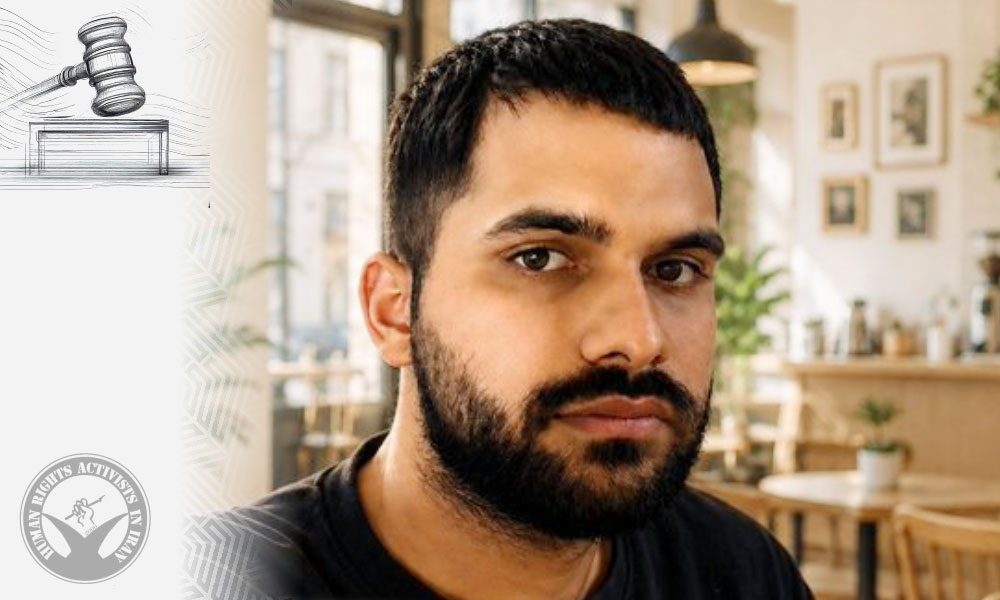
HRANA – The judiciary’s media center announced that in the early hours of today, Thursday, April 2, the execution sentence of Amirhossein Hatami was carried out. Mr. Hatami had been arrested in connection with the January 2026 protests in Tehran and was later sentenced to death and confiscation of property by the Tehran Revolutionary Court. Earlier this week, he had been transferred to solitary confinement in Karaj’s Ghezel Hesar Prison.
According to Mizan, the report states that after being arrested by the IRGC Intelligence during the January 8, 2026 protests, Mr. Hatami was prosecuted on charges of “participation in operational actions against the country’s security for Israel, the United States, and anti-government groups; entering classified military sites with the intent to remove weapons and ammunition; and destroying and setting fire to government property with the aim of confronting the system of the Islamic Republic.”
Ultimately, following court sessions, Mr. Hatami was sentenced to death and confiscation of property. The death sentence of this citizen, who had been imprisoned in Ghezel Hesar Prison, was reviewed by the Supreme Court, and after his appeal was rejected, the lower court’s ruling ordering his execution was upheld.
The report adds that during the January protests, Mr. Hatami had allegedly intended to enter a military center and gain access to the weapons stored there, but ultimately did not succeed in carrying out this action.
HRANA had previously reported that in recent days at least five prisoners, Amirhossein Hatami, Mohammadamin Biglari, Shahin Vahedparast Kalur, Abolfazl Salehi Siavashani, and Ali Fahim, were transferred to solitary cells in Unit Three of Ward 35 of Qezel Hesar Prison. Following the executions of Akbar Daneshvarkar, Seyed Mohammad Taghavi-Sangdehi, as well as Babak Alipour and Pouya Qobadi in recent days, the transfer of the remaining prisoners had heightened concerns about their fate and the risk that their sentences would also be carried out.
Amirhossein Hatami, approximately 19, was arrested on the evening of Thursday, January 8, near Namjoo Street in eastern Tehran by security forces. His case was heard by Branch 15 of the Tehran Revolutionary Court, presided over by Judge Abolqasem Salavati, and on February 6, 2026, he was sentenced to death.
According to the annual report on the state of human rights in Iran, published by the Statistics, Publications, and Works Unit of the Human Rights Activists in Iran, in 2026 at least 2,488 citizens, including 63 women and 2 juvenile offenders, were executed. Of these, 13 executions were carried out in public. During the same period, another 130 individuals, including 10 women and 1 juvenile offender, were sentenced to death.