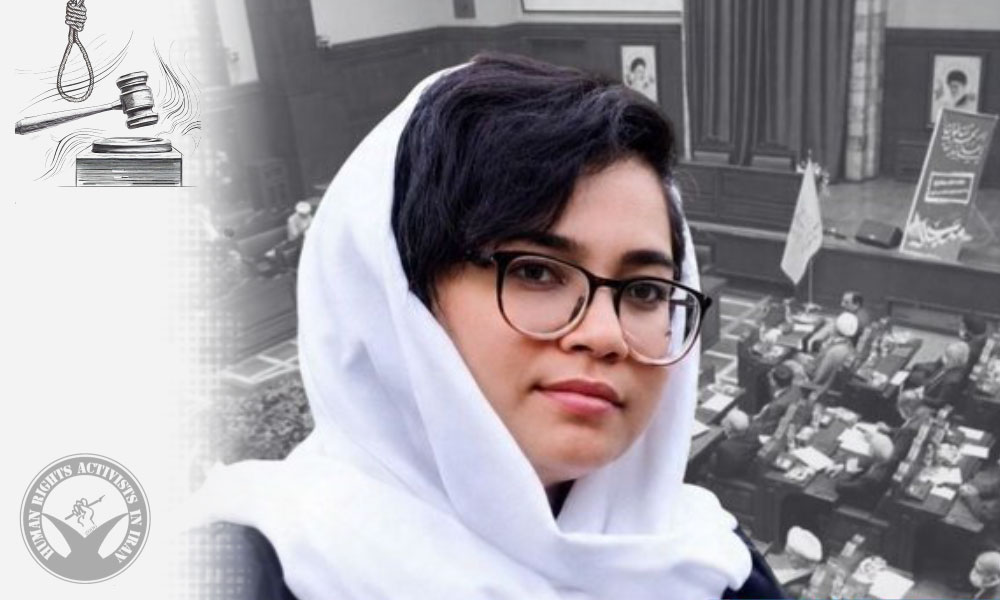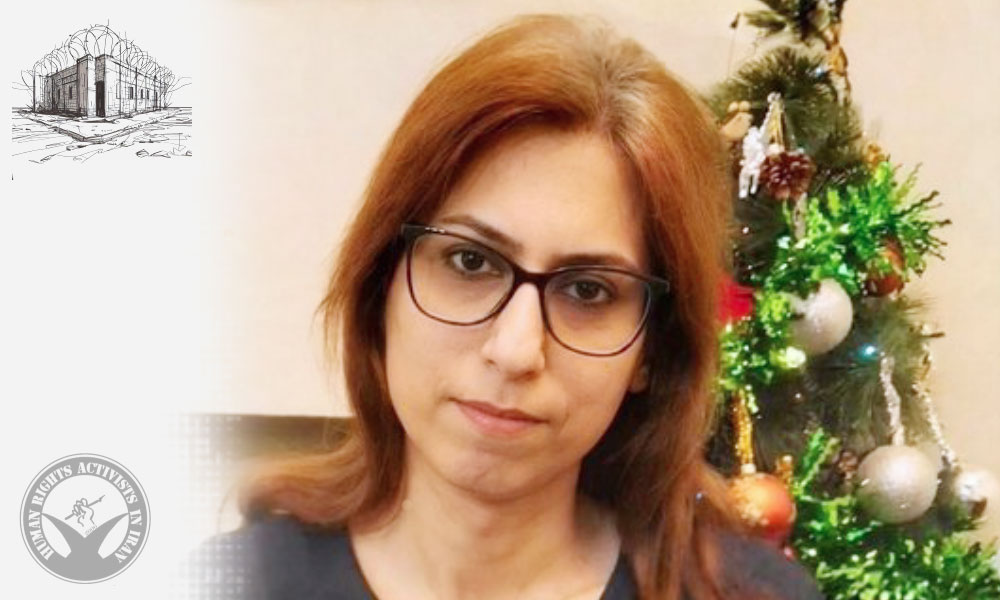
HRANA – Ghazal Marzban, a transgender woman incarcerated in Evin Prison, has written a letter describing her experience of sexual assault at one of the Ministry of Intelligence’s detention facilities. She says that following her arrest in May 2023, she was raped at the detention facility and subsequently threatened into remaining silent about the incident.
According to HRANA, Ghazal Marzban wrote in a letter, a copy of which was obtained by HRANA, that on May 17, 2023, while walking in a park, she was detained by several individuals and taken blindfolded to a location that she later learned was one of the Ministry of Intelligence’s operational detention facilities.
In describing what happened to her at the detention facility, she wrote that after being searched and forced to remove her clothes, she was left in a cell in the basement. According to Ms. Marzban, minutes later, a masked man entered the cell and raped her, an incident that, according to her account, resulted in bleeding as well as physical and psychological injuries. She further wrote that afterward, several officials at the detention facility promised to release her in exchange for her silence and, when releasing her, again threatened her against speaking about the incident.
In another part of the letter, Ms. Marzban wrote that when she was arrested again in January 2026, she was taken back to the same detention facility. She described the fear that the assault might happen again as the “greatest torture” she endured during her 22 days in detention. She also stated that her attempts to file a complaint regarding the rape were met with obstruction and threats, and that she continues to suffer from the psychological effects of the incident.
The full text of the letter, as published by HRANA, follows:
“It was May 17, 2023, a relatively cool afternoon, with mild weather that was pleasant for walking in the park. It was a habit I had maintained for several years to stay healthy.
As I walked, I found myself reflecting on the events of the previous year and everything that had happened to all of us, the people of Iran, since September 16, 2022: the stories of people’s suffering, the blood spilled in the streets, the lives unjustly taken in the pursuit of freedom, the grief we had once again been forced to swallow, and the streets that still bore witness to the solidarity of the Iranian people.
I walked around the park, gradually making my steps firmer and quicker. It was as though, with each step, I was distancing myself from the world around me. The words ‘Woman, Life, Freedom’ could still be seen on the walls surrounding the park. There were even handwritten slogans that seemed to carry the touch of young elementary school girls, little girls who had written them in colored pencil.
I was lost in my thoughts when suddenly two men and a woman stood in front of me. I changed direction, but it seemed they really had come for me. Truthfully, I was a little frightened. Over the years, whenever people like this, with that kind of imposing demeanor, appeared before me, I knew something serious was about to happen.
The woman was wearing a chador and a face mask. After the COVID pandemic, wearing masks had become ordinary for us, but this time, the mask seemed to carry the scent of fear. I don’t know, perhaps they are more afraid of facing their victims than we are of them.
I stood there staring at them until hearing them call my name several times brought me back to the moment: ‘Ms. Marzban, you need to come with us. You are under arrest.’ I asked why, but the only response was anger and threats. I tried to resist going with them, but two more men joined the group and threatened that if I did not go willingly, they would take me by force.
There were two white Samand cars. A woman, a man, and I got into one of them; both of them were wearing masks. The others got into the second car. Once I was inside, they used my scarf to blindfold me.
For about an hour, perhaps longer, I don’t know; I had lost track of time. But I remember that I was arrested at around 2 p.m. It took some time before we reached their intended destination, a place that I later learned, during a subsequent detention, was one of the Ministry of Intelligence’s operational detention facilities.
First, a young man entered my identification details into the system. I was then taken with a woman to a room to be searched. After these procedures, which did not take very long, I was blindfolded and led to another room where two women were present. I was told to remove all of my clothes.
Until that day, I had never been arrested and was unfamiliar with such procedures. I became extremely anxious, crying continuously and pleading with them to let me go. The women, who were wearing chadors and masks, told me not to worry, saying this was standard procedure and that I had to be searched. They said that if I complied, they would allow me to call my husband and tell him that I had been arrested.
At their suggestion, I took off my manteau, but once again I was overcome with anxiety and terror. While I was naked, they wrapped a chador around me and forcibly took me into a cell, where they left me alone.
I got up and looked around the cell. From a small opening high on the wall that looked out into darkness, I realized I was underground. There was a shower and a stainless-steel toilet, separated from the rest of the cell by a low wall. The air was damp and thick with dust, and my breathing grew heavier.
Less than ten minutes later, the cell door opened. This time, a tall man, perhaps around 180 centimeters, entered, speaking in a harsh voice filled with shouting and anger. His eyes stood out beneath a black hood that covered his entire face except for his eyes and mouth. His shirt hung over his trousers, resembling the way men involved in repression typically dress.
He wore a ring set with red agate, with an inscription on it; it stood out against his entirely black clothing. From the sound of his voice, I could tell he was a man in his thirties. He was so large and heavily built that when he entered, his body filled the entire doorway. From the moment he came in, I knew that what was happening was in no way normal.
He shouted at me to change into the two pieces of clothing he had thrown down in front of me. I was terrified. With all the strength I had, I screamed and protested; it felt as though, at that moment, my life was being torn from my body.
I was a human being trapped in a state of absolute helplessness. I wanted to pound on the door and call for help. I did not know what was about to happen. My breathing became heavier, as though I were still walking through the park, faster and faster. It was as if everything were a dream. I could not believe it.
It was me in his hands, not in the gentle hands of my husband, a man who, for years, had respected my boundaries and dignity even when caressing or kissing me. For a moment, I came back to myself: No, this was real. I was still trapped in that room with that man. He had violated the boundaries of my body, my womanhood, my human dignity. My resistance, my tears, my screams…
Time felt like years. I don’t know, perhaps half an hour, perhaps less or more, this brutal rape continued. Afterward, I was left alone. I lay on the floor. The flooring of the room was stained red with a large pool of blood from my body.
I thought of all those whose memories live on, whose precious blood had been spilled on the pavement of the streets the year before—those whose most basic demand had been nothing more than an ordinary life.
Less than five minutes later, the door opened again. Two women wearing masks and chadors, along with another woman dressed in a white nurse’s uniform, came over to me. They tended briefly to my distressed condition and allowed me to put my own clothes back on. They had even brought me my manteau.
Several more men, from among those same operatives, entered the cell and promised that I would be released by that evening in exchange for my promise to remain silent. I wrapped my arms around my knees and sat in a corner of the cell, waiting. I had lost all sense of time. The entire time, I felt as though I were dreaming, but the pain in my body, and the pain in my soul, which was far greater than the physical pain, kept reminding me: “You are awake. You are awake.”
Those people returned, blindfolded me again, and put me into the same car in which they had brought me there. Throughout the journey, they repeatedly threatened me and warned me about the consequences of breaking my silence. They dropped me off somewhere near my home. It was still May 17. It was around seven o’clock.
My phone had rung several times. My husband was worried because he had not heard from me for so long. I called him and told him that I had extended my walking route and had forgotten to take my phone off silent mode.
I returned home. Nothing felt normal anymore. I did not know what to do with the suffering that had been inflicted upon me.
I was worried about my husband. He had been suffering from advanced Parkinson’s disease for several years, and his condition was very poor. I did not know what learning about something like this would do to him. The suffering caused by his illness had crushed his youth like a flower plucked from its stem, and it did not seem right to add another burden to his pain.
I remained silent. I withdrew into myself and distanced myself from others. I stopped going to the park. I made excuses, saying the weather was not suitable for walking. Night after night and day after day, I held my wounded spirit close, searching for some way to heal from the unimaginable experience I had endured.
On January 14, 2026, at around midnight, I was arrested again. This time, it was much like the previous occasion, except that many other women were with me. Perhaps their presence, and the large number of detainees, somewhat eased my fear that what had happened before would happen again.
This time, too, I was taken to the same place. During the 22 days I spent in the Ministry of Intelligence’s detention facility, my greatest torment was the fear that the horrific incident would be repeated. I objected several times to men entering and leaving the women’s detention area, but the officials there responded harshly.
Ultimately, I went on a hunger and thirst strike. After ten days, when I was close to death, they transferred me to prison.
After I was arrested last (Hijri) year, I tried several times to formally file a complaint about the sexual assault, but each time they refused and used threats to keep me silent. Now, seven months after my arrest and imprisonment, I continue to endure the bitter days and routines of prison while still suffering from anxiety whenever I see men.
Yet I remain hopeful that one day, the seeds of our suffering will sprout and the tree of our pursuit of justice will grow strong. Through this letter, I seek justice for the suffering that the Ministry of Intelligence inflicted upon my life. Perhaps, too, I can help pave the way for courage to spread and multiply, so that we may speak out about the abuses that run rampant in the dark chambers of oppression under the Islamic Republic.
I remain hopeful for the day my country is freed from the scourge of authoritarian violence, particularly the religious authoritarianism against which women have for years stood among the foremost ranks of resistance. For years, women have spread courage and achieved victories through civil activism, the struggle of ideas in universities, think tanks, and justice-seeking circles, and through acts of civil disobedience.
We have proven that our power to prevail is greater than the power of missiles and bombs used to dominate and subjugate. We are the ones who brought protest from our homes into the streets.
We will return once again to the front lines of the struggle of ideas, until the day freedom of thought, freedom of belief, freedom to choose how we dress, and liberation from authoritarian rule are realized for our beloved homeland, not through an enemy attack, but through the resistance of the women and men of Iran.
Long live freedom; long live our homeland, Iran.”
Ghazal Marzban, August 2026.
Regarding Ghazal Marzban, it should be noted that in June of this year, Branch 26 of the Tehran Revolutionary Court sentenced her to nine years and eight months in prison. The sentence was issued on charges including “propaganda against the regime” and “assembly and collusion against national security.”
Ms. Marzban was arrested by security forces at her home in Tehran on January 15, 2026. She was subsequently transferred to Evin Prison.
Marzban, who converted to Catholic Christianity, has previously served prison sentences in connection with her activities.
It should also be noted that in recent years, this Christian convert faced numerous difficulties obtaining Parkinson’s medication for her spouse. Marzban has claimed that some of these difficulties were related to the couple’s Christian faith.
Ghazal Marzban Jourshari is a law graduate originally from Lasht-e Nesha, Rasht, and resides in Tehran.