





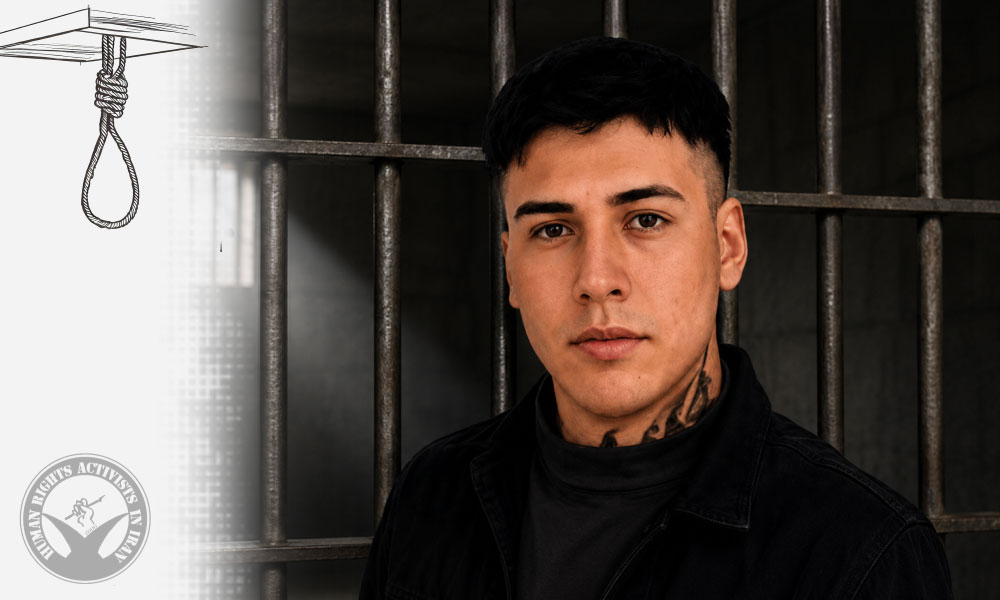
HRANA – Today, August 20, Ghaem (Arian) Hosseini, arrested during the January 2026 protests in Isfahan, was executed. He had been tried in a case known as the “Isfahan Alikhani Square” case and sentenced to death.
According to HRANA, citing Mizan, the death sentence of Ghaem Hosseini, a foreign national and one of those arrested during the January 2026 protests in Isfahan, was carried out.
The Judiciary’s Media Center has claimed that four law enforcement officers were killed during the January 8, 2026 protests in Isfahan’s Alikhani Square. The institution further alleges that a number of protesters attacked law enforcement officers and damaged public property and facilities. The Judiciary has also alleged that, after attacking law enforcement personnel, the defendants in the case committed acts of violence, including setting fire to the bodies of those killed.
According to Mizan, Ghaem Hosseini was sentenced to death on charges including “moharebeh (enmity against God) through drawing a weapon and creating fear, terror, and insecurity; corruption on earth through actions against national security; disrupting public order and creating insecurity; destruction of public property; and collusion to act against national security,” as well as other related charges. The Judiciary further claims that after the sentence was issued, the case was reviewed by the Supreme Court and the ruling was upheld following Hosseini’s appeal. Ultimately, after the legal procedures were completed, Mr. Hosseini’s death sentence was carried out.
In describing the alleged conduct underlying the charges against Mr. Hosseini, Mizan claimed that he was present at the location where the law enforcement officers were killed and that he struck the body of one of them. The outlet also cited his alleged participation in setting fire to property belonging to a charitable center. According to the same report, Mr. Hosseini acknowledged being present at the protests in Alikhani Square. However, no independent information has been made public regarding the manner or circumstances in which these statements were obtained, whether he had access to a lawyer during interrogation, or whether the claims made by judicial authorities could be independently verified.
Ghaem Hosseini, known as “Arian,” was a foreign national. The report did not specify the exact location where his execution was carried out.
HRANA has so far been unable to independently verify the claims made by the Judiciary’s media outlet. Moreover, according to information received by HRANA, the proceedings in this case were subject to restrictions and irregularities, including the defense lawyer’s lack of effective access to the case file, court hearings conducted via videoconference, families being kept uninformed about the details of the sentences, and the court’s failure to consider defense evidence. Given the documented history of the Islamic Republic’s security and judicial institutions using coerced confessions, torture, and other forms of ill-treatment in security-related cases, there are serious concerns regarding compliance with fair-trial standards and the defendants’ rights in this case.
It should be noted that HRANA previously reported that the proceedings in the cases of Alireza and Abolfazl Sepahi were subject to restrictions including the defense lawyer’s lack of effective access to the case file, the inability to obtain a copy of the court ruling, hearings conducted via videoconference, and the court’s failure to consider defense evidence. According to a source close to the family, they also remain unaware of the details of the charges, the evidence relied upon by the court, and the full contents of the rulings issued.
On July 28, Abolfazl Sepahi and Amirhossein Safari, two other individuals sentenced to death in the case known as the “Isfahan Alikhani Square” case, were publicly executed. The death sentences of Erfan Esfandiari and Gol-Mohammad Mohammadi, two other defendants in the case, were carried out in Isfahan on July 19.
At the trial court level, 15 defendants in the case were sentenced to death. According to information provided by a lawyer, the sentence of one defendant was overturned by a higher judicial authority, while the death sentences of the other 14 defendants were upheld.
The identities of 12 of these individuals had been established as Alireza Sepahi, Abolfazl Sepahi, Erfan Esfandiari, Gol-Mohammad Mohammadi, Amirhossein Safari, Ghaem Hosseini, Shervin Bagherian, Amirhossein Maleki, Ali Dashti, Abolfazl Ebrahimi, Alireza Raisi, and Amirhossein Ebrahimi Analoucheh.