





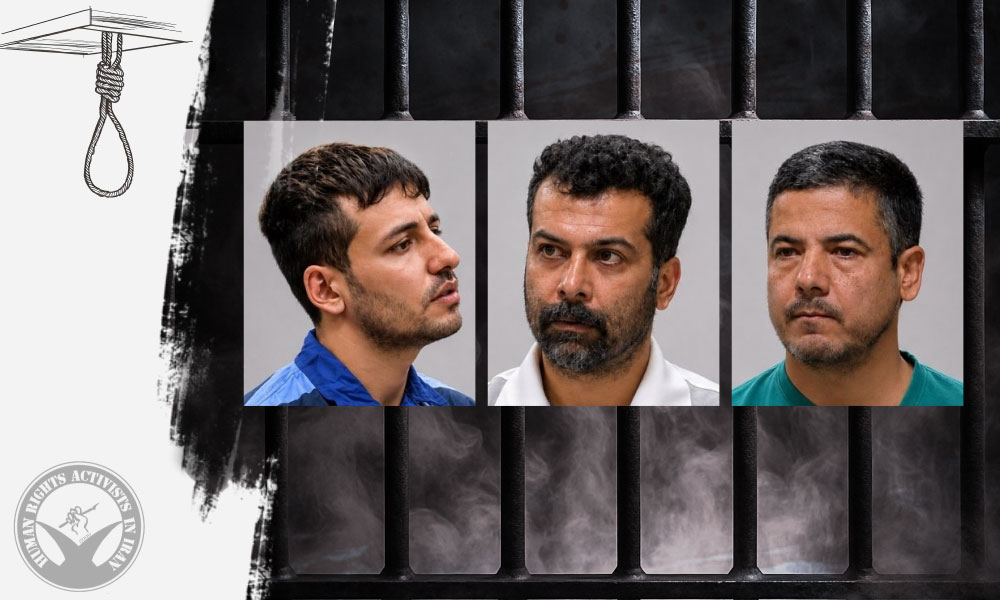
HRANA – The Iranian judiciary has announced the execution of Hassan Divband, Hamid Kazemi, and Reza Zanganeh, three individuals arrested during the January 2026 protests in Karaj. According to the judiciary, their sentences were carried out this morning, Sunday, November 8, following their confirmation by the Supreme Court.
According to HRANA, citing Mizan News Agency, Hassan Divband, Hamid Kazemi, and Reza Zanganeh, three individuals arrested during the protests of January 8 and 9, 2026, in Karaj, were executed this morning, Sunday, November 8, 2026.
According to the report, the three men had been sentenced to death and confiscation of all their assets by the Karaj Revolutionary Court on charges of “participating in operational activities on behalf of Israel, the United States, and hostile groups against national security and interests.” Their death sentences were carried out after being upheld by the Supreme Court, and the process of confiscating their assets is ongoing.
Mizan reported that the case involved a total of 11 defendants. Hassan Divband, the first defendant in the case, was accused of organizing several of his relatives and employees at his auto repair shop to participate in the protests. Hamid Kazemi, the second defendant, was accused of manufacturing Molotov cocktails and homemade grenades, while Reza Zanganeh, the third defendant, was accused of participating in the destruction of electrical infrastructure and causing power outages in parts of Karaj.
According to claims made by the state-affiliated news outlet, the defendants participated in activities during the January protests, including attacks on public and government facilities, destruction of public property, carrying weapons, and manufacturing and using 20 Molotov cocktails and 15 homemade bombs.
According to the report, Hassan Divband and Hamid Kazemi cited economic and financial hardships as reasons for participating in the protests during their trials. However, judicial authorities claimed, based on an examination of the two men’s assets, that they were financially well-off. Accordingly, their properties, including several residential units, an auto repair shop, and vehicles, have been subjected to confiscation orders.
The eight other defendants in the case were sentenced by the Karaj Revolutionary Court to prison terms ranging from five to ten years. According to Mizan, all those convicted have remained in prison since their arrests.
The published report provides no information regarding the defendants’ access to lawyers of their choosing, how the court hearings were conducted, or details of the judicial proceedings. It also does not specify the exact location where the executions were carried out.
Reza Zanganeh and Hamid Kazemi and Hassan Divband were arrested by security forces last winter in connection with the nationwide protests and transferred to Karaj Central Penitentiary. They were tried in Branch 2 of the Karaj Revolutionary Court, presided over by Judge Sabzevari, with Judge Narimani serving as an advisory judge.
Background of the January 2026 Protests