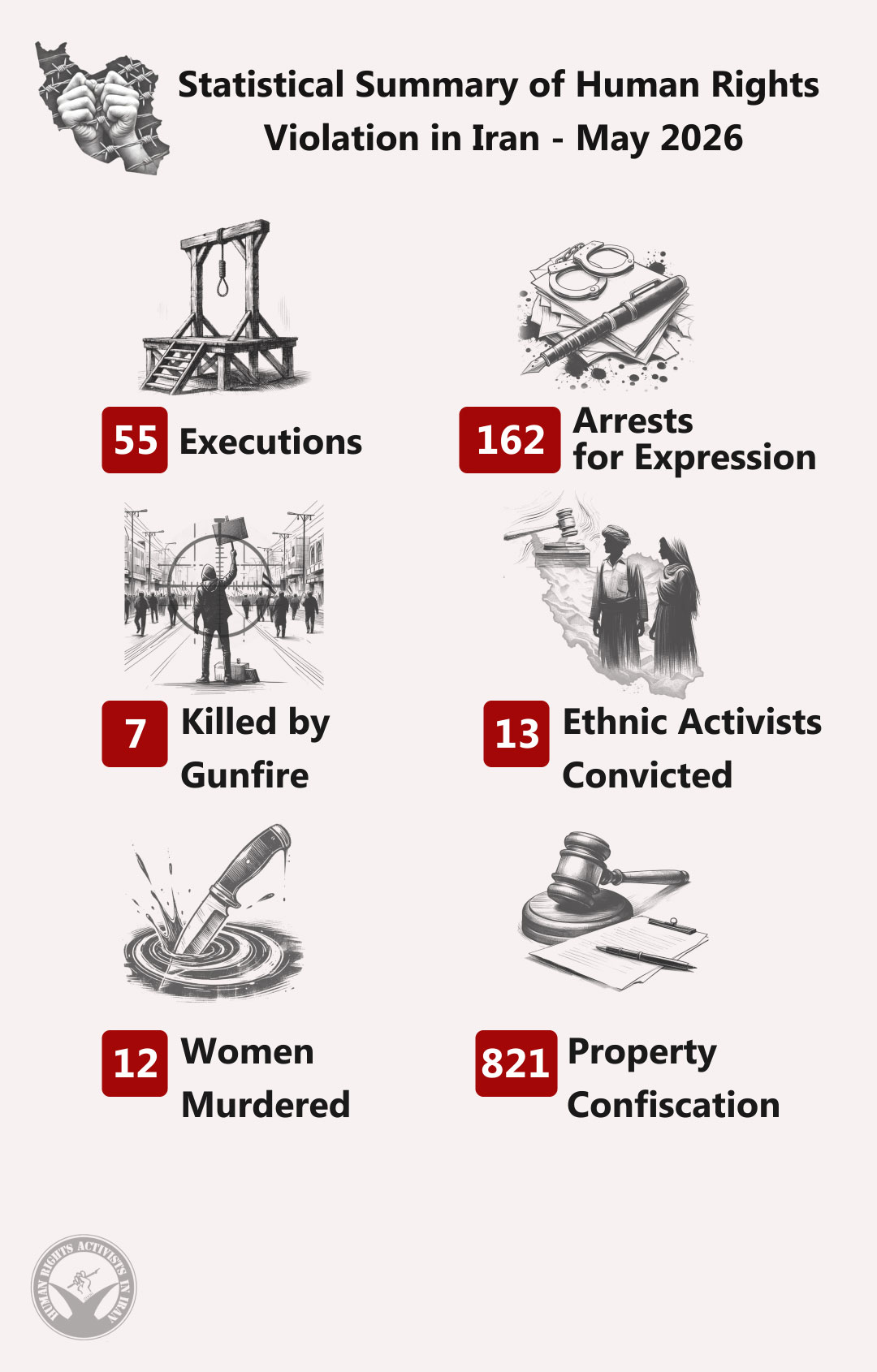
This report provides a statistical overview of human rights violations documented by HRANA during the month of May. Among the most notable human rights concerns in Iran this month were the alarming increase in executions of prisoners on political and security-related charges, including espionage; the killing of two protesters by the IRGC Intelligence Organization; and the growing number of convictions handed down against ethnic rights activists.
Executions
During the past month, the Iranian regime carried out 55 executions. Among those executed was one woman, while the gender of four others remains unknown.
Twenty-two of the individuals had been sentenced to death on murder charges, while sixteen had been convicted of drug-related offenses. Two others were executed on charges of spreading corruption on earth (efsad-e fel-arz). The charges related to two of the executions remain unknown.
A particularly notable development was the execution of 13 individuals on political and security-related charges, including five people convicted of espionage. The execution of political and security prisoners has intensified following the recent war.
During the same month, Iranian judicial authorities issued 18 death sentences. Among the most significant cases were the death sentences handed down to four protesters involved in the 2022 protests in the case known as “Ekbatan Township”, as well as the death sentences of 20-year-old twin brothers on espionage charges.
Eight of these death sentences have been upheld by the Supreme Court, increasing the risk that they may be carried out.
Freedom of Thought and Expression
In May, the regime’s security forces arrested 162 individuals for reasons that constitute violations of citizens’ freedom of expression. During the same period, the summons of one person to security agencies and six individuals to court were also reported.
The homes of seven individuals were searched by security forces, and five people stood trial.
Iranian courts also sentenced 35 individuals to a combined total of 3,575 months of imprisonment for expressing their views and opinions. Among these cases was the five-year prison sentence imposed on Yasamin Dashtani, one of the defendants in the case known as the Ekbatan Township case. In another development, an appeals court sentenced four citizens to a combined total of 30 years in prison.
In addition to prison sentences, courts imposed seven cases of deprivation of social rights, 24 months of internal exile, and 20 lashes. Authorities also confiscated the assets of 821 individuals, a practice that, according to decisions by Iran’s senior judicial officials, has intensified following the recent war and has been particularly directed against opponents of the regime, especially those residing outside the country.
Additionally, one case of physical assault related to the exercise of freedom of expression and opinion was reported.
Prisoners’ Rights
In May, HRANA documented eight cases of denial of medical care for political and ideological prisoners, including the denial of medical treatment to Mahshar Parandin, a Christian convert imprisoned in Evin Prison, despite serious health complications.
The month also saw seven cases of denial of phone contact, 17 cases of denial of access to legal counsel, five cases of denial of visitation rights, 31 cases of detention under harsh conditions, and three cases of forced prisoner transfers.
Additionally, 15 cases of forced confessions obtained from prisoners or detainees were reported, along with 61 cases of detainees being held in legal limbo without clarification of their status. In 39 arrest cases, prison authorities and security agencies withheld information regarding the detainees’ whereabouts or condition from their families.
During the same month, reports also emerged of a hunger strike by Craig and Lindsay Foreman, the British couple imprisoned in Evin Prison.
Kolbars and Fuel Carriers
In May, military and security forces killed seven individuals through shootings. The most notable case was the killing of Meysam Veisi and Mojtaba Veisi by gunfire from the IRGC Intelligence Organization. The two followers of the Yarsan faith were being pursued by security forces in connection with the January protests. In another incident, four occupants of a vehicle were killed after officers from the Iranshahr Intelligence Department opened indiscriminate fire on their car.
Workers’ Rights
In May, at least 13 labor protests and one workers’ strike were held. HRANA also reported the dismissal of 551 workers, reflecting the widespread layoffs and workforce reductions that occurred during and after the war.
Workplace accidents claimed the lives of 25 workers and left 86 others injured during the month. One notable incident was the death of a mine worker in Tabas due to gas inhalation.
Trade unions and guilds also held 22 protest gatherings. In addition, three business establishments were sealed by authorities for reasons including non-compliance with the mandatory hijab regulations.
Women’s Rights
During this month, HRANA recorded the murders of twelve women. In most of these cases, the victims were killed by family members, highlighting the high prevalence of domestic violence in Iran.
Children’s Rights
In May, three cases of child murder were reported, including the stabbing death of an infant by his father and the murder of an 11-year-old boy by a man allegedly motivated by sexual assault.
Additionally, one case involving the detention of a child by security forces was reported.
Religious Minorities
During the past month, HRANA documented six cases of members of religious minorities being arrested by security forces. Four home searches were also reported.
Additionally, a Baha’i citizen, Amin Imanian, was sentenced by the Revolutionary Court of Babol to one year in prison.
Ethnic Rights
In the past month, security forces arrested eleven individuals from ethnic minority communities or ethnic rights activists, including three people in Mahabad. In seven cases, security forces reportedly failed to present arrest warrants. Additionally, the trial of four Azerbaijani-Turk activists on political charges was held before the Revolutionary Court.
Thirteen individuals were also collectively sentenced to a total of 977 months of imprisonment.
Inhuman Punishment
During this month, Iranian courts sentenced at least 16 individuals to a total of 309 lashes.