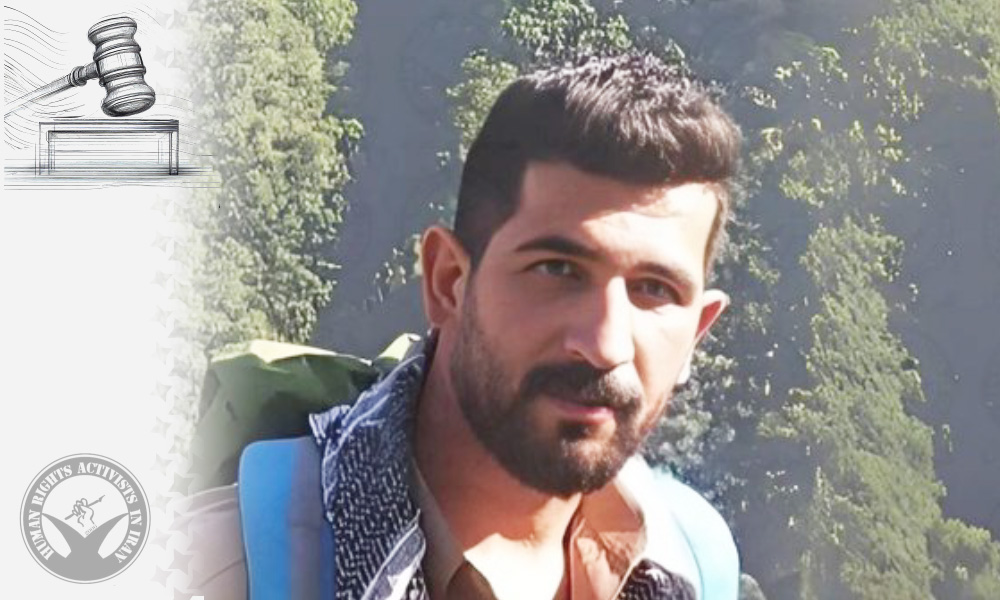
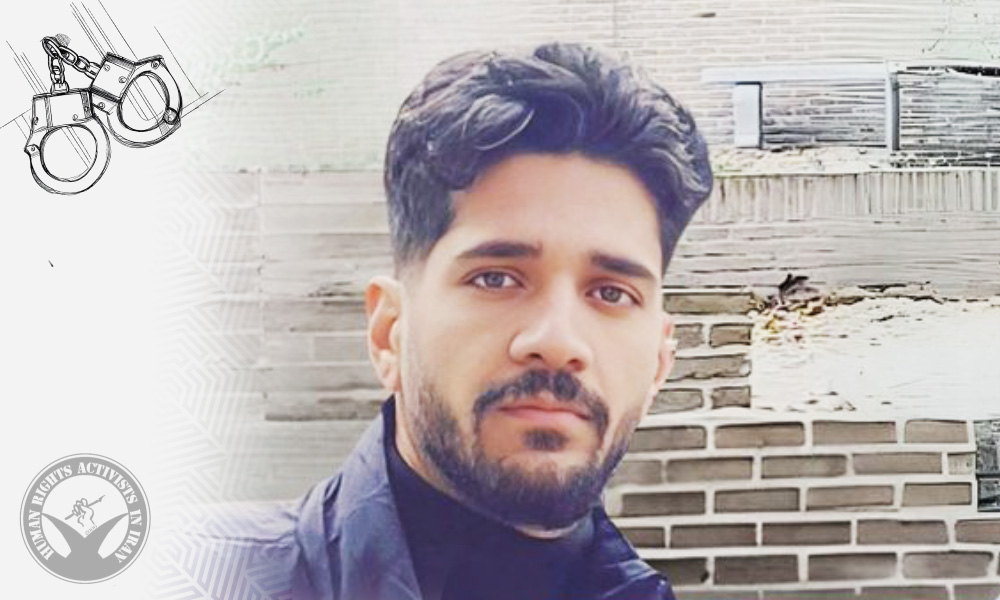
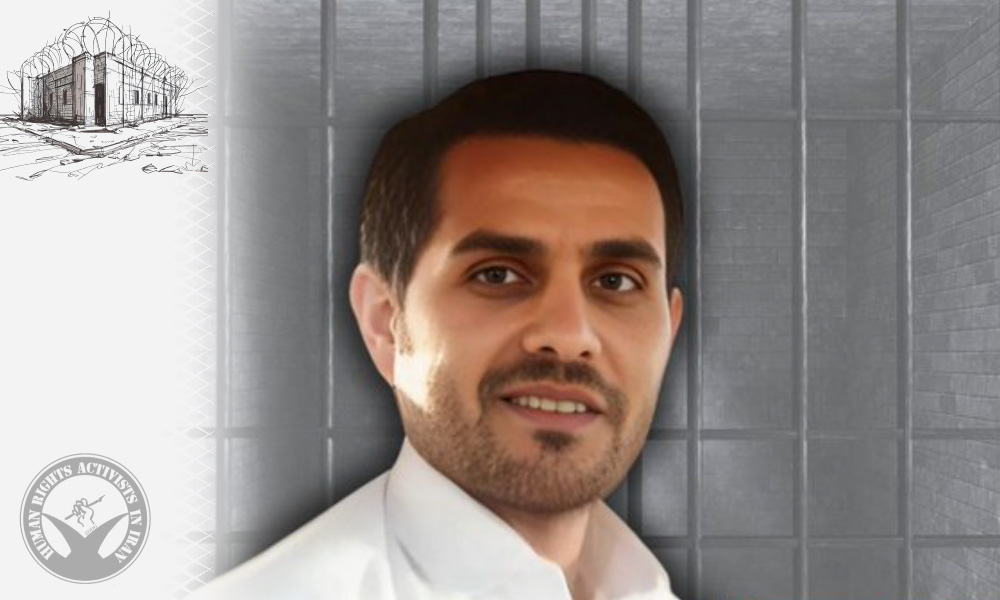
For the second time, Pakhshan Azizi’s Request for Retrial Rejected by the Supreme Court

HRANA News Agency – Maziar Tataei, attorney-at-law, has announced that the Supreme Court has rejected the second request for a retrial filed on behalf of Pakhshan Azizi, a political prisoner sentenced to death.

Maziar Tataei, Azizi’s defense attorney, stated in his announcement that the reviewing branch of the Supreme Court dismissed the second retrial request submitted by her legal team without reviewing the case file and declared the defense arguments unsubstantiated. He emphasized that such a decision logically necessitated an examination of the original case documents — a step that, regrettably, was not taken.

In February of last year, attorney Amir Raisian had also reported that Branch 9 of the Supreme Court had issued a ruling rejecting Azizi’s retrial request. Previously, Tataei had also announced that during an earlier follow-up with the Supreme Court, the reviewing branch had agreed to suspend the execution of the sentence under Note 478 of Iran’s Code of Criminal Procedure.

Background on Azizi’s Case

On August 4, 2023, Azizi, along with her 67-year-old father Aziz Azizi (a lymphoma patient), her sister Parshang (49), and her sister’s husband Hossein Abbasi (49), was arrested in Tehran. The arrests were carried out by approximately 20 armed agents who stopped their moving vehicle, searched them, and transferred them to The Ministry of Intelligence’s detention facility, known as Ward 209 of Evin Prison.

In protest against her family’s detention, Pakhshan began a hunger strike, which she ended after learning that her family members were released on bail after two weeks of solitary confinement. After being held in solitary confinement in Ward 209 for three months and three weeks, she was transferred to the women’s ward of Evin Prison on December 10, 2023.

Later, Aziz Azizi, Parshang Azizi, and Hossein Abbasi were sentenced to one year in prison each by Branch 26 of the Tehran Revolutionary Court, also under Judge Iman Afshari, for “assisting a criminal in escaping prosecution and conviction.” Their sentences were upheld by the Tehran Court of Appeals on September 27, and their appeal was forwarded to the Supreme Court.

On July 24, 2024, Azizi was sentenced to death and four years in prison by Branch 26 of the Tehran Revolutionary Court, presided over by Judge Iman Afshari, on charges of “armed rebellion (baghi)” through alleged membership in dissident groups.

A source close to Azizi’s family told HRANA:
“Pakhshan has no affiliations with any groups. She worked as a social worker for 10 years in refugee camps in Rojava. The groups she worked with were fighting against ISIS—an enemy of both the Islamic Republic and the Quds Force. There was no direct conflict between Pakhshan’s associates and Iranian forces, a fact clearly evident in her case.”

In mid-October 2024, during a protest by female prisoners in Evin following the execution of Reza Rasaei and a clash with prison guards, Azizi was accused of “assaulting an officer and disobedience” and was sentenced to six months in prison by the Criminal Court.

Also, in August, 2024, Azizi faced new accusations of “inciting unrest in prison” during the second round of the 2024 presidential election, brought before Branch 3 of the Evin Prosecutor’s Office.

A native of Mahabad, Azizi has a history of arrests and judicial encounters. In 2009, she was detained on charges of political activity and was released after four months on bail.

Environmental Photographer Hor Mansouri Abdolmaleki Sentenced to Prison

HRANA News Agency – Hor Mansouri Abdolmaleki, an environmental photographer, has been sentenced to seven months of discretionary imprisonment by Branch 147 of the Criminal Court Two in Nur County, Mazandaran province.

According to HRANA, citing Hyrcani News Outlet, the conviction is based on the charge of “spreading falsehoods” and follows his criticism of deforestation in the Hyrcanian forests, carried out to build a parking lot.

Mansouri Abdolmaleki, known for his environmental advocacy through photography, has previously been arrested and faced security-related pressure due to his activism.

Wahab Khadiri Pour Sentenced to Prison by Mahabad Revolutionary Court

HRANA News Agency – Wahab Khadiri Pour, a resident of Mahabad, has been sentenced to 10 months in prison by the city’s Revolutionary Court.

According to HRANA, quoting Kolbar News, Mr. Khadiri Pour was sentenced to prison on the charge of alleged collaboration with one of the opposition parties.

He had been arrested on January 19, 2025, following a summons by the Mahabad office of the Ministry of Intelligence. After his interrogation, he was transferred from The Ministry of Intelligence’s detention facility to Mahabad Prison. He was released from Mahabad Prison on February 20, 2025, after posting bail.

Wahab Khadiri Pour, 32, is the father of two children. He is also the cousin of Shomal Khadiri Pour, one of the victims killed during the 2022 nationwide protests.

Critical Health Concerns Amid Medical Neglect of Political Prisoner Marziyeh Farsi in Evin Prison

HRANA News Agency – Marzieh Farsi, a political prisoner held in Evin Prison, has been denied access to specialized medical care and transfer to medical facilities despite her poor health condition.

A source close to her family confirmed the news to HRANA, stating: “Ms. Farsi suffers from heart disease, persistent dizziness, headaches, nausea, and severe physical weakness. She also had breast cancer in the past and underwent surgery. However, after her arrest and transfer to prison, she was not sent to a hospital for specialized medical examinations. This has worsened her physical condition, and her health is currently in a concerning state.”

On February 14, 2024, Farsi was sentenced to 15 years in prison by Branch 26 of the Tehran Revolutionary Court on suspicion of membership in opposition groups.

The specific charges cited by the judge for this sentence remain unclear. However, Iman Afshari, the presiding judge of Branch 26, has a history of issuing unfair verdicts against political activists. Her trial was held in absentia by the same court earlier in February.

On August 21, 2023, Farsi was arrested by security forces in Tehran. Shortly after, she informed her family in a phone call that she had been transferred to The Ministry of Intelligence’s detention facility, known as Ward 209 of Evin Prison. She was later moved to the women’s ward of the same prison.

Marzieh Farsi has previously been arrested and imprisoned for her activism.

Farzad Abdi Arrested by Security Forces in Dehloran County

HRANA News Agency – Yesterday, Farzad Abdi, a resident of Dehloran County, was arrested by security forces and taken to an undisclosed location.

According to HRANA, citing Kurdpa, on Wednesday, April 2, 2025, Farzad Abdi was arrested in Dehloran County located in Ilam province. Security forces reportedly arrested this resident of the city of Pahle in Dehloran without presenting a judicial warrant and used physical violence during the arrest.

A source familiar with the situation stated that Mr. Abdi’s arrest took place following a Nowruz celebration held in the city of Pahle.

As of the time of this report, no information has been obtained regarding his whereabouts or the charges brought against him.

Subscribe to Our Newsletter

Now is definitely not the time to stop reading!

Alam Azizi Held Incommunicado for 26 Days Following Arrest

HRANA News Agency – Alam Azizi, a resident of Qasr-e Qand, has been held in detention by security forces for 26 days, with no information available about his whereabouts.

A source close to Mr. Azizi’s family confirmed the news to HRANA, stating: “Despite 26 days having passed since his arrest, Azizi has not had any visits or contact with his family. The lack of information about his condition has deepened the concerns of his family and relatives.”

He was previously arrested by security forces on March 8, 2025, in Qasr-e Qand.

As of the time of this report, no information has been obtained regarding the location of his detention or the charges brought against him.

Alam Azizi is approximately 36 years old and a resident of Azizabad village in Qasr-e Qand County, Sistan and Baluchestan Province. He has previously been arrested due to his activities.

A Woman and a Man Executed in Dastgerd Prison in Isfahan

HRANA News Agency – On Saturday, March 29, the death sentences of two inmates — including a woman — who had previously been convicted in separate cases on charges related to drug offenses and murder, were carried out in Dastgerd Prison in Isfahan.

Iran Human Rights has identified them as 24-year-old Mahnaz Kakaei and approximately 40-year-old Ali Sufian, a resident of Shiraz.

According to the report, Mr. Sufian had been arrested three years ago on charges related to drug offenses and was sentenced to death by the judiciary. Ms. Kakaei had been arrested four years and seven months ago for allegedly killing her fiancé and was also sentenced to death.

As of the time of this report, the executions have not been officially announced by prison authorities or other responsible institutions.

In 2024, HRA reported 61 executions in Dastgerd Prison, Isfahan, making it the third-highest among prisons in terms of execution numbers.

On the First Day of Iranian New Year, Several Citizens Arrested at Historical Sites

HRANA News Agency – The head of the Public Security Police of FARAJA announced that several citizens were arrested at various historical sites across the country on the first day of the Iranian New Year (1404). He claimed that these individuals were attempting to disrupt public order through “norm-breaking” behavior.

According to HRANA, quoting Mehr News Agency, a number of citizens were detained at cultural and historical locations across Iran on the first day of the new year.

The police official referred to the detainees as “leaders” and “main instigators,” accusing them of engaging in acts of “norm violation.” Seyed Majid Feyz Jafari, without providing any specific examples of the alleged misconduct, asserted that the detainees intended to disturb public security.

The report does not mention the identities or the number of those arrested. There is also no information available regarding their legal status or current conditions of detention.

In recent years, during the Nowruz holidays, as public presence in cultural and historical sites increases, numerous incidents have been reported involving authorities confronting citizens over issues such as dress code, dancing, or public celebration. In some cases, detainees were later released on bail but faced charges such as “propaganda against the regime” or “encouraging corruption and prostitution.”

Monthly Report – March 2025: Human Rights Situation in Iran

HRANA News Agency -In March 2025, HRANA, via its Statistics Department, documented a continued deterioration in Iran’s human rights conditions. The month witnessed a sharp rise in executions, persistent suppression of civil liberties, and intensified pressure on vulnerable groups such as women, children, ethnic and religious minorities, and border laborers. The findings presented here aim to inform the public and international community of the systemic challenges within Iran’s legal, political, and social institutions.

Executions

Iran carried out 58 executions in March 2025—51 men, 4 women, and 3 of unspecified gender. Most were related to murder (28) or drug offenses (27), with three cases lacking public charges. No public or juvenile executions were reported, but at least three Afghan nationals were among the executed, reinforcing concerns about due process and treatment of foreign nationals.

Notably, Nasrin Barani, convicted of murdering her abusive ex-husband, was executed on March 1 in Isfahan. That same day, seven prisoners—two Afghans—were hanged in Zahedan, mostly on drug charges. In a politically sensitive case, Kurdish political prisoner Hamid Hosseinnezhad’s death sentence for “armed rebellion” was upheld after a closed trial.

Additionally, 13 new death sentences were issued—mostly for murder—with no political or security-related charges reported. Though reconciliation spared some from execution, systemic issues such as vague charges and the disproportionate use of capital punishment persist.

Freedom of Thought and Expression

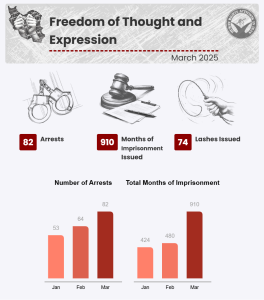
At least 82 individuals were arrested, and 39 convicted, for expressing dissent or participating in civil activism. Courts issued over 900 months of prison time, 616 months of other discretionary penalties, and financial fines nearing 287 million tomans. At least 74 lashes were executed under these cases.

Targeted groups included journalists, poets, professors, and lawyers. Five cultural figures were sentenced in Abadan for participating in peaceful gatherings. Defense lawyer Behnam Nezadi began a four-month sentence despite appeals for alternative sentencing. Academic Hassan Bagherinia received over 10 years in penalties for political commentary.

Pop singer Sohrab Pakzad was arrested after a concert clip was labeled “immoral,” and his associates face legal proceedings. HRANA also documented 24 trials, 23 warrantless arrests, and various restrictions, including travel bans and home searches. Although four public protests were held, state pressure and isolated violence persisted.
Women’s Rights

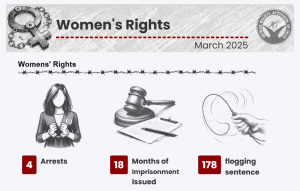
Iranian authorities intensified enforcement of compulsory hijab and politically charged gender laws. Four women were arrested for hijab-related violations, and four others were killed, including one in a suspected domestic violence case. Sentences totaling 18 months in prison and 178 lashes were issued for hijab defiance and protest activity.

Among key cases, activist Hamideh Zeraei was sentenced for refusing to wear hijab in court and for resisting arrest. Leila Pashaei, arrested after Women’s Day comments, remains in unknown custody. HRANA also recorded one rape, four summonses, and four cases of gender-based discrimination.

Although no businesses were sealed for hijab violations in March, judicial penalties reflect ongoing state control over women’s behavior and continued violations of gender equality principles under international law.
Workers’ Rights

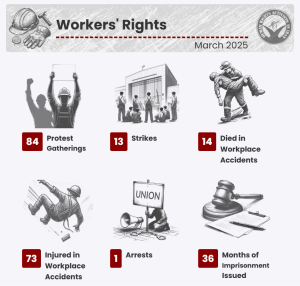
Labor conditions remained precarious. HRANA documented 84 protest gatherings, 13 strikes, and at least 14 worker deaths due to unsafe conditions, with 73 injuries also reported. Major cities like Tehran and Shiraz saw workplace accidents without employer accountability.

Wage delays were a key grievance. Nearly 770 complaints involved unpaid wages—equating to 96 months in delays—while 760 workers reported missing bonuses. Seventy-three workers were left in employment limbo. Protests arose in Izeh, Zahedan, and Chabahar due to layoffs and threats.

Authorities arrested one union activist, issued 3 prison sentences totaling 36 months, and imposed travel bans. Teacher and unionist Kobra Taherkhani was sentenced to three years for social media posts. Forty-eight businesses were also sealed for violating Ramadan norms.

Despite escalating hardship, organized labor resistance continues to highlight the need for meaningful protections, though legal retaliation remains widespread.
Kulbars and Fuel Carriers

HRANA recorded 4 deaths and 8 injuries among border laborers and civilians. In Baneh, a Kolbar named Sina was shot without warning, while others suffered injuries from exposure or violence. One fuel carrier was also injured in separate incidents.

In addition to targeting cross-border laborers, security forces killed three civilians, including Gholam Shahriari in Zabol and Farshad Maghami in Tehran. Five others were injured in shootings by security forces or landmine explosions, underscoring the persistent dangers in Iran’s border regions.

The use of live ammunition, absence of legal oversight, and economic desperation continue to endanger border workers and civilians, perpetuating cycles of poverty and violence.

Children’s Rights

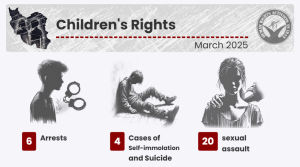
HRANA documented six child arrests, four suicides, one murder, and 20 sexual assaults involving minors. Additionally, 28 children were injured due to official negligence, including unsafe schools and lack of public infrastructure safeguards.

Twelve-year-old Fatima Soleimani died by suicide after being forced into marriage and subjected to abuse. In Bandar Lengeh, 16-year-old Yousef Rasaneh was detained without warrant. A viral case from Isfahan involved a student expelled due to unpaid tuition, prompting administrative investigations.

Although no juvenile executions occurred, these cases expose deep failures in child protection systems and reflect ongoing violations of the UN Convention on the Rights of the Child.
Religious Minorities

In March 2025, the persecution of religious minorities in Iran remained severe. HRANA recorded three convictions totaling 500 months in prison, two enforced sentences, and over 910 million tomans in fines. Social restrictions, travel bans, and targeted arrests reflect continued discrimination against non-Shia communities—particularly Baha’is and Christian converts.

Christian convert Narges Nasri received a 16-year sentence, 15 years of social deprivation, and substantial fines. Pregnant at the time of arrest, she now faces harsh incarceration conditions. Similarly, Baha’i citizen Anisa Fanaeian began serving a 7-year sentence in Semnan after being arrested while taking her daughter to a hospital. Her case involved confiscation of family funds and expansive social penalties.

Christian converts Mehran Shamlooei and Abbas Soori were also sentenced to a combined 25 years and over half a billion tomans in fines. The continued use of national security charges to criminalize peaceful religious activity highlights Iran’s failure to uphold constitutional and international protections for religious freedom.

Prisoners’ Conditions

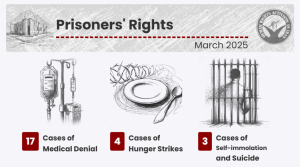
Detention conditions in Iran’s prisons remained dire throughout March. HRANA reported at least 17 cases of denied medical care, three deaths in custody, and multiple instances of solitary confinement, assault, and mental health deterioration.

Heydar Mohammadi died under suspicious circumstances after arrest in Hamadan, with no official cause disclosed. In Evin Prison, political prisoner Varisheh Moradi was repeatedly denied spinal surgery despite medical urgency. Labor rights activist Morteza Saeedi launched a hunger strike after being forcibly transferred to quarantine.

Ten detainees were denied legal counsel, and four initiated hunger strikes to protest conditions. Three prisoners attempted suicide, while at least 14 suffered psychological pressure. Reports also included forced transfers, inappropriate confinement, and violations of classification standards.

Despite international norms such as the Mandela Rules, Iran’s detention system continues to foster abuse, neglect, and impunity, particularly for political prisoners and vulnerable detainees.
Ethnic Rights

Targeting of ethnic minorities—particularly Kurds and Azerbaijani Turks—persisted through arrests, interrogations, and surveillance. HRANA documented 14 arrests, five court summonses, and multiple house searches and interrogations without due process.

Azerbaijani activist Vadood Asadi was transferred to Evin Prison to serve a reduced nine-month sentence. Later, activists Amir Ebrahimlou and Soheil Daeiri were arrested and taken to unknown locations, with no charges disclosed. Most arrests were conducted without judicial warrants, and no new convictions were recorded, though prior sentences were enforced.

These patterns reflect systemic efforts to suppress ethnic and linguistic advocacy using national security pretexts, in violation of Iran’s obligations to uphold equality and cultural rights under international law.

Violation of Human Dignity

Corporal punishment continued to be used extensively. HRANA recorded at least 502 lashes issued during March. Though no amputations or lashings were carried out publicly, the practice remains prevalent and widely condemned.

In Sardasht, nine city council members were sentenced to flogging amid a corruption case. Another defendant in Tehran received a sentence including two executions and 80 lashes for a 2022 murder, despite retracted confessions and inconsistent testimony. Such rulings, based on judicial discretion rather than clear evidence, raise serious concerns about fair trial standards.

The continued use of flogging as legal punishment—often alongside imprisonment or capital sentences—reflects the Iranian judiciary’s ongoing reliance on practices that contravene the prohibition of cruel and degrading treatment.

International News Update

On March 18, 2025, the UN Special Rapporteur on human rights in Iran expressed alarm at the surge in executions—particularly among minorities and political prisoners—during an oral update to the Human Rights Council in Geneva. He urged Iran to adopt a moratorium on the death penalty and address systemic legal abuses [Source: https://www.ohchr.org/en/press-releases/2025/03/iran-un-expert-alarmed-execution-surge].

Separately, the U.S. Department of State released its annual human rights report on March 22, dedicating extensive coverage to Iran. The report cited routine torture, suppression of dissent, denial of fair trials, and targeting of ethnic and religious minorities, calling for the release of all prisoners of conscience [Source: https://www.state.gov/reports/2024-country-reports-on-human-rights-practices/iran/].

These international statements highlight growing global concern over Iran’s deepening human rights crisis and reinforce calls for accountability and reform.

Download the Full Report:


Four-Year Prison Sentences for Christian Converts Mansour and Mahmoud Mardani

HRANA News Agency – Mansour and Mahmoud Mardani, two Christian convert brothers, have been sentenced by the Revolutionary Court of Lenjan County in Isfahan province, to four years in prison each, along with fines and additional punishments.

According to HRANA, citing Article 18, the verdict was issued on January 5, 2025, by Judge Mohammad Ali Abbasi and was recently communicated to the two converts. Each was sentenced to four years in prison, a fine of 150 million tomans, and a five-year deprivation of social rights on charges of “propaganda against the regime through promoting Christianity.”

In addition, the brothers were banned from residing in Isfahan Province and the city of Fooladshahr, and sentenced to two years of exile in Ardal County, located in Chaharmahal and Bakhtiari Province.

Mansour and Mahmoud Mardani were first arrested on December 22, 2021, during a Christmas celebration at a house church in Fooladshahr, Isfahan, and were later released on bail.

Notably, while Christianity is officially recognized as a minority religion in Iran, security agencies view the conversion of Muslims to Christianity as a highly sensitive matter and respond with severe crackdowns on those involved in religious activism.

The persecution of Christian converts in Iran persists despite Article 18 of both the Universal Declaration of Human Rights and the International Covenant on Civil and Political Rights, which affirm every individual’s right to freedom of religion, including the right to change their faith and to practice it openly or privately, alone or in community with others.