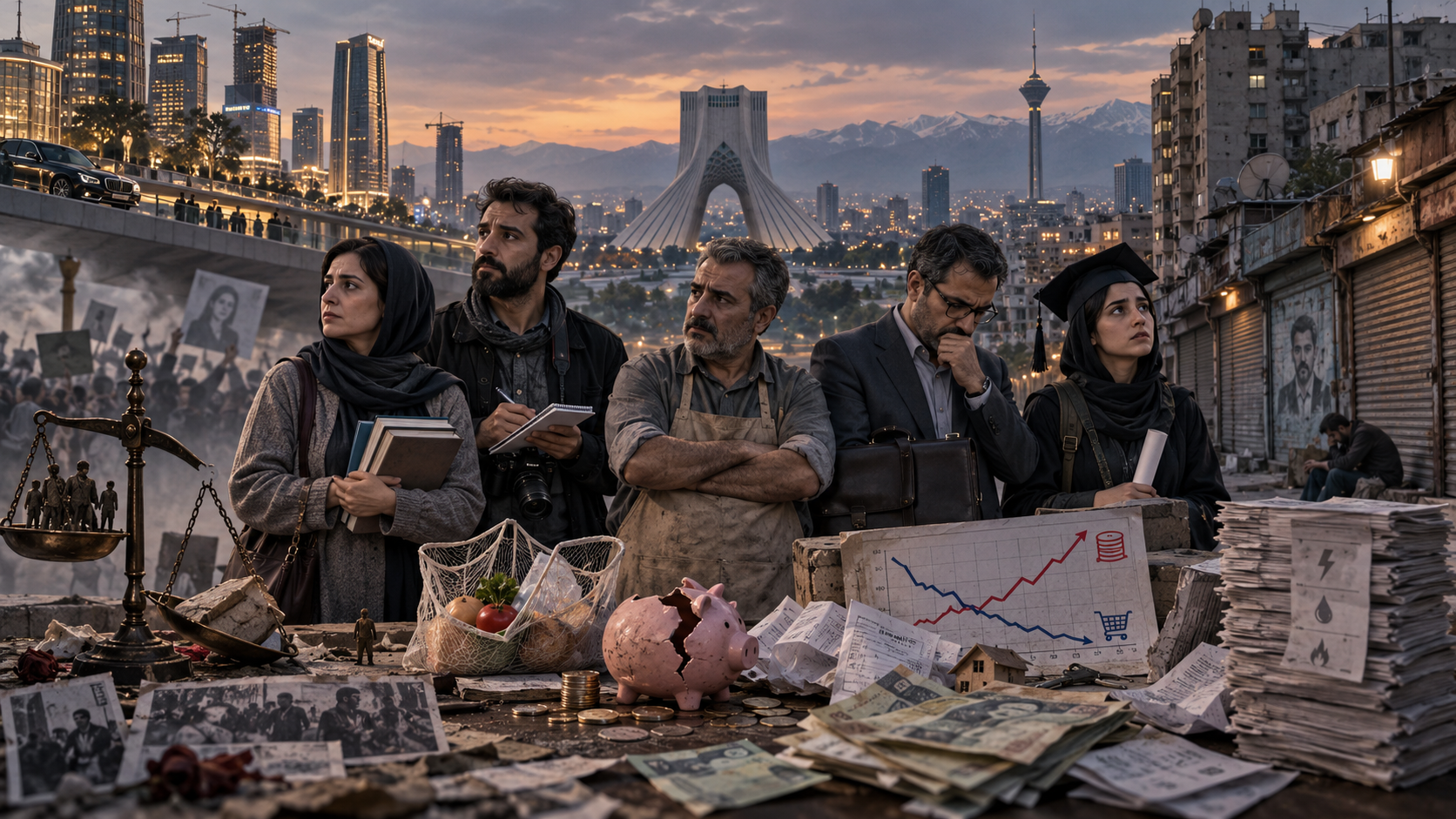
Years of high inflation, declining purchasing power, economic insecurity, sanctions, political instability and, most recently, war have placed extraordinary pressure on Iran’s middle class. The consequences extend beyond household finances. As educated professionals, small business owners, teachers, journalists, lawyers and other traditionally middle-income groups lose economic independence, Iran risks losing some of the social infrastructure historically associated with civic participation, institutional accountability and democratic change.
For decades, Iran’s urban middle class occupied a politically significant position between concentrated economic power at the top and economically vulnerable populations below. It included university graduates, teachers, engineers, physicians, lawyers, journalists, civil servants, entrepreneurs, shopkeepers, cultural workers and skilled employees whose education, professional networks and relative economic security allowed at least some degree of independence from both state patronage and immediate economic survival.
That social position has become increasingly difficult to sustain.
The deterioration has accelerated during the past several years. World Bank data put Iran’s consumer-price inflation at 42.2 percent in 2025, while the International Monetary Fund projected average inflation of 68.9 percent for 2026. The IMF also projected a contraction of Iran’s real GDP in 2026 as the regional war compounded existing economic pressures.
The World Bank, meanwhile, described an economy already substantially disrupted before the latest conflict. It estimated that GDP contracted by approximately 2.7 percent in the Iranian year ending March 2026, citing a combination of military escalation, protests, strikes, telecommunications disruptions and trade disturbances. The Bank warned that conflict-related damage, oil-export disruptions, shortages of water and energy, and weakened investment could further constrain the non-oil economy.
These figures describe a macroeconomic crisis. For middle-income households, however, the consequences are experienced more directly: salaries lose purchasing power before they are adjusted; savings accumulated over years depreciate rapidly; home ownership becomes increasingly inaccessible; private businesses struggle with unstable costs and investment conditions; and families devote progressively greater attention to preserving their existing standard of living rather than building wealth.
The result is not simply greater poverty. It is the erosion of the economic distance that once separated large parts of the middle class from financial precarity.
A Middle Class Under Pressure
Defining the “middle class” in Iran is difficult. There is no universally accepted income threshold, and the extraordinary instability of the rial makes dollar-denominated definitions particularly misleading. Middle-class status is therefore better understood as a combination of income, education, occupation, consumption capacity, property ownership and economic security.
By that broader definition, the pressure is visible across numerous sectors.
A university education, once regarded as an important pathway into middle-class security, no longer guarantees economic stability. World Bank and International Labour Organization data estimated youth unemployment in Iran at approximately 21.9 percent in 2025. Among economically active young women, the estimated rate was approximately 32 percent.
The gender gap is even more pronounced in labor-force participation. World Bank gender data estimated female labor-force participation at only about 14 percent in 2025, compared with more than 67 percent for men.
These conditions are particularly significant because Iran has invested heavily in education and has produced generations of highly educated women and men. When educational attainment fails to translate into professional opportunity or economic independence, one of the traditional mechanisms through which a stable middle class reproduces itself begins to break down.
At the same time, inflation weakens those who already hold professional employment. A teacher, engineer, journalist or office employee may technically remain employed and therefore never appear in unemployment statistics, while experiencing a substantial decline in real income.
This distinction matters. A society can report relatively moderate headline unemployment while still experiencing widespread downward mobility.
From Economic Independence to Economic Dependence
The political significance of this process lies partly in the relationship between economic independence and civic autonomy.
Political scientists have long debated whether economic development and the expansion of a middle class produce democracy. The evidence does not support a simple rule that wealth automatically causes democratization. James Robinson, reviewing the literature, cautioned that the causal relationship between economic development and democracy is far more complicated than classical modernization theory suggested. More recent research similarly emphasizes conditional rather than automatic relationships between rising income and democratic transition.
Nor is every middle class necessarily democratic. Research has found that middle classes dependent heavily on authoritarian states for employment or economic benefits may behave differently from economically autonomous professional or entrepreneurial groups. A 2021 study published in the American Political Science Review, for example, distinguished between relatively autonomous bourgeois classes and middle classes produced through state-directed modernization, finding important differences in their relationship with democratic competition and media freedom.
Iran illustrates why this distinction matters.
A financially independent lawyer, shopkeeper, physician, engineer or entrepreneur possesses resources that can provide some protection from government pressure. Independent income can support professional associations, independent media, cultural initiatives, unions, advocacy groups and other forms of organization outside direct state control.
When such groups lose that independence, their relationship with political authority can change.
A professional who depends increasingly on a government salary, state contract, subsidized credit or access to a regulated market may face higher personal costs for political participation. A small business owner struggling to survive inflation and regulatory uncertainty has fewer resources to support civic organizations. A journalist facing both censorship and financial insecurity has less institutional protection. A family whose savings are rapidly disappearing may prioritize emigration or economic survival over sustained political engagement.
None of these outcomes determines political behavior. Economic hardship can sometimes produce protest rather than passivity. But it changes the environment in which civic action takes place.
The Disappearance of Time, Money and Organizational Capacity
Democratic participation requires more than political preferences.
It requires resources.
Civil society organizations need employees, offices, technology and funding. Independent journalism requires reporters who can afford to remain in the profession. Professional associations require members who have time to participate. Protest movements require communication networks. Political organizing requires people who can absorb the economic risks associated with participation.
Middle-class households have historically supplied many of these resources in societies undergoing political change.
When real incomes decline, discretionary resources disappear first.
A household struggling with rent, education, healthcare and food costs has less money available for books, newspapers, cultural activities, professional associations or donations to civic institutions. Workers may take additional jobs. Professionals devote more time to private work. Young people focus on migration.
The political effect is therefore not simply that people become poorer. The opportunity cost of participation rises.
This is one reason researchers have often associated stronger middle classes and lower economic polarization with more stable political institutions. Research by economist William Easterly found cross-country associations between a larger middle-class share of income and higher education, stronger infrastructure, greater political stability and more democratic political systems, although such correlations do not establish a simple causal mechanism.
Conversely, extreme economic polarization can make political compromise more difficult. Literature on inequality and democratization has examined how societies divided sharply between wealthy elites and economically insecure majorities may experience more intense distributional conflict and greater difficulties building stable institutions.
Iran’s Shrinking Space Between Wealth and Poverty
In Iran, economic transformation has increasingly produced a society in which access to assets matters more than professional income.
Those who own significant property, foreign currency, gold, businesses linked to protected markets or assets outside Iran may be partially insulated from inflation. Salaried professionals generally are not.
This can gradually transform the social structure.
Instead of a broad middle class separating wealth from poverty, society becomes more polarized between those who possess inflation-resistant assets and those whose livelihoods depend primarily on wages.
Professional status then becomes disconnected from economic status.
A university professor, journalist, engineer or teacher may retain considerable education and social capital while experiencing declining purchasing power. At the same time, individuals with access to property, protected markets or politically connected economic opportunities may accumulate wealth regardless of educational or professional credentials.
Such a transformation has implications for democratic development because the middle class is not important only as an income category. It often constitutes a network of professions and institutions through which expertise, pluralism and organized interests enter public life.
Weakening those networks can reduce the number of institutions standing between individual citizens and the state.
Migration and the Loss of Human Capital
The political consequences may be compounded by emigration.
Economic uncertainty, professional restrictions and political instability create strong incentives for educated Iranians to seek opportunities abroad. The loss is not limited to the number of people who leave.
Those most capable of migration are often precisely those with internationally transferable qualifications, foreign-language skills, university education, financial resources and professional networks.
In other words, emigration can selectively remove portions of the population with some of the greatest capacity for independent organization.
For the individuals involved, migration may be a rational personal decision. At the societal level, however, sustained departure of professionals, academics, entrepreneurs and skilled workers can reduce both economic productivity and domestic civic capacity.
The effects are cumulative. Each departing physician, engineer, researcher, entrepreneur or journalist represents not only lost human capital but also a potentially weakened professional network inside the country.
Economic Crisis Does Not Automatically Produce Democracy
There is an important misconception in discussions of authoritarian systems: that severe economic deterioration will eventually produce democratic transition simply because public dissatisfaction increases.
Historical evidence is considerably more complicated.
Economic crises can weaken governments, trigger protests and alter political coalitions. But they can also fragment society, increase dependence on state resources, destroy independent institutions and encourage emigration.
Daniel Treisman’s review of economic development and democracy found that higher levels of development are strongly associated with democratization and democratic survival over medium-term periods, but that political change often depends on additional triggers and conditions rather than income alone.
For Iran, this distinction is crucial.
A poorer population may be angrier without necessarily becoming more capable of sustained democratic organization.
Indeed, if economic collapse disproportionately damages independent professionals, private-sector workers, journalists, lawyers, educators and small entrepreneurs while leaving politically connected economic institutions comparatively protected, the balance of organizational power may shift toward the state rather than away from it.
The paradox is therefore significant: economic deterioration can increase opposition to existing conditions while simultaneously weakening some of the social groups best positioned to translate dissatisfaction into durable institutions.
The Democratic Cost of Downward Mobility
Iran’s recent economic crisis should therefore be understood not only in terms of inflation, poverty or GDP.
It is also transforming the country’s social architecture.
The erosion of middle-class security means fewer households with meaningful savings, fewer young professionals confident that education will produce upward mobility, fewer entrepreneurs able to operate independently of political networks, and more families contemplating emigration as their principal strategy for improving their future.
For democratization, the consequences are ambiguous but potentially profound.
A strong middle class does not guarantee democracy. Middle-class citizens can support democratic, authoritarian or politically disengaged positions depending on circumstances. But a broad and economically autonomous professional class can provide resources that pluralistic political systems require: independent institutions, professional associations, expertise, media, entrepreneurship, civic networks and citizens able to participate in public life without complete economic dependence on the state.
Iran is losing portions of that independence.
The longer inflation, economic contraction, insecurity and political instability continue, the greater the risk that what remains will be a highly polarized society: a relatively small asset-owning or politically connected upper tier, a much larger population experiencing economic insecurity, and a weakened professional middle struggling to preserve its position.
That development would have consequences far beyond household living standards.
The erosion of Iran’s middle class may ultimately weaken one of the principal social environments in which independent organization, civic participation and institutional pluralism can survive. For a country whose political future will depend not simply on public dissatisfaction but on the capacity to build durable institutions, that may prove to be one of the most consequential effects of the economic crisis.
By: Keyvan Rafiee