Sistan and Baluchestan is often discussed in Iran primarily through the language of borders, militancy, trafficking and security operations. Yet many of the province’s most persistent security challenges are intertwined with a different set of problems: water scarcity, weak infrastructure, limited employment opportunities, environmental degradation and unequal access to public services. Sustainable development cannot eliminate violence or organized crime on its own, but reducing these structural vulnerabilities can strengthen community resilience, expand lawful livelihoods and ultimately contribute to a more durable form of security.
Iran’s southeastern province of Sistan and Baluchestan occupies one of the country’s most strategically sensitive locations. It borders both Afghanistan and Pakistan, includes Iran’s principal oceanic port at Chabahar, and lies along routes connecting Central Asia and Afghanistan to the Arabian Sea.
It is also a province in which security concerns have remained persistent.
Militant organizations have repeatedly carried out attacks against Iranian security personnel. In April 2024, coordinated attacks in Chabahar and Rask attributed by Iranian authorities to Jaish al-Adl resulted in the deaths of security personnel and militants. Reuters described the province as a longstanding center of both militant activity and narcotics trafficking.
These threats are real. But viewing Sistan and Baluchestan exclusively through a security lens risks overlooking conditions that can make insecurity more difficult to address.
Research on Iran’s peripheral provinces has described what scholars call a “security-development nexus”: regions perceived as insecure receive intensified security attention, while insufficient development contributes to grievances and marginalization that can themselves deepen instability. A 2024 study in Iranian Studies argued that Sistan and Baluchestan has historically remained among Iran’s least-developed regions despite improvements in absolute living standards, with persistent deficits in income, employment, education, health and housing relative to more central provinces.
The consequence can become circular.
Underdevelopment increases vulnerability. Vulnerability strengthens informal and illicit economies. Insecurity then encourages authorities to prioritize policing and military control over social investment. Communities consequently experience the state more prominently through security institutions than through schools, hospitals, employment programs or reliable public services.
Breaking that cycle requires treating development itself as part of security policy.
Security Begins With Basic Services
In Sistan and Baluchestan, perhaps no issue illustrates the connection between human security and national security more clearly than water.
UNDP describes the province as suffering from severe water stress after decades of drought intensified by climate change. Limited access to clean water and inefficient agricultural practices have undermined livelihoods and community resilience.
The consequences are tangible.
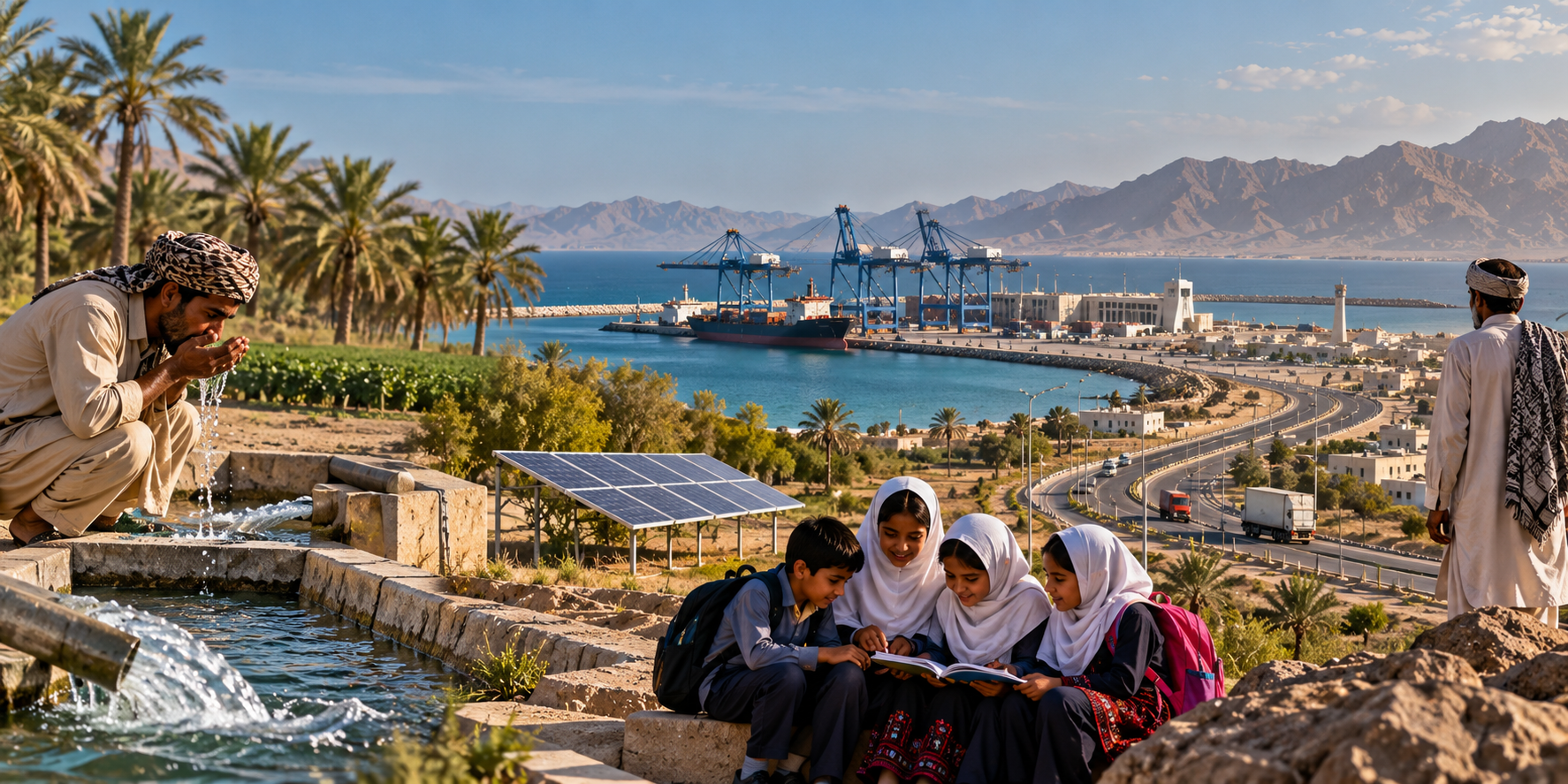
Following severe flooding in southeastern Sistan and Baluchestan in 2024, UNICEF documented communities in which clean-water access was already unreliable before the disaster. Residents described repeated interruptions in tap water and health problems associated with contaminated water. UNICEF subsequently deployed solar-powered water-disinfection systems capable of providing safe drinking water to approximately 200,000 people and expanded water-quality testing capacity.
Infrastructure of this kind is normally classified as development or humanitarian assistance. But it also has security implications.
When rural communities have reliable water, sanitation, healthcare and electricity, displacement pressures decrease. Agricultural livelihoods become more sustainable. Household income becomes more predictable. Communities have greater incentives to remain economically connected to formal institutions rather than seek survival through informal cross-border activity.
UNDP has explicitly linked water scarcity in the province with rural-to-urban migration and weakening livelihoods. Its Chabahar-area program, involving more than $2.6 million in investment, was designed to improve access to drinking water and water-efficient agriculture for approximately 50,000 residents across five villages.
This is the logic of preventative security: addressing vulnerabilities before they become sources of displacement, conflict or criminal exploitation.
Livelihoods Matter at the Border
Border communities frequently live in economic environments very different from those of major metropolitan centers.
Where formal employment is scarce but international borders are nearby, smuggling can become a livelihood rather than simply an organized criminal enterprise.
Historical research by the United Nations Office on Drugs and Crime illustrates the scale of this challenge. A UNODC study of Shirabad, near Zahedan, found significant local dependence on informal cross-border trade and logistical support for drug-trafficking networks. The research is old and should not be treated as a current measurement of the province, but it illustrates a longstanding structural problem: when formal employment alternatives are weak, illicit economies can become embedded in community survival strategies.
This distinction matters for policy.
A state can increase patrols, build barriers and intensify law enforcement. These measures may disrupt trafficking networks. But if individuals still lack viable alternatives for earning income, the economic incentive to participate in illicit trade remains.
UNODC itself now incorporates “Alternative Development and Sustainable Livelihoods” into its 2023–2026 cooperation program with Iran, alongside border management and illicit-trafficking prevention. The approach reflects an internationally recognized principle in drug-control policy: reducing illegal economies requires not only enforcement but also credible lawful sources of income.
For Sistan and Baluchestan, this could mean expanding small and medium-sized enterprises, agricultural processing, fisheries, renewable energy, logistics, handicrafts and regulated border commerce.
The objective is not to reward illegal activity. It is to reduce the economic environment in which criminal networks can recruit labor cheaply and consistently.
Chabahar: Turning Geography Into Opportunity
The province’s geography is often described as a source of vulnerability. It can also be an economic advantage.
Chabahar provides Iran with direct access to the Gulf of Oman and serves as an increasingly important trade corridor for Afghanistan and regional commerce. Afghan traders have increasingly used routes through Iran and Chabahar as alternatives to Pakistan, particularly during repeated disruptions at Pakistan’s border crossings.
In principle, increased trade can generate employment in transportation, logistics, warehousing, customs services, food processing, maintenance and other sectors.
But the local security benefits depend on how development occurs.
Large infrastructure projects do not necessarily improve local stability if surrounding communities see investment passing through their region without creating jobs or improving public services.
Sustainable development therefore requires local inclusion.
Young people from the province need realistic access to jobs created by port expansion and regional trade. Local businesses need access to procurement opportunities. Roads connecting rural communities should improve alongside international transit corridors. Vocational programs should train residents for jobs actually being created in logistics, maritime services, construction and renewable energy.
Development that appears geographically located in Sistan and Baluchestan but economically disconnected from its population will have a much weaker security effect.
Climate Change Is Also a Security Issue
Environmental degradation presents another long-term challenge.
The Hamoun wetlands in northern Sistan and Baluchestan have been severely affected by water scarcity and climate pressures. UNDP warns that wetland degradation has damaged rural livelihoods, intensified sand and dust storms and contributed to displacement and poverty.
These effects create what security researchers increasingly describe as “threat multipliers.”
Climate change does not directly cause militancy or crime. But it can worsen existing vulnerabilities.
When agriculture becomes impossible, families lose income. When communities are displaced, social networks fragment. When young people see no future in their home region, migration and informal economic activity become more attractive. Competition over increasingly scarce resources can also aggravate local tensions.
Environmental restoration, climate-smart agriculture and efficient irrigation therefore belong within any serious long-term security strategy for the province.
Recent research on climate-smart agriculture in the Sistan Plain similarly emphasizes that adoption depends not merely on technology but also on access to infrastructure, financial services, extension support and trust in institutions.
That last factor—trust—is especially important.
Development and Trust in the State
Security ultimately depends on more than the physical capacity of security forces.
It also depends on whether residents regard state institutions as legitimate, accessible and responsive.
In a province where communities have experienced longstanding economic marginalization and a heavy security presence, development can alter how residents interact with the state.
A functioning health clinic produces a different relationship between citizen and government than a checkpoint.
A reliable school produces a different relationship than a detention facility.
A transparent local employment program produces a different relationship than dependence on informal intermediaries or illicit networks.
This does not mean infrastructure spending automatically produces political trust. Poorly designed projects, corruption, discrimination or exclusion from decision-making can have the opposite effect.
Development must therefore be participatory.
Local communities should have a meaningful role in determining priorities. Municipal authorities, educators, business owners, civil society groups, tribal and community leaders, women and young people should be incorporated into planning rather than treated simply as recipients of decisions made elsewhere.
The process matters as much as the project.
Education as Long-Term Security Infrastructure
The same logic applies to education.
UNICEF reported in August 2026 that programs improving water, sanitation and health conditions in schools in Sistan and Baluchestan and Khorasan Razavi had reached more than 72,000 students. The organization also noted that many schools in southern provinces continue to face infrastructure deficiencies, including electricity interruptions.
Improving schools may appear far removed from counterterrorism or border security.
Over the long term, it is not.
Education expands the number of lawful economic options available to young people. It strengthens labor mobility, entrepreneurship and access to higher-skilled employment. It also increases the ability of communities to participate in public institutions.
Where young people have few prospects, armed groups, smuggling networks and criminal organizations have a larger pool of economically vulnerable individuals from which to recruit.
No serious analysis should imply that poverty automatically produces extremism. Most people experiencing poverty never join violent organizations. Militancy has ideological, political, regional and organizational causes that cannot be explained by economic conditions alone.
But deprivation can increase vulnerability to recruitment, especially when combined with political grievances, exclusion and weak institutions.
Education therefore represents security investment measured over decades rather than months.
Beyond a Militarized Definition of Security
None of this eliminates the need for conventional security measures.
Iran faces genuine cross-border challenges in the southeast, including armed organizations, drug trafficking and migrant-smuggling networks. States have a legitimate interest in protecting civilians, policing borders and preventing violent attacks, provided those measures comply with domestic and international legal obligations.
The problem arises when security becomes almost exclusively coercive.
A security strategy centered principally on checkpoints, arrests, border fortifications and military deployments may suppress certain threats without changing the conditions from which new instability emerges.
Sustainable security requires several layers simultaneously: effective law enforcement, accountable institutions, economic opportunity, environmental resilience, education, healthcare and public participation.
The experience of Sistan and Baluchestan illustrates why these categories cannot easily be separated.
Water infrastructure affects agriculture.
Agriculture affects employment.
Employment influences migration and participation in informal economies.
Education determines access to formal employment.
Economic inclusion affects institutional trust.
Trust influences cooperation between communities and authorities.
And that cooperation, in turn, directly affects the effectiveness of security policy.
Security Through Inclusion
Sistan and Baluchestan should therefore not be viewed merely as a vulnerable frontier requiring permanent containment.
It is also a region with considerable economic and human potential: access to international maritime routes, renewable-energy resources, agriculture, fisheries, cross-border commerce and a young population.
The question is whether these assets can generate broadly shared development.
If economic opportunities remain concentrated, infrastructure bypasses local communities, water insecurity continues and residents experience government primarily through coercive institutions, security challenges are likely to remain difficult and expensive to manage.
If, however, development increases access to water, education, healthcare and employment; creates legitimate alternatives to informal economies; strengthens local participation; and narrows the development gap between the province and the rest of the country, the effects will extend beyond economic indicators.
Communities with functioning institutions and credible economic opportunities are more resilient to criminal networks, environmental shocks, displacement and political violence.
That is why sustainable development in Sistan and Baluchestan should not be treated as something that comes after security has been achieved.
Properly designed, it is part of how lasting security is built.
By: Keyvan Rafiee