Iran is already bound by several of the foundational treaties of the international human rights system, including the International Covenant on Civil and Political Rights and the International Covenant on Economic, Social and Cultural Rights. Yet it remains outside several other major human rights conventions dealing with torture, discrimination against women, enforced disappearance and migrant workers. It has also declined to join a number of optional protocols that would permit individual complaints or create stronger international monitoring mechanisms. Ratification would not, by itself, transform Iran’s human rights situation. But it could expand legal protections, create new accountability mechanisms and provide Iranian civil society with additional tools for demanding compliance with internationally recognized standards.
Iran’s relationship with the international human rights system is more complicated than the claim that the country simply refuses international human rights law.
Iran is already a party to several of the United Nations’ core human rights treaties. It ratified the International Covenant on Civil and Political Rights (ICCPR) in 1975 and the International Covenant on Economic, Social and Cultural Rights (ICESCR) the same year. It is also a party to the International Convention on the Elimination of All Forms of Racial Discrimination, the Convention on the Rights of the Child and the Convention on the Rights of Persons with Disabilities.
These obligations remain legally binding on Iran.
At the same time, however, Iran has remained outside several major treaties that address areas in which serious human rights concerns have repeatedly been documented.
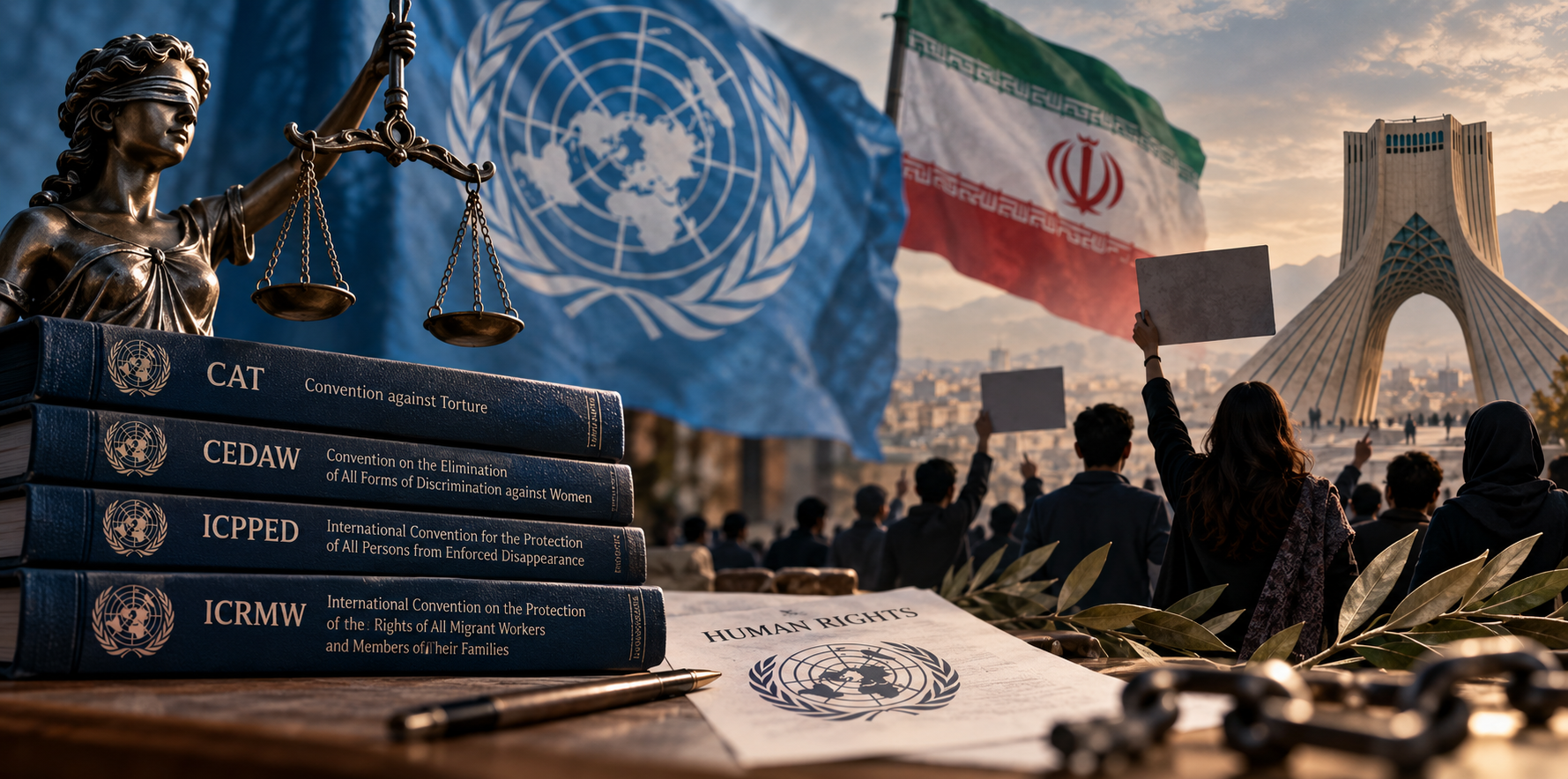
According to the United Nations Treaty Body Database, Iran has not joined the Convention against Torture and Other Cruel, Inhuman or Degrading Treatment or Punishment (CAT); the Convention on the Elimination of All Forms of Discrimination against Women (CEDAW); the International Convention for the Protection of All Persons from Enforced Disappearance (ICPPED); or the International Convention on the Protection of the Rights of All Migrant Workers and Members of Their Families (ICRMW).
It has also remained outside several optional protocols that would strengthen international scrutiny of its human rights obligations.
These omissions matter.
The Convention Against Torture
Perhaps the most consequential gap is Iran’s failure to become a party to the Convention against Torture.
CAT requires states to criminalize torture, investigate credible allegations, prosecute or extradite alleged perpetrators under specified circumstances, prevent other forms of cruel or degrading treatment and exclude statements obtained through torture from legal proceedings.
Iran is already prohibited from using torture under other legal obligations. Article 7 of the ICCPR, to which Iran is a party, prohibits torture and cruel, inhuman or degrading treatment. Iran’s own Constitution also contains protections against torture for extracting confessions or information.
Joining CAT would nevertheless create a substantially more detailed legal framework.
Iran would be required to periodically report to the UN Committee against Torture and respond to questions about its laws, detention practices and implementation of the Convention. Depending on the declarations and protocols accepted, additional mechanisms could become available.
Iran has also not joined the Optional Protocol to CAT, known as OPCAT. OPCAT establishes a preventive system based on regular visits to places of detention through both international and national mechanisms. The UN describes its system as one based on regular visits to locations where people are deprived of liberty.
For a country in which allegations concerning treatment in detention frequently form part of human rights reporting, an independent preventive inspection system could be particularly significant.
The potential benefit would not simply be retrospective accountability after torture occurs. The central philosophy of OPCAT is prevention.
CEDAW and Women’s Equality
Iran is also not a party to the Convention on the Elimination of All Forms of Discrimination against Women.
CEDAW is one of the most widely accepted international human rights treaties and establishes obligations covering equality before the law, political participation, education, employment, healthcare, family relations and discrimination affecting women in other areas of public and private life.
The official UN treaty database lists no signature or ratification by Iran.
Iran’s relationship with CEDAW has long been politically and legally contested domestically, particularly over questions concerning compatibility between provisions of the Convention and interpretations of Islamic law.
Those debates do not necessarily make accession impossible.
States frequently enter reservations when joining international treaties, although reservations that are incompatible with the object and purpose of a convention may be challenged. Accession can also become a process through which domestic authorities systematically identify areas where national law diverges from international standards.
The practical significance of CEDAW would be substantial.
Ratification would require periodic scrutiny of Iranian legislation and practice concerning subjects such as discrimination in employment, political representation, marriage and family law, access to public life and protection against gender-based discrimination.
The Convention would also provide lawyers, academics and civil society organizations with a more precise international legal framework against which domestic law could be evaluated.
Iran has likewise not accepted the Optional Protocol to CEDAW, which creates an individual communications procedure and an inquiry mechanism in certain circumstances.
Enforced Disappearance
Iran has also not joined the International Convention for the Protection of All Persons from Enforced Disappearance.
The Convention defines and prohibits enforced disappearance and requires states to criminalize the practice, investigate disappearances and protect victims and relatives.
Its importance goes beyond cases in which a person permanently disappears.
Under international law, enforced disappearance can occur when state agents—or persons acting with state authorization, support or acquiescence—deprive someone of liberty and then refuse to acknowledge the deprivation of liberty or conceal the person’s fate or whereabouts, placing that individual outside the protection of law.
This means that certain forms of secret or unacknowledged detention may fall within the Convention even where a detainee later reappears.
Iran has neither signed nor ratified the Convention according to the UN treaty database.
Accession would establish more detailed duties concerning detention records, investigation, access to information and the rights of relatives. It would also place implementation under the scrutiny of the Committee on Enforced Disappearances.
The Convention contains particularly important mechanisms for urgent situations. Its treaty body can, under applicable procedures, consider urgent requests concerning disappeared persons and monitor implementation by states parties.
For families attempting to determine where detained relatives are being held, international legal recognition of the right to know the truth about a person’s fate and whereabouts can be especially significant.
Migrant Workers
Iran has also not joined the International Convention on the Protection of the Rights of All Migrant Workers and Members of Their Families.
This absence receives less public attention than CAT or CEDAW, but it has substantial relevance to Iran.
Iran has for decades hosted large populations of migrants and refugees, particularly from Afghanistan. At the same time, many Iranian nationals live and work abroad.
The Migrant Workers Convention establishes protections concerning basic rights, due process, working conditions, family unity and treatment of migrant workers, while distinguishing in some areas between documented and undocumented migration.
The UN treaty database records no Iranian ratification or accession to the Convention.
Accession could require a more systematic review of Iranian labor, immigration and administrative practices affecting migrants while also reinforcing the principle that Iranian migrant workers abroad should receive internationally recognized protections.
The Missing Right of Individual Complaint
There is another, less visible gap in Iran’s treaty commitments.
Iran is a party to the ICCPR, but it has not joined the First Optional Protocol to the Covenant.
That distinction is important.
The ICCPR establishes rights including freedom of expression, peaceful assembly, freedom of religion, fair trial guarantees and protection against arbitrary detention.
The First Optional Protocol creates a mechanism through which individuals who claim that a state party violated their Covenant rights may, after satisfying admissibility requirements such as exhaustion of available domestic remedies, submit communications to the UN Human Rights Committee.
Because Iran has not accepted the Protocol, individuals under Iranian jurisdiction cannot use that procedure to bring complaints against Iran before the Committee.
Iran has similarly not joined the Optional Protocol to the ICESCR, the Optional Protocol to the Convention on the Rights of Persons with Disabilities or the communications procedure under the Convention on the Rights of the Child.
Accepting these procedures would not create an international appeals court capable of automatically overturning Iranian judgments. Treaty-body decisions are different from judgments of a national court.
But individual communications produce authoritative interpretations of treaty obligations, establish a documented international record and can create sustained pressure for remedies and legal reform.
The Death Penalty Protocol
Iran has also not joined the Second Optional Protocol to the ICCPR, which is specifically aimed at abolition of the death penalty.
This is politically and legally distinct from the other treaties because accession would require a fundamental change in Iran’s approach to capital punishment.
Iran remains a retentionist state and continues to impose the death penalty for numerous offenses. Consequently, accession to the Second Optional Protocol would involve not merely stronger monitoring but a commitment to abolition, subject to the limited reservation permitted by the Protocol concerning certain wartime military crimes.
For that reason, it represents one of the most far-reaching potential treaty commitments available to Iran.
Ratification Is Not the Same as Implementation
Civil society advocacy for treaty accession should nevertheless avoid presenting ratification as an end in itself.
Governments can ratify treaties and violate them.
Iran’s existing obligations under the ICCPR demonstrate the point. Formal membership in a convention does not automatically prevent arbitrary detention, restrictions on expression or unfair trials.
What ratification does is alter the legal architecture surrounding those violations.
A new treaty can require periodic government reports, produce examinations by independent experts, generate authoritative recommendations, establish international complaint procedures and require domestic legislation to be reviewed against more detailed standards.
It also changes the vocabulary available to domestic actors.
A lawyer arguing against torture after CAT accession would no longer rely only on general constitutional guarantees and Article 7 of the ICCPR. Specific obligations concerning investigation, prosecution, evidence obtained through torture and prevention would become relevant.
Likewise, CEDAW would provide a structured legal framework through which discriminatory legislation could be evaluated provision by provision.
Ratification therefore matters most when it is combined with implementation, domestic legislation and access to monitoring mechanisms.
What Role Can Civil Society Play?
Treaty accession ultimately requires decisions by state institutions, but civil society can contribute to the process through lawful public participation, legal analysis and international human rights mechanisms.
One avenue is the Universal Periodic Review.
During Iran’s UPR cycles, other UN member states have repeatedly recommended accession to treaties including CAT, CEDAW, ICPPED and the Migrant Workers Convention. Recommendations concerning Iran’s outstanding treaty commitments therefore already exist within an established UN process.
Civil society organizations can submit information to the UPR, track recommendations across review cycles and document the government’s responses.
A second avenue is domestic legal analysis.
Instead of discussing treaty accession only as a political slogan, universities, bar associations, women’s organizations, labor groups and other professional bodies can examine individual provisions and identify precisely what legislative changes accession would require.
This can make the debate more concrete.
Which provisions of Iranian criminal law would require amendment before or after CAT accession? What legislation would conflict with CEDAW? What institutional safeguards would be needed to comply with ICPPED?
These are questions capable of legal analysis rather than ideological positioning.
Parliament also has an important institutional role in treaty ratification. UN guidance on CEDAW specifically identifies parliamentarians, civil society organizations, academics, journalists and other stakeholders as actors commonly involved in national debates over ratification.
Civil society can additionally produce Persian-language treaty materials, comparative studies of implementation in other Muslim-majority states, legal commentaries and assessments of possible reservations. Such work can improve the quality of public debate regardless of the position ultimately taken by state institutions.
Building a Treaty-Based Human Rights Infrastructure
Another useful approach is to distinguish accession to a convention from acceptance of its strongest monitoring mechanisms.
These can occur in stages.
Joining CAT, for example, is one decision. Joining OPCAT and permitting a system of preventive detention visits is another. Becoming party to the ICCPR has already occurred; accepting its individual complaints mechanism would require the First Optional Protocol.
A step-by-step approach makes it possible to identify precisely what each commitment would change.
Civil society organizations can also maintain a public “ratification map” showing which treaties Iran has accepted, which remain outstanding, which optional protocols have not been joined and which individual complaint procedures remain unavailable.
This kind of monitoring can transform an abstract discussion into measurable commitments.
What Would Iran Gain?
Treaty accession is sometimes discussed only as an obligation imposed on states.
There are also potential institutional benefits.
Joining major conventions could strengthen Iran’s claim that its domestic legal system is capable of engaging with universal human rights standards rather than remaining outside substantial parts of the treaty system.
It could create structured channels of communication between Iranian institutions and international experts.
It could encourage clearer statutory definitions of prohibited conduct, stronger detention safeguards, improved data collection and more regular examination of discriminatory laws.
It could also provide civil society and victims with additional mechanisms that do not currently exist.
None of these outcomes would occur automatically.
A government can submit incomplete reports. Treaty-body recommendations can remain unimplemented. Domestic courts may fail to invoke international obligations. Reservations can weaken the practical effect of accession.
But absence from a treaty guarantees that many of these mechanisms will not apply at all.
From Ratification to Accountability
The long-term objective should therefore be broader than collecting additional ratifications.
Iran already belongs to enough major human rights treaties to demonstrate the difference between formal commitment and implementation.
The more meaningful objective is a system in which international commitments translate into domestic law, independent oversight, effective remedies and enforceable rights.
Accession to CAT could strengthen the legal architecture against torture.
CEDAW could establish a comprehensive framework for examining discrimination against women.
ICPPED could create stronger obligations concerning secret detention and disappeared persons.
The Migrant Workers Convention could strengthen protections for one of the most vulnerable populations living and working in Iran.
Optional protocols could give individuals access to international procedures currently unavailable to them.
And the Second Optional Protocol to the ICCPR would represent a commitment to abolishing capital punishment.
These instruments would not resolve Iran’s human rights problems by themselves.
But international human rights law develops incrementally. Each treaty creates obligations. Each reporting cycle creates a record. Each monitoring procedure creates another avenue for scrutiny. Each domestic implementing law can create another legal protection.
For Iranian civil society, the significance of treaty ratification therefore lies not in the symbolic act of adding Iran’s name to another international document.
Its real value lies in turning broad human rights principles into additional legal obligations, institutions and mechanisms through which the state can be asked to account for whether those rights are actually respected.
By: Keyvan Rafiee