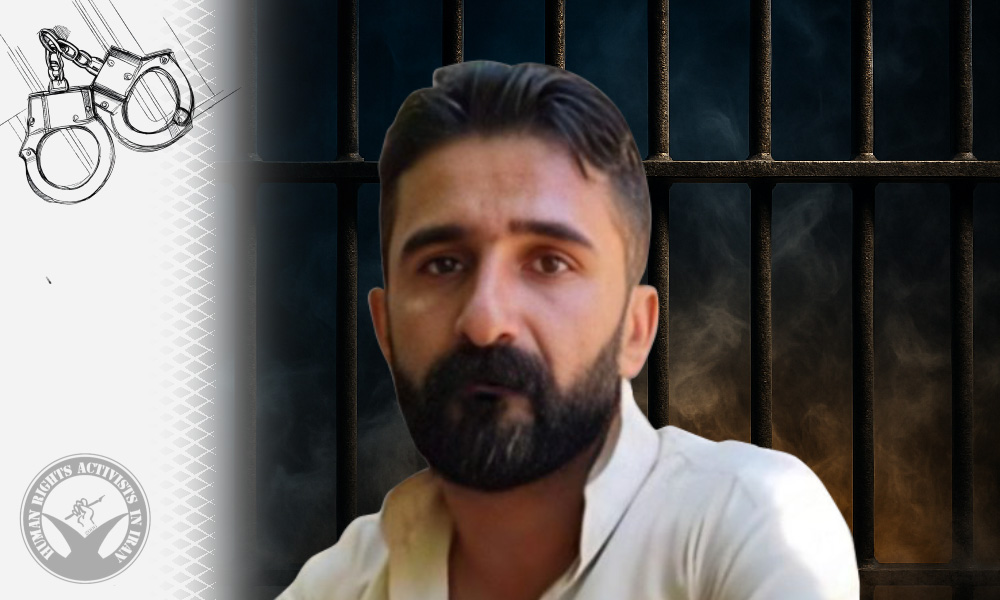
HRANA News Agency – Ali Qebchaq-Shahi, a writer and theater director from Naqadeh, was arrested by security forces in the city on Wednesday, June 26, and has since been held incommunicado.
Based on information received by HRANA, Qabchaq-Shahi was arrested by security forces in Naqadeh on June 25, and taken to an undisclosed location.
Despite six days having passed since his arrest, there is still no information regarding the reasons for his detention, the charges against him, or where he is being held.
Ali Qebchaq-Shahi is a writer and theater director from Naqadeh.
HRANA News Agency – Over the past several days, nine citizens—Kamyar (Kamal) Oghabi, Ahsan Othmani, Hamzeh Othmani, Ramyar Rezaei, Omid Bakhah, Abdollah Bakhah, Askar Najafi, Hassan Falaeian, and Abdul Rasouli—have been arrested by security forces in the cities of Oshnavieh, Marivan, Qasr-e Shirin, Divandarreh, and Piranshahr, and transferred to undisclosed locations.
According to a report by Kordpa, on Sunday, June 29, Kamyar Oghabi was arrested at his home in the village of Balagir, a district of Oshnavieh, without a judicial warrant. Security agents reportedly used violence during the arrest and took him to an unknown location. Oghabi, 33, is a married environmental activist with a prior record of arrest and conviction.
Kordpa also reported that in recent days, Askar Najafi, a resident of Sarpol-e Zahab, was detained by security forces at his workplace in the Qasr-e Shirin market and taken to an undisclosed location. No warrant was presented at the time of his arrest.
Additionally, according to KolbarNews, five residents of the village of Dareh-Nakhi, a district of Marivan, were arrested by security forces on Sunday and taken to unknown locations. The individuals were identified as Ahsan Othmani (22), Hamzeh Othmani (24), Ramyar Rezaei (25), Omid Bakhah (30), and Abdollah Bakhah (35). The arrests were reportedly carried out without judicial warrants, and the individuals’ homes were searched.
Separately, KolbarNews reported that Hassan Falaeian—also known as “Hawar Rojhelatî”—a poet and cultural activist from Piranshahr, was arrested on Sunday, June 21, and transferred to an undisclosed location. He remains in custody.
Furthermore, on Wednesday, June 18, security forces arrested a citizen in Divandarreh. KolbarNews identified the individual as Abdul Rasouli, 37, from the village of Tazabad Doleh Rash, a district of Divandarreh.
At the time of this report, the reasons for the arrests, the charges, and the whereabouts of the detainees remain unknown.
HRANA News Agency – In recent days, security and law enforcement forces have arrested 13 citizens in the cities of Astara, Urmia, Mahabad, and Rudsar, with some transferred to undisclosed locations.
According to Mehr News Agency, Jalaleddin Javanmardi, the police chief of Rudsar, announced today the arrest of five individuals in the city. He stated that the arrests were made over allegations of “collaborating with Israel on social media,” “insulting religious sanctities,” and “disturbing public opinion.”
Javanmardi, detailing the case, said that the police acted in response to online posts insulting religious sanctities and deceased IRGC commanders, sharing pro-Israel clips, and publishing offensive content against Iranian officials.
He added that the detainees include a 52-year-old woman and four men aged 31, 39, 40, and 41, who were arrested in Rahimabad, Kelachay, and the central district of Rudsar County. All were transferred to a police station and referred to the judiciary after case files were opened.
ILNA also reported the arrest of four citizens in Astara, quoting the city’s police chief, Morteza Ahadi. Ahadi said the arrests took place on Friday, June 27, on charges such as “espionage” and “propaganda against the regime.”
He added that the detainees, two men and two women from western provinces, were arrested along with digital evidence. Their phones allegedly contained photos and videos from Astara and other cities, which were reportedly sent to opposition networks. They had also applied for asylum in European countries.
On June 25, 2025, security forces arrested a citizen in Urmia. Kurdpa identified the individual as Alireza Khaledi, 22, a resident of Hasanabad village in the Sumay Baradost region. Security agents reportedly detained Mr. Khaledi without presenting a judicial warrant and transferred him to an undisclosed location.
Reports also indicate that on June 24, another citizen was arrested in Urmia by security forces. Kolbar News identified him as Bakhtiar Azizi, a resident of the Dizaj area. According to the report, security agents also arrested him without a court order. On the same day, two more individuals—Afshin Azizi and Kako Azizi—were also detained in Urmia.
Kolbar News further reported the arrests of two additional citizens about ten days ago. Authorities transferred both to an undisclosed location. They were identified as Hazhar Asadpour, 27, an employee of the Red Crescent, and Keyvan Ashtab, 29, an emergency medical technician at Mahabad Hospital.
As of now, there is no information regarding the whereabouts or charges against these individuals.
HRANA News Agency-The large-scale Israeli airstrikes on Iranian soil, which began on June 13 and lasted for twelve days, resulted in at least 5,665 casualties, including 1,190 killed and 4,475 injured, both military and civilian[1]. The attacks, which affected 28 provinces across the country, caused severe damage to critical military, civilian, medical, and emergency infrastructure, and posed a serious threat to the safety of citizens nationwide. During this period, 1,596 individuals were also arrested by the Iranian regime’s security forces.
Prelude
Download the PDF version of the report here
From June 13 to June 24, 2025, Iran witnessed one of the most intense military confrontations in recent decades. The successive waves of Israeli air and missile strikes not only targeted military and strategic infrastructure but also disrupted the daily lives of millions of civilians—ranging from prolonged internet outages by regime and disrupted banking services to partial suspension of public transportation and reduced capacity of medical centers. These concentrated attacks—which even targeted prominent scientific figures—have raised serious questions regarding adherence to humanitarian principles and triggered unprecedented security concerns.
Relying on nearly two decades of experience documenting crises, the Human Rights Activists News Agency (HRANA) began tracking casualties and damages from the earliest hours of the conflict, updating its data continuously. The comprehensive report at hand is the result of collecting and verifying thousands of data points over these twelve days, offering a documented view of the war’s human, economic, and infrastructural dimensions—a picture that underscores the depth of the crisis and the urgent need for global attention to support civilians and rebuild damaged infrastructure.
Geographic Scope and Chronology of Events
Around dawn on June 13, the first wave of Israeli missiles and drones awakened the capital and northern regions of Iran. That same day, air defense systems were activated in multiple locations as the attacks penetrated deep into Iranian territory.
The following day, the scope of the attacks expanded, prompting the Red Crescent’s emergency forces across the country to go on high alert.
On June 15, critical energy sector targets in the capital were set ablaze, and parts of military infrastructure also caught fire. Simultaneously, numerous reports emerged of strikes hitting residential areas in the capital.
A day later, smoke rose from the glass headquarters of the Islamic Republic of Iran Broadcasting (IRIB) and from a hospital in western Iran. The strike on an emergency vehicle highlighted the growing risks to emergency services.
On the fifth day (June 17), several new areas were added to the list of strike zones. Around the same time, a Red Crescent spokesperson stated—without providing specifics—that “since the start of the attacks, 21 provinces have been affected.”
On June 18, the capital was once again hit by a heavy wave of attacks, and the strikes spread to parts of central and northern provinces.
The end of the first week (June 19) brought a blow to the country’s central infrastructure; the seven-day campaign had engulfed nearly all of Iran’s main regions.
On June 20, missiles struck northern and coastal provinces. The Israeli military announced it had carried out 720 airstrikes since the beginning of the operation—a figure that revealed the intensity of the conflict.
On the ninth day (June 21), mountainous areas in central Iran also came under fire. Unofficial reports indicated the attacks had expanded to more than two-thirds of the country’s provinces.
On the tenth day of the war (June 22), the capital once again trembled; simultaneously, three nuclear facilities in central Iran were bombed. The capital’s governor stated that “over 200 locations” in the province had been targeted over the past ten days.
On June 23, the attacks continued and several additional provinces were added to the list of affected areas; the capital’s air defense remained active throughout the night.
In the early hours of June 24—just before the ceasefire was officially declared—several sites in the capital and neighboring provinces came under fire. The picture that emerged from twelve days of conflict: widespread destruction of both military and civilian infrastructure and a persistent threat to citizens nationwide.
Although the ceasefire brought an end to the airstrikes, residents of the affected neighborhoods know that this does not mean the end of their worries. In the days ahead, fundamental questions about reconstruction capacity, the protection of critical infrastructure, and the fate of the damaged cities will remain at the forefront of the news.
In total, the provinces that were either attacked or had their air defense systems activated include:
Tehran, Isfahan, East Azerbaijan, Kermanshah, Alborz, Khuzestan, Fars, West Azerbaijan, Hamedan, Qom, Gilan, Lorestan, Razavi Khorasan, Zanjan, Bushehr, Markazi (Central), Kurdistan, Ilam, Qazvin, Hormozgan, Mazandaran, Yazd, Golestan, Semnan, Chaharmahal and Bakhtiari, Kerman, Ardabil, and Sistan and Baluchestan.
The main cities that were either targeted or had their air defense systems activated include:
During the twelve days of conflict, the Israeli military announced that in just the first three days, it had carried out over 720 airstrikes, targeting more than 60 locations in total. On the fifth day, Israel claimed that three new waves of attacks struck at least 40 additional targets.
In investigations by human rights groups, the principle of proportionality in the laws of war holds particular significance, especially concerning the balance between the nature of targets and the weapons used. Based on data compiled from reliable sources, in addition to precision-guided bombs, suicide drones, and long-range rockets fired from within Iran, the Israeli military deployed the following weaponry:
1 • Harop – Suicide Drone: Produced by Israel Aerospace Industries (IAI), this loitering munition remains airborne for extended periods and crashes into targets like radars or air defense systems. Used to blind Iranian radar systems. 2 • Harpy – Anti-Radar Drone: An older type of anti-radiation drone that autonomously seeks out radar signals and strikes once detected. Used to destroy radars in Iran’s missile systems. 3 • F-35I Adir – Stealth Multirole Fighter: Israel’s customized version of the U.S. F-35, equipped with domestic electronic systems. Led the initial strike waves due to its stealth, targeting command centers, air defenses, and nuclear sites. 4 • F-15I Ra’am – Long-Range Strike Fighter: A twin-engine aircraft capable of carrying heavy payloads, primarily used to deliver bunker-buster bombs like the GBU-28. Played a key role in strikes on underground facilities, including Natanz. 5 • F-16I Sufa – Multirole Fighter: An upgraded F-16D with long-range capability and multiple precision weapons. Deployed to hit military bases, missile platforms, and communication infrastructure using SPICE and JDAM bombs. 6 • Delilah – Air-Launched Cruise Missile: A long-range missile that can loiter near a target area, effective against mobile or hidden systems like radars or command vehicles. 7 •Rampage – Supersonic Air-to-Surface Missile: A fast, precision missile developed by Elbit Systems, used to strike strategic infrastructure such as shelters, missile factories, and munitions depots. Its speed complicates interception. 8 • Blue Sparrow – Air-Launched Ballistic Missile: Originally a test missile for simulating threats, but field evidence suggests operational use against strategic infrastructure. 9 • LORA – Short-Range Ballistic Missile: A ground-launched missile with a 400 km range, capable of striking fixed targets with less than 10-meter accuracy. Used early in the campaign to destroy key infrastructure in western Iran. 10 • SPICE-1000/2000 – Glide-Guided Bombs: Smart kits that turn unguided bombs into precision weapons by locking onto target images. Widely used against sensitive Iranian facilities. 11 • JDAM – GPS-Guided Bombs: U.S.-made kits that enable ordinary bombs to be guided via GPS. Various types were used to strike fixed targets. 12 • GBU-39 SDB – Small Diameter Bomb: Lightweight, high-precision bombs that allow multiple munitions to be carried simultaneously on a single fighter. Suitable for strikes with high risk of collateral damage. 13 • GBU-28 – Bunker Buster Bomb: A 5,000-pound bomb capable of penetrating reinforced concrete and earth. Used against underground sites like Natanz. 14 • Spike ATGM – Guided Anti-Tank Missile: An advanced Israeli missile by Rafael with fire-and-forget capability, using visual and thermal targeting to destroy armored vehicles and light fortifications. Long-range variants were used to hit vehicles and buildings. 15 • B-2 Spirit – Strategic Stealth Bomber: A U.S. intercontinental bomber by Northrop Grumman, capable of carrying about 23 tons of guided munitions. Its low radar cross-section allowed it to penetrate Iranian airspace stealthily and drop bunker-busters. In a joint U.S.-Israeli mission, the B-2 targeted the Fordow, Natanz, and Arak nuclear facilities, deploying GBU-57 bombs from high altitude. 16 • GBU-57A/B MOP – Super-Heavy Bunker Buster: A 30,000-pound bomb capable of penetrating over 60 meters of earth and reinforced concrete. Guided via inertial/GPS systems, it is exclusively deployed by B-2 bombers and was used in the initial strikes to disable sensitive underground sections of Iran’s nuclear infrastructure.
Widespread Disruption of Civilian Life
Over the twelve days of war, HRANA received numerous reports and testimonies that together paint a vivid picture of civilian life under bombardment.
Collapse of Financial Chains and Access to Funds
Banks were among the first casualties of cyberattacks and widespread internet outages. At one point, the cash withdrawal limit in some branches was reduced to one million tomans, and ATMs—especially in migrant-heavy northern cities—were either empty or inoperative. A simultaneous hack of Sepah Bank, Pasargad, and several private banks on the sixth day disrupted card payments for hours. Small online businesses—which became a lifeline for thousands of families post-COVID—faced sudden shutdowns due to inoperable banking gateways and delivery platforms. In Tehran’s Shush and Nasser Khosrow bazaars, many shopkeepers kept their shutters down to avoid facing crowds with no purchasing power.
Paralyzed Transport, Rush Migration, and Route Profiteering
In Tehran, intercity taxi fares reportedly surged to 80 million rials (approx. $160) for the Tehran–Gilan route. In the south, drivers only accepted prepayment in U.S. dollars for routes like Bandar Abbas–Tehran. After a drone strike on Qom station, Iran’s railway suspended four national lines, leaving hundreds stranded in unlit terminals. On western exits of the capital, cars queued for kilometers in 40°C heat, forced to shut off air conditioners due to fuel shortages. Accounts converged on a scene of overcrowding, heat exhaustion, and dwindling gas.
Rationing, Queues, and Soaring Prices for Essentials
With major supply routes blocked, bakeries in northern and northwestern Iran saw lines of over 200 people. In a village in Qazvin, flatbread reached more than four times its pre-war price. Oil, infant formula, and sanitary pads were rationed in Tehran and Rasht. Central produce vendors reported a 50% drop in customers, while small grocers on Police Street had to discard most of their daily greens. Conversely, residents in southern Tehran created solidarity by distributing drinks among neighbors.
Vulnerable Groups Under Extra Pressure
– Elderly and chronically ill: A civil observatory recorded at least 22 deaths due to dialysis delays or power cuts to home oxygen devices.
– Disabled persons and female-headed households: The local welfare network in Kermanshah reported that its stockpile of wheelchairs and aids near Khosravi airport was destroyed in a fire, and resupply halted due to fuel shortages.
– Afghan migrants: Dozens of reports indicated that they were denied access to public shelters in two districts of Tehran—Tehran-No and Lavizan. In another account, three Afghan families had to spent the night in their car near Fashafouyeh.
– Pets and stray animals: The closure of veterinary clinics and rising pet food prices triggered a wave of pet abandonment. Volunteers in Sa’adat Abad (Tehran) created a makeshift shelter in Parvaz Park for 30 dogs.
Forced Labor Under Airstrike
Industrial workers in zones 18 and 20 of Tehran continued 24-hour shifts despite evacuation warnings, under threat of dismissal for “war-time absenteeism.” Some workers at a foundry in Ghal’eh Morghi took cover under deactivated machinery for eight hours after shrapnel struck the roof, waiting for fire risk to subside. A confidential directive from the government’s administrative body mandated that public employees return to offices by day three. Internal videos showed staff in the Ministry of Agriculture corridors wearing helmets.
Strike on Evin Prison and Breakdown of Inmate Services
Industrial workers in Tehran’s districts 18 and 20 were compelled to continue 24-hour shifts despite evacuation warnings, facing threats of dismissal for “wartime absenteeism.” In one example, at a foundry in Ghal’eh Morghi, some workers sheltered for eight hours beneath inactive machinery after shrapnel hit the roof, waiting for fire hazards to pass. A confidential directive from the Administrative and Recruitment Affairs Organization ordered public employees to return to work by the third day of the war. Internal footage showed Ministry of Agriculture staff wearing helmets in office corridors.
Communication Blackouts and Mental Strain
Three waves of internet shutdowns peaked on June 18. Families of diaspora Iranians faced total communication blackouts. Field psychologists reported that calls related to panic attacks and sleep disorders tripled compared to pre-war averages. Students at dorms in Amirkabir and Tehran Markazi Universities said they slept fully dressed and shoed, ready to evacuate at any moment.
Information Vacuum and Explosive Rumors
State media mostly repeated military briefings, offering no updates on sheltering or food safety. In this void, social media spread unverified claims of “radiological contamination in eastern Tehran” and “Israeli use of chemical warheads,” sparking an emergency exodus to the north. Media analysts noted a direct correlation between conspiracy theory circulation and a spike in “anonymous link views.”
Social Resilience and Grassroots Solidarity Networks
Amid the destruction, some remaining residents in Tehran used the hashtag #IAmTehran as a symbolic show of presence. Café owners in Iranshahr kept their lights on—serving only apple pie—so “the city wouldn’t feel deserted.” In the south Tehran, youths at Khorasan Square handed out drinks. Handwritten signs in Jordan Street read, “When you return, watch out for the glass,” in an effort to protect the property of displaced neighbors. These modest, spontaneous acts played a vital role in easing fear and replacing a narrative of “flight” with one of “staying and rebuilding.”
Human Casualties from the Iran-Israel War
Twelve consecutive days of bombardment resulted in at least 5,665 casualties, including 1,190 killed and 4,475 injured, according to field data collected by HRANA and its network of medical and local volunteers. These figures were recorded across 28 provinces. In contrast, the Iranian Ministry of Health announced a slightly lower total of 5,356 casualties as of midday on June 24, reporting 610 deaths and 4,746 injuries.
Rising Toll: A Day-by-Day Breakdown
▪️ Day 1 (June 13): Simultaneous strikes on Tehran, Tabriz, and Kermanshah left at least 770 casualties, including 35 women and children among the dead.
▪️ Day 2: With missiles hitting Khorramabad and Asadabad, the total rose to 983. The first report of an ambulance strike was recorded.
▪️ Day 3: A series of explosions in Tehran’s Narmak and Sabunchi neighborhoods pushed the total number of casualties past 1,000.
▪️ Days 4–6: Concentrated bombings on IRGC bases in Qom, Borujerd, and the police headquarters in Tehran triggered a new wave of military casualties, bringing the total to 1,968 by June 18.
▪️ End of Week 1 (June 19): HRANA published a seven-day tally of 2,694. The Health Ministry stated it had received 2,500 injured but did not report a death toll.
▪️ Days 8–9: Continued attacks on energy facilities and hospitals brought the total to 4,261. For the first time, the government acknowledged that “54 women and children” had died.
▪️ Day 10 (June 22): As Israeli air raids continued across several provinces, U.S. air forces bombed Natanz, Isfahan, and Fordow. Total casualties rose to 4,400; the Red Crescent confirmed the deaths of three aid workers.
▪️ Day 11: Continued Israeli strikes raised the number to 4,432. Notable events included the bombing of Evin Prison, the targeting of an ambulance in Najafabad, and the death of a five-year-old child in Asadabad.
▪️ Day 12 and Ceasefire (June 24): The final wave of Israeli drones struck eastern Tehran, Ahvaz, and Astaneh-ye Ashrafiyeh. HRANA data placed the total number of dead and injured at 5,665, while the government’s official figure was 5,356.
•Women and children: At least 65 children and 49 women—including two pregnant women—were killed; 270 women and children were injured. •Medical and emergency workers: Five doctors and four aid workers were killed; at least 49 were injured. Nine ambulances and seven hospitals were directly hit or damaged by shrapnel. Six ambulances and one Red Crescent helicopter were also impacted. •Civilian infrastructure: Six emergency medical bases and two maternal-child health centers were destroyed or severely damaged.
The following table lists the confirmed identities of several children who were injured or killed in recent attacks. HRANA is currently reviewing additional identity data for other affected children.
Province
City
Date
Killed
Injured
Age
Identity
Location
1
Tehran
Tehran
Friday, June 13
1
–
12 yrs
Amirali Amini
Mahallati Street
2
Tehran
Tehran
Friday, June 13
1
–
16 yrs
Parham Abbasi
Sattarkhan neighborhood
3
Unknown
Unknown
Unknown (June 13–14 window)
–
3
2 yrs
–
–
4
Tehran
Tehran
Friday, June 13
1
–
10 yrs
Mahya (Mahia) Nikzad
–
5
Tehran
Tehran
Unknown (June 13–14 window)
1
–
–
Heida Zeinali
–
6
Tehran
Tehran
Unknown (June 13–14 window)
1
–
–
Ayda Zeinali
–
7
Tehran
Tehran
Friday, June 13
1
–
9 yrs
Baran Eshraghi
–
8
Tehran
Tehran
Friday, June 13
1
–
5 yrs
Fatemeh Zakerian
–
9
Tehran
Tehran
Friday, June 13
1
–
7 mos
Zahra Zakerian
–
10
Tehran
Tehran
Unknown (June 13–14 window)
1
–
11 yrs
Soheil Katooli
–
11
Tehran
Tehran
Saturday, June 14
1
–
17 yrs
Seyed Hamidreza Sedighi Saber
Sattarkhan neighborhood
12
Tehran
Tehran
Unknown (June 13–16 window)
1
–
3 yrs
–
–
13
Tehran
Tehran
Unknown (June 13–16 window)
1
–
8 yrs
Tara Haji Miri
Patrice Lumumba Street
14
Isfahan
Najafabad
Tuesday, June 17
1
–
13 yrs
Fatemeh Sharifi
–
15
Isfahan
Najafabad
Tuesday, June 17
1
–
10 yrs
Mojtaba Sharifi
–
16
Tehran
Tehran
Friday, June 13
1
–
11 yrs
Motahareh Niyazmand
Chamran Residential Complex
17
Tehran
Tehran
Friday, June 13
1
–
13 yrs
Mohaddeseh Aghdasi
Chamran Residential Complex
18
Tehran
Tehran
Friday, June 13
1
–
10 yrs
Mohammadreza Aghdasi
Chamran Residential Complex
19
Tehran
Tehran
Friday, June 13
1
–
13 yrs
Mersana Bahrami
Chamran Residential Complex
20
Unknown
Unknown
Friday, June 13
1
–
8 yrs
Mohammad Hossein Khaki
Chamran Residential Complex
21
Tehran
Tehran
Friday, June 13
1
–
10 yrs
Fatemeh Niazmand
Chamran Residential Complex
22
Tehran
Tehran
Friday, June 13
1
–
12 yrs
Alireza Niazmand
Chamran Residential Complex
23
Tehran
Tehran
Friday, June 13
1
–
9 yrs
Zahra Bahman Abadi
Chamran Residential Complex
24
Tehran
Tehran
Friday, June 13
1
–
5 yrs
Hanieh Bahman Abadi
Chamran Residential Complex
25
Tehran
Tehran
Friday, June 13
1
–
2 yrs
Mohammadali Bahman Abadi
Chamran Residential Complex
26
Tehran
Tehran
Friday, June 13
1
–
16 yrs
Matin Safaeyan
Tajrish
27
Tehran
Tehran
Unknown (June 13–16 window)
1
–
Unknown
–
Tehranpars
28
Tehran
Tehran
Unknown (June 13–16 window)
1
–
2 months
Yaran Ghasemian
–
29
Tehran
Unknown
Unknown (June 13–17 window)
1
–
–
–
–
30
Qom
Qom
Saturday, June 21
1
–
16 yrs
Ehsan Ghasemi
–
31
Unknown
Unknown
Unknown (June 13–20 window)
1
–
10 yrs
Fatemeh Sadat Sadati
–
32
Khuzestan
Andimeshk
Unknown (June 19–20 window)
1
–
7 yrs
Seyed Armin Mousavi
Dokoheh Military Zone
33
Lorestan
Unknown
Unknown (June 13–20 window)
1
–
Unknown
Helena Gholami
–
34
Kermanshah
Eslamabad-e Gharb
Saturday, June 21
1
–
6 yrs
Yasin Molaei
–
35
Kermanshah
Eslamabad-e Gharb
Saturday, June 21
–
1
3 yrs
Unknown (Yasin Molaei’s brother)
–
36
Kermanshah
Hamil
Saturday, June 21
1
1
6 yrs killed, 1 yr injured
–
–
37
East Azerbaijan
Tabriz
Saturday, June 21
1
–
7 yrs
Alisan Jabari
Azerbaijan Square
38
East Azerbaijan
Tabriz
Saturday, June 21
1
–
7 yrs
Taha Behroozi
Azerbaijan Square
39
Tehran
Tehran
Injured June 13–16, died June 23
1
–
5 yrs
Kian Ghasemian
–
Contrasting Official and Independent Figures
1 • Scope of Sources
HRANA gathers data from three layers: volunteers embedded in medical centers, a network of hundreds of verified local channels, and official statements used for cross-verification. In contrast, the government relies almost exclusively on reports from public hospitals and state medical facilities. 2 •Recording and Updating Methods
HRANA updates its casualty figures daily and in real time, with each number confirmed by at least one independent source before being finalized. Government figures are released periodically and often feature sudden, unexplained jumps. 3 •Inclusion of Victims
HRANA’s estimates include military personnel, outpatient injuries, and unidentified victims. Official tallies often exclude military casualties (or report them with delay) and typically omit outpatient injuries. 4 •Political Pressure and Motivations
During the conflict, the government revised casualty figures significantly on at least three occasions (e.g., an increase from 2,500 to 4,500 injured on Day 8), suggesting that numbers are filtered through political considerations before release. HRANA, by contrast, reports gradual and documented increases. 5 •The 309-Person Discrepancy
While the final 309-person gap between HRANA’s and the government’s tallies may seem minor, it highlights which groups are omitted or downplayed in the official narrative—and underscores why independent access to raw data is vital for human rights organizations and international observers.
Nuclear Scientists
During the wave of Israeli, at least eleven of the country’s leading nuclear scientists were killed in Tehran and several other cities. These attacks not only claimed the lives of prominent scientific figures but also killed family members and neighbors, bringing the documented death toll to over 60.
According to field sources and medical data, Fereydoon Abbasi-Davani—former head of the Atomic Energy Organization of Iran and a professor of nuclear physics—was killed along with his 24-year-old daughter in the “Sarv Professors Complex” in Sa’adat Abad, Tehran. In the same complex, Mohammad Mehdi Tehranchi, a board member of Islamic Azad University, died from a direct explosive hit; witnesses say only scattered remains of his body were found.
Hours later, in Tehran’s Shahrara neighborhood, Abdolhamid Minoochehr—a professor of nuclear engineering and editor of the journal Nuclear Technology and Energy—was killed at 3:30 a.m. in his five-story apartment building, along with a domestic worker. In the Shahid Daghaghi residential area of Lavizan, Ahmadreza Zolfaghari Daryani, former dean of the Nuclear Sciences Faculty at Shahid Beheshti University, was killed when a guided missile struck his home.
Another victim, Seyed Amirhossein Faghihi—former deputy head of the Atomic Energy Organization and faculty member at Shahid Beheshti University—was killed in Tehran’s Marzdaran neighborhood. That same night, Nader (Akbar) Matlabi-Zadeh, a nuclear physicist from Isfahan affiliated with Islamic Azad University, was targeted and killed in Yazd as he exited his home.
The attacks on residential homes caused severe family casualties:
• On Pasdaran Street in Tehran, Ali Bakaei Karimi was killed along with his wife and two young children. • Near Heravi Square Tehran, Mansour Asgari, a researcher on research reactors, died with his wife and four-year-old child. • Local sources reported the death of Saeed Borji, a research assistant at the Khondab facility, in eastern Tehran; further details are pending. • The deadliest event occurred on the morning of June 24: a strike on a residential block in southern Tehran killed Mohammadreza Sedighi Saber, a specialist in advanced centrifuges. The explosion caused the building to collapse entirely. According to witnesses, 43 others—including his 17-year-old son—also died or were trapped under the rubble. • Hours later, news emerged of the assassination of Issar Tabatabaei Qomsheh, a nuclear engineering professor at Sharif University of Technology, at his home in Shahr-e Rey. He and his wife, Mansoureh Haji Salem, were both killed.
Although officials have yet to comment on the specific types of weapons used, forensic evidence and the extent of destruction suggest a combination of precision-guided bombs, suicide drones, and long-range rockets. Most strikes occurred late at night—a tactic that experts say is designed to maximize psychological impact and hinder immediate rescue efforts.
Forensic authorities and hospitals in the capital have confirmed the identities of several victims, while search operations under the rubble continue in multiple locations. Medical sources report that over 70 people were injured in these incidents, some in critical condition due to severe burns or amputations.
Israeli Strikes on Iran’s Civilian Infrastructure
As the twelve-day conflict between Israel and Iran came to an end, HRANA’s updated assessment reveals that a significant portion of Iran’s civilian infrastructure and assets remained under fire. Verified data from June 13 to 24 records at least 109 strikes or explosions at industrial, energy, administrative, and commercial sites—a number that poses a serious challenge to the country’s economic outlook. Nearly two-thirds of these incidents (73 cases) occurred in Tehran Province, followed by Alborz, Lorestan, Fars, and Kermanshah as the hardest-hit provinces. The peak occurred on June 15 with 53 reported incidents, coinciding with the first nationwide internet blackout and a several-hour disruption to energy production and distribution.
Methodological Note: The classification of targeted locations in this report as “military” or “civilian” is based on publicly available information, visible indicators, and testimonies from local residents. A definitive determination of the nature of these sites requires further verification through official documents, satellite imagery, and comprehensive analysis, which are currently not accessible. Therefore, this categorization is provisional and intended to provide an initial overview rather than a conclusive judgment about the nature of the targets.
Strikes on Energy Infrastructure
The most extensive energy-related damage was observed in the southern provinces and Tehran. In Bushehr, the Fajr Jam refinery and Phase 14 of the South Pars gas field were hit twice in succession on June 14, causing a 30% drop in gas pressure. In the capital, the oil depots in Shahran and South Tehran, as well as the Shahr-e Rey refinery, suffered three consecutive explosions on June 15, igniting three ten-million-liter storage tanks and shutting down the distillation unit for 12 hours. Fires in the hydrocracking unit of Kermanshah Oil Refinery on June 16 and disruption of backup power at Yazd’s combined cycle power plant the next day caused a 7% drop in refining capacity during the review period, leading to multi-kilometer fuel lines on roads west and south of Tehran.
Manufacturing and Industrial Plants
In Lorestan, strikes on the car manufacturing company, Zagros and the Oshtorinan Machine-Building Complex destroyed pressing and painting halls, halting assembly lines. An explosion near Shiraz Electronics Industries ignited a telecommunications board warehouse and disabled SMT lines. Power outages and roof collapses at industrial parks in Alborz (Qazvin) and Marand, as well as damage to five textile and food factories in Zanjan and Hamedan, forced at least 3,000 workers into forced leave or unemployment.
Administrative and Transport Infrastructure
Mehrabad and Tabriz airports were each temporarily shut down twice due to security alerts—Mehrabad in particular suffered a cruise missile hit on June 16 that burned out the fueling system for its western runway. An explosion at an annex of the Ministry of Foreign Affairs near the Garden Museum, and shattered windows at Shahid Beheshti University’s Central Library (June 23), disrupted thousands of employees and students. Evin Prison was struck on June 19, with a missile hitting the entry gate; damage to the infirmary and cut phone lines led to widespread human rights protests. In total, 16 administrative and transport targets—from passenger terminals to telecom towers—sustained direct damage.
Commercial Property and Market Losses
Broken windows at the massive Iran Mall complex in western Tehran, fires in warehouse clusters near the Karaj highway, and a localized explosion at the Grand Bazaar of Isfahan were among the most notable commercial incidents. Twelve identified commercial centers suffered structural damage or temporary closure. Field reports also indicate a significant drop in access to essential goods in western Tehran.
Targeting Patterns and Human Impact
Although the Israeli military stated that its strikes focused on missile-related infrastructure, the spread of attacks and the lack of nearby air defenses at civilian sites—such as Shahran Oil Depot or Shiraz Electronics—raise serious concerns about adherence to the principle of distinction between military and civilian targets. So far, the deaths of four refinery workers, two fuel truck drivers, and three factory guards have been confirmed, along with dozens of injuries—a figure likely to rise as provincial data collection continues.
Attacks on Tehran Neighborhoods
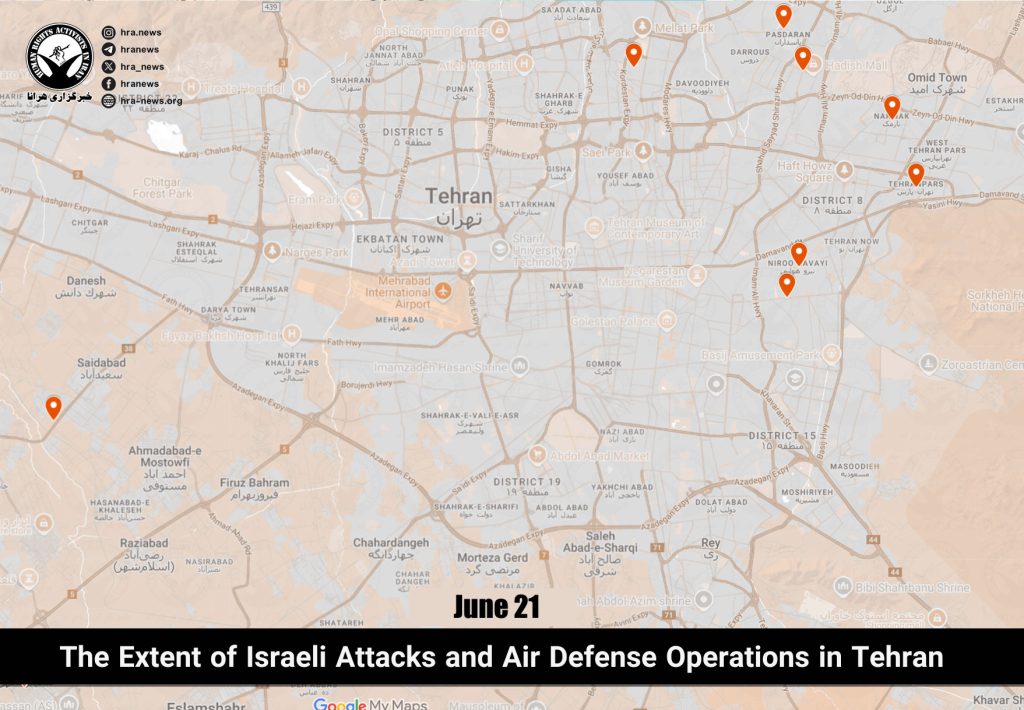
HRANA’s compilation of twelve days of conflict data reveals that the geography of strikes in the capital was more concentrated around the city’s outer ring than previously estimated—zones where strategic infrastructure and dense residential areas are often adjacent. A total of 300 strike or explosion events were recorded within Tehran’s urban area, a number that is expected to significantly alter the capital’s security landscape for years to come. Of these, 95 events were precisely mapped at the neighborhood level: 45 incidents (47%) occurred in the east and northeast corridor, 27 (28%) in the west, 16 (17%) in the north and northwest, and 7 (7%) in the south and southwest.
East and Northeast: The Most Frequent Target Zone
The Tehranpars, Hakimiyeh, and Lavizan corridor, extending along Babayi Expressway, remained the most heavily targeted axis. Forty-five strike or explosion incidents were recorded in this narrow industrial-residential corridor, including three direct hits on Lavizan fuel depots and two secondary explosions felt as far as the Babayi Expressway interchange. Nobonyad, Majidieh, and Narmak neighborhoods repeatedly came under blast waves. Air defense batteries stationed on the Lashgark heights fired seven interceptor missiles and launched several artillery bursts over five consecutive nights, lighting up the eastern sky.
North and Northwest: The Administrative Buffer Zone
Sixteen incidents were recorded in the Tajrish–Vanak–Jordan axis, including three in a 48-hour span that shattered windows in Seoul Street office towers twice and paralyzed the Sadr Expressway for hours. Shrapnel bursts over Niavaran, Valiasr Street, and near Saei Park disrupted radio communications and caused localized power outages. On the sixth night of the conflict, two surface-to-air interceptors were confirmed to have launched from the Lavizan–Niavaran defense site.
Western Axis: Between Industrial and Residential Arteries
Twenty-seven incidents were reported in the Shahran, Chitgar, and Bidganeh corridor—home to the Shahran oil depot and the Bidganeh missile base. On June 15, smoke from a massive explosion at the oil depot was visible from the city center. For three consecutive nights, air defense systems on Chitgar’s hills and near Azadi Square fired three interceptor missiles along with multiple artillery rounds. Tourist activity at Chitgar Lake’s parks was suspended for several days, and residents of Ekbatan and Iran Mall spent at least two nights in emergency shelters.
South and Southwest: Fewer Strikes, Heavier Damages
Seven incidents occurred in the southern zone, from Eslamshahr to Khaniabad-e No and along the Persian Gulf Expressway. Though fewer in number, the strikes caused disproportionately heavy damage to logistics depots and aging residential areas. An explosion near the Khalij-e Fars Complex destroyed two fuel storage tanks and three warehouse hangars, displacing at least 100 families until the ceasefire. On the ninth night, two short-range interceptors were launched from a defense site in southern Tehran.
Overall Pattern and Impacts
Nearly half of the strikes with known coordinates occurred in the eastern–northeastern corridor—an area whose mix of fuel facilities and dense housing raised the highest civilian casualty concerns. The western sector, dense with energy and logistics infrastructure, was the second major target zone. Among the 300 recorded incidents, at least three major fuel tanks, two strategic logistics depots, and hundreds of residential or commercial units were damaged. Verified reports confirm the deaths of four fuel depot workers, two tanker drivers, and three factory guards, along with dozens more injured. Given the geographical spread and ongoing debris clearance operations, the casualty figures may still rise. Experts believe this focused targeting of peripheral belts will lead to a substantial reassessment of the capital’s security posture in the coming years.
Israeli Strikes on Iranian Military Sites
Over the twelve days of war, at least 154 heavy strike waves were recorded against military bases and installations across the country. These attacks occurred in 28 provinces, averaging more than 12 military targets per day. According to data collected by HRANA:
Key Metric
Figure
Description
Total Recorded Attacks
154
Includes only strictly military targets; dual-use infrastructure not counted.
Provinces Affected
28 out of 31
Tehran, Isfahan, and Kermanshah were hit the most.
Most Frequent Day
June 18 (31 attacks)
Unprecedented wave of missile and drone strikes in various parts of Tehran, Alborz, and Rey.
Most Strikes in a Province
Tehran (42 attacks)
Concentrated especially around Parchin, Shahr-e Rey, and Lavizan.
Timeline of Major Attacks
Date
Notable Targets
Key Highlight
June 13
Mehrabad Airport, Kermanshah Missile Base, 8th Tactical Air Base (Isfahan)
Official start of conflict; three hits in the first few hours.
Khondab Heavy Water Complex (Arak), Natanz nuclear site, multiple locations in Tehran
First major engagement with strategic nuclear targets on military list.
June 20
Bushehr Air Base, IRGC garrison near Chaharshir (Ahvaz)
Attacks expand to the south and Persian Gulf coast.
June 21
Defense Industries Complex, the Third Naval Base, Cyber Police (FATA), the Fourth Tactical Air Base, and the Army’s 71st Mechanized Infantry Brigade in the Sumar region were among the sites targeted.
The Cyber Police Center of the Law Enforcement Command (FATA) was attacked.
June 22
Three nuclear facilities (Natanz, Fordow, Isfahan) — joint U.S. operation
Peak of strategic strikes; 22 military targets hit in one day.
June 23
Shahid Madani logistics center (Tabriz), Parchin missile complex, IRGC Seyed-al-Shohada unit (Shahr-e Rey)
Focus on IRGC supply lines and missile industries.
During the twelve-day war, Iran’s top military command structure sustained unprecedented losses, beginning with the confirmed deaths of at least twelve prominent figures from the Islamic Revolutionary Guard Corps (IRGC) and the Armed Forces General Staff, and extending to mid-level intelligence officers.
In the early hours of June 13, the deaths of several top-ranking military officials were announced, including Amir-Ali Hajizadeh, commander of the IRGC Aerospace Force; Mohammad Bagheri, Chief of Staff of the Armed Forces; and Hossein Salami, Commander-in-Chief of the IRGC. Also confirmed dead that night were Gholam Ali Rashid, commander of the Khatam al-Anbia Central Headquarters; Mehdi Rabani, deputy chief of army operations; and Davoud Sheikhian, a senior officer in planning and operations.
These simultaneous losses across three tiers of strategic command created what many described as a “command chain vacuum” in the war’s critical opening hours.
Two days later, on June 14, Israeli strikes shifted focus to intelligence command centers. Gholamreza Mehrabi, deputy head of intelligence for the Armed Forces General Staff, and Brigadier General Khosrow Hassani, deputy for IRGC Aerospace Intelligence, were killed in Tehran. According to internal security analysts, this event caused a temporary suspension of drone interception operations.
The most devastating blow to IRGC intelligence occurred on June 15, when an official statement confirmed the deaths of Mohammad Kazemi, the newly appointed head of the IRGC Intelligence Organization; his deputy, Hassan Mohaqeq; and Mohsen Bagheri, a senior commander for IRGC foreign operations. Sources indicate that the deaths occurred in a building hosting the “Joint Electronic Warfare Command” in western Tehran, which exploded—an event that coincided with a blackout and military radio disruption.
Thus, within just three days, the decision-making chain—from strategic command to intelligence operations—lost six top commanders and five senior intelligence officials. Although military spokespeople claimed “rapid replacement of command,” inconsistencies in official statements and delays in reporting casualties suggest that the new hierarchy has yet to stabilize.
At least three sources close to the IRGC confirmed that in the wake of these losses, control of the “Joint Air Defense Command” was transferred to the Army General Staff, and several cruise missile interception systems in northern Tehran were reassigned to army units. Normally, such changes would require approval from the Supreme National Security Council, but in this case, the order was issued directly by the Deputy for Army Operations. These sources also reported that from the evening of June 16 onward, encrypted messages—normally exchanged every twelve hours between regional commands—began arriving with multi-hour delays, indicating continued disruption to the command system.
Beyond these confirmed names, a long list of mid-ranking fatalities—including missile brigade commanders in Zanjan and Aran va Bidgol, and signals intelligence officials in southern Kerman—has yet to be officially acknowledged. Due to widespread internet shutdowns and media restrictions, public verification of these accounts remains difficult.
Official reports so far indicate the deaths of 35 senior IRGC and Army commanders, at least 11 nuclear scientists, and 32 national-level athletes. HRANA has verified the identities of 19 athletes and 38 scientific and military figures, and continues to investigate claims regarding the deaths of other “high-ranking officials.”
Arrests and Repression of Citizens
HRANA’s final assessment of citizen arrests during the twelve-day conflict between Israel and Iran shows that at least 301 individuals were detained nationwide for sharing content, expressing opinions, or participating on social media. The number rose at an alarming rate from the early hours of the war until the ceasefire and spanned a wide range of provinces.
Initial Surge: June 13–15
The first wave of arrests began in the initial hours of the conflict. On June 13 alone, security forces conducted simultaneous raids in at least six provinces, arresting 58 individuals: 5 in Yazd, 14 in Hormozgan, 16 in Isfahan, 21 in Semnan, and one each in Rumeshkan (Lorestan province) and Tehran. The arrest of Motahareh Gounei (Goonehi), a student activist at the University of Tehran, was the most notable case. Although no new arrests were officially reported the following day, a wave of prosecutorial threats spread across social media. On June 15, a second wave brought 42 new arrests, raising the three-day total to 100—a clear sign of a policy shift toward “deterrence through fear.”
Pattern Stabilization and Wider Spread: June 16–18
On June 16, at least 15 more people were arrested, mostly in Kerman, Ardabil, Khorramabad, and North Khorasan, pushing the total past 115. Judicial authorities, threatening “immediate wartime trials,” declared that any “content supporting the enemy” could warrant the harshest penalties. The next day saw a surge in charges such as “spreading public anxiety” and “collaborating with Mossad”: at least 21 citizens were detained in Lorestan, Bafgh, Bukan, and Tehran. By June 17, the total reached 139. On June 18, state media reported 21 more arrests, raising the cumulative figure to 160—an average of over 26 arrests per day in the first week.
Peak of Repression: June 19–21
The most intense spike occurred on June 19, with at least 30 people arrested in Lorestan, Yazd, Kerman, Mahabad, and Aliabad-e Katul, pushing the total to 206. Lorestan led with 16 confirmed arrests. The next day (June 20), another 30 arrests were reported—in Bushehr, Masjed Soleyman, Urmia, Izeh, Rasht, and Parsabad-Moghan—raising the total to 236. Local sources said many of these arrests were based solely on “resharing attack footage” or “expressing hope for an end to the conflict.” June 21 repeated the 30-arrest figure, confirming the trend. In provinces like Hamedan and Bukan, police claimed those arrested were “demoralizing the public.”
Gradual Attrition and Targeted Detentions: June 22–24
A full international internet shutdown on June 18 slowed information exchange, but arrests continued. On June 22, four people were arrested in Dehdasht and eleven in Ramshir; Bukan’s commander confirmed five more arrests, and Kerman recorded its 14th. By then, the ten-day total had reached 277. The following day saw only four new arrests—likely a result of communication blackouts and fear of reporting. However, on June 24, five additional arrests were confirmed (in Baharestan, Qaemshahr, Bushehr, and Qazvin), bringing the total to 286.
Geographic Breakdown and Detainee Profiles
Lorestan province topped the list with 42 confirmed arrests, followed by Khuzestan (29), Kerman (25), Golestan (24), and Yazd (22). Arrests were reported in at least 24 provinces. While charges remain unclear in many cases, available data indicates around 5% were accused of “supporting Israel” via content sharing, and roughly 3% faced charges of “disturbing public opinion.”
Legal and Social Implications
Beyond the volume of arrests, the speed of issuing temporary rulings and the public threats by judicial officials have raised serious concerns about due process and fair trial rights. Many families report that detainees are being held in undisclosed locations without legal counsel. Prolonged internet outages have further restricted access for lawyers and journalists, hindering documentation of potential violations.
Security Arrests
HRANA’s final review of security-related arrests during the twelve-day conflict indicates that Iranian intelligence and security forces detained at least 1,295 individuals on charges including “espionage for Israel,” “operating drones,” “weapons smuggling,” and “undermining national security.” These arrests escalated from isolated early incidents to broad search-and-seizure operations nationwide, culminating in three executions during the war period. Just hours after the ceasefire was announced, Iran’s judiciary executed three additional individuals—Edris Ali, Azad Shojaei, and Rasoul Ahmad Rasoul—in Urmia prison on charges of espionage and collaboration with Israel. All six executed individuals had been arrested and sentenced prior to the outbreak of war.
June 13–15 | Initial Arrests and Public Threats
The first hours of the conflict were accompanied by warnings from the head of the judiciary, promising rapid trials for “Israeli collaborators.” That same day, state television reported the dismantling of an “organized network” in Yasuj, while police in western Tehran arrested a pickup driver transporting dozens of drones. In Ashkhaneh, a local photographer was detained for filming “sensitive” locations. On June 15, two foreign nationals were arrested in Tehran for allegedly relaying the locations of IRIB headquarters and an official’s residence to a contact in Germany.
June 16–19 | Provincial Operations and First Execution
As internet access was restricted and the security atmosphere intensified, coordinated operations were launched across several provinces. IRGC intelligence in Chaharmahal and Bakhtiari reported dismantling a drone team; the Ministry of Intelligence announced the seizure of a weapons shipment in Kurdistan and the arrest of one individual. By the end of Day 10, security-related arrests had reached 363, and state media reported the execution of Majid Mosayebi for espionage on behalf of Israel.
June 20–21 | Major Crackdowns in Khuzestan and Qazvin
Footage from a “Basij checkpoint operation” in Qazvin showed 80 foreign nationals arrested for illegal entry and possession of knives and ammunition, marking the largest mass arrest of the conflict. The Khuzestan prosecutor reported 41 arrests on suspicion of intelligence cooperation with Israel. Around the same time, a video surfaced showing the alleged confessions of “six Mossad agents” in Tehran—its authenticity remains unverified.
June 22–24 | Second Wave of Executions and Scattered Raids
In the final days of the conflict, reports emerged from Pakdasht to Astara of small armed groups being arrested. These included three Afghan nationals with military equipment, a foreign woman in Chalous, and two espionage suspects in Astara. Meanwhile, police officials announced the arrest of members of a “drone network” in the northwestern mountains of Tehran. Executions of Mohammadamin Mahdavi and Esmaeil Fekri, both accused of espionage, were carried out. The number of security arrests climbed to 537.
Geographic Distribution and Charge Patterns
Tehran leads with over 120 confirmed arrests, followed by Qazvin (80), Khuzestan (41), Gilan (36), Lorestan (10), and multiple large cases in Kurdistan and Chaharmahal and Bakhtiari. At least 98 foreign nationals were arrested—ranging from European to Afghan citizens—accused of illegal entry or membership in intelligence networks. More than half of the cases involve “control or construction of drones” and “filming sensitive sites,” about a third relate to weapons or explosives smuggling, and the rest involve “cyber espionage” or “propaganda for a hostile state.”
Legal Implications
Beyond the six confirmed executions, many unnamed detainees are reportedly being held in undisclosed locations. In parallel, Iranian lawmakers introduced an emergency bill to “increase penalties for espionage,” with officials insisting that the harshest punishments will apply to these groups. Due to internet blackouts and the secrecy of the files, independent lawyers have effectively lost access to their clients, raising further concerns about violations of due process and fair trial rights.
Internet Disruption and Cyber Attacks
HRANA’s comprehensive analysis shows that during the war, the virtual domain became a separate frontline, struck by a combination of government-imposed restrictions and cross-border cyberattacks. Three successive waves of throttling and access limitations were imposed, culminating in a nationwide shutdown on the early morning of June 18—an event comparable only to the November 2019 blackout. This systemic disruption coincided with unprecedented intrusions into government websites, financial systems, academic platforms, and even health infrastructure, revealing a blurred line between “defensive countermeasures” and punitive operations.
Timeline of Disruptions and Cyberattacks
June 13 | Network Shaking Begins
In the opening hours of the bombardment, international bandwidth slowed noticeably, government websites went offline, and the emergency SMS system failed. Initial alerts also indicated potential breaches of e-government portals.
June 14 | Public Service Systems Targeted
Health insurance registration, fuel card services, and judicial systems became inaccessible. The National Cyberspace Center issued public warnings about “information infiltration.”
June 15 | Mobile Operator Disruption
Users reported dropped voice calls nationwide, widespread failures in online shopping, and attempted breaches of the national ID registry and border control databases—suggesting attacks on identity and border-data systems.
June 16 | City-Level Infrastructure Hit
Severe slowdowns in messaging apps coincided with hacking of traffic cameras in Tabriz and Hamedan. Late at night, the Communications Minister confirmed “defensive actions are underway,” without specifying details.
June 17 | Hybrid Attacks on Energy Infrastructure
The national fuel distribution website was taken down for hours. The Oil Minister acknowledged “cyber and physical attacks are intertwined,” prompting emergency fuel reserves to be activated at refineries.
June 18 | Nationwide Outage and Live Broadcast Hack
By around 2 a.m., global internet connectivity dropped to near zero. That night, a live broadcast of Islamic Republic of Iran News Network was briefly hacked to play an unidentified military march. The government framed this as a “defensive measure against Israeli attacks,” while independent observers called it a “preventive shutdown aiming to control the domestic narrative.”
June 19 | Energy Ministry Breach and Financial Disruption
The group “Predatory Sparrow” claimed responsibility for hacking the Energy Ministry and crippling the backup power grid. Simultaneously, private bank systems experienced transaction delays, and internal transfer limits surfaced.
June 20 | Attack on Crypto Market
Iran’s largest cryptocurrency exchange suffered a server attack, halting deposits and withdrawals for hours and sparking rumors of asset theft. Insurance portals and university portals also encountered login failures.
June 21 | Health Infrastructure Exploited
Backup power systems failed at hospitals in Kerman, Golestan, and Markazi provinces, and large-scale phishing SMS campaigns spread malware. The Health Ministry reported an unprecedented volume of DDoS attacks on emergency services.
June 22 | DDoS Waves at Health Services
The 115 emergency number in Tehran and Isfahan experienced repeated outages, forcing manual reporting of casualty data. Provincial crisis teams reverted to legacy radio networks.
June 23 | Data Leak at State Bank
Bank Melli announced a “limited customer data leak,” with cybersecurity experts warning that this could be the first sign of eroding public trust due to unclear breach scope.
June 24 | Partial Restoration
Following the ceasefire, nationwide internet restrictions were gradually lifted. However, by the end of the day, connectivity in parts of Sistan‑and‑Baluchestan, Kohgiluyeh‑and‑Boyer-Ahmad, and around Kermanshah provinces remained below 30% of pre-war levels.
Multi-Layered Consequences
• Economic impact: Financial systems were paralyzed, delaying salaries and subsidies, and many small online businesses faced sudden collapse. • Emergency response disruption: Loss of location-based services hampered relief efforts during ongoing physical attacks. • Legal concerns: There was no transparent judicial process for restricting access or arresting more than 30 online activists, creating another loophole in the right to information. • Digital crisis framework: The three waves of throttling, the full outage on June 18, and over ten critical cyberattacks against energy, health, and banking sectors painted a picture of fragile digital infrastructure overwhelmed by security-first crisis management. • Path to recovery: Sustainable restoration—especially in underserved areas—depends on government transparency about responses, compensation for affected businesses, and a halt to punitive cyber policies; without these, Iran’s cyberspace will remain a battlefield of censorship, cyberattacks, and distrust.
Political and Diplomatic Reactions
HRANA’s review of international responses to the twelve-day war between Iran and Israel reveals an unprecedented consensus from the very outset. While the tone and intensity varied, nearly all statements converged on three shared imperatives: restraint, an immediate return to diplomacy, and the protection of civilians. Governments, regional blocs, and global institutions issued statements condemning or expressing grave concern over the conflict, warning that further escalation could destabilize the Middle East and jeopardize international security.
Early Days: Condemnation and Calls for Restraint
As the first wave of attacks unfolded, countries including the UK, Germany, Japan, Australia, Russia, Saudi Arabia, Oman, Iraq, Jordan, and China—alongside the UN Secretary-General and the International Atomic Energy Agency—voiced explicit or implicit alarm over rising tensions. Despite political differences, all actors emphasized a shared goal: preventing regional spillover and civilian harm.
Ongoing Strikes: Broader Criticism and Civilian Protection Focus
By midweek, a second wave of diplomatic responses emerged. The Qatari Foreign Ministry, the Economic Cooperation Organization (ECO), and 21 Arab and Islamic nations—from Algeria to Sudan—issued coordinated statements. These not only condemned or expressed concern over the attacks but also called for unhindered humanitarian access and full respect for civilian protections—signaling potential breaches of international humanitarian law.
Regional Powers Step into Mediation
As casualties and infrastructure damage mounted, Moscow and Ankara began proposing diplomatic initiatives. The Kremlin spokesperson stated that Russia remains in contact with both parties and that an earlier mediation offer stood. President Erdoğan of Turkey also phoned Iran’s president to express readiness to facilitate nuclear negotiations and de-escalation—reflecting regional actors’ efforts to fill a void left by multilateral diplomacy.
UN and Human Rights Bodies Take the Stage
In the latter half of the conflict, rhetoric intensified. Twenty leading international human rights organizations jointly labeled Israel’s airstrikes a grave breach of humanitarian law and potentially war crimes, urging an immediate ceasefire and independent investigation. Concurrently, the UN’s fact-finding mission highlighted attacks on a Tehran residential complex and Evin Prison as violations of the principle of distinction between military and civilian targets. The UN Human Rights Office explicitly condemned the Evin strike as a serious breach of international law.
Conclusion: Fragile but Widespread Consensus
While the language ranged from direct condemnation to “deep concern,” the overall diplomatic alignment—against escalation and for civilian protection—was clear. This alignment extended to legal accountability, with UN experts and human rights bodies pushing for formal inquiries. On Day 11, the UN High Commissioner for Human Rights and the International Committee of the Red Cross demanded immediate access to Evin Prison.
Finally, on the twelfth day, a ceasefire was brokered by the U.S. President, Qatar, and the UN Secretary-General, and took effect at 12:30 a.m.
Following the armed conflict between Iran and Israel, documentation gathered by HRA suggests that the pattern of Israeli air and missile strikes often failed to comply with the requirements of international obligations. In addition, the repeated strikes on civilian-populated areas in Tehran, Tabriz, and Kermanshah; the bombing of Evin Prison; and the impact on at least nine health facilities and six EMS bases indicate a failure to uphold essential principles enshrined in International Humanitarian Law.
1 • Distinguish between military objectives and civilian populations or objects, 2 • Avoid indiscriminate or disproportionate attacks, and 3 •Take all feasible precautions to minimize civilian harm
However, repeated strikes on civilian-populated areas in Tehran, Tabriz, and Kermanshah; the bombing of Evin Prison; and the impact on at least nine health facilities and six EMS bases indicate a systematic failure to uphold these essential principles.
According to HRANA’s field data, during this period there were 5,665 casualties, military and civilian, (1,190 killed and 4,475 wounded) across 28 provinces. Among them, at least 431 civilians, including 65 children and 49 women, were killed, and over 2,000 civilians were injured.
The combined killing of at least eight aid workers or medical personnel and the destruction or damage to ambulances and medical infrastructure, calls for prompt investigations into potential violations of IHL are paramount.
Furthermore, analysis of the recorded targets reveals the following breakdown:
• 62% of targeted locations were dual-use or of uncertain (remain under investigation), • 16% were explicitly •22% were clearly military.
This alarming distribution increases the likelihood of violations of the principles of distinction and proportionality.
The June 23 strike on Evin Prison, which killed a physician, destroyed the prison clinic, disrupted communications, and resulted in the deaths of two civilians unaffiliated with the prison. constitutes not only a violation of the principle of distinction.
Human rights organizations have called for neutral investigations, guaranteed humanitarian access, and criminal accountability for perpetrators. CSOs have emphasized that persistent disregard for the fundamental principles of international humanitarian law, particularly indiscriminate and disproportionate attacks, could rise to the level of war crimes.
Reaffirming Humanitarian Obligations
With the cessation of hostilities and the implementation of a ceasefire, critical humanitarian priorities remain:
• Protection of civilians and critical infrastructure – The extensive destruction of refineries, power networks, and healthcare facilities, alongside internal displacement and shortages of essential goods, requires urgent rebuilding efforts and reparations.
• Ensuring safe and effective humanitarian access –Repeated internet shutdowns, damaged transportation infrastructure, and fuel shortages have critically impeded the ability of CSOs to assess needs, communicate with affected populations, and deliver aid in a timely and safe manner.
• Respect for detainees’ rights and freedom of expression –The wave of security-related arrests and communication restrictions has heightened the risk of violations of fair trial standards. The immediate release of detainees imprisoned solely for expressing opinions or reporting on events is essential.
• Independent investigations and accountability –The high number of victims, attacks on medical centers and Evin Prison, and the use of high-powered weaponry in densely populated areas necessitate the need for immediate and impartial investigations into potential violations.
Human Rights Activists in Iran reiterates its commitment to ongoing documentation and analysis, emphasizing that the end of hostilities does not mark the end of legal responsibility. Reconstruction, reparations, and guarantees of non-repetition must remain central to the international community’s focus and to all involved actors.
[1] The figures presented here include both military and civilian casualties. For a detailed breakdown of civilian losses, see the “Human Casualties from the Iran-Israel War” section of this report.
HRANA News Agency – On Monday, June 23, Soleiman Ghader Galvan, a resident of Oshnavieh and brother of Abdolsalam Ghader Galvan, one of the victims of the 2022 nationwide protests, was arrested by security forces in the city and taken to an undisclosed location.
Kurdpa reported that the arrest took place on Monday, June 24, 2025, at his family home without the presentation of a judicial warrant.
As of the time of this report, the reasons for the arrest, his place of detention, and the charges against him remain unknown.
Ghader Galvan has previously faced arrests and other encounters with security forces.
It is worth noting that his brother, Abdolsalam Ghader Galvan was shot and injured during the 2022 nationwide protests in Oshnavieh and later died on September 26, 2022, at a hospital in Urmia.
HRANA News Agency – Yesterday, June 24, a ceasefire agreement between Iran and Israel took effect. In the lead-up to the truce, the Israeli military carried out strikes for twelve consecutive days, targeting multiple military and civilian sites and expanding the conflict’s reach to 26 provinces across Iran.
Since the onset of the attacks, Iranian security forces have arrested at least 286 citizens for expressing opinions related to recent events, while an additional 537 individuals have been detained on security-related charges, including espionage.
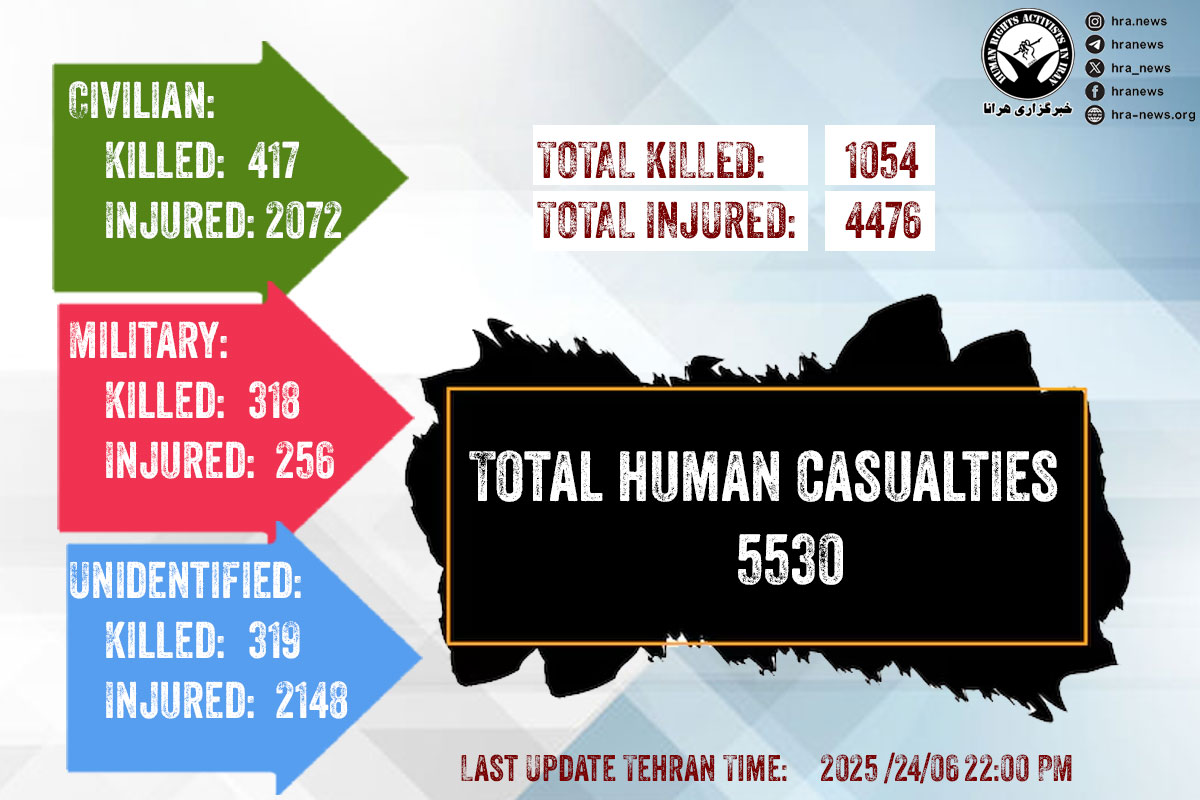
The total number of casualties from Israel’s attacks has reached 5,530, including 1,054 dead and 4,476 injured.
Geographic Scope and Course of Events
Over the past 12 days, until the announcement of the ceasefire, Israeli attacks targeted Iran’s infrastructure, military and civilian facilities, residential areas, and industrial zones across 26 provinces.
Yesterday, prior to the announcement of the ceasefire on the twelfth day of the conflict, the provinces of Fars, Tehran, West Azerbaijan, Gilan, and Alborz were targeted.
The Governor of Tehran stated that, in the early hours of yesterday, 12 locations in Tehran city and province were targeted by Israeli attacks.
The provinces that have been directly attacked since June 13 are as follows:
Tehran, East Azerbaijan, West Azerbaijan, Ardabil, Isfahan, Ilam, Kermanshah, Markazi, Hamedan, Fars, Khuzestan, Kurdistan, Alborz, Zanjan, Bushehr, Qazvin, Gilan, Hormozgan, Qom, Razavi Khorasan, Chaharmahal and Bakhtiari, Kerman, Semnan, Mazandaran, Yazd, and Golestan.
The Latest Casualty and Damage Figures
Since the beginning of Israel’s military attacks on Iranian soil, thousands of citizens have been killed or injured. The military or civilian status of some of the victims is still under investigation. According to aggregated figures announced by official bodies such as the Ministry of Health, the Red Crescent, and provincial authorities, as of 12 PM Tehran time on June 24, the total number of casualties has reached 5,356.
According to Hossein Kermanpour, head of the Public Relations and Information Center of the Ministry of Health, among these, 610 people have died and 4,746 have been injured. Additionally, 971 people remain hospitalized, 3,436 have been discharged after treatment, and 255 received on-site medical care. So far, 687 surgeries have been performed on the wounded.
Among the dead, 49 are women, including two pregnant women in Tehran and Isfahan, and 13 are children, the youngest being only two months old. Among the injured, there are 185 women and 65 children under the age of 20; the youngest known injured person is a three-year-old child.
Kermanpour also reported that 25 medical personnel have been affected, including 20 injured and 5 killed. The attacks have also inflicted considerable damage on healthcare infrastructure, including 9 ambulances, 7 hospitals, 4 health centers, and 6 emergency stations.
Earlier, Mohammadreza Zafarghandi, the Minister of Health, had stated that 95% of the deceased died under the rubble, while only 5% passed away after being transferred to hospitals. He did not comment on whether the victims were military personnel or civilians.
In terms of relief efforts, the spokesperson for the Red Crescent Society announced that its relief workers have so far transported 288 injured individuals, treated 109 on site, and provided emergency shelter for 1,087 people. The Deputy Minister of Nursing also reported that at least 10 ambulances were directly attacked during relief operations, leading to the deaths of 4 medical personnel.
In Ahvaz, the president of Ahvaz Jundishapur University of Medical Sciences reported the highest death toll over two consecutive days, with approximately 200 people injured.
The Governor of Tehran also reported the complete destruction of more than 120 residential units and serious damage to over 500 others in the province. According to him, public infrastructure, including water, electricity, gas, and even medical centers, were targeted in Tehran.
In Gilan Province, according to the Deputy Governor, last night’s attacks on Astaneh Ashrafieh resulted in 16 deaths, 33 injuries, and the complete destruction of 4 residential units.
Finally, the Iranian Medical Council announced that five doctors have lost their lives in these attacks.
It should be noted that, in line with its commitment to maximum transparency and independent reporting, HRANA does not rely solely on government figures for its statistics.
According to the latest updates from HRANA News Agency, based on information gathered through its network of volunteers and independent, non-governmental sources, and incorporating newly received documents and yesterday’s reports, the casualty figures are as follows:
▫️Civilians: Killed: 417
Injured: 2,072
▫️Military personnel: Killed: 318
Injured: 256
▫️Unspecified: Killed: 319
Injured: 2,148
Total fatalities:1,054 Total injuries:4,476 Total casualties:5,530 people
Israeli Attacks on Civilian Infrastructure
As on previous days, multiple civilian areas across the country came under attack yesterday, with several residential buildings in Gilan and two hospitals in Tehran sustaining damage.
The Deputy Minister of Nursing at the Ministry of Health reported that Motahari Burn Hospital and Labbafi Nejad Hospital in Tehran were struck during the overnight attacks. Shahid Motahari Hospital was fully evacuated, and patients were transferred to other medical facilities. Portions of Labbafi Nejad Hospital were also damaged, prompting the relocation of patients.
Strikes were also reported yesterday in the cities of Tehran, Karaj, Rasht, Urmia, Astaneh Ashrafieh, and Lahijan.
One of the most significant attacks on civilian infrastructure occurred at Evin Prison. The Judiciary’s spokesperson announced that the prison was hit during family visiting hours. Asghar Jahangir stated that part of the administrative building was destroyed, leading to the deaths of “some of our colleagues and members of the public.”
Following the attack, the Prisons Organization announced that Evin prisoners have been transferred to other facilities within Tehran province.
A source close to one Evin prisoner’s family told HRANA that most inmates were moved to Greater Tehran Prison. The source described severe overcrowding: “Each prisoner has been given only one blanket. Conditions are so cramped that prisoners don’t even have space to sit.”
Furthermore, yesterday, air defense activity was reported in cities including Shiraz, Tehran, Urmia, Rasht, Babol, Tabriz, and Babolsar.
Methodological Note: The classification of targeted locations in this report as “military” or “civilian” is based on publicly available information, visible indicators, and testimonies from local residents. A definitive determination of the nature of these sites requires further verification through official documents, satellite imagery, and comprehensive analysis, which are currently not accessible. Therefore, this categorization is provisional and intended to provide an initial overview rather than a conclusive judgment about the nature of the targets.
Israeli Attacks on Iran’s Military Infrastructure
In addition to civilian areas, yesterday Israel targeted the Parchin missile site.
The Joint Headquarters of the IRGC in Kolahdouz Square, Tehran, was also among the military targets struck by the Israeli army prior to the ceasefire announcement.
Arrests and Crackdown on Citizens
Baha’i citizens in Iran continue to report to HRANA an escalation of security crackdowns against this religious minority following Israel’s attacks on Iran. So far, HRANA has received reports of one arrest and home searches of 20 Baha’i citizens in the cities of Baharestan, Qaemshahr, and Bushehr.
Meanwhile, yesterday the Chief Prosecutor of Qazvin Province announced that 19 legal cases have been opened for individuals arrested in recent events. HRANA had previously reported the arrest of 16 of these individuals.
It has also been documented that Morteza Asadi, a political science researcher, was arrested without a court warrant at his home by security agents on June 20. His and his wife’s personal belongings were confiscated. After three days, his family remains unaware of his whereabouts or health condition. He suffers from a digestive illness and does not have access to his necessary medication.
Including the most recent arrests, in the past 12 days, 286 Iranian citizens have been detained for their online activity and for posting content related to Israel’s attack on Iran.
Security-Related Arrests
In addition to those detained for expressing opinions or political activities, there is another category of arrestees about whom little information is available. These individuals are typically accused by security agencies of more serious charges such as espionage, armed activities, terrorism, and similar offenses. The mere filing of such charges, given the Iranian government’s history of labeling opponents in order to suppress dissent, cannot by itself serve as a basis for judgment. Fair trial and due process remain the only standards for human rights organizations to assess and validate such accusations.
Yesterday, the Deputy for Public Relations of the IRGC in Hamedan Province reported the arrest of 6 individuals in the cities of Razan, Nahavand, and Hamedan, accusing them of espionage for Israel. The head of the Hamedan Judiciary also stated that 24 cases have been opened for individuals allegedly involved in espionage, sending information, photos, and videos to Israel.
The deputy police chief of Kermanshah Province reported the arrest of two individuals in this city, accusing them of “disturbing public opinion” through online posts. At the same time, the Chief Prosecutor of Kermanshah stated that since the beginning of the conflict, 115 people have been arrested, 54 of whom have since been released on bail. According to him, only a small number face espionage charges, while the majority are accused of propaganda against the regime.
Yesterday, there was also a report of the arrest of a European national in Hormozgan. The semi-official Fars news agency reported that this individual was detained “while spying on sensitive and military sites.”
Additionally, the Chief Prosecutor of Sistan and Baluchestan Province announced the arrest of several individuals in this province, claiming that a “large shipment of American weapons and ammunition” was seized from them.
On the other hand, state media released a video yesterday showing the arrest of 6 individuals in Tehran, in which the detainees, under unclear circumstances, confess to cooperating with Israeli intelligence.
With these new cases, the total number of individuals arrested on security charges by law enforcement and intelligence agencies since the start of the military conflict has reached 537.
New Legislative Proposals to Increase Penalties
In this context, yesterday, members of parliament approved an emergency bill to increase the punishments for citizens arrested on espionage charges. yesterday, Judiciary spokesperson Ali Asghar Jahangir stated: “If we wanted to prosecute many of those we arrested during the war with Israel under the existing espionage law, we would have faced restrictions and limitations. However, the parliament has now given us greater legal latitude.”
Communication Disruptions
Yesterday marks the sixth day of internet disruptions in Iran. Although there has been slight improvement in connectivity, the country remains largely offline. Citizens continue to rely on VPNs to access global social networks.
The news outlet Ham-Mihan, citing its sources, reported that Telegram may soon be unblocked, while WhatsApp will remain banned due to its alleged involvement in espionage for Israel.
International Reactions: Global Consensus on Restraint and Concern over Escalation
Yesterday, the UN Human Rights Office condemned Israel’s attack on Evin Prison as a “gross violation” of international law. The spokesperson stated: “Evin Prison is not a military target, and striking it constitutes a serious breach of international humanitarian law.”
The UN fact-finding mission also reported yesterday that Israel’s strike on a residential complex in Tehran had resulted in dozens of fatalities. According to the mission, these attacks violate international humanitarian law and have so far led to the deaths of three Red Cross staff members in Tehran. The mission expressed concern that Israel may be failing to uphold the principle of distinction between military and civilian targets.
Astaneh-ye Ashrafiyeh
Gilan Province
Astaneh-ye Ashrafiyeh
Gilan Province
Astaneh-ye Ashrafiyeh
Gilan Province
A residential building in
Astaneh Ashrafieh
Bokharest Street in District 6 of Tehran
Fire in Tehran following
the crash of a Hermes drone
Fire in Tehran following
the crash of a Hermes drone
HRANA News Agency – On June 23, Israel’s military attacks on Iran entered their eleventh consecutive day. Since the onset of the conflict, strikes have extended to 26 provinces across the country. As of 21:00 UTC on June 23, including the casualties from the most recent attacks, the total number of victims has risen to 4,432, with 974 confirmed fatalities and 3,458 injuries. Over the same period, 705 individuals have been arrested in Iran on political or security-related charges.
Geographic Scope and Course of Events
Over the past eleven days, military strikes in Iran have targeted infrastructure, military and civilian facilities, residential areas, and industrial zones across 26 provinces.
Yesterday, Monday, June 23, attacks continued for the eleventh day, striking the provinces of West Azerbaijan, Kermanshah, Fars, Yazd, East Azerbaijan, Isfahan, Tehran, Alborz, Qom, and Khuzestan. The continuation of attacks on this day indicates that the security situation remains critical, with no immediate prospect for de-escalation in sight.
Tehran has consistently been among the most heavily targeted areas. Mohammad Sadegh Motamedian, the governor of Tehran, stated yesterday that Israel has attacked over 200 locations in Tehran province over the past ten days.
The provinces that have been directly attacked since June 13 are as follows:
Tehran, East Azerbaijan, West Azerbaijan, Ardabil, Isfahan, Ilam, Kermanshah, Markazi, Hamadan, Fars, Khuzestan, Kurdistan, Alborz, Zanjan, Bushehr, Qazvin, Gilan, Hormozgan, Qom, Razavi Khorasan, Chaharmahal and Bakhtiari, Kerman, Semnan, Mazandaran, Yazd, and Golestan.
Latest Statistics on Human Casualties and Losses So Far
Since the beginning of Israeli attacks on Iran, hundreds of military and civilian individuals have been killed or wounded. The military or civilian status of a significant number of victims mentioned in this report is still under investigation.
Last night, channels affiliated with security agencies published images of an attack on an ambulance. According to official sources, following an attack by several Israeli drones on an ambulance on duty in Najafabad, Isfahan, three occupants — including the driver, a patient, and the patient’s companion — lost their lives.
State media announced yesterday that Yaser Zeyvari, a firefighter from Asadabad county in Hamadan province, who had been struck while on duty during the initial days of Israel’s attacks on Iran, has died due to the severity of his injuries.
Tasnim News Agency also reported that Abbas Es-haqi, a shooter athlete, and Rouhollah Giyahdusti Arani, a karate coach, were killed as a result of Israel’s attacks on Iran.
The Judiciary’s media center, Mizan, announced that Kian Ghasemian, a 5-year-old child who, along with three members of his family, had been targeted at their residence, has died from the severity of his injuries.
According to the latest updates from HRANA— which collects information through a network of volunteers and independent non-governmental sources — the casualty figures, including newly received documents from recent days as well as yesterday’s reports, are as follows:
▫️Civilians: Killed: 387
Injured: 1,564
▫️Military personnel: Killed: 268
Injured: 256
▫️Undetermined: Killed: 319
Injured: 1,638
Total fatalities:974 Total injured:3,458 Total human casualties:4,432
According to reports gathered by HRANA, dozens of children have lost their lives since the first day of Israel’s attacks on Iran.
Israeli Attacks on Civilian Infrastructure
Yesterday, several civilian areas in the country were also targeted. During these attacks, damage was inflicted on locations such as parts of the Handball Federation, the Fakhr Iran spinning and weaving factory, as well as civilian areas in the south and west of Tabriz, Tajrish, District 3, Saadat Abad, Afsarieh, and parts of eastern Tehran. One of the buildings of the Ministry of Energy and infrastructure near the Red Crescent Peace Building were also affected.
The CEO of Alborz Province Electricity Distribution Company reported power outages in parts of Karaj city due to the ongoing Israeli attacks on Iran. According to him, the company’s operational teams are working to restore electricity.
At the same time, state media, quoting Tehran Regional Electricity Company’s public relations office, announced that the blackout in northern Tehran has been resolved. Previously, Tavanir (Iran Power Generation, Transmission and Distribution Company) had stated that one of the main power lines supplying northern Tehran had been damaged due to Israeli attacks, causing power outages in parts of Districts 2 and 3.
The head of Tehran Province’s Emergency Medical Services stated that field observations by rescue teams indicate that “more than 90 percent of the 206 sites attacked by Israel have been residential homes.”
In one of the most significant attacks yesterday, Evin Prison — one of the main detention centers for political and financial prisoners in Tehran — was directly struck. According to information received by HRANA, the windows of Ward 4 were shattered, and parts of the women’s ward ceiling partially collapsed. The prison’s infirmary and visitation hall were also damaged. Following the attack, phones in most wards were disconnected, visitations were canceled, and ward doors were locked. According to a knowledgeable source, the prison warden, accompanied by armed forces, entered Ward 4 and, threatening prisoners with forced transfer to Greater Tehran Prison, ordered the immediate evacuation of the ward without personal belongings. Simultaneously, the wall between Wards 4 and 6 was demolished to enable internal transfers of prisoners. This attack has raised serious concerns among families and human rights organizations.
Yesterday, the cities of Tabriz, Kermanshah, Ahvaz, Tehran, Shiraz, Yazd, and Karaj were among the areas where air defense activity was reported.
Methodological Note: The classification of targeted locations in this report as “military” or “civilian” is based on publicly available information, visible indicators, and testimonies from local residents. A definitive determination of the nature of these sites requires further verification through official documents, satellite imagery, and comprehensive analysis, which are currently not accessible. Therefore, this categorization is provisional and intended to provide an initial overview rather than a conclusive judgment about the nature of the targets.
Israeli Attacks on Iran’s Military Infrastructure
In addition to civilian areas, yesterday the Fordow nuclear site was once again targeted by Israeli forces. The General Command Headquarters of the Law Enforcement Command, the Human Resources Department of Faraja (Law Enforcement Command), and the central headquarters of the Cyber Police (FATA) were among other military targets struck yesterday.
Military facilities near the Sarkeh Hesar mountain, the Basij building in eastern Tehran, an IRGC garrison in downtown Karaj, and the Seyyed al-Shohada IRGC building in Shahr-e Rey on Deylaman Street were also among yesterday’s military infrastructures targeted by the Israeli army.
Arrests and Crackdowns on Citizens
Baha’i citizens in Iran have reported to HRANA an intensification of security crackdowns on this religious minority following Israeli attacks on Iran. According to HRANA’s information, since the beginning of the military attacks, the homes of at least 19 Baha’i families in Baharestan and Qaemshahr have been searched—15 homes in Baharestan and 4 in Qaemshahr. Additionally, Navid Tashakor, a Baha’i citizen residing in Baharestan, was arrested by Ministry of Intelligence forces at his home on June 21. His arrest was accompanied by a home search and the confiscation of his digital devices. He had previously been arrested on June 14 and released after one day.
A Baha’i citizen from Baharestan, whose home was searched, told HRANA: “The agents presented no warrant during the search and behaved inappropriately with my family. They claim that my family and I are cooperating with Israel, but they have no evidence to support this accusation.”
This morning, the prosecutor of Zarand reported the arrest of a citizen in the city, accusing him of “propaganda against the state, demoralizing the public, and supporting Israel.” Reza Yaghoubi also stated that 10 others have been summoned to court on charges of propaganda against the regime.
The IRGC Intelligence Organization in Mazandaran announced in a statement that several individuals have been arrested for their online activities and connections with Israeli media. In its sixth statement, no details on the number, identity, or current status of the detainees were provided.
The police commander of Rezvanshahr announced that a 36-year-old man connected to the Mojahedin-e Khalq Organization (MEK) has been arrested and imprisoned.
The deputy police commander of Kermanshah province reported the arrest of two individuals on charges of “disturbing public opinion” through posts on social media.
With the addition of these recent arrests, 281 Iranian citizens have been detained over the past 11 days for online activity and publishing content related to Israel’s attack on Iran.
Security Arrests
Besides those arrested for political statements or online activities, another group of detainees faces much more serious charges, often made by security agencies, including espionage, armed activity, terrorism, and similar offenses. Given the Iranian government’s history of labeling its opponents with such charges to suppress dissent, these accusations alone cannot be taken as proof of guilt. Only a fair trial and an impartial judicial process can validate the government’s claims against these defendants, according to human rights groups.
In this context, yesterday the prosecutor of Hamadan announced the arrest of a European national on espionage charges.
The spokesperson for Faraja (Iran’s Law Enforcement Command) stated that several individuals belonging to a “micro-drone smuggling network in the mountains northwest of Tehran” have been arrested. Significant amounts of drone control and guidance equipment were reportedly seized.
The Hamshahri newspaper reported that security forces seized a truck loaded with numerous drones in western Tehran and arrested an individual accused of ties to Israel.
Iranian state TV reported the arrest of three Afghan nationals in Pakdasht, claiming that rockets and explosive devices were seized from them.
According to official reports, a foreign woman (nationality undisclosed) was arrested in Chalous on espionage charges.
Two suspects accused of espionage and links to Israel were also arrested by police in Astara, Gilan province.
The Islamic Republic’s Law Enforcement Command announced the arrest of two individuals who allegedly attempted to manufacture bombs and handmade grenades to create fear and panic in the Andisheh township near Tehran.
Fars News Agency, affiliated with security bodies, quoted the Lorestan prosecutor saying that “10 individuals have been arrested under court orders for espionage, propaganda against the regime, and disturbing public opinion.”
The police commander of Gilan province announced: “36 people have been arrested for disturbing public opinion, collaborating with hostile enemies, filming military sites with micro-drones, arson, making handmade bombs, and cooperating with opposition groups.”
Security-affiliated channels reported yesterday that three individuals identified as “members of Ukraine’s intelligence service” were arrested, accused of plotting an attack on a drone factory in Isfahan.
Including the 61 people arrested yesterday, the total number of individuals arrested for security-related reasons by police and security forces over the past 11 days has reached 424.
Separately, yesterday, Monday, June 24, the Judiciary’s media center announced the execution of Mohammad Amin Mahdavi Shayesteh, a prisoner convicted of espionage for Israel. Since the start of Israel’s attacks on Iran on June 13, at least three individuals have been executed on espionage charges for Israel in various Iranian prisons.
Communication Disruptions and Secondary Consequences
Yesterday marked the fifth consecutive day of widespread internet outages in Iran. Although there has been slight improvement, the country remains largely offline. Reports indicate that connectivity significantly worsened again in the afternoon hours.
The extensive internet disruptions, which began alongside the military attacks, have become one of the most serious secondary consequences of the crisis. Internet shutdowns not only hinder the free flow of information but also severely disrupt access to vital services such as banking, education, healthcare, and communication with relatives in affected areas. This situation has left many people, especially in rural and underprivileged regions, isolated and uninformed.
Tonight, IRIB’s News Network interrupted regular programming to broadcast continuous military marches, without any official explanation from authorities.
Some reports suggest that this broadcast coincided with special security conditions in Tehran, including Israeli missile strikes on targets in the capital such as Evin Prison. However, any direct link between this programming change and the attacks has not been officially confirmed.
The Islamic Republic’s media networks sometimes broadcast military marches to signal special conditions or officially declare states of emergency. Nonetheless, the authorities’ silence has fueled speculation on social media.
Ehsan Chitsaz, Deputy Minister of Policy and Digital Economy at the Ministry of Communications, published an image of a downed Israeli drone, claiming it was transmitting data using an advanced American satellite modem during its recent attack on Iran. Previously, the Ministry of Communications had stated that internet restrictions were imposed to “prevent Israel from using the country’s communication network for military purposes.”
The Judiciary’s news agency also reported that the news website Entekhab has been blocked for “ignoring multiple warnings about publishing reports that disturb public mental security.”
Around noon yesterday, amid widespread Israeli attacks on Tehran, IRIB News Network’s live broadcast and its on-screen news ticker were disrupted for about 30 minutes. The authorities have not explained the cause of this incident.
In the early hours of yesterday, a hacker group claimed responsibility for hacking Bank Melli and leaking data from 73 million accounts. Bank Melli denied the claim, stating that the leaked data only included “card numbers, national IDs, names, birth dates, and phone numbers of some users,” likely from previous breaches.
Reports have also emerged of increased suspicious text messages containing malicious links and expert warnings about organized cyberattacks against the country’s infrastructure. Many small and home-based businesses reliant on the internet have completely shut down, placing thousands of livelihoods in crisis.
As the situation continues, concerns over human rights violations — particularly freedom of expression and access to information — have grown. International digital rights organizations have warned that internet blackouts amid military conflict limit the ability to document human rights abuses and deliver targeted humanitarian aid. Additionally, many small businesses dependent on internet access have faced closure, endangering the livelihoods of thousands.
International Reactions: Global Calls for Restraint and Concerns Over Escalation
The United Nations fact-finding mission announced that Israel’s attack on a residential complex in Tehran has left dozens dead, stating that these attacks violate international humanitarian law. In Tehran alone, three Red Cross staff members have been killed. The UN fact-finding mission expressed concern over Israel’s potential violation of the principle of distinction between military and civilian targets.
HRANA News Agency – During today’s Israeli airstrikes on Tehran, Evin Prison was directly targeted. According to received reports, the prison’s main entrance gate and the judiciary building located within its compound were struck. Several conscript soldiers were reportedly killed or injured in the attack. Additionally, some prison staff and several inmates assigned to service duties, who were gardening at the time, were wounded.
HRANA’s reports indicate that windows in various parts of the prison — including Ward 4 — were shattered, though no serious structural damage has been reported so far. In the women’s ward, a section of the ceiling partially collapsed, though the damage is described as minor. The prison’s main infirmary and parts of the visiting hall also sustained damage, though no injuries have yet been reported in these areas.
A brother of a sick inmate told HRANA: “With the infirmary at Evin damaged, my sister cannot receive the critical medical care she requires. Given the lack of transparency from official sources and widespread distrust of the authorities’ assurances, we — the families of sick prisoners — are experiencing heightened anxiety and emotional strain.”
Following the strike, phone lines have been disconnected in most wards and restricted in others. All visits have been suspended until further notice. Outdoor time for inmates has been canceled, and doors to multiple wards have been locked. This report pertains to the prison’s general population; no information is currently available regarding the condition of the security wards, including Ward 209, Ward 2-A, and the Judiciary Protection Unit.
The attack has sparked widespread concern among inmates and their families. Although the majority of Evin’s current population consists of financial prisoners, due to its historical role in Iran’s political landscape, the prison has long remained a focal point for public attention and human rights oversight.
HRANA News Agency – Early yesterday, alongside Israel’s ongoing airstrikes on multiple Iranian provinces, the United States launched its first direct attacks, targeting Iran’s nuclear facilities in Fordow, Natanz, and Isfahan. The U.S. entry into the conflict has significantly escalated tensions and sparked widespread reactions.
According to data collected by HRANA, since the outbreak of hostilities, 25 Iranian provinces have come under attack. Including yesterday’s casualties, as of June 22, 21:00 UTC, the total number of victims has risen to 4,400. Of these, 950 have been killed and 3,450 injured. In addition, 640 citizens have been arrested on political or security-related charges during this period.
As clashes between Iran and Israel escalate, the United States’ direct involvement marks a critical turning point in the conflict’s expansion, raising serious concerns about the humanitarian and civilian toll. The engagement of another military power has broadened the crisis’s scope, leading to widespread disruption: collapse of public services, instability in the banking sector, suspension of public transportation, shortages of essential goods, surging prices, and increasingly limited access to medical care for vulnerable groups.
Geographical Scope and Developments
Over the past 10 days, military strikes in Iran have targeted infrastructure, military and civilian facilities, residential and industrial areas in 25 provinces. The provinces directly affected so far are:
Tehran, East Azerbaijan, West Azerbaijan, Ardabil, Isfahan, Ilam, Kermanshah, Markazi, Hamedan, Fars, Khuzestan, Kurdistan, Alborz, Zanjan, Bushehr, Qazvin, Gilan, Hormozgan, Qom, Razavi Khorasan, Chaharmahal and Bakhtiari, Kerman, Semnan, Mazandaran, and Golestan.
Yesterday, Sunday, June 22, the military attacks continued into their tenth day, targeting the provinces of Kermanshah, Alborz, Semnan, Qom, Isfahan, Tehran, Lorestan, Zanjan, Fars, Khuzestan, East Azerbaijan, Yazd, Bushehr, and again Fars. The continuation of attacks yesterday indicates that the security situation remains critical, with no clear prospect for an immediate de-escalation.
Tehran has consistently seen the highest number of attacks. Mohammad Sadegh Motamedian, the governor of Tehran, stated that Israel has targeted more than 200 locations in Tehran province over the past 10 days.
While Iran faces daily waves of extensive Israeli strikes, early yesterday, the U.S. Air Force also bombed three key Iranian nuclear sites in Isfahan, Fordow, and Natanz.
Latest Casualty and Human Loss Statistics as of Now
Since Friday, June 13, thousands of military personnel and civilians have been killed or injured as a result of Israeli and U.S. military attacks on Iran. The military or civilian status of a significant portion of the casualties mentioned in this report is still under investigation.
Yesterday, the spokesperson for the Red Crescent announced that so far, 3 aid workers have been killed in Tehran and East Azerbaijan provinces, and 29 others have been seriously injured.
The government spokesperson also stated yesterday that the military conflicts have so far resulted in the deaths of 55 women and children and injuries to 209 women and children. According to him, 18 medical personnel have also been killed or injured. He further reported damage to 6 emergency bases and 9 ambulances.
Meanwhile, the Director-General of Crisis Management for East Azerbaijan province announced that 52 people have been killed in East Azerbaijan since the beginning of the attacks. He did not specify how many of these were military or civilian.
State media reported the deaths of 32 athletes during the military strikes on Iran. HRANA had previously documented 27 of these fatalities.
Additionally, the head of the Red Crescent, regarding the casualties from the U.S. military strikes on nuclear sites, stated that 11 people were injured in these attacks, most of whom have since been discharged from the hospital. He claimed that there were no signs of nuclear radiation leaks or contamination among the injured.
Yesterday, the Ministry of Health announced that since the start of the Israeli attacks, 450 civilians have been killed and more than 3,500 civilians injured.
Based on the latest updates from HRANA News Agency — which gathers its information through a network of volunteers and independent non-governmental sources — the casualty figures, as of June 22, 21:00 UTC, including newly received reports from previous days and yesterday’s updates, are as follows:
Total Fatalities: 950 Total Injured: 3,450 Total Human Casualties: 4,400
Yesterday, domestic media reported the deaths of two children, Taha Behroozi and Alisan Jabari, both aged seven. According to these reports, the children were killed after being struck by shrapnel from a downed Israeli drone in the Azerbaijan Square area of Tabriz.
Israeli Strikes on Civilian Infrastructure – Day 10
Yesterday, several civilian areas across the country were once again targeted. The most significant reported damage occurred in civilian areas around the Mosalla (Grand Prayer Ground) in Tehran, the Pirouzi district of Tehran, the Hakimiyeh district of Tehran, as well as parts of Andimeshk and Fardis. In addition, channels close to security institutions published images of an attack on an ambulance.
Throughout the day, the cities of Yazd, Bushehr, Damavand, Dezful, Isfahan, and Shiraz witnessed air defense operations against hostile projectiles. In Tehran, air defense activity was also reported in the Tehranpars and Ashrafi Esfahani districts.
Yesterday, officials from the Red Crescent and the Ministry of Health announced that five hospitals and several healthcare centers across the country have been damaged in Israeli airstrikes on Iranian territory. According to these reports, facilities affected include Hakim Children’s Hospital in southwest Tehran, another hospital in Tehran, Farabi Neuropsychiatric Hospital in Kermanshah, the Comprehensive Health Center of Mianrahan in Dinavar District of Kermanshah Province, and another comprehensive health services center. Six emergency ambulances and one rescue helicopter have also been put out of service.
Methodological Note: The classification of targeted locations as “military” or “civilian” in this report is based on publicly available information, visual evidence, and testimonies from local citizens. A precise and definitive assessment of these sites requires official documents, satellite imagery, and additional analysis, which are currently not accessible. Therefore, this classification is preliminary and intended to provide an initial picture of the situation, without representing a final judgment on the nature of the targets.
Israeli Strikes on Iranian Military Infrastructure – Day 10
In addition to civilian areas, yesterday U.S. forces targeted Iran’s nuclear facilities, destroying the Fordow, Natanz, and Isfahan nuclear sites.
. Other military targets struck yesterday included: . Malek Ashtar Industrial University in Lavizan, affiliated with the Ministry of Defense and Armed Forces Logistics; . IRGC-affiliated sites in Bagh Deh Bozorgi, Shiraz; . IRGC headquarters in Ahvaz; . Madani military base in Tabriz; . Ammunition depot of the 31st Ashura Division in Tabriz; . IRGC logistics and supply center in Tabriz; . IRGC military base in Saeedabad, Tabriz; . 4th Tactical Fighter Base “Vahdati” in Dezful; . Military zones near the Shiraz Industrial Park; . A military base in Qom; . IRGC Al-Ghadir unit in Yazd; . Shahid Sadoughi military base in Yazd; . Military sites around Bushehr; . Military zones in Khorramabad; . IRGC Ansar Al-Mahdi unit in Zanjan Province; . Military industries base in Isfahan; . Military zones around Kermanshah, Shahroud, and Qazvin.
Arrests and Crackdown on Citizens
On Friday, four citizens were arrested in the city of Dehdasht by forces of The Ministry of Intelligence. These individuals were detained on charges such as “disturbing public opinion,” “propaganda against the regime,” and “promoting Israel” through activities on social media. HRANA’s inquiries into their current situation and place of detention are ongoing.
According to reports received by HRANA, at least 11 social media users were also arrested by security forces in the city of Ramshir, Khuzestan province. Their identities had not been confirmed at the time of this report, and there is no precise information about the reasons for their arrest, the detaining authority, or their place of detention.
On the same day, the police commander of Bukan announced the arrest of five individuals accused of “disturbing public opinion” both on social media and in public spaces. These individuals were handed over to the judiciary.
The police commander of Kerman Province reported the identification and arrest of 14 additional individuals, accusing them of “reposting Israeli actions on social media, disturbing public opinion, and supporting Israel.”
With these new arrests, a total of 277 Iranian citizens have been detained in the past 10 days for online activities and publishing content related to Israel’s attacks on Iran.
Security-Related Arrests
In addition to those arrested for opinions or political activities, there is another category of detainees about whom little information is available. These individuals are typically arrested by security agencies on more serious charges such as espionage, armed activity, terrorism, and similar accusations. The mere filing of such charges, given the Iranian government’s history of labeling dissidents to justify repression, cannot in itself be considered evidence of guilt. Only fair trial standards and due process provide a legitimate basis for human rights organizations to assess these accusations.
In this context, yesterday the judiciary’s spokesperson announced that three individuals were arrested in Kermanshah Province on espionage charges and handed over to the judiciary. He stated that one of them is a citizen of a European country.
The deputy police chief of Fars Province reported the arrest of 53 individuals, accusing them of “disturbing public opinion, possession and operation of drones and small UAV parts, filming sensitive areas, and sending footage to opposition media.”
The head of the cultural and social affairs department of East Azerbaijan Police reported the arrest of one individual in Tabriz on charges of connections with Israel, alleging that this person exchanged classified information with individuals abroad. He claimed that photos and articles related to drone design and construction were found on the suspect’s phone and laptop.
Agents from the IRGC Intelligence Organization in Mazandaran also claimed to have arrested a person on charges of “espionage.” The Mehr News Agency reported that the detainee had undergone specialized and military training in a foreign country, and at the time of arrest, various espionage and communication devices were confiscated.
The police commander of Robat Karim announced that one individual was arrested on charges of “disturbing public opinion.” He claimed this person had links to Israel’s intelligence services, received financial payments, and deliberately published certain content online.
The judiciary’s spokesperson also reported that five individuals were identified in one of the provinces who were allegedly “planning terrorist operations.” Four of them were arrested, while one committed suicide during the arrest attempt.
Including the 63 individuals arrested yesterday, the total number of people detained on security charges over the past 10 days has reached 363.
Separately, domestic media yesterday reported the execution of a prisoner named Majid Masibi, who had been sentenced to death on charges of “espionage for Israel.” Since the start of Israeli attacks on Iran on June 13 (23 Khordad), at least two individuals have been executed in Iran on espionage charges related to Israel.
Disruptions in Communications and Secondary Consequences
From the first day of the attacks, the Minister of Communications claimed that, “due to the special situation of the country,” internet access had been temporarily restricted. However, these restrictions intensified in the following days, and as of Wednesday, June 18 (28 Khordad), Iranian citizens’ access to the global internet has been severely disrupted. The official stated that “the Iranian government has officially ordered the national internet shutdown” to prevent “Israeli cyberattacks.” The government spokesperson said the restrictions were imposed to prevent infiltration by enemies and to protect critical infrastructure.
The widespread internet disruptions, which began with the onset of the military attacks, have now become one of the most serious secondary consequences of the crisis. The shutdown or severe limitation of communications has not only obstructed the free flow of information but has also significantly disrupted people’s access to essential services, including banking, education, healthcare, and communication with relatives in affected areas. The situation is particularly dire in rural and underprivileged areas, leaving many citizens isolated and uninformed.
As these restrictions persist, human rights concerns over freedom of expression and the right to information have intensified. International digital rights groups have warned that internet shutdowns amid military conflict hamper the documentation of human rights violations and the delivery of targeted humanitarian aid. Furthermore, many small and home-based businesses dependent on internet access have been forced to shut down, endangering the livelihoods of thousands of people.
Yesterday, NetBlocks, which monitors internet access worldwide, reported that Iran’s internet shutdown has entered its fourth day. Despite slight improvements in connectivity, the country remains largely offline. After 72 hours, the ongoing telecommunications blackout continues to affect people’s ability to communicate and inform one another.
HRANA News Agency — Israeli military strikes against Iran continued for the ninth consecutive day on June 21st. These attacks, targeting both military and civilian areas, have led to ongoing human casualties. According to information gathered by HRANA, since the conflict began, targets in 25 provinces across the country have been struck. As of 21:00 UTC on June 21, including yesterday’s casualties, the total number of victims has reached 4,261. Of these, 865 people have been killed and 3,396 injured.
The impact of Israel’s military operations has deeply disrupted civilian life in Iran, throwing daily routines into disarray. The collapse of urban services, disruptions to the banking system, suspension of public transportation, severe shortages of essential goods, surging prices, and limited access to medical care for vulnerable groups have created a wide-ranging and multi-faceted crisis. Among the most defenseless are conscripts, laborers, the elderly, patients, people with disabilities, and Afghan migrants. Simultaneously, internet blackouts and the lack of official information have further fueled public fear and uncertainty. Field reports suggest that support infrastructures are overwhelmed, and a growing humanitarian disaster is unfolding.
Geographical Scope and Developments
According to data collected over the past nine days, these attacks have targeted infrastructures, military and civilian facilities, residential areas, and industrial sites in 25 provinces. The provinces directly affected by the attacks are:
Tehran, East Azerbaijan, West Azerbaijan, Ardabil, Isfahan, Ilam, Kermanshah, Markazi, Hamedan, Fars, Khuzestan, Kurdistan, Alborz, Zanjan, Bushehr, Qazvin, Gilan, Hormozgan, Qom, Razavi Khorasan, Chaharmahal and Bakhtiari, Kerman, Semnan, Mazandaran, and Golestan.
The number and diversity of these provinces indicate that the conflict is not limited to border or specific regions but has extended deep into the country’s interior.
Yesterday, June 21st, on the ninth day of military clashes, the attacks continued, this time targeting the provinces of Chaharmahal and Bakhtiari, Semnan, Isfahan, Lorestan, Khuzestan, Qom, Isfahan (again), Fars, Tehran, East Azerbaijan, Hormozgan, Hamedan, and Kermanshah. The continuation of attacks yesterday demonstrates that the security situation remains critical, and no clear prospect for a swift de-escalation is in sight.
Latest Statistics on Casualties and Human Losses So Far
Since the onset of Israel’s attacks on Iran, hundreds of military personnel and civilians have been killed or wounded. The military or civilian status of many victims referenced in this report remains under investigation.
According to the Iranian government spokesperson, 54 women and children have been killed and 194 injured since the beginning of Israel’s attacks. The spokesperson also reported that one Red Crescent helicopter and six ambulances have been targeted by Israeli strikes.
Yesterday, the Ministry of Health announced that since the start of the hostilities, nearly 14 healthcare workers have been injured and 2 have lost their lives. Meanwhile, the Ministry of Sports reported the deaths of 24 Iranian athletes; HRANA has independently verified the identities of 10 of them.
Also yesterday, the Director General of Crisis Management for East Azerbaijan Province reported 48 fatalities in that province due to Israeli attacks, without specifying whether the victims were military personnel or civilians.
Additionally, the Ministry of Health reported that since the beginning of Israel’s attacks, 450 civilians have been killed and over 3,500 civilians injured.
Based on the latest updates from HRANA, which collects its information through a network of volunteers and independent non-governmental sources, the current casualty statistics, including newly obtained documents from recent days and yesterday’s reports, are as follows:
▫️Civilians: Killed: 363 Injured: 1,525
▫️Military Personnel: Killed: 215 Injured: 233
▫️Unspecified: Killed: 287 Injured: 1,638
Total killed: 865 Total injured: 3,396 Total human casualties: 4,261
Israeli Attacks on Civilian Infrastructure – Day Nine
Yesterday, several of the country’s infrastructures were once again targeted. The most notable of these damages involved the 115 Emergency Base in Hoveyzeh and the Kaleh dairy factory in Tehran. Other civilian areas targeted include Qom, Lenjan, Mobarakeh, Shahreza, Shiraz, Shahr-e Rey, Ahvaz, Tabriz, and Tehran.
Additionally, yesterday saw air defense engagements with hostile projectiles in the cities of Shahr-e Kord, Khorramabad, Ahvaz, Bandar Mahshahr, Lavasan, Tabriz, Bandar Abbas, Shiraz, Hamedan, Bandar Lengeh, Dezful, Shahreza, and in various neighborhoods of Tehran including Pirouzi, Tehranpars, Narmak, Heravi, Sohrevardi, and Pasdaran.
Officials from the Red Crescent and the Ministry of Health have announced that, so far, five hospitals and several healthcare centers across different parts of the country have been damaged during Israel’s aerial attacks on Iranian territory. According to these reports, Hakim Children’s Hospital in southwest Tehran, another hospital in Tehran, Farabi Psychiatric Hospital in Kermanshah, the Miyanrahan Comprehensive Health Center in the Dinevar district of Kermanshah Province, and another comprehensive health services center are among the facilities that have been struck. Additionally, six emergency ambulances and one rescue helicopter have been taken out of service.
Methodological Note: The classification of targeted locations as “military” or “civilian” in this report is based on publicly available information, apparent evidence, and testimonies from local citizens. It is understood that an accurate and definitive assessment of the nature of these sites requires examination of official documents, satellite imagery, and supplementary analyses, which are currently unavailable. Therefore, this categorization is temporary and intended to provide an initial picture of the situation, and should not be considered a conclusive judgment regarding the nature of the targets.
Israeli Attacks on Iran’s Military Infrastructure – Day Nine
In addition to civilian areas, yesterday, military targets were also struck, including a military center in Shiraz, nuclear facilities in Isfahan, a site related to the missile program in Khomeini Shahr, the 3rd Naval Base in Bandar Mahshahr, the FATA police headquarters (Cyber Police), the Army’s 71st Mechanized Infantry Brigade in Qasr-e Shirin, the 4th Tactical Fighter Base in Dezful, a trailer carrying military equipment in Hamil, an IRGC transportation unit in Andimeshk, Imam Ali Barracks in Shiraz, the Gulf Base (Montazeran-e Shahadat) in Ahvaz, a barracks in Najafabad, the Defense Industries Complex in Lenjan, a vacated military base in Qom, and military zones around Tuyserkan.
Arrests and Crackdowns on Citizens
Yesterday, the Deputy Prosecutor General of Yazd announced that over the past week, seven citizens in Yazd have been arrested for activities in cyberspace.
Including these recent arrests, a total of 243 Iranian citizens have been detained over the past nine days for online activities and publishing content related to Israel’s attack on Iran.
In addition, the Deputy Prosecutor of Yazd reported that during this period, 81 cases have been opened against individuals accused of “spreading rumors and false information under current conditions” online. He stated that 200 citizens have also received verbal warnings, and pre-trial detention orders have been issued for eight individuals.
Security-Related Arrests
Yesterday, the Head of Qom’s Intelligence Police announced the arrest of 22 individuals, accusing them of espionage, spreading public anxiety, and supporting Israel.
Separately, Tasnim News Agency, affiliated with security agencies, reported the arrest of eight individuals who were allegedly attempting to leave the country. The agency accused them of espionage.
Yesterday, state media also reported the arrest of two individuals. Images allegedly showing seized items from these individuals suggest that they were in possession of cold and firearms.
The Deputy Prosecutor of Yazd also announced the arrest of a local individual on charges of spying for Israel. He claimed that this person had provided Israel with information on sensitive sites outside the province, including coordinates for air defense systems at several facilities, some of which were recently targeted by Israeli forces.
ISNA News Agency reported that on the night of June 20, an individual with a known identity contacted security authorities, demanding the release of Israeli regime pilots and threatening to carry out severe bombings in Khorramabad. This individual was arrested during a joint operation by the Lorestan Provincial Police Command and the IRGC Intelligence Organization. Reports indicate that one bomb was defused and one hunting rifle was seized from the suspect.
Videos of Gholamhossein Mohseni Ejei, Chief Justice of Iran, have been published in state-affiliated media showing him issuing orders regarding detainees accused or suspected of espionage for Israel.
In one of these videos, released by Mizan News Agency (the judiciary’s official outlet), Mohseni Ejei emphasizes: “The cases of primary suspects linked to Israel must be completed and sent to court as quickly as possible. These files should not remain unresolved, and full information from the detainees must be extracted in the shortest possible time.” The videos also show senior officials such as Ahmadreza Radan, Commander of the Law Enforcement Force, and Ali Salehi, Tehran’s Prosecutor General.
Although many of these security-related charges may not formally fall under international human rights violations, the Iranian regime’s history of abusing war-time or unrest situations to suppress dissent raises serious concerns that detainees could become victims of extrajudicial goals or unfair trials by security forces.
International Concern Over Escalation: Condemnations and Warnings Following Attacks on Iran
UN human rights experts have strongly condemned Israel’s recent attacks on Iran, denouncing them as “a clear violation of fundamental principles of international law” and “an act of aggression contrary to peremptory norms.” They confirmed that the bombardment of Tehran resulted in civilian casualties and expressed particular concern over reports of deaths and injuries among women and children, emphasizing their heightened vulnerability in armed conflicts and disproportionate suffering from such violence.
The statement was signed by prominent UN experts across various fields of human rights and international law, including Mai Sato (Special Rapporteur on the situation of human rights in Iran), Francesca Albanese (Special Rapporteur on the situation of human rights in the Palestinian territories), George Katrougalos (Special Rapporteur on the promotion of a democratic and equitable international order), Claudia Mahler (Independent Expert on the enjoyment of all human rights by older persons), Morris Tidball-Binz (Special Rapporteur on extrajudicial executions), Ben Saul (Special Rapporteur on human rights and counterterrorism), Irene Khan (Special Rapporteur on freedom of expression), and Surya Deva (Special Rapporteur on the right to development).
Amnesty International has also raised alarms, warning of a heightened risk of executions and torture in Iran following mass arrests under charges of “collaborating with Israel.”
In a separate development, Human Rights Activists in Iran (HRA), together with 20 other human rights organizations, issued a joint statement condemning Israel’s airstrikes on Iran as a grave violation of international humanitarian law. Citing field reports of thousands of civilian casualties, the coalition expressed deep concern over the deliberate targeting of civilians and civilian infrastructure. They called for an immediate end to the attacks, broad international condemnation, and the initiation of independent global investigations. The statement warned that strikes on residential areas, healthcare facilities, and media outlets may constitute war crimes.
The signatories urged world governments to uphold moral responsibility and reinforce humanitarian protections for civilians. They cautioned that silence or inaction in the face of this crisis amounts to indirect complicity in ongoing human rights violations and undermines the foundations of international law. Among the signatories were Human Rights Activists in Iran, Access Now, CIVICUS, and several regional networks advocating for women’s rights and digital freedoms.
Communication Disruptions and Consequences
From the onset of the attacks, the Minister of Communications stated that internet access was being “temporarily restricted due to the country’s special circumstances.” However, these restrictions have steadily intensified. Since last Wednesday, Iranians’ access to the global internet has been severely disrupted. According to reports, the Iranian government has officially ordered a nationwide internet shutdown, citing the need to prevent “Israeli cyberattacks.” A government spokesperson claimed that the measures were necessary to block enemy infiltration and safeguard critical infrastructure.
NetBlocks, an organization that monitors global internet access, reported that after a brief period during which limited communication with the outside world was possible, internet connectivity in Iran has once again been fully cut off. This nationwide shutdown, unfolding alongside the ongoing conflict with Israel, continues to drastically limit public access to information and free communication.