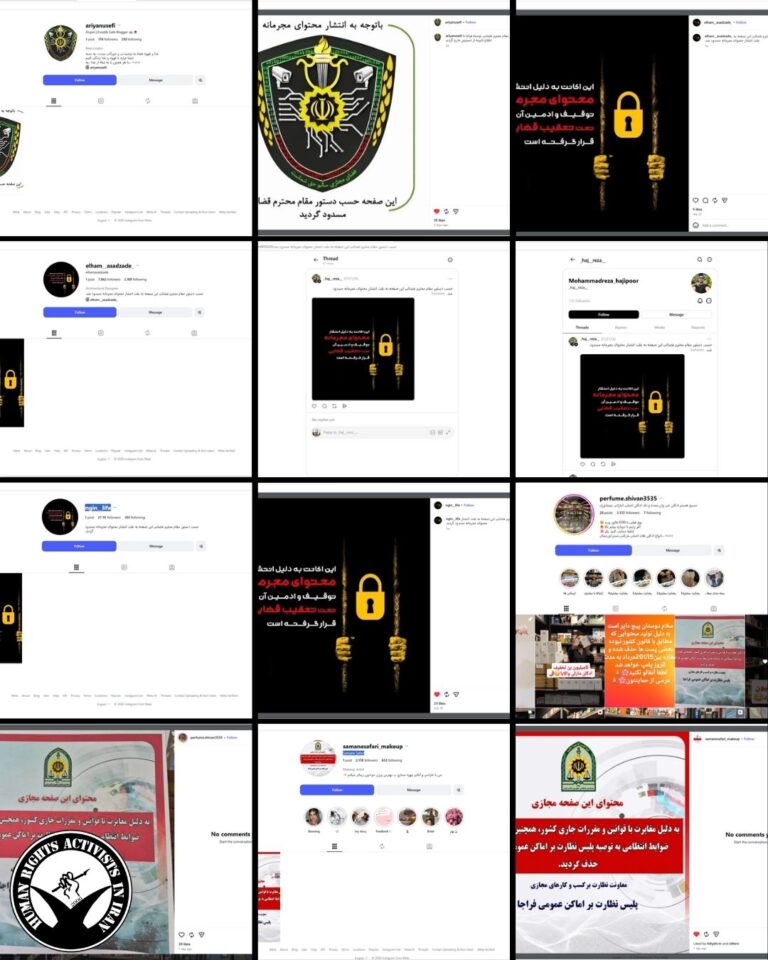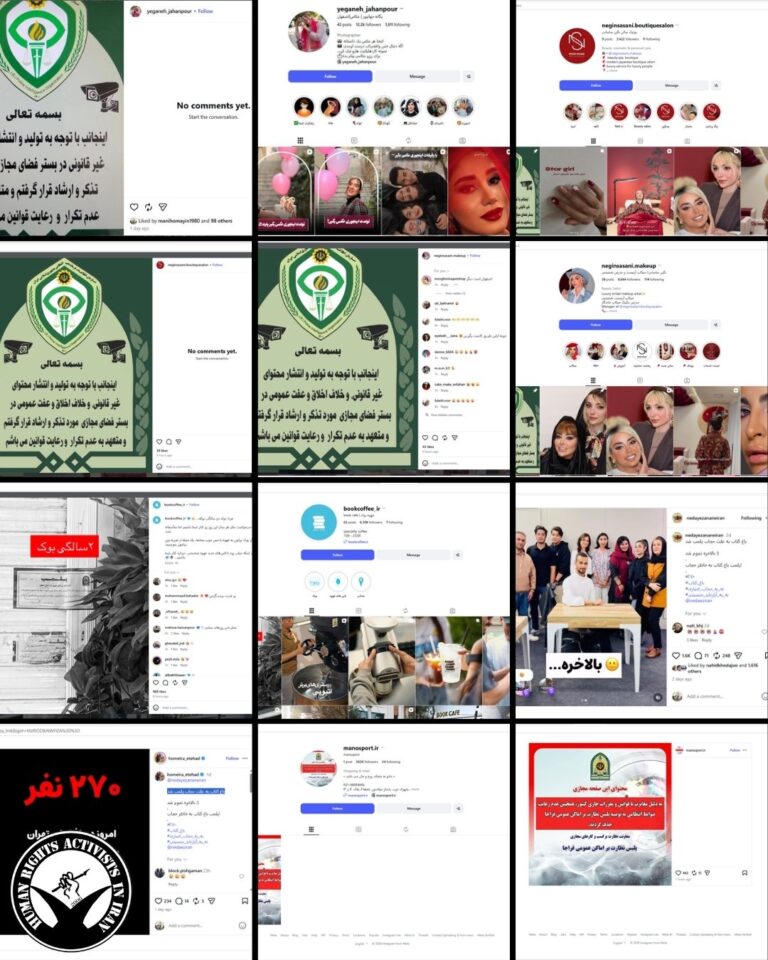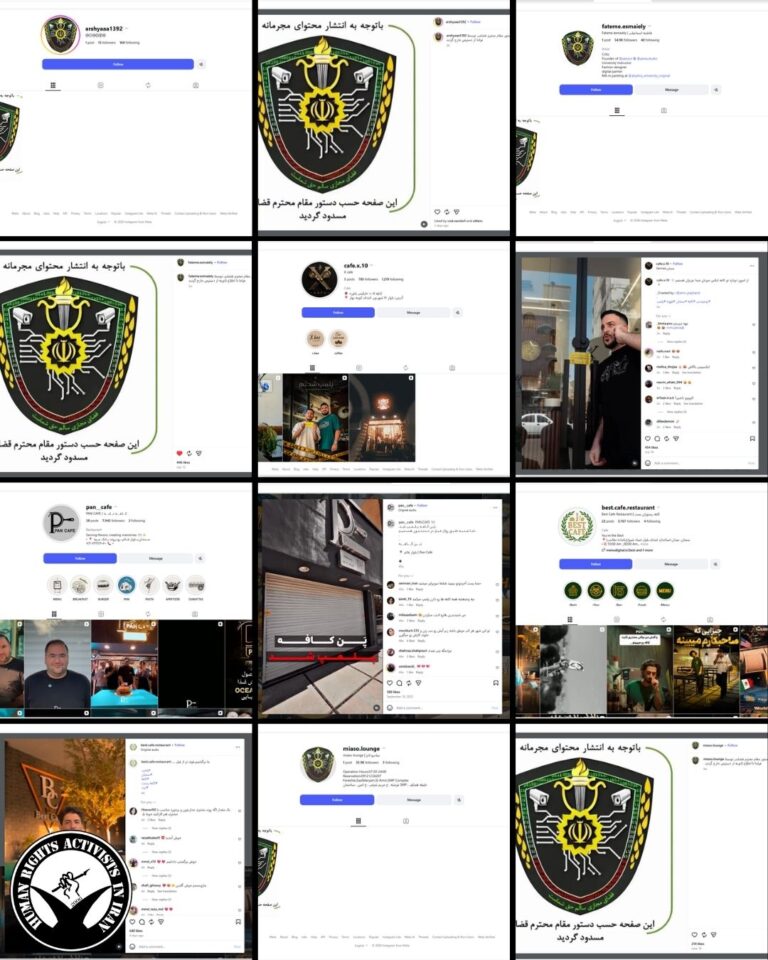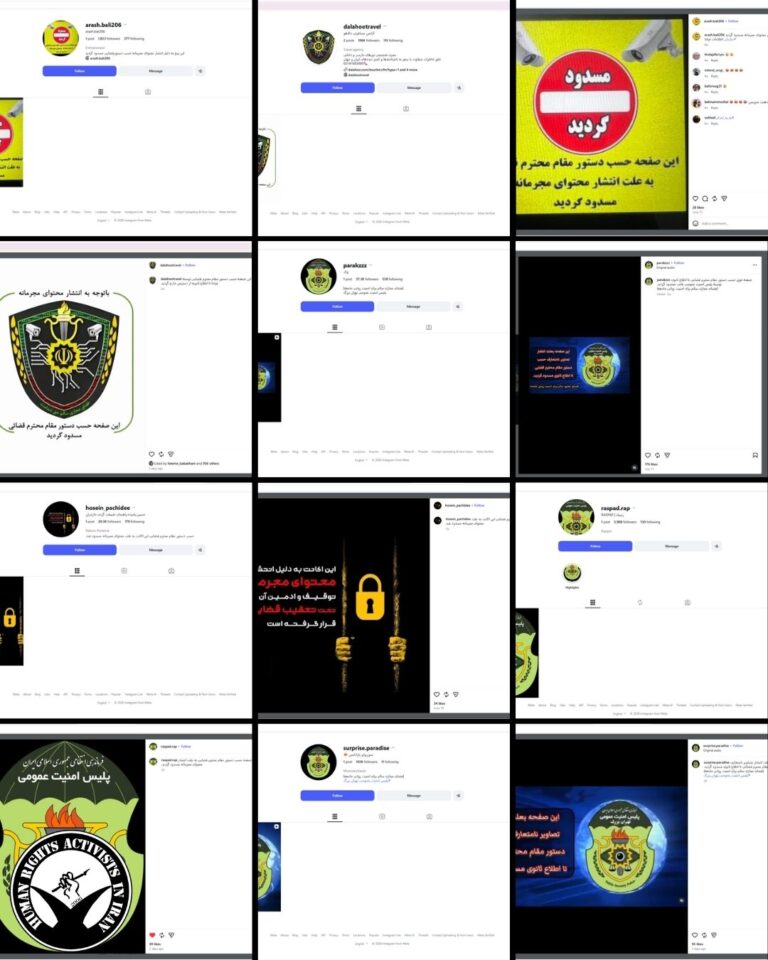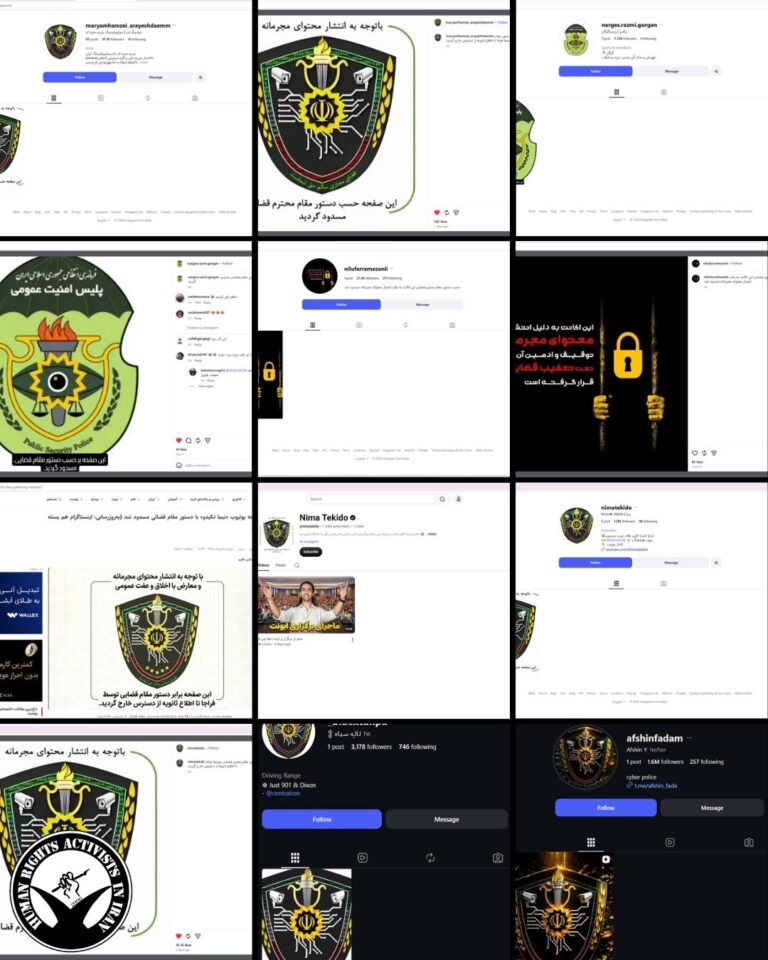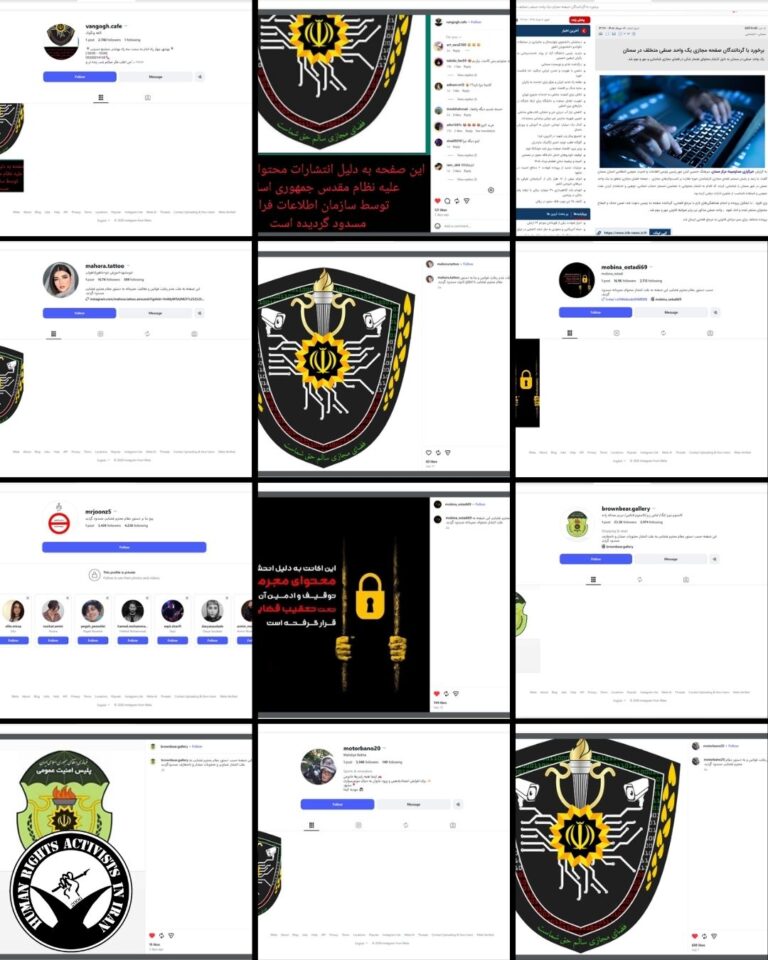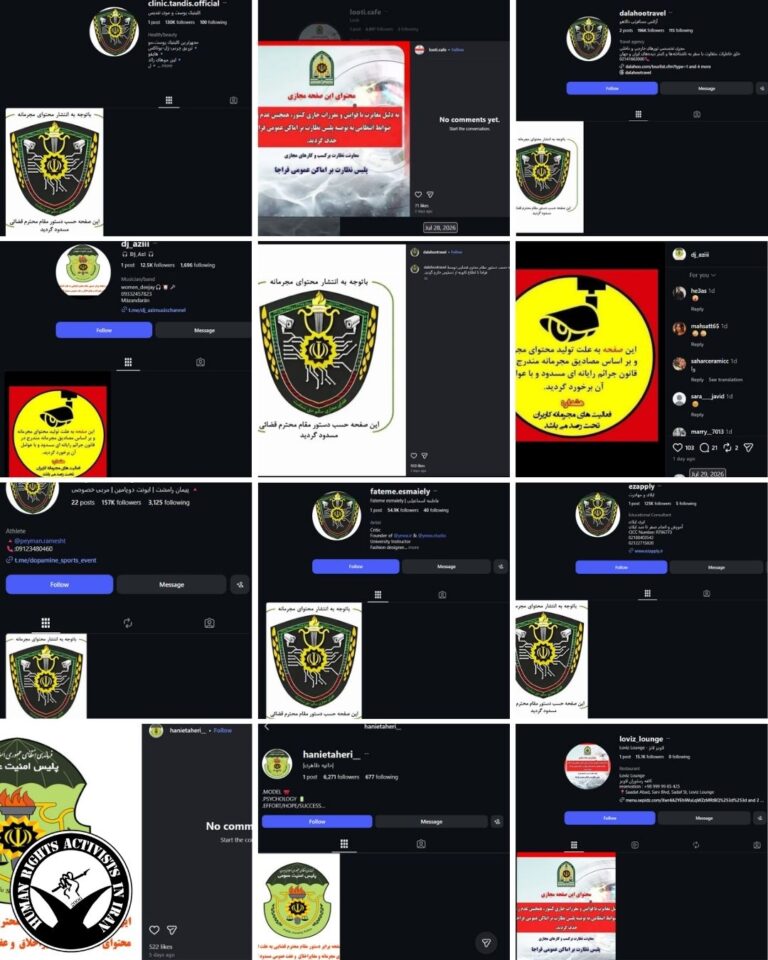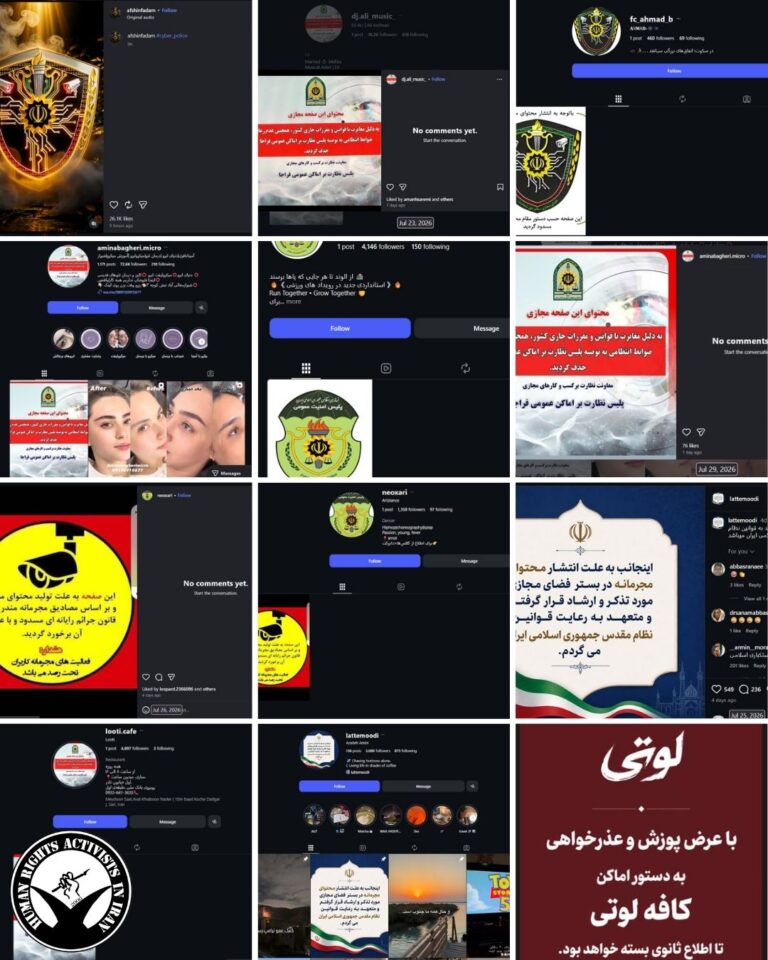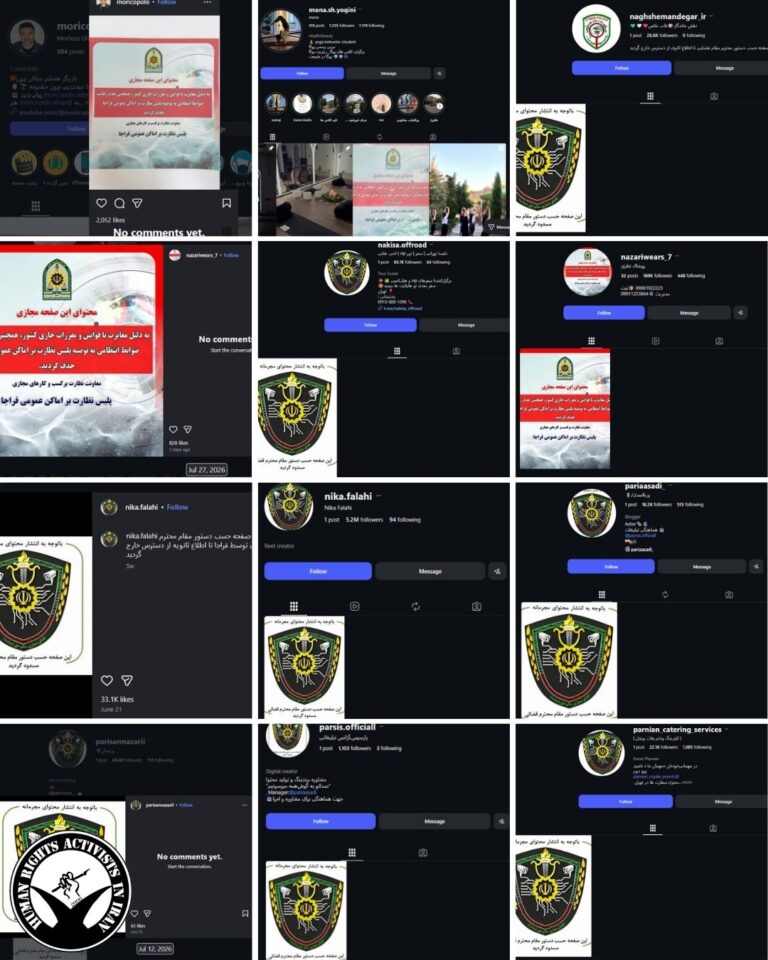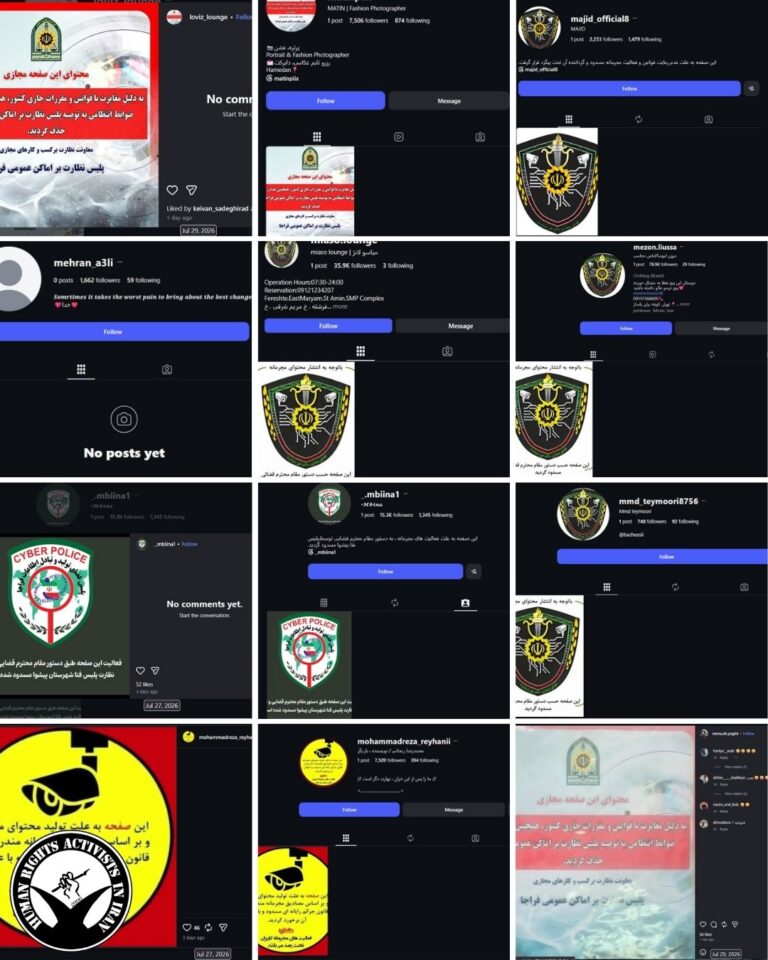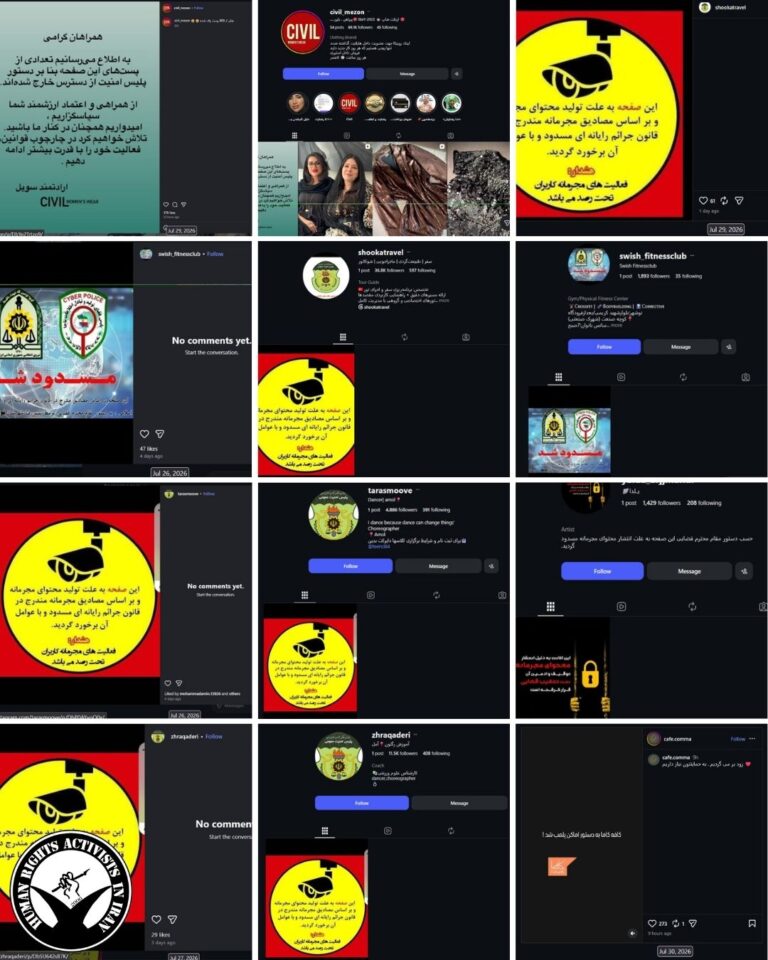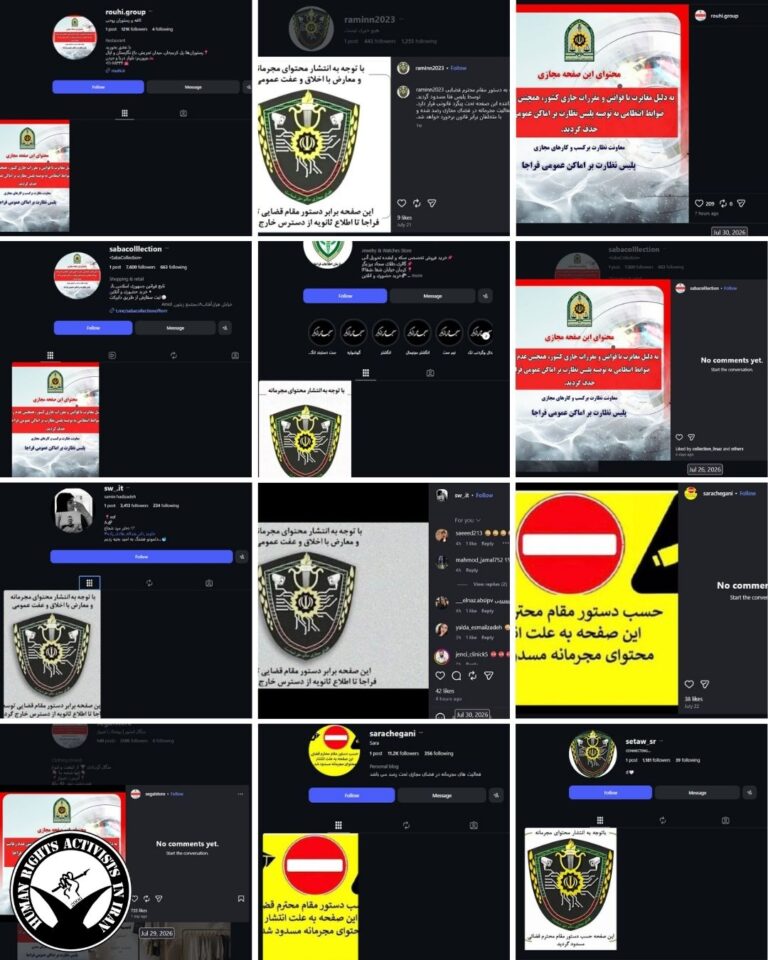
HRANA – Iranian authorities have launched a new wave of restrictions targeting social media users, online businesses, and commercial establishments across the country in recent weeks. The crackdown has included the blocking of social media pages, the mass removal of online content, the forced publication of written pledges, summonses and judicial action against account administrators, the sealing of businesses, and restrictions on online commercial activity.
A review of information collected by HRANA, including interviews with business owners and social media page administrators, indicates that these measures have affected a broad cross-section of individuals and businesses rather than any single group or sector. Those targeted include bloggers, content creators, media outlets, athletes, artists, fashion and beauty professionals, online businesses, cafés, and other commercial establishments. The similarities in the methods of enforcement, the repeated use of comparable allegations and official terminology, and the involvement of law enforcement, judicial, and security agencies across multiple cases suggest a broader pattern of enforcement rather than a series of isolated or unrelated actions.
A significant portion of these measures has been linked to compulsory hijab regulations, the presence of women with optional hijab, and vague concepts such as “norm-breaking,” “content contrary to public morality,” and “failure to observe Islamic standards.” The simultaneous pressure on online activities, businesses, and public gathering places points to a renewed intensification of mechanisms of social control, a trend that has affected both cyberspace and the public sphere at the same time.
This report examines documented incidents that occurred between July 11 and August 1, 2026. The information was compiled through monitoring social media platforms, reviewing notices posted on blocked or restricted pages, examining statements issued by judicial and law enforcement authorities, reviewing remarks by government officials, collecting reports from business owners and media sources, as well as conducting numerous interviews with page administrators.
Where possible, HRANA has identified duplicate cases and avoided counting them more than once. Only pages whose names or identities could be verified and for which evidence indicated that the restrictions resulted from intervention by government authorities have been included in the documented statistics.
The figures for blocked pages, published pledges, and sealed businesses overlap in some instances. For example, the social media page of a business may have been blocked, its administrator compelled to publish a written pledge, and the business itself sealed. Therefore, these totals should not be interpreted as representing the number of individuals, legal cases, or independent enforcement actions.
Aggregate reports in which the names of pages or specific details of the measures were not disclosed are listed separately and have not been included in the statistics for individually documented cases. Furthermore, because of deleted content, deactivated accounts, and restricted access to official information, the figures presented represent only the minimum number of identifiable cases and do not necessarily encompass all enforcement actions carried out during this period.
Government authorities have justified these actions using allegations such as “disturbing public opinion,” “norm-breaking,” “publishing content contrary to public morality,” “criminal activity,” and “insulting religious sanctities.” However, an examination of the documented incidents suggests that they cannot all be regarded as isolated and unrelated measures. The diversity of the targeted groups, the broad geographic scope, the similarities in enforcement methods, and the repeated use of common language in official statements, page-blocking notices, and written pledges all point to the emergence, or renewed intensification, of a coordinated pattern of enforcement targeting online activity, businesses, and public spaces.
In some respects, particularly the use of judicial and law enforcement mechanisms to impose restrictions on dress, lifestyle, and cultural and social activities, this pattern is reminiscent of the social control policies implemented in the years preceding the “Woman, Life, Freedom” protests. However, in the absence of any publicly available directive or document indicating the existence of a centralized, nationwide decision, it cannot be stated with certainty that all of these measures are part of a single coordinated policy.
One of the defining features of this wave has been the expansion of enforcement beyond political and media activists. Bloggers, content creators, online businesses, travel agencies, figures in the fashion and beauty industry, sports coaches, commercial establishments, and pages associated with cultural and commercial activities have also faced restrictions. HRANA’s review of the collected information indicates that, in recent weeks alone, at least 72 high-profile social media pages or accounts have been blocked, seized, or taken offline.
In many cases, previously published content was removed and replaced with nearly identical notices stating that the page had been blocked by order of a judicial authority or alleging the publication of “criminal content,” “failure to comply with the law,” or “content contrary to public morality and decency.” In addition, at least 21 pages, following warnings or intervention by law enforcement and judicial authorities, were compelled to publish written pledges committing to comply with regulations and refrain from repeating their previous activities. During the same period, at least 23 businesses were sealed in cities across the country.
Because, in some cases, page blocking, content removal, the extraction of written pledges, and the sealing of business premises occurred simultaneously, these figures represent the number of documented enforcement measures rather than the number of separate cases or individuals. The repeated use of similar methods, including content removal, page blocking, and the compulsory publication of written pledges, indicates a coordinated pattern of enforcement targeting a broad spectrum of online actors and businesses.
Breakdown by Category of Blocked or Seized Social Media Pages
The following is a breakdown by category of high-profile and widely followed social media pages that were subjected to action by security agencies or the Cyber Police (FATA) during the reporting period:
• Bloggers, online personalities, and personal accounts: Approximately 25 cases, including lifestyle bloggers, content creators, entertainment pages, and personal accounts belonging to Nima Takido, Haj Reza, Mobina Ostadi, Arshia, Niloufar Ramezani, Negin, Mahdieh Keikha, Arian Yousefi, Parya Asadi, Yalda Arjmandi, Laleh Siah, Ahmad, Mehran, Saeed, Setareh, Mohammad Teymouri, Ramin, Hanieh Taheri, Sara Chegeni, Mobina, Morteza Ghafouri, Nika Fallahi, Samin Hadizadeh, Afshin Fada, and Zahra Rafizadeh.
Among the cases that received significant attention on social media was the blocking of Nima Takido’s YouTube and Instagram accounts by order of a judicial authority and carried out by Iran’s Law Enforcement Command (FARAJA). The action came several days after a controversial gathering of his supporters at Iran Mall and rendered inaccessible his YouTube channel, which had approximately one million subscribers, and his Instagram page, which had more than 1.5 million followers.
• Commercial, retail, and service businesses: Approximately 19 cases, including shops, beauty centers, event management companies, advertising agencies, and other online businesses, including Miaso Lounge Café, Surprise Paradise, Elham Asadzadeh, Van Gogh Café, Brown Bear Gallery (owned by Maryam Abdollahzadeh), Parsis Advertising Agency, Sajjad Barzigar Gold & Jewelry Store, Naqsh-e Mandegar, Parnian Catering & Events, Easy Apply, Tandis Skin and Hair Clinic, Liosa Fashion House, Nazari Clothing Store, Louti Café, Saba Collection, Segal Store, Laviz Café-Restaurant, Manto Sport, and Rouhi Café & Restaurant.
• Beauty, fashion, cosmetics, and modeling: Approximately 10 cases, involving makeup artists, tattoo artists, fashion designers, and beauty service providers, including Fatemeh Esmaeili, Mahoura Yahooei, Parak, Negin, Samaneh Safari, Maryam Hamzeh’i, Matin, Majid, Amina Bagheri, and Parisan Nazari.
• Sports, coaching, and athletic activities: Approximately 9 cases, including sports clubs, coaches, athletes, dance instructors, and sports groups, including Arash Bali, Dopamine Event (managed by Peyman Ramesht), Alvand Running Club, Tara, Swish Sports Club, Mona, dance instructor known professionally as Ari, Zahra Gaderi, and Narges, a martial artist based in Gorgan.
• Arts, music, and cultural activities: Approximately 5 cases, including singers, DJs, actors, writers, and cultural pages, namely Ekhtesasi Marjoon, rapper Respa, DJ Azi, Mohammadreza Reyhani, and Ali Keshvari.
• Tourism, nature travel, and travel services: Approximately 4 cases, including travel agencies, tour guides, and eco-tour organizers: Dalahoo Travel Agency, Hossein Pachideh, Nikisa Tehrani, and Shooka Tour.
Among this category, the blocking of Dalahoo Travel Agency’s Instagram page by judicial order attracted the greatest media attention. The measure followed the publication of images showing women without compulsory hijab during tours organized by the agency. After the page was blocked, all of its content was removed and replaced with a single notice stating: “This page has been blocked pursuant to the order of the respected judicial authority.”
Some pages operated across more than one field. For example, several bloggers were simultaneously active in fashion, beauty, sports, or tourism. Accordingly, the above classification is based on each page’s primary area of activity.
In addition to the specifically identified pages, the Qazvin Province Public Places Supervision Police announced the identification and “cleansing” of 56 Instagram pages, describing them as containing “norm-breaking promotional content and culturally harmful material.” Because neither the names of these pages nor the precise measures taken against them were disclosed, these cases have not been included in the total of 72 specifically identified pages.
Similarly, in Gilan Province, the Public Places Supervision Police reported identifying 32 businesses in Rasht and removing more than 3,258 pieces of content from their Instagram pages. Since content removal does not necessarily amount to the complete blocking of an account, these cases have likewise not been included in the count of blocked pages.
Breakdown by Category of Pages Required to Publish Written Pledges
• Fashion, clothing, modeling, and beauty services: 9 cases, involving Fariba Jamshidi (beauty services), Nasrin Ghadiri, Sarar Beauty Salon, Leila Nazari, Ala Zandi, Sovil Fashion House, Negin Sasani, the Milad Clothing sales page, and fashion and beauty blogger Sana Allahi.
• Sports and coaching: 4 cases, including Farina (fitness and bodybuilding), Elham Kardanpour (swimming and aquatic fitness coach), Mohammad Nateghi (bodybuilding athlete), and Afaq (middle- and long-distance running coach).
• Bloggers and lifestyle/social content creators: 3 cases, involving Arnika Kaveh, Azadeh Amini, and Amirhossein Garivani.
• Other professional and commercial fields: 5 cases, including photographer Yeganeh Jahanpour, general surgeon Dr. Mohammad Hassan Izadian, Omid Hamidvand (active in the audio systems industry), the Avand cultural and artistic platform, and A&A Hypermarket.
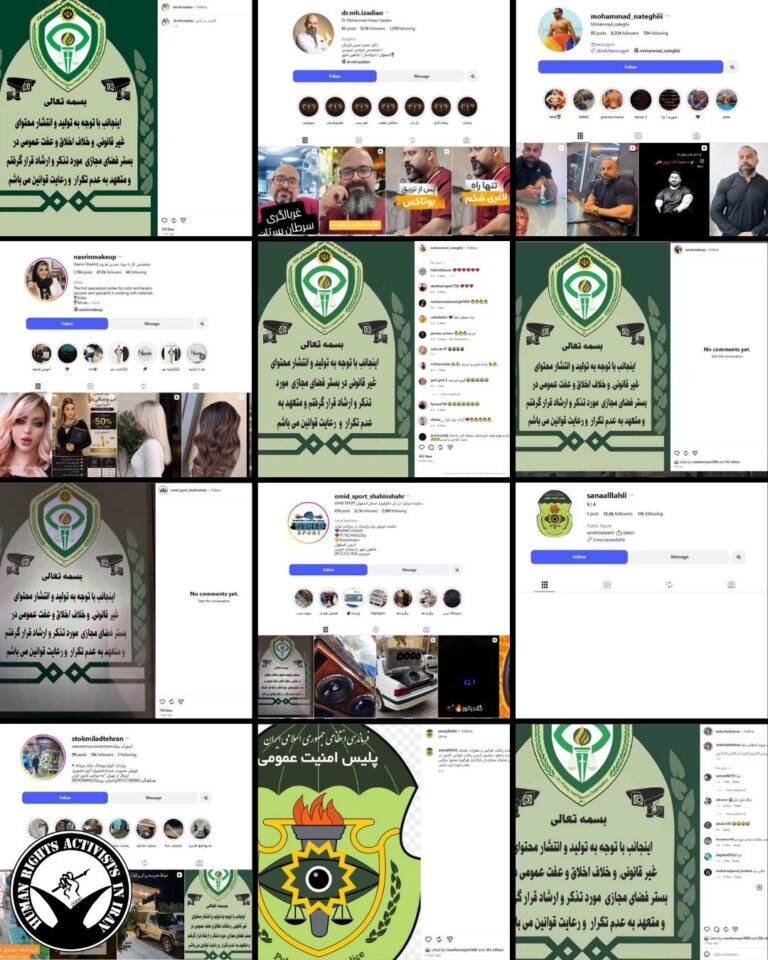
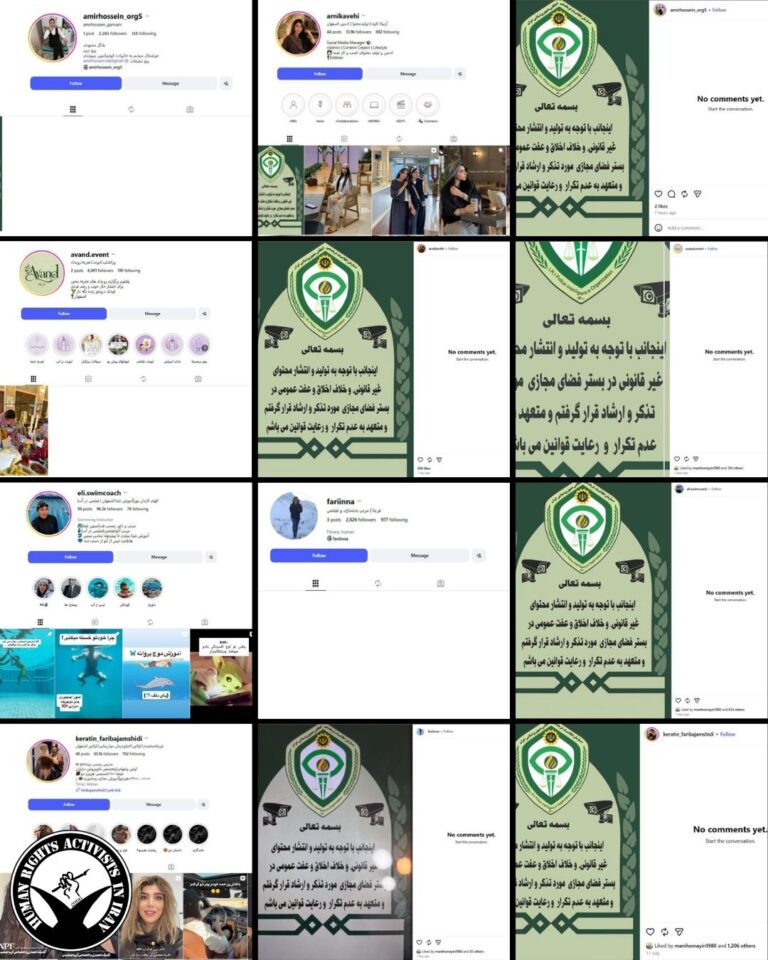
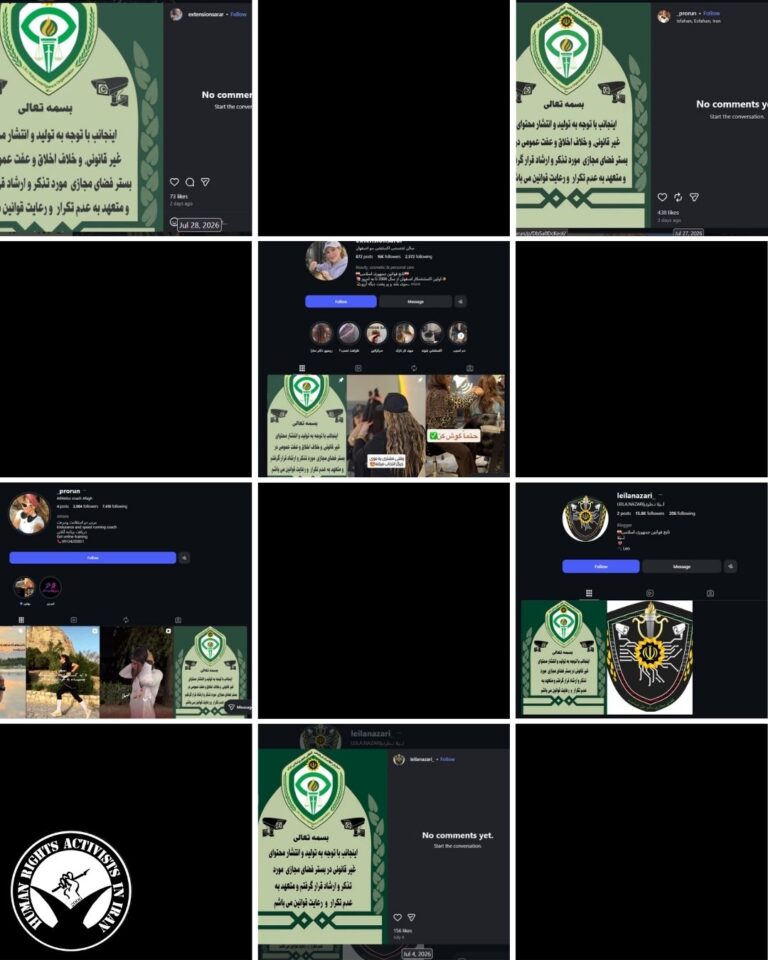
In a significant number of these cases, the written pledges were published bearing the logo of FARAJA’s Intelligence Organization. They contained nearly identical language referring to “compliance with the law,” “non-repetition,” “warning and guidance,” and refraining from publishing the content that had prompted the authorities’ intervention. The similarity in both the wording and format of these statements suggests the use of standardized templates and the implementation of a common procedure in dealing with the administrators of different social media pages.
In several of these cases, the publication of a written pledge was accompanied by additional enforcement measures. The page of a fashion and beauty blogger, as well as the pages of Amirhossein Garivani and Leila Nazari, were blocked in addition to being required to publish pledges. The pages of Ala Zandi and Farina also had their previous content removed, while Sovil Fashion House reported that more than 800 posts had been deleted from its page on the orders of the Security Police. In Semnan, action taken against the social media page of a commercial establishment resulted in the removal or modification of its content, the extraction of a written pledge from its administrator, and the sealing of the business premises.
Breakdown of Sealed Businesses
• Cafés and restaurants on Sanai and Iranshahr streets in Tehran: 7 cases, including Joe Café, 1401, Sam Café, Do Bar, Man, Novuk, and Theory.
• Businesses in Semnan: 4 cases, including Tabeh Café, X Café, Best Café, and another business that was sealed after publishing content described by the authorities as “mocking the Islamic hijab.”
• Other businesses: 12 cases, including cafés and commercial establishments in Tehran, Dezful, Behbahan, Sari, Tonekabon, and Isfahan, among them Caspian Café in Tonekabon, Mohseni Mansion in Behbahan, Kama Café, Gol-e Yakh Café, Rouhi Café, Pizza Davood, Mansha Mansion in Tehran, and other reported businesses.
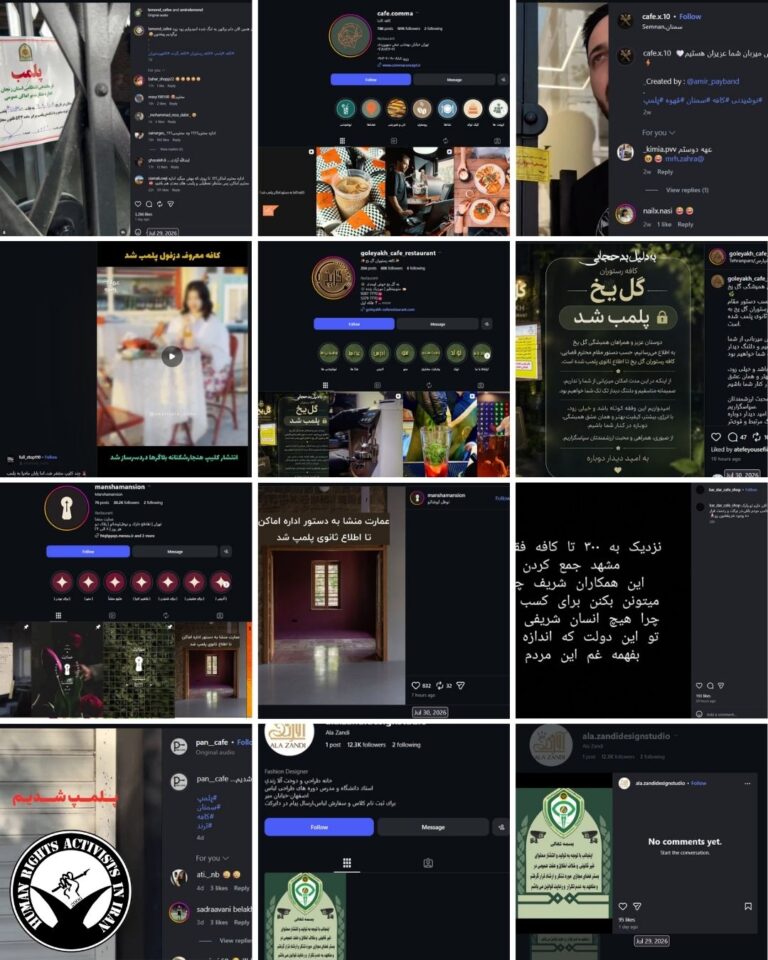
One of the most notable examples of this pattern was the simultaneous enforcement action against several café-restaurants on Sanai and Iranshahr streets in Tehran. On July 20, at least seven café-restaurants in the area were sealed on allegations including failure to enforce the compulsory hijab and what authorities described as violations of “Islamic standards.” At the same time, the Instagram pages of several of these businesses were also blocked by order of a judicial authority.
Several days after these actions, reports emerged that curbs, flower beds, raised seating areas, and outdoor seating spaces in front of cafés on Sanai Street had been demolished, while benches along Iranshahr Street were removed. The timing of these measures, alongside the closure of the cafés, has raised concerns that the restrictions extend beyond businesses themselves to encompass informal public gathering spaces used by residents.
In Dezful, a café was sealed after videos showing women with optional hijab were published, and judicial cases were opened against individuals connected to the establishment. Mohseni Mansion in Behbahan was also sealed because customers were present without compulsory hijab and music was being played. Several businesses sealed in Semnan later announced that the closure orders had been lifted after a few days and that they had resumed operations. A perfume store was likewise sealed for two days. Pizza Davood, one of Tehran’s oldest pizzerias, was sealed in recent weeks because customers were present without compulsory hijab; it later announced that the seal had been lifted and that it had reopened.
Caspian Café-Restaurant in Tonekabon was sealed after a video of a football match viewing event was published, with authorities alleging the occurrence of “social abnormalities.” In Ardabil, a café was sealed on accusations including “norm-breaking,” “failure to observe Islamic standards,” and “promoting corruption,” while two of its owners were arrested.
Kama Café and Mansha Mansion were also sealed by order of the Public Places Supervision Office. Gol-e Yakh Café-Restaurant in Tehran reported that it had been sealed by judicial order based on allegations of “improper hijab.” Ghahveh Book Café in Isfahan was likewise sealed, although no explanation was provided regarding the reason for the closure.
Expansion of Enforcement from Cyberspace to the Public Sphere
A review of the documented incidents indicates that these restrictions have not been confined to the online sphere. In a number of cases, page blocking, content removal, the compulsory publication of written pledges, the summoning of page administrators, and the sealing of business premises were carried out simultaneously or within a short period of one another. The targeting of cafés and popular gathering places for young people, the demolition or removal of public seating areas, restrictions on group sporting activities, and action against organizers of tours and cultural events all suggest that this policy extends beyond regulating online content and also seeks to control how citizens use public spaces.
The names of numerous state bodies, including Iran’s Law Enforcement Command (FARAJA), the Public Security Police, the Public Places Supervision Police, the Cyber Police (FATA), FARAJA’s Intelligence Organization, and judicial authorities, appear repeatedly in blocking notices, written pledges, and official statements issued during this period.
On many blocked pages, in addition to references to judicial orders, the names or logos of the Deputy for Supervision of Online Businesses and the Public Places Supervision Police also appeared. The repeated presence of these agencies in cases involving businesses and social media pages indicates their involvement in parts of the process of identifying alleged violations, removing content, and blocking accounts. This suggests that enforcement against online activity—particularly activity connected to commercial businesses—has not been carried out solely through the Cyber Police (FATA), but has also involved agencies responsible for supervising online businesses and public establishments.
Common Terminology and Ambiguity in the Legal Basis for Enforcement
Terms such as “norm-breaking,” “psychological security of society,” “culturally harmful content,” “content contrary to public morality,” “harmful advertising,” “criminal activity,” and “content contrary to public ethics and decency” have been repeatedly used across a large number of official statements, page-blocking notices, and written pledges.
In many cases, however, the specific conduct or content that allegedly justified the enforcement action was never identified. Likewise, in a number of cases, pages were blocked pursuant to judicial orders, yet the identity of the issuing judicial authority, the case number, and the available procedures for legal appeal or challenge were not disclosed.
In this context, on July 25, the official responsible for online activists in Kohgiluyeh and Boyer-Ahmad Province announced that the Ministry of Culture and Islamic Guidance had launched a process to “organize and provide insurance coverage for online activists.” According to the announcement, online activists would be formally recognized, while individuals who violated applicable laws and regulations would be dealt with in accordance with the law.
However, one day later, on July 26, the Secretariat of the Supreme Council of Cyberspace denied the announcement, stating that “the Supreme Council of Cyberspace has not convened for more than a year to adopt such a resolution, and no such proposal is under consideration.”
These contradictory statements, and the subsequent denial, at the very least point to a lack of transparency and coordination in the official narrative regarding the origin and legal basis of this initiative.
Conclusion
A review of the statistics and documentation collected by HRANA indicates that the enforcement measures carried out in recent weeks cannot be regarded merely as a series of isolated judicial or law enforcement actions. During the reporting period, at least 72 identified social media pages and accounts were blocked or seized, the administrators of 21 pages were compelled to publish written pledges—or statements committing to comply with applicable regulations, and at least 23 businesses were sealed.
In addition, official reports indicate enforcement measures against 56 Instagram pages in Qazvin Province and the removal of 3,258 pieces of content from the Instagram pages of 32 businesses in Rasht. Because the names of the pages, the identities of their administrators, and the precise nature of the measures taken were not disclosed, these cases have not been included in the statistics for specifically identified cases presented in this report.
Several page administrators who spoke with HRANA described similar experiences regarding the conduct of law enforcement authorities. According to their accounts, officers from the Cyber Police (FATA) initially contacted them by telephone before summoning them to a designated location. During these visits, some individuals had their mobile phones inspected, and conditions were imposed on their continued activity online. These conditions included signing a written pledge, deleting previously published content, and posting a statement on their personal or business pages committing to comply with applicable regulations.
Some interviewees stated that these actions were carried out directly by police officers at the location where they had been summoned. According to their accounts, officers used the individual’s mobile phone to access their social media accounts, deleted selected content, published the required written pledge, obtained the individual’s signed undertaking, and then returned the phone.
However, the method of enforcement was not identical in every case. Other interviewees reported that, depending on the city in which they operated and the nature of their page or business, instructions to remove content, publish a written pledge, and refrain from repeating the activities objected to by the authorities were communicated solely by telephone, without requiring an in-person appearance.
Taken together, these accounts, alongside the diversity of targeted groups, the broad geographic scope of the enforcement measures, the similarities in implementation, the repeated use of common official terminology, and the concurrent involvement of judicial, security, and law enforcement bodies, suggest the emergence of a pattern that extends well beyond isolated or case-specific enforcement actions.
The fact that a significant proportion of these measures relate to compulsory hijab, women’s dress, the publication of images of women without compulsory hijab, collective sporting and cultural activities, and the way citizens use public spaces further strengthens the possibility that the Islamic Republic is once again intensifying its mechanisms of social control. This trend appears to target the online sphere, economic activity, and the public realm simultaneously.
Given the limited access to information, the deletion or deactivation of some social media pages, and the absence of publicly available details for many cases, the actual number of enforcement actions is likely to be significantly higher than the documented figures presented here. If this trend continues, it may lead to a further expansion of restrictions on online users, businesses, and public spaces in the weeks and months ahead.
The following section presents a collection of images and supporting documentation gathered by HRANA relating to blocked social media pages and pages whose administrators were compelled to publish written pledges.
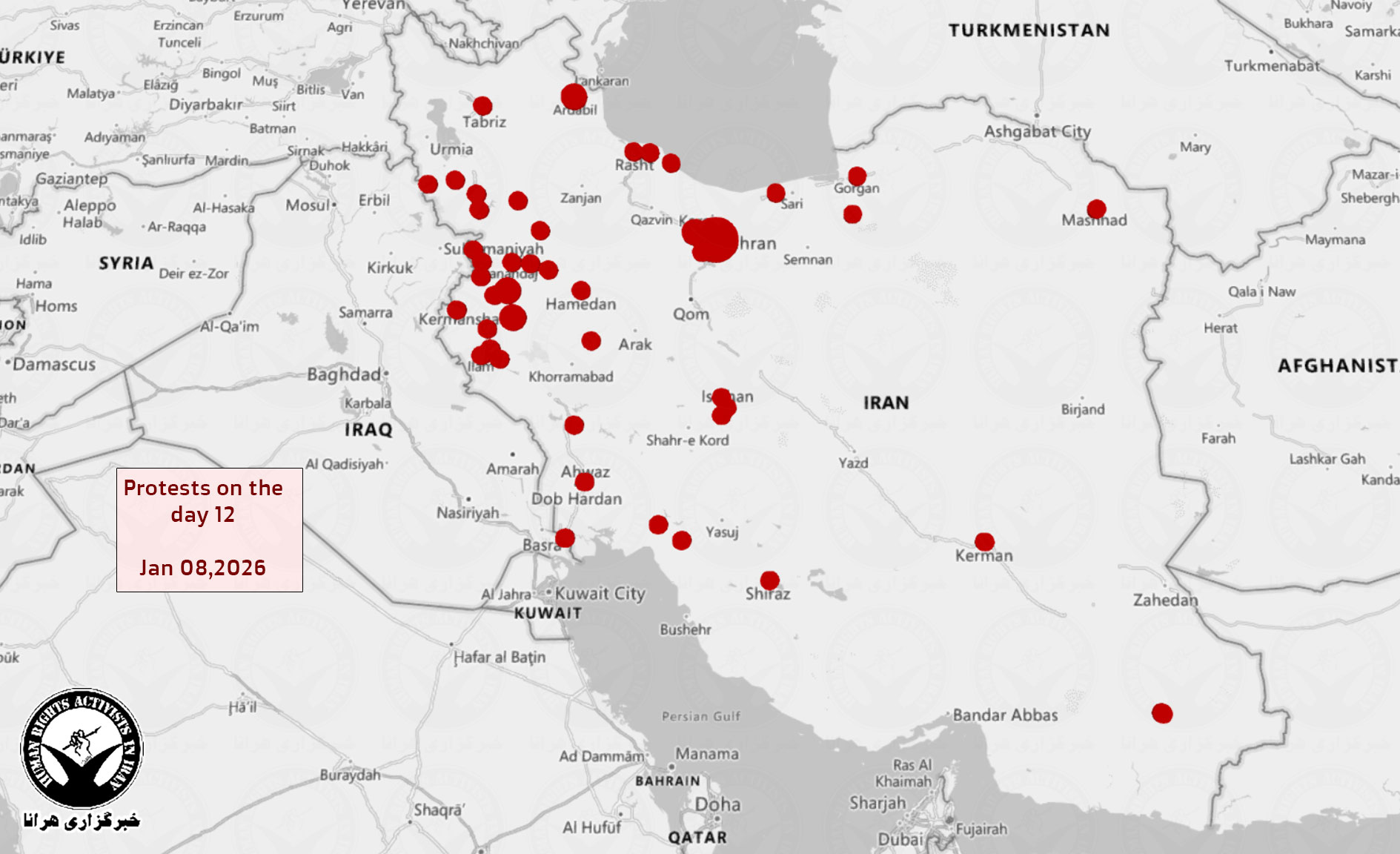
HRANA – Nationwide protests in Iran continued on their twelfth day, Thursday, January 8, 2026, according to reports collected by HRANA. Demonstrations and protest actions were recorded in at least 46 cities across 21 provinces. At the same time, a wave of strikes and market closures was reported, particularly in Kurdish regions, with dozens of cities in Kurdistan, West Azerbaijan, Kermanshah, and Ilam provinces joining the strikes.
On the twelfth day of the nationwide protests, at least 60 additional arrests were recorded. This brings the total number of detainees over the past 12 days to more than 2,277 individuals. Among those arrested, at least 166 were under the age of 18 and 48 were university students. During the same period, 45 cases of forced confessions were broadcast by state media.
Alongside these developments, reports indicated a nationwide internet shutdown on the twelfth night of protests, as well as targeted disruptions to infrastructure, including a sharp drop in IPv6 connectivity. These measures led to widespread disruptions in mobile internet access, internet-based calls, and the functioning of circumvention tools. The death toll from the past 12 days of protests has reached 42 people, including five minors under 18 and eight security personnel or officers.
Background of the Protests
The current protests began on December 28, 2025, amid accumulated social and economic grievances, and gradually expanded from trade- and market-based demands to street protests, later spreading into university spaces. Continued economic pressure, declining purchasing power, and a sense that public demands are being ignored, alongside a deep lack of trust in official accountability mechanisms, have been described as the main drivers behind this wave of unrest.
In the following days, the pattern of protests shifted from scattered gatherings to a network of demonstrations, nighttime chants, and market strikes. By the twelfth day, widespread strikes and shop closures, alongside street protests, had emerged as one of the most prominent features. At the same time, the increased presence of security forces and intensified crackdowns, including mass arrests, the airing of forced confessions, and restrictions on communications (internet shutdowns or signal disruptions), have pushed much of the situation into an environment marked by information disruption and competing narratives.
In parallel, reported slogans indicate that demands have not remained confined to economic issues. In many locations, they have evolved into political protests and structural criticism. Within this context, the twelfth day of protests can be seen as a continuation of a phase in which the street, the bazaar, and civil actions have operated simultaneously and in a complementary manner, while the government has sought to contain both the scope of the protests and their public reflection through a combination of on-the-ground control, judicial and security pressure, and communication restrictions.
Geographic Scope and Key Focal Points of the Protests
Reports collected from various sources indicate that on the twelfth day of the protests, demonstrations and protest activities continued in at least 46 cities across 21 provinces.
In Tehran, numerous locations were reported as sites of street presence and scattered gatherings by protesters. These included Aryashahr and Sadeghieh, Narmak, Valiasr, Keshavarz Boulevard, Yousef Abad, Azadi Street (Eskandari intersection), Tehranpars, Nazi Abad, Sattarkhan, Haft-Hoz, Gheytariyeh, Vanak, Punak (from Esfahani Square to Marzdaran), Kashani Boulevard, Taleghani Square, and Shahrak-e Azadi. In addition, reports were published of nighttime chanting from inside homes in the Heravi area, as well as neighborhood-based protests in Saadat Abad and Jannat Abad. Some reports also referred to street gatherings in Islamshahr.
Furthermore, HRANA received reports of shop closures and strikes in the Tehran Grand Bazaar and central districts of the city, coinciding with the concentration of security forces around Sabzeh Meydan, Amir Kabir Street, and along the metro route from 15 Khordad Station to the Naser Khosrow–Sabzeh Meydan intersection.
In a number of cities, reports were published of internet or electricity disruptions, as well as the sound of gunfire being heard.
According to the compilation of reports received by HRANA, gatherings and protests on the twelfth day took place in cities including Sanandaj, Kermanshah, Marivan, Kamyaran, Ravansar, Sarpol-e Zahab, Saqqez, Mahabad, Paveh, Hamedan, Bukan, Isfahan, Bijar, Dehgolan, Piranshahr, Eslamabad-e Gharb, Ardabil, Ilam, Takab, Sarableh, Sarvabad, Qorveh, Lumar, Pir Bakran, Borujerd, Kerman, Kalachay, Shiraz, Abadan, Astaneh Ashrafieh, Tehran, Gachsaran, Behbahan, Tabriz, Islamshahr, Mashhad, Karaj, Babol, Dezful, Shahin Shahr, Gorgan, Ahvaz, Rasht, Damghan, Iranshahr, and Robat Karim.
Fatalities and Victims of the Protests
According to updated data, by the end of the twelfth day of the protests, at least 42 people had lost their lives. This figure includes:
• 29 protesting civilians • 8 security–military forces • 5 children and adolescents (under 18 years old)
The presence of children among those killed has once again highlighted serious concerns regarding how security forces are confronting the protests and whether the principle of proportionality in the use of force is being observed.
In addition to those killed, numerous reports have been published regarding citizens injured during street clashes and security operations. However, due to limited access to field information and ongoing communication disruptions, the exact number of injured individuals is still being compiled.
Universities and the Role of Students
Based on aggregated data, 34 universities have so far been involved in the protests, with a total of 46 gatherings held on university campuses. Nevertheless, no reports of demonstrations at universities were received today.
In terms of security responses, collected data indicate that over the past 12 days, at least 48 students have been arrested. Alongside this broader trend, notable developments in the university sphere today include the following:
• Amirkabir University of Technology: It was reported that end-of-term exams have been postponed for one week, citing the “current special circumstances.” • Ministry of Health: An official source claimed that “only one medical sciences student” has been arrested, and that this arrest occurred “outside the university environment.” • University of Tehran: The university’s Student Council reported the arrest of Parsa Ghobakhloo, an undergraduate student of electrical engineering, by security forces, stating that his whereabouts are unknown and that the detaining authority has not been identified.
Forms of Protest and Slogans
On the twelfth day of protests, forms of protest action remained diverse. Street gatherings and visible protest presence in urban centers, alongside strikes and market closures in a number of cities, were among the most prominent expressions of dissent. The continuation of this pattern,particularly during nighttime hours and under conditions where internet disruptions or outages and power blackouts were reported in some areas, indicates that the protests have not been confined to a single fixed form, but continue to reproduce themselves through varied methods.
At the ground level, reports point to a combination of scattered and decentralized actions, including neighborhood-based protests, temporary blockages of certain routes and disruptions to traffic, as well as the use of symbolic and low-cost methods to express dissent. At the same time, in several cities, security forces were reported to have used tools such as tear gas to disperse gatherings, and in some areas, the sound of gunfire further intensified the security pressure surrounding the protests.
In terms of content, the slogans and messages raised can largely be categorized into two main themes: some reflect livelihood-related grievances and economic pressures, while others relate to structural and political criticism of governance, the lack of accountability of official institutions, opposition to state repression and violence, and demands for regime change. This simultaneity suggests that, in the minds of protesters, the economic crisis and the crisis of governance are understood as two interconnected aspects of the same underlying problem.
Arrests and Intensified Security Crackdowns
According to collected data, at least 60 additional arrests were reported or confirmed today. As a result, the total number of detainees over the past 12 days has risen to more than 2,277 people. However, due to limited access to field information and incomplete reporting from some areas, the actual number of arrests is likely significantly higher. During the same period, it has also been reported that 45 cases of forced confessions by detainees have been broadcast. Among those arrested, at least 48 are students and 166 are under the age of 18.
Alongside the increase in arrests, signs of escalated on-the-ground repression have been reported in several cities. Reports from Kermanshah indicate the violent arrest of protesters by plainclothes agents. In Behbahan and Ardabil, witnesses have also reported gunfire by security forces.
In addition to street-level crackdowns, a number of official and governmental actions and positions point to an expansion of security and judicial repression. Among these, security bodies in Azna (Lorestan Province) claimed to have arrested an “organized network,” attributing it to monarchist groups, and alleged that the network was involved in the “recruitment of young women” and the “distribution of Lion and Sun flags and promotional materials.” In Tehran, the judiciary announced the opening of cases against “certain individuals” as well as “brands and shops” on charges of direct or indirect support for protest calls. At the same time, reports cited an order by the Tehran prosecutor to monitor cyberspace and identify individuals or cases deemed to be in violation.
At the field level, reports have emerged of widespread use of tear gas, including in Shahin Villa (Karaj), Ghaemshahr, Khorramabad, and Maragheh, as well as gunfire in several cities. These include aerial gunfire in Bijar, reports of repeated gunshots in Khorramabad, and heavy gunfire in Behbahan. In Gohardasht, Karaj, severe communication disruptions and signal outages were also reported simultaneously with clashes.
Summonses and Security Pressure Beyond the Streets
Alongside street-level repression, reports from the twelfth day indicate an expansion of security and surveillance pressures beyond public demonstrations. These pressures range from media threats and psychological operations to judicial tools, phone calls, text messages, and informal summonses. Their stated aim has been described as controlling narratives, preventing the continuation of protests, and monitoring professional, labor, and media circles.
Within this framework, Tasnim News Agency (close to security institutions) published a threatening video attributed to the FARAJA Intelligence Organization, claiming that “individuals chanting slogans from inside their homes” had been identified, warned, and would be arrested “if necessary.” In a statement attributed to the same body, it was emphasized that “all activities are under intelligence surveillance” and that action against chanting from homes would continue.
At the same time, in the economic and trade sphere, reports indicate that The Ministry of Intelligence’s detention facility contacted some shopkeepers and threatened them to reopen their businesses.
In the realm of judicial pressure and digital surveillance, the opening of cases against certain individuals and brands or shops in Tehran has been cited as another example of repression outside the streets, an approach linked to monitoring cyberspace and efforts to curb direct or indirect support for protest calls.
Regarding narrative control and restrictions on content production, it has been reported that some protesters, civil activists, and journalists have been threatened or informally summoned through anonymous phone calls and text messages, warning them against taking positions or producing content related to the protests.
At the international level, in relation to the domestic media environment, the Committee to Protect Journalists (CPJ) has condemned the actions of security institutions in summoning and threatening journalists. The organization stated that following remarks by Ali Khamenei regarding repression, journalists were contacted and summoned to security bodies, including the IRGC.
Internet Disruptions and Communication Restrictions
On the twelfth night of the protests, it was reported that the internet was shut down nationwide, a situation that NetBlocks also confirmed as a widespread internet outage. In follow-up reports, NetBlocks warned that Tehran and several other cities were entering a state of “digital blackout,” and also reported a complete internet shutdown in Kermanshah Province. Within this framework, it was reported that on Thursday, January 8, disruptions, severe slowdowns, and repeated outages continued in a large number of cities.
At the same time, published technical data indicate a pattern of targeted disruption of IPv6. According to reports, Filterban announced that a significant portion of IPv6 connections went offline around 15:19 Tehran time, with the timing pattern suggesting a coordinated action. In the same vein, Cloudflare Radar reported that the volume of IPv6 addresses dropped by approximately 98.5%, and the share of IPv6 traffic fell from around 12% to about 1.8%. It was further emphasized that disruption of this protocol can directly affect mobile internet, modern browsers, applications, internet-based calls, and even the functioning of a significant number of VPNs and circumvention tools. According to these reports, some VPNs either failed to connect or effectively stopped working.
At the field level, and based on specific reports received for January 8, communication restrictions were reported in several cities as follows:
• Bijar (Imam Boulevard): Intermittent internet connectivity. • Khorramabad: Reports of internet shutdown and inability to send videos. • Neyshabur: Reports of a complete internet shutdown, with only text messages being sent with great difficulty. • Karaj (Gohardasht): Initially a complete internet shutdown in the early evening hours; later, mobile phone signal was cut to the extent that calls and SMS stopped working, with reports indicating that only landline phones remained usable. • Amol: In addition to communication disruptions, reports of power outages on main streets were raised, which as an environmental restriction further complicated communication and field coverage.
Strikes and Labor Protests
On the twelfth day of protests, alongside street demonstrations, an unprecedented expansion of strikes and market closures was reported. This pattern took shape from the early days, beginning with the protests on December 28 and reports of gatherings or protests by some shopkeepers in the Tehran Grand Bazaar, and then rapidly spread to numerous cities. On this day, strikes in many areas took the form of shop closures, market shutdowns, and merchants joining street protests.
Kurdish Regions and Kurdistan
Reports indicate widespread strikes in Kurdish- and Lur-inhabited areas, with dozens of cities across four provinces, Kurdistan, West Azerbaijan, Kermanshah, and Ilam, joining the strikes. At the city level, strikes by shopkeepers were reported in cities such as Sanandaj, Bukan, Kamyaran, Dehgolan, Saqqez, Qorveh, Paveh, Sarvabad, Ravansar, Eslamabad-e Gharb, Sarpol-e Zahab, and Kerend-e Gharb.
Tehran and the Bazaar Axis
In Tehran, reports point to the continued closure and stagnation of several markets and commercial centers, alongside the heavy deployment of security forces in parts of the city’s central and commercial districts. Some reports identified routes and locations such as Sabzeh Meydan, Amir Kabir Street, and the entrance of the 15 Khordad metro station up to the Naser Khosrow–Sabzeh Meydan intersection as focal points of security presence—conditions that, according to sources, could affect citizens’ movement and the normal functioning of the markets.
Cities and Markets Reported on Strike (Selected Examples)
In addition to Kurdish regions and Tehran, strikes and shop closures of varying scope were also reported in a range of other cities, including Arak, Hamedan, Khorramabad, Abyek (Qazvin), Borujerd, Qazvin, Isfahan, Ardabil, Bandar Abbas, Bandar Deylam (Bushehr), Shiraz, Khomeini Shahr, Karaj, Shahreza, Nurabad-e Mamasani, Kazerun, Tabriz, Urmia, and Zanjan.
International Reactions
As the protests continued, a number of international officials and figures responded to developments in Iran. Donald Trump warned on several occasions that if the Iranian government “starts killing people like it did in the past,” it would face a “severe blow,” and he emphasized the “value of freedom” in his remarks. Additionally, quoting a White House official (Wednesday, January 7), it was stated that the U.S. president had explicitly said that if the Iranian government shoots peaceful protesters or severely beats them, it will face a “severe blow,” describing this as a “promise.”
In the same context, J.D. Vance stated that “we stand with anyone who peacefully protests for their rights.” The House Foreign Affairs Committee of the U.S. House of Representatives (majority) also warned that if Tehran violently kills peaceful protesters, “justice will be swiftly served.”
The U.S. Department of State (including its Persian-language account) issued a travel advisory stating that Iran remains at Level 4 – Do Not Travel, urging U.S. citizens to “under no circumstances” travel to Iran. The advisory cited risks such as terrorism, unrest, kidnapping, and wrongful detention. It has also been reported that Australia has urged its citizens to leave Iran.
In Europe, Roberta Metsola, President of the European Parliament, expressed solidarity with protesters and, referring to reports of “30 killed,” emphasized that threats, prison, and tear gas cannot suppress the desire for freedom. Hannah Neumann (Chair of the European Parliament’s Iran delegation) also stated that people have returned to the streets and may face bullets, but for many, “silence is more dangerous,” stressing the need to “shine a light” on events in Iran.
Meanwhile, Canada’s foreign minister expressed support for the right to protest and voiced concern over repression and violent crackdowns. Germany’s foreign minister (Johann Wadephul) condemned the “excessive use of violence against protesters” and emphasized the right to peaceful protest and Iran’s obligation to uphold its international commitments.
Domestic (Governmental) Reactions
In response to the continuation of protests, a range of official and media positions were released at the level of the government, security–judicial institutions, and media close to the authorities. A significant portion of these responses focused on securitizing the protests and attributing them to foreign interference.
At the diplomatic level, Iran’s Ministry of Foreign Affairs described the support and positions of senior U.S. officials as “interventionist and deceptive,” claiming that the United States is pursuing a range of tools including psychological warfare, media operations, the spread of disinformation, threats, and incitement to violence. In the same framework, Abbas Araghchi emphasized that “Iran’s internal issues concern no one but the Iranian people,” framing the protests as “domestic affairs.” Along these lines, some official statements sought to portray the protests as purely economic demands, while simultaneously attributing part of the problems to U.S. sanctions.
In the media and propaganda sphere, the newspaper Kayhan, using labels such as “Mossad and ISIS agents,” attempted to portray protesters as a security threat, while also speaking of “harsh” judicial and security crackdown as the path forward. The repeated official dichotomy of “protest” versus “riot” was also highlighted in various statements as a red line in government discourse.
At the parliamentary and security-institution level, reports emerged of a closed-door parliamentary session attended by the government and security/law enforcement bodies, during which it was said that “statistics, charts, and provincial maps” of the protest situation were presented. In the narratives of some lawmakers, concepts such as “hybrid warfare” and “behind-the-scenes enemy planning” were emphasized, and it was claimed that the government had been “tasked with engaging in dialogue with the people and calming them.” It was also reported that one MP (Mohammad Bayat) claimed that “the use of weapons has occurred only in cases where the country was harmed”, a claim described as being in contradiction with field accounts and human rights reports, particularly regarding gunfire.
In statements by the government and the judiciary, Masoud Pezeshkian called on security forces to refrain from “targeting protesters,” while the government spokesperson used emotional language to describe the pain of “every drop of blood being spilled.” The head of the judiciary, addressing merchants’ strikes, described them as “defenders of the system” and sought to avoid framing strikes or discontent as opposition to the authorities. At the same time, in certain judicial-security measures, emphasis was placed on monitoring cyberspace and confronting the symbolic economy of protest, including opening cases against “brands or shops” and “public figures”, as tools to curb protest calls and indirect support.
Regarding the official narrative on casualties and security, the judiciary-affiliated outlet Mizan reported the killing of a police officer in Malard. In another reaction, the Ministry of Health claimed that arrests in university environments had been very limited and that only “one medical sciences student” had been arrested, and that this arrest had occurred “outside the university environment.”
Domestic Reactions (Civil Society, Labour Groups, and Public Figures)
As the protests continued, a series of statements by professional and civil groups, along with positions taken by critical cultural, sports, and political figures, were published. A shared theme across many of these responses was the condemnation of repression, an emphasis on the right to protest, and solidarity with protesters.
Statements and Organizations
In the field of arts and culture, 184 Iranian filmmakers issued a statement condemning the crackdown on protests, emphasizing that shooting unarmed people constitutes a “crime against the right to life,” and affirming their support for freedom of expression. The Iran Cinema House also stated in a separate declaration that people find no avenue other than the streets to voice their protests, describing violence against protesters as illegitimate, unlawful, and irrational.
Today, child rights organizations likewise condemned violence against children and called for the release of detained children and adolescents.
Regarding labor and professional protests, widespread strikes and shop closures were reported in Kurdish regions. These strikes were mainly documented in cities such as Ilam, Kermanshah, Sanandaj, Marivan, Saqqez, Mahabad, Bukan, Oshnavieh, and Sardasht.
Public Figures
Among well-known figures, a range of supportive and critical positions were expressed. Mohsen Makhmalbaf, in a supportive text, emphasized national solidarity and criticized individual dictatorship. Mohammad Fazeli proposed a “democratic bargain with the people” as a path forward. Parsa Pirouzfar, by raising a critical question about the “limits of humiliating and crushing people’s bodies and spirits,” reacted to the atmosphere of repression.
Among sports figures, Voria Ghafouri expressed solidarity and announced that he would close his café for today and tomorrow. Hamid Derakhshan, Mehdi Ghaedi, Mostafa Mastour, Alireza Faghani, and Rasoul Khadem also voiced support for the protests through messages or videos.
At the political and social level, Shirin Ebadi stressed solidarity and described the protests and strikes as unprecedented and nationwide. Azar Mansouri condemned the “repressive approach” toward protesters, described the situation as a “crisis of governance,” and called for the release of detainees, especially women, youth, adolescents, and students. Zahra Rahnavard, in a message using mournful language, referred to the “young lives cut down,” reiterated the slogan “Do not be afraid… we are all together,” and emphasized the transition to democracy.
In addition, references were made to positions and controversies surrounding Ali Daei, whose criticism of government performance and the economic situation, including remarks such as “eggs becoming a luxury item”, was met with reactions and media attacks. Mojtaba Mehrami also made statements expressing support for Mohammad Reza Shah and a positive view of the Pahlavi era.
Arrests
Individual Arrests with Confirmed Identities
1. Issa Foroughi – City of arrest: Dehdasht (Kohgiluyeh and Boyer-Ahmad Province), Gachi village – Place of detention: Unknown – Current status: Detained – Source: HRANA
2. Jaber Foroughi – City of arrest: Dehdasht (Kohgiluyeh and Boyer-Ahmad Province), Gachi village – Place of detention: Unknown – Current status: Detained – Source: HRANA
3. Iman Foroughi – City of arrest: Dehdasht (Kohgiluyeh and Boyer-Ahmad Province), Gachi village – Place of detention: Unknown – Current status: Detained – Source: HRANA
4. Jamal Askari – City of arrest: Dehdasht (Kohgiluyeh and Boyer-Ahmad Province), Gachi village – Place of detention: Unknown – Current status: Detained – Source: HRANA
5. Asghar Vahdat – City of arrest: Dehdasht (Kohgiluyeh and Boyer-Ahmad Province), Gachi village – Place of detention: Unknown – Current status: Detained – Source: HRANA
6. Pouya Barati – City of arrest: Dehdasht (Kohgiluyeh and Boyer-Ahmad Province), Gachi village – Place of detention: Unknown – Current status: Detained – Source: HRANA
7. Reza Moradi – City of arrest: Songhor (Kermanshah Province) – Place of detention: Unknown – Current status: Detained – Source: Kurdpa
8. Mostafa Golzar – City of arrest: Songhor (Kermanshah Province) – Place of detention: Unknown – Current status: Detained – Source: Kurdpa
9. Mohsen Kamyab – City of arrest: Songhor (Kermanshah Province) – Place of detention: Unknown – Current status: Detained – Source: Kurdpa
10. Mohammad Seyfouri – City of arrest: Songhor (Kermanshah Province) – Place of detention: Unknown – Current status: Detained – Source: Kurdpa
11. Ebrahim Pishvaei – City of arrest: Songhor (Kermanshah Province) – Place of detention: Unknown – Current status: Detained – Source: Kurdpa
12. Morteza Sarhadi – City of arrest: Songhor (Kermanshah Province) – Place of detention: Unknown – Current status: Detained – Source: Kurdpa
13. Amir Mozaheri – City of arrest: Songhor (Kermanshah Province) – Place of detention: Unknown – Current status: Detained – Source: Kurdpa
14. Ahad Seyfouri – City of arrest: Songhor (Kermanshah Province) – Place of detention: Unknown – Current status: Detained – Source: Kurdpa
15. Arman Masoudi – City of arrest: Songhor (Kermanshah Province) – Place of detention: Unknown – Current status: Detained – Source: Kurdpa
16. Setareh Farghei – City of arrest: Songhor (Kermanshah Province) – Place of detention: Unknown – Current status: Detained – Source: Kurdpa
17. Fariborz Abbasi – City of arrest: Songhor (Kermanshah Province) – Place of detention: Unknown – Current status: Detained – Source: Kurdpa
18. Yazdan Faalehgari – City of arrest: Songhor (Kermanshah Province) – Place of detention: Unknown – Current status: Detained – Source: Kurdpa
19. Kamal Mahdavi – City of arrest: Harsin (Kermanshah Province) – Place of detention: Unknown – Current status: Detained – Source: Kurdpa
20. Hassan Rostami Namdari – City of arrest: Kermanshah – Place of detention: Unknown – Current status: Detained – Source: Kurdpa
21. Pouria Bamkhasht – City of arrest: Kermanshah – Place of detention: Unknown – Current status: Detained – Source: Kurdpa – Notable point: Student
22. Mahan Dabiripour – City of arrest: Kermanshah – Place of detention: Unknown – Current status: Detained – Source: Kurdpa
23. Fatemeh Hataminejad – City of arrest: Sabzevar (Razavi Khorasan Province) – Place of detention: Unknown – Current status: Detained – Source: HRANA
24. Ahmadreza Farhadi Topkanlou – City of arrest: Sabzevar (Razavi Khorasan Province) – Place of detention: Unknown – Current status: Detained – Source: HRANA
25. Mahsa Basir Tavana – City of arrest: Rasht (Gilan Province) – Place of detention: Unknown – Current status: Released – Source: HRANA
26. Parsa Ghobakhloo – City of arrest: Tehran – Place of detention: Unknown – Current status: Detained – Source: Amirkabir Newsletter – Notable point: Student
27. Pezhman Parsa – City of arrest: Shiraz (Fars Province), Yaghtin Street – Place of detention: Unknown – Current status: Detained – Source: HRANA
28. Moslem Kamyab – City of arrest: Songhor (Kermanshah Province) – Place of detention: Songhor Prison – Current status: Detained – Source: HRANA
29. Amirhossein Takbaz – City of arrest: Karaj (Alborz Province) – Place of detention: Unknown – Current status: Detained – Source: HRANA
30. Asad Abedi – City of arrest: Yasuj (Kohgiluyeh and Boyer-Ahmad Province) – Place of detention: Unknown – Current status: Detained – Source: HRANA
31. Hamidreza Esmailpour – City of arrest: Bojnord (North Khorasan Province) – Place of detention: Unknown – Current status: Detained – Source: Baluch Activists Campaign
32. Sina Mohammadi – City of arrest: Dezful (Khuzestan Province) – Place of detention: Unknown – Current status: Detained – Source: HRANA
33. Amirparsa Neshat – City of arrest: Tehran, Shahrak-e Gharb – Place of detention: Unknown – Current status: Detained – Source: HRANA
34. Nasser Toghiri – City of arrest: Hamedan – Place of detention: The Ministry of Intelligence’s detention facility (Hamedan) – Current status: Detained – Source: HRANA – Notable point: Activist
35. Hassan Mohammadi Saghai – City of arrest: Behbahan (Khuzestan Province) – Place of detention: Unknown – Current status: Released – Source: HRANA
36. Sadrallah Mohammadi Saghai – City of arrest: Behbahan (Khuzestan Province) – Place of detention: Unknown – Current status: Released – Source: HRANA
Group or Unidentified Arrests
1. One citizen – City of arrest: Borujerd (Lorestan Province) – Place of detention: Unknown – Current status: Detained
2. Two citizens – City of arrest: Malard (Tehran Province) – Place of detention: Unknown – Current status: Detained – Notable point: Forced confessions
3. one citizen – City of arrest: Nurabad (Lorestan Province) – Place of detention: Unknown – Current status: Detained
4. ninw citizens – City of arrest: Mehriz (Yazd Province) – Place of detention: Unknown – Current status: Detained
5. onw citizen – City of arrest: Unknown – Place of detention: Unknown – Current status: Detained – Notable point: Forced confessions
6. one citizen – City of arrest: Baharestan (Tehran Province), Sabz Dasht – Place of detention: Unknown – Current status: Detained – Notable point: Under 18, forced confessions
7. onw citizen – City of arrest: Unknown – Place of detention: Unknown – Current status: Unknown
8. onw citizen – City of arrest: Azna (Lorestan Province) – Place of detention: Unknown – Current status: Detained
9. one citizen – City of arrest: Jahrom (Fars Province) – Place of detention: Unknown – Current status: Detained
10. one citizen – City of arrest: Mashhad (Razavi Khorasan Province) – Place of detention: Unknown – Current status: Detained
In Conclusion
Overall, the twelfth day of the protests was marked by the simultaneous convergence of three prominent trends: the continuation of scattered gatherings in numerous cities, the expansion of labor and professional strikes, particularly in Kurdish regions, and the intensification of security pressure accompanied by a new wave of arrests. Alongside these developments, widespread communication disruptions and a nationwide internet shutdown on the twelfth night further constrained the flow of information and intensified the battle over narratives. This combination indicates that, despite repression and restrictions, the protests continue to retain the capacity to regenerate and adapt, both in the streets and within the urban economy.
HRANA – Amid an unprecedented rise in executions in recent months in Iran, at least 12 prisoners have been executed over the past three days on charges of murder or drug-related offenses in various prisons across the country.
Tuesday, December 2 HRANA reported the executions of Fariborz Niazi on a murder charge in Malayer Prison; Mohammad Javad Aminpour on a murder charge in Ardabil Prison; Aziz Sheikhi on drug-related charges in Ferdows Prison; and Malek Gerayi on a murder charge in Ilam Prison.
Wednesday, December 3 According to HRANA, on this date the following executions were carried out: Manouchehr Ahmadi, on a murder charge in Borazjan Prison Mehran Chaboksavar, on a murder charge in Neyshabur Prison Amin Mahdavi, on a murder charge in Mahshahr Prison Majid Namjou, on a murder charge in Bushehr Prison Siavash Khosravi, on drug-related charges in Kashan Prison Saber Zahedi, on drug-related charges in Shahr-e Kord Prison Karam Khoda Sepehri, on drug-related charges in Bojnourd Prison
Thursday, December 4 On this day, HRANA reported the executions of Rahim Mansouri, on a murder charge in Kashmar Prison, and Hossein Ali Yeganeh, on drug-related charges in Birjand Prison.
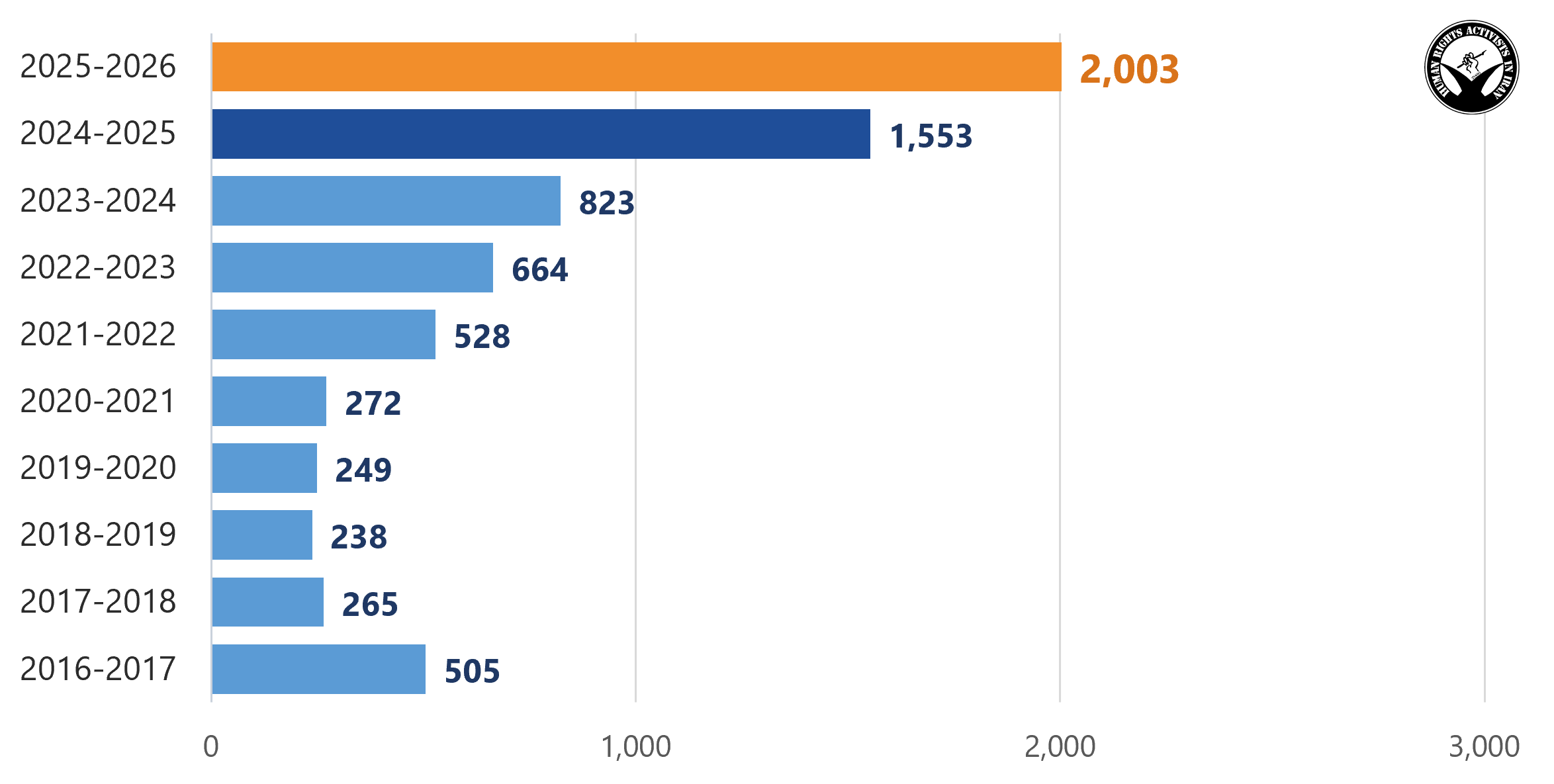
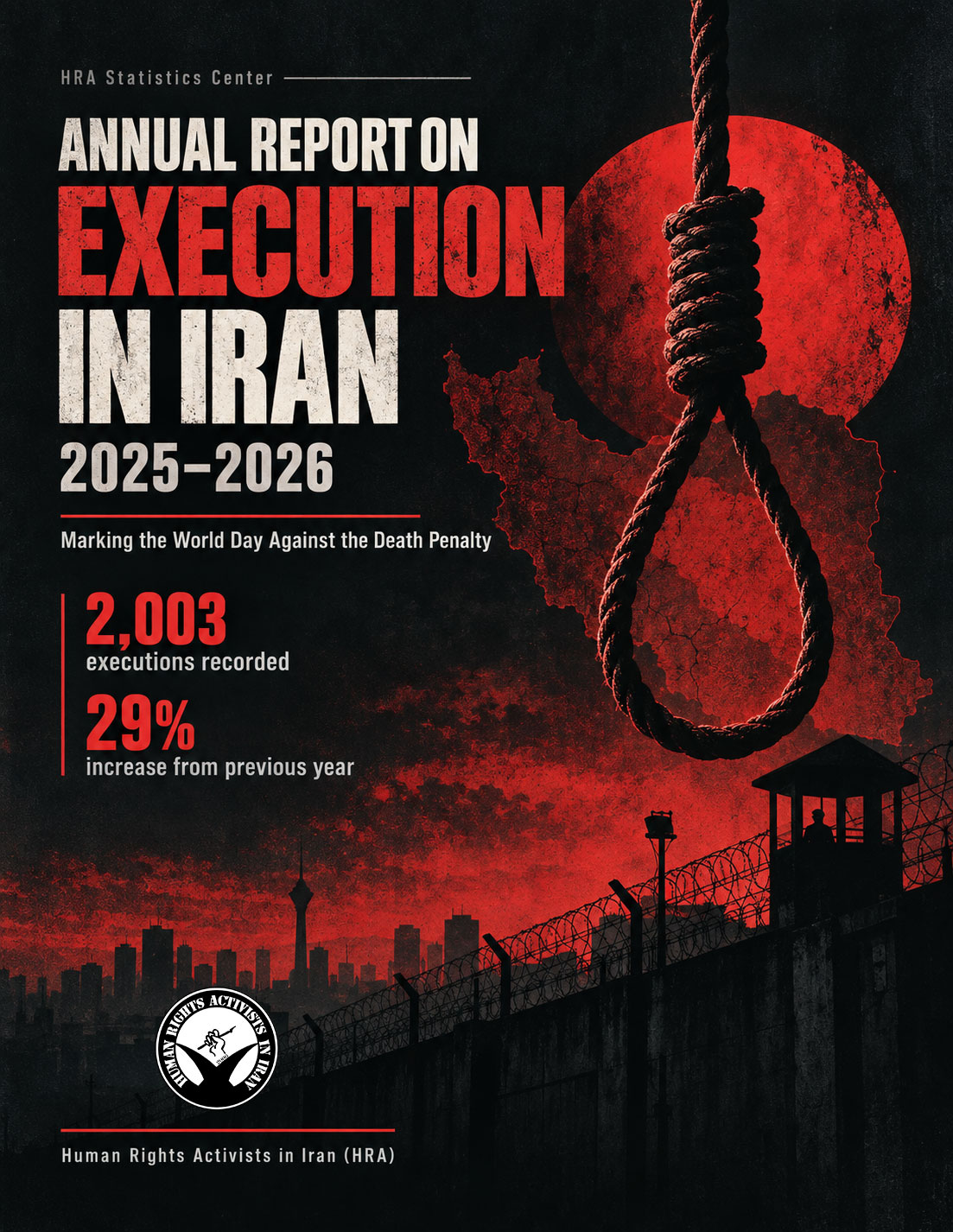
From the beginning of this year until the end of November, 2025, the Iranian regime has executed 1,594 people, marking an unprecedented increase compared to previous years.
HRANA– On the eve of the Orange Week campaign, new one-year data shows that violence against women in Iran is not only a domestic problem but part of a broader, systemic machinery. From murder and sexual assault to judicial rulings and security-agency intervention, patterns of violence appear across the entire country. Women’s bodies, clothing, relationships, and public activism remain central targets of state control. This report summarizes documented cases recorded between November 24, 2024, and November 20, 2025.
Direct and Deadly Violence
Over the past year, more than 110 women and girls were killed in the context of domestic or family-related violence. The victims included adult women as well as young girls aged 5, 9, 13, 18, and 23.
The main drivers of these killings were family disputes and long-standing tensions. Reported motives included so-called “honor” justifications, retaliation for refusing forced or child marriage, reactions to requests for divorce or separation, as well as suspicion, coercive control, and other forms of domination.
Methods of killing included stabbing, firearms, strangulation, severe beating, and burning. In dozens of cases, the perpetrator attempted suicide after the murder.
At least 20 multi-victim family murders were recorded, including cases where women were killed alongside their young children or relatives in Golestan, Amol, Borujerd, Mahidasht (Kermanshah), Urmia, Maku, Khorramabad, Mahabad, Lahijan, and Tehran.
At least 25 honor killings were also reported. Victims included girls aged 17–18 and young women; in several cases, the perpetrator was a teenage boy within the family.
During this period, nine acid attacks against women were documented, from Tehran and Karaj to Khomam, Sanandaj, and Golestan. Some victims lost sight in both eyes.
Additionally, at least six women were killed by their husbands or relatives through intentional burning in Sanandaj, Rezvanshahr, Bandar Abbas, Tehran, Mahabad, and Saqqez.
Sexual Violence and Assault
The documented cases include unprecedented and disturbing incidents, for example, rape inside an ambulance (in one case, the victim died), and the sexual harassment of 12 women seeking jobs in Tehran.
A gang rape in Yasuj led to the victim’s suicide. Serial cases of street harassment in Sanandaj, as well as staged sexual assaults by individuals posing as “employers,” “landlords,” or “ride-share drivers,” also appeared in the reporting.
One of the most shocking cases involved a woman and her young daughter who were imprisoned in a birdcage and assaulted over a period of six years.
Suicide and Self-Immolation Linked to Abuse
At least two women died by suicide following severe domestic violence or relationship breakdowns. One young woman in Mahabad died after self-immolation.
Structural and State-Driven Violence
Violence against women in public spheres also takes the form of security surveillance, judicial pressure, and cultural restrictions.
Arrests, Summonses, and Interrogations
During this period, at least 45 women were arrested, and more than 30 women were summoned to security agencies. Targets included women’s rights activists, artists, female singers, content creators, women appearing in dance videos, protest participants, and women present in public without the mandatory hijab.
Closure of Businesses and Venues
At least 12 businesses, including cafés, galleries, clinics, and cultural centers, were sealed for alleged violations of “hijab” or “public decency.” One case involved a gynecology clinic in Yazd.
Cultural and Artistic Restrictions
Concerts were canceled due to the presence of female musicians or singers. Women participating in events faced fabricated legal charges, and seven female singers in Behbahan were summoned by authorities.
Security Crackdown on Clothing
Women were arrested over their clothing or for “dancing,” cases were opened against organizers of cultural events, and some women were barred from attending interrogation sessions due to their clothing—highlighting how intensely dress codes have been policed.
Judicial Penalties and Sentences
Over the past year, women collectively received more than 200 months of discretionary imprisonment, 74 to 178 lashes, bans on activity and travel, electronic ankle bracelets, and forced residence orders.
Examples include:
• Hamideh Zeraei sentenced to 18 months in prison and 178 lashes • Hasti Amiri sentenced to 3 years in prison with supplementary penalties • Maryam Karimi given prison with an electronic monitoring bracelet • Nina Golestani and Rozita Rajai each sentenced to one year in prison • Fariba Hosseini and Elham Salehi receiving combined prison terms and activity bans
These rulings show that protesting women and civil activists face structured judicial violence.
Geography of Violence
Violence against women was recorded in most provinces, with the highest-risk areas including Tehran, Khorasan Razavi, Alborz, Kurdistan, Fars, West Azerbaijan, Ilam, and Kermanshah. In these provinces, reports included a combination of family murders, acid attacks, sexual violence, and security-driven crackdowns.
Trends Over the Year
Analysis of the past year’s data shows distinct periods of intensified violence:
• Winter and spring saw peaks in domestic and honor killings. • May was the deadliest month with 19 murders. • Summer brought increased security crackdowns, summonses, and business closures. • In the days leading up to March 8 (International Women’s Day), a wave of arrests and summonses targeted women’s rights activists. • Multi-victim family murders, killing a wife along with children or relatives, rose sharply in the final months of the year. • Sexual assaults using deceptive methods, job offers, rental arrangements, or promises of housing, also increased, alongside incidents in formal settings like emergency rooms and ambulances.
Meanwhile, state power structures continued to fuel violence through closures of venues, legal cases, arrests of women artists, and harsh sentences over dress or online content.
Violence as a Crime Against Humanity
The violence documented in this report cannot be understood without acknowledging the broader context of gender-based persecution as a crime against humanity. In 2023, after nine months of investigation, Human Rights Activists in Iran concluded that women and girls in Iran are deliberately and severely denied their fundamental rights because of their gender. These findings were later used as supporting evidence in UN determinations that gender-based persecution is occurring in Iran.
The cases presented here, from murder and sexual violence to punitive court rulings and systematic harassment, reflect patterns that are neither isolated nor accidental. They are part of a wider policy that, both in law and in practice, treats women and girls as lesser.
Recognizing this reality is essential, because the scale and persistence of these violations demand a response grounded in international law, justice, and accountability.
HRANA – Craig and Lindsay Foreman, two British nationals imprisoned in Iran, have gone on hunger strike in protest against the lack of progress in their case.
According to HRANA, quoting the BBC, Ms. Foreman told her son, Joe Bennet, during a phone call yesterday that “not eating is the only power she has.” Joe Bennet also told the BBC that he is not sure whether the hunger strike will help secure phone contact, and he does not know when the strike began.
He added that his mother said she “feels confused and has been let down by both the UK government and Iranian authorities.”
Craig Foreman and Lindsay Foreman, who entered Iran on a round-the-world motorcycle trip, were arrested in January of 2025 in Kerman by IRGC Intelligence forces. Judicial authorities have accused them of “espionage,” claiming the couple gathered information in several provinces under the cover of tourism and research activities.
The British ambassador to Iran at the time also met with the two defendants at the Kerman Prosecutor’s Office in February of that same year.
In recent years, Iranian authorities have arrested several foreign nationals on charges such as espionage or cooperation with hostile governments. Some of those detained have later been released following political negotiations. Human rights organizations and several Western governments have accused Iran of using such arrests for political leverage, an allegation Iranian officials have consistently denied.
HRANA – Many political and religious prisoners in Iran have endured over twenty years behind bars. To prevent their cases from fading from public memory in the flow of daily news, HRANA has launched a series of reports highlighting their situations. Each installment outlines the prisoner’s legal case, detention conditions, access to rights, and immediate needs.
In this installment, HRANA, the news agency of Human Rights Activists in Iran, examines the latest status of Abdul-Zahra Halichi (Haliji) after more than two decades of imprisonment.
Case Information
• Name: Abdul-Zahra Halichi (Haliji)
• Year of arrest: 2005
• Charges: “Acting against national security, moharebeh (enmity against God), and efsad-e fel-arz (corruption on earth)”
• Initial sentence: Life imprisonment
• Current sentence: Life imprisonment
• Places of detention: Served his sentence in Karun Prison, Ahvaz; currently held in Ward 5 of Sheiban Prison, Ahvaz.
• Leave / access: No prison leave reported in recent years; limited access to family and lawyer.
• Current status: Still serving a life sentence despite legal changes that could allow for review or commutation.
Case Background and Judicial Process
In 2005, Abdul-Zahra Halichi was arrested by security forces. Shortly thereafter, Branch 1 of the Revolutionary Court of Ahvaz convicted him of “acting against national security, moharebeh, and corruption on earth,” sentencing him to life imprisonment. This verdict placed him among those serving indefinite terms, effectively extending incarceration for decades and severely limiting access to judicial review.
Key points in the process:
• Heavy security charges: The charge of moharebeh is among the most severe in Iran’s political-security cases and typically carries wide-ranging judicial and executive consequences.
• Continued imprisonment despite legal reforms: Although legislative changes allow for retrial, sentence reduction, or parole in some cases, Halichi remains incarcerated.
Conditions of Detention and Transfers
Throughout his imprisonment, Halichi has been held in Karun and Sheiban prisons in Ahvaz. He spent several years in Karun Prison following his sentencing.
• Feb 2019: Reports of beatings in Sheiban Prison.
• Apr 2020: Subjected to torture after being transferred to The Ministry of Intelligence’s detention facility in Ahvaz.
• Apr 2024: Reported beatings by prison guards and intelligence protection officers in Ward 5 of Sheiban Prison.
• Dec 2024: Threatened with solitary confinement or exile to remote areas after protesting authorities’ failure to enforce the principle of separation of crimes. Since then, he has remained imprisoned in Sheiban.
Observations on Detention Standards
• Frequent transfers: Repeated relocations between wards and prisons disrupt access to family, lawyers, and medical care.
• Violence in custody: Multiple reports of beatings (2019, 2020, 2024) highlight the need for independent documentation and legal follow-up.
• Denial of medical care: Despite suffering from right leg infections, knee pain, and requiring urgent surgery to remove a metal rod from his leg, Halichi has been systematically denied hospital transfer and specialized treatment. Denying prisoners access to healthcare constitutes inhuman treatment and a violation of the right to health and even the right to life, often used as a tool of further pressure and repression.
Access to Family, Lawyer, and Leave
In recent years, Halichi has not been granted leave, and his access to family and legal counsel has been restricted. Such limitations not only have psychological and social consequences but also undermine his ability to mount an effective legal defense or pursue retrial procedures.
Potential Legal Avenues (General Recommendations)
1. Retrial: Assessing new evidence or procedural flaws.
2. Sentence reduction or commutation: If legal grounds are met.
3. Conditional release or suspension: Based on time served, good conduct, or health conditions.
4. Addressing rights violations in custody: Including access to treatment, protection from violence, regular visitation rights, and legal access.
International documentation and advocacy: Utilizing UN reporting mechanisms when domestic avenues are blocked.
Timeline (Summary)
• 2005: Arrested; charged with “acting against national security, moharebeh, and corruption on earth.”
• Initial verdict: Life imprisonment.
• Following years: Held in Karun Prison, Ahvaz.
• Feb 2019: Reported beating in Sheiban Prison.
• Apr 2020: Tortured in The Ministry of Intelligence’s detention facility, Ahvaz.
• Apr 2024: Beaten by prison guards and intelligence officers in Sheiban Prison.
• Dec 2024: Threatened with solitary confinement or exile after protesting non-segregation of prisoners.
• Recent years: No leave granted; deprived of adequate medical care; limited access to family and lawyer.
• Current status: Continues to serve life imprisonment despite potential eligibility for legal review.
Conclusion and Need for Review
Despite legal reforms enabling retrial, sentence reduction, or release in moharebeh cases, Halichi remains behind bars. His case exemplifies long-term political-security imprisonment in Iran, underscoring the urgent need for review mechanisms.
Halichi’s situation highlights both the systematic denial of fundamental rights in detention (such as visitation, legal access, and healthcare) and the importance of using all available domestic and international legal avenues to reduce sentences and secure freedom.
Urgent Needs
• Regular, unrestricted access to lawyer and family.
• Independent medical evaluation following allegations of torture and long-term health issues.
• Review of eligibility for retrial or other mechanisms to reduce/terminate his sentence under current law.
• Enforcement of prison regulations regarding visitation, calls, and leave.
• Access to appropriate medical care and treatment.
About this Series
This report is part of the “Two Decades Behind Bars” series, which aims to document the cases of long-term prisoners and to highlight the collective responsibility to ensure their visibility and pursue their rights.
HRANA – The Judiciary spokesperson has announced the arrest of 20 people across several provinces, accusing them of spying for Israel during the recent 12-day war with Iran. He said the cases are currently under investigation, with results to be announced once inquiries are complete.
Quoting ISNA, HRANA reports that Asghar Jahangir stated the detainees face charges of espionage and collaboration with Mossad, alleging their activities were connected to the 12-day Israel-Iran conflict.
Citing an earlier statement from the Ministry of Intelligence, Jahangir noted that the cases remain under review by interrogators. That statement had also reported the summons and arrest of 98 citizens over media-related activities.
Jahangir added that some individuals detained before the conflict allegedly confessed to missions tied to the war, while charges against others were altered or dropped. “A person may be arrested on suspicion of espionage, but later, during the investigation, the charges may be dismissed,” he said.
Describing espionage cases as “complex and sensitive,” Jahangir claimed they must be handled carefully and with respect for the rights of the accused.
Although combating espionage is not considered a human rights violation, the Iranian government’s longstanding record of using such charges against political opponents means these claims—especially in the absence of clear details or transparent judicial proceedings—are widely met with skepticism.
HRANA News Agency-The large-scale Israeli airstrikes on Iranian soil, which began on June 13 and lasted for twelve days, resulted in at least 5,665 casualties, including 1,190 killed and 4,475 injured, both military and civilian[1]. The attacks, which affected 28 provinces across the country, caused severe damage to critical military, civilian, medical, and emergency infrastructure, and posed a serious threat to the safety of citizens nationwide. During this period, 1,596 individuals were also arrested by the Iranian regime’s security forces.
Prelude
Download the PDF version of the report here
From June 13 to June 24, 2025, Iran witnessed one of the most intense military confrontations in recent decades. The successive waves of Israeli air and missile strikes not only targeted military and strategic infrastructure but also disrupted the daily lives of millions of civilians—ranging from prolonged internet outages by regime and disrupted banking services to partial suspension of public transportation and reduced capacity of medical centers. These concentrated attacks—which even targeted prominent scientific figures—have raised serious questions regarding adherence to humanitarian principles and triggered unprecedented security concerns.
Relying on nearly two decades of experience documenting crises, the Human Rights Activists News Agency (HRANA) began tracking casualties and damages from the earliest hours of the conflict, updating its data continuously. The comprehensive report at hand is the result of collecting and verifying thousands of data points over these twelve days, offering a documented view of the war’s human, economic, and infrastructural dimensions—a picture that underscores the depth of the crisis and the urgent need for global attention to support civilians and rebuild damaged infrastructure.
Geographic Scope and Chronology of Events
Around dawn on June 13, the first wave of Israeli missiles and drones awakened the capital and northern regions of Iran. That same day, air defense systems were activated in multiple locations as the attacks penetrated deep into Iranian territory.
The following day, the scope of the attacks expanded, prompting the Red Crescent’s emergency forces across the country to go on high alert.
On June 15, critical energy sector targets in the capital were set ablaze, and parts of military infrastructure also caught fire. Simultaneously, numerous reports emerged of strikes hitting residential areas in the capital.
A day later, smoke rose from the glass headquarters of the Islamic Republic of Iran Broadcasting (IRIB) and from a hospital in western Iran. The strike on an emergency vehicle highlighted the growing risks to emergency services.
On the fifth day (June 17), several new areas were added to the list of strike zones. Around the same time, a Red Crescent spokesperson stated—without providing specifics—that “since the start of the attacks, 21 provinces have been affected.”
On June 18, the capital was once again hit by a heavy wave of attacks, and the strikes spread to parts of central and northern provinces.
The end of the first week (June 19) brought a blow to the country’s central infrastructure; the seven-day campaign had engulfed nearly all of Iran’s main regions.
On June 20, missiles struck northern and coastal provinces. The Israeli military announced it had carried out 720 airstrikes since the beginning of the operation—a figure that revealed the intensity of the conflict.
On the ninth day (June 21), mountainous areas in central Iran also came under fire. Unofficial reports indicated the attacks had expanded to more than two-thirds of the country’s provinces.
On the tenth day of the war (June 22), the capital once again trembled; simultaneously, three nuclear facilities in central Iran were bombed. The capital’s governor stated that “over 200 locations” in the province had been targeted over the past ten days.
On June 23, the attacks continued and several additional provinces were added to the list of affected areas; the capital’s air defense remained active throughout the night.
In the early hours of June 24—just before the ceasefire was officially declared—several sites in the capital and neighboring provinces came under fire. The picture that emerged from twelve days of conflict: widespread destruction of both military and civilian infrastructure and a persistent threat to citizens nationwide.
Although the ceasefire brought an end to the airstrikes, residents of the affected neighborhoods know that this does not mean the end of their worries. In the days ahead, fundamental questions about reconstruction capacity, the protection of critical infrastructure, and the fate of the damaged cities will remain at the forefront of the news.
In total, the provinces that were either attacked or had their air defense systems activated include:
Tehran, Isfahan, East Azerbaijan, Kermanshah, Alborz, Khuzestan, Fars, West Azerbaijan, Hamedan, Qom, Gilan, Lorestan, Razavi Khorasan, Zanjan, Bushehr, Markazi (Central), Kurdistan, Ilam, Qazvin, Hormozgan, Mazandaran, Yazd, Golestan, Semnan, Chaharmahal and Bakhtiari, Kerman, Ardabil, and Sistan and Baluchestan.
The main cities that were either targeted or had their air defense systems activated include:
During the twelve days of conflict, the Israeli military announced that in just the first three days, it had carried out over 720 airstrikes, targeting more than 60 locations in total. On the fifth day, Israel claimed that three new waves of attacks struck at least 40 additional targets.
In investigations by human rights groups, the principle of proportionality in the laws of war holds particular significance, especially concerning the balance between the nature of targets and the weapons used. Based on data compiled from reliable sources, in addition to precision-guided bombs, suicide drones, and long-range rockets fired from within Iran, the Israeli military deployed the following weaponry:
1 • Harop – Suicide Drone: Produced by Israel Aerospace Industries (IAI), this loitering munition remains airborne for extended periods and crashes into targets like radars or air defense systems. Used to blind Iranian radar systems. 2 • Harpy – Anti-Radar Drone: An older type of anti-radiation drone that autonomously seeks out radar signals and strikes once detected. Used to destroy radars in Iran’s missile systems. 3 • F-35I Adir – Stealth Multirole Fighter: Israel’s customized version of the U.S. F-35, equipped with domestic electronic systems. Led the initial strike waves due to its stealth, targeting command centers, air defenses, and nuclear sites. 4 • F-15I Ra’am – Long-Range Strike Fighter: A twin-engine aircraft capable of carrying heavy payloads, primarily used to deliver bunker-buster bombs like the GBU-28. Played a key role in strikes on underground facilities, including Natanz. 5 • F-16I Sufa – Multirole Fighter: An upgraded F-16D with long-range capability and multiple precision weapons. Deployed to hit military bases, missile platforms, and communication infrastructure using SPICE and JDAM bombs. 6 • Delilah – Air-Launched Cruise Missile: A long-range missile that can loiter near a target area, effective against mobile or hidden systems like radars or command vehicles. 7 •Rampage – Supersonic Air-to-Surface Missile: A fast, precision missile developed by Elbit Systems, used to strike strategic infrastructure such as shelters, missile factories, and munitions depots. Its speed complicates interception. 8 • Blue Sparrow – Air-Launched Ballistic Missile: Originally a test missile for simulating threats, but field evidence suggests operational use against strategic infrastructure. 9 • LORA – Short-Range Ballistic Missile: A ground-launched missile with a 400 km range, capable of striking fixed targets with less than 10-meter accuracy. Used early in the campaign to destroy key infrastructure in western Iran. 10 • SPICE-1000/2000 – Glide-Guided Bombs: Smart kits that turn unguided bombs into precision weapons by locking onto target images. Widely used against sensitive Iranian facilities. 11 • JDAM – GPS-Guided Bombs: U.S.-made kits that enable ordinary bombs to be guided via GPS. Various types were used to strike fixed targets. 12 • GBU-39 SDB – Small Diameter Bomb: Lightweight, high-precision bombs that allow multiple munitions to be carried simultaneously on a single fighter. Suitable for strikes with high risk of collateral damage. 13 • GBU-28 – Bunker Buster Bomb: A 5,000-pound bomb capable of penetrating reinforced concrete and earth. Used against underground sites like Natanz. 14 • Spike ATGM – Guided Anti-Tank Missile: An advanced Israeli missile by Rafael with fire-and-forget capability, using visual and thermal targeting to destroy armored vehicles and light fortifications. Long-range variants were used to hit vehicles and buildings. 15 • B-2 Spirit – Strategic Stealth Bomber: A U.S. intercontinental bomber by Northrop Grumman, capable of carrying about 23 tons of guided munitions. Its low radar cross-section allowed it to penetrate Iranian airspace stealthily and drop bunker-busters. In a joint U.S.-Israeli mission, the B-2 targeted the Fordow, Natanz, and Arak nuclear facilities, deploying GBU-57 bombs from high altitude. 16 • GBU-57A/B MOP – Super-Heavy Bunker Buster: A 30,000-pound bomb capable of penetrating over 60 meters of earth and reinforced concrete. Guided via inertial/GPS systems, it is exclusively deployed by B-2 bombers and was used in the initial strikes to disable sensitive underground sections of Iran’s nuclear infrastructure.
Widespread Disruption of Civilian Life
Over the twelve days of war, HRANA received numerous reports and testimonies that together paint a vivid picture of civilian life under bombardment.
Collapse of Financial Chains and Access to Funds
Banks were among the first casualties of cyberattacks and widespread internet outages. At one point, the cash withdrawal limit in some branches was reduced to one million tomans, and ATMs—especially in migrant-heavy northern cities—were either empty or inoperative. A simultaneous hack of Sepah Bank, Pasargad, and several private banks on the sixth day disrupted card payments for hours. Small online businesses—which became a lifeline for thousands of families post-COVID—faced sudden shutdowns due to inoperable banking gateways and delivery platforms. In Tehran’s Shush and Nasser Khosrow bazaars, many shopkeepers kept their shutters down to avoid facing crowds with no purchasing power.
Paralyzed Transport, Rush Migration, and Route Profiteering
In Tehran, intercity taxi fares reportedly surged to 80 million rials (approx. $160) for the Tehran–Gilan route. In the south, drivers only accepted prepayment in U.S. dollars for routes like Bandar Abbas–Tehran. After a drone strike on Qom station, Iran’s railway suspended four national lines, leaving hundreds stranded in unlit terminals. On western exits of the capital, cars queued for kilometers in 40°C heat, forced to shut off air conditioners due to fuel shortages. Accounts converged on a scene of overcrowding, heat exhaustion, and dwindling gas.
Rationing, Queues, and Soaring Prices for Essentials
With major supply routes blocked, bakeries in northern and northwestern Iran saw lines of over 200 people. In a village in Qazvin, flatbread reached more than four times its pre-war price. Oil, infant formula, and sanitary pads were rationed in Tehran and Rasht. Central produce vendors reported a 50% drop in customers, while small grocers on Police Street had to discard most of their daily greens. Conversely, residents in southern Tehran created solidarity by distributing drinks among neighbors.
Vulnerable Groups Under Extra Pressure
– Elderly and chronically ill: A civil observatory recorded at least 22 deaths due to dialysis delays or power cuts to home oxygen devices.
– Disabled persons and female-headed households: The local welfare network in Kermanshah reported that its stockpile of wheelchairs and aids near Khosravi airport was destroyed in a fire, and resupply halted due to fuel shortages.
– Afghan migrants: Dozens of reports indicated that they were denied access to public shelters in two districts of Tehran—Tehran-No and Lavizan. In another account, three Afghan families had to spent the night in their car near Fashafouyeh.
– Pets and stray animals: The closure of veterinary clinics and rising pet food prices triggered a wave of pet abandonment. Volunteers in Sa’adat Abad (Tehran) created a makeshift shelter in Parvaz Park for 30 dogs.
Forced Labor Under Airstrike
Industrial workers in zones 18 and 20 of Tehran continued 24-hour shifts despite evacuation warnings, under threat of dismissal for “war-time absenteeism.” Some workers at a foundry in Ghal’eh Morghi took cover under deactivated machinery for eight hours after shrapnel struck the roof, waiting for fire risk to subside. A confidential directive from the government’s administrative body mandated that public employees return to offices by day three. Internal videos showed staff in the Ministry of Agriculture corridors wearing helmets.
Strike on Evin Prison and Breakdown of Inmate Services
Industrial workers in Tehran’s districts 18 and 20 were compelled to continue 24-hour shifts despite evacuation warnings, facing threats of dismissal for “wartime absenteeism.” In one example, at a foundry in Ghal’eh Morghi, some workers sheltered for eight hours beneath inactive machinery after shrapnel hit the roof, waiting for fire hazards to pass. A confidential directive from the Administrative and Recruitment Affairs Organization ordered public employees to return to work by the third day of the war. Internal footage showed Ministry of Agriculture staff wearing helmets in office corridors.
Communication Blackouts and Mental Strain
Three waves of internet shutdowns peaked on June 18. Families of diaspora Iranians faced total communication blackouts. Field psychologists reported that calls related to panic attacks and sleep disorders tripled compared to pre-war averages. Students at dorms in Amirkabir and Tehran Markazi Universities said they slept fully dressed and shoed, ready to evacuate at any moment.
Information Vacuum and Explosive Rumors
State media mostly repeated military briefings, offering no updates on sheltering or food safety. In this void, social media spread unverified claims of “radiological contamination in eastern Tehran” and “Israeli use of chemical warheads,” sparking an emergency exodus to the north. Media analysts noted a direct correlation between conspiracy theory circulation and a spike in “anonymous link views.”
Social Resilience and Grassroots Solidarity Networks
Amid the destruction, some remaining residents in Tehran used the hashtag #IAmTehran as a symbolic show of presence. Café owners in Iranshahr kept their lights on—serving only apple pie—so “the city wouldn’t feel deserted.” In the south Tehran, youths at Khorasan Square handed out drinks. Handwritten signs in Jordan Street read, “When you return, watch out for the glass,” in an effort to protect the property of displaced neighbors. These modest, spontaneous acts played a vital role in easing fear and replacing a narrative of “flight” with one of “staying and rebuilding.”
Human Casualties from the Iran-Israel War
Twelve consecutive days of bombardment resulted in at least 5,665 casualties, including 1,190 killed and 4,475 injured, according to field data collected by HRANA and its network of medical and local volunteers. These figures were recorded across 28 provinces. In contrast, the Iranian Ministry of Health announced a slightly lower total of 5,356 casualties as of midday on June 24, reporting 610 deaths and 4,746 injuries.
Rising Toll: A Day-by-Day Breakdown
▪️ Day 1 (June 13): Simultaneous strikes on Tehran, Tabriz, and Kermanshah left at least 770 casualties, including 35 women and children among the dead.
▪️ Day 2: With missiles hitting Khorramabad and Asadabad, the total rose to 983. The first report of an ambulance strike was recorded.
▪️ Day 3: A series of explosions in Tehran’s Narmak and Sabunchi neighborhoods pushed the total number of casualties past 1,000.
▪️ Days 4–6: Concentrated bombings on IRGC bases in Qom, Borujerd, and the police headquarters in Tehran triggered a new wave of military casualties, bringing the total to 1,968 by June 18.
▪️ End of Week 1 (June 19): HRANA published a seven-day tally of 2,694. The Health Ministry stated it had received 2,500 injured but did not report a death toll.
▪️ Days 8–9: Continued attacks on energy facilities and hospitals brought the total to 4,261. For the first time, the government acknowledged that “54 women and children” had died.
▪️ Day 10 (June 22): As Israeli air raids continued across several provinces, U.S. air forces bombed Natanz, Isfahan, and Fordow. Total casualties rose to 4,400; the Red Crescent confirmed the deaths of three aid workers.
▪️ Day 11: Continued Israeli strikes raised the number to 4,432. Notable events included the bombing of Evin Prison, the targeting of an ambulance in Najafabad, and the death of a five-year-old child in Asadabad.
▪️ Day 12 and Ceasefire (June 24): The final wave of Israeli drones struck eastern Tehran, Ahvaz, and Astaneh-ye Ashrafiyeh. HRANA data placed the total number of dead and injured at 5,665, while the government’s official figure was 5,356.
•Women and children: At least 65 children and 49 women—including two pregnant women—were killed; 270 women and children were injured. •Medical and emergency workers: Five doctors and four aid workers were killed; at least 49 were injured. Nine ambulances and seven hospitals were directly hit or damaged by shrapnel. Six ambulances and one Red Crescent helicopter were also impacted. •Civilian infrastructure: Six emergency medical bases and two maternal-child health centers were destroyed or severely damaged.
The following table lists the confirmed identities of several children who were injured or killed in recent attacks. HRANA is currently reviewing additional identity data for other affected children.
Province
City
Date
Killed
Injured
Age
Identity
Location
1
Tehran
Tehran
Friday, June 13
1
–
12 yrs
Amirali Amini
Mahallati Street
2
Tehran
Tehran
Friday, June 13
1
–
16 yrs
Parham Abbasi
Sattarkhan neighborhood
3
Unknown
Unknown
Unknown (June 13–14 window)
–
3
2 yrs
–
–
4
Tehran
Tehran
Friday, June 13
1
–
10 yrs
Mahya (Mahia) Nikzad
–
5
Tehran
Tehran
Unknown (June 13–14 window)
1
–
–
Heida Zeinali
–
6
Tehran
Tehran
Unknown (June 13–14 window)
1
–
–
Ayda Zeinali
–
7
Tehran
Tehran
Friday, June 13
1
–
9 yrs
Baran Eshraghi
–
8
Tehran
Tehran
Friday, June 13
1
–
5 yrs
Fatemeh Zakerian
–
9
Tehran
Tehran
Friday, June 13
1
–
7 mos
Zahra Zakerian
–
10
Tehran
Tehran
Unknown (June 13–14 window)
1
–
11 yrs
Soheil Katooli
–
11
Tehran
Tehran
Saturday, June 14
1
–
17 yrs
Seyed Hamidreza Sedighi Saber
Sattarkhan neighborhood
12
Tehran
Tehran
Unknown (June 13–16 window)
1
–
3 yrs
–
–
13
Tehran
Tehran
Unknown (June 13–16 window)
1
–
8 yrs
Tara Haji Miri
Patrice Lumumba Street
14
Isfahan
Najafabad
Tuesday, June 17
1
–
13 yrs
Fatemeh Sharifi
–
15
Isfahan
Najafabad
Tuesday, June 17
1
–
10 yrs
Mojtaba Sharifi
–
16
Tehran
Tehran
Friday, June 13
1
–
11 yrs
Motahareh Niyazmand
Chamran Residential Complex
17
Tehran
Tehran
Friday, June 13
1
–
13 yrs
Mohaddeseh Aghdasi
Chamran Residential Complex
18
Tehran
Tehran
Friday, June 13
1
–
10 yrs
Mohammadreza Aghdasi
Chamran Residential Complex
19
Tehran
Tehran
Friday, June 13
1
–
13 yrs
Mersana Bahrami
Chamran Residential Complex
20
Unknown
Unknown
Friday, June 13
1
–
8 yrs
Mohammad Hossein Khaki
Chamran Residential Complex
21
Tehran
Tehran
Friday, June 13
1
–
10 yrs
Fatemeh Niazmand
Chamran Residential Complex
22
Tehran
Tehran
Friday, June 13
1
–
12 yrs
Alireza Niazmand
Chamran Residential Complex
23
Tehran
Tehran
Friday, June 13
1
–
9 yrs
Zahra Bahman Abadi
Chamran Residential Complex
24
Tehran
Tehran
Friday, June 13
1
–
5 yrs
Hanieh Bahman Abadi
Chamran Residential Complex
25
Tehran
Tehran
Friday, June 13
1
–
2 yrs
Mohammadali Bahman Abadi
Chamran Residential Complex
26
Tehran
Tehran
Friday, June 13
1
–
16 yrs
Matin Safaeyan
Tajrish
27
Tehran
Tehran
Unknown (June 13–16 window)
1
–
Unknown
–
Tehranpars
28
Tehran
Tehran
Unknown (June 13–16 window)
1
–
2 months
Yaran Ghasemian
–
29
Tehran
Unknown
Unknown (June 13–17 window)
1
–
–
–
–
30
Qom
Qom
Saturday, June 21
1
–
16 yrs
Ehsan Ghasemi
–
31
Unknown
Unknown
Unknown (June 13–20 window)
1
–
10 yrs
Fatemeh Sadat Sadati
–
32
Khuzestan
Andimeshk
Unknown (June 19–20 window)
1
–
7 yrs
Seyed Armin Mousavi
Dokoheh Military Zone
33
Lorestan
Unknown
Unknown (June 13–20 window)
1
–
Unknown
Helena Gholami
–
34
Kermanshah
Eslamabad-e Gharb
Saturday, June 21
1
–
6 yrs
Yasin Molaei
–
35
Kermanshah
Eslamabad-e Gharb
Saturday, June 21
–
1
3 yrs
Unknown (Yasin Molaei’s brother)
–
36
Kermanshah
Hamil
Saturday, June 21
1
1
6 yrs killed, 1 yr injured
–
–
37
East Azerbaijan
Tabriz
Saturday, June 21
1
–
7 yrs
Alisan Jabari
Azerbaijan Square
38
East Azerbaijan
Tabriz
Saturday, June 21
1
–
7 yrs
Taha Behroozi
Azerbaijan Square
39
Tehran
Tehran
Injured June 13–16, died June 23
1
–
5 yrs
Kian Ghasemian
–
Contrasting Official and Independent Figures
1 • Scope of Sources
HRANA gathers data from three layers: volunteers embedded in medical centers, a network of hundreds of verified local channels, and official statements used for cross-verification. In contrast, the government relies almost exclusively on reports from public hospitals and state medical facilities. 2 •Recording and Updating Methods
HRANA updates its casualty figures daily and in real time, with each number confirmed by at least one independent source before being finalized. Government figures are released periodically and often feature sudden, unexplained jumps. 3 •Inclusion of Victims
HRANA’s estimates include military personnel, outpatient injuries, and unidentified victims. Official tallies often exclude military casualties (or report them with delay) and typically omit outpatient injuries. 4 •Political Pressure and Motivations
During the conflict, the government revised casualty figures significantly on at least three occasions (e.g., an increase from 2,500 to 4,500 injured on Day 8), suggesting that numbers are filtered through political considerations before release. HRANA, by contrast, reports gradual and documented increases. 5 •The 309-Person Discrepancy
While the final 309-person gap between HRANA’s and the government’s tallies may seem minor, it highlights which groups are omitted or downplayed in the official narrative—and underscores why independent access to raw data is vital for human rights organizations and international observers.
Nuclear Scientists
During the wave of Israeli, at least eleven of the country’s leading nuclear scientists were killed in Tehran and several other cities. These attacks not only claimed the lives of prominent scientific figures but also killed family members and neighbors, bringing the documented death toll to over 60.
According to field sources and medical data, Fereydoon Abbasi-Davani—former head of the Atomic Energy Organization of Iran and a professor of nuclear physics—was killed along with his 24-year-old daughter in the “Sarv Professors Complex” in Sa’adat Abad, Tehran. In the same complex, Mohammad Mehdi Tehranchi, a board member of Islamic Azad University, died from a direct explosive hit; witnesses say only scattered remains of his body were found.
Hours later, in Tehran’s Shahrara neighborhood, Abdolhamid Minoochehr—a professor of nuclear engineering and editor of the journal Nuclear Technology and Energy—was killed at 3:30 a.m. in his five-story apartment building, along with a domestic worker. In the Shahid Daghaghi residential area of Lavizan, Ahmadreza Zolfaghari Daryani, former dean of the Nuclear Sciences Faculty at Shahid Beheshti University, was killed when a guided missile struck his home.
Another victim, Seyed Amirhossein Faghihi—former deputy head of the Atomic Energy Organization and faculty member at Shahid Beheshti University—was killed in Tehran’s Marzdaran neighborhood. That same night, Nader (Akbar) Matlabi-Zadeh, a nuclear physicist from Isfahan affiliated with Islamic Azad University, was targeted and killed in Yazd as he exited his home.
The attacks on residential homes caused severe family casualties:
• On Pasdaran Street in Tehran, Ali Bakaei Karimi was killed along with his wife and two young children. • Near Heravi Square Tehran, Mansour Asgari, a researcher on research reactors, died with his wife and four-year-old child. • Local sources reported the death of Saeed Borji, a research assistant at the Khondab facility, in eastern Tehran; further details are pending. • The deadliest event occurred on the morning of June 24: a strike on a residential block in southern Tehran killed Mohammadreza Sedighi Saber, a specialist in advanced centrifuges. The explosion caused the building to collapse entirely. According to witnesses, 43 others—including his 17-year-old son—also died or were trapped under the rubble. • Hours later, news emerged of the assassination of Issar Tabatabaei Qomsheh, a nuclear engineering professor at Sharif University of Technology, at his home in Shahr-e Rey. He and his wife, Mansoureh Haji Salem, were both killed.
Although officials have yet to comment on the specific types of weapons used, forensic evidence and the extent of destruction suggest a combination of precision-guided bombs, suicide drones, and long-range rockets. Most strikes occurred late at night—a tactic that experts say is designed to maximize psychological impact and hinder immediate rescue efforts.
Forensic authorities and hospitals in the capital have confirmed the identities of several victims, while search operations under the rubble continue in multiple locations. Medical sources report that over 70 people were injured in these incidents, some in critical condition due to severe burns or amputations.
Israeli Strikes on Iran’s Civilian Infrastructure
As the twelve-day conflict between Israel and Iran came to an end, HRANA’s updated assessment reveals that a significant portion of Iran’s civilian infrastructure and assets remained under fire. Verified data from June 13 to 24 records at least 109 strikes or explosions at industrial, energy, administrative, and commercial sites—a number that poses a serious challenge to the country’s economic outlook. Nearly two-thirds of these incidents (73 cases) occurred in Tehran Province, followed by Alborz, Lorestan, Fars, and Kermanshah as the hardest-hit provinces. The peak occurred on June 15 with 53 reported incidents, coinciding with the first nationwide internet blackout and a several-hour disruption to energy production and distribution.
Methodological Note: The classification of targeted locations in this report as “military” or “civilian” is based on publicly available information, visible indicators, and testimonies from local residents. A definitive determination of the nature of these sites requires further verification through official documents, satellite imagery, and comprehensive analysis, which are currently not accessible. Therefore, this categorization is provisional and intended to provide an initial overview rather than a conclusive judgment about the nature of the targets.
Strikes on Energy Infrastructure
The most extensive energy-related damage was observed in the southern provinces and Tehran. In Bushehr, the Fajr Jam refinery and Phase 14 of the South Pars gas field were hit twice in succession on June 14, causing a 30% drop in gas pressure. In the capital, the oil depots in Shahran and South Tehran, as well as the Shahr-e Rey refinery, suffered three consecutive explosions on June 15, igniting three ten-million-liter storage tanks and shutting down the distillation unit for 12 hours. Fires in the hydrocracking unit of Kermanshah Oil Refinery on June 16 and disruption of backup power at Yazd’s combined cycle power plant the next day caused a 7% drop in refining capacity during the review period, leading to multi-kilometer fuel lines on roads west and south of Tehran.
Manufacturing and Industrial Plants
In Lorestan, strikes on the car manufacturing company, Zagros and the Oshtorinan Machine-Building Complex destroyed pressing and painting halls, halting assembly lines. An explosion near Shiraz Electronics Industries ignited a telecommunications board warehouse and disabled SMT lines. Power outages and roof collapses at industrial parks in Alborz (Qazvin) and Marand, as well as damage to five textile and food factories in Zanjan and Hamedan, forced at least 3,000 workers into forced leave or unemployment.
Administrative and Transport Infrastructure
Mehrabad and Tabriz airports were each temporarily shut down twice due to security alerts—Mehrabad in particular suffered a cruise missile hit on June 16 that burned out the fueling system for its western runway. An explosion at an annex of the Ministry of Foreign Affairs near the Garden Museum, and shattered windows at Shahid Beheshti University’s Central Library (June 23), disrupted thousands of employees and students. Evin Prison was struck on June 19, with a missile hitting the entry gate; damage to the infirmary and cut phone lines led to widespread human rights protests. In total, 16 administrative and transport targets—from passenger terminals to telecom towers—sustained direct damage.
Commercial Property and Market Losses
Broken windows at the massive Iran Mall complex in western Tehran, fires in warehouse clusters near the Karaj highway, and a localized explosion at the Grand Bazaar of Isfahan were among the most notable commercial incidents. Twelve identified commercial centers suffered structural damage or temporary closure. Field reports also indicate a significant drop in access to essential goods in western Tehran.
Targeting Patterns and Human Impact
Although the Israeli military stated that its strikes focused on missile-related infrastructure, the spread of attacks and the lack of nearby air defenses at civilian sites—such as Shahran Oil Depot or Shiraz Electronics—raise serious concerns about adherence to the principle of distinction between military and civilian targets. So far, the deaths of four refinery workers, two fuel truck drivers, and three factory guards have been confirmed, along with dozens of injuries—a figure likely to rise as provincial data collection continues.
Attacks on Tehran Neighborhoods
HRANA’s compilation of twelve days of conflict data reveals that the geography of strikes in the capital was more concentrated around the city’s outer ring than previously estimated—zones where strategic infrastructure and dense residential areas are often adjacent. A total of 300 strike or explosion events were recorded within Tehran’s urban area, a number that is expected to significantly alter the capital’s security landscape for years to come. Of these, 95 events were precisely mapped at the neighborhood level: 45 incidents (47%) occurred in the east and northeast corridor, 27 (28%) in the west, 16 (17%) in the north and northwest, and 7 (7%) in the south and southwest.
East and Northeast: The Most Frequent Target Zone
The Tehranpars, Hakimiyeh, and Lavizan corridor, extending along Babayi Expressway, remained the most heavily targeted axis. Forty-five strike or explosion incidents were recorded in this narrow industrial-residential corridor, including three direct hits on Lavizan fuel depots and two secondary explosions felt as far as the Babayi Expressway interchange. Nobonyad, Majidieh, and Narmak neighborhoods repeatedly came under blast waves. Air defense batteries stationed on the Lashgark heights fired seven interceptor missiles and launched several artillery bursts over five consecutive nights, lighting up the eastern sky.
North and Northwest: The Administrative Buffer Zone
Sixteen incidents were recorded in the Tajrish–Vanak–Jordan axis, including three in a 48-hour span that shattered windows in Seoul Street office towers twice and paralyzed the Sadr Expressway for hours. Shrapnel bursts over Niavaran, Valiasr Street, and near Saei Park disrupted radio communications and caused localized power outages. On the sixth night of the conflict, two surface-to-air interceptors were confirmed to have launched from the Lavizan–Niavaran defense site.
Western Axis: Between Industrial and Residential Arteries
Twenty-seven incidents were reported in the Shahran, Chitgar, and Bidganeh corridor—home to the Shahran oil depot and the Bidganeh missile base. On June 15, smoke from a massive explosion at the oil depot was visible from the city center. For three consecutive nights, air defense systems on Chitgar’s hills and near Azadi Square fired three interceptor missiles along with multiple artillery rounds. Tourist activity at Chitgar Lake’s parks was suspended for several days, and residents of Ekbatan and Iran Mall spent at least two nights in emergency shelters.
South and Southwest: Fewer Strikes, Heavier Damages
Seven incidents occurred in the southern zone, from Eslamshahr to Khaniabad-e No and along the Persian Gulf Expressway. Though fewer in number, the strikes caused disproportionately heavy damage to logistics depots and aging residential areas. An explosion near the Khalij-e Fars Complex destroyed two fuel storage tanks and three warehouse hangars, displacing at least 100 families until the ceasefire. On the ninth night, two short-range interceptors were launched from a defense site in southern Tehran.
Overall Pattern and Impacts
Nearly half of the strikes with known coordinates occurred in the eastern–northeastern corridor—an area whose mix of fuel facilities and dense housing raised the highest civilian casualty concerns. The western sector, dense with energy and logistics infrastructure, was the second major target zone. Among the 300 recorded incidents, at least three major fuel tanks, two strategic logistics depots, and hundreds of residential or commercial units were damaged. Verified reports confirm the deaths of four fuel depot workers, two tanker drivers, and three factory guards, along with dozens more injured. Given the geographical spread and ongoing debris clearance operations, the casualty figures may still rise. Experts believe this focused targeting of peripheral belts will lead to a substantial reassessment of the capital’s security posture in the coming years.
Israeli Strikes on Iranian Military Sites
Over the twelve days of war, at least 154 heavy strike waves were recorded against military bases and installations across the country. These attacks occurred in 28 provinces, averaging more than 12 military targets per day. According to data collected by HRANA:
Key Metric
Figure
Description
Total Recorded Attacks
154
Includes only strictly military targets; dual-use infrastructure not counted.
Provinces Affected
28 out of 31
Tehran, Isfahan, and Kermanshah were hit the most.
Most Frequent Day
June 18 (31 attacks)
Unprecedented wave of missile and drone strikes in various parts of Tehran, Alborz, and Rey.
Most Strikes in a Province
Tehran (42 attacks)
Concentrated especially around Parchin, Shahr-e Rey, and Lavizan.
Timeline of Major Attacks
Date
Notable Targets
Key Highlight
June 13
Mehrabad Airport, Kermanshah Missile Base, 8th Tactical Air Base (Isfahan)
Official start of conflict; three hits in the first few hours.
Khondab Heavy Water Complex (Arak), Natanz nuclear site, multiple locations in Tehran
First major engagement with strategic nuclear targets on military list.
June 20
Bushehr Air Base, IRGC garrison near Chaharshir (Ahvaz)
Attacks expand to the south and Persian Gulf coast.
June 21
Defense Industries Complex, the Third Naval Base, Cyber Police (FATA), the Fourth Tactical Air Base, and the Army’s 71st Mechanized Infantry Brigade in the Sumar region were among the sites targeted.
The Cyber Police Center of the Law Enforcement Command (FATA) was attacked.
June 22
Three nuclear facilities (Natanz, Fordow, Isfahan) — joint U.S. operation
Peak of strategic strikes; 22 military targets hit in one day.
June 23
Shahid Madani logistics center (Tabriz), Parchin missile complex, IRGC Seyed-al-Shohada unit (Shahr-e Rey)
Focus on IRGC supply lines and missile industries.
During the twelve-day war, Iran’s top military command structure sustained unprecedented losses, beginning with the confirmed deaths of at least twelve prominent figures from the Islamic Revolutionary Guard Corps (IRGC) and the Armed Forces General Staff, and extending to mid-level intelligence officers.
In the early hours of June 13, the deaths of several top-ranking military officials were announced, including Amir-Ali Hajizadeh, commander of the IRGC Aerospace Force; Mohammad Bagheri, Chief of Staff of the Armed Forces; and Hossein Salami, Commander-in-Chief of the IRGC. Also confirmed dead that night were Gholam Ali Rashid, commander of the Khatam al-Anbia Central Headquarters; Mehdi Rabani, deputy chief of army operations; and Davoud Sheikhian, a senior officer in planning and operations.
These simultaneous losses across three tiers of strategic command created what many described as a “command chain vacuum” in the war’s critical opening hours.
Two days later, on June 14, Israeli strikes shifted focus to intelligence command centers. Gholamreza Mehrabi, deputy head of intelligence for the Armed Forces General Staff, and Brigadier General Khosrow Hassani, deputy for IRGC Aerospace Intelligence, were killed in Tehran. According to internal security analysts, this event caused a temporary suspension of drone interception operations.
The most devastating blow to IRGC intelligence occurred on June 15, when an official statement confirmed the deaths of Mohammad Kazemi, the newly appointed head of the IRGC Intelligence Organization; his deputy, Hassan Mohaqeq; and Mohsen Bagheri, a senior commander for IRGC foreign operations. Sources indicate that the deaths occurred in a building hosting the “Joint Electronic Warfare Command” in western Tehran, which exploded—an event that coincided with a blackout and military radio disruption.
Thus, within just three days, the decision-making chain—from strategic command to intelligence operations—lost six top commanders and five senior intelligence officials. Although military spokespeople claimed “rapid replacement of command,” inconsistencies in official statements and delays in reporting casualties suggest that the new hierarchy has yet to stabilize.
At least three sources close to the IRGC confirmed that in the wake of these losses, control of the “Joint Air Defense Command” was transferred to the Army General Staff, and several cruise missile interception systems in northern Tehran were reassigned to army units. Normally, such changes would require approval from the Supreme National Security Council, but in this case, the order was issued directly by the Deputy for Army Operations. These sources also reported that from the evening of June 16 onward, encrypted messages—normally exchanged every twelve hours between regional commands—began arriving with multi-hour delays, indicating continued disruption to the command system.
Beyond these confirmed names, a long list of mid-ranking fatalities—including missile brigade commanders in Zanjan and Aran va Bidgol, and signals intelligence officials in southern Kerman—has yet to be officially acknowledged. Due to widespread internet shutdowns and media restrictions, public verification of these accounts remains difficult.
Official reports so far indicate the deaths of 35 senior IRGC and Army commanders, at least 11 nuclear scientists, and 32 national-level athletes. HRANA has verified the identities of 19 athletes and 38 scientific and military figures, and continues to investigate claims regarding the deaths of other “high-ranking officials.”
Arrests and Repression of Citizens
HRANA’s final assessment of citizen arrests during the twelve-day conflict between Israel and Iran shows that at least 301 individuals were detained nationwide for sharing content, expressing opinions, or participating on social media. The number rose at an alarming rate from the early hours of the war until the ceasefire and spanned a wide range of provinces.
Initial Surge: June 13–15
The first wave of arrests began in the initial hours of the conflict. On June 13 alone, security forces conducted simultaneous raids in at least six provinces, arresting 58 individuals: 5 in Yazd, 14 in Hormozgan, 16 in Isfahan, 21 in Semnan, and one each in Rumeshkan (Lorestan province) and Tehran. The arrest of Motahareh Gounei (Goonehi), a student activist at the University of Tehran, was the most notable case. Although no new arrests were officially reported the following day, a wave of prosecutorial threats spread across social media. On June 15, a second wave brought 42 new arrests, raising the three-day total to 100—a clear sign of a policy shift toward “deterrence through fear.”
Pattern Stabilization and Wider Spread: June 16–18
On June 16, at least 15 more people were arrested, mostly in Kerman, Ardabil, Khorramabad, and North Khorasan, pushing the total past 115. Judicial authorities, threatening “immediate wartime trials,” declared that any “content supporting the enemy” could warrant the harshest penalties. The next day saw a surge in charges such as “spreading public anxiety” and “collaborating with Mossad”: at least 21 citizens were detained in Lorestan, Bafgh, Bukan, and Tehran. By June 17, the total reached 139. On June 18, state media reported 21 more arrests, raising the cumulative figure to 160—an average of over 26 arrests per day in the first week.
Peak of Repression: June 19–21
The most intense spike occurred on June 19, with at least 30 people arrested in Lorestan, Yazd, Kerman, Mahabad, and Aliabad-e Katul, pushing the total to 206. Lorestan led with 16 confirmed arrests. The next day (June 20), another 30 arrests were reported—in Bushehr, Masjed Soleyman, Urmia, Izeh, Rasht, and Parsabad-Moghan—raising the total to 236. Local sources said many of these arrests were based solely on “resharing attack footage” or “expressing hope for an end to the conflict.” June 21 repeated the 30-arrest figure, confirming the trend. In provinces like Hamedan and Bukan, police claimed those arrested were “demoralizing the public.”
Gradual Attrition and Targeted Detentions: June 22–24
A full international internet shutdown on June 18 slowed information exchange, but arrests continued. On June 22, four people were arrested in Dehdasht and eleven in Ramshir; Bukan’s commander confirmed five more arrests, and Kerman recorded its 14th. By then, the ten-day total had reached 277. The following day saw only four new arrests—likely a result of communication blackouts and fear of reporting. However, on June 24, five additional arrests were confirmed (in Baharestan, Qaemshahr, Bushehr, and Qazvin), bringing the total to 286.
Geographic Breakdown and Detainee Profiles
Lorestan province topped the list with 42 confirmed arrests, followed by Khuzestan (29), Kerman (25), Golestan (24), and Yazd (22). Arrests were reported in at least 24 provinces. While charges remain unclear in many cases, available data indicates around 5% were accused of “supporting Israel” via content sharing, and roughly 3% faced charges of “disturbing public opinion.”
Legal and Social Implications
Beyond the volume of arrests, the speed of issuing temporary rulings and the public threats by judicial officials have raised serious concerns about due process and fair trial rights. Many families report that detainees are being held in undisclosed locations without legal counsel. Prolonged internet outages have further restricted access for lawyers and journalists, hindering documentation of potential violations.
Security Arrests
HRANA’s final review of security-related arrests during the twelve-day conflict indicates that Iranian intelligence and security forces detained at least 1,295 individuals on charges including “espionage for Israel,” “operating drones,” “weapons smuggling,” and “undermining national security.” These arrests escalated from isolated early incidents to broad search-and-seizure operations nationwide, culminating in three executions during the war period. Just hours after the ceasefire was announced, Iran’s judiciary executed three additional individuals—Edris Ali, Azad Shojaei, and Rasoul Ahmad Rasoul—in Urmia prison on charges of espionage and collaboration with Israel. All six executed individuals had been arrested and sentenced prior to the outbreak of war.
June 13–15 | Initial Arrests and Public Threats
The first hours of the conflict were accompanied by warnings from the head of the judiciary, promising rapid trials for “Israeli collaborators.” That same day, state television reported the dismantling of an “organized network” in Yasuj, while police in western Tehran arrested a pickup driver transporting dozens of drones. In Ashkhaneh, a local photographer was detained for filming “sensitive” locations. On June 15, two foreign nationals were arrested in Tehran for allegedly relaying the locations of IRIB headquarters and an official’s residence to a contact in Germany.
June 16–19 | Provincial Operations and First Execution
As internet access was restricted and the security atmosphere intensified, coordinated operations were launched across several provinces. IRGC intelligence in Chaharmahal and Bakhtiari reported dismantling a drone team; the Ministry of Intelligence announced the seizure of a weapons shipment in Kurdistan and the arrest of one individual. By the end of Day 10, security-related arrests had reached 363, and state media reported the execution of Majid Mosayebi for espionage on behalf of Israel.
June 20–21 | Major Crackdowns in Khuzestan and Qazvin
Footage from a “Basij checkpoint operation” in Qazvin showed 80 foreign nationals arrested for illegal entry and possession of knives and ammunition, marking the largest mass arrest of the conflict. The Khuzestan prosecutor reported 41 arrests on suspicion of intelligence cooperation with Israel. Around the same time, a video surfaced showing the alleged confessions of “six Mossad agents” in Tehran—its authenticity remains unverified.
June 22–24 | Second Wave of Executions and Scattered Raids
In the final days of the conflict, reports emerged from Pakdasht to Astara of small armed groups being arrested. These included three Afghan nationals with military equipment, a foreign woman in Chalous, and two espionage suspects in Astara. Meanwhile, police officials announced the arrest of members of a “drone network” in the northwestern mountains of Tehran. Executions of Mohammadamin Mahdavi and Esmaeil Fekri, both accused of espionage, were carried out. The number of security arrests climbed to 537.
Geographic Distribution and Charge Patterns
Tehran leads with over 120 confirmed arrests, followed by Qazvin (80), Khuzestan (41), Gilan (36), Lorestan (10), and multiple large cases in Kurdistan and Chaharmahal and Bakhtiari. At least 98 foreign nationals were arrested—ranging from European to Afghan citizens—accused of illegal entry or membership in intelligence networks. More than half of the cases involve “control or construction of drones” and “filming sensitive sites,” about a third relate to weapons or explosives smuggling, and the rest involve “cyber espionage” or “propaganda for a hostile state.”
Legal Implications
Beyond the six confirmed executions, many unnamed detainees are reportedly being held in undisclosed locations. In parallel, Iranian lawmakers introduced an emergency bill to “increase penalties for espionage,” with officials insisting that the harshest punishments will apply to these groups. Due to internet blackouts and the secrecy of the files, independent lawyers have effectively lost access to their clients, raising further concerns about violations of due process and fair trial rights.
Internet Disruption and Cyber Attacks
HRANA’s comprehensive analysis shows that during the war, the virtual domain became a separate frontline, struck by a combination of government-imposed restrictions and cross-border cyberattacks. Three successive waves of throttling and access limitations were imposed, culminating in a nationwide shutdown on the early morning of June 18—an event comparable only to the November 2019 blackout. This systemic disruption coincided with unprecedented intrusions into government websites, financial systems, academic platforms, and even health infrastructure, revealing a blurred line between “defensive countermeasures” and punitive operations.
Timeline of Disruptions and Cyberattacks
June 13 | Network Shaking Begins
In the opening hours of the bombardment, international bandwidth slowed noticeably, government websites went offline, and the emergency SMS system failed. Initial alerts also indicated potential breaches of e-government portals.
June 14 | Public Service Systems Targeted
Health insurance registration, fuel card services, and judicial systems became inaccessible. The National Cyberspace Center issued public warnings about “information infiltration.”
June 15 | Mobile Operator Disruption
Users reported dropped voice calls nationwide, widespread failures in online shopping, and attempted breaches of the national ID registry and border control databases—suggesting attacks on identity and border-data systems.
June 16 | City-Level Infrastructure Hit
Severe slowdowns in messaging apps coincided with hacking of traffic cameras in Tabriz and Hamedan. Late at night, the Communications Minister confirmed “defensive actions are underway,” without specifying details.
June 17 | Hybrid Attacks on Energy Infrastructure
The national fuel distribution website was taken down for hours. The Oil Minister acknowledged “cyber and physical attacks are intertwined,” prompting emergency fuel reserves to be activated at refineries.
June 18 | Nationwide Outage and Live Broadcast Hack
By around 2 a.m., global internet connectivity dropped to near zero. That night, a live broadcast of Islamic Republic of Iran News Network was briefly hacked to play an unidentified military march. The government framed this as a “defensive measure against Israeli attacks,” while independent observers called it a “preventive shutdown aiming to control the domestic narrative.”
June 19 | Energy Ministry Breach and Financial Disruption
The group “Predatory Sparrow” claimed responsibility for hacking the Energy Ministry and crippling the backup power grid. Simultaneously, private bank systems experienced transaction delays, and internal transfer limits surfaced.
June 20 | Attack on Crypto Market
Iran’s largest cryptocurrency exchange suffered a server attack, halting deposits and withdrawals for hours and sparking rumors of asset theft. Insurance portals and university portals also encountered login failures.
June 21 | Health Infrastructure Exploited
Backup power systems failed at hospitals in Kerman, Golestan, and Markazi provinces, and large-scale phishing SMS campaigns spread malware. The Health Ministry reported an unprecedented volume of DDoS attacks on emergency services.
June 22 | DDoS Waves at Health Services
The 115 emergency number in Tehran and Isfahan experienced repeated outages, forcing manual reporting of casualty data. Provincial crisis teams reverted to legacy radio networks.
June 23 | Data Leak at State Bank
Bank Melli announced a “limited customer data leak,” with cybersecurity experts warning that this could be the first sign of eroding public trust due to unclear breach scope.
June 24 | Partial Restoration
Following the ceasefire, nationwide internet restrictions were gradually lifted. However, by the end of the day, connectivity in parts of Sistan‑and‑Baluchestan, Kohgiluyeh‑and‑Boyer-Ahmad, and around Kermanshah provinces remained below 30% of pre-war levels.
Multi-Layered Consequences
• Economic impact: Financial systems were paralyzed, delaying salaries and subsidies, and many small online businesses faced sudden collapse. • Emergency response disruption: Loss of location-based services hampered relief efforts during ongoing physical attacks. • Legal concerns: There was no transparent judicial process for restricting access or arresting more than 30 online activists, creating another loophole in the right to information. • Digital crisis framework: The three waves of throttling, the full outage on June 18, and over ten critical cyberattacks against energy, health, and banking sectors painted a picture of fragile digital infrastructure overwhelmed by security-first crisis management. • Path to recovery: Sustainable restoration—especially in underserved areas—depends on government transparency about responses, compensation for affected businesses, and a halt to punitive cyber policies; without these, Iran’s cyberspace will remain a battlefield of censorship, cyberattacks, and distrust.
Political and Diplomatic Reactions
HRANA’s review of international responses to the twelve-day war between Iran and Israel reveals an unprecedented consensus from the very outset. While the tone and intensity varied, nearly all statements converged on three shared imperatives: restraint, an immediate return to diplomacy, and the protection of civilians. Governments, regional blocs, and global institutions issued statements condemning or expressing grave concern over the conflict, warning that further escalation could destabilize the Middle East and jeopardize international security.
Early Days: Condemnation and Calls for Restraint
As the first wave of attacks unfolded, countries including the UK, Germany, Japan, Australia, Russia, Saudi Arabia, Oman, Iraq, Jordan, and China—alongside the UN Secretary-General and the International Atomic Energy Agency—voiced explicit or implicit alarm over rising tensions. Despite political differences, all actors emphasized a shared goal: preventing regional spillover and civilian harm.
Ongoing Strikes: Broader Criticism and Civilian Protection Focus
By midweek, a second wave of diplomatic responses emerged. The Qatari Foreign Ministry, the Economic Cooperation Organization (ECO), and 21 Arab and Islamic nations—from Algeria to Sudan—issued coordinated statements. These not only condemned or expressed concern over the attacks but also called for unhindered humanitarian access and full respect for civilian protections—signaling potential breaches of international humanitarian law.
Regional Powers Step into Mediation
As casualties and infrastructure damage mounted, Moscow and Ankara began proposing diplomatic initiatives. The Kremlin spokesperson stated that Russia remains in contact with both parties and that an earlier mediation offer stood. President Erdoğan of Turkey also phoned Iran’s president to express readiness to facilitate nuclear negotiations and de-escalation—reflecting regional actors’ efforts to fill a void left by multilateral diplomacy.
UN and Human Rights Bodies Take the Stage
In the latter half of the conflict, rhetoric intensified. Twenty leading international human rights organizations jointly labeled Israel’s airstrikes a grave breach of humanitarian law and potentially war crimes, urging an immediate ceasefire and independent investigation. Concurrently, the UN’s fact-finding mission highlighted attacks on a Tehran residential complex and Evin Prison as violations of the principle of distinction between military and civilian targets. The UN Human Rights Office explicitly condemned the Evin strike as a serious breach of international law.
Conclusion: Fragile but Widespread Consensus
While the language ranged from direct condemnation to “deep concern,” the overall diplomatic alignment—against escalation and for civilian protection—was clear. This alignment extended to legal accountability, with UN experts and human rights bodies pushing for formal inquiries. On Day 11, the UN High Commissioner for Human Rights and the International Committee of the Red Cross demanded immediate access to Evin Prison.
Finally, on the twelfth day, a ceasefire was brokered by the U.S. President, Qatar, and the UN Secretary-General, and took effect at 12:30 a.m.
Following the armed conflict between Iran and Israel, documentation gathered by HRA suggests that the pattern of Israeli air and missile strikes often failed to comply with the requirements of international obligations. In addition, the repeated strikes on civilian-populated areas in Tehran, Tabriz, and Kermanshah; the bombing of Evin Prison; and the impact on at least nine health facilities and six EMS bases indicate a failure to uphold essential principles enshrined in International Humanitarian Law.
1 • Distinguish between military objectives and civilian populations or objects, 2 • Avoid indiscriminate or disproportionate attacks, and 3 •Take all feasible precautions to minimize civilian harm
However, repeated strikes on civilian-populated areas in Tehran, Tabriz, and Kermanshah; the bombing of Evin Prison; and the impact on at least nine health facilities and six EMS bases indicate a systematic failure to uphold these essential principles.
According to HRANA’s field data, during this period there were 5,665 casualties, military and civilian, (1,190 killed and 4,475 wounded) across 28 provinces. Among them, at least 431 civilians, including 65 children and 49 women, were killed, and over 2,000 civilians were injured.
The combined killing of at least eight aid workers or medical personnel and the destruction or damage to ambulances and medical infrastructure, calls for prompt investigations into potential violations of IHL are paramount.
Furthermore, analysis of the recorded targets reveals the following breakdown:
• 62% of targeted locations were dual-use or of uncertain (remain under investigation), • 16% were explicitly •22% were clearly military.
This alarming distribution increases the likelihood of violations of the principles of distinction and proportionality.
The June 23 strike on Evin Prison, which killed a physician, destroyed the prison clinic, disrupted communications, and resulted in the deaths of two civilians unaffiliated with the prison. constitutes not only a violation of the principle of distinction.
Human rights organizations have called for neutral investigations, guaranteed humanitarian access, and criminal accountability for perpetrators. CSOs have emphasized that persistent disregard for the fundamental principles of international humanitarian law, particularly indiscriminate and disproportionate attacks, could rise to the level of war crimes.
Reaffirming Humanitarian Obligations
With the cessation of hostilities and the implementation of a ceasefire, critical humanitarian priorities remain:
• Protection of civilians and critical infrastructure – The extensive destruction of refineries, power networks, and healthcare facilities, alongside internal displacement and shortages of essential goods, requires urgent rebuilding efforts and reparations.
• Ensuring safe and effective humanitarian access –Repeated internet shutdowns, damaged transportation infrastructure, and fuel shortages have critically impeded the ability of CSOs to assess needs, communicate with affected populations, and deliver aid in a timely and safe manner.
• Respect for detainees’ rights and freedom of expression –The wave of security-related arrests and communication restrictions has heightened the risk of violations of fair trial standards. The immediate release of detainees imprisoned solely for expressing opinions or reporting on events is essential.
• Independent investigations and accountability –The high number of victims, attacks on medical centers and Evin Prison, and the use of high-powered weaponry in densely populated areas necessitate the need for immediate and impartial investigations into potential violations.
Human Rights Activists in Iran reiterates its commitment to ongoing documentation and analysis, emphasizing that the end of hostilities does not mark the end of legal responsibility. Reconstruction, reparations, and guarantees of non-repetition must remain central to the international community’s focus and to all involved actors.
[1] The figures presented here include both military and civilian casualties. For a detailed breakdown of civilian losses, see the “Human Casualties from the Iran-Israel War” section of this report.
HRANA News Agency – On June 19, the seventh day of military conflict between Iran and Israel, airstrikes on military and civilian infrastructure continued across various parts of Iran. At least two people were killed in yesterday’s attacks. Including yesterday’s casualties, the total number of deaths and injuries since the morning of Friday, June 13 (23 Khordad) has reached 2,694, consisting of 657 killed and 2,037 injured.
Over the past week, Israeli attacks have expanded to 21 provinces across the country, severely disrupting the daily lives of millions of Iranians. Banking systems, transportation, communications, and healthcare services have been disrupted. Citizens are facing shortages of goods, long queues, rationing, and widespread anxiety. Afghan migrants, patients, the elderly, and even pets have not been spared from the consequences of the crisis. Simultaneously, widespread internet outages, cybersecurity attacks, lack of transparent information, and ongoing security-related arrests have intensified public distrust and anxiety.
Geographic Scope and Timeline of Events
On the first day of attacks, several infrastructures and facilities in the provinces of Tehran, East Azerbaijan, West Azerbaijan, Ardabil, Isfahan, Ilam, Kermanshah, Markazi, Hamedan, Fars, Khuzestan, and Kurdistan were targeted.
On the second day, attacks extended to the provinces of Lorestan, Kermanshah, East Azerbaijan, Alborz, Zanjan, Hamedan, Tehran, Bushehr, Qazvin, Fars, Khuzestan, Gilan, Hormozgan, Isfahan, and West Azerbaijan.
On the third day, Israel attacked the provinces of Tehran, Alborz, Isfahan, Kermanshah, Fars, Alborz, and Razavi Khorasan.
On the fourth consecutive day of Israeli military attacks on Iranian soil, several energy infrastructures, military installations, and residential areas in the provinces of Ilam, Kermanshah, Tehran, Qom, Hamedan, Khuzestan, Zanjan, Alborz, Markazi, East Azerbaijan, Kurdistan, and Fars were targeted.
On the fifth day, the provinces of Tehran, Isfahan, East Azerbaijan, Alborz, Markazi, Qazvin, Khuzestan, Hormozgan, West Azerbaijan, Razavi Khorasan, Kurdistan, Kermanshah, Chaharmahal and Bakhtiari, Hamedan, Bushehr, and Kerman continued to be attacked by the Israeli military. On this day, the spokesperson for the Red Crescent, without specifying the names of the affected provinces, stated: “Since the beginning of Israeli attacks, 21 provinces have been involved.”
According to HRANA’s report, on Wednesday, June 18 (28 Khordad), several infrastructures and facilities in the provinces of Zanjan, Fars, Tehran, Isfahan, Hamedan, Alborz, East Azerbaijan, Semnan, Kermanshah, Mazandaran, Khuzestan, Ilam, Qom, Bushehr, Gilan, and Qazvin were targeted. As in previous days, Tehran remained the primary target of the attacks.
Yesterday, Thursday, June 19 (29 Khordad), marks the seventh day of military conflict between Iran and Israel. On this day, infrastructures and facilities in the provinces of Markazi, Isfahan, Tehran, Fars, Alborz, Kermanshah, Kerman, and Lorestan were attacked by the Israeli military.
Military Equipment and Scope of Attacks
During the first three days of the conflict, the Israeli army announced that it had conducted over 720 airstrikes and targeted more than 60 locations. On the fifth day of attacks, Israel claimed that in three new waves of strikes, it had hit at least 40 targets.
In the investigations conducted by human rights groups, the principle of proportionality in the laws of war holds particular significance. This proportionality includes various aspects, such as the proportionality between targets and weapons. Based on information collected from reliable sources, the Israeli military has employed the following weapons in its attacks:
Weapon
Type
Model/Variant
Description & Role
1
Harop
Loitering attack drone
– (IAI Harop)
Autonomous kamikaze drone that loiters and dives onto targets (especially radars). Used to suppress Iranian air defenses and communications by homing in on radar emissions.
2
Harpy
Loitering anti-radar drone
– (IAI Harpy)
Anti-radiation loitering munition designed to seek and destroy enemy radars. Older, fire-and-forget drone that crashes into SAM radar emitters. Complemented Harop in knocking out Iran’s SAM sites.
3
F-35I “Adir”
Stealth multirole fighter
F-35I (Israel variant)
5th-gen stealth fighter jet with Israeli electronics. Penetrated Iranian airspace undetected to lead initial strikes, targeting air defenses, command centers, and nuclear sites with precision munitions.
4
F-15I “Ra’am”
Strike fighter-bomber
F-15I (Israel variant)
Long-range heavy fighter(F-15E variant) carrying large payloads (bunker busters, etc.). Non-stealth, but high payload and range; used to bomb hardened sites like Natanz once air defenses were down.
5
F-16I “Sufa”
Multirole fighter
F-16D Block 52+ (Israel)
Versatile fighter jetwith conformal fuel tanks for extended range. Dropped guided bombs (e.g., SPICE, JDAM) on a wide array of targets (missile launchers, bases, leaders). Backbone of strike force.
6
Delilah
Air-launched cruise missile
– (IMI Delilah)
Standoff cruise missile (loitering munition) with ~250 km range. Can loiter and be retargeted in flight. Used to surgically strike mobile or well-hidden targets (radars, convoys) from afar.
7
Rampage
Air-to-surface guided missile
– (Elbit Rampage)
Supersonic guided strike missile(air-launched rocket) designed to penetrate bunkers and hit high-value targets at long range. Difficult to intercept due to high speed.
8
Blue Sparrow
Air-launched ballistic missile (ALBM)
– (Blue Sparrow target missile)
Air-dropped ballistic missileused as a pseudo-weapon. Released from aircraft to strike like a short-range ballistic missile. Provided Israel a way to hit distant hardened targets quickly.
9
LORA
Short-range ballistic missile
LORA (IAI)
Surface-launched ballistic missile(ground/ship) with ~400 km range and 10 m accuracy. Carries a 570 kg warhead. Used to hit fixed strategic targets (bases, infrastructure) at long range in opening salvo.
10
SPICE-1000/2000
Precision glide bomb kit
SPICE family (Rafael)
Electro-optical/GPS guided bombs(1000 lb or 2000 lb) that glide to target. Extremely accurate (<3 m CEP). Used to destroy buildings, runways, and other fixed targets with minimal collateral damage.
11
JDAM Bombs
GPS-guided bomb (kit)
GBU-31 JDAM etc.
Joint Direct Attack Munition – a guidance kit for 500–2000 lb bombs using GPS/INS. Turns “dumb” bombs into all-weather smart bombs (~5–10 m accuracy). Formed a large portion of munitions dropped on Iranian targets.
12
GBU-39 Small Diameter Bomb
Guided glide bomb
GBU-39/B SDB I
250 lb glide bombwith GPS guidance and pop-out wings (range ~110 km). Small warhead for pinpoint strikes on SAM sites, launchers, etc. Allows multiple bombs per aircraft hardpoint.
13
GBU-28 “Bunker Buster”
Laser/GPS guided bomb
GBU-28/B
5,000 lb deep-penetration bombdeveloped to destroy heavily fortified underground facilities. Can penetrate dozens of feet of concrete/earth. Deployed by F-15I against Iran’s buried nuclear sites (e.g. Natanz).
14
Spike
Anti-Tank Guided Missile
ATGM
An advanced anti-tank missile developed by Israel’s Rafael company, featuring fire-and-forget capability. Using optical and thermal guidance, it can accurately target armored vehicles, military transport vehicles, and even light fortifications. In these operations, long-range variants of the missile have been used to destroy vehicles and buildings.
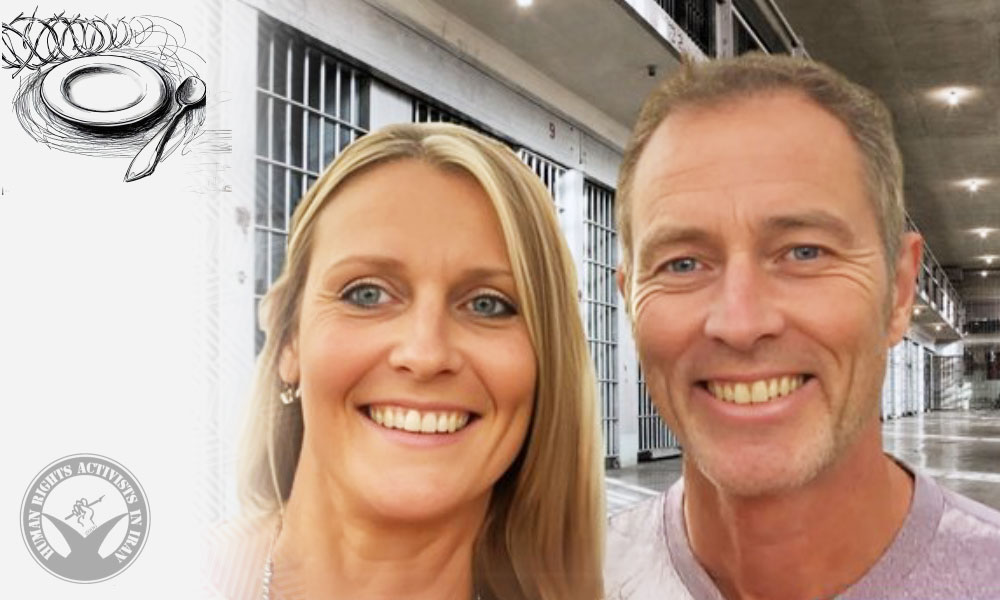
Latest Statistics on Casualties and Human Losses So Far
Since the beginning of Israel’s attacks on Iran, hundreds of military and civilian citizens have been killed or injured. The military or civilian status of a significant number of the casualties mentioned in this report is still under investigation.
The spokesperson for the Ministry of Health announced that since the onset of the military conflict between Iran and Israel, more than 2,500 of the wounded have been admitted to public and university hospitals. According to Hossein Kermanpour, of this number, about 1,600 have received outpatient treatment, and nearly 500 remain hospitalized. Additionally, 380 specialized surgeries have been performed on the injured so far.
This official did not comment on the number of fatalities or whether the deceased were military or civilian.
The statistics provided by HRANA, based on its network of volunteers and other non-governmental groups, show slight differences due to updates from newly received documents related to casualties in recent days, as well as the inclusion of yesterday’s two military deaths in the city of Abhar, Zanjan Province. The breakdown is as follows:
Total Fatalities: 657 Total Injuries: 2,037 Total Human Casualties: 2,694
During one week of Israeli military attacks on different regions of Iran, children — as one of the most vulnerable groups in society — have suffered extensive harm. Local sources and hospital reports indicate that a number of children have lost their lives due to the bombing of residential areas, seizures caused by fear, or injuries from collapsing debris. Some children, suffering from severe anxiety triggered by the repeated sounds of explosions, experienced seizures and died due to the lack of immediate medical care.
On the first day of the attacks, the Islamic Republic of Iran Broadcasting’s news network announced that dozens of people in Tehran, including 35 women and children, had been injured following the Israeli strikes.
On Monday, June 16 (26 Khordad), the government spokesperson stated that in the first four days of Israeli army attacks, 153 women and children had been injured and 58 had been killed. According to him, among the fatalities was a pregnant woman who died along with her seven-month-old fetus.
Some state-run newspapers, referring to the psychological toll of war on children, reported instances of infants and children dying from seizures and severe injuries in medical centers. According to these reports, infants transferred to hospitals showed no vital signs, and some died after several days due to the severity of their injuries. However, these reports did not provide precise statistics on the number of child casualties and injuries over the past week.
While many areas are facing shortages of medicine, power outages, and an overwhelmed healthcare system, children have been deprived of even basic medical and psychological support. School closures, loss of parents or family members, and lack of safe shelters have created a critical psychological situation for many children.
yesterday, images and videos circulated on social media showing the evacuation of the “Ameneh Infant Care Center” by Welfare Organization staff and the transfer of infants and children to another location. This operation took place on June 16 (26 Khordad) following an Israeli military warning to evacuate Tehran’s District 3.
These events once again highlight the urgent need for the international community to address the humanitarian dimensions of the conflict and to protect children during wartime.
The table below contains the verified identities of some of the children who have been injured or killed in recent attacks. Further information and identification of affected children are still under investigation.
Province
City
Date
Killed
Injured
Age
Identity
Neighborhood / Location
1
Tehran
Tehran
Friday, June 13
1
–
12 years old
Amirali Amini
Mahallati Street
2
Tehran
Tehran
Friday, June 13
1
–
16 years old
Parham Abbasi
Sattarkhan neighborhood
3
Unspecified
Unspecified
Unspecified (between June 13–14)
–
1
2 years old
–
–
4
Tehran
Tehran
Friday, June 13
1
–
10 years old
Mahya (Mahia) Nikzad
–
5
Tehran
Tehran
Unspecified (between June 13–14)
1
–
–
Heida Zeinali
–
6
Tehran
Tehran
Unspecified (between June 13–14)
1
–
–
Ayma Zeinali
–
7
Tehran
Tehran
Friday, June 13
1
–
9 years old
Baran Eshraghi
–
8
Tehran
Tehran
Friday, June 13
1
0
5 years old
Fatemeh Zakarian
–
9
Tehran
Tehran
Friday, June 13
1
–
7 months old
Zahra Zakarian
–
10
Tehran
Tehran
Unspecified (between June 13–14)
1
–
11 years old
Soheil Katouli
–
11
Tehran
Tehran
Saturday, June 14
1
–
17 years old
Seyed Hamidreza Sedighi Saber
Sattarkhan neighborhood
12
Unspecified
Unspecified
Unspecified (between June 13–16)
1
–
3 years old
–
–
13
Tehran
Tehran
Unspecified (between June 13–16)
1
–
8 years old
Tara Haji Miri
Patrice Lumumba Street
14
Isfahan
Najafabad
Wednesday, June 17
1
–
13 years old
–
–
15
Isfahan
Najafabad
Wednesday, June 17
1
–
10 years old
–
–
16
Tehran
Tehran
Friday, June 13
1
–
12 years old
Motahareh Niyazmand
Chamran Residential Complex
17
Tehran
Tehran
Friday, June 13
1
–
11 years old
Mohaddeseh Aghdasi
Chamran Residential Complex
18
Tehran
Tehran
Friday, June 13
1
–
9 years old
Mohammadreza Aghdasi
Chamran Residential Complex
19
Tehran
Tehran
Friday, June 13
1
–
13 years old
Mersana Bahrami
Chamran Residential Complex
20
Unspecified
Unspecified
Friday, June 13
1
–
8 years old
Mohammad Hossein Khaki
Chamran Residential Complex
21
Tehran
Tehran
Friday, June 13
1
–
10 years old
Fatemeh Niyazmand
Chamran Residential Complex
22
Tehran
Tehran
Friday, June 13
1
–
12 years old
Alireza Niyazmand
Chamran Residential Complex
23
Tehran
Tehran
Friday, June 13
1
–
9 years old
Zahra Bahman Abadi
Chamran Residential Complex
24
Tehran
Tehran
Friday, June 13
1
–
5 years old
Hanieh Bahman Abadi
Chamran Residential Complex
25
Tehran
Tehran
Friday, June 13
1
–
2 years old
Mohammad Ali Bahman Abadi
Chamran Residential Complex
The Shadow of War Over Daily Life: From Collapsed Services to People’s Desperation
As the unrest enters its seventh day, the civilian aspects of Israel’s military attacks on Iran have become increasingly apparent. Now, not only the targeted areas but vast regions of the country are suffering from the cascading effects of the crisis, including shortages of essential goods, disruptions to urban services, and abandonment of vulnerable groups. Field reports and citizen accounts received by HRANA paint a worrying picture of a growing humanitarian disaster and the inability of support structures to respond effectively.
Financial Crisis Amid War: Banks Unable to Operate
With the expansion of the conflict, disruptions in banking services and a shortage of cash have become serious challenges for citizens. Many bank branches have imposed a cash withdrawal limit of one million tomans (about $20 USD), which is insufficient for basic family expenses. Numerous ATMs are empty, and the inability to make online purchases has made it difficult for citizens to acquire essential goods. Simultaneously, cyberattacks on banking systems — especially on Sepah Bank and Pasargad Bank — have caused widespread financial paralysis and confusion.
Many citizens, needing cash to cover basic necessities or to leave affected cities, have been unable to access funds, compounding their hardships.
Transportation Collapses; Travel Costs Skyrocket
Public transportation in many affected areas has nearly shut down. Intercity travel has sharply declined due to a shortage of vehicles and skyrocketing fares, making travel impossible for many. According to one Tehran resident, the cost for a family of three to travel to Gilan province has reached eight million tomans — far beyond what most families can afford.
Abandoned in Crisis: The Isolation of the Elderly, the Sick, and the Disabled
In wartime conditions, the elderly, the sick, and people with disabilities have been left isolated. Numerous messages indicate that many of these individuals remain alone and unattended in their homes. Healthcare services face shortages of essential medications and disruptions in the treatment of chronic diseases, endangering the lives of thousands.
Intensified Livelihood Pressure: Rationing, Queues, and Rising Prices
As supply chains break down, stores face empty shelves, closures, or rationing of essential goods. Reports mention the rationing of items such as sanitary products, bread shortages, and street disputes over food. At the same time, prices of essential goods have doubled on average in less than a week.
Forced Labor Under Fire: No Protection for Workers
Despite security warnings and evacuation orders, some workshops and factories in high-risk areas continue operations. Workers, without legal protection and directly exposed to attacks, are forced to keep working. Field reports indicate that even during the early hours of bombardment, mandatory shifts were not canceled.
Afghan Migrants: On the Margins of Danger and Defenseless
Afghan migrants living in Iran are experiencing even harsher conditions. In addition to the direct threat of war, some face accusations such as espionage or denial of access to shelters and emergency aid. This situation has placed them in a double bind of discrimination and vulnerability.
Abandoned in Ruins: Pets, the Silent Victims
The lack of support infrastructure has made caring for pets extremely difficult under crisis conditions. Many citizens have been forced to abandon their animals or remain in unsafe areas because they are unable to transport them. This adds emotional and practical burdens to pet owners.
Conscripts: The Silent Forces on the Frontlines
Conscripts, who often have no operational responsibilities, have been forcibly kept at high-risk military sites during the war. Reports indicate a reduction in professional military staff at some bases and an increase in mandatory shifts for conscripts. Some conscripts have been killed in recent attacks, but official media have refrained from reporting their names or statuses.
Cut Off from the World: Communication Isolation and Family Anxiety
Internet outages and communication restrictions, especially in central regions, have completely severed family contacts with loved ones abroad. Families with members living in Europe, Canada, or neighboring countries are left in total uncertainty and anxiety.
Official Silence Amid Threats: No Guidance on Safety or Contamination Risks
State media continue to focus on military and propaganda activities without providing safety instructions or guidance for citizens. While global concerns grow over potential nuclear contamination, residents near sensitive facilities have been left without any training or official information, relying solely on social media and stressful personal communications.
Israeli Attacks on Iranian Civilian Infrastructure
In the first two days of Israeli attacks on various parts of Iran, numerous civilian, industrial, and medical facilities were targeted. In Tehran, one projectile struck the exterior of Hakim Children’s Hospital, which, according to the Deputy Director of the University of Medical Sciences, resulted in no casualties. In Ilam, the Musian Fire Department building was hit, and in Borujerd, the Farda Motors automobile factory was targeted, leading to massive fires and casualties. In Qazvin, the Alborz Industrial Park was struck, while in Tabriz, areas near the petrochemical facility were bombed. Explosions were also reported in Ashtianan (Lorestan province) and parts of Kermanshah.
In Bushehr, an Israeli drone targeted the Fajr Jam Refinery, which processes gas from the South Pars gas field — marking the first attack on Iran’s energy infrastructure during this conflict. Simultaneously, defensive and military activities were reported in cities such as Tabriz, Malard, southern and central Tehran, Pasteur, Chaldoran, Ahvaz, Urmia, Bukan, Bandar Abbas, Naqadeh, Shahroud, Isfahan, Maragheh, Ouramanat, Javanrud, Mashhad, Ravansar, and Shahr-e Rey (Fadaiyan-e Islam district).
The attacks on Iran’s civilian areas continued into the third day, Sunday, June 15 (25 Khordad), damaging civilian infrastructure in Tehran, Isfahan, Shiraz, Mashhad, Kermanshah, Kordan, Garmdareh, Baharestan, Bagher Shahr, and Kahrizak. Among the damaged targets were oil depots in Shahran, western and southern Tehran, MAPNA factory, SAIRAN, KAICO Kermanshah Company, Mashhad Airport, student dormitories in Keshavarz Square, various energy facilities, and one building associated with the Ministry of Foreign Affairs.
In Tehran, the most severe damage and defensive clashes were reported in neighborhoods such as Niavaran, Tehranpars, Mirdamad, Pasteur, Ekbatan, Saadatabad, Farmanieh, Shahran, and many others.
On Monday, June 16 (26 Khordad), the fourth consecutive day of conflict, Israeli attacks again targeted several civilian infrastructures. On this day, air defense engagements were reported in Bushehr, Qeshm, Bandar Abbas, Dehloran, Natanz, Tehran, Sanandaj, Tabriz, Kermanshah, Ahvaz, Bandar Anzali, Bostan Abad, Marand, and Malayer. Tehran experienced the highest number of attacks among all affected provinces. In and around Tehran, targeted areas included Khalazir village, Shahrak-e Gharb, Bidganeh, Vavan, Bagheri, Olympic Village, Mehrabad Airport vicinity, Azadi Square, Tehranpars, and the IRIB (state broadcaster) building.
On the fifth day, civilian and infrastructure targets in Tehran, Kashan, Tabriz, Nazarabad, Zarandieh, Khomein, Qazvin, Najafabad, Ardestan, Shahin Shahr, and Naein were hit. Targets included the IRIB building in Tehran, the Nazarabad Industrial Park, and Zaviyeh Industrial Park, as well as civilian areas such as Piroozi Street, Majidieh, Andarzgoo, Sablon Square, Velenjak, Pasdaran, Elahiyeh in Tehran, and Velayat town in Qazvin.
On the sixth day, civilian and infrastructure targets in Tehran, Ilam, Fardis, Karaj, Shahr-e Qods, Chalous, Tabriz, Shahroud, Zanjan, Qazvin, Abhar, and Shahriar were attacked. Damaged sites included the Parsian Resources Research Center in Zanjan, Tehran Nuclear Research Center, Ilam Petrochemical Complex, airports in Kermanshah, Tabriz, and Karaj, fuel storage facilities in Alborz province, and the TESA centrifuge production facility in Karaj.
In Tehran, numerous neighborhoods and areas were hit, including Piroozi, Sabalan, Sayad, Punak, Garmdareh, Bagheri Highway, District 18, Damavand Street, Lavasan Road, Aghdasieh, Jordan, Kurdistan Highway, Vanak, Kavoosieh, Nobonyad, Seoul Street, District 22, Chitgar, Shahran, Phases 2 and 8 of Pardis, Sadr Highway, Babayi Highway, Tehranpars, Afsariyeh, Simon Bolivar, and Lavizan.
yesterday, Thursday, June 19 (29 Khordad), marks the seventh consecutive day of military conflict between Iran and Israel. Civilian targets were again hit in cities including Tehran, Isfahan, Shiraz, Kermanshah, and Kerman. Notably, yesterday’s strikes damaged the Khondab Heavy Water Reactor, the Arak plutonium production facility, and the Natanz nuclear site.
Methodological Note: The classification of targeted locations in this report as “military” or “civilian” is based on publicly available information, visible indicators, and testimonies from local residents. A definitive determination of the nature of these sites requires further verification through official documents, satellite imagery, and comprehensive analysis, which are currently not accessible. Therefore, this categorization is provisional and intended to provide an initial overview rather than a conclusive judgment about the nature of the targets.
Israeli Attacks on Iran’s Military Infrastructure
Over the past week, alongside civilian areas, numerous military infrastructures in Iran have been targeted by the Israeli army. In the first two days, military infrastructures in various cities were struck, including Tabriz, Malard, southern and central areas of Tehran, Pasteur neighborhood in Tehran, Chaldoran, the airspace near Ahvaz Steel Industries, Urmia, Bukan, Bandar Abbas, Naqadeh, Shahroud, Isfahan, Maragheh, the Ouramanat region, Javanrud, Mashhad, Ravansar, Malard, and Fadaiyan-e Islam district in Shahr-e Rey. Attacks were also reported on military bases and facilities such as the 2nd Tactical Air Base in Tabriz, Imam Ali Garrison in Khorramabad, the IRGC missile booster parts factory in Shamsabad (Tabriz), Imam Hassan Garrison in Mahidasht, the Isfahan nuclear site, and the Natanz nuclear facility.
On the third day of the conflict, Israeli forces targeted the Ministry of Defense, the Organization for Defense Innovation and Research, IRGC bases, missile storage and launch sites in western Iran, the Garmdareh radar site, a facility affiliated with the Ministry of Defense, the Tehran police headquarters, and the Bidganeh missile site.
On Monday, June 16 (26 Khordad), the fourth day of Israeli attacks, military targets included IRGC missile depots in Faraman and Dowlatabad (Kermanshah province), Fatemeh Masoumeh Air Defense, Mostafa Khomeini Garrison and Qiam Kushk Nosrat Pilot Training Garrison in Qom, an air defense site in Andimeshk, IRGC garrisons in Zanjan, Sardroud, and Marivan, the Alvand Khomein missile site, and a military garrison in western Tehran.
On the fifth day of the military conflict between Iran and Israel, targets included a checkpoint in the Kashan area, Hashemtiyeh Garrison, Al-Zahra Garrison in Tabriz, IRGC Quds Garrison in Shahin Shahr, an ammunition depot and Ayat Base in Vilashahr, Hashem Abad Air Defense in Naein, another ammunition depot in Ekhtiyariabad, and the 15 Khordad Garrison in Isfahan.
Yesterday, on the sixth day of the war, military sites attacked included Janbazorgi Garrison in Shahr-e Rey, a missile ammunition depot in Sorkheh Hesar (Tehran), garrisons in Parand, the Bidganeh complex in Malard, military facilities in Parchin, Imam Hossein University affiliated with the IRGC, Zeyn al-Din Garrison in Abhar, the IRGC garrison at Darvazeh Ghoran (Tehran), Imam Hassan Garrison, several other military bases in Kermanshah, the Law Enforcement Command headquarters near Vanak Square, the Sarallah IRGC headquarters, and the Meisami Base in Karaj.
The spokesperson for the Israeli army announced that last night, 40 of the country’s fighter jets targeted several areas in Iran with more than 100 munitions.
yesterday, Thursday, June 19 (29 Khordad), on the seventh day of the military conflict, southern heights of Shiraz, including Soltanabad and the IRGC garrison, the 84th Army Garrison in Badrabad (Lorestan), and the Special Forces Police Unit headquarters in Tehran were attacked. Other military centers in Isfahan, Shiraz, Kerman, and Kermanshah were also among yesterday’s military targets.
Communications Disruptions and Cyberattacks
From the very first day of Israel’s military attacks on Iran, internet disruptions have been reported across the country. Users from various regions reported severe slowness and an inability to access Cloudflare-based services. The situation worsened in subsequent days.
Yesterday morning, Bank Sepah’s infrastructure was targeted by a cyberattack, knocking the bank’s online services offline. The IRGC-affiliated Fars News Agency confirmed the attack and stated that fuel stations dependent on Bank Sepah’s systems might also experience outages.
In recent days, some citizens told HRANA they received suspicious text messages containing unknown links, suspected to be designed for espionage or cyber infiltration purposes.
Last night, IRIB (state broadcaster) live programming was briefly disrupted. The broadcaster’s public relations office confirmed that this was due to a cyberattack attributed to Israel.
That same night, the monitoring group NetBlocks announced that real-time data showed Iran’s national internet had been almost entirely shut down. The blackout was nationwide, effectively cutting off access to the global internet for users across the country.
In an official statement, the Ministry of Information and Communications Technology acknowledged the restrictions, claiming they were implemented to prevent Israel from exploiting Iran’s communications network for military purposes.
As of this morning, NetBlocks reported that Iran had experienced a full 24-hour internet blackout, describing it as the most severe communication disruption since the November 2019 protests.
Ongoing airstrikes and the prevailing security situation have forced the closure of Tehran’s Grand Bazaar, with many shop owners refusing to reopen their businesses.
Crackdown on Citizens
yesterday, state media reported the arrest of 30 individuals for activities in cyberspace. This includes 16 people in Lorestan, 8 in Yazd, 5 in Kerman (including one woman), 2 in Mahabad, 8 in Aliabad Katoul, 1 in Behbahan, 3 in Ardestan, Hassan Bagherinia (former faculty member of Hakim Sabzevari University) and his wife in Mashhad, and also Toomaj Salehi in Kish.
Including these latest arrests, the total number of citizens detained over online activity and publishing content related to Israel’s attacks on Iran over the past six days has reached 206.
Security Arrests
yesterday, Iran’s state broadcaster (IRIB) reported the arrest of a group of individuals in Yasuj described as “an organized network.” No details were provided about the identity or exact number of detainees.
The spokesperson for Iran’s law enforcement (FARAJA) announced that yesterday in western Tehran, a man transporting a large number of microdrones in his pickup truck was arrested. He also stated that an individual in Ashkhaneh, who had been photographing a wheat silo, flour factory, and other sensitive sites, was detained by the Intelligence Police of North Khorasan province.
Simultaneously, the police commander of Robat Karim reported the arrest of two individuals who, according to him, were photographing industrial complexes for Israel with the intention of causing harm.
The IRGC Intelligence Unit of Chaharmahal and Bakhtiari province also announced the identification and arrest of a team involved with microdrones.
The Ministry of Intelligence further announced the discovery of an arms shipment linked to opposition groups in Kurdistan and the arrest of one of their members.
On the seventh day of the unrest, the commander of West Tehran’s law enforcement declared that 24 people had been arrested on charges of espionage and targeted activities against the regime both in real life and online.
International Humanitarian Law (IHL) Analysis
On the seventh day of the international armed conflict between Iran and Israel, growing concerns have been raised about escalating violations of fundamental principles of international humanitarian law. According to Article 51 of Additional Protocol I to the Geneva Conventions, the parties are obligated to distinguish between military objectives and the civilian population. However, reports of at least ten children killed in a residential building attack and the death of a worker at a horse stable suggest possible indiscriminate and disproportionate attacks.
Repeated targeting of sites with no clear military value not only challenges the principles of proportionality and precaution but directly violates the absolute prohibition against direct attacks on civilians, as stipulated in Article 48 of the same Protocol. Moreover, under Article 57, even if a military objective is located near civilian areas, parties are required to take all feasible precautions to minimize harm to civilians, including effective advance warnings before attacks — measures which often appear to have been neglected.
HRA reaffirmed its commitment to documentation, legal analysis, and accountability in accordance with international humanitarian law, warning that continued indiscriminate attacks may constitute war crimes.
International Reactions to Israel’s Attacks on Iran: Global Consensus on Restraint and Concerns Over Escalation
Following Israel’s extensive attacks on Iranian territory, numerous governments and international bodies issued statements. Most condemned the attacks or expressed serious concern over the escalation, emphasizing the need for restraint, a return to diplomacy, and preservation of regional security.
Countries such as Iraq, Turkey, Pakistan, Afghanistan, Armenia, Lebanon, Saudi Arabia, the UAE, Qatar, Kuwait, Bahrain, China, Russia, Japan, Brazil, as well as the United Nations, the Economic Cooperation Organization (ECO), 21 Arab and Islamic countries including Algeria, Chad, Comoros, Djibouti, Egypt, Gambia, Mauritania, Somalia, Sudan, and the International Atomic Energy Agency (IAEA) have either explicitly condemned Israel’s attacks or warned of their consequences.
Many of these states, while reaffirming national sovereignty, called for an immediate end to the conflict and the protection of civilians. In Latin America, countries like Venezuela, Cuba, Nicaragua, Chile, and Bolivia expressed similar positions.
Overall, despite some variation in individual responses, there is a broad international consensus about the danger of further escalation and the need for restraint.
Emphasis on Compliance with Obligations
As the field consequences of the attacks expand, damage to civilian infrastructure and disruptions in emergency and medical services have worsened. These developments further underline the critical importance of adhering strictly to the principles of precaution, proportionality, and distinction in targeting.
International organizations and human rights defenders have reiterated the call for safe and unhindered access to emergency aid and protection of the civilian population. At the same time, the continued indiscriminate attacks without regard for civilians’ locations present a serious challenge to the legitimacy of the military actions by both sides.
The Human Rights Activists in Iran (HRA), while continuing to monitor developments, has stressed the need for independent investigations, precise documentation of suspected violations, and legal accountability of all parties under international humanitarian law.
Visual documentation from the past week’s attacks, as well as yesterday’s assaults, follows:
Arak Heavy Water Facility
Near the Red Crescent Building – Tehran
Welfare Organization – Qasr-e Shirin
Payam Airport – Karaj
Residential Areas – Tehran
Farabi Hospital – Kermanshah
IRIB (State Broadcaster) Building
Tehran
Ministry of Justice Building – Tehran
Near the Red Crescent Building – Tehran
Destruction of Residential Homes
in Narmak – Tehran
The Islamic Revolutionary Guard Corps (IRGC) Intelligence Organization announced the arrest of 12 individuals across six provinces in Iran, according to Mehr News Agency. The organization claims these individuals were planning to carry out “anti-security actions.”
In a statement, the IRGC’s public relations office alleged, “A network of 12 individuals collaborating with Israel, who intended to conduct anti-security activities in Iran,” was identified and detained by IRGC intelligence forces across the country.
The statement did not provide details on the identities or whereabouts of the detainees.