
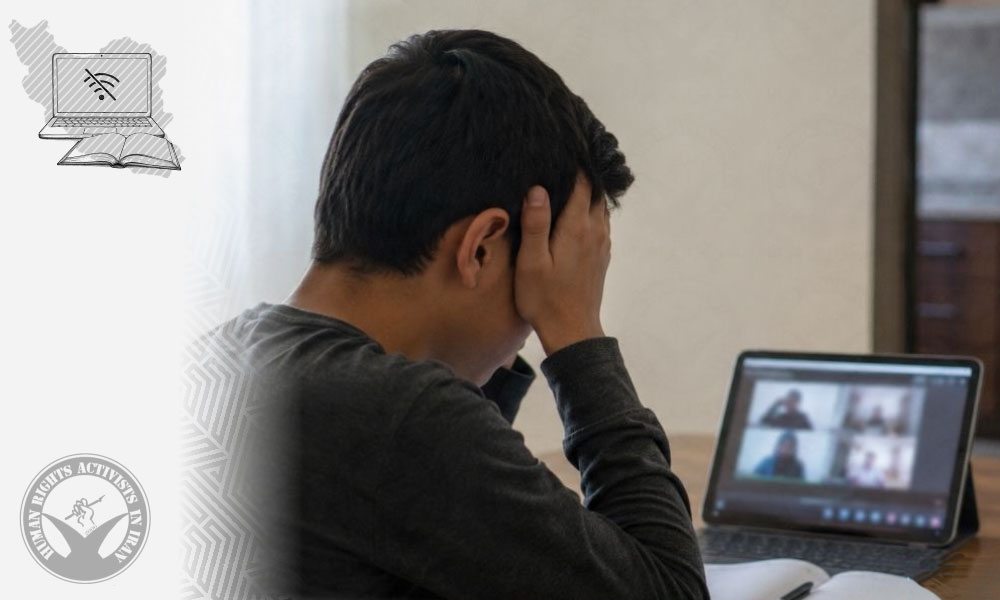
A Report on the Poor Quality of Virtual Education and Deprivation of Access to Learning

HRANA – While virtual education was initially intended as a temporary solution to allow students to continue their studies during the wartime crisis, many families and teachers now say that rather than serving as a sustainable substitute for in-person schooling, it has led to a severe decline in the quality of education.

The following report, prepared by HRANA based on interviews with students’ families, teachers, school administrators, and education experts, examines the deepening crisis of remote education in Iran. The report explores how widespread internet disruptions, inadequate educational infrastructure, limited access to digital equipment, mounting economic pressure on families, and the absence of coherent planning for an uncertain future have severely undermined access to effective education across the country.

Many of the individuals interviewed by HRANA say that education in recent months has effectively been left adrift amid internet outages, unstable educational platforms, and contradictory decisions by officials. According to them, this situation has not only reduced the quality of learning but has also raised serious concerns about students’ educational future.

After schools were closed due to wartime conditions, education initially continued through an application called Shad. However, widespread disruptions in the platform forced many schools to move classes to another application called Rubika, a platform which, according to families and teachers, also suffers from numerous problems. Many students say that online classes either fail to open altogether or experience constant interruptions in audio and video during sessions. Some educational files fail to upload, and in certain cases, even sending a simple video or audio file can take hours.

It is around 10 a.m., and a science class at a middle school has just begun, but the teacher’s voice keeps cutting in and out. Several students repeatedly write in the class group chat: “We can’t hear anything,” “The image isn’t loading,” “The file won’t open.” A few minutes later, the class becomes inaccessible, and attempts to reconnect begin again. One parent says this happens almost every day.

She says:

“Some days, the children spend more time clicking the refresh button than actually studying, just hoping the class will reconnect. In the end, the class is left unfinished because either the teacher gets exhausted or the internet cuts out.”

The mother of an elementary school student says her child has effectively lost concentration and connection with schoolwork:

“Most of the class time, the children are saying things like ‘Ma’am, the sound cut out’ or ‘The image isn’t loading.’ Sometimes the class doesn’t open at all. In the end, half the lesson remains unfinished.”

She says many families have been forced to increase spending on internet access and mobile phones so their children can attend classes, yet despite this, the quality of education remains poor.

In some areas, the problem is not limited to software disruptions; restricted or weak internet access has also caused some students to effectively fall behind in the educational process. A high school teacher says some of her students can only join classes using their parents’ mobile phones, and if the parents are at work, those students are effectively deprived of attending class that day.

She says:

“We send files, but many students either don’t have suitable internet access or can’t open the files at all. Some only mark their attendance and then leave the class completely because the phone doesn’t belong to them.”

According to her, virtual education in recent weeks has become more like attendance registration than real learning:

“Sometimes at the end of class I ask the students if they understood anything. They stay silent. Some of them don’t even know what the teacher taught because half the class was disconnected.”

In some households, several students are forced to share a single mobile phone in order to attend classes. Some parents also say that due to economic hardship, they cannot afford suitable phones or reliable internet access, placing additional pressure on students.

The father of one student in southern Tehran says:

“We have three school-age children, but only one relatively functional phone at home. When their classes are held at the same time, one or two of them are effectively deprived of attending lessons.”

In some areas, power outages have further compounded the problems of online education. Families say there have been many instances where students were disconnected from online classes or exams due to electricity cuts and internet shutdowns.

An eleventh-grade student says:

“Sometimes it takes half an hour just to enter the class. And when we finally connect, the teacher says there’s no time and rushes through the lesson. In the end, we don’t understand anything.”

At the same time, amid the ongoing disruptions, some schools attempted to hold limited in-person classes to compensate for students’ academic decline. However, according to families, these decisions were also accompanied by confusion and contradictory restrictions.

Several families say that during meetings, schools asked parents to provide written consent for remedial classes to be held outside the formal school environment, since the Ministry of Education had not authorized in-person classes inside schools.

One parent of an elementary school student says that during one of these meetings, it was suggested that classes be held at the local mosque or that families collectively rent a location for lessons.

She says:

“They asked us to let the children attend classes twice a week for two hours each time so they wouldn’t fall too far behind in their studies, but many families opposed the idea.”

According to her, families’ concerns are not limited to education alone; wartime conditions and insecurity have also made many unwilling to send their children to locations outside school premises.

“Some families said they would not allow their children to attend classes in mosques or unspecified places. Everyone is afraid of the situation. Private homes are also completely unsuitable for holding classes for such a large number of students.”

Following these disagreements, some schools, with the agreement of a number of parents, decided to hold limited classes at centers run by the Institute for the Intellectual Development of Children and Young Adults. However, these classes were also suspended after only a few sessions.

One teacher at a girls’ school in Tehran says that schools were later informed that no in-person classes should be held anywhere:

“We were told that under no circumstances were we allowed to hold in-person classes, neither inside the school nor anywhere else. They emphasized that education must remain entirely virtual.”

Some teachers say that even school principals often do not know exactly which directives are supposed to be implemented. Circulars change constantly, and decisions are sometimes completely reversed within just a few days.

One administrator at a private school says:

“One day they tell us to hold limited in-person classes, and two days later they call and tell us to cancel them immediately. Neither the families nor the schools know what they’re supposed to do.”

At the same time, some teachers report educational pressure and unofficial directives aimed at ensuring all students pass to the next grade, a development that has further deepened concerns about declining educational standards.

One high school teacher, who asked not to be named, says schools have recently been instructed that students at all grade levels must be promoted, even if their academic performance is weak.

She says:

“Some teachers were told that if a student fails, the teacher themselves would have to hold remedial summer classes until the student passes. In practice, it means no one is supposed to fail.”

According to her, under such conditions, assessing students’ actual learning has become nearly impossible:

“When a student hasn’t had proper classes, real exams, or full access to education, how can anyone know what level they’re really at? But in the end, we’re still expected to pass everyone.”

Some families say their children have lost motivation to study in recent months. The mother of a ninth-grade student says her son spends hours in front of a mobile phone but ultimately learns very little from class:

“At the end of the night, when I ask him what he learned today, he says, ‘Nothing, the internet kept disconnecting and the teacher couldn’t teach.’”

Another parent says:

“Children used to have school, recess, friends, and teachers. Now their entire school has turned into a mobile phone screen that constantly freezes.”

Educational experts have warned for years about the consequences of unstable education, but families say their concern today is not merely declining grades, but the deterioration of real learning quality. According to them, many students are advancing to higher grades without properly learning foundational concepts.

One elementary school teacher says some of her students are now struggling even with reading and writing, yet will likely still be promoted to the next grade:

“A child who still hasn’t fully learned this year’s lessons is going to move up to the next grade. This problem isn’t just about this year, its effects may only become visible years later.”

Some psychologists and education activists have also warned about the psychological consequences of the current situation. They say the combination of insecurity, prolonged isolation, unstable education, and economic pressure could have long-term effects on students’ concentration, motivation, and mental health.

One educational counselor in Tehran says:

“We’re not only facing academic decline. Some students have developed feelings of exhaustion, hopelessness, and constant anxiety. For some children, school no longer has the meaning it once did.”

While officials describe the continuation of virtual education as a solution for overcoming the crisis, many families and teachers say what is actually taking place is more a form of minimum crisis management than real education. Students whose classes are disrupted by internet outages, interrupted audio and video, unopened files, and contradictory educational decisions are now expected to advance to higher grades without proper evaluation.

For many families, the concern is not simply falling behind in a few subjects. They say the real issue is a generation of students who, during one of the most important periods of their education, have lost access to regular and effective learning, a generation that now experiences school mainly through a mobile phone screen; a screen on which classes sometimes fail to load, the teacher’s voice cuts out, and in the end, the only thing left from a school day is a recorded attendance mark.

At night, in many homes, students still try to download files sent by teachers or watch videos that fail to load. Some parents sit beside their children in hopes that an online class might finally proceed without interruption, while others simply hope the school year ends as soon as possible.

Overall, at a time when the country’s formal education system remains caught between closures, virtual learning, and bans on in-person classes, many students are experiencing not education itself, but a state of educational uncertainty, an uncertainty whose real consequences may only become clear years from now.
Teachers’ Association Sounds Call to General Strike on October 14th & 15th

Human Rights Activists News Agency (HRANA)- The Coordinating Council of Teachers Syndicates in Iran (CCTSI) has issued a statement critical of the Ministry of Education, drawing public attention to a trend of paltry compensation for teachers.

The statement calls for teachers and other pedagogical staff to stage sit-ins in the administrative offices of schools this coming October 14th and October 15th [the work week in Iran runs from Saturday to Thursday]. It also asks teachers to sensitize students by explaining to them in advance the civic impetus behind the sit-ins to come.

The full text of their letter, translated into English by HRANA, is below:

Dear Iranian teachers,
Cherished students,
Esteemed parents,

Teachers both active and retired have been scraping by on painfully low wages for years. They protest cuts to school budget allocations and the unconstitutional shift of educational duties from the shoulders of schools to the shoulders of the people. Teachers have stood their ground in civic and community actions [on behalf of concerns] that officials never deign to acknowledge. No, it seems they are preoccupied with staying in power, defensively clutching their spoils. They think only of their own interests, those of their small inner circle, and those of some citizens in other countries.

Out-of-control inflation and climbing prices have gripped the country, and the purchasing power of teachers, like that of many other hard-working classes, has fallen significantly. What’s more, the cost of education is on the rise, and the Iranian government and parliament have failed to answer to teachers’ faltering quality of life and the ailing education system. The time has come for us to protest this systemic disorder.

All have come to feel that the Ministry of Education, as the face and custodian of this system encompassing millions of people, is without a practical program or vision for improving our educational infrastructure. Instead of attending to the quality of formation and to teachers’ livelihoods, the ministry opts increasingly for monetizing education and impoverishing teachers.

The Public Service Law, which was passed in 2007, has yet to be implemented 10 years later.

The bill on teacher ranking is postponed month after month.
The Teachers’ Savings Fund has been looted, and according to the Fund’s inquiry committee, 18 million tomans [approximately $1,200 USD] is missing from each teacher’s share.

Teacher’s salaries have not kept up with the rate of inflation, and in practice, a majority of teachers live below the poverty line. At the same time, there are fewer and fewer public schools, and those still in operation [depend on separate funding] to run.

The security apparatus and judiciary, rather than pursuing those responsible for corruption and the robbery of our society, prefer to threaten, exile, fire, and imprison teachers who express their needs and pursue justice.

On behalf of workers in the education system both active and retired, CCTSI has exhausted available paths for bettering our current conditions. Teachers have voiced their demands in meetings and letters to officials, published them in statements, launched them as campaigns, and hosted syndical rallies for them. But the regime and the government refuse to take even a single step towards addressing those issues.

Honorable People of Iran,
Imprudent Iranian officials,

We are going to stage sit-ins because teachers can’t go to class in these conditions. In any case, classes held in makeshift camps, overcrowded to the extreme, can hardly be put to any use.

For the reasons discussed above and the many others we have voiced before, CCTSI calls on educational staff of all levels across the country to stage sit-ins in the offices of their schools on Sunday, October 14 and Monday, October 15. We ask that they refuse to go to classes and that they raise students awareness on the factors compelling this initiative.

We ask the school principals to join in and to refrain from harsh treatment of our colleagues. We warn security offices and institutions not to retaliate against the teachers taking part in demonstrations. We have tasted detention and incarcerations, and some of our brave colleagues are still in chains today. We ask that you lay down your weapons of repression.

This October sit-ins are only the beginning: if we don’t see swift, constructive, and concrete changes to the pay slips of active and retired educational employees, and to per-capita funding of students, we will escalate our general strikes come November.

We ask our retired comrades to come visit their local colleagues carrying a flower. Employed colleagues who are off on [the strike days] must also join in, at a school close to their home or in the school where they work.
Teachers believe in the common right to a dignified life, and in access to free, fair, and quality education for all children.

The Coordinating Council of Teachers Syndicates in Iran
October 10th, 2018

Blackballed Baha’is: 40 and Counting

Human Rights Activists News Agency (HHRANA) – HRANA has so far confirmed the names of at least 40 Baha’i Iranian citizens who have been denied the opportunity to enroll in university despite successfully placing on the competitive national admissions test.

HRANA has confirmed that the candidate files of Nima Amini, Hanan Hashemi Dehaj, Hasti Maleki, Aria Ehsani, Tina Hamidi Fard from Tehran (ranked #15000 on the national exam) and Rozhan Khooniki (ranked #9477) have all been flagged “deficiency on file” on the National Organization for Educational Testing website. HRANA previously reported the names of 34 other students singled out by the same system.

The “deficiency on file” flag is one known method of the wider anti-Baha’i discrimination politics administered by Iran’s Supreme Council of the Cultural Revolution. An informed source confirmed to HRANA that the flag is a go-to excuse to prevent Baha’i students from entering institutes of higher education.

Baha’i College Student Stopped Short of Degree

Human Rights Activists News Agency (HRAN)- Baha’i student Shaghayegh Zabihi Amrie was finishing the last semester of her associate’s degree in architectural drafting when the *National Organization for Educational Testing (NOET) stopped her short.

An informed source told HRANA that Amrie’s problems began with a summons to the Azad University Security Office, where she was drilled with questions about her faith. After placing a call to the director of Rasam Non-Profit University of Karaj on the western outskirts of Tehran, where Amrie was a student, authorities had little information with which to push forward and cleared her to continue her studies.

“When she applied to obtain her certificate of completion,” the source related, “she received a letter from NOET informing her that getting her certificate, and advancing further in her bachelor’s studies, would be prohibited.”

While many Baha’i students find themselves held back from ever pursuing post-secondary studies, some are admitted into institutions of higher education only to be blackballed later, per previous HRANA reports.

The highly-anticipated announcement of results from the National University Entrance Exam, known as “Konkur,” has been marred for many Baha’is who, with passing results and on the brink of starting college, are rendered ineligible by the NOET error message “deficiency on file,” a well-known pretext for quashing young Baha’i ambitions the moment they take shape.

The process has been utilized for years, and with a look at this year’s numbers, looks nowhere near abating. This year alone, HRANA has reported on at least 40 prospective college students who have been barred from pursuing their studies because of their Baha’i faith.

Contrary to the provisions of the **law, Iran’s Supreme Council of the ***Cultural Revolution has passed a law barring members of the Baha’i religious minority from both university enrollment and employment in public institutions. Since the 1979 Revolution, UN Special Rapporteurs on the Situation of Human Rights in Iran have protested the anti-Baha’i policies and practices of Iranian authorities, particularly the academic blackballing of Baha’is, deeming these practices a violation of Iran’s international commitments.

Baha’i citizens of Iran are systematically deprived of religious freedoms, while according to Article 18 of the Universal Declaration of Human Rights and Article 18 of the International Covenant on Civil and Political Rights, all people are entitled to freedom of religion, belief, and changes thereof, as well as the right to express and practice those beliefs as individuals or collectives, in public or in private.

Though unofficial sources estimate the Baha’i population of Iran at more than 300,000, Iran’s Constitution officially recognizes only Islam, Christianity, Judaism, and Zoroastrianism, and does not acknowledge the Baha’i faith as an official religion. As a result, the rights of Baha’is in Iran are systematically violated.

* NOET is established with the mandate to develop and implement the rules of admission to higher education with the collaboration of the universities http://www.sanjesh.org/en/aboutus.aspx
** The Islamic Republic’s constitution does not recognize Baha’i followers as a religious minority, but articles of the Constitution guarantees the right to association for everyone
*** The Council was founded in 1984 on the order of Ayatollah Khomeini, the founder of the Islamic Republic, to ensure the “Islamization” of universities, survey academia to ensure their allegiance to the regime and their adherence to “Islamic” values.

More than 30 Baha’i College Applicants Denied Enrollment for their Religious Affiliation

Update: Authorities Continue to Hold Back Aspiring Baha’i Students

Human Rights Activists News Agency (HRANA) – The number of Iranian Baha’is being denied college-enrollment eligibility despite successfully passing the national admissions test has reached 34, according to HRANA cumulative reports.

As part of a larger anti-Baha’i discrimination policy administered by the Supreme Council of the Cultural Revolution, the e-dossiers of Foroozan Noordel from Tabriz, Parsa Sheikh Zavareh, Hoda Hedayati, Arian Baghaei Amrei from Sari, Vafa Nobakht from Sari, Adib Rahmani from Sari (ranked #960, studying Mathematics), Parviz Rahmani, Kiana Rastak, Negar Iqani from Shiraz, Hooman Zarei Kadavi and Arsham Hashemi have all been flagged “deficiency on file.”

An informed source told HRANA that “deficiency on file” is the routine excuse for preventing Baha’i students from entering institutes of higher education.

Subscribe to Our Newsletter

Now is definitely not the time to stop reading!

Number of Barred Baha’i Students Increases on 2018 National University Entrance Exam

Human Rights Activists News Agency (HRANA) – A large number of Baha’i students who participated in the 2018 National University Entrance Exam, known as “Konkur,” have had their applications flagged “deficiency on file” on the National Organization for Educational Testing website, a known harbinger of educational aspirations dead in the water.

As an informed source told HRANA, “The ‘deficiency in file’ flag is used on Baha’i citizens to keep them from moving forward in their studies, a practice that’s been prevalent since 2006.”

The barred Baha’i students are Shamim Idelkhani, of Ardebil, ranked #139; Farnia Iliyazadeh of Tehran, studying Mathematics; Parmida Husaynpuli Mamaqani, ranked #4500, studying Mathematics; Sarvin Azarshab of Tehran, studying business, ranked #19000; Parand Mithaqi; Shahrzad Tirgar; and Melina Qavaminik, from Tehran, studying mathematics, ranked #10545.

Yesterday, HRANA reported on a number of Baha’is at the same impasse: Tarannum Mu’tamedi Broujerdi from Shahin Shahr of Isfahan, Faran Abbaspouli Mamaghani from Tehran, Sahand Ghaemi from Shahin Shahr of Isfahan, Vahid Sadeghi Sisan, and Shaghayegh Ghassemi.

In direct violation of the law, Baha’is are prevented from pursuing degrees or employment in government offices, per under-the-table directives from the Supreme Council of the Cultural Revolution. Every year, a new cohort of Baha’is is barred in this way from the university enrollment process.

Since the 1979 revolution, the office of the United Nations Special Rapporteur on Iran has repeatedly protested the Iranian government’s animosity towards its Baha’i population, particular in preventing these citizens from furthering their studies. According to the Rapporteur, such directives demonstrate a blatant disregard of multiple international treaties.

Iranian Baha’i citizens are systematically deprived of religious freedoms, while according to Article 18 of the Universal Declaration of Human Rights and Article 18 of the International Covenant on Civil and Political Rights, everyone is entitled to freedom of religion and belief, and the right to adopt and manifest the religion of their choice, be it individually, in groups, in public, or in private.

Based on unofficial sources, more than 300,000 Baha’is live in Iran. However, Iran’s Constitution only recognizes Islam, Christianity, Judaism, and Zoroastrianism, and does not acknowledge the Baha’i faith as an official religion. Consequently, the rights of Baha’is are systematically violated in Iran.