Urban Exposé: the lost voices of Iran’s foragers

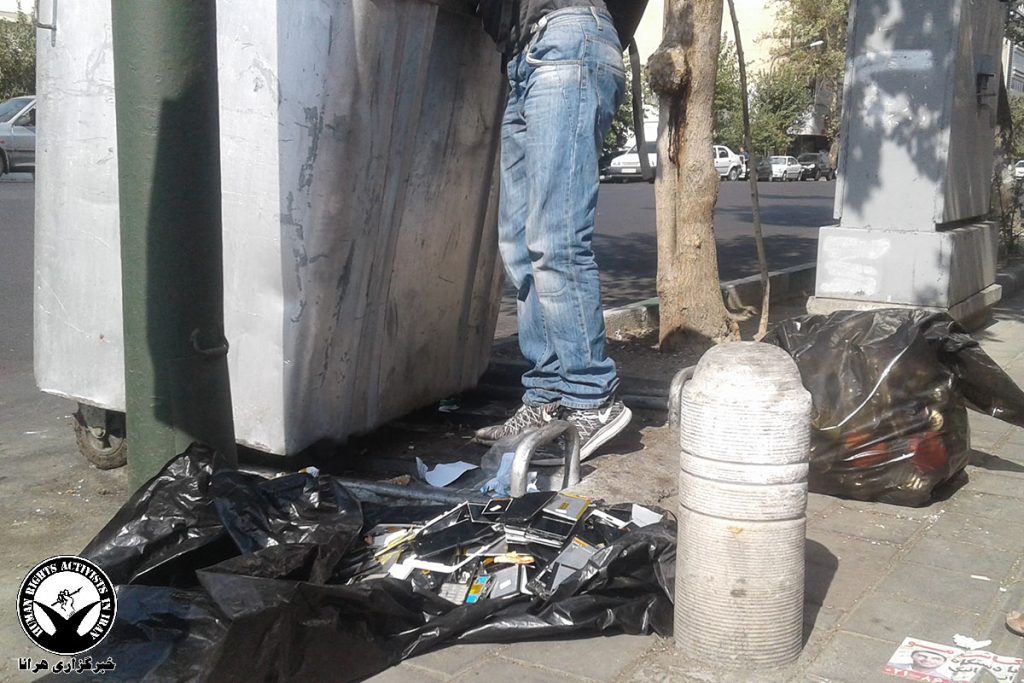
Human Rights Activists News Agency (HRANA) – For years, piles of giant parcels could be seen on the street corners of almost every Iranian metropolis, each representing the bounty of a few hours of foraging. A morning stroll in the city reveals “dumpster divers” hunched over almost every visible waste bin, toiling in the day at what used to be a moonlight gig. Now, this mainstay of urban culture is coming under fire for its poor regulation, safety hazards, incorporation of child labor, and–in the current economic crisis– its rapid expansion into smaller cities.

Many of Iran’s municipalities have on payroll designated foragers of recyclable goods, who often work in deplorable conditions and have been known to outsource this work to young children. In cities like Abadan and Khorramshahr, dumpster divers have become enmeshed in the fabric of the city, all while a creeping trend of privatization has heightened both its precarity for workers and its appeal for would-be entrepreneurs that are hiring them.

Labor activist *Mehrdad spoke to HRANA about the society’s low bar on working conditions for child foragers who aren’t even of age. “All of them suffer from a host of skin, digestive, and respiratory conditions,” Mehrdad said, identifying basic gear like gloves, masks, or protective uniforms as virtually-unheard-of commodities. “What’s worse, instead of telling our municipalities that these children should not be employed– that we need to abolish child labor and think about their welfare–we’re fighting for improved sanitary conditions, and to protect them from sexual harassment.”

Off-the-rolls workers–especially children–are not entitled to complain about their conditions, let alone expect better. Mehrdad said that many of these foragers make do, and even spend the night, in factories and storage spaces used for waste separation. “Obviously, these children work in a contaminated environment.”

Journalists, along with children’s’ rights and civil rights activists, have drawn attention to a burgeoning “garbage mafia” that exploits those willing to accept paltry wages, such as freelance dumpster divers and children.

While waste management officials in some cities have maintained management of the foraging sector and verbally committed to refining the rights and status of these workers–like the waste management office supervisor of the city of Zanjan, who has promised them ID cards and more organized labor administration–such supports have a low chance of survival in an environment of economic downturn and unregulated outsourcing.

Indeed, Mehrdad attributes the recent spike in dumpster diving to Iran’s new wave of economic crisis. “Within the last year, the hard-working class of society has become poorer […] the unemployed have have taken to dumpster diving, while the employed recruit their own kids to do it. Dumpster diving is the last resort of a working class struggling to stay afloat.”

Two months ago, a Hamedan city councilman announced that 550 dumpster divers were active in that city. Disheveled and dressed in dirty clothes, they roam encumbered by large bags of paper, plastic, and metal cans. According to one children’s rights activist studying the child foragers of Tehran, child dumpster divers are expected to collect an average of 170 pounds of recyclables daily, a quota they must trek miles across the city to meet.

These children may be outsourced by contractors, who themselves are managed–and paid–by the city. “What’s awful about it,” said Mehrdad, “is that the municipality and its contractors are capitalizing on their vulnerability.”

Foragers in larger cities won’t necessarily fare better. “The conditions for such children outside the capital, if not harder than in Tehran, aren’t any better. At least in Tehran there’s some media coverage on dumpster divers. In smaller cities, hardly anyone talks about them.”

While article 7 of Iran’s Declaration of Citizenship Rights mandates that “all citizens enjoy equal access to human dignity and the benefits prescribed in laws and regulations,” city councils and municipal authorities in affected cities have yet to make concrete strides toward the protection of the human dignity of foragers. On the contrary, several municipalities have reportedly evaded accountability for underage citizens working in the workshops and waste separation centers of their cities, repeatedly deferring to the very contractors they hire and supervise. “The root of the issue is that these contractors win the municipality’s bidding process by offering the lowest price, and compensate for this low fare by mining the cheap labor pool of children and poor individuals,” said Mehrdad, who anticipates that dumpster diving will remain on the rise until a labor law makes these issues explicit, and is pushed to implementation with considerable pressure from the Iranian people.

Privatization, according to Mehrdad, is the scourge of the freelance forager. “Conditions for dumpster divers was bad enough in the past, but privatization, and the issuing of permits by contractors, have turned the situation downright deplorable. Where some foragers were able to work independently before, now contractors have monopoly on the market and are free to enforce their own restrictions.” Contractors hired by the municipality currently have no legal responsibility to address these issues.

As this HRANA reporter has observed, as long as municipalities skirt their responsibilities of contractor oversight, the number of dumpster divers–along with their quotas, pressures, and hazards–will steadily climb. The voices of these working citizens, for now, are drowned out by financial crisis and political turmoil.

* Mehrdad’s last name was not published due to safety reasons.

Forty Days Later, Whereabouts of Imprisoned Dervish Amin Alizadeh Still Unknown

Human Rights Activists News Agency (HRANA) – The family of Amin Alizadeh–a member of Iran’s Gonabadi Dervish religious minority who was arrested in Tehran on June 29th with fellow Dervish Jalal Mousavi–has now been in the dark about his whereabouts for 40 days.

Alizadeh and Mousavi were arrested amid the “Golestan Haftom” incident in February 2018. The incident, named after the street in Tehran on which it took place, broke out when a gathering of several hundred *Gonabadi Dervishes were violently confronted by Iranian police and plainclothes members of the Revolutionary Guard’s Basij faction outside the residence of their spiritual leader, Noor Ali Tabandeh.

The Dervish community had rallied outside Tabandeh’s residence to prevent his possible detainment, as he has reportedly been placed under extended house arrest by Iranian authorities.

Hundreds of Dervishes were beaten, wounded, and arrested during the Golestan Haftom incident. A similar attack occurred on January 24th after an intervention from security forces on the same street, heightening the sense of fear within the Dervish community.

After their arrests in June, Alizadeh and Mousavi were transferred to Ilam Prison in Iran’s Kurdish region, located over 400 miles west of Tehran. According to Ilam Prison authorities, Alizadeh was later transferred to Damavand Prison, closer to Tehran. Damavand judicial authorities, however, have not allowed any visits or contact between Alizadeh and his family.

Though Iranian judicial authorities estimate that around 300 people have been arrested in connection with Golestan Haftom, HRANA has thus far published the names of 324 arrestees and estimates that the actual number is considerably higher.

* There are various divisions among Dervishes in Iran. In this report, the term “Dervish” refers to Nematollahi Gonabadis, who declare themselves as followers of Twelver Shi’ism, Iran’s official state religion.

Prisoner Hanged to Death Without Warning

Human Rights Activists News Agency (HRANA) – Kamal Ahmadnejad, a prisoner held on death row in Miandoab Prison in northwestern Iran, was precipitously executed in the early morning of Monday, September 10th, 2018.

Prison authorities carried out the execution without informing his family or granting them a final visit. Ahmadnejad, originally from Gamishgoli village near Miandoab, was abruptly transferred to Ward 2 of Miandoab Prison two weeks ago.

The Center for Democracy and Human Rights in Kurdistan reported that Ahmadnejad was executed in face of lingering questions about the coherence of his case. Arrested along with five others in December of 2015, he was the only defendant in the case to be sentenced to death. His co-defendants Halmat Abdullahi, Milad Abdi, Saeid Siahi, Soleyman Kori, and Mostafa Tahazadeh were each sentenced to fifteen years in prison, according to Maf News, an affiliate of the Center for Democracy and Human Rights in Kurdistan.

The six were charged with killing Hashem Zeinali, former member of the Islamic Revolutionary Guard Corps (IRGC), as well as “membership in a Kurdish opposition party.” Ahmadnejad’s family has alleged that he was forced to confess under the duress of torture.

According to their families, some of the defendants were not at the scene of the crime when the murder allegedly occurred, a discrepancy they said was raised during court proceedings.

The six were originally convicted on September 18, 2016.

Ahwazi Arab Protestor Posts Bail, Awaits Trial

Human Rights Activists News Agency (HRANA) – Jamil Savari, resident of Ahvaz in Iran’s southwestern Khuzestan Province and member of the Ahwazi Arab ethnic minority, was released on a 200 million IRR (approximately $14,000 USD) bail Sunday, September 9th pending completion of the investigation into his case.
During the week of March 29th, 2018, members of Iran’s Ahwazi Arab minority staged rallies in protest of being treated as “invisible” by the state-run media, one example of what is believed to be a larger policy of oppression and discrimination endorsed by the Islamic Republic. Savari was first arrested in March of 2018 by security forces in the midst of these protests, and was subsequently transferred to Sheyban Prison in Ahvaz.
Security forces arrested hundreds of protestors in efforts to shut down the March rallies, which gained momentum in a number of cities, particularly in Khuzestan near the Iran-Iraq border. Reports have surfaced of authorities’ mistreatment and torture of these detainees, many of whom–including a number of minors whose conditions are unknown–remain behind bars despite authorities’ verbal engagements to release them.

Women Prisoners of Conscience Respond to Executions of Ramin Hossein Panahi, Loghman & Zanyar Moradi

Human Rights Activists News Agency (HRANA) – Political and civil rights activists detained in the Women’s Ward of Evin Prison in Tehran have released a statement in response to the execution of political prisoners Ramin Hossein Panahi, Loghman Moradi, and Zanyar Moradi.

In a letter, Narges Mohammadi, Nasrin Sotoudeh, Golrokh Ibrahim Iraee, Maryam Akbari Monfared, Atena Daemi, Azita Rafizadeh, and Negin Ghademian expressed condolences to the families of the three Iranian Kurdish prisoners, who were hung to death September 8th amid dubious legal proceedings and international protest.

Barring the families from interring their sons’ bodies themselves, authorities commandeered the remains to be buried in an undisclosed location. According to Ramin’s brother Amjad Hossein Panahi, the Ministry of Intelligence has threatened the Moradis and Panahi families with detention. To the surprise of all families involved, the executions were carried out in an undisclosed location in Tehran province.

Amnesty International, one of the human rights organizations who were aghast at the course of the young men’s case, called the executions an “outrage.” Voices of the Evin Prison Women’s Ward now join the wave of dissent against the outcome of their case.

During a visitation on Sunday, the authors of the statement, many of whom are being held as political prisoners themselves, joined the families in singing “Ode to the Bleeding Tulip” and “O Iran” to commemorate and honor the memories of Ramin Hossein-Panahi, Loghman Moradi, and Zanyar Moradi.

The full text of their message, translated into English by HRANA, is below:

No words could contain the crushing weight of our sorrow.

These brave children of our country leave us a legacy of patience, freedom, and perseverance.

Their names are affixed to the helms of those fighting for freedom, and for those that seek it, the path has been laid by their resistance.

We wish solace for the families and cellmates of Zanyar Moradi, Loghman Moradi, and Ramin Hossein-Panahi. We wish solace for all the afflicted citizens of our land.

We bear your pain in our chests and we stand with you.

Narges Mohammadi, Nasrin Sotudeh, Golrokh Ibrahimi, Maryam Akbari Monfared, Atena Daemi, Azita Rafizadeh, and Negin Ghadamian

Women’s Ward of Evin Prison

Subscribe to Our Newsletter

Now is definitely not the time to stop reading!

Activist in Iranshahr Girls Case Released on Bail

Human Rights Activists News Agency (HRANA)- Abdollah Bozorgzadeh, a civil rights activist who was arrested June 17, 2018 for joining a peaceful gathering in support of the Iranshahr Girls, has been released on a bail of 1,200,000,000 Rials (approximately $12,000 USD).

Upon his arrest, Bozorgzadeh was transferred to a Zahedan detention center run by the intelligence department of the Islamic Revolutionary Guard Corps (IRGC).

The Iranshahr Girls are a group of 41 girls who were reportedly raped in the southeastern city of Iranshahr. Their case attracted public attention when Sunni Imam Molavi Tayeb Molazehi spoke about them during a sermon at the end of Ramadan, stating the girls had been raped by a group of men “of wealth and power.” The sermon ignited street rallies and social media campaigns against authorities’ failure to prosecute the men accused of the rape.

In July of this year, the IRGC reported the arrest of a number of foreign media heads, releasing video-recorded confessions from Abdollah Bozorgzadeh and six other protester-arrestees.

More than 100 well-known civil and human rights activists have spoken out against the Iranian security apparatus, issued a statement calling for Bozorgzadeh’s immediate release, and demanded an investigation to identify and punish those responsible for the rape. Amnesty International called for Bozorgzadeh’s release in a statement released July 4th.

* Iranshahr is located in Sistan and Baluchistan Province, southeastern Iran. Most of the residents of this city are members of the Sunni religious minority.

Appeals Court Upholds Convictions of Six Azerbaijani Activists

Human Rights Activists News Agency (HRANA) – Six Azerbaijani activists accused of national-security related crimes for protesting Azerbaijani cultural misrepresentation in 2015 had their appeal rejected.

On September 1, 2018, Judge Hossein Farshi Radvar of Branch 3 of the East Azerbaijan Province Appeals Court moved to uphold the original ruling, issued to a total of seven activists in October 2017 by Branch 1 of Ahar Revolutionary Court. Ahar is situated in northwest Iran, home to Iran’s Azerbaijani ethnic minority.

On a conviction of “Assembly and collusion against national security by propagandizing against the regime,” the activists all face prison time: ten months for both Akbar Aboulzadeh and Ebrahim Noori, and seven months apiece for Esrafil Fathollahzadeh, Hamed Allahverdipour, Morteza Shokri, and Soleiman Kazemi.

Though the appeals court had also summoned Saleh Molla Abbasi, his name did not figure in the final verdict. The initial ruling indicated he faces a 10-month prison sentence.

From the group of seven, the four who attended the initial court hearing were the same ones present at the appeals hearing: Aboulzadeh, Fathollahzadeh, Allahverdipour, and Shokri. Three others – Saleh Molla Abbasi, Kazemi, and Noori – did not attend the court session. Noori is currently serving a sentence for other charges in Evin Prison of Tehran.

The activists were arrested in November of 2015 for their involvement in public protests against the state-sponsored television series “Fitileh,” parts of which were believed to portray the Azerbaijani ethnic minority in a derogatory light. The “Fitileh” protests reportedly involved around 25 participants. All but these seven were eventually acquitted.

HRANA previously reported on the activists’ pending appeals hearing.

Naqadeh Farmer Arrested by Revolutionary Guards

Human Rights Activists News Agency (HRANA) – A farmer from the village of Kooyik in Naqadeh county, West Azerbaijan Province was arrested on September 2nd.

Saadi Maroof Khalkhaaneh, 23, was arrested by authorities from the Intelligence Unit of the Iranian Revolutionary Guard Corps (IRGC) and transported to an unidentified location.

A source close to the family confirmed the news to HRANA, stating Saadi was accused of “backing opposition parties” and detained without an arrest order.

In repeated inquiries about him to security authorities, the source said, Khalkhaaneh’s family has been met with the stock response that he is “in IRGC custody.” His whereabouts remain unknown.

Urmia Prisoner Enters 11th Day of Hunger Strike

Human Rights Activists News Agency (HRANA) – Mehdi Taha of Urmia Central Prison’s Ward 14 is entering the 11th day of a hunger strike he declared August 30th in protest of being denied furlough.

Taha is currently in year six of a 15-year sentence for drug-related offenses. He has been repeatedly denied furlough over the course of his detention. According to a close source, Taha believes prison authorities are refusing his furlough requests out of spite.

Violence against Executed Kurdish Political Prisoners Follows them to the Grave, Continue to Haunt their Families

Human Rights Activists News Agency (HRANA) – “Loghman’s mother has scratched at her own face so much that she has claw marks across her cheeks,” writes former political prisoner Bahman Ahmadi Amouee, documenting a family’s anguish over the sudden loss of their son Loghman Moradi, who was executed without trial, or any official warning, on Saturday, September 8th. “Her daughter is helping her to stand, and together they are wailing.”
Amouee, a journalist and former political prisoner, writes as a witness to the tightly-controlled visits to the grave sites of Zanyar and Loghman Moradi in Tehran’s Behesht-e Zahra cemetery, where their families were permitted to say final goodbyes on the condition that they refrain from screaming, wailing, or taking any pictures or video.
Pursuant to a dubious legal proceeding that drew outrage from human rights organizations across the world, both Moradi cousins, along with their co-defendant Ramin Hossein Panahi, were hanged to death in an undisclosed location in Tehran Province on Saturday.
Ramin’s brother Amjad reported to HRANA that the victims’ respective families have been threatened with detention by the Ministry of Intelligence. Ramin’s remains will not be handed over to his family for burial, Amjad said, but will instead meet the same fate as that of the Moradis, and of many political prisoners before them: interment by the government in secret location.
In an open letter, Atena Daemi and six other civil activists imprisoned at Evin have expressed condolences to the families of the victims.
Bahman Ahmadi Amouee wrote a report, excerpted above, from his observations of the victims’ grieving families during their final visitation to their graves. The text of Amouee’s letter, sourced from his website, is below, translated to English by HRANA:
“Loghman’s mother has scratched at her own face so much that she has claw marks across her cheeks. Her daughter is helping her to stand, and they are both wailing. She is engulfed in sorrow. I’m in disbelief that this broken girl is Loghman’s little sister. Across the way, her surviving brother hangs his head. They arrived only this morning from Marivan. The family, along with their attorneys, have been treading from room to room in the prosecutor’s office. As if they still cannot believe the news of Loghman and Zanyar’s execution, they say, ‘we won’t believe it until we see the bodies.’ If lore on such matters again proves true, there will be no viewing of the bodies, nor any information released about their burial site. And yet, hope lingers.
At 11 a.m., the family’s attorney Saleh Nikbakht announces that authorities have granted permission for the families to view the bodies in the preparation washroom of the mortuary. I hasten to make my way there. It appears I was faster than everyone else. It is noon, and a few other families are circulating, waiting for their own loved ones’ burials. Sounds of tears and lamentations fill the air. Every few minutes, an intercom pronounces the name of one of the bodies, requesting the family to come forward to identify it.
I asked myself if Zanyar and Loghman would be announced this way. Never would I have imagined coming to find them in a place like this. For two and a half years, we were together day and night. I remember Loghman’s laugh, his wide grin. He was a few years older than Zanyar, and more protective of him than a brother. Each time he would spread out the table cloth for meals, he would call out, ‘Dear Zanyar, come! Let us eat!’
I went to the census bureau of Behesht-e Zahra to see what I could find out. The person behind the computer told me their names weren’t in the system at all. They didn’t figure on the list of those buried in previous days, either. We’re being given the run-around once again, I thought. Distraught, Zanyar’s brother Diyar said, “we got a call from a blocked number–they said we need to go to Behesht-e Zahra.” Loghman and Zanyar’s cellmates are there, too. Everyone we ask says something different. Nikbakht goes into a room. After a few minutes, Diyar goes after him. Four security officers held a meeting with a handful of Behesht-e Zahra administrators; an hour passed. Finally they came out with the news: Zanyar and Loghman’s family members were granted permission to visit their bodies, on the condition that they do not take any pictures or recordings. Oh, and they weren’t going to be allowed to scream or wail when they got there, either.”
Hours go by; Behesht-e Zahra is now closed, all of its employees gone. The large mortuary washroom is so hollow that the slightest sound I’d make would reverberate across the room. I feel empty. I am sitting in a corner, waiting with Zanyar and Loghman’s former cellmates. For a moment, a thought crosses my mind; and if we’re being strung along again…? Loghman’s mother bursts outside, and playing herself on the ground beneath the burning sun. She is cold and racked with trembling, asking over and over to see her dead son.
They summon the immediate family members. We flood through a door. They stop us from advancing further. The windows are cloaked over with banners and cloth.
The families have been standing, choked, over the shrouded bodies of Loghman and Zanyar for half of an hour now. Loghman’s mother was finally able to see her son, covered in a burial cloth. But Zanyar’s mother is not here to do the same. His aunt, uncle, and brother go to see him instead.
A man dressed in a blue suit, his shirt buttoned up to the neck, is ordering people around the room; it seems he’s their boss. Saleh Nikbakht tells him, ‘since they have not been buried yet, won’t you allow us to take them to Loghman’s ancestral village, 25 miles from Marivan? The family has a hard time traveling to Tehran. We ask you to think of them as well.’
The man responds, ‘I have to take it up with the prosecutor. For now, they will stay in the morgue for a few days. If he approves your request, they will be transferred to the location you ask. If not, we will bury them here in Behesht-e Zahra and tell you the location of their grave.’ Wailing and crying burst forth again. The family exits. The summer sun sears into us, and the sounds of crying do not let up. The shrouded bodies are loaded into a pickup truck and taken away. Osman, Loghman’s father, looks defeated. His thin frame is even more haggard than before. He says through sobs, ‘What hurts is that I couldn’t do anything for them.’ Those who had so far been holding back tears are now bawling. Loghman’s sister is clawing at her own face now, howling out tears along with their mother. Their laments shift into Kurdish; all I can understand are the boys’ names.”