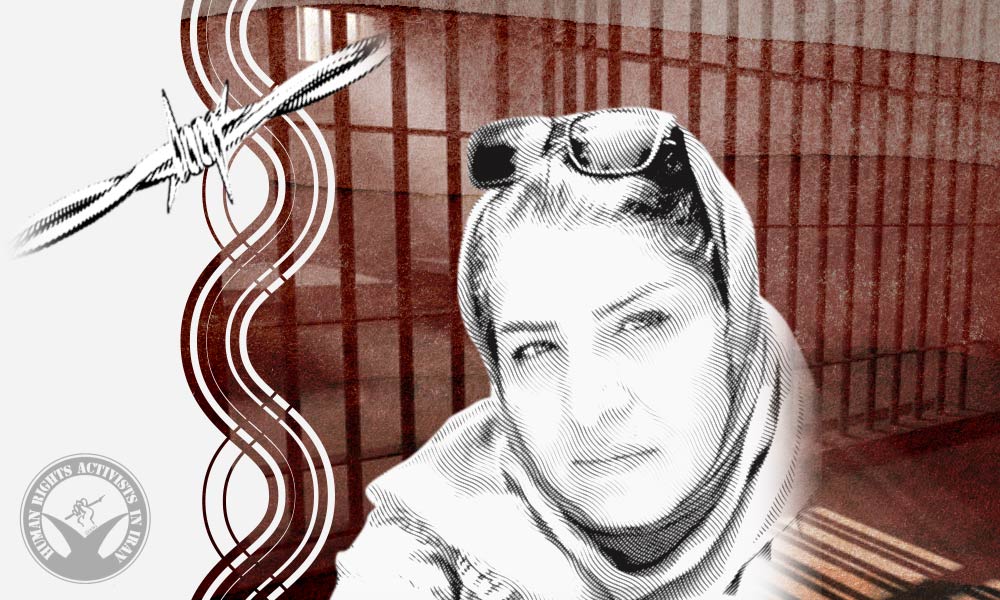
Security forces arrested Elham Afkari in Shiraz and took her to an undisclosed location. She is the sister of Iranian wrestler Navid Afkari, who was executed on September 12, 2020, in Adel-Abad Prison despite serious ambiguities in his case and worldwide outcry to halt the execution.
According to HRANA, the news agency of Human Rights Activists, Elham Afkari, Navid Afkari’s sister, was arrested by security forces in Shiraz.
Breaking the news, her brother, Saeed Afkari, wrote on social media, “My sister Elham Afkari was arrested in Shiraz, and there is no news of her husband and her three-year-old daughter Liana.”
IRGC-affiliated news agency Tasnim, however, claimed that Afakri was arrested by intelligence agents at the border while trying to flee the country.
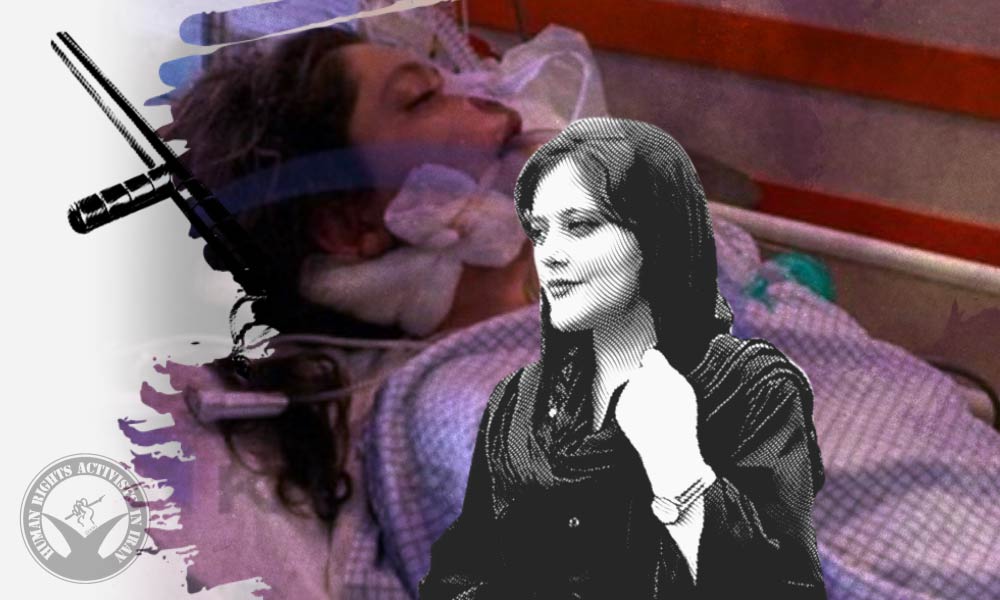
HRANA, the news agency of Human Rights Activists – Mahsa Amini, a 22-year-old young woman, was arrested by the morality police for the crime of improper hijab. Her arrest and death in detention fueled nationwide protests in Iran. Protesters came to the streets with the central slogan “Women, Life, Freedom” in protest against the performance, laws and structure of the regime. The following 209-page report is dedicated to the statistical review, analysis, and summary of the first twenty days of the ongoing protests (September 17 to October 5, 2022). In this report, in addition to the geographic analysis and the presentation of maps and charts, the identity of 200 deceased, including 18 children and teenagers, an estimated of 5,500 arrested along with the identity of 563 arrested citizens, 123 students and 36 journalists or activists in the field of information is compiled. In addition the report includes a complete collection of 698 verified video reports by date and topic. The report examines protests across 342 documented gatherings in all 31 provinces of the country, including 105 cities and 68 universities.
Summary
Mahsa (Zhina) Amini, a 22-year-old young woman from Saqqez, Kurdistan who had traveled to Tehran on Tuesday, September 13, 2022, was taken into custody by several Moral Security Police officers at the Haqqani metro station in Tehran charged with not observing the strict Islamic dress code and was taken to the detention center of this organization known as Vozara.
Shortly after her arrest, her partially alive body was transferred to the intensive care unit of Kasra Hospital, she was admitted in a coma with level three consciousness.
Given the atrocious track record of the police force in mistreating the accused and previous incidents that were similar to this, public opinion reacted acutely to this situation because there was the widespread perception that this young girl was beaten in the Vozara detention center.
Click here to download the full version in PDF format
The widespread street protests against this incident were set off from the time Mahsa Amini was announced, in front of Kasra Hospital on Argentina Street in Tehran, and then quickly spread to the streets despite the intimidating presence of Iran’s security apparatus. The protests after Mahsa’s burial in a Saqqez cemetery, intensified whereby after twenty days of nationwide protests, they spread all of Iran’s 31 provinces, 105 cities, and 69 major universities.
The protests were not limited to Ms. Amini’s death and quickly targeted the Iranian government’s political and ideological foundations. These protests were violently quashed by the anti-riot police and Iran’s militia force (baseej) through the use of teargas, pellets, and live ammunition. This widespread crackdown has led to the death of dozens of people and the wounding of hundreds of protestors.
Despite the severe communication restrictions imposed by the Iranian government, the following report summarizes the twenty days of protests between September 17, to October 5, 2022. The protests that at the time of this report are still going on in various forms. They are not necessarily in the form of street protests, but they manifest themselves in a variety of individual and collective actions.
Unique Features of These Protests
These protests reviewed in this report have unique characteristics that differentiate them from the protests of the last decade in Iran and are at times unprecedented in the life of the Islamic Republic.
• Contrary to most of the protests in recent years, this recent protest was not based on economic or environmental grievances. Instead, political, and human rights demands were at the center of it.
• These protests were triggered by the death of a young, Kurdish and Sunni woman. Being female, Kurdish and of Sunni faith are all grounds for discrimination in Iran for her being a woman, being a Kurd, and being a Sunni was attributed to oppressed groups and subjected to gender, ethnic, and religious discrimination. Yet, the Iranian public showed a united front and disregarded all these categories that tend to divide people and instead displayed that collectively they can take a positive step forward.
• The Iranian youth, whose average age has now reached 15 years of age, according to law enforcement officials, has played a key role in these protests.
• An unprecedented solidarity has been formed between Iranians inside Iran and those in the diaspora.
• These protests put almost all classes of Iranian society into one unified group of people in support of the protesters. The urban middle class alongside the lower or upper classes in small and large urban areas, different ethnic groups, religious minorities, sexual minorities, and trade groups including teachers, laborers, students, professors, artists, and athletes were integral to this united front. In these protests, we witnessed different businesses showing solidarity with the protesters by going on strikes.
• In terms of continuity, these protests can be considered among the longest continuous protests since the inception of the Islamic Republic of Iran.
• Because of the substantive and progressive demands of these protesters, the international community, especially celebrities in the fields of the arts, culture, and politics, became the voice of the Iranian people in an unprecedented way, and by disseminating information and taking various actions, they have attention to what is going on in Iran.
• The demands of the protesters, which centered on the issue of women’s rights, have indicated that Iran has a progressive and assertive society.
• One of the distinguishing features of these protests from the previous ones was unarmed protesters routinely confronting the security forces. There have been many scenes of protestors showing solidarity as they came together to prevent people from being taken into custody or by standing in front of the police who were equipped with full anti-riot gear. Public anger over the operation of the Moral Security Police and decades of meddling by this force in the most personal areas of women’s lives was also a great motivating factor for the protestors to resist being subjugated by Iran’s security apparatus.
• In addition to the street protests, there was cyber warfare going on between the opponents and supporters of the status quo. Numerous government sites were hacked, and the global solidarity propelled Mahsa Amini’s hashtag, which became the first in the history of Twitter to record more than 300 million tweets.
• The government of Iran this time around gave more latitude to Faraja (Iran’s main law enforcement agency) and their rank and file to spearhead the repression of the street protests. The government also adopted alternative methods regarding the Internet (e.g., reducing its speed rather than cutting it off as we as filtering certain sites). Also, after the death of an army officer, it became clear that the Iranian army also played a role in suppressing protests, which is considered a rare event.
• The media close to Iran’s security apparatus tried to cover the protests in their own way by sending their reporters to the streets to present the news in a slanted way that is favorable to the government. These reporters continuously have provided the latest from street clashes between the protesters and security forces.
• These protests, which have lacked leadership and command-and-control, have shown that Iranian society, especially its younger generation, is determined to attain their basic human rights.
The Protests
At the time when Iranian president Ebrahim Raisi spoke about human rights in his annual speech at the UN General Assembly, Iranian protesters took to the streets to speak out against police brutality and discriminatory religious laws against women in Iranian society.
On September 17, the first sparks of these protests took place in Tehran, Sanandaj and Saqqez. Then the protests quickly reached other cities and different social groups and classes.
Thirty-one provinces, in other words, Iran’s all provinces, were the scenes of protests from September 17 to October 5, 2022.
In the 20 days of protests that are reviewed in this report, a total of 105 cities from Iran’s all 31 provinces became the scene of protests up to 266 times. If there were instances when the protesters could not find their way to the street, that was due to tight security measures in the area.
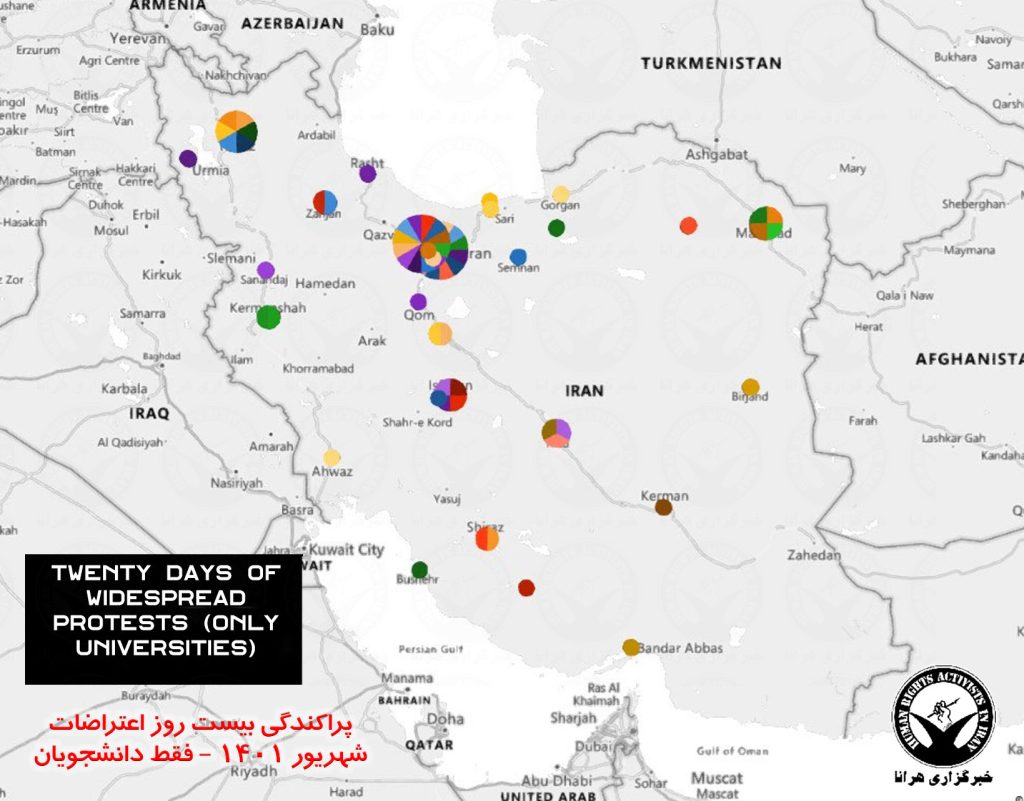
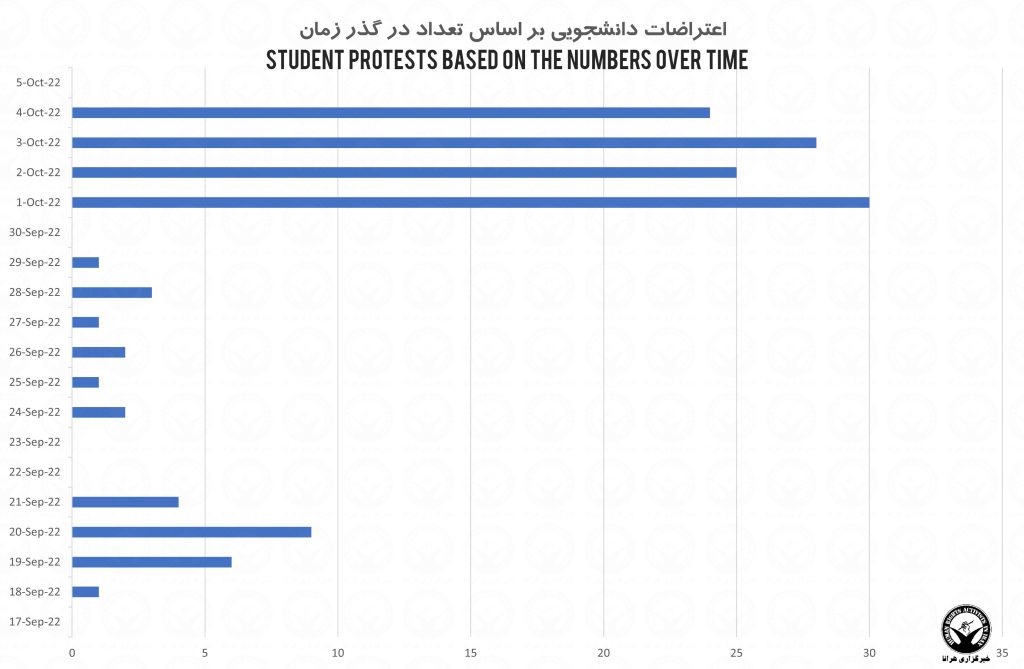
In addition to 226 instances of street protests, there were 76 protests on 69 university campuses.
The cities where protesters appeared in the streets during a week of protest have been verified by HRANA as follows:
Protesters’ Slogans
Various slogans were chanted in the gatherings. The ones that were repeated most are listed below:
• We are all Mahsa, if you fight, we will fight back
• Cannons, Tanks, Fireworks, the Mullah Should Get Lost
• We don’t want the Islamic Republic, we do not.
• Death to the rule of the Islamic Jurist
• Get lost Baseeji (Islamic militia), get lost Baseeji
• Liberty, liberty, liberty
• Death to Khamenei
• Justice, liberty, optional clothing
• Death to Morality Police and its Patrol
• Our stupid leader is our disgrace
• Death to the Islamic Republic
• Saqqez is not alone, Sanandej has your back.
• Killing women for bad hijab, how long such humiliation?
• Be scared, we are all united
• We will fight, we will die, we will get Iran back
• Women, life, liberty
• From Yazd to Kurdistan, we give our lives for Iran
• Jailed students should be released
• Sharif University students are honorable, the Baseejis are humiliated
• No to headscarves, no to beating women
• Liberty, equality, Justice
• Liberty, optional clothing
• From Kurdistan to Tabriz, it’s all poverty, corruption, and discrimination
• This is not just a protest, it’s the start of a revolution
• We do not want universities under siege, we do not
• If we do get united, they will kill us one by one
• Evin prison has turned into a university, Tehran has become a detention center
• Justice, liberty, optional clothing
• They have killed Sharif students, but they say they didn’t kill Mahsa
• Students would rather die than get humiliated
• Students are in jail; our professors stay silent
• Honorable students, support us, support us
• We will fight, we will die; we will get Iran back
• You killed our students, now ask us to stay silent
• Azerbaijan is awake, it supports Kurdistan
• Liberty is our right, Zhina (Mahsa) is our code word
• Poverty, corruption and injustice; shame on this despotism
• Servitude, unemployment, forced hijab on women
Conclusion
Three weeks after Mehsa (Zhina) Amini’s death, Iran’s Medical Forensic Organization, published its pathology tests showing her “death was not caused by blows to the head or any vital organs and parts of the body.”
In the statement of the coroner’s office, it is stated: “Based on hospital medical documents, the investigation of C. T-scan of the brain and lungs, the results of the physical examination of the body and autopsy, pathology tests, Mahsa’s death was not caused by strikes to the head and the vital organs and other parts of the body.”
The Iranian coroner’s office added that due to the “underlying illness” of Mahsa Amini, “she did not have the necessary ability to compensate and adapt to the situation, therefore, under the circumstance, she suffered from a heart rhythm disorder and a drop in blood pressure, and subsequently, a decrease in the level of consciousness, which due to the ineffective cardio-respiratory resuscitation in the first critical minutes, she suffered severe hypoxia resulting in brain damage.”
In its statement, this government body claimed that “despite the return of cardiac function following the resuscitation of the emergency personnel, the respiratory support did not work” and despite being transferred to the hospital “she passes away on September 16 due to multi-organ failure (M.O.F) caused by cerebral hypoxia.”
In response to this statement, Saleh Nikbakht, the lawyer for the Amini family, told the media that the medical examiner’s claim that Mahsa Amini’s death was caused by a glandular surgery that was performed on her when she was eight is baseless because the same surgeon who performed the surgery has said it cannot be the cause of her death. Other neurologists have refuted this too.
Mr. Nikbakht also called Mahsa Amini’s “instant death” and the attempt to link it with “her childhood surgery or taking thyroid pills” nonsense and said how is it possible that Mahsa Amini, who “has not had any physical issues for 15 years, after being taken into custody by the Morality Police and spending an hour and a half at their headquarters, suddenly has a stroke, heart, and kidney failure and loses ninety-eight percent of her vital signs.”
According to the lawyer of the Amini family, Mahsa Amini’s case “is in the investigation stage and has not yet been filed with the court.”
These protests, besides the cost in blood they had for the protesters, have cost the human rights violators dearly as well.
There have been spontaneous collective actions by the protesters to identify human rights violators and agents of repression. There have been orchestrated attempts such as the Spreading Justice as well, which aims at identifying human rights violators using digital tools and by following up on the information received. Spreading Justiceuses the information they receive to incur costs for human rights violators.
A number of Western countries have approved new human rights sanctions against Iran.
In the latest action, the US Treasury Department sanctioned seven officials of the Islamic Republic of Iran for cutting off the Internet and suppressing protesters during protest rallies.
Ahmad Vahidi, Minister of the Interior, Issa Zarepour, Minister of Communications, Hossein Sajdinia, Deputy of Faraja (law enforcement) Operations, Yadullah Javani, Political Deputy of the Revolutionary Guards, Vahid Majid, Chief of Fata (a force that fights cyber-crimes) Police, Hossein Nejat, Commander of Tharullah Camp, and Hossein Rahimi, Chief of Tehran Police, are listed as human rights violators. Sanctions have been imposed.
The U.S. Treasury Department had previously slapped sanctions on Iran’s Moral Security Police and a number of human rights violators such as Seyed Ismaeel Khatib, the Minister of Information, Manouchehr Amanollahi, the police commander of Kermanshah province, Salar Abnoush, the commander of the Revolutionary Guards, Kyomars Heydari, the commander of the ground forces of the Islamic Republic of Iran, Haj Ahmed Mirzaei, the former head of Tehran’s Moral Security Police, Mohammad Rostami Cheshme Gachi, the police chief of Minab city, and Qasem Rezaei.
The Ministry of Foreign Affairs of Canada also announced sanctions against the Moral Security Police, the Cyber Defense Command of the Revolutionary Guards, Evin Prison, and a number of Iranian figures known for taking part in widespread human rights violations, namely Mohammad Hassan Bagheri, Chief of the General Staff of the Armed Forces of the Islamic Republic, Hossein Salami, Commander The General of the Islamic Revolutionary Guard Corps, Ismail Qaani, Commander of the Quds Force of the Islamic Revolutionary Guard Corps, Mohammad Saleh Hashemi Golpaigani, the Secretary of the Commanding Good and Prohibiting Evil, Ismail Khatib, the Minister of Information, Mohammad Rostami, the Chief of the Moral Security Police.
The Ministry of Foreign Affairs of Canada also called the Moral Security Police, the Cyber Defense Command of the Revolutionary Guards, Evin Prison and a number of Iranian figures known for participating in widespread human rights violations, namely Mohammad Hassan Bagheri, Chief of the General Staff of the Armed Forces of the Islamic Republic, Hossein Salami, Commander The General of the Islamic Revolutionary Guard Corps, Ismail Qaani, Commander of the Quds Force of the Islamic Revolutionary Guard Corps, Mohammad Saleh Hashemi Golpaigani, the Secretary of the Command for Good and Prohibition of Evil, Ismail Khatib, the Minister of Information, Mohammad Rostami, the Chief of the Moral Security Police, sanctioned.
Also, in the first days of the protests, six member states of the European Union, including Germany, France, Denmark, Spain, Italy, and the Czech Republic, proposed new sanctions against the Islamic Republic. The proposed sanctions will cover 16 individuals, organizations, and institutions in Iran that have played key roles in suppressing the protesters.
Maps of protests
For a better understanding of the extent of the protests of Sep-Oct 2022, look at its distribution map in the last twenty days.
Follow the most concentrated protest points on the map below
In the map below, see the points that witnessed protests, regardless of the number of repetitions
In the chart below, see the number of urban protests without considering student protests or strikes
Disruption in Internet Access
Disruption in the Internet and mobile communication networks was detected from the first days of the recent protests.
From September 20, 2022, Internet disruptions reached its peak, especially in Kurdistan and other protest hotbeds.
The cities of Saqqez, Sanandaj, Tehran, Mahabad, Ahvaz, Baneh, Bukan, Kermanshah, Qazvin, Arak, Mashhad, Marivan, Paveh, Bijar, Qorveh, Kamiyaran, Dehgolan, Sarovabad, Diwandara, Urmia, Rasht, Shahinshahr, Karaj, Piranshahr, Sardasht, Shiraz, Chabahar, Shahin Dej, Takab, Rabat, Ashnavieh, Langrood and Amlesh experienced the most cases of Internet disruptions until September 30, 2022.
There are several reports that indicate that in a number of cities in the country, the speed of the Internet diminished from 12 noon to 4p.m., and then from 4p.m. to 12 midnight, the reduction in the speed of home Internet doubled. And mobile Internet was also completely cut off in that period.
In addition, the review of Internet Outage Detection (IODA) data, which reviews Internet traffic around the world, indicates that the 10 provinces that face the most interruptions and disruptions of the internet are: Hormozgan, Fars, Isfahan, Ilam, Qom, Semnan, Tehran, Qazvin, Mazandaran, and Golestan.
From September 29, when the communication disruption took a nationwide form, platforms such as Instagram, WhatsApp, Skype, App Store, Google Play, Clash of Clans, LinkedIn, and Viber were filtered.
In the wake of Internet disruptions, the amount of Internet usage in Iran diminished by 67 percent and also mobile communication networks, including First Mobile, Irancell, and Rightel, suffered constant disruptions.
Also, the Axios News site reported a 3,000 percent increase in the demand for and download of Virtual Private Networks (VPN) in the country.
In the first days of the nationwide protests, Elon Musk, the owner of Starlink, promised satellite Internet for all Iranians. After his comment, the site of Mr. Musk’s company was filtered in Iran.
Also, the text messages containing Mahsa Amini’s name were filtered and blocked by the Hamrahe Aval Telecommunication Network.
During this period, various human rights groups issued statements and expressed their concern about the Internet shutdown in Iran and its repercussions.
On Monday, September 24, the Tejarat News Web site reported in a news story that after reviewing the economic consequences of the internet outage in Iran it concluded that the livelihoods of about 10 million Iranians are in jeopardy just because of the lack of access to Instagram. However, Issa Zarepour, the Minister of Communications and Information Technology announced the establishment of new filters indefinitely.
According to many experts, many online businesses are on the verge of bankruptcy, and eight hours of daily Internet outage has caused a lot of financial hardship to Iranian economy.
Hamshahri newspaper reported in a news story that nine million Iranian citizens who have chosen Instagram as their preferred method to do business have faced serious challenges after the regime began filtering Instagram.
Activists in the field of information
Journalists and other members of the media were a group that were arrested by the security institutions for the purpose of preventing the flow of information. The Committee to Protect Journalists (CPJ) published the following list of individuals who have contributed to the flow of information as official/unofficial journalists or bloggers:
1. Yalda Meiri 2. Nilufar Hamedi, reporter of Sharq newspaper 3. Iman Behpasand 4. Ruhollah Nakhai 5. Alireza Khoshbakht 6. Zahra Tohidi 7. Fatemeh Rajabi 8. Mojtaba Rahimi 9. Majid Tavakoli 10. Marzie Talai, reporter of Mukrian News Agency 11. Masoud Kordpour, editor of Mukrian News Agency 12. Khosro Kordpour, reporter and editor Mukrian News Agency 13. Elahe Mohammadi, reporter at Ham Mihan 14. Elnaz Mohammadi, reporter of Andisheh Pooya Magazine 15. Vida Rabbani 16. Hamed Shafaei 17. Ahmadreza Halabisaz 18. Sarvenaz Ahmadi (released) 19. Seyyed Hossein Ronghi Maleki 20. Elmira Bahmani 21. Batul Bilali, reporter of Pasargad Weekly 22. Samira Alinjad, reporter of Sirjan Ravi News 23. Jabar Dastbaz 24. Mehrnoosh Tafian 25 Farshid Ghorbanpour, columnist of Haft Sobh Newspaper, 26. Aria Jafari ISNA photographer 27. Mobin Baloch 28. Javad Shaker, editor of Sharif University newspaper, 29. Alborz Nezami, journalist of Donya Eghtesad Newspaper 30. Safie Qarabaghi 31. Alireza Jabari-Darestani, correspondent of Mehr news agency 32. Siavash Soleimani 33. Ali Khatibzadeh, reporter of Mukrian, 34. Shahram Azmudeh, the editor-in-chief of Talash Monthly 35. Ali Salem, editor of “Andishe” section in Sharq newspaper. 36. Sepideh Salarvand, documentary film maker and ethnographer
Human and Financial Losses
A large number of protesters and security forces were killed and wounded during the twenty days of the nationwide protests.
There was also a lot of damage to government and private property.
Violence
During the nationwide protests, in addition to the dead, scores of citizens across the country were injured in various ways. According to news reports, these injuries are caused by beatings with batons, electric shocks, or because of the use of weapons such as pepper spray, tear gas, pellets, or plastic bullets, and in some cases, weapons of war, especially handguns.
According to news reports, military forces have used ambulances and city buses to move their forces around in urban areas. Protesters’ defensive actions, as a result, have caused damage to around 60 ambulances in the country. In addition, law enforcement agencies have also used city schools as bases to store their gear and equipment in preparation to confront the protesters. Consequently, these places have sustained damage to their structure during clashes. The mayor of Tehran has also claimed that 43 city buses, 54 bus stations, and 25 fire engines have sustained damage in the city.
Many pictures and videos published on social networks, as well as news reports that have been shared with HRANA, indicate the frequent use of handguns by law enforcement to quell the protests.
A major part of the anti-riot police deployed during the protests is coming from the ranks of the Islamic Republic Police Command (Faraja), of which the special unit (Yegan Vijeh) is the main component.
The Basij force, along with the police, was one of the main bodies to suppress the protesters during the unrest in this period, and it seems that the most casualties sustained by government law enforcement were also from this group.
The unregulated use of shotguns with pellets by law enforcement has resulted in the injury of many protesters.
These forces have tried to use firearms against elderly people, protesting teenagers or even children present during the protests. In some cases, firearms have resulted in serious injury to the eyes of these protesters. Some have lost complete eyesight.
In addition, according to the reports received by HRANA, during the last few days, hundreds of arrested protestors have been transferred to Qarchak, Varamin, Tehran, Vakil Abad, Ilam, Evin and other prisons in the country.
Media outlets that are close to the government have claimed, however, that many of the personnel in the Baseej and law enforcement have been injured in the protests. This claim is not, however, consistent with the available evidence. The heavy hand of the forces deployed against the protesters makes this less plausible.
Iran’s official media claimed the Iranian economy suffered damages to the tune of 800 or 100 billion tomans (the Iranian currency) due to the recent protests and strikes. Officials have claimed 460 bank branches and ATMs, and 61 ambulances were damaged. That bank shareholders have also lost tens of billions of tomans. In addition, the four-day closure of shops in 80 cities in the country, the destruction of 70 bus stations, 100 buses, 30 fire engines, and 15 police cars have all been damaging to public services.
As usual, the Iran security apparatus tried to deny responsibility for the violence and damage to property and places and pin the blame on the protesters by publishing reports including coerced confessions from the detainees. However, pictures of security forces destroying houses and the personal property of citizens have been published on social networks.
The Fatalities in the Protests
HRANA has divided the information about the fatalities in the 20-day protests into three categories.
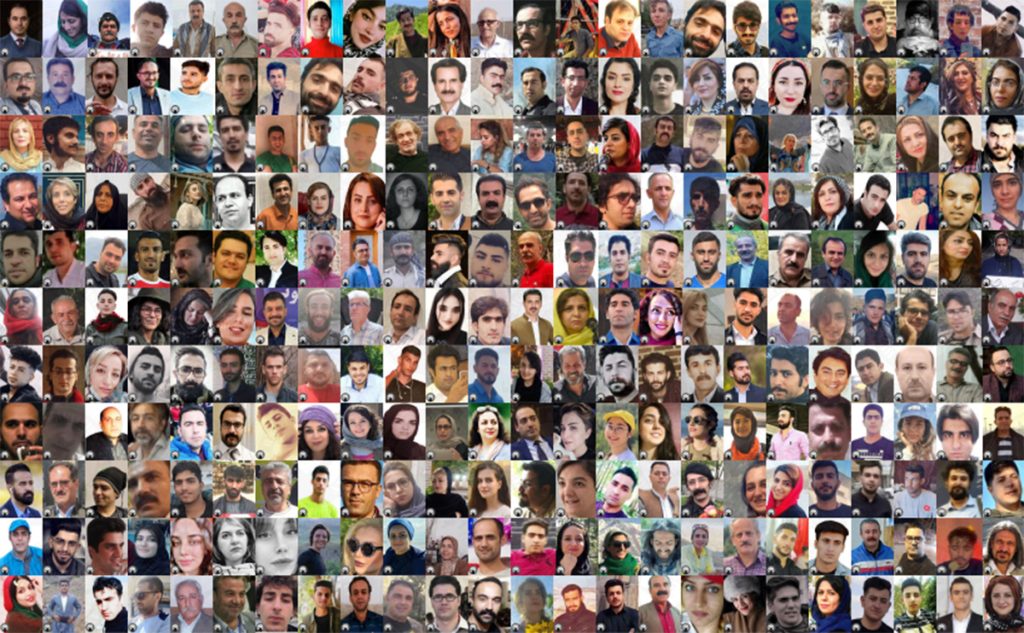
The first group is 200 people whose identities have been received by the HRANA News Agency. Verification of this batch is in progress. So far, the verification of the death of 31 people from this list has been directly verified and confirmed by HRANA, and other information is being investigated at the time of publication of this report.
Among the identities under investigation, 7% are women, and also among the 43 identities whose exact or relative age has been determined, 29% are people who were less than 18 years old.
Child victims
Following are the names of some of the victims of younger than 18 years old: Zakaria Khial (16 years old), Amin Maroufi (16 years old), Amirali Fouladi (16 years old), Parsa Rezadoost (17 years old), Siavash Mahmoudi (16 years old), Nika Shakarami (17 years old), Sarina Esmailzadeh (16 years old), Samer Hashemzehi (16 years old), Amirhossein Basati (15 years old), Mohammad Reza Sarvari (14 years old), Ali Mozaffari Salanghouch (17 years old), Sedis Keshani (14 years old), Javad Pousheh (12 years old), Jaber Shirouzi (12 years old), Amir Mahdi Farkhipour (17 years old), Ehsan Alibazi (16 years old), Omid Safarzahi (17 years old), Nima Shafaqdoost (16 years old),
The second category is remarks or reports made by government officials or government institutions and human rights groups. This category only relies on figures but without mentioning any details and identities. In this category, in two reports from the Fars news agency, as well as a statements from the Friday Prayer Imam of the Sunni community in Zahedan, there are 100 fatalities as the minimum number from reliable statistics.
The third category is the security forces or plainclothes agents who have been killed during the protests, and their deaths have been confirmed and announced by the media close to the security apparatus.
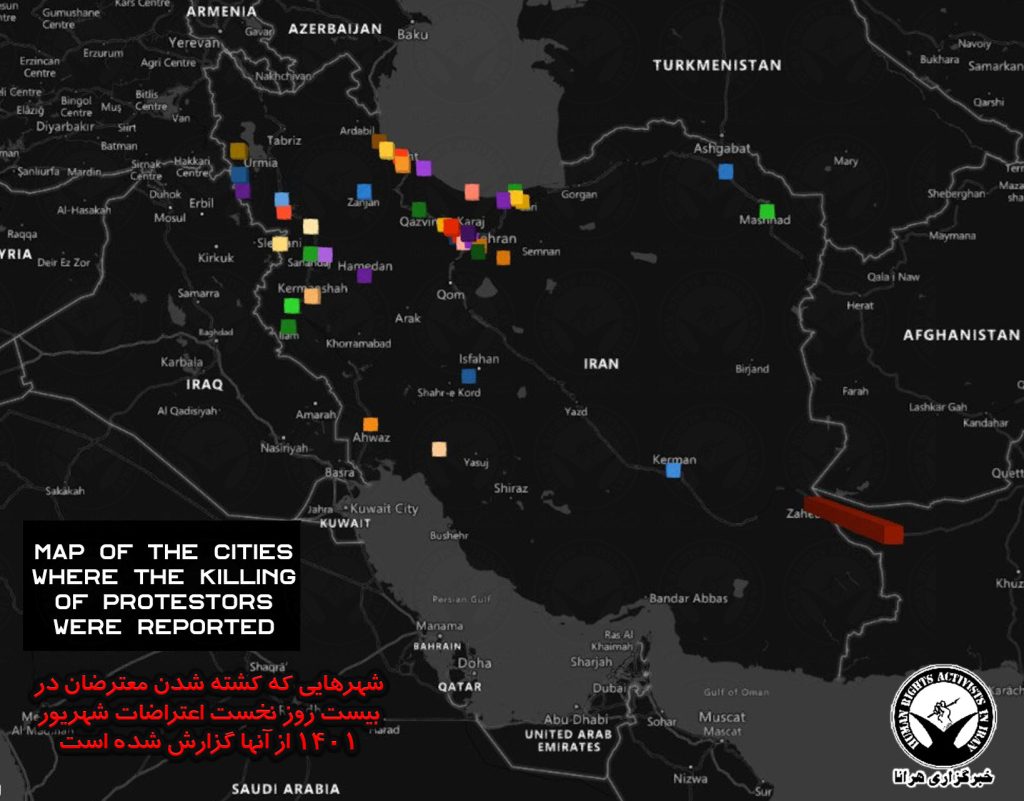
The geography of those killed
Before checking the list of identities of the possible deaths, take a look at the map below to better understand the geographical distribution of the violence
First category – identity of 200 people
1 – Mohsen Mohammadi – Age: 28 – Place of death: Divandarreh – Date of death: 19-Sep-22 – Cause of death: bullet wound – Source: HRANA – Status according to HRANA: Confirmed
2 – Foad Ghadimi – Age: approximately 40 – Place of death: Divandarreh – Date of death: 21-Sep-22 – Cause of death: bullet wound – Source: Kurdpa – Status according to HRANA: Confirmed
3 – Zakaria Khial (Soleymani) – Age: 16 – Place of death: Piranshahr – Date of death: 20-Sep-22 – Cause of death: bullet wound – Source: HRANA – Status according to HRANA: Confirmed
4 – Reza Lotfi – Age: approximately 25 – Place of death: Dehgolan – Date of death: 19-Sep-22 – Cause of death: bullet wound – Source: HRANA – Status according to HRANA: Confirmed
5 – Minoo Majidi – Age: 62 – Place of death: Kermanshah – Date of death: 20-Sep-22 – Cause of death: bullet wound – Source: HRANA – Status according to HRANA: Confirmed
6 – Fereydoun Mahmoudi – Age: 32 – Place of death: Saqqez – Date of death: 19-Sep-22 – Cause of death: bullet wound – Source: HRANA – Status according to HRANA: Confirmed
7 – Farjad Darvishi – Age: 23 – Place of death: Balu village of Urmia – Date of death: 20-Sep-22 – Cause of death: bullet wound – Source: HRANA – Status according to HRANA: Confirmed
8 – Mohsen Gheysari – Age: 32 – Place of death: Ilam – Date of death: 21-Sep-22 – Cause of death: bullet wound – Source: Radio Farda – Status according to HRANA: under investigation
9 – Amir Nowrozi – Age: 18 – Place of death: Bandar-e Anzali – Date of death: 21-Sep-22 – Cause of death: bullet wound – Source: Iran Huamn Rights – Status according to HRANA: under investigation
10 – Abdollah Mahmoudpour – Age: approximately 18 – Place of death: Balu village of Urmia – Date of death: unknown – Cause of death: bullet wound – Source: Kurdpa – Status according to HRANA: Confirmed
11 – Fardin Bakhtiari – Age: unknown – Place of death: Sanandaj – Date of death: unknown – Cause of death: bullet wound – Source: HRANA – Status according to HRANA: Confirmed
12 – Amin Maroufi – Age: 16 – Place of death: Oshnavieh – Date of death: 21-Sep-22 – Cause of death: bullet wound – Source: HRANA – Status according to HRANA: Confirmed
13 – Sadreddin Litani – Age: 27 – Place of death: Oshnavieh – Date of death: 21-Sep-22 – Cause of death: bullet wound – Source: Kurdpa – Status according to HRANA: Confirmed
14 – Danesh Rahnema – Age: 25 – Place of death: Balu village of Urmia – Date of death: 21-Sep-22 – Cause of death: bullet wound – Source: Kurdpa – Status according to HRANA: under investigation
15 – Rouzbeh Khademi – Age: 32 – Place of death: Karaj – Date of death: 21-Sep-22 – Cause of death: bullet wound – Source: Social Media – Status according to HRANA: under investigation
16 – Milan Haghighi – Age: 21 – Place of death: Oshnavieh – Date of death: 21-Sep-22 – Cause of death: bullet wound – Source: HRANA – Status according to HRANA: Confirmed
17 – Mohammad Hossein Sarvi – Age: unknown – Place of death: Garmsar – Date of death: unknown – Cause of death: unknown – Source: HRANA – Status according to HRANA: Confirmed
18 – Milad Zare – Age: 25 – Place of death: Babol – Date of death: 21-Sep-22 – Cause of death: unknown – Source: HRANA – Status according to HRANA: Confirmed
19 – Pedram Azarnoush – Age: unknown – Place of death: Dehdasht – Date of death: unknown – Cause of death: unknown – Source: HRANA – Status according to HRANA: Confirmed
20 – Mehrdad Behnam Asl – Age: unknown – Place of death: Dehdasht – Date of death: unknown – Cause of death: unknown – Source: HRANA – Status according to HRANA: Confirmed
21 – Hananeh Kian (Kia) – Age: 22 – Place of death: Nowshahr – Date of death: 21-Sep-22 – Cause of death: bullet wound – Source: HRANA – Status according to HRANA: Confirmed
22 – Ghazaleh Chalavi – Age: 33 – Place of death: Amol – Date of death: 22-Sep-22 – Cause of death: bullet wound – Source: HRANA – Status according to HRANA: Confirmed
23 – Reza Shahparnia – Age: 20 – Place of death: Kermanshah – Date of death: 20-Sep-22 – Cause of death: bullet wound – Source: Social Media – Status according to HRANA: under investigation
24 – Farzin Lotfi – Age: approximately 35 – Place of death: Rezvanshahr – Date of death: 22-Sep-22 – Cause of death: bullet wound – Source: Iran Huamn Rights – Status according to HRANA: under investigation
25 – Sasan Ghorbani – Age: approximately 32 – Place of death: Rezvanshahr – Date of death: 22-Sep-22 – Cause of death: bullet wound – Source: Iran Huamn Rights – Status according to HRANA: under investigation
26 – Yasin Jamalzadeh – Age: approximately 28 – Place of death: Rezvanshahr – Date of death: 22-Sep-22 – Cause of death: bullet wound – Source: HRANA – Status according to HRANA: Confirmed
27 – Hajar Abbasi – Age: approximately 70 – Place of death: Mahabad – Date of death: 19-Sep-22 – Cause of death: bullet wound – Source: Social Media – Status according to HRANA: under investigation
28 – Yaser Jafari – Age: unknown – Place of death: Ilam – Date of death: 22-Sep-22 – Cause of death: unknown – Source: Social Media – Status according to HRANA: under investigation
29 – Erfan Rezaei – Age: 21 – Place of death: Amol – Date of death: 21-Sep-22 – Cause of death: bullet wound – Source: HRANA – Status according to HRANA: Confirmed
30 – Mohammad Fallah – Age: 33 – Place of death: Amol – Date of death: 21-Sep-22 – Cause of death: bullet wound – Source: HRANA – Status according to HRANA: Confirmed
31 – Amirali Fouladi – Age: 16 – Place of death: Eslamabad-e Gharb – Date of death: 21-Sep-22 – Cause of death: bullet wound – Source: Kurdpa – Status according to HRANA: under investigation
32 – Saeid Mohammadi – Age: 21 – Place of death: Eslamabad-e Gharb – Date of death: 21-Sep-22 – Cause of death: bullet wound – Source: Kurdpa – Status according to HRANA: under investigation
33 – Parsa Rezadoust – Age: 17 – Place of death: Hashtgerd – Date of death: 23-Sep-22 – Cause of death: bullet wound – Source: HRANA – Status according to HRANA: Confirmed
34 – Javad Heydari – Age: 36 – Place of death: Qazvin – Date of death: 22-Sep-22 – Cause of death: bullet wound – Source: HRANA – Status according to HRANA: Confirmed
35 – Mahsa Mogouei – Age: 18 – Place of death: Fuladshahr – Date of death: 22-Sep-22 – Cause of death: bullet wound – Source: HRANA – Status according to HRANA: Confirmed
36 – Hadis Najafi – Age: 20 – Place of death: Karaj – Date of death: 21-Sep-22 – Cause of death: bullet wound – Source: HRANA – Status according to HRANA: Confirmed
37 – Seyyed Sina Mousavi – Age: unknown – Place of death: Amol – Date of death: unknown – Cause of death: bullet wound – Source: Social Media – Status according to HRANA: under investigation
38 – Mehdi Asgari – Age: 25 – Place of death: Garmsar – Date of death: 21-Sep-22 – Cause of death: bullet wound – Source: Social Media – Status according to HRANA: under investigation
39 – Iman Mohammadi – Age: unknown – Place of death: Eslamabad-e Gharb – Date of death: 21-Sep-22 – Cause of death: unknown – Source: Kurdpa – Status according to HRANA: under investigation
40 – Hosseinali kia kanjouri – Age: 23 – Place of death: Nowshahr – Date of death: 21-Sep-22 – Cause of death: bullet wound – Source: HRANA – Status according to HRANA: Confirmed
41 – Abdolsalam Ghader Galvani – Age: 32 – Place of death: Oshnavieh – Date of death: 26-Sep-22 – Cause of death: unknown – Source: Kurdpa – Status according to HRANA: under investigation
42 – Mohammad Reza Eskandari – Age: 25 – Place of death: Pakdasht – Date of death: 21-Sep-22 – Cause of death: unknown – Source: Social Media – Status according to HRANA: under investigation
43 – Mohammad Zamani – Age: unknown – Place of death: Tehran – Date of death: 22-Sep-22 – Cause of death: unknown – Source: HRANA – Status according to HRANA: under investigation
44 – Kan’an Aghaei – Age: 18 – Place of death: Karaj – Date of death: 22-Sep-22 – Cause of death: bullet wound – Source: Social Media – Status according to HRANA: under investigation
45 – Hamid Foulavand – Age: unknown – Place of death: Varamin – Date of death: 25-Sep-22 – Cause of death: unknown – Source: HRANA – Status according to HRANA: under investigation
46 – Behnam Layeghpour – Age: unknown – Place of death: Rasht – Date of death: 21-Sep-22 – Cause of death: unknown – Source: HRANA – Status according to HRANA: Confirmed
47 – Mahdi Mousavi – Age: unknown – Place of death: Zanjan – Date of death: unknown – Cause of death: unknown – Source: Social Media – Status according to HRANA: under investigation
48 – Mehrdad Ghorbani – Age: unknown – Place of death: Zanjan – Date of death: 21-Sep-22 – Cause of death: bullet wound – Source: Social Media – Status according to HRANA: under investigation
49 – MohammadHasan Torkaman – Age: 27 – Place of death: Babol – Date of death: 21-Sep-22 – Cause of death: bullet wound – Source: Social Media – Status according to HRANA: under investigation
50 – Samad Barginia – Age: unknown – Place of death: Piranshahr – Date of death: 28-Sep-22 – Cause of death: bullet wound – Source: Kurdpa – Status according to HRANA: under investigation
51 – Maziar Salmanian – Age: unknown – Place of death: Rasht – Date of death: 22-Sep-22 – Cause of death: unknown – Source: HRANA – Status according to HRANA: Confirmed
52 – Erfan Nazarbeigi – Age: unknown – Place of death: Tehran – Date of death: unknown – Cause of death: unknown – Source: HRANA – Status according to HRANA: Confirmed
53 – Arian Moridi – Age: unknown – Place of death: Salas-e Babajani – Date of death: unknown – Cause of death: unknown – Source: Social Media – Status according to HRANA: under investigation
54 – Seyyedeh Ameneh Vahdat Hosseini – Age: unknown – Place of death: Karaj – Date of death: 23-Sep-22 – Cause of death: unknown – Source: HRANA – Status according to HRANA: Confirmed
55 – Mahmoud Keshvari – Age: unknown – Place of death: Karaj – Date of death: 24-Sep-22 – Cause of death: unknown – Source: Social Media – Status according to HRANA: under investigation
56 – Afshin Shahamat – Age: unknown – Place of death: Tehran – Date of death: unknown – Cause of death: unknown – Source: HRANA – Status according to HRANA: Confirmed
57 – Siavash Mahmoudi – Age: 16 – Place of death: Tehran – Date of death: unknown – Cause of death: bullet wound – Source: HRANA – Status according to HRANA: Confirmed
58 – Nika Shakarami – Age: 17 – Place of death: Tehran – Date of death: unknown – Cause of death: unknown – Source: HRANA – Status according to HRANA: Confirmed
59 – Mahmoud Brahoui – Age: 18 – Place of death: Zahedan – Date of death: 30-Sep-22 – Cause of death: unknown – Source: Social Media – Status according to HRANA: Confirmed
60 – Amin (surname unknown) – Age: unknown – Place of death: Zahedan – Date of death: 30-Sep-22 – Cause of death: unknown – Source: Social Media – Status according to HRANA: under investigation
61 – Mohammad Sadigh (Rafe) Narouei – Age: 23 – Place of death: Zahedan – Date of death: 30-Sep-22 – Cause of death: unknown – Source: HalVash – Status according to HRANA: under investigation
62 – Sarina Esmaeilzadeh – Age: 16 – Place of death: Karaj – Date of death: 29-Sep-22 – Cause of death: unknown – Source: HRANA – Status according to HRANA: Confirmed
63 – Mohammad Farmani – Age: unknown – Place of death: Unknown – Date of death: unknown – Cause of death: unknown – Source: Amnesty International – Status according to HRANA: under investigation
64 – Mohammadhossein Hosseini Khah – Age: unknown – Place of death: Unknown – Date of death: unknown – Cause of death: unknown – Source: Amnesty International – Status according to HRANA: under investigation
65 – Mehzad Avazpour – Age: unknown – Place of death: Unknown – Date of death: unknown – Cause of death: unknown – Source: Amnesty International – Status according to HRANA: under investigation
66 – Jalil Rakhshani – Age: unknown – Place of death: Zahedan – Date of death: 30-Sep-22 – Cause of death: unknown – Source: HalVash – Status according to HRANA: under investigation
67 – Abdolmajid Rigi – Age: unknown – Place of death: Zahedan – Date of death: 30-Sep-22 – Cause of death: unknown – Source: HRANA – Status according to HRANA: Confirmed
68 – Mohammadali Gomshadzehi – Age: unknown – Place of death: Zahedan – Date of death: 30-Sep-22 – Cause of death: unknown – Source: HalVash – Status according to HRANA: under investigation
69 – Yasser Shah Bakhsh – Age: unknown – Place of death: Zahedan – Date of death: 30-Sep-22 – Cause of death: unknown – Source: HalVash – Status according to HRANA: under investigation
70 – Amirmahdi Fakhripour – Age: unknown – Place of death: Tehran – Date of death: 28-Sep-22 – Cause of death: unknown – Source: HalVash – Status according to HRANA: under investigation
71 – Mokhtar Ahmadi – Age: unknown – Place of death: Marivan – Date of death: 1-Oct-22 – Cause of death: unknown – Source: KulbarNews – Status according to HRANA: Confirmed
72 – Hamzeh Narouei – Age: unknown – Place of death: Zahedan – Date of death: 30-Sep-22 – Cause of death: unknown – Source: HalVash – Status according to HRANA: under investigation
73 – Hamid Narouei – Age: unknown – Place of death: Zahedan – Date of death: 30-Sep-22 – Cause of death: unknown – Source: HalVash – Status according to HRANA: under investigation
74 – Hamzeh Narouei – Age: unknown – Place of death: Zahedan – Date of death: 30-Sep-22 – Cause of death: unknown – Source: HalVash – Status according to HRANA: under investigation
75 – Younes Narouei – Age: unknown – Place of death: Zahedan – Date of death: 30-Sep-22 – Cause of death: unknown – Source: HalVash – Status according to HRANA: under investigation
76 – Mansour Rakhshani – Age: 23 – Place of death: Zahedan – Date of death: 30-Sep-22 – Cause of death: unknown – Source: HalVash – Status according to HRANA: under investigation
77 – Ali Agheli (Narouei) – Age: 28 – Place of death: Zahedan – Date of death: 30-Sep-22 – Cause of death: unknown – Source: HalVash – Status according to HRANA: under investigation
78 – Omran Shah Bakhsh – Age: unknown – Place of death: Zahedan – Date of death: 30-Sep-22 – Cause of death: unknown – Source: HalVash – Status according to HRANA: under investigation
79 – Farzad Shah Bakhsh – Age: unknown – Place of death: Zahedan – Date of death: 30-Sep-22 – Cause of death: unknown – Source: HalVash – Status according to HRANA: under investigation
80 – Ahmad Shah Bakhsh – Age: unknown – Place of death: Zahedan – Date of death: 30-Sep-22 – Cause of death: unknown – Source: HalVash – Status according to HRANA: under investigation
81 – Abdolmalek Shah Bakhsh – Age: unknown – Place of death: Zahedan – Date of death: 30-Sep-22 – Cause of death: unknown – Source: HalVash – Status according to HRANA: under investigation
82 – Mohammadamin Gomshadzehi – Age: unknown – Place of death: Zahedan – Date of death: 30-Sep-22 – Cause of death: unknown – Source: HalVash – Status according to HRANA: under investigation
83 – Salaheddin Gomshadzehi – Age: unknown – Place of death: Zahedan – Date of death: 30-Sep-22 – Cause of death: unknown – Source: HalVash – Status according to HRANA: under investigation
84 – Pouya Rajab Nia – Age: 24 – Place of death: Babolsar – Date of death: 1-Oct-22 – Cause of death: unknown – Source: Social Media – Status according to HRANA: under investigation
85 – Balal Aneshini – Age: unknown – Place of death: Zahedan – Date of death: 30-Sep-22 – Cause of death: unknown – Source: HalVash – Status according to HRANA: under investigation
86 – Abdolghafour Nourbrahavei – Age: unknown – Place of death: Zahedan – Date of death: 30-Sep-22 – Cause of death: unknown – Source: HalVash – Status according to HRANA: under investigation
87 – Mohammad Berahoui – Age: unknown – Place of death: Zahedan – Date of death: 30-Sep-22 – Cause of death: unknown – Source: HalVash – Status according to HRANA: under investigation
88 – Abdolsamad Berahoui (Eydouzhi) – Age: 18 – Place of death: Zahedan – Date of death: 30-Sep-22 – Cause of death: unknown – Source: HalVash – Status according to HRANA: under investigation
89 – Lalmohammad Aalizehi – Age: unknown – Place of death: Zahedan – Date of death: 30-Sep-22 – Cause of death: unknown – Source: HalVash – Status according to HRANA: under investigation
90 – Aboubakr Nahtani – Age: unknown – Place of death: Zahedan – Date of death: 30-Sep-22 – Cause of death: unknown – Source: HalVash – Status according to HRANA: under investigation
91 – Mousa Nahtani (Aneshini) – Age: unknown – Place of death: Zahedan – Date of death: 30-Sep-22 – Cause of death: unknown – Source: HalVash – Status according to HRANA: under investigation
92 – Mohammad Gholjani – Age: unknown – Place of death: Zahedan – Date of death: 30-Sep-22 – Cause of death: unknown – Source: HalVash – Status according to HRANA: under investigation
93 – Aminollah Gholjani – Age: unknown – Place of death: Zahedan – Date of death: 30-Sep-22 – Cause of death: unknown – Source: HalVash – Status according to HRANA: under investigation
94 – Mohammad Rigi – Age: unknown – Place of death: Zahedan – Date of death: 30-Sep-22 – Cause of death: unknown – Source: HalVash – Status according to HRANA: under investigation
95 – Samer Hashemzehi – Age: 16 – Place of death: Zahedan – Date of death: 30-Sep-22 – Cause of death: unknown – Source: HalVash – Status according to HRANA: under investigation
96 – Sami Hashemzehi – Age: 33 – Place of death: Zahedan – Date of death: 30-Sep-22 – Cause of death: unknown – Source: HalVash – Status according to HRANA: under investigation
97 – Abdulrahman Balouchikhah – Age: unknown – Place of death: Zahedan – Date of death: 30-Sep-22 – Cause of death: unknown – Source: HalVash – Status according to HRANA: under investigation
98 – Mohammadreza Adib Toutazehi – Age: unknown – Place of death: Zahedan – Date of death: 30-Sep-22 – Cause of death: unknown – Source: HalVash – Status according to HRANA: under investigation
99 – Omar Shahnavazi – Age: unknown – Place of death: Zahedan – Date of death: 30-Sep-22 – Cause of death: unknown – Source: HalVash – Status according to HRANA: under investigation
100 – Abdolkhalegh (Omar) Shahnavazi – Age: unknown – Place of death: Zahedan – Date of death: 30-Sep-22 – Cause of death: unknown – Source: HalVash – Status according to HRANA: under investigation
101 – Amirhamzeh Shahnavazi – Age: unknown – Place of death: Zahedan – Date of death: 30-Sep-22 – Cause of death: unknown – Source: HalVash – Status according to HRANA: under investigation
102 – Eghbal Shahnavazi – Age: unknown – Place of death: Zahedan – Date of death: 30-Sep-22 – Cause of death: unknown – Source: HalVash – Status according to HRANA: under investigation
103 – Jalil Ghanbarzehi – Age: unknown – Place of death: Zahedan – Date of death: 30-Sep-22 – Cause of death: unknown – Source: HalVash – Status according to HRANA: under investigation
104 – Nematollah Kobdani – Age: unknown – Place of death: Zahedan – Date of death: 30-Sep-22 – Cause of death: unknown – Source: HalVash – Status according to HRANA: under investigation
105 – Abdolsamad Sabetizadeh (Shahouzehi) – Age: unknown – Place of death: Zahedan – Date of death: 30-Sep-22 – Cause of death: unknown – Source: HalVash – Status according to HRANA: under investigation
106 – Ebrahim Gorgij – Age: unknown – Place of death: Zahedan – Date of death: 30-Sep-22 – Cause of death: unknown – Source: HalVash – Status according to HRANA: under investigation
107 – Ahmad Sargolzaei – Age: unknown – Place of death: Zahedan – Date of death: 30-Sep-22 – Cause of death: unknown – Source: HalVash – Status according to HRANA: under investigation
108 – Mohammad Farough Rakhshani – Age: unknown – Place of death: Zahedan – Date of death: 30-Sep-22 – Cause of death: unknown – Source: HalVash – Status according to HRANA: under investigation
109 – Aliakbar Halghebegoush – Age: unknown – Place of death: Zahedan – Date of death: 30-Sep-22 – Cause of death: unknown – Source: HalVash – Status according to HRANA: under investigation
110 – Aboubakr Alizehi – Age: unknown – Place of death: Zahedan – Date of death: 30-Sep-22 – Cause of death: unknown – Source: HalVash – Status according to HRANA: under investigation
111 – Hamid Isazehi – Age: unknown – Place of death: Zahedan – Date of death: 30-Sep-22 – Cause of death: unknown – Source: HalVash – Status according to HRANA: under investigation
112 – Jalil Mohammadzehi – Age: unknown – Place of death: Zahedan – Date of death: 30-Sep-22 – Cause of death: unknown – Source: HalVash – Status according to HRANA: under investigation
113 – Omid Shahnavazi – Age: unknown – Place of death: Zahedan – Date of death: 30-Sep-22 – Cause of death: unknown – Source: HalVash – Status according to HRANA: under investigation
114 – Amin Goleh Bacheh – Age: unknown – Place of death: Zahedan – Date of death: 30-Sep-22 – Cause of death: unknown – Source: HalVash – Status according to HRANA: under investigation
115 – Amirhossein Basati – Age: 15 – Place of death: Kermanshah – Date of death: 21-Sep-22 – Cause of death: unknown – Source: Kurdpa – Status according to HRANA: under investigation
116 – Pouya Sheyda – Age: unknown – Place of death: Orumiyeh – Date of death: 21-Sep-22 – Cause of death: unknown – Source: Social Media – Status according to HRANA: under investigation
117 – Omran Hassanzehi – Age: 18 – Place of death: Zahedan – Date of death: 30-Sep-22 – Cause of death: unknown – Source: HalVash – Status according to HRANA: under investigation
118 – Mohsen Gomshadzehi – Age: unknown – Place of death: Zahedan – Date of death: 30-Sep-22 – Cause of death: unknown – Source: HalVash – Status according to HRANA: under investigation
119 – Vahid Hout – Age: unknown – Place of death: Zahedan – Date of death: 30-Sep-22 – Cause of death: unknown – Source: HalVash – Status according to HRANA: under investigation
120 – (unknown first name) Gangozehi Rigi – Age: unknown – Place of death: Zahedan – Date of death: 30-Sep-22 – Cause of death: unknown – Source: HalVash – Status according to HRANA: under investigation
121 – A woman (identity unknown) – Age: unknown – Place of death: Mosque in Zahedan – Date of death: 30-Sep-22 – Cause of death: unknown – Source: HalVash – Status according to HRANA: under investigation
122 – Amirhossein Mirkazehi – Age: 19 – Place of death: Zahedan – Date of death: 30-Sep-22 – Cause of death: unknown – Source: HalVash – Status according to HRANA: under investigation
123 – Esmail Hosseinzehi – Age: unknown – Place of death: Zahedan – Date of death: 30-Sep-22 – Cause of death: unknown – Source: HalVash – Status according to HRANA: under investigation
124 – child (identity unknown) – Age: unknown – Place of death: Shirabad, Zahedan – Date of death: 30-Sep-22 – Cause of death: unknown – Source: HalVash – Status according to HRANA: under investigation
125 – child (identity unknown) – Age: unknown – Place of death: Shirabad, Zahedan – Date of death: 30-Sep-22 – Cause of death: unknown – Source: HalVash – Status according to HRANA: under investigation
126 – Salman Maleki (Arab) – Age: 25 – Place of death: Zahedan – Date of death: 2-Oct-22 – Cause of death: bullet wound – Source: HalVash – Status according to HRANA: under investigation
127 – Jamal Abdol Naser Mohammad Hasani (Brahuei) – Age: unknown – Place of death: Shirabad, Zahedan – Date of death: 2-Oct-22 – Cause of death: unknown – Source: HalVash – Status according to HRANA: under investigation
128 – Mohammadreza Sarvari – Age: 14 – Place of death: Shahr-e Ray – Date of death: 22-Sep-22 – Cause of death: bullet wound – Source: HRANA – Status according to HRANA: Confirmed
129 – Ali Mozaffari Salanqhouch – Age: 17 – Place of death: Quchan – Date of death: unknown – Cause of death: bullet wound – Source: Social Media – Status according to HRANA: under investigation
130 – Mehrab Dolat Panah – Age: unknown – Place of death: Talesh – Date of death: 1-Oct-22 – Cause of death: bullet wound – Source: Social Media – Status according to HRANA: under investigation
131 – Amirreza Naderzadeh – Age: 19 – Place of death: Nowshahr – Date of death: 28-Sep-22 – Cause of death: unknown – Source: Social Media – Status according to HRANA: under investigation
132 – Hamid Narouei (son of Mohammadali) – Age: unknown – Place of death: Zahedan – Date of death: 30-Sep-22 – Cause of death: unknown – Source: HalVash – Status according to HRANA: under investigation
133 – Abdullah Narouei – Age: unknown – Place of death: Zahedan – Date of death: 30-Sep-22 – Cause of death: unknown – Source: HalVash – Status according to HRANA: under investigation
134 – Mohammadali Esmailzehi (Shah Bakhsh) – Age: unknown – Place of death: Zahedan – Date of death: 30-Sep-22 – Cause of death: unknown – Source: HalVash – Status according to HRANA: under investigation
135 – Majid Balouchzehi Shah Bakhsh – Age: unknown – Place of death: Zahedan – Date of death: 30-Sep-22 – Cause of death: unknown – Source: HalVash – Status according to HRANA: under investigation
136 – Mahdi Anashtani – Age: unknown – Place of death: Zahedan – Date of death: 30-Sep-22 – Cause of death: unknown – Source: HalVash – Status according to HRANA: under investigation
137 – Balal Rakhshani – Age: unknown – Place of death: Zahedan – Date of death: 30-Sep-22 – Cause of death: unknown – Source: HalVash – Status according to HRANA: under investigation
138 – Mohammad Eqbal Nayebzehi Shahnavazi – Age: unknown – Place of death: Zahedan – Date of death: 30-Sep-22 – Cause of death: unknown – Source: HalVash – Status according to HRANA: under investigation
139 – Arman Hasanzehi – Age: unknown – Place of death: Zahedan – Date of death: 2-Oct-22 – Cause of death: unknown – Source: HalVash – Status according to HRANA: under investigation
140 – Morteza Hasanzehi – Age: unknown – Place of death: Zahedan – Date of death: 2-Oct-22 – Cause of death: unknown – Source: HalVash – Status according to HRANA: under investigation
141 – Zolfaghar Hasanzehi – Age: unknown – Place of death: Zahedan – Date of death: 2-Oct-22 – Cause of death: unknown – Source: HalVash – Status according to HRANA: under investigation
142 – Mahmoud Hasanzehi – Age: unknown – Place of death: Zahedan – Date of death: 2-Oct-22 – Cause of death: unknown – Source: HalVash – Status according to HRANA: under investigation
143 – Sedis Keshani – Age: 12 – Place of death: Zahedan – Date of death: 30-Sep-22 – Cause of death: unknown – Source: HalVash – Status according to HRANA: under investigation
144 – Abdolghafour Dehmordeh – Age: unknown – Place of death: Zahedan – Date of death: 30-Sep-22 – Cause of death: unknown – Source: HalVash – Status according to HRANA: under investigation
145 – Esmail Abil – Age: unknown – Place of death: Zahedan – Date of death: 30-Sep-22 – Cause of death: unknown – Source: HalVash – Status according to HRANA: under investigation
146 – Soleyman Arab – Age: unknown – Place of death: Zahedan – Date of death: 30-Sep-22 – Cause of death: unknown – Source: HalVash – Status according to HRANA: under investigation
147 – Ahmad Sarani – Age: unknown – Place of death: Zahedan – Date of death: 30-Sep-22 – Cause of death: unknown – Source: HalVash – Status according to HRANA: under investigation
148 – Javad Pousheh – Age: 12 – Place of death: Zahedan – Date of death: 30-Sep-22 – Cause of death: unknown – Source: HalVash – Status according to HRANA: under investigation
149 – Maheddin Shirouzehi – Age: unknown – Place of death: Zahedan – Date of death: 3-Oct-22 – Cause of death: unknown – Source: HalVash – Status according to HRANA: under investigation
150 – Jaber Shirouzehi – Age: 12 – Place of death: Zahedan (from Shirabad) – Date of death: 30-Sep-22 – Cause of death: unknown – Source: HalVash – Status according to HRANA: under investigation
151 – Male (identity unknown) – Age: unknown – Place of death: Zahedan – Date of death: 30-Sep-22 – Cause of death: unknown – Source: HalVash – Status according to HRANA: under investigation
152 – Male (identity unknown) – Age: unknown – Place of death: Zahedan – Date of death: 30-Sep-22 – Cause of death: unknown – Source: HalVash – Status according to HRANA: under investigation
153 – Lalmohammad Anshini (Son of Sharif) – Age: unknown – Place of death: Zahedan – Date of death: 30-Sep-22 – Cause of death: unknown – Source: HalVash – Status according to HRANA: under investigation
154 – Khodanour Lajaei – Age: unknown – Place of death: Zahedan – Date of death: 30-Sep-22 – Cause of death: unknown – Source: HalVash – Status according to HRANA: under investigation
155 – Ehsan Khanmohammadi – Age: unknown – Place of death: unknown – Date of death: unknown – Cause of death: unknown – Source: Social Media – Status according to HRANA: under investigation
156 – Amir Mahdi Farkhipour – Age: 17 – Place of death: unknown – Date of death: unknown – Cause of death: unknown – Source: Social Media – Status according to HRANA: under investigation
157 – Mohammad Zarei – Age: unknown – Place of death: Qrachak – Date of death: 22-Sep-22 – Cause of death: bullet wound – Source: Social Media – Status according to HRANA: under investigation
158 – Abdoljalil Rakhshani – Age: unknown – Place of death: Zahedan – Date of death: 30-Sep-22 – Cause of death: unknown – Source: HalVash – Status according to HRANA: under investigation
159 – Mousa Vira (Narouei) – Age: 18 – Place of death: Zahedan – Date of death: 30-Sep-22 – Cause of death: unknown – Source: HalVash – Status according to HRANA: under investigation
160 – Matin Ghanbarzehi – Age: unknown – Place of death: Zahedan – Date of death: 30-Sep-22 – Cause of death: unknown – Source: HalVash – Status according to HRANA: under investigation
161 – Abdolmanan Rakhshani – Age: unknown – Place of death: Zahedan – Date of death: 30-Sep-22 – Cause of death: unknown – Source: HalVash – Status according to HRANA: under investigation
162 – (uncertain first name) Mirshkar – Age: 25 – Place of death: Zahedan – Date of death: 3-Oct-22 – Cause of death: unknown – Source: HalVash – Status according to HRANA: under investigation
163 – Arash Pahlavan – Age: 27 – Place of death: Mashhad – Date of death: 21-Sep-22 – Cause of death: bullet woundدر ناحیه سر – Source: Social Media – Status according to HRANA: under investigation
164 – Mohsen Mal Mir – Age: unknown – Place of death: Nowshahr – Date of death: 21-Sep-22 – Cause of death: bullet wound – Source: Social Media – Status according to HRANA: under investigation
165 – Mehdi Leylazi – Age: unknown – Place of death: Marlik Karaj – Date of death: 22-Sep-22 – Cause of death: bullet wound – Source: Social Media – Status according to HRANA: under investigation
166 – Hedieh Naeimani – Age: 25 – Place of death: Nowshahr – Date of death: 23-Sep-22 – Cause of death: bullet wound – Source: Social Media – Status according to HRANA: under investigation
167 – Abolfazl Mehdipour – Age: unknown – Place of death: Babol – Date of death: unknown – Cause of death: bullet wound – Source: Social Media – Status according to HRANA: under investigation
168 – Amir Hossein Shams – Age: unknown – Place of death: Nowshahr – Date of death: 21-Sep-22 – Cause of death: bullet wound – Source: Social Media – Status according to HRANA: under investigation
169 – Saeid Iranmanesh – Age: unknown – Place of death: Kerman – Date of death: unknown – Cause of death: bullet wound – Source: Social Media – Status according to HRANA: under investigation
170 – Gholam Nabi Notizehi – Age: unknown – Place of death: Zahedan – Date of death: 30-Sep-22 – Cause of death: unknown – Source: Baloch Activists Campaign – Status according to HRANA: under investigation
171 – Abolfazl Akbari Doust – Age: unknown – Place of death: Langarud – Date of death: unknown – Cause of death: bullet wound – Source: Social Media – Status according to HRANA: under investigation
172 – Erfan Khazaei – Age: unknown – Place of death: Shahriar – Date of death: 21-Sep-22 – Cause of death: bullet wound – Source: Social Media – Status according to HRANA: under investigation
173 – Mehdi Babrnjad – Age: unknown – Place of death: Quchan – Date of death: unknown – Cause of death: bullet wound – Source: Social Media – Status according to HRANA: under investigation
174 – Roshana Ahmadi – Age: unknown – Place of death: Bukan – Date of death: unknown – Cause of death: bullet wound – Source: Social Media – Status according to HRANA: under investigation
175 – Mohammad Hosseinkhah – Age: unknown – Place of death: Mazandaran – Date of death: 22-Sep-22 – Cause of death: bullet wound – Source: Social Media – Status according to HRANA: under investigation
176 – Mehrdad Avazpour – Age: unknown – Place of death: Nowshahr – Date of death: 22-Sep-22 – Cause of death: bullet wound – Source: Social Media – Status according to HRANA: under investigation
177 – Mohammad Rasoul Momenizadeh – Age: unknown – Place of death: Rasht – Date of death: 22-Sep-22 – Cause of death: bullet wound – Source: Social Media – Status according to HRANA: under investigation
178 – Mohsen Pazouki – Age: 22 – Place of death: Pakdasht Varamin – Date of death: 21-Sep-22 – Cause of death: bullet wound – Source: Social Media – Status according to HRANA: under investigation
179 – Emad Heydari – Age: 31 – Place of death: Ahvaz – Date of death: 6-Oct-22 – Cause of death: Beating in the detention center – Source: Social Media – Status according to HRANA: under investigation
180 – Behzad Rigi – Age: 30 – Place of death: Zahedan – Date of death: 30-Sep-22 – Cause of death: unknown – Source: HalVash – Status according to HRANA: under investigation
181 – Mohammad Jameh Bozorg – Age: unknown – Place of death: Marlik Karaj – Date of death: 25-Sep-22 – Cause of death: bullet wound – Source: Social Media – Status according to HRANA: under investigation
182 – Sasan Bagheri – Age: unknown – Place of death: Rezvanshahr – Date of death: 20-Sep-22 – Cause of death: bullet wound – Source: Social Media – Status according to HRANA: under investigation
183 – Alireza Fathi – Age: 22 – Place of death: Qazvin – Date of death: 21-Sep-22 – Cause of death: bullet wound – Source: Social Media – Status according to HRANA: under investigation
184 – Seyyed Abbas Mirmousa – Age: unknown – Place of death: Langarud – Date of death: 21-Sep-22 – Cause of death: bullet wound – Source: Social Media – Status according to HRANA: under investigation
185 – Alireza Hosseini – Age: 26 – Place of death: Tehran – Date of death: 23-Sep-22 – Cause of death: bullet wound – Source: Social Media – Status according to HRANA: under investigation
186 – Javad Khansari – Age: 36 – Place of death: Tehran – Date of death: 23-Sep-22 – Cause of death: Due to lung damage from tear gas – Source: Social Media – Status according to HRANA: under investigation
187 – Abdolvahid Tohid Nia – Age: unknown – Place of death: Zahedan – Date of death: 30-Sep-22 – Cause of death: bullet wound – Source: HalVash – Status according to HRANA: under investigation
188 – Amir Hossein Mahdavi – Age: unknown – Place of death: Rasht – Date of death: 21-Sep-22 – Cause of death: Due to baton and gun butt blows to the head – Source: Social Media – Status according to HRANA: under investigation
189 – Ehsan Alibazi – Age: 16 – Place of death: Qods – Date of death: 23-Sep-22 – Cause of death: Hit by 12 bullets – Source: Social Media – Status according to HRANA: under investigation
190 – Morteza Nowrozi – Age: unknown – Place of death: Langarud – Date of death: 21-Sep-22 – Cause of death: bullet wound – Source: Social Media – Status according to HRANA: under investigation
191 – Hossein Morovoti – Age: unknown – Place of death: Qrachak Varamin – Date of death: 23-Sep-22 – Cause of death: bullet wound to heart and lung area – Source: Social Media – Status according to HRANA: under investigation
192 – Pouya (Ali) Ahmadpour Pasikhani – Age: unknown – Place of death: Rasht – Date of death: 23-Sep-22 – Cause of death: bullet wound – Source: Social Media – Status according to HRANA: under investigation
193 – Mohsen Mohammadi Kochsaraei – Age: unknown – Place of death: Qaemshahr – Date of death: 21-Sep-22 – Cause of death: bullet wound – Source: Social Media – Status according to HRANA: under investigation
194 – Hamid Saneipour – Age: unknown – Place of death: Hamedan – Date of death: unknown – Cause of death: bullet wound – Source: Social Media – Status according to HRANA: under investigation
195 – Mohammadamin Takali – Age: unknown – Place of death: unknown – Date of death: 23-Sep-22 – Cause of death: As a result of being hit by a tear gas grenade – Source: Social Media – Status according to HRANA: under investigation
196 – Aysan Madanpasand – Age: unknown – Place of death: Tabriz – Date of death: 19-Sep-22 – Cause of death: Beating the security forces – Source: Social Media – Status according to HRANA: under investigation
197 – Omid Safarzehi – Age: 17 – Place of death: Zahedan – Date of death: 30-Sep-22 – Cause of death: bullet wound – Source: HalVash – Status according to HRANA: under investigation
198 – Najmeddin Tajik – Age: unknown – Place of death: Zahedan – Date of death: 30-Sep-22 – Cause of death: unknown – Source: HalVash – Status according to HRANA: under investigation
199 – Samer Shahnavazi – Age: unknown – Place of death: Zahedan – Date of death: 30-Sep-22 – Cause of death: unknown – Source: Baloch Activists Campaign – Status according to HRANA: under investigation
200 – Nima Shafagh Doust – Age: 16 – Place of death: Orumiyeh – Date of death: unknown – Cause of death: bullet wound – Source: Kurdpa – Status according to HRANA: under investigation
The second part – statistics without names and details
1 – Two citizens – Location: Kermanshah – date: 21-Sep-22 – Source: Prosecutor of Kermanshah / Tasnim
2 – Seventeen citizens – Location: across the country – date: The first five days of protests – Source: State Media
3 – Two citizens – Location: Ghaemshahr – date: 22-Sep-22 – Source: BBC
4 – a citizen – Location: Tehran – date: 22-Sep-22 – Source: BBC
5 – Three citizens – Location: Babol – date: Unknown – Source: Iran Human Rights
6 – Three citizens – Location: Rezvanshahr – date: 22-Sep-22 – Source: Iran Human Rights
7 – Eleven citizens – Location: Amol – date: 21-Sep-22 – Source: Iran Human Rights
8 – Sixty citizens – Location: across the country – date: Unknown – Source: Fars news
9 – Four citizens – Location: Kurdistan province – date: Unknown – Source: Prosecutor of Kurdistan / ISNA
10 – Nineteen citizens – Location: Zahedan – date: 30-Sep-22 – Source: Rajanews
11 – Two citizens – Location: Marivan – date: 1-Oct-22 – Source: Kolbarnews
The third part – dead military-security personnel
1 – 1st Lieutenant Muslim Javidi Mehr – Affiliation: Army – Location: Ghouchan – Date: 21-Sep – Source: State Media
2 – Hossein Ojaghi – Affiliation: Basij Force – Location: Tabriz – Date: 21-Sep – Source: State Media
3 – Muhammad Rasool Dost Mohammadi – Affiliation: Basij Force – Location: Mashhad – Date: 21-Sep – Source: State Media
4 – Abbas Khaleghi – Affiliation: Basij Force – Location: Qazvin – Date: 21-Sep – Source: State Media
5 – Hossein Taghipour – Affiliation: Basij Force – Location: Tehran – Date: unknown – Source: Tasnim
6 – Farid Karampour – Affiliation: police – Location: Robat Karim, Tehran – Date: 27-Sep – Source: Irna
7 – Reza Zare Movayedi – Affiliation: police assistant – Location: Shiraz – Date: 20-Sep – Source: Mehr news agency
8 – Mohammad Hossein Sarvary Rad – Affiliation: The Revolutionary Guards – Location: Garmsar – Date: 21-Sep – Source: Mehr news agency
9 – Seyyed Abbas Fatimiyeh – Affiliation: Basij Force – Location: Orumieh – Date: 22-Sep – Source: Mehr news agency
10 – Ali Asghar Qort Biglo – Affiliation: Basij Force – Location: Karaj – Date: 21-Sep – Source: Mehr news agency
11 – Colonel Seyyed Hamidreza Hashemi (Syed Ali Mousavi) – Affiliation: The Revolutionary Guards – Location: Zahedan – Date: 30-Sep – Source: Mehr news agency
12 – Mohammad Amin Azar Shekar – Affiliation: The Revolutionary Guards – Location: Zahedan – Date: 30-Sep – Source: Mehr news agency
13 – Mohammad Amin Arefi – Affiliation: Basij Force – Location: Zahedan – Date: 30-Sep – Source: Mehr news agency
14 – Saeed Burhan Zahi Rigi – Affiliation: Basij Force – Location: Zahedan – Date: 30-Sep – Source: Mehr news agency
15 – Ali Beyk – Affiliation: The Revolutionary Guards – Location: Zahedan – Date: 1-Oct – Source: Mehr news agency
16 – Mehdi Zahid Loui – Affiliation: Basij Force – Location: Qom – Date: 30-Sep – Source: Mehr news agency
17 – Mojtaba Amiri Domari – Affiliation: Basij Force – Location: Qeshm – Date: 21-Sep – Source: IRNA news agency
18 – Lieutenant Colonel Davud Abdullahi – Affiliation: police – Location: Marivan – Date: 2-Oct – Source: Irna
19 – Pooria Ahmadi – Affiliation: Basij Force – Location: Tehran – Date: 21-Sep – Source: Tasnim
20 – Nasser Brahui – Affiliation: Basij Force – Location: Zahedan – Date: 1-Oct – Source: Public relations of Quds South East camp
Detainees
Based on general statistics, estimates and previous experiences, the number of detainees is estimated to be at least 5,500 individuals. There is still no exact information about the number of detainees.
In checking the identity of the detainees, three lists are presented below.
The first list contains the names of the detainees whose identity and arrest have been confirmed.
The second list is the names and identities of the arrested students.
The third list is information about mass arrests that require further investigation and confirmation.
List number one: individuals arrested whose identity is confirmed
1 – Javad Heydarian – Date of arrest: 17-Sep-22 – Place of arrest: Tehran – Last status: released – Source: HRANA
2 – Arya Majidpour – Date of arrest: 17-Sep-22 – Place of arrest: Saqez – Last status: unknown – Source: KolbarNews
3 – Mohammad Abdullahpour – Date of arrest: 18-Sep-22 – Place of arrest: Sanandaj – Last status: unknown – Source: HRANA
4 – Zaniar Mohammad Nejad – Date of arrest: 18-Sep-22 – Place of arrest: Tehran – Last status: unknown – Source: Coordinating committee to help form workers unions (Komiteh Hamahangi)
5 – Faranak Rafiee – Date of arrest: 18-Sep-22 – Place of arrest: Sanandaj – Last status: released – Source: HRANA
6 – Leila Mirghafari – Date of arrest: 18-Sep-22 – Place of arrest: Tehran – Last status: unknown – Source: HRANA
7 – Kamyar Heydari – Date of arrest: 19-Sep-22 – Place of arrest: Saqez – Last status: released – Source: HRANA
8 – Mohammad Zabihi – Date of arrest: 19-Sep-22 – Place of arrest: Saqez – Last status: unknown – Source: Coordinating committee to help form workers unions (Komiteh Hamahangi)
9 – Ahoun Houshmand – Date of arrest: 19-Sep-22 – Place of arrest: Saqez – Last status: released – Source: HRANA
10 – Lotfullah Ahmadi – Date of arrest: 19-Sep-22 – Place of arrest: Sanandaj – Last status: unknown – Source: Coordinating committee to help form workers unions (Komiteh Hamahangi)
11 – Shahu Eqbal – Date of arrest: 19-Sep-22 – Place of arrest: Sanandaj – Last status: unknown – Source: Kurdpa
12 – Farhad Sanandaji – Date of arrest: 19-Sep-22 – Place of arrest: Sanandaj – Last status: unknown – Source: Kurdpa
13 – Goshin Mohammadian – Date of arrest: 19-Sep-22 – Place of arrest: Sanandaj – Last status: unknown – Source: Kurdpa
14 – Babak Ghasemi – Date of arrest: 19-Sep-22 – Place of arrest: Paveh – Last status: unknown – Source: Kurdpa
15 – Arvin Eqbali – Date of arrest: 19-Sep-22 – Place of arrest: Paveh – Last status: unknown – Source: Kurdpa
16 – Pishva Rahbari – Date of arrest: 19-Sep-22 – Place of arrest: Paveh – Last status: released – Source: HRANA
17 – Ashna Rasouli – Date of arrest: 19-Sep-22 – Place of arrest: Paveh – Last status: released – Source: HRANA
18 – Gelareh Moradi – Date of arrest: 19-Sep-22 – Place of arrest: Paveh – Last status: unknown – Source: KolbarNews
19 – Abubakr Irandoost – Date of arrest: 19-Sep-22 – Place of arrest: Oshnavieh – Last status: unknown – Source: Kurdpa
20 – Kaveh Amini – Date of arrest: 19-Sep-22 – Place of arrest: Bukan – Last status: unknown – Source: HRANA
21 – Nazanin Hajizadeh – Date of arrest: 19-Sep-22 – Place of arrest: Tehran – Last status: released – Source: HRANA
22 – Mahnaz Mohammadi – Date of arrest: 19-Sep-22 – Place of arrest: Tehran – Last status: unknown – Source: HRANA
23 – Ribwar Kamranipur – Date of arrest: 19-Sep-22 – Place of arrest: Marivan – Last status: released – Source: HRANA
24 – Amjad Saedi – Date of arrest: 19-Sep-22 – Place of arrest: Marivan – Last status: unknown – Source: HWU
25 – Soran (Zania) Mohammadian – Date of arrest: 19-Sep-22 – Place of arrest: Divandarreh – Last status: unknown – Source: HRANA
26 – Samko Mohammadian – Date of arrest: 19-Sep-22 – Place of arrest: Divandarreh – Last status: unknown – Source: HRANA
27 – Leila Abbasi – Date of arrest: 19-Sep-22 – Place of arrest: Bijar – Last status: unknown – Source: HRANA
28 – Shoja Roshan – Date of arrest: 19-Sep-22 – Place of arrest: Sanandaj – Last status: unknown – Source: HRANA
29 – Saber Abdullah Taash – Date of arrest: 19-Sep-22 – Place of arrest: Mahabad – Last status: released – Source: HRANA
30 – Sirvan Moradi – Date of arrest: 19-Sep-22 – Place of arrest: Kamyaran – Last status: unknown – Source: Kurdpa
31 – Ribaz Rezaei – Date of arrest: 19-Sep-22 – Place of arrest: Saqez – Last status: unknown – Source: KolbarNews
32 – Zaniar Sabouri – Date of arrest: 19-Sep-22 – Place of arrest: Kamyaren – Last status: unknown – Source: KolbarNews
33 – Ehsan Fatehi – Date of arrest: 19-Sep-22 – Place of arrest: Kamyaren – Last status: unknown – Source: HRANA
34 – Saria Sharifi – Date of arrest: 19-Sep-22 – Place of arrest: Sanandaj – Last status: unknown – Source: KolbarNews
35 – Moemen Ghoreishi – Date of arrest: 19-Sep-22 – Place of arrest: Divandarreh – Last status: unknown – Source: KolbarNews
36 – Nazanin Jalil – Date of arrest: 20-Sep-22 – Place of arrest: Yasuj – Last status: unknown – Source: HRANA
37 – Neda Mousavi – Date of arrest: 20-Sep-22 – Place of arrest: Yasuj – Last status: unknown – Source: HRANA
38 – Yunus Chukeli – Date of arrest: 21-Sep-22 – Place of arrest: Mahabad – Last status: unknown – Source: Kurdpa
39 – Yamin Daneshi – Date of arrest: 20-Sep-22 – Place of arrest: Yasuj – Last status: unknown – Source: HRANA
40 – Khosrow Kordpour, responsible director and editor of Mokrian news agency – Date of arrest: 20-Sep-22 – Place of arrest: Bukan – Last status: unknown – Source: Kurdpa
41 – Masoud Kordpour, responsible director and editor of Mokrian news agency – Date of arrest: 20-Sep-22 – Place of arrest: Bukan – Last status: unknown – Source: Kurdpa
42 – Payam Jeyhouni – Date of arrest: 22-Sep-22 – Place of arrest: Behbahan – Last status: unknown – Source: HRANA
43 – Rizan Ahmadi – Date of arrest: 20-Sep-22 – Place of arrest: Sanandaj – Last status: unknown – Source: Kurdpa
44 – Kaveh Karimi – Date of arrest: 20-Sep-22 – Place of arrest: Sanandaj – Last status: unknown – Source: HRANA
45 – Hadi Kamangar – Date of arrest: 20-Sep-22 – Place of arrest: Kamyaren – Last status: unknown – Source: HRANA
46 – Avin Rasti – Date of arrest: 20-Sep-22 – Place of arrest: Marivan – Last status: unknown – Source: Kurdpa
47 – Azadeh Jamaati – Date of arrest: 20-Sep-22 – Place of arrest: Sanandaj – Last status: unknown – Source: HWU
48 – Bahar Zangi Band spring – Date of arrest: 20-Sep-22 – Place of arrest: Sanandaj – Last status: unknown – Source: HWU
49 – Maahru Hedayati – Date of arrest: 20-Sep-22 – Place of arrest: Sanandaj – Last status: unknown – Source: HWU
50 – Baran Saedi – Date of arrest: 20-Sep-22 – Place of arrest: Sanandaj – Last status: unknown – Source: HWU
51 – Shahriyar Afsari – Date of arrest: 20-Sep-22 – Place of arrest: Marivan – Last status: unknown – Source: KolbarNews
52 – Kaveh Faqih Amiri – Date of arrest: 20-Sep-22 – Place of arrest: Bukan – Last status: unknown – Source: HRANA
53 – Abubakr Ghoreishi – Date of arrest: 20-Sep-22 – Place of arrest: Divandarreh – Last status: unknown – Source: KolbarNews
54 – Anwar Ghorbani – Date of arrest: 20-Sep-22 – Place of arrest: Kamyaran – Last status: unknown – Source: KolbarNews
55 – Mohammad Parvizi – Date of arrest: 20-Sep-22 – Place of arrest: Kamyaran – Last status: unknown – Source: KolbarNews
56 – Amin Heydarian – Date of arrest: 20-Sep-22 – Place of arrest: Yasuj – Last status: unknown – Source: HRANA
57 – Diyako Navazi – Date of arrest: 20-Sep-22 – Place of arrest: Bukan – Last status: unknown – Source: HRANA
58 – Ahmad Nezamipour – Date of arrest: 20-Sep-22 – Place of arrest: Qorveh – Last status: unknown – Source: HRANA
59 – Ghasem Aeini- Date of arrest: 20-Sep-22 – Place of arrest: Qorveh – Last status: unknown – Source: HRANA
60 – Zhina Modares Gorgi – Date of arrest: 20-Sep-22 – Place of arrest: Sanandaj – Last status: unknown – Source: KolbarNews
61 – Rozhan Qaderi – Date of arrest: 20-Sep-22 – Place of arrest: Sanandaj – Last status: released – Source: Kurdpa
62 – Shahryar Oskouei – Date of arrest: 20-Sep-22 – Place of arrest: Sanandaj – Last status: unknown – Source: KolbarNews
63 – Masoud (Soran) Abdullahzadeh – Date of arrest: 20-Sep-22 – Place of arrest: Naqadeh – Last status: unknown – Source: HRANA
64 – Manouchehr Abdullahzadeh – Date of arrest: 20-Sep-22 – Place of arrest: Naqadeh – Last status: unknown – Source: HRANA
65 – Sina Hasani – Date of arrest: 20-Sep-22 – Place of arrest: Urmia – Last status: unknown – Source: HRANA
66 – Hayat Almasi – Date of arrest: 21-Sep-22 – Place of arrest: Sanandaj – Last status: unknown – Source: KolbarNews
67 – Koroush Jalil – Date of arrest: 21-Sep-22 – Place of arrest: Yasuj – Last status: unknown – Source: HRANA
68 – Cyrus Abbasi – Date of arrest: 21-Sep-22 – Place of arrest: Dehgolan – Last status: unknown – Source: HRANA
69 – Azad Abbasi – Date of arrest: 21-Sep-22 – Place of arrest: Dehgolan – Last status: unknown – Source: HRANA
70 – Sarveh Rahmanipour – Date of arrest: 21-Sep-22 – Place of arrest: Dehgolan – Last status: unknown – Source: HRANA
71 – Yalda Moayeri – Date of arrest: 21-Sep-22 – Place of arrest: Tehran – Last status: unknown – Source: HRANA
72 – Rozhin Mousazadeh – Date of arrest: 21-Sep-22 – Place of arrest: Tehran – Last status: unknown – Source: HRANA
73 – Saeideh Mohammadi – Date of arrest: 21-Sep-22 – Place of arrest: Tehran – Last status: unknown – Source: HRANA
74 – Hassan Vatanpour – Date of arrest: 21-Sep-22 – Place of arrest: Ilam – Last status: unknown – Source: Iran Human Rights
75 – Roya Shaker – Date of arrest: 21-Sep-22 – Place of arrest: Ilam – Last status: unknown – Source: Iran Human Rights
76 – Narges Mirza Kermani – Date of arrest: 21-Sep-22 – Place of arrest: Ilam – Last status: unknown – Source: Iran Human Rights
77 – Soroush Abbasi Shahebrahimi – Date of arrest: 21-Sep-22 – Place of arrest: Saqez – Last status: unknown – Source: Kurdpa
78 – Amir Abdali – Date of arrest: 21-Sep-22 – Place of arrest: Urmia – Last status: unknown – Source: Kurdpa
79 – Mehran Pazashi – Date of arrest: 21-Sep-22 – Place of arrest: Urmia – Last status: unknown – Source: Kurdpa
80 – Reza Sharifeh – Date of arrest: 21-Sep-22 – Place of arrest: Sanandaj – Last status: unknown – Source: HWU
81 – Heshmatollah Tabarzadi – Date of arrest: 21-Sep-22 – Place of arrest: Golpayegan – Last status: unknown – Source: HRANA
82 – Karamollah Soleimani – Date of arrest: 21-Sep-22 – Place of arrest: Gachsaran – Last status: unknown – Source: HRANA
83 – Ebrahim Parvizi – Date of arrest: 21-Sep-22 – Place of arrest: Saravan – Last status: unknown – Source: HRANA
84 – Mohsen Mohsenzadeh – Date of arrest: 21-Sep-22 – Place of arrest: Ardabil – Last status: unknown – Source: HRANA
85 – Fatemeh Sepehri – Date of arrest: 21-Sep-22 – Place of arrest: Mashhad – Last status: unknown – Source: HRANA
86 – Niloofar Hamedi – Date of arrest: 22-Sep-22 – Place of arrest: Tehran – Last status: unknown – Source: Shargh Newspaper
87 – Majid Bertani – Date of arrest: 22-Sep-22 – Place of arrest: Marivan – Last status: unknown – Source: HRANA
88 – Zahra Tohidi – Date of arrest: 22-Sep-22 – Place of arrest: Tehran – Last status: unknown – Source: HRANA
89 – Hoda Tohidi – Date of arrest: 22-Sep-22 – Place of arrest: Tehran – Last status: unknown – Source: HRANA
90 – Alireza Khoshbakht – Date of arrest: 22-Sep-22 – Place of arrest: Tehran – Last status: unknown – Source: HRANA
91 – Ruhollah Nakhaei – Date of arrest: 22-Sep-22 – Place of arrest: Tehran – Last status: unknown – Source: HRANA
92 – Mohammad Reza Jalaeipour – Date of arrest: 22-Sep-22 – Place of arrest: Tehran – Last status: unknown – Source: HRANA
93 – Arman Nourizad – Date of arrest: 22-Sep-22 – Place of arrest: Sanandaj – Last status: released – Source: HWU
94 – Mozhgan Kavousi – Date of arrest: 22-Sep-22 – Place of arrest: Kelardasht – Last status: unknown – Source: HRANA
95 – Ali (Abtin) Tabarzadi – Date of arrest: 22-Sep-22 – Place of arrest: Golpayegan – Last status: released – Source: HRANA
96 – Mojtaba Rahimi – Date of arrest: 22-Sep-22 – Place of arrest: unknown – Last status: unknown – Source: Emtedad
97 – Khaled Hosseini – Date of arrest: 22-Sep-22 – Place of arrest: Sanandaj – Last status: unknown – Source: HWU
98 – Behnam Darabi – Date of arrest: 22-Sep-22 – Place of arrest: Tehran – Last status: unknown – Source: HRANA
99 – Maliheh Gol Afshan – Date of arrest: 22-Sep-22 – Place of arrest: Malekan – Last status: released – Source: HRANA
100 – Yashar Soltani – Date of arrest: 22-Sep-22 – Place of arrest: Malekan – Last status: unknown – Source: HRANA
101 – Saeid Ilkhani – Date of arrest: 22-Sep-22 – Place of arrest: Malekan – Last status: unknown – Source: HRANA
102 – Romina Rahmani – Date of arrest: 22-Sep-22 – Place of arrest: Malekan – Last status: released – Source: HRANA
103 – Meysam Zahmatkesh – Date of arrest: 22-Sep-22 – Place of arrest: Malekan – Last status: released – Source: HRANA
104 – Mehdi Pourkarim – Date of arrest: 22-Sep-22 – Place of arrest: Malekan – Last status: released – Source: HRANA
105 – Amirhossein Khalilzadeh – Date of arrest: 22-Sep-22 – Place of arrest: Malekan – Last status: released – Source: HRANA
106 – Atila Sadeghi – Date of arrest: 22-Sep-22 – Place of arrest: Tabriz – Last status: unknown – Source: HRANA
107 – Siavash Hayati – Date of arrest: 23-Sep-22 – Place of arrest: Kermanshah – Last status: unknown – Source: HRANA
108 – Aram Badiei – Date of arrest: 23-Sep-22 – Place of arrest: Saqez – Last status: unknown – Source: Kurdpa
109 – Fatemeh Rajabi – Date of arrest: 23-Sep-22 – Place of arrest: unknown – Last status: unknown – Source: BBC
110 – Haniyeh Daemi – Date of arrest: 23-Sep-22 – Place of arrest: Tehran – Last status: released – Source: HRANA
111 – Hossein Fatehi – Date of arrest: 23-Sep-22 – Place of arrest: Tehran – Last status: released – Source: HRANA
112 – Majid Tavakoli – Date of arrest: 23-Sep-22 – Place of arrest: Tehran – Last status: unknown – Source: HRANA
113 – Mansoureh Mousavi – Date of arrest: unknown – Place of arrest: Mashhad – Last status: unknown – Source: BBC
114 – Leila Salehi – Date of arrest: unknown – Place of arrest: Bijar – Last status: unknown – Source: HRANA
115 – Ehsan Sadeghiyani – Date of arrest: unknown – Place of arrest: Paveh – Last status: unknown – Source: Kurdpa
116 – Milad Gholami – Date of arrest: unknown – Place of arrest: Paveh – Last status: unknown – Source: Kurdpa
117 – Sina Naderi – Date of arrest: unknown – Place of arrest: Paveh – Last status: unknown – Source: Kurdpa
118 – Danesh Karimi – Date of arrest: unknown – Place of arrest: Paveh – Last status: unknown – Source: Kurdpa
119 – Parsa Hosseini – Date of arrest: unknown – Place of arrest: Paveh – Last status: unknown – Source: Kurdpa
120 – Akar Salimi – Date of arrest: unknown – Place of arrest: Paveh – Last status: unknown – Source: Kurdpa
121 – Azhvan Sadeghi – Date of arrest: unknown – Place of arrest: Paveh – Last status: unknown – Source: Kurdpa
122 – Sirvan Ansari – Date of arrest: unknown – Place of arrest: Paveh – Last status: unknown – Source: Kurdpa
123 – Omran Ahmadi – Date of arrest: unknown – Place of arrest: Paveh – Last status: unknown – Source: Kurdpa
124 – Peyman Ahmadi – Date of arrest: unknown – Place of arrest: Paveh – Last status: unknown – Source: Kurdpa
125 – Milad Ansari – Date of arrest: unknown – Place of arrest: Paveh – Last status: unknown – Source: Kurdpa
126 – Saman Moazi – Date of arrest: unknown – Place of arrest: Paveh – Last status: unknown – Source: Kurdpa
127 – Suma Naqshbandi – Date of arrest: unknown – Place of arrest: Paveh – Last status: unknown – Source: Kurdpa
128 – Vahid Ansari – Date of arrest: unknown – Place of arrest: Paveh – Last status: unknown – Source: Kurdpa
129 – Mosleh Sharifi – Date of arrest: unknown – Place of arrest: Paveh – Last status: unknown – Source: Kurdpa
130 – Anis Maqsoodi – Date of arrest: unknown – Place of arrest: Paveh – Last status: unknown – Source: Kurdpa
131 – Amaanj Shojaei – Date of arrest: unknown – Place of arrest: Paveh – Last status: unknown – Source: Kurdpa
132 – Javad Moloodi – Date of arrest: 22-Sep-22 – Place of arrest: Paveh – Last status: unknown – Source: Kurdpa
133 – Kamran Karimi – Date of arrest: 22-Sep-22 – Place of arrest: Paveh – Last status: unknown – Source: Kurdpa
134 – Peyman Karimi – Date of arrest: 22-Sep-22 – Place of arrest: Paveh – Last status: unknown – Source: Kurdpa
135 – Loqman Kiani – Date of arrest: 22-Sep-22 – Place of arrest: Paveh – Last status: released – Source: Kurdpa
136 – Ribwar Fatehi – Date of arrest: 22-Sep-22 – Place of arrest: Paveh – Last status: unknown – Source: Kurdpa
137 – Hazhar Sharifi – Date of arrest: 22-Sep-22 – Place of arrest: Paveh – Last status: unknown – Source: Kurdpa
138 – Sohrab Sohrabi – Date of arrest: unknown – Place of arrest: Naqadeh – Last status: unknown – Source: Kurdpa
139 – Yan Abdullahpour – Date of arrest: unknown – Place of arrest: Naqadeh – Last status: unknown – Source: Kurdpa
140 – Himan Ghasemi – Date of arrest: unknown – Place of arrest: Naqadeh – Last status: unknown – Source: Kurdpa
141 – Abdullah Khoshkam – Date of arrest: unknown – Place of arrest: Naqadeh – Last status: unknown – Source: Kurdpa
142 – Ali Hanifi – Date of arrest: unknown – Place of arrest: Naqadeh – Last status: unknown – Source: Kurdpa
143 – Samad Hosseini – Date of arrest: unknown – Place of arrest: Naqadeh – Last status: unknown – Source: Kurdpa
144 – Hadi Dirmina – Date of arrest: unknown – Place of arrest: Naqadeh – Last status: unknown – Source: Kurdpa
145 – Ramin (surname unknown) – Date of arrest: unknown – Place of arrest: Naqadeh – Last status: unknown – Source: Kurdpa
146 – Zaniar (surname unknown) – Date of arrest: unknown – Place of arrest: Naqadeh – Last status: unknown – Source: Kurdpa
147 – Alireza Jabbari – Date of arrest: unknown – Place of arrest: unknown – Last status: unknown – Source: Saham News
148 – Abdul Rahman Mohammadi – Date of arrest: unknown – Place of arrest: Piranshahr – Last status: unknown – Source: HRANA
149 – Reza Naqibi – Date of arrest: unknown – Place of arrest: Behbahan – Last status: unknown – Source: HRANA
150 – Ahmed Motasabi – Date of arrest: unknown – Place of arrest: Behbahan – Last status: unknown – Source: HRANA
151 – Anas Wold Begi – Date of arrest: 22-Sep-22 – Place of arrest: Paveh – Last status: unknown – Source: Kurdpa
152 – Abbas Bagheri – Date of arrest: unknown – Place of arrest: unknown – Last status: unknown – Source: Iran International
153 – Reza Ramezanzadeh – Date of arrest: 23-Sep-22 – Place of arrest: Tehran – Last status: unknown – Source: HWU
154 – Sajjad Ramezanzadeh – Date of arrest: 23-Sep-22 – Place of arrest: Tehran – Last status: unknown – Source: HRANA
155 – Hasan Rokouei Haghighi – Date of arrest: 22-Sep-22 – Place of arrest: Tehran – Last status: unknown – Source: HRANA
156 – Hesam Rezadoust – Date of arrest: 23-Sep-22 – Place of arrest: Hashtgerd – Last status: unknown – Source: HRANA
157 – Mahyar Ashouri – Date of arrest: 21-Sep-22 – Place of arrest: Bandar Anzali – Last status: unknown – Source: HRANA
158 – Mobina Rahmani – Date of arrest: 22-Sep-22 – Place of arrest: Malekan – Last status: released – Source: HRANA
159 – Hesam Samak – Date of arrest: 22-Sep-22 – Place of arrest: Bandar Anzali – Last status: unknown – Source: HRANA
160 – Babak Khatami – Date of arrest: 3-Oct-22 – Place of arrest: Kermanshah – Last status: unknown – Source: HRANA
161 – Sirvan Naserzadeh – Date of arrest: unknown – Place of arrest: Oshnavieh – Last status: unknown – Source: Kurdpa
162 – Zaniar Nasiri – Date of arrest: unknown – Place of arrest: Piranshahr – Last status: unknown – Source: HRANA
163 – Saeid Karimi – Date of arrest: unknown – Place of arrest: Piranshahr – Last status: unknown – Source: HRANA
164 – Fardin Mamkhezrpour – Date of arrest: unknown – Place of arrest: Piranshahr – Last status: unknown – Source: HRANA
165 – Abubakr Barzanji – Date of arrest: unknown – Place of arrest: Piranshahr – Last status: unknown – Source: HRANA
166 – Shahab Lavzheh – Date of arrest: unknown – Place of arrest: Piranshahr – Last status: unknown – Source: HRANA
167 – Chyia Bazargani – Date of arrest: unknown – Place of arrest: Piranshahr – Last status: unknown – Source: HRANA
168 – Jalal Sattarzadeh – Date of arrest: unknown – Place of arrest: Piranshahr – Last status: unknown – Source: HRANA
169 – Ali Heydarzadeh – Date of arrest: unknown – Place of arrest: Piranshahr – Last status: unknown – Source: HRANA
170 – Sharif Ghaderzadeh – Date of arrest: unknown – Place of arrest: Piranshahr – Last status: unknown – Source: HRANA
171 – Fardin Kamela – Date of arrest: unknown – Place of arrest: Piranshahr – Last status: unknown – Source: HRANA
172 – Mohammad (Shahram) Qaderpour – Date of arrest: unknown – Place of arrest: Piranshahr – Last status: unknown – Source: HRANA
173 – Mohammad Nozari – Date of arrest: unknown – Place of arrest: Piranshahr – Last status: unknown – Source: HRANA
174 – Ebrahim Mohammadi – Date of arrest: unknown – Place of arrest: Piranshahr – Last status: unknown – Source: HRANA
175 – Ashkan Pirnia – Date of arrest: unknown – Place of arrest: Piranshahr – Last status: unknown – Source: HRANA
176 – Mullah Anwar Rastegar – Date of arrest: unknown – Place of arrest: Piranshahr – Last status: unknown – Source: HRANA
177 – Haji Mohammad Peyghami – Date of arrest: unknown – Place of arrest: Oshnavieh – Last status: unknown – Source: Kurdpa
178 – Omid Hosseinpour – Date of arrest: unknown – Place of arrest: Oshnavieh – Last status: unknown – Source: Kurdpa
179 – Jafar Hosseinpour – Date of arrest: unknown – Place of arrest: Oshnavieh – Last status: unknown – Source: Kurdpa
180 – Seyed Wahab Habibi – Date of arrest: unknown – Place of arrest: Oshnavieh – Last status: unknown – Source: Kurdpa
181 – Mousa Mam Ali – Date of arrest: unknown – Place of arrest: Oshnavieh – Last status: unknown – Source: Kurdpa
182 – Siamand Azarian – Date of arrest: unknown – Place of arrest: Oshnavieh – Last status: unknown – Source: Kurdpa
183 – Shahram Marouf Mullah – Date of arrest: unknown – Place of arrest: Oshnavieh – Last status: unknown – Source: Kurdpa
184 – Farzad Tahazadeh – Date of arrest: unknown – Place of arrest: Oshnavieh – Last status: unknown – Source: Kurdpa
185 – Moloud (surname unknown) – Date of arrest: unknown – Place of arrest: Oshnavieh – Last status: unknown – Source: Kurdpa
186 – Fardin Khoshkhahesh- Date of arrest: 23-Sep-22 – Place of arrest: Oshnavieh – Last status: unknown – Source: Kurdpa
187 – Kaveh Amini – Date of arrest: 23-Sep-22 – Place of arrest: Paveh – Last status: unknown – Source: Kurdpa
188 – Yadollah Motaei – Date of arrest: 19-Sep-22 – Place of arrest: Dehgolan – Last status: unknown – Source: Kurdpa
189 – Fatemeh Kouhbar- Date of arrest: unknown – Place of arrest: Abadan – Last status: unknown – Source: HRANA
190 – Saeid Karimi – Date of arrest: unknown – Place of arrest: Piranshahr – Last status: unknown – Source: Kurdpa
191 – Arash Rasouli – Date of arrest: unknown – Place of arrest: Behbahan – Last status: released – Source: HRANA
192 – Jalal Sattarzadeh – Date of arrest: unknown – Place of arrest: Piranshahr – Last status: unknown – Source: Kurdpa
193 – Ali Heydarzadeh – Date of arrest: unknown – Place of arrest: Piranshahr – Last status: unknown – Source: Kurdpa
194 – Sharif Qaderzadeh – Date of arrest: unknown – Place of arrest: Piranshahr – Last status: unknown – Source: Kurdpa
195 – Zahra Savarian – Date of arrest: unknown – Place of arrest: Abadan – Last status: unknown – Source: HRANA
196 – Kamiyar Shamati – Date of arrest: 23-Sep-22 – Place of arrest: Oshnavieh – Last status: unknown – Source: Kurdpa
197 – Behzad Saeidi – Date of arrest: 23-Sep-22 – Place of arrest: Oshnavieh – Last status: unknown – Source: Kurdpa
198 – Amin Khaleghi – Date of arrest: unknown – Place of arrest: Oshnavieh – Last status: unknown – Source: Kurdpa
199 – Mehran Mohabati – Date of arrest: 22-Sep-22 – Place of arrest: Rasht – Last status: unknown – Source: HRANA
200 – Monireh Mohammadi – Date of arrest: 19-Sep-22 – Place of arrest: Sanandaj – Last status: unknown – Source: HRANA
201 – Armin Hemati – Date of arrest: unknown – Place of arrest: Abdanan – Last status: unknown – Source: HRANA
202 – Ahmad Nezamipour – Date of arrest: 20-Sep-22 – Place of arrest: Qorveh – Last status: unknown – Source: Kurdpa
203 – Fatemeh Zahra Sahragard – Date of arrest: 21-Sep-22 – Place of arrest: Amol – Last status: unknown – Source: HRANA
204 – Sahar Nik Manesh – Date of arrest: 21-Sep-22 – Place of arrest: Amol – Last status: unknown – Source: HRANA
205 – Sirous Nadimi – Date of arrest: 19-Sep-22 – Place of arrest: Kamyaran – Last status: unknown – Source: KolbarNews
206 – Chiako Bigleri – Date of arrest: 25-Sep-22 – Place of arrest: Sanandaj – Last status: unknown – Source: Kurdpa
207 – Kamal Esmaeili – Date of arrest: 25-Sep-22 – Place of arrest: Oshnavieh – Last status: unknown – Source: Kurdpa
208 – Mateen Mihankhah – Date of arrest: unknown – Place of arrest: Oshnavieh – Last status: unknown – Source: Kurdpa
209 – Rahim Azizi – Date of arrest: 24-Sep-22 – Place of arrest: Oshnavieh – Last status: unknown – Source: Kurdpa
210 – Farshad Nasiri – Date of arrest: 24-Sep-22 – Place of arrest: Abdanan – Last status: unknown – Source: Kurdpa
211 – Hassan Safar – Date of arrest: 24-Sep-22 – Place of arrest: Abdanan – Last status: unknown – Source: Kurdpa
212 – Shima Beyranvand – Date of arrest: 24-Sep-22 – Place of arrest: Abdanan – Last status: unknown – Source: Kurdpa
213 – Keyvan Azarang – Date of arrest: 23-Sep-22 – Place of arrest: Oshnavieh – Last status: unknown – Source: Kurdpa
214 – Wahab Azarang – Date of arrest: 23-Sep-22 – Place of arrest: Oshnavieh – Last status: unknown – Source: Kurdpa
215 – Yaqub Majour – Date of arrest: 23-Sep-22 – Place of arrest: Oshnavieh – Last status: unknown – Source: Kurdpa
216 – Shirzad Tahazadeh – Date of arrest: 23-Sep-22 – Place of arrest: Oshnavieh – Last status: unknown – Source: Kurdpa
217 – Esmaeil Nabi – Date of arrest: 22-Sep-22 – Place of arrest: Piranshahr – Last status: unknown – Source: Kurdpa
218 – Behzad Moustafapour – Date of arrest: 22-Sep-22 – Place of arrest: Piranshahr – Last status: unknown – Source: Kurdpa
219 – Ehsan Abdullahzadeh – Date of arrest: 22-Sep-22 – Place of arrest: Piranshahr – Last status: unknown – Source: Kurdpa
220 – Hadi Kia – Date of arrest: 24-Sep-22 – Place of arrest: Bane – Last status: unknown – Source: Kurdpa
221 – Mahan Fathi – Date of arrest: 21-Sep-22 – Place of arrest: Paveh – Last status: unknown – Source: Kurdpa
222 – Aso Gorouhani – Date of arrest: 18-Sep-22 – Place of arrest: Mahabad – Last status: unknown – Source: Kurdpa
223 – Nasser Shali – Date of arrest: 18-Sep-22 – Place of arrest: Mahabad – Last status: unknown – Source: Kurdpa
224 – Shadi Aslani – Date of arrest: 21-Sep-22 – Place of arrest: Sanandaj – Last status: unknown – Source: HRANA
225 – Mansour Rezaei – Date of arrest: 29-Sep-22 – Place of arrest: Qorveh – Last status: unknown – Source: Social Media
226 – Marzieh Lorestani – Date of arrest: 22-Sep-22 – Place of arrest: Tehran – Last status: unknown – Source: HRANA
227 – Mohammad Siamaknia – Date of arrest: 23-Sep-22 – Place of arrest: Tabriz – Last status: unknown – Source: HRANA
228 – Shahram Bangini – Date of arrest: 23-Sep-22 – Place of arrest: Oshnavieh – Last status: unknown – Source: Kurdpa
229 – Kamyar Maroufi – Date of arrest: 25-Sep-22 – Place of arrest: Oshnavieh – Last status: unknown – Source: Kurdpa
230 – Haasel Ghodou – Date of arrest: unknown – Place of arrest: Piranshahr – Last status: unknown – Source: Kurdpa
231 – Hossein Ronaghi Maleki – Date of arrest: unknown – Place of arrest: Tehran – Last status: unknown – Source: HRANA
232 – Mohammad Kazemi – Date of arrest: 19-Sep-22 – Place of arrest: Sanandaj – Last status: unknown – Source: Kurdpa
233 – Priya Mortezaei – Date of arrest: 21-Sep-22 – Place of arrest: Sanandaj – Last status: unknown – Source: Kurdpa
234 – Babak Paknia – Date of arrest: 25-Sep-22 – Place of arrest: Tehran – Last status: unknown – Source: HRANA
235 – Milad Alipur – Date of arrest: unknown – Place of arrest: Behbahan – Last status: released – Source: HRANA
236 – Mahshid Bibak – Date of arrest: unknown – Place of arrest: Ahvaz – Last status: released – Source: HRANA
237 – Golrokh Iraei – Date of arrest: 26-Sep-22 – Place of arrest: Tehran – Last status: unknown – Source: HRANA
238 – Fatemeh Nikmagham – Date of arrest: 25-Sep-22 – Place of arrest: Dehdasht – Last status: unknown – Source: HRANA
239 – Fatemeh Qaraati – Date of arrest: 25-Sep-22 – Place of arrest: Dehdasht – Last status: unknown – Source: HRANA
240 – Rose Borjas – Date of arrest: 25-Sep-22 – Place of arrest: Dehdasht – Last status: unknown – Source: HRANA
241 – Ayda Kiani – Date of arrest: 25-Sep-22 – Place of arrest: Dehdasht – Last status: unknown – Source: HRANA
242 – Sina Iranipour – Date of arrest: 26-Sep-22 – Place of arrest: Marivan – Last status: unknown – Source: Kurdpa
243 – Sepideh Ahmadkhani – Date of arrest: 23-Sep-22 – Place of arrest: Zanjan – Last status: unknown – Source: Iran Watch
244 – Farzad Rasoulpour – Date of arrest: 24-Sep-22 – Place of arrest: Oshnavieh – Last status: unknown – Source: Kurdpa
245 – Osameh (surname unknown) – Date of arrest: 24-Sep-22 – Place of arrest: Oshnavieh – Last status: unknown – Source: Kurdpa
246 – Hossein Sepandji – Date of arrest: 27-Sep-22 – Place of arrest: Abdanan – Last status: unknown – Source: Kurdpa
247 – Amir Tayari – Date of arrest: 21-Sep-22 – Place of arrest: Bandar Abbas – Last status: unknown – Source: HRANA
248 – payam Khodabandeh – Date of arrest: 21-Sep-22 – Place of arrest: Hamedan – Last status: unknown – Source: HRANA
249 – Sanaz (Saba) Razavi Fard – Date of arrest: 22-Sep-22 – Place of arrest: Behbahan – Last status: released – Source: HRANA
250 – Salah Zamani – Date of arrest: 18-Sep-22 – Place of arrest: Sanandaj – Last status: unknown – Source: Kurdpa
251 – Maryam Karim Beigi – Date of arrest: 26-Sep-22 – Place of arrest: Tehran – Last status: released – Source: HRANA
252 – Batoul Balali – Date of arrest: 22-Sep-22 – Place of arrest: Sirjan – Last status: unknown – Source: HRANA
253 – Samira Alinezhad – Date of arrest: 22-Sep-22 – Place of arrest: Sirjan – Last status: unknown – Source: HRANA
254 – Parisa Rahimi – Date of arrest: 23-Sep-22 – Place of arrest: Gonbad-e Kavous – Last status: released – Source: HRANA
255 – Helia Rahimi – Date of arrest: 23-Sep-22 – Place of arrest: Gonbad-e Kavous – Last status: released – Source: HRANA
256 – Elmira Bahmani – Date of arrest: unknown – Place of arrest: Rasht – Last status: unknown – Source: HRANA
257 – Mustafa Khaki – Date of arrest: unknown – Place of arrest: Yazd – Last status: unknown – Source: HRANA
258 – Bakhtiar Samadi – Date of arrest: 18-Sep-22 – Place of arrest: Sanandaj – Last status: unknown – Source: Kurdpa
259 – Shouresh Eslam Sakani – Date of arrest: 26-Sep-22 – Place of arrest: Urmia – Last status: unknown – Source: Kurdpa
260 – Salim Mirzaei – Date of arrest: 26-Sep-22 – Place of arrest: Urmia – Last status: unknown – Source: Kurdpa
261 – Ayda Darvishi – Date of arrest: unknown – Place of arrest: Paveh – Last status: released – Source: Kurdpa
262 – Nagin Mahmoudi – Date of arrest: unknown – Place of arrest: Paveh – Last status: unknown – Source: Kurdpa
263 – Yaqoub Sharifzadeh – Date of arrest: unknown – Place of arrest: Naqadeh – Last status: unknown – Source: Kurdpa
264 – Sina Rahmani – Date of arrest: unknown – Place of arrest: Naqadeh – Last status: unknown – Source: Kurdpa
265 – Ebrahim Sufi – Date of arrest: unknown – Place of arrest: Naqadeh – Last status: unknown – Source: Kurdpa
266 – Ehsan Khani – Date of arrest: unknown – Place of arrest: Naqadeh – Last status: unknown – Source: Kurdpa
267 – Saeid Roghani – Date of arrest: 18-Sep-22 – Place of arrest: Mahabad – Last status: unknown – Source: Kurdpa
268 – Shouresh Talaei – Date of arrest: 22-Sep-22 – Place of arrest: Saqez – Last status: unknown – Source: Kurdpa
269 – Morteza Behboudi – Date of arrest: 22-Sep-22 – Place of arrest: Tehran – Last status: unknown – Source: HRANA
270 – Behzad Mohammadi – Date of arrest: 26-Sep-22 – Place of arrest: Abhar – Last status: unknown – Source: HRANA
271 – Sepehr Taheri – Date of arrest: 22-Sep-22 – Place of arrest: Dehdasht – Last status: unknown – Source: HRANA
272 – Dariush Taheri – Date of arrest: 22-Sep-22 – Place of arrest: Dehdasht – Last status: unknown – Source: HRANA
273 – Behnam Ghaderi – Date of arrest: 22-Sep-22 – Place of arrest: Sardasht – Last status: unknown – Source: Kurdpa
274 – Peyman Mirzazadeh – Date of arrest: 26-Sep-22 – Place of arrest: Urmia – Last status: unknown – Source: Kurdpa
275 – Erfan Kahzad – Date of arrest: 26-Sep-22 – Place of arrest: Karaj – Last status: unknown – Source: HRANA
276 – Sara Saniei – Date of arrest: 25-Sep-22 – Place of arrest: unknown – Last status: unknown – Source: Social Media
277 – Jabbar Dastbaz – Date of arrest: 22-Sep-22 – Place of arrest: Sanandaj – Last status: unknown – Source: Kurdpa
278 – Hajar Hamidi – Date of arrest: 24-Sep-22 – Place of arrest: Oshnavieh – Last status: unknown – Source: Social Media
279 – Iman Parsa – Date of arrest: 25-Sep-22 – Place of arrest: Behbahan – Last status: unknown – Source: HRANA
280 – Sultan Ali Mohseni – Date of arrest: 21-Sep-22 – Place of arrest: Behbahan – Last status: unknown – Source: HRANA
281 – (first name unknown) Niyayesh – Date of arrest: unknown – Place of arrest: Behbahan – Last status: unknown – Source: HRANA
282 – Armin Nabizadeh – Date of arrest: 23-Sep-22 – Place of arrest: Urmia – Last status: unknown – Source: Kurdpa
283 – Fereydoun Nabizadeh – Date of arrest: 23-Sep-22 – Place of arrest: Urmia – Last status: unknown – Source: Kurdpa
284 – Mehdi Hamidi Shafiq – Date of arrest: 20-Sep-22 – Place of arrest: Tabriz – Last status: unknown – Source: HRANA
285 – Asgar Akbarzadeh – Date of arrest: 22-Sep-22 – Place of arrest: Ardabil – Last status: unknown – Source: HRANA
286 – Saeid Sadeghi Far – Date of arrest: 22-Sep-22 – Place of arrest: Ardabil – Last status: unknown – Source: HRANA
287 – Meysam Jolani – Date of arrest: 22-Sep-22 – Place of arrest: Ardabil – Last status: unknown – Source: HRANA
288 – Asal Nami – Date of arrest: unknown – Place of arrest: Tabriz – Last status: unknown – Source: Social Media
289 – Sagar Saadat – Date of arrest: unknown – Place of arrest: Tabriz – Last status: unknown – Source: Social Media
290 – Melika Lame – Date of arrest: unknown – Place of arrest: Tabriz – Last status: unknown – Source: Social Media
291 – Narges Amiri – Date of arrest: unknown – Place of arrest: Tabriz – Last status: unknown – Source: Social Media
292 – Farideh Amini – Date of arrest: unknown – Place of arrest: Tabriz – Last status: unknown – Source: Social Media
293 – Seuda Arash Kia – Date of arrest: unknown – Place of arrest: Tabriz – Last status: unknown – Source: Social Media
294 – Houriyeh Fakhim Fard – Date of arrest: unknown – Place of arrest: Tabriz – Last status: unknown – Source: Social Media
295 – Pouria Vafaei Fard – Date of arrest: unknown – Place of arrest: Tabriz – Last status: unknown – Source: Social Media
296 – Aydin Alipour Moghtader – Date of arrest: unknown – Place of arrest: Tabriz – Last status: unknown – Source: Social Media
297 – Ali Nik Seresht – Date of arrest: unknown – Place of arrest: Tabriz – Last status: unknown – Source: Social Media
298 – Farid Hosseini Azar – Date of arrest: unknown – Place of arrest: Tabriz – Last status: unknown – Source: Social Media
299 – Sina Salehi – Date of arrest: unknown – Place of arrest: Tabriz – Last status: unknown – Source: Social Media
300 – Sajjad Zarrabi – Date of arrest: unknown – Place of arrest: Tabriz – Last status: unknown – Source: Social Media
301 – Hesam Abedini – Date of arrest: unknown – Place of arrest: Tabriz – Last status: unknown – Source: Social Media
302 – Nima Gholgholeh – Date of arrest: unknown – Place of arrest: Tabriz – Last status: unknown – Source: Social Media
303 – Navid Gholgholeh – Date of arrest: unknown – Place of arrest: Tabriz – Last status: unknown – Source: Social Media
304 – Mohammad Najaf – Date of arrest: unknown – Place of arrest: Tabriz – Last status: unknown – Source: Social Media
305 – Arin Nazari – Date of arrest: unknown – Place of arrest: Tabriz – Last status: unknown – Source: Social Media
306 – Reza Nemati – Date of arrest: unknown – Place of arrest: Tabriz – Last status: unknown – Source: Social Media
307 – Alireza Taghavi Seyedlar – Date of arrest: unknown – Place of arrest: Tabriz – Last status: unknown – Source: Social Media
308 – Saeid Hadi – Date of arrest: unknown – Place of arrest: Tabriz – Last status: unknown – Source: Social Media
309 – Ramin Bohlouli – Date of arrest: unknown – Place of arrest: Tabriz – Last status: unknown – Source: Social Media
310 – Farzad Taghavi Bayat – Date of arrest: unknown – Place of arrest: Tabriz – Last status: unknown – Source: Social Media
311 – Seyed Hassan Zeynali – Date of arrest: unknown – Place of arrest: Tabriz – Last status: unknown – Source: Social Media
312 – Hojjat Soltani – Date of arrest: unknown – Place of arrest: Tabriz – Last status: unknown – Source: Social Media
313 – Hamed Zarifi – Date of arrest: unknown – Place of arrest: Tabriz – Last status: unknown – Source: Social Media
314 – Mehdi Abedi – Date of arrest: unknown – Place of arrest: Tabriz – Last status: unknown – Source: Social Media
315 – Arash Ahmadi Kobra – Date of arrest: unknown – Place of arrest: Tabriz – Last status: unknown – Source: Social Media
316 – Pouria Pourhemmati – Date of arrest: unknown – Place of arrest: Tabriz – Last status: unknown – Source: Social Media
317 – Sahand Khataei – Date of arrest: unknown – Place of arrest: Tabriz – Last status: unknown – Source: Social Media
318 – Esa Alibabaei – Date of arrest: unknown – Place of arrest: Tabriz – Last status: unknown – Source: Social Media
319 – Pouya Davari – Date of arrest: unknown – Place of arrest: Tabriz – Last status: unknown – Source: Social Media
320 – Mirhadi Razavizadeh – Date of arrest: unknown – Place of arrest: Tabriz – Last status: unknown – Source: Social Media
321 – Matin Heydari – Date of arrest: unknown – Place of arrest: Tabriz – Last status: unknown – Source: Social Media
322 – Mir Sjad Hosseini – Date of arrest: unknown – Place of arrest: Tabriz – Last status: unknown – Source: Social Media
323 – Armin Asl Mohammadzadeh – Date of arrest: unknown – Place of arrest: Tabriz – Last status: unknown – Source: Social Media
324 – Pezhman Eslami – Date of arrest: unknown – Place of arrest: Tabriz – Last status: unknown – Source: Social Media
325 – Masoumeh Maleki – Date of arrest: unknown – Place of arrest: Urmia – Last status: unknown – Source: HRANA
326 – Amir Abdullahzadeh – Date of arrest: 28-Sep-22 – Place of arrest: Mahabad – Last status: unknown – Source: Kurdpa
327 – Ahmad Ghaderi – Date of arrest: 28-Sep-22 – Place of arrest: Piranshahr – Last status: unknown – Source: Kurdpa
328 – Ahmad Maroufzadeh – Date of arrest: 26-Sep-22 – Place of arrest: Oshnavieh – Last status: unknown – Source: Kurdpa
329 – Frayad (surname unknown) – Date of arrest: 27-Sep-22 – Place of arrest: Oshnavieh – Last status: unknown – Source: Kurdpa
330 – Kambiz Shahi – Date of arrest: 27-Sep-22 – Place of arrest: Oshnavieh – Last status: unknown – Source: Kurdpa
331 – Nuroddin Rastgar – Date of arrest: 29-Sep-22 – Place of arrest: Urmia – Last status: unknown – Source: Social Media
332 – Faezeh Hashemi Rafsanjani – Date of arrest: 27-Sep-22 – Place of arrest: Tehran – Last status: unknown – Source: Fars
333 – Navid Jamshidi – Date of arrest: 24-Sep-22 – Place of arrest: Tehran – Last status: unknown – Source: VOA
334 – Mohsen Khan Mohammadi – Date of arrest: 23-Sep-22 – Place of arrest: Kermanshah – Last status: unknown – Source: Social Media
335 – Elahe Mohammadi – Date of arrest: 29-Sep-22 – Place of arrest: Tehran – Last status: unknown – Source: Emtedad
336 – Marzieh Talaei – Date of arrest: 20-Sep-22 – Place of arrest: Saqez – Last status: unknown – Source: Emtedad
337 – Ali Khatibzadeh – Date of arrest: 20-Sep-22 – Place of arrest: Saqez – Last status: unknown – Source: Emtedad
338 – Eman Behpasand – Date of arrest: 22-Sep-22 – Place of arrest: Tehran – Last status: unknown – Source: Emtedad
339 – Vida Rabbani – Date of arrest: 24-Sep-22 – Place of arrest: Tehran – Last status: unknown – Source: Emtedad
340 – Ahmad Halabisaz – Date of arrest: 25-Sep-22 – Place of arrest: Tehran – Last status: unknown – Source: Emtedad
341 – Omran Mirzaei – Date of arrest: unknown – Place of arrest: Urmia – Last status: unknown – Source: Kurdpa
342 – Hirsh Ahmadzadeh – Date of arrest: unknown – Place of arrest: Oshnavieh – Last status: unknown – Source: Kurdpa
343 – Ashkan Saadat Mehr – Date of arrest: 24-Sep-22 – Place of arrest: Urmia – Last status: released – Source: Social Media
344 – Elham Salehi – Date of arrest: unknown – Place of arrest: Behbahan – Last status: released – Source: HRANA
345 – Hossein Baboli – Date of arrest: unknown – Place of arrest: Behbahan – Last status: unknown – Source: HRANA
346 – Erfan Shahbazi – Date of arrest: 19-Sep-22 – Place of arrest: Marand – Last status: unknown – Source: Social Media
347 – Mehrnoush Tafian – Date of arrest: 28-Sep-22 – Place of arrest: Ahvaz – Last status: unknown – Source: Social Media
348 – Mohsen Amiri – Date of arrest: 21-Sep-22 – Place of arrest: Tehran – Last status: unknown – Source: Union councils of students of the country
349 – Omran Qeysari – Date of arrest: unknown – Place of arrest: Abdanan – Last status: unknown – Source: HRANA
350 – Alireza Darvishipour – Date of arrest: unknown – Place of arrest: Abdanan – Last status: unknown – Source: HRANA
351 – Amirreza Jamshidi – Date of arrest: unknown – Place of arrest: Abdanan – Last status: unknown – Source: HRANA
352 – Seyed Ali Asghar Rahimi – Date of arrest: unknown – Place of arrest: Abdanan – Last status: unknown – Source: HRANA
353 – Pouria Mahmoudnezhad – Date of arrest: unknown – Place of arrest: Abdanan – Last status: unknown – Source: HRANA
354 – Eman Nazari – Date of arrest: unknown – Place of arrest: Abdanan – Last status: unknown – Source: HRANA
355 – Hossein Mansouri – Date of arrest: unknown – Place of arrest: Abdanan – Last status: unknown – Source: HRANA
356 – Hadi Wafaei Nezhad – Date of arrest: unknown – Place of arrest: Abdanan – Last status: unknown – Source: HRANA
357 – Masoud Kasaei – Date of arrest: unknown – Place of arrest: Abdanan – Last status: unknown – Source: HRANA
358 – Vali Hosseini – Date of arrest: 25-Sep-22 – Place of arrest: Abdanan – Last status: unknown – Source: HRANA
359 – Hesam Vasigh – Date of arrest: unknown – Place of arrest: Abdanan – Last status: unknown – Source: HRANA
360 – Behnam Tahmasebi – Date of arrest: 27-Sep-22 – Place of arrest: Izeh – Last status: unknown – Source: HRANA
361 – Mehsa Gholamalizadeh – Date of arrest: 24-Sep-22 – Place of arrest: Tehran – Last status: unknown – Source: HRANA
362 – Mahmoud Shahriari – Date of arrest: 28-Sep-22 – Place of arrest: Tehran – Last status: unknown – Source: Mehr
363 – Farshid Ghorbanpour – Date of arrest: 25-Sep-22 – Place of arrest: Tehran – Last status: unknown – Source: HRANA
364 – Mohammad Aminzadeh Dil – Date of arrest: 22-Sep-22 – Place of arrest: Gachsaran – Last status: released – Source: HRANA
365 – Behnam Monajjemi – Date of arrest: 28-Sep-22 – Place of arrest: Malekan – Last status: released – Source: HRANA
366 – Mehdi Javanmardi – Date of arrest: 26-Sep-22 – Place of arrest: Dehgolan – Last status: unknown – Source: Kurdpa
367 – Davoud Razavi – Date of arrest: 27-Sep-22 – Place of arrest: Tehran – Last status: unknown – Source: Syndicate of Workers of Tehran and Suburbs Bus Company
368 – Mobin Balouch – Date of arrest: 28-Sep-22 – Place of arrest: Chabahar – Last status: unknown – Source: HalVash
369 – Amir Tanha – Date of arrest: unknown – Place of arrest: unknown – Last status: unknown – Source: Modara
370 – Mona Borzouei – Date of arrest: 28-Sep-22 – Place of arrest: Tehran – Last status: released – Source: HRANA
371 – Amir Sadeghian – Date of arrest: 29-Sep-22 – Place of arrest: Malekan – Last status: released – Source: HRANA
372 – Farzin Movafaghi – Date of arrest: unknown – Place of arrest: Kamyaran – Last status: unknown – Source: Kurdpa
373 – Khabat Mozaffari – Date of arrest: unknown – Place of arrest: Kamyaran – Last status: unknown – Source: Kurdpa
374 – Amir Nadimi – Date of arrest: unknown – Place of arrest: Kamyaran – Last status: unknown – Source: Kurdpa
375 – Milad Kamangar – Date of arrest: 26-Sep-22 – Place of arrest: Kamyaran – Last status: unknown – Source: Kurdpa
376 – Omid (Ali) Askari – Date of arrest: unknown – Place of arrest: Behbahan – Last status: unknown – Source: HRANA
377 – Kamran Sakhtemangar – Date of arrest: 29-Sep-22 – Place of arrest: Sanandaj – Last status: unknown – Source: Kurdpa
378 – Sohrab Jalali – Date of arrest: 27-Sep-22 – Place of arrest: Sanandaj – Last status: unknown – Source: Kurdpa
379 – Payam Bastani Parizi – Date of arrest: 24-Sep-22 – Place of arrest: Tehran – Last status: unknown – Source: HRANA
380 – Saeideh Moradi – Date of arrest: 22-Sep-22 – Place of arrest: Abhar – Last status: unknown – Source: HRANA
381 – Ali Maghsoudi – Date of arrest: 22-Sep-22 – Place of arrest: Abhar – Last status: unknown – Source: HRANA
382 – Alireza Razavi – Date of arrest: 22-Sep-22 – Place of arrest: Abhar – Last status: unknown – Source: HRANA
383 – Mobin Rasoul Tab – Date of arrest: 28-Sep-22 – Place of arrest: Oshnavieh – Last status: unknown – Source: Kurdpa
384 – Mehran Hassanzadeh – Date of arrest: 28-Sep-22 – Place of arrest: Oshnavieh – Last status: unknown – Source: Kurdpa
385 – Aria Jafari – Date of arrest: 25-Sep-22 – Place of arrest: Esfahan – Last status: unknown – Source: HRANA
386 – Amir Hossein Barimani – Date of arrest: 26-Sep-22 – Place of arrest: Tehran – Last status: unknown – Source: HRANA
387 – Nazanin Rasouli – Date of arrest: unknown – Place of arrest: Tehran – Last status: unknown – Source: HRANA
388 – Reyhaneh Sadatian – Date of arrest: unknown – Place of arrest: Tehran – Last status: unknown – Source: HRANA
389 – Marziyeh Yousefzadeh – Date of arrest: unknown – Place of arrest: Yasuj – Last status: unknown – Source: HRANA
390 – Ali Meskini – Date of arrest: unknown – Place of arrest: Behbahan – Last status: unknown – Source: HRANA
391 – Arman Nourizad – Date of arrest: 22-Sep-22 – Place of arrest: Sanandaj – Last status: unknown – Source: Kurdpa
392 – Abbas Hashempour – Date of arrest: 22-Sep-22 – Place of arrest: Oshnavieh – Last status: unknown – Source: Kurdpa
393 – Hossein Mahini – Date of arrest: 29-Sep-22 – Place of arrest: unknown – Last status: released – Source: IRNA
394 – Seyed Mohammad Karam Zamani – Date of arrest: 27-Sep-22 – Place of arrest: Bijar – Last status: unknown – Source: Union councils of students of the country
395 – Hossein Taheri – Date of arrest: 4-Oct-22 – Place of arrest: Sarv Abad – Last status: unknown – Source: Kurdpa
396 – Somayeh Ebrahimi – Date of arrest: 29-Sep-22 – Place of arrest: Sanandaj – Last status: unknown – Source: Kurdpa
397 – Purbak Mohammadi – Date of arrest: 29-Sep-22 – Place of arrest: Sanandaj – Last status: unknown – Source: Kurdpa
398 – Bayan Azizi – Date of arrest: 29-Sep-22 – Place of arrest: Sanandaj – Last status: unknown – Source: Kurdpa
399 – Saman Ghazali – Date of arrest: 25-Sep-22 – Place of arrest: Mahabad – Last status: unknown – Source: Kurdpa
400 – Reza Ramezani – Date of arrest: 26-Sep-22 – Place of arrest: Eslamabad-e-Gharb – Last status: unknown – Source: Kurdpa
401 – Ahad Yare – Date of arrest: unknown – Place of arrest: Abdanan – Last status: unknown – Source: HRANA
402 – Donya Rad – Date of arrest: 29-Sep-22 – Place of arrest: Tehran – Last status: unknown – Source: Social Media
403 – Mohammad Nagrawi – Date of arrest: 26-Sep-22 – Place of arrest: Susangerd – Last status: unknown – Source: Social Media
404 – Ali Asadi – Date of arrest: 26-Sep-22 – Place of arrest: Susangard – Last status: unknown – Source: Social Media
405 – Atusa Hosseini – Date of arrest: 29-Sep-22 – Place of arrest: Sanandaj – Last status: unknown – Source: Social Media
406 – Hediyeh Mihami – Date of arrest: 29-Sep-22 – Place of arrest: Sanandaj – Last status: unknown – Source: Social Media
407 – Raheleh Jafari – Date of arrest: 29-Sep-22 – Place of arrest: Sanandaj – Last status: unknown – Source: Social Media
408 – Milad Arsanjani – Date of arrest: 30-Sep-22 – Place of arrest: Tehran – Last status: unknown – Source: Social Media
409 – Mohammad Amin Kasravi – Date of arrest: 29-Sep-22 – Place of arrest: Piranshahr – Last status: unknown – Source: Kurdpa
410 – Saeid Feyzi – Date of arrest: 30-Sep-22 – Place of arrest: Takab – Last status: unknown – Source: Social Media
411 – Afsaneh Rabiei – Date of arrest: 30-Sep-22 – Place of arrest: unknown – Last status: unknown – Source: Coordinating Council of Iranian Teacher Trade Associations
412 – Moslem Gholami – Date of arrest: 27-Sep-22 – Place of arrest: Qasreqand- Last status: unknown – Source: Rasanak
413 – Sheyda Saberi – Date of arrest: 29-Sep-22 – Place of arrest: Yasuj – Last status: unknown – Source: Social Media
414 – Masoud Qalandari – Date of arrest: 29-Sep-22 – Place of arrest: Yasuj – Last status: unknown – Source: Social Media
415 – Mohsen Qalandari – Date of arrest: 29-Sep-22 – Place of arrest: Yasuj – Last status: unknown – Source: Social Media
416 – Yasser Farrokhzad – Date of arrest: 29-Sep-22 – Place of arrest: Yasuj – Last status: unknown – Source: Social Media
417 – Rose Berenjas – Date of arrest: 29-Sep-22 – Place of arrest: Yasuj – Last status: unknown – Source: Social Media
418 – Farideh Nemati – Date of arrest: 30-Sep-22 – Place of arrest: Sanandaj – Last status: released – Source: Kurdpa
419 – Veera Akbarzadeh – Date of arrest: 27-Sep-22 – Place of arrest: Bushehr – Last status: unknown – Source: Social Media
420 – Habib Daneshvar – Date of arrest: unknown – Place of arrest: Tehran – Last status: released – Source: Social Media
421 – Safiyeh Gharebaghi – Date of arrest: unknown – Place of arrest: Zanjan – Last status: unknown – Source: Social Media
422 – Morvarid Ayyaz – Date of arrest: 21-Sep-22 – Place of arrest: Rasht – Last status: unknown – Source: Social Media
423 – Kiana (Didar) Karimpour – Date of arrest: unknown – Place of arrest: unknown – Last status: unknown – Source: HRANA
424 – Atila Arfaei – Date of arrest: unknown – Place of arrest: Tabriz – Last status: unknown – Source: Social Media
425 – Mukhtar Karimeh – Date of arrest: 4-Oct-22 – Place of arrest: Sanandaj – Last status: unknown – Source: Kurdpa
426 – Sajjad Majidi – Date of arrest: unknown – Place of arrest: Ardabil – Last status: unknown – Source: Social Media
427 – Ali Zahmatkesh – Date of arrest: 22-Sep-22 – Place of arrest: Malekan – Last status: released – Source: HRANA
428 – Siavash Soleimanipour – Date of arrest: 1-Oct-22 – Place of arrest: Urmia – Last status: unknown – Source: HRANA
429 – Karim Sarvari – Date of arrest: 1-Oct-22 – Place of arrest: Karaj – Last status: unknown – Source: HRANA
430 – Mohsen Mohammadi – Date of arrest: unknown – Place of arrest: Mashhad – Last status: unknown – Source: HRANA
431 – Hossein Bouzhmehrani – Date of arrest: unknown – Place of arrest: Mashhad – Last status: unknown – Source: HRANA
432 – Omid Fathi – Date of arrest: unknown – Place of arrest: Mashhad – Last status: unknown – Source: HRANA
433 – Hadi Rajabizadeh – Date of arrest: unknown – Place of arrest: Mashhad – Last status: unknown – Source: HRANA
434 – Sajjad Jalayeri – Date of arrest: unknown – Place of arrest: Mashhad – Last status: unknown – Source: HRANA
435 – Behrouz Ezadi – Date of arrest: unknown – Place of arrest: Mashhad – Last status: unknown – Source: HRANA
436 – Behzad Jalayeri – Date of arrest: unknown – Place of arrest: Mashhad – Last status: unknown – Source: HRANA
437 – Reza Hamed Burang – Date of arrest: unknown – Place of arrest: Mashhad – Last status: unknown – Source: HRANA
438 – Omid Rasulpour – Date of arrest: 28-Sep-22 – Place of arrest: Oshnavieh – Last status: unknown – Source: Kurdpa
439 – Mohammad Aref Jahangiri – Date of arrest: 1-Oct-22 – Place of arrest: Sanandaj – Last status: unknown – Source: Coordinating Council of Iranian Teacher Trade Associations
440 – Salar Taher Afshar – Date of arrest: unknown – Place of arrest: Kermanshah – Last status: released – Source: Social Media
441 – Haleh Ershadi – Date of arrest: 22-Sep-22 – Place of arrest: Ardabil – Last status: unknown – Source: HRANA
442 – Amir Ghazizadeh – Date of arrest: 22-Sep-22 – Place of arrest: Ardabil – Last status: unknown – Source: HRANA
443 – Ghasem Khodadadi – Date of arrest: 23-Sep-22 – Place of arrest: Tehran – Last status: unknown – Source: HRANA
444 – Reza Ghorbani – Date of arrest: 22-Sep-22 – Place of arrest: Ardabil – Last status: unknown – Source: HRANA
445 – Babak Hamrang – Date of arrest: 22-Sep-22 – Place of arrest: Ardabil – Last status: unknown – Source: HRANA
446 – Hamidreza Aliasgari – Date of arrest: 2-Oct-22 – Place of arrest: Tehran – Last status: unknown – Source: ILNA
447 – Alborz Nezami – Date of arrest: 2-Oct-22 – Place of arrest: Tehran – Last status: unknown – Source: Eghtesad News
448 – Ebrahim Pakdel – Date of arrest: unknown – Place of arrest: Ardabil – Last status: unknown – Source: Social Media
449 – Zaniar Bagheri – Date of arrest: unknown – Place of arrest: Saqez – Last status: unknown – Source: KolbarNews
450 – Sara Shamsaei – Date of arrest: 27-Sep-22 – Place of arrest: Tehran – Last status: unknown – Source: HRANA
451 – Javad Ahmadi Yekaaneli – Date of arrest: 2-Oct-22 – Place of arrest: Khoy – Last status: unknown – Source: HRANA
452 – Mohammad Haji Rasoulpour – Date of arrest: 1-Oct-22 – Place of arrest: Bukan – Last status: unknown – Source: Kurdpa
453 – Fardin Fathi – Date of arrest: 29-Sep-22 – Place of arrest: Dehgolan – Last status: unknown – Source: Kurdpa
454 – Hiwa Valadebeygi – Date of arrest: unknown – Place of arrest: Paveh – Last status: unknown – Source: Kurdpa
455 – Arman Naghshi – Date of arrest: unknown – Place of arrest: Paveh – Last status: unknown – Source: Kurdpa
456 – Arvin Khanmoradi – Date of arrest: unknown – Place of arrest: Paveh – Last status: unknown – Source: Kurdpa
457 – Mokhtar Sadeghi – Date of arrest: unknown – Place of arrest: Paveh – Last status: unknown – Source: Kurdpa
458 – Foad Valadbeygi – Date of arrest: unknown – Place of arrest: Paveh – Last status: unknown – Source: Kurdpa
459 – Seyed Vahid Mousavi – Date of arrest: 2-Oct-22 – Place of arrest: Shiraz – Last status: unknown – Source: Union councils of students of the country
460 – Shilan Pouramini – Date of arrest: 1-Oct-22 – Place of arrest: Mahabad – Last status: unknown – Source: Kurdpa
461 – Sadi Feyzi – Date of arrest: 2-Oct-22 – Place of arrest: Takab – Last status: unknown – Source: Kurdpa
462 – Chiako Mohammadi – Date of arrest: 1-Oct-22 – Place of arrest: Dehgolan – Last status: unknown – Source: Kurdpa
463 – Hamid Rahimi – Date of arrest: 1-Oct-22 – Place of arrest: Dehgolan – Last status: unknown – Source: Kurdpa
464 – Hossein Masoumi – Date of arrest: 2-Oct-22 – Place of arrest: Tehran – Last status: unknown – Source: HRANA
465 – Neda Naji – Date of arrest: 2-Oct-22 – Place of arrest: Tehran – Last status: unknown – Source: HWU
466 – Bahareh Hedayat – Date of arrest: 3-Oct-22 – Place of arrest: Tehran – Last status: unknown – Source: HRANA
467 – Alessia Piperno – Date of arrest: 2-Oct-22 – Place of arrest: Tehran – Last status: unknown – Source: Corriere della Sera Newspapers
468 – Shirzad Abdullahpour – Date of arrest: 19-Sep-22 – Place of arrest: Bukan – Last status: unknown – Source: KolbarNews
469 – Salah Baatmaani – Date of arrest: 1-Oct-22 – Place of arrest: Kamyaran – Last status: unknown – Source: KolbarNews
470 – Sarina Gherabat – Date of arrest: 2-Oct-22 – Place of arrest: Oshnavieh – Last status: unknown – Source: Social Media
471 – Mohammad Javani – Date of arrest: unknown – Place of arrest: Ardabil – Last status: unknown – Source: Social Media
472 – Atefeh Chaharmahalian – Date of arrest: 1-Oct-22 – Place of arrest: Dehgolan – Last status: unknown – Source: HRANA
473 – Hiwa Masoudi – Date of arrest: 26-Sep-22 – Place of arrest: Sanandaj – Last status: unknown – Source: Kurdpa
474 – Kaveh Feqh Miri – Date of arrest: 20-Sep-22 – Place of arrest: Bukan – Last status: unknown – Source: Kurdpa
475 – Hadi Amini – Date of arrest: 3-Oct-22 – Place of arrest: Bukan – Last status: unknown – Source: Kurdpa
476 – Eman Dastyar – Date of arrest: unknown – Place of arrest: Yasuj – Last status: unknown – Source: Social Media
477 – Ali Jahanbin – Date of arrest: unknown – Place of arrest: Yasuj – Last status: unknown – Source: Social Media
478 – Iraj Hassanzadeh – Date of arrest: unknown – Place of arrest: Yasuj – Last status: unknown – Source: Social Media
479 – Aminollah Balinparast – Date of arrest: unknown – Place of arrest: Yasuj – Last status: unknown – Source: Social Media
480 – Soroush Khalilipour – Date of arrest: unknown – Place of arrest: Yasuj – Last status: unknown – Source: Social Media
481 – Javad Taghvaei – Date of arrest: unknown – Place of arrest: Yasuj – Last status: unknown – Source: Social Media
482 – Ali Taghvaei – Date of arrest: unknown – Place of arrest: Yasuj – Last status: unknown – Source: Social Media
483 – Mahyar Zahedian – Date of arrest: unknown – Place of arrest: Yasuj – Last status: unknown – Source: Social Media
484 – Behzad Heydari – Date of arrest: unknown – Place of arrest: Yasuj – Last status: unknown – Source: Social Media
485 – Yaghoub Javanbakht – Date of arrest: unknown – Place of arrest: Yasuj – Last status: unknown – Source: Social Media
486 – Ehsan Rakhshan – Date of arrest: unknown – Place of arrest: Yasuj – Last status: unknown – Source: Social Media
487 – Amir Abbas Pouyan – Date of arrest: unknown – Place of arrest: Yasuj – Last status: unknown – Source: Social Media
488 – Fatemeh Baloch Kari – Date of arrest: 28-Sep-22 – Place of arrest: Chabahar – Last status: unknown – Source: HalVash
489 – Mehrnaz Omarzehi – Date of arrest: 28-Sep-22 – Place of arrest: Chabahar – Last status: unknown – Source: HalVash
490 – Sarah Baloch – Date of arrest: 28-Sep-22 – Place of arrest: Chabahar – Last status: unknown – Source: HalVash
491 – A woman (identity unknown) – Date of arrest: 28-Sep-22 – Place of arrest: Chabahar – Last status: unknown – Source: HalVash
492 – A woman (identity unknown) – Date of arrest: 28-Sep-22 – Place of arrest: Chabahar – Last status: unknown – Source: HalVash
493 – Hossein Sarbandi – Date of arrest: 3-Oct-22 – Place of arrest: Tehran – Last status: unknown – Source: HRANA
494 – Hamid Rahmati – Date of arrest: 3-Oct-22 – Place of arrest: Esfahan – Last status: unknown – Source: Coordinating Council of Iranian Teacher Trade Associations
495 – Mohammad Moghaddam Sis – Date of arrest: 28-Sep-22 – Place of arrest: Urmia – Last status: unknown – Source: Kurdpa
496 – Hamed Pazham – Date of arrest: unknown – Place of arrest: Yasuj – Last status: unknown – Source: Social Media
497 – Kianoush Vahedi Asl- Date of arrest: unknown – Place of arrest: Yasuj – Last status: unknown – Source: Social Media
498 – Hamed Pouraboutaleb – Date of arrest: unknown – Place of arrest: Marand – Last status: unknown – Source: Social Media
499 – Mohammad Jolani – Date of arrest: 1-Oct-22 – Place of arrest: Ardabil – Last status: unknown – Source: Social Media
500 – Sajjad Qane Moghaddam – Date of arrest: 1-Oct-22 – Place of arrest: Ardabil – Last status: unknown – Source: Social Media
501 – Yashar Akbarzadeh – Date of arrest: 3-Oct-22 – Place of arrest: Ardabil – Last status: unknown – Source: HRANA
502 – Golaleh Vatandoust – Date of arrest: 3-Oct-22 – Place of arrest: Sanandaj – Last status: unknown – Source: Kurdpa
503 – Mohammad Fathi – Date of arrest: unknown – Place of arrest: Paveh – Last status: unknown – Source: Kurdpa
504 – Shayan Fathi – Date of arrest: unknown – Place of arrest: Paveh – Last status: unknown – Source: Kurdpa
505 – Arash Efati – Date of arrest: 3-Oct-22 – Place of arrest: Tabriz – Last status: unknown – Source: Social Media
506 – Meysam Beheshti – Date of arrest: 3-Oct-22 – Place of arrest: Tehran – Last status: unknown – Source: Social Media
507 – Khalil Manbari – Date of arrest: 4-Oct-22 – Place of arrest: Sanandaj – Last status: unknown – Source: Kurdpa
508 – Mohammad Hosseini Nia – Date of arrest: 2-Oct-22 – Place of arrest: Kamyaran – Last status: unknown – Source: KolbarNews
509 – Arian Eqbal – Date of arrest: 4-Oct-22 – Place of arrest: Tehran – Last status: unknown – Source: Social Media
510 – Ali Salem – Date of arrest: 3-Oct-22 – Place of arrest: Tehran – Last status: unknown – Source: HRANA
511 – Shervin Hajipour – Date of arrest: 29-Sep-22 – Place of arrest: Sari – Last status: released – Source: Social Media
512 – Sajjad Sadeghi – Date of arrest: 2-Oct-22 – Place of arrest: Tehran – Last status: unknown – Source: HRANA
513 – Sepideh Salarvand – Date of arrest: 1-Oct-22 – Place of arrest: Tehran – Last status: unknown – Source: HRANA
514 – Fateh Mahmoudi – Date of arrest: 4-Oct-22 – Place of arrest: Tehran – Last status: unknown – Source: HRANA
515 – Ramin Behzad – Date of arrest: 2-Oct-22 – Place of arrest: Tehran – Last status: unknown – Source: HRANA
516 – Masoud Mohammadi – Date of arrest: unknown – Place of arrest: Oshnavieh – Last status: unknown – Source: Kurdpa
517 – Leila Pashaei – Date of arrest: 23-Sep-22 – Place of arrest: Sanandaj – Last status: released – Source: Kurdpa
518 – Ali Shirzad – Date of arrest: 2-Oct-22 – Place of arrest: Tehran – Last status: unknown – Source: HRANA
519 – Saeid Shirzad – Date of arrest: 2-Oct-22 – Place of arrest: Tehran – Last status: unknown – Source: HRANA
520 – Kamran Khezrinezhad – Date of arrest: 29-Sep-22 – Place of arrest: Naqadeh – Last status: unknown – Source: HRANA
521 – Salim Pishdad – Date of arrest: 23-Sep-22 – Place of arrest: Naqadeh – Last status: unknown – Source: Kurdpa
522 – Afshin Osmani – Date of arrest: unknown – Place of arrest: Naqadeh – Last status: unknown – Source: Kurdpa
523 – Mohammad Tahir Hosseinpour – Date of arrest: unknown – Place of arrest: Naqadeh – Last status: unknown – Source: Kurdpa
524 – Ayub Malek Hamamian – Date of arrest: unknown – Place of arrest: Naqadeh – Last status: unknown – Source: Kurdpa
525 – Milad Shomali – Date of arrest: 24-Sep-22 – Place of arrest: Sari – Last status: unknown – Source: HRANA
526 – Saba Haj Jafar – Date of arrest: 1-Oct-22 – Place of arrest: Tehran – Last status: unknown – Source: HRANA
527 – Ali Khademi – Date of arrest: 1-Oct-22 – Place of arrest: Tehran – Last status: unknown – Source: HRANA
528 – Zahra Shafaei – Date of arrest: 1-Oct-22 – Place of arrest: Tehran – Last status: unknown – Source: HRANA
529 – Yashar Khademi – Date of arrest: 1-Oct-22 – Place of arrest: Tehran – Last status: unknown – Source: HRANA
530 – Ali Moezi – Date of arrest: 30-Sep-22 – Place of arrest: Tehran – Last status: unknown – Source: HRANA
531 – Asadollah Hadi – Date of arrest: 30-Sep-22 – Place of arrest: Tehran – Last status: unknown – Source: HRANA
532 – Mohammad Taheri Khorram – Date of arrest: 1-Oct-22 – Place of arrest: Karaj – Last status: unknown – Source: HRANA
533 – Afaf Ebadi – Date of arrest: 2-Oct-22 – Place of arrest: Ahvaz – Last status: unknown – Source: HRANA
534 – Hamid Khalilavi – Date of arrest: 2-Oct-22 – Place of arrest: Ahvaz – Last status: unknown – Source: HRANA
535 – Mansour Dehmardeh – Date of arrest: 3-Oct-22 – Place of arrest: Zahedan – Last status: unknown – Source: HRANA
536 – Shahram Azmoudeh – Date of arrest: unknown – Place of arrest: Talesh – Last status: unknown – Source: Coordinating Council of Iranian Teacher Trade Associations
537 – Nikan Mostafavi – Date of arrest: unknown – Place of arrest: Oshnavieh – Last status: unknown – Source: HRANA
538 – Hossein Aziz Nasri – Date of arrest: 29-Sep-22 – Place of arrest: Mashhad – Last status: unknown – Source: HRANA
539 – Sohrab Khojasteh – Date of arrest: 4-Oct-22 – Place of arrest: Mashhad – Last status: unknown – Source: HRANA
540 – Morteza Maleki – Date of arrest: unknown – Place of arrest: Marand – Last status: unknown – Source: Social Media
541 – Saleh Mulla Abbasi – Date of arrest: unknown – Place of arrest: Ahar – Last status: unknown – Source: Social Media
542 – Mehdi Dadgar – Date of arrest: unknown – Place of arrest: Abhar – Last status: unknown – Source: Social Media
543 – Ms. (first name unknown) Dadger – Date of arrest: unknown – Place of arrest: Abhar – Last status: unknown – Source: Social Media
544 – Bahram Yaghoubi – Date of arrest: 4-Oct-22 – Place of arrest: Tabriz – Last status: unknown – Source: HRANA
545 – Rasoul Mousavi – Date of arrest: unknown – Place of arrest: Ahvaz – Last status: unknown – Source: HRANA
546 – Soheila Moataei – Date of arrest: 1-Oct-22 – Place of arrest: Dehgolan – Last status: unknown – Source: Kurdpa
547 – Delnia Khani – Date of arrest: 1-Oct-22 – Place of arrest: Dehgolan – Last status: unknown – Source: Kurdpa
548 – Sarina Hosseini – Date of arrest: 1-Oct-22 – Place of arrest: Dehgolan – Last status: unknown – Source: Kurdpa
549 – Behnam Gorjinia – Date of arrest: 20-Sep-22 – Place of arrest: Gachsaran – Last status: unknown – Source: HRANA
550 – Pariya Bornaei – Date of arrest: unknown – Place of arrest: unknown – Last status: released – Source: HRANA
551 – Arsalan Shabarang – Date of arrest: unknown – Place of arrest: Kermanshah – Last status: unknown – Source: Kurdpa
552 – Faranak Jafari – Date of arrest: unknown – Place of arrest: Gachsaran – Last status: unknown – Source: HRANA
553 – Atefeh Tahernia – Date of arrest: unknown – Place of arrest: Dehdasht – Last status: unknown – Source: HRANA
554 – Morteza Maleki – Date of arrest: unknown – Place of arrest: Marand – Last status: unknown – Source: Social Media
555 – Fatemeh Bavand – Date of arrest: unknown – Place of arrest: Dehdasht – Last status: unknown – Source: HRANA
556 – Hora (Sara) Aksari – Date of arrest: unknown – Place of arrest: Yasuj – Last status: unknown – Source: HRANA
557 – Samaneh Khazaei – Date of arrest: unknown – Place of arrest: Gachsaran – Last status: unknown – Source: HRANA
558 – Bahar Askari – Date of arrest: unknown – Place of arrest: Yasuj – Last status: released – Source: HRANA
559 – Elham Shafiee – Date of arrest: unknown – Place of arrest: Yasuj – Last status: released – Source: HRANA
560 – Yusuf Kari – Date of arrest: 5-Oct-22 – Place of arrest: Ardabil – Last status: unknown – Source: Social Media
561 – Shahram Gorgani – Date of arrest: unknown – Place of arrest: Oshnavieh – Last status: unknown – Source: Kurdpa
562 – Sedigheh Moradi – Date of arrest: 4-Oct-22 – Place of arrest: Tehran – Last status: released – Source: HRANA
563 – Bahar Aslani – Date of arrest: 26-Sep-22 – Place of arrest: Tehran – Last status: unknown – Source: HRANA
List number two – detained students
Students played an important role in these protests. In the map below, you can see the distribution of protests based on the location of the universities
In the chart below, you can see the number of student protests in the first twenty days, according to the time and number of protests.
The list of names of 123 detained students has been authenticated
1 – Bardia Shakuri Far – Date of arrest: 21 September 2022 – Place of arrest: Tehran – University: University of Tehran – Last status: unknown – Source: Union councils of country students
2 – Alireza Sabrian – Date of arrest: 22 September 2022 – Place of arrest: Mashhad – University: Mashhad Medical Sciences – Last status: released – Source: Union councils of country students
3 – Mehrdad Arandan – Date of arrest: 21 September 2022 – Place of arrest: Tehran – University: Allameh Tabatabai – Last status: unknown – Source: Union councils of country students
4 – Muhammad Arab – Date of arrest: 22 September 2022 – Place of arrest: Babol – University: Noshirvani Babol Industrial – Last status: unknown – Source: Union councils of country students
5 – Mohammad Nouri – Date of arrest: 22 September 2022 – Place of arrest: Tehran – University: University of Tehran – Last status: unknown – Source: HRANA
6 – Sahand Mortazavi – Date of arrest: 22 September 2022 – Place of arrest: Tehran – University: University of Tehran – Last status: unknown – Source: Union councils of country students
7 – Ahmad Reza Afshar – Date of arrest: 21 September 2022 – Place of arrest: Tabriz – University: Islamic Art University of Tabriz – Last status: unknown – Source: Union councils of country students
8 – Sarvin Heydari – Date of arrest: 22 September 2022 – Place of arrest: Tehran – University: University of Tehran – Last status: unknown – Source: Kurdpa
9 – Mohammad Valizadeh – Date of arrest: 22 September 2022 – Place of arrest: Bokan – University: Urmia University – Last status: unknown – Source: Kurdpa
10 – Farhad Shoja Haidari – Date of arrest: unknown – Place of arrest: Tehran – University: Allameh Tabatabaei University – Last status: unknown – Source: Union councils of country students
11 – Zahra Kashkaki – Date of arrest: unknown – Place of arrest: Unknown – University: Tarbiat Modares Tehran – Last status: unknown – Source: Union councils of country students
12 – Mehdi Bagherzadeh – Date of arrest: 23 September 2022 – Place of arrest: Tehran – University: Azad university of Tehran – Last status: unknown – Source: HRANA
13 – Kamiyar Sharifi – Date of arrest: 21 September 2022 – Place of arrest: Tehran – University: University of Tehran – Last status: unknown – Source: Union councils of country students
14 – Mahan Gachpazan Eidgahi – Date of arrest: 22 September 2022 – Place of arrest: Tehran – University: University of Tehran – Last status: unknown – Source: HRANA
15 – Reyhaneh Marouf – Date of arrest: unknown – Place of arrest: Tehran – University: University of Tehran – Last status: unknown – Source: Union councils of country students
16 – Mehdi Tejalai Far – Date of arrest: 29 September 2022 – Place of arrest: Tehran – University: Beheshti University – Last status: unknown – Source: Union councils of country students
17 – Majid Imamvardi – Date of arrest: 22 September 2022 – Place of arrest: Tehran – University: University of Tehran – Last status: unknown – Source: Union councils of country students
18 – Behrooz Shirbigi – Date of arrest: unknown – Place of arrest: Tehran – University: Allameh Tabatabai – Last status: unknown – Source: Union councils of country students
19 – Amin Tohidi – Date of arrest: unknown – Place of arrest: Tehran – University: Allameh Tabatabai – Last status: unknown – Source: Union councils of country students
20 – Shahu Bayazidi – Date of arrest: unknown – Place of arrest: Tehran – University: Allameh Tabatabai – Last status: unknown – Source: Union councils of country students
21 – Mahsa Abdullahzadeh – Date of arrest: 22 September 2022 – Place of arrest: Tehran – University: University of Tehran – Last status: unknown – Source: Union councils of country students
22 – Mobina Mohammadi – Date of arrest: 22 September 2022 – Place of arrest: Tehran – University: University of Tehran – Last status: unknown – Source: Union councils of country students
23 – Saeed Ezzati – Date of arrest: 22 September 2022 – Place of arrest: Zahedan – University: Zahedan University – Last status: unknown – Source: HalVash
24 – Mehdi Mohedi – Date of arrest: 3 October 2022 – Place of arrest: Tehran – University: Khwaja Nasiruddin Tusi University of Technology – Last status: unknown – Source: Union councils of country students
25 – Maeda Delbari – Date of arrest: 23 September 2022 – Place of arrest: Tehran – University: AlZahra University – Last status: unknown – Source: HRANA
26 – Matin Cheraghi – Date of arrest: 29 September 2022 – Place of arrest: Kermanshah – University: Razi University of Kermanshah – Last status: unknown – Source: Kurdpa
27 – Khabat Veysi – Date of arrest: 20 September 2022 – Place of arrest: Marivan – University: Payam Noor Marivan – Last status: unknown – Source: Union councils of country students
28 – Azin Saidi Nesab – Date of arrest: 22 September 2022 – Place of arrest: Tehran – University: University of Tehran – Last status: unknown – Source: Union councils of country students
29 – Vahid Farahani – Date of arrest: 22 September 2022 – Place of arrest: Tehran – University: University of Tehran – Last status: unknown – Source: Union councils of country students
30 – Homan Mohammadizadeh – Date of arrest: 23 September 2022 – Place of arrest: Ahvaz – University: Chamran University of Ahvaz – Last status: unknown – Source: HRANA
31 – Amirhossein Ghorbanzadeh – Date of arrest: 28 September 2022 – Place of arrest: Tehran – University: University of Tehran – Last status: unknown – Source: HRANA
32 – Youssef Teymuri – Date of arrest: unknown – Place of arrest: Tehran – University: Beheshti University – Last status: unknown – Source: Union councils of country students
33 – Negin Aramesh – Date of arrest: 23 September 2022 – Place of arrest: Tehran – University: Farhangistan University of Persian Language and Literature – Last status: unknown – Source: Union councils of country students
34 – Ramtin Movasagh – Date of arrest: 23 September 2022 – Place of arrest: Tehran – University: Beheshti University – Last status: unknown – Source: Social Media
35 – Shiva Mousazadeh – Date of arrest: 22 September 2022 – Place of arrest: Tehran – University: Tehran University of Art – Last status: unknown – Source: HRANA
36 – Alireza Azad – Date of arrest: 4-Oct-22 – Place of arrest: Tehran – University: Tehran Sharif University of Technology – Last status: unknown – Source: HRANA
37 – Banafsheh Kamali – Date of arrest: unknown – Place of arrest: Tehran – University: University of Tehran – Last status: unknown – Source: HRANA
38 – unknown – Date of arrest: unknown – Place of arrest: Tehran – University: Tehran Sharif University of Technology – Last status: unknown – Source: Union councils of country students
39 – Pedram Moeini – Date of arrest: 24 September 2022 – Place of arrest: Tehran – University: Azad university of Tehran – Last status: unknown – Source: Union councils of country students
40 – Mohammad Mehdi Mohammadi – Date of arrest: 4-Oct-22 – Place of arrest: Tehran – University: Tehran Sharif University of Technology – Last status: unknown – Source: HRANA
41 – Alireza Ghamgosar – Date of arrest: 20 September 2022 – Place of arrest: Kashan – University: Kashan University – Last status: released – Source: Union councils of country students
42 – Mahdiar Gerami – Date of arrest: 25 September 2022 – Place of arrest: Lahijan – University: Shiraz university – Last status: unknown – Source: Social Media
43 – Mohammad Gholamzadeh – Date of arrest: 24 September 2022 – Place of arrest: Tehran – University: University of Tehran – Last status: unknown – Source: Social Media
44 – Soroush Ahmadi – Date of arrest: unknown – Place of arrest: Tehran – University: University of Tehran – Last status: unknown – Source: Social Media
45 – Reyhana Naseri – Date of arrest: 21 September 2022 – Place of arrest: Shiraz – University: Shiraz university – Last status: unknown – Source: Social Media
46 – (first name unknown) Hasami – Date of arrest: unknown – Place of arrest: Tehran – University: Sharif University of Technology (Pardis campus) – Last status: unknown – Source: Social Media
47 – Motahareh Gonei – Date of arrest: unknown – Place of arrest: Tehran – University: University of Tehran – Last status: unknown – Source: Social Media
48 – Hadi Alizadeh – Date of arrest: unknown – Place of arrest: Tehran – University: Faculty of Pharmacy, University of Tehran – Last status: unknown – Source: Social Media
49 – Amin Salari Salajagheh – Date of arrest: unknown – Place of arrest: Rasht – University: Beheshti University – Last status: unknown – Source: Social Media
50 – Hafez Taheri – Date of arrest: unknown – Place of arrest: Tehran – University: University of Tehran – Last status: unknown – Source: Union councils of country students
51 – Mohammad Javad Moghdisi – Date of arrest: 25 September 2022 – Place of arrest: Tehran – University: Beheshti University – Last status: unknown – Source: Union councils of country students
52 – Benyamin Moghadasi – Date of arrest: 24 September 2022 – Place of arrest: Tehran – University: University of Tehran – Last status: unknown – Source: Social Media
53 – Mohsen Nikmanesh – Date of arrest: 19 September 2022 – Place of arrest: Tehran – University: Tabriz University of Arts – Last status: unknown – Source: Social Media
54 – Nima Soltani (Zhakau) – Date of arrest: 22 September 2022 – Place of arrest: Tehran – University: Tehran University of Art – Last status: unknown – Source: Union councils of country students
55 – Mohammad Pardeh Baf – Date of arrest: 26 September 2022 – Place of arrest: Yazd – University: Yazd University of Science and Art – Last status: unknown – Source: Social Media
56 – Mahdi Kohnavard – Date of arrest: 25 September 2022 – Place of arrest: Yazd – University: University of Tehran – Last status: unknown – Source: Union councils of country students
57 – Ahmed Pirouznia – Date of arrest: unknown – Place of arrest: Tehran – University: Tarbiat Modares University – Last status: unknown – Source: Union councils of country students
58 – Shahriar Shams – Date of arrest: 26 September 2022 – Place of arrest: Tehran – University: Azad University (North Tehran) – Last status: unknown – Source: Union councils of country students
59 – Ramin Kiani – Date of arrest: 26 September 2022 – Place of arrest: Tehran – University: University of Tehran – Last status: unknown – Source: Union councils of country students
60 – Hossein Rahad – Date of arrest: 24 September 2022 – Place of arrest: Neyshabour – University: Neyshabur University – Last status: unknown – Source: Union councils of country students
61 – Mohammadreza Lotfalizadeh – Date of arrest: 26 September 2022 – Place of arrest: Tehran – University: Tehran Sharif University of Technology – Last status: unknown – Source: Union councils of country students
62 – Mohammad Hossein Noorian – Date of arrest: 26 September 2022 – Place of arrest: Tehran – University: Tehran Sharif University of Technology – Last status: unknown – Source: Union councils of country students
63 – Nima Azar – Date of arrest: 26 September 2022 – Place of arrest: Tehran – University: Tehran Sharif University of Technology – Last status: unknown – Source: Union councils of country students
64 – Javad Shaker – Date of arrest: 26 September 2022 – Place of arrest: Tehran – University: Tehran Sharif University of Technology – Last status: unknown – Source: Union councils of country students
65 – Mohammad Javaheri – Date of arrest: 26 September 2022 – Place of arrest: Tehran – University: Tehran Sharif University of Technology – Last status: unknown – Source: Union councils of country students
66 – Jalil Aram – Date of arrest: 26 September 2022 – Place of arrest: Chabahar : Student of Sistan and Baluchistan University – Last status: unknown – Source: HalVash
67 – Mohammad Saleh Homayouni – Date of arrest: 26 September 2022 – Place of arrest: Tehran – University: Beheshti University – Last status: unknown – Source: Social Media
68 – Mohammad Sadegh Akhundi – Date of arrest: 28 September 2022 – Place of arrest: Tehran – University: Faculty of Dentistry, Tehran University of Medical Sciences – Last status: unknown – Source: Social Media
69 – Ali Rouzi – Date of arrest: 3 October 2022 – Place of arrest: Kermanshah – University: Razi University of Kermanshah – Last status: unknown – Source: Kurdpa
70 – Sadra Salim Jo – Date of arrest: 19 September 2022 – Place of arrest: Tehran – University: Allameh Tabatabaei University – Last status: unknown – Source: Union councils of country students
71 – Ali Muslimi – Date of arrest: 19 September 2022 – Place of arrest: Tehran – University: University of Science and Industry – Last status: unknown – Source: Union councils of country students
72 – Mohammad Reza Movahed – Date of arrest: 22 September 2022 – Place of arrest: Tabriz – University: Unknown – Last status: unknown – Source: Social Media
73 – Zahrayas Amini – Date of arrest: 28 September 2022 – Place of arrest: Tehran – University: Allameh Tabatabaei University – Last status: unknown – Source: Union councils of country students
74 – Setayesh Daman Afshan – Date of arrest: 22 September 2022 – Place of arrest: Tehran – University: Beheshti University – Last status: unknown – Source: Union councils of country students
75 – Morteza Ghanbari – Date of arrest: 28 September 2022 – Place of arrest: Tehran – University: Allameh Tabatabaei University – Last status: unknown – Source: Union councils of country students
76 – Rahi Lorki Nejad – Date of arrest: 25 September 2022 – Place of arrest: Tehran – University: University of Science and Industry – Last status: unknown – Source: Union councils of country students
77 – Arad Rostamzad – Date of arrest: 28 September 2022 – Place of arrest: Tehran – University: Khwaja Nasir University – Last status: unknown – Source: Union councils of country students
78 – Adele Shibani – Date of arrest: 25 September 2022 – Place of arrest: Tehran – University: Gilan University – Last status: unknown – Source: Union councils of country students
79 – Hossein Kaveh – Date of arrest: 18 September 2022 – Place of arrest: Gorgan – University: Gorgan University of Medical Sciences – Last status: unknown – Source: Union councils of country students
80 – Mohammad Hossein Shaani – Date of arrest: 28 September 2022 – Place of arrest: Tehran – University: Allameh Tabatabaei University – Last status: unknown – Source: Union councils of country students
81 – Reza Kianipour – Date of arrest: 29 September 2022 – Place of arrest: Tehran – University: University of Tehran – Last status: unknown – Source: Union councils of country students
82 – Helia Karimnejad – Date of arrest: 29 September 2022 – Place of arrest: Tehran – University: kharazmi University – Last status: unknown – Source: Union councils of country students
83 – Fatima Rashidi Abarghani – Date of arrest: 29 September 2022 – Place of arrest: Tehran – University: AlZahra University – Last status: unknown – Source: Union councils of country students
84 – Mohammad Reza Masoudi – Date of arrest: 29 September 2022 – Place of arrest: Tehran – University: University of Tehran – Last status: unknown – Source: Union councils of country students
85 – Parviz Jangal – Date of arrest: 29 September 2022 – Place of arrest: Tehran – University: University of Tehran – Last status: unknown – Source: Union councils of country students
86 – Mohammad Hossein Shahabi Majd – Date of arrest: 29 September 2022 – Place of arrest: Tehran – University: University of Tehran – Last status: unknown – Source: Union councils of country students
87 – Bavan Lotfi – Date of arrest: 29 September 2022 – Place of arrest: Mahabad – University: Urmia University – Last status: unknown – Source: Union councils of country students
88 – Ali Daie Naseri – Date of arrest: 25 September 2022 – Place of arrest: Tehran – University: University of Tehran – Last status: unknown – Source: Union councils of country students
89 – Ali Shurouzi – Date of arrest: 29 September 2022 – Place of arrest: Tehran – University: University of Tehran – Last status: unknown – Source: Union councils of country students
90 – Maeda Amirsiyafi – Date of arrest: 29 September 2022 – Place of arrest: Tehran – University: University of Tehran – Last status: unknown – Source: Union councils of country students
91 – Sarah Naderi – Date of arrest: 29 September 2022 – Place of arrest: Tehran – University: University of Tehran – Last status: unknown – Source: Union councils of country students
92 – Hasan Mohammad Panah – Date of arrest: 29 September 2022 – Place of arrest: Tehran – University: Garmsar Ivanki University – Last status: unknown – Source: Union councils of country students
93 – Ali Mohammad Dost Hosseini – Date of arrest: 28 September 2022 – Place of arrest: Yazd – University: Yazd Sadougi University – Last status: unknown – Source: Union councils of country students
94 – Ali Hedayati Vardi – Date of arrest: 29 September 2022 – Place of arrest: Tehran – University: University of Tehran – Last status: unknown – Source: Union councils of country students
95 – Salar Jahdkaran – Date of arrest: 29 September 2022 – Place of arrest: Gorgan – University: Golestan University of Gorgan – Last status: unknown – Source: Union councils of country students
96 – Ali Latifi – Date of arrest: 29 September 2022 – Place of arrest: Arak – University: Unknown – Last status: unknown – Source: Union councils of country students
97 – Seyed Ali Hashemian – Date of arrest: 2 October 2022 – Place of arrest: Tehran – University: Allameh Tababaei University – Last status: unknown – Source: Union councils of country students
98 – Ali Mansouri – Date of arrest: 2 October 2022 – Place of arrest: Tehran – University: University of Tehran – Last status: unknown – Source: Union councils of country students
99 – Sepideh Nawabi – Date of arrest: 2 October 2022 – Place of arrest: Tehran – University: kharazmi University – Last status: unknown – Source: HRANA
100 – Shakiba Hooshyar – Date of arrest: 29 September 2022 – Place of arrest: Kermanshah – University: Razi University of Kermanshah – Last status: unknown – Source: HRANA
101 – Parham Davodi – Date of arrest: 2 October 2022 – Place of arrest: Tehran – University: University of Tehran – Last status: unknown – Source: Union councils of country students
102 – Mohammadreza Rajabi – Date of arrest: 2 October 2022 – Place of arrest: Rasht – University: Rasht Azad University – Last status: unknown – Source: Union councils of country students
103 – Shahriar Morabi – Date of arrest: 2 October 2022 – Place of arrest: Tehran – University: Beheshti University – Last status: unknown – Source: Union councils of country students
104 – Mehrab Kamali – Date of arrest: 2 October 2022 – Place of arrest: Tehran – University: Beheshti University – Last status: unknown – Source: Union councils of country students
105 – Seyed Kian Sadrayi – Date of arrest: 29 September 2022 – Place of arrest: Tehran – University: kharazmi University – Last status: unknown – Source: Union councils of country students
106 – Sirvan Soleimani – Date of arrest: 2 October 2022 – Place of arrest: Tehran – University: kharazmi University – Last status: unknown – Source: Union councils of country students
107 – Massoud Niazi – Date of arrest: 2 October 2022 – Place of arrest: Tehran – University: kharazmi University – Last status: unknown – Source: Union councils of country students
108 – Armin Jalali Roshan – Date of arrest: 2 October 2022 – Place of arrest: Tehran – University: Amirkabir University – Last status: unknown – Source: Union councils of country students
109 – Melika Kharagozlu – Date of arrest: 29 September 2022 – Place of arrest: Tehran – University: Allameh Tabatabaei University – Last status: unknown – Source: Social Media
110 – Behnam Heydari – Date of arrest: 29 September 2022 – Place of arrest: Tehran – University: University of Tehran – Last status: unknown – Source: Union councils of country students
111 – Mohammad Javad Khajawi – Date of arrest: 18 September 2022 – Place of arrest: Tehran – University: Pars University of Architecture and Art – Last status: unknown – Source: Union councils of country students
112 – Kausar Kausarnia – Date of arrest: 29 September 2022 – Place of arrest: Orumieh – University: Urmia University – Last status: unknown – Source: Social Media
113 – Mahdi Velayati – Date of arrest: 3 October 2022 – Place of arrest: Babol – University: Babol Noshirvani University of Technology – Last status: unknown – Source: Union councils of country students
114 – Mirshahin Fatemi – Date of arrest: 3 October 2022 – Place of arrest: Tehran – University: University of Science and Culture – Last status: unknown – Source: Union councils of country students
115 – Hamed Khalili – Date of arrest: 26 September 2022 – Place of arrest: Qazvin – University: Qazvin International University – Last status: unknown – Source: Union councils of country students
116 – Ali Taheri – Date of arrest: 29 September 2022 – Place of arrest: Tehran – University: Tehran University of Art – Last status: unknown – Source: Union councils of country students
117 – Javad Azad – Date of arrest: 26 September 2022 – Place of arrest: Tehran – University: Allameh Tabatabai University – Last status: unknown – Source: Union councils of country students
118 – Adel Mansouri – Date of arrest: 26 September 2022 – Place of arrest: Tehran – University: Allameh Tabatabai University – Last status: unknown – Source: Union councils of country students
119 – Sajjad Jeyriyayi – Date of arrest: 3 October 2022 – Place of arrest: Tehran – University: University of Judicial Sciences – Last status: unknown – Source: Union councils of country students
120 – Ali Jalilian – Date of arrest: 4 October 2022 – Place of arrest: Mashhad – University: Mashhad Ferdowsi University – Last status: unknown – Source: Union councils of country students
121 – Safar Basami – Date of arrest: 4 October 2022 – Place of arrest: Mashhad – University: Mashhad Ferdowsi University – Last status: unknown – Source: Union councils of country students
122 – Mohammad Amin Mousavi – Date of arrest: 4 October 2022 – Place of arrest: Mashhad – University: Mashhad Ferdowsi University – Last status: unknown – Source: Union councils of country students
123 – Mehrab Mehri – Date of arrest: 29 September 2022 – Place of arrest: Tehran – University: Beheshti University – Last status: unknown – Source: Union councils of country students
List number three – mass detentions without specifications
1 – Location: Tehran – Number of arrests: 15 people – Date: 17-Sep-22 – Last status: Unknown – Source: Eyewitness reports to HRANA
2 – Location: Tehran – Number of arrests: Unknown – Date: 19-Sep-22 – Last status: Unknown – Source: Fars news
3 – Location: Saghez – Number of arrests: 19 people – Date: 19-Sep-22 – Last status: Unknown – Source: Eyewitness reports to HRANA
4 – Location: Rasht – Number of arrests: 22 people – Date: 19-Sep-22 – Last status: Unknown – Source: Deputy police chief of Gilan
5 – Location: Yasuj – Number of arrests: 10 people – Date: 20-Sep-22 – Last status: Unknown – Source: Eyewitness reports to HRANA
6 – Location: Qom – Number of arrests: 20 people – Date: 20-Sep-22 – Last status: Unknown – Source: Fars news
7 – Location: Shiraz – Number of arrests: 15 people – Date: 20-Sep-22 – Last status: Unknown – Source: Governor of Shiraz
8 – Location: Gharchak – Number of arrests: 1 person – Date: 20-Sep-22 – Last status: Unknown – Source: Governor of Qarchak County
9 – Location: Mashhad – Number of arrests: Groups of 50 people – Date: 20-Sep-22 – Last status: Unknown – Source: Governor of Mashhad
10 – Location: Mallard – Number of arrests: Unknown – Date: The first four days of protests – Last status: Unknown – Source: Fars news
11 – Location: Tehran – Number of arrests: Unknown – Date: 20-Sep-22 – Last status: Unknown – Source: Tasnim News Agency
12 – Location: Robat Karim – Number of arrests: 7 people – Date: 21-Sep-22 – Last status: Unknown – Source: IRGC Intelligent / Iran Watch website
13 – Location: Amol – Number of arrests: 50 people – Date: 21-Sep-22 – Last status: Transferred to the Amol prison – Source: Eyewitness reports to HRANA
14 – Location: Mashhad – Number of arrests: 300 people – Date: The first three days of protests – Last status: Unknown – Source: Eyewitness reports to HRANA
15 – Location: Gharchak – Number of arrests: 100 people – Date: 22-Sep-22 – Last status: Unknown – Source: Eyewitness reports to HRANA
16 – Location: unknown – Number of arrests: 80 female – Date: 21-Sep-22 – Last status: Transferred to the women’s ward of Qarchak prison – Source: Eyewitness reports to HRANA
17 – Location: Malayer – Number of arrests: 69 people – Date: 22-Sep-22 – Last status: Unknown – Source: The governor of Malair/ Hadeseh News
18 – Location: Gilan – Number of arrests: 211 people – Date: 22-Sep-22 – Last status: Unknown – Source: Deputy police chief of Gilan / Farraro
19 – Location: Ghouchan – Number of arrests: 150 people – Date: 23-Sep-22 – Last status: Unknown – Source: Eyewitness reports to HRANA
20 – Location: Zahedan province – Number of arrests: 35 people – Date: 22-Sep-22 – Last status: 14 of them were released, and the rest are unknown – Source: Halvash
21 – Location: East Azerbaijan border – Number of arrests: 2 people – Date: Unknown – Last status: Unknown – Source: Governor of East Azerbaijan
22 – Location: Zahedan – Number of arrests: dozens of people – Date: 22-Sep-22 – Last status: Unknown – Source: Rasank
23 – Location: Pakdasht – Number of arrests: Unknown – Date: 22-Sep-22 – Last status: Unknown – Source: Rokna
24 – Location: Tehran – Number of arrests: About 30 people – Date: 22-Sep-22 – Last status: Unknown – Source: Union councils of country students
25 – Location: Toysarkan – Number of arrests: 8 people – Date: Unknown – Last status: Unknown – Source: IRNA news agency
26 – Location: Kurdistan province – Number of arrests: Unknown – Date: Unknown – Last status: Unknown – Source: Rukna news agency
27 – Location: Khuzestan province – Number of arrests: 17 foreign citizens – Date: 23-Sep-22 – Last status: Unknown – Source: Public Relations of Imam Sadiq (AS) Bushehr Operation Brigade
28 – Location: Gilan – Number of arrests: 739 people, including 60 women – Date: 20-Sep-22 to 23-Sep-22 – Last status: Unknown – Source: Gen. Azizullah Maleki, Gilan Police Commander / Tabnak
29 – Location: Sari – Number of arrests: 450 people – Date: 17-Sep-22 to 24-Sep-22 – Last status: Unknown – Source: Sari Prosecutor / Rokna
30 – Location: Ardebil province – Number of arrests: Unknown – Date: 24-Sep-22 – Last status: Unknown – Source: Prosecutor of Ardabil Central Province
31 – Location: Amol – Number of arrests: 7 people – Date: 21-Sep-22 – Last status: Unknown – Source: HRANA
32 – Location: Tehran (Evin Prison) – Number of arrests: 64 people – Date: Unknown – Last status: Unknown – Source: HRANA
33 – Location: Qom – Number of arrests: 6 people – Date: 17-Sep-22 to 25-Sep-22 – Last status: Unknown – Source: MIOS of Qom Province
34 – Location: Behbahan – Number of arrests: 2 women – Date: 22-Sep-22 – Last status: released – Source: HRANA
35 – Location: Behbahan – Number of arrests: 40 men – Date: 22-Sep-22 – Last status: released – Source: HRANA
36 – Location: Semnan – Number of arrests: 129 men and 26 women – Date: 17-Sep-22 to 6-Oct-2022 – Last status: Unknown – Source: HRANA
37 – Location: Gonbad-e Qabus – Number of arrests: 180 people – Date: Unknown – Last status: Unknown – Source: HRANA
38 – Location: Ilam Province – Number of arrests: 180 people – Date: Unknown – Last status: Unknown – Source: Governor of Ilam
39 – Location: North Khorasan province – Number of arrests: 8 people – Date: Unknown – Last status: Unknown – Source: North Khorasan IRGC Intelligence
40 – Location: Gilan – Number of arrests: 12 people – Date: Unknown – Last status: Unknown – Source: Gilan IRGC Intelligence
41 – Location: Behbahan – Number of arrests: 4 people – Date: Unknown – Last status: Unknown – Source: HRANA
42 – Location: Lorestan province – Number of arrests: 120 people – Date: Unknown – Last status: Unknown – Source: Chief Justice of Lorestan
43 – Location: Qom – Number of arrests: 50 people – Date: Unknown – Last status: Unknown – Source: Social Media
44 – Location: Zahedan – Number of arrests: 8 people – Date: 30-Sep-22 – Last status: Unknown – Source: Basij news agency
45 – Location: Kurdistan – Number of arrests: 100 people – Date: Unknown – Last status: released – Source: Irna
46 – Location: Tehran – Number of arrests: 9 people – Date: Unknown – Last status: released – Source: Irna
47 – Location: Gilan – Number of arrests: 6 people – Date: Unknown – Last status: Unknown – Source: Irna
48 – Location: Tehran – Number of arrests: Unknown – Date: 1-Oct-22 – Last status: released – Source: ISNA
49 – Location: Lorestan – Number of arrests: 12 people – Date: 1-Oct-22 – Last status: released – Source: Entekhab
50 – Location: Tehran Province (Gharchak Varamin Prison) – Number of arrests: 26 people – Date: 2-Oct-22 – Last status: Unknown – Source: HRANA
51 – Location: Tehran – Number of arrests: 30 people – Date: 2-Oct-22 – Last status: released – Source: Irna
52 – Location: Kurdistan – Number of arrests: 150 people – Date: Unknown – Last status: released – Source: Mehr
53 – Location: Gilan – Number of arrests: Unknown – Date: Unknown – Last status: Unknown – Source: Basij news agency
54 – Location: Tehran – Number of arrests: 620 people – Date: Unknown – Last status: released – Source: Irna
55 – Location: Tehran – Number of arrests: 400 people – Date: Unknown – Last status: released – Source: Mehr
56 – Location: Golestan – Number of arrests: 4 groups (Unknown number) – Date: Unknown – Last status: Unknown – Source: Mehr
57 – Location: Hamedan province – Number of arrests: 700 people – Date: Unknown – Last status: Unknown – Source: Mazaher Majidi, Commander of Ansar al-Hussein Corps of Hamedan Province / ISNA
Reactions
Following the arrest and death of Mahsa (Jhina) Amini and then the beginning and continuation of protests, some Iranian and international political figures and activists, artists and public figures did not remain silent. The following is a brief mention of these supports.
Non-governmental Political Figures in Iran
Masoumeh Ebtekar, former President Hassan Rouhani’s vice president for women and family affairs, called the surveillance video attributed to Mahsa Amini in the Vozara Detention Centre released by the police as truncated and said that this video has raised more questions. Sayyid Mohammad Khatami, the fifth president of the Islamic Republic of Iran, called the death of Mehsa Amini an “unfortunate tragedy.”
Many Iranian political figures living inside the country, such as Mahmoud Ahmadinejad, Ali Motahari, Ahmad Montazeri, Zahra Rahnavard, Abdollah Ramezanzadeh, Mahmoud Sadeghi, Mohammad Reza Aref, Fatemeh Hashemi Rafsanjani, Azar Mansouri, Jalal Mirzaei, Ali Shakuri Rad, Ayatollah Mostafa Mohaghegh Damad, Abbas Abdi, Abolfazl Qadiani, Hamid Rasaei and other figures like Jafar Kosha, (president of Iranian Bar Association), Farshid Gurbanpour (journalist), Abdul Samad Khorramshahi (lawyer), Nasrin Sotoudeh (lawyer) and Maulvi Abdul Ghaffar Naqshbandi (a figure for Sunni people in Iran in Iran and the Imam of Friday prays at Rask Mosque) reacted to the mentioned events in the country through publishing a message. Grand Ayatollah Asadollah Bayat-Zanjani, a senior cleric, also vocally criticized the “morality police” (Ghashte-e-Ershad) and described it as illegal, illegitimate and irrational, as well as against religion.
Furthermore, several professors at the Sharif University of Technology went on strike in response to the arrest of students. Shahram Khazaei, Sohrab Rahwar, Ali Ghazizadeh, Mehrzadpour Mohammad Namvar, Alireza Moazezi Tehrani, Siros Askari, Alireza Bahreini, Zahra Kaveh Vash and Ali Sharifi Zarchi are nine of the professors of Sharif University of Technology who, while emphasizing that “until the release of students Detainees will not hold classes,” went on strike.
Dara Moazzami (professor of Technical faculty of Tehran University), Keyvan Sarreshteh, Milad Shajareh, Maham Miqani, Hamidreza Paasvar and Mozhgan Khaleghi (visiting professors of faculty of Performing Arts of Tehran University of Fine Arts Campus), Nasrullah Hekmat (professor of department of Philosophy at Shahid Beheshti University), Negar Zilabi (professor of faculty of Theology at Shahid Beheshti University), Majid Rajabi (professor of the faculty of Mechanics, University of Science and Technology), Morteza Sediq (Professor of the faculty of Architecture, University of Science and Technology), Maryam Kashkulinia (professor of the Visual Arts, faculty of the College of Fine Arts), Pedram Mohammadi (professor of University of Performing Arts), Alireza Mostaghni (head of the faculty of Architecture and Urban Planning, University of Arts), Alireza Heydari (member of the faculty of department of Pediatric Dentistry, Tehran University of Medical Sciences), Azin Movahed (member of faculty of Fine Arts, Tehran University) and a group of professors of Tehran University’s music department also announced their strike. Lili Galehdaran, a member of the academic staff of the Dramatic Literature Department of the Shiraz University of Arts, while supporting the nationwide protests, also resigned from her position in protest against the death of Mehsa Amini.
In addition, Mohammad Javad Azari Jahormi, the former intelligence officer who served as the Minister of Information and Communications Technology in the administration of President Hassan Rouhani, reacted to the limitations of the Internet and social media filters by publishing a message on his Telegram channel and wrote: “This way of interacting with cyberspace is definitely wrong. Once burned, twice shy.”
More so, some Iranian and non-Iranian political prisoners and civil activists reacted to the recent events by sending messages and letters from prison. Salimollah Hossein Bar (a political prisoner in Saravan Prison), Leila Hosseinnzadeh (a student activist in the Adil Abad Prison in Shiraz), Hamid Haj Jafar Kashani, Payam Shakiba, Saeed Eqbali and Ali Mousanezhad Farkoush (political prisoners in Rajaei Shahr Prison in Karaj), Sepideh Qolian (political prisoner in Evin Prison), Soheil Yadollahi (political prisoner in Bojnord Prison), Narges Mohammadi, Aliyeh Motallebzadeh, Hasti Amiri, Zhila Makoundi, Sepideh Kashani, Maliheh Jafari, Elnaz Eslami, Mahnaz Tarrah, Nazanin Mohammadnezhad, Raha Asgarizadeh and Golareh Abbasi (political prisoners in Evin Prison) announced their support to the recent protests in Iran by publishing separate messages. Monireh Arabshahi, Yasaman Ariani, Sakineh Parvaneh, Arsham Rezaei, Yashar Tabrizi, Zartosht Ahmadi Ragheb, Seyyed Afkham Ebrahimi, Siros Gharche, Sadegh Omidi, Moein Hajizadeh, Mohammad Khani and Mohammad Irannezhad, also reacted to this event by signing either a joint statement or going on a limited hunger strike.
Domestic Political or Civil Groups
Independent labour and teachers unions such as The Coordinating Council of Iranian Teachers’ trade Associations, Teachers’ unions of Tehran, Khuzestan, Bushehr, Fars, Eslamabad-e-Gharb and Kurdistan, The Syndicate of Workers of Tehran and Suburbs Bus Company (SWTSBC), The Free Union of Iranian Workers (FUIW), and Union of Scientific Societies of Social Sciences of the country condemned the death of 22-year-old Mahsa Amini by publishing separate statements.
Consultative Assembly of Yarasan Civil Activists, Iranian Retired Council, National Union of Iranian Retired, Tehran Independent Retired Group, House of Cinema and Reform Front also issued separate statements. They all condemned the incident, calling for the disbandment of the morality police and the trial of the commanders and perpetrators of Mahsa Amini’s death.
Furthermore, the Islamic associations of students of Tehran University and Tehran Medical Sciences issued a statement protesting the performance of university security staff in suppressing students. And a group of gender equality and LGBTQI+ activists in Iran reacted to the recent events in Iran by publishing a statement.
As a symbolic act, a weekly magazine in Kermanshah called Sedaye Azadi (Voice of Freedom) also printed its front page in white in protest against what happened to Mahsa Amini.
In the meantime, startups such as Digikala, Snapp!, Flightio, Divar and TAPSI publicly announced their sympathy for the recent events by releasing separate messages.
On the other hand, on Monday, September 26, the Dentistry students at Tabriz University went on strike in protest against the widespread arrest of students. A group of students from “Shaheed Chamran” University in Ahvaz, Bu-Ali Sina University in Hamedan, Sooreh University in Tehran, University of Arts and Pars Architecture in Tehran, K. N. Toosi University of Technology, Allameh Tabataba’i University in Tehran, Tehran National University, Kharazmi University in Tehran, Tabriz National University, the Amirkabir University of Technology in Tehran, University of Science and Culture in Tehran, “Shahid Beheshti” University in Tehran, Tarbiat Modares University in Tehran, Qazvin International University, Ferdowsi University of Mashhad, Gilan University, Alzahra University in Tehran and the University of Social Welfare and Rehabilitation Sciences in Tehran by publishing statements protesting the suppression of protests and arresting students and refused to attend classes.
On the same day, the organizing council of oil contract workers’ protests issued a statement in protest against “the killing of people and the repression and harassment of women because of the hijab and the death of Mahsa Amini at the hands of Morality Police.” The organization warned the government and stated that “protesting is the inalienable right of us workers and we are the people, and we are protesting against the oppression and repression that has been inflicted on us for more than forty years. We are no longer willing to continue tolerating this slavery and injustice.”
A group of professors at the Ferdowsi University of Mashhad also issued a statement calling for an end to any violence.
In addition, by publishing a statement, the Scientific Association of Political Sciences of Tabriz University announced that it will refrain from conducting any scientific activities and hold any educational classes until further notice. The association highlighted that such activities would give students hope that science is alive in this system and make them believe the lie and untruth.
More than 300 Christian-Iranian citizens inside the country also published a statement and announced their solidarity with the nationwide protests, condemning and announcing the suppression of protesting people by the Islamic Republic.
In response to the filtering and restrictions imposed on the Internet in Iran in the last few days, the Tehran E-Commerce Association has issued a statement criticizing these conditions and announced: “The interruption of access to Instagram in Iran has negatively affected more than 400,000 businesses, and the livelihood of more than one million people has faced serious problems.
Human Rights Organizations and Figures
International human rights organizations reacted to Mahsa Amini’s death. In this regard, we can refer to the statement of Amnesty International, which described Mahsa Amini’s death as a suspicious death and that “all agents and responsible officials” in this case should be brought to justice.
Human Rights Activists (in Iran), accompanied by 161 international and regional human rights organizations and women’s rights defenders, announced their solidarity with the protesters in Iran by publishing a statement. Before that, Human Rights Activists (in Iran) and 12 other human rights organizations issued another statement calling for the international community’s intervention to counter the oppression of women and protesters by the Iranian government. Also, Human Rights Activists (in Iran) with 19 human rights organizations, in a letter addressed to the President of the United States, Joe Biden, asked him to fulfill his promise to confront authoritarian and repression in Iran.
Furthermore, the Association for the Protection of Children’s Rights issued a statement calling for an immediate end to any violence against children and declared its readiness to negotiate with the judicial authorities for the release of the arrested children.
On the other hand, Javaid Rehman, Special Rapporteur on the situation of human rights in Iran, condemned the compulsory hijab law in Iran “in the strongest tone.” Prior to that, Mr. Rehman considered the compulsory hijab as a sign of widespread violation of human rights in Iran and demanded the adoption of resolutions by the United Nations Human Rights Council condemning the mandatory hijab in Iran. Reporters without Borders also published an article stating that the country’s authorities have prevented the news coverage of widespread protests following Mahsa Amini’s death.
In addition, acting UN High Commissioner for Human Rights Nada Al-Nashif expressed alarm at the death in custody of Mahsa Amini and the violent response by security forces to ensuing protests. And, UN Secretary-General Antonio Guterres called for an impartial and effective investigation of the death of 22-year-old Mahsa Amini. “We are increasingly concerned about reports of rising fatalities, including women and children, related to the protests,” his spokesman Stephane Dujarric said in a statement.
Governments, Politicians, and Foreign Institutions
The US Secretary of State Antony Blinken, Robert Malley, Special Representative of the US Department of State, Jake Sullivan, US National Security Adviser, 21 US Congress Representatives, Nancy Pelosi, speaker of the United States House of Representatives, and French Ministry of Foreign Affairs also separately condemned the mandatory hijab laws in Iran. They demanded that the Iranian government allow the protesters to hold peaceful protests.
The European Union also said that the injuries inflicted on Mahsa Amini in police custody are unacceptable, and the perpetrators of this murder must be held accountable.
Canada’s Prime Minister, Justin Trudeau, and Masud Gharahkhani, President of the Storting in Norway separately reacted to the suppression of popular protests in Iran.
Senator Adam Schiff, former US Secretary of State Hillary Clinton and Republican member of the US House of Representatives Michael McCaul spoke about oppression against women and injustice towards protesters.
Annalena Baerbock, Minister for Foreign Affairs of Germany, also described the attack on brave Iranian women as an attack on humanity and called for recognition of women’s rights in Iran. And Mélanie Joly, Minister of Foreign Affairs of Canada, stated: “Canada is gravely concerned by potential further crackdowns and the use of additional force against civilians. We call on Iran to stop escalating tensions and to refrain from committing further acts of violence against its own population”. “We salute the courage of the Iranian women who are peacefully protesting and we join them in sending the regime a very clear message: they must end all forms of persecution and violence against women,” she added.
British Foreign Minister James Cleverly and Gabriel Boric, President of Chile, called for respect for people’s protests and to end oppression against women.
Anonymous, a well-known hacktivist group, also came to the aid of Iranian protesters by organizing online to orchestrate cyber-attacks on Iranian officials and institutions and stated: “we will not keep the Iranian government alive on the internet.”
In addition, Linda Thomas-Greenfield, who is the United States ambassador to the United Nations under President Joe Biden, while announcing her support for the courage of Iranian women in the nationwide protests, wrote in her Twitter account: To the women in Iran standing up for basic freedoms: we stand in solidarity with you. Your bravery is an inspiration to people all over the world”.
Moreover, the government of Canada announced that it would sanction institutions and people responsible for violence against women in Iran, including the “Morality Police,” which played a role in the death of Mahsa Amini. On the tenth day of the nationwide protests in Iran, Annalena Baerbock, Minister for Foreign Affairs of Germany, called for the imposition of sanctions against the authorities of the Islamic Republic for suppressing the protests.
In this regard, the French newspaper, Libération, devoted its first page to the protests of the Iranian people. In addition, the British newspaper The Times published a cartoon and wrote: This is the biggest demonstration against the hijab in modern history.
By publishing a statement, the European Council called on the government of the Islamic Republic of Iran to immediately stop the “violent” suppression of the ongoing protests in the country and to guarantee citizens’ access to the Internet and the free flow of information.
On the other hand, Hundreds of women in the Kurdish city of Qamishli in Northeast Syria demonstrated in solidarity with Iranian women to condemn the death of Mahsa Amini who was an Iranian Kurdish woman.
Ravina Shamdasani, Spokesperson for the UN High Commissioner for Human Rights, also expressed concern about the suppression of protests by the security apparatus of the Islamic Republic and the restrictions imposed on the use of communication lines, the Internet and social networks in Iran and stated: “we are extremely concerned by comments by some leaders vilifying protesters, and by the apparent unnecessary and disproportionate use of force against protesters. Firearms must never be used simply to disperse an assembly”.
Ahmad Massoud, an Afghan politician, said in response to nationwide protests in Iran, “everything that happens in Iran, more difficult of it happens Afghanistan; however, both of them are a common pain in which they defend for their rights.”
Rashid Farivar, an Iranian-born Swedish Politician and a Member of the Sweden Parliament, also announced his support for the protests in Iran by publishing a message.
U.S. State Department spokesperson Ned Price said on his Twitter account that “Iranian women should not be subject to arrest, let alone brutal beatings, for how they choose to dress. Iran’s government should listen to those protesting Mahsa Amini’s unconscionable death in police custody, not fire on them”. He also stated that we condemn the violence, the brutality exhibited by Iran’s security forces following Mahsa Amini’s death and that it is incumbent on the international community to speak out.
The Former United States Secretary of State, Mike Pompeo, also stated on his Twitter that “After more than 40 years of tyranny, the proud Iranian people are standing up to their government’s abuses. The American people stand with the people of Iran”.
Edi Rama, Prime Minister of Albania, ended diplomatic ties with Iran in a video statement on September 7 and declared, “the Albanian government will consider restoring relations with Iran only when Iran is free.”
In addition, the representative of France condemned the death of Mahsa Amini and the “brutal” suppression of protesters by the security apparatus of the Islamic Republic and said: “The only fault of Mahsa Amini was that she did not wear a headscarf correctly.”
Josh Burns, the head of the Australian Labor Party Parliamentary Joint Committee on Human Rights, also reacted to the events in Iran. In addition, Isabelle Lonvis-Rome, the Minister for Gender Equality, Diversity and Equal Opportunities in the Borne government, and Roland Rescuer, representative of the Minister of Industry of France, participated in the Iranian diaspora protest, which was held in Paris on September 26th in support of Iran’s demonstrations. By publishing a statement that criticized their colleagues in academic environments, dozens of feminist professors from universities around the world demanded to declare their solidarity with the Iranian protesters. They claimed that the protests of the Iranian people are a ‘feminist revolution” whose clear demand is to end a religious regime.”
Moreover, Jim Risch, the Republican Senator in the US stated that the protests indicate Iranians’ desire for a free and peaceful country. He also added that the Biden administration’s blind pursuit of a new nuclear deal will only empower the regime.” Democratic Senator Bob Menendez also said in a message that Iranian protesters should know that we in the United States and all over the world see and praise their courage against the violent, oppressive and misogynistic regime of Iran.
Rick Scott, Chris Van Hollen, Mitt Romney, and Mike Rounds, four American Senators, Giorgia Meloni, a member of the Chamber of Deputies in Italy, and Peter Khalil, a Member of the Australian House of Representatives, are among other foreign political figures who have reacted to the recent events in Iran.
More importantly, Mélanie Joly, Minister of Foreign Affairs of Canada, announced the list of sanctions on 34 Iranian officials and entities about a week after Canadian Prime Minister Justin Trudeau promised measures against the Islamic Republic. The list includes 25 individuals and 9 entities such as Mohammed-Hossein Bagheri, Major General in the Islamic Revolutionary Guard Corps (IRGC) and the Chief of Staff of Iran’s Armed Forces; Major General Hossein Salami, Commander-in-Chief of the Islamic Revolutionary Guard Corps (IRGC); Esmail Qaani, Commander of the Quds Force of the Islamic Revolutionary Guard Corps; Seyyed Mohammed Saleh Hashemi Golpayegani, Secretary of Iran’s Headquarters for the Office of Enjoining Right and Forbidding Evil; Islamic Revolutionary Guard Corps’ (IRGC) Cyber Defense Command; Evin Prison, which houses political prisoners; Iran’s Morality Police, and Mohammad Rostami Cheshmeh Gachi, Head of the Morality Police; Esmail Khatib, Minister of Intelligence and Security and the Ministry of Intelligence and Security (MOIS).
Similarly, the German magazine Der Spiegel reported that six member states of the European Union, including Germany, France, Denmark, Spain, Italy and the Czech Republic, have submitted 16 proposals for new European Union sanctions against Iran for its violent crackdown on protests over women’s rights.
Austria supports “together with our European partners,” Germany, France, Denmark, Italy, Spain and Czechia, the extension of sanctions against those responsible for human rights violations in Iran, the foreign ministry said. “The Federal Government is called upon to work to prevent and combat violence against women, including sexual and gender-based violence, and to address relevant individual cases such as the case of Mahsa Amini, also at the bilateral level,” said the for Foreign Affairs human rights spokesperson in Austria, Ewa Ernst-Dziedzic, on 30 September.
Furthermore, in a statement, the President of the United States, Joe Biden, stated that “for decades, Iran’s regime has denied fundamental freedoms to its people and suppressed the aspirations of successive generations through intimidation, coercion, and violence. The United States stands with Iranian women and all the citizens of Iran who are inspiring the world with their bravery”. He added that “the United States is making it easier for Iranians to access the Internet, including through facilitating greater access to secure, outside platforms and services. The United States is also holding accountable Iranian officials and entities, such as the Morality Police, that are responsible for employing violence to suppress civil society”.
Wendy Ruth Sherman, United States Deputy Secretary of State, shared President Biden’s statement on her Twitter account and added: “the United States remains deeply concerned about the intensifying violent crackdown on peaceful protesters in Iran. We stand with the Iranian people and will continue supporting their right to protest freely”.
Karine Jean-Pierre, White House Press Secretary, also announced the US government’s “concern and disgust” over the suppression of protesting Iranian students after the death of 22-year-old Mahsa Amini. She told the press that university students in Iran are “rightly enraged” by Mahsa Amini’s death and that the recent crackdowns in the Sharif University are the type of events that prompt young people in Iran to leave the country “and seek dignity and opportunity elsewhere.”
More so, Roberta Metsola, President of the European Parliament, supported the protests of Iranian women and stated that “Women. Life. Liberty.” [aka Woman, Life, Freedom] Three words that have become a rallying cry for all those standing up for equality, dignity and freedom in Iran”.
Last but not least, by releasing a statement, the Swedish Trade Union Confederation declared that we are “deeply concerned by the death of Mahsa Amini after she suffered injuries while in police custody. The Iranian regime must respect and ensure the fundamental rights of Iran’s citizens and that those who are under any form of detention are not subject to violence and mistreatment.”
Iranian Artists
Iranian artists were among the other groups that reacted to the death of 22-year-old Mahsa Amini. Ahmad Mehranfar, Golshifteh Farahani, Ali Zand Vakili, Babak Jahanbakhsh, Hengameh Ghaziani, Sirvan Khosravi, Ehsan Khajeh Amiri, Shabnam Farshadjou, Haniyeh Tavasoli, Mohammad Taghavi, Reza Kianian, Mehran Ahmadi, Leyli Rashidi, Mehrab Ghasem Khani, Mehdi Yarahi, Tahmineh Milani, Hana Kamkar, Panthea Bahram, Amir Jadidi, Yalda Moayeri, Hamed Behdad, Parastoo Golestani, Taraneh Alidousti, Fatemeh Motamed-Arya, Navid Mohammadzadeh, Fereshteh Hosseini, Maryam Toosi, Abbas Jamshidi Far, Asghar Farhadi, Mohsen Tanabandeh, Parsa Pirouzfar, Amin Hayai, Mehran Modiri, Adel Ferdosipour, Alireza Ghorbani, Alireza Assar, Keyhan Maleki, Elnaz Nowrouzi, Masoud Kimiai, Mona Borzouei, Farzad Farzin, Ashvan, Masih & Arash Ap, Marjan Selahshouri, Mohsen Chavoshi, Keyhan Kalhor, Homayoun Shajarian. Ali Sabouri, Soheil Mostajabian, Shahram Nazeri, Parinaz Izadyar, Borzo Arjmand, Falamak Joneydi, Pegah Ahangarani, Shahab Hosseini, Navid Negahban, Vishka Asayesh, Ali Foroutan, Hedieh Tehrani, Akbar Golpayegani, Marziyeh Sadraei, Pejman Jamshidi, Sahar Dolatshahi, Maryam Palizian, Hamid Farrokhnezhad, Siamak Ansari, Amir Jafari, Baran Kosari, Amir Nowrouzi, Ardavan Kamkar, Mojtaba Pourbakhsh, Aban Askari, Mona Farja, Mani Haghighi, Amir Naderi, Shakib Mossadegh, Kambiz Dirbaz, Elham Pavehnezhad, Zaniar Khosravi, Roham Sobhani, Mahmoud Shahriari, Shahab Jafaranezhad, Hamid Arayesh, Shadmehr Aghili, Jamshid Akrami, Elham Korda, Bahram Beyzaei, Houman Seyedi, Hooten Shakiba, Niusha Zeighami, Pouri Banaei, Behnaz Jafari, Saber Abar, Roya Teymourian, Rakhshan Banietemad, Negar Javaherian, Najmeh Joudaki, Nazanin Bayati, Mahnaz Afshar, Mahsa Malek Marzban, Mehrab Ghasemkhani, Mahtab Keramati, Manizheh Hekmat, Maryam Boubani, Maryam Ebrahimvand, Marjaneh Golchin, Matin Sotoudeh, Gohar Kheyrandish, Golareh Abbasi, Katayoun Riahi, Fatemeh Goudarzi, Ali Oji, Tanaz Tabatabaei, Shila Khodadad, Shohreh Soltani, Shiva Ebrahimi, Shaghayegh Soltani, Shaghayegh Dehghan, Sharareh Dolatabadi, Shabnam Qolikhani, Shabnam Tolouei, Shahrokh Astakhari, Soroush Sehat, Setareh Pesyani, Setareh Eskandari, Sam Derakhshani, Saeid Soheili, Reyhane Parsa, Ronak Younesi, Reza Attaran, Reza Rashidpour, Reza Hosseinzadeh, Rambod Javan, Donya Madani, Hossein Soleymani, Hamed Komeyli, Pezhman Bazeghi, Parviz Parastouei, Parastoo Salehi, Behnoush Tabatabaei, Behnoush Bakhtiari, Bahman Ghobadi, Bahram Afshari, Anahita Hemmati, Anahita Dargahi, Amin Zandegani, Amin Tarokh, Amir Mehdi Zhuleh, Amir Hossein Rostami, Elham Hamidi, Elsa Firoz-azar, Ahmad Irandoost, Ehsan Karami, Ehsan Alikhani, Hasti Mahdavi, Niki Karimi, Negar Forouzandeh. Naemeh Nezamdoust, Nasrin Moghanlou, Milad Keymaram, Mehrdad Sedighian, Mostafa Kiaei, Mehran Nael, Maryam Masoumi, Mohammad Reza Hayati, Mohammad Reza Hedayati, Mohsen Kiaei, Laden Tabatabaei, Golab Adineh, Ghazal Shakeri, Alireza Khamseh, Ali Sarabi, Ali Shadman, Sahra Fathi, Shabnam Moghadami, Shahin Samadpour, Sina Mehrad, Siavash Kheyrabi, Samira Hosseini, Saeid Roustaei, Sepideh Golchin, Zahra Amirebrahimi, Reza Davoudnezhad, Tina Pakravan, Peyman Moadi, Behnam Tashakkor, Bahram Radan, Bahareh Afshari, Barbod Babaei, Armin Rahimian, Atila Pesyani, Aban Asgari, Eman Safa, Omid Jalili, Amir Ghafarmanesh, Elnaz Shakerdoust, Homan Shahi, Naser Zeynali, Mozhgan Shajarian, Shervin Hajipour, Sami Beigi, Payam Dehkordi, Parmis Zand, Vahid Jalilvand, Mina Daris, Babak Karimi, Arjang Amirfazli and Marzieh Meshkini are among these artists.
Iranian Athletes
Among the athletes we can mention Hossein Mahini, Ali Daei, Kamran Ghasempour, Mehdi Mahdavi Kia, Ali Karimi, Zobeir Niknafs, Mohammad Mousavi, Reza Moradkhani, Ahmad Reza Abedzadeh, Sardar Azmoun, Mahsa Sadeghi, Heshmatollah Mohajerani, Sajjad Esteki, Farhad Majidi, Masoud Shojaei, Reza Ghoochannejhad, Mohammad Nejad Mehdi, Mohammad Khodabandehloo, Mansour Bahrami, Mohammad Ali Geraei, Alireza Haghighi, Amin Bodaghi, Peyman Hosseini, Mahmoud Ebrahimzadeh, Mohammad Taghavi, Alireza Beiranvand, Aref Gholami, Fatemeh Yavari, Roya Safavi, Arman Zanganeh, Vahid Sarlak, Shohreh Bayat, Soroush Rafiee, Voria Ghafouri, Maryam Irandoust. Fatemeh Rohani, Mitra Hejazi, Mehrdad Mohammadi, Sarasadat Khademalsharieh, Farzaneh Tavasoli, Amir Arsalan Motahari, Javad Kazemian, Mehrdad Pouladi, Hadi Aghili, Sara Bahmanyar, Sardar Pashaei, Ashkan Dejagah, Ali Samari, Amir Asadollahzadeh, Salar Gholami, Saeid Fazl Ola, Parisa Jahan Fekhrian, Bakhitar Rahmani, Saeid Molaei, Fardin Rabet, Mahsa Kodkhoda, Zahra Kiani, Vahid Qlich, Sajjad Ganjazadeh, Masoud Mozhdehi, Dina Pouryounes, Pazhman Jamshidi, Sadaf Khadem, Saman Abdoli, Mohammad Reza Geraei, Nahid Kiani, Mahdi Khodabakhshi, Matin Moazezi, Jassem Vishgahi, Hamed Kenarivand, Melika Balali, Leila Rajabi, Peyman Rajabi, Mahla Mahroughi, Bahman Tayyebi, Kimia Alizadeh Zonoozi, Pouya Tajik, Hossein Vafaei, Farshad Faraji, Amirhossein Hosseinzadeh, Ali Fadakar, Ehsan Hajsafi, Shoja Khalilzadeh, Mahsa Afsaneh, Aso Javaheri, Fatemeh Madahi, Niloofar Ardalan, Majid Hosseini, Mehdi Taremi, Milad Sarlak, Morteza Pouraliganji, Ramin Rezaian, Ahmad Nourollahi, Fatemeh Asaadi, Omid Ahmadi Safa, Soheila Naderi, Saman Qodous, Hossein Hosseini, Ahmad Nourollahi, Bakhtiar Rahmani, Javad Nekounam, Seyyed Jalal Hosseini, Mohammad Mohebi, Yahya Golmohammadi, Mehdi Ghaedi, Mahan Baghdadi, Siamak Nemati, Shoja Khalilzadeh, Karim Bagheri, Pejman Montazeri, Hamidreza Ali Askari, Sara Delavari, Maryam Tousi, Mojtabi Abedini, Rasul Khadem, Raziyeh Janbaz, Jalal Talebi, Shima Hafezian, Hassan Taftian, and Kave Rezaei that each of them reacted separately to the death of Mahsa Amini and the current events in Iran.
Non-Iranian Popular Figures
Noam Chomsky, the American linguist and philosopher, condemned the death of 22-year-old Mahsa Amini by publishing a video message. Chomsky stated that: “One Crime, Too Many.” Slavoj Zizek, the Slovenian philosopher, also sent a video message of solidarity to the Iranians protesting Mahsa Amini’s death. He also wrote on his Instagram account that: “we don’t need female figureheads or Woman Kings; we need women who mobilize us all for ‘woman, life, freedom’ and against hate, violence, and fundamentalism.” Canadian poet and writer Margaret Atwood (best known for The Handmaid’s Tale) also stated that “Mahsa Amini’s brutal death may be moment of reckoning for Iran.”
Elif Shafak (Turkish novelist), J. K. Rowling (British author and creator of the popular Harry Potter series), Serkay Tutuncu (Turkish actor), Murat Boz (Turkish singer -songwriter), Damla Sonmez (Turkish actress), Nurgul Yesilcay (Turkish actress), Burak Ozdemir –aka CZN Burak- (popular Turkish chef), Mustafa Sandel (Turkish singer -songwriter), Ebru Gundes (Turkish singer), Gokhan Alkan (Turkish actor), Sezen Aksu (Turkish singer-songwriter), Ibrahim Tatlises (Turkish singer), Kate Beckinsale (English actress), Hailey Bieber (American model), Claudio Marchisio (Italian former football player), Jada Pinkett Smith, (American actress), Irina Shayk (Russian model), Bella Hadid (American model), Halsey (American singer-songwriter), Sharon Stone (American actress), Omar Momani (Jordanian cartoonist), Sonya Amoroso (Australian film producer), Daniella Semaan (Lebanese model), Reece James (English football player), Khaby Lame (Senegalese influencer), Nathaniel Buzolic (Australian actor), Charlize Theron (American actress), Aryana Sayeed (Afghan singer), Roger Waters (English musician), Mahsun Kirmizigul (Turkish singer), Sarah Wayne Callies (American actress), Eric Cantona (French actor, producer, and former professional footballer), Alexander Rybak (Belarusian singer), Justin Bieber (Canadian singer), Roberto Mancini (Manager of the Italian football national team), Eva Mendes (American actress), Jessica Chastain (American actress), Gregory Masouras (popular Greek photographer), Valentina Giacinti (Italian footballer), Lola Astanova (American pianist), Bernice King (American lawyer and Martin Luther King’s daughter), Elie Wiesel (American writer), Marcus Kowal (MMA fighter), Deepak Chopra (Indian-American author) Brian Denis Cox (Scottish actor), Melek Mosso (Turkish musician), Daniel Day-Lewis (English actor), Marcell Jacobs (Italian runner), Kim Kardashian (American influencer), Pinar Deniz (Turkish actress), Abdullah Al-Junaid (Bahraini writer), Walter Zenga (Italian association football manager), Kylie Moore-Gilbert (Australian-British academic), Samantha Kerr (Australian footballer) Dragan Skocic (football manager), Iker Casillas (Spanish footballer), Jake Paul (American boxer), Eric Maxim Choupo-Moting (Cameroonian footballer), Fernando Pimenta (Portuguese sprint canoeist), Shpejtim Arifi (German footballer), Paolo Maldini (Italian footballer), Jessica Silva (Portuguese footballer), Gianluigi Buffon (Italian footballer), Davide Calabria (Italian footballer), Isabella Barker (reporter), Jules Koundé (French footballer), Juan Sebastian Veron (Argentina former football player), Aline Rotter-Focken (German wrestler), Ibrahim Ba (French footballer), Lee Kiefer (American fencer), Torrie Wilson (American wrestler), Pierluigi Casiraghi (Italian football coach), Clarence Seedorf (Dutch association football manager), Kosovare Asllani (Swedish footballer), Selin Toy (Turkish volleyball player), Annika Wendle (German wrestler), Lewis Hamilton (British racing driver- Formula One), Jordan Burroughs (American wrestler), Helen Maroulis (American wrestler), Frank Chamizo (Cuban-Italian wrestler), Jennifer Aniston (American actress), Ricky Martin (Puerto Rican singer-songwriter), Penelope Cruz, (Spanish actress), Fusun Demirel (Turkish actress), Liraz Charhi (Israeli actress), Angelina Jolie (American actress), Jason Momoa (American actor), Rasha Hilwi (Palestinian writer), Juliette Binoche (French actress), Gerardo Seoane (Swedish coach), Gable Steveson (American wrestler), Luciano Spalletti (Italian football manager), Murad Osmann (Russian photographer), Januario (Brazilian footballer), Kylie Jenner (American influencer), Emily Schrader (Israeli activist), Misha Collins (American actor), Riccardo Simonetti (German Influencer), Patrick Bet-David (American Entrepreneur), Ursula Corbero (Spanish actress), Sophie Turner (British actress), Alex Jolig (German singer and actor), Nur Surer (Turkish actress), Ariana Grande (American singer), Farhad Darya (Afghan singer), Bebe Rexha (American singer-songwriter), Chris de Burgh (British-Irish singer-songwriter), Dua Lipa (British singer), Halsey (American singer-songwriter), Yungblud (English singer), Adnan Karim (Iraqi-Kurdish singer), Xero Abbas (Syrian singer), Shanaz Zahir (Iraqi Kurdish singer), Garry Kasparov (Russian chess grandmaster), Swedish House Mafia (Swedish singers), Arian Moayed (American actor), Nick Cave, (Australian singer-songwriter), and a group of political Kurdish female inmates in Ward B 6 of Bakırköy Women’s Prison in Istanbul, Turkey, are among the countless non-Iranian figures who reacted to the events in Iran.
Against protests; Public Figures, Government, and Military organizations
Mehdi Ramezani, the deputy governor of Kurdistan, only reported that “a few people who had thrown stones in front of the governorate of this city” were injured and claimed that “no one has been killed” during the protests in Sanandaj and Saqqez over the past two days. He also confirmed the arrest of several protesters.
Islamic of Republic of Iran’s President Ebrahim Raisi also only stated that there is a difference between protests and riots.
Mohammad Sadegh Kooshaki, a fundamentalist activist, said regarding the protests that “they want to promote chaos, they have come to the streets and falsely claim that they are grieving a girl who died young”.
Also, Mohammad Reza Naqdi, the deputy coordinator of the IRGC, said: “the enemy’s media empire has used the death of a woman as an excuse for their propaganda. Mahsa Amini’s death was accidental.”
Hossein Hasanpour, the deputy police chief of Gilan, while calling the protesters rioters, said: “If the protests continue in Rasht city; The police will use other “legal tactics at their disposal”.
Ahmad Khatami, Friday imam of Tehran said: “Those who have eaten the bread of the system have joined the rioters.”
Hossein Rahimi, the head of the Tehran police, defended the performance of the police force and said: “The police have a duty to warn those who do not comply with the necessary regulations.” In this regard, the Army of the Islamic Republic of Iran issued a statement and stated: “We strongly condemn any destruction of public property, disturbance in the security of the people and the country, and any attack on security personnel.” Also, in a statement, the Islamic Revolutionary Guard Corps (IRGC) considered the actions of the country’s police command as the guarantor of the authority and security of the system and the Islamic Republic. The General Staff of the Armed Forces of the Islamic Republic of Iran also published a similar statement; “The armed forces will not allow the current security and peace to be compromised.”
Gholam-Hossein Mohseni-Eje’i, the head of the Judiciary, called the protesting citizens rioters and asked the prosecutors all over the country to “accelerate” the processing of the cases of the arrested protesters.
Behzad Rahimi, the representative of Saqqez and Baneh in the Islamic Council called the arrest of protesters a preventive measure. Ruhollah Salgi, the political security deputy of the governor of Mazandaran, announced that 76 police and Basij agents were injured in this province during the protests.
In response to criticism of the human rights situation in Iran and the suppression of protesters, Nasser Kanani, the spokesman of the Iranian Ministry of Foreign Affairs, said: “Human rights perpetrators do not deserve to comment on human rights.” Earlier, Issa Zarepour, the Minister of Communications, and Information Technology, considered the Internet restrictions to be due to security issues.
Jafar Mohammadi, a member of the board of directors of the Nasr Organization in Tehran, said earlier: “All the start-ups that expressed their condolences on the death of Mahsa Amini in various posts on the social network have been ordered to delete these posts.”
In addition, in a report, Tasnim news agency announced that Mehran Modiri was “banned from leaving the country” and claimed: “He has already left the country.”
A Hamshahri newspaper report wrote on behalf of Gholam-Hossein Mohseni-Eje’i, the head of the Judiciary, addressing the artists and celebrities supporting the demands of the protesting people: “Those who eccoed enemies voice, should know they will have to pay for the material and spiritual damage caused to the people and the country. Those who encouraged and supported [protests] are guilty and their wrongdoings will be dealt with.”
In addition, Lotfollah Siahkali, the representative of Qazvin in the Islamic Council, while confirming the internet shut down in Iran, said: “As long as the streets are busy, we will see disruptions and restrictions of the internet and social networks!”
In a visit to the Greater Tehran Prison, Mohammad Jafar Montazeri, the Attorney General of the country, claimed in regard to the detainees of the nationwide protests: “During this visit, it was emphasized to speed up the handling of the affairs of the detainees and the condition of detention of the detainees is favorable.”
Also, in a report, Mehr News Agency announced that there are public accusations and arrest warrants against a number of former IRIB actors and hosts.
Mohsen Mansouri, the governor of Tehran, also threatened the celebrities who supported the protesting people during the nationwide protests and said: “We will deal with the celebrities who fanned the flames of ‘riots’.”
Ensiyeh Khazali, the vice president for women’s affairs, stated that the principle of hijab and modesty is cultural building, and claimed: “we do not have a physical confrontation with the issue of hijab, and we hope that hijab will return to its path.”
Also, Kurdistan Governor Ismail Zarei Koosha, while calling the popular protests in Kurdistan “riots”, claimed: “in Kurdistan province, less than three percent of the protesters were arrested.”
Hamid Maleki, the deputy director of seminaries (Hozeh), claimed that Mahsa Amini’s death while in custody was a “natural death” and claimed: “they make a “natural death” that occurs all over the world an excuse to hold riots.”
Eisa Zarepour, the Minister of Communications, also said regarding the WhatsApp and Instagram filter: “In the current situation and until an unknown time, the filter of some social networks such as WhatsApp and Instagram will continue to be in place.”
In addition, Hekmat Ali Mozaffari, the head of the Administrative Court of Justice, said in response to the protests against Mahsa Amini’s death: “people should not be deceived by deviant movements, and for this reason, the principles of the regime should not be targeted.”
In a statement, Dezful’s Friday Prayer Imam said that “if his majesty allows us, we will end the riots in an hour” and Iran’s Foreign Minister claimed that “the United States is working with the rioters in the implementation of the ‘insecurity project’ in Iran”.
While standing among the Special Units responsible for supressing the protest in recent days, Hossein Ashtari, the Commander-in-Chief of the Islamic Republic of Iran, called the way to deal with the nationwide uprising of the people “the bright path” and said: “Don’t doubt for a bit, our path is the right path.”
The prosecutor of Tehran also said about the recent incidents: “those who want to disrupt the great achievement of peace and security of the people will face a harsh and decisive action by the judicial system.”
At the same time, the Minister of the Interior asked the judicial system to “deal decisively, quickly and punitively with the leaders of the recent events”.
Mohseni-Eje’i, the head of the Judiciary, stated: “it has been emphasized that innocent or less guilty citizens should be released before being transferred to prisons and detention centers.”
Ali Mirahmadi, deputy police chief of Semnan province, announced the arrest of 155 protesters in this province and said: “26 of them were women and 124 were men.”
Also, Ali Alghasi-Mehr, Chief Justice of Tehran Province, said: “Special branches for dealing with crimes against public security have been established in Tehran’s General and Revolutionary Prosecutor’s Office, Revolutionary Court and Court of Appeal.”
The President of the Supreme Court, Mortazavi Moghadam, declared: “The people who committed these atrocities with hot and cold weapons during the recent riots are “real Moharebs [those who wage war against god or people]”. Ali Moalemi, Qaemshahr Friday Prayer Imam, also called “burning a scarf extremely indecent.”
Ahmad Khatami, a member of the Board of Experts, said: “From the beginning, the police said that there was absolutely no beating of Mahsa Amini.” What the police did about Mahsa Amini was according to the law and they followed the law, and the story of Mahsa Amini became an excuse for the oppositionists of the regime”
Hossein Rajabi, the prosecutor of Qazvin, stated that the judicial system will deal with the people who were active in the gatherings in a decisive, uncompromising and deterrent manner, and said: “The faces that encouraged people in the cyberspace to continue subversive actions are under surveillance and legal action will be taken against them”
In addition, Hasan Karami, the commander of the special unit of the police, described the anti-government protesters as rioters and thugs and said that if they come back to the scene, “we are ready to bring the situation under our control within four to five days.”
Moreover, in an interview with Al-Monitor, Hossein Amir-Abdollahian, the foreign minister of the Islamic Republic, made the suppression of popular protests a natural thing and claimed: “We must respond to the riots in a powerful and formidable way, and there is a complete democracy in Iran; Come and see for yourself.”
Sadegh Hosseini, the commander of the Kurdistan Revolutionary Guards Corps, also stated that “the regime did all it could for Mahsa Amini’s case” and claimed: “Those who claim to care about Mahsa Amini were happy about the death of this lady.”
More so, Fars news agency claimed, “Most of the protesters are under 18 years of age, they are violent, have no religious campus, they believe in the ultimate freedom of relations with the opposite sex, have weak family ties, they have no economical concerns, and they carry pocketknives and pepper spray.”
The Ministry of Intelligence of the Islamic Republic of Iran published a statement on Friday, October 8, announcing the arrest of more than 265 protesters during the nationwide protests, including 9 people with citizenship of foreign countries, widespread summonses and opening new cases for some other protesters.
IRIB also published an interview with a person who is said to be the father of Hadith Najafi and claimed: “The police did not kill my daughter. The BBC is lying. And No one can force me to speak against my will.” Prior to this, a video of Hadith Najafi’s mother was published stating that her daughter died by three bullets and after the death of her daughter, her family was under pressure from the security forces, and Hadith Najafi’s sister also published an article on the social media, stating “On the day Hadith’s body was handed over, his father was beaten, and they summon him to the court every day.”
In addition, a number of news channels that are close to the security institutions have published a video of the forced confessions of a number of citizens who are alleged to be protesters in provinces such as Gilan and Isfahan.
The Attorney General of the country issued a statement to the public and revolutionary prosecutors of the country regarding the handling of the protestors’ case and announced: “The leaders and subordinates of the recent events should be detained until the court is held. In the court, severe punishment, and the issuance of restraining orders without discounts should be requested for them, in the case of detained students, a decision should be made with the opinion of the security guard and the university president, and the students who have played a role in disrupting public security should be temporarily detained; Other students should be released on bail.”
It should be noted that with the announcement of this statement, Ebrahim Hamidi, the Chief Justice of Kerman Province, and Hosseini, the Chief Justice of Kurdistan Province, announced the arrest and imprisonment of some protesters and the issuing and execution of sentences for these people, and Kazem Mousavi, the Chief Justice and The prosecutor of Fars province’s capital also said regarding the arrestees of nationwide protests: “The arrestees of the recent events will be detained until the end of the judicial investigation.”
The Guardian Council announced in a statement: “It expects the judicial system to deal decisively with the main perpetrators and causes of killing and injuring innocent people and security guards, as well as those who attack people and destroy public and private property.” »
Hossein Amir-Abdollahian, the Minister of Foreign Affairs of the Islamic Republic of Iran, in an interview with NPR National Radio, said that “Iran is not a place where anyone can stage a color coup or a revolution”, he said: “In Iran, we pay attention to the demands of the people, but with Those who want to riot and be influenced by foreign countries, we will act according to our laws.”
Also, Mohammad-Bagher Ghalibaf claimed: “Unfortunately, we are busy with those who have not endured even a single slap for the revolution, they have not suffered, and they have not done anything, and they have only cheered while we have emptied the square and pulled away.”
A group of representatives of the Islamic Council issued a statement in response to nationwide protests in Iran, condemning “insulting the sanctity of the people, including women’s Hijab” and claiming: “We are trying to eliminate the grounds for breaking moral norms and obscenity and create an atmosphere To provide suitable culture for the Iranian nation.
In a statement, the command of Iran’s police force called the protesters “Rioters” and “enemies of the government” who “seek to disrupt the order, security and comfort of the nation under any pretext and tactic.” He also announced that “law enforcement officers of the country will stand until the last moment”. In this regard, Ghasem Rezaei, the Deputy Commander of the Police Force of the Islamic Republic of Iran, claimed: “The police force is of the people and for the people, and we will not allow mercenaries and rioters to have a chance.”
On Thursday, September 29, Mohsen Mansouri, the governor of Tehran, said: “We may not deal with the protesters for any reason in the midst of riots, but anyone who has played a leading role in the recent riots should know that we will definitely deal with them in whatever hole they are hiding in.” In addition, Abedin Khorrami, the governor of East Azerbaijan, claimed: “Today, the war is the war of virtual space and media. A few people, about 150 people, who have entered the field, is the product of years of efforts, propaganda, and psychological operations that the enemy has carried out.”
In addition, Hossein Salami, the Commander-in-Chief of the IRGC, has threatened that “taking revenge for the blood of the martyrs of Zahedan’s Black Friday crime is on our agenda.”
233 members of the parliament issued a statement demanding severe punishment for the protesters.
Also, the heads of the three powers of the Islamic Republic have discussed the protests of the last two weeks at the presidential headquarters of Iran. In this meeting, they have appreciated the role of government agencies in “combating riots”, and also, “the heads of the executive, legislative and judicial branches emphasized the necessity of recognizing and explaining the conspiracies of anti-Iranians and enemies of the Islamic Revolution from the media and elites. They also said they appreciate the honorable people of the country who have thwarted the complex and multi-layered planning of the enemies to create a crisis in the country with their insight, timing and smart demarcation.
In addition, the IRGC Intelligence Organization published a message and wrote: “Undoubtedly, the children of the proud nation of Islamic Iran will avenge the pure blood of the oppressed martyrs of Zahedan on Black Friday from the enemies, and the cowardly attacks of the armed opponents will not go unanswered. and by God’s grace, they will wipe out the blind and cruel movements of the enemies.”
On Monday, October 3rd, the leader of the Islamic Republic of Iran said at Police University regarding the death of Mahsa Amini and the nationwide protests in Iran: “A young girl died, which broke our hearts, but the reaction to this incident without investigation and without knowing the facts and its truth, Let some people come to make the streets unsafe, burn the Qoran, remove the Hijab from the head of a veiled woman, set fire to the mosque, Hosseiniyeh, and people’s cars, it was not a normal and natural reaction.”
Also, Iran Newspaper, in an article entitled “Separatists are busy”, analyzed the direct shooting at the worshipers on Friday in Zahedan and wrote: “Some regions of the country, such as Sistan and Baluchistan region, due to the geopolitical situation and also Special cultural, ethnic, economic and social characteristics have always been exposed to a large amount of terrorist attacks.
Nasser Kanani, the spokesman of the Ministry of Foreign Affairs of the Islamic Republic, referring to the telephone call of Ebrahim Raisi with the family of Mahsa Amini, said: “We are defenders of women’s rights in the Islamic Republic, and women’s human rights are among our values, and the Islamic Republic is a model and example in the field of women’s rights. ”
Also, on Tuesday, October 4th, Ebrahim Raisi, while attending the Islamic Council, emphasized Ali Khamenei’s statements the previous day and said: “In his speech, the Supreme Leader of the Islamic Revolution presented a comprehensive analysis of the recent events and the reason for sedition against the country. And they brought up the revolution, which was understandable to everyone, and the reason for the enemy’s anger towards our country and nation is that they see that we are progressing despite the threats and sanctions. He ignores the sanctions and obstacles, yes, but he tries to remove the sanctions, but at the same time, he tries to neutralize the sanctions.”
Mohammad-Bagher Ghalibaf, Speaker of the Parliament, welcomed Ali Khamenei’s statements and said: “Enlightened statements were made in a sensitive situation and he made very wise, intelligent and precise words and once again defined the demarcation between the people and rioters.”
Ahmad Vahidi, the Minister of Interior, stated that today’s enemy’s war is a war of values, and claimed: Those who created slogans such as women, life, freedom; They created the most heinous scenes to defend women and see freedom in women’s nakedness and shamelessness.
Ismail Zarei Kosha, the governor of Kurdistan, in response to the nationwide protests and boycott of classrooms, called for a “decisive approach” to teachers and professors who do not attend classes.
Mahmoud Nabavian (representative of Tehran in the Islamic Council), Farhad Taghvamanesh (IRIB expert), Ayatollah Nasser Makarem Shirazi (Marja), Zohra Sadat Lajevardi (representative of the Islamic Council), Abdollah Hajisadeghi, (representative of Ayatollah Khamenei in IRGC), Abbas Abdullahi (Director General of Islamic Propaganda in Semnan), Ahmad Rastineh (Spokesperson of the Cultural Commission of the Iranian Parliament), Ebrahim Fayaz (Fundamentalist Professor of Tehran University), Hamid Maleki (Deputy of the Seminaries of the country), Ahmad Hossein Falahi (Representative of Hamadan), Mohammad Reza Naqdi (Deputy Coordinator of the Revolutionary Guards), Abolfazl Ahmadi (Secretary of the Headquarters for Revival of the Good and Prohibition of Evil in Chaharmahal and Bakhtiari), Mohammad Reza Mirtaj al-Dini, (Representative of the Majlis), Mahmoud Mashaikh (Noshahr Friday Prayer Imam), Hossein Shariatmadari (Representative of Ali Khamenei in Kayhan newspaper), chairman of the board of directors of Madahan House, Hossein Ghenati (president of Tehran University of Medical Sciences), Ali Shamsipour (spokesman of the Ministry of Science), Hossein Rajabi (prosecutor of Qazvin), Khanmohammadi (Spokesman of the Revival of the Good and Prohibition of Evil), Masoud Satayeshi (Spokesman of the Judiciary), Hamid Reza Taraghee (Member of the Central Council of the Islamic Motalefeh Party), Abolfazl Amoui (Speake person of the National Security Commission), Hossein Mirzaei (Member of the Cultural Commission of the consultative assembly), Ismail Khatib (intelligence Minister), Ezzatullah Zarghami (Minister of Cultural Heritage, Tourism and Handicrafts), Seyyed Mohammad Nabi Mousavifard (Majlis Representative) are other political figures or figures close to the government who have reacted against the protesting citizens in relation to the recent events.
698 Video Footage
Nationwide protests have taken place in Iran from the middle of September and at the time of publication of this report, the protests are still on going in various forms.
Despite the severe disruption of the Internet, HRANA News Agency has managed to collect and document 698 video footage from 105 cities in Iran.
To see all this footage, refer to the YouTube link or click on the image below.
Also, by referring to the links below, you can view the video report based on time or topic.
On October 10, the 20th anniversary of the World Day Against the Death Penalty, Human Rights Activists in Iran and 58 other human rights organizations issued a joint statement to draw attention to gender bias and discrimination against women and LGBTQIA+, which can negatively impact the judicial process. They also called for the abolition of the death penalty for all offenses.
The following is the full text of this statement:
20TH WORLD DAY AGAINST THE DEATH PENALTY
On this 20th anniversary of the World Day Against the Death Penalty dedicated to the link between torture and the use of the death penalty and in continuation of the 2021 World Day Against the Death Penalty dedicated to women facing capital punishment, sentenced to death, executed, pardoned or charged with a capital crime and found not guilty, the members of the World Coalition and allies of women and LGBTQIA+ individuals sentenced to death take this opportunity to:
Draw attention to gender bias in the use of torture in the judicial process leading to the imposition of the death penalty. Women and LGBTQIA+ individuals are particularly at risk to abuse, including physical, sexual, and psychological torture. In addition, women victims of gender-based violence, who are over-represented on death row, are at risk of making false confessions when subjected to coercive investigative methods, especially those carried out by men.
Emphasize that violence against women and LGBTQIA+ individuals in detention – including gender and sexual abuse and harassment, inappropriate touching during searches, rape, and sexual coercion – can rise to the level of torture or cruel, inhuman, or degrading treatment or punishment, in violation of the International Covenant on Civil and Political Rights (ICCPR) and the Convention Against Torture (CAT), among others.
Accentuate that women and LGBTQIA+ individuals have specific needs, including sexual and reproductive health care, medical and mental health care, harm reduction services for those using drugs, and protection from gender-based violence, among others. These needs are not systematically considered and covered in prisons, which can turn detention into torture.
Stress that in many countries, particularly those with the mandatory death penalty, women and LGBTQIA+ individuals may be sentenced to death without considering their experiences of gender-based violence, among their other vulnerability aspects, prior to incarceration.
More broadly, the members of the World Coalition and allies of women and LGBTQIA+ individuals sentenced to death and at risk of being sentenced to death wish to use this 20th anniversary to:
Emphasize that, as done by the Special Rapporteur on extrajudicial, summary or arbitrary executions in its 2022 report, the death penalty as currently practiced can be considered as torture.
Call attention to the intersectional discrimination and inequalities that women and LGBTQIA+ individuals face, as these can negatively impact the judicial process leading to the death penalty. Pervasive gender biases in criminal legal systems influence: the investigation, through gender bias by law enforcement; the trial, where marginalized women and LGBTQIA+ individuals tend to be denied fair trial; and at the sentencing stage, where mitigating circumstances that might benefit women and LGBTQIA+ individuals sentenced to death are not considered.
Recall that, in violation of international human right law and standards, 12 countries continue to criminalize consensual same-sex relations, imposing the death penalty upon conviction.
Address the recognition of the intersectional dimension of discrimination. An analysis of the profiles of women sentenced to death reveals that most are from ethnic and racial minorities, are non-literate, and live with intellectual or psychological disabilities, often as a result of the gender-based violence they have suffered. Gender-based discrimination does not operate in isolation but is compounded by other forms of discrimination, including discrimination based on age, race, ethnicity, nationality, sexual orientation, gender identity and expression, sex characteristics, economic status, and disability, among others.
Make visible the lack of accurate and up-to-date data on the number and status of women and LGBTQIA+ individuals sentenced to death, executed, or whose death sentences have been commuted or pardoned.
We recommend that governments in countries that still retain the death penalty:
Abolish the death penalty for all offences, regardless of gender, sexual orientation, gender identity and expression, and sex characteristics;
Establish a moratorium on executions with a view to abolishing the death penalty, as called for by the UN General Assembly in its resolutions calling for a moratorium on the use of the death penalty;
Pending full abolition, we call on governments to:
Eliminate the death penalty for offences that do not meet the threshold of “most serious crimes” under international law and standards including same-sex relationships and drug offences;
Repeal provisions that allow for the mandatory imposition of the death penalty, which does not allow judges to consider the circumstances of the offence for the defendant at sentencing;
Commute the sentences of women sentenced to death for killing close family members who perpetrated gender-based violence against them and for women sentenced to death for drug trafficking and other offenses that do not involve the loss of human life;
Acknowledge the compounding forms of violence and discrimination experienced by girls, women and LGBTQIA+ individuals – including gender-based violence, early and forced marriage;
Review laws, criminal procedures, and judicial practices and implement policies and legislative reforms to protect women and LGBTQIA+ individuals from violence and discrimination;
Ensure that the criminal legal system takes full account of any mitigating factors linked to women’s and LGBTQIA+ individuals’ backgrounds, including evidence of prior abuse as well as psycho-social and intellectual disabilities;
Ensure publicly available disaggregated data on people sentenced to death, their profile, age, gender, the courts that have pronounced the judgements charges and places of detention;
Prevent the disproportionate detention and prosecution of women for “moral and sexual” crimes and of people for their sexual orientation and decriminalize such offenses;
Promote the training of all those involved in the investigation, legal defense, prosecution, trial, adjudication and conviction of crimes involving women on gender-based discrimination and violence, pathways to crime, and gender-sensitive mitigations;
Ensure that all those facing the death penalty have access to free and effective legal representation by counsel with experience representing individuals charged with capital offences and who are trained to recognize and bring forward mitigating factors, including those linked to gender-based discrimination and violence;
Develop and implement programs to prevent gender-based violence and discrimination, and to promote the human rights of women, girls and LGBTQIA individuals+;
Guarantee access to consular assistance for foreign women charged with death-eligible offenses, as required by the Vienna Convention on Consular Relations;
In accordance with the Bangkok Rules and the Mandela Rules, adopt gender-sensitive policies regarding the detention of women, ensuring their safety and security before trial, during admission to prison, and while incarcerated.
Signatory organizations:
ACAT Germany
AdvocAid
The Advocates for Human Rights
American Constitution Society
Anti-Death Penalty Asia Network (ADPAN)
Association pour les Droits Humains au Kurdistan d’Iran-Genève (KMMK-G)
Avocats sans frontières France
Capital Punishment Justice Project
Center for Constitutional Rights
Coalition Tunisienne Contre la Peine de mort
Colegio de Abogados y Abogadas de Puerto Rico
Cornell Center on the Death Penalty Worldwide
The Death Penalty Project
Droit et Paix
Ensemble Contre la Peine de Mort
Federal Association of Vietnamese Refugees in the Federal Republic of Germany
Fédération internationale pour les droits humains (FIDH)
Fédération internationale des ACAT (FIACAT)
Forum Marocain pour la Vérité et la Justice
Gender Violence Clinic – University of Maryland Carey School of Law
German Coalition to Abolish the Death Penalt
Global Alliance Against Traffic in Women
Greater Caribbean for Life
Harm Reduction International
Human Rights Activists in Iran
Human Rights and Legal Profession Project Assistant
International Commission of Jurist
Institute for Criminal Justice Reform
Institute for the Rule of Law of the International Association of Lawyers
IraQueer
Italian Federation for Human Rights
Japan Innocence and Death Penalty Information Center
Kenya Human Rights Commission
Lawyers Collective India
Lembaga Bantuan Hukum Masyarakat
Ligue des droits de l’Homme (LDH)
Madrid Bar Association
MASUM & PACTI
Mouvement contre le racisme et pour l’amitié entre les peuples (MRAP)
Parliamentarians for Global Action (PGA)
Pax Christi Uvira
Penal Reform International
Persatuan Sahabat Wanita Selangor
Red para la Abolición de la Pena de Muerte y las Penas Crueles
Resilient Women’s Organization
Planète Réfugiés-Droits de l’Homme
The Rights Practice
Sandigan Kuwait
The Sentencing Project
Society for Human Rights and Development Organisation (SHRDO)
Taiwan Alliance to End the Death Penalty (TAEDP)
Terre des Femmes e.V.
The Texas After Violence Project
Union Chrétienne pour le Progrès et la Défense des Droits de l’Homme
Security forces arrested women rights activist Avin Rasti and transferred her to an unidentified location on September 20, 2022, for her participation in protests after the death of Mahsa Amini.
According to HRANA, the news agency of Human Rights Activists, women rights activist Avin Rasti was arrested in Mariwan, Kurdistan Province.
Since the nationwide protests began after the death of Mahsa Amini on September 16, numerous individuals have been arrested.
So far, HRANA has identified several individuals who have been arrested, including Mehdi Hamidi Shafigh in Tabriz, Shoja Roushan in Sanandaj, Nazanin Jalil, Neda Mousavi, Keyvan Mousavi, Yamin Daneshi in Yasuj, Sooran Mohammadian, and Samku Mohammadian in Divandarreh, and Leila Abbasi in Bijar.
Additional 19 individuals have been arrested and jailed in Saqqez Prison, and the deputy police chief of Gilan Province announced the arrest of 22 protestors in Rasht.
The Tehran Revolutionary Court sentenced Melika Gharagozlou, a student of journalism at Allameh Tabatabaei University, to four years and four months in prison and additional penalties.
According to HRANA, the news agency of Human Rights Activists, Melika Gharagozlou was sentenced to four years and four months in prison.
According to this verdict, Gharagozlou was sentenced to three years and eight months in prison on the charge of “assembly and collusion”, eight months on the charge of “propaganda against the regime”, and pay a fine of 8 million tomans. If the verdict is upheld on appeal, based on Article 134 of the Islamic Penal Code, three years and eight months for the first charge will be enforceable to her.
As additional punishment, the court has also banned Gharagozlou from leaving the country and membership in political groups.
On July 13, 2022, security forces arrested Gharagozlou after she published a video of herself without a headscarf.
Gharagozlou faced arrests and convictions for her civil activities in 2019.
On September 16, 2022, Mahsa Amini, a 22-year-woman who was hospitalized following being arrested by the police for her improper hejab, died at a hospital. Her death sparked widespread condemnation on social media and the reactions of numerous public figures, athletes and artists.
Amini was visiting Tehran from the Kurdistan region with her family. She was stopped by the Morality Police in Tehran and taken to the Vozara Station, where she underwent a stroke for unknown reasons.
An informed source told HRANA that during the arrest, the police told Amini’s brother that she would be released in an hour. However, she was taken to Kasra Hospital after a few hours. Some eyewitnesses leaving the detention facility stated that the detained women’s families who were present at the place and witnessing Amini’s condition began to protest. The police used violence and pepper spray to silence them.”
The Morality Police has a history of mistreating the individuals it collects from the streets. Therefore, people speculate that Amini is a victim of police brutality. Amnesty International has also called Amini’s death suspicious.
Earlier, the Greater Tehran police chief had claimed that Amini was taken to a police station where during an educational class, she suddenly had a heart attack, which her family denied.
Mahsa Amini, a 22-year-old woman who was visiting Tehran from the Kurdistan region was hospitalized due to brain and heart stroke when she was in the custody of Tehran’s Morality Police. The police took her into custody for what they deemed improper hejab. In response to the widespread public reaction on social media, the Greater Tehran police chief claimed that Amini was taken to a police station where during an educational class, she suddenly had a heart attack.
According to HRANA, the news agency of Human Rights Activists, Amini was hospitalized after being assaulted and apprehended by Tehran’s Morality Police.
An informed source told HRANA that Amini is 22 years old and a resident of Saqqez. She had travelled to Tehran with her family to visit a relative. A few days ago, while she and her brother were passing through a street, she was stopped by the Morality Police. They beat her and took her to Vozara Police Station. They told her brother that she would be released after one hour. The police, however, beat her again in the police station and after a few hours, transferred her from the police station to a hospital.
Kurdpa has reported that Amini has undergone a grade 3 concussion and is in a coma.
In recent months, Tehran’s Morality Police has increased their activities in the streets.
On August 30, 2022, Sepideh Rashno was released on an 800-million-tomans bail after being indicted.
According to #HRANA, the news agency of Human Rights Activists, artist Sepideh Rashno was indicted and then released on bail until the end of the legal proceeding.
On August 29, Branch 26 of the Tehran Revolutionary Court indicted Rashno on the charge of “assembly and collusion to act against national security”, “propaganda against the regime”, and “promotion of impurity and indecency.”
On July 16, security forces arrested Rashno after a quarrel on a city bus with a woman who harassed and assaulted her for what she deemed as improper hejab. Such incidents are on the rise in public places as the government has tightened the hejab enforcement.
On July 30, Official media outlets inside Iran released a forced confession video of Rashno. HRANA revealed that prior to this confession, Rashno had been hospitalized due to the risk of internal bleeding indicating she had been tortured to make the confession.
Rashno, age 28, is a student of Tehran University and a resident of Khorramabad.
Retired teacher and political prisoner Masoumeh Askari was beaten by the prisoners of violent crime in Kachooie Prison. The prison officials purposely hold political prisoners in the same ward as the prisoners of violent crime, which is a violation of prison rules and exposes the political prisoners to life-threatening violence.
According to HRANA, the news agency of Human Rights Activists, political prisoner Masoumeh Askari was beaten by eight prisoners of violent crime.
An informed source told HRANA that about four days ago, eight prisoners of violent crimes assaulted Askari. She suffers from psychiatric diseases, kidney, liver and diabetes. Prison officials refused to send her to a healthcare facility to assess her condition.
On August 2, 2018, security forces arrested Askari in Tehran and transferred her to Qarchak Prison in Varamin. After a few days, she was released on bail.
Askari was arrested in December of 2018 and was detained for one month in Ward 209 of Evin Prison and later transferred to the public ward. The Revolutionary Court of Tehran sentenced her to five years in prison on the charge of “assembly and collusion.” This verdict was upheld on appeal.
An informed source has revealed to HRANA that detained artist Sepideh Rashno had been hospitalized due to the risk of internal bleeding, which raised the question as to whether she was tortured to make confession aired on July 30.
On July 16, security forces arrested Rashno after a quarrel on a city bus with a woman who harassed and assaulted her for what she deemed improper hejab.
The informed source told HRANA, “Overnight, a lot of agents took Rashno to the Taleghani Hospital in Tehran for a possible internal bleeding caused by assault.”
A few days after the hospitalisation, Iran’s State TV broadcast Rashno’s forced confession. A picture on social media showing Rashno’s paled face and circles around her eye raised concern about her health condition. So far, she has been denied access to a lawyer and the charges against her are unknown.
Rashno is in custody for her resistance and confrontation against an individual who was enforcing the hejab code in public transportation, a practice which is praised by the Iranian authorities.





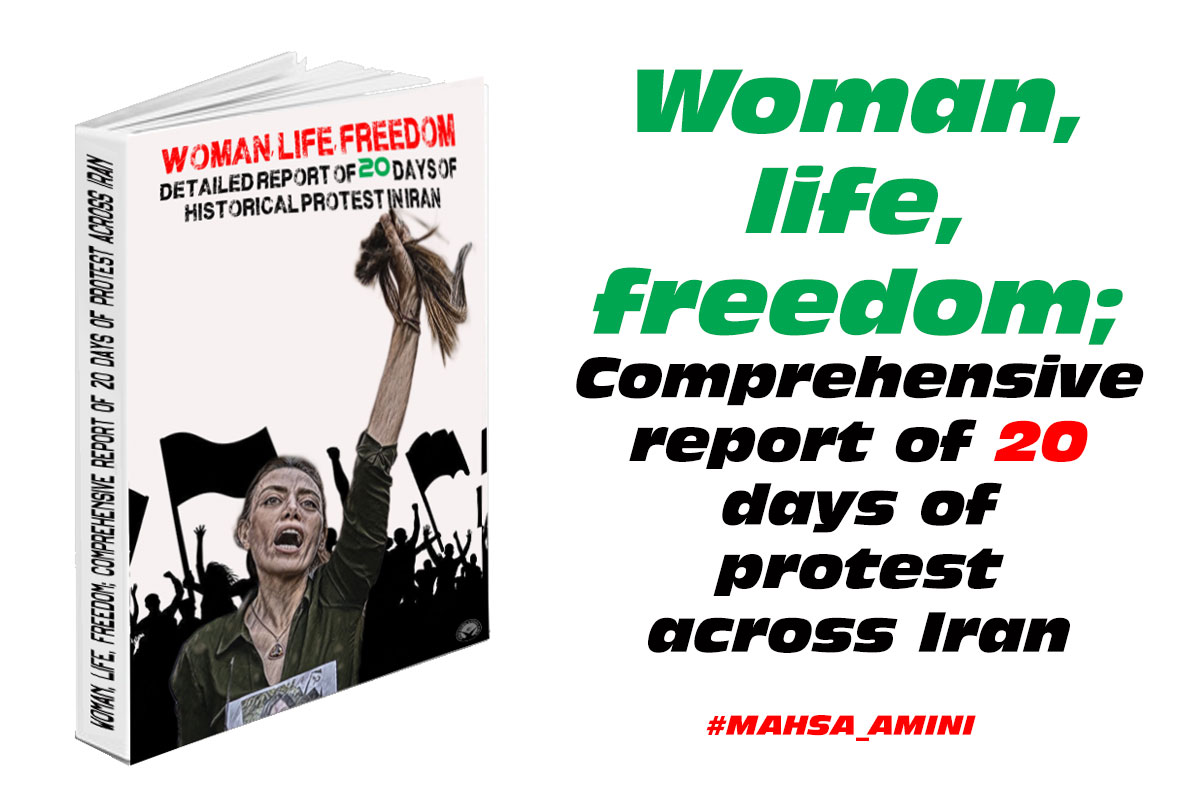

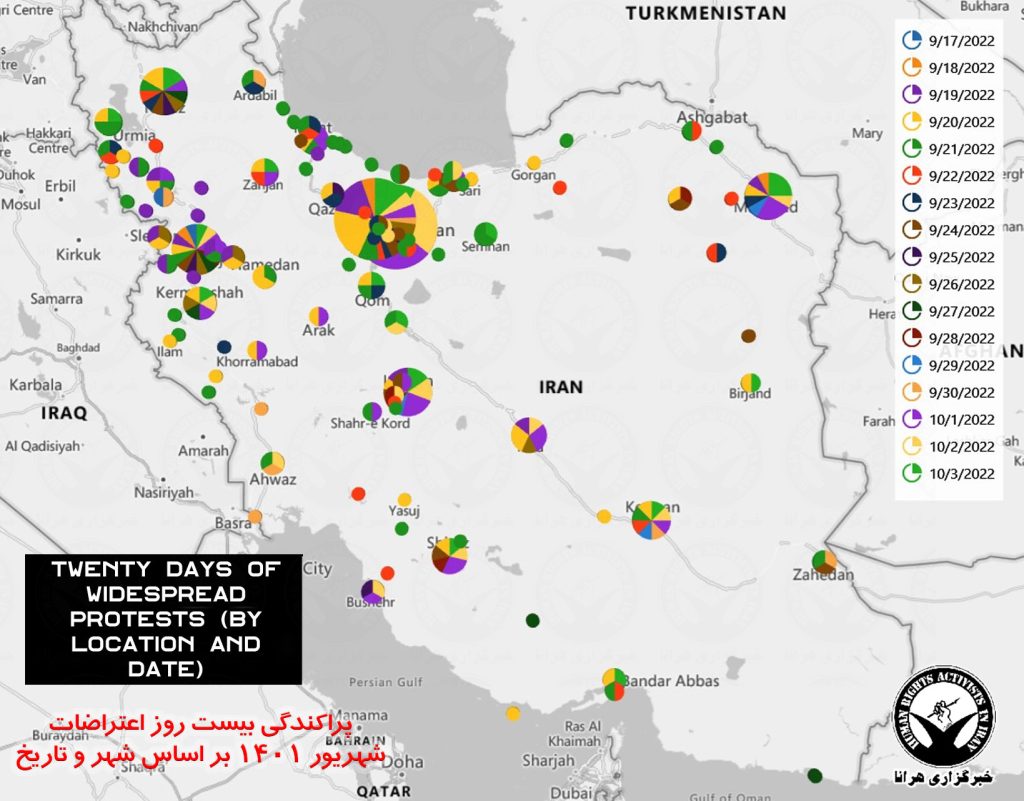
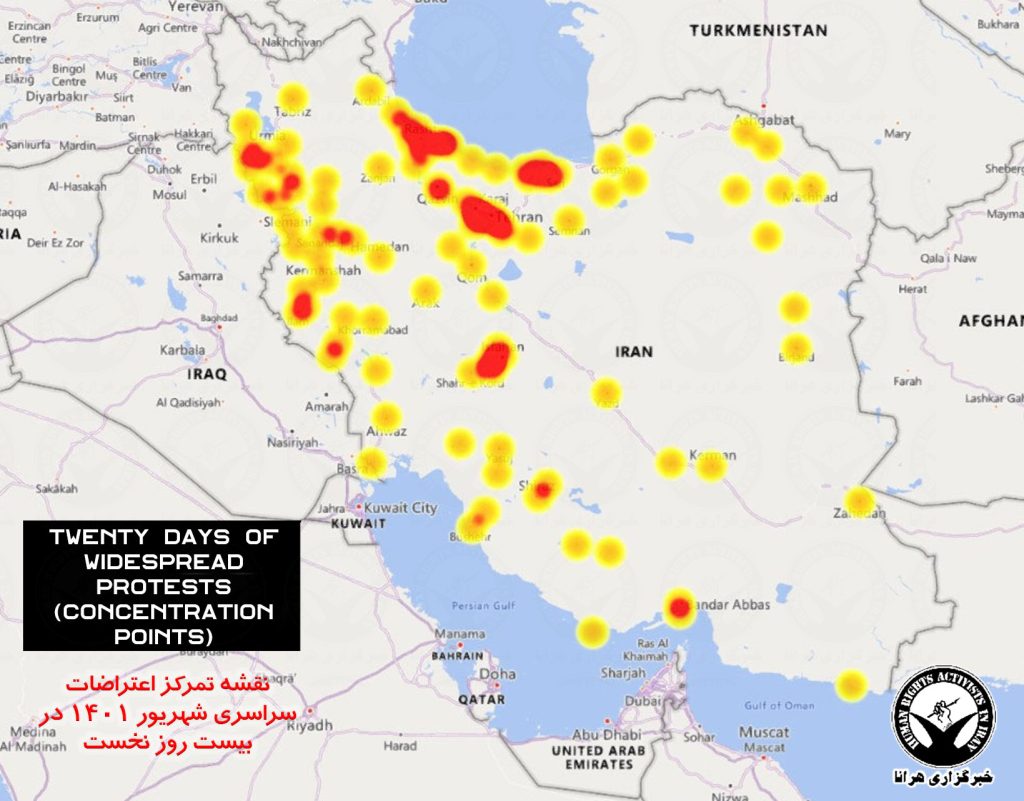
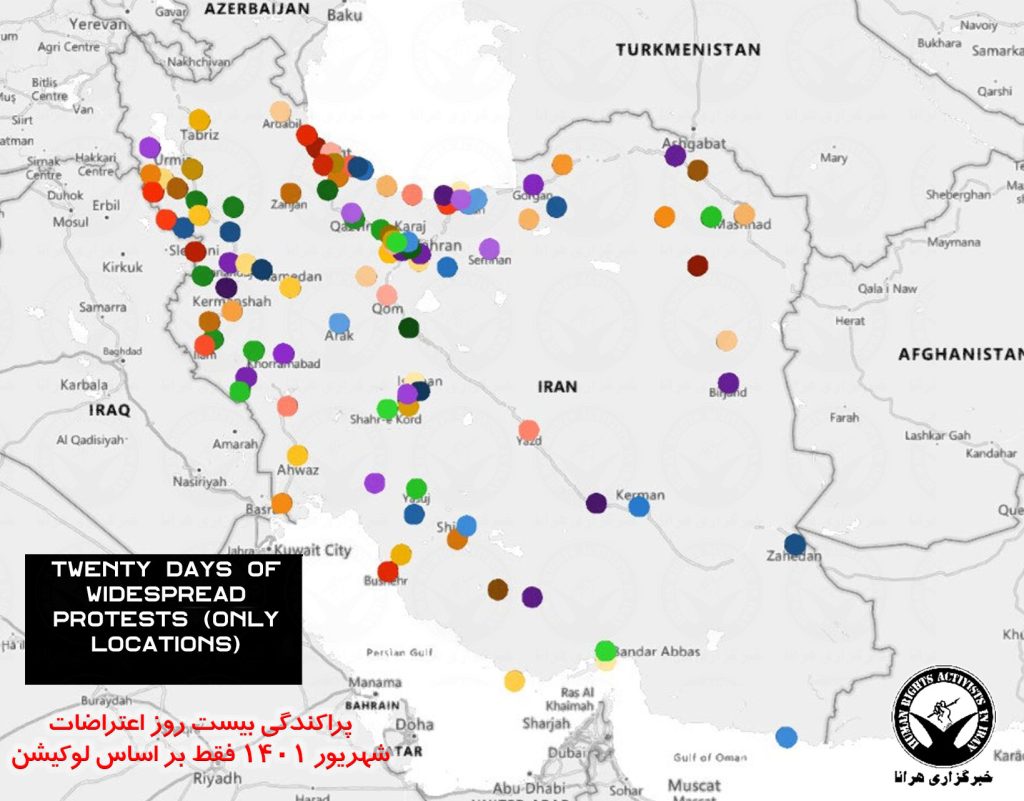
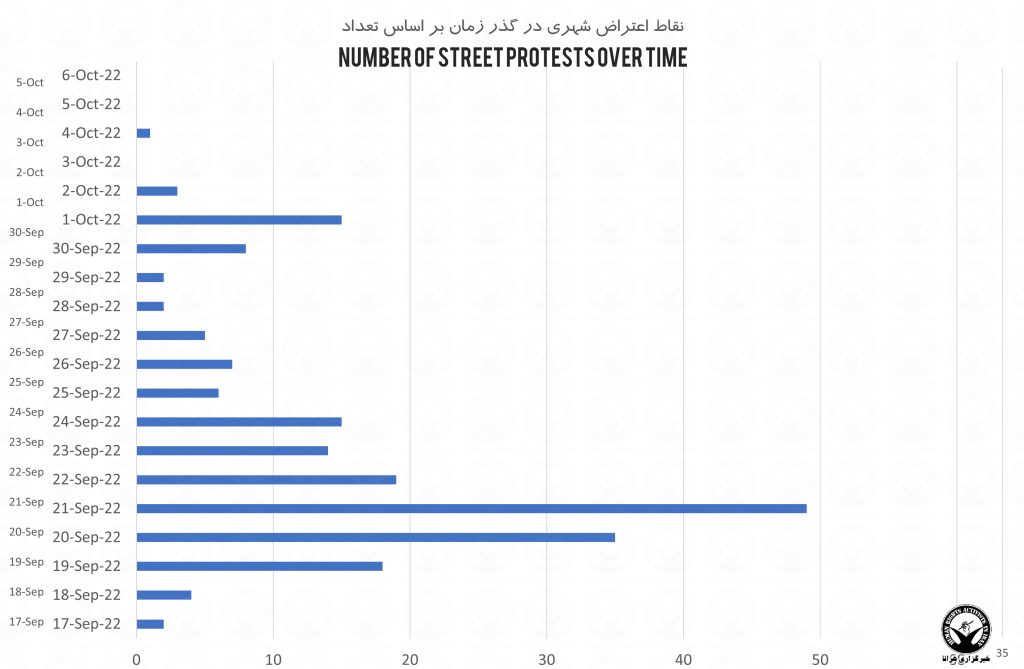
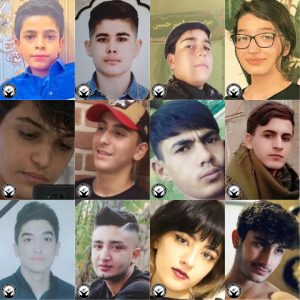 Following are the names of some of the victims of younger than 18 years old: Zakaria Khial (16 years old), Amin Maroufi (16 years old), Amirali Fouladi (16 years old), Parsa Rezadoost (17 years old), Siavash Mahmoudi (16 years old), Nika Shakarami (17 years old), Sarina Esmailzadeh (16 years old), Samer Hashemzehi (16 years old), Amirhossein Basati (15 years old), Mohammad Reza Sarvari (14 years old), Ali Mozaffari Salanghouch (17 years old), Sedis Keshani (14 years old), Javad Pousheh (12 years old), Jaber Shirouzi (12 years old), Amir Mahdi Farkhipour (17 years old), Ehsan Alibazi (16 years old), Omid Safarzahi (17 years old), Nima Shafaqdoost (16 years old),