Annual Report on Execution in Iran; Marking the World Day Against the Death Penalty

HRANA – Marking the World Day Against the Death Penalty, the Statistics Center of Human Rights Activists in Iran (HRA) has released its annual report on the use of capital punishment in Iran. The findings point to a sharp intensification in executions, continued secrecy surrounding implementation of death sentences, and an increase in political and security-related executions.

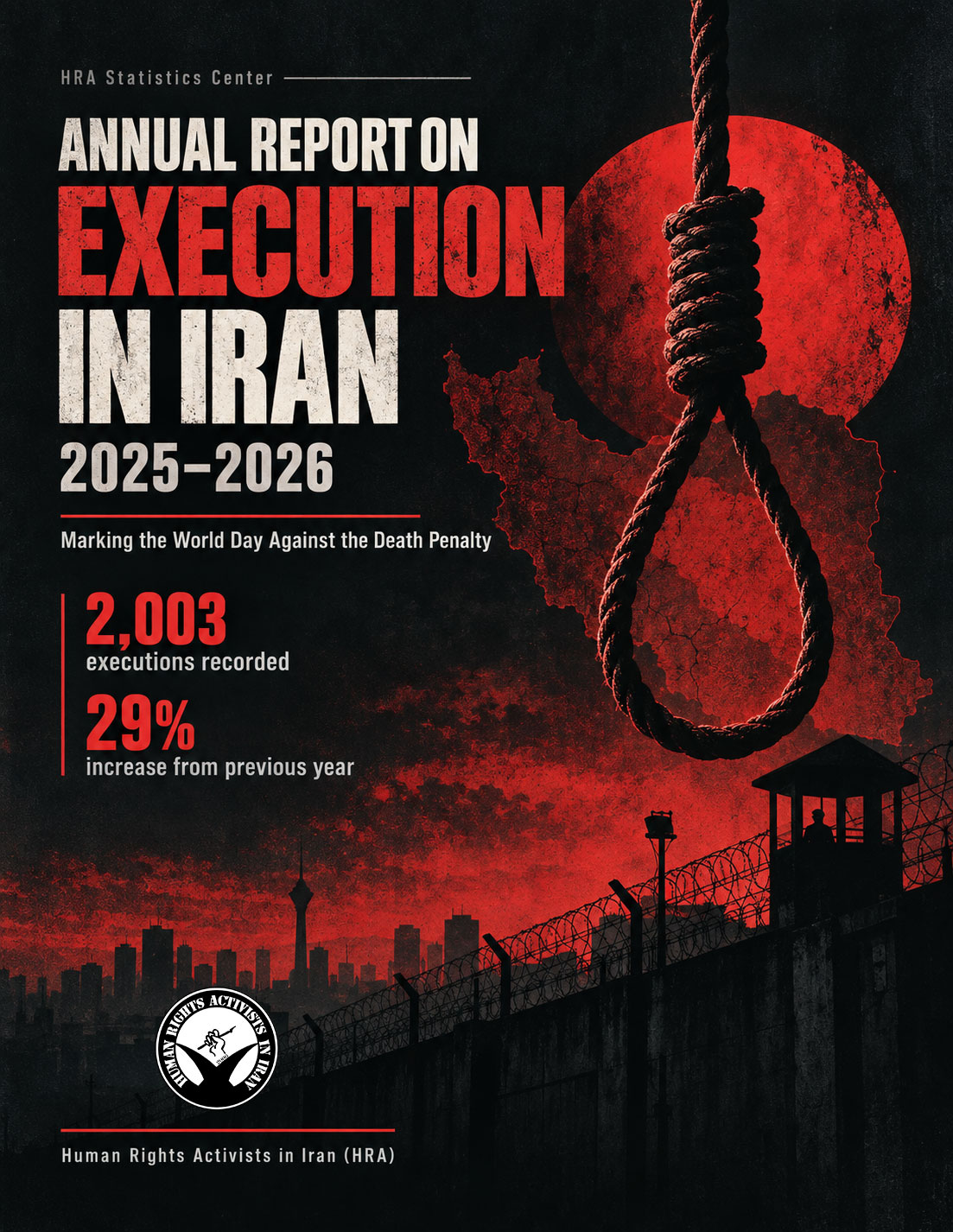
Between October 10, 2025 and October 8, 2026, HRANA documented at least 2,003 executions across Iran on the basis of 1,857 reports, an increase of approximately 29% compared with the previous reporting period. During the same period, 230 people were documented as having been sentenced to death. The full report also includes detailed statistical analysis, profiles of political and security-related executions, and documentation concerning judicial officials involved in issuing or upholding death sentences.

Executions in Iran: Key Figures

IndicatorData
Total executions documented2,003
Change from previous periodApproximately 29% increase
Average frequency of executionApproximately one person every 4.35 hours
Death sentences issued230
Women executed47
Juvenile offenders executed4
Public executions9
Political and security-related executions69
Executions unannounced by official sourcesApproximately 95%

Rising Executions and the Monthly Pattern

The 2,003 executions documented during the current reporting period represent the highest total recorded across the ten reporting periods examined in the report. Compared with 1,553 executions in 2024–2025, the total increased by approximately 29%. The current figure is also more than 182% above the ten-period average of 710 executions.

Monthly data show that executions peaked in December 2025. By contrast, March 2026 recorded the lowest total among complete months. The October 2026 figure covers only the first seven days of the month and therefore should not be compared directly with full-month totals.
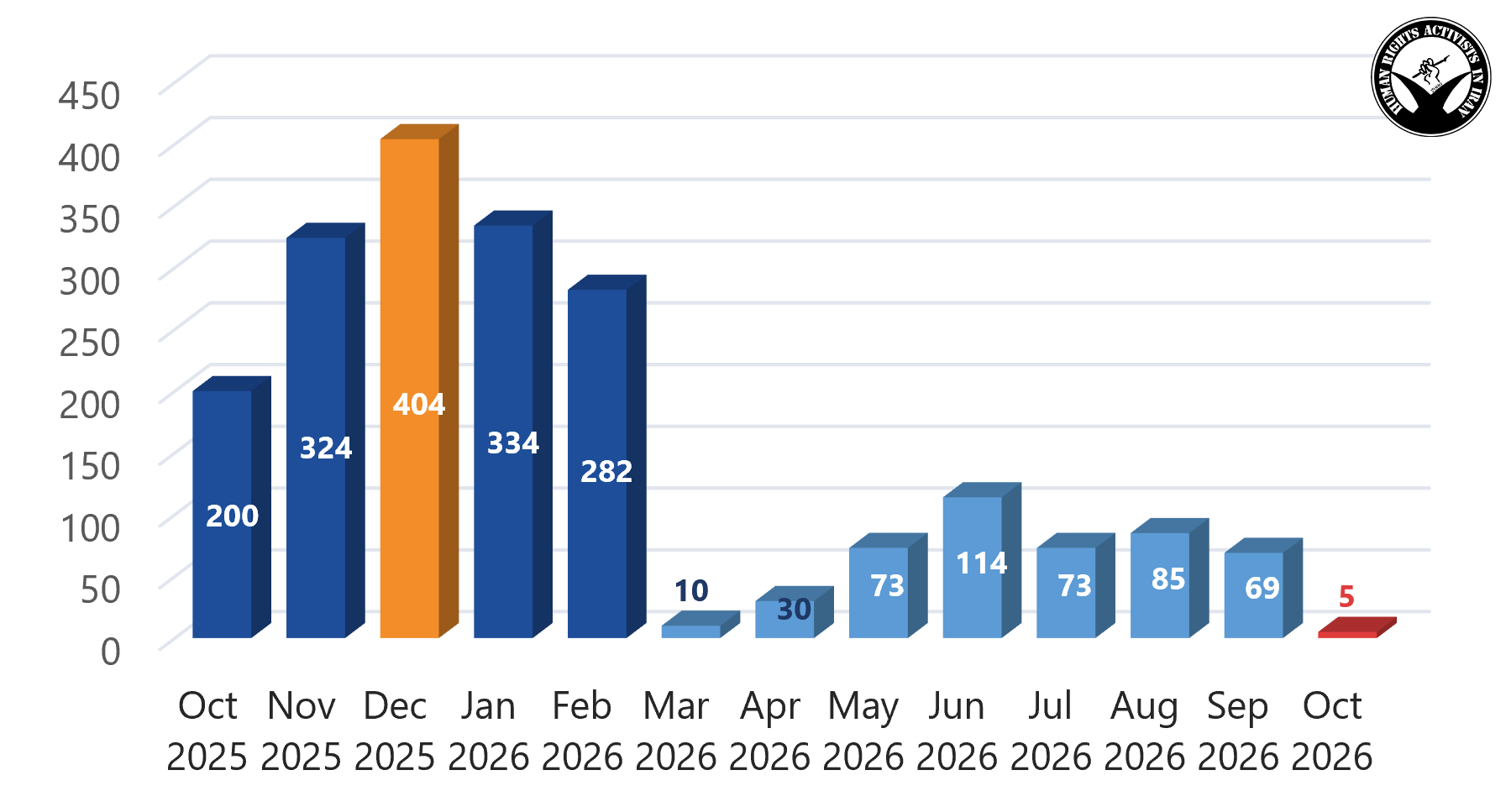
CHART 1 — Monthly Executions

Charges: Murder and Drug Offenses Dominate

The distribution of charges resulting in execution shows a notable shift from the previous period. According to HRANA documentation, 57.56% of those executed were convicted of murder and 36.25% of drug-related offenses. Political and security-related moharebeh or baghi charges accounted for 2.40%; other or unknown charges for 1.10%; security charges including espionage, assassination or bombing for 0.90%; rape for 0.80%; non-political moharebeh for 0.80%; efsad-e fel-arz (corruption on earth) for 0.15%; and economic crimes for 0.05%.

Taken together, murder and drug-related offenses account for more than 93% of all documented executions. At the same time, the increase in political and security-related executions, and the connection of a significant number of those cases to protests, stands out as a defining feature of the current reporting period.
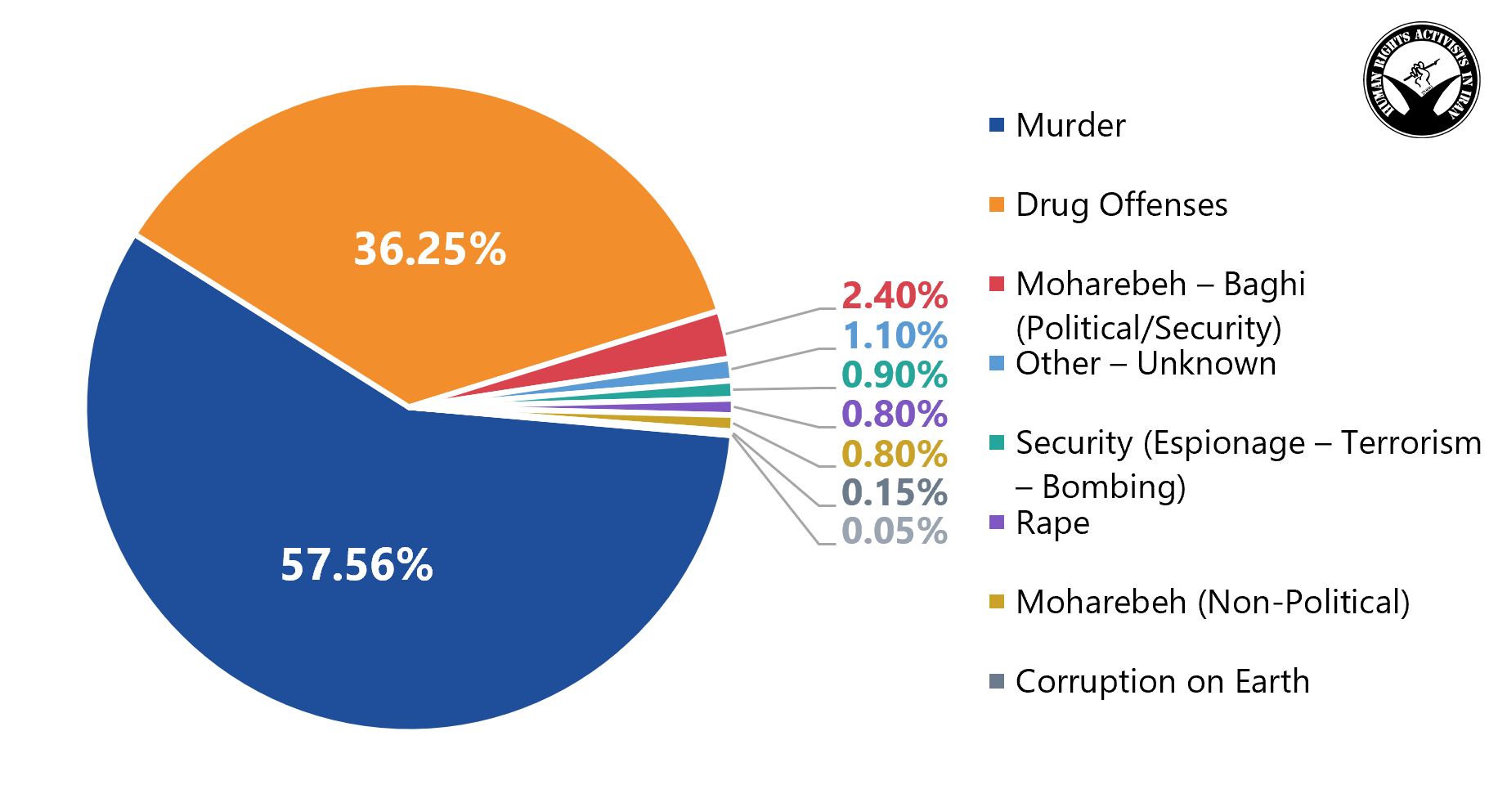
CHART 2 — Executions by Charge

Geography of Executions: Concentration in Several Provinces and Prisons

By location of execution, Razavi Khorasan recorded the highest number with 200 executions, followed by Isfahan with 164 and Alborz with 123. Fars recorded 119, Khuzestan 112 and Lorestan 102. These figures are calculated on the basis of prison location and do not necessarily reflect the place of residence or alleged offense of the person executed.

Per-capita figures provide a different picture, particularly in smaller provinces. The report cautions that prisoner transfers and executions carried out outside a prisoner’s province of origin can inflate provincial rates. Tehran is not included in the per-capita table because no executions were recorded there, and 30 executions with an unknown province were excluded from that calculation.

At the prison level, Dastgerd Prison in Isfahan and Adelabad Prison in Shiraz recorded the highest numbers of executions. The spread of executions across dozens of prisons, alongside clear concentration in several facilities, illustrates both the nationwide scope and localized intensity of the death penalty.
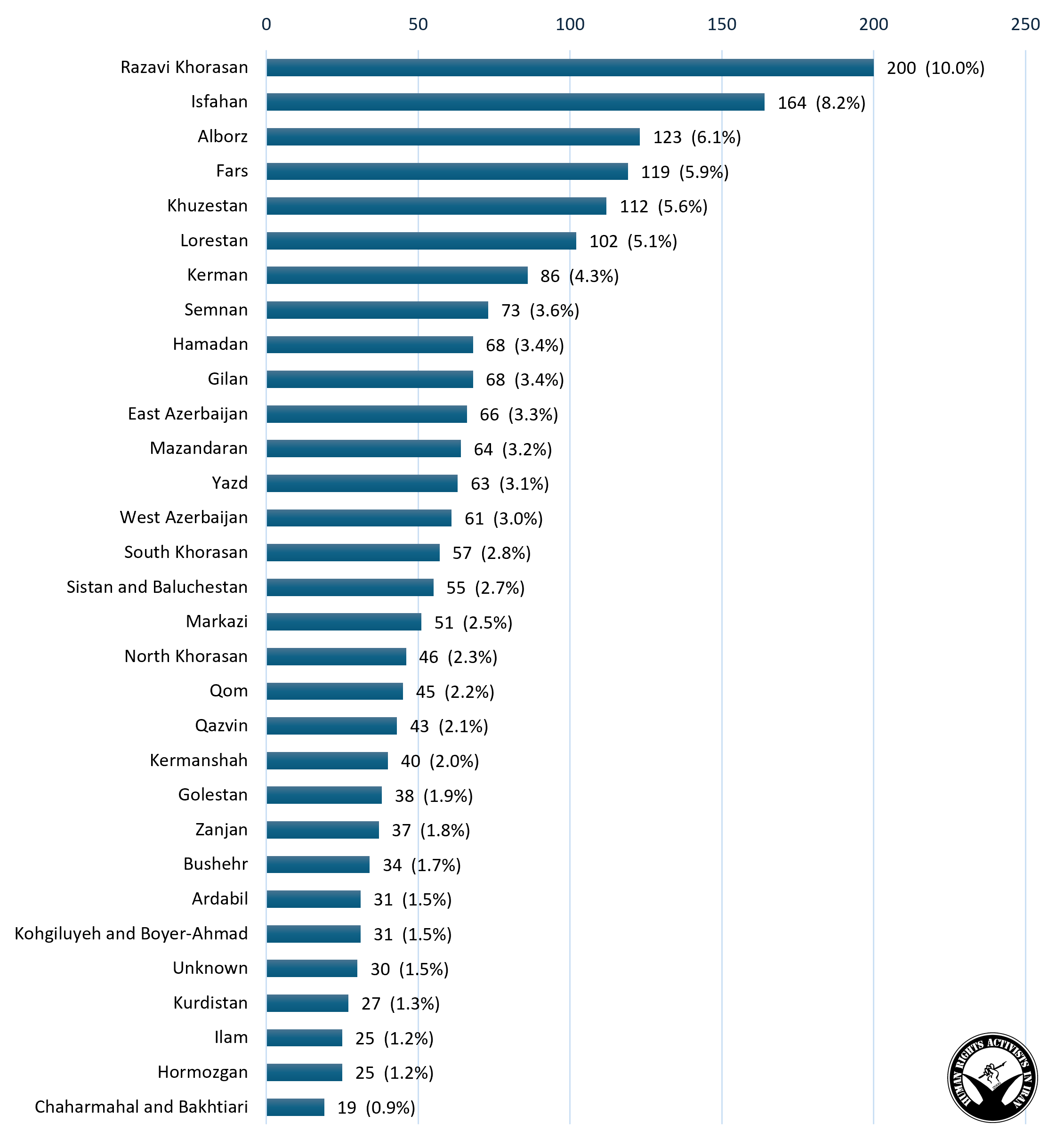
CHART 3 — Executions by Province

Secrecy, Public Executions and Gender

One of the report’s most significant findings is the continued lack of official transparency. Approximately 95% of documented executions were carried out secretly or without announcement in official or domestic media, while only about 5% were reported through official or domestic sources. This pattern sharply limits public oversight and independent assessment of execution practices.

Of the 2,003 executions documented, 9 were carried out in public, representing about 0.4% of the total. Forty-seven women were executed during the reporting period. Four people whose identities and case histories were verified were under the age of 18 at the time of the alleged offense. Overall, 2.3% of those executed were women, 88.8% were men, and the gender of 8.9% remained unknown in the available data.

In relation to sentencing, HRA documented 230 people sentenced to death. At least 16 of those sentenced were women, 6 were sentenced to public execution, and 74 death sentences were upheld by the Supreme Court.

Ten-Year Trend: The Highest Recorded Level

A review of ten reporting periods shows that, after executions declined from 505 in 2016–2017 to 238 in 2018–2019, the trend turned upward from 2019–2020 onward. The totals then rose through 249, 272, 528, 664, 823 and 1,553 before reaching 2,003 in 2025–2026.

This trajectory places the current one-year increase within a longer pattern of escalation. Continued restrictions on access to official information, together with the very high share of unannounced executions, mean that the documented figures should be understood as the minimum that could be independently verified rather than necessarily the complete number of executions carried out.
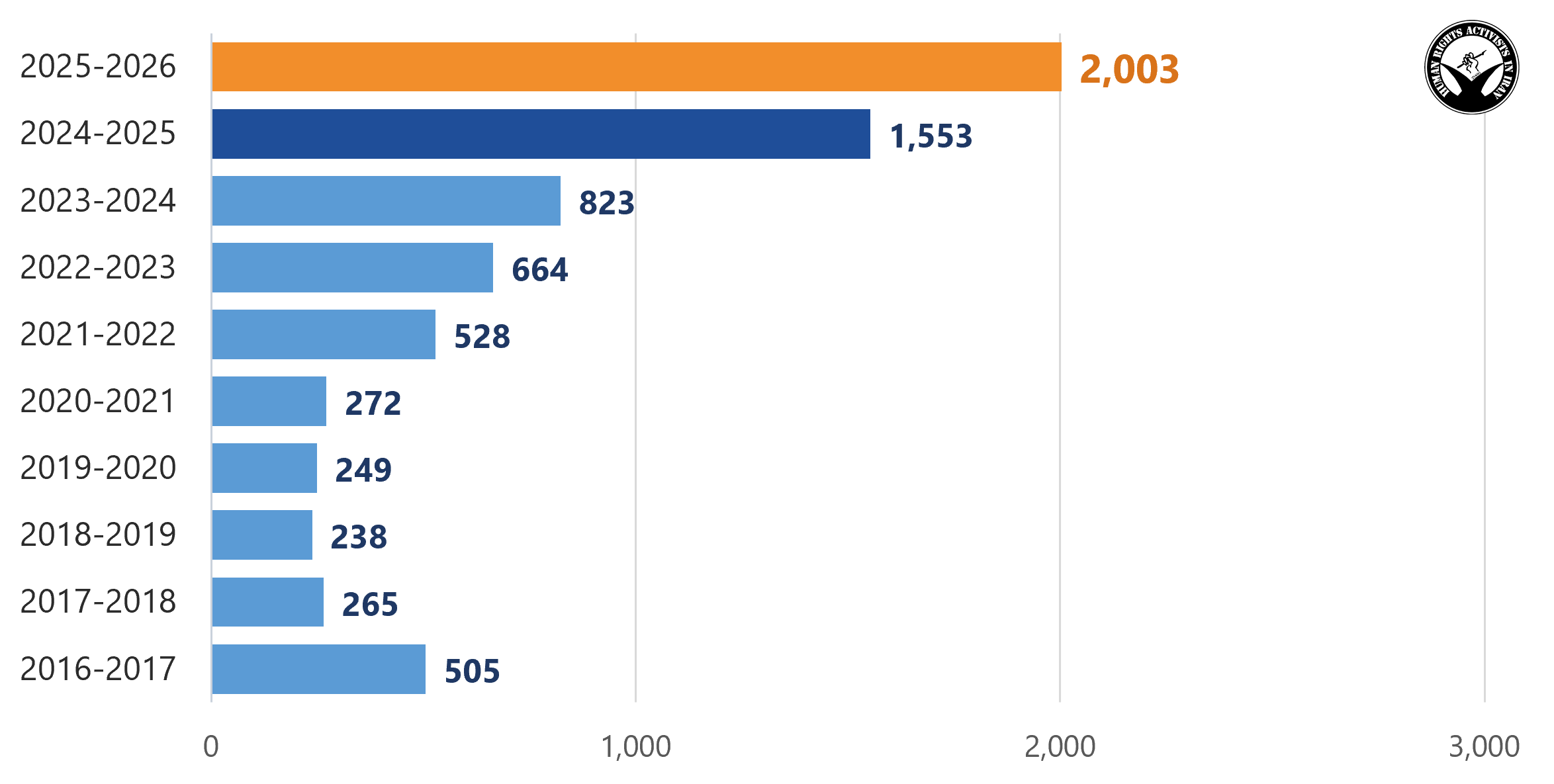
CHART 4 — Ten-Year Execution Trend

69 Political and Security-Related Executions

During the reporting period, HRANA documented 69 people executed on political and security-related charges. Of these, 35 people — approximately 51% — were executed in connection with the January 2026 (Dey 1404) protests. Twenty-nine people were executed in April and May 2026 alone, with 14 in April and 15 in May, marking the peak of executions in this category.

Among these 69 cases, 29 people were executed on charges of moharebeh, either alone or alongside other charges. Where the province was known, Alborz accounted for the largest share with 19 cases, followed by Isfahan with 10. The province was unknown in 20 cases.

The full report provides an individual case card for each of the 69 people, setting out the charge, date of execution, case background, province or city, and prison where available. This case-level documentation allows the aggregate figures to be examined in greater detail and shows the diversity of charges and case backgrounds included within the political and security-related category.

Judicial Actors Involved in Issuing or Upholding Death Sentences

For the first time in this format of the annual report, a dedicated section documents judges and courts identified in death-penalty cases. This research covers October 10, 2025 through September 26, 2026, meaning that its documentation window ends twelve days before the October 8, 2026 cutoff used for the report’s main statistical sections.

HRA’s review found that several judges identified during the current period had also appeared in earlier political, security-related or protest cases involving death sentences. Among the examples examined are Abolghasem Salavati of Branch 15 of the Tehran Revolutionary Court, Iman Afshari of Branch 26 of the Tehran Revolutionary Court, Vahid Hemmatnejad of Branch 5 of the Isfahan Revolutionary Court, Ahmad Darvish-Goftar of Branch 1 of the Rasht Revolutionary Court, Reza Najafzadeh of Branch 3 of the Urmia Revolutionary Court, and Seyed Mahmoud Sadati of Branch 1 of the Shiraz Revolutionary Court.

The report emphasizes that this list is not exhaustive. Iranian authorities routinely withhold information about capital proceedings, and public reporting often fails to identify the presiding judge or even the relevant branch. Accordingly, the absence of a judge’s name from the report should not be read as evidence that the judge was not involved; rather, it reflects the limits of independently verifiable information.

A separate section also addresses Supreme Court review and distinguishes between issuing a death sentence at trial and later upholding or reviewing that sentence. The available documentation identifies judges from Branches 9, 20, 39 and 41 of the Supreme Court in connection with specific death-penalty cases.

Methodology and Data Limitations

HRA’s Statistics Center relies on HRANA reporting, a nationwide volunteer network, verified open-source material, and official judicial announcements. Because independent human rights groups cannot operate freely in Iran, access to prisons and courts is restricted, and many executions are deliberately concealed, a margin of error is unavoidable.

The figures in this report therefore reflect the capacity of civil society to document and independently verify executions rather than a claim to a flawless count of every execution carried out. The fact that approximately 95% of executions were not announced by official sources underscores the importance of independent monitoring and verification in assessing the true scale of capital punishment in Iran.

Access the Full Report

The full report contains detailed statistical tables, charts, provincial and prison-level data, profiles of all 69 people executed on political and security-related charges, and the section documenting judicial officials. For case details, sources and supporting data, download and read the complete report.
Download the full PDF report here

Annual Report on Executions in Iran: Marking the World Day Against the Death Penalty

Human Rights Activists News Agency (HRANA)– Ahead of the World Day against the Death Penalty, the Center of Statistics of Human Rights Activists in Iran (HRA) has published its annual report in an effort to inform the public about situation of the death penalty in Iran, particularly thousands of individuals facing the death penalty and awaiting looming executions.

HRA’s Statistics Center relies on the work of HRANA reporters, as well as a network of independent and verifiable sources. It also incorporates the judicial authorities’ announcements or confirmations of prisoner executions on media, and as such, is exposed to a margin of error representing efforts by the Iranian authorities to omit, conceal, or restrict the collection of such data.

Between October 10, 2023, and October 8, 2024, at least 811 individuals were executed by hanging in Iran, rising to 23.06% compared to the same period last year. Of these executions, four were carried out in public. Many of the defendants were denied a fair trial.

HRANA obtained 721 reports regarding executions and death penalty in Iran during this period. The identified executed individuals, include 23 women and 4 juvenile offenders under the age of 18 at the time of alleged crime. Compared to the last period, the execution of female offenders has increased 35.29%.

According to the reports obtained by HRANA, over this period, Iranian authorities sentenced at least 186 defendants to death penalty, including at least 12 women, and 3 individuals to public execution. Death sentences issued increased by 13.41% compared to the last year. In the reporting period, the Supreme Court additionally upheld 59 previously imposed death sentences.

The chart below shows a breakdown of executions by capital offense: 55.49% were charged with drug trafficking, 35.51% with murder, 2.34% with rape, 2.34% with unknown offenses, 1.23% with spying, terror, and bombing, 1.11% with Corruption on Earth (Non-political), 0.86% with Political or Security-related offenses, 0.62% with armed robbery and 0.49% with Corruption on Earth.

execution in Iran

The pie chart below displays execution numbers by the province in which they took place. According to this chart, the Alborz (where three overcrowded prisons are located)  had the highest number of executions at 21.70%. Fars and Isfahan Provinces come second and third, with 9.86% and 6.78%, respectively.

The chart below depicts the distribution of executions’ information sources. The chart indicates that 71.64% of HRANA-confirmed executions were not announced by the official Iranian sources. Undisclosed executions are referred to as “secret” executions.


The chart down shows the execution numbers by gender.

The chart below displays execution numbers by the prison where the executions were carried out. The Qezel Hesar Prison of Karaj And Adel Abad of Shiraz officials have carried out the highest number.

The chart below displays percentage of executions carried out in public vs the number of executions that were carried out in prison. According to statistics, 0.49% of the executions in Iran were carried out in public.


For further inquiries please contact Skylar Thompson, Deputy Director Human Rights Activists in Iran (HRA) at [email protected]

World Day Against the Death Penalty: Annual Report on Execution in Iran 2022-2023

Human Rights Activists News Agency (HRANA)- On the World Day against the Death Penalty, the Center of Statistics of Human Rights Activists in Iran (HRA) has published its annual report in an effort to sensitize the public about the death penalty situation in Iran, particularly thousands of death-row convicts awaiting their looming executions.

HRA’s Statistics Center relies on the work of HRANA reporters, as well as a network of independent and verifiable sources. It also incorporates the judicial authorities’ announcements or confirmations of prisoner executions on media, and as such, is exposed to a margin of error representing efforts by the Iranian authorities to omit, conceal, or restrict the collection of such data.

Click on the picture to download the report in PDF format

Between October 10, 2022, and October 8, 2023, at least 659 convicts were executed by hanging in Iran, rising to 24% compared to the same period last year. Of these executions, Seven were carried out in public. Many of the defendants were denied a fair trial and due process.

HRANA obtained 580 reports regarding executions and the death penalty in Iran during this period. The identified executed individuals, include 17 women and 1 juvenile offender under the age of 18 at the time of the alleged crime. Compared to the last period, the execution of female offenders has decreased 15%.

According to the reports obtained by HRANA, over this period, Iranian authorities sentenced at least 164 defendants to the death penalty, including at least 5 women, and 2 public executions. Issuing death sentences rose by 84% compared to the last year.

As the chart below shows a breakdown of executions by capital offense: 56.60% for drug and narcotic offenses, 35.05% for murder, 2.58% for rape, 2.28% for unknown reasons, 1.21% for political or security-related offenses, 0.61% for “Corruption on Earth”, 0.61% for spying, terror, and bombing, 0.46% for “Corruption on Earth” (non-political), 0.46% for ideological, political, or religious reasons, 0.15% for Adultery – Types of consensual sexual relations

A comparison for the crimes committed by executed individuals

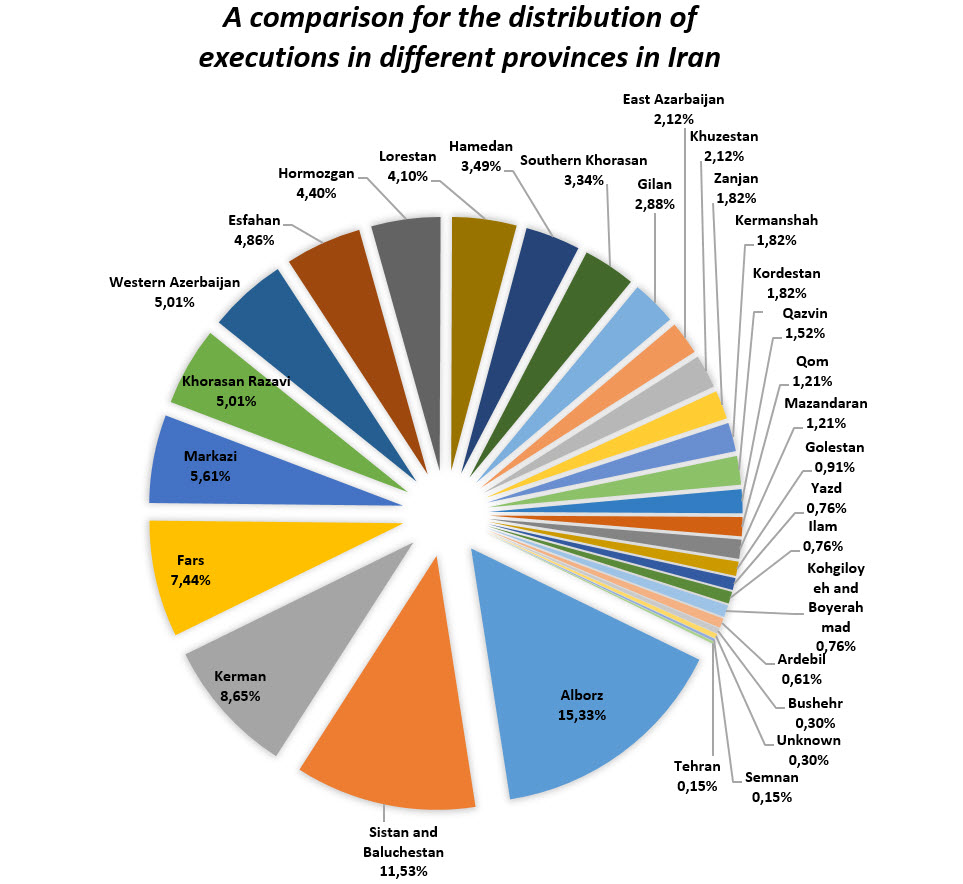
The pie chart below displays execution numbers by the province in which they took place. According to this chart, the Alborz (where three overcrowded prisons are located)  had the highest number of executions at 15.33%. Sistan and Baluchestan and Kerman Provinces come second and third, with 11.53% and 8.65%, respectively.

A comparison for the distribution of executions in different provinces in Iran

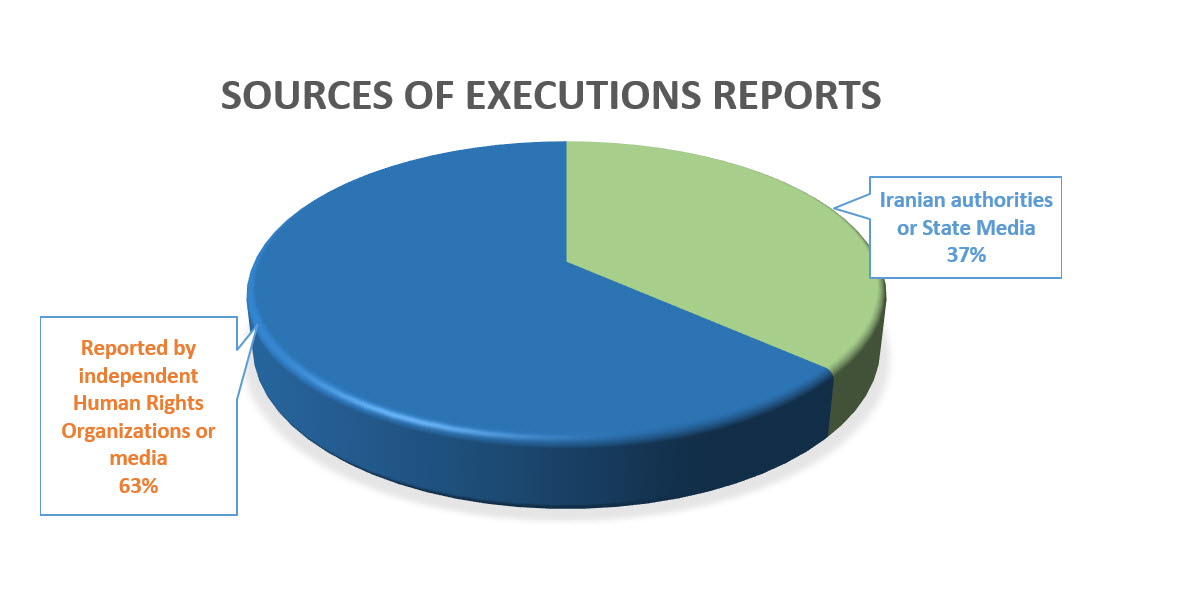
The chart below depicts the distribution of execution information sources. The chart indicates that 63% of HRANA-confirmed executions were not announced by official Iranian sources. Undisclosed executions are referred to as “secret” executions.

Sources of executions reports

The chart down shows the execution numbers by gender.

Victims' Gender

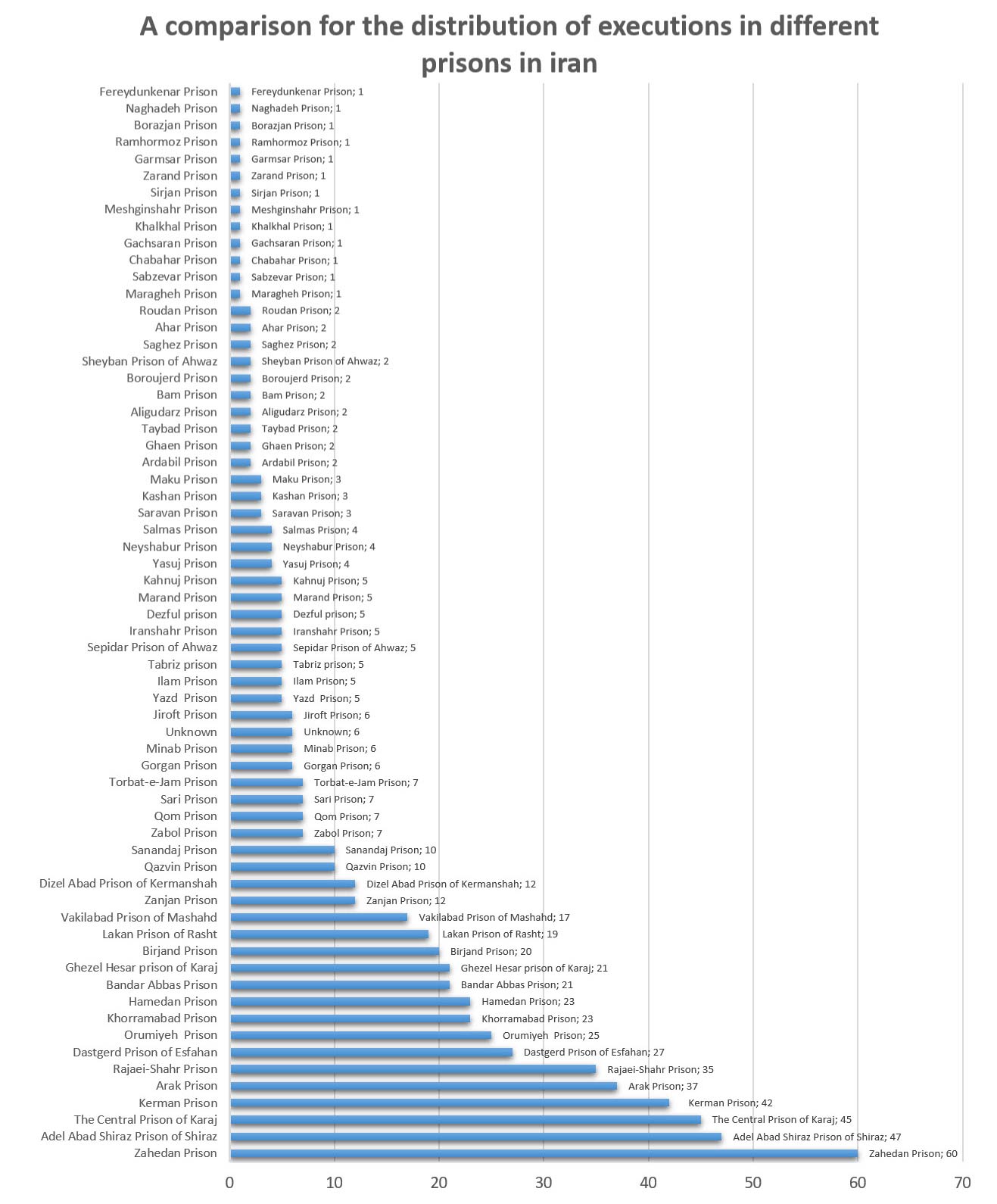
The chart below displays execution numbers by the prison where the executions were carried out. The Zahedan Prison And Adel Abad of Shiraz officials have carried out the highest number.

A comparison for the distribution of executions in different prisons in iran

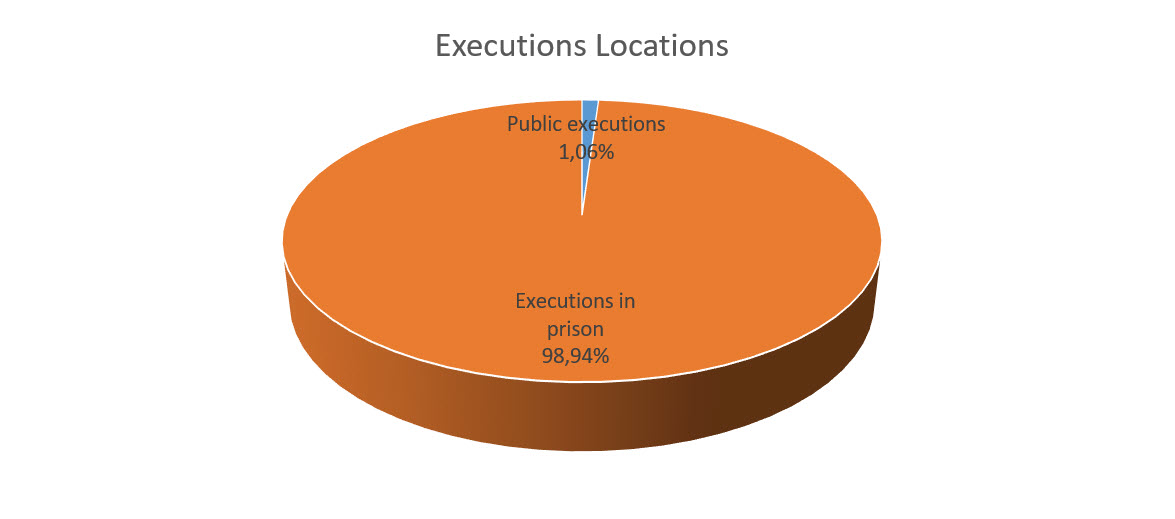
The chart below displays the percentage of executions carried out in public Vs the number of executions that were carried out in prison. According to statistics, 1.06% of the executions in Iran were carried out in public.

Executions Locations

Click here to download the report in PDF format.

For further inquiries please contact Skylar Thompson, Senior Advocacy Coordinator Human Rights Activists in Iran (HRA) at [email protected]

59 Human Rights Organizations Call for Abolition of Death Penalty for All Offences

On October 10, the 20th anniversary of the World Day Against the Death Penalty, Human Rights Activists in Iran and 58 other human rights organizations issued a joint statement to draw attention to gender bias and discrimination against women and LGBTQIA+, which can negatively impact the judicial process. They also called for the abolition of the death penalty for all offenses.

The following is the full text of this statement:

20TH WORLD DAY AGAINST THE DEATH PENALTY

On this 20th anniversary of the World Day Against the Death Penalty dedicated to the link between torture and the use of the death penalty and in continuation of the 2021 World Day Against the Death Penalty dedicated to women facing capital punishment, sentenced to death, executed, pardoned or charged with a capital crime and found not guilty, the members of the World Coalition and allies of women and LGBTQIA+ individuals sentenced to death take this opportunity to:

  • Draw attention to gender bias in the use of torture in the judicial process leading to the imposition of the death penalty. Women and LGBTQIA+ individuals are particularly at risk to abuse, including physical, sexual, and psychological torture. In addition, women victims of gender-based violence, who are over-represented on death row, are at risk of making false confessions when subjected to coercive investigative methods, especially those carried out by men.
  • Emphasize that violence against women and LGBTQIA+ individuals in detention – including gender and sexual abuse and harassment, inappropriate touching during searches, rape, and sexual coercion – can rise to the level of torture or cruel, inhuman, or degrading treatment or punishment, in violation of the International Covenant on Civil and Political Rights (ICCPR) and the Convention Against Torture (CAT), among others.
  • Accentuate that women and LGBTQIA+ individuals have specific needs, including sexual and reproductive health care, medical and mental health care, harm reduction services for those using drugs, and protection from gender-based violence, among others. These needs are not systematically considered and covered in prisons, which can turn detention into torture.
  • Stress that in many countries, particularly those with the mandatory death penalty, women and LGBTQIA+ individuals may be sentenced to death without considering their experiences of gender-based violence, among their other vulnerability aspects, prior to incarceration.

More broadly, the members of the World Coalition and allies of women and LGBTQIA+ individuals sentenced to death and at risk of being sentenced to death wish to use this 20th anniversary to:

  • Emphasize that, as done by the Special Rapporteur on extrajudicial, summary or arbitrary executions in its 2022 report, the death penalty as currently practiced can be considered as torture.
  • Call attention to the intersectional discrimination and inequalities that women and LGBTQIA+ individuals face, as these can negatively impact the judicial process leading to the death penalty. Pervasive gender biases in criminal legal systems influence: the investigation, through gender bias by law enforcement; the trial, where marginalized women and LGBTQIA+ individuals tend to be denied fair trial; and at the sentencing stage, where mitigating circumstances that might benefit women and LGBTQIA+ individuals sentenced to death are not considered.
  • Recall that, in violation of international human right law and standards, 12 countries continue to criminalize consensual same-sex relations, imposing the death penalty upon conviction.
  • Address the recognition of the intersectional dimension of discrimination. An analysis of the profiles of women sentenced to death reveals that most are from ethnic and racial minorities, are non-literate, and live with intellectual or psychological disabilities, often as a result of the gender-based violence they have suffered. Gender-based discrimination does not operate in isolation but is compounded by other forms of discrimination, including discrimination based on age, race, ethnicity, nationality, sexual orientation, gender identity and expression, sex characteristics, economic status, and disability, among others.
  • Make visible the lack of accurate and up-to-date data on the number and status of women and LGBTQIA+ individuals sentenced to death, executed, or whose death sentences have been commuted or pardoned.

We recommend that governments in countries that still retain the death penalty:

  1. Abolish the death penalty for all offences, regardless of gender, sexual orientation, gender identity and expression, and sex characteristics;
  2. Establish a moratorium on executions with a view to abolishing the death penalty, as called for by the UN General Assembly in its resolutions calling for a moratorium on the use of the death penalty;
  3. Pending full abolition, we call on governments to:
    1. Eliminate the death penalty for offences that do not meet the threshold of  “most serious crimes” under international law and standards including same-sex relationships and drug offences;
    2. Repeal provisions that allow for the mandatory imposition of the death penalty, which does not allow judges to consider the circumstances of the offence for the defendant at sentencing;
    3. Commute the sentences of women sentenced to death for killing close family members who perpetrated gender-based violence against them and for women sentenced to death for drug trafficking and other offenses that do not involve the loss of human life;
    4. Acknowledge the compounding forms of violence and discrimination experienced by girls, women and LGBTQIA+ individuals – including gender-based violence, early and forced marriage;
    5. Review laws, criminal procedures, and judicial practices and implement policies and legislative reforms to protect women and LGBTQIA+ individuals from violence and discrimination;
    6. Ensure that the criminal legal system takes full account of any mitigating factors linked to women’s and LGBTQIA+ individuals’ backgrounds, including evidence of prior abuse as well as psycho-social and intellectual disabilities;
    7. Ensure publicly available disaggregated data on people sentenced to death, their profile, age, gender, the courts that have pronounced the judgements charges and places of detention;
    8. Prevent the disproportionate detention and prosecution of women for “moral and sexual” crimes and of people for their sexual orientation and decriminalize such offenses;
    9. Promote the training of all those involved in the investigation, legal defense, prosecution, trial, adjudication and conviction of crimes involving women on gender-based discrimination and violence, pathways to crime, and gender-sensitive mitigations;
    10. Ensure that all those facing the death penalty have access to free and effective legal representation by counsel with experience representing individuals charged with capital offences and who are trained to recognize and bring forward mitigating factors, including those linked to gender-based discrimination and violence;
    11. Develop and implement programs to prevent gender-based violence and discrimination, and to promote the human rights of women, girls and LGBTQIA individuals+;
    12. Guarantee access to consular assistance for foreign women charged with death-eligible offenses, as required by the Vienna Convention on Consular Relations;
    13. In accordance with the Bangkok Rules and the Mandela Rules, adopt gender-sensitive policies regarding the detention of women, ensuring their safety and security before trial, during admission to prison, and while incarcerated.

Signatory organizations:


  1. ACAT Germany
  2. AdvocAid
  3. The Advocates for Human Rights
  4. American Constitution Society
  5. Anti-Death Penalty Asia Network (ADPAN)
  6. Association pour les Droits Humains au Kurdistan d’Iran-Genève (KMMK-G)
  7. Avocats sans frontières France
  8. Capital Punishment Justice Project
  9. Center for Constitutional Rights
  10. Coalition Tunisienne Contre la Peine de mort
  11. Colegio de Abogados y Abogadas de Puerto Rico
  12. Cornell Center on the Death Penalty Worldwide
  13. The Death Penalty Project
  14. Droit et Paix
  15. Ensemble Contre la Peine de Mort
  16. Federal Association of Vietnamese Refugees in the Federal Republic of Germany
  17. Fédération internationale pour les droits humains (FIDH)
  18. Fédération internationale des ACAT (FIACAT)
  19. Forum Marocain pour la Vérité et la Justice
  20. Gender Violence Clinic – University of Maryland Carey School of Law
  21. German Coalition to Abolish the Death Penalt
  22. Global Alliance Against Traffic in Women
  23. Greater Caribbean for Life
  24. Harm Reduction International
  25. Human Rights Activists in Iran
  26. Human Rights and Legal Profession Project Assistant
  27. International Commission of Jurist
  28. Institute for Criminal Justice Reform
  29. Institute for the Rule of Law of the International Association of Lawyers
  30. IraQueer
  31. Italian Federation for Human Rights
  32. Japan Innocence and Death Penalty Information Center
  33. Kenya Human Rights Commission
  34. Lawyers Collective India
  35. Lembaga Bantuan Hukum Masyarakat
  36. Ligue des droits de l’Homme (LDH)
  37. Madrid Bar Association
  38. MASUM & PACTI
  39. Mouvement contre le racisme et pour l’amitié entre les peuples (MRAP)
  40. Parliamentarians for Global Action (PGA)
  41. Pax Christi Uvira
  42. Penal Reform International
  43. Persatuan Sahabat Wanita Selangor
  44. Red para la Abolición de la Pena de Muerte y las Penas Crueles
  45. Resilient Women’s Organization
  46. Planète Réfugiés-Droits de l’Homme
  47. The Rights Practice
  48. Sandigan Kuwait
  49. The Sentencing Project
  50. Society for Human Rights and Development Organisation (SHRDO)
  51. Taiwan Alliance to End the Death Penalty (TAEDP)
  52. Terre des Femmes e.V.
  53. The Texas After Violence Project
  54. Union Chrétienne pour le Progrès et la Défense des Droits de l’Homme
  55. The William Gomes Podcast
  56. Witness to Innocence
  57. Women Beyond Walls
  58. The Women and Harm Reduction International
  59. World Coalition Against the Death Penalty


World Day Against the Death Penalty: Annual Report on Execution in Iran 2021-2022

Human Rights Activists News Agency (HRANA)- On the World Day against the Death Penalty, the Center of Statistics of Human Rights Activists in Iran (HRA) has published its annual report in an effort to sensitize the public about the death penalty situation in Iran, particularly thousands of death-row convicts awaiting their looming executions.

HRA’s Statistics Center relies on the work of HRANA reporters, as well as a network of independent and verifiable sources. It also incorporates the judicial authorities’ announcements or confirmations of prisoner executions on media, and as such, is exposed to a margin of error representing efforts by the Iranian authorities to omit, conceal, or restrict the collection of such data.

Between October 10, 2021, and October 7, 2022, at least 528 convicts were executed by hanging in Iran, rising to 98% compared to the same period last year. Of these executions, one was carried out in public. Many of the defendants were denied a fair trial and due process.

Click here to download report in PDF format

HRANA obtained 439 reports regarding executions and death penalty in Iran during this period. The identified executed individuals, include 20 women and 6 juvenile offenders under the age of 18 at the time of alleged crime. Compared to the last period, the execution of female offenders has raised 55%.

According to the reports obtained by HRANA, over this period, Iranian authorities sentenced at least 89 defendants to death penalty, including at least 5 women, and 7 public executions.  Issuing death sentence decreased by 1% compared to the last year.

As the chart below shows a breakdown of executions by capital offense: 50.38% were charged with murder, 41.29% with drug and narcotic offenses, 3.03% with rape, 1.70% with non-political armed robbery/offenses classified as “corruption on earth,” and 0.38% with political or security-related offenses. Moreover, 0.38% were convicted of security charges (spying, terror, and bombing), 0.38% were convicted of armed robbery, and 2.46% of charges are unknown.

The pie chart below displays execution numbers by the province in which they took place. According to this chart, the Sistan and Baluchestan Province had the highest number of executions at 16%. Alborz (where three overcrowded prisons are located) and Fars Provinces come second and third, with 16.48% and 11.93%, respectively.

The chart below depicts the distribution of executions’ information sources. The chart indicates that 70% of HRANA-confirmed executions were not announced by the official Iranian sources. Undisclosed executions are referred to as “secret” executions.


The chart above shows the execution numbers by gender.

The pie chart below displays execution numbers by the prison where the executions were carried out. The Rajai-Shahr Prison officials have carried out the highest number of executions with 14.42%. Zahedan Prison ranks second with 12,33% executions.

The chart below displays percentage of executions carried out in public Vs. the number of executions that were carried out in prison. According to statistics, 0.19% of the executions in Iran were carried out in public.

***

Click here to download the report in PDF format.

For further inquiries please contact Skylar Thompson, Senior Advocacy Coordinator Human Rights Activists in Iran (HRA) at [email protected]

Subscribe to Our Newsletter

Now is definitely not the time to stop reading!

Juvenile Offender Arman Abdolali in Imminent Danger of Execution in Rajai Shahr Prison

Arman Abdolali, who was previously sentenced to death for a murder charge from when he was a child, is in imminent danger of execution in Rajai Shahr Prison.

According to HRANA, the news agency of Human Rights Activists, despite his denial of having committed the crime, and despite the fact that the victim’s body was never found, the criminal court of Tehran Province sentenced Abdolali to death. The verdict was upheld twice by the supreme court of Iran.

Abdolali was reportedly transferred to a solitary confinement cell, as is the protocol for inmates on death row in the days before their execution, yesterday. In July of this year, his lawyer had informed about the forwarding Abdolali’s case to the Executive Branch of Tehran Criminal Court.
“Iran continues to use the death penalty for crimes committed by people under the age of 18, in violation of its obligations under the International Covenant on Civil and Political Rights and the Convention on the Rights of the Child,” Amnesty International expressed in a statement, calling for Iranian authorities to halt Abdolali’s execution.

In 2013, when he was underage, Arman Abdolali was indicted on the charge of murdering his girlfriend, Ghazaleh Shakur. During interrogation, he confessed to killing her but later on, he denied the charges and pleaded his innocence.

After the first confirmation of the sentence, Abdolali’s lawyer claimed him as innocent and asked for a retrial, which was granted by the Supreme Court of Iran. In the second retrial, the death sentence was upheld after six months both by the Supreme Court of Iran and thereafter by an appellate court.
World Day Against the Death Penalty: Annual Report on Execution in Iran 2019-2020

Human Rights Activists News Agency (HRANA)- On the World Day Against the Death Penalty, the Center of Statistics of Human Rights Activists in Iran (HRAI) has published its annual report, in efforts to sensitize the public about the situation of the death penalty in Iran.
HRANA’s Statistics Center relies on the work of HRANA reporters, as well as a network of independent and verifiable sources. It also incorporates disclosures to the media by judicial authorities announcing or confirming prisoner executions, and as such is exposed to a margin of error representing efforts by the Iranian authorities to omit, conceal, or restrict the collection of such data.

Between October 10, 2019, and October 8, 2020, the death penalty and executions have been the focus of 264 HRANA reports. Over this time period, the Iranian authorities issued the death penalty sentence to 96 individuals and have already carried out 256 executions including 2 public executions.

Click here to download report in PDF format

While execution numbers went down by 2% in comparison to the same time last year, Iranian courts have issued 16% less death sentences. Public hangings and executions of women have decreased by 78% and increased 12%, respectively.

Females account for only 15 of the 256 HRANA-confirmed execution victims this year. . In addition, 2 juvenile offenders, under the age of 18 when they allegedly committed the crime they were charged with, were executed.

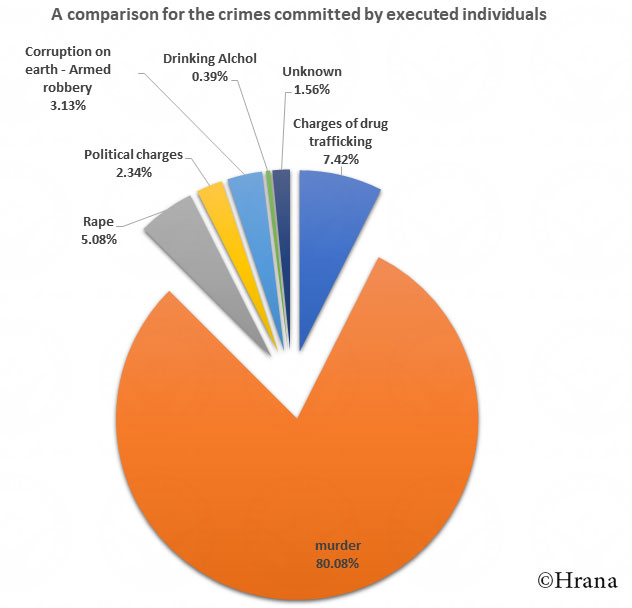
The report includes a breakdown of executions by capital offense: 80.08% were charged with murder, 7.42% were charged with drug and narcotic offenses, 5.08% were charged with Rape, 2.34% were charged with armed robbery/offenses classified as “corruption on earth”, 3.13% were charged with political or security-related offenses, 0.39% were charged with drinking alcohol and 1.56% had unknown charges.

The chart below displays execution numbers by the province in which they took place. According to this chart, Alborz had the highest number of executions at 16%.  Khorasan Razavi and West Azerbaijan come second and third, with 11% and 9% respectively.

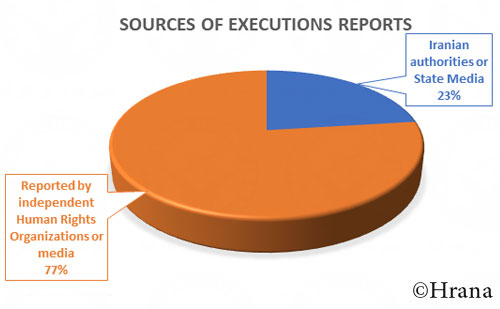
The chart below is a distribution of execution information sources. The chart indicates that 77% of HRANA-confirmed executions were not announced by the official Iranian sources. Undisclosed executions are referred to as “secret” executions.

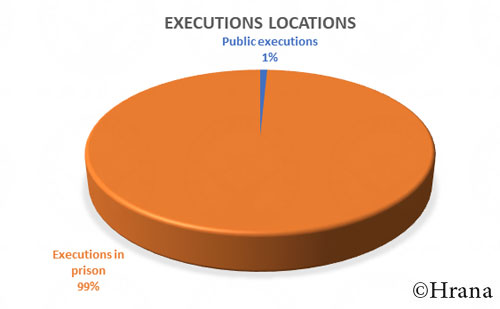
The chart below displays execution numbers by their location in prison or public. According to statistics, 1% of the executions in Iran were carried out in public.


Click here to download the report in PDF format

World Day Against the Death Penalty: Annual Report on Execution in Iran-2019

Human Rights Activists News Agency (HRANA)- On the World Day Against the Death Penalty, the Center of Statistics of Human Rights Activists in Iran (HRAI) has published its annual report, in efforts to sensitize the public about the situation of the death penalty in Iran.

HRANA’s Statistics Center relies on the work of HRANA reporters, as well as a network of independent and verifiable sources. It also incorporates disclosures to the media by judicial authorities announcing or confirming prisoner executions, and as such is exposed to a margin of error representing efforts by the Iranian authorities to omit, conceal, or restrict the collection of such data.

From October 10, 2018, to October 8, 2019, the death penalty and executions have been the focus of 250 HRANA reports. Over this time period, the Iranian authorities issued the death penalty sentence to 134 individuals and have already carried out 242 executions including 16 public executions.

While execution numbers went down by 5.4% in comparison to the same time last year, Iranian courts have issued 47.6% less death sentences. Public hangings and executions of women have raised 6.6% and 140%, respectively.

Females account for only 12 of the 242 HRANA-confirmed execution victims this year. In addition, five juvenile offenders who were under the age of 18 when they allegedly committed the crime they were charged with, were executed.

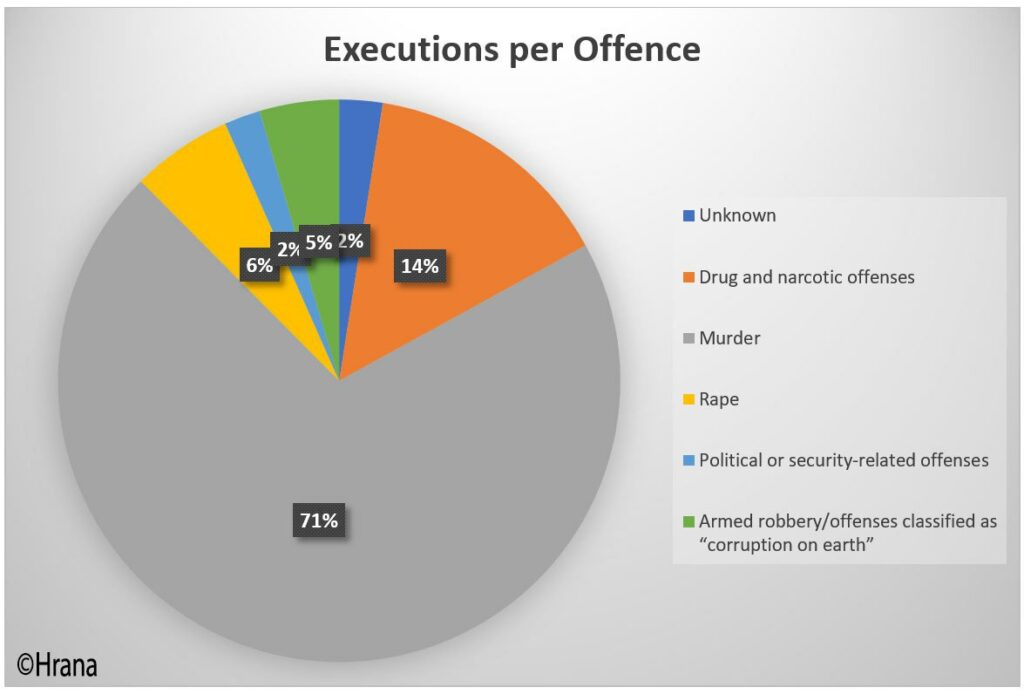
The report includes a breakdown of executions by capital offense: 71% were charged with murder, 14% were charged with drug and narcotic offenses, 6% were charged with rape, 5% were charged with armed robbery/offenses classified as “corruption on earth”, 2% were charged with political or security-related offenses, and 2% had unknown charges.

The chart below displays execution numbers by their location in prison or public. According to statistics, 7% of the executions in Iran were carried out in public.

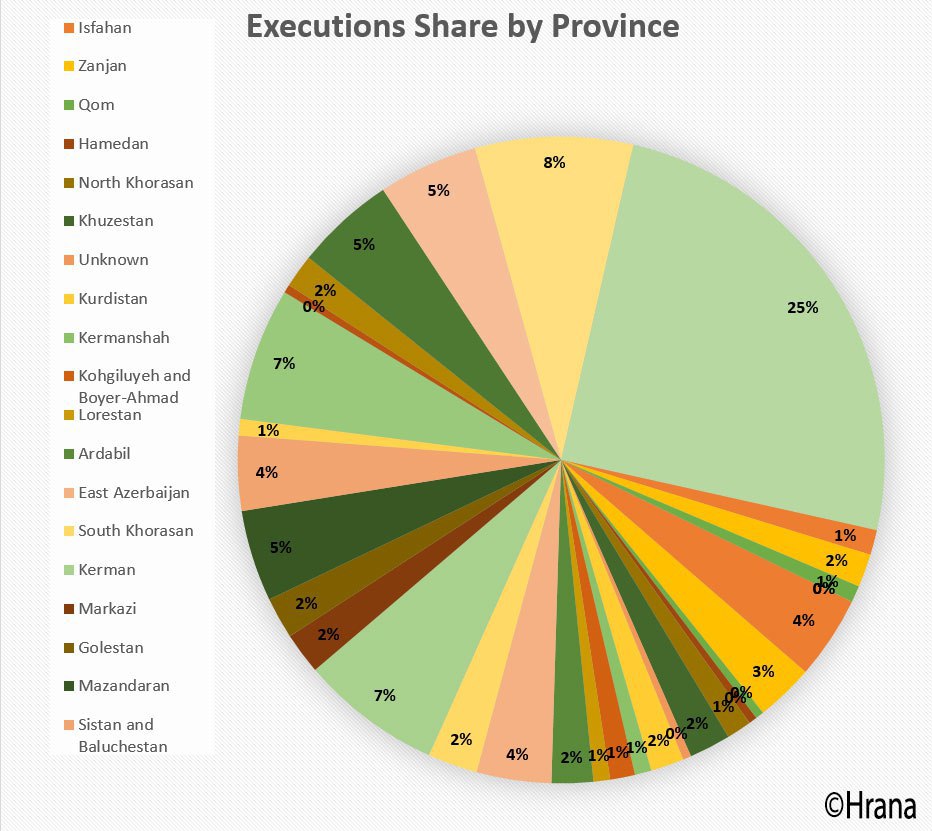
The chart below displays execution numbers by the province in which they took place. According to this chart, Alborz with 25% has the highest number of executions and West Azerbaijan 8% and Kerman 7% are second and third.

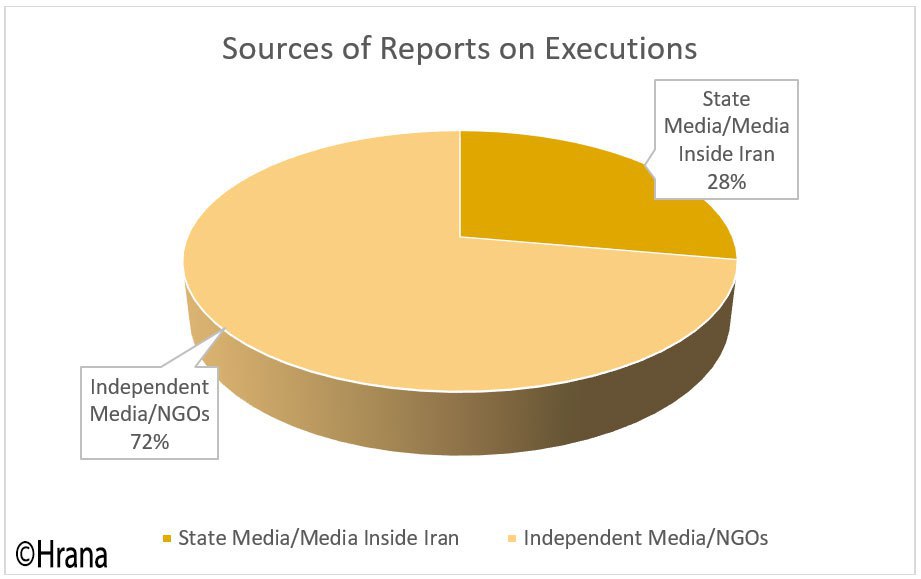
The chart below is a distribution of execution information sources. The chart indicates that 72% of HRANA-confirmed executions were not announced by the official Iranian sources. Undisclosed executions are referred to as “secret” executions.


Click here to download the report

On World Day Against Death Penalty, Women in Evin Prison Urge UN Special Rapporteur to Visit Iran

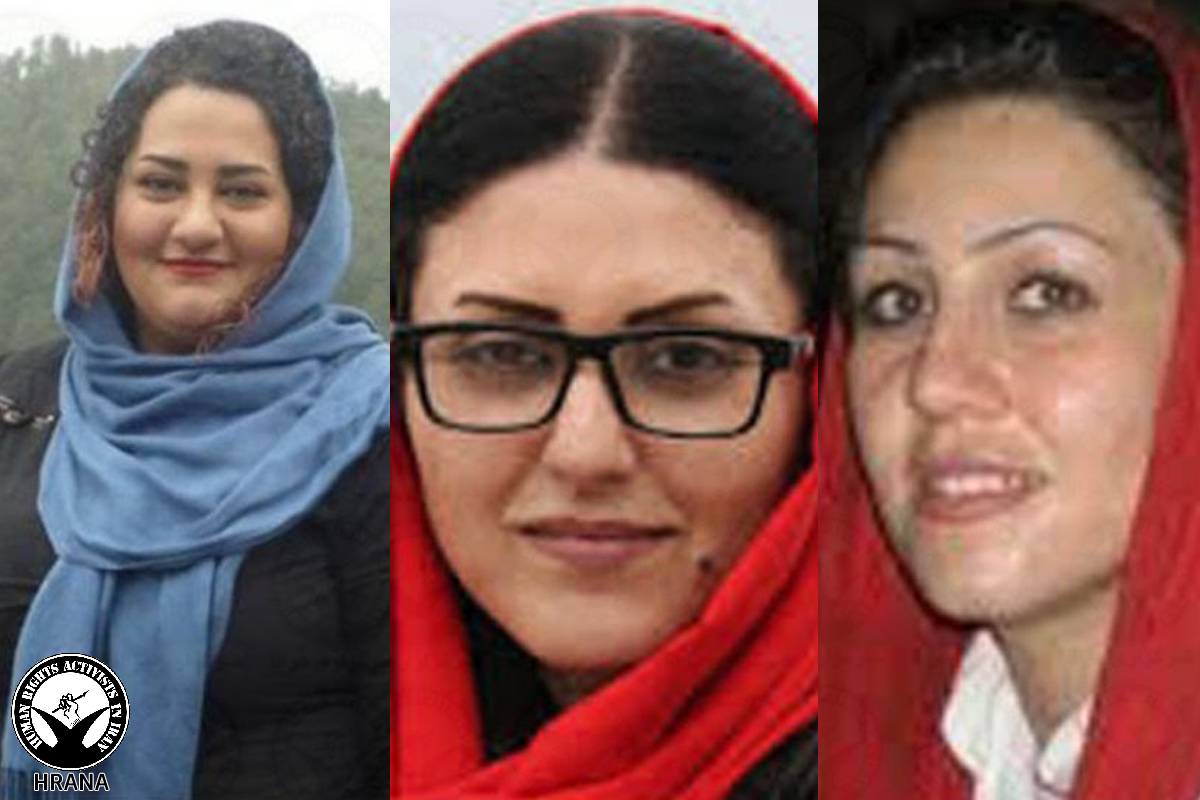
Human Rights Activist News Agency (HRANA) – From the walls of Evin Prison’s Women’s Ward, political prisoners Maryam Akbari Monfared, Golrokh Irayee, and Atena Daemi wrote a letter dated October 10th — the World Day Against the Death Penalty — urging the United Nations Special Rapporteur Javaid Rehman to come and witness Iranian human rights violations in person.

In observance of the same occasion, Human Rights Activists in Iran (HRAI) recently published its annual report on the death penalty, pending, and carried out since October 2017. According to this report, 256 executions were carried out in Iran between October 10, 2017, and October 9, 2018, a 50% decrease from last year due likely to newly-ratified laws precluding death-sentence rulings on drug-related cases. Due process is glaringly absent from the judicial processes leading up to executions in Iran.

Recently, another group of prisoners from Rajai Shahr in Karaj wrote to Rehman, requesting that members of the United Nations place on their dealings with Iranian authorities a condition: demonstrate further respect for human rights by abolishing the death penalty, which the prisoners called a “weapon of terror.”

The complete text of Akbari, Irayee, and Daemi’s letter, translated into English by HRANA, is below:

“To Mr. Javaid Rehman, United Nations Special Rapporteur on the Situation of Human Rights in Iran,

As the World Day Against the Death Penalty approaches, we decided to report to you a summary of the countless instances of human rights violations that took place over the last decade in our country.

News agencies announced the elimination of the death penalty for drug-related offenses some time ago, yet killings on such accounts are still happening outside of the media spotlight. Drug dealing and homicide remain the judicial justification for a majority of the executions in Iran.

Current statistics — which you most certainly have seen — indicate that defendants, men & women alike, are sentenced to death every year on homicide and manslaughter charges, and lose their lives very soon after their convictions are delivered.

Alongside prisoners convicted on criminal charges, many prisoners of conscience and political prisoners have been executed by firing squad or in the gallows over the last four decades.

According to available documentation, these executions were at their peak in the first decade of the Islamic Republic (1978-1988). People were often executed without trial, their bodies piled in unmarked mass graves on the fringe of the city. (Meanwhile, those who oppose capital punishment have no license to speak, and are currently behind bars because of their dissent).

As the World Day Against the Death Penalty drew near, authorities carried out the execution sentence of Zaynab Sakavand, a 24-year-old woman who had spent many years in prison since being convicted as a minor. This was but one example among the thousands carried out over the past few years on charges of smuggling, theft, killing, […]. As long as the death sentence can be meted, its pool of victims will be populated by alleged offenders of this type, many of whom are victims of poverty and socioeconomic class struggle, or political and ideological activists who are victims of a corrupt system whose policies are rigged against them.

The current administration began selling in 2013 the well-known figurative promise to provide keys to unlock problems and free prisoners of politics and conscience. Yet executions [on these grounds] have pressed on. Sherko Moarefi, Ehsan Fattahian, and Gholamreza Khosravi were all executed shortly after the administration undertook its [“key”] project.

The summer of 2016 conjured memories of the 1980s. Prisoners of conscience (Sunni Kurds) were executed en masse, leading to the overnight evacuation of a Rajai Shahr Prison hall. Exactly one month before the World Day Against the Death Penalty, Ramin Hossein Panahi, Zanyar Moradi, and Loghman Moradi were executed without the slightest shred of evidence to support their conviction. Their bodies, like the bodies of Farzad Kamangar (the hanged teacher), were buried in an unknown location. They suffered the same fate as Roghiyeh Akbari Monfared, Mojtaba Mohseni, Mehrzad Pakzad, Abdolreza Akbari Monfared, the Behkish Family, and thousands of others who lost their lives in the mass executions of the 1980’s, many of whose names have been documented by the Committee for Enforced Disappearance of the United Nations.

Over the past few years, many Kurdish and Arab activists, as well as a number of ideological activists, have been arrested for subscribing to beliefs that countered those of the ruling body. They were accused of baseless crimes, and — with the ultimate intention of creating fear and repressing public unrest — were tortured, forced to implicate themselves by false confession, and hanged. Mohammad Salas was the most recent of these victims.

The Islamic Republic’s apology for the death sentence is its [supposed] role in preventing criminal recidivism and in setting an example for others. While experience has proven that execution is not and never will be an effective preventative measure, the Islamic Republic continues to argue for its necessity and consonance with Sharia law. This fact alone demonstrates their abuse of the religious spirit of Iranian society, with the intention of oppressing and deceiving the public mind. If Iranian authorities can actually produce reliable documentation in support of their position on these cases, which are only a few among countless cases like them in Iran, they should certainly welcome you in Tehran.

We the undersigned, political activists held at the Women’s Ward of Evin Prison, on this World Day Against the Death Penalty, express our abhorrence of the executions that have already taken place in Iran, and request that you — Special Rapporteur on the Situation of Human Rights in Iran, Mr. Javaid Rehman — travel to Iran to investigate violations of human rights, and advocate for a wholesale abolition of the death sentence, regardless of the crimes it aims to punish, be they political, ideological, or criminal. Your arrival in Iran and plea for accountability from authorities will clarify many ambiguities. The Islamic Republic’s refusal to welcome you would demonstrate their determination to eliminate human beings in their death machine and would confirm the criminal scope of their actions. While we harbor no delusions that things will improve, since we view the current administration as beyond reform, we nevertheless wish for an immediate halt on capital-punishment verdicts, and for a change to Iran’s oppressive penal law.

Signed:

Maryam Akbari Monfared, Golrokh Irayee, and Atena Daemi
Women’s Ward of Evin Prison, October 2018”

About the authors: Maryam Akbari Monfared was detained on December 31, 2009 following a widespread Ashura demonstration during the holy month of Muharram. In June 2010, Judge Salavati sentenced her to 15 years’ imprisonment in Branch 15 of Tehran Revolutionary Court. She was convicted of enmity against god, gathering and colluding against national security, and propagating against the regime through working with the Mujahedin-e Khalq (MEK). She has denied these charges.

Golrokh Ebrahimi Irayee was arrested along with her husband on September 6, 2014. She was first held at an IRGC safe house for two days and then spent 20 days in the solitary cells of Evin’s Section 2A, which is under IRGC jurisdiction. She was released on a bail of 800 million rials. On October 24, 2016, the IRGC arrested Irayee again, without a warrant. Her husband Arash Sadeghi, who was sentenced to 19 years in prison, is currently in Karaj’s Rajai Shahr prison, and has undergone operations for cancer. Irayee was sentenced to six years in prison, which was reduced to 2.5 years based on amnesty and Article 134 of Islamic Penal Code. She was convicted of insulting the sacred and gathering and collusion against the regime.

Atena Daemi was detained October 21, 2014, and was transferred to Evin’s Women’s Ward January 14, 2015 after spending 86 days in a solitary cell of Ward 2-A. On May 15, 2015, she was sentenced by Judge Moghiseh of Revolutionary Court Branch 28 to 14 years’ imprisonment on charges of assembly and collusion against national security, propaganda against the regime, and Insulting the supreme leader. On February 15, 2016, she was released on a bail of 5500 million rials. Her appeals court convened in July of 2016, and reduced her sentence to seven years. She learned of the appeals decision two months later. After being arrested again in her parents home on November 26, 2016, her sentence was reduced to five years, pursuant to article 134 of Islamic Penal Code.

Earlier this month, HRANA reported on verbal orders from an Evin Warden that barred these women from having visitors for three weeks.

World Day Against the Death Penalty: Iran Annual Report Oct ’17 – Oct ’18

Human Rights Activists News Agency (HRANA)- On the World Day Against the Death Penalty, the Center of Statistics at Human Rights Activists in Iran (HRAI) has published its annual report, in efforts to sensitize the public about the situation of the death penalty in Iran.

HRANA’s Statistics Center relies on the work of HRANA reporters, as well as a network of independent and verifiable sources. It also incorporates disclosures to the media by judicial authorities announcing or confirming prisoner executions, and as such is exposed to a margin of error representing efforts by the Iranian authorities to omit, conceal, or restrict the collection of such data.

Between October 10, 2017, and October 9, 2018, the death penalty and executions have been the focus of 287 HRANA reports. Over this time period, the Iranian authorities issued the death penalty sentence to 240 individuals and have already carried out 256 executions; [that’s one hanging every 34 hours for a population about twice the size of California’s]. Six percent of the executions in Iran were carried out in public.

Females account for only three of the 256 HRANA-confirmed execution victims this year.

Five were under the age of 18 when they allegedly committed the crime they were charged with.

While execution numbers went down by 50% in comparison to the same time last year, Iranian courts have issued 7.4% more death sentences.

Public hangings and executions of women have gone down 54% and 50%, respectively.

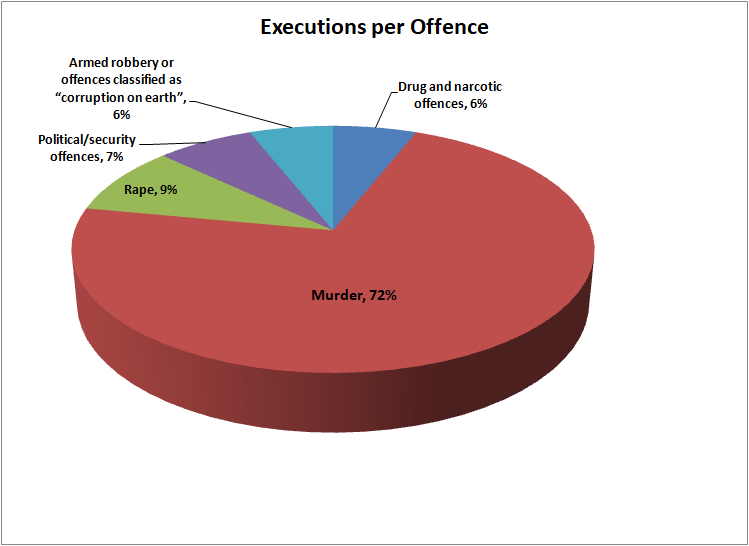
The report includes a breakdown of executions by capital offense:

Drug and narcotic offenses: 6%
Murder: 72%
Rape: 9%
Political or security-related offenses: 7%
Armed robbery/offenses classified as “corruption on earth”: 6%

The chart below displays execution numbers by the province in which they took place.

Below is a distribution of execution information sources. The chart indicates that 68% of HRANA-confirmed executions were not announced by official Iranian sources. Undisclosed executions are referred to as “secret” executions.