Amputation Sentence Carried Out in Isfahan for Theft Conviction

HRANA – The sentence of amputating four fingers of the right hand of Mohsen Ashiri, a 37-year-old prisoner from Falavarjan, Isfahan Province, was carried out in Dastgerd Prison of Isfahan, despite the victim’s consent and the submission of a repentance statement by the prisoner. This action took place even though, under Iran’s Islamic Penal Code, both repentance and the complainant’s consent can prevent the implementation of such punishments (hudud).

The identity of this prisoner has been confirmed as Mohsen Ashiri, 37, a resident of Falavarjan County in western Isfahan Province. His amputation sentence was carried out on Tuesday, September 30, in Dastgerd Prison. The implementation occurred despite the fact that the complainant had already granted consent.

A relative of Mr. Ashiri confirmed the incident and told HRANA:

“About five years ago, Mohsen Ashiri, along with another individual named Majid, was arrested on charges of stealing from the home of a provincial official’s son-in-law. The Isfahan Criminal Court sentenced him to six months in prison and the amputation of four fingers of his right hand. After the stolen property was returned, the complainant expressed consent, and Mr. Ashiri submitted a written repentance statement. He was later released on bail of one billion tomans.”

The source added:

“Later, during the judicial process, the case was referred to the Supreme Court. At that stage, despite not having committed any new offense, Mohsen was again summoned to court and detained. His bail was suddenly increased from one billion to 200 billion tomans without a clear explanation from the judiciary. Eventually, on Tuesday, September 30, the amputation was carried out in Dastgerd Prison, and he was released after being transferred to a hospital.”

Under Articles 114 and 119 of the Islamic Penal Code, in crimes punishable by hadd (such as theft), repentance before the proof of the crime, the victim’s consent, and the existence of doubt about the fulfillment of religious conditions can prevent the execution of the sentence. Furthermore, Article 113 provides that if the convicted person repents after conviction, the judge may request clemency from the Supreme Leader. Considering that in this case the prisoner had repented, the victim had consented, and the stolen property was returned, the execution of the amputation sentence raises serious legal and ethical concerns.

The unprecedented increase in bail amount and the execution of such an irreversible and severe corporal punishment despite the absence of a new offense may indicate judicial misconduct or external interference in the case.

It should be noted that hand amputation sentences violate the fundamental principle of human dignity. The International Covenant on Civil and Political Rights (ICCPR) explicitly prohibits inhuman and degrading punishments, yet Iran continues to carry out such sentences despite domestic and international objections.

Piranshahr: Three Citizens Arrested by Security Forces

HRANA – On the evening of Wednesday, October 8, Khaled Ghaderpour (30), Mohammad Ghaderi (27), and Morad-Rasoul Bahrami (36), residents of the village of Tamarchian in Piranshahr County, West Azerbaijan Province, were arrested by security forces and taken to an undisclosed location.

According to HRANA, quoting Kolbar News, the arrests were carried out by security forces without the presentation of a judicial warrant.

As of this report’s publication, no information is available regarding the reasons for the arrests, the detainees’ whereabouts, or the charges brought against them.

Over the past year, HRANA published 585 reports of human rights violations in West Azerbaijan Province, making it the third province with the highest number of HRANA reports on human rights abuses.

Families of Six Executed Prisoners in Ahvaz Threatened Against Holding Mourning Ceremonies

HRANA – Security forces in Khuzestan Province have severely threatened the families of six executed Arab prisoners, warning them not to hold mourning ceremonies or communicate with media outlets and human rights organizations.

The six men – Ali Mojaddam, Mohammadreza Moghaddam, Moein Khanfari, Habib Deris, Adnan Ghobeishavi, and Salem Mousavi – were executed at dawn on Saturday, October 4, 2025, in Sepidar Prison, Ahvaz, without prior notice to their families or lawyers.

According to HRANA, agents of the Ministry of Intelligence contacted the families by phone on the day of the execution to inform them of the death of their loved ones. Prior to these calls, the families had received no information regarding the scheduled execution or the prisoners’ transfer to solitary confinement.

Sources close to the families told HRANA that, following the executions, security authorities summoned several relatives and tribal elders to intelligence offices, including the local headquarters of the Ministry of Intelligence, and explicitly forbade them from holding mourning ceremonies in mosques or public halls. The authorities also prohibited the recitation of the Quran, poetry, or other religious rituals over loudspeakers – traditional mourning practices among the Arab community in Khuzestan.

According to information obtained by HRANA, family members and tribal elders were compelled to sign written pledges promising not to organize any public gatherings. They were further warned that any communication with media or international human rights organizations would result in punitive measures.

The six Arab prisoners were arrested by security forces in February 2019 and later sentenced to death by a branch of the Ahvaz Revolutionary Court in March 2023. The judiciary of the Islamic Republic accused them of “membership in the armed wing of Harakat al-Nidal al-Arabi li-Tahrir al-Ahwaz and armed action against the foundations of the Islamic Republic.”

As of two days after the executions, the families remain unaware of the burial locations or the circumstances under which the sentences were carried out.

Forced Confessions of Three Rappers Published by Tehran Security Police

HRANA – Three rap artists, Arash Sayyadi, Ashkan Shekarian Moghaddam, and Rasam Sohrabi, were arrested by the Tehran Security and Intelligence Police. Videos of their forced confessions have been circulated on social media while their cases are still pending judicial review.

In the published videos, the three men appear half-naked, apparently to display their tattoos, suggesting the security forces intended to showcase them.

According to HRANA, the news agency of Human Rights Activists in Iran, these rappers, often labeled “underground” musicians for lacking official production licenses, were detained by Tehran’s Security Police. Following their arrests, videos were posted on social media accounts attributed to Arash Sayyadi, Rasam Sohrabi, and Ashkan Shekarian Moghaddam, in which they appear half-naked and confess to “taunting” and “disrupting public order” online.

At the end of the videos, the three express “gratitude and apologies” to “law enforcement, judicial authorities, the Second Base of the Intelligence Organization, and the Prosecutor’s Office of District 5 of Tehran.”

It is worth noting that, beyond violating human dignity, the recording and broadcasting of forced confessions constitute a breach of legal principles: under the law, individuals are presumed innocent until proven guilty in court, and any punitive action before a final conviction is a violation of their civil and human rights.

These three citizens are active in rap music. Arash Sayyadi, known by his stage name “Isin,” and composer Rasam Sohrabi had previously faced security-related confrontations and arrests. Ashkan Shekaryan Moghaddam performs under the stage name “Ashkan Leo.

Bandar Abbas Revolutionary Court Acquits German National of Espionage Charge

HRANA – The head of the Hormozgan Province Judiciary announced that the Bandar Abbas Revolutionary Court has acquitted Lennart Christian Jean-Pierre Monterlos, a German national, of espionage charges. Monterlos, who also holds French nationality, was arrested during the 12-day war between Israel and Iran on suspicion of spying.

According to Mizan News Agency, Mojtaba Ghahremani, head of the Hormozgan Judiciary, stated that Monterlos had been detained on espionage charges during the conflict.

Ghahremani added: “Despite the indictment issued by the prosecutor’s office, the Revolutionary Court, adhering to legal principles and considering doubts regarding the alleged offense, issued a verdict of acquittal. However, under the law, the prosecutor has the right to appeal the ruling.”

The report did not specify the current status or location of the foreign national.

During the 12-day Iran–Israel conflict, a German-language news outlet covering France and international affairs reported that Jean-Pierre Monterlos, an 18-year-old French citizen, had traveled to Iran by bicycle and had been missing since June 16, 2025.

Shortly afterward, Abbas Araghchi, Iran’s Foreign Minister, confirmed his arrest in an interview with a French publication, claiming that the individual had been detained “for committing a crime.”

Subscribe to Our Newsletter

Now is definitely not the time to stop reading!

Family Left in the Dark Nine Days After Saro Yarahmadi’s Arrest by IRGC Intelligence

HRANA – Saro Yarahmadi (Yar-Ahmadi), a dentist residing in Kermanshah, has been held in detention by IRGC Intelligence agents in this city for the past nine days, with no information available about his whereabouts. The uncertainty surrounding his fate has heightened the concerns of his family and relatives.

A source close to his family confirmed the news to HRANA, stating: “On Wednesday, September 24, 2025, Mr. Yarahmadi was arrested in Kermanshah by IRGC Intelligence agents and transferred to an undisclosed location. Despite the family’s efforts, none of the security or judicial institutions have provided clear answers regarding his situation.”

The lack of information about Mr. Yarahmadi’s condition has caused increasing concern among his family and close relatives.

In 2024, a total of 2,783 Iranian citizens were arrested by security and judicial authorities due to their beliefs, opinions, or political and civil activities. Over the past decade, the number of such arrests has exceeded 56,000. The highest number of arrests occurred in 2022, during the nationwide protests, when HRANA documented 23,977 detentions.

Monthly Report – September 2025: Human Rights Situation in Iran

HRANA– This report reviews documented cases of human rights violations in Iran in September 2025, based on statistics compiled by HRANA, the news agency of Human Rights Activists in Iran. The sharp rise in executions during this month, the arrests of minors, and the alarming reports of prisoner deaths in Qarchak Prison of Varamin were among the most notable human rights violations recorded.

Executions

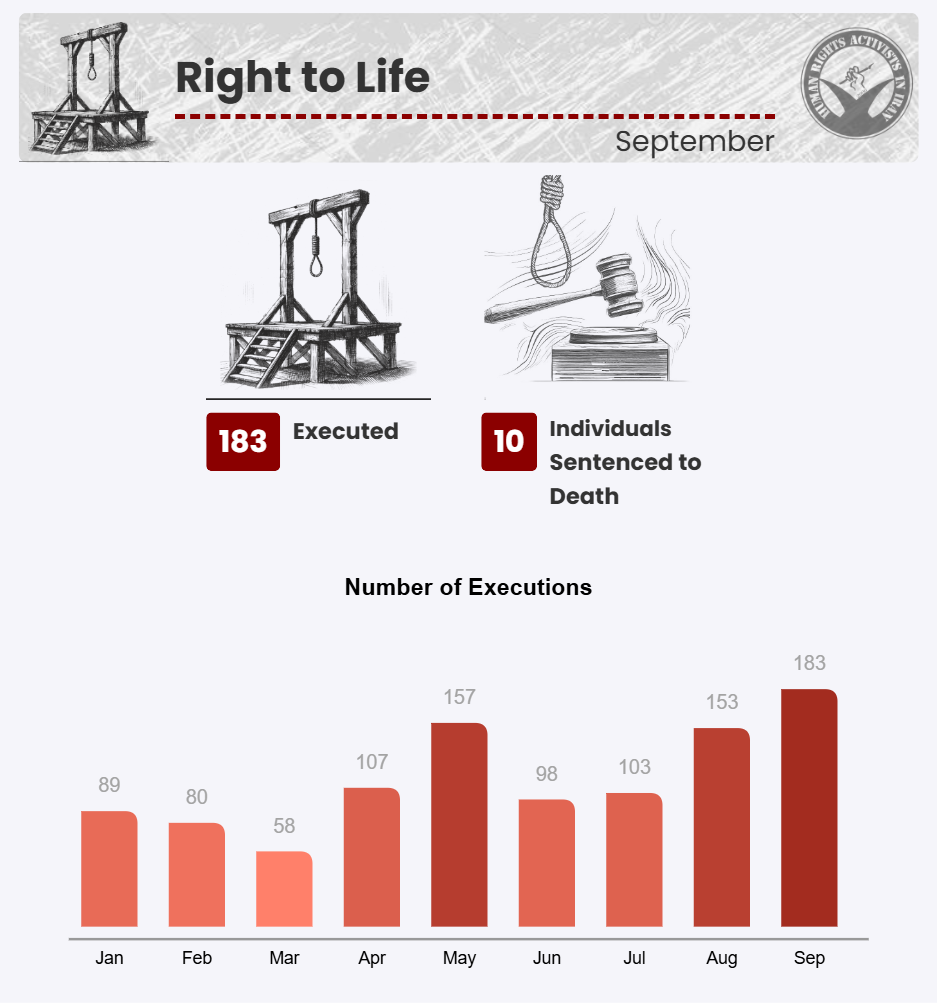
In September, Iranian prisons recorded 183 executions, marking the highest monthly total since the start of the year. According to HRANA, the executed included 164 men and 6 women, while the gender of 13 prisoners remains unverified due to the lack of official announcements.

At least 9 Afghan nationals were among those executed, bringing the total number of Afghan citizens executed in Iran since the beginning of this year to 50.

Of those executed, 92 prisoners had been sentenced to death on drug-related charges, and 83 were executed on murder charges. Since the beginning of this year, the Iranian regime’s judiciary has executed 486 individuals on drug-related charges.

In addition, two individuals, including Babak Shahbazi, were executed on the political charge of “enmity against God” (Moharebeh). For Babak Shahbazi, “intelligence and security collaboration with Israel” was cited as an instance of this charge.

Furthermore, one prisoner was executed on politico-religious charges, and another on security-related charges. The charges against four prisoners remain unknown.

In September, the Iranian regime’s judiciary issued death sentences against ten individuals, including one woman. The gender of two of those sentenced to death remains unknown. Among these cases is the concerning news of the Supreme Court’s confirmation of the death sentence against Peyman Farah-Avar, a poet from Gilan.

Additionally, one individual in Yasuj has also been sentenced to execution in public.
right to life

Prisoners’ Rights

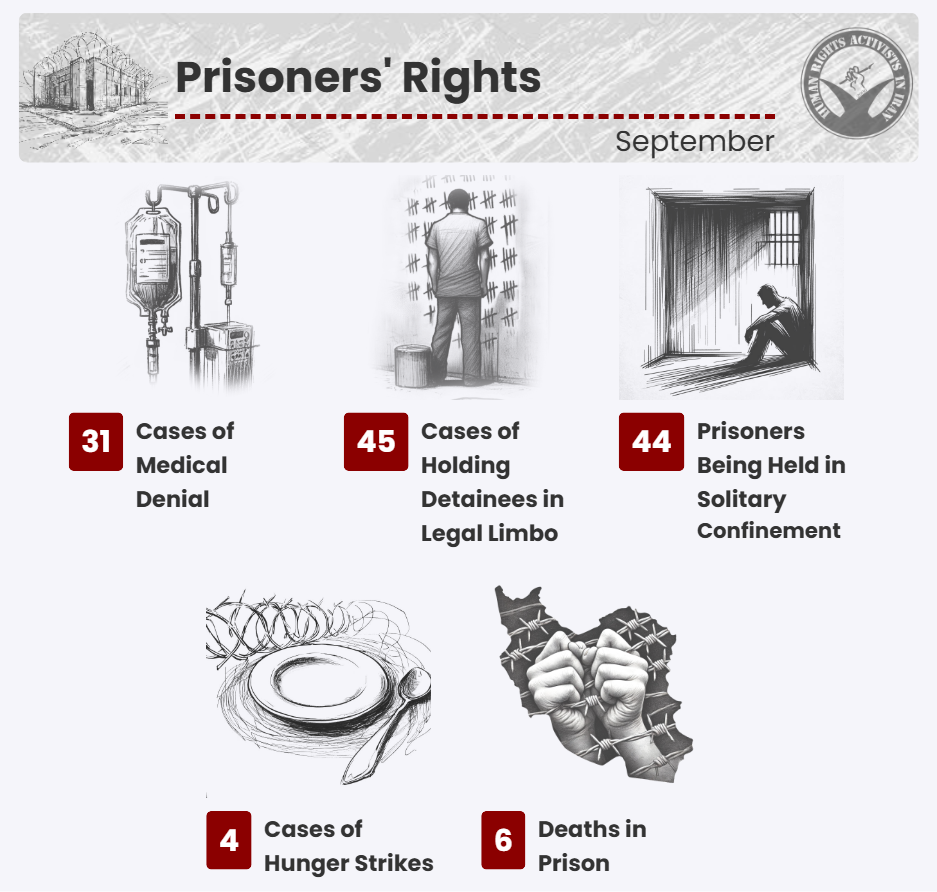
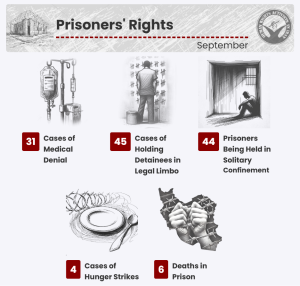
In September, six prisoners died in Iranian prisons due to illness and the lack of adequate or timely medical care. Among these cases, HRANA reported the consecutive deaths of three women in Qarchak Prison of Varamin. One of them, Somayeh Rashidi, who had been arrested in Tehran for writing slogans, died as a result of delays in being transferred to a hospital.

In addition to the above cases, in September HRANA documented 31 reports of political and religious prisoners being denied medical care in prison.

The detention of political and religious prisoners under harsh and unsuitable conditions is another recurring instance of rights violations in Iran’s prisons. Among such cases is the detention of the British couple, Craig and Lindsay Foreman, in poor conditions, including being held in an overcrowded ward lacking proper sleeping arrangements.

Other instances of prisoners’ rights violations reported by HRANA this month regarding political prisoners and prisoners of conscience include: 45 cases of holding prisoners in legal limbo, 14 cases of families being denied information about the condition of their detained relatives, 44 reports of prisoners being transferred to solitary confinement, 2 cases of denial of access to a lawyer, 13 cases of denial of visitation rights, and 8 cases of pressure and threats against prisoners.

In response to such violations, some prisoners resort to hunger strikes. In September, HRANA documented 4 hunger strikes and 2 cases of suicide among prisoners (political and non-political).
prisoners rights

Kolbars and Fuel Carriers

In September, 15 citizens lost their lives as a result of indiscriminate shootings by military and security forces – a figure that is three times higher than the previous month. Since the beginning of this year, military forces, particularly in border areas, have taken the lives of 77 people.

Of those killed this month, five were fuel carriers (sukhtbar) and one was a kolbar (cross-border porter). In addition, 13 others were injured as a result of these indiscriminate shootings, including two kolbars and three fuel carriers.

In addition, landmine explosions in September caused the death and injury of four Iranian citizens. Among the victims were two teenage brothers killed in Mirjaveh, located in Sistan and Baluchestan Province.

Freedom of Thought and Expression

In September, 34 individuals were arrested by security forces for expressing their opinions and beliefs. Additionally, 15 people were summoned to security agencies and 23 others to court.

Among those arrested were three lawyers in Gilan Province: Shahrzad Sharabiyani, Shadi Falahati, and Hesam Pourahmadi. Furthermore, ten other lawyers in this province were also summoned to security and judicial authorities.

During the same month, 14 people were tried on similar charges, and convictions were issued against 23 individuals, resulting in a total of 868 months of prison sentences as well as a ruling of 38 lashes.

Regarding freedom of expression, eight protest gatherings were held in September, while in one case security forces prevented a ceremony and gathering from taking place. During the same month, the Press Court also tried the managers of three media outlets as well as a member of parliament.

Workers’ Rights

In September, HRANA documented 122 workers’ protest gatherings and two labor strikes, including strikes by workers in the oil and gas industries. According to these reports, more than 5,100 workers stated that they have not received their overdue wages.

Additionally, a labor activist was sentenced to 72 months in prison.

Also, workplace accidents in September claimed the lives of 35 workers and left 69 others injured. Since the beginning of this year, 280 workers have lost their lives in workplace incidents.

In September, trade associations and unions held 68 protest gatherings and two strikes. In one case, a teachers’ gathering was met with mass arrests and the confiscation of personal belongings. A total of 19 people were arrested, and 10 individuals faced convictions in court. HRANA also documented the closure of 29 commercial establishments during this month.

Women’s Rights

Among the most serious violations of women’s rights this month were the killings of three women, including a 35-year-old woman in Saqqez who was set on fire by her husband and died. In addition, a woman in Khomam, Gilan Province, was the target of an acid attack.

A man was also murdered in a so-called honor killing, and one case of sexual assault was reported.

Furthermore, the Iranian regime sealed eight commercial establishments for allegedly failing to enforce mandatory hijab regulations.

Children’s Rights

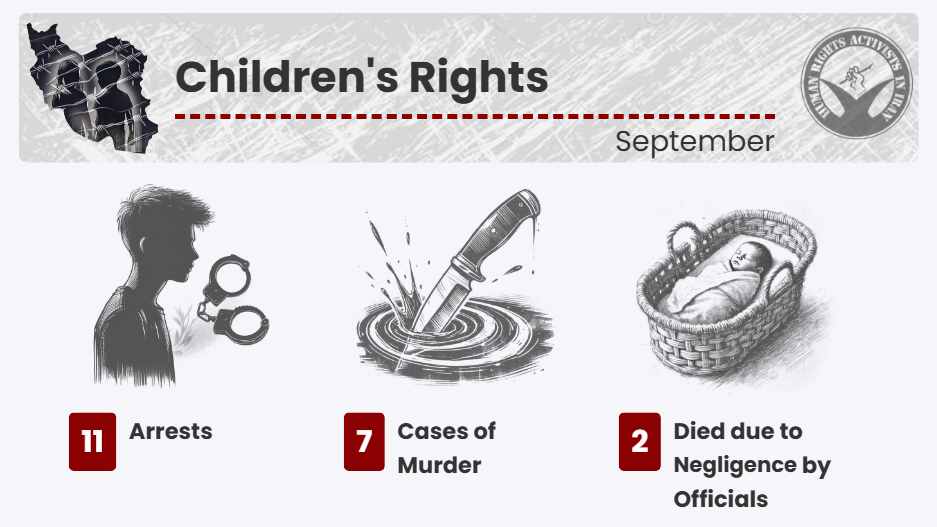
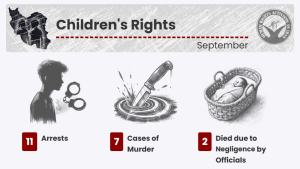
In September, Iranian security forces arrested 11 minors under the age of 18.

During the same month, the killings of seven children were reported, including the murder of a teenage girl in Shadegan in an honor-related killing.

Additionally, the deaths of two children and injuries to two others were reported as a result of the negligence of state authorities.
Children Rights

Religious Minorities

In September, security forces arrested one member of a religious minority. Additionally, the Iranian judiciary sentenced eight members of religious minorities to a combined total of 701 months in prison. In one case, Loghman Amini, a Sunni cleric, was sentenced to imprisonment and stripped of his clerical status.

HRANA also documented six court summonses and one case of a house search targeting religious minorities during this month.

Ethnic Rights

In September, 21 members of ethnic minorities were arrested by security forces. Among them was Peyman Ebrahimi, an Azerbaijani-Turk activist.

HRANA also reported two summonses to security agencies, two court summonses, and one case of physical assault carried out by security forces against members of ethnic minorities.

Inhuman Punishment

In September, the Iranian regime issued a total of 642 flogging sentences, along with one case of shame parading of a defendant in the city of Borujerd, and a ruling for amputation – all examples of inhuman punishments.

Following Protest Gathering; 11 Citizens Arrested in Behbahan

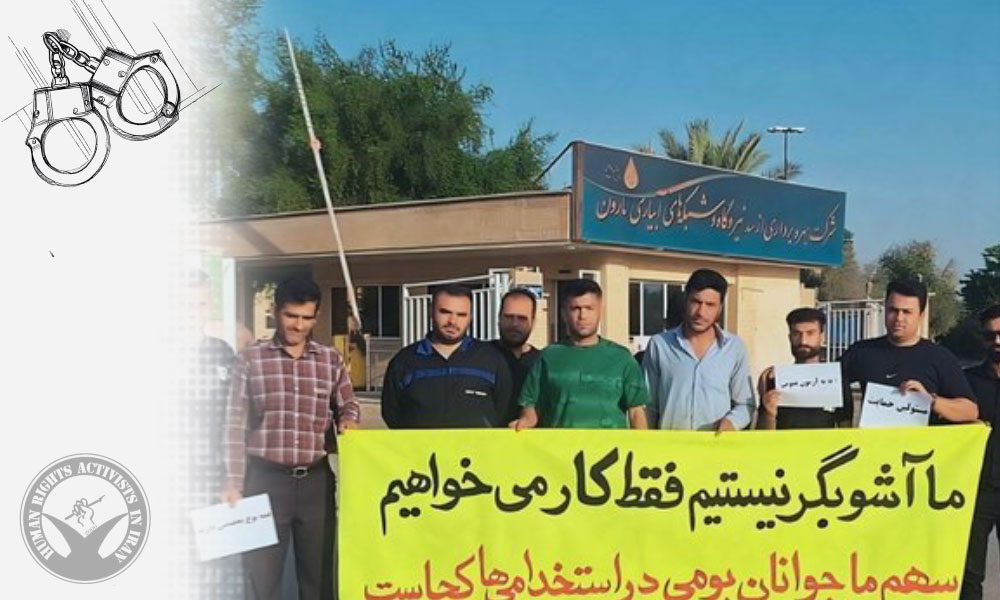
HRANA – On Sunday, September 28, eleven job-seeking citizens from the village of Barzion in Bahmai County were arrested by Ministry of Intelligence agents following a protest gathering. After their arrest, these citizens were transferred to Behbahan Prison, Khuzestan province.

According to information obtained by HRANA, the eleven arrested citizens are: Ali Moradi, Abolfazl Jamali, Asad Fathi, Gholam Emami, Salman Ja’fari, Mohammad Ahmadi, Mohammadreza Bahrami, Mehdi Fathi, Morteza Atoon, Hamzeh Atoon, and Mohammad Mohammadpour.

They were arrested after holding a protest in front of the Maroun Dam and Power Plant Operating Company building. Residents of the area are demanding the opportunity to participate in the company’s employment test. Reports indicate that the arrest of some protesters was accompanied by violence from security forces.

Residents of the area had also gathered in front of the Maroun Dam and Power Plant Operating Company building in Behbahan on Saturday, September 27.

These citizens, who are mostly local youths, had previously told HRANA that they are barred from participating in the employment test due to the location of the Maroun Dam and Power Plant Operating Company in Khuzestan Province. They stressed that they have repeatedly raised the issue through local and provincial authorities but have received no response so far.

Two Citizens, Including a Minor, Arrested by Security Forces in Oshnavieh

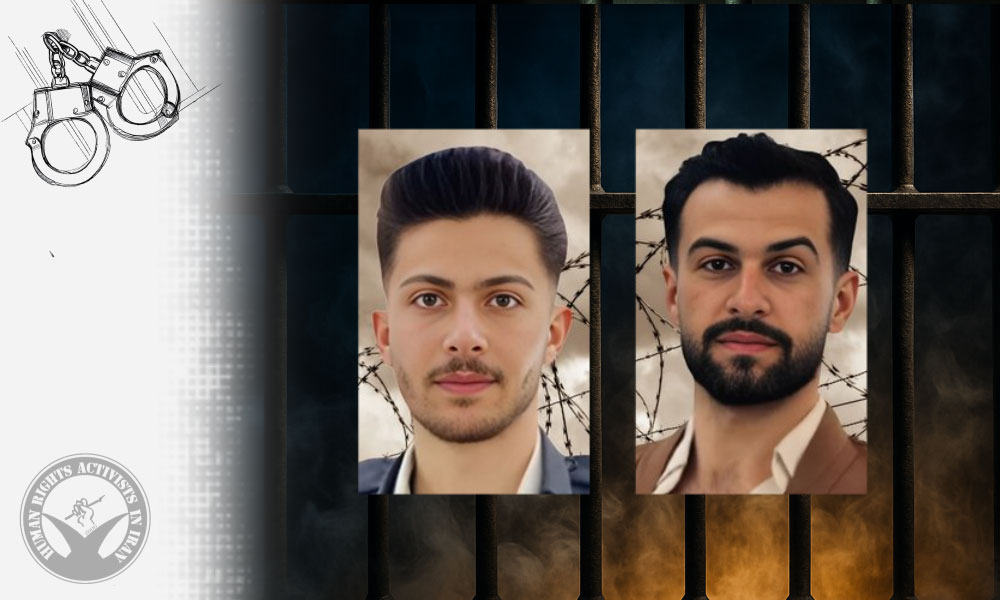
HRANA – On Thursday, September 18, two citizens, including a teenager, were arrested by security forces in Oshnavieh and transferred to an undisclosed location. They have been identified as Zaniar Shadikhah and Mohsen Dehar.

According to Kurdpa, the identities of those arrested are: Zaniar Shadikhah, 17 years old, Mohsen Dehar, 24 years old, both residents of Singan village, Oshnavieh County.

Yesterday, Thursday, September 18, intelligence agents raided the family homes of these two citizens without presenting a judicial warrant and arrested them.

As of this writing, no information has been made available regarding the reasons for their arrest, their whereabouts, or the charges against them.

It is worth noting that two days ago, intelligence agents also arrested two other 16-year-old teenagers, Diyar Gargul and Alan Tabnak, in the same county.

Security Forces Arrest Two 16-Year-Olds in Oshnavieh

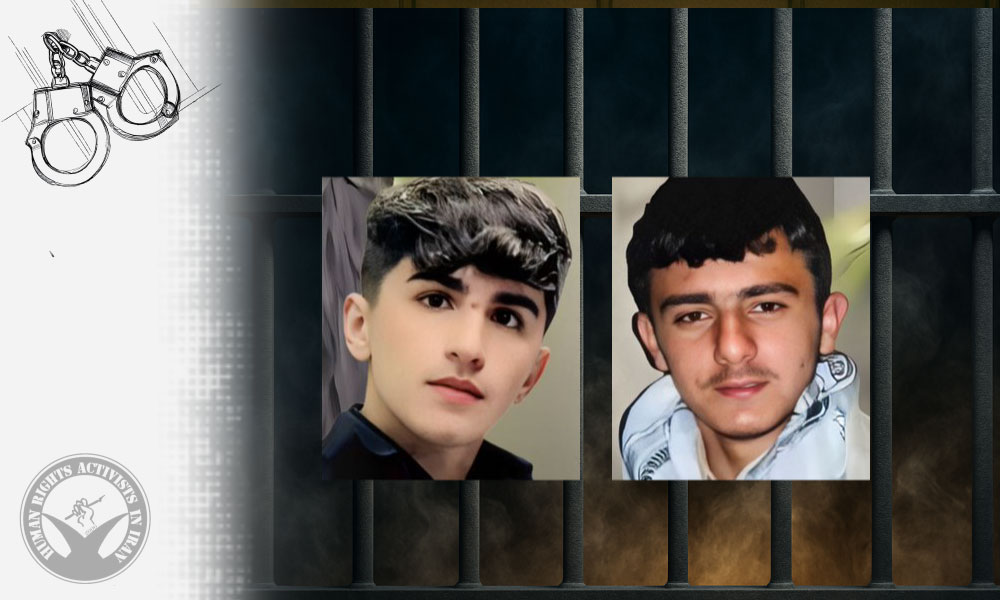
HRANA – Early this morning, two 16-year-old teenagers, identified as Diyar Gargul and Alan Tabnak, were arrested by security forces in Oshnavieh and taken to an undisclosed location.

According to Kurdpa, the arrests took place on Wednesday morning, September 17. Security agents reportedly raided the family homes of the teenagers without presenting a judicial warrant and detained them.

So far, no information has been made available regarding the reasons for their arrest or their current whereabouts.

Arbitrary arrests, transferring detainees to undisclosed locations, and leaving families in the dark about the fate of their loved ones are routine practices of the Iranian regime’s security agencies, such as the Ministry of Intelligence and the IRGC Intelligence Unit. This pattern of behavior stands in clear violation of the United Nations Standard Minimum Rules for the Treatment of Prisoners, known as the Nelson Mandela Rules.