

Geographic Scope of the Strikes
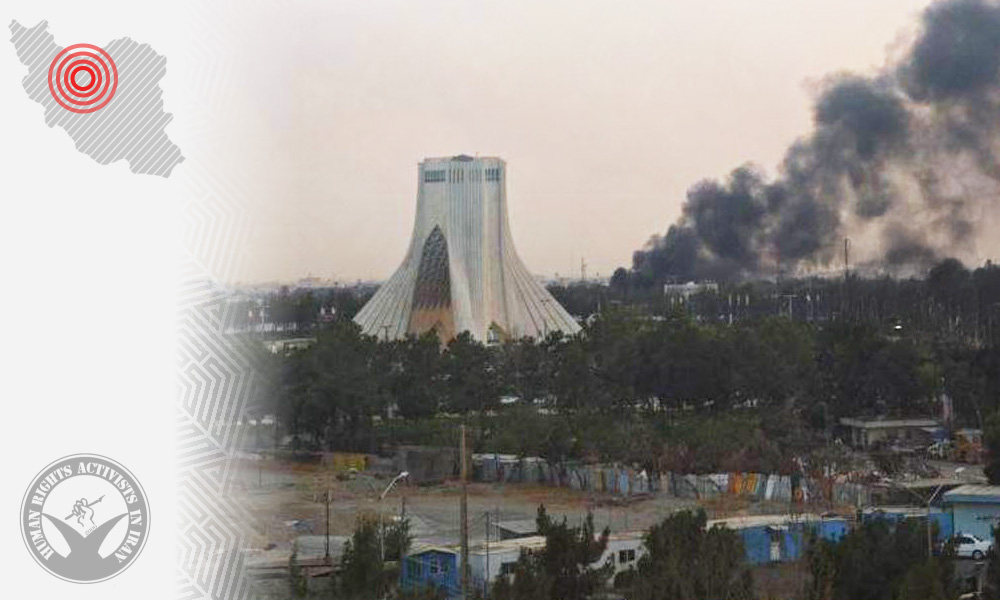
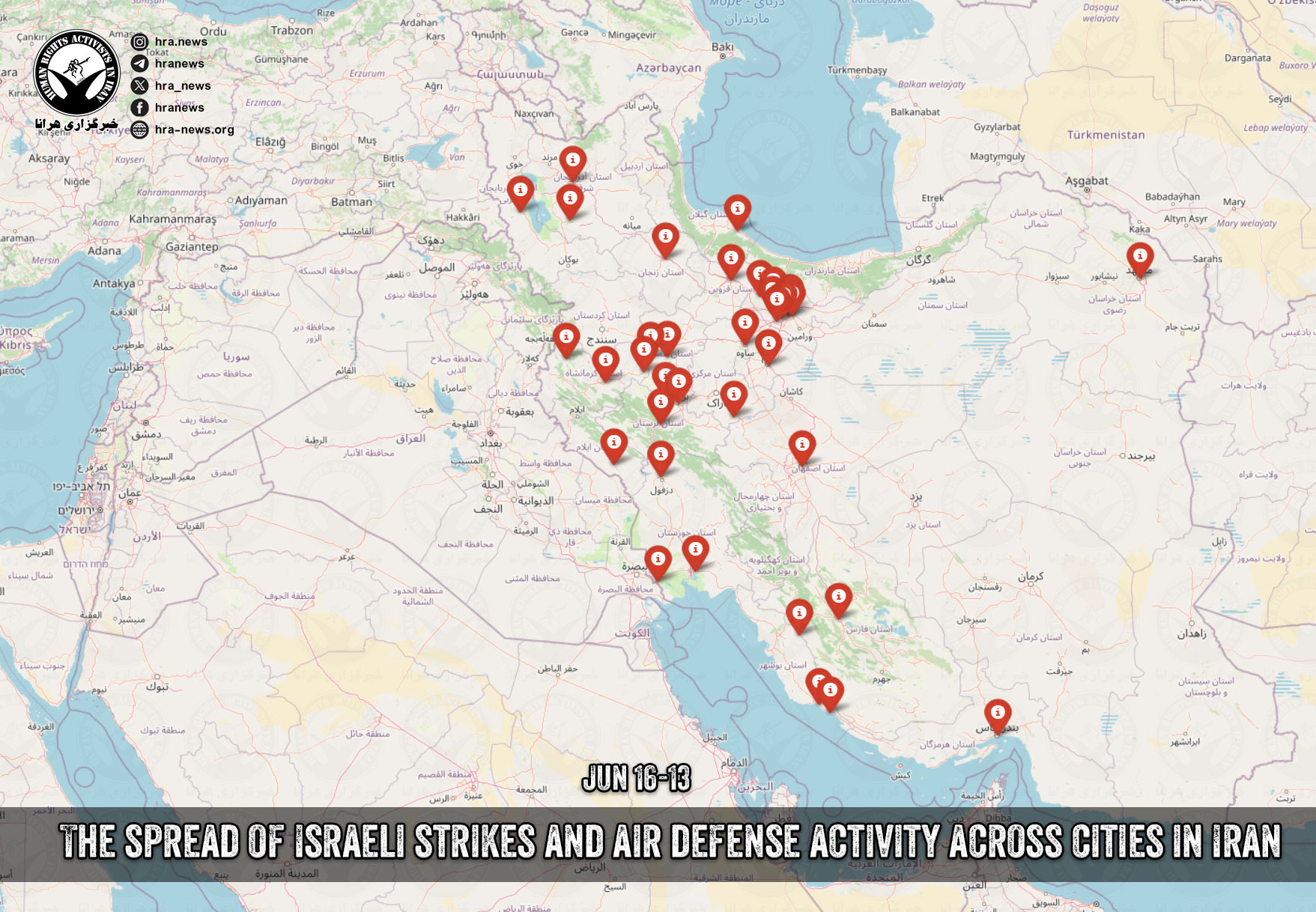
As Israeli military attacks on Iranian soil continue, yesterday a number of energy infrastructures, military installations, and residential areas were targeted in the provinces of Ilam, Kermanshah, Tehran, Qom, Hamedan, Khuzestan, Zanjan, Alborz, Markazi, East Azerbaijan, Kurdistan, and Fars. Notable sites targeted yesterday include the IRIB building in Tehran, the Musian fire station in Ilam province, Farabi Hospital in Kermanshah, and an oil refinery in Kermanshah. An emergency vehicle was also struck in yesterday’s Israeli attacks in Tehran. In addition, IRGC barracks and missile warehouses in several provinces were hit.
Explosions in some of these areas have caused widespread damage and likely human casualties. Further information is being reviewed and updated.
Fighter jets, drones, various planted bombs, Delilah air-launched cruise missiles, short-range projectiles, and suicide microdrones are among the primary weapons reportedly used by Israel in yesterday’s attacks.
The Israeli army announced yesterday that it has carried out 720 airstrikes on various locations across Iran since the beginning of the attacks.
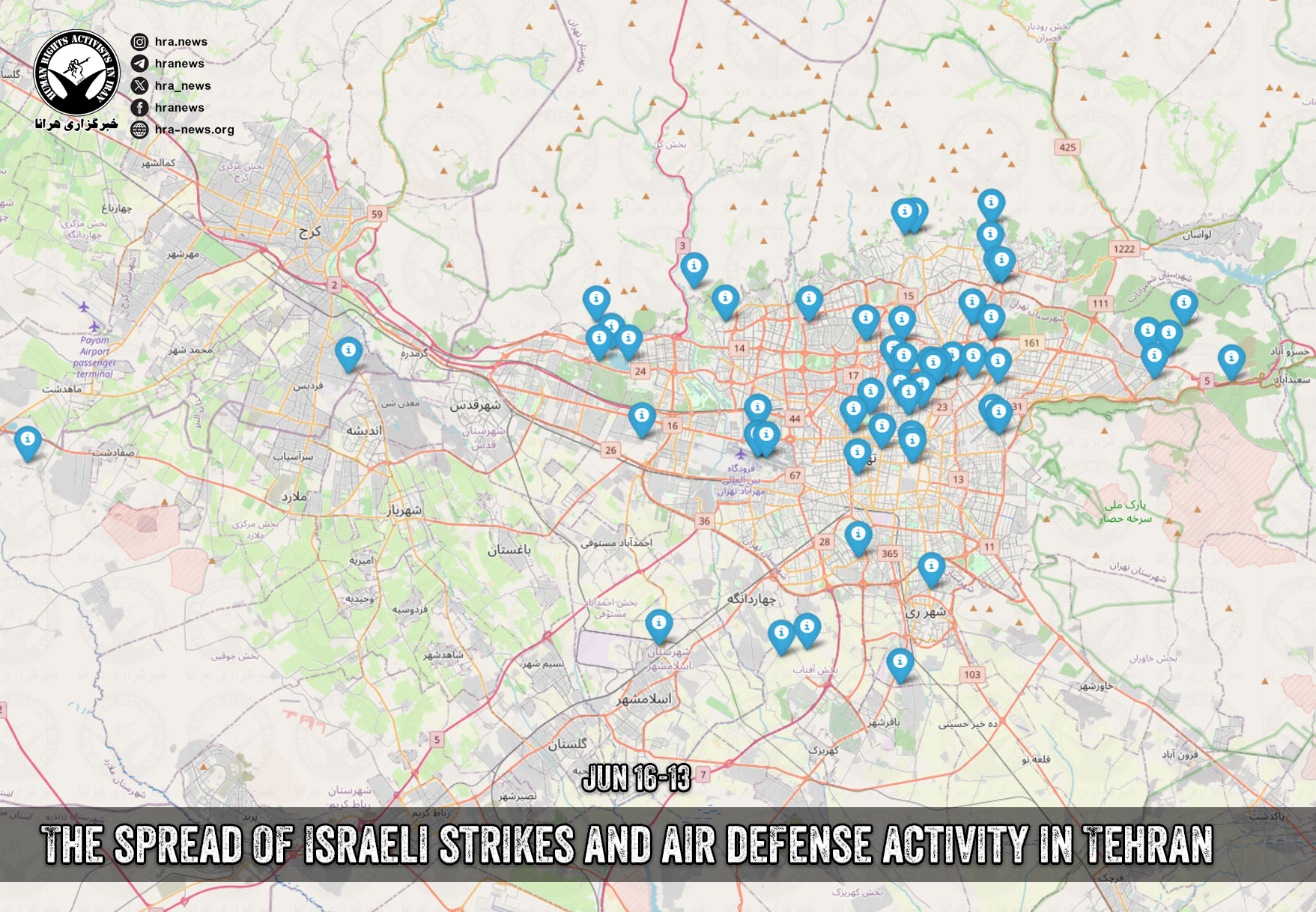
The map below shows the distribution of attacks and defense activity from the beginning of the conflict up to the present.
Update on Casualties and Human Losses
Since the start of Israeli attacks on Iran, more than a thousand military or civilian citizens have been killed or injured in total. The military or civilian status of a significant number of the human victims mentioned in this report is still under investigation.
HRANA had reported 1,005 people killed or injured during the first three days of attacks. With access to new information regarding casualties from previous days, this figure has now increased to 1,082.
The table below provides updated casualty figures from the first three days of the attacks, supplementing earlier reports. In some instances, the changes reflect reclassification rather than an actual increase in numbers.
Updated Casualty Figures from Previous Days
| Province | City | Date | Category | Killed | Injured | Notes | Location |
|---|---|---|---|---|---|---|---|
| Tehran | Tehran | Unknown (June 13–16) | Civilian | 12 | 1 | Victims include 5 children | Residential areas |
| Hamadan | Asadabad | Unknown (June 13–16) | Civilian | 4 | 0 | Victims were firefighters | Asadabad Agricultural Airport |
| Unknown | Unknown | Unknown (June 13–16) | Civilian | 1 | 3 | Qasemi family; a 2-month-old infant was killed | Unknown |
| Tehran | Tehran | June 13 | Civilian | 1 | 0 | – | Shahrara |
| Tehran | Tehran | June 15 | Civilian | 4 | 0 | – | Tajrish / Mohebbi Shariati Street |
| Tehran | Tehran | June 15 | Military | 1 | 0 | – | Police HQ (FATA) |
| Tehran | Tehran | June 15 | Military | 1 | 0 | – | Unknown |
| Lorestan | Unknown | June 13 | Military | 1 | 0 | – | Military Garrison |
| East Azerbaijan | Tabriz | June 13 | Military | 2 | 0 | – | Shahid Fakouri Airbase |
| Qom | Qom | June 15 | Military | 2 | 42 | – | Hazrat Fatemeh Air Defense / Mostafa Khomeini Garrison |
| Hamadan | Asadabad | Unknown (June 13–16) | Military | 2 | 0 | – | Asadabad Agricultural Airport |
Latest Statistics on Casualties and Human Losses So Far
In addition to the previous section, reports published regarding yesterday’s attacks have documented the deaths of 13 individuals and the injury of at least 3 others, bringing the total number of people killed or injured due to Israeli attacks—according to non-governmental sources—to at least 1,098.
| Province | City | Date | Killed | Injured | Notes | Location |
|---|---|---|---|---|---|---|
| Markazi | Khomein | June 15 | 2 | 0 | – | Unknown |
| Province | City | Date | Killed | Injured | Notes | Location |
|---|---|---|---|---|---|---|
| Kermanshah | Kermanshah | June 16 | 0 | 1 | Attack on a truck dealership | Dizelabad |
| Tehran | Tehran | June 16 | 3 | 0 | Red Crescent relief personnel | Unknown |
| Tehran | Tehran | June 16 | 0 | 2 | Includes an IRIB journalist | IRIB Building |
| Province | City | Date | Killed | Injured | Notes | Location |
|---|---|---|---|---|---|---|
| Zanjan | Zanjan | June 16 | 2 | 0 | – | Ansar al-Mahdi IRGC Garrison |
| Markazi | Khomein | June 16 | 6 | 0 | – | Rouhollah IRGC Garrison |
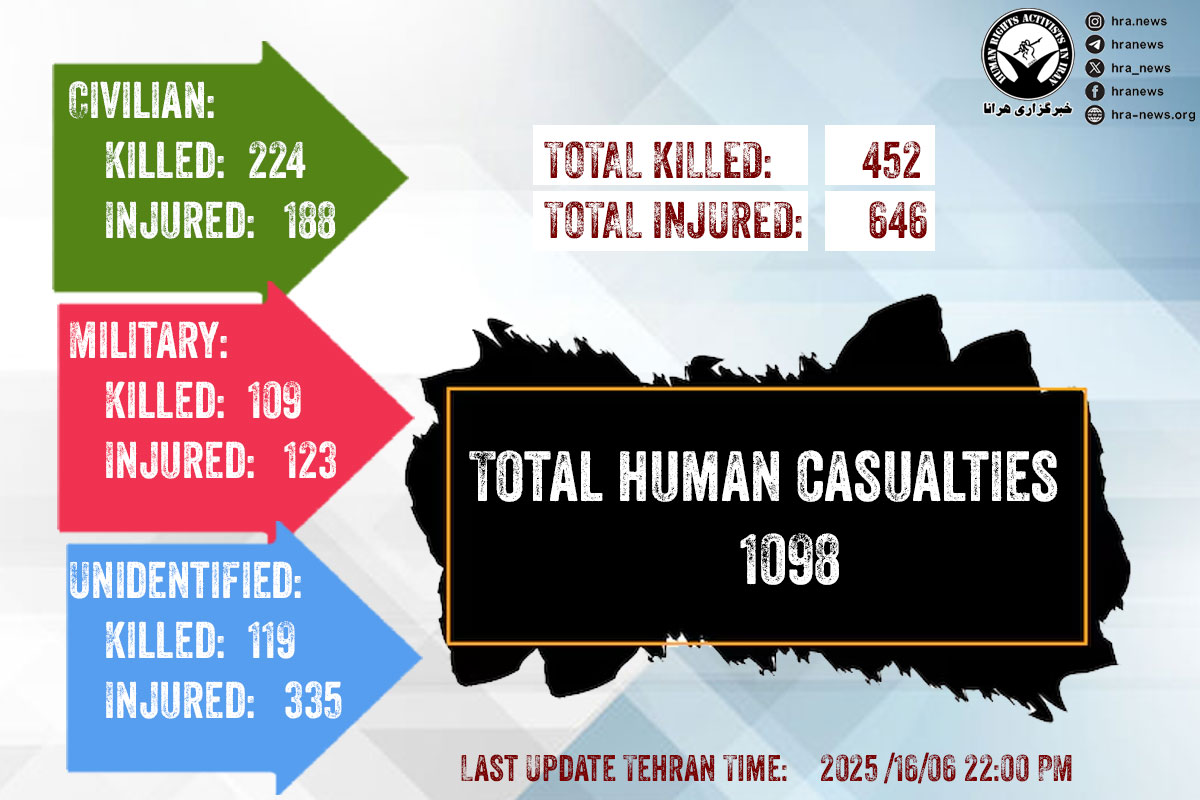
According to non-governmental sources, as of the time this report was compiled, a total of 1,098 military or civilian citizens have been killed or injured, broken down as follows:
▫️Civilians:
Deaths: 224
Injured: 188
▫️Military personnel:
Deaths: 109
Injured: 123
▫️Unspecified:
Deaths: 119
Injured: 335
▫️Total deaths: 452
▫️Total injured: 646
▫️Total human casualties: 1,098 individuals
It is also worth noting that access to casualty data has become significantly more difficult for non-governmental groups since the first day of attacks. This could be due to government-imposed security measures or communication disruptions.
While non-governmental sources estimate Iran’s human losses at just under 1,100, Hossein Kermanpour, Head of the Ministry of Health’s Public Relations and Information Center, reported a significantly higher figure in a social media post yesterday. According to Kermanpour, 1,481 people were killed or injured during the first 65 hours of Israeli attacks, with “over 90 percent” identified as civilians. He added that 522 of those affected have been discharged, reporting a total of 224 deaths and 1,257 injuries.
However, yesterday, the Minister of Health, in an interview with IRNA, stated that 1,800 people have been injured due to Israeli attacks. Regarding yesterday’s attack on Quds Square in Tehran, he said that not only were water pipes broken, but 59 people were injured in the incident. He added that 12 people “attained martyrdom” in the Quds Square bombing, one of whom was a pregnant woman.
Continued Israeli Attacks on Iran’s Civilian Infrastructure on the Fourth Day
The Israeli army’s attacks continued yesterday, causing damage to non-military infrastructure. Throughout the day, the cities of Bushehr, Qeshm, Bandar Abbas, Dehloran, Natanz, Tehran, Sanandaj, Tabriz, Kermanshah, Ahvaz, Bandar Anzali, Bostanabad, Marand, Malayer, and Shahriar witnessed air defense engagement with hostile projectiles. Among the affected provinces, Tehran once again experienced the heaviest attacks. The areas in and around Tehran that were hit include: Khalazir village, Shahrak-e Gharb, Bideganeh neighborhood, Vavan township, Bagheri township, Olympic Village, areas around Mehrabad Airport, around Azadi Square, Tehranpars, and the IRIB building in Tehran.
Other key areas that witnessed attacks and air defense activity include: areas along the Imam Reza and Tehran–Qom highways, Marand Industrial Town, Shahrak-e Emam and the oil refinery in Kermanshah, areas around the Tehran–Saveh highway, Nazarabad and Mehrshahr in Alborz province, Farabi Hospital in Kermanshah, and a truck dealership in Kermanshah.
In addition to civilian sites, several IRGC missile warehouses in Faraman and Dowlatabad in Kermanshah province, the Fatemeh Masoumeh air defense unit, Mostafa Khomeini garrison, and the Qiam Kushk-e Nosrat pilot training base in Qom, an air defense unit in Andimeshk, IRGC garrisons in Zanjan, Sardroud, and Marivan, the Alvand missile site in Khomein, and a military base in western Tehran were among yesterday’s military targets.
Disruptions in Communications and Secondary Consequences
From the first day of the attacks, Iran’s Ministry of Communications imposed temporary internet restrictions “due to the country’s special circumstances.” The WhatsApp messaging service has remained blocked for the fourth consecutive day, and user access to Cloudflare-based services has been disrupted. These measures have severely hampered the operations of independent media, the transmission of humanitarian data, and immediate access to information.
Judicial and security authorities began threatening citizens from the early hours of the conflict. In the latest statements, the head of Iran’s judiciary announced that those arrested on charges of collaborating with Israel would be tried and punished swiftly under wartime conditions. Mohseni-Ejei warned that the harshest punishment would be imposed without leniency on individuals cooperating with Israel.
Yesterday, security crackdowns on citizens in Iran continued, with at least 15 arrests recorded, bringing the total number of arrests over the past four days to more than 115 individuals. These citizens were mostly detained for publishing content related to the Iran-Israel military conflict. Those arrested yesterday include two individuals in Kerman, two in Tehran, five in Ardabil, several in Khorramabad and Borujerd, one in Shahr-e Qods, several in Gerash County, and five in North Khorasan. In addition, 60 citizens in Isfahan Province are facing legal proceedings. The head of Isfahan’s cyber police accused these individuals of “disturbing public opinion in cyberspace.”
The newspaper Ham Mihan also published images of at least two citizens being arrested, identifying them as “individuals linked to Israel.” A channel affiliated with the IRGC published images of two detainees, claiming they were “preparing for an operation from an unfinished building.” Another channel close to security agencies released a video reporting the arrest of five Afghan nationals in Nahavand County, claiming that “several microfiles” were discovered in their possession.
Meanwhile, the judiciary announced that 28 individuals had been arrested in Tehran Province over the past four days, with some of the charges including “espionage, photographing military fortifications and restricted areas, possession of military weapons, and membership in anti-regime groups.”
In the past three days, at least 100 other individuals in Iran had already been arrested by security forces for publishing content related to the Iran-Israel conflict.
Yesterday, the judiciary also announced that the execution of Esmaeil Fekri on charges of “espionage for Israel” had been carried out. According to the judiciary’s news agency, Mr. Fekri was arrested in Azar 1402 (December 2023), and after the initial verdict was issued, the case was referred to the Supreme Court for appeal. The court, citing “available evidence,” confirmed and upheld the original sentence.
International Humanitarian Law (IHL) Analysis
On the third day of the international armed conflict between Iran and Israel, concerns over increasing violations of fundamental principles of international humanitarian law have intensified. According to Article 51 of Additional Protocol I to the Geneva Conventions, parties to the conflict are obligated to distinguish between military objectives and the civilian population. However, reports of the deaths of at least ten children in a residential building strike and the killing of a worker at a horse stable reinforce the possibility of indiscriminate and disproportionate attacks.
The repeated targeting of locations with no apparent military value not only calls into question the principles of proportionality and precaution but also directly contradicts the absolute prohibition of direct attacks on civilians, as stated in Article 48 of the mentioned Protocol. Furthermore, under Article 57, even if a military target is located near civilian areas, the parties are obligated to take all feasible precautions to minimize harm to civilians, including the issuance of effective advance warnings—a measure that, in many cases, appears not to have been observed.
Human rights organizations have once again emphasized the need to halt indiscriminate attacks, protect civilian lives, and ensure access to emergency assistance. The Human Rights Activists in Iran also noted in its latest assessment, while highlighting concerning patterns in target selection: “Protection of civilian lives must remain at the center of attention.”
The organization has reaffirmed its commitment to documentation, legal analysis, and pursuit of accountability for all parties under international humanitarian law, warning that the continued execution of indiscriminate attacks may constitute war crimes.
International Reactions to Ongoing Conflict
As the conflict continues, the international community has issued new responses regarding the military attacks. A number of governments and international bodies have called for restraint from both parties and an immediate return to diplomatic channels. Statements released yesterday emphasized the need to avoid escalating violence, fully respect civilian rights, and ensure access to humanitarian aid.
These positions underscore the role of neutral international organizations in monitoring developments and supporting peace-building efforts, while also expressing concern over the risk of the conflict expanding further. There was also a renewed call for all parties to uphold their obligations under the United Nations Charter and the rules of international humanitarian law.
Russia and Turkey announced their readiness to mediate in order to end the conflict between Iran and Israel. A spokesperson for the Russian presidency stated that Russia remains in contact with both sides of the war and that its earlier offer to mediate still stands. Simultaneously, Turkish President Recep Tayyip Erdoğan, in a phone call with his Iranian counterpart Masoud Pezeshkian, said that Turkey is ready to play a mediating role in resuming nuclear negotiations and ending the dispute with Israel.
Emphasis on Adhering to Legal Obligations
With the expansion of field consequences resulting from the attacks, damage to civilian infrastructure and disruptions in emergency and medical services have also increased. These conditions further highlight the critical importance of strictly adhering to humanitarian law requirements, including the principles of precaution, proportionality, and distinction between targets.
International institutions and human rights advocates have once again reiterated the need to guarantee safe and unimpeded access to emergency aid and to protect the civilian population. At the same time, the ongoing use of indiscriminate attacks without regard for civilian locations poses a serious challenge to the legitimacy of both parties’ military actions.
The Human Rights Activists in Iran, while continuing to monitor developments on the ground, have stressed the need for independent investigations, thorough documentation of suspected violations, and the pursuit of legal accountability for all parties involved.
 |  |  |
| Missile strike on Farabi Hospital in Kermanshah | Missile strike on Farabi Hospital in Kermanshah | Dormitory of Shahid Beheshti University of Medical Sciences |
 |  |  |
| East Tehran | Mehrabad area, next to the Mapping Organization | One of the Ministry of Foreign Affairs buildings in Tehran |
 |  |  |
| Truck dealership in Kermanshah | Kimi Darou pharmaceutical factory in the Tehranpars -Tehran | Bagheri Township, Chitgar, and Iran Mall in Tehran |
 |  |  |
| IRIB (Islamic Republic of Iran Broadcasting) building | IRIB (Islamic Republic of Iran Broadcasting) building | IRIB (Islamic Republic of Iran Broadcasting) building |