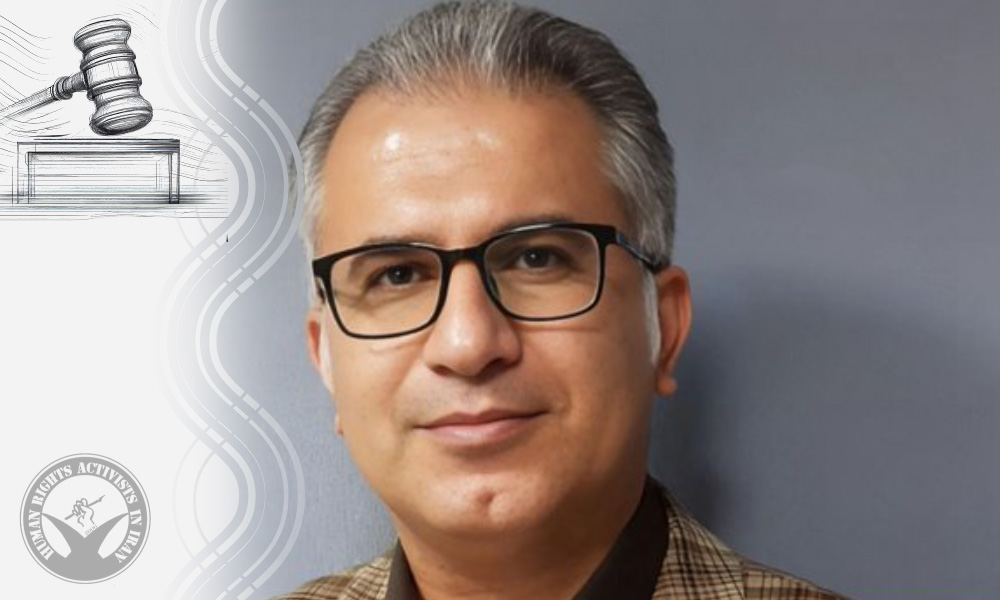
Appeals Court Upholds 10-Year Prison Sentence and Additional Punishments for Reza Valizadeh

HRANA News Agency – The Tehran Court of Appeals has upheld the 10-year prison sentence and additional punishments for Reza Valizadeh, a journalist currently imprisoned in Evin Prison.

He was previously convicted by Branch 26 of the Tehran Revolutionary Court and sentenced to 10 years in prison, a travel ban, a ban on residing in Tehran and neighboring provinces, and a two-year prohibition on membership in political and social groups.

According to HRANA, the news agency of Human Rights Activists in Iran, the Appeals Court confirmed all aspects of the initial verdict against Reza Valizadeh.

His lawyer, Mohammad-Hossein Aghasi, stated:

“Today, I visited Abdolreza Valizadeh to show him the appeal rejection. I had previously said that the court’s standard procedure is to uphold the original ruling, but perhaps a retrial could finally open the blindfolded eyes of justice.”

In December 2024, Judge Iman Afshari of Branch 26 of the Tehran Revolutionary Court sentenced Reza Valizadeh to 10 years in prison on charges of “collaboration with a hostile government (the U.S.)”. Additionally, he was banned from leaving the country, prohibited from residing in Tehran and neighboring provinces, and barred from joining political or social groups for two years.

Background on Reza Valizadeh’s Arrest

  • After living abroad for several years, Reza Valizadeh returned to Iran in March 2023. Upon arrival, he was interrogated by IRGC intelligence and the Ministry of Intelligence, released after signing a commitment, and allowed to remain free.
  • However, a few months later, in early October 2023, he was arrested by security forces and transferred to Evin Prison.
  • According to Voice of America (VOA), he was detained in Ward 209 of Evin Prison, controlled by the Ministry of Intelligence, and denied family visits.

Before emigrating, Reza Valizadeh was previously arrested in 2007 but later released on bail. He reportedly holds dual citizenship and has worked with various media outlets, including Radio France, Voice of America (VOA), Radio Farda, and the Islamic Republic of Iran Broadcasting (IRIB).

Thirteen Baha’i Citizens Arrested by the IRGC Intelligence Organization in Isfahan

HRANA News Agency – The IRGC Intelligence Organization in Isfahan has announced the arrest of 13 Baha’i citizens for allegedly promoting and teaching beliefs associated with the Baha’i faith.

According to HRANA, quoting ISNA, in a statement released today, the IRGC Intelligence Organization claimed that the arrests were made due to the promotion and teaching of Baha’i beliefs among children and teenagers through virtual classes. the IRGC Intelligence, without disclosing the identities or whereabouts of the detainees, alleged that these individuals engaged in actions such as “altering Islamic lifestyles through promoting promiscuity, dog walking, intermingling of girls and boys.”

It is worth noting that HRANA previously reported on the imprisonment of 10 Baha’i women in Isfahan, but it remains unclear whether the ISNA report refers to these individuals or to other Baha’i citizens recently arrested in the city.

According to the Department of Statistics and Publications of the Human Rights Activists in Iran (HRA), between January 1, 2024, and December 20, 2024, a total of 157 reports were recorded in the category of religious and faith-based minority rights. Among these, Baha’is accounted for 67.54% of the reports, ranking as the most observed group in human rights monitoring.

The Baha’i faith is not recognized as a legitimate religion by Iranian authorities, leading to systematic and longstanding violations of the rights of Baha’is in the country. This includes the denial of their fundamental right to practice their religion, which constitutes a clear breach of both Article 18 of the Universal Declaration of Human Rights and Article 18 of the International Covenant on Civil and Political Rights. The United Nations covenant holds that every person has the right to freedom of religion, freedom of converting religion, as well as freedom of expression, individually or collectively; openly or secretly.

Beniamin Rahimpour Arrested in Sanandaj

HRANA News Agency – On Tuesday, January 21, 2025, Beniamin Rahimpour, a resident of Sanandaj, was arrested by security forces and transferred to the IRGC Intelligence detention facility in the city (Shahramfar), According to Kurdpa.

Security forces reportedly arrested Mr. Rahimpour at his workplace and transferred him to the IRGC Intelligence detention facility. They then searched his home, seizing some of his electronic devices.

As of the time of this report, no information is available about the reasons for his arrest, the charges against him, or his current location.

Rahimpour, 33, originally from Avihang village and residing in Sanandaj, has a history of previous arrests due to his activism.

From the human rights cases reported and compiled by HRANA, in 2024, Islamic Revolutionary Guard Corps Intelligence has been involved in 117 cases, including arbitrary arrests. For details and statistics read HRANA’s 2024 annual report.

IRGC Intelligence Arrests 7 Supporters of Erfan-e-Halgheh in Ardabil

The Prosecutor General of Ardabil Province has announced the arrest of seven supporters of Erfan-e-Halgheh (Interuniversal Mysticism), by agents of the IRGC Intelligence Organization in Ardabil.

According to HRANA, citing Mehr News Agency, the detainees are accused of engaging in activities described as “deviant and contrary to Islamic principles,” including “illicit relationships, fraudulent scientific claims, unauthorized medical practices under the guise of treatment, acquiring wealth through unlawful means, and propagandizing against the regime.” Jalal Afaghi, the Prosecutor General, confirmed the arrests but did not provide details about the identities, current locations, or specific charges against those detained.

The Iranian government classifies Erfan-e-Halgheh as a “deviant and anti-religious movement” and has taken strict judicial and security actions against its founder and followers. Participants in the movement have faced severe punishments, including imprisonment, fines, and flogging.

International human rights organizations have condemned these actions as violations of the right to freedom of belief and expression. They have repeatedly urged the Iranian government to cease such repressive measures and respect religious and ideological freedoms.

IRGC Agents Arrest Several in Khuzestan on Espionage Charges

HRANA News Agency – Several individuals in Khuzestan Province have been arrested by the Intelligence Organization of the Islamic Revolutionary Guard Corps (IRGC) on charges of “espionage,” according to a report by the IRGC-affiliated Tasnim News Agency.

The report claims that the detainees were “in contact with the intelligence service of a Persian Gulf country and involved in collecting information from sensitive sites within the province.”

Details regarding the exact number of those arrested, their identities, and their current location remain undisclosed.

While combating espionage is not inherently a human rights issue, Iran’s consistent history of using such accusations as a pretext to suppress political dissent raises concerns. These allegations, particularly in the absence of detailed evidence and judicial transparency, often invite skepticism and call into question the motives behind such arrests.

Subscribe to Our Newsletter

Now is definitely not the time to stop reading!

Ayoub Gheibipour Arrested by IRGC Intelligence in Ahvaz

Ayoub Gheibipour Hajivar, one of the detainees from the 2022 nationwide protests, was arrested by security forces in Ahvaz yesterday and transferred to an undisclosed location.

According to HRANA, the news agency of Human Rights Activists in Iran, a source close to Gheibipour’s family confirmed the news, stating:
“Yesterday, IRGC intelligence agents first went to Mr. Gheibipour’s family home in Ahvaz. After learning he was not home, they went to the gym where he was training and arrested him there. The agents also confiscated the gym’s CCTV cameras. His current location remains unknown.”

The source added: “Mr. Gheibipour has not received any summons to serve his sentence. It is likely that his arrest is connected to his activities.”
In April of 2024, the Ahvaz Revolutionary Court sentenced Gheibipour on charges of arson, destruction of public property, and propaganda against the regime. He was given a 10-year prison term in exile in Kerman Prison for “moharebeh” (enmity against God) and an additional year for “propaganda against the regime.” One of the charges cited against him was “burning a statue of Qassem Soleimani.”

Initially, this verdict was overturned by Branch 20 of the Supreme Court and sent back for retrial. The Ahvaz Revolutionary Court reinstated the same sentence, which was later upheld by the Supreme Court in late October 2024.

Gheibipour was previously arrested in November 2022 during the nationwide protests and detained at Sheiban Prison in Ahvaz. He was eventually released on February 13, 2024, after posting a bail of 3 billion tomans. During his detention, he was denied adequate medical care.

Prolonged Detention and Hunger Strike: Pouria Javaheri’s Case in Sanandaj Prison

Pouria Javaheri, a resident of Kamyaran and one of those arrested during the 2022 nationwide protests in Iran, remains in Sanandaj Prison more than 25 months after his arrest. Frustrated by the lack of resolution in his case, he has started a hunger strike to protest his prolonged detention.

Mustafa Ahmadian, Mr. Javaheri’s lawyer, announced: “My client, Pouria Javaheri, has gone on a hunger strike to protest his extended pre-trial detention in Sanandaj Prison.”

Mr. Javaheri was arrested on November 29, 2022, after being summoned by the IRGC Intelligence office in Kamyaran. Following his arrest, he was held in Kamyaran Prison until late February 2023, before being transferred to Sanandaj Prison in early September 2023.

In early 2023, the Chief Justice of Kurdistan Province publicly announced that Mr. Javaheri had been charged with “moharebeh” (enmity against God). By August 2023, his case had been referred to Branch 1 of the Sanandaj Revolutionary Court, where he now faces multiple allegations, including “moharebeh through the intentional killing of a military officer,” “membership in opposition groups,” “propaganda against the regime,” and “intentional assault on several security officers.”

Farahnaz Nik-Khoo Sentenced to Ten Years in Prison

The Revolutionary Court of Tehran sentenced Farahnaz Nik-Khoo to ten years in prison on political charges.

Branch 15 of the Revolutionary Court of Tehran, presided over by Judge Salavati, sentenced Nik-Khoo to ten years for “acting against national security through espionage.”

On December 3, 2022, IRGC Intelligence arrested Nik-Khoo at Tehran airport as she was attempting to leave the country. She was initially detained in Evin Prison, and after seven months, on April 30, 2023, she was moved to the women’s ward of Evin Prison.

The exact nature of the activities leading to these charges remains unclear.

A reliable source previously informed HRANA that Nik-Khoo was transferred to Ward 209 of Evin Prison, which is controlled by the Ministry of Intelligence, and interrogated for two weeks. Meanwhile, the case is under the purview of IRGC intelligence.

Nik-Khoo, 50 years old, is a retired employee of the national telecommunications company.

IRGC Detains Two Individuals in Miandoab After Nowruz Celebration

According to Kurdpa, on April 17, 2024, Mohsen Ghader-Rash and Omid Ghader-Nejad were arrested after being summoned to the IRGC Intelligence office in Miandoab and subsequently transferred to the city’s prison.

Ghader-Rash, 30, and Ghader-Nejad, 28, were allegedly summoned and detained for participating in the Nowruz celebration gathering.

Imprisoned Political Activist Mostafa Tajzadeh Confronts Additional Charges

Mostafa Tajzadeh, a political prisoner currently held in Evin Prison, is facing new legal challenges as he receives a summons related to fresh charges. The accusations include “assembly and collusion against national security” and “propaganda against the regime,” compelling Tajzadeh to attend a court hearing scheduled for March 10.

In response to the summons, Tajzadeh, in an open letter from prison, declared, “As usual, I refused to receive the summons letter. The Judicial authorities can hand me several additional years-long prison terms in absentia, but I will attend neither courthouse nor the court.”

In late February, Tajzadeh was confined to solitary confinement as a punitive measure for his statement advocating the boycott of the parliamentary election and conducting media interviews from prison.

The prominent political activist was apprehended by security forces on July 8, 2022, and subsequently transferred to Ward 2-A in Evin Prison under the control of the Islamic Revolutionary Guard Corps (IRGC). After months of legal uncertainty, Tajzadeh was sentenced to eight years in prison by Branch 15 of the Revolutionary Court of Tehran, presided over by Judge Salavati. The charges included “assembly and collusion against national security,” “disseminating false information,” and “propaganda against the regime,” with five years of the verdict deemed enforceable.

Tajzadeh, who previously served as the deputy interior minister under President Mohammad Khatami, has a history of judicial confrontations and periods of incarceration stemming from his activism.