





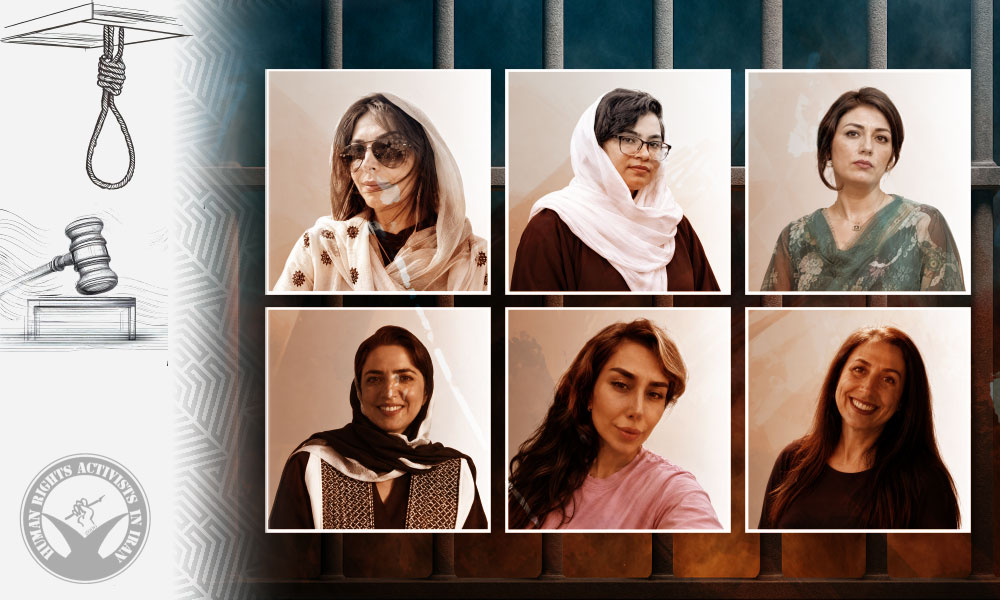
HRANA – At least eight imprisoned women are facing death sentences in various prisons across Iran. The sentences were issued in cases involving charges including “armed rebellion” (baghi), “enmity against God” (moharebeh), and “corruption on earth” (efsad-e fel-arz).
According to HRANA, a review of the judicial cases of imprisoned women shows that at least eight women in different parts of the country are facing death sentences.
These women include Pakhshan Azizi, Arghavan Fallahi, Zahra Shahbaz Tabari, Maryam Hodavand, Mahnaz Chardoli, Leila Abolhasani, Taraneh Rahimi, and Souda (Marzieh) Ebrahimi Shamsabadi.
Four of these women, Maryam Hodavand, Mahnaz Chardoli, Leila Abolhasani, and Taraneh Rahimi, have been sentenced to death in cases related to the protests of the January 2026. Souda (Marzieh) Ebrahimi Shamsabadi is also facing a death sentence in a case connected to security-related developments that occurred during the war. Pakhshan Azizi, Arghavan Fallahi, and Zahra Shahbaz Tabari have been sentenced to death in separate political and security-related cases.
These sentences were issued by various branches of the Revolutionary Courts in Tehran, Isfahan, Rasht, and Bandar Abbas. The judges who issued these sentences include Iman Afshari, Abolghasem Salavati, Vahid Hemmat-Nejad, Morteza Barati, Mohammadreza Tavakoli, Mohammad Ali Darvish-Goftar, and Judge Hajizadeh.
According to the latest available information, the death sentences of Pakhshan Azizi and Arghavan Fallahi have been upheld by the Supreme Court. Zahra Shahbaz Tabari, whose initial death sentence was overturned, has once again been sentenced to death by a parallel branch of the court. The death sentences in the cases of the other five women remain at the trial or appellate review stages.
The latest status and judicial proceedings in each of these prisoners’ cases are detailed below:
 | 1. Pakhshan Azizi, held in Evin Prison, is one of the women sentenced to death in political and security-related cases. She was arrested in Tehran on August 4, 2023, and in August 2024, Branch 26 of the Tehran Revolutionary Court, presided over by Iman Afshari, sentenced her to death and four years in prison on the charge of “armed rebellion (baghi) through membership in groups opposed to the country.” Ms. Azizi’s death sentence was upheld by the Supreme Court in January 2025, and her requests for retrial have also been denied. |
 | 2. Arghavan Fallahi, another woman sentenced to death, is being held in Evin Prison. She was arrested in Tehran in February 2025, and her case was heard by Branch 15 of the Tehran Revolutionary Court, presided over by Judge Abolghasem Salavati. Ms. Fallahi was sentenced to death on the charge of “armed rebellion (baghi) through membership in groups opposed to the government and armed action.” The sentence against her was upheld by the Supreme Court in August 2026. |
 | 3. Zahra Shahbaz Tabari, 68, who is held in Lakan Prison in Rasht, is another woman sentenced to death in a political and security-related case. She was arrested at her home in Rasht in April 2025. Ms. Shahbaz Tabari was initially sentenced to death by Branch 1 of the Rasht Revolutionary Court, presided over by Judge Ahmad Darvish-Goftar, but the Supreme Court overturned the sentence. Her case was subsequently referred for retrial to Branch 2 of the Rasht Revolutionary Court, presided over by Mohammad Ali Darvish-Goftar. On April 14, 2026, the court again sentenced her to death on the charge of “armed rebellion (baghi) through membership and activity in an opposition group.” |
 | 4. Maryam Hodavand, 45 and a mother of two, is being held in Evin Prison. She was arrested in connection with the events of January 8, 2026, in Pakdasht, in a joint case involving three other defendants. Their case was heard by Branch 26 of the Tehran Revolutionary Court, presided over by Iman Afshari. Ms. Hedavand has been sentenced to death on charges including “participation in the killing of two Basij members,” “deliberately setting fire to a religious site,” “destruction of public property,” and “assembly and collusion against national security.” According to the latest available information, the sentence against her remains at the trial-court stage. |
| 5. Mahnaz Chardoli, held in Qarchak Prison in Varamin, was prosecuted in a case related to the January 2026 protests in Tehran. She and Mehdi Nazer were tried in a joint case before Branch 15 of the Tehran Revolutionary Court, presided over by Judge Abolghasem Salavati. The charges against her include “attacking a mosque with a Molotov cocktail,” “participating in gatherings,” and “assembly and collusion.” According to available information, Ms. Chardoli has received an initial death sentence, but the status of the sentence before the Supreme Court has not yet been determined. |
 | 6. Leila Abolhasani, approximately 43 years old and the mother of two teenage daughters, is being held in Dowlatabad Prison in Isfahan. She was arrested on January 8, 2026, during protests in Shahin Shahr, Isfahan. Branch 5 of the Isfahan Revolutionary Court, presided over by Vahid Hemmat-Nejad, sentenced her to death on the charge of “enmity against God” (moharebeh). Following an appeal by her attorney, the case was referred to the Supreme Court for appellate review. A source close to her family previously told HRANA that the charge against Ms. Abolhasani stems from her presence at and filming of the scene of a fire at a store, while judicial authorities have accused her of involvement in setting the fire. |
 | 7. Taraneh Rahimi, another woman sentenced to death in connection with the January 2026 protests, is imprisoned in Dowlatabad Prison in Isfahan. She was arrested along with a number of protesters in Isfahan, and her case was heard as part of a case known as the “Isfahan Shohada Square” case. Branch 1 of the Isfahan Revolutionary Court, with Judges Morteza Barati and Mohammadreza Tavakoli presiding, sentenced Ms. Rahimi and nine other defendants to death and 11 years in prison each. The charges in the case include “enmity against God (moharebeh) through carrying a bladed weapon,” “destruction of public property,” “assembly and collusion,” and “propaganda activity against the regime.” Her sentence remains at the trial-court stage. |
 | 8. Souda (Marzieh) Ebrahimi Shamsabadi, 32, who is held in Bandar Abbas Prison, is the only woman on this list whose death sentence was issued in a case related to security developments during the war. She was arrested on March 29 by Ministry of Intelligence agents and was subsequently tried before the Bandar Abbas Revolutionary Court, presided over by Judge Hajizadeh. Ms. Ebrahimi Shamsabadi was sentenced to death on the charge of “corruption on earth” (efsad-e fel-arz), as well as charges including “insulting the Supreme Leader,” “media and propaganda activities contrary to national security,” “intelligence and security activities on behalf of hostile governments,” and “photographing a military site and sending the images to Persian-language media outlets based outside Iran.” The sentence against her remains at the initial trial stage. |
Bita Hemmati and Varisheh Moradi: Death Sentences Overturned, Cases Remain Unresolved Pending Retrial
In addition to the eight women who, according to the latest available information, continue to face death sentences, the cases of Bita Hemmati and Varisheh Moradi are also noteworthy because both were previously sentenced to death and their judicial proceedings remain ongoing. The Supreme Court overturned both prisoners’ death sentences and referred their cases to parallel branches for retrial; however, the final outcomes of their cases remain undetermined.
 | Varisheh Moradi, who has been in detention since August 2023, was sentenced to death in late November 2024 by the Tehran Revolutionary Court, presided over by Judge Abolghasem Salavati, on the charge of “armed rebellion” (baghi). The Supreme Court overturned the sentence in late December 2025 and referred the case to a parallel branch for retrial. A retrial hearing in her case, which had been scheduled for July 2026 before Branch 15 of the Tehran Revolutionary Court, was canceled because Ms. Moradi did not appear. As of the time of this report, the final outcome of the retrial remains unknown. |
 | Bita Hemmati, one of those arrested during the December 2025–January 2026 protests, was previously sentenced by Branch 26 of the Tehran Revolutionary Court, presided over by Iman Afshari, to death on the charge of “conducting operations on behalf of the hostile government of the United States and hostile groups,” and to five years in prison on the charge of “assembly and collusion against national security.” In June 2026, the Supreme Court overturned her death sentence and referred the case to a parallel branch for retrial. Ms. Hemmati, who was arrested in Tehran on January 9, 2026, is currently being held in the women’s ward of Evin Prison. HRANA’s investigations into the outcome of her retrial and her latest judicial status are ongoing. |