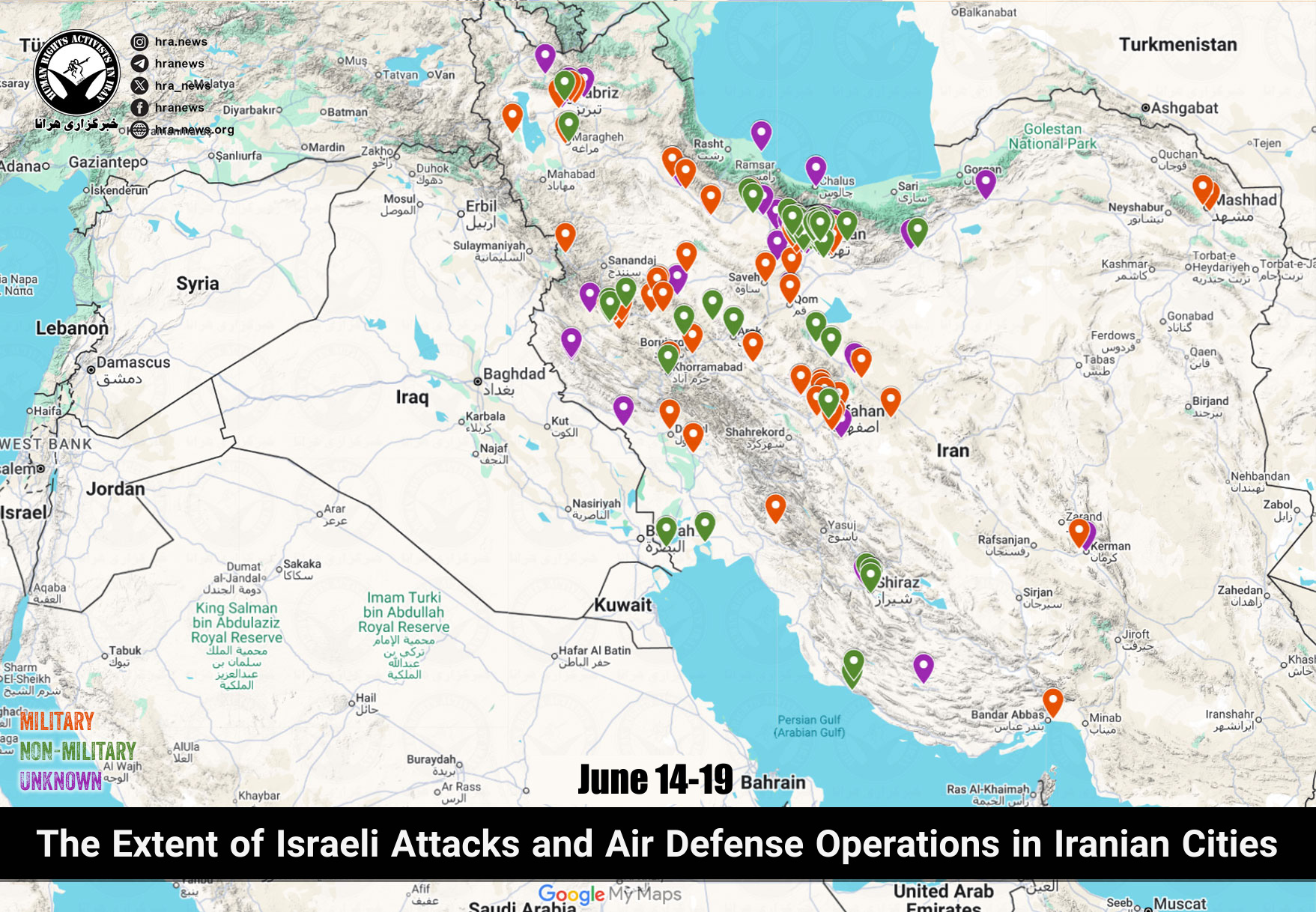
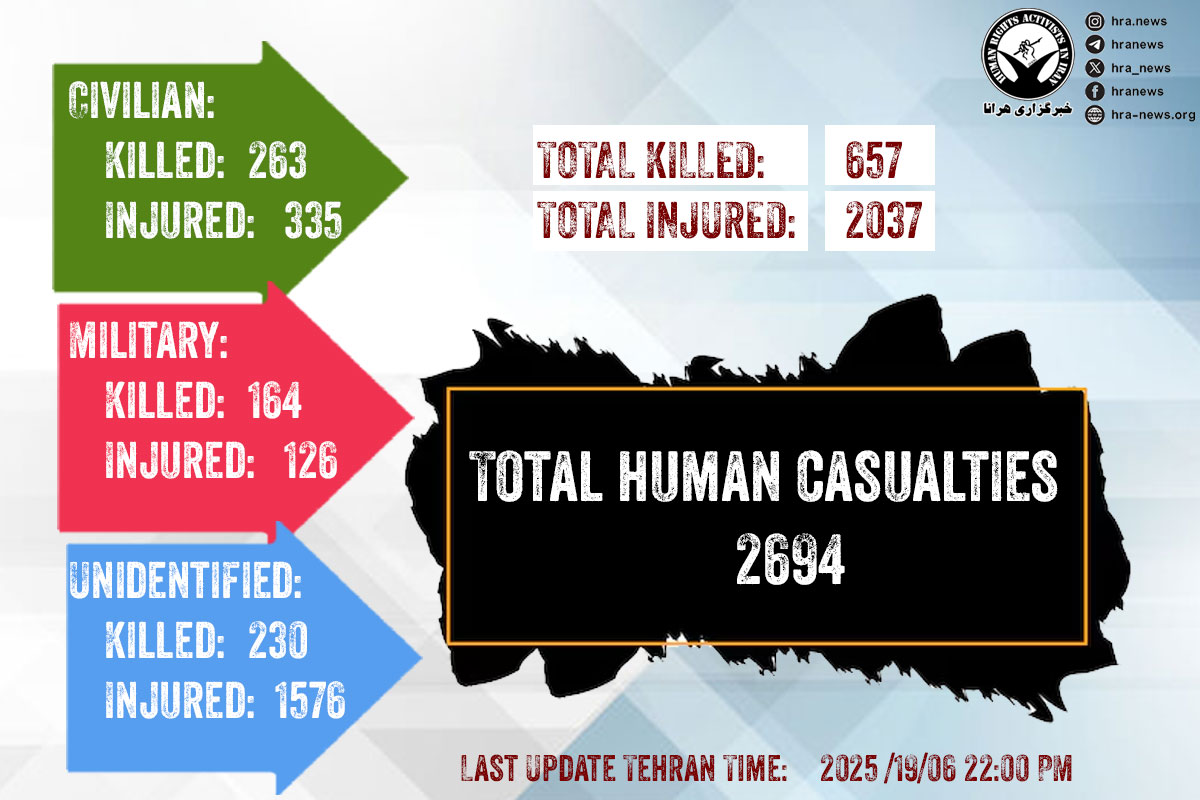
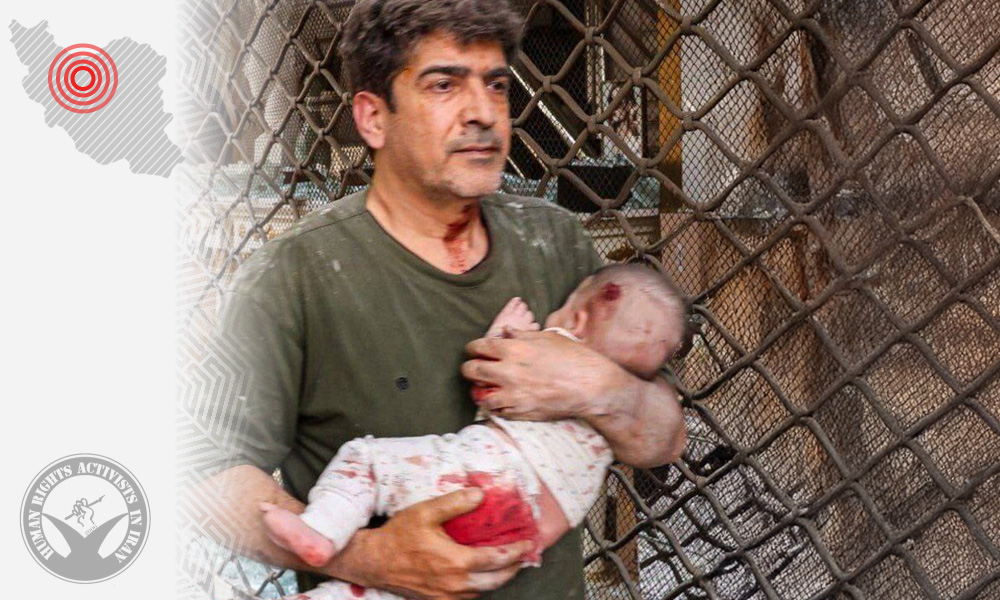
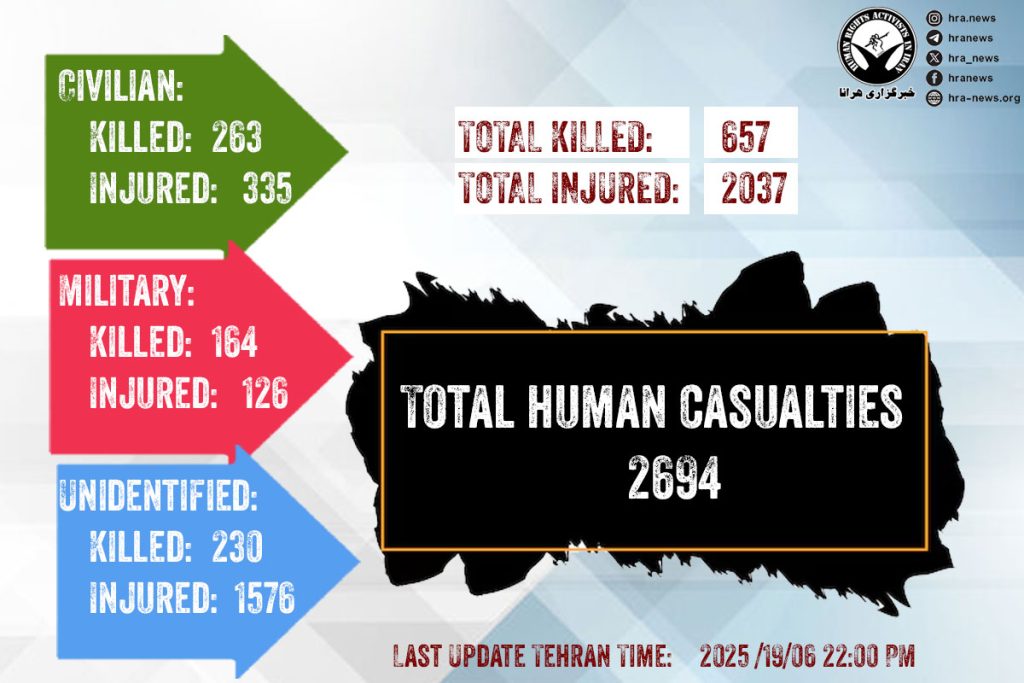
HRANA News Agency – On June 19, the seventh day of military conflict between Iran and Israel, airstrikes on military and civilian infrastructure continued across various parts of Iran. At least two people were killed in yesterday’s attacks. Including yesterday’s casualties, the total number of deaths and injuries since the morning of Friday, June 13 (23 Khordad) has reached 2,694, consisting of 657 killed and 2,037 injured.
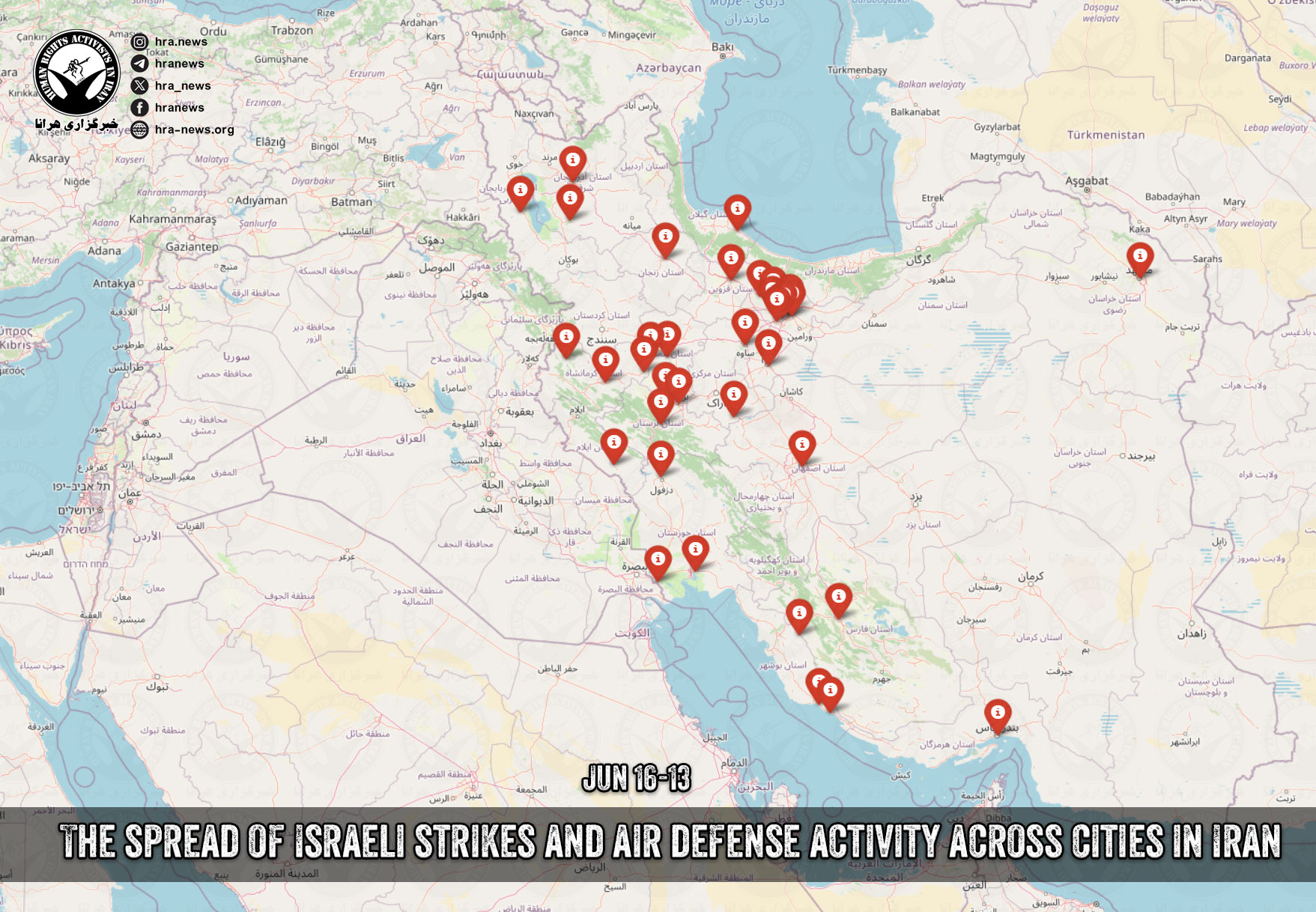
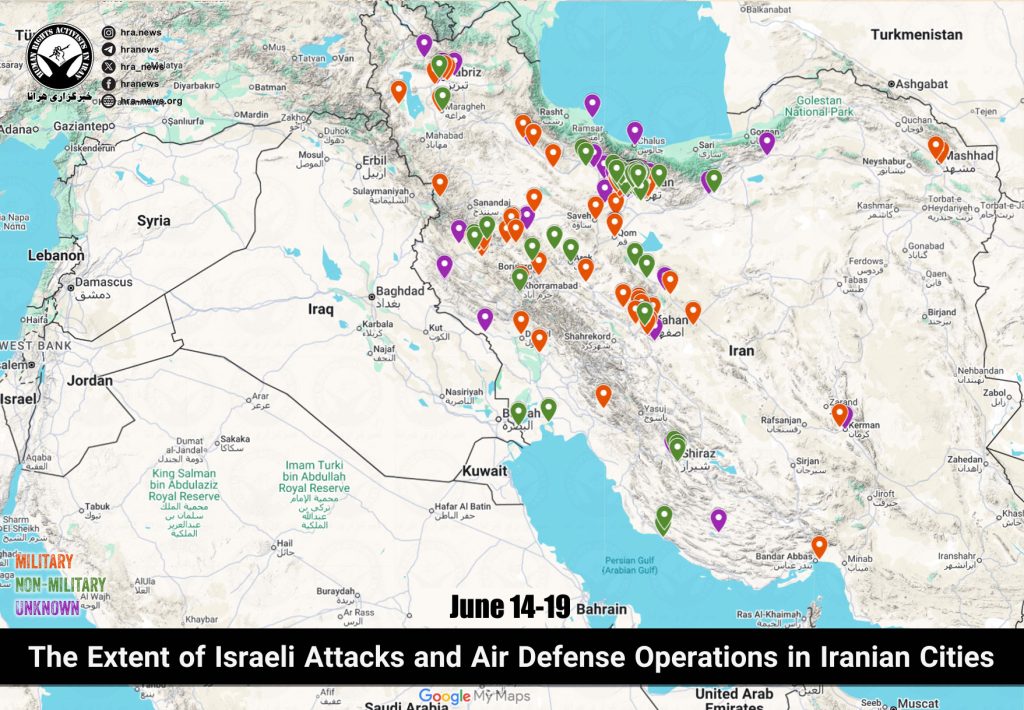
Over the past week, Israeli attacks have expanded to 21 provinces across the country, severely disrupting the daily lives of millions of Iranians. Banking systems, transportation, communications, and healthcare services have been disrupted. Citizens are facing shortages of goods, long queues, rationing, and widespread anxiety. Afghan migrants, patients, the elderly, and even pets have not been spared from the consequences of the crisis. Simultaneously, widespread internet outages, cybersecurity attacks, lack of transparent information, and ongoing security-related arrests have intensified public distrust and anxiety.
Geographic Scope and Timeline of Events
On the first day of attacks, several infrastructures and facilities in the provinces of Tehran, East Azerbaijan, West Azerbaijan, Ardabil, Isfahan, Ilam, Kermanshah, Markazi, Hamedan, Fars, Khuzestan, and Kurdistan were targeted.
On the second day, attacks extended to the provinces of Lorestan, Kermanshah, East Azerbaijan, Alborz, Zanjan, Hamedan, Tehran, Bushehr, Qazvin, Fars, Khuzestan, Gilan, Hormozgan, Isfahan, and West Azerbaijan.
On the third day, Israel attacked the provinces of Tehran, Alborz, Isfahan, Kermanshah, Fars, Alborz, and Razavi Khorasan.
On the fourth consecutive day of Israeli military attacks on Iranian soil, several energy infrastructures, military installations, and residential areas in the provinces of Ilam, Kermanshah, Tehran, Qom, Hamedan, Khuzestan, Zanjan, Alborz, Markazi, East Azerbaijan, Kurdistan, and Fars were targeted.
On the fifth day, the provinces of Tehran, Isfahan, East Azerbaijan, Alborz, Markazi, Qazvin, Khuzestan, Hormozgan, West Azerbaijan, Razavi Khorasan, Kurdistan, Kermanshah, Chaharmahal and Bakhtiari, Hamedan, Bushehr, and Kerman continued to be attacked by the Israeli military. On this day, the spokesperson for the Red Crescent, without specifying the names of the affected provinces, stated: “Since the beginning of Israeli attacks, 21 provinces have been involved.”
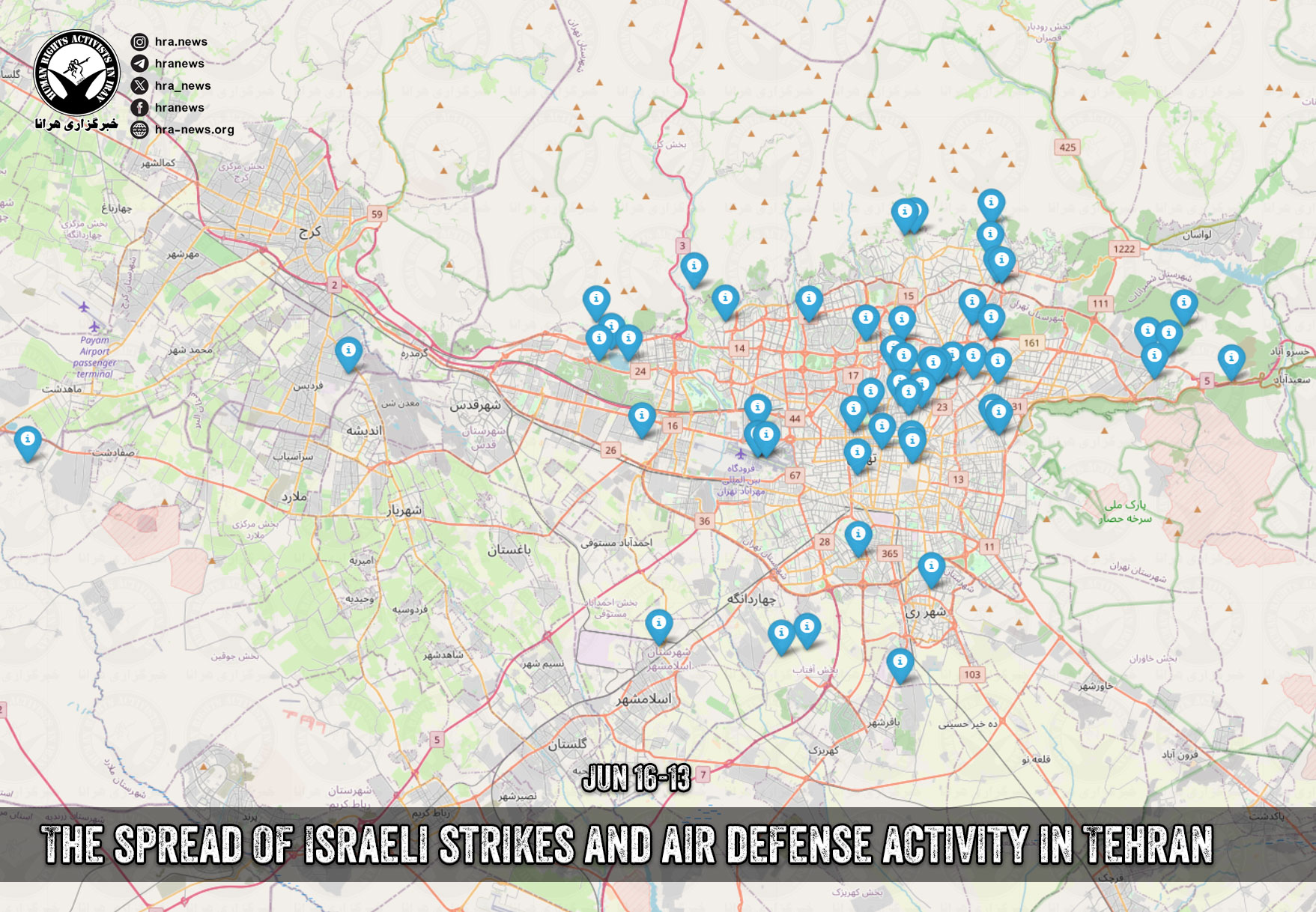
According to HRANA’s report, on Wednesday, June 18 (28 Khordad), several infrastructures and facilities in the provinces of Zanjan, Fars, Tehran, Isfahan, Hamedan, Alborz, East Azerbaijan, Semnan, Kermanshah, Mazandaran, Khuzestan, Ilam, Qom, Bushehr, Gilan, and Qazvin were targeted. As in previous days, Tehran remained the primary target of the attacks.
Yesterday, Thursday, June 19 (29 Khordad), marks the seventh day of military conflict between Iran and Israel. On this day, infrastructures and facilities in the provinces of Markazi, Isfahan, Tehran, Fars, Alborz, Kermanshah, Kerman, and Lorestan were attacked by the Israeli military.
Military Equipment and Scope of Attacks
During the first three days of the conflict, the Israeli army announced that it had conducted over 720 airstrikes and targeted more than 60 locations. On the fifth day of attacks, Israel claimed that in three new waves of strikes, it had hit at least 40 targets.
In the investigations conducted by human rights groups, the principle of proportionality in the laws of war holds particular significance. This proportionality includes various aspects, such as the proportionality between targets and weapons. Based on information collected from reliable sources, the Israeli military has employed the following weapons in its attacks:

| Weapon | Type | Model/Variant | Description & Role |
|---|
| 1 | Harop | Loitering attack drone | – (IAI Harop) | Autonomous kamikaze drone that loiters and dives onto targets (especially radars). Used to suppress Iranian air defenses and communications by homing in on radar emissions. |
| 2 | Harpy | Loitering anti-radar drone | – (IAI Harpy) | Anti-radiation loitering munition designed to seek and destroy enemy radars. Older, fire-and-forget drone that crashes into SAM radar emitters. Complemented Harop in knocking out Iran’s SAM sites. |
| 3 | F-35I “Adir” | Stealth multirole fighter | F-35I (Israel variant) | 5th-gen stealth fighter jet with Israeli electronics. Penetrated Iranian airspace undetected to lead initial strikes, targeting air defenses, command centers, and nuclear sites with precision munitions. |
| 4 | F-15I “Ra’am” | Strike fighter-bomber | F-15I (Israel variant) | Long-range heavy fighter(F-15E variant) carrying large payloads (bunker busters, etc.). Non-stealth, but high payload and range; used to bomb hardened sites like Natanz once air defenses were down. |
| 5 | F-16I “Sufa” | Multirole fighter | F-16D Block 52+ (Israel) | Versatile fighter jetwith conformal fuel tanks for extended range. Dropped guided bombs (e.g., SPICE, JDAM) on a wide array of targets (missile launchers, bases, leaders). Backbone of strike force. |
| 6 | Delilah | Air-launched cruise missile | – (IMI Delilah) | Standoff cruise missile (loitering munition) with ~250 km range. Can loiter and be retargeted in flight. Used to surgically strike mobile or well-hidden targets (radars, convoys) from afar. |
| 7 | Rampage | Air-to-surface guided missile | – (Elbit Rampage) | Supersonic guided strike missile(air-launched rocket) designed to penetrate bunkers and hit high-value targets at long range. Difficult to intercept due to high speed. |
| 8 | Blue Sparrow | Air-launched ballistic missile (ALBM) | – (Blue Sparrow target missile) | Air-dropped ballistic missileused as a pseudo-weapon. Released from aircraft to strike like a short-range ballistic missile. Provided Israel a way to hit distant hardened targets quickly. |
| 9 | LORA | Short-range ballistic missile | LORA (IAI) | Surface-launched ballistic missile(ground/ship) with ~400 km range and 10 m accuracy. Carries a 570 kg warhead. Used to hit fixed strategic targets (bases, infrastructure) at long range in opening salvo. |
| 10 | SPICE-1000/2000 | Precision glide bomb kit | SPICE family (Rafael) | Electro-optical/GPS guided bombs(1000 lb or 2000 lb) that glide to target. Extremely accurate (<3 m CEP). Used to destroy buildings, runways, and other fixed targets with minimal collateral damage. |
| 11 | JDAM Bombs | GPS-guided bomb (kit) | GBU-31 JDAM etc. | Joint Direct Attack Munition – a guidance kit for 500–2000 lb bombs using GPS/INS. Turns “dumb” bombs into all-weather smart bombs (~5–10 m accuracy). Formed a large portion of munitions dropped on Iranian targets. |
| 12 | GBU-39 Small Diameter Bomb | Guided glide bomb | GBU-39/B SDB I | 250 lb glide bombwith GPS guidance and pop-out wings (range ~110 km). Small warhead for pinpoint strikes on SAM sites, launchers, etc. Allows multiple bombs per aircraft hardpoint. |
| 13 | GBU-28 “Bunker Buster” | Laser/GPS guided bomb | GBU-28/B | 5,000 lb deep-penetration bombdeveloped to destroy heavily fortified underground facilities. Can penetrate dozens of feet of concrete/earth. Deployed by F-15I against Iran’s buried nuclear sites (e.g. Natanz). |
| 14 | Spike | Anti-Tank Guided Missile | ATGM | An advanced anti-tank missile developed by Israel’s Rafael company, featuring fire-and-forget capability. Using optical and thermal guidance, it can accurately target armored vehicles, military transport vehicles, and even light fortifications. In these operations, long-range variants of the missile have been used to destroy vehicles and buildings. |
Latest Statistics on Casualties and Human Losses So Far
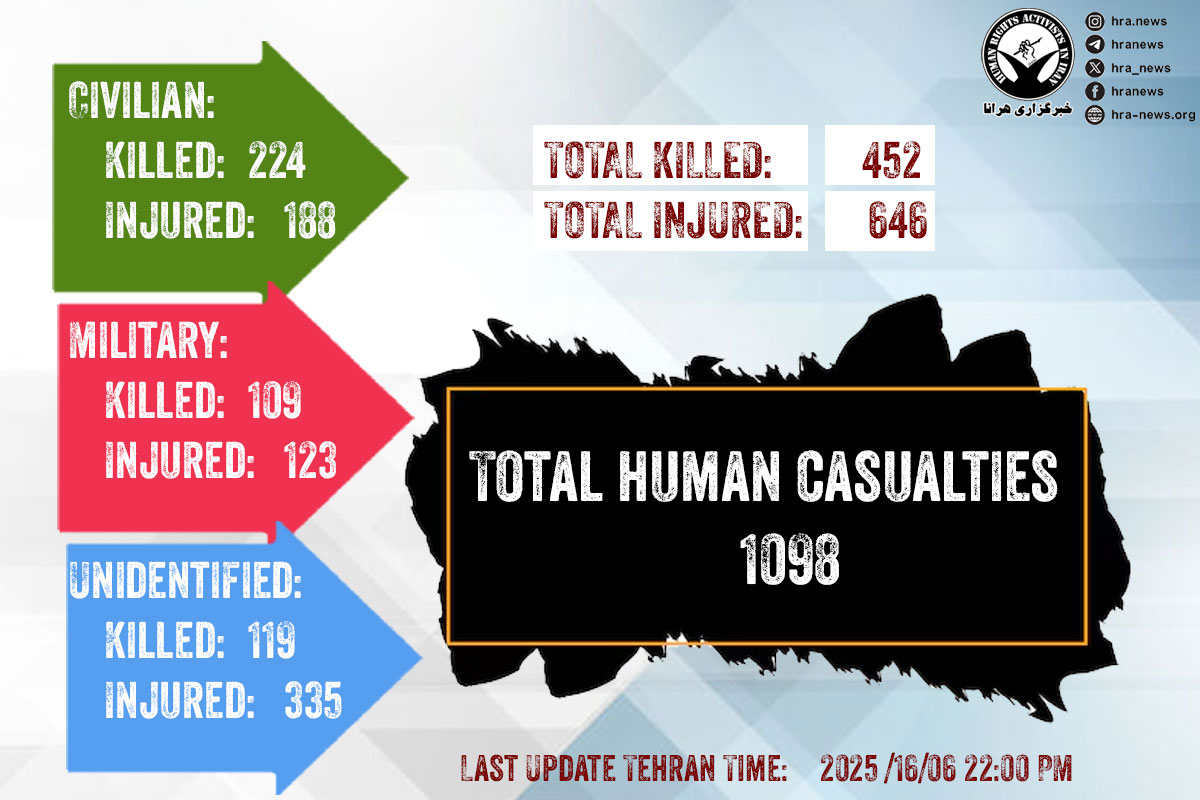
Since the beginning of Israel’s attacks on Iran, hundreds of military and civilian citizens have been killed or injured. The military or civilian status of a significant number of the casualties mentioned in this report is still under investigation.
The spokesperson for the Ministry of Health announced that since the onset of the military conflict between Iran and Israel, more than 2,500 of the wounded have been admitted to public and university hospitals. According to Hossein Kermanpour, of this number, about 1,600 have received outpatient treatment, and nearly 500 remain hospitalized. Additionally, 380 specialized surgeries have been performed on the injured so far.
This official did not comment on the number of fatalities or whether the deceased were military or civilian.
The statistics provided by HRANA, based on its network of volunteers and other non-governmental groups, show slight differences due to updates from newly received documents related to casualties in recent days, as well as the inclusion of yesterday’s two military deaths in the city of Abhar, Zanjan Province. The breakdown is as follows:
▫️Civilians:
Killed: 263
Injured: 335
▫️Military Personnel:
Killed: 164
Injured: 126
▫️Unspecified:
Killed: 230
Injured: 1,576
Total Fatalities: 657
Total Injuries: 2,037
Total Human Casualties: 2,694
During one week of Israeli military attacks on different regions of Iran, children — as one of the most vulnerable groups in society — have suffered extensive harm. Local sources and hospital reports indicate that a number of children have lost their lives due to the bombing of residential areas, seizures caused by fear, or injuries from collapsing debris. Some children, suffering from severe anxiety triggered by the repeated sounds of explosions, experienced seizures and died due to the lack of immediate medical care.
On the first day of the attacks, the Islamic Republic of Iran Broadcasting’s news network announced that dozens of people in Tehran, including 35 women and children, had been injured following the Israeli strikes.
On Monday, June 16 (26 Khordad), the government spokesperson stated that in the first four days of Israeli army attacks, 153 women and children had been injured and 58 had been killed. According to him, among the fatalities was a pregnant woman who died along with her seven-month-old fetus.
Some state-run newspapers, referring to the psychological toll of war on children, reported instances of infants and children dying from seizures and severe injuries in medical centers. According to these reports, infants transferred to hospitals showed no vital signs, and some died after several days due to the severity of their injuries. However, these reports did not provide precise statistics on the number of child casualties and injuries over the past week.
While many areas are facing shortages of medicine, power outages, and an overwhelmed healthcare system, children have been deprived of even basic medical and psychological support. School closures, loss of parents or family members, and lack of safe shelters have created a critical psychological situation for many children.
yesterday, images and videos circulated on social media showing the evacuation of the “Ameneh Infant Care Center” by Welfare Organization staff and the transfer of infants and children to another location. This operation took place on June 16 (26 Khordad) following an Israeli military warning to evacuate Tehran’s District 3.
These events once again highlight the urgent need for the international community to address the humanitarian dimensions of the conflict and to protect children during wartime.
The table below contains the verified identities of some of the children who have been injured or killed in recent attacks. Further information and identification of affected children are still under investigation.
| Province | City | Date | Killed | Injured | Age | Identity | Neighborhood / Location |
|---|
| 1 | Tehran | Tehran | Friday, June 13 | 1 | – | 12 years old | Amirali Amini | Mahallati Street |
| 2 | Tehran | Tehran | Friday, June 13 | 1 | – | 16 years old | Parham Abbasi | Sattarkhan neighborhood |
| 3 | Unspecified | Unspecified | Unspecified (between June 13–14) | – | 1 | 2 years old | – | – |
| 4 | Tehran | Tehran | Friday, June 13 | 1 | – | 10 years old | Mahya (Mahia) Nikzad | – |
| 5 | Tehran | Tehran | Unspecified (between June 13–14) | 1 | – | – | Heida Zeinali | – |
| 6 | Tehran | Tehran | Unspecified (between June 13–14) | 1 | – | – | Ayma Zeinali | – |
| 7 | Tehran | Tehran | Friday, June 13 | 1 | – | 9 years old | Baran Eshraghi | – |
| 8 | Tehran | Tehran | Friday, June 13 | 1 | 0 | 5 years old | Fatemeh Zakarian | – |
| 9 | Tehran | Tehran | Friday, June 13 | 1 | – | 7 months old | Zahra Zakarian | – |
| 10 | Tehran | Tehran | Unspecified (between June 13–14) | 1 | – | 11 years old | Soheil Katouli | – |
| 11 | Tehran | Tehran | Saturday, June 14 | 1 | – | 17 years old | Seyed Hamidreza Sedighi Saber | Sattarkhan neighborhood |
| 12 | Unspecified | Unspecified | Unspecified (between June 13–16) | 1 | – | 3 years old | – | – |
| 13 | Tehran | Tehran | Unspecified (between June 13–16) | 1 | – | 8 years old | Tara Haji Miri | Patrice Lumumba Street |
| 14 | Isfahan | Najafabad | Wednesday, June 17 | 1 | – | 13 years old | – | – |
| 15 | Isfahan | Najafabad | Wednesday, June 17 | 1 | – | 10 years old | – | – |
| 16 | Tehran | Tehran | Friday, June 13 | 1 | – | 12 years old | Motahareh Niyazmand | Chamran Residential Complex |
| 17 | Tehran | Tehran | Friday, June 13 | 1 | – | 11 years old | Mohaddeseh Aghdasi | Chamran Residential Complex |
| 18 | Tehran | Tehran | Friday, June 13 | 1 | – | 9 years old | Mohammadreza Aghdasi | Chamran Residential Complex |
| 19 | Tehran | Tehran | Friday, June 13 | 1 | – | 13 years old | Mersana Bahrami | Chamran Residential Complex |
| 20 | Unspecified | Unspecified | Friday, June 13 | 1 | – | 8 years old | Mohammad Hossein Khaki | Chamran Residential Complex |
| 21 | Tehran | Tehran | Friday, June 13 | 1 | – | 10 years old | Fatemeh Niyazmand | Chamran Residential Complex |
| 22 | Tehran | Tehran | Friday, June 13 | 1 | – | 12 years old | Alireza Niyazmand | Chamran Residential Complex |
| 23 | Tehran | Tehran | Friday, June 13 | 1 | – | 9 years old | Zahra Bahman Abadi | Chamran Residential Complex |
| 24 | Tehran | Tehran | Friday, June 13 | 1 | – | 5 years old | Hanieh Bahman Abadi | Chamran Residential Complex |
| 25 | Tehran | Tehran | Friday, June 13 | 1 | – | 2 years old | Mohammad Ali Bahman Abadi | Chamran Residential Complex |
The Shadow of War Over Daily Life: From Collapsed Services to People’s Desperation
As the unrest enters its seventh day, the civilian aspects of Israel’s military attacks on Iran have become increasingly apparent. Now, not only the targeted areas but vast regions of the country are suffering from the cascading effects of the crisis, including shortages of essential goods, disruptions to urban services, and abandonment of vulnerable groups. Field reports and citizen accounts received by HRANA paint a worrying picture of a growing humanitarian disaster and the inability of support structures to respond effectively.
Financial Crisis Amid War: Banks Unable to Operate
With the expansion of the conflict, disruptions in banking services and a shortage of cash have become serious challenges for citizens. Many bank branches have imposed a cash withdrawal limit of one million tomans (about $20 USD), which is insufficient for basic family expenses. Numerous ATMs are empty, and the inability to make online purchases has made it difficult for citizens to acquire essential goods. Simultaneously, cyberattacks on banking systems — especially on Sepah Bank and Pasargad Bank — have caused widespread financial paralysis and confusion.
Many citizens, needing cash to cover basic necessities or to leave affected cities, have been unable to access funds, compounding their hardships.
Transportation Collapses; Travel Costs Skyrocket
Public transportation in many affected areas has nearly shut down. Intercity travel has sharply declined due to a shortage of vehicles and skyrocketing fares, making travel impossible for many. According to one Tehran resident, the cost for a family of three to travel to Gilan province has reached eight million tomans — far beyond what most families can afford.
Abandoned in Crisis: The Isolation of the Elderly, the Sick, and the Disabled
In wartime conditions, the elderly, the sick, and people with disabilities have been left isolated. Numerous messages indicate that many of these individuals remain alone and unattended in their homes. Healthcare services face shortages of essential medications and disruptions in the treatment of chronic diseases, endangering the lives of thousands.
Intensified Livelihood Pressure: Rationing, Queues, and Rising Prices
As supply chains break down, stores face empty shelves, closures, or rationing of essential goods. Reports mention the rationing of items such as sanitary products, bread shortages, and street disputes over food. At the same time, prices of essential goods have doubled on average in less than a week.
Forced Labor Under Fire: No Protection for Workers
Despite security warnings and evacuation orders, some workshops and factories in high-risk areas continue operations. Workers, without legal protection and directly exposed to attacks, are forced to keep working. Field reports indicate that even during the early hours of bombardment, mandatory shifts were not canceled.
Afghan Migrants: On the Margins of Danger and Defenseless
Afghan migrants living in Iran are experiencing even harsher conditions. In addition to the direct threat of war, some face accusations such as espionage or denial of access to shelters and emergency aid. This situation has placed them in a double bind of discrimination and vulnerability.
Abandoned in Ruins: Pets, the Silent Victims
The lack of support infrastructure has made caring for pets extremely difficult under crisis conditions. Many citizens have been forced to abandon their animals or remain in unsafe areas because they are unable to transport them. This adds emotional and practical burdens to pet owners.
Conscripts: The Silent Forces on the Frontlines
Conscripts, who often have no operational responsibilities, have been forcibly kept at high-risk military sites during the war. Reports indicate a reduction in professional military staff at some bases and an increase in mandatory shifts for conscripts. Some conscripts have been killed in recent attacks, but official media have refrained from reporting their names or statuses.
Cut Off from the World: Communication Isolation and Family Anxiety
Internet outages and communication restrictions, especially in central regions, have completely severed family contacts with loved ones abroad. Families with members living in Europe, Canada, or neighboring countries are left in total uncertainty and anxiety.
Official Silence Amid Threats: No Guidance on Safety or Contamination Risks
State media continue to focus on military and propaganda activities without providing safety instructions or guidance for citizens. While global concerns grow over potential nuclear contamination, residents near sensitive facilities have been left without any training or official information, relying solely on social media and stressful personal communications.
Israeli Attacks on Iranian Civilian Infrastructure
In the first two days of Israeli attacks on various parts of Iran, numerous civilian, industrial, and medical facilities were targeted. In Tehran, one projectile struck the exterior of Hakim Children’s Hospital, which, according to the Deputy Director of the University of Medical Sciences, resulted in no casualties. In Ilam, the Musian Fire Department building was hit, and in Borujerd, the Farda Motors automobile factory was targeted, leading to massive fires and casualties. In Qazvin, the Alborz Industrial Park was struck, while in Tabriz, areas near the petrochemical facility were bombed. Explosions were also reported in Ashtianan (Lorestan province) and parts of Kermanshah.
In Bushehr, an Israeli drone targeted the Fajr Jam Refinery, which processes gas from the South Pars gas field — marking the first attack on Iran’s energy infrastructure during this conflict. Simultaneously, defensive and military activities were reported in cities such as Tabriz, Malard, southern and central Tehran, Pasteur, Chaldoran, Ahvaz, Urmia, Bukan, Bandar Abbas, Naqadeh, Shahroud, Isfahan, Maragheh, Ouramanat, Javanrud, Mashhad, Ravansar, and Shahr-e Rey (Fadaiyan-e Islam district).
The attacks on Iran’s civilian areas continued into the third day, Sunday, June 15 (25 Khordad), damaging civilian infrastructure in Tehran, Isfahan, Shiraz, Mashhad, Kermanshah, Kordan, Garmdareh, Baharestan, Bagher Shahr, and Kahrizak. Among the damaged targets were oil depots in Shahran, western and southern Tehran, MAPNA factory, SAIRAN, KAICO Kermanshah Company, Mashhad Airport, student dormitories in Keshavarz Square, various energy facilities, and one building associated with the Ministry of Foreign Affairs.
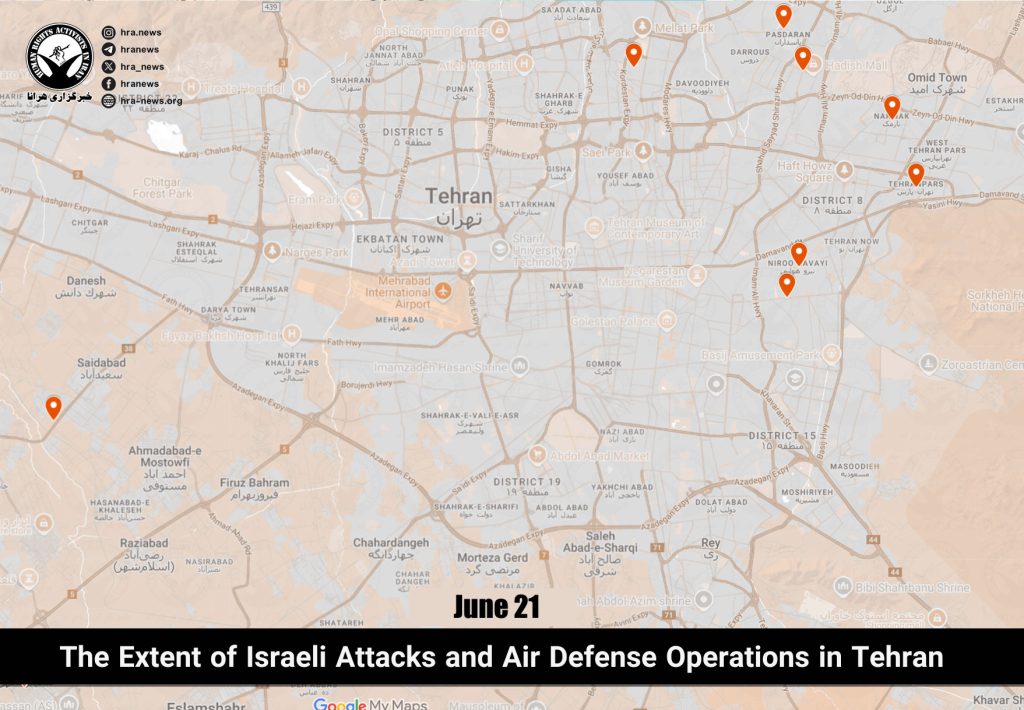
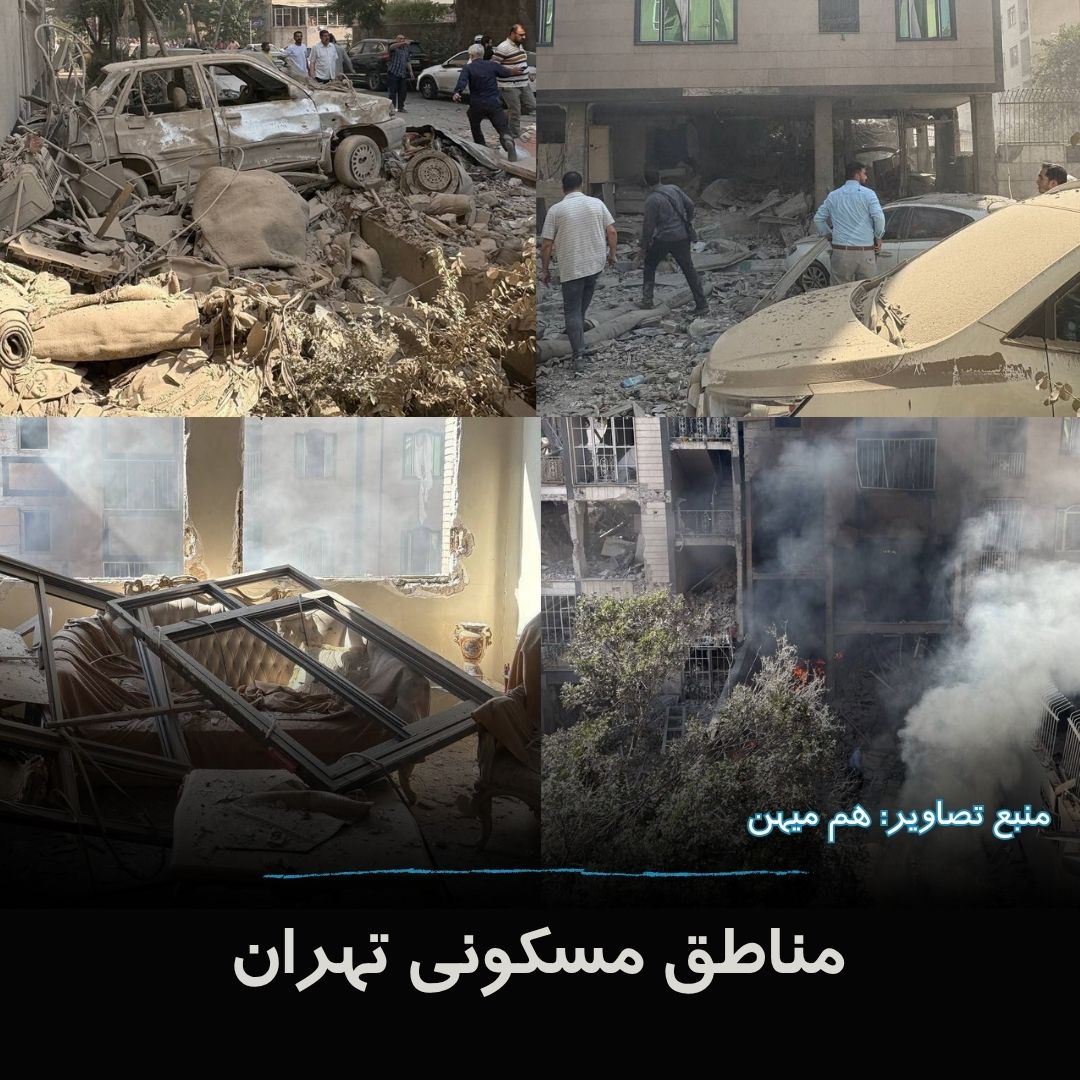
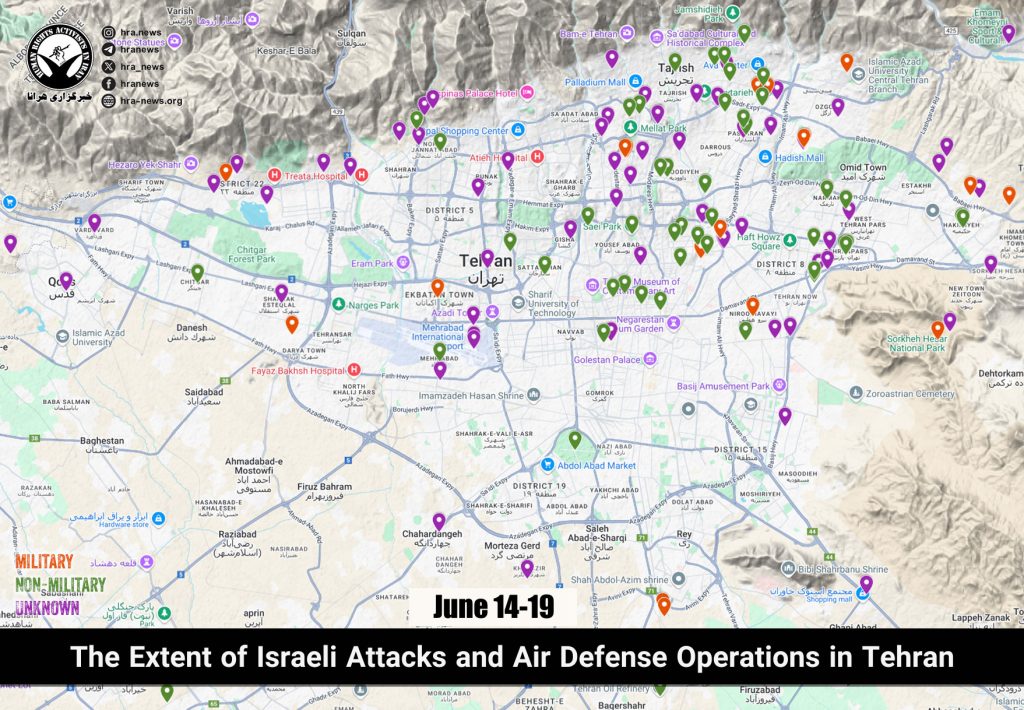
In Tehran, the most severe damage and defensive clashes were reported in neighborhoods such as Niavaran, Tehranpars, Mirdamad, Pasteur, Ekbatan, Saadatabad, Farmanieh, Shahran, and many others.
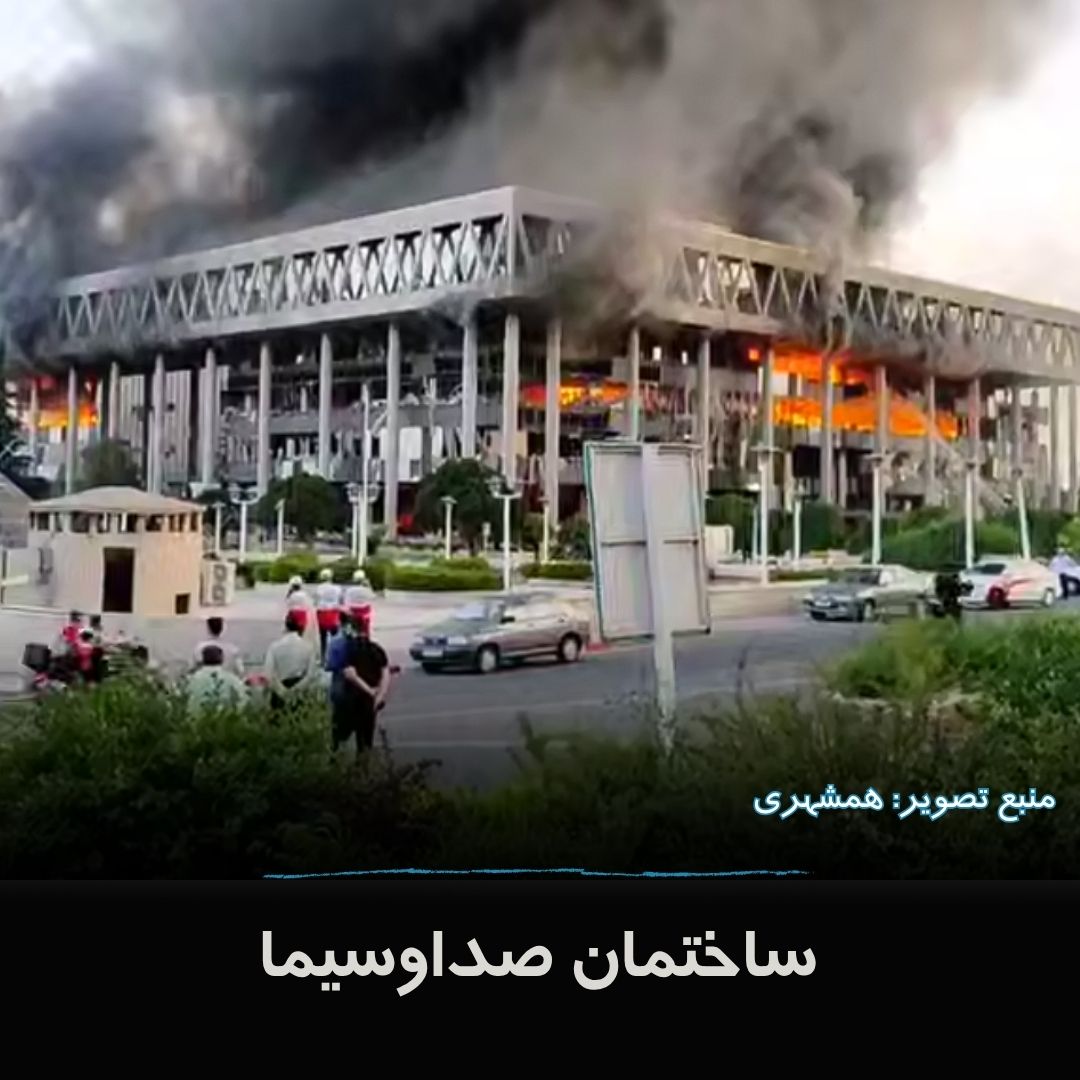
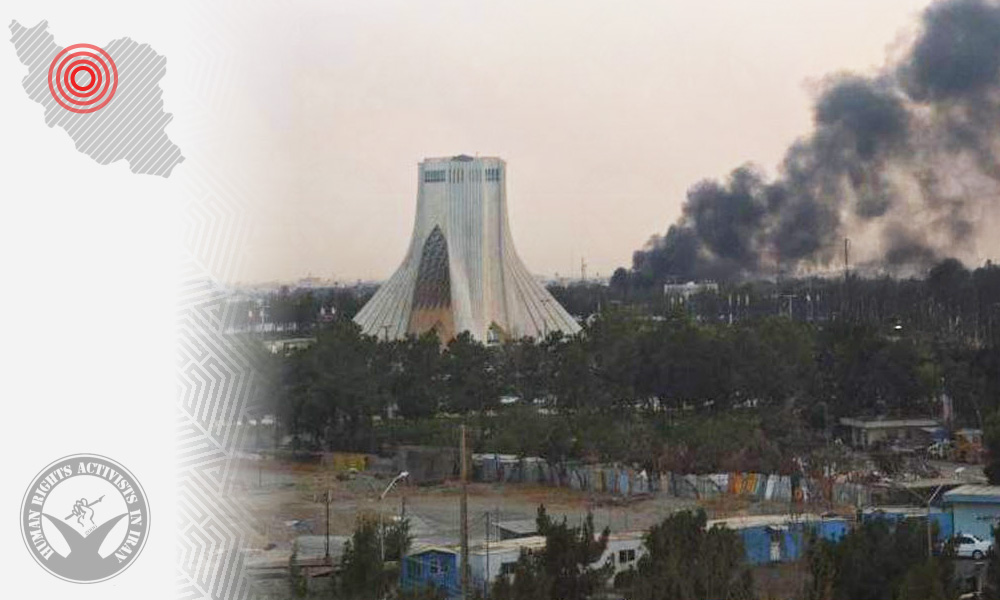
On Monday, June 16 (26 Khordad), the fourth consecutive day of conflict, Israeli attacks again targeted several civilian infrastructures. On this day, air defense engagements were reported in Bushehr, Qeshm, Bandar Abbas, Dehloran, Natanz, Tehran, Sanandaj, Tabriz, Kermanshah, Ahvaz, Bandar Anzali, Bostan Abad, Marand, and Malayer. Tehran experienced the highest number of attacks among all affected provinces. In and around Tehran, targeted areas included Khalazir village, Shahrak-e Gharb, Bidganeh, Vavan, Bagheri, Olympic Village, Mehrabad Airport vicinity, Azadi Square, Tehranpars, and the IRIB (state broadcaster) building.
On the fifth day, civilian and infrastructure targets in Tehran, Kashan, Tabriz, Nazarabad, Zarandieh, Khomein, Qazvin, Najafabad, Ardestan, Shahin Shahr, and Naein were hit. Targets included the IRIB building in Tehran, the Nazarabad Industrial Park, and Zaviyeh Industrial Park, as well as civilian areas such as Piroozi Street, Majidieh, Andarzgoo, Sablon Square, Velenjak, Pasdaran, Elahiyeh in Tehran, and Velayat town in Qazvin.
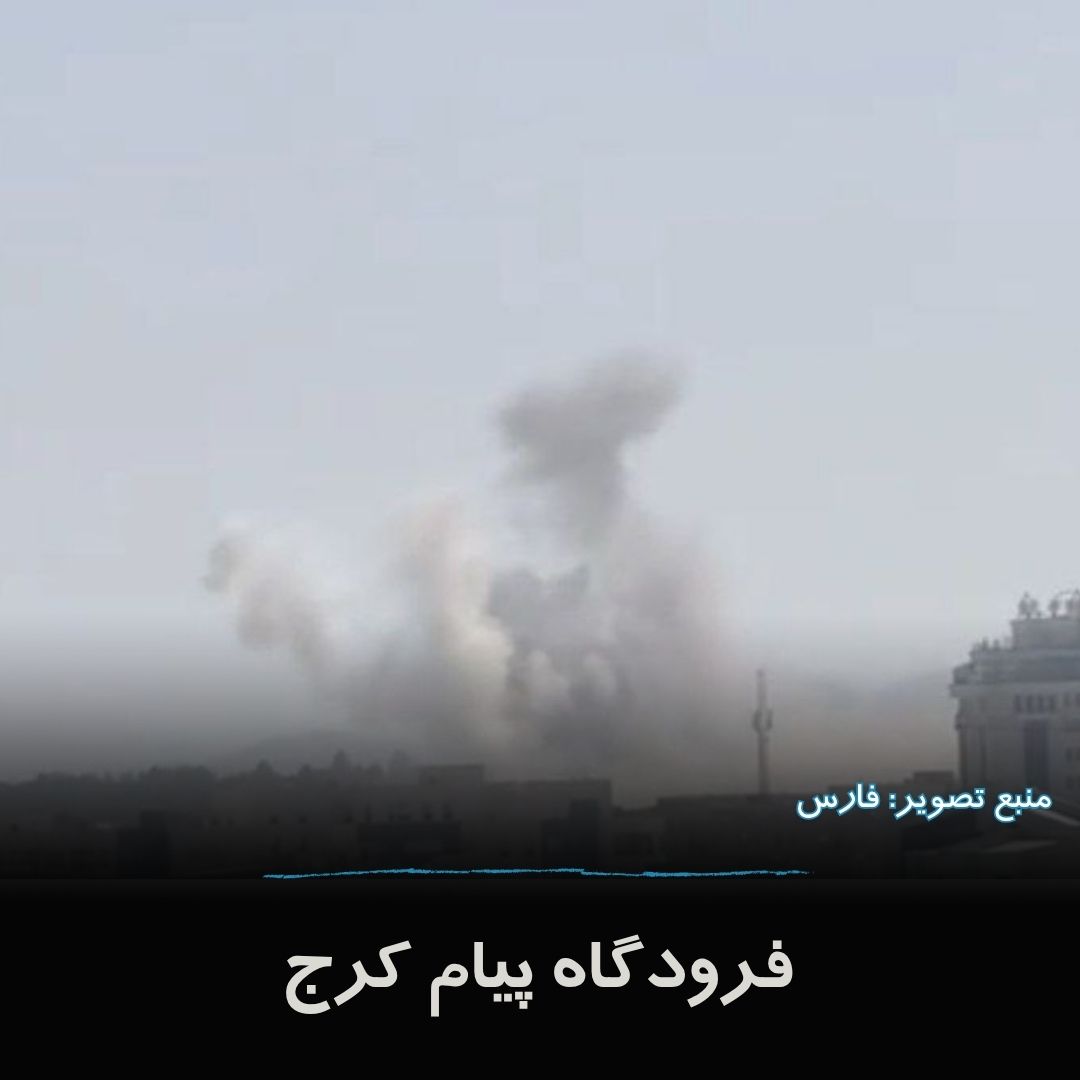
On the sixth day, civilian and infrastructure targets in Tehran, Ilam, Fardis, Karaj, Shahr-e Qods, Chalous, Tabriz, Shahroud, Zanjan, Qazvin, Abhar, and Shahriar were attacked. Damaged sites included the Parsian Resources Research Center in Zanjan, Tehran Nuclear Research Center, Ilam Petrochemical Complex, airports in Kermanshah, Tabriz, and Karaj, fuel storage facilities in Alborz province, and the TESA centrifuge production facility in Karaj.
In Tehran, numerous neighborhoods and areas were hit, including Piroozi, Sabalan, Sayad, Punak, Garmdareh, Bagheri Highway, District 18, Damavand Street, Lavasan Road, Aghdasieh, Jordan, Kurdistan Highway, Vanak, Kavoosieh, Nobonyad, Seoul Street, District 22, Chitgar, Shahran, Phases 2 and 8 of Pardis, Sadr Highway, Babayi Highway, Tehranpars, Afsariyeh, Simon Bolivar, and Lavizan.
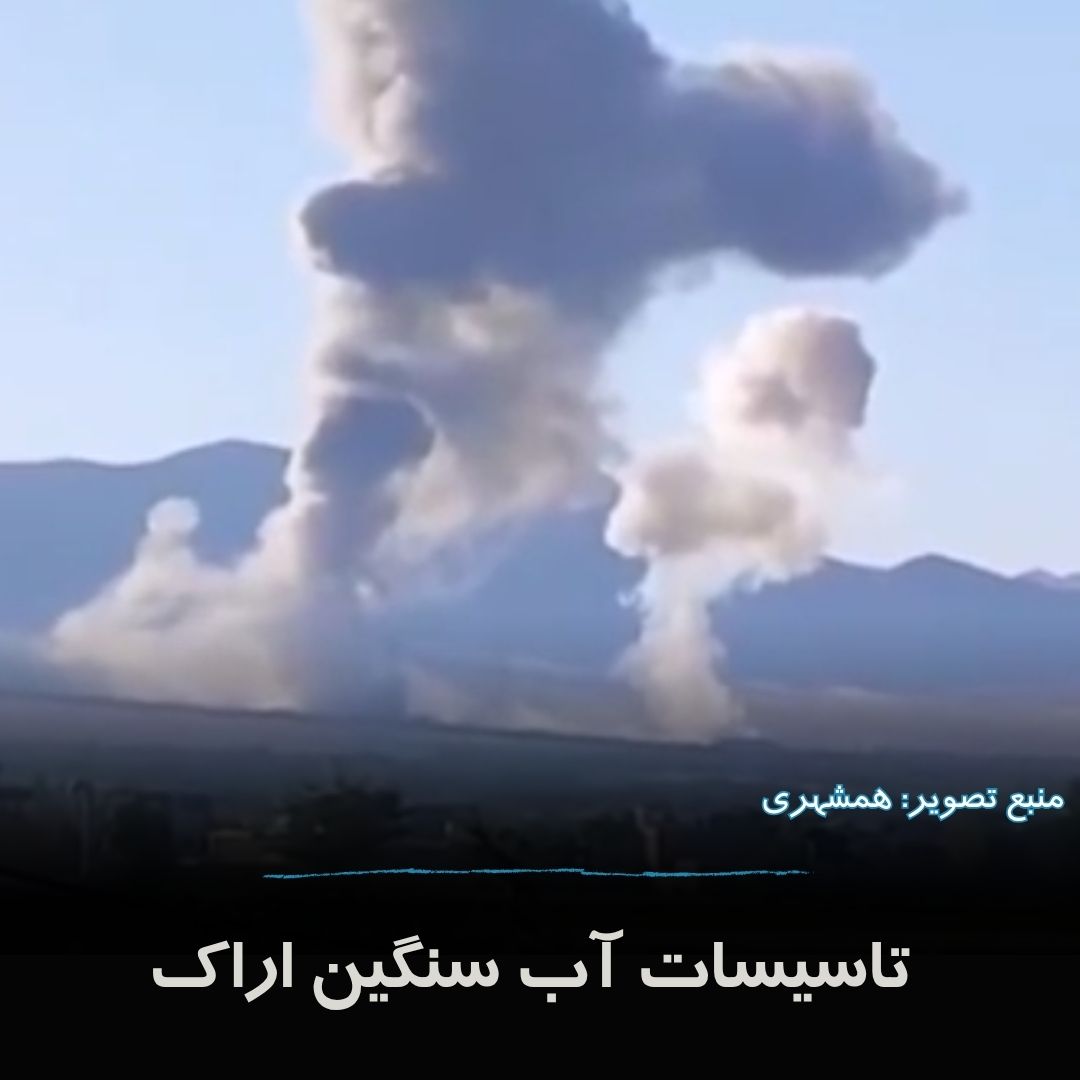
yesterday, Thursday, June 19 (29 Khordad), marks the seventh consecutive day of military conflict between Iran and Israel. Civilian targets were again hit in cities including Tehran, Isfahan, Shiraz, Kermanshah, and Kerman. Notably, yesterday’s strikes damaged the Khondab Heavy Water Reactor, the Arak plutonium production facility, and the Natanz nuclear site.
Methodological Note: The classification of targeted locations in this report as “military” or “civilian” is based on publicly available information, visible indicators, and testimonies from local residents. A definitive determination of the nature of these sites requires further verification through official documents, satellite imagery, and comprehensive analysis, which are currently not accessible. Therefore, this categorization is provisional and intended to provide an initial overview rather than a conclusive judgment about the nature of the targets.
Israeli Attacks on Iran’s Military Infrastructure
Over the past week, alongside civilian areas, numerous military infrastructures in Iran have been targeted by the Israeli army. In the first two days, military infrastructures in various cities were struck, including Tabriz, Malard, southern and central areas of Tehran, Pasteur neighborhood in Tehran, Chaldoran, the airspace near Ahvaz Steel Industries, Urmia, Bukan, Bandar Abbas, Naqadeh, Shahroud, Isfahan, Maragheh, the Ouramanat region, Javanrud, Mashhad, Ravansar, Malard, and Fadaiyan-e Islam district in Shahr-e Rey. Attacks were also reported on military bases and facilities such as the 2nd Tactical Air Base in Tabriz, Imam Ali Garrison in Khorramabad, the IRGC missile booster parts factory in Shamsabad (Tabriz), Imam Hassan Garrison in Mahidasht, the Isfahan nuclear site, and the Natanz nuclear facility.
On the third day of the conflict, Israeli forces targeted the Ministry of Defense, the Organization for Defense Innovation and Research, IRGC bases, missile storage and launch sites in western Iran, the Garmdareh radar site, a facility affiliated with the Ministry of Defense, the Tehran police headquarters, and the Bidganeh missile site.
On Monday, June 16 (26 Khordad), the fourth day of Israeli attacks, military targets included IRGC missile depots in Faraman and Dowlatabad (Kermanshah province), Fatemeh Masoumeh Air Defense, Mostafa Khomeini Garrison and Qiam Kushk Nosrat Pilot Training Garrison in Qom, an air defense site in Andimeshk, IRGC garrisons in Zanjan, Sardroud, and Marivan, the Alvand Khomein missile site, and a military garrison in western Tehran.
On the fifth day of the military conflict between Iran and Israel, targets included a checkpoint in the Kashan area, Hashemtiyeh Garrison, Al-Zahra Garrison in Tabriz, IRGC Quds Garrison in Shahin Shahr, an ammunition depot and Ayat Base in Vilashahr, Hashem Abad Air Defense in Naein, another ammunition depot in Ekhtiyariabad, and the 15 Khordad Garrison in Isfahan.
Yesterday, on the sixth day of the war, military sites attacked included Janbazorgi Garrison in Shahr-e Rey, a missile ammunition depot in Sorkheh Hesar (Tehran), garrisons in Parand, the Bidganeh complex in Malard, military facilities in Parchin, Imam Hossein University affiliated with the IRGC, Zeyn al-Din Garrison in Abhar, the IRGC garrison at Darvazeh Ghoran (Tehran), Imam Hassan Garrison, several other military bases in Kermanshah, the Law Enforcement Command headquarters near Vanak Square, the Sarallah IRGC headquarters, and the Meisami Base in Karaj.
The spokesperson for the Israeli army announced that last night, 40 of the country’s fighter jets targeted several areas in Iran with more than 100 munitions.
yesterday, Thursday, June 19 (29 Khordad), on the seventh day of the military conflict, southern heights of Shiraz, including Soltanabad and the IRGC garrison, the 84th Army Garrison in Badrabad (Lorestan), and the Special Forces Police Unit headquarters in Tehran were attacked. Other military centers in Isfahan, Shiraz, Kerman, and Kermanshah were also among yesterday’s military targets.
Communications Disruptions and Cyberattacks
From the very first day of Israel’s military attacks on Iran, internet disruptions have been reported across the country. Users from various regions reported severe slowness and an inability to access Cloudflare-based services. The situation worsened in subsequent days.
Yesterday morning, Bank Sepah’s infrastructure was targeted by a cyberattack, knocking the bank’s online services offline. The IRGC-affiliated Fars News Agency confirmed the attack and stated that fuel stations dependent on Bank Sepah’s systems might also experience outages.
In recent days, some citizens told HRANA they received suspicious text messages containing unknown links, suspected to be designed for espionage or cyber infiltration purposes.
Last night, IRIB (state broadcaster) live programming was briefly disrupted. The broadcaster’s public relations office confirmed that this was due to a cyberattack attributed to Israel.
That same night, the monitoring group NetBlocks announced that real-time data showed Iran’s national internet had been almost entirely shut down. The blackout was nationwide, effectively cutting off access to the global internet for users across the country.
In an official statement, the Ministry of Information and Communications Technology acknowledged the restrictions, claiming they were implemented to prevent Israel from exploiting Iran’s communications network for military purposes.
As of this morning, NetBlocks reported that Iran had experienced a full 24-hour internet blackout, describing it as the most severe communication disruption since the November 2019 protests.
Ongoing airstrikes and the prevailing security situation have forced the closure of Tehran’s Grand Bazaar, with many shop owners refusing to reopen their businesses.
Crackdown on Citizens
yesterday, state media reported the arrest of 30 individuals for activities in cyberspace. This includes 16 people in Lorestan, 8 in Yazd, 5 in Kerman (including one woman), 2 in Mahabad, 8 in Aliabad Katoul, 1 in Behbahan, 3 in Ardestan, Hassan Bagherinia (former faculty member of Hakim Sabzevari University) and his wife in Mashhad, and also Toomaj Salehi in Kish.
Including these latest arrests, the total number of citizens detained over online activity and publishing content related to Israel’s attacks on Iran over the past six days has reached 206.
Security Arrests
yesterday, Iran’s state broadcaster (IRIB) reported the arrest of a group of individuals in Yasuj described as “an organized network.” No details were provided about the identity or exact number of detainees.
The spokesperson for Iran’s law enforcement (FARAJA) announced that yesterday in western Tehran, a man transporting a large number of microdrones in his pickup truck was arrested. He also stated that an individual in Ashkhaneh, who had been photographing a wheat silo, flour factory, and other sensitive sites, was detained by the Intelligence Police of North Khorasan province.
Simultaneously, the police commander of Robat Karim reported the arrest of two individuals who, according to him, were photographing industrial complexes for Israel with the intention of causing harm.
The IRGC Intelligence Unit of Chaharmahal and Bakhtiari province also announced the identification and arrest of a team involved with microdrones.
The Ministry of Intelligence further announced the discovery of an arms shipment linked to opposition groups in Kurdistan and the arrest of one of their members.
On the seventh day of the unrest, the commander of West Tehran’s law enforcement declared that 24 people had been arrested on charges of espionage and targeted activities against the regime both in real life and online.
International Humanitarian Law (IHL) Analysis
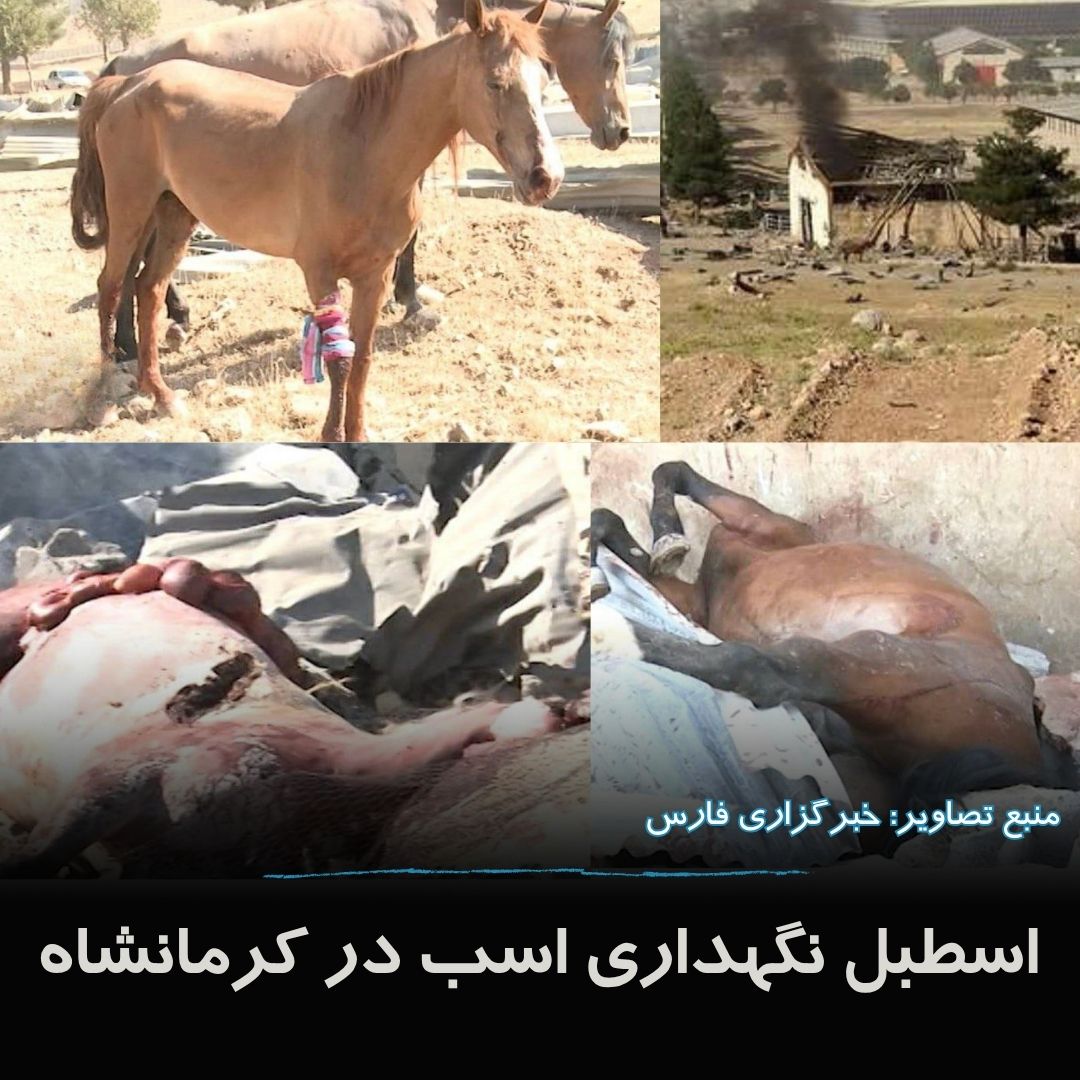
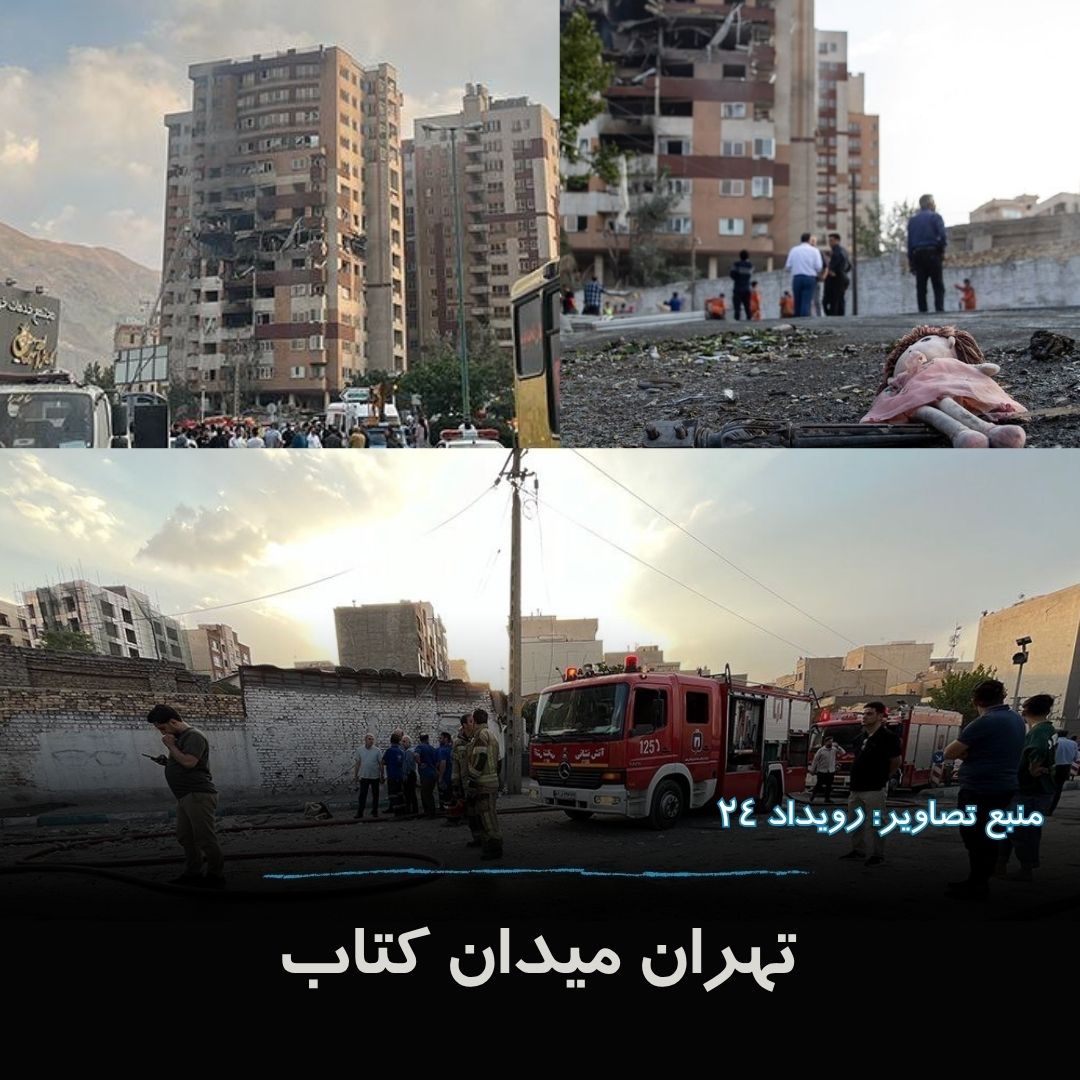
On the seventh day of the international armed conflict between Iran and Israel, growing concerns have been raised about escalating violations of fundamental principles of international humanitarian law. According to Article 51 of Additional Protocol I to the Geneva Conventions, the parties are obligated to distinguish between military objectives and the civilian population. However, reports of at least ten children killed in a residential building attack and the death of a worker at a horse stable suggest possible indiscriminate and disproportionate attacks.
Repeated targeting of sites with no clear military value not only challenges the principles of proportionality and precaution but directly violates the absolute prohibition against direct attacks on civilians, as stipulated in Article 48 of the same Protocol. Moreover, under Article 57, even if a military objective is located near civilian areas, parties are required to take all feasible precautions to minimize harm to civilians, including effective advance warnings before attacks — measures which often appear to have been neglected.
Human rights organizations have once again stressed the urgent need to halt indiscriminate attacks, safeguard civilian lives, and ensure unhindered access to emergency aid. HRA stated in its latest assessment, “Protection of Civilians and Civilian Infrastructure Must Be a Priority.”
HRA reaffirmed its commitment to documentation, legal analysis, and accountability in accordance with international humanitarian law, warning that continued indiscriminate attacks may constitute war crimes.
International Reactions to Israel’s Attacks on Iran: Global Consensus on Restraint and Concerns Over Escalation
Following Israel’s extensive attacks on Iranian territory, numerous governments and international bodies issued statements. Most condemned the attacks or expressed serious concern over the escalation, emphasizing the need for restraint, a return to diplomacy, and preservation of regional security.
Countries such as Iraq, Turkey, Pakistan, Afghanistan, Armenia, Lebanon, Saudi Arabia, the UAE, Qatar, Kuwait, Bahrain, China, Russia, Japan, Brazil, as well as the United Nations, the Economic Cooperation Organization (ECO), 21 Arab and Islamic countries including Algeria, Chad, Comoros, Djibouti, Egypt, Gambia, Mauritania, Somalia, Sudan, and the International Atomic Energy Agency (IAEA) have either explicitly condemned Israel’s attacks or warned of their consequences.
Many of these states, while reaffirming national sovereignty, called for an immediate end to the conflict and the protection of civilians. In Latin America, countries like Venezuela, Cuba, Nicaragua, Chile, and Bolivia expressed similar positions.
Overall, despite some variation in individual responses, there is a broad international consensus about the danger of further escalation and the need for restraint.
Emphasis on Compliance with Obligations
As the field consequences of the attacks expand, damage to civilian infrastructure and disruptions in emergency and medical services have worsened. These developments further underline the critical importance of adhering strictly to the principles of precaution, proportionality, and distinction in targeting.
International organizations and human rights defenders have reiterated the call for safe and unhindered access to emergency aid and protection of the civilian population. At the same time, the continued indiscriminate attacks without regard for civilians’ locations present a serious challenge to the legitimacy of the military actions by both sides.
The Human Rights Activists in Iran (HRA), while continuing to monitor developments, has stressed the need for independent investigations, precise documentation of suspected violations, and legal accountability of all parties under international humanitarian law.
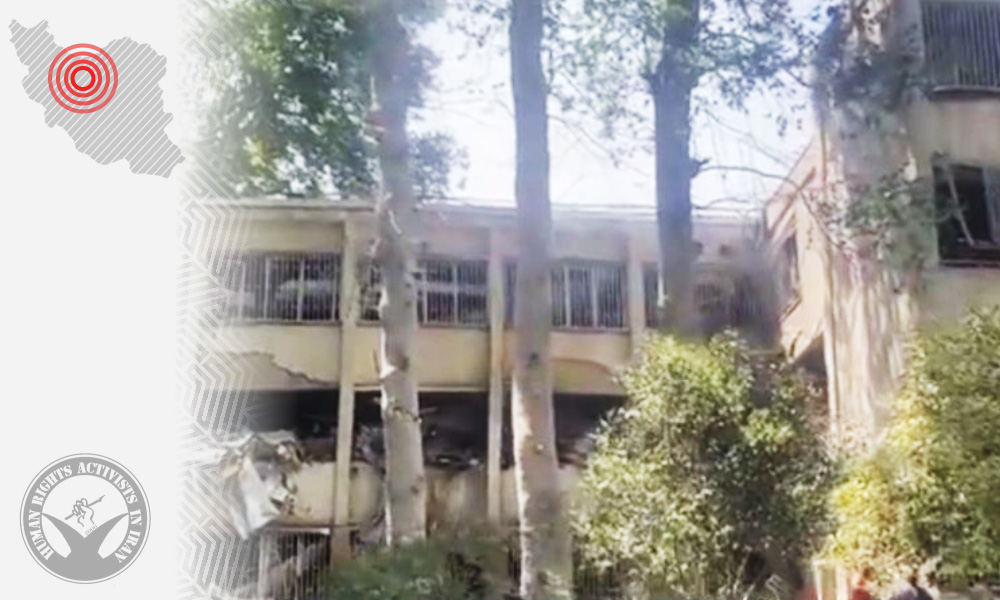
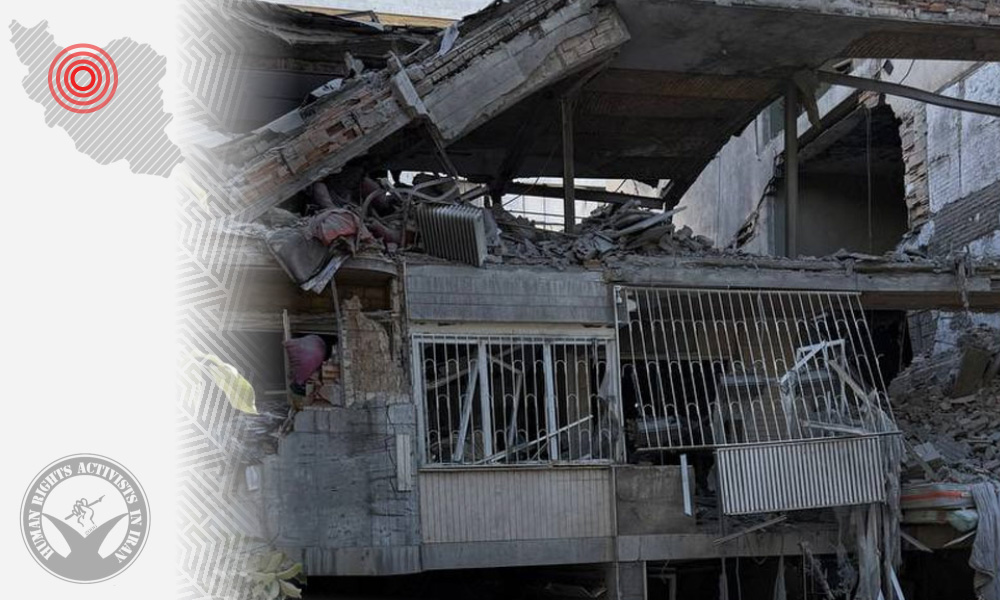
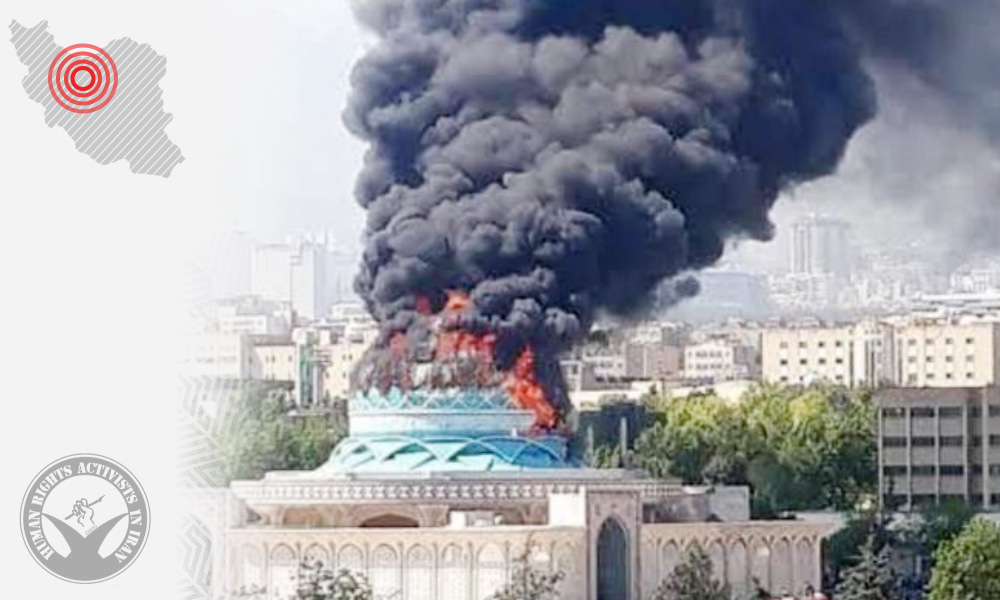
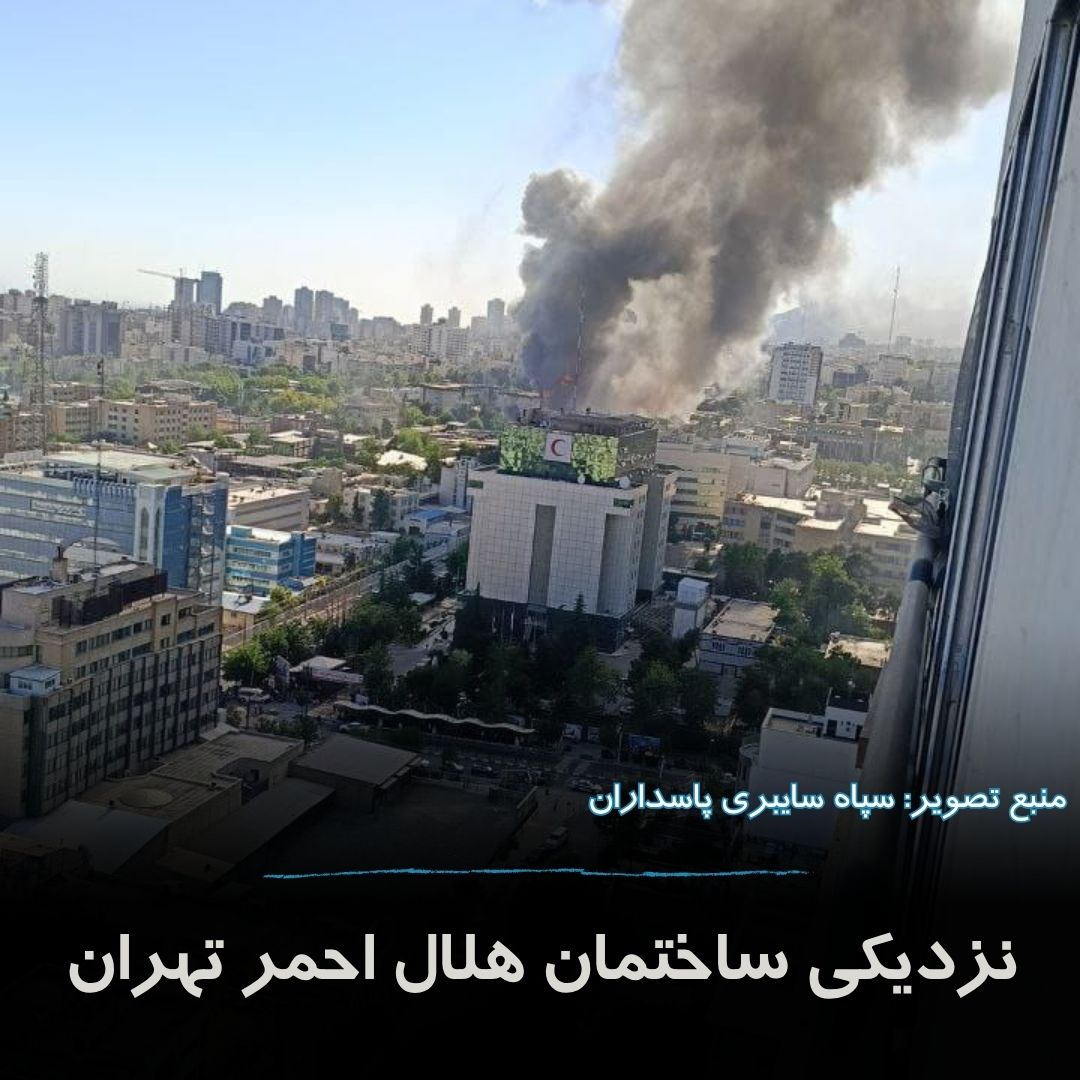
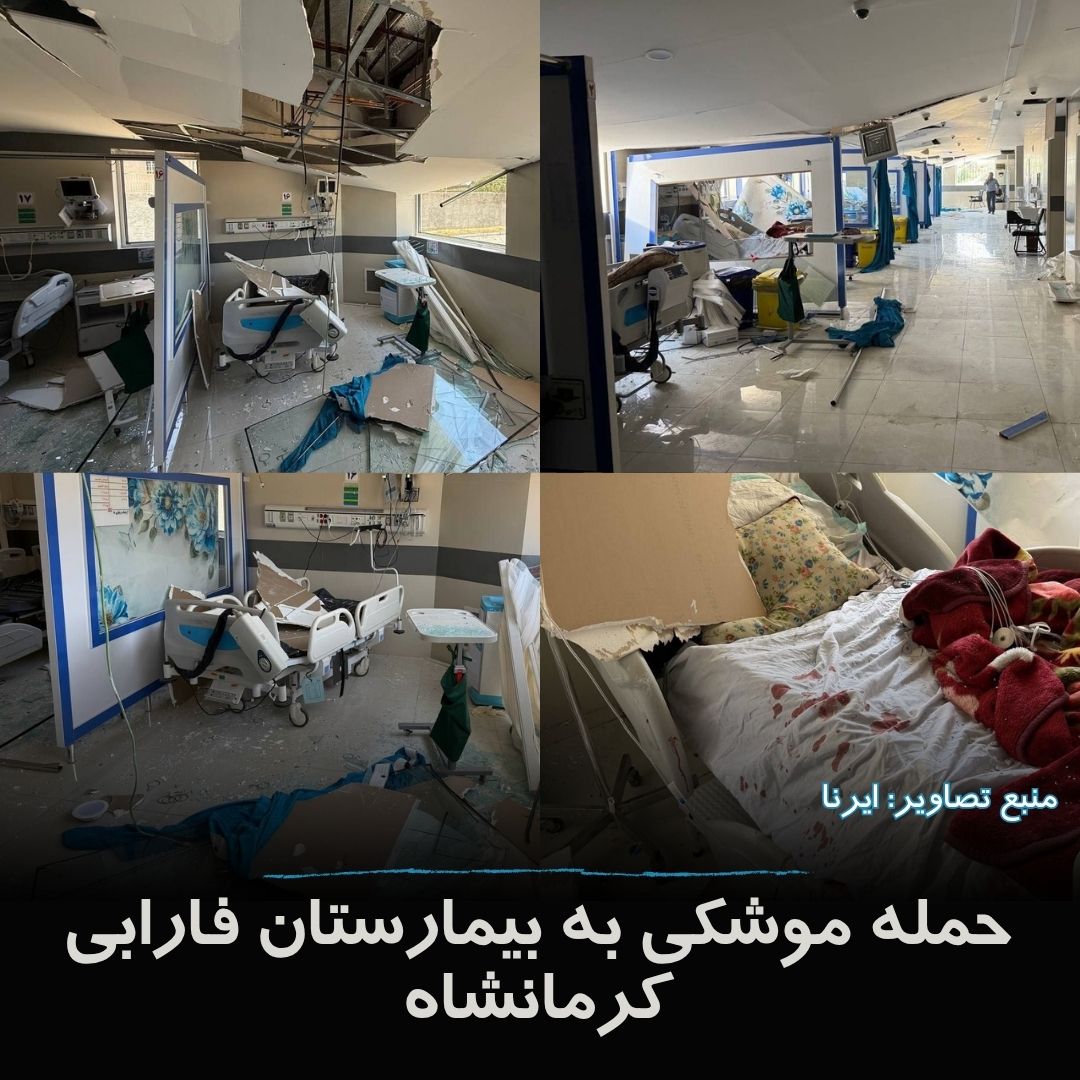
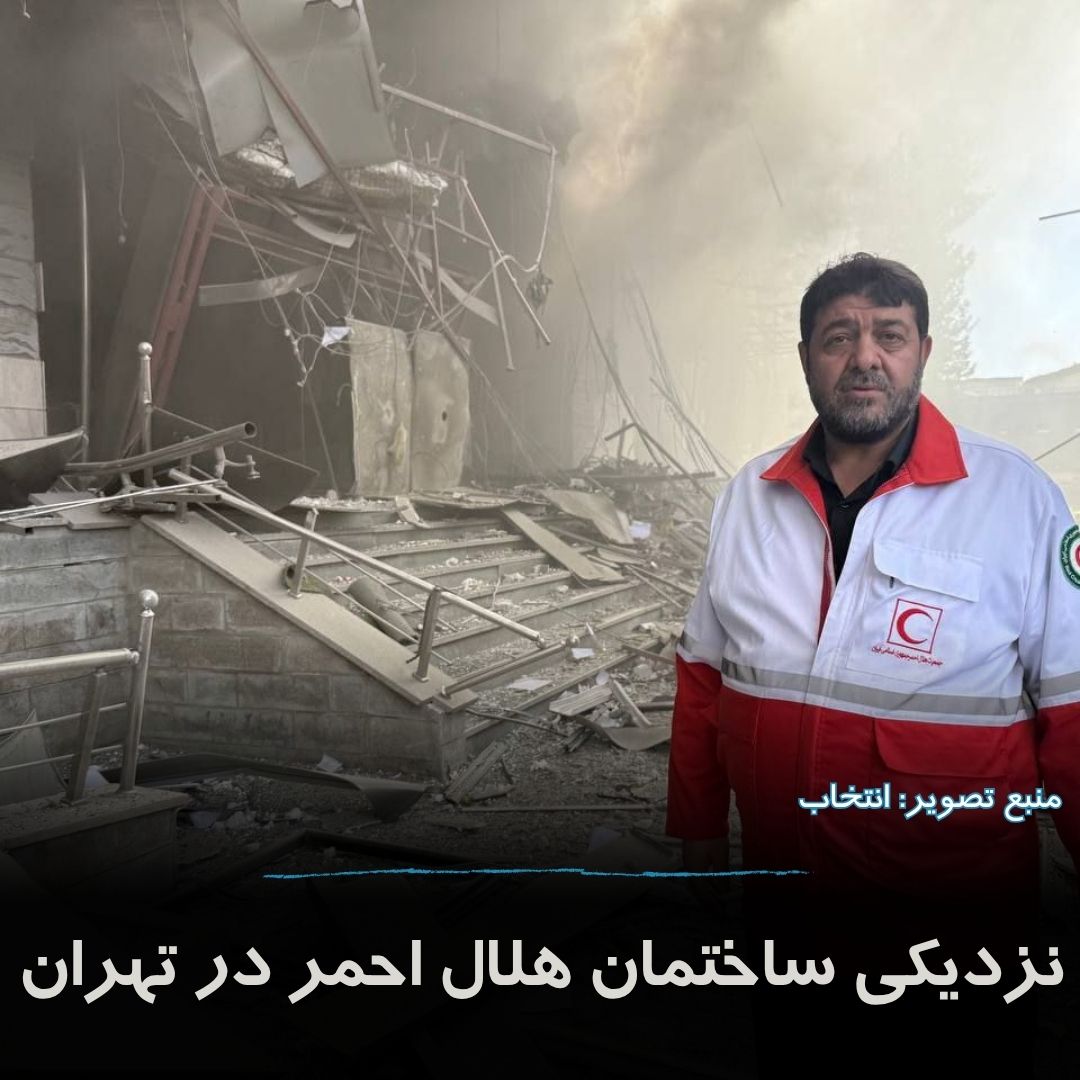
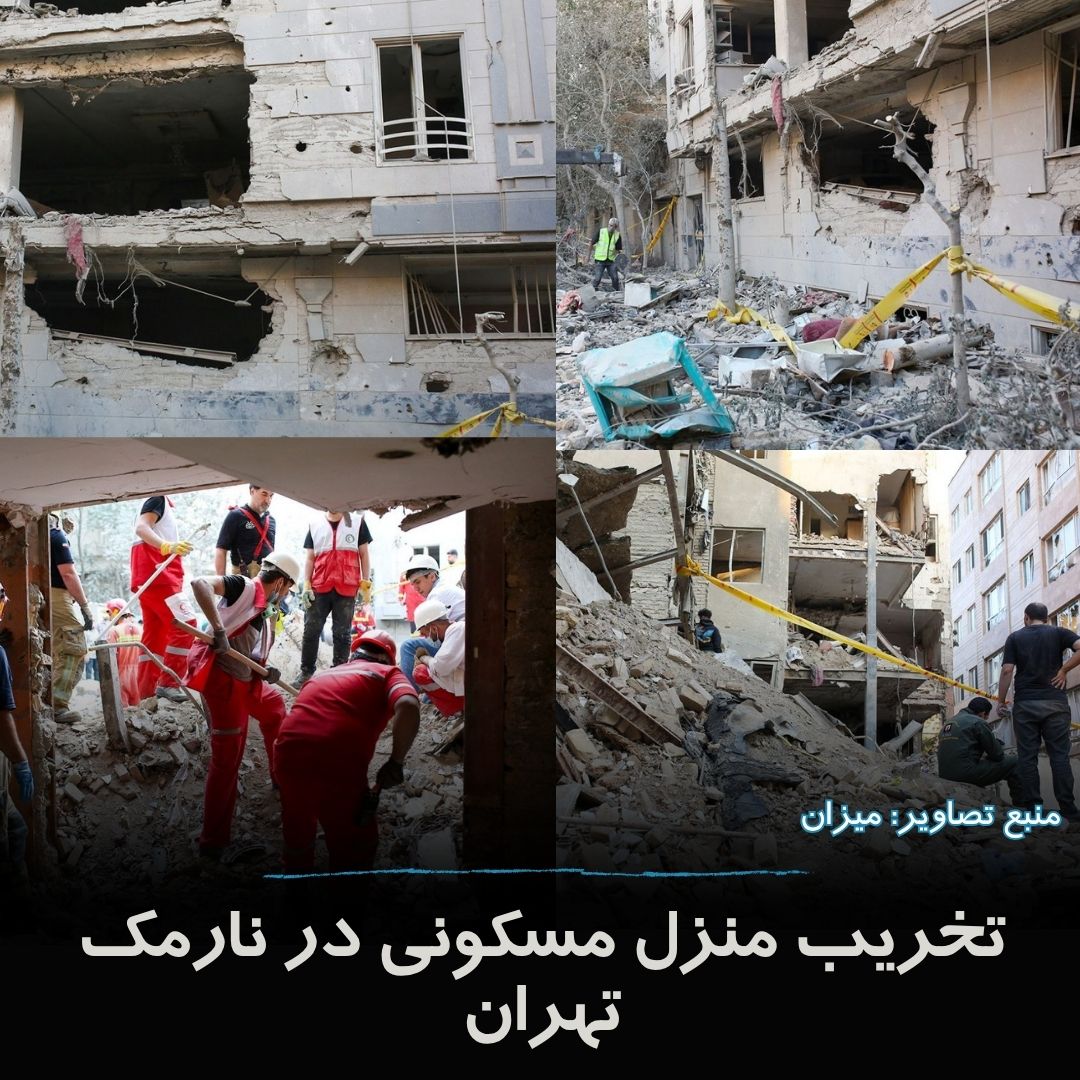
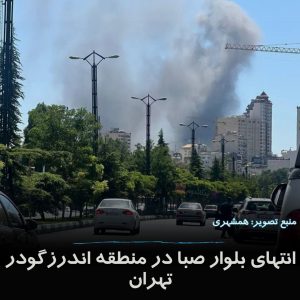
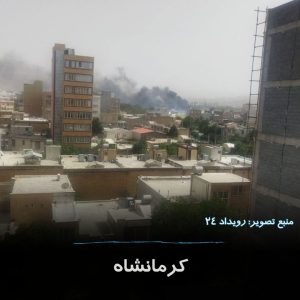
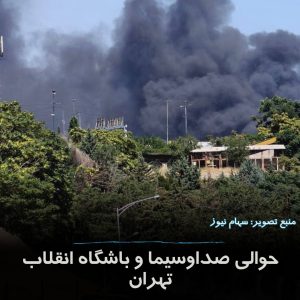
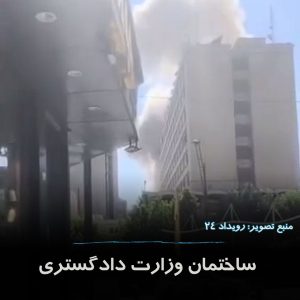
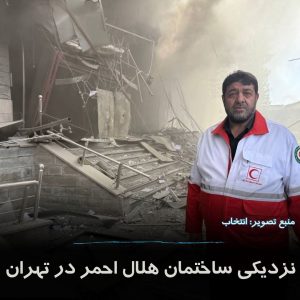
Visual documentation from the past week’s attacks, as well as yesterday’s assaults, follows:
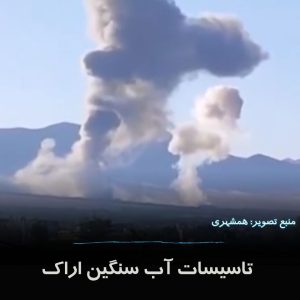 | 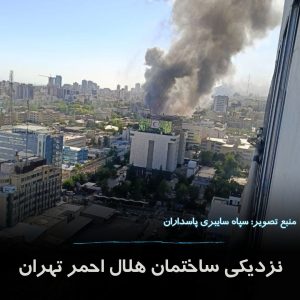 | 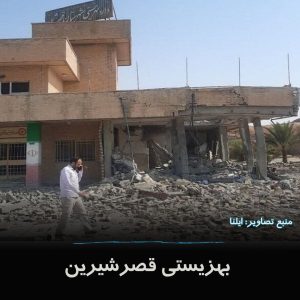 |
| Arak Heavy Water Facility | Near the Red Crescent Building – Tehran | Welfare Organization – Qasr-e Shirin |
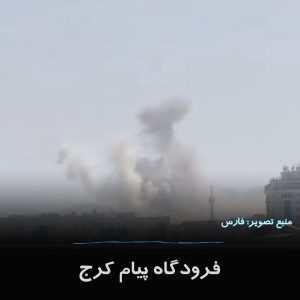 | 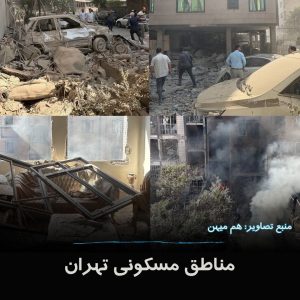 | 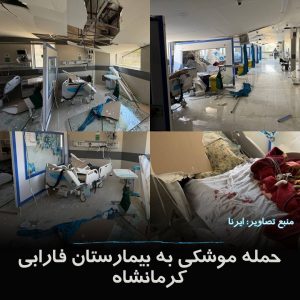 |
| Payam Airport – Karaj | Residential Areas – Tehran | Farabi Hospital – Kermanshah |
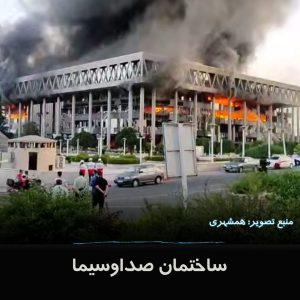 |  |  |
IRIB (State Broadcaster) Building
Tehran | Ministry of Justice Building – Tehran | Near the Red Crescent Building – Tehran |
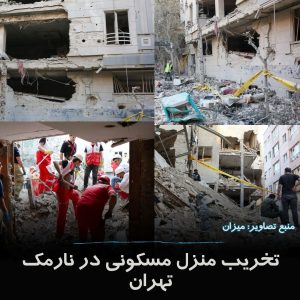 | 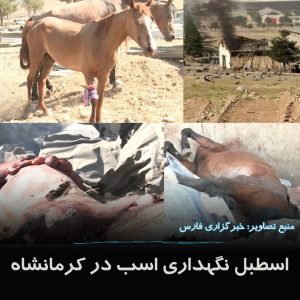 | 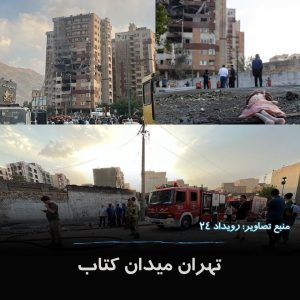 |
Destruction of Residential Homes
in Narmak – Tehran | Horse Stable – Kermanshah | Ketab Square – Tehran |