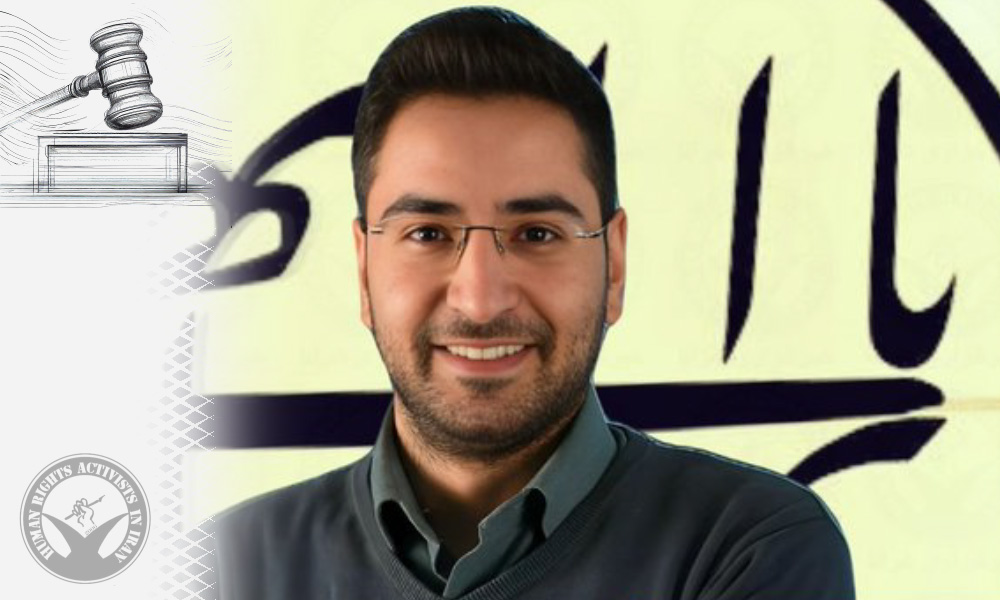
Azerbaijani-Turk Activist Salar Taher Afshar Sentenced to 5 Years in Prison

Salar Taher Afshar, an Azerbaijani-Turk activist, has been sentenced to five years in prison by Branch 15 of the Tehran Revolutionary Court. The sentence was issued based on charges of “assembly and collusion to commit crimes against national security.”

In a recent post on his personal page, Mr. Taher Afshar confirmed that he was informed of his sentence in person.

His trial, along with that of fellow activist Vadud Asadi, took place on May 21, 2023, presided over by Judge Abolqasem Salavati. Both individuals faced charges in Branch 15 of the Tehran Revolutionary Court. Earlier, on April 20, a preliminary hearing was held for Mr. Taher Afshar and three other Azerbaijani-Turk activists—Vadud Asadi, Saeed Jamalzadeh, and Behnam Babashpour—at Branch 5 of the Evin Prosecutor’s Office.

Mr. Taher Afshar was arrested by security forces in Urmia on February 6, 2024. He was then transferred to Ward 209 of Evin Prison, a section managed by the Ministry of Intelligence, where he remained in detention for 22 days before being released on bail.

In a previous case, he was sentenced to six months in prison by Branch 2 of the Tabriz Revolutionary Court. After serving part of that sentence, he has been under electronic monitoring with restrictions on his movement outside of prison. Recently, Mr. Taher Afshar was barred from employment with the Snapp platform due to a “disqualification” issued by Iran’s Law Enforcement Forces (NAJA).


Three Prisoners Executed in Isfahan and Shiraz Prisons

The death sentences of three prisoners, each convicted of murder in separate cases, were recently carried out in Dastgerd Prison of Isfahan and Adelabad Prison of Shiraz, according to the Iran Human Rights Organization.

The executed prisoners were identified as Mohsen Mokhtari from Shiraz, Abbas Karimi, a 36-year-old father of two, and Mohammad Ali Najafi, a 35-year-old father of one from Shahin Shahr.

The executions of Najafi and Karimi took place on Thursday, October 17, 2024, in Dastgerd Prison, while Mokhtari was executed a day earlier on Wednesday, October 16, 2024, in Adelabad Prison, Shiraz.

Najafi had been arrested three years ago and Karimi earlier, both on separate murder charges, before being sentenced to death by the judiciary. Mokhtari, who had been in custody for five years following a murder charge, was sentenced to death as well. He had been held in Ward 10 of Adelabad Prison prior to his execution.

According to data compiled by HRANA, Adelabad Prison carried out 49 executions in 2023, ranking fifth among prisons in Iran, followed by Dastgerd Prison with 35 executions. For a detailed analysis of execution statistics across the country, refer to HRANA’s comprehensive report.

Report on the Latest Status of Political Prisoner Saeideh Ghorbanali in Evin Prison

Saeideh (Bahareh) Ghorbanali, a political prisoner, is currently serving a two-year prison sentence in Evin Prison, as upheld by the Tehran Court of Appeals. Her transfer to the women’s ward occurred on September 7, 2024, following her arrest to serve this sentence.

According to a source close to Ghorbanali’s family, who confirmed the details to HRANA, Ghorbanali has recently been denied in-person visits with her family by direct order of the prison warden.

Ghorbanali’s legal troubles began in early 2019 when she was first arrested by security forces in Shahriar. Shortly after her initial detention, she was released on bail.

She later faced trial alongside nine others in a joint case at Branch 15 of the Tehran Revolutionary Court. In late 2019, Ghorbanali was sentenced to three years in prison on charges including “assembly and collusion against national security,” “propaganda against the regime,” and “insulting the founder of the Islamic Republic and the Supreme Leader.”

In May 2020, Branch 36 of the Tehran Court of Appeals, presided over by Judge Zargar, upheld her sentence. However, under Article 134 of the Islamic Penal Code, only the severest charge is applied, making Ghorbanali subject to two years of imprisonment.

Baha’i Citizen Faraz Razavian Sentenced to Prison and Other Penalties

Faraz Razavian, a Baha’i citizen, has been sentenced by the Rasht Revolutionary Court to two years and one day in prison, along with a fine and social restrictions.

According to the verdict from Branch 3 of the Rasht Revolutionary Court, Razavian has been sentenced to two years and one day of imprisonment, a fine of 80 million Tomans (approximately $1,500), and five years of deprivation of social rights.

A source close to Razavian’s family confirmed to HRANA that he had not been previously arrested or interrogated. The source explained that during a recent trial for Razavian’s mother, Mojgan Samimi, at the same court, Faraz Razavian was unexpectedly named as a defendant. Both Razavian and his mother were sentenced for engaging in educational activities and promoting the Baha’i faith. After Razavian’s lawyer requested a separate hearing, the court convened again but reissued the same sentence.

Baha’is are subjected to violations of their religious rights, comprising 82% of reports on infringements against religious minorities, according to HRA’s 2023 annual report.

The Baha’i faith is not recognized as a legitimate religion by Iranian authorities, leading to systematic and longstanding violations of the rights of Baha’is in the country. This includes the denial of their fundamental right to practice their religion, which constitutes a clear breach of both Article 18 of the Universal Declaration of Human Rights and Article 18 of the International Covenant on Civil and Political Rights. The United Nations covenant holds that every person has the right to freedom of religion, freedom of converting religion, as well as freedom of expression, individually or collectively; openly or secretly.

Two Prisoners Executed in Qazvin Prison for Drug Offenses

At dawn today, October 17, two prisoners who had been previously sentenced to death on drug-related charges were executed in Qazvin Prison.

HRANA has identified the prisoners as Nourmorad Garavand and Sanjari (first name unknown). These individuals had been arrested on drug-related charges and later sentenced to death by the judiciary.

As of the time of this report, the executions have not been officially confirmed by prison authorities or other relevant institutions.

he reports from the Department of Statistics and Publication of Human Rights Activists for the year 2023 reveal a concerning prevalence of executions for drug offenses in Iran, constituting 56.4% of the total executions. For a comprehensive examination of the details and statistics surrounding the executions in Iran, refer to HRANA’s report.

Subscribe to Our Newsletter

Now is definitely not the time to stop reading!

Two Prisoners Executed in Hamedan Prison for Drug Offenses

At dawn on October 16, two prisoners, including a woman, were executed in Hamedan Prison after being sentenced to death on drug-related charges.

HRANA has identified one of the executed prisoners as Rasoul Fili. Both individuals had been arrested on drug charges and sentenced to death by the Revolutionary Court.

As of this report, the executions have not been officially confirmed by prison authorities or other relevant institutions.

The reports from the Department of Statistics and Publication of Human Rights Activists for the year 2023 reveal a concerning prevalence of executions for drug offenses in Iran, constituting 56.4% of the total executions. For a comprehensive examination of the details and statistics surrounding the executions in Iran, refer to HRANA’s report.

Nasrin Shakarami Arrested in Khorramabad

On October 16, Nasrin Shakarami, the mother of Nika Shakarami—who was killed during the 2022 nationwide protests—was arrested in Khorramabad.

Her daughter, Aida Shakarami, confirmed the arrest but stated that the reason for the detention and any charges against Nasrin remain unclear. As of now, Nasrin’s location is also unknown.

Nika Shakarami, a 17-year-old from Khorramabad, lost her life during the 2022 protests in Tehran. Behesht Zahra Cemetery later attributed her death to “multiple injuries caused by blunt force trauma.”

Six Political Activists Sentenced to Over 50 Years in Prison

Kamal Nouri, Ayaz Seyfkhah, Abdolaziz Azimi Ghadim, Bagher Haji-Zadeh, Hossein Piri, and Araz Aman, all Azerbaijani-Turk activists, have been sentenced to a combined 53 years in prison by Branch 15 of the Tehran Revolutionary Court.

The verdict, issued on Wednesday, October 16, by Judge Abolqasem Salavati, details the following sentences:

  • Hossein Piri: Five years for “assembly and collusion against national security.”
  • Abdolaziz Azimi Ghadim: One year for “propaganda against the regime” and five years for “assembly and collusion against national security.”
  • Araz Aman, Ayaz Seyfkhah, and Bagher Haji-Zadeh: Each sentenced to eight years for “espionage” and five years for “assembly and collusion against national security.”
  • Kamal Nouri: Three years, with two years of his sentence suspended.

Nouri, Seyfkhah, Azimi Ghadim, Haji-Zadeh, and Aman were arrested by security forces in February of last year and subsequently transferred to Evin Prison.

Four Prisoners Executed in Ghezel Hesar Prison for Drug-Related Crimes

At dawn today, October 16, the execution of four prisoners who had previously been sentenced to death on drug-related charges was carried out in Ghezel Hesar Prison, Karaj.

HRANA has confirmed the identities of three of the prisoners who were hanged this morning as “Abdolbari Tajik and Pasha Pashto, two Afghan nationals, and Javid Ahmadkhani.” The identity of the fourth executed prisoner is still under investigation by HRANA.

These prisoners, who had been previously sentenced to death for drug-related charges, were transferred to solitary confinement in Ghezel Hesar Prison yesterday along with two other prisoners in preparation for their execution.

According to data gathered by the Department of Statistics and Publication of Human Rights Activists, Ghezel Hesar Prison in Karaj witnessed the highest number of executions in 2023, with Zahedan Prison following closely behind. For a comprehensive examination of the details and statistics surrounding the executions in Iran, refer to HRANA’s report.

Prisoner Executed in Urmia Prison

Yesterday, October 15, a prisoner who had been sentenced to death for murder was executed in Urmia Prison.

HRANA has identified the prisoner as Naser Mohammadi Hangravani, from the village of Nichlan in the Sumay-ye Beradust District of Urmia. He had been arrested on murder charges and sentenced to death by a judicial authority.

As of the time of this report, prison officials and relevant authorities have not yet officially announced the execution.

According to the Department of Statistics and Publication of Human Rights Activists in Iran, in 2023, at least 767 citizens, including 21 women and 2 juvenile offenders, were executed. Of these, the executions of 7 individuals were carried out in public. Additionally, during this period, 172 others were sentenced to death, with 5 of them sentenced to public execution. It is worth noting that during the same period, the initial death sentences of 49 other individuals were also upheld by the Supreme Court.