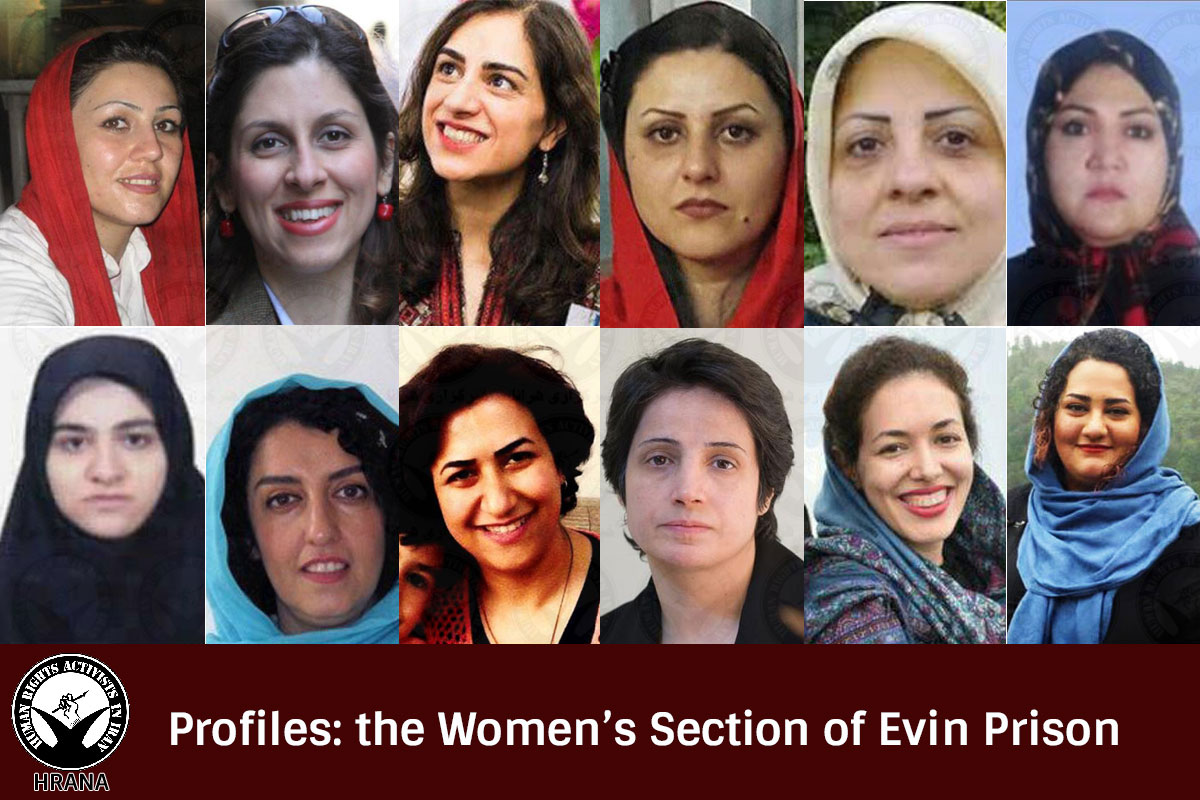
Human Rights Activists News Agency (HRANA) – The 17 prisoners held on political or security-related charges in the Women’s Ward of Tehran’s Evin Prison live with deplorable conditions, compromised hygiene, and paltry nutrition. The following is a brief exposé of their quality of life, followed by a snapshot of their individual case files.
Many of these prisoners are mothers pained by the distance from their children, a pain that is only exacerbated by the prison chief’s refusal to grant them access to the phone on days of the week that their children are home from school. While the prisoners were granted permission from prosecutors to open the Saturday-to-Wednesday phone schedule to any day of the week, the chief, who goes by “Chaharmahali,” has refused to loosen up the former protocol.
In another blatant disregard of court orders, prison authorities refuse to send prisoners to outside medical clinics even when prosecutors and deputy prosecutors order or grant permission for the transfers. Prison authorities justify their refusal by saying that the prison clinic has its own doctors, or will recruit them as necessary; yet prisoners needing help from a psychologist, eye doctor, or internal specialist wait months to be seen.
These women are effectively hindered from providing even the most basic care to themselves, as clinic authorities refuse to distribute basic medicine or first aid kits to inmates. Many–insulted by the stipulations from Khani, the clinic head, that they take all of their nightly medication in one supervised sitting–have quit their medications in protest, and are experiencing aggravated symptoms as a result.
Evin Prison dentistry operates in less-than-sterile conditions and exposes patients to remarkably high risk for infections. Cavity fillings are expensive there, putting patients out as much as 20 million rials (approximately $114 USD) or preventing them, for lack of means, from getting the fillings they need. Many of the Evin women have trouble footing the bill, as the now-unemployed breadwinners of their households or as the wives of men who are also behind bars.
Prison food rations are growing more pitiful by the day. Forty-day rations of dry food items that are distributed to prisoners are depleted without fail within half that time. In the last six months, meat and vegetables have been cut from the prisoners’ diets.
Hygiene and cleaning items are also in short supply. Most prisoners run out, and those who can’t afford the pricey prison shop simply do without.
Deputy prosecutor Rostami oversees political and security prisoners and recently took up his position in Evin’s prosecutorial office. While he has verbally engaged to welcome prisoner families into his office on Sundays and Tuesdays, complaints from these families suggest that he is chronically unavailable, impassive to their requests, and generally unaccountable. Complaints lead nowhere, families say; requests for furlough or conditional release are routinely ignored.
Prison authorities rarely visit the Women Section, and tend to either lose or ignore any letters from its inmates.
Who are the women of Evin Prison’s Women’s Ward?
1- Maryam Akbari Monfared (born 1975)
 Convicted of enmity against god, gathering and colluding against national security and propagating against the regime through working with the Mujahedin-e Khalq (MEK), Monfared is serving a suspended sentence of 15 years.
Monfared was arrested December 31, 2009, following a widespread Ashura demonstration during the holy month of Muharram. She was tried the following May and sentenced by Branch 15 of Tehran’s Revolutionary Court, presided by Judge Salavati. She denied the accusations against her.
Monfared has been shuffled around different penitentiaries over the course of her imprisonment, inducing the solitary cells of Ward 209, the Methadone Ward, the Women’s Ward, Rajai Shahr Prison, and Qarchak Prison in Varamin. After writing several letters to clerics, prison authorities, and Ahmad Shaheed, then the United Nations Special Rapporteur on the Situation of Human Rights in Iran, she was returned to Evin’s Women’s Ward and has remained there since.
Two of Maryam’s brothers were executed in 1981 and 1984 for their connections to the MEK. Another younger brother and a sister were also executed during the 1988 massacre.
Maryam, a mother of two, has been barred from conditional release and has not received a single day of furlough since she began her sentence in 2009.
2- Zahra Zahtabchi (born 1969)
 Zahra Zahtabchi was issued a 10-year suspended sentence for Baqi (violation) and enmity against god through support of the MEK.
Zahtabchi was arrested with her husband and daughter on October 16, 2013. She came to Evin’s Women’s Ward after spending 14 months in the solitary cells of Ward 209. On December 8, 2014, Branch 15 of the Revolutionary Courts sentenced her to 12 years in prison. The sentence was reduced to 10 years in appeals court.
Her two daughters are Narges, 22 and Mina, 15.
In 2016, three years after her arrest, she went on furlough for three days.
3- Fatemeh Mosana (born 1967)
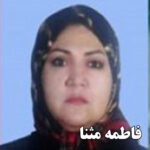 Fatemeh Mosana was sentenced to 15 years for Baqi and enmity against god through support of the MEK in Branch 26 of Tehran’s Revolutionary Court, headed by Judge Ahmadzadeh. Her husband Hassan Sadeghi received the same sentence.
Mosana, Sadeghi, and their child were arrested January 28, 2013, by Intelligence Ministry forces. The child was released after six weeks.
Mosana spent 75 days in the solitary cells of Ward 209 before her transfer to the Women’s Ward.
On January 13, 2014, she was temporarily released on bail. Some of her family’s property, including Sadeghi’s shop and their personal house, was seized by the authorities.
On September 30, 2015, she was re-arrested and taken to the Women’s Ward. She has two children who currently live with their ailing grandmothers.
Mosana, who suffers from ulcerative colitis and severe nervous migraines, has never been granted furlough.
4- Narges Mohammadi (born 1972)
 Narges Mohammadi is serving a 16-year sentence, compounded by a six-year sentence on a previous case.
Narges was first arrested in 2002 and then released on bail after a week. For that case, she received a one-year sentence.
In May 2010, she was arrested and held for weeks in the solitary cells of Evin’s Ward 209 before being released on a bail of 1 billion rials. In 2011, she was convicted of gathering and collusion against national security and propaganda against the regime, which carried a sentence of 11 years in prison. The sentence was later reduced to six years in appeals court.
She started serving her sentence in 2012, which began with one month in solitary confinement and four months in exile in Zanjan. She was released due to health conditions before being re-arrested in 2015 to resume her sentence. At that point, authorities opened up a new case file against her, convicting her anew of gathering and collusion, and of propaganda against the regime, with the additional charge of establishing LEGAM, a campaign to abolish the death penalty. Collectively her charges earned her 16 years in prison, but by Article 134 of Islamic Penal Code, she should only serve 10 [i.e. the sentence corresponding to the heaviest among her multiple charges].
She has two children, and on the prosecutor’s orders is barred from having contact with her husband.
She suffers from pulmonary embolism and was granted a three-day furlough on September 29th.
5- Reyhaneh Haj Ebrahim Dabagh
 Born in 1982, Reyhaneh Haj Ebrahim Dabagh is serving a 15-year exile imprisonment sentence, ruled by Judge Salavati in Branch 15 of the Revolutionary Court on charges of enmity against god through support of the MEK, gathering and colluding, and propaganda against the regime.
Ebrahim Dabagh has been in prison since early 2010. She suffers from ulcerative colitis and has served exile time in Qarchak and Rajai Shahr prisons. Her husband Ahmad Daneshpour and her father-in-law Mohsen Daneshpour are awaiting trial in Evin’s Section 350. They are both said to have been sentenced to capital punishment.
After seven years in prison, Ebrahim Dabagh went on furlough for the first time in December 2016, and was briefly freed on bail. On August 15, 2018, she was sent back to Women’s Ward to serve the rest of her sentence.
6- Azita Rafizadeh (born 1980)
 As part of a 2011 crackdown on the Baha’i academic community, security agents raided the homes of managers and professors at the Baha’i Institute of Higher Education (BIHE), including Azita Rafizadeh’s. In the raid, her religious books, personal writings, and electronic devices were confiscated.
Rafizadeh was sentenced in 2014 to four years in prison on charges of acting against national security and membership in “the illegal Baha’i organization.” Her husband Peyman Kooshkbaghi was sentenced to five years in prison at the same time.
She presented hersef to Evin’s prosecutors in 2015 to begin her sentence. On February 28, 2018, her husband was detained without reason in Evin’s section 8 while trying to arrange a visit with her. Rafizade and Kooshkbaghi have a 10-year-old son name Bashir who in absence of his parents has been trusted to the care of another family.
7- Nazanin Zaghari-Ratcliffe (born 1979)
 Zaghari-Ratcliffe is serving a five-year suspended sentence on charges of gathering and collusion against national security.
Zaghari-Ratcliffe was arrested at the airport while visiting Iran on holiday in 2016. After a day in IRGC’s detention center, she was transferred to Kerman prison, and two months later to Tehran, where Judge Salavati issued her prison sentence in July of that year. A few months later, she was sent to the Women’s Ward.
On August 23rd, she was granted a three-day furlough after two and a half years in prison. She has a four-year-old daughter.
8- Aras Amiri (born in 1986)
 A student of London’s Kingston University, Amiri was arrested by Intelligence Ministry forces on March 14, 2018, and released two months later after posting a 5000 million rial bail. On September 7, 2018, she was summoned and subsequently arrested by Evin prosecutors, after which she was sent to the prison’s Women’s Ward. She has denied the “gathering and collusion against national security” accusations against her and is still awaiting trial.
9- Golrokh Ebrahimi Irayi (born 1980)
Irayi was sentenced to six years in prison, which was reduced to 2.5 years based on amnesty and Article 134 of Islamic Penal Code. She was convicted of insulting the sacred and gathering and collusion against the regime. Earlier this year, she was exiled to Varamin’s Qarchak prison, and was brought back to Evin after going on hunger strike.
 On September 6, 2014, Golrokh was arrested along with her husband, Arash Sadeghi. She spent two days in an IRGC safe house and then 20 days in the solitary cells of Evin’s Section 2A, which is under IRGC jurisdiction. She was released on a bail of 800 million rials.
Judge Salavati sentenced her to six year in prison while she was undergoing surgery in the hospital.
On October 24, 2016, the IRGC arrested her without a warrant. Her husband Arash Sadeghi was also arrested and sentenced to 19 years in prison. He is currently in Karaj’s Rajai Shahr prison and has undergone operations for cancer.
Arash and Golrokh have been forbidden from seeing each other for the past 8 months.
10- Nasrin Sotoudeh (born 1963)
 According to Sotoudeh’s lawyer, she has been sentenced to five years in prison for espionage (a charge that does not figure on her charge sheet), a complaint from Kashan prosecutorial interrogators, and an arrest order from Branch Two of Evin’s interrogators. She currently awaits trial.
Sotoudeh was first arrested September 2010 and sentenced to 11 year in prison, a 20-year ban from the bar association, and 20-year travel ban. Appeals court reduced these sentences to six years in prison and a 10-year ban from the bar. She was in Evin prison from 2010 to 2013 on charges of “acting against national security.” Upon her release, lawyer’s court banned her from the bar for three years, which she protested in 2014 by organizing a sit-in in front of the Bar Association. Because of her sit-in, her attorney privileges were reinstated.
On June 13th of this year she was arrested in her home and taken to Evin prison. Her husband Reza Khandan is being held in Evin’s Section Four. Two of her children, Mehrave and Nima, are currently in the care of family friends.
11- Negin Ghadamian (born 1983)
 Ghadamian was sentenced to a five-year suspended sentence on a conviction of against national security through membership in “the illegal Baha’i organization.”
On May 24, 2011, Negin was arrested by security forces and released on a bail of 500 million rials. In February 2013, along with eight other Baha’i citizens, she was convicted in absentia of working with the Baha’i Institute for Higher Education and sentenced to five years in prison by Judge Moghise. On December 16, 2017, she was arrested at the airport and sent to the Women’s Ward of Evin prison to serve her sentence.
12 – Masoumeh (Mino) Ghasemzade Malakshah (born 1976)
Malakshah and her ex-husband, Amir-Mehdi Tabasi were arrested in 2011 by the Intelligence Ministry agents. Both were detained and later released on bail on espionage charges after travelling to  the Israeli embassy in Turkey and applying for residency in Israel. Both Malakshah and Tabasi were sentenced to 10 years, a sentence which was confirmed in appeals court in 2017.
Malakshah was taken to the Women’s Ward of Evin prison. Tabasi is detained in a different ward of same prison.
13- Ruqayya Haji Mashallah (born 1981)
Mashallah is awaiting trial on charges that are currently unclear.
Of Iranian origin, Mashallah is a citizen of Bahrain. She was arrested in May 2018 in Mashhad and taken to Evin’s Women’s Ward on June 27th of the same year. Her Bahraini husband has only been able to meet with her once since her arrest. She a mother to three children.
14- Leila Tajik (born 1973)
Tajik was arrested by IRGC’s Intelligence Department on September 5, 2017. She was taken to the Women’s Ward earlier this year after spending seven months in an IRGC safe house. Her husband, who is said to be a retired employee of IRGC’s Intelligence Department, is also under arrest. She awaits trial on charges of espionage.
Tajik and her spouse have two children aged 16 and 19.
15 – Atena (Fateme) Daemi (born 1988)
Daemi was arrested on October 21, 2014.
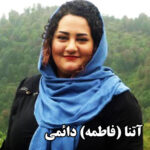 On May 15, 2015, Judge Moghise of Branch 28 of the Revolutionary Court sentenced her to 14 year in prison on charges of collusion and gathering against national security, propaganda against the regime, and insulting the Supreme Leader. Her sentence was reduced to five years with application of Article 134 of Islamic Penal Code.
After her arrest and before her trial, she spent 86 days in the solitary cells of Section 2-A. On February 15, 2016, she was released on a bail of 5500 million rials. Her sentenced was reduced to seven years in appeals court in August of 2016.
Daemi was arrested in her father’s house that November, and cases against her two sisters and one of her brother-in-laws immediately followed. She went on hunger strike for 54 days until the charges against them were dropped. So far she has been acquitted of two case files that have been opened against her.
In January of this year, she was taken to Varamin’s Qarchak prison after being assaulted. On May 9th, she was taken back to Evin’s Women’s Ward. She has thus far been denied furlough and has yet to request parole.
16- Elham Barmaki (born 1968)
On December 28, 2011, Barmarki was arrested on the street and spent three months in the solitary cells of Section 209. She was then released on bail and was later acquitted.
On July 23, 2012, she was arrested again, this time spending 14 months Section 209 solitary cells. On September 29, 2013, she was transferred to the Women’s Ward.
In Branch 28 of the Revolutionary Court, headed by Judge Moghise, Barmaki was sentenced to 10 years in prison and fines of 25,000 Euros, 70,000 USD, and 400 million rials. She has two children, Amir-Parviz and Anita, who both live abroad. She was released once on furlough in March 2017 for the Persian New Year. Her request for parole has been rejected.
17 – Sotoudeh Fazeli (born 1953)
Fazeli was arrested in early 2011 by the Intelligence Ministry. She spent 31 days in Evin’s Section 209 before being released on bail in 2011. Branch 15 of the Revolutionary Court, headed by Judge Salavati, sentenced her to three years in prison on charges of “enmity against god by supporting the MEK.” She has been held in the Women’s Ward since June 29, 2016.
Fazeli suffers from eye and muscle problems, among other health conditions. She was released on a short furlough in 2016. Her requests for parole have been repeatedly rejected.
Since the beginning of the new Persian calendar year in 2018, 15 new prisoners have entered the Women’s Ward, including Zahra Zare, Negar Zarei, Mandana Azarmah, Akram Gholami, Aliyah Eghdamdoost, Akram Mirsane, Raha Fasayi, Parisa Rahmati, Batool Ezati and Arefe Aziz. A number of these women have been already released.