Upcoming Execution of Dual National Ahmad Reza Jalali Set for May 21

Quoting an informed source, ISNA reports that imprisoned Iranian-Swedish national Ahamd Reza Jalali is to be executed by May 21, 2022.

Jalali’s death sentence was previously upheld by the Supreme Court of Iran on the charge of espionage which he has vehemently denied and was seen as a political manoeuvring against those who invited him and to force concessions from the Swedish government 

The announcement today has also raised concern that the Iranian regime intends to use Professor Jalali to force the Swedish government to free Hamid Nouri, an Iranian official who is on trial and accused of participating in the 1988 execution of political prisoners. This trial is coming to an end as the Swedish government has asked for a life sentence for Nouri based on evidence from a lengthy trial. 

Professor Jalali, who travelled to Iran in May 2016 at the invitation of the University of Tehran, was arrested by security forces on charges of “enmity against God (Moharebeh) through espionage for Israel”. Moharebeh, loosely translated as “waging war against God”, is a pillar of Sharia Law which is typically applied to those suspected of connection to acts against the state.

Mr. Jalali was sentenced to death for espionage, and the sentence was upheld by the Supreme Court in December 2017.

Ahmad Reza Jalali worked at the Center for Natural Disasters after graduating from medical school in Iran. He immigrated to Sweden in 2009 to continue his studies and earned a doctorate. He completed his postdoctoral in Disaster Medicine at the University of Piedmont in Italy, and later, settled in Sweden with his wife and two children.

According to a report published by HRANA in November 2020, Ahmad Reza Jalali was transferred to solitary confinement for a week to be prepared for execution. In December of that year, his attorney Mrs. Mousavian was informed that her client’s death sentence was put on hold and he was transferred to ward 209 of Evin prison.

“Fortunately, Mr. Jalali was transferred to a public ward in April, but so far, despite all the efforts, his death sentence has not changed,” Mousavian said. “I am very worried about my client, especially now that the presidential election is over. Despite my repeated expressions of concern, no effective action has been taken by the country of dual citizenship and the European Union.”

Civil Activist Monireh Arabshahi Hospitalized for Poor Health Conditions

On Sunday, May 1, 2022, imprisoned civil activist Monireh Arabshahi was hospitalized due to poor health conditions.

According to HRANA, the news agency of Human Rights Activists, on Sunday, May 1, 2022, civil activist Monireh Arabshahi, who is currently jailed in Kachooie Prison in Karaj City, was dispatched to a hospital outside the prison.

She was sent to a prison health facility first and after a few hours, dispatched to a hospital outside the prison.

An informed source told HRANA: ” after surgery and Thyroid drainage, Arabshahi has to be under medical care by a physician to check her hormone levels, which is not possible in prison. Nonetheless, the prosecutor does not grant any medical furlough.”

Earlier, on August 4, 2021, Arabshahi was sent on medical furlough and on October 4, 2021, forced to return to prison despite unfinished medical treatment.

Also, on July 31, 2021, Arabshahi was dispatched to a hospital and was sent back to prison a day after without adequate medical treatment.   

Despite poor health conditions, which make her unable to endure imprisonment, Arabshahi is still jailed in Kachooie Prison in Karaj City.

Yasaman Aryani, Arabshahi’s daughter and an outspoken opponent of the compulsory hijab in Iran, who had been released after serving out her sentence on February 14, 2019, was also arrested again on April 10, 2019, on new charges.

One day after the arrest of her daughter, Arabshahi was also arrested and both were relocated to Gharchak Prison. Subsequently, both were sent to Evin Prison and finally to Kachooye Prison in Karaj.

Subsequently, Branch 28 of the revolutionary court convicted the mother and daughter to a total of 16 years in prison, which were later reduced to a total of 9 years and 7 months. They were charged with “assembly and collusion against national security”, “propaganda against the regime”,  and “provoking and provisioning of impurity and indecency”.

Behnam Moosivand Hospitalized As a Result of Hunger Strike

On Sunday, April 24, 2022, civil activist Behnam Moosivand was sent to the quarantine section of Evin Prison from Rajai-Shahr Prison. He has been on hunger strike since April 19 and is currently hospitalized for low blood pressure and other side effects.

According to HRANA, the news agency of Human Rights Activists, Civil activist Behnam Moosivand who is still on a hunger strike after seven days, was transferred to the quarantine section of Evin Prison from Rajai-Shahr Prison. On Tuesday, April 26, 2022, he was sent to a hospital for low blood pressure and other side effects.

According to an informed source, last Sunday, while Moosivand was suffering from life-threatening side effects of his hunger strike, without any prior notice, prison officials transferred him to Evin Prison.

On April 19, 2022, Mr Moosivand went on a hunger strike in protest against being beaten by prison officers following his objection to being handcuffed during the dispatching to the hospital.

On February 1, 2018, the intelligence officials raided Behnam Moosivand’s home and transferred him to the detention facility of the Ministry of Intelligence in Evin Prison, known as Ward209. He was released on bail on March 19, 2018.

Subsequently, in September 2019, branch 28 of Tehran’s Revolutionary Court sentenced Moosivand to five years in prison on the charge of “assembly and collusion to act against national security”, and one year on a charge of “propaganda against the regime”. The verdict was upheld on appeal. On June 14, 2020, Moosivand went to Evin for sentencing. In September of 2020, he was sent into exile, to Rajai-Shahr prison in Karaj City.

Inmate Died in Prison Due to Medical Negligence

On Friday, April 22, 2022, an inmate in Kamyaran Prison died due to medical negligence.

According to HRANA, the news agency of Human Rights Activists, in Kamyran Prison, an inmate, identified by HRANA as Savad Eliasi, died because of the denial of medical care. He had been convicted of drug-related crimes.

An informed source told HRANA: “At 5 A.M. Savad Eliasi was transferred to prison health facility due to his critical health condition. Despite having a history of heart attacks, he was only injected a pain reliever. Consequently, Eliasi died after three hours.”

The most recent report from the Statistics and Publication Center of the Human Rights Activists in Iran (HRA) has registered twenty deaths by diseases, five cases of suicide in Iran prisons and five cases of arrestees who were killed by prison authorities between January 1 of 2021 and December 20 of 2021.

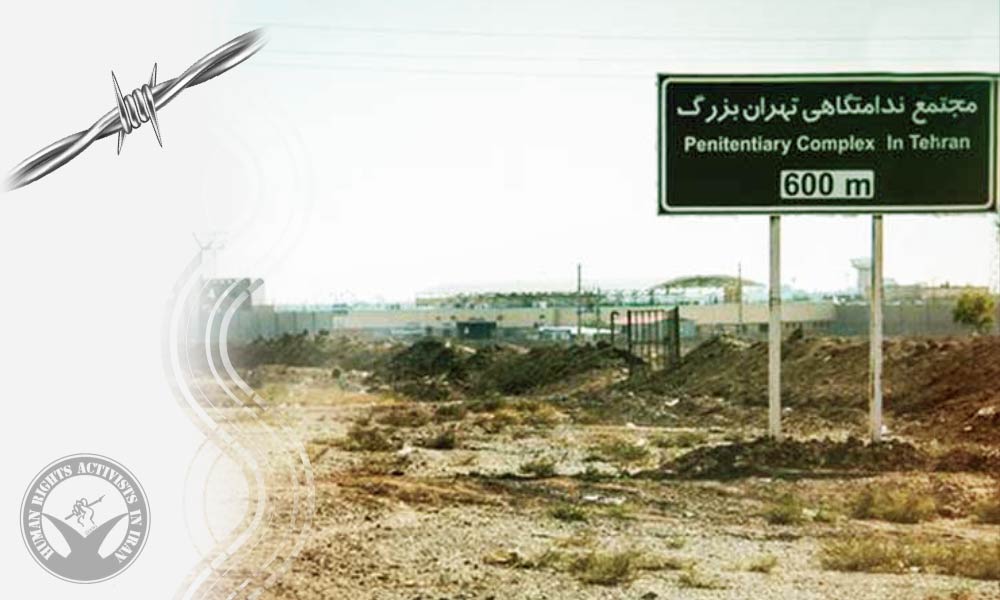
Vahid Bagheri Returned to Greater Tehran Central Penitentiary after Furlough

Last Saturday, April 16, 2022, Vahid Bagheri, political prisoner and one of the individuals arrested in the 2019 Iranian protests returned to the Greater Tehran Central Penitentiary after furlough. He had been released on furlough after 19 months of imprisonment. In recent days, his request for early release on probation was rejected.

According to HRANA, the news agency of Human Rights Activists, political Prisoner Vahid Bagheri returned to The Greater Tehran Central Penitentiary after furlough.

Earlier, in an open letter, he wrote “I am the breadwinner of two families. Why should I be in prison  only for attending a protest?”

During the nationwide 2019–2020 Iranian protests known as the Aban Protests, the security forces arrested Bagheri and after a while transferred him from a detention facility to the Greater Tehran Central Penitentiary.

Subsequently, branch 28 of the Revolutionary Court of Tehran sentenced Bagheri to six years in prison on the charge of “propaganda against the regime and assembly and collusion against national security”. Applying article 134 of the Islamic Penal Code, of the two counts, five years in prison for the charge of “assembly and collusion” is enforceable.

Bagheri was not granted furlough to attend his brother’s funeral while in prison.

Vahid Bagheri is 33 years old, married and a father of two children.

In November of 2019, an unprecedented increase in fuel prices sparked a wave of protests in dozens of cities across Iran. According to reports from human rights organizations, hundreds were killed during these protests by the regime forces.

Subscribe to Our Newsletter

Now is definitely not the time to stop reading!

Inmate Majid Keshvari Committed Suicide for Lack of Medical Care in the Greater Tehran Central Penitentiary

On Tuesday, April 19, 2022, at the Greater Tehran Central Penitentiary, an inmate committed suicide after he was denied adequate medical treatment. Following the attempt, he was hospitalized in a hospital outside the prison. This inmate, who suffers from mental health problems, had attempted suicide several times before.

According to HRANA, the news agency of Human Rights Activists, feeling desperate for not receiving medical treatment, the inmate identified as Majid Keshvari committed failed suicide attempt in the Greater Tehran Central Penitentiary.

An informed source told HRANA, “It has been a long time since Mr. Keshvari is in need of surgery and the prison health providers had recommended his dispatch urgently to a hospital outside the prison. Instead, the prison officials sent him to a psychiatric ward and then sent him back to prison, ignoring care for his health issues. 

Keshvari then attempted to hang himself in protest against this unfair treatment and was hospitalized. There is still no news about his latest condition.”

Reportedly, Keshvari had attempted to commit suicide on another occasion as well.


Political Prisoner Khadijeh Mahdipour Denied Urgent Medical Treatment in Ilam Prison

Political prisoner Khadijeh Mahdipour was denied access to medical treatment despite having severe digestive issues.

According to HRANA, the news agency of Human Rights Activists, political Prisoner Khadijeh Mahdipour is in poor health in Ilam Prison due to the denial of medical care.

According to an informed source, Mrs  Mahdipour suffers from severe digestive issues that result in episodes of nausea. She has lost weight in the last two months, but the authorities deny sending her to Tehran to receive more adequate treatment.

After long procrastination, on January 4, 2022, prison officials sent Mahdipour to a hospital outside prison for treatment of a black fleck in her eyes. She is currently serving her 20-month sentence in Ilam Prison.

On October 10, 2021, IRGC intelligence agents arrested Mahdipour at her uncle’s house and transferred her to Ilam Prison after two days of interrogation.

She was sentenced to 20 months in prison on the charges of “propaganda against the regime” and “offensive statements against the supreme leader of Iran”. She was acquitted of the charge of “advocating for anti-regime groups”.

She had earlier faced other arrests and convictions. On October 3, 2020, the security forces arrested her in Ilam City and she was fined 3 million tomans to avoid imprisonment.


Political Prisoner Mehdi Salehi’s Body Buried under Strict Security Measures

This morning, April 15, 2022, the body of political prisoner Mehdi Salehi was buried in Yazdanshahr Cemetery under tough security measures. Salehi’s death did not trigger an investigation and there was no official announcement about the cause of his death. 

During the 2018 protests in Khomeini Shahr City, Salehi was arrested and subsequently sentenced to death for crimes he never confessed to. Recently, he died suspiciously in prison health facility in Dastgerd prison in Isfahan.

According to HRANA, the news agency of Human Rights Activists, on Friday morning, Mehdi Salehi’s Body was buried in a cemetery in Yazdangerd under strict security measures.

One of his family members told HRANA that “his family’s frequent inquiries remained unanswered by the authorities. Ultimately, the security forces moved his body to Yazdanshahr cemetery and buried him. They informed the family about the funeral just one hour before the burial. The authorities threatened the family to keep Salehi’s ordeal a secret and  to guarantee the family’s silence in the matter, held his brother, Mehdi Salehi in custody during the funeral.”

During nationwide protests that broke out in December 2017 and continued into 2018, many people were killed by the regime forces, including Asghar Haroon Al-Rashidi who was shot dead in Khomeini Shahr in January  2018. His family filed a complaint against the IRGC forces, Basij and the police. Thereafter, on November 3, 2019, some of Haroon Al-Rashidi’s friends including Mehdi Salehi were arrested by security forces for taking part in the protests.

On February 8, 2020, the Revolutionary Court of Isfahan sentenced Salehi to death (two times) on the charges of “enmity against God by using a firearm and shooting in public” and “using weapons of war (Kalashnikov rifle) against the regime forces during the unrest”. Salehi was also sentenced to 5 years in prison on the charge of “spreading corruption on earth by disturbing the public order and leading the insurrectionists.”

Mehdi Salehi never accepted these allegations. In a statement, he claimed that he had witnessed when Haroon Al-Rashidi was shut in the back by the regime forces.

Salehi was also injured by a pallet gun bullet in his head when he was trying to help Haroon Al-Rashidi.

Mehdi Salehi was 38 years old, married and father of a nine-years girl.


Political Prisoner Mehdi Salehi Died In Prison

Political prisoner Mehdi Salehi Gale’eh-Shahrokhi has died in prison. He was one of those arrested during the 2018 protests in Khomeini Shahr City and was sentenced to death.

According to HRANA, the news agency of Human Rights Activists, political prisoner Mehdi Salehi Gale’eh-Shahrokhi who was on death row has died in prison.

Confirming Mr Salehi’s death, an informed source close to his family stated: “When I  contacted the prison officials, they only confirmed that he passed away without mentioning the cause of death.”

“Some of his fellow inmates ascribed his death to a medical error of prison healthcare. However, so far no official clarification has been given to his family.”, he added.

During nationwide protests that broke out in December 2017 and continued into 2018, many people were killed by the regime forces, including Asghar Haroon Al-Rashidi who was shot dead in Khomeini Shahr in January  2018. His family filed a complaint against the IRGCforces, Basij and the police. Thereafter, on November 3, 2019, some of Haroon Al-Rashidi’s friends including Mehdi Salehi were arrested by security forces for taking part in the protests.

On February 8, 2020, the Revolutionary Court of Isfahan sentenced Salehi to death (two times) on the charges of “enmity against God by using a firearm and shooting in public” and “using weapons of war (Kalashnikov rifle) against the regime forces during the unrest”. He also was sentenced to 5 years in prison on the charge of “spreading corruption on earth to disturb the public order and leading the insurrectionists.”

Mehdi Salehi never accepted these allegations. In a statement, he claimed that he had witnessed when Haroon Al-Rashidi was shut in his back by the regime forces.

Salehi was also injured by a pallet gun bullet in his head when he was trying to help Haroon Al-Rashidi.

Mehdi Salehi was 38 years old, married and father of a nine-years girl.


Political Prisoner Zahra Safai Denied Urgent Medical Treatment by Prison Officials

On Tuesday, April 12, 2022, despite prior agreement and a set appointment, prison officials denied dispatching the political prisoner Zahra Safai to a hospital. The denial was under the pretext of her disagreement with transfer with handcuff and foot cuffs. According to the State Prisons and Security and Corrective Measures Organization’s rules, transferring the prisoners with foot cuffs except for prisoners of violent crimes is forbidden.

According to HRANA, the news agency of Human Rights Activists, through the obstruction of prison officials, political prisoner Zahra Safai was denied medical treatment.

Mrs Safai suffers from heart disease and has had angiography surgery in the past. Since September of last year, she has been dispatched several times to a hospital outside the prison. This time, the prison officials denied her access to urgent medical care.

On February 24, 2020, security forces arrested Zahra Safai and her daughter Parastoo Moeini in Tehran and transferred them to Ward 209 of Evin Prison. In April 2020, they were sent in exile to Qarchak Prison in Varamin City. On June 28, 2020, Mrs Safai was released on bail with the amount of 300 million tomans. However, on July 26 of that year, they increased the bail ten times and subsequently arrested and sent her back to Qarchak Prison when she could not provide the set bail.

In February of 2021, Branch 23 of the Revolutionary Court of Tehran sentenced Mrs Safai to 5 years in prison on the charge of “assembly and collusion to act against national security”, one year on the charge of “propaganda against the regime” and two years on the charge of “offensive statements against the former and current Supreme Leader of Iran”. As an additional punishment, she was banned from leaving the country and membership in any political parties or civil groups.

Zahra Safai has also faced arrest and conviction in 2006. Further, during the 1980’s she had been imprisoned for a while. Her father, Haji Safai was a well-known businessman who was executed on the charge of “advocacy for the People’s Mujahedin Organization of Iran (the Mujahedin-e-Khalq or MEK)”.