
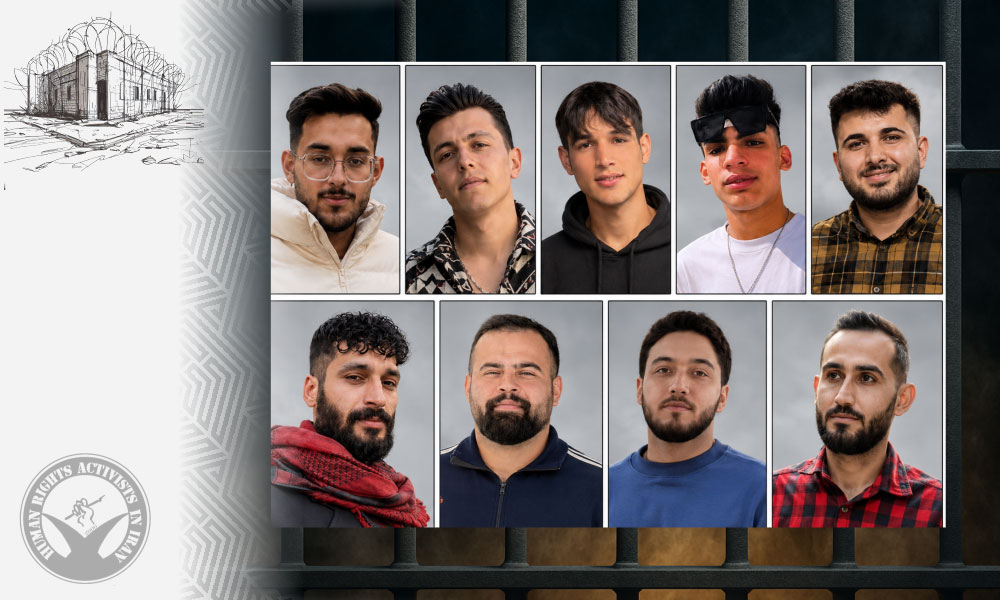
January 2026 Protests: Nine Detained Citizens from Esfarayen, Including a Teenager, Remain in Legal Limbo

HRANA – Nine citizens, including a 16-year-old teenager, who were arrested in connection with the January 2026 protests in Esfarayen, remain in judicial limbo.

According to HRANA, the nine individuals arrested in connection with the January 2026 protests in Esfarayen County continue to be held without a final judicial decision.

A source familiar with the case, who confirmed the information to HRANA, said that they were arrested in connection with the fire at the traffic police station in Esfarayen, an incident that resulted in the deaths of Esfarayen Prosecutor Ali Akbar Hosseinzadeh and four other people on January 8, 2026. The detainees are currently facing charges including enmity against God (moharebeh), corruption on earth, premeditated murder, complicity in premeditated murder, intentional destruction of property, arson, inciting and provoking people to engage in armed conflict, disrupting public order and peace, and endangering national security. Their case is currently under review by Branch 1 of the Revolutionary Court in Bojnurd.

According to information received by HRANA, Mohammad Azari, Reza Rezapour, Hossein Mehrangiz, Sajjad Shamsaei, Ali Babri, Amirhossein Nazarzadeh, Sajjad Sang-Sefidi, and Mostafa Rajab-Alizadeh are being held in Esfarayen Prison, while 16-year-old Amirhossein Sarban is detained at the Juvenile Correction and Rehabilitation Center in Bojnurd. All nine were arrested in connection with the January 2026 nationwide protests in Esfarayen and, more than six months later, remain in legal limbo.

They were arrested separately by security forces over the course of January 2026. Amirhossein Nazarzadeh was detained on January 20, Mohammad Azari on January 14, Hossein Mehrangiz on January 9, and Ali Bebri later that month.

Amirhossein Nazarzadeh, 27, is from the village of Fartan. Mohammad Azari, 35, Amirhossein Sarban, 16, and the remaining detainees, Reza Rezapour, Hossein Mehrangiz, Sajjad Shamsaei, Ali Bebri, Sajjad Sang-Sefidi, and Mostafa Rajab-Alizadeh, are residents of Esfarayen County.

At the time of publication, no confirmed information was available regarding the formal charges brought against these individuals, the judicial authority handling their case, or whether they have access to legal counsel.

Background on the January 2026 Protests

It should be noted that protests and strikes by shopkeepers and bazaar merchants began in Tehran on Sunday, December 28, 2025, and within two days spread beyond markets and commercial centers. With the participation of students, citizens, and various social groups, these protests became one of the largest protest movements of recent years. Following the crackdown by security and law enforcement forces, thousands were killed or injured, and tens of thousands were arrested or summoned by security agencies. For more information, readers may refer to HRANA’s comprehensive report titled “Crimson Winter,” documenting the first fifty days following the outbreak of Iran’s nationwide protests.

Day 47 of the Protests: Intensified Communication Restrictions and Ongoing Arrests

HRANA – According to the latest aggregated data compiled by HRANA through the end of the forty-seventh day since the start of the protests, the total number of confirmed fatalities has reached 7,005. Of these, 6,506 have been classified as “protesters,” including 219 children under the age of 18. Additionally, 214 of those killed were members of military or government forces, while 66 were recorded as non-protester civilians. A further 11,730 cases remain under investigation.

During the same period, the number of injured civilians has been recorded at 25,845, the total number of arrests at 53,166, student arrests at 136 cases, the broadcast of forced confessions at 337 instances, and summonses at 11,051 cases. Furthermore, since the beginning of the protests up to the time of this report, 676 protest-related incidents have been recorded in 210 cities across 31 provinces.

On this day, four key incidents are noteworthy: the intensification of communication restrictions through the blocking of SIM cards, the continuation of scattered arrests in various cities, the expansion of security pressures on educational environments, and international reactions to the scale of the crackdown.

Widespread Blocking of Citizens’ SIM Cards

As part of ongoing control measures, numerous reports have emerged of the sudden blocking of citizens’ SIM cards. A number of users, including journalists, have stated that their access to phone calls and text messaging services was cut off without prior official notice. In some cases, this action has been accompanied by the confiscation of mobile phones, laptops, and identification documents, including passports, national ID cards, and birth certificates.

According to received reports, this trend began approximately one month ago, coinciding with the peak of the protests, and has since become one of the tools used to restrict communications. In certain instances, the measure has also disrupted individuals’ access to banking services, employment-related matters, and everyday essential services.

Adoption of a European Parliament Resolution

At the international level, the European Parliament adopted, by a majority vote, a resolution condemning the crackdown on citizens in Iran. The resolution criticizes the treatment of civil activists, protesters, women, and minorities, and emphasizes the immediate release of those detained.

The text of the resolution expresses concern over the scale of the repression and stresses the need for independent documentation of human rights violations and the preservation of evidence for potential judicial proceedings. It also calls for the immediate cessation of violence, arbitrary arrests, and pressure on medical personnel.

Report by the Coordinating Council of Iranian Teachers’ Trade Associations on the Entry of Security Forces into Schools

The Coordinating Council of Iranian Teachers’ Trade Associations has reported that the scope of the street crackdown has extended into schools. According to the report, individuals outside the educational staff, under titles such as Basij members, religious preachers, and plainclothes agents, have entered schools with prearranged programs.

The report describes the mission of these individuals as “ideological screening” and the exertion of psychological pressure on students. Referring to repeated interrogations and threatening questions, the Council stated that the atmosphere in some schools has become marked by anxiety and tension. The body had previously reported that at least 200 students were killed during the protests.

Minister of Communications Acknowledges Ongoing Internet Disruptions

The Minister of Communications and Information Technology, referring to the internet shutdown following the nationwide  protests, stated that the country’s communications network continues to face disruptions and has not returned to its previous stable condition.

He emphasized that approximately 10 million citizens rely on digital communications to earn their livelihoods, and that even the slightest disruption can significantly affect their lives.

Rejection of Allegations of “Injecting Violence” by the Government in the Iranian President’s Remarks

In remarks delivered recently, the President of Iran rejected allegations that security institutions injected violence during the January protests, describing such claims as “unfair.”

Referring to certain critical narratives, he stated that the government did not set fire to markets, mosques, or ambulances, and asserted that such accounts align with the positions of foreign adversaries.

Arrests and Security Measures Continue

On the forty-seventh day, arrests and security crackdowns continued in various cities. According to reports by HRANA:

In Abdanan, Ali Nazarzadeh was arrested.
In Bukan, Musa Dadyar, Hamzeh Dadyar, and Naser Dadyar were arrested.
In Qarchak, Aria Adavi was detained by security forces and transferred to an undisclosed location.

In Miandoab, Jamal Abdollahi; in Sirvan, Malek Khalafi; and in Oshnavieh, Ribin Moloudi (a physician), were arrested. Additionally, at least three unidentified citizens were detained in Alborz Province.

Arman (Mehdi) Momeni in Tehran, Hamid Rudsarabi in Sabzevar, and Mohammad Azari in Esfarayen were arrested in connection with the January protests and remain imprisoned. Mr. Momeni was arrested near Qeytarieh Park in Tehran by IRGC Intelligence agents and has had only one brief contact with his family during this period.

In Razavi Khorasan Province, the IRGC Intelligence Organization announced the arrest of several citizens described as “affiliated elements.”

Within the prison system, Abolfazl Karimi was transferred from Greater Tehran Prison to Qezel Hesar Prison, with reports indicating that he was subjected to torture and suffered a broken arm. Iltay Akhoundi, a 14-year-old detainee in Gonbad-e Kavus, has reportedly been denied full access to his asthma medication. Additionally, Younes Azadbar and Jamshid Azizi were returned to Lakan Prison in Rasht before the end of their furlough.

Updated (Cumulative) Statistics Through the End of Day 47

• Total number of protest incidents recorded since the beginning of the protests: 676

• Number of cities involved (without duplication): 210

• Number of provinces involved (without duplication): 31

• Injured civilians: 25,845

• Total arrests: 53,166

• Student arrests: 136

• Forced confessions broadcast: 337

• Summonses issued: 11,051

• Total protesters killed: 6,506

▪️ Including children: 219
▪️ Military/government forces: 214
▪️ Non-protester civilians: 66

• Total fatalities: 7,005

• Cases under investigation: 11,730

It should be noted that the confirmed figures for fatalities represent the minimum number that can be verified, while estimates suggest that the actual number of those killed may be significantly higher.

Summary

The forty-seventh day concluded with communication restrictions, pressure within schools, and the continuation of scattered arrests remaining among the central developments. Alongside the rising cumulative numbers of arrests and summonses, international reactions have also continued. Recorded data indicate that since the beginning of the protests, incidents have spread to 210 cities across 31 provinces.

Nationwide Protests: Report on the Arrest of 3 Citizens in Various Cities

HRANA – Three citizens, Arman (Mehdi) Momeni in Tehran, Hamid Rudsarabi in Sabzevar, and Mohammad Azari in Esfarayen, were arrested on different dates in connection with the protests and remain in detention.

He was detained near Qeytarieh Park in Tehran by agents of the IRGC Intelligence. According to a relative who spoke to HRANA, Mr. Momeni has had only one brief phone call with his family during this period, in which he stated that he was unaware of his place of detention. Despite repeated follow-ups by his family to obtain information about his whereabouts and the charges against him, no response has been received, heightening their concerns.

In another development, a citizen in Sabzevar identified as Hamid Rudsarabi, born in 1995, was arrested at his workplace by security agents on January 10, 2026.

His relatives have stated that they have no information regarding his place of detention or the charges brought against him.

On January 14, another citizen was also arrested by security forces in Esfarayen.

HRANA has identified him as Mohammad Azari, born in 1992. Two weeks after his arrest, following the completion of the interrogation process, he was transferred to Esfarayen Prison.