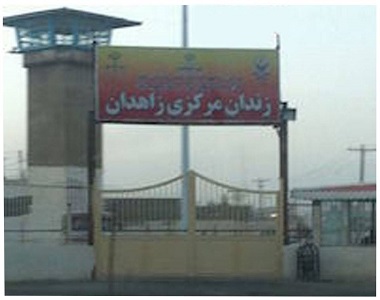
State of Mental Health Critical for Zahedan Political Prisoner Held Six Years Without Trial

Human Rights Activists News Agency (HRANA) – A hostage of judicial bureaucracy for six years and counting, political prisoner Meysam Chandani, 28, has recently experienced a serious psychological downturn, a close source told HRANA.

“He is suffering from severe psychological illness due to the pressures of incarceration, the living conditions inside, and his legal limbo,” the source said. “He makes noises throughout the day and night, behaves strangely, and has caused problems for his ward mates.”

Currently held in section 4 of Zahedan Prison in the southeastern province of Sistan and Baluchestan, home to Iran’s Baloch minority, Chandani was arrested six years ago by the Ministry of Intelligence forces of Saravan county and charged with “acting against national security,” “Moharebeh (enmity against God) through armed activities,” and “membership in an opposition group.” Unable to post his 5 billion toman (approximately $1,250,000 USD) bail, he has been waiting on his sentencing–or any updates at all–ever since.

In the meantime, prison officials refuse to attend to his medical needs, which according to eyewitnesses reports are growing more serious by the day.

While prison management has no direct responsibility to nudge the judiciary about lagging case files, they have been slow to address the prison’s dearth of communication channels with the judiciary and its general lack of social aid workers, shortcomings which make the follow-up process too difficult for some prisoners to undertake themselves.

Overpopulation has become a prevailing issue at Zahedan prison, where officials routinely disregard or postpone consideration of prisoner requests for sentencing reduction via part-time sentence schedules, furlough, and conditional pardon.

HRANA has previously reported on general lack of medical treatment in Zahedan Central Prison, based on interviews with eyewitnesses. The prison also hosts many who suffer from legal limbo like Chandani. This is in direct contravention of Article 9 of the International Covenant on Civil and Political Rights–of which Iran is a signatory–which guarantees arrestees the right to a prompt trial and to be promptly informed of the extent and nature of any charges on which they are being detained.

Prisoners in Iranian Baluchestan Brutally Tortured by IRGC Intelligence Unit

Human Rights Activists News Agency (HRANA) – At the hands of the Islamic Revolutionary Guards Corp’s Saravan Intelligence Unit, at least seven detainees have recently been subjected to torture.
HRANA has identified two of these victims as Najib Dehvari, 21, and Abdolshokur Sotoudeh, 22, both from Saravan. Saravan is a city in Iran’s southeastern Sistan & Baluchestan Province, home to the Baloch ethnic minority group.
Dehvari, Sotoudeh, and their comrades were initially arrested in connection to a sound bomb that went off in front of the Ministry of Intelligence Bureau in Saravan. There were no casualties. They were held in the IRGC Intelligence Detention Center before being transferred to Ward 1 of Zahedan Prison in the province’s capital city.
A source familiar with the case told HRANA that the seven were religious seminary students who confessed after enduring prolonged beatings and torture. The source added, “they were interrogated during the night, lashed with electrical cables shocked with electricity. The wounds are still visible on the soles of their feet, and they are unable to walk.”
The torture of prisoners by IRGC Intelligence Units and the Ministry of Intelligence is more widespread in Baluchestan than in other regions of Iran. In a technique commonly exerted by these centers, called the “miracle bed,” the prisoner is tied to a bed frame and repeatedly flogged with the goal of extracting a confession. Historically, prisoners often utter confessions to put an end to the torture, rather than authentically confess to a crime.
Massoud Ghanbarzehi, another prisoner was detained on charges of “Acting against national security through cooperation with opposition groups” back in June, was interrogated and tortured while being held for three weeks in a Zahedan Ministry of Intelligence detention center before being transferred to Zahedan Central Prison.
Three additional Intelligence Center detainees who previously reported on their torture–Mohammad Saber Malik-Raeisi, Abdulkarim Shah Bakhsh, and Noor Ahmad–shared accounts of the various torture methods they endured, among them the “miracle bed” technique.

Baluchi plight laid bare in exiled prisoner letter

Human Rights Activists News Agency (HRANA) – Three Baluchi political prisoners exiled to the northwestern city of Ardabil wrote an open letter in critique of the Iranian authorities and to raise public awareness about the plight of their people.
From Ward 7 of Ardabil Central Prison, Mohammad Saber Malek Raisi, Shirahmad Shirani, and Noor Ahmad Hassanzehi wrote of dysfunctions plaguing the infrastructure of the Sistan and Baluchestan province, and of government inaction against the severe desiccation of Hamoun Lake.
Their letter concludes with a poem entitled “Friendship Is Our Long-Lasting Treasure,” which celebrates the unity among the different ethnicities of the Sistan and Baluchestan province.
Their letter is below, translated into English by HRANA:
Greetings, our dear Sistani peoples, especially those around Hirmand and Hamoun,
As exiled Baluchi political prisoners, we regard it as our duty to declare solidarity and express support to you, noble and kind fellows, through these troubles of our day. From the bottom of our hearts, we wish the best to you and to all the peoples of our province. We wish you emancipation from dictatorship.
How inconceivable it is to live this way! With border regions barren of water, electricity, gas, housing, employment, and of basic amenities like schools, roads, heating and cooling, toilets, and now, of the natural right to breathe; what is left to do but to survive, but to suffer? And for how long?
Clean air is the unconditional and vital right of all living beings. Despite this, some — who pursue personal and organizational profiteering, are guilty of mismanagement or carelessness, or persist in the mass theft of subterranean marine resources — have blighted this ancient erudite land with chaos and suffering. This birthplace of brave souls like Rostam, Sohrab, and Yaqub Leith; this place of Iranian linguistic and social renaissance.
How can we bear to see Sistan, the fertile crescent of ancient Iran, abandoned to a fate steered by those who caused this chaos, i.e. the regime and its agents?
The carelessness and profiteering of the regime’s authorities must cease its exploitation of the immense natural, cultural, and ethnic wealth of Sistan and Baluchestan, by ceasing the stripping of its precious gold and ore mines and the closing of its borders, the sole gateways to hope for the regions’ people in this era of poverty and destitution. Their job is not to gamble Sistani lives. You are the authorities! It’s your duty to heal the disorder you’ve caused.
What have you done all these years to restore Hamoun Lake and its wetlands? What have you done besides spend billions of rials on a border wall, fence, moats, towers, watchtowers, and other border controls? How much have you spent on the welfare of this region’s people? How much on the restoration of Hamoun Lake and wetlands, equal parts a cause and excuse for our insecurity? How will you restore hope and comfort to these poor and wronged Sistani farmers and fishermen? With lies, with promises?
You, our fellow Sistanis, people of our province, should know that we, the Baluchi people, irrespective of the regime and its schemes, will stand up to any abuse that violates your rights. We will condemn it. We will put our lives on the line for you.
Mohammad Saber Malek Raisi, Shirahmad Shirani, Noor Ahmad Hassanzehi
Exiled Baluchi political prisoners,
Ward 7 of Ardabil Central prison
August 30, 2018

Status of Activist Molavi Nasser Rigi Still Unknown

Human Rights Activists News Agency (HRANA) – According to the Baluch Activists Campaign, though Sunni cleric Molavi Nasser Rigi was arrested by Revolutionary Guard agents more than three weeks ago, his whereabouts remain unknown.
Rigi is a civil rights activist and member of a charity called “School Ambassadors.” He was active in several social initiatives, including the collection signatures for a petition in support of the Iranshahr girls.
He was arrested July 15th in response to allegedly fake social media accounts created in his name, which indicate he is a member of “SAHAB” (Baluchistan Protest Coordinator organization) and responsible for torching the Pasteur Pharmacy in Iranshahr (in Sistan and Baluchestan province). He denied the accusations, demanding the arrest of those responsible for disseminating the misinformation.
Iranshahr residents previously held mass protests in response to the statements of Sunni Imam Molavi Tayeb, who announced after leading a Friday prayer that 41 girls from Iranshahr had been abducted and raped. Security forces detained many of the protesters, including Abdullah Bozorgzadeh.

Six Prisoners Hanged in Zahedan; Executions Not Announced by IRI

HRANA News Agency – On Saturday, October 15, 2011, six prisoners were hanged in Zahedan Central Prison on charges of drug trafficking.[Zahedan is the capital city in Sistan and Baluchestan Province in southeast corner of the country.]

According to a report by Human Rights Activists News Agency (HRANA), one of the prisoners hanged yesterday in Zahedan was an Afghani citizen.Although two days have passed since these prisoners were executed, Iran’s Judiciary Branch has not yet officially announced the news.

During the last few weeks, the number of executions throughout Iran has continued to increase while only a small number of these killings are formally confirmed by the Islamic Republic of Iran.Like before, the majority of hangings are performed secretly.

Copyright © 2009-2011 All Rights Reserved

Subscribe to Our Newsletter

Now is definitely not the time to stop reading!