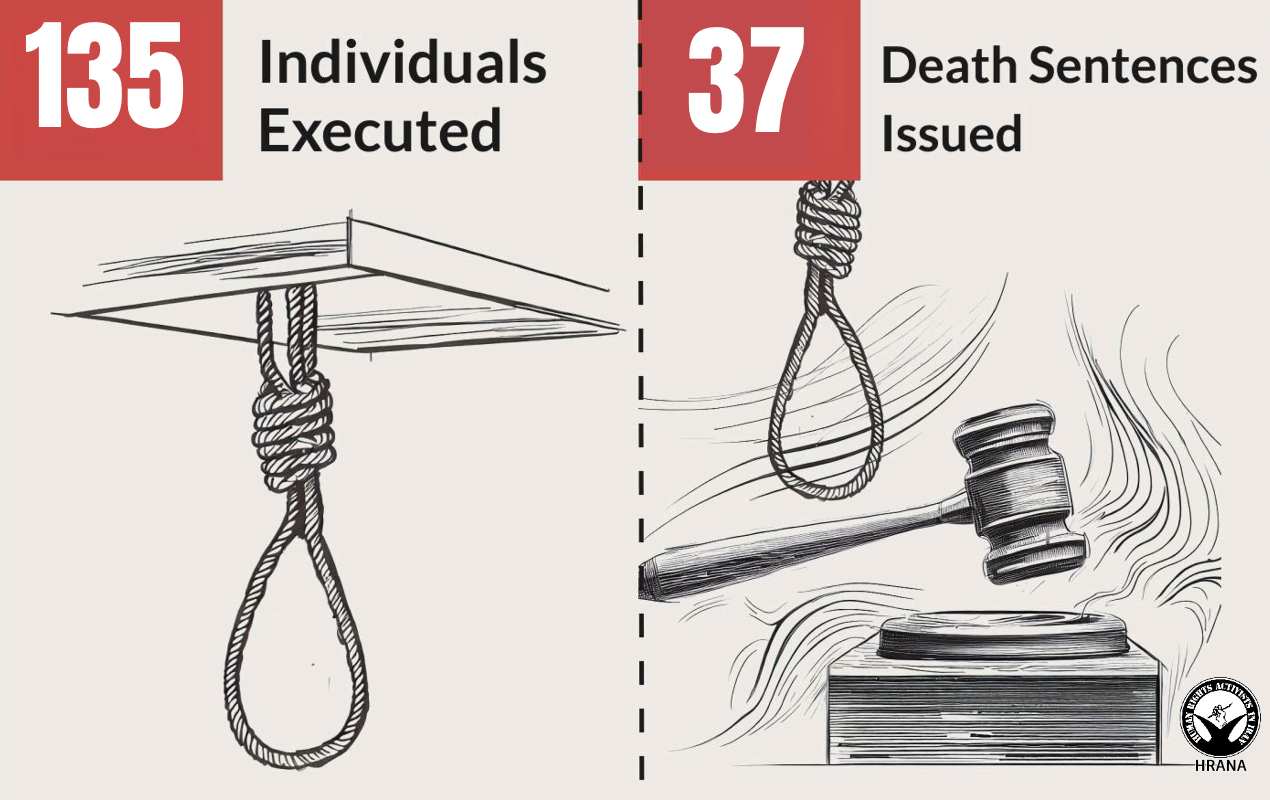
HRANA – HRA’s Statistics Department has released its monthly report for November 2024, highlighting ongoing human rights violations across Iran. This month, 135 individuals were executed, comprising 127 men, 4 women, and 1 juvenile offender, including 11 Afghan citizen. Alongside these executions, 37 individuals were sentenced to death, underscoring a persistent use of capital punishment in Iran, often for offenses that do not meet international standards, notably drug-related crimes. 68 people were executed for drug-related offenses this month, a practice starkly contradicting the right to life as articulated in the International Covenant on Civil and Political Rights (ICCPR).
Freedom of expression remains severely curtailed, with 55 individuals arrested in relation to this issue during November. Among them was Mojtaba Rahimi, a journalist at Arman Imroz newspaper, who was fined 6,600,000 Tomans on charges of “publishing falsehoods with the aim of disturbing the public mind.” Additionally, Branch 26 of the Tehran Revolutionary Court, led by Judge Iman Afshari, sentenced eight political prisoners to severe penalties, including six death sentences, long prison terms, and exile. Charges included rebellion, treason, and collusion against national security. These arrests and convictions reflect Iran’s continuing crackdown on dissent and freedom of expression.
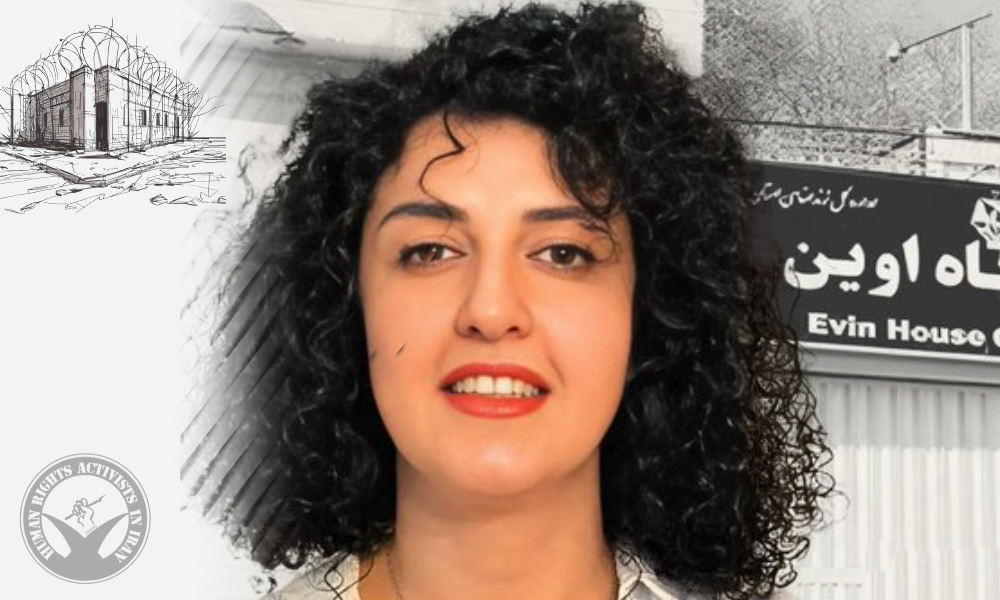
Prison conditions remain dire and continue to be a place of serious human rights violations, with reports of 30 cases of medical neglect and significant delays in judicial processes. 34 cases of incommunicado detention left families in the dark about prisoners’ fates due to a lack of contact. Furthermore, 47 prisoners were transferred to solitary confinement, 9 prisoners had no access to a lawyer, and 5 went on hunger strikes in protest of their conditions. Rahleh Rahmipour, a 72-year-old civil activist imprisoned in Evin Prison, faces severe health challenges, including a growing brain tumor, heart disease, diabetes, and cataracts, yet remains denied specialized medical care. Similarly, Ruhollah Khosravi, detained for over 15 months without trial, suffered physical abuse after protesting prison conditions and was transferred to solitary confinement. These cases exemplify the systemic neglect and mistreatment of detainees in Iranian prisons.
Women’s rights violations persist under Iran’s restrictive social and legal policies. This month, 12 women were killed due to domestic violence, and 4 women were arrested for hijab violations. In one case, a woman was attacked by her husband with a pickaxe and later succumbed to her injuries. In another incident, a woman was stabbed to death by her son. Additionally, compulsory hijab enforcement continues to target women for “improper dress.” On November 2, 2024, at Tehran’s Islamic Azad University, a female student was detained after protesting against hijab enforcement by removing her clothing during a confrontation with university security. Incidents like these highlight the ongoing repression faced by women under Iran’s mandatory hijab laws.
Workers in Iran endure hazardous conditions, with 38 fatalities and 135 injuries recorded from work-related accidents in November. Additionally, 736 workers reported unpaid wages, exacerbating economic hardships in unsafe working environments. Violent incidents involving border workers (kulbars and Sukhtbars) also continued. On November 3, 2024, indiscriminate shooting by military forces killed Saber Barzkar and injured two others in Espakeh, Lashar County. On the same day, military forces in Iranshahr County opened fire on a suspected fuel-smuggling vehicle, killing three Sukhtbars. These incidents underscore the ongoing dangers faced by marginalized laborers in Iran’s border regions.
Executions
This month in Iran, the execution of 135 individuals took place, comprising 127 men and 4 women, and 1 juvenile offender.This also includes 11 Afghan citizens. A total of 37 individuals were sentenced to death. Iran persists in executing individuals for offenses falling short of the standards outlined in the International Covenant on Civil and Political Rights. Notably, there remains a consistent trend of individuals being executed for drug-related crimes, a practice in clear contravention of the right to life as stipulated by the ICCPR. This month, 68 people were executed for drug-related offenses.
On November 9, 2024, Voriesha Moradi, a political prisoner held in Tehran’s Evin Prison, was sentenced to death by Branch 15 of the Tehran Revolutionary Court, presided over by Judge Abolqasem Salavati. She was convicted of “armed rebellion” (baghi) due to alleged membership in an opposition group.
On November 13, 2024, eight inmates were executed at Ghezel Hesar Prison in Karaj, Iran. Among them were Hamzeh Tarkashvand, Jafar Rahsepar, and an individual with the surname Rasgoo, all convicted on drug-related charges. Additionally, Khaled Tajik, Ahmad Alizadeh, Saman Bozorgi, an unnamed woman, and another unidentified man were executed for murder convictions
Mohammad Mehdi-S was sentenced to death by Branch Five of the Criminal Court One in Khorasan Razavi Province for fatally stabbing Basij member Rasoul Doost Mohammadi during the 2022 nationwide protests in Mashhad. In addition to the death penalty, he received a two-and-a-half-year prison sentence and was ordered to pay blood money for causing bodily harm, and 74 lashes for possessing explosive materials. Mohammad Mehdi-S claimed the stabbing was unintentional, and the verdict is subject to appeal in the Supreme Court.
Six defendants in the case known as “Ekbatan Town” were sentenced to death by Branch 13 of Tehran’s Criminal Court. The individuals—Milad Armon, Alireza Kafaei, Amir Mohammad Khosh Iqbal, Navid Najaran, Hossein Nemati, and Alireza Barmarzpournak—faced charges including “participation in murder,” “warfare,” and “disturbing public order” following the 2022 nationwide protests in Iran. These charges stemmed from the killing of Basij member Arman Ali Verdi in Ekbatan during the protests. Their cases, initially delayed due to procedural issues, were ultimately sent to Branch 13 and Branch 15 of Tehran’s Revolutionary Court, presided over by Judge Abolqasem Salavati. While four of the defendants were previously released on bail, they were rearrested after their final defense hearings in November 2024. The ruling, which included a dissenting minority opinion, can still be appealed.
Additionally, in Qazalhisar prison in Karaj one juvenile offender was executed, he was 17 years old when he was arrested after being accused of murdering his friends during a fight in 2019.
Freedom of Thought and Expression
Iran continues to crack down on anyone who protests or criticizes the regime, persistently violating the right to freedom of expression and thought. This month alone, 55 individuals have been arrested related to freedom of expression, 29 trials, and 4 people were arrested without any judicial order. There were also 6 cases of assault and battery by a police officer and 1 journalist was required to pay a fine of 6,600,000 Tomans, Mojtaba Rahimi a journalist at Arman Imroz newspaper was accused of publishing falsehoods with the aim of disturbing the public mind.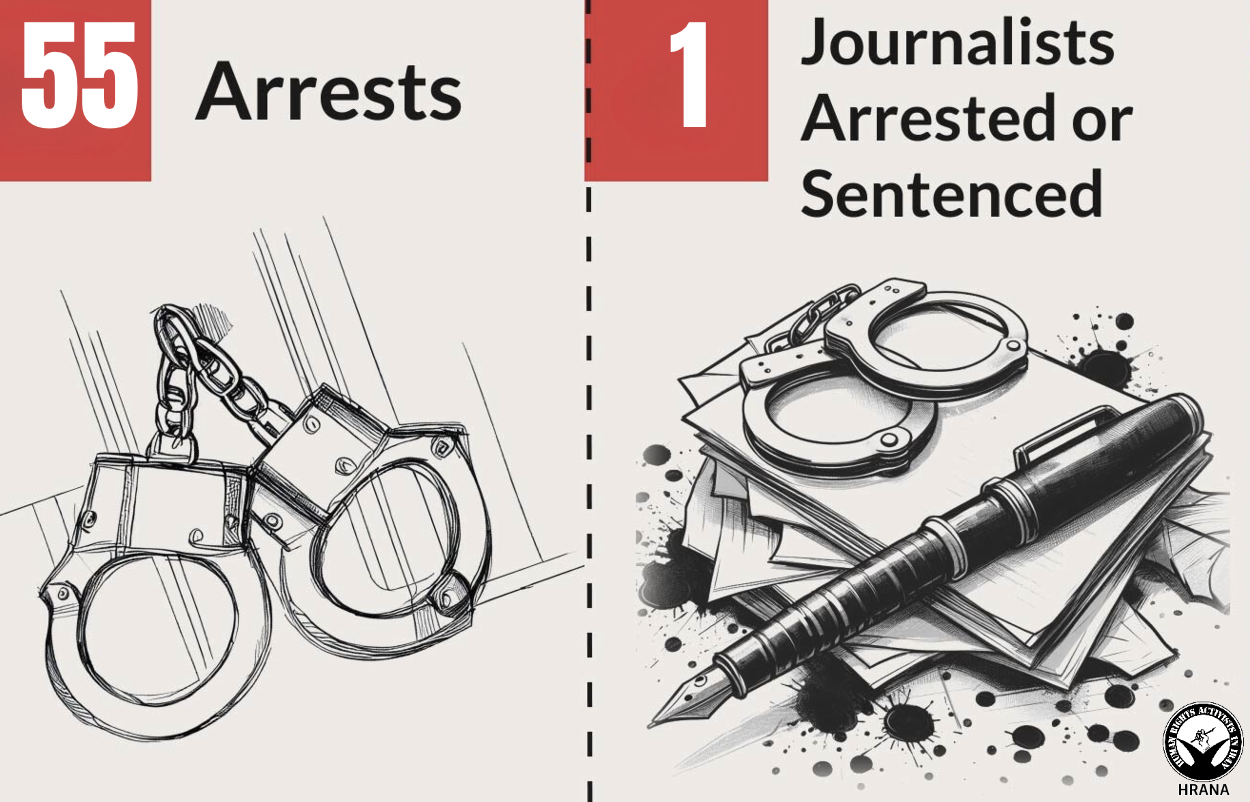
Branch 26 of the Tehran Revolutionary Court, led by Judge Iman Afshari, sentenced eight political prisoners to severe penalties, including six death sentences, long prison terms, and exile. The defendants were charged with crimes such as rebellion, treason, and collusion against national security, stemming from allegations of membership in anti-regime groups. Arrests occurred between late 2022 and early 2023, and some defendants had prior political convictions. The final verdicts were issued in October 2024.
- Akbar Daneshvar Kar:
- Charge: Rebellion through membership in anti-regime groups.
- Sentences: Death penalty, 5 years of imprisonment for assembly and collusion to disrupt national security, 10 years of imprisonment for forming illegal organizations.
- Seyyed Mohammad Taqvi Sangdehi:
- Charge: Sedition through membership in anti-regime groups.
- Sentences: Death penalty, 5 years of imprisonment for assembly and collusion to disrupt national security, 10 years of imprisonment for creating illegal documents.
- Babak Alipour:
- Charge: Rebellion through membership in anti-regime groups and destruction of public property.
- Sentences: Death penalty, 5 years of imprisonment for assembly and collusion to disrupt national security, 20 years of exile in Khash city.
- Pooya Qobadi Bistoni:
- Charge: Membership in anti-regime groups.
- Sentences: Death penalty, 1 year of imprisonment for illegally crossing borders.
- Vahid Bani Amirian:
- Charge: Rebellion through membership in anti-regime groups.
- Sentences: Death penalty, 5 years of imprisonment for assembly and collusion to disrupt national security.
- Seyyed Abulhasan Montazer:
- Charge: Treason through membership in anti-regime groups.
- Sentences: Death penalty, 5 years of imprisonment for assembly and collusion to disrupt national security.
- Seyyed Ali Taqvi Sangdehi:
- Charge: Membership in anti-regime groups.
- Sentences: 2 years of imprisonment.
- Seyyed Mojtaba Taqvi Sangdehi:
- Charge: Assembly and collusion to disrupt national security and membership in anti-regime groups.
- Sentences: 3 years and 7 months of imprisonment for collusion, 3 years of imprisonment for membership in anti-regime groups.
On November 17, 2024, the Revolutionary Court in Khorramabad convened to address additional charges against Nasrin Shakarami, mother of Nika Shakarami—a 17-year-old who died during the 2022 nationwide protests in Iran. Nasrin, currently detained in Khorramabad Prison, faced allegations including “propaganda against the regime,” “inciting people to war and killing,” and “insulting the Supreme Leader and the founder of the Islamic Republic.” Earlier, on November 10, she defended herself via video conference in the Criminal Court Two of Khorramabad against charges of “insulting the sacred” and “spreading falsehoods to disturb public opinion.” Her attorney, Ali Omidi, noted that prior to her arrest on October 16, 2024, Nasrin had been summoned multiple times through the Sana system but was unaware of the notifications, leading to her detention.
Prison Conditions
In November, there were 30 cases of prisoners lacking medical care and 34 cases of incommunicado detention, leaving families in the dark about the prisoners’ fates due to a lack of contact. Furthermore, 47 prisoners have been transferred to solitary confinement, 9 prisoners have had no access to a lawyer, and 5 have gone on hunger strikes in protest of their conditions.
Rahleh Rahmipour, a 72-year-old civil activist imprisoned in Evin Prison, faces severe health challenges, including a growing brain tumor, heart disease, diabetes, and cataracts, yet remains denied specialized medical care. Despite frequent health crises, including unconsciousness and heart attacks, she is routinely returned to her cell without adequate treatment. Arrested in 2018 and sentenced to six years in prison for “gathering, collusion, and propagandizing against the regime,” Rahmipour’s condition has worsened significantly, with judicial authorities refusing appeals for her parole or transfer to medical facilities. Her case highlights the systemic neglect faced by political prisoners in Iran.
Ruhollah Khosravi, a political detainee held for over 15 months without trial, was transferred from Sheiban Prison to Sepidar Prison in Ahvaz in late November 2024. On November 9, after protesting the relocation of public telephones to a noisy area near the prison kitchen, Khosravi was reportedly beaten by guards and moved to solitary confinement. Following 18 days in isolation, he was placed in the general ward of Sepidar Prison. Arrested on August 23, 2023, in Izeh, Khosravi has been denied access to legal representation, and his case, involving national security charges, remains under investigation by the Izeh Prosecutor’s Office. As of now, the specific allegations against him have not been disclosed.

Women
This month, 12 women were killed due to domestic violence, 4 women were arrested for hijab violations. Women continue to face harassment and arrests for not wearing hijab properly.
Women in Iran continue to suffer from domestic violence, often facing emotional, physical, and sexual abuse by their husbands. In November, a woman was attacked by her husband with a pickaxe, she was struck on the head and then went into a coma, a week later she died due to her injuried. A woman was also stabbed to death by her son in Tehran, claiming family disput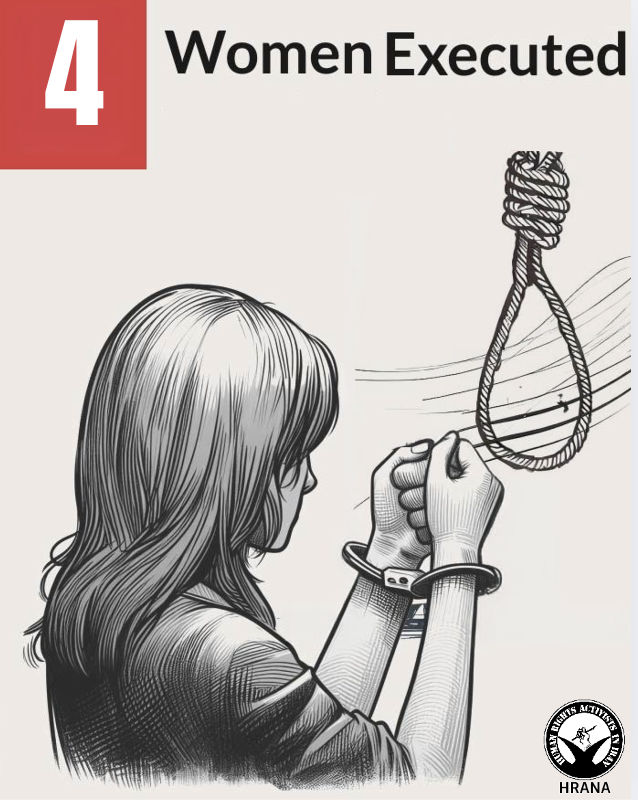 es as the reason for the attack.
Additionally, women continue to suffer under Iran’s strict hijab and clothing laws for women, the head of the FATA police in Bushehr arrested 10 men and 2 women for “producing and publishing vulgar content on Instagram”.
A women was also assaulted by a motorcyclist, after the publication of the video, the police in Tehran filed a case against the women for not wearing her hijab, while the motorcyclist was only prosecuted for not following the traffic regulations
On November 2, 2024, at Tehran’s Islamic Azad University, Science and Research Branch, a female student removed her clothing in protest after a violent confrontation with university security over alleged hijab violations. She was subsequently detained and taken to an undisclosed location. While some sources attribute her actions to mental health issues, others link them to compulsory hijab enforcement. The student’s identity remains unknown.
Workers
Workers in Iran face ongoing challenges and hazardous workplaces. In a tragic turn of events, this month saw 38 fatalities resulting from work-rel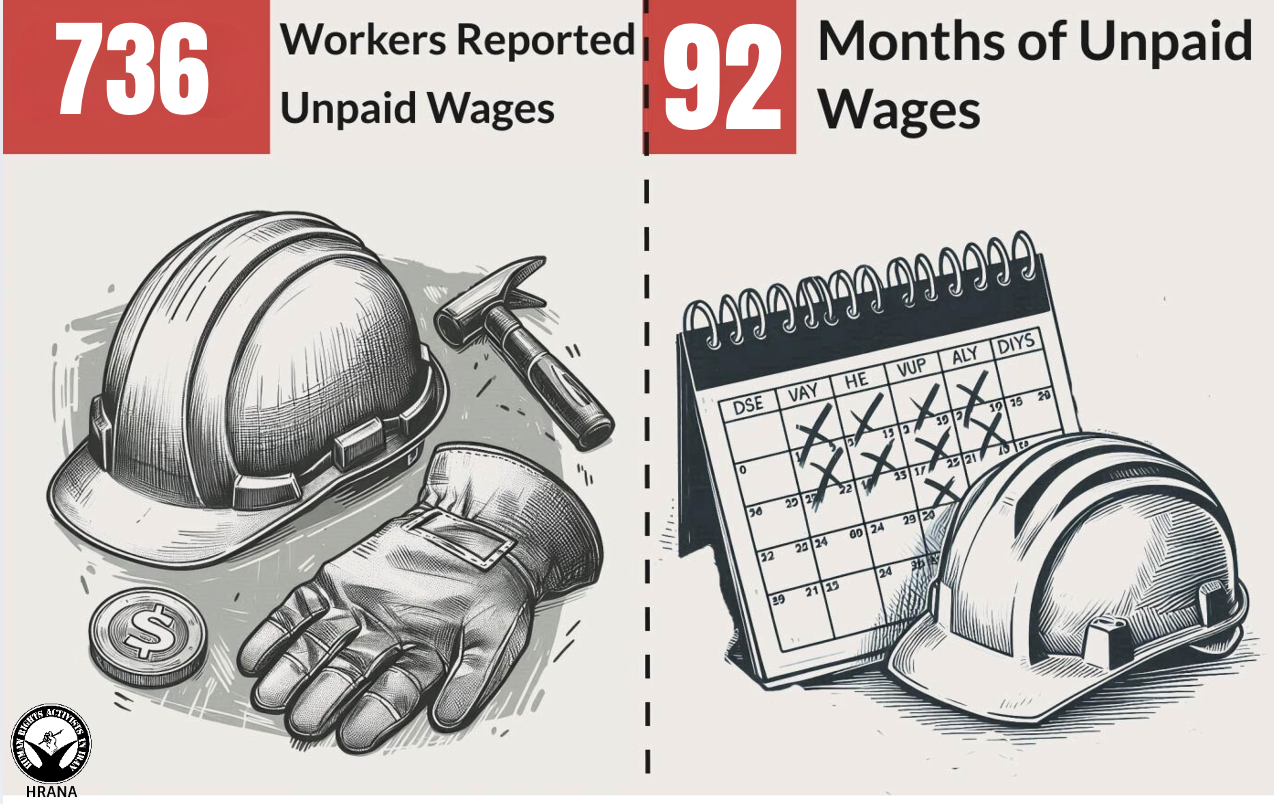 ated accidents, with an additional 135 workers left injured. Moreover, 736 workers reported unpaid wages. This month there were also 2 strikes and 32 worker gatherings.
In early November 2024, due to inadequate workplace safety, 18 workers in Iran’s Zabol and Farooj counties suffered accidents: a 22-year-old construction worker in Zabol died after being struck by falling materials from a malfunctioning hoist, and 17 workers in a tomato paste factory in Farooj were injured in a fire, with five hospitalized.
In early November 2024, a series of violent incidents in Iran resulted in the deaths of one kulbar and three sukhtbars. On November 3, in Espakeh, Lashar County, the indiscriminate shooting by military forces killed Saber Barzkar and injured two others. On November 4, in Nosud, military forces fired upon a group of kulbars, injuring 42-year-old Mardin Shakri, he was hospitalized in Kermanshah. Additionally, on November 3, in Iranshahr County, military forces opened fire on a vehicle suspected of fuel smuggling, resulting in the deaths of three sukhtbars. These incidents highlight the ongoing dangers faced by kulbars and sokhtbars in border regions.
International News Update:
The UN Fact-Finding Mission on Iran held consultations with survivors of the Iranian government’s repression of the 2022 “Woman, Life, Freedom” protests. Survivors, including women, children, and young adults, shared their experiences of violence, persecution, arbitrary detention, and torture following the death of Jina Mahsa Amini, which sparked widespread protests. They emphasized the need for truth, justice, accountability, and reparations, citing systemic legal discrimination and repression in Iran.
Key points include:
- Survivors face ongoing challenges, including denial of mourning rights, pervasive surveillance, and judicial harassment.
- Testimonies revealed the courage of individuals within Iran, such as medical professionals and lawyers, who supported protesters at great personal risk.
- Survivors stressed the need for legal reforms, victim rehabilitation, psycho-social support, and international pressure on Iran to meet its human rights obligations
The Mission, tasked with investigating these human rights violations, is preparing a report for the Human Rights Council in March 2025. This report will include a roadmap for accountability and reparations and actionable recommendations for the international community. Survivors expressed frustration with the lack of progress but remain committed to seeking justice and equality.
In her first report to the UN General Assembly, Mai Sato, Special Rapporteur on human rights in Iran, expressed serious concerns over the increasing number of executions, lack of transparency, and worsening human rights conditions, especially for women and girls. She highlighted:
- Executions: A sharp rise in executions, with 93 carried out in August 2024 alone, many for drug-related offences and vaguely defined security charges like “spreading corruption on earth” or “waging war against God,” which do not meet international law standards for “most serious crimes.”
- Women’s Rights: The Iranian government’s response to the “Women, Life, Freedom” movement and the proposed Chastity and Hijab Bill reflect systemic discrimination. Iran has yet to ratify the Convention on the Elimination of All Forms of Discrimination against Women.
- Discrimination: A call for an intersectional and gendered perspective to address discrimination affecting marginalized groups based on gender, ethnicity, religion, and sexual orientation.
- Right to Life: Sato emphasized concerns over the death penalty, lethal state violence, deaths in custody, and laws or practices that excuse or fail to investigate killings.
Sato urged Iran to cooperate with her mandate to address human rights violations, emphasizing her role as an independent expert offering constructive support to improve human rights protections. She appealed for collaboration among all stakeholders, including the Iranian government, civil society, and the international community, to make meaningful progress.
Download full Pdf: Monthly Report November