Azerbaijani Activist Abbas Lasani Tried in Absentia

Human Rights Activists News Agency (HRANA) – On Monday, September 24th, Azerbaijani activist and former political prisoner Abbas Lasani was notified by text message that he has been sentenced in absentia.
On September 16, 2018, HRANA reported on Lasani’s response to his summons via SMS from Branch 2 of Tabriz Revolutionary Court. “Even ignoring the suspect intent of this summons, their delay in sending it, and the timing of the hearing on [the eve of the Muharram holidays]– it’s impossible to ignore that the summons is illegitimate, arriving by text message with no official hard copy,” Lasani had said. “Appropriate preparations can’t be made in these circumstances.”
Abbas Lasani was among a group of four Azerbaijani (Turk) activists residing in Ardebil arrested by Intelligence agents July 2, 2018, a few days before an annual gathering at Babak Fort, a site that has acquired symbolic importance for Azerbaijani rallies in recent years.
Lasani was presumably arrested for sharing a video in which he encouraged people to attend the gathering. He was released on bail of approximately $3,500 USD (500 million IRR) on July 11, 2018.
Lasani was among the first of more than 80 Azerbaijani activists arrested throughout Ardabil, West Azerbaijan, and East Azerbaijan provinces at the time of the Babak Fort gathering.
In a press release on August 11, 2018, Amnesty International called the arrests of Azerbaijani (Turk) people “arbitrary” and unlawful, and demanded the immediate release of all individuals detained for their participation in an Azerbaijani Turkic cultural gathering.

In Wake of Ahvaz Parade Attack, a Sweep of Arrests Sows Community Unease

Human Rights Activists News Agency (HRANA)- Four days after the September 22nd armed attack on an Ahvaz military parade that left several civilians wounded, Iran’s Ministry of Intelligence has announced that it has 22 suspects in custody, backing its announcement with a video recording of blindfolded, unidentified detainees facing a wall.

Local sources have countered this official report, estimating the tally of those detained so far to be closer to 300. The majority of these arrests have taken place in the cities of Ahvaz, Khorramshahr, Susangerd, and Abadan, all located in Khuzestan province. HRANA is working to independently confirm the total number of arrests and the identities of those detained.

Security measures now loom large over the Arab-majority neighborhoods south of Khuzestan, local sources say, while the families of those detained have been unable to obtain any indication from authorities on the status or location of their loved ones.

Many of the recent arrestees have a previous track record with police, pointing to the possibility that security forces are attempting to pluck clues from past offenders about a recent incident.

Despite the urgency to hold the assailants accountable for wounding and killing civilians, including women and children, Iran’s security establishment is marred by a history of questionable investigative methods, raising public concern that innocent scapegoats may be subject to coercive interrogations in order to be impugned for the attacks. Iranian Minister of Intelligence Mahmoud Alavi has already made the public claim that “the terrorists who opened fire on the crowd have been killed,” adding, “Every single person behind the attack […] will be identified, and the majority of them have already been apprehended.”

On the day of the attack, a military parade in Ahvaz commemorating the Iran-Iraq war was interrupted when gunmen suddenly opened fire on soldiers and spectators. That day, Mojtaba Zolnour, a member of the Iranian parliamentary committee for national security and foreign affairs, announced that 29 had died and 57 were wounded. Iran-based media agencies published a list of victims that included several civilians, including a 4-year-old child.

Both Al-Ahwaz National Resistance group and ISIS (Daesh) have claimed responsibility for the attack.

Nationalist-Religious Activist Reza Aghakhani Denied Conditional Release

Human Rights Activists News Agency (HRANA)- Despite his eligibility for conditional release for already having served a third of his sentence, authorities have said “no” to Evin Prisoner Reza Aghakhani, a nationalist-religious activist.

An informed source told HRANA, “The assistant prosecutor of the prison cited an objection from the interrogator as the reason for the negative response, despite the fact that his wife recently just had a kidney transplant and his child is dealing with a physical disability.”

Aghakhani was sentenced to three years in prison by Branch 15 of the Revolutionary Court on a charge of “acting against national security.” In its processing of the case, Branch 35 of the Supreme Court did not assent the charges. They were nonetheless confirmed later in Branch 54 of Appeals Court.

Aghakhani was previously detained for 45 days in May 2013 and served a few years in prison in the eighties for his political activities. Along with some of his fellow prisoners, Aghakhani previously went on hunger strike for three days in protest of human rights violations across the country.

Narges Mohammadi Released on 3-Day Furlough

Human Rights Activists News Agency (HRANA) – Deputy of the Defenders of Human Rights Center Narges Mohammadi was released on a three-day furlough on September 26, 2018. Reporting the news of her furlough to HRANA, Mohammadi’s spouse Taghi Rahmani shared that Mohammadi will need long-term medical furlough to get adequate care for her illness.

Prior to Mohammadi’s furlough release, her mother Ozra Bazargan wrote to the Prosecutor of Tehran with the request that her daughter is granted a furlough to visit her ailing father. From June 30th – July 5th of this year, Mohammadi was released from prison to get back surgery at an outside hospital. On August 6th, prison authorities prevented Mohammadi from being transferred out of Evin Prison to see a neurologist, only to approve her transfer to Imam Khomeini Hospital when she fell into critical condition one week later.

Mohammadi’s attorney Mohamoud Behzadirad previously commented on the status of his client’s case file, stating “it has been six years and four months since my client was detained, and around three years and eight months remain of her sentence. She is eligible for conditional release, but the request for that release has yet to be approved.”

In May 2016, Narges Mohammadi was sentenced by the Revolutionary Court of Tehran to sixteen years of imprisonment, ten years of which was for her role in the Step-by-Step Campaign to Abolish Death Penalty in Iran (LAGAM). The court considered her collaboration with this peaceful campaign to be an example of “gathering with intent to disrupt national security.”

According to Narges Mohammadi, her trial judge treated her with bias and hostility, openly defending the charges levied against her by officials from the Ministry of Intelligence and accusing her of trying to “warp divine law” for her demonstrations of dissent against capital punishment.

The additional six years of Narges Mohammadi’s imprisonment were issued in connection to her peaceful human rights activism, which translated in court to charges of “gathering and conspiring against national security” and “propaganda against the regime.” Her offenses included giving media interviews about human rights violations, her participation in peaceful gatherings to support the families of prisoners on death row, her contact with other human rights defenders (including Nobel Peace Prize laureate Shirin Ebadi), her participation in peaceful protests to condemn acid attacks against women, and her 2014* meeting with Catherine Ashton.

In Autumn of 2016, Branch 36 of the Tehran Appeals Court upheld Narges Mohammadi’s prison sentence. In May 2017, her request for a retrial was reportedly rejected by Iran’s Supreme Court.

Two Teachers Imprisoned at Evin Pen Statement of Support for Farhad Meysami

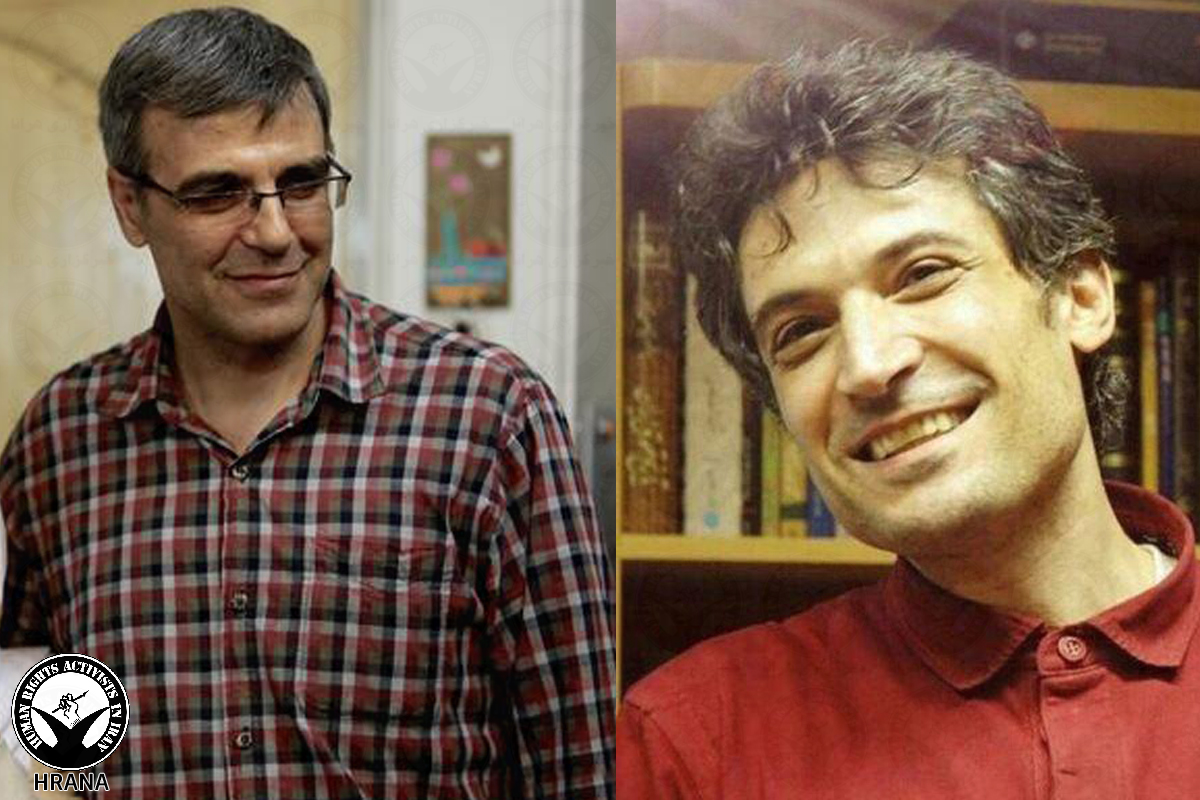
Human Rights Activists News Agency (HRANA) – Mahmoud Beheshti Langroudi and Esmail Abdi, two teachers imprisoned at Evin, have demanded in a letter to Judicial authorities that their ward mate Farhad Meysami–who is now in the 54th day of his hunger strike–be transferred to an outside treatment facility to avert an impending health crisis.

Meysami has dropped 30 pounds since he started starving himself on August 1st to protest both his detention and authorities’ refusal to appoint the lawyer of his choosing. In addition to his 18-year history of ulcerative colitis, Meysami experienced a steep drop in blood pressure on Saturday, September 8th, prompting the prison doctor to recommend more aggressive treatment. Notwithstanding the doctor’s orders, prison authorities refuse to clear his transfer to a different facility for treatment.

In a letter, Langroudi and Abdi, two imprisoned teachers held with Meysami in Ward 8 of Evin Prison, urge authorities to approve Meysami’s transfer to a medical treatment facility, to “prevent a possible calamity from occurring.”

The full text of their letter, translated into English by HRANA, is below:

“In the name of the God of wisdom and life,

Fifty days have passed since Dr. Farhad Meysami, civil activist and political prisoner, declared his hunger strike. His strike was a response to unjust legal proceedings, and authorities’ hindrance of his effective defense by refusing him the right to choose an attorney. He is now in a critically weakened condition. It is said that the doctors at Evin Prison insisted he be hospitalized, yet judicial authorities refuse to issue the order to have him transferred to a prison more materially equipped to treat him.

Because this civil activist suffers from ulcerative colitis and has lost 30 pounds over the course of his hunger strike, his blood pressure, pulse, and other vital signs have dipped into gravely abnormal ranges. As of last week he stopped accepting intravenous treatment, leaving us more concerned than ever that a calamitous outcome might be imminent.

We, the undersigned, thus put on guard the relevant judicial authorities, that they express their agreement to transfer Dr. Meysami to a proper hospital without delay, to prevent a possible calamity from occurring.

His ward-mates, Mahmoud Beheshti Langroudi and Esmail Abdi”

Subscribe to Our Newsletter

Now is definitely not the time to stop reading!

Kermanshah Prisoner Shahriar Tahmasbi: Status Update

Human Rights Activists News Agency (HRANA) – Unable to post his bail amount of 150 million tomans (approximately $36,000 USD), Kermanshah resident Shahriar Tahmasbi has been behind bars since security forces detained him on July 5th.
An informed source told HRANA that Tahmasbi’s bail was too heavy for him to post. “He has not yet been able to procure that much money. He requested that the bail is lowered, but no decisions have been made so far in that regard.”
Tahmasbi was arrested along with Mostafa Bagheri Ashena and Ardeshir Musavi, whose bails were also set at $36,000 apiece. While both were able to afford it and have now gone free, HRANA’s source stated that the bail amount was far out of proportion with the severity of the charges they face.
Earlier, another source provided background into the evening Tahmasbi was arrested, stating that a group of about 8 people had gathered in the Kermanshah residence of Ali Nazari on Jalili street to discuss the formation of a literary society for speakers, learners, and enthusiasts of a minority dialect called Laki.
“Security forces entered the house proclaiming that Shahriyar Tahmasbi was a fugitive, and arrested him along with Ardeshir Musavi,” the source said. “They also seized the cellphones of six people in attendance, including the host.”
Tahmasbi was also detained on September 6th of last year for organizing a protest in support of border couriers known as Kulbars. Walking out of Kermanshah’s Dizelabad Prison one month later on October 10, 2017, cost him $24,000 (100 million Tomans) in bail money.
HRANA has previously reported on the relatively higher rates of detention of Iranian citizens near the western border.

Shirazi Baha’i Arrestee Released on Bail

Human Rights Activists News Agency (HRANA) – After 37 days in the Intelligence Ministry’s detention center, Baha’i Shiraz resident Kourosh Rouhani was released Monday, September 24th on 1 billion rials (approximately $6000 USD) bail, and now awaits trial. As of the date of this report, no further information is available on his charges or the reasons behind his arrest.

According to HRANA reports, Rouhani was among a group of six Baha’is arrested August 18th by security forces in Shiraz: Pezhman Shahriari, Dorna Esmaili, Hooman Esmaili, Negar Misaghian, and Mahboob Habibi.

Notably, Negar Misaghian, Dorna Esmaili, and Hossman Esmaili were released within hours of their arrest, while Rouhani, Shahriari, and Habibi were transferred to the Intelligence Ministry’s detention center in Shiraz.

Shiraz has seen a notable increase in the arrests of Baha’i citizens this month, including the arrest and detention of Noora Pourmoradian, Elaheh Samizadeh, Ehsan Mahboob Rahvafa, Navid Bazmandegan, and his spouse Bahareh Ghaderi on September 15th and 16th. [2]

Baha’i citizens of Iran are systematically deprived of religious freedoms, while according to Article 18 of the Universal Declaration of Human Rights and Article 18 of the International Covenant on Civil and Political Rights, all people are entitled to freedom of religion, belief, and changes thereof, as well as the right to express and practice those beliefs as individuals or collectives, in public or in private.

Though unofficial sources estimate the Baha’i population of Iran at more than 300,000, Iran’s Constitution officially recognizes only Islam, Christianity, Judaism, and Zoroastrianism, and does not acknowledge the Baha’i faith as an official religion. As a result, the rights of Baha’is in Iran are systematically violated.

Authorities Continue Pursuit of Baha’i Citizens in Isfahan Province

Human Rights Activists News Agency (HRANA) – On Sunday, September 23rd, Saham Armin became the eighth Baha’i citizen to be detained by Ministry of Intelligence forces after having his home searched in Baharestan, a city 12 miles southeast of Isfahan on the route to Shiraz.

HRANA previously reported on the arrest of Afshin Bolbolan, Anoosh Rayeneh, Milad Davardan, Farhang Sahba, Bahareh Zeini (Sobhanian), Sepideh Rohani, and Fojan Rashidi by security forces in the same city [1]. As of the date of this report, no further information was available on their location or the reasons behind their arrest.

A close source to the group previously confirmed to HRANA that Bolbolan’s books, laptop, tablet, and mobile phone were seized by authorities during a search of his home.

In recent weeks, members of the Baha’i religious minority have faced increased pressure from Iranian security and judiciary establishments all over Iran, resulting in several arrests on specious grounds. In the last month, HRANA published reports on the arrests of Baha’i residents of Shiraz and Karaj who were swept up in this trend: Maryam Ghaffarmanesh, Jamileh Pakrou (Mohammad Hossein), Kianoush Salmanzadeh, and Peyman Manavi were arrested and transferred to Evin Prison from Karaj on September 16, 2018. Shiraz security forces arrested Soudabeh Haghighat, Noora Pourmoradian, Elaheh Samizadeh, Ehsan Mahboob Rahvafa, Navid Bazmandegan, and his wife Bahareh Ghaderi on September 15th and 16th.

Iranian Baha’i citizens are systematically deprived of religious freedoms, while according to Article 18 of the Universal Declaration of Human Rights and Article 18 of the International Covenant on Civil and Political Rights, everyone is entitled to freedom of religion and belief, and the right to adopt and manifest the religion of their choice, be it individually, in groups, in public, or in private.

Based on unofficial sources, more than 300,000 Baha’is live in Iran. However, Iran’s Constitution only recognizes Islam, Christianity, Judaism, and Zoroastrianism, and does not acknowledge the Baha’i faith as an official religion. Consequently, the rights of Baha’is are systematically violated in Iran.

Former IRGC Member Faces Death Penalty on Spying Charges

Human Rights Activists News Agency (HRANA) – Confirming the sentence issued two months ago in Branch 1 of the Military Court of Urmia, the Supreme Court has issued an execution sentence to former IRGC member Arsalan Khodkam, who was charged with “collaborating with an anti-regime party through espionage,” allegedly on behalf of a Kurdish opposition party.

The Supreme Court delivered the execution order to Khodkam’s attorney on September 25, 2018, a close source told HRANA.

Khodkam was detained in April of this year by the Intelligence Office of IRGC and is currently imprisoned at Ward 3-4 of Urmia Prison. He alleged that his interrogators subjected him to torture.

Earlier, an informed source reported on Khodkam’s background to HRANA. The married, 50-year-old resident of Mahabad was formerly a member of the Kurdish Democratic Party (KDP), which eventually “surrendered to the forces of the Islamic Republic.” Later, in the 2000s, he switched allegiance by joining the IRGC, which he served for 16 years before being accused of spying on behalf of the KDP.

Northeastern Border Guard Opens Fire on Shepherd

Human Rights Activists News Agency (HRANA)- As he had done for the past 20 years, Hamidreza Sepahi Layin was taking his sheep to graze from the border town of Dargaz, Razavi Khorasan province on September 19th, 2018. As Hamid’s brother Alireza explains, shepherds like Hamidreza often usher their herds across the plains and mountain grasses carpeting Iran’s northeastern borderlands with Turkmenistan. What happened next, however, was a break in routine.

That day, Layin, a 32-year-old father of two, had herded his flock about half of a mile into Turkmenistan territory when he caught sight of Majid Amiri, the head of the Sangdivar border guard post. Layin was familiar with the guard, and while crossing back to the Iranian side made his way over to greet him. When he was about 10 yards away from being able to reach out and give him a handshake, Amiri pulled out a gun and opened fire on Layin’s leg.

A friend and fellow shepherd had accompanied Layin that morning and procured a donkey to rush his wounded friend to the village clinic. As Layin slipped out of consciousness, profusely losing blood from two bullet wounds, Amiri blocked their passage for a full 40 minutes until Layin’s friend told him to either pull the gun on him, too, or let them go. Amiri let them pass.

Amiri’s plans to blame Turkmens for the shooting were upended by a Turkmen cohort who witnessed the incident from afar and reported it to authorities before him. Layin has undergone an operation to repair his bullet-shattered bone with metal plates.

Alireza Sepahi Layi, who is an author and journalist, wrote a note about his brother’s ordeal entitled “one bird with two stones,” excerpts of which have been translated into English by HRANA:

“We do have borders, in drought and abundance, war and peace, mourning and joy, solitude and company. For the past 500 years, we have used our bodies as shields, holding our ground, digging in our heels. With blood, sweat and tears, we quenched the thirst of our herds and irrigated our paddies and wheat fields. All of this to make sure that Russians, Uzbeks, and Turkmens don’t open their eyes one morning to find border villages like Sandiqal and Layin abandoned by Iranians; lest they believe those brave sentinels have tired of their duties and fled. I went to Dargaz today. No, I had not been summoned to court– not this time.  I’ve come many a time for trials or for prison to my hometown of Kalat-e Naderi. This time my destination was Dargaz, and my reason was to visit my brother who had been shot; a bird, shot with two stones. A man to whom fighting and brawls are unknown, who has never raised his shepherd’s crook, even to an ant. Thank God the bullets had the decency to strike only his shin. While they shattered his leg, they, fortunately, spared his life. The shooting took place during the Muharram ceremonies, on the eve of the anniversary of *Hussein’s death; and just as it was back then between Hussein and Yazid, a line in blood was drawn between the forces of good and evil. Javad Amiri, the head of Sangdivar border guard, pulled the trigger. He had just finished his officer training. He was probably sent for shooting practice to the border post, where the people have been defenseless for centuries, wielding only crooks of shepherding, shovels of gardening, and sickles of harvest. They have spread their generosity, kindness, and hospitality from **Hezarmasjed to ***Alborz and ****Zagros mountains…”

<b> * </b>     The third Shiite saint and Imam whose death in battle in the 7th century AD is a watershed moment in Shiite history commemorated each year in widespread rituals. Hussein represents the force of Good while the ruler he was fighting against, Yazid, symbolizes Evil.

<b> ** </b>   Mountain range in northeastern Iran

<b> *** </b>   Mountain range in Northern Iran

<b> **** </b>   Mountain range in Western Iran