Protests and Marches in at Least Six Iranian Cities

Human Rights Activists News Agency (HRANA) – Throughout Sunday and Monday in Iran, multiple protests were reported across Iran. Protesters included: a group of Azadi Sports Complex workers (in Tehran), a group of Falat-e Ghare oil workers (in Khark island in the Persian Gulf), several Northeastern Railroad workers, a group of Tehran’s Shad Abad Iron Market merchants, a group of landowners in Savojbalagh (whose properties have been recently designated as a “national resource”), and a group of residents of Asr Abad village in Marivan (western Iran).

Azadi Sports Complex

According to the state-run Fars News Agency, Azadi Sports Complex workers were protesting the dismissal of six of their colleagues in addition to unpaid severance pays.

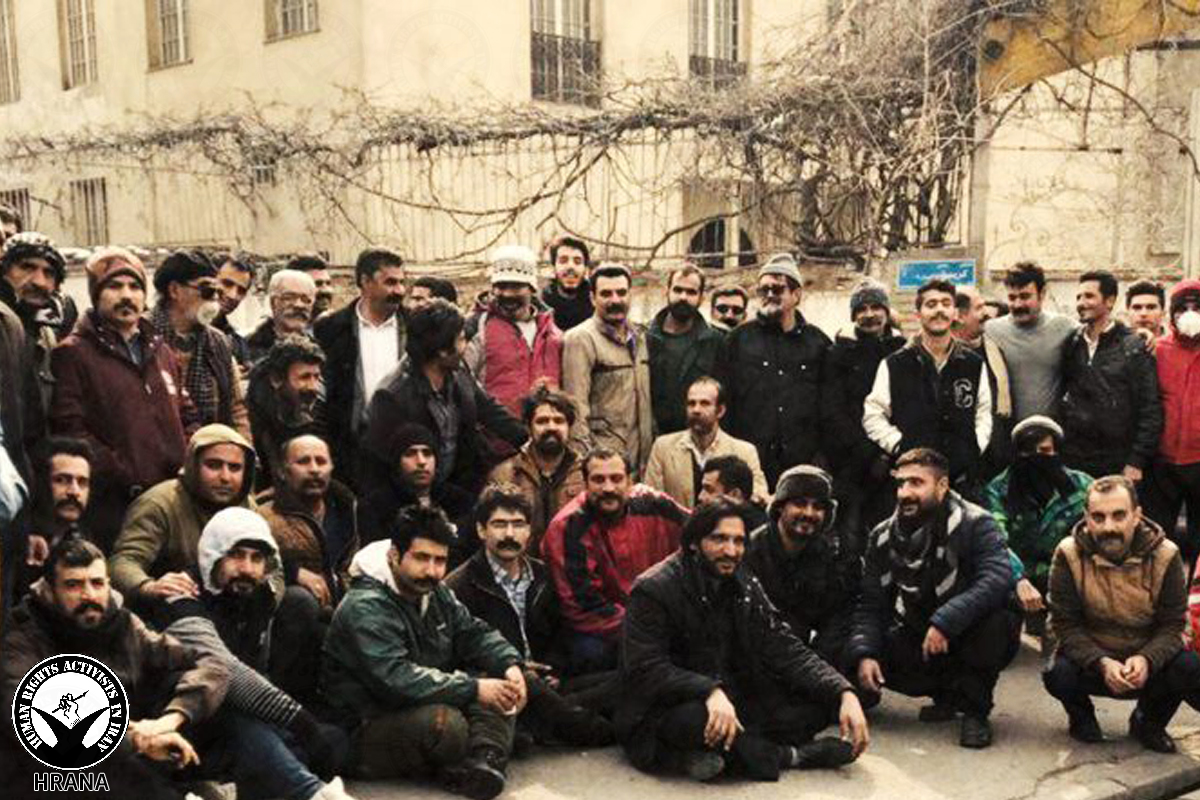
Azadi complex is under provisional direction following the sacking of its last director in July. Twenty protesting workers first gathered in Azadi Sports Complex to voice their demands and then headed to the Ministry of Sport and Youth. Following the rally in front of the Ministry, Zhaleh Faramarzian, a Ministry VP, met and spoke with a representative of the protesters. When Ms Faramarzian reportedly promised to help resolve their issues, the protestors marched to the Development and Maintenance of the Athletic Facilities Office to hold discussions with its president, Hassan Karimi.
As a result of these discussions, it was agreed that the six dismissed workers would return to work and the other demands would be met as soon as possible.

Falat-Ghareh Oil Workers Go on Strike

Workers at the Falat-Ghareh located in Khark Island in the Persian Gulf launched a strike and rallied in protest to a $50* cut to their salaries. According to the state-run Tasnim News Agency, the employer is refusing to heed to the demands of the workers.

Railroad workers continue their strike

The news website Radio Zamaneh reports on the continued strikes of railroad workers and that the North East railroad workers blocked railroad tracks to stop train services.

There are reports of continued strikes in the cities of Sarakhs, Shahroud, Damghan, and Semnan. The workers in these areas have reportedly not received their salaries, insurance, and severance pays for the past three months.

Railroad workers in Iran who number 7,000 nationally demand that temporary and contractual agreements are scrapped and replaced by permanent positions. They also ask for their unpaid salaries and benefits and seek insurance coverage [by the employer].

Iron Market Strike Continues

Radio Zamaneh reports that for the second day in a row, merchants at Tehran’s Shad Abad Iron Market went on strike. A video clip disturbed on social networks shows closed shops at this market.

Land Owners of Kowsar Remain in Limbo over Legal Status of Their Properties

According to Radio Zamaneh, a group of landowners at Savojbalagh assembled in front of Alborz Province’s Agricultural Jihad Ministry to protest broken promises by officials and the legal limbo surrounding the status of their properties.

The owners of these 1,200 pieces of land had purchased their properties from Habitation Coops. However, the lands were declared “national” property in 2016. The owners have been passed between the Natural Resources Office and the Housing and Urban Planning Organization.

Back in March, the Savojbalagh county director claimed that the issues surrounding the properties were resolved and the landowners would receive good news.

Residents of Asr Abad Village Protest Their Village Being Used as Landfill

According to Radio Zamaneh, Asr Abad residents protesting the burial of the city of Varamin’s garbage in their village have blocked the burial for the past three days. Photos of the large piles of garbage in a parking lot have been distributed. Marivan’s Governor had promised to remove the trash but no concrete action has been taken.

—-

* Calculated based on an exchange rate of $1=10,000 tomans

Mazandaran Paddy Fields Running Dry

Human Rights Activists News Agency (HRANA) – Valuja is a village located 24 miles away from Sari, the capital of the Mazandaran province. This northern Iranian province is known for its humid and rainy weather. During the past years, the villagers have had the right to a share of the water from Nakarod River and were able to collect surface water for agricultural and fish farm usages through dike construction that could supply water for lands as big as 172 to 247 acres.

Villagers and local committees previously managed the consumption of the dikes’ water storage. However, because of the decrease in rainfall, reduction of the dam’s water supply and the lack of enforcement by Mazandaran’s provincial water management of the villagers’ right to a share of the water, 2,471 acres of agricultural soil has turned into arid lands and 617 acres of paddy fields have dried up.

Photos published by state-run Tasnim News Agency:

Status of Activist Molavi Nasser Rigi Still Unknown

Human Rights Activists News Agency (HRANA) – According to the Baluch Activists Campaign, though Sunni cleric Molavi Nasser Rigi was arrested by Revolutionary Guard agents more than three weeks ago, his whereabouts remain unknown.
Rigi is a civil rights activist and member of a charity called “School Ambassadors.” He was active in several social initiatives, including the collection signatures for a petition in support of the Iranshahr girls.
He was arrested July 15th in response to allegedly fake social media accounts created in his name, which indicate he is a member of “SAHAB” (Baluchistan Protest Coordinator organization) and responsible for torching the Pasteur Pharmacy in Iranshahr (in Sistan and Baluchestan province). He denied the accusations, demanding the arrest of those responsible for disseminating the misinformation.
Iranshahr residents previously held mass protests in response to the statements of Sunni Imam Molavi Tayeb, who announced after leading a Friday prayer that 41 girls from Iranshahr had been abducted and raped. Security forces detained many of the protesters, including Abdullah Bozorgzadeh.

Photo Report: Air Pollution in Zabol Reaches 12 Times the Standard Limit

Human Rights Activists News Agency (HRANA) – Gust winds of 108 km/hour in the city of Zabol (Sistan & Baluchistan province) has resulted in the density of suspended particles to reach 12 times higher than the standard limit.

Photo Report: Rising Fish Fatalities at Fish Farming Complex in Southern Iran

Human Rights Activists News Agency (HRANA) – Low water levels and increasing salt concentration in Karoun river, a major river in southern Iran, has resulted in rising fish fatalities at the Khorramshahr Fish Farming Complex.

This complex started its activities as a conglomerate of 55 cooperatives in 1998 and expanded to include 88 cooperatives in 2016. The farm grows a variety of fish such as phytophagous, carp, amur, and bighead, and it has more than 1,000 employees.

Khorramshahr is a city located in the southern province of Khuzestan, which is rich in natural resources.

State-run Mehr News Agency has published the following photos from the complex:

Subscribe to Our Newsletter

Now is definitely not the time to stop reading!

Telegram Activist Transferred to Intelligence Ward in Evin Prison

Human Rights Activists News Agency (HRANA) – Alireza Tavakoli, a Telegram activist who was held in Tehran’s Evin Prison for more than two years, was transferred yesterday from Ward 8 to a ward in the prison known as “209”, which is operated by the Ministry of Intelligence and does not fall under prison jurisdiction.

A source close to Mr Tavakoli told HRANA: “Alireza Tavakoli was transferred from Ward 8 to Ward 209, and the Ministry of Intelligence is likely to open a new prosecution against him.”

In July, Mr Tavakoli had written an open letter to Seyed Mahmoud Alavi, a cleric and Intelligence Minister appointed by Hassan Rouhani, regarding his five-year prison sentence, calling the verdict “outrageous”.

Alireza Tavakoli was arrested in 2016 on blasphemy charges along with two other Telegram activists, Mohammad Mohajer and Mohammad Mehdi Zaman Saleh. They were sentenced to a 12-year prison term each, but their sentences were reduced by an appeals court to five years each.

Mr Tavakoli suffers from joint and intestinal pain. Recently, judicial authorities opposed a request by the Ministry of Intelligence to conditionally release Alireza Tavakoli, Mohammad Mohajer and Mohammad Mehdi Saleh.

The Case of Ahmadinejad’s Former VP Sent to Revolutionary Court

Human Rights Activists News Agency (HRANA) – Abbas Pouriani, the head of Iran’s Revolutionary Courts, has announced that the case file for Esfandiar Rahim Mashaei was sent to the Revolutionary Court, according to the state-run news agency, Young Journalists Club. Mr Mashaei is a close ally of Mahmoud Ahmadinejad and his former Vice President.

Earlier, Adel Heidari, Mr Mashaei’s lawyer, had stated: “After the prosecution was completed and the indictment was issued, I was not given the opportunity to access [my client’s case] or meet with my client, despite several follow-ups.”

“My client was arrested after setting the judicial verdict for Hamid Baghaie on fire in front of the British embassy. He has been detained for almost four months and the response we received to our objection to his arrest was the approval of [my client’s] continued detention. Due to the termination of an investigation by the Prosecutor’s office…[my] client should have been released. His continued detention is no longer justified,” said Mr Heidari.

On March 17, 2018, the Public and Revolutionary Prosecutor’s office announced Mr Mashaei’s arrest by police forces for the purpose of conducting further investigation on his case. On July 1, 2018, Abbas Jafari Dolatabadi, the Tehran Prosecutor, announced that the indictment of Rahim Mashaei had been issued.

Two days before his arrest, Mr Mashaei demonstrated in front of the British embassy in Tehran in objection to the judicial verdict issued to his ally, Hamid Baghaei, Mr Ahmadinejad’s former deputy president. Mr Mashaei accused Iran’s Judiciary of taking orders from Britain and the Queen of England to issue the verdict against Mr Baghaei.

Three released, 16 arrested and interrogated in string of crackdowns across northwestern Iran

Human Rights Activists News Agency (HRANA) – Three detained residents of Kermanshah, Paveh, and Marivan have been released on bail. In Oshnavieh, Kamyaran, Ravansar, Urmia, and Marivan, at least 16 individuals were arrested on charges of membership in Kurdish opposition parties.
According to the Center for Democracy and Human Rights of Kurdistan, on Sunday, August 6, 2018, Amir Hossein Darabi, a news correspondent from Kermanshah, was released on a bail of approximately $1,900 USD. Security forces had arrested Darabi Tuesday, June 26th for “criticizing officials of the Islamic Republic” by “investing and squandering money in countries like Yemen”.
Meanwhile in Marivan, Atta Fatahi, who had been arrested on July 11th for “cooperating with one of the Kurdish opposition parties,” was released on bail after 25 days of detention.
Soran Ahmadi from Paveh province had been arrested on the same charges on July 12th. He posted bail and was released Saturday, August 11th.
The same charge would also be the cause of more detentions on August 4th in Oshnavieh, where the Intelligence Office arrested Yousef Ahmadi from Tajoddinabad, Kurosh Azizi from Qarehsoghol, Mansour Omarzadeh from Dashtibil, Maqdir Mohammadzad from Singan village, and Abu Bakr Minapak from Sujeh.
In Urmia, Anzal resident Mohsen Alipour was arrested by security forces and transferred to an undisclosed location on charges of “propagating in favor of Kurdish opposition parties.”
A few days ago, plainclothes Kamyaran intelligence forces arrested two individuals — Farouk Mohammadi from Shahu village and Rahim Khateri from Shirvaneh village — for “contacting Kurdish opposition parties.” They were transferred to an undisclosed location.
Last week, Bagher Safari, 60, was summoned and interrogated at the Intelligence Office of Ravansar province.
In the first week of August, several more were arrested following inspections of their homes, according to numerous reports from Marivan: Mohammad Mamlekati, Mohammad Irankhah, and Mohammad Hosseini from Dari village; Osman Delaoviz and Mohammad Karami from Gouveizeh Kaviri village; Akbar Samadi and Jamal Ebrahimi from Marivan.

Iran: Suicide rate up 5% in 2017 compared to previous Year

Human Rights Activists News Agency (HRANA) – According to the World Health Organization (WHO) statistics in 2017, nearly “800 000 people die due to suicide every year”.
The Center for Disease Control and Prevention reports the rate of attempted suicide higher among women than men; however, four times as many men die due to suicide than women.

Iran’s Suicide Rate: Iran, the state-run newspaper, reports that between five to seven people per every 100,000 commit suicide in Iran.

According to the Iranian National Coroner Office, the suicide rate in Iran increased by 5% between *March 2017 and March 2018 compared to the twelve months before that period. A rise of such magnitude may not seem alarming, but once the statistics are assessed in more detail, the figures are shocking.

Despite no recorded or accurate statistics on adolescence suicide in Iran, multiple reports in recent years indicate that suicide is not exclusive to adults (18+ years old). An increasing number of children and teenagers as young as 10, 12, and 15 years of age are committing suicide as a result of feeling hopeless about resolving their emotional distress and other issues in their lives.

Iran Newspaper reports that the increase in suicide among children and teenagers in Iran is alarming. Women, men, adolescents and children commit suicide for a variety of reasons, most of which have economic roots. Other reasons include heartache caused by a romantic relationship, academic failure, inability to contain and control emotions and feelings, psychological problems, substance abuse, domestic violence and genetic predisposition.

—-

* The rates cited in this article correspond to the Iranian solar calendar which starts on March 21st (or the first day of spring) and follows the Zodiac months.

Report: New Wave of Mass Protests in Iran

Human Rights Activists News Agency (HRANA) –  A new wave of widespread protests that began on Tuesday, continued across Iran through the week for six days. Protesters included merchants, shopkeepers and other citizens who gathered in objection to the worsening economic conditions in Iran. Their main concerns were centered around the issues of unemployment and the rising of prices and exchange rates. Rising prices, inflation, and unemployment have led to protests since December 2017.


First Day of Protests
Tuesday, July 31, 2018

Protests in Isfahan on Shapur Jadid Street began with a strike by merchants and shopkeepers, which led to other citizens joining in on the protest. The gathering quickly turned violent when security forces attempted to disperse the crowd with tear gas and gunshots.

In Karaj, people gathered in Gohardasht Square to hold a protest rally. According to reports, many women participated. Some protesters were reportedly arrested by security and plainclothes forces and are currently held at a Basij-operated center in the Gohardasht neighborhood.

Second Day of Protests
Wednesday, August 1, 2018

Protests in Rasht and Shiraz were accompanied by the heavy presence of security forces. Some of the videos from Shiraz indicate that a 7-year-old was shot with tear gas by police forces.

Protesters in these burned tires on the streets to counter the effects of tear gas and chanted slogans including “Our enemy is right here, they are lying claiming it’s the U.S.”, “Guns and tanks are no longer effective, mullahs should get lost,” “No to Gaza, no to Lebanon — I give my life only for Iran,” “The nation begs while *He acts like he’s God” and “Down with high prices”.

Mass protests also occurred in Isfahan and Karaj.

Third Day of Protests
Thursday, August 2, 2018

Protests were reported in twelve Iranian cities: Isfahan, Shahinshahr, Najafabad, Karaj, Mashhad, Shiraz, Sari, Tehran, Ahvaz, Kermanshah, Qahderijan and Arak.

Peaceful protests turned violent in Isfahan and Shiraz when security, plainclothes and Basij forces shot at the protesters with guns and tear gas. In the videos from Thursday, protesters are seen throwing rocks at the Iranian authorities in response to the gunshots. Protesters are also seen starting fires in order to counter the effects of the tear gas.

Many protesters were reportedly arrested in Mashhad and Shiraz.

Fourth Day of Protests 
Friday, August 3, 2018

Protests occurred in five different cities: Karaj, Qahderijan, Tehran, Qazvin and Kermanshah.

Fifth Day of Protests 
Saturday, August 4, 2018

Since the early hours of Saturday, a strong presence of security forces had created an ambience of intimidation in many of the Iranian cities. Reports indicate that large protests were held in the central city of Qom, Karaj and Tehran.

People were heard chanting “Iranians, it is time to demand your rights from this regime”, “Down with the dictator”, “Don’t let fear conquer, we are all together”, “The nation begs while He acts like he’s God”.

Some reports claim that 50 of the female protesters were arrested in recent days and transferred to the quarantine ward in *Varamin’s Garchak Prison.

Many of the state-run media or news agencies with ties to the government have either denied the existence of protests or play them down as rallies incited by opposition or simply gatherings with strictly syndical demands.

The police forces in the cities of Mahdasht and Gohardasht (both located in the Alborz province) imposed restrictions on traffic and banned driving after 6PM in these areas.

Reports from sources close to security institutions, one person was shot dead in Karaj and at least 20 others were wounded.

Ali Hendiani, the director of the seminary in Eshtehard county, said: “Protesters threw stones at the seminary building and broke the prayer room’s windows…These people were dispersed by the anti-riot security forces, and the police have identified them and are on the search for them. Some have been arrested, and the mission to find the other protesters continues.”

Sixth Day of Protests 
Sunday, August 5, 2018

Despite the persistence of security measures and the heavy presence of security forces aimed at intimidating citizens, protests were held in the city of Kazerun (located in the Fars province).

There are reports that protesters attempted to rally in Shiraz (capital of the Fars province), Tehran, Karaj and Qom, but strong police presence prevented these rallies from taking shape.


Mobile Services Cut Off

Subscribers of Irancell, an Iranian telecommunication service provider, reported that mobile services in parts of central Tehran and the city of Zanjan were interrupted. Some of the clients of Operator Network, another cell phone service provider, reported that they received a message regarding a temporary and nation-wide interruption to their service. It is not yet clear whether this stoppage is part of the Iranian security apparatus’ attempt to control the protests. In previous protests, there was precedence in taking such measures to curb protests.

Protester Death

Reza Shakarami, General Prosecutor for the Alborz province, denied reports attributed to him about the death of a young man from Karaj during a night protest. “The shooting [leading to the protester’s death] and the circumstances surrounding it are under investigation. Any quote cited from me regarding the murder of the victim by the rioters or any other individual is denied,” he said. The victim referred to by Mr. Shakarami was identified on social media as Reza Otadi.

Salman Samani, the Interior Ministry spokesperson, has reacted to online invitations to assemble. “In the last month, dozens of invitations and calls to protest rising prices, inflation and living conditions have been widely distributed. The source of the majority of such calls is outside Iran, but the invitations have been reposted and shared by people inside Iran,” he said.

Reactions from Iranian Authorities

Ali Motahari, Member of Parliament for Tehran, told a state-run newspaper that the authorities are trying hard to resolve the issues [the protesters have voiced their concerns about], and if the people wait and be patient a few more months, the conditions will improve. He also blamed certain movements who made attempts for the Iran Nuclear Deal to fail and whose actions paved the way for a Trump presidency, the pretext to withdraw from the **Deal.

Meanwhile, Kheirollah Tarkhani, a security official in the Alborz province, stated: “We have been trying to appease the protesters and listen to them. However, we have realized that their protests are not about economic demands and are aimed at the political structure. The small, scattered protests are not the sum of the people’s economic grievances and demands.”

——
* Reference to Iranian Supreme Leader, Ali Khamenei
** Gharchark is a women’s prison south east of Tehran; reports point to prisoners facing deplorable conditions in this prison (https://www.en-hrana.org/comprehensive-report-womens-ward-evin-prison)
*** Ali Motahari is implicitly referring to the Revolutionary Guards commanders and some hardliners whose interference in neighboring countries coupled with their push for an aggressive missile program created the conditions for Trump’s withdrawal from the JCPOA (Joint Comprehensive Plan of Action, aka Iran Nuclear Deal)