





Human Rights Activists News Agency (HRANA)- Mystery still shrouds the condition and fate of Farhad Abdollahpour, who was arrested on June 30, 2018, by IRGC Intelligence forces and has effectively been missing since July.
Abdollahpour’s family, from Oshnavieh in northwestern Iran, were able to visit him briefly after his arrest in the IRGC Intelligence Detention Center of Urmia. They reported seeing signs of torture on his body. Their subsequent inquiries into his current status and the reason behind his arrest have been left unanswered by Oshnavieh’s Judiciary and the IRGC Intelligence Office.
A source close to the Abdollahpour family told HRANA, “Farhad was arrested without a warrant. Their home was then searched. IRGC forces told the family that Abdollahpour had been reported for allegedly keeping weapons at home. They found none, though, and took Farhad away with them. His family was able to trace him to the IRGC Intelligence Detention Center. When they were granted a visit with him 20 days later, they were distraught by the state he was in, apparently the result of mistreatment and torture; it was so bad that he couldn’t even walk without support.”
A 20-day detention warrant for Abdollahpour has expired and has not been renewed by Oshnavieh court. Nevertheless, and despite their frequent follow-ups, Abollahpour’s family is still in the dark about his fate.

Abdollahpour’s brother, Hedayatollah Abdollahpour, is on death row.
The source added: “Yesterday, a plainclothes individual visited Abollahpour’s home and shared awful news about Farhad’s condition with his ageing mother, who fainted from the shock.”
Category: News
Photo Report: Rallies against water shutoffs in Khuzestan
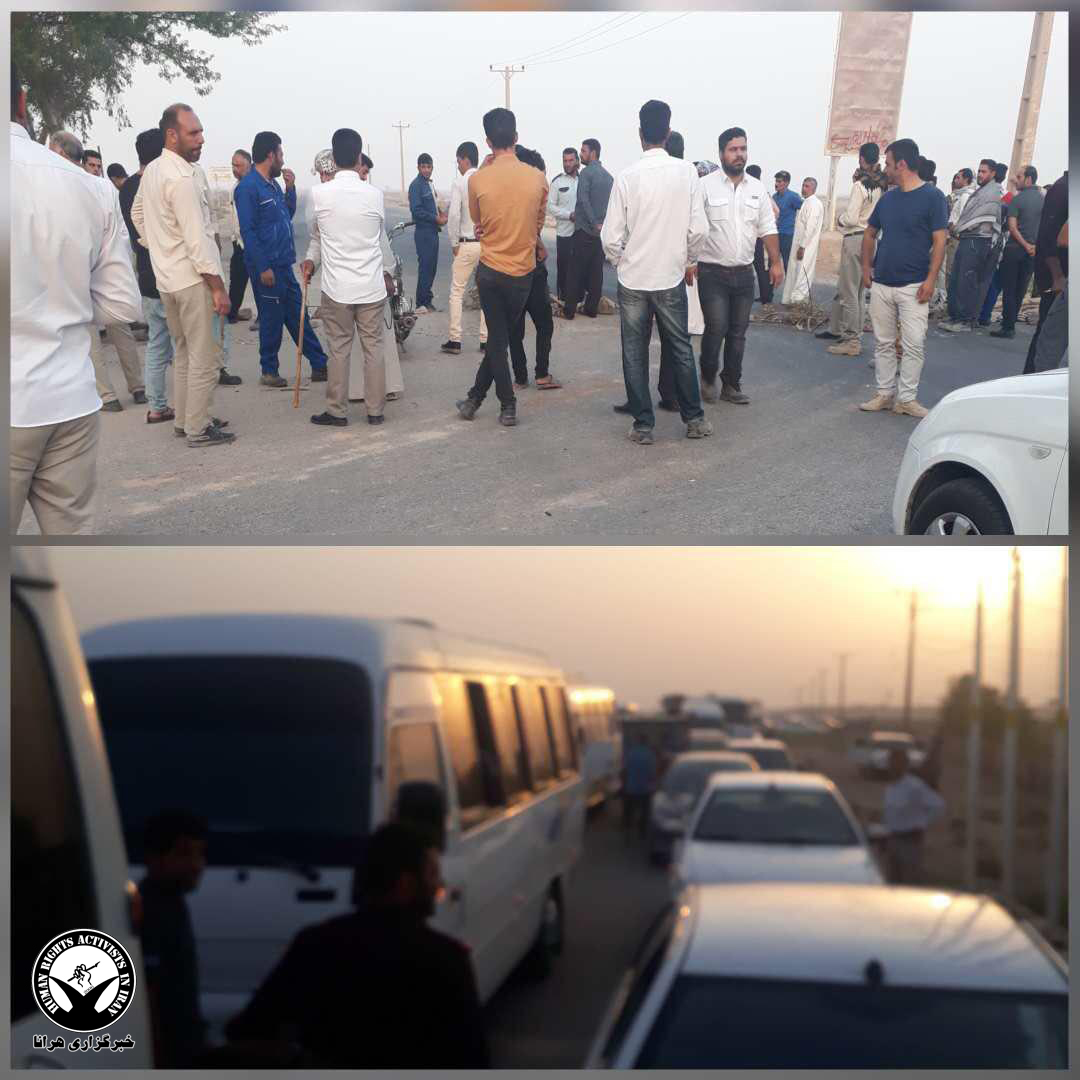
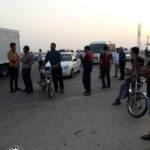
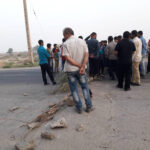
Human Rights Activists News Agency (HRANA) – On Monday, August 27, 2018, residents of Jafir Village (near Hoveyzeh) in the Khuzestan province (southwestern Iran) rallied on the road before local oil companies who have recently cut local water services.
An informed source told HRANA: “There are several oil and gas companies near the village. After receiving numerous complaints from the villagers, they had promised to look into it and get their running water back; a group came to the village to resolve the problem, wrote up a report, and reconnected the water for just one day before cutting it off again.”
The source added: “The villagers were disappointed by the promises from provincial and county officials, and blocked the road to these companies in protest of the problem. [The villagers] threatened to prevent company staff from entering if things continue this way.”
In July 2018, HRANA reported on water problems plaguing the villages surrounding Hoveyzeh. Hoveyzeh is a border town in Khuzestan with a population of approximately 20,000, most of whom work as farmers and ranchers. Due to the drought affecting Khuzestan, about ten regional villages face a crisis of water shortage.
Jafir Village is located 30 miles west of Ahvaz, the capital of Khuzestan. A large oil field encompassing the village contains an estimated 2.1 billion barrels of oil reserves. In addition to oil, there are layered reservoirs of natural gas in the region with a production capacity of 6.3 million cubic feet per day. Nevertheless, the villagers of this region are deprived of their basic rights.
Below: Jafir villagers protest on Monday, August 27, 2018.
Nine Prisoners on Hunger Strike in Iran
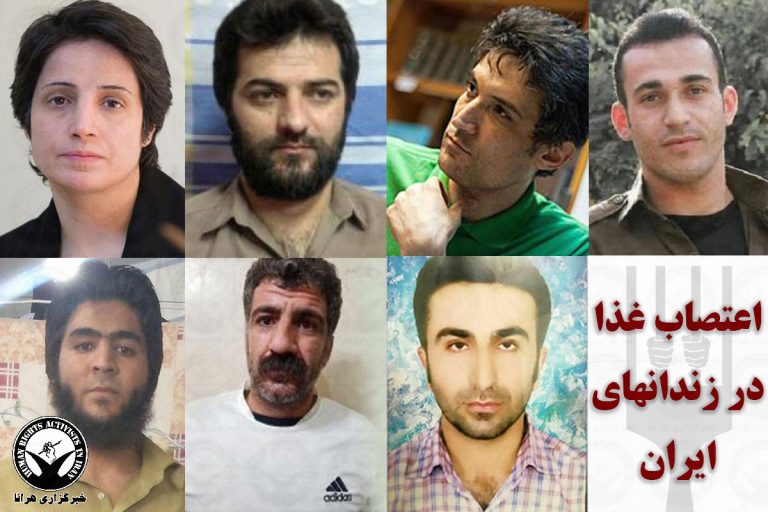
Human Rights Activists News Agency (HRANA) – In the last few weeks, a number of prisoners across the country have declared hunger strike. HRANA has prepared a bulletin on their cases, previously reported in detail.
Nasrin Sotoudeh
Lawyer and human rights activist
Nasrin Sotoudeh started a hunger strike on August 25th in protest to her arrest and the judicial pressures being placed on her family, relatives, and friends.
She published an open letter outlining her reasons for the strike.
Ramin Hossein Panahi
Political prisoner
Sentenced to death, Ramin Hossein Panahi was recently transferred to Karaj’s Rajai Shahr Prison and declared hunger strike on August 27th by sewing his lips together. He is protesting his sentence and multiple violations of his legal rights. His lawyers published a statement sharing the reasons behind the strike. According to them, his whereabouts have been unknown since his August 26th transfer out of Rajai Shahr.
Farhad Meysami
Civil rights activist
Farhad Meysami was arrested July 31st by security forces. He started a hunger strike August 1st, protesting his arrest and the constraints being placed on his choice of attorney. He was transferred from Evin’s Quarantine Ward to the General Ward on August 26th, where he is reportedly suffering from low blood pressure and drastic weight loss.
Namegh Deldel
Prisoner of conscience
Sunni prisoner Namegh Deldel from hall 21, Ward 7 of Rajai Shahr Prison has been suffering from an injury to his right leg. In protest of his restricted access to medical care, including the prison’s refusal to transfer him to an outside hospital, he has been on hunger strike for more than a month.
Farhad Ariai (Sahrapeyma)
Political prisoner
Farhad Ariai (Sahrapeyma), a political prisoner in the Workers’ Ward of Urmia Prison, is in the sixth year of his seven-year sentence. Eligible for early release per Article 134 on the serving of concurrent sentences, he declared hunger strike on August 15th when the court refused to review his request thereof. According to a credible source, Ariai was transferred to the quarantine ward immediately after starting his hunger strike.
Ariai also declared hunger strike last year when prison officials denied his request for furlough. In response to that strike, prison staff forcibly handcuffed and transferred him to the Workers’ Ward of the prison, where he remains to this day.
Seyed Ghassem Abasteh
Prisoner of conscience
Seyed Ghassem Abasteh, a Sunni prisoner in Karaj’s Rajai Shahr prison, started a hunger strike on July 17th to protest his inadequate medical care and the prison’s denial of his access to a clinic. Despite developing asthenia and severe weight loss as of the fifteenth day of his strike, prison authorities continue to ignore his pleas.
His poor health condition has been repeatedly reported on, and in March, he was diagnosed with thyroid cancer. His condition has deteriorated to the point that he struggles to speak and breathe.
Abasteh is married with two children. He was arrested in early 2010 and sent to solitary confinement in Urmia Prison, which is run by the Ministry of Intelligence. He spent eight months there before being transferred to Evin Prison, where he spent six months in the solitary cells of wards 240 and 209. After 14 months, he spent another 20 days in Ward 350 of Evin before finally being transferred to Rajai Shahr on April 8, 2012.
He faces charges such as “militant activity”, accused of backing Salafi groups. He denied such involvement, saying the charges are baseless.
He has been awaiting trial since his 2016 prison sentence from Judge Moghiseh was nullified. He has thus far spent eight years in prison without due process.
Saman Rahmani
Saman Rahmani, a prisoner in the Health Ward of Saqez Prison, is on the verge of losing his arms after suffering an injury, yet continues to be denied the rights of furlough and access to a clinic. He started a hunger strike on July 20th in protest.
“Rahmani was to be sent to Karaj’s Rajai Shahr prison for care, but prison authorities changed their minds,” a credible source told HRANA.
When authorities promised him medical care earlier this year, he stopped the hunger strike he had started in June for the same reasons.
Farshid Nasseri
Prisoner of conscience
Sunni prisoner Farshid Nasseri of Rajai Shahr started a hunger strike on June 16th to demand his right to furlough. Twenty-eight days later, his condition had severely deteriorated. He suffers from back and neck problems, in addition to psychological issues stemming from his years spent in prison.
Verya Saed Moochashmi
On August 19th, on orders from a Ward chief penalizing their refusal to end their hunger strike, five prisoners from Ward 3 of Rajai Shahr were beaten and sent to solitary confinement. They were reportedly striking to protest issues with their respective legal cases.
HRANA understands these prisoners to be Verya Saed Moochashmi, Hossein Esmaeili, Saeed Moradpour, Mojtaba Kounani, and Alireza Kounani. As of yesterday, August 27, 2018, Moochashmi is the sole among the group to continue the strike.
In 1998, Moochashmi, then 17, was sentenced to death and 80 lashings when he was convicted of aiding and abetting murder. He has so far served 21 years in prison.
Ahwazi Arab Activists Arrested in Southwestern Iran

Human Rights Activists News Agency (HRANA) – Three Ahwazi Arab activists from the city of Hamidiyeh, in the province of Khuzestan (southwestern Iran), were arrested by plainclothes forces on the morning of Monday August 27th and taken to an undisclosed location.
HRANA has confirmed the identities of two of the detainees as Hassan Beit Said, 26, and Ali Mazraeh, 27.
Hamidiyeh county consists of two districts and four villages and has a population of 48,935 people (based on a 2006 census).
At the same time, three prisoners who were detained on July 2, 2018, during widespread protests in Ahwaz (capital of the Khuzestan province) were transferred to Sheyban Prison by IRGC Intelligence forces following the completion of the interrogation process. HRANA has identified these three individuals as Seyed Ali Mousavi, 27, Mohammad Savari, 18, and Reza Savari, 26. All three are residents of Ahwaz’s Kouy-e Alawi district. The charges against them are still unknown.
Prisoners Taken to Solitary Confinement Facing Imminent Execution

Human Rights Activists News Agency (HRANA)- At least five death row inmates in Karaj’s Rajai Shahr Prison have been transferred from their respective wards to solitary confinement, raising fear of their imminent execution.
Convicted of murder, the prisoners face the death penalty unless the families of their victims choose to pardon them, a stipulation of the Islamic penal code.
HRANA has been able to confirm the identities of two of the prisoners, Mojtaba Asadi from Ward 2, and Shamsali Abdollahi from Ward 10.
The HRANA Statistics Center has reported that between March 21, 2017, and March 18, 2018, at least 322 persons have been executed and 236 have received the death penalty in Iran. Among those executed, there were four juvenile offenders — under 18 years of age at the time of the offense — and 23 executions carried out in public. More than sixty percent (60%) of the executions have not been publicized, and are considered “secret” executions.

The Tragic Tale of a Juvenile Offender Hanged

Human Rights Activists News Agency (HRANA) – The following feature is sourced from a report given to state-run news agency Ghanoon Daily and translated to English by HRANA.
I. The Boy Who Took the Fall
Clad in black from head to toe, Simin sits silently in her humble home at the end of an alley on the outskirts of Qom, central Iran. In a corner of the room sits her 50-year-old husband, whose hair has turned fully white. Against the far wall sits their son Mohammad.
Their demure is sparsely decorated: an old TV set and a brown wooden cabinet, on which sits a photo of her son Abolfazl Chezani. His picture overlooks a room muted by grief. It has been 38 days since Abolfazl, 18, was hanged for murder.
As is customary among the Shiites, the family is preparing a ceremony in observance of the 40-day mourning period following his death.
Once in a while, a deep sigh from Simin breaks the silence. As she lowers drinking glasses and a pitcher of cold water to the floor, she draws a breath and remembers aloud the events of one day, four years ago, that would change their lives for the worse forever.
“Abolfazl was working in a Sohan[1] baking factory. That afternoon, he came home late from work and asked me to make him a cheese sandwich…”, she said, pointing to a spot on the carpet. “Abolfazl was standing right there in front of me. He was looking at himself in the mirror…then his friend Ali came by on a motorcycle and buzzed the door to ask if Abolfazl would join him. I didn’t know where they were going….he left home, and never came back.”
She recoils in pain, silenced for a moment by grief; her hands wring together, and she bursts into tears, eyes still fixated to the spot on the carpet where she last saw her son. The rest of her words are choked — the lump in her throat lets out halting, unintelligible sounds. Fat tears flow down the wrinkles of her face, rolling down her skirt to the carpet.
Abolfazl’s father and his brother Mohammad pick up where Simin left off: their home was raided by the police that day, they say, who left when they realized Abolfazl wasn’t home and was only a child. Upon his return, Abolfazl’s father stopped him at the threshold of their home, to escort him to the station to turn him in to the police.
His father and brother went off to visit the assault victim: 20-year-old Morteza, who was in critical condition suffering from stabs to the heart. Ali, who was Morteza and Abolfazl’s mutual friend, was also arrested. During Ali and Abolfazl’s detainment, Ali convinced Abolfazl to take the blame because he was the younger one. “In a few days, Morteza will recover, and then they’ll let you go,” Ali told him. So Abolfazl told police that he was the sole one responsible for Morteza’s assault. Ali was released three days later; eleven days after that, Morteza died of his injuries. Abolfazl had confessed to a murder.
II. Lack of Due Process
Abolfazl’s brother Mohammad explains that Ali had fought with Morteza two weeks prior to the stabbing incident. “Ali was in our alley that day, looking for another guy named Hamid to take him to fight Morteza again,” he said. “Since he couldn’t find Hamid, he took Abolfazl.”
Morteza’s family requested to file a complaint against Ali, who they believe instigated the brawl that ended in his murder. Mohammad continues: “during the trial, [the judge] didn’t even permit testimonies from witnesses who saw Ali pick up Abolfazl that day. We went to the court with the neighborhood elders to push the complaint against Ali, but to no avail.”
Simin goes to a drawer and takes out a red shirt. “He bought this to wear at his brother’s wedding”, she said, caressing the shirt as her tears flow. Abolfazl’s father explains that he tried to persuade the family of the victim to pardon Abolfazl[2] by going to their home, but he was ignored. “We sent many people to mediate and convince them to forgive, but they wouldn’t even allow them inside the home. I personally went to their family’s elder and pleaded with him to spare my son’s life. I told them I would give whatever blood money they asked. I would sell my house. I would take up a collection. But they stayed silent. We really wanted to meet with the victim’s family during the trial, but the judge wouldn’t allow it. We asked for help from the prison social worker, who went to Morteza’s family only once.
On the day of Albofazl’s execution, they waited outside the prison. Simin threw a copy of the Quran at their family car, crying and begging them for forgiveness before they entered the prison, but they just sat in their car and stared out at me.”
When confronted after the execution by some of Abolfazl’s relatives, Morteza’s mother said: “My son died. So did hers.”
Mohammad recalls the details of the trial. “My brother’s case had two judges. Months after the case was handed to the second judge, he was executed. We were still in the middle of the second legal process. Had they seen the process through, perhaps we could have found a recourse; maybe the family of the victim would have decided to pardon him. What’s the rush in carrying out the execution? The victim’s father, who pulled the stool out from under Abolfazl’s feet at the hanging, is in an awful emotional state. Taking a life with your own hands isn’t easy to forget, especially my brother’s, who was only 14 at the time of the murder, and when executing a child is forbidden all over the world.”
III. Four Trips to the Gallows
During the four years and six months of his imprisonment, and before finally being executed, Abolfazl Chezani was taken three times to the prison quarantine, where condemned inmates spend the eve of their executions. Those three times, his execution was stalled. “In his childish mind,” Mohammad says, “he didn’t understand that quarantine means he could be executed the next day. He never thought the world could be so cruel as to throw a rope around his neck and take his life.”
IV. A Portrait of Kindness and Optimism
What happened on the night of the murder is unclear. Abolfazl’s conduct and spirit in prison showed no indication that he was capable of such violence. His family collected testimonials from neighbors who noted that Abolfazl had never before engaged in fights or brawls.
He observed Ramadan in prison, fasting until his eyes hurt. He had observed Ashura [3] since childhood and would organize the memorial procession himself. In prison, he took to memorizing the passages of the Quran. He earned a “good behaviour” designation in the Juvenile Rehabilitation and Education Centre.
Simin shares that her son “stopped studying in the seventh grade. He quit school to work, and would give me his salary.”
Mohammad explains how his family’s suffering during the ordeal made Albolfazl feel ashamed. “I’d try to console him, and he would just hang his head without uttering a word. It’s as if we all died on the day he was executed.”
Abolfazl always comforted his family, they say, right down to their last visit. Simin remembers her telling him, with eyes full of hope, “Don’t fret mom, nothing will happen!” To the prison social worker who brought him a copy of the Quran and told him not to be afraid on the eve of his death, he responded with a laugh. “They won’t execute me. I’ll be pardoned.”
Amnesty International had previously issued a statement asking Iranian authorities to stop the execution proceedings of Abolfazl Chezani, who was a minor at the time the offense was committed.
After Abolfazl’s execution, Amnesty International criticized the compliance of Iranian courts, parliamentarians, and doctors in “compliance with assault on the rights of children.” Amnesty referred specifically to a court-affiliated doctor who, by providing “maturity” assessments on convicts with death sentences, “effectively facilitate the execution of those who were children at the time of their crimes.” A report of this kind was used to justify the death sentence of Abolfazl Chezani.
—–
[1] Sohan is a brittle Iranian sweet made with saffron and rosewater. The city of Qom is known for its Sohans.
[2] Qesas, an “eye-for-an-eye” punishment encoded in Iran’s Islamic penal code, which grants the family of murder victims to either seek the death penalty or accept dieh — “blood money” — in return for sparing the life of the accused.
[3] Ashura is a Shiite ceremony commemorating the death of Hussain, the 3rd Imam and Prophet Mohammad’s grandson, who was killed in a battle in 7th century A.D. Many Iranians and Iraqis observe days of mourning and large processions in remembrance of his death.
Ramin Hossein Panahi Sews Lips Shut, Declares Hunger Strike

Human Rights Activists News Agency (HRANA) – The lawyers of Ramin Hossein Panahi, a Kurdish political prisoner who has been sentenced to death, announced on August 27th that he had sewn his lips together and begun a hunger strike in protest to the violation of his legal rights.
Hossein Panahi’s lawyers published a statement today explaining that their client has been denied the right to appeal and the right to amnesty, among others. According to the statement, Hossein Panahi had been transferred to Karaj’s Rajai Shahr Prison on August 13th for unidentified reasons and has been unreachable since his transfer out of Rajai Shahr.
One of Hossein Panahi’s lawyers, Hassan Ahmadiniaz, elaborated in the statement the four motivations behind his client’s hunger strike:
1- Deprivation of legal rights, including medical treatment outside the prison as requested by the authorities of the Sanandaj Central Prison clinic,
2- Unlawful cessation of his phone contacts and visitations with family and lawyers,
3- Deprivation of customary prisoners’ rights and access to prison facilities,
4- The unlawful and unjust nature of the sentence in light of the necessity to reassess his charges through the customary legal channels.
In their statement, Hossein Panahi’s lawyers appeal to articles 477 and 474 of the penal code, requesting that their client’s execution be stopped so that “legal avenues to appeal may be explored for his sentence, or the client may benefit from amnesty.”
Ahmadiniaz revealed in June 2018 that Hossein Panahi’s request for a retrial had been rejected.
Hossein Panahi was convicted of “Acting against national security by violating the rights of others” and sentenced to death by Branch One of Sanandaj’s Revolutionary Court. The Supreme Court confirmed this sentence in late March and forwarded it to the Enforcement Department.
The statement, signed by Ahmadiniaz, Maziar Tatayi, and Osman Mozayan, indicates that Hossein Panahi will continue his strike until his demands are met.
Appeals Court Convenes for 4 Baha’i Residents of Mashhad
Human Rights Activists News Agency (HRANA) – On August 26, 2018, the Appeals Court of Razavi Khorasan Province met to process the appeal of four Baha’i residents of Mashhad convicted of propaganda against the regime.
Dori Amri, May Kholousi, Saghi Fadaei, and Shayan Tafzili each face a sentence of one year in prison, issued by Branch 3 of the Revolutionary Court of Mashhad in March 2018.
An informed source told HRANA that an appeals decision is anticipated soon.
The accused were apprehended in June 2014 by Mashhad security forces and later released on bail. They were tried in two court sessions that met on December 17, 2014, and June 17, 2017. These trials culminated in a sentencing from Judge Soltani of one-year discretionary imprisonment each.
In Iran, Baha’i citizens do not enjoy the freedom of religion. Their systematic oppression flouts both Article 18 of the Universal Declaration of Human Rights and Article 18 of the International Covenant for Civil and Political Rights, affording all individuals religious freedoms, i.e. the right “to have or to adopt a religion or belief of one’s choice and freedom, either individually or in community with others, and in public or private to manifest one’s religion or belief in worship, observance, practice and teaching.”
Unofficial reports indicate that over three hundred thousand Baha’is currently reside in Iran. However, the constitution of Iran only recognizes Islam, Christianity, Judaism, and Zoroastrianism as official religions, and does not extend this recognition to the Baha’i faith. For this reason, the rights of the Iranian Baha’i community are systematically violated.
Imprisoned “Teacher of Civil Disobedience” Enters 26th Day of Hunger Strike
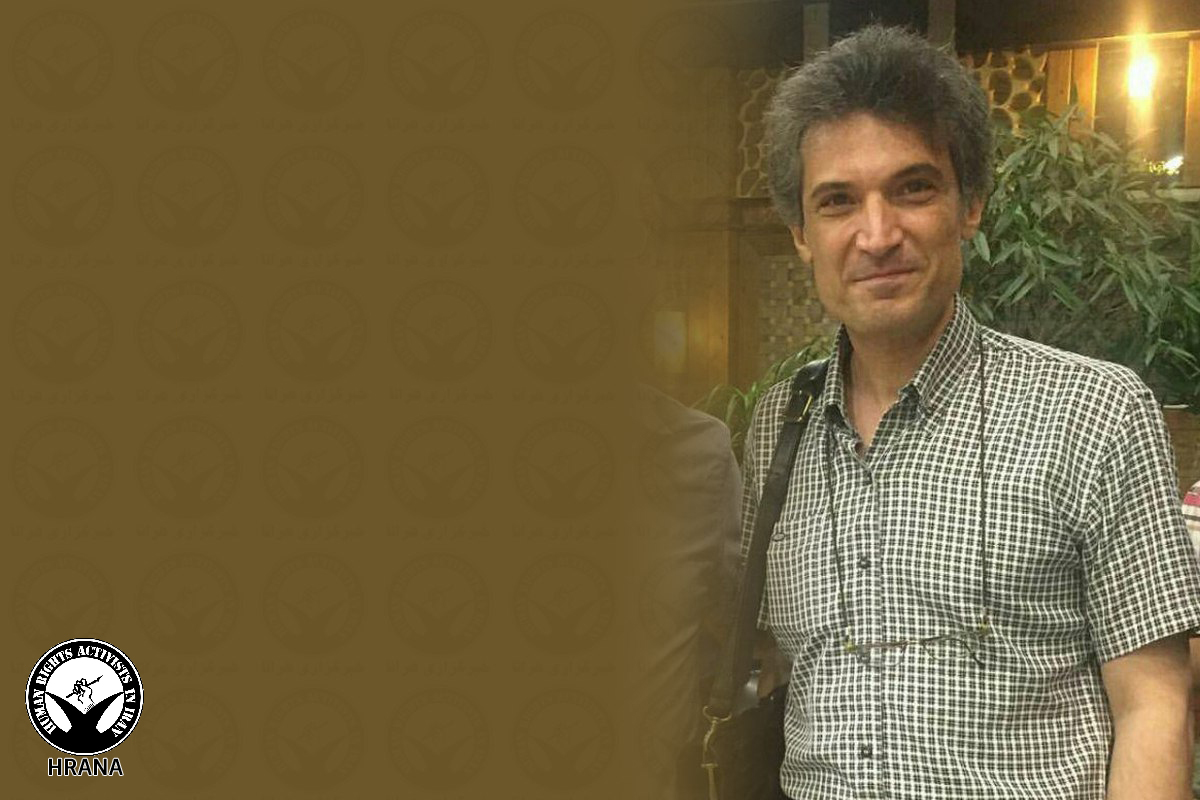
Human Rights Activist News Agency (HRANA) – The health condition of Farhad Meysami — who declared hunger strike the day after his arrest on July 31st in protest of his detention and the denial of his right to a lawyer of his choice — is in decline.
As of the 26th day of his hunger strike, Meysami was suffering from low blood pressure, low blood sugar, and severe weight loss. He was transferred from prison quarantine to the general ward (Ward 4, Hall 3) yesterday.
A source close to Meysami confirmed his health condition to HRANA, adding, “He has lost 11 kilograms since the start of his hunger strike, and intends to continue striking despite his frail condition and insistence from his family and friends to put an end to it.”
The source went on to elucidate the events surrounding Meysami’s arrest: ”He was in his personal library with Zia Nabavi when an individual buzzed in, saying that they wished to submit a book to the publication house located one floor below Mr. Meysami’s flat. When Meysami opened the door for him, four Ministry of Intelligence agents came in and presented an arrest warrant for both Meysami and Nabavi. After a search of his library in which they confiscated pin-back buttons reading “I protest mandatory veiling” along with 30 copies of the book titled “Small Acts of Resistance” and 40 copies of “Human Rights: Questions & Answers,” they arrested both Meysami and Nabavi and transferred them to Ward 209 of Evin Prison. Mr Nabavi was released the next day as he was not implicated in the case.”
The source added that Meysami was called a “teacher of civil disobedience” during his interrogation. He faces charges of “Collusion and conspiracy to threaten national security”, “Disseminating propaganda against the regime”, and “Insulting the hijab, an essential sacrament of Islam” from Branch 7 of the Evin Court. Based on the content of his interrogation sheets, these charges stem from “provoking women to appear without hijab in the street,” as well as a speech he gave on the topic of “social nonviolence” at the University of Isfahan.
Meysami’s hunger strike is motivated in part by his wish to appoint Arash Keikhosravi as his lawyer. Keikhosravi, who has been detained in the Great Tehran Penitentiary for the past 11 days, previously explained to HRANA, “On Sunday, August 12th, Mr. Meysami’s mother and I went to Branch 7 of Evin court to follow up on his case and to see how he was doing. I planned to register as his lawyer, but the officials at the branch told me that section 48 of the Criminal Procedure Code bars me from doing so.”
Section 48 of the recently-amended Criminal Procedure Code states that those accused of national security crimes must choose their lawyer from a list approved by the Iranian judiciary.
Civil Rights Activist Mohammad Davari Released on Bail
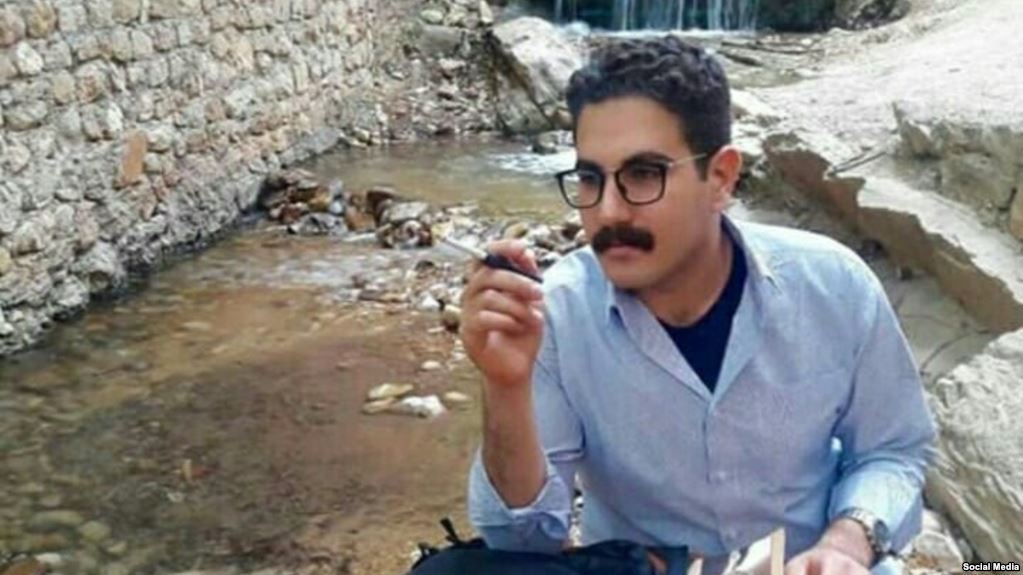
Human Rights Activists News Agency (HRANA)- Mohammad Davari, a 26-year-old civil rights activist from the city of Yasouj (southwestern Iran) who was arrested by Ministry of Intelligence forces on August 10, 2018, was released around noon local time on August 27th on a 200 million tomans (approximately $20,000 USD) bail pending the completion of the investigation into his case.
Earlier a source close to Davari’s family told HRANA: “Mr Davari was severely beaten in the chest and stomach areas during his interrogation at the Yasouj Intelligence office. As a result, he suffered from severe nausea which led to shortness of breath and consequently, on Monday, August 20th, Mr. Davari vomited blood. He asked twice for medical attention but the authorities refused to transfer him to the prison clinic or a hospital outside the prison.”
Mohammad Davari was held incommunicado in the Yasouj Intelligence office before he was transferred to Yasouj Central Prison. He was previously detained on March 5, 2018, for taking part in widespread popular protests in Iran. He was released eight days later on a 50 million tomans (approximately $10,000 USD) bail. The authorities reportedly told Davari’s family that he was arrested on the charge of “Acting against national security through disturbing the public peace of mind”.
Born in Dehdasht (150 km west of Yasouj), Davari is a Masters student of Political Science. He was arrested another time following the death of Hashemi Rafsanjani when he pulled down a banner bearing Rafsanjani’s photo. He was later released on bail.