Between Missiles and Repression; HRA Releases New Report on US/Israeli Operations in Iran

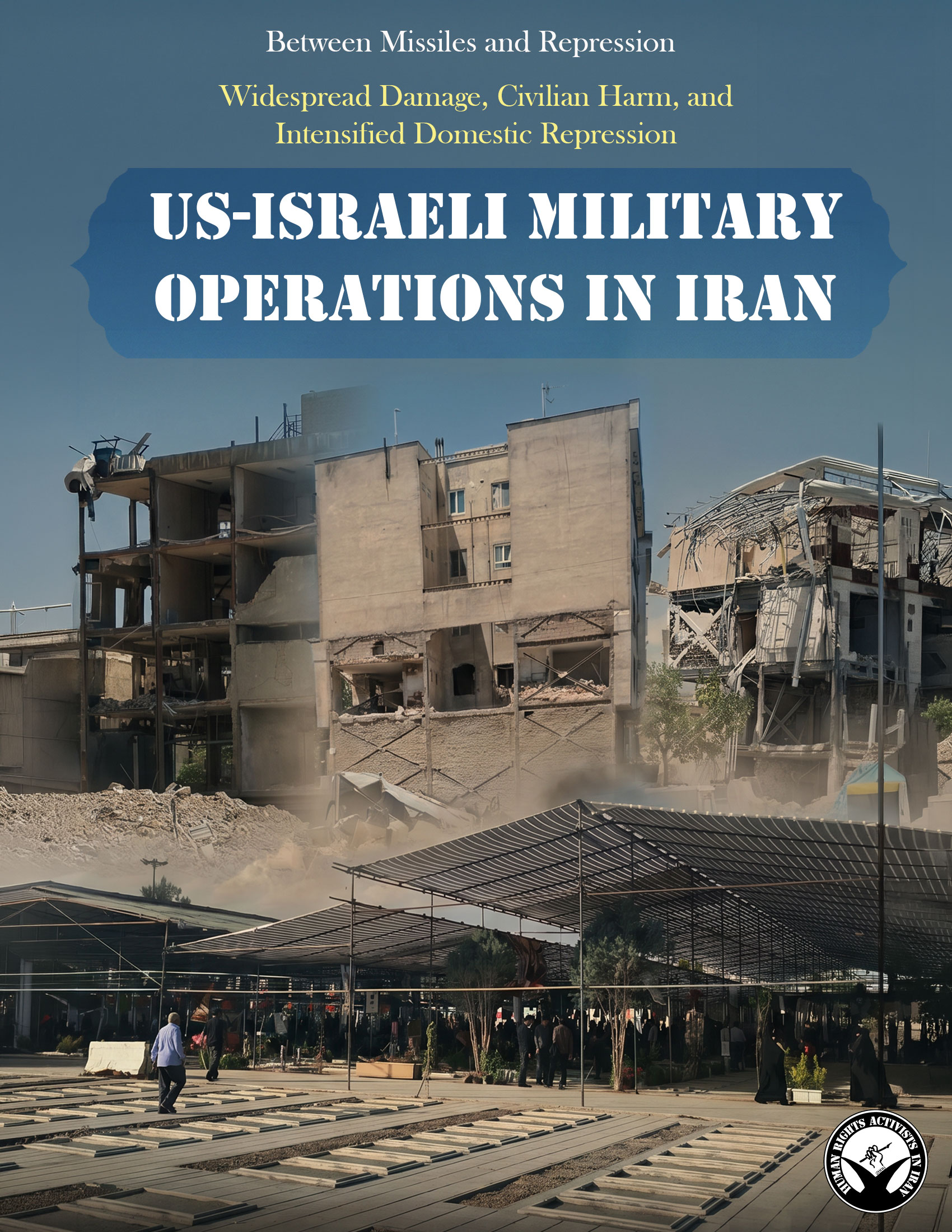
HRANA – Today, Human Rights Activists in Iran (HRA) released a new report examining the US and Israeli military campaign in Iran between 28 February and 8 April 2026. The report documents 6,324 unique incidents comprising 12,798 distinct attacks, based on 177 verified sources, including open-source reporting and HRA’s in-country network.

It is important to note that the report is not intended to provide a comprehensive account of the conflict. Rather, its findings are limited to incidents documented and verified within HRA’s dataset.

Methodology

HRA relies on two primary and parallel workflows to document the scale of destruction and associated civilian harm.

First, HRA systematically collects open-source information, which is cross-checked against credible external reporting and corroborated through its established in-country network.

Second, HRA receives direct reports from its network, which are independently verified through additional contacts or cross-referenced with open-source material. In all cases, inclusion requires corroboration from at least two independent sources, with consistency in key details such as time, location, and nature of the incident.

HRA also separately preserves official narratives and state-reported figures, which are not incorporated into verified casualty counts. Incident data and casualty figures presented in the report represent documented minimums only and do not capture the full scope of harm.

Key Findings

◾️HRA documented 6,324 unique incidents comprising 12,798 distinct attacks between 28 February and 8 April 2026. Within HRA’s dataset, 77 percent of incidents involved civilian harm or damage to civilian objects.
◾️Of HRA’s verified incidents, Tehran province accounted for 44.85 percent of documented incidents, followed by Isfahan (10.5 percent), Khuzestan (6.74 percent), and Alborz (6.23 percent), indicating that some of Iran’s most densely populated provinces experienced a disproportionate concentration of attacks and civilian harm.
◾️
HRA documented at least 3,636 fatalities, including 1,701 civilians, 1,221 military personnel, and 714 individuals whose identity or status could not be confirmed. These figures should be understood as minimums.
◾️
HRA verified the deaths of 307 children and injuries to 2,213 children as a result of the attacks. HRA documented attacks affecting schools, sports facilities, parks, and residential areas where children were present, a majority on the first day of the conflict.

The report identifies several patterns that raise serious concerns under international humanitarian law, including:

◽️apparent failures in target verification,
◽️use of artificial intelligence with minimal human oversight,
◽️
inadequate and inaccessible warnings,
◽️
the use of large explosive weapons in populated areas,
◽️
Repeated or “double-tap” strikes,
◽️
attacks targeting widespread civilian infrastructure

Public rhetoric by senior US and Israeli officials also raised concerns, particularly statements suggesting disregard for rules of engagement and direct threats directed at civilian infrastructure.

◾️HRA independently verified damage to the following (noncomprehensive):

▫️108 educational facilities
▫️50 healthcare facilities
▫️122 cultural and religious sites
▫️381 industrial and commercial facilities
▫️173 electricity generation and distribution sites
▫️191 judicial and law enforcement facilities

HRA additionally documented conduct by Iranian authorities that increased civilian exposure to harm.

At the same time, Iranians experienced a convergence of harm through increased domestic repression. At least 4,023 individuals were arrested on accusations including espionage, threats to national security, or sharing information related to the conflict. Conditions inside detention facilities sharply deteriorated, while authorities expanded checkpoints, intensified movement restrictions, and imposed a prolonged internet blackout that reduced national connectivity to approximately 1 percent of normal levels. Between 28 February and 13 May, HRA documented 50 executions, including 32 carried out on political and security-related grounds. HRA also documented increased child presence at Basij checkpoints following an IRGC recruitment campaign targeting children as young as 12 years old.

Annexes

The report annexes include:

◾️a detailed list and analysis of weapons and munitions documented during the conflict, prepared with the support of HRA’s internal weapons specialist,
◾️casualty documentation,
◾️
detainee documentation,
◾️
and a compilation of HRA’s ground reporting, open-source verification, and exclusive visual documentation

Click on the image to download the full report

Report on the Arrest of Several Individuals in Fars and Lorestan Provinces

HRANA – The deputy commander of the Law Enforcement Forces in Fars Province announced that a citizen was arrested for setting up a network in several provinces across the country to sell unfiltered internet via Starlink. Meanwhile, IRGC Intelligence reported the arrest of several citizens in Fars Province for what it described as “sending images to a foreign-based media outlet.” The Lorestan Police Information Center also announced that seven citizens in the province were arrested on charges of espionage.

According to Mehr News Agency, a citizen was arrested in Shiraz. Regarding the case, the deputy commander of the Fars Provincial Police stated that the 37-year-old citizen was arrested for establishing a network across several provinces in order to sell unfiltered internet via Starlink. The individual’s Starlink device and related equipment were also discovered and confiscated.

In a separate development, the Islamic Republic of Iran Broadcasting (IRIB) News Agency published a statement from the IRGC Intelligence announcing that several citizens in Fars Province were arrested for “sending images to a foreign-based media outlet.”

The statement claimed that the individuals were collecting images on the social media platform Telegram under the title “Leon” and sending them to the Iran International network. It alleged that by broadcasting these images they intended to provoke public opinion and incite unrest in the streets. The organization also described the detainees as being connected to one of the groups opposed to the government.

According to Fars News Agency, the Lorestan Police Information Center reported the arrest of seven citizens in the province on charges of espionage. According to the statement, the individuals had taken photographs of certain locations.

Although countering espionage is not considered a violation of human rights, given the Iranian government’s record of instrumentally using such accusations to confront political opponents, these kinds of claims, particularly when details and the judicial process remain unclear—are consistently viewed with skepticism.

The reports did not mention the date of the arrests or the identities of the detainees.

Since February 28, Iranian territory has been targeted by military attacks carried out by Israel and the United States. For more information, see HRANA’s report on the thirteenth day following the start of these attacks, published last night.

Day Five of the U.S.–Israel War on Iran: Expansion of Areas Affected by Military Strikes

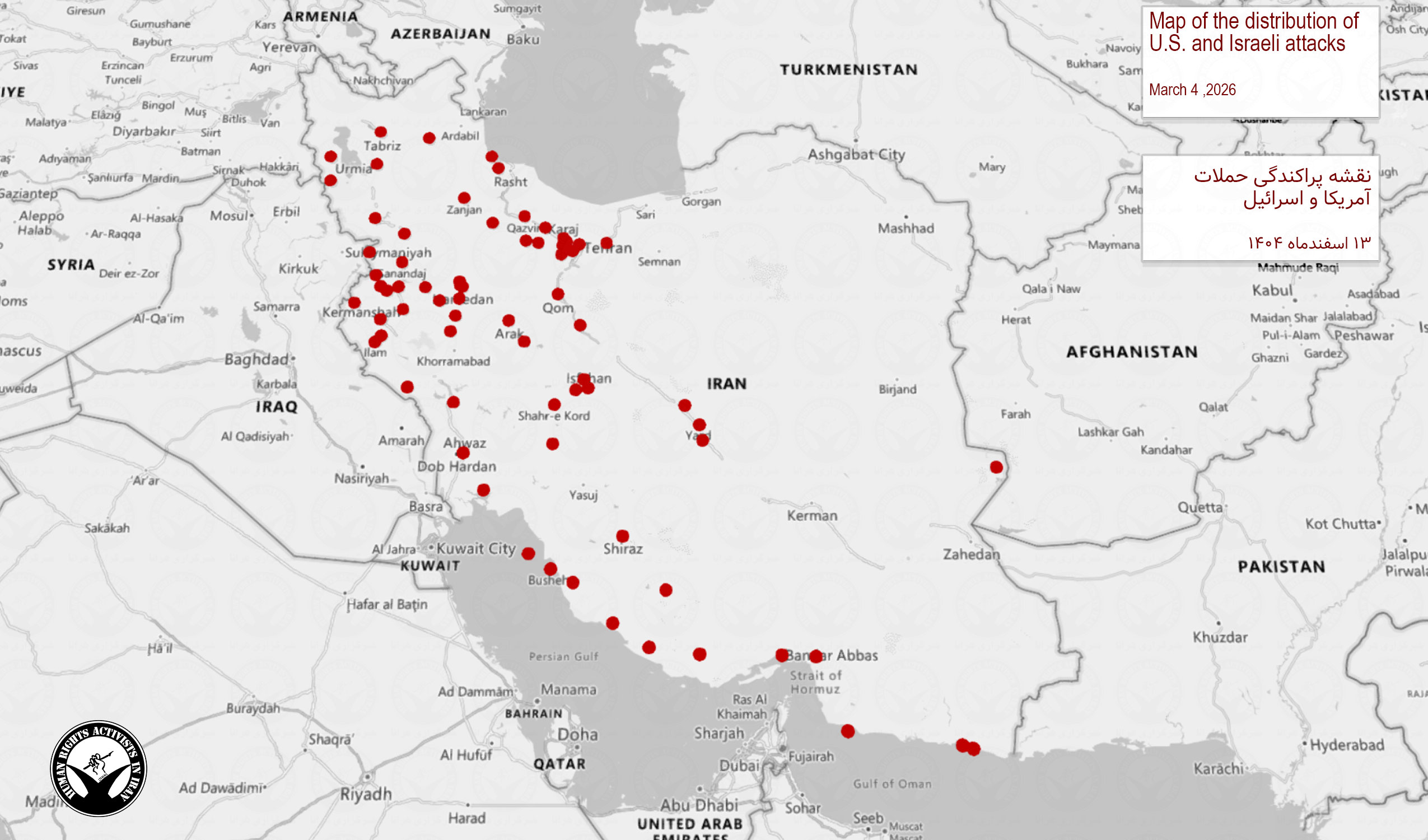
HRANA – In the last 24 hours, and as of March 4, 2026, at 17:00 ET, HRANA has recorded at least 117 attacks across 51 incidents in 23 provinces, resulting in a total of at least 57 casualties (killed and injured, both civilian and military). According to aggregated data since the outbreak of the conflict on February 28, the total number of reported civilian deaths has reached 1,114 including 183 children, most of them under the age of ten. An additional 926 reported deaths are currently under review for verification and classification.

Based on information verified today, HRANA has recorded 31 civilian deaths and 25 civilian injuries, as well as the death of one military personnel. During the last 24-hour period, 926 cases (deaths and injuries) remain under review for verification and classification, including assessment of whether individuals were civilians or military personnel.

Additionally, over the past 24 hours, it has been reported that 51 targets have been struck in 117 attacks. These include a range of locations and infrastructure, including several military bases, a medical center, a blood transfusion center, and several residential areas. The nature of these objects, whether under special protected status, civilian, military, or dual use, remains under review, and classifications may be revised as further information becomes available. The number of recorded targets includes both those that were directly struck and those that sustained damage as a result of nearby attacks or collateral impacts.

Aggregated data since the beginning of the conflict on 28 February 2026: The total number of reported civilian deaths stands at 1,114, including 181 children, with 926 reported deaths currently and under review pending verification and classification.

This report provides a preliminary analysis of incidents documented within the last 24 hours. All figures and classifications contained herein are based on information available at the time of publication. As verification efforts continue and additional information becomes available, casualty figures, classifications of individuals as civilian or military, and the categorization of damaged objects may be updated.

HRANA applies a verification methodology that relies on cross-checking field reports, local sources, medical and emergency contacts, and available open source material. In cases where information cannot yet be conclusively verified, incidents or casualties are classified as undetermined and remain under active review. The dynamic nature of the situation, access constraints, and communication disruptions may affect the completeness of current data.

1. Overview of Incidents in the Last 24 Hours

In the last 24 hours, incidents were reported across multiple provinces, reflecting a geographically dispersed pattern of hostilities. The documented incidents include airstrikes and missile attacks, primarily involving cruise missiles.

Preliminary analysis indicates that Tehran Province, accounting for 34% of the attacks, continues to be targeted more than any other part of the country. Kermanshah and Fars provinces follow, each accounting for 6% of the attacks. Meanwhile, western regions of the country, such as Kurdistan and West Azerbaijan, continue to account for a significant share of the airstrikes.

2 List of Objects Reported Hit

The Fourth Day of the U.S.–Israel War on Iran: Strikes Continue in Western Regions of the Country

HRANA – In the last 24 hours, and as of March 3, 2026, at 17:00 ET, HRANA has recorded at least 104 attacks across 85 incidents in 19 provinces, resulting in a total of 31 casualties (killed and injured, both civilian and military). According to aggregated data since the outbreak of the conflict on February 28, the total number of reported civilian deaths has reached 1,097, including 181 children under the age of ten. An additional 880 reported deaths are currently under review for verification and classification. The number of reported civilian injuries since February 28 has reached 5,402, including 100 children.

Based on information verified today, HRANA has recorded 15 civilians killed and 1 civilian injured, as well as 12 military personnel killed. During the last 24-hour period, 10 cases (deaths and injuries) remain under review for verification and classification, including assessment of whether individuals were civilians or military personnel.

In addition, in the last 24 hours, 34 objects were reported as hit. These include a range of sites and infrastructure, including several military bases, two medical centers, and one residential area. The nature of these objects, whether under special protected status, civilian, military, or dual use, remains under review, and classifications may be revised as further information becomes available. The number of recorded targets includes both those that were directly struck and those that sustained damage as a result of nearby attacks or collateral impacts.

Aggregated data since the beginning of the conflict on 28 February 2026: The total number of reported civilian deaths stands at 1097, including 181 children under 18, with 880 reported deaths currently and under review pending verification and classification. Reported civilian injuries since 28 February 2026 stand at 5402, including 100 children.

This report provides a preliminary analysis of incidents documented within the last 24 hours. All figures and classifications contained herein are based on information available at the time of publication. As verification efforts continue and additional information becomes available, casualty figures, classifications of individuals as civilian or military, and the categorization of damaged objects may be updated.

HRANA applies a verification methodology that relies on cross-checking field reports, local sources, medical and emergency contacts, and available open source material. In cases where information cannot yet be conclusively verified, incidents or casualties are classified as undetermined and remain under active review. The dynamic nature of the situation, access constraints, and communication disruptions may affect the completeness of current data.

1. Overview of Incidents in the Last 24 Hours

In the last 24 hours, incidents were reported across multiple provinces, reflecting a geographically dispersed pattern of hostilities. The documented incidents include airstrikes and missile attacks, primarily involving cruise missiles.

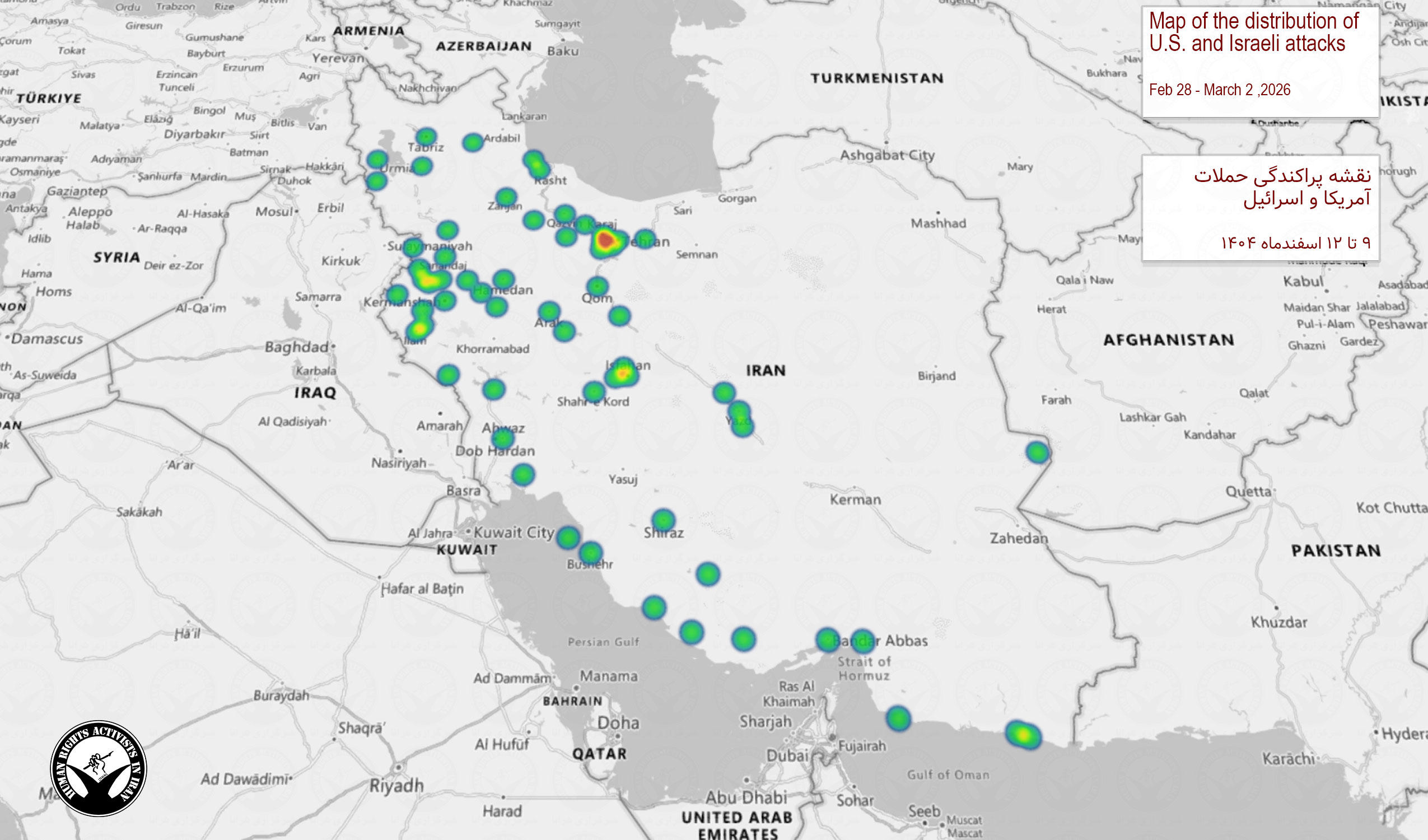
Preliminary analysis indicates that Tehran Province, accounting for 38 percent of the attacks, continues to be targeted more than any other part of the country. Unlike previous days, when Kurdistan and Ilam provinces ranked second and third in terms of the number of attacks, today Kermanshah and Isfahan provinces held those positions, accounting for 9 percent and 8 percent of the attacks respectively. Kurdistan, with a 7 percent share, continues to experience a significant and sustained portion of the air and missile strikes.

• Allah Akbar Garrison in Tehran

• A military headquarters affiliated with the Mohammad Rasoul Allah Corps in Kermanshah

• The Army’s 328th Infantry Brigade garrison in Marivan

• Shahid Yazdani Garrison in Najafabad

• Imam Hossein University in Tehran

For a number of the above-listed objects, the precise nature of the target, whether civilian, military, or dual use, remains under review. Verification efforts are ongoing to determine the status and function of each object at the time of the reported strike. As further information becomes available, classifications may be revised in subsequent updates.

Facilities Protected Under International Humanitarian Law:

Under international humanitarian law, medical facilities, educational institutions, humanitarian facilities, religious sites, and emergency service centers are among the many objects that maintain special protected status and are afforded special protection.

As of the past 24 hours, HRANA documents reported damage to the following facilities protected by IHL. The information below reflects preliminary findings and remains subject to verification. This list is not exhaustive; those listed are illustrative.

• Shohada Hospital in Sarpol-e Zahab

• A field hospital in Salas-e Babajani

• The Criminal Investigation Department in Marivan

• Nuclear facilities in Natanz

• The Dezful Radio building in Dezful

3. Civilian Casualties

All casualty figures presented below are based on information available at the time of publication. The classification of individuals as civilian, military, or undetermined is preliminary and subject to change as further verification is conducted. Where sufficient corroboration is not yet available, cases remain under review and may be reclassified in subsequent updates.

In the last 24 hours, 15 civilians were reported killed, and one civilian were reported injured across 19 provinces. Among them, 2 children were killed.

The highest number of civilian casualties was documented in Tehran province, followed by Isfahan Province.

4. Military Casualties

During the same reporting period, 12 military personnel were reported killed. This figure for military casualties is limited exclusively to those reported in connection with attacks on military or paramilitary bases. Where possible, organizational affiliation and operational context are being assessed; however, not all details have been independently verified.

In certain incidents, individuals were killed in proximity to military objectives, but their formal status has not yet been conclusively established. These cases remain under review, and classification may be revised if credible information indicates a different status.

5. Unverified Casualties

As of publication, 52 casualties remain under active review and are currently classified as undetermined.

The classification may remain pending for the following reasons:

• Lack of identifying documentation

• Conflicting reports from sources

• Insufficient information regarding affiliation or role at the time of death or injury

• Ongoing efforts to verify open-source reports through the HRANA network

6. Undetermined Casualties

As of the time of publication, 10 casualties (deaths and injuries) remain classified as undetermined. This includes cases where HRANA has not yet been able to confirm whether the individual was a civilian or military personnel, or where age status (including potential child casualties) has not been conclusively verified.

A Note on HRANA Methodology

The information contained in this report is compiled through HRANA’s established documentation network. Data is collected from a combination of field reports, local contacts, medical and emergency sources, civil society networks, and open source materials, including publicly available images, videos, and official statements where relevant. Each reported incident is logged and assessed through an internal review process before publication.

Given the evolving nature of hostilities, information is gathered on a rolling basis and reflects the status of documentation at the time of publication.

The figures presented in this report may not reflect the full scope of harm. Ongoing hostilities, damage to infrastructure, communication disruptions, restricted access to affected areas, and security risks for sources may limit the ability to document incidents comprehensively.

Delays in medical reporting, difficulties in confirming identities, and restricted access to certain provinces may result in temporary undercounting. As access improves or additional evidence emerges, casualty figures and incident classifications may be revised accordingly.

HRANA remains committed to transparency, methodological rigor, and the continual updating of its findings as new verified information becomes available.

Humanitarian Obligations

Human Rights Activists in Iran today issued a statement condemning the ongoing conflict between the United States–Israel and Iran, warning of rising casualties and ongoing assessments. HRA described attacks on medical centers and critical infrastructure as serious violations of international humanitarian law and called for an immediate halt to attacks, the protection of civilians, and the full restoration of internet access in Iran.

The Third Day of the U.S.–Israel War on Iran: Rising Casualties and Intensified Strikes in Tehran and Western Provinces

HRANA – In the last 24 hours, and as of March 2, 2026, at 17:00 ET, HRANA recorded at least 56 incidents across 13 provinces, resulting in 101 total casualties (killed and injured, civilian and military). All figures and classifications in this report are preliminary and may be updated as additional information becomes available and verification efforts continue.

Based on information verified today, HRANA has recorded 85 civilians killed and 5 total civilians injured, as well as 11 military personnel killed. During the last 24-hour period, 579 cases (deaths and injuries) remain under review for verification and classification, including assessment of whether individuals were civilians or military personnel.

In addition, in the last 24 hours, 28 objects were reported as hit. These include a range of locations and infrastructure, such as several military bases, two residential areas, and Shahid Bahonar Pier in Bandar Abbas. The nature of these objects, whether under special protected status, civilian, military, or dual use, remains under review, and classifications may be revised as further information becomes available. The list of 28 recorded targets are included in this report and reflect both objects reportedly directly targeted and those documented as damaged due to nearby strikes or collateral effects.

Aggregated data since the beginning of the conflict on 28 February 2026: The total number of reported civilian deaths stands at 742, including 176 children under 18, with 624 reported deaths currently and under review pending verification and classification. Reported civilian injuries since 28 February 2026 stand at 971, including 115 children.

This report provides a preliminary analysis of incidents documented within the last 24 hours. All figures and classifications contained herein are based on information available at the time of publication. As verification efforts continue and additional information becomes available, casualty figures, classifications of individuals as civilian or military, and the categorization of damaged objects may be updated.

HRANA applies a verification methodology that relies on cross-checking field reports, local sources, medical and emergency contacts, and available open source material. In cases where information cannot yet be conclusively verified, incidents or casualties are classified as undetermined and remain under active review. The dynamic nature of the situation, access constraints, and communication disruptions may affect the completeness of current data.

1. Overview of Incidents in the Last 24 Hours

In the last 24 hours, incidents were reported across multiple provinces, reflecting a geographically dispersed pattern of hostilities. Documented incidents include airstrikes and missile attacks.

Preliminary analysis indicates that Tehran Province, accounting for 56% of the attacks, continues to be targeted more than any other part of the country. Unlike previous days, when West Azerbaijan and East Azerbaijan provinces ranked second and third in terms of the number of attacks, today Kurdistan and Hormozgan provinces hold those positions, with shares of 8% and 7%, respectively.
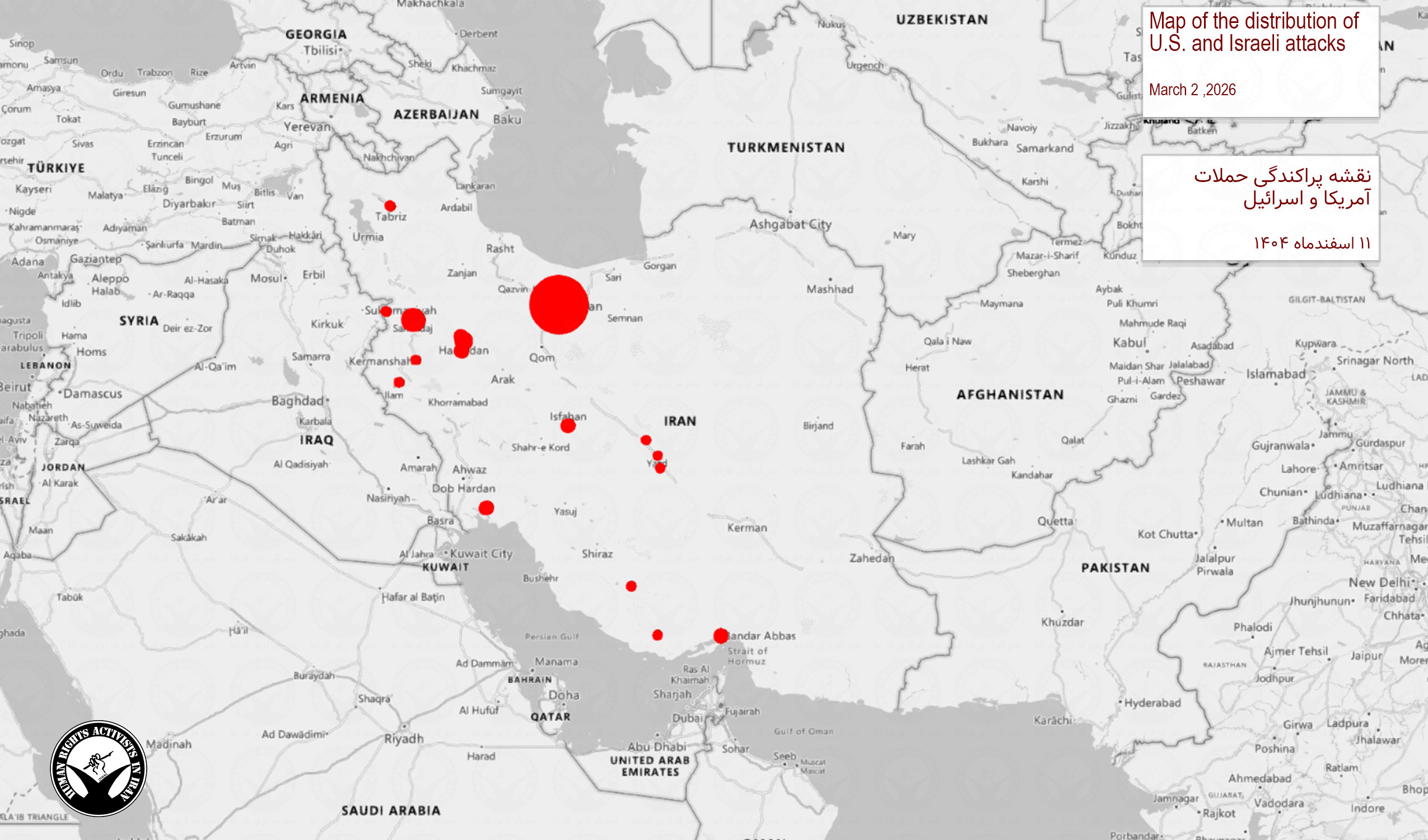
US-Iran war map Day 3

2 List of Objects Reported Hit

In the last 24 hours, the following objects were reported as hit. Please note that this list includes not only objects reportedly directly targeted, but also those documented as damaged as a result of nearby strikes or blast effects. This list is not exhaustive; the items listed are illustrative.

• The Law Enforcement Command Headquarters of Kurdistan, located in Sanandaj

• The Kurdistan Border Guard Command Center, located in Sanandaj

• The 8th Tactical Air Base (Islamic Republic of Iran Air Force) in Isfahan was targeted

• The Army’s Self-Sufficiency Jihad Base in Tehran was targeted

For a number of the above-listed objects, the precise nature of the target, whether civilian, military, or dual use, remains under review. Verification efforts are ongoing to determine the status and function of each object at the time of the reported strike. As further information becomes available, classifications may be revised in subsequent updates.

Facilities Protected Under International Humanitarian Law:

Under international humanitarian law, medical facilities, educational institutions, humanitarian facilities, religious sites, and emergency service centers are among the many objects that maintain special protected status and are afforded special protection.

As of the past 24 hours, HRANA documents reported damage to the following facilities protected by IHL. The information below reflects preliminary findings and remains subject to verification. This list is not exhaustive; those listed are illustrative.

• A mosque in Mehrshahr, Karaj, was targeted

• A residential building on Shariati Street in Tehran was targeted

• The governor’s office in Rey was targeted

• Shahid Bahonar Pier in Bandar Abbas was targeted

• A residential complex on Sepahbod Qarani Street in Tehran was targeted

3. Civilian Casualties

All casualty figures presented below are based on information available at the time of publication. The classification of individuals as civilian, military, or undetermined is preliminary and subject to change as further verification is conducted. Where sufficient corroboration is not yet available, cases remain under review and may be reclassified in subsequent updates.

In the last 24 hours, 85 civilians were reported killed, and 5 civilians were reported injured across 13 provinces. Among them, 1 children were killed.

The highest number of civilian casualties was documented in the city of Ilam, Ilam Province, followed by Kurdistan Province.

In Tehran, a particularly severe incident occurred when an airstrike damaged the Iranshahr Street Emergency building and several adjacent buildings. These incidents continue to be reviewed as additional documentation becomes available.

4. Military Casualties

During the same reporting period, 11 military personnel were reported killed. This figure for military casualties is limited exclusively to those reported in connection with attacks on military or paramilitary bases. Where possible, organizational affiliation and operational context are being assessed; however, not all details have been independently verified.

In certain incidents, individuals were killed in proximity to military objectives, but their formal status has not yet been conclusively established. These cases remain under review, and classification may be revised if credible information indicates a different status.

5. Unverified Casualties

As of publication, 52 casualties remain under active review and are currently classified as undetermined.

Classification may remain pending due to:

• Lack of identifying documentation

• Conflicting reports from sources

• Insufficient information regarding affiliation or role at the time of death or injury

• Ongoing efforts to verify open-source reports through the HRANA network

Several incidents and casualties documented in this reporting period remain under review due to incomplete or conflicting information. These cases are recorded but are not yet fully verified or cannot yet be reliably classified, and may be updated as additional corroboration becomes available.

6. Undetermined Casualties

As of the time of publication, 579 casualties (deaths and injuries) remain classified as undetermined. This includes cases where HRANA has not yet been able to confirm whether the individual was a civilian or military personnel, or where age status (including potential child casualties) has not been conclusively verified.

A Note on HRANA Methodology

The information contained in this report is compiled through HRANA’s established documentation network. Data is collected from a combination of field reports, local contacts, medical and emergency sources, civil society networks, and open source materials, including publicly available images, videos, and official statements where relevant. Each reported incident is logged and assessed through an internal review process before publication.

Given the evolving nature of hostilities, information is gathered on a rolling basis and reflects the status of documentation at the time of publication.

The figures presented in this report may not reflect the full scope of harm. Ongoing hostilities, damage to infrastructure, communication disruptions, restricted access to affected areas, and security risks for sources may limit the ability to document incidents comprehensively.

Delays in medical reporting, difficulties in confirming identities, and restricted access to certain provinces may result in temporary undercounting. As access improves or additional evidence emerges, casualty figures and incident classifications may be revised accordingly.

HRANA remains committed to transparency, methodological rigor, and the continual updating of its findings as new verified information becomes available.

Humanitarian Obligations

HRA reiterates that all parties to the conflict are bound by international humanitarian law and must at all times distinguish between civilians and combatants, and between civilian objects and military objectives. Attacks directed against civilians or civilian objects, as well as indiscriminate attacks, are prohibited. All parties are required to take all feasible precautions to minimize civilian harm and to protect facilities afforded special protection, including medical units, schools, humanitarian facilities, religious sites, and objects indispensable to the survival of the civilian population.

HRA further underscores the obligation under human rights law of the Islamic Republic of Iran to ensure access to information. Authorities must refrain from imposing internet shutdowns, communication disruptions, or other restrictions that impede the flow of information, obstruct documentation efforts, or prevent families from obtaining information about the fate and whereabouts of their relatives. Transparency and access to information are essential for civilian protection and the effective delivery of humanitarian assistance.

As seen in the documentation in this report, armed conflict brings profound destruction and suffering to civilians and deepens humanitarian crises. HRA calls for an immediate cessation of hostilities and a renewed commitment to a peaceful resolution grounded in international law. The continued loss of civilian life, including that of children, underscores the urgent need to prioritize the protection of human life above all else.

The protection of civilians and the safeguarding of fundamental rights, including access to information, are binding legal obligations. The pursuit of peace remains essential to preventing further harm.

Subscribe to Our Newsletter

Now is definitely not the time to stop reading!