HRANA– In the last 24 hours, and as of April 6, 2026, at 17:00 ET, HRANA has recorded at least 573 attacks across 215 incidents in 20 provinces, resulting in a total of at least 109 casualties (killed and injured, both civilian and military). The large scale of strikes over the past 24 hours marks the highest rate of attacks seen in the last ten days. In addition to their intensity and breadth, these attacks also show a strong focus on core industries, including Iran’s energy sector.
According to information recorded and verified by HRANA, from the first minutes of the day through the end of April 6, 2026 (Tehran time), at least 49 civilians were killed and 58 others were injured.
Aggregated data since the beginning of the conflict on February 28, 2026, based on incidents recorded in the incident tab and using minimum values for figures marked “more than”:
• Civilian fatalities: 1,665 people (including at least 248 children)
• Military fatalities: 1,221 people
• Unclassified fatalities (civilian/military): 711 people
Note on Official Statements: Alongside HRANA’s independent reporting, several official aggregate figures were also recorded today from state media, including:
The head of the Medical Council stated: “So far, we have had more than 24 martyrs from the health and medical sector, and more than 300 treatment centers, hospitals, and emergency units have been attacked.”
Miadfar, head of the Emergency Organization, said: “The youngest injured person was a one-month-old baby boy, and the oldest was a 100-year-old man. The number of injured medical staff has reached 117, of whom 77 were emergency personnel injured while on duty. Eighteen percent of the injured were women.”
Zakani, Mayor of Tehran, said: “In Tehran, we have had around 548 impact points; the number of damaged residential units has reached 33,500. More than 13,000 units have been completed and residents have returned to their homes. The homes of more than 4,500 households have sustained more extensive damage and will require more time.”
Alishvandi, Deputy for International Affairs of the Red Crescent, stated: “The number of women killed in the war has reached 251, including two who were pregnant. A total of 217 children and adolescents under the age of 18 have been killed.”
Since these figures are presented in aggregate form and cannot be precisely matched to specific incidents, they have not been included in the event-based calculations used in HRANA’s independent reporting section of this review. They are mentioned here solely as a record of official statements.
1. Overview of Incidents in the Last 24 Hours
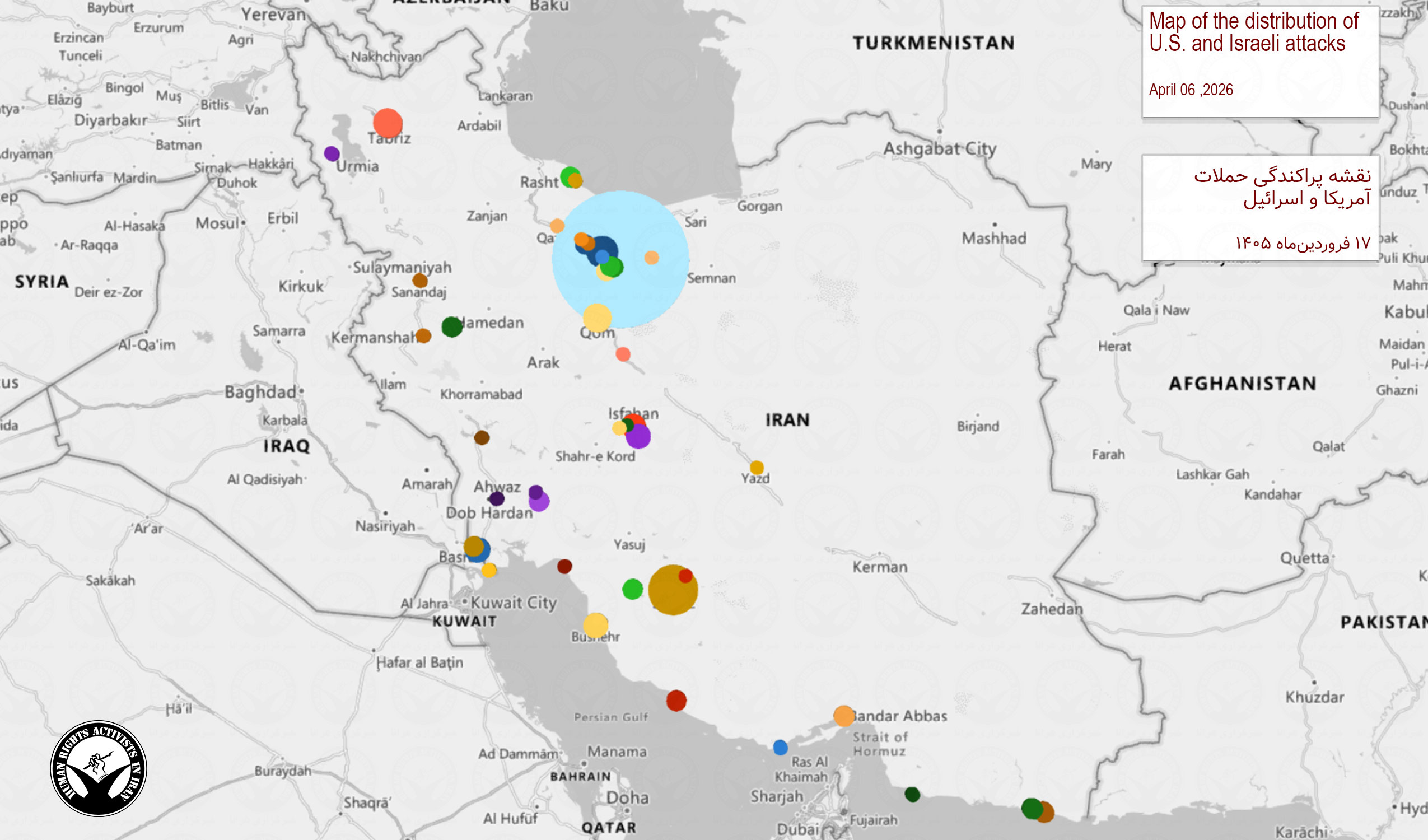
In the last 24 hours, incidents were reported across multiple provinces, reflecting a geographically dispersed pattern of hostilities. In a large portion of the incidents, the method/type of attack has not yet been confirmed and has been recorded as “undetermined.” In cases where the attack type was identifiable, airstrikes and drone attacks were reported.
Preliminary analysis shows that Tehran Province ranks first, accounting for 54% of all provinces targeted in the attacks. Fars Province, with a 7% share, ranks second, while Khuzestan Province, accounting for 5%, comes in third. The list is followed, respectively, by Alborz, Isfahan, Hormozgan, Bushehr, and Sistan and Baluchestan provinces.
2. List of Objects Reported Hit
In the past 24 hours, the recorded attacks have damaged 61 distinct objects or facilities. These include a range of different types of targets. In some cases, damage caused by nearby strikes or secondary consequences of the attacks has also been reported.
Examples of targets recorded over the past 24 hours:
• Tactical Air Base (Tabriz)
• Misaq Base Headquarters (Abadan)
• Al-Ghadir Brigade Headquarters (Yazdan Shahr)
• Naval Forces Facilities (Konarak)
• Parchin Military Zone (Tehran)
For a number of the listed targets, the exact nature of the target (civilian/military/dual-use) is still under review, and classifications may be revised as additional information becomes available.
Facilities Protected Under International Humanitarian Law:
Under international humanitarian law, medical facilities, educational institutions, humanitarian facilities, religious sites, and emergency service centers are among the many objects that maintain special protected status and are afforded special protection. In the past 24 hours, HRANA has preliminarily recorded the following cases:
• Sharif University of Technology (Tehran)
• Damand Company, electricity supplier for oil facilities (Asaluyeh)
• Agricultural Silos (Mehran)
• A school (Kermanshah)
• 132 Power Substation (Mashhad)
3. Civilian Casualties
In the past 24 hours, at least 49 civilian citizens, including 4 children and 2 women, were killed, and 58 other civilians, including 1 child, were injured. All classifications are preliminary and may be updated if new information becomes available.
4. Military Casualties
During the reporting period covered here, 2 military personnel were killed. Military casualties are generally reported in the context of attacks on Army and Islamic Revolutionary Guard Corps (IRGC) bases. Where possible, organizational affiliation and operational context are being assessed; however, not all details have yet been independently verified.
In some incidents, individuals have been killed in the vicinity of military targets; however, their official status has not yet been definitively determined. These cases remain under review, and if reliable information indicating a different status becomes available, the classification may be revised accordingly.
It is believed that military casualties are significantly higher than the figures reported in these reports. However, due to the sensitive nature of military information and the limited access of human rights groups and media to locations where military forces are present, this section largely reflects reports of senior officers or military personnel who were present in urban areas.
A Note on HRANA Methodology
Note that, in line with HRANA policy, this report reflects only incidents that occurred within the territorial borders of Iran.
The information contained in this report is compiled through HRANA’s established documentation network. Data is collected from a combination of field reports, local contacts, medical and emergency sources, civil society networks, and open source materials, including publicly available images, videos, and official statements where relevant. Each reported incident is logged and assessed through an internal review process before publication.
Given the evolving nature of hostilities, information is gathered on a rolling basis and reflects the status of documentation at the time of publication.
The figures presented in this report may not reflect the full scope of harm. Ongoing hostilities, damage to infrastructure, communication disruptions, restricted access to affected areas, and security risks for sources may limit the ability to document incidents comprehensively.
Delays in medical reporting, difficulties in confirming identities, and restricted access to certain provinces may result in temporary undercounting. As access improves or additional evidence emerges, casualty figures and incident classifications may be revised accordingly.
HRANA remains committed to transparency, methodological rigor, and the continual updating of its findings as new verified information becomes available.