
Day 28 of U.S. and Israeli Attacks on Iran: Strikes on Industrial Units and Infrastructure

HRANA– In the last 24 hours, and as of March 27, 2026, at 17:00 ET, HRANA has recorded at least 541 attacks across 164 incidents in 18 provinces, resulting in a total of at least 171 casualties (killed and injured, both civilian and military). In addition to the fact that the number of attacks and casualties marks the highest rate in the past week, today Iran’s steel industry and two related power plants witnessed a large-scale wave of attacks and destruction.

According to information recorded and verified by HRANA, from the first minutes of the day until the end of March 27, 2026 (Tehran time), at least 35 civilians were killed and 60 civilians were injured.

Aggregated data since the beginning of the conflict on February 28, 2026, based on incidents recorded in the incident tab and using minimum values for figures marked “more than”:

• Civilian fatalities: 1,527 people (including at least 228 children)

• Military fatalities: 1,167 people

• Unclassified fatalities (civilian/military): 695 people

Note on official statements: Alongside the independent reports published by HRANA, several aggregated official statistics were also recorded today from state media, including:

The Red Crescent announced: “More than 92,000 civilian units have been damaged, and 1,621 children under the age of 18 have been injured.”

The head of the Emergency Organization said: “In this war, more than 200 individuals under 18 and 237 women have been killed.”

The governor of Isfahan stated: “25 workers were killed in recent enemy attacks across different parts of Isfahan province, one of whom was from the province’s Armenian and Christian community.”

1. Overview of Incidents in the Last 24 Hours

In the last 24 hours, incidents were reported across multiple provinces, reflecting a geographically dispersed pattern of hostilities. In a large portion of the incidents, the method/type of attack has not yet been confirmed and has been recorded as “undetermined.” In cases where the attack type was identifiable, airstrikes and drone attacks were reported.

Preliminary analysis indicates that Tehran Province, with a 36% share, ranks first among the provinces that have been targeted. Isfahan Province, with an 18% share, is in second place, followed by Fars Province with 9% in third. Further down the list are Alborz Province, Khuzestan Province, and East Azerbaijan Province, respectively.
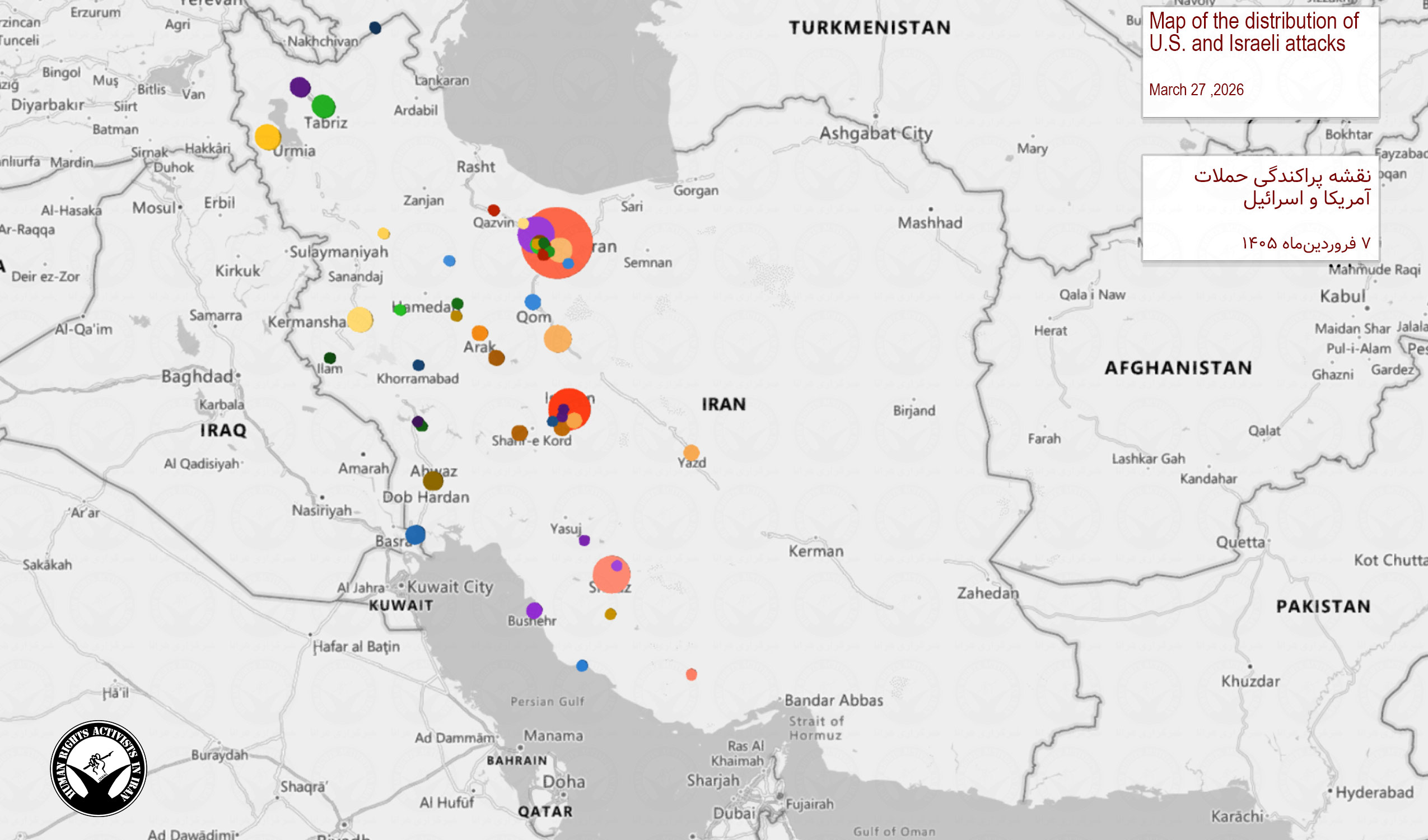
Map of Attacks Day 28

2. List of Objects Reported Hit

In the past 24 hours, the recorded attacks have damaged 42 distinct objects or facilities. These include a range of different types of targets. In some cases, damage caused by nearby strikes or secondary consequences of the attacks has also been reported.

Examples of targets recorded over the past 24 hours:

• Parchin Military Complex (Tehran)

• Army Helicopter Base Isfahan (Isfahan)

• Garrison 06 Tehran (Tehran)

• Ahmad Kazemi Garrison Vilashahr (Isfahan)

• 4th Tactical Fighter Base Dezful Andimeshk (Andimeshk)

For a number of the listed targets, the exact nature of the target (civilian/military/dual-use) is still under review, and classifications may be revised as additional information becomes available.

Facilities Protected Under International Humanitarian Law:

Under international humanitarian law, medical facilities, educational institutions, humanitarian facilities, religious sites, and emergency service centers are among the many objects that maintain special protected status and are afforded special protection. In the past 24 hours, HRANA has preliminarily recorded the following cases:

• Mobarakeh Steel Company (Isfahan)

• Khuzestan Steel Company (Khuzestan)

• Firoozabad Cement Plant and Mine (Firoozabad)

• Ardakan Uranium Processing Facility (Ardakan)

• Arak Heavy Water Facility (Arak)

3. Civilian Casualties

In the past 24 hours, at least 35 civilian citizens, including 7 children and 6 women, have been killed, and 60 civilians, including 1 child, have been injured. All classifications are preliminary and may be updated as new information becomes available.

4. Military Casualties

During the period covered by this report, no reports of military casualties have been received. Military casualties are generally reported in the context of attacks on Army and Islamic Revolutionary Guard Corps (IRGC) bases. Where possible, organizational affiliation and operational context are being assessed; however, not all details have yet been independently verified.

In some incidents, individuals have been killed in the vicinity of military targets; however, their official status has not yet been definitively determined. These cases remain under review, and if reliable information indicating a different status becomes available, the classification may be revised accordingly.

It is believed that military casualties are significantly higher than the figures reported in these reports. However, due to the sensitive nature of military information and the limited access of human rights groups and media to locations where military forces are present, this section largely reflects reports of senior officers or military personnel who were present in urban areas.

5. Confirmed but Unspecified Casualties

In the past 24 hours, 25 deaths and 51 injuries have been reported but remain classified as undetermined. This means that HRANA News Agency has not yet been able to establish with sufficient certainty whether these individuals were civilians or military personnel.

A Note on HRANA Methodology

Note that, in line with HRANA policy, this report reflects only incidents that occurred within the territorial borders of Iran.

The information contained in this report is compiled through HRANA’s established documentation network. Data is collected from a combination of field reports, local contacts, medical and emergency sources, civil society networks, and open source materials, including publicly available images, videos, and official statements where relevant. Each reported incident is logged and assessed through an internal review process before publication.

Given the evolving nature of hostilities, information is gathered on a rolling basis and reflects the status of documentation at the time of publication.

The figures presented in this report may not reflect the full scope of harm. Ongoing hostilities, damage to infrastructure, communication disruptions, restricted access to affected areas, and security risks for sources may limit the ability to document incidents comprehensively.

Delays in medical reporting, difficulties in confirming identities, and restricted access to certain provinces may result in temporary undercounting. As access improves or additional evidence emerges, casualty figures and incident classifications may be revised accordingly.

HRANA remains committed to transparency, methodological rigor, and the continual updating of its findings as new verified information becomes available.

Dozens of Citizens Arrested in Connection with the War Across Several Provinces

HRANA – Domestic media have reported the arrest of more than 84 citizens in Hamedan, Dezful, Semnan, and the provinces of Golestan, West Azerbaijan, Kerman, Isfahan, and Ilam on charges such as “cooperating with foreign media and sending images of missile impact sites and the locations of military centers to these outlets.” A video has also been published showing the forced confession of one of these citizens, though the conditions under which it was recorded remain unclear.

According to Tasnim, several citizens were arrested in Semnan. The report claims that these individuals were in contact with accounts affiliated with the Israeli government and had gathered information and facilitated potential attacks on areas in Semnan Province before being identified and arrested. The provincial police commander of Semnan further alleged that one of the detainees confessed to having requested a missile strike on the city of Semnan in communications with an alleged Israeli agent.

Meanwhile, IRIB reported that 46 citizens were arrested in the provinces of Golestan, West Azerbaijan, Kerman, Isfahan, and Ilam. According to this report, the arrests were carried out by agents of the Ministry of Intelligence on charges such as collecting images and sending them to Iran International.

The report also claimed that six of those arrested were members of opposition groups in the northwest of the country. Additionally, during these arrests, “a number of handguns and two Starlink devices” were discovered and confiscated.

In a separate report, Young Journalists Club announced the arrest of at least 36 citizens across three provinces. According to this report, 21 individuals were arrested in Kerman Province, 10 in Isfahan Province, and 5 others in Ilam Province by agents of the Ministry of Intelligence.

The report alleges that these individuals had sent information and images of certain locations to a foreign media outlet and opposition groups. It also stated that two Starlink devices were discovered and confiscated from them.

According to a report by Fars News Agency, one citizen was also arrested by security forces in Dezful. At the same time, a video of this individual’s forced confession was published, though it is unclear under what conditions it was recorded.

Mehr News Agency reported that the public relations office of the IRGC in Hamedan announced the arrest of an individual accused of recording and sending videos and images to foreign media outlets.

These reports did not provide information regarding the identities or places of detention of the arrested citizens.

It is worth noting that military attacks by the United States and Israel on Iran began on February 28, 2026. Since the start of these attacks, HRANA has been documenting and recording related events across different parts of the country on a daily basis. For further information, you can refer to HRANA’s detailed report on the twenty-seventh day of the conflict, published last night.

Report on the Arrest of 113 Citizens in Tehran and Kashan

HRANA – The IRGC Intelligence Organization in Tehran announced the arrest of 103 citizens since the beginning of the war and stated that action has also been taken against 16 holders of Starlink devices and 400 sellers of cyber circumvention tools. Meanwhile, 10 citizens in Kashan were arrested by IRGC Intelligence forces for chanting slogans in support of parties involved in the war with Iran.

According to IRIB, the IRGC Intelligence Organization in Tehran reported the arrest of 103 citizens since the start of the war. The statement added that four individuals had intended to carry out “sabotage on Tehran’s electricity network infrastructure” but were identified and arrested. Five individuals affiliated with an opposition group, who allegedly “intended to make the streets unsafe,” were also detained by agents. Additionally, five citizens were arrested for “armed attacks on checkpoint patrols.” Another 90 citizens were detained for sending coordinates of sensitive locations and images of impact sites to foreign media outlets.

In another part of the statement, without specifying the nature of the measures taken, it was noted that action had also been taken against 16 holders of Starlink devices and 400 sellers of cyber circumvention tools.

Separately, Mehr News Agency, quoting the Prosecutor of Kashan, reported that early this morning, 10 individuals were arrested by IRGC Intelligence forces for chanting slogans in support of parties involved in the war with Iran.

The reports did not mention the identities of the detainees or their place of detention.

It is worth noting that military attacks by the United States and Israel on Iran began on February 28, 2026. Since the start of these attacks, HRANA has been documenting and recording related events across different parts of the country on a daily basis. For further information, you can refer to HRANA’s detailed report on the twenty-seventh day of the conflict, published last night.

At least 16 Citizens Arrested in Tehran and Anar County

HRANA – The Police Information Center of Kerman Province announced in a statement that 15 citizens were arrested in Anar County on charges of “criminal activities online and offline.” Meanwhile, a woman was arrested in Tehran for recording videos of explosion sounds and sending them to media outlets.

According to  ILNA, 15 citizens were arrested in Anar County. In its statement, the Police Information Center of Kerman Province cited “criminal activities in virtual and real spaces” as the reason for these arrests.

The statement further accused these individuals of “disturbing public opinion,” and legal cases have been opened against them.

The Student News Agency also reported the arrest of a woman in Tehran by the IRGC Intelligence Organization. The reason given for her arrest was recording videos of explosion sounds in Tehran and sending them to media outlets.

The reports did not mention the identities of the detainees, the time of their arrest, or their place of detention.

It is worth noting that military attacks by the United States and Israel on Iran began on February 28, 2026. Since the start of these attacks, HRANA has been documenting and recording related events across different parts of the country on a daily basis. For further information, you can refer to HRANA’s detailed report on the twenty-seventh day of the conflict, published last night.

Day 27 of U.S. and Israeli Attacks on Iran: Renewed Escalation in Strikes

HRANA– In the last 24 hours, and as of March 26, 2026, at 17:00 ET, HRANA has recorded at least 357 attacks across 154 incidents in 21 provinces, resulting in a total of at least 42 casualties (killed and injured, both civilian and military). The data recorded today shows that after two days of relative decline, the number of attacks has increased again.

According to information recorded and verified by HRANA, from the first minutes of the day until the end of March 26, 2026 (Tehran time), at least 28 civilians were killed and nine civilians were injured.

Aggregated data since the beginning of the conflict on February 28, 2026, based on incidents recorded in the incident tab and using minimum values for figures marked “more than”:

• Civilian fatalities: 1,492 people (including at least 221 children)

• Military fatalities: 1,167 people

• Unclassified fatalities (civilian/military): 670 people

Note on Official Statements: Alongside HRANA’s independent reporting, several aggregated official figures were also recorded today from state media, including:

A provincial official in Hormozgan told Mehr News Agency: “Since the beginning of the Ramadan war, 222 residents of Hormozgan have been killed as a result of American and Zionist attacks on our country.”

The governor of Zanjan stated: “As a result of airstrikes by the Zionist regime and the United States on Zanjan Province, 60 citizens have been killed. Of these, 46 were residents of the province, while the remaining 16 lived in other parts of the country and were buried in Zanjan.”

1. Overview of Incidents in the Last 24 Hours

In the last 24 hours, incidents were reported across multiple provinces, reflecting a geographically dispersed pattern of hostilities. In a large portion of the incidents, the method/type of attack has not yet been confirmed and has been recorded as “undetermined.” In cases where the attack type was identifiable, airstrikes and drone attacks were reported.

Preliminary analysis indicates that Tehran Province, accounting for 49%, ranks at the top of the list of provinces targeted by the attacks. Isfahan and Razavi Khorasan provinces each rank jointly in second place with a 10% share, while Fars Province ranks third with 7%. They are followed by Alborz, Hamedan, and Sistan & Baluchestan provinces, respectively.

Map of Attacks Day 27

2. List of Objects Reported Hit

In the past 24 hours, the recorded attacks have damaged 15 distinct objects or facilities. These include a range of different types of targets. In some cases, damage caused by nearby strikes or secondary consequences of the attacks has also been reported.

Examples of targets recorded over the past 24 hours:

• Missile site (Zafar)

• Army armored garrison (Shiraz)

• IRGC-affiliated headquarters (Hamedan)

• Ministry of Defense aerospace industries in Mehrabad, Tehran

• Fuel depot near Shahid Hashemi-Nejad Airport, Mashhad

For a number of the listed targets, the exact nature of the target (civilian/military/dual-use) is still under review, and classifications may be revised as additional information becomes available.

Facilities Protected Under International Humanitarian Law:

Under international humanitarian law, medical facilities, educational institutions, humanitarian facilities, religious sites, and emergency service centers are among the many objects that maintain special protected status and are afforded special protection. In the past 24 hours, HRANA has preliminarily recorded the following cases:

• Four-story residential building (Isfahan)

• Judiciary building on Kaveh Street (Isfahan)

• Seven-story residential building (Bandar Abbas)

• Residential areas of Asbas village (Khosrowshah)

•Industrial town (Neyshabur)

3. Civilian Casualties

In the past 24 hours, at least 28 civilian citizens, including 4 children, have been killed and 9 others injured. All classifications are preliminary and may be updated as new information becomes available.

4. Military Casualties

During the period covered by this report, no reports of military casualties have been received. Military casualties are generally reported in the context of attacks on Army and Islamic Revolutionary Guard Corps (IRGC) bases. Where possible, organizational affiliation and operational context are being assessed; however, not all details have yet been independently verified.

In some incidents, individuals have been killed in the vicinity of military targets; however, their official status has not yet been definitively determined. These cases remain under review, and if reliable information indicating a different status becomes available, the classification may be revised accordingly.

It is believed that military casualties are significantly higher than the figures reported in these reports. However, due to the sensitive nature of military information and the limited access of human rights groups and media to locations where military forces are present, this section largely reflects reports of senior officers or military personnel who were present in urban areas.

5. Confirmed but Unspecified Casualties

One reported death and four injuries over the past 24 hours remain classified as “undetermined,” meaning HRANA has not yet verified whether the individuals were civilians or military personnel.

Additionally, 24 burials were recorded today, related to casualties from attacks in previous days.

A Note on HRANA Methodology

Note that, in line with HRANA policy, this report reflects only incidents that occurred within the territorial borders of Iran.

The information contained in this report is compiled through HRANA’s established documentation network. Data is collected from a combination of field reports, local contacts, medical and emergency sources, civil society networks, and open source materials, including publicly available images, videos, and official statements where relevant. Each reported incident is logged and assessed through an internal review process before publication.

Given the evolving nature of hostilities, information is gathered on a rolling basis and reflects the status of documentation at the time of publication.

The figures presented in this report may not reflect the full scope of harm. Ongoing hostilities, damage to infrastructure, communication disruptions, restricted access to affected areas, and security risks for sources may limit the ability to document incidents comprehensively.

Delays in medical reporting, difficulties in confirming identities, and restricted access to certain provinces may result in temporary undercounting. As access improves or additional evidence emerges, casualty figures and incident classifications may be revised accordingly.

HRANA remains committed to transparency, methodological rigor, and the continual updating of its findings as new verified information becomes available.

Subscribe to Our Newsletter

Now is definitely not the time to stop reading!

Report on the Arrest of Christian Convert Mohammad Nikbakht

HRANA – Mohammad Nikbakht, a Christian convert, has been detained by security forces for over 10 days and is currently being held in Dastgerd Prison in Isfahan.

Based on the report by Article 18, Mr. Nikbakht was arrested by security forces on March 15, 2026. He is currently being held in Ward 2-A of Dastgerd Prison in Isfahan.

The report states that the arrest of this Christian citizen was accompanied by the use of violence.

As of the time of this report, no information has been obtained regarding the reasons for his arrest or the charges brought against him.

The treatment of Christian converts in Iran takes place despite Article 18 of the Universal Declaration of Human Rights and Article 18 of the International Covenant on Civil and Political Rights, which affirm that every person has the right to freedom of religion, including the freedom to change their religion and to manifest it individually or collectively, in public or in private.

Over 15 Citizens Arrested by IRGC Intelligence Agents in Isfahan

HRANA – The IRGC Intelligence Organization in Isfahan has reported the arrest of more than 15 citizens in the province on charges described as “cooperating with foreign media and sending images of missile strike locations and the positions of military, relief, and checkpoint centers to these outlets.” Images of the forced confessions of three of these citizens have also been released, though the conditions under which they were recorded remain unclear.

According to Mehr News Agency, IRGC Intelligence in Isfahan has claimed that these individuals were cooperating with foreign media and sending images of locations targeted by missiles from countries involved in the war with Iran, as well as the positions of forces and military, rescue, and checkpoint sites.

At the same time, images of the forced confessions of three of these citizens have been published, though the circumstances of their recording are unknown.

The report does not provide further details, including the identities of the detainees or their place of detention.

It is worth noting that U.S. and Israeli military attacks on Iran began on February 28, 2026 . Since the start of these attacks, HRANA has been documenting and recording related developments across the country on a daily basis. For more information, readers can refer to HRANA’s detailed report on the 26th day of the conflict, published last night.

Six Citizens Arrested in Yazd for Using Starlink Equipment

HRANA – Domestic media have reported the arrest of six citizens in Yazd over what has been described as “using Starlink equipment and sending news to foreign media outlets.” Additionally, 61 bank accounts linked to these individuals have been frozen.

According to Mehr, Ahmad Negahban, the commander of the Law Enforcement Forces in Yazd Province, stated that these individuals were detained for “using Starlink equipment.”

He added that during inspections by law enforcement forces, six Starlink devices were discovered and confiscated from these citizens. Furthermore, 61 bank accounts belonging to them have been blocked.

According to Negahban, the arrested individuals were “sending news and information to foreign media and selling internet services.”

The report does not provide further details, including the identities of the detainees or their place of detention.

It is worth noting that U.S. and Israeli military attacks on Iran began on February 28, 2026 . Since the start of these attacks, HRANA has been documenting and recording related developments across the country on a daily basis. For more information, readers can refer to HRANA’s detailed report on the 26th day of the conflict, published last night.

Report on the Arrest of at Least 12 Citizens in Various Provinces

HRANA – Domestic media outlets have reported the arrest of at least 12 citizens in Kermanshah, Urmia, and Semnan Province on charges such as “espionage” and alleged connections with foreign-based media. Images of the forced confessions of two of these citizens have also been published, although the conditions under which they were recorded remain unclear.

According to Hamshahri, three citizens were arrested in Kermanshah. These individuals were detained by intelligence agents of the IRGC’s “Nabi Akram” unit on charges of membership in an alleged “espionage” network.

Meanwhile, Tasnim reported that two citizens were arrested in Urmia by intelligence agents of the IRGC in West Azerbaijan Province. In this report, a video was released accusing the individuals of “espionage,” alleging that they had “connections with Israel and sent information and images of certain locations to foreign media outlets.” At the same time, footage of their forced confessions was also published, though the circumstances of the recordings remain unknown.

According to ILNA, IRGC Intelligence Organization in Semnan Province announced the identification and arrest of seven citizens in the province. The report claims that the detainees “had links with foreign intelligence services and engaged in identifying military and sensitive locations, arson, and writing slogans.”

These reports do not provide further details such as the identities of the detainees, the exact time and location of their arrests, or their place of detention.

Since February 28, Iranian territory has been targeted by military attacks from Israel and the United States. For more information, readers can refer to HRANA’s report published last night on the 26th day since the beginning of these attacks.

It should also be noted that while combating espionage is not in itself considered a violation of human rights, given the Iranian government’s record of using such charges instrumentally against political opponents, such claims, especially in the absence of transparent details and due process, are consistently met with skepticism.

Day 26 of U.S. and Israeli Attacks on Iran: Explosions Reach Razavi Khorasan Province

HRANA– In the last 24 hours, and as of March 25, 2026, at 17:00 ET, HRANA has recorded at least 90 attacks across 53 incidents in 13 provinces, resulting in a total of at least 27 casualties (killed and injured, both civilian and military). Today, Razavi Khorasan Province, considered one of the geographically most distant regions of Iran from the current conflict, was also targeted by the United States and Israel.

According to information recorded and verified by HRANA, from the first minutes of the day until the end of March 25, 2026 (Tehran time), at least nine civilians were killed and 18 civilians were injured.

Aggregated data since the beginning of the conflict on February 28, 2026, based on incidents recorded in the incident tab and using minimum values for figures marked “more than”:

• Civilian fatalities: 1,464 people (including at least 217 children)

• Military fatalities: 1,167 people

• Unclassified fatalities (civilian/military): 669 people

Note on Official Statements: Alongside HRANA’s independent reports, several aggregated official statistics were also reported today by state media, including:

The head of the Iranian Red Crescent Society stated in a televised interview: “In these attacks, 66 children have lost their lives and around 3,000 women have been severely injured. Additionally, three emergency helicopters and 48 rescue vehicles have been completely destroyed. The organization’s rapid response teams have been placed on alert across the country, and in Tehran, 680 people have been rescued from under the rubble.”

The governor of Zanjan announced: “In these attacks, 43 people from the province, mostly women, children, workers, and road maintenance personnel, and 16 other residents from the province in other parts of the country were killed. Their bodies have been buried in Zanjan, bringing the total number of fatalities from the province to 59. Among them were five children, 11 women, four individuals over the age of 50, and 15 aged between 19 and 25. In total, 324 residents of the province, including women, children, and urban and rural workers, were injured.”

The Israeli Minister of Defense, regarding the country’s operations against Iran, stated that so far, more than 15,000 bombs have been dropped on Iran. This number is four times the amount used in the 12-day war.

1. Overview of Incidents in the Last 24 Hours

In the last 24 hours, incidents were reported across multiple provinces, reflecting a geographically dispersed pattern of hostilities. In a large portion of the incidents, the method/type of attack has not yet been confirmed and has been recorded as “undetermined.” In cases where the attack type was identifiable, airstrikes and drone attacks were reported.

Preliminary analysis indicates that, for the second time since the beginning of the war, Tehran Province ranks first among the provinces targeted, accounting for 23% of the attacks. Alborz and Hormozgan provinces, each with a 13% share, jointly rank second, while Isfahan Province, with 9%, ranks third. Following these are East Azerbaijan, Razavi Khorasan, and Fars provinces, respectively.

Map of Attacks Day 26

2. List of Objects Reported Hit

In the past 24 hours, the recorded attacks have damaged 23 distinct objects or facilities. These include a range of different types of targets. In some cases, damage caused by nearby strikes or secondary consequences of the attacks has also been reported.

Examples of targets recorded over the past 24 hours:

• Airbase (Bandar Abbas)

• Marine Brigade (Bandar Abbas)

• Shipyard (Bandar Abbas)

• Airport (Shiraz)

• Airport (Lamerd)

For a number of the listed targets, the exact nature of the target (civilian/military/dual-use) is still under review, and classifications may be revised as additional information becomes available.

Facilities Protected Under International Humanitarian Law:

Under international humanitarian law, medical facilities, educational institutions, humanitarian facilities, religious sites, and emergency service centers are among the many objects that maintain special protected status and are afforded special protection. In the past 24 hours, HRANA has preliminarily recorded the following cases:

• Railway staff housing (Tabriz)

• Damage to residential homes in eastern Tehran (Tehran)

• Imam Sajjad Mosque (Mashhad)

• Kiarostami House-Museum (Tehran)

• Industrial Town No. 5 (Ahvaz)

3. Civilian Casualties

In the past 24 hours, at least nine civilians have been killed and 18 injured. All classifications are preliminary and may be updated as new information becomes available.

4. Military Casualties

During the period covered by this report, no reports of military casualties have been received. Military casualties are generally reported in the context of attacks on Army and Islamic Revolutionary Guard Corps (IRGC) bases. Where possible, organizational affiliation and operational context are being assessed; however, not all details have yet been independently verified.

In some incidents, individuals have been killed in the vicinity of military targets; however, their official status has not yet been definitively determined. These cases remain under review, and if reliable information indicating a different status becomes available, the classification may be revised accordingly.

It is believed that military casualties are significantly higher than the figures reported in these reports. However, due to the sensitive nature of military information and the limited access of human rights groups and media to locations where military forces are present, this section largely reflects reports of senior officers or military personnel who were present in urban areas.

5. Confirmed but Unspecified Casualties

Today, one burial was recorded, related to casualties from previous days’ attacks.

A Note on HRANA Methodology

Note that, in line with HRANA policy, this report reflects only incidents that occurred within the territorial borders of Iran.

The information contained in this report is compiled through HRANA’s established documentation network. Data is collected from a combination of field reports, local contacts, medical and emergency sources, civil society networks, and open source materials, including publicly available images, videos, and official statements where relevant. Each reported incident is logged and assessed through an internal review process before publication.

Given the evolving nature of hostilities, information is gathered on a rolling basis and reflects the status of documentation at the time of publication.

The figures presented in this report may not reflect the full scope of harm. Ongoing hostilities, damage to infrastructure, communication disruptions, restricted access to affected areas, and security risks for sources may limit the ability to document incidents comprehensively.

Delays in medical reporting, difficulties in confirming identities, and restricted access to certain provinces may result in temporary undercounting. As access improves or additional evidence emerges, casualty figures and incident classifications may be revised accordingly.

HRANA remains committed to transparency, methodological rigor, and the continual updating of its findings as new verified information becomes available.