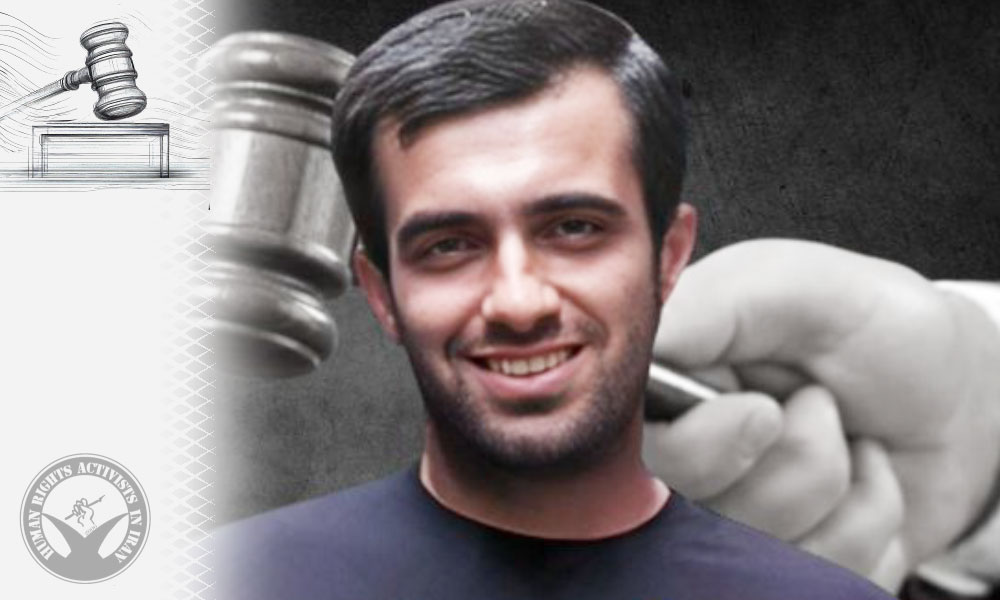
Mojahed Korkor Executed

HRANA – The Judiciary’s Media Center announced today, Wednesday, June 11, that Abbas (Mojahed) Korkor (Korkori), a prisoner held in Sheiban Prison in Ahvaz, has been executed.

The report from Mizan, the Judiciary’s media outlet, states that Korkor had been sentenced to death on three separate counts by the Ahvaz Revolutionary Court. The Supreme Court upheld the verdict. He was convicted on charges including moharebeh (enmity against God) for allegedly brandishing a weapon with intent to kill and intimidate the public; corruption on earth through acts of violence using military-grade firearms; and forming and participating in an armed group opposed to the Islamic Republic.

In late-December 2024, Korkor was sentenced to death for the second time by the Revolutionary Court. A previous death sentence had been overturned by the Supreme Court in early-December 2024 and sent back to a parallel court branch for reconsideration.

Korkor had initially been sentenced to death in April 2023 by Branch 1 of the Ahvaz Revolutionary Court on charges including moharebeh and corruption on earth.

He had been held in solitary confinement at Sheiban Prison since December 20, 2022, and was later transferred to Ward 8 of the prison in August 2024.

The judiciary accused Abbas Korkor of involvement in the killing of Kian Pirfalak, a child who was fatally shot during the nationwide protests. However, the Pirfalak family has publicly rejected this claim. Kian’s mother stated, “On our way home, officers opened fire on our car.”

Korkor was charged with disrupting public order, inflicting fatal injuries resulting in the deaths of seven individuals including Kian Pirfalak, causing serious damage to public and private property, and forming or joining anti-government groups engaged in armed rebellion against the Islamic Republic.

In January 2023, the prosecutor of Izeh announced that 70 people had been charged in connection with the protests held on November 16, 2022. On that day, at least seven people, including Kian Pirfalak, were fatally shot by security forces.

While authorities continue to describe the events of November 16 in Izeh as a “terrorist attack,” eyewitnesses and the families of victims have presented accounts that contradict the government’s narrative.

Mohammad Amouri Sentenced to One Year in Prison on Political Charges

HRANA News Agency –The Revolutionary Court of Ahvaz has sentenced Mohammad Amouri, a citizen held in Sheiban Prison, to one year in prison.

Based on the verdict issued by the Ahvaz Revolutionary Court and communicated to Mr. Amouri, he has been sentenced to one year in prison on the charge of propaganda against the regime, with time spent in detention counted toward the sentence.

On January 8, 2025, Mohammad Amouri was arrested by agents of the Ministry of Intelligence in Ramhormoz and transferred to The Ministry of Intelligence’s detention facility. He was eventually moved to Sheiban Prison in Ahvaz.

Mohammad Amouri is a 27-year-old citizen from Ramshir, Khuzestan Province.

Prisoner Executed in Sheiban Prison, Ahvaz

HRANA News Agency – At dawn on Thursday,  February 20, 2025, a prisoner convicted of drug-related charges was executed in Sheiban Prison, Ahvaz.

According to HRANA, the news arm of the Human Rights Activists in Iran, the executed prisoner has been identified as Mohsen Sagvand.

Sagvand had previously been arrested on drug-related charges and later sentenced to death by a judicial authority.

As of the time of this report, Iranian authorities and prison officials have not publicly announced his execution.

According to data compiled by HRANA, 52.69% of all executions in Iran in 2024 were related to drug-related charges. Notably, only 6% of the executions were officially announced, highlighting a significant lack of transparency. For a detailed analysis of these executions and the associated statistics, see HRANA’s full report.

Over 110 Days in Limbo: Mohammad Loveimi’s Case Remains Unclear

HRANA News Agency – Mohammad Loveimi, a political detainee, has been held in uncertainty at Sheiban Prison in Ahvaz for nearly four months since his arrest, with no clear charges or legal proceedings in sight.

A source familiar with his case confirmed to HRANA: “More than 110 days have passed since Mr. Loveimi’s arrest, yet he remains in legal limbo at Sheiban Prison in Ahvaz. There is still no information about the reasons for his detention or the charges against him, and authorities have not allowed his release on bail.”

According to information obtained by HRANA, Mohammad Loveimi was arrested by security forces in November 2024 and transferred to Ward 5 of Sheiban Prison in Ahvaz.

Earlier in 2024, Loveimi had been released from the same prison after completing a nine-month sentence.

Mokhtar Alboshokeh Exposes Torture and Medical Neglect in Ahvaz Police Detention

HRANA News Agency – Mokhtar Alboshokeh, a political prisoner held in Sheiban Prison in Ahvaz, has described the physical and psychological torture he endured in one of the police detention facilities in Ahvaz in an open letter.

In the letter, he recounts how officers subjected him to verbal sexual harassment and repeatedly struck his abdomen despite being aware of his hernia condition. These violent acts exacerbated his illness, causing severe pain. Alboshokeh, who is serving a life sentence, also reveals that he has been deprived of essential medical treatment, despite medical recommendations. Instead of receiving appropriate care, he has been forced to rely on heavy painkillers and medications to endure the pain caused by his condition and the torture.

Previously, Alboshokeh was removed from prison on orders from the Iranian Cyber Police (FATA) and was subsequently beaten while in one of the police detention centers in Ahvaz. His letter details the worsening of his condition due to the violent acts and the resulting injuries.

Here is the full text of Mokhtar Alboshokeh’s letter:

“When you’ve been in prison for 14 years with a life sentence plus five more years, even a glimpse of the streets, cars in motion, the trees lining the boulevards, or the hurried faces of people seems like embarking on a luxurious tour to see the most beautiful sights in the world. That’s why, on December 6, 2024, when I was called and escorted to a car within the prison grounds, a spark of excitement ignited in me. This feeling lasted only until I left the prison gate with a group of plainclothes agents I didn’t recognize. The person in the front seat turned, punched me hard in the face, and instructed his colleague beside me, ‘Put a blindfold and handcuffs on this scum!’

Holding my aching face, I resisted while the two officers beside me wrenched my hands away, forcing them behind my back to handcuff me. Their aggressive actions caused severe pain as I caught the last fleeting glimpses of the world outside the prison before a blindfold plunged me into complete darkness. At that moment, it struck me: ‘Mokhtar, this isn’t a sightseeing trip. There will be no boulevards, trees, cars, or faces of passersby to marvel at.’ But even then, I didn’t anticipate the extent of torture awaiting me—especially after spending 14 years in prison!

I tried to reassure myself: ‘I’ve already spent 14 years in prison with a life sentence for a crime I didn’t commit. What more could they want from me to justify tormenting me further?’ While I was lost in these thoughts, a powerful punch to my lower abdomen left me doubled over in pain. Reflexively, I said, ‘Please, don’t hit me! I have a severe hernia.’ The officer next to me, seemingly thrilled by this information, sneered and said, ‘Oh, even better!’ He hurled vulgar sexual insults and added, ‘A hernia, huh? I’ll make you forget all about it!’ before landing another brutal punch to the same spot.

During the drive to their detention center, their relentless barrage of obscene insults directed at my mother, sister, and family was so psychologically painful that it almost distracted me from the physical pain of their punches and slaps. After arriving at the facility—later revealed to belong to the Ahvaz Cyber Police (FATA)—I endured severe torture for several days.

I lost track of time but eventually passed out from the repeated punches and kicks, especially to my abdomen. When I regained consciousness, I found myself chained to a hospital bed with handcuffs and leg shackles. A man, presumably a doctor, was pleading with the officers, saying, ‘This man has a severe hernia, and there’s a high risk of rupture. He needs to stay here and undergo immediate surgery.’ Ignoring him as though he were talking to a wall, the plainclothes officers dragged me off the hospital bed after re-blindfolding and handcuffing me, returning me to their torture chamber.

This cycle of torture, vulgar insults aimed at my family, losing consciousness, being taken to the hospital, the doctor’s pleas for urgent treatment, and the officers’ indifference repeated itself. All of this happened while I was on a hunger strike. Eventually, I was returned to Sheiban Prison in Ahvaz. And why did they do all this? Because they found my name in the contact list of a phone belonging to someone who had been arrested. I’ve been in their prison for 14 years!

When I returned to the prison ward, I initially thought I had been gone for over two months. My cellmates reminded me it had only been 12 days—from December 6 to December 18. Now, a month after those events, I feel an irreparable void inside me—not because of the physical torture, but because of the psychological torment of their relentless vulgar insults against my loved ones. It’s a wound that will never heal.”

Background on Mokhtar Alboshokeh

Mokhtar Alboshokeh was arrested by security forces in March 2011 in the city of Khalafabad (also known as Ramshir) in Khuzestan Province. In July 2012, he was sentenced to death by Branch 3 of the Ahvaz Revolutionary Court, presided over by Judge Seyyed Mohammad Bagher Mousavi, on charges of moharebeh (waging war against God), efsad-e-fel-arz (spreading corruption on earth), propaganda against the Islamic Republic, and actions against national security. His death sentence was later commuted to life imprisonment.

Subscribe to Our Newsletter

Now is definitely not the time to stop reading!

Mojahed Korkor Sentenced to Death for the Second Time

Abbas (Mojahed) Korkor, a prisoner held in Sheiban Prison in Ahvaz, has been sentenced to death for the second time by the Revolutionary Court of Ahvaz. He had previously been sentenced to death by the same court, but that ruling was overturned by the Supreme Court, and his case was referred to a parallel branch for retrial.

The prisoner’s sister, in a public statement, announced: “Based on the latest information, we have learned that Mojtaba has been sentenced to death once more.”

In December of this year, the Supreme Court had overturned Korkor’s initial death sentence and referred his case for retrial to a parallel branch. In April of 2023, he had been sentenced to death by Branch 1 of the Revolutionary Court of Ahvaz on charges such as “enmity against God” (Moharebeh) and “spreading corruption on earth” (Efsad-e Fel-Arz). Then, in December 2023, the Supreme Court upheld the death sentence, and his case was forwarded to the execution enforcement branch of the Izeh court.

Korkor was initially held in solitary confinement at Sheiban Prison starting December 20, 2022, before being moved to Ward 8 in early August 2023.

The judiciary accused Korkor of involvement in the killing of Kian Pirfalak, a child who died during the 2022 nationwide protests. However, Kian’s family has consistently denied these allegations, with his mother stating, “When we were returning home, security forces opened fire on our car.”

The court had charged Korkor with “disrupting public order, causing severe injuries and the deaths of seven individuals, including Kian Pirfalak, significant damage to public and private property, forming opposition groups, and engaging in armed rebellion against the Islamic Republic of Iran.”

In January 2023, the Izeh prosecutor reported that judicial cases had been filed against 70 protesters involved in the November 16 protests, during which at least seven people, including Kian Pirfalak, were fatally shot by security forces.

While officials have described the November 16 events in Izeh as “terrorist attacks,” eyewitness accounts and testimonies from victims’ families directly contradict these claims.

Houman Almasi: Over 600 Days of Uncertainty in Sheiban Prison Without Trial

Houman Almasi, a political detainee, has been held in Sheiban Prison, Ahvaz, for over 600 days without trial or legal resolution, according to HRANA, the news agency of Human Rights Activists in Iran.

Despite his prolonged detention, authorities have taken no action to address his case or convene a court hearing.

On October 19, 2024, Mr. Almasi began a hunger strike to protest his indefinite legal limbo. Following this, he was transferred to solitary confinement within Sheiban Prison. He ended his hunger strike after receiving assurances from prison officials, after which he was returned to the general ward.

A source close to Mr. Almasi previously informed HRANA that the detainee, who suffers from kidney disease, has been denied specialized medical care and access to treatment outside the prison.

Houman Almasi was initially arrested in March-April 2023 by security forces and detained at The Ministry of Intelligence’s detention facility in Ahvaz. After two months of interrogation, he was transferred to Sheiban Prison, where he remains in custody.

As of this report, the charges against Mr. Almasi remain undisclosed.

Ruhollah Khosrawi Transferred to Sepidar Prison in Ahvaz; 15 Months in Legal Limbo

Political detainee Ruhollah Khosrawi remains in limbo over 15 months after his arrest. In mid-November, he was transferred from Sheiban Prison to Sepidar Prison in Ahvaz.

A source close to his family confirmed to HRANA: “On November 9, Mr. Khosrawi protested the relocation of Sheiban Prison’s public telephones to a noisy area near the kitchen. After a confrontation with guards, he was beaten and violently removed from the general ward. Following this, and under the orders of Sheiban Prison’s deputy security chief Mr. Ahmadi, coordinated with prison oversight judge Mr. Kooti, he was transferred to Sepidar Prison in Ahvaz.”

Khosrawi recently informed his family that, after 18 days in solitary confinement, he was moved to the general ward of Sepidar Prison.

He was arrested on August 23, 2023, in Izeh by security forces and initially held at The Ministry of Intelligence’s detention facility in Ahvaz before being transferred to Sheiban Prison.

On October 19, Khosrawi began a hunger strike in Sheiban Prison to protest his prolonged detention without trial. During the strike, he was moved to solitary confinement but returned to the general ward after ending his strike.

Khosrawi’s case is being investigated by a branch of the Izeh Prosecutor’s Office, with charges reportedly linked to national security. Since his arrest, he has been denied access to legal counsel, and no court hearings have been held.

As of this report, no information has been provided about the charges against him.

Khosrawi, aged around 35, is married and the father of a young daughter and son.

Gholamhossein Kalbi, Political Prisoner in His 24th Year of Life Sentence, Denied Medical Care Amid Deteriorating Health

Political prisoner Gholamhossein Kalbi is now in his 24th year of a life sentence at Sheiban Prison in Ahvaz. He suffers from multiple health conditions, yet has been denied specialized medical care and transfer to treatment centers.

As per HRANA’s information, Mr. Kalbi suffers from a hernia, ear and dental infections, and has recently contracted a fungal infection that has caused severe toe infections. Despite his worsening condition and repeated transfers to the prison infirmary, he has only received basic examinations and minimal medication due to limited medical resources. Kalbi urgently needs specialized medical care, which has yet to be approved.

According to a source close to the case, the Ministry of Intelligence, overseeing Kalbi’s file, recently rejected his request for transfer to a prison near his home in Mahshahr. “He is held in Sheiban’s security ward, where he lacks any area for exercise and lives in overcrowded conditions, with twice the capacity in his cell,” the source told HRANA.

Kalbi was arrested on January 8, 2001, along with Saeed Masouri, in Dezful, on charges of membership in the People’s Mojahedin Organization of Iran. In 2002, he was sentenced to death by the Tehran Revolutionary Court on charges of “enmity against God” (Moharebeh). His death sentence was later commuted to life imprisonment.

After his arrest, he spent 14 months in solitary confinement at the Ministry of Intelligence’s detention facility in Ahvaz before being transferred to Ward 209, and later to Ward 350 of Evin Prison. Following his sentencing, he was moved to Mahshahr Prison and later to Karun Prison in Ahvaz. After the closure of Karun Prison in February 2016, he was transferred along with other prisoners to Sheiban Prison.

In October 2016, his brother, the last remaining member of his family, suffered a stroke and passed away while en route to the prison for a face-to-face visit with him—a visit he had managed to secure after five years of effort. The judicial authorities denied Mr. Kalbi leave to attend his brother’s funeral.

The troubling case of Kalbi underscores a broader pattern of neglect within Iranian prisons. In 2023, the Department of Statistics of Human Rights Activists in Iran documented 1,390 instances of denial or neglect of medical care for prisoners, highlighting a systemic issue that urgently demands attention.

Over 450 Days in Limbo: Continued Detention of Masoud Jamei in Sheiban Prison, Ahvaz

Masoud Jamei, a political detainee with serious health issues, has been held without trial in Sheiban Prison, Ahvaz, for over 450 days.

A source close to his family told HRANA that a court-appointed attorney was recently assigned to Mr. Jamei. Previously, in one of Ahvaz’s prosecutor’s offices, he was charged with “spreading corruption on earth,” “membership in opposition groups,” and “assembly and collusion to disrupt national security.” Despite these charges, he has yet to stand trial and remains in indefinite detention, now entering his 452nd day in Sheiban Prison.

According to HRANA, Jamei suffers from fatty liver disease and gastrointestinal issues. Although he has been sent to the prison infirmary multiple times, his treatment has been limited to basic exams and a few medications. His condition necessitates specialized medical care and a transfer to an external hospital for proper treatment.

Masoud Jamei, around 47 years old and a resident of Ahvaz, was initially detained by security forces on July 31, 2023. His prolonged, unresolved detention continues to place both his health and due process rights at risk.