





Human Rights Activists News Agency (HRANA) – On August 26, 2018, Azerbaijani activist Hamid Saghati was released from Tabriz Prison after serving four months.
In June of 2016, HRANA published a report on the arrest and detention of Hamid Saghati and five others in the city of Ardabil. An informed source confirmed to HRANA that Saghati was among a group of six sentenced in November of the same year.
The others charged in the case were sentenced as follows: Babak Avand and Esmaeil Fakhimi, four months’ imprisonment; Mehdi Amirinejad, two years’ imprisonment; and Habib Sasanian, nine years’ imprisonment.
In late June 2016, the Head of the East Azerbaijan Judiciary called the group “members of the six-member GAMU spying team”.
Category: Ethnic Minorities
Zahedan Death Row Prisoner Now in Custody of the IRGC

Human Rights Activist News Agency (HRANA) – Abubakr Rostami, a political prisoner on death row, was transferred from Ward 4 of Zahedan Central Prison to an IRGC detention center on August 28, 2018. To date, HRANA is unable to confirm the reason for his transfer.
A source close to Rostami told HRANA, “A few days ago, prison authorities told Rostami he was not to use the library or gym, then on Tuesday they transferred him outside.”
Rostami was among a group of political prisoners in Zahedan who addressed a letter to UN special rapporteur Javaid Rehman, imploring him to advocate for political prisoners’ rights.
Prior to this, in an open letter co-written by Bandeh Chakerzehi and Sajjad Baluch — the two arrested with him on September 16, 2015– Rostami proclaimed their innocence, stating the IRGC and Intelligence Agency exerted physical and mental torture on them on charges that were “bogus”.
In the letter, Rostami wrote of the trip to Pakistan he was planning in anticipation of making arrangements for continuing his studies [abroad]: “Due to border limitations, I was forced to travel through Pakistan to get to [another] foreign country, but I was arrested midway and handed over to the IRGC,” he wrote.
A second-year medical student at Zabol University of Medical Sciences, Rostami has spent the past three years in prison. In August 2017, along with Chakerzehi and Baluch who were on trial for the same case, he was sentenced to death by the Revolutionary Court of Zahedan on charges of “Moharebeh” (enmity against God) and “Acting Against National Security through Cooperation with Opposition Groups”.
No further details on their case or charges were available.
*Zahedan is a county in the Sistan and Baluchestan Province.
Concerns Mount over Fate of Tortured Kurdish Prisoner
Human Rights Activists News Agency (HRANA)- Mystery still shrouds the condition and fate of Farhad Abdollahpour, who was arrested on June 30, 2018, by IRGC Intelligence forces and has effectively been missing since July.
Abdollahpour’s family, from Oshnavieh in northwestern Iran, were able to visit him briefly after his arrest in the IRGC Intelligence Detention Center of Urmia. They reported seeing signs of torture on his body. Their subsequent inquiries into his current status and the reason behind his arrest have been left unanswered by Oshnavieh’s Judiciary and the IRGC Intelligence Office.
A source close to the Abdollahpour family told HRANA, “Farhad was arrested without a warrant. Their home was then searched. IRGC forces told the family that Abdollahpour had been reported for allegedly keeping weapons at home. They found none, though, and took Farhad away with them. His family was able to trace him to the IRGC Intelligence Detention Center. When they were granted a visit with him 20 days later, they were distraught by the state he was in, apparently the result of mistreatment and torture; it was so bad that he couldn’t even walk without support.”
A 20-day detention warrant for Abdollahpour has expired and has not been renewed by Oshnavieh court. Nevertheless, and despite their frequent follow-ups, Abollahpour’s family is still in the dark about his fate.

Abdollahpour’s brother, Hedayatollah Abdollahpour, is on death row.
The source added: “Yesterday, a plainclothes individual visited Abollahpour’s home and shared awful news about Farhad’s condition with his ageing mother, who fainted from the shock.”
Ahwazi Arab Activists Arrested in Southwestern Iran

Human Rights Activists News Agency (HRANA) – Three Ahwazi Arab activists from the city of Hamidiyeh, in the province of Khuzestan (southwestern Iran), were arrested by plainclothes forces on the morning of Monday August 27th and taken to an undisclosed location.
HRANA has confirmed the identities of two of the detainees as Hassan Beit Said, 26, and Ali Mazraeh, 27.
Hamidiyeh county consists of two districts and four villages and has a population of 48,935 people (based on a 2006 census).
At the same time, three prisoners who were detained on July 2, 2018, during widespread protests in Ahwaz (capital of the Khuzestan province) were transferred to Sheyban Prison by IRGC Intelligence forces following the completion of the interrogation process. HRANA has identified these three individuals as Seyed Ali Mousavi, 27, Mohammad Savari, 18, and Reza Savari, 26. All three are residents of Ahwaz’s Kouy-e Alawi district. The charges against them are still unknown.
Ramin Hossein Panahi Sews Lips Shut, Declares Hunger Strike

Human Rights Activists News Agency (HRANA) – The lawyers of Ramin Hossein Panahi, a Kurdish political prisoner who has been sentenced to death, announced on August 27th that he had sewn his lips together and begun a hunger strike in protest to the violation of his legal rights.
Hossein Panahi’s lawyers published a statement today explaining that their client has been denied the right to appeal and the right to amnesty, among others. According to the statement, Hossein Panahi had been transferred to Karaj’s Rajai Shahr Prison on August 13th for unidentified reasons and has been unreachable since his transfer out of Rajai Shahr.
One of Hossein Panahi’s lawyers, Hassan Ahmadiniaz, elaborated in the statement the four motivations behind his client’s hunger strike:
1- Deprivation of legal rights, including medical treatment outside the prison as requested by the authorities of the Sanandaj Central Prison clinic,
2- Unlawful cessation of his phone contacts and visitations with family and lawyers,
3- Deprivation of customary prisoners’ rights and access to prison facilities,
4- The unlawful and unjust nature of the sentence in light of the necessity to reassess his charges through the customary legal channels.
In their statement, Hossein Panahi’s lawyers appeal to articles 477 and 474 of the penal code, requesting that their client’s execution be stopped so that “legal avenues to appeal may be explored for his sentence, or the client may benefit from amnesty.”
Ahmadiniaz revealed in June 2018 that Hossein Panahi’s request for a retrial had been rejected.
Hossein Panahi was convicted of “Acting against national security by violating the rights of others” and sentenced to death by Branch One of Sanandaj’s Revolutionary Court. The Supreme Court confirmed this sentence in late March and forwarded it to the Enforcement Department.
The statement, signed by Ahmadiniaz, Maziar Tatayi, and Osman Mozayan, indicates that Hossein Panahi will continue his strike until his demands are met.

Two Arrested in Saqqez and Transported to Unknown Location

Human Rights Activists News Agency (HRANA) – The whereabouts of two people who were arrested in Saqqez about three weeks ago are still unknown.
Houshmand Alipour of Sardasht, West Azerbaijan Province, and Mohammad Ostadghader of Saqqez, Kurdistan Province, stand accused of “membership in Kurdish opposition parties.” They were taken to an unknown location after their arrest by Intelligence forces on August 3, 2018.
Security forces reportedly opened fire on the detainees during the arrest, injuring Ostadghader.
Since their detainment, they have been denied communication with their families and access to a lawyer.
Saga of the Iranshahr Girls: whereabouts of imprisoned activist still unknown

Human Rights Activists News Agency (HRANA) – The family of Abdollah Bozorgzadeh has been in the dark about his whereabouts for twenty days. The activist was arrested by plainclothes forces on June 17th after joining a peaceful gathering in support of the Iranshahr Girls.
The Iranshahr Girls are a group of 41 girls who have reputedly been raped in the southeastern city of Iranshahr. Their case attracted publicity after Sunni Imam Molavi Tayeb Molazehi spoke about them in his sermon at the end of Ramadan, in which he stated the girls had been raped by a group of men “of wealth and power”.
According to the Baluchi Activist Campaign, Bozorgzadeh spoke once with his family on the phone from a detention center run by the intelligence department of the Islamic Revolutionary Guard Corps (IRGC). He was then transferred to the quarantine section of Zahedan Prison and has not been heard from since.
A day after his arrest, Bozorgzadeh was seen in the corridors of Iranshahr’s Revolutionary Court where he said he had been tortured.
In the days that followed, the head of the Judiciary of Sistan & Baluchestan province was asked in a news interview about the reasons for the arrest. He responded that the activist had been “disrupting order”, adding that Bozorgzadeh’s brother was “among the enemies of the regime”.
A short while after, IRGC’s intelligence department published footage that showed Bozorgzadeh among a group of six male and female teenagers.
Social media has been buzzing in support of Bozorgadeh and his fellow protesters who were arrested for gathering to advocate for the Iranshahr Girls. Many Friday-prayer imams have also asked for his release.
After the names of the Iranshahr girls’ rapists were published on social media, it became evident that they had the support of the IRGC and security apparatuses.
Evin Prosecutors Summon Azerbaijani Activist Jafar Rostamirad in Connection to Babak Fort Gathering
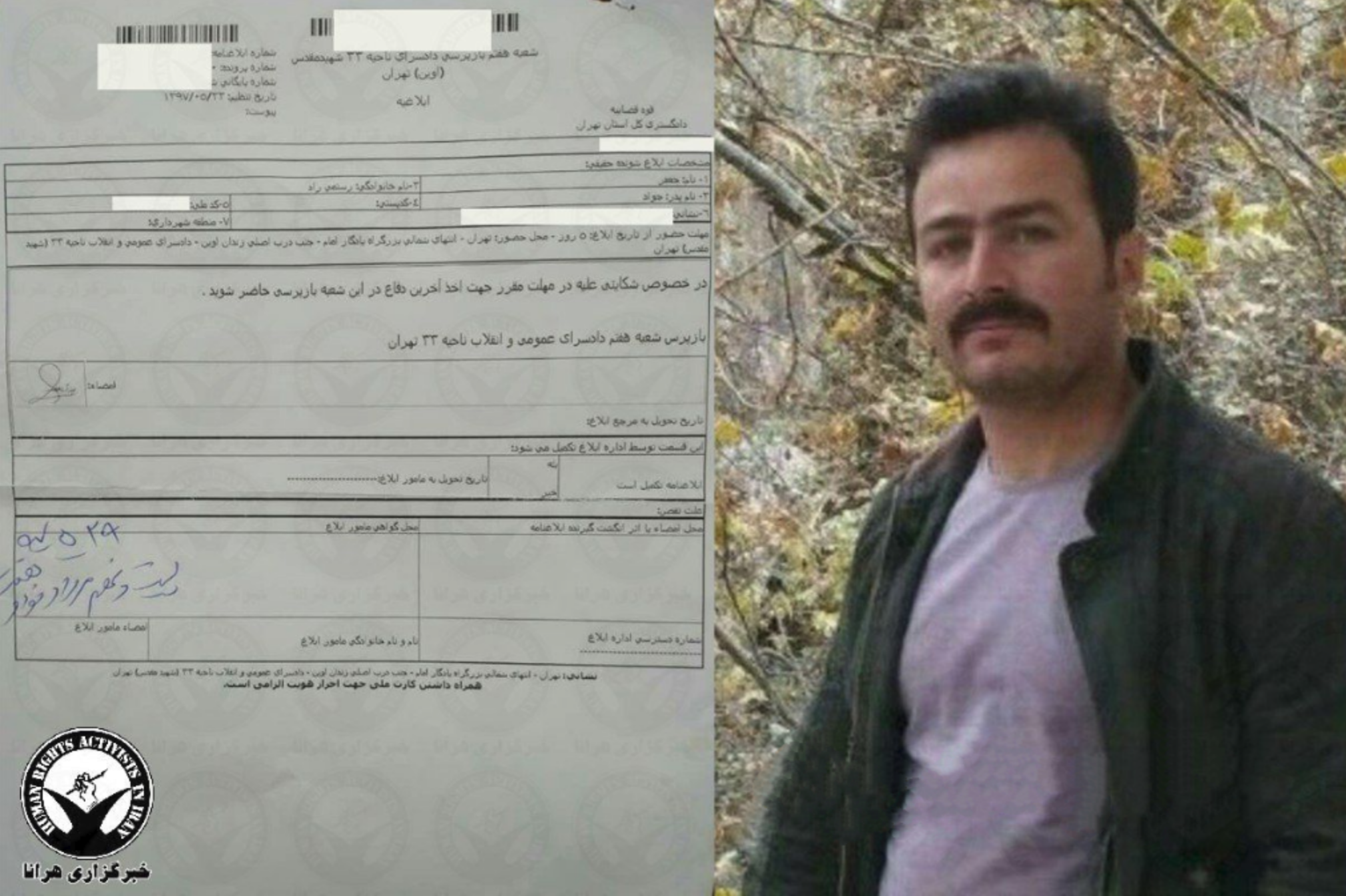
Human Rights Activists News Agency (HRANA) – Jafar Rostamirad, an Azerbaijani Turkic minority rights activist, has been summoned by Branch 7 of the Prosecutor’s Office, based in Tehran’s Evin Prison, for the last round of his defense statement. He has been given five days to go to the Prosecutor’s Office, a credible source told HRANA.
Rostamirad was arrested on July 2nd by plainclothes security forces in Tehran who did not present a warrant. His arrest was in connection with the Babak Fort gathering that occurred on the same day. After spending seven days in solitary confinement, he was sent to Ward 209 of Evin Prison and charged with “Propaganda against the regime”. He was released on bail on July 31st.
From the *Babak Fort arrests on July 2nd, Ebrahim Noori, an Azerbaijani Turkic minority rights activist, is the only one who remains in prison. He is held in Ward 209 of Evin Prison.
Rostamirad had previously been arrested on February 21, 2015, after taking part in a private meeting to commemorate International Mother Language Day.
—
*Babak Fort, a monument built during the pre-Islamic Sassanian period, is named after Babak Khorramdin, known for leading an uprising against the Abbasid caliphate in 893. In recent years, it has become a place of symbolic gatherings for Azerbaijani activists, especially during the annual commemorations in the first week of July.
Azerbaijani Activist Arrested and Transferred to Sarab Prison

Human Rights Activists News Agency (HRANA) – Seyed Jamal Moosavinejad, an Azerbaijani Turkic minority rights activist from the city of Sarab, was arrested by security forces on the morning of August 25th and taken to Sarab Prison to start his one-year sentence, a credible source told HRANA.
Last May, Moosavinejad was convicted of “Propagating against the regime in favor of partisan ethnic and separatist groups” which led to a suspended prison sentence of one year. Branch 26 of the East Azerbaijan Appeals Court, presided by Judge Mikayil Khoobyarpour, upheld the sentence.
The court cites the following activities as the reasoning behind Moosavinejad’s conviction: issuing statements on social media; reflecting anti-regime and ethnic activities in foreign media; respecting and kissing of a flag belonging to an alien country due to ethnic beliefs in contravention of the Islamic Republic of Iran; praising the Azerbaijani events of 1945 and praising their founder, Jafar Pishevari; confessing to engaging in ethnic activities on Telegram.
Moosavinejad had also been charged with “Insulting the Supreme Leader” but was acquitted of that count.
Seyed Jamal Moosavinejad was first arrested in February after security forces raided his house. His phone, laptop, books and papers were confiscated at the time. He was released on a four billion rial [apprximately $40,000 USD] bail. According to Moosavinejad, he was insulted and humiliated by security forces throughout the process of arrest, being charged, and the initial court and appeals hearings. Furthermore, he had previously been arrested in Sarab in the summer of 2012, together with several other citizens.
Writer Nader Faturehchi Decries the Plight of “Ordinary” Inmates at Great Tehran Penitentiary

Human Rights Activists News Agency (HRANA) – Released on Monday, August 20th after spending one day in the Great Tehran Penitentiary, writer, translator, and journalist Nader Faturehchi was moved to publish a post on Facebook about the miserable conditions of the prison’s quarantine ward.
Having been arrested the day before, Faturehchi was sent to the Great Tehran Penitentiary (also known as “Fashafoyeh”) when he was unable to post bail, HRANA reported. He was arrested pursuant to charges brought by Mohammad Emami, who himself has been charged with embezzling money from a pension fund for teachers.
Summoned to answer to Emami’s accusations on August 19th, Faturehchi wrote, “A serious battle with corruption has begun. I’m going to court, coerced to ‘explain myself’”.
Born in 1977, Faturehchi writes on politics, art, social issues, and philosophy.
Below is the translated text of his post:
I had a very short stay in Fashafoyeh Prison.
I write here not to describe “personal suffering”, but to deliver on a promise that I made to the inmates of the quarantine ward.
All that’s worth saying about myself is that I “went” to Fashafoyeh Prison; the judge had insisted I go to Evin [Prison], but I was transferred to Fashafoyeh instead. Unbelievably, prisoners are made to pay their own transfer costs (if they can afford it), and naturally the fee for a transfer to Evin (150,000 rials) [about $1.50 USD] is “considerably” different from the fee for a transfer to Fashafoyeh (1,000,000 rials) [about $9.50 USD].
At any rate, the greed of police agents afforded me a glimpse into the conditions of Fashafoyeh’s quarantine or “drug offenders” ward.
Among inmates, the colloquial name for the quarantine ward is “Hell”.
The accused, the convicts, the inmates awaiting transfer, or any other kind of “client” will spend four days in the quarantine ward before transfer to a ward known as “the tip”.
The prisoners said the difference in living conditions between the tip and quarantine wards are analogous to those between a bedroom and a toilet.
Having witnessed the quarantine ward on three different occasions in the 90s and 2000s, I can definitively corroborate their accounts of how “grave” the conditions in Fashafoyeh’s quarantine ward really are.
In a routine four-day quarantine period, the prisoner, no matter their crime or sentence, is deprived of potable water, ventilation, toilets, cigarettes, and digestible food (there is cold, half-baked pasta, and cold, uncooked yellow rice).
Fashafoyeh, designed for drug addicts with limited mobility, doesn’t have a public toilet. The toilet is a hole on the floor of a 2X2 foot area without light or running water, separated by a curtain from the ward’s beds and 10X10 foot cells, known as “physicals,” that house between 26 and 32 prisoners. The living conditions in the physicals are so inhumane that quarantined inmates call them the “place of exile”.
Quarantine cells have three-tier bunk beds and two blankets spread on the floor. Two glassless skylights are all they have to regulate temperature. There is no running water between 4 p.m. and 7 a.m., and the only light glows from a 100-watt fluorescent bulb. Should it burn out, the prisoners say, “only God could make someone replace it”.
The cells operate on an unspoken caste system. “Window beds” are reserved for convicts with longer sentences and greater street cred (lifers, drug-dealing kingpins, gang members, violent offenders and grand theft cases); ordinary beds (with no access to the skylight) go to lower-ranking prisoners (small-time drug dealers, pickpockets and petty thieves, etc.), while drug addicts, Afghans, and newcomers are directed to the floor.
Crowding at the prison evidences a mass daily influx of newcomers. Every 24 hours or so, more than 40 new prisoners are brought to the quarantine ward, while a maximum of ten [prisoners] leave the ward each day.
“Floor sleepers” — most often Afghans and intravenous drug addicts — endure conditions similar to those in “coffins”, the coffin-sized cells reserved for political prisoners in the 1980s that were barely large enough to lie down in.
In the cramped conditions, floor sleepers are sometimes pushed to spending the night beneath the beds of other inmates. Coined as “coffin sleepers,” it is typical for other inmates to sit on the floor next to their sleeping enclosure, restraining their movement and blocking their access to light and air.
The stench of sweat and infected wounds is unbelievable. Many inmates are detoxing from drug addictions and are in no state to be taken to the so-called “bathroom” to wash up, which thickens the stench.
More than 80 percent of quarantine inmates are intravenous drug addicts and homeless people unable to stand on their own two feet who belong in a hospital, not in a prison.
A single guard presides over the entire ward, a government agent, while the rest of prison labor (reception, maintenance, cooking, night watch, chaperoning for transfers and even medical work) is performed by the inmates themselves.
In addition to the guard, a mullah (cultural agent) and social worker count among the “staff” whose presence is of no use to the prisoners.
The prison machine is a hierarchical one. Representatives and monitors of each ward are usually white-collar convicts charged with embezzling and fraud. They bunk in cells with amenities like private beds and telephones and have the freedom to move around, smoke cigarettes, don personal slippers and even wear socks. One rung down from them are the “night monitors,” also financial convicts. The third rung down (reception, maintenance, kitchen staff) are theft convicts who have been in the “tip” for less than two weeks.
From what I’ve seen myself, the population of educated people in prison charged with white-collar crimes has spiked in recent decades. This invites an urgently relevant case study from a sociological point of view.
Aggression, insults, and mockery toward newcomers are natural, given that the prison is run by prisoners who, tasked with running the place, tend to be much more amenable to familiar wardmates. And while newcomers are met with brute force and verbal aggression, the guards develop compassion towards them after this initial hazing period has passed (intravenous drug addicts and detoxers are of course an exception to this rule).
I myself was spared insults or humiliation, both from the staff and the prisoners in charge, even though I arrived at the ward shackled hand and foot. For 99 percent of my fellow prisoners and even the staff, the charges against me were considered “incomprehensible, unknown, and strange.”
At no point did I experience disrespect, insults, or aggression, and though my status would have made of me a “newcomer and floor sleeper,” I was shown kindness and respect from the beginning by fellow prisoners, especially from the ward representative, monitors, administrative staff, police officers, and guard. My special treatment was made all the more obvious by the fact that I was the sole newcomer whose head was not shaved, as it is the protocol in quarantine. Drug addicts, theft convicts, “dirty ones” and Afghans are treated like livestock from the moment they step foot in the ward.
Fashafoyeh is a prison for nonpolitical cases and ordinary criminals who do not elicit media attention or human rights outcry, and that is the greatest criticism one could make of civil and human rights activists.
Drawing attention to conditions of the “ordinary prisoners” in Fashafoyeh is an urgent and immediate necessity. No one in Iran is more oppressed and vulnerable. They exist in the epitome of “inhumane conditions” and are victims of a twofold oppression. To bear this, even for one day, is beyond the power of the human spirit and will undoubtedly cause permanent trauma to their body and soul. Every day, the number of cases like these only multiply.
Above the entryway to the Fashafoyeh Prison is a banner reading “Great Tehran House of Regret.” And yet, beneath the physical and spiritual pressures awaiting inmates across the threshold, there will remain no heart with which to reflect. It is impossible to think, let alone regret.
Another deplorable element of Fashafoyeh is its perimeter. Families of prisoners sit in the desert outside, and no one (I.e. the few soldiers on outside duty) are ignorant to who is or isn’t contained there (either that or they don’t reveal to the families what they know.) This is critical when Fashafoyeh prisoners come from poor families who can only come by taxi, at a cost between 1 to 1.5 million rials [approximately $10 to $15 USD].
I met people in Fashafoyeh who had been arrested four days prior and had yet to receive their due right of a free two-minute phone call. For the prisoners from poor families, a call at cost could mean millions of rials.
As I left the prison, I met a group of Gonabadi Dervishes, including Kasra Noori, Mr Entesari, and others. Their kindness and camaraderie chased away the emotional turmoil I had faced in the hours before. To see them was like seeing a familiar face, a ray of light in a dark abyss. I will never forget the warmth of their smiles.
My conscience was deeply troubled after I was released from Fashafoyeh, and I don’t think I will be ever able to forget the horrible conditions my fellow inmates were living in. Seeing their living conditions and their eyes devoid of hope; the putrid odor of the corridors; people who had nowhere to go; cells like cages; their constricted breaths; all of these sensations left a deep wound on my soul. With every glass of water that I drink and every cigarette that I smoke, tears pour down my face.
My arrest is of absolutely no importance. Banish it from memory. The outpouring of media attention and kindness that surrounded my arrest embarrassed and even somewhat upset me. My case is the least of this country’s priorities, a speck in the current of deep human sufferings over this land. The living conditions in prisons, especially for ordinary prisoners, is too terrible for words.
To quote Paul Valery, “This is humanity, naked, solitary, and mad. Not the baths, the coffee, and the verbosity”.
Note: If I didn’t respond to the kindness shown to me by comrades and friends, it is because I was haunted by the grim plight of those who remain there, and for whom I could do nothing. I apologize to you all.

Photo: Half of the Bahman cigarette, gifted to me by one of my dear Dervishes. In my last moments inside, two cigarettes were given to me by Mr Moses, an inmate on a life sentence with a big heart. He put the cigarettes in my pocket and said to me, “Praise the Prophet, all of you, and pray for the freedom for all prisoners… go and never come back, kid”.