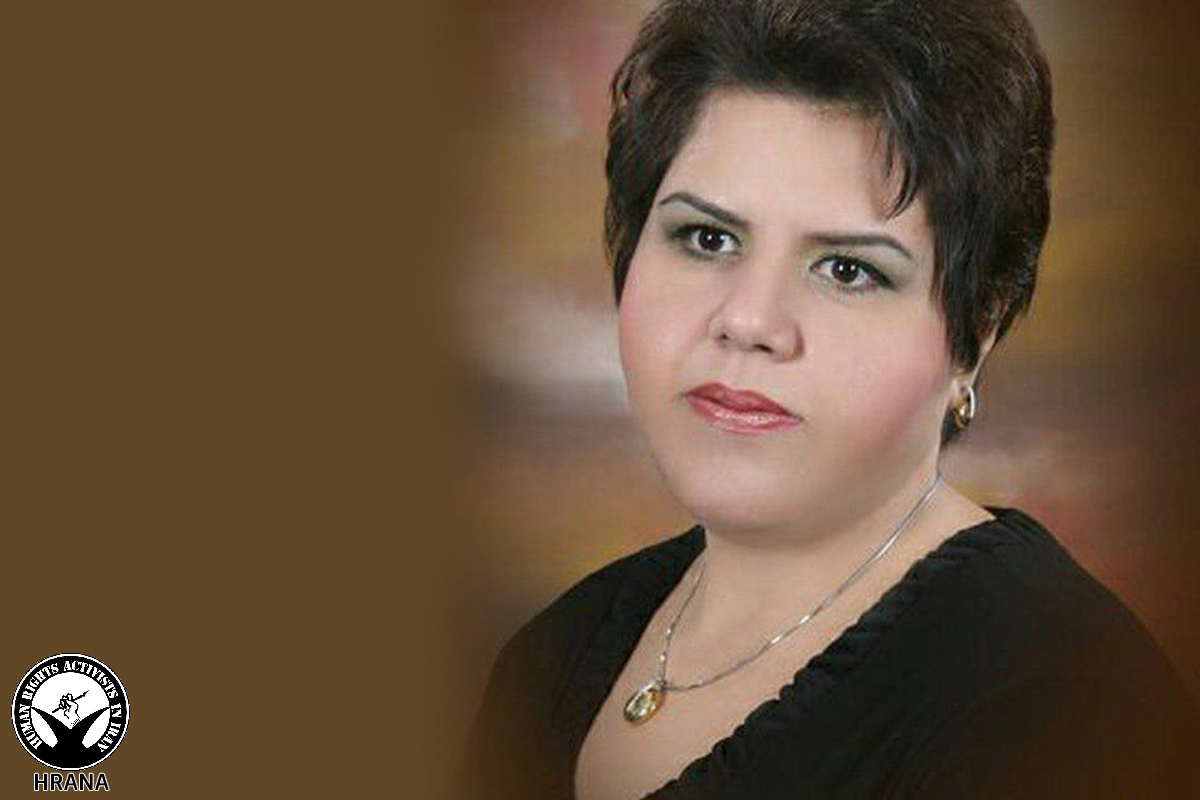
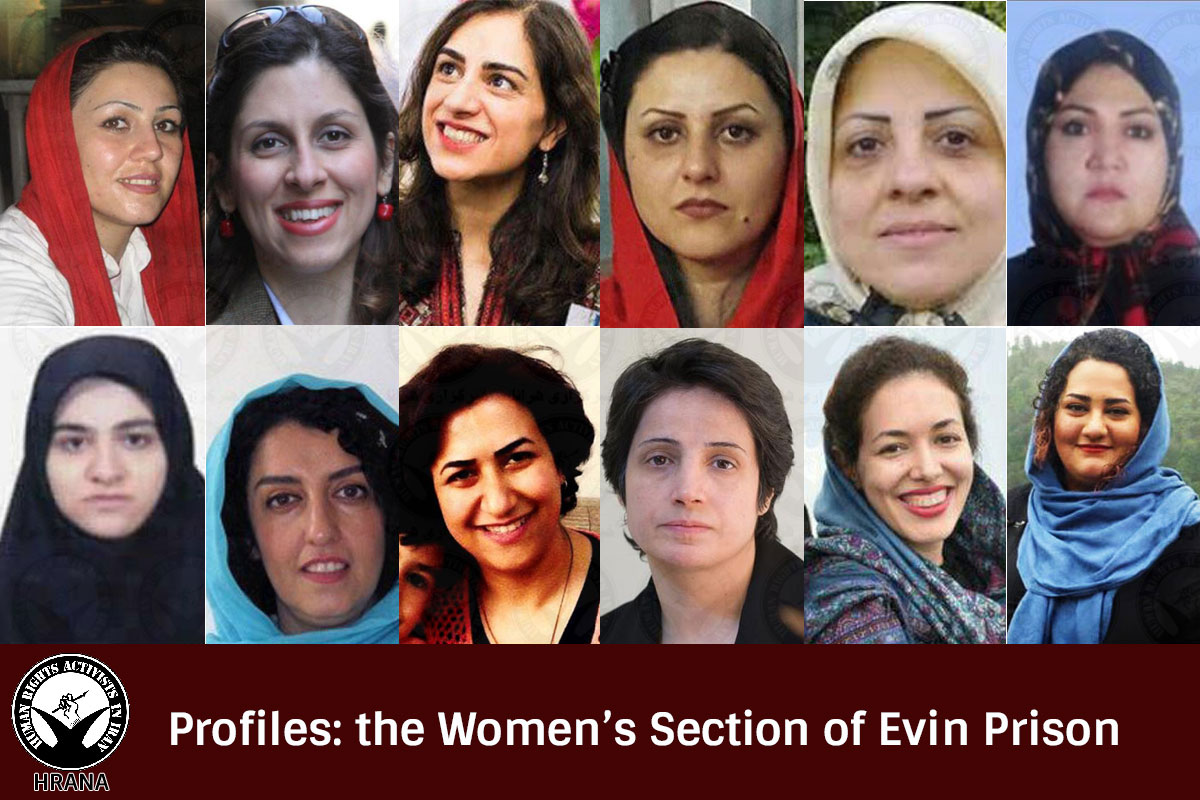
Profiles: the Women’s Section of Evin Prison

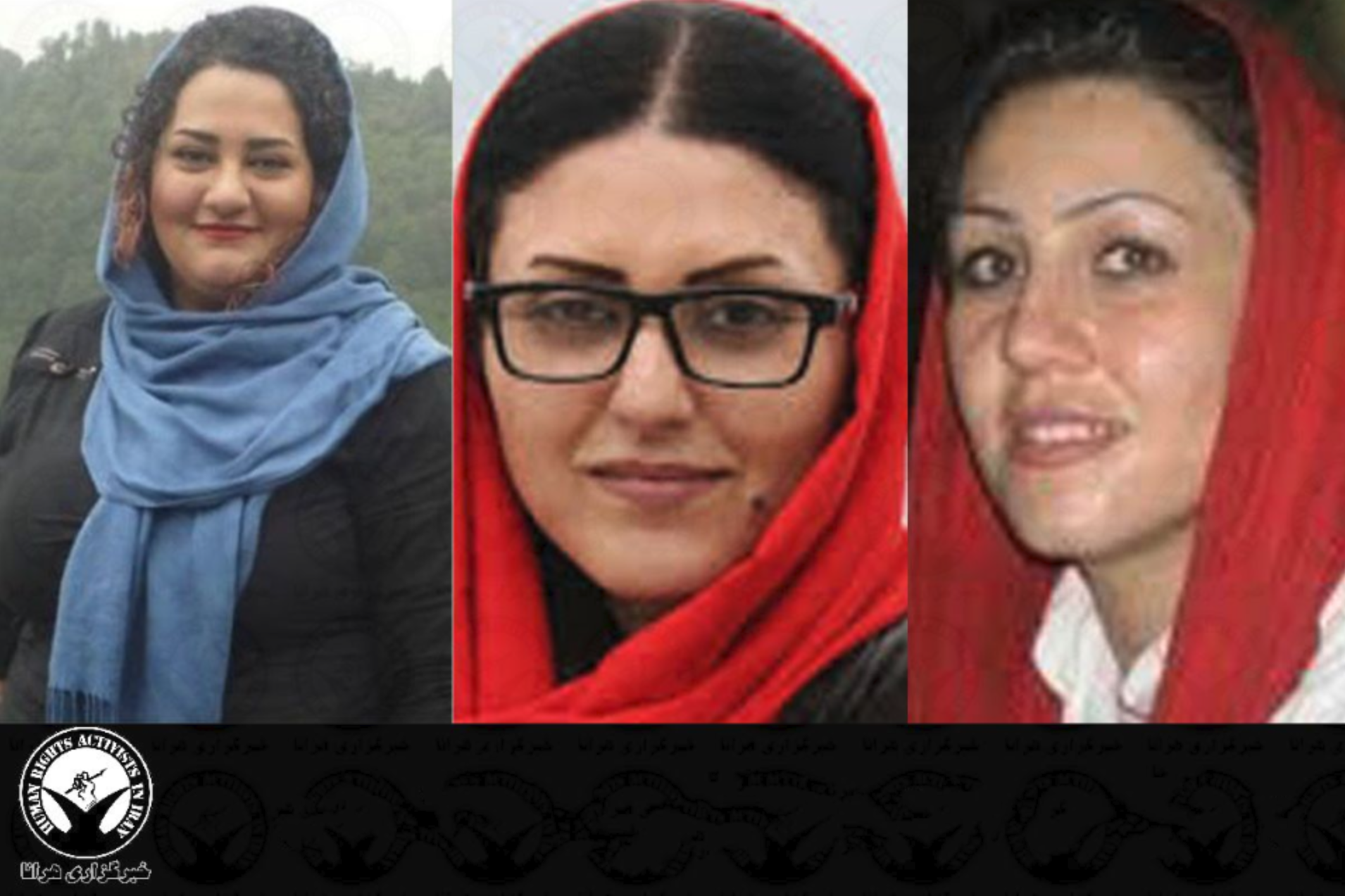
Human Rights Activists News Agency (HRANA) – The 17 prisoners held on political or security-related charges in the Women’s Ward of Tehran’s Evin Prison live with deplorable conditions, compromised hygiene, and paltry nutrition. The following is a brief exposé of their quality of life, followed by a snapshot of their individual case files.

Many of these prisoners are mothers pained by the distance from their children, a pain that is only exacerbated by the prison chief’s refusal to grant them access to the phone on days of the week that their children are home from school. While the prisoners were granted permission from prosecutors to open the Saturday-to-Wednesday phone schedule to any day of the week, the chief, who goes by “Chaharmahali,” has refused to loosen up the former protocol.

In another blatant disregard of court orders, prison authorities refuse to send prisoners to outside medical clinics even when prosecutors and deputy prosecutors order or grant permission for the transfers. Prison authorities justify their refusal by saying that the prison clinic has its own doctors, or will recruit them as necessary; yet prisoners needing help from a psychologist, eye doctor, or internal specialist wait months to be seen.

These women are effectively hindered from providing even the most basic care to themselves, as clinic authorities refuse to distribute basic medicine or first aid kits to inmates. Many–insulted by the stipulations from Khani, the clinic head, that they take all of their nightly medication in one supervised sitting–have quit their medications in protest, and are experiencing aggravated symptoms as a result.

Evin Prison dentistry operates in less-than-sterile conditions and exposes patients to remarkably high risk for infections. Cavity fillings are expensive there, putting patients out as much as 20 million rials (approximately $114 USD) or preventing them, for lack of means, from getting the fillings they need. Many of the Evin women have trouble footing the bill, as the now-unemployed breadwinners of their households or as the wives of men who are also behind bars.

Prison food rations are growing more pitiful by the day. Forty-day rations of dry food items that are distributed to prisoners are depleted without fail within half that time. In the last six months, meat and vegetables have been cut from the prisoners’ diets.

Hygiene and cleaning items are also in short supply. Most prisoners run out, and those who can’t afford the pricey prison shop simply do without.

Deputy prosecutor Rostami oversees political and security prisoners and recently took up his position in Evin’s prosecutorial office. While he has verbally engaged to welcome prisoner families into his office on Sundays and Tuesdays, complaints from these families suggest that he is chronically unavailable, impassive to their requests, and generally unaccountable. Complaints lead nowhere, families say; requests for furlough or conditional release are routinely ignored.

Prison authorities rarely visit the Women Section, and tend to either lose or ignore any letters from its inmates.

Who are the women of Evin Prison’s Women’s Ward?

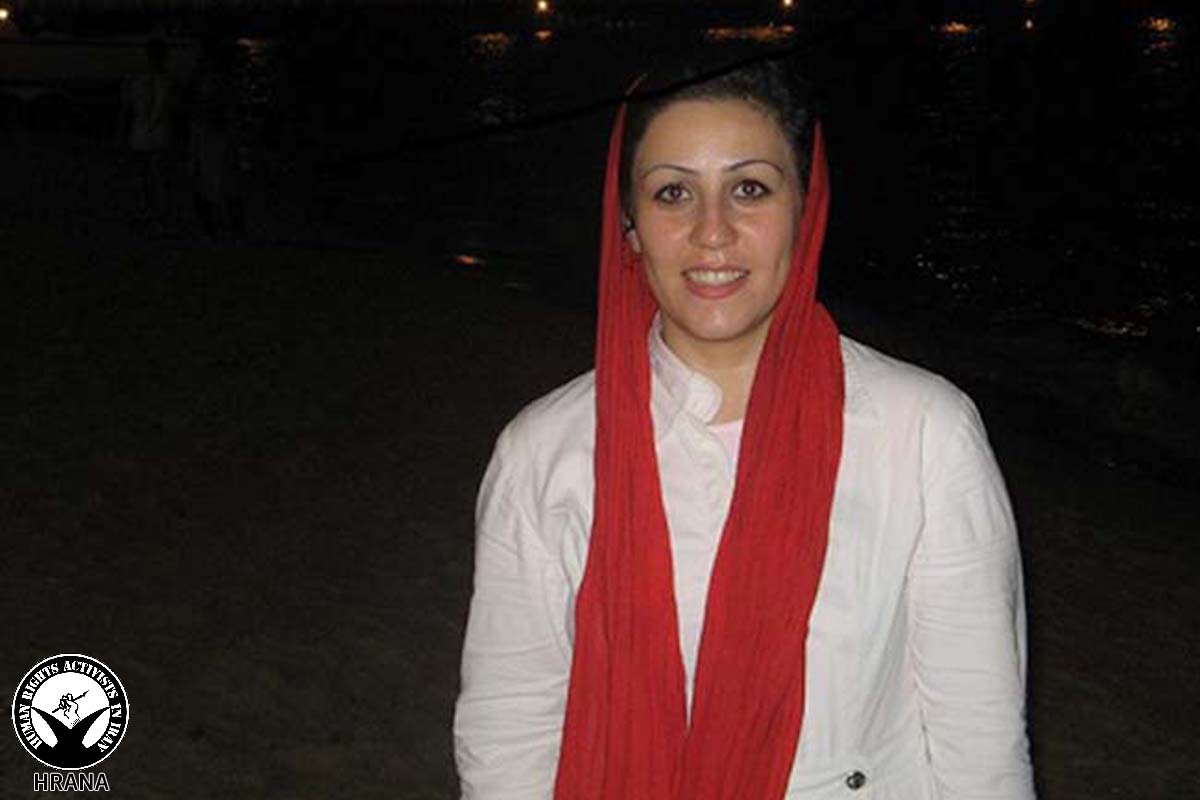
1- Maryam Akbari Monfared (born 1975)

Convicted of enmity against god, gathering and colluding against national security and propagating against the regime through working with the Mujahedin-e Khalq (MEK), Monfared is serving a suspended sentence of 15 years.

Monfared was arrested December 31, 2009, following a widespread Ashura demonstration during the holy month of Muharram. She was tried the following May and sentenced by Branch 15 of Tehran’s Revolutionary Court, presided by Judge Salavati. She denied the accusations against her.

Monfared has been shuffled around different penitentiaries over the course of her imprisonment, inducing the solitary cells of Ward 209, the Methadone Ward, the Women’s Ward, Rajai Shahr Prison, and Qarchak Prison in Varamin. After writing several letters to clerics, prison authorities, and Ahmad Shaheed, then the United Nations Special Rapporteur on the Situation of Human Rights in Iran, she was returned to Evin’s Women’s Ward and has remained there since.

Two of Maryam’s brothers were executed in 1981 and 1984 for their connections to the MEK. Another younger brother and a sister were also executed during the 1988 massacre.

Maryam, a mother of two, has been barred from conditional release and has not received a single day of furlough since she began her sentence in 2009.

2- Zahra Zahtabchi (born 1969)

Zahra Zahtabchi was issued a 10-year suspended sentence for Baqi (violation) and enmity against god through support of the MEK.

Zahtabchi was arrested with her husband and daughter on October 16, 2013. She came to Evin’s Women’s Ward after spending 14 months in the solitary cells of Ward 209. On December 8, 2014, Branch 15 of the Revolutionary Courts sentenced her to 12 years in prison. The sentence was reduced to 10 years in appeals court.

Her two daughters are Narges, 22 and Mina, 15.

In 2016, three years after her arrest, she went on furlough for three days.

3- Fatemeh Mosana (born 1967)
Fatemeh Mosana was sentenced to 15 years for Baqi and enmity against god through support of the MEK in Branch 26 of Tehran’s Revolutionary Court, headed by Judge Ahmadzadeh. Her husband Hassan Sadeghi received the same sentence.

Mosana, Sadeghi, and their child were arrested January 28, 2013, by Intelligence Ministry forces. The child was released after six weeks.

Mosana spent 75 days in the solitary cells of Ward 209 before her transfer to the Women’s Ward.

On January 13, 2014, she was temporarily released on bail. Some of her family’s property, including Sadeghi’s shop and their personal house, was seized by the authorities.

On September 30, 2015, she was re-arrested and taken to the Women’s Ward. She has two children who currently live with their ailing grandmothers.

Mosana, who suffers from ulcerative colitis and severe nervous migraines, has never been granted furlough.

4- Narges Mohammadi (born 1972)

Narges Mohammadi is serving a 16-year sentence, compounded by a six-year sentence on a previous case.

Narges was first arrested in 2002 and then released on bail after a week. For that case, she received a one-year sentence.

In May 2010, she was arrested and held for weeks in the solitary cells of Evin’s Ward 209 before being released on a bail of 1 billion rials. In 2011, she was convicted of gathering and collusion against national security and propaganda against the regime, which carried a sentence of 11 years in prison. The sentence was later reduced to six years in appeals court.

She started serving her sentence in 2012, which began with one month in solitary confinement and four months in exile in Zanjan. She was released due to health conditions before being re-arrested in 2015 to resume her sentence. At that point, authorities opened up a new case file against her, convicting her anew of gathering and collusion, and of propaganda against the regime, with the additional charge of establishing LEGAM, a campaign to abolish the death penalty. Collectively her charges earned her 16 years in prison, but by Article 134 of Islamic Penal Code, she should only serve 10 [i.e. the sentence corresponding to the heaviest among her multiple charges].

She has two children, and on the prosecutor’s orders is barred from having contact with her husband.

She suffers from pulmonary embolism and was granted a three-day furlough on September 29th.

5- Reyhaneh Haj Ebrahim Dabagh

Born in 1982, Reyhaneh Haj Ebrahim Dabagh is serving a 15-year exile imprisonment sentence, ruled by Judge Salavati in Branch 15 of the Revolutionary Court on charges of enmity against god through support of the MEK, gathering and colluding, and propaganda against the regime.

Ebrahim Dabagh has been in prison since early 2010. She suffers from ulcerative colitis and has served exile time in Qarchak and Rajai Shahr prisons. Her husband Ahmad Daneshpour and her father-in-law Mohsen Daneshpour are awaiting trial in Evin’s Section 350. They are both said to have been sentenced to capital punishment.

After seven years in prison, Ebrahim Dabagh went on furlough for the first time in December 2016, and was briefly freed on bail. On August 15, 2018, she was sent back to Women’s Ward to serve the rest of her sentence.

6- Azita Rafizadeh (born 1980)

As part of a 2011 crackdown on the Baha’i academic community, security agents raided the homes of managers and professors at the Baha’i Institute of Higher Education (BIHE), including Azita Rafizadeh’s. In the raid, her religious books, personal writings, and electronic devices were confiscated.

Rafizadeh was sentenced in 2014 to four years in prison on charges of acting against national security and membership in “the illegal Baha’i organization.” Her husband Peyman Kooshkbaghi was sentenced to five years in prison at the same time.

She presented hersef to Evin’s prosecutors in 2015 to begin her sentence. On February 28, 2018, her husband was detained without reason in Evin’s section 8 while trying to arrange a visit with her. Rafizade and Kooshkbaghi have a 10-year-old son name Bashir who in absence of his parents has been trusted to the care of another family.

7- Nazanin Zaghari-Ratcliffe (born 1979)

Zaghari-Ratcliffe is serving a five-year suspended sentence on charges of gathering and collusion against national security.

Zaghari-Ratcliffe was arrested at the airport while visiting Iran on holiday in 2016. After a day in IRGC’s detention center, she was transferred to Kerman prison, and two months later to Tehran, where Judge Salavati issued her prison sentence in July of that year. A few months later, she was sent to the Women’s Ward.

On August 23rd, she was granted a three-day furlough after two and a half years in prison. She has a four-year-old daughter.

8- Aras Amiri (born in 1986)

A student of London’s Kingston University, Amiri was arrested by Intelligence Ministry forces on March 14, 2018, and released two months later after posting a 5000 million rial bail. On September 7, 2018, she was summoned and subsequently arrested by Evin prosecutors, after which she was sent to the prison’s Women’s Ward. She has denied the “gathering and collusion against national security” accusations against her and is still awaiting trial.

9- Golrokh Ebrahimi Irayi (born 1980)

Irayi was sentenced to six years in prison, which was reduced to 2.5 years based on amnesty and Article 134 of Islamic Penal Code. She was convicted of insulting the sacred and gathering and collusion against the regime. Earlier this year, she was exiled to Varamin’s Qarchak prison, and was brought back to Evin after going on hunger strike.

On September 6, 2014, Golrokh was arrested along with her husband, Arash Sadeghi. She spent two days in an IRGC safe house and then 20 days in the solitary cells of Evin’s Section 2A, which is under IRGC jurisdiction. She was released on a bail of 800 million rials.

Judge Salavati sentenced her to six year in prison while she was undergoing surgery in the hospital.

On October 24, 2016, the IRGC arrested her without a warrant. Her husband Arash Sadeghi was also arrested and sentenced to 19 years in prison. He is currently in Karaj’s Rajai Shahr prison and has undergone operations for cancer.

Arash and Golrokh have been forbidden from seeing each other for the past 8 months.

10- Nasrin Sotoudeh (born 1963)

According to Sotoudeh’s lawyer, she has been sentenced to five years in prison for espionage (a charge that does not figure on her charge sheet), a complaint from Kashan prosecutorial interrogators, and an arrest order from Branch Two of Evin’s interrogators. She currently awaits trial.

Sotoudeh was first arrested September 2010 and sentenced to 11 year in prison, a 20-year ban from the bar association, and 20-year travel ban. Appeals court reduced these sentences to six years in prison and a 10-year ban from the bar. She was in Evin prison from 2010 to 2013 on charges of “acting against national security.” Upon her release, lawyer’s court banned her from the bar for three years, which she protested in 2014 by organizing a sit-in in front of the Bar Association. Because of her sit-in, her attorney privileges were reinstated.

On June 13th of this year she was arrested in her home and taken to Evin prison. Her husband Reza Khandan is being held in Evin’s Section Four. Two of her children, Mehrave and Nima, are currently in the care of family friends.

11- Negin Ghadamian (born 1983)

Ghadamian was sentenced to a five-year suspended sentence on a conviction of against national security through membership in “the illegal Baha’i organization.”

On May 24, 2011, Negin was arrested by security forces and released on a bail of 500 million rials. In February 2013, along with eight other Baha’i citizens, she was convicted in absentia of working with the Baha’i Institute for Higher Education and sentenced to five years in prison by Judge Moghise. On December 16, 2017, she was arrested at the airport and sent to the Women’s Ward of Evin prison to serve her sentence.

12 – Masoumeh (Mino) Ghasemzade Malakshah (born 1976)

Malakshah and her ex-husband, Amir-Mehdi Tabasi were arrested in 2011 by the Intelligence Ministry agents. Both were detained and later released on bail on espionage charges after travelling to the Israeli embassy in Turkey and applying for residency in Israel. Both Malakshah and Tabasi were sentenced to 10 years, a sentence which was confirmed in appeals court in 2017.

Malakshah was taken to the Women’s Ward of Evin prison. Tabasi is detained in a different ward of same prison.

13- Ruqayya Haji Mashallah (born 1981)

Mashallah is awaiting trial on charges that are currently unclear.

Of Iranian origin, Mashallah is a citizen of Bahrain. She was arrested in May 2018 in Mashhad and taken to Evin’s Women’s Ward on June 27th of the same year. Her Bahraini husband has only been able to meet with her once since her arrest. She a mother to three children.

14- Leila Tajik (born 1973)

Tajik was arrested by IRGC’s Intelligence Department on September 5, 2017. She was taken to the Women’s Ward earlier this year after spending seven months in an IRGC safe house. Her husband, who is said to be a retired employee of IRGC’s Intelligence Department, is also under arrest. She awaits trial on charges of espionage.

Tajik and her spouse have two children aged 16 and 19.

15 – Atena (Fateme) Daemi (born 1988)

Daemi was arrested on October 21, 2014.

On May 15, 2015, Judge Moghise of Branch 28 of the Revolutionary Court sentenced her to 14 year in prison on charges of collusion and gathering against national security, propaganda against the regime, and insulting the Supreme Leader. Her sentence was reduced to five years with application of Article 134 of Islamic Penal Code.

After her arrest and before her trial, she spent 86 days in the solitary cells of Section 2-A. On February 15, 2016, she was released on a bail of 5500 million rials. Her sentenced was reduced to seven years in appeals court in August of 2016.

Daemi was arrested in her father’s house that November, and cases against her two sisters and one of her brother-in-laws immediately followed. She went on hunger strike for 54 days until the charges against them were dropped. So far she has been acquitted of two case files that have been opened against her.

In January of this year, she was taken to Varamin’s Qarchak prison after being assaulted. On May 9th, she was taken back to Evin’s Women’s Ward. She has thus far been denied furlough and has yet to request parole.

16- Elham Barmaki (born 1968)

On December 28, 2011, Barmarki was arrested on the street and spent three months in the solitary cells of Section 209. She was then released on bail and was later acquitted.

On July 23, 2012, she was arrested again, this time spending 14 months Section 209 solitary cells. On September 29, 2013, she was transferred to the Women’s Ward.

In Branch 28 of the Revolutionary Court, headed by Judge Moghise, Barmaki was sentenced to 10 years in prison and fines of 25,000 Euros, 70,000 USD, and 400 million rials. She has two children, Amir-Parviz and Anita, who both live abroad. She was released once on furlough in March 2017 for the Persian New Year. Her request for parole has been rejected.

17 – Sotoudeh Fazeli (born 1953)

Fazeli was arrested in early 2011 by the Intelligence Ministry. She spent 31 days in Evin’s Section 209 before being released on bail in 2011. Branch 15 of the Revolutionary Court, headed by Judge Salavati, sentenced her to three years in prison on charges of “enmity against god by supporting the MEK.” She has been held in the Women’s Ward since June 29, 2016.

Fazeli suffers from eye and muscle problems, among other health conditions. She was released on a short furlough in 2016. Her requests for parole have been repeatedly rejected.

Since the beginning of the new Persian calendar year in 2018, 15 new prisoners have entered the Women’s Ward, including Zahra Zare, Negar Zarei, Mandana Azarmah, Akram Gholami, Aliyah Eghdamdoost, Akram Mirsane, Raha Fasayi, Parisa Rahmati, Batool Ezati and Arefe Aziz. A number of these women have been already released.

66-year-old Cancer Patient Denied Parole

Human Rights Activist News Agency (HRANA) – Authorities at Evin Prison in Tehran have denied parole to Sotoodeh Fazeli, a 66-year-old political prisoner suffering from thalassemia, cancer, and a family history scarred by merciless judicial directives.

Two of Fazeli’s sons, Peyman and Pooya, are in the Albania-based camp of the People’s Mojahedin Organization of Iran, also known as Mojahedine Khalq (MEK). When MEK was based in Iraq’s Ashraf camp, Sotoodeh attempted to visit her sons for the first time in many years, but was arrested before traveling there. “She hasn’t seen then in 18 years,” a close source told HRANA.

According to the above source, Fazeli was arrested in early 2011 by the Intelligence Ministry and spent 31 days in Evin’s Section 209 before being released on bail that spring.

According to the source, Judge Salavati tried Sotoodeh, but she was never formally sentenced. Nevertheless, on June 29, 2016, she was arrested and sent to the Evin Women’s Ward, where she learned she had been sentenced to three years in prison despite having never been convicted.

After a brief release on furlough in July of 2017, Fazeli was returned to the prison in May 2018 despite her old age and the advancement of her disease. Her recent request for conditional release has been denied.

When Fazeli’s mother late Masoome Haj Abdolrahim Khabbaz requested a meeting with her daughter in the last days of her life, her family made great efforts to facilitate the visit. But Sootodeh’s hopes to be granted a hospital visit with her ailing mother, even for a few hours and in handcuffs, was denied by the Prosecutor’s office.

While Iranian legislation, including a ruling (or fatwa) from Iran’s Supreme Leader Ayatollah Khamenei, supports conditional release of prisoners over 55 years of age, requests from eligible detainees are often denied in practice.

Fazeli’s brother Seyed Shamseddin Fazeli was arrested in 1982 at the age of 20. His family learned of his execution when he was already dead, after he had spent three years in prison without ever being sentenced in court.

Fazeli, who is now retired, worked for 30 years as a school teacher.

Update: Leila Tajik Spends 13 Months in Legal Suspense in Evin’s Women’s Ward

Human Rights Activists News Agency (HRANA) – Leila Tajik has now spent more than a year in the Evin Prison Women’s Ward, waiting for Iranian courts to decide her fate.

This 45-year-old prisoner was arrested along with her ex-husband in September of last year in a joint case opened by the intelligence unit of the Islamic Revolutionary Guard Corps (IRGC) charging the two with espionage. Following the arrest, she was interrogated for seven months in an IRGC outpost.

An informed source told HRANA that her ex-husband, who formerly served on the IRGC, is still detained at the outpost. “Their children, Sabah, 16, and Sahand, 19, are hurting over the breakup of their family, and are feeling additional pressures from IRGC agents.”

Tajik and her ex-spouse reportedly filed divorce papers prior to their arrest. Both have been barred from appointing a defense lawyer of their choosing.

Nationalist-Religious Activist Reza Aghakhani Denied Conditional Release

Human Rights Activists News Agency (HRANA)- Despite his eligibility for conditional release for already having served a third of his sentence, authorities have said “no” to Evin Prisoner Reza Aghakhani, a nationalist-religious activist.

An informed source told HRANA, “The assistant prosecutor of the prison cited an objection from the interrogator as the reason for the negative response, despite the fact that his wife recently just had a kidney transplant and his child is dealing with a physical disability.”

Aghakhani was sentenced to three years in prison by Branch 15 of the Revolutionary Court on a charge of “acting against national security.” In its processing of the case, Branch 35 of the Supreme Court did not assent the charges. They were nonetheless confirmed later in Branch 54 of Appeals Court.

Aghakhani was previously detained for 45 days in May 2013 and served a few years in prison in the eighties for his political activities. Along with some of his fellow prisoners, Aghakhani previously went on hunger strike for three days in protest of human rights violations across the country.

Narges Mohammadi Released on 3-Day Furlough

Human Rights Activists News Agency (HRANA) – Deputy of the Defenders of Human Rights Center Narges Mohammadi was released on a three-day furlough on September 26, 2018. Reporting the news of her furlough to HRANA, Mohammadi’s spouse Taghi Rahmani shared that Mohammadi will need long-term medical furlough to get adequate care for her illness.

Prior to Mohammadi’s furlough release, her mother Ozra Bazargan wrote to the Prosecutor of Tehran with the request that her daughter is granted a furlough to visit her ailing father. From June 30th – July 5th of this year, Mohammadi was released from prison to get back surgery at an outside hospital. On August 6th, prison authorities prevented Mohammadi from being transferred out of Evin Prison to see a neurologist, only to approve her transfer to Imam Khomeini Hospital when she fell into critical condition one week later.

Mohammadi’s attorney Mohamoud Behzadirad previously commented on the status of his client’s case file, stating “it has been six years and four months since my client was detained, and around three years and eight months remain of her sentence. She is eligible for conditional release, but the request for that release has yet to be approved.”

In May 2016, Narges Mohammadi was sentenced by the Revolutionary Court of Tehran to sixteen years of imprisonment, ten years of which was for her role in the Step-by-Step Campaign to Abolish Death Penalty in Iran (LAGAM). The court considered her collaboration with this peaceful campaign to be an example of “gathering with intent to disrupt national security.”

According to Narges Mohammadi, her trial judge treated her with bias and hostility, openly defending the charges levied against her by officials from the Ministry of Intelligence and accusing her of trying to “warp divine law” for her demonstrations of dissent against capital punishment.

The additional six years of Narges Mohammadi’s imprisonment were issued in connection to her peaceful human rights activism, which translated in court to charges of “gathering and conspiring against national security” and “propaganda against the regime.” Her offenses included giving media interviews about human rights violations, her participation in peaceful gatherings to support the families of prisoners on death row, her contact with other human rights defenders (including Nobel Peace Prize laureate Shirin Ebadi), her participation in peaceful protests to condemn acid attacks against women, and her 2014* meeting with Catherine Ashton.

In Autumn of 2016, Branch 36 of the Tehran Appeals Court upheld Narges Mohammadi’s prison sentence. In May 2017, her request for a retrial was reportedly rejected by Iran’s Supreme Court.

Subscribe to Our Newsletter

Now is definitely not the time to stop reading!

Baha’i Crackdown Intensifies with Three More Arrests in Karaj

Human Rights Activist News Agency (HRANA) – Crackdowns on Iran’s Baha’i community continued this week with the arrest of three residents of the northwestern Tehran suburb of Karaj, who were transferred to Evin Prison on Sunday, September 16th and are now being held on approximately $23,000 USD (3 billion IRR) bail.

Maryam Ghaffarmanesh, Jamileh Pakrou, and Kianoush Salmanzadeh–participants in an environmental education session led by Ghaffarmanesh and hosted in the private residence of Ramin Sedighi–were arrested when intelligence agents showed up demanding their cell phones and pressing them to fill out personal information forms.

After confiscating Sedighi’s hard drive, pamphlets, and religious materials, the agents moved on to search Pakrou’s residence, a close source told HRANA.

Ghaffarmanesh, Pakrou, and Salmanzadeh were transferred to Evin Prison. Ghaffarmanesh’s family learned of her bail some 20 hours later, on a call with her from ward 209 of the prison.

The same day, HRANA reported that intelligence ministry agents had arrested and searched the homes of six Baha’i residents of the central Iranian city of Shiraz: Soudabeh Haghighat, Noora Pourmoradian, Elaheh Samizadeh, Ehsan Mahboob Rahvafa, and a married couple, Navid Bazmandegan and Bahareh Ghaderi.

Shiraz had already seen a string of Baha’i arrests one month earlier that landed a number of its residents in an intelligence ministry detention center.

On the morning of September 19th, Baha’i Yazd resident Mehran Bandi Amirabadi was released after being held in custody for 43 days without a warrant. After being tried with six other Baha’i citizens in Branch 3 of Yazd Appeals Court, located in central Iran, Amirabadi was sentenced to one and a half years in prison and one year in exile to be served in Divandareh, a remote city in Iranian Kurdistan.

Mehran Bandi Amirabadi

Iranian Baha’i citizens are systematically deprived of religious freedoms, in contravention of international treaties including the Universal Declaration of Human Rights and the International Covenant on Civil and Political Rights.

Based on unofficial sources, more than 300,000 Baha’is live in Iran. Iran’s Constitution, however, only recognizes Islam, Christianity, Judaism, and Zoroastrianism, and does not acknowledge the Baha’i faith as an official religion. Consequently, the rights of Baha’is are systematically violated in Iran.

Author and Humorist Kiyumars Marzban Detained

Human Rights Activists News Agency (HRANA) – On August 26, 2018, Islamic Revolutionary Guard Corps (IRGC) Intelligence forces arrested author and satirist Kiyumars Marzban in his home, confiscating several personal items including his mobile phone and laptop.

Last year, Marzban, 26, came back to Iran after eight years abroad to visit his ailing grandmother. While he entered the country without event, Branch 1 of the Evin Prosecutor’s Interrogation office opened up a case file and arranged for his arrest within his first year back home.

While Marzban alleges he never traveled to the U.S., a state-affiliated news site has accused him of “Networking in Iran” on contract with American partners. The same news site accuses Marzban, who also teaches art, of entering Iran with the intent to sensationalize and divide the community with his classes. As of the date of this report, no further information was available about the reasons for Marzban’s arrest.

Human Rights Watch revealed in a press release that he has not been allowed to visit his family yet.

Kiyumars Marzban began his career with filmmaking in 2005. By 2009 he had produced eight short films and left Iran to develop his portfolio in Malaysia. Shortly afterward, via Facebook, he launched the world’s premier Persian-language comedy podcast, called “Radio Sangetab” (Sangtab, the name of a village in northern Iran, is also a cooking method using hot stones). His works include “Kham Bodam Pokhte Shodam Balke Pasandideh Shodam” (I was raw, I became ripe and rather pleasant) and “Aziz Jan” (Dear darling).

Iran: UK-Based Art Philosophy Student Detained on Charges of Threatening National Security

Human Rights Activists News Agency (HRANA) – Aras Amiri, an Iranian citizen and 10-year resident of the UK who was released on bail for national-security-related charges in March, was summoned to Evin Prison, read her charges, and transferred to the women’s ward on September 7, 2018.

Iranian intelligence officers apprehended the Kingston University graduate student on March 14, 2018, just prior to the Iranian New Year. She had been out of custody since posting a bond of $120,000 USD (500 million IRR) bail on May 21.

A source close to Amiri confirmed the news of her recent summons, and told HRANA that she is being pursued on charges of “action against national security.” “However,” the source added, “we are still in the dark about how she responded to that charge since the case file has yet to be sent to court.”

Prior to her arrest, Amiri–who studies the philosophy of art–was working to launch joint exhibition projects between Iranian and British artists, collaborating with bodies like the British Council and a UK-based charity with satellite offices worldwide. The British Council had its own office in Tehran until February of 2009, when security agents prompted the Council to cease its in-country operations by excessively questioning the employees there.

One of Amiri’s family members previously told the media that her cultural activities have been in concert and alignment with the various branches of the Iranian Ministry of Culture. During the ten years of her residence in the UK, she had repeatedly traveled to Iran without issue.

In recent years, a number of Iranian nationals residing outside of the country have been detained and imprisoned upon returning to Iran. Abbas Edalat, an Iranian-British dual citizen and professor of Mathematics and Computer Science at Imperial College in London, was traveling to Iran for an educational workshop when he was detained and sent to Evin Prison in April 2018.

Mother of Narges Mohammadi Pleads with Prison Officials: “Give her one hour at her father’s side”

Human Rights Activists News Agency (HRANA) – Currently imprisoned at Evin, civil rights activist and Vice President of Defenders of Human Rights Centre (DHRC) Narges Mohammadi is being championed by her mother, Ozra Bazargan. Worried that her daughter might never see her ailing father again, Bazargan pleads Mohammadi’s case for temporary release in a letter addressed to Tehran’s Prosecutor General.

The text of Bazargan’s letter, sourced from DHRC and translated into English by HRANA, is below:

Dear Mr. Jafari Dolatabadi, Tehran Prosecutor General,

Why won’t you agree to Narges’s furlough? How far will you take this injustice against my daughter?

We are in the fourth autumn of our family’s separation. Narges’s father, who is 85 years old, suffers from a cardiac disease and high blood pressure. We have seen Narges four times in as many as years, as our poor health prevents us from traveling to Tehran where our beloved daughter is held. The Evin Prison officials can attest to this.

Last year, Narges’s father suffered from three horrific heart attacks. Fearing she would never again see her father alive, Narges was ready to make the trip to see her him in the ICU–with guards present–for only an hour. And officials wouldn’t even grant her that.

Narges is being kept from her two children, her husband, and her father, all while looters, embezzlers, and society’s high crooks walk free, sit comfortably at home, or– if they’re in prison– enjoy perks from the Judiciary and security forces. An intolerable discrimination underlies this.

We have witnessed the temporary release of prisoners whose lives were affected by tragic events. The last of these was Abdolfatta Soltani [who was only granted furlough in the wake of his daughter’s sudden death]. I fear that my daughter will have to wait for a tragedy, too.

My daughter did not deserve a ruthless 22-year prison sentence at the age of 44. I cannot bear to think of it, let alone of the conditions she’s in: bereft of seeing her loved ones, deprived of medical care, cut off from the cures to her many ailments. I hear that my daughter struggles with aches and pains that she is keeping from us, to spare us the worry. You and your assistants, on the other hand–you know about her pain firsthand. I am told that she suffers through days without getting care. In tears–in cries–I lift my grief to heaven and I ask God for justice.

As a mother and a member of a family of activists, I am weary of the fight against oppression. I condemn this injustice and cruelty oppressing my daughter. I request that authorities consider the length of my daughter’s long sentence, and grant her this furlough. And if you still are resolute on restricting my daughter, send guards along. Give her one hour at her father’s side, so that he might find peace at the sight of his beloved daughter.
Ozra Bazargan
Narges Mohammadi’s mother

* According to her lawyer Mohamoud Behzadirad, Narges Mohammadi has served 6 years and 4 months of her prison sentence, and has 3 years, 8 months left ahead. “She is eligible for conditional release, but the request for that release has yet to be approved,” Behzadirad said.

HRANA reported August 13th, 2018 on Mohammadi’s transfer to Imam Khomeini hospital following a deterioration in her health condition, one week after prison officials had barred her from seeing a neurologist. Earlier, on June 30th, she spent almost a week away from prison while undergoing eye surgery.

Mohammadi was issued a 16-year prison sentence in 2016, 10 years of which were for her role in LAGAM (the Step-by-Step Campaign to Abolish Death Penalty in Iran). The court equated her LAGAM affiliations with “association with the aim to threaten national security.”  Mohammadi later stated that her trial judge had displayed an openly hostile attitude towards her, and seemed adamant about backing the charges against her from the Ministry of Intelligence. She also stated that the judge likened her campaigns against the death penalty as attempts to warp divine law.

The other 6 years of Mohammadi’s sentence were on charges of “assembly and collusion against national security” and “disseminating propaganda against the regime,” both in connection to her peaceful civic activities, including: interviews with the media about human rights violations, participating in peaceful assemblies before prisons, supporting the families of death row detainees, contacting fellow human rights activist and Nobel Peace Laureate Shirin Ebadi, participation in peaceful assemblies in protest of acid attacks, and meeting with Catherine Ashton (at the time the EU’s High Representative of the Union for Foreign Affairs and Security policy) in 2014.

Branch 26 of Appeals Court upheld Mohammadi sentence in October 2016. In May 2017, her request for a retrial in the Supreme Court was denied.

Prisoner of Conscience Atena Daemi Rebukes Authorities, Eulogizes Executed Kurds

Human Rights Activists News Agency (HRANA) – From the walls of Evin Prison, detained civil rights activist Atena Daemi has written a letter in response to the executions of Ramin Hossein Panahi, Loghman Moradi, and Zanyar Moradi, three Iranian Kurdish political prisoners who were hanged to death in secret on Saturday, September 8th.
The executions of the Moradis and Panahi drew outrcry from human rights institutions internationally. The attorneys representing them called their convictions and executions — the latter which took place without the mandatory notice to, or presence of, their lawyers — legally ambiguous under both Iranian and international law. Caught unawares, none of the families were present during their sons’ final moments, as the executions were carried out at an undisclosed location in Tehran. The Ministry of Intelligence has since issued detention threats to the family members of the deceased men.
Condemning Iranian authorities for their treatment of the three men, and extending her condolences to their families, Atena Daemi’s letter joins the many voices of outrage over the course of the young mens’ fate. Daemi, imprisoned since 2014, is serving a seven-year sentence for “propaganda against the regime,” “assembly and collusion to act against national security,” and “insulting the supreme leader [Ayatollah Khamenei] as well as the founder of the Islamic Republic, Ayatollah Khomeini.”

The text of Atena Daemi’s eulogy, translated into English by HRANA, is below:
They killed our loved ones, and claim with pride that in doing so they have administered justice.
The “justice” they refer to is not the one represented by Lady Justice holding a fair and balanced scale. It is instead a man — a man with a turban on his head [a cleric], whose forehead bears the mark of the clay which grazes his head during prayers. He is blindfolded, not as a sign of impartiality, but of blindness to the truth. In one hand is a rosary. In the other, a scale suspended by a noose.
These scales are so unbalanced that one tray is a speck in the heavens, while the other is laden with dead bodies dragging it deep into the ground. This “justice” they invoke has been neither seen nor heard in *40 years.
In this troubled time – a time of economic turbulence, poverty, and unemployment – what problem was solved by murdering these three beloved men? Has their killing soothed any of the ailments suffered by the Iranian people?
Your majesties– where is this mania taking you? By deceit and without warning, you led our loved ones to the killing fields. Even in the short lives granted them, you wouldn’t offer them peace. While they were still **hungry and thirsty, you cut their lives short. How it must have incensed you to your core to never see them falter. As you, dry-eyed, pitied them in their walk to the gallows to die for the ideals, their heads were held high, their steps steady…
How insolently you watch our loved ones draw their last breaths! It must burn you to hold them hostage from their families and brand them as terrorists, only to see them rise as steadfast symbols of democracy for the rest of us. For nine years, they showed friendship to inmates of different creeds and beliefs; they were endeared to their fellow prisoners, loved by us, and cherished by the Iranian people.
Before the start of religious months of Moharram and Safar(1) each year, you prepare yourself for mourning with a savage display. Drunk and armed with handguns, you launch into a monologue about Imam Hussein, who, lips dry from thirst, was beheaded by Yazid. What a repugnant contradiction–what abhorrent hypocrisy! You mirror Yazid’s troops, and for the past 40 years, you have tightened ropes around resolute throats, pulled the stool from beneath the feet of persistent and patient youth. You instigate sectarian war between Sunni and Shiites. Then, your pockets brimming with billions, you pretend to be mourning Hussain.
I am sure that you know your savage acts only dig you deeper into public contempt. Your path is one of self-annihilation. Today, you only dug your graves deeper. You did not kill Zanyar, Loghman, and Ramin. You have only endeared them in our hearts, inspiring the world into mourning the true martyrs of our time.
You have tarnished Iran’s standing and dignity in the world. They see us as a terrorist country for the cutthroat, blood-thirsty, and rapacious actions of a select and powerful few. How long and how far will you continue on this road? Dream on about imposing war on your people: they will rise to the challenge again and again. Stop your killing machine. Lift your lead boots from the throats of Iran and Kurdistan.
How tightly you cling to your towering throne, oblivious to the fact that you could tumble from your high horses at any moment to the miry earth below. Throughout history, many who rode high thought of themselves as invincible, only to take refuge in sewage tunnels, where they were tracked down and punished for their crimes.
Iran is a pile of live embers cloaked in a thin layer of ash. Lest your actions arouse the flames that lie beneath.
We congratulate the steadfast families of these martyrs.
Atena Daemi – Evin Prison Women Ward
September 8th, 2018
(1) Months in the Islamic lunar calendar commemorated by Shiite Muslims in mourning of Imam Hussein, the 3rd Shiite Imam, who was killed in battle against Yazid (Imam Hussain has come to symbolize the force of Good while Yazid stands for Evil).
* The Islamic Republic of Iran was founded after the Iranian Revolution approximately 40 years ago
** Zanyar and Loghman Moradi and Ramin Hossein Panahi were all reportedly on hunger strike before they were executed.