Day 37 of U.S. and Israeli Attacks on Iran: From Kohgiluyeh and Boyer-Ahmad to Ardabil

HRANA– In the last 24 hours, and as of April 5, 2026, at 17:00 ET, HRANA has recorded at least 168 attacks across 83 incidents in 11 provinces, resulting in a total of at least 7 casualties (killed and injured, both civilian and military). Renewed attacks on petrochemical complexes in the Mahshahr region, as well as heavy clashes in Kohgiluyeh and Boyer-Ahmad Province, were among the developments that drew the attention of the media and public opinion.

According to information recorded and verified by HRANA, from the first minutes of the day through the end of April 5, 2026 (Tehran time), at least six civilians were killed and one other person was injured.

Aggregated data since the beginning of the conflict on February 28, 2026, based on incidents recorded in the incident tab and using minimum values for figures marked “more than”:

• Civilian fatalities: 1,616 people (including at least 244 children)

• Military fatalities: 1,219 people

• Unclassified fatalities (civilian/military): 711 people

Note on official statements: Alongside HRANA’s independent reporting, several official aggregate figures were also recorded today from state media, including:

The head of the Ministry of Education’s Center for Information and Public Relations said: “The number of student martyrs in the Third Imposed War has reached 243.” He added: “In the enemy’s brutal attacks, 58 teachers and education staff members were also killed.” Sadeghi said that “over the past 36 days, 178 students and 24 teachers have also been injured.”

Jalal Maleki, spokesperson for the Tehran Fire Department, said: “Over the past 36 to 37 days, we have managed to rescue 410 people alive from beneath the rubble.”

Figures released by the Lorestan Operations Control and Coordination Center indicate that “2,739 people were injured during this period. The Red Crescent played a direct role in providing aid to 855 people. Ten technical rescue operations were also recorded. On the tragic side of these incidents, 142 people in Lorestan were killed as a result of Zionist and American attacks. The Red Crescent also participated in the transfer of 41 bodies.”

Since these figures are presented in aggregate form and cannot be precisely matched to specific incidents, they have not been included in the event-based calculations used in HRANA’s independent reporting section of this review. They are mentioned here solely as a record of official statements.

1. Overview of Incidents in the Last 24 Hours

In the last 24 hours, incidents were reported across multiple provinces, reflecting a geographically dispersed pattern of hostilities. In a large portion of the incidents, the method/type of attack has not yet been confirmed and has been recorded as “undetermined.” In cases where the attack type was identifiable, airstrikes and drone attacks were reported.

Preliminary analysis indicates that Isfahan Province, accounting for 40 percent, tops the list of provinces that have been targeted. Khuzestan Province, with a 19 percent share, ranks second, while Tehran Province, at 16 percent, places third. The list is followed, respectively, by Bushehr, Hormozgan, and Fars provinces.

2. List of Objects Reported Hit

In the past 24 hours, the recorded attacks have damaged 15 distinct objects or facilities. These include a range of different types of targets. In some cases, damage caused by nearby strikes or secondary consequences of the attacks has also been reported.

Examples of targets recorded over the past 24 hours:

• IRGC base in Sartel (Bushehr)

• Naval Forces base (Bushehr)

• Military barracks (Shiraz)

• Air Force base (Shiraz)

• International airport (Ahvaz)

For a number of the listed targets, the exact nature of the target (civilian/military/dual-use) is still under review, and classifications may be revised as additional information becomes available.

Facilities Protected Under International Humanitarian Law:

Under international humanitarian law, medical facilities, educational institutions, humanitarian facilities, religious sites, and emergency service centers are among the many objects that maintain special protected status and are afforded special protection. In the past 24 hours, HRANA has preliminarily recorded the following cases:

• Boys’ high school (Mobarakeh)

• Petrochemical complex (Mahshahr)

• Gas station (Bandar Kong)

• Road Maintenance Department (Borujerd)

• Sadra Marine Industries (Bushehr)

 3. Civilian Casualties

During the period covered by this report, no reports of civilian casualties were received. All classifications are preliminary and may be updated if new information becomes available.

4. Military Casualties

During the period covered by this report, six military personnel were killed and one other individual was injured. Military casualties are generally reported in the context of attacks on Army and Islamic Revolutionary Guard Corps (IRGC) bases. Where possible, organizational affiliation and operational context are being assessed; however, not all details have yet been independently verified.

In some incidents, individuals have been killed in the vicinity of military targets; however, their official status has not yet been definitively determined. These cases remain under review, and if reliable information indicating a different status becomes available, the classification may be revised accordingly.

It is believed that military casualties are significantly higher than the figures reported in these reports. However, due to the sensitive nature of military information and the limited access of human rights groups and media to locations where military forces are present, this section largely reflects reports of senior officers or military personnel who were present in urban areas.

5. Confirmed but Unspecified Casualties

Burials: Today, 15 burial cases resulting from attacks in previous days were recorded.

A Note on HRANA Methodology

Note that, in line with HRANA policy, this report reflects only incidents that occurred within the territorial borders of Iran.

The information contained in this report is compiled through HRANA’s established documentation network. Data is collected from a combination of field reports, local contacts, medical and emergency sources, civil society networks, and open source materials, including publicly available images, videos, and official statements where relevant. Each reported incident is logged and assessed through an internal review process before publication.

Given the evolving nature of hostilities, information is gathered on a rolling basis and reflects the status of documentation at the time of publication.

The figures presented in this report may not reflect the full scope of harm. Ongoing hostilities, damage to infrastructure, communication disruptions, restricted access to affected areas, and security risks for sources may limit the ability to document incidents comprehensively.

Delays in medical reporting, difficulties in confirming identities, and restricted access to certain provinces may result in temporary undercounting. As access improves or additional evidence emerges, casualty figures and incident classifications may be revised accordingly.

HRANA remains committed to transparency, methodological rigor, and the continual updating of its findings as new verified information becomes available.

Day 36 of U.S. and Israeli Attacks on Iran: Fire Breaks Out at Iran’s Petrochemical Facilities

HRANA– In the last 24 hours, and as of April 4, 2026, at 17:00 ET, HRANA has recorded at least 272 attacks across 92 incidents in 14 provinces, resulting in a total of at least 184 casualties (killed and injured, both civilian and military). Widespread attacks on petrochemical complexes, particularly in the Mahshahr region in the south of the country, drew significant attention in the media.

According to information recorded and verified by HRANA, from the first minutes of the day until the end of April 4, 2026 (Tehran time), at least nine civilians were killed.

Aggregated data since the beginning of the conflict on February 28, 2026, based on incidents recorded in the incident tab and using minimum values for figures marked “more than”:

• Civilian fatalities: 1,616 people (including at least 244 children)

• Military fatalities: 1,213 people

• Unclassified fatalities (civilian/military): 711 people

Note on official statements: Alongside HRANA’s independent reports, several official aggregated statistics were also recorded today by state-affiliated media, including:

The deputy governor of Khuzestan Province for security and law enforcement affairs told media outlets: “Since the beginning of the Ramadan War, 1,000 projectiles have been fired toward the province. As a result of these attacks, 210 locations across 26 counties in Khuzestan have been targeted. He also stated that 1,430 people in the province have been injured since the start of the Ramadan War, adding that 27 civilian citizens have also been killed during this period.”
Jafar Miadfar, head of the country’s Emergency Medical Services Organization, stated: “Unfortunately, during efforts to provide services to those injured in the Ramadan War, 24 healthcare defenders lost their lives. Of this number, 3 were EMS 115 rescue workers, and the rest were from various sectors of the health field, including public health, treatment, food, and pharmaceuticals; among them were doctors, nurses, and technicians.”
Miadfar also said: “During the imposed war period, 360 cases of damage to health-sector infrastructure and 46 ambulances were recorded. The number of injured individuals under the age of 18 has reached approximately 1,900, of whom 121 were under 5 years old. Women account for around 4,695 of the injured, with the youngest being one month old and the oldest 100 years old. So far, 216 of those killed were under the age of 18, a significant portion of whom were students. Additionally, 17 of the recorded fatalities were under 5 years old. The number of female fatalities has also reached 261, the youngest of whom was a newborn only a few days old.”

Since these figures are presented in aggregate form and cannot be precisely matched to specific incidents, they have not been included in the event-based calculations used in HRANA’s independent reporting section of this review. They are mentioned here solely as a record of official statements.

1. Overview of Incidents in the Last 24 Hours

In the last 24 hours, incidents were reported across multiple provinces, reflecting a geographically dispersed pattern of hostilities. In a large portion of the incidents, the method/type of attack has not yet been confirmed and has been recorded as “undetermined.” In cases where the attack type was identifiable, airstrikes and drone attacks were reported.

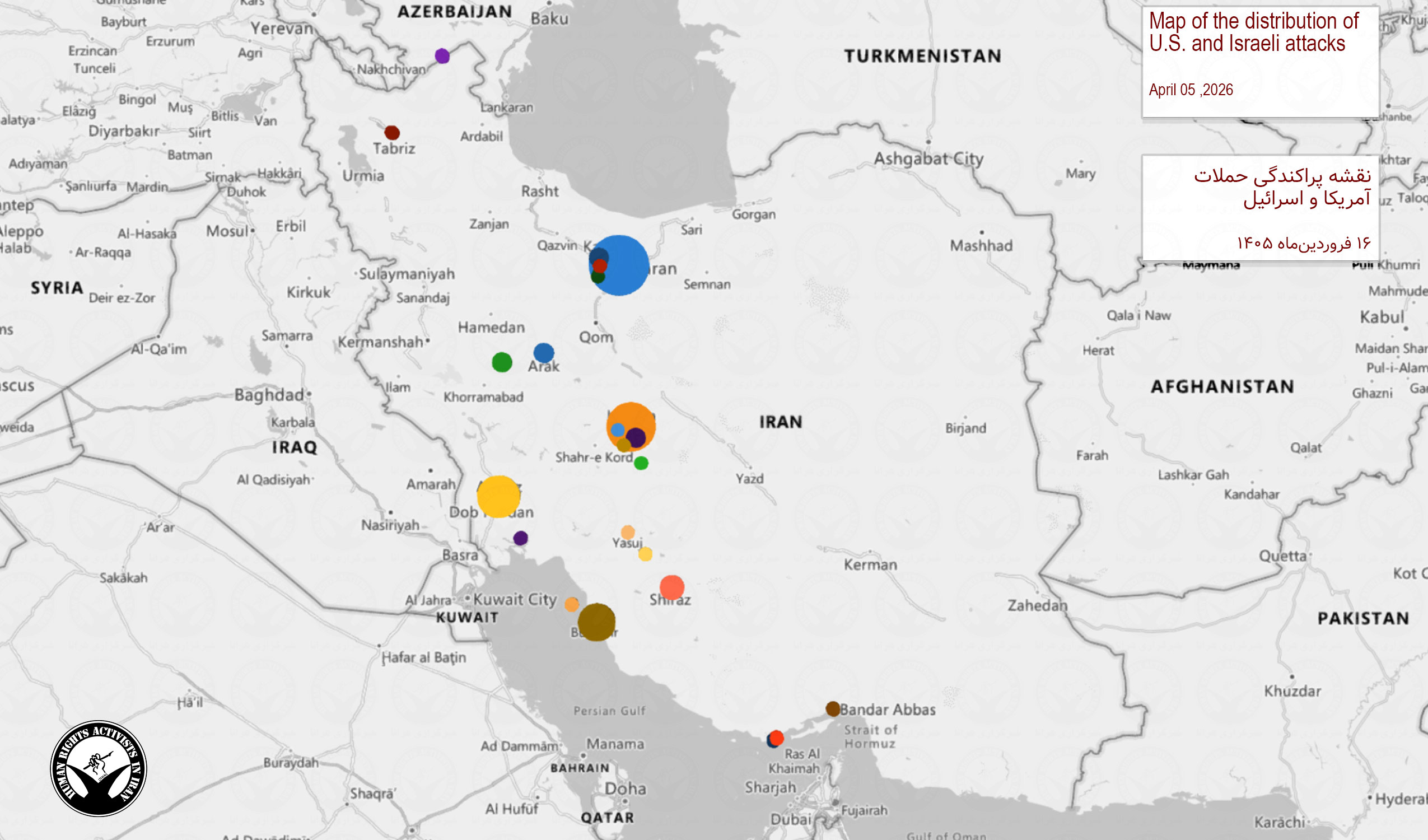
Preliminary analysis shows that Tehran Province tops the list of attacked provinces with a 34% share. Khuzestan Province follows in second place with 22%, while Isfahan Province ranks third with 16%. The list is then followed by Alborz, Bushehr, Ilam, and Sistan and Baluchestan provinces, respectively.


Map of Attacks

2. List of Objects Reported Hit

In the past 24 hours, the recorded attacks have damaged 28 distinct objects or facilities. These include a range of different types of targets. In some cases, damage caused by nearby strikes or secondary consequences of the attacks has also been reported.

Examples of targets recorded over the past 24 hours:

• Army Aviation Base (Isfahan)

• 15 Khordad Garrison (Isfahan)

• Badr Military Airport (Isfahan)

• Air Base (Bushehr)

• Imam Ali Garrison (Mobarakeh)

For a number of the listed targets, the exact nature of the target (civilian/military/dual-use) is still under review, and classifications may be revised as additional information becomes available.

Facilities Protected Under International Humanitarian Law:

Under international humanitarian law, medical facilities, educational institutions, humanitarian facilities, religious sites, and emergency service centers are among the many objects that maintain special protected status and are afforded special protection. In the past 24 hours, HRANA has preliminarily recorded the following cases:

• Widespread attack on the Karun Petrochemical Complex (Mahshahr)

• Bandar Imam Petrochemical Complex (Bandar Imam Khomeini)

• Mineral water storage warehouses (Mehran)

• Nuclear power plant (Bushehr)

• Residential area (Tehran)

3. Civilian Casualties

Over the past 24 hours, at least nine civilian citizens were killed and 175 others injured. All classifications are preliminary and may be updated if new information becomes available.

4. Military Casualties

During the period covered by this report, no reports of military casualties were received. Military casualties are generally reported in the context of attacks on Army and Islamic Revolutionary Guard Corps (IRGC) bases. Where possible, organizational affiliation and operational context are being assessed; however, not all details have yet been independently verified.

In some incidents, individuals have been killed in the vicinity of military targets; however, their official status has not yet been definitively determined. These cases remain under review, and if reliable information indicating a different status becomes available, the classification may be revised accordingly.

It is believed that military casualties are significantly higher than the figures reported in these reports. However, due to the sensitive nature of military information and the limited access of human rights groups and media to locations where military forces are present, this section largely reflects reports of senior officers or military personnel who were present in urban areas.

5. Confirmed but Unspecified Casualties

Burials: Today, Five burial cases resulting from attacks in previous days were recorded.

A Note on HRANA Methodology

Note that, in line with HRANA policy, this report reflects only incidents that occurred within the territorial borders of Iran.

The information contained in this report is compiled through HRANA’s established documentation network. Data is collected from a combination of field reports, local contacts, medical and emergency sources, civil society networks, and open source materials, including publicly available images, videos, and official statements where relevant. Each reported incident is logged and assessed through an internal review process before publication.

Given the evolving nature of hostilities, information is gathered on a rolling basis and reflects the status of documentation at the time of publication.

The figures presented in this report may not reflect the full scope of harm. Ongoing hostilities, damage to infrastructure, communication disruptions, restricted access to affected areas, and security risks for sources may limit the ability to document incidents comprehensively.

Delays in medical reporting, difficulties in confirming identities, and restricted access to certain provinces may result in temporary undercounting. As access improves or additional evidence emerges, casualty figures and incident classifications may be revised accordingly.

HRANA remains committed to transparency, methodological rigor, and the continual updating of its findings as new verified information becomes available.


Execution of Nine Prisoners on Murder and Drug-Related Charges

HRANA – At dawn yesterday, Thursday, February 19, 2026, the death sentences of at least nine prisoners were carried out in Vakilabad Prison in Mashhad, as well as in the prisons of Esfarayen, Sari, Bukan, Behbahan, Taybad, Bojnord, Mahshahr, and Ferdows.

According to information received by HRANA, Rahman Omari was executed in Esfarayen Prison; Mehrshad Panji in Sari Prison; Farez Babaei in Bukan Prison; Ali Jafar Sadeghi in Behbahan Prison; Milad Ghaedi in Mahshahr Prison; Rahim Mashayekhi in Ferdows Prison; and Hassan Narouie in Vakilabad Prison in Mashhad. These prisoners had previously been arrested on charges of murder and were subsequently sentenced to death by criminal courts.

In addition, the executions of Mokhtar Azizian in Bojnurd Prison and an Afghan national in Taybad Prison were carried out on charges related to drug offenses. Further details, including the identity of the ninth prisoner executed at dawn today, are still under investigation by HRANA.

As of the time of this report, the executions have not been officially announced by prison authorities or relevant institutions.

According to HRA’s annual report, in 2025, at least 2,063 individuals were executed in Iran during the one-year period from January 1, 2025, to January 1, 2026. This represents a 119% increase in executions compared to 2024. In many of these cases, due to secrecy, prisoners were even deprived of the right to a final visit with their families.

Execution of 14 Prisoners on Murder and Drug-Related Charges

Amid ongoing concerns over the lack of judicial transparency and widespread internet disruptions in Iran, at least 14 prisoners were executed in various prisons across the country in the last four days. These prisoners had previously been sentenced to death on charges related to drug offenses and murder.

Based on information received by HRANA, Rastin Noorian was executed on Tuesday in Behbahan Prison on a charge of murder. On the same day, Farshid Darabi in Sari Prison and Changiz Ghafoori in Bukan Prison were also executed on murder charges. In addition, Amirali Haghighat-Doost was hanged on Tuesday in Gonabad Prison on charges related to drug offenses. On Wednesday, Houshang Maleki in Ferdows Prison, Touraj Rashidi in Esfarayen Prison, Shaho Safari in Sanandaj Prison, and Jalal Papi in Nowshahr Prison were all executed on murder charges. Two other prisoners were executed in Rasht Prison on murder charges; the identity of one of them, Ashkan Kalehri, has been confirmed by HRANA.

On Monday, Iman Zamani was executed in Quchan Prison on charges related to drug offenses. Additionally, on Wednesday, Momen Abdi-Pour was executed in Mahshahr Prison on a charge of murder. Meanwhile, today, Thursday, January 22, Abdullah Panjshiri, an Afghan national, was executed in Taybad Prison on charges related to drug offenses. Nariman Sohrabi was also executed in Bojnord Prison on a murder charge.

Further details, including the identity of one of the prisoners executed in Rasht Prison, are still under investigation by HRANA.

As of the time of this report, these executions have not been officially announced by prison authorities or relevant institutions.

According to HRA’s annual report, at least 2,063 people were executed in Iran during the one-year period from January 1, 2025, to January 1, 2026. This represents a 119% increase in executions compared to 2024. In many of these cases, due to secrecy, prisoners were denied even the right to a final visit with their families.

Eight Prisoners Executed in Prisons Across Iran

HRANA – In recent days, the death sentences of at least eight prisoners, previously convicted on charges related to drug offenses and murder, were carried out in the prisons of Bojnurd, Sari, Taybad, Mahshahr, Ferdows, Behbahan, and Bukan.

The identities of seven of these prisoners, Ramin Navazi, Shahram Aghcheli, Nemat Gholami, Sharif Hadavi, Majid Madadi, Abdollah Dashti, and Ali-Bakhsh Khanmohammadi, have been confirmed by HRANA.

Based on information received by HRANA, today, January 8, Ramin Navazi, convicted of drug-related charges, was executed in Bojnurd Prison. The death sentence of Shahram Aghcheli, convicted of murder, was carried out in Sari Prison. In Taybad Prison, two prisoners, both sentenced to death on drug-related charges, were executed; the identity of one of them, Nemat Gholami, has been confirmed by HRANA.

Meanwhile, on Wednesday, January 7, the death sentence of Sharif Hadavi, convicted of murder, was carried out in Mahshahr Prison. On Tuesday, January 6, 2026, Majid Madadi, also convicted of murder, was executed in Ferdows Prison. On the same day, Abdollah Dashti was executed on murder charges in Behbahan Prison.

Additionally, on Monday, January 5, 2026, Ali-Bakhsh Khanmohammadi, convicted of murder, was hanged in Bukan Prison.

Further details, including the identification of one of the prisoners, are still under review by HRANA.

As of the time of this report, the executions of these prisoners have not been officially announced by prison authorities or relevant institutions.

According to HRA’s annual report, at least 2,063 people were executed in Iran during 2025. Based on this report, executions increased by 119% compared to 2024.

Subscribe to Our Newsletter

Now is definitely not the time to stop reading!

Unprecedented Surge in Executions Continues: Twelve Prisoners Executed on Murder and Drug Charges in Recent Days

HRANA – The unprecedented surge in executions in recent days has continued. This report details the execution of twelve individuals on charges related to murder and drug offenses:

Thursday, December 25
On this day, HRANA reported the executions of the following individuals:

Amin Safari, on drug-related charges, in Bojnurd Prison;
Majid Khani, on a murder charge, in Sari Prison;
Heshmat Beigi, on drug-related charges, in Ferdows Prison.

Wednesday, December 24
According to HRANA, the death sentences of the following individuals were carried out:

Behrouz Sheikhi, on a murder charge, in Behbahan Prison;
Yarmohammad Saljouqi, on drug-related charges, in Taybad Prison.

Tuesday, December 23
On this day, six individuals were executed on murder charges in various prisons:

Sepehr Moradi, in Mahshahr Prison;
Jalal Taheri, in Bukan Prison;
Habib Amouri, in Sepidar Prison;
Afshin Toosi, in Quchan Prison;
Milad Norouzi, in Nowshahr Prison;
Yadollah Almasi, in Kashmar Prison.

Additionally, on Sunday, December 21, Rastin Karami was executed by hanging on a murder charge in Sanandaj Prison.

As of the time of this report, the executions of these prisoners have not been officially announced by prison authorities or the relevant institutions.

At Least 27 Prisoners Executed in Iran Over Two Days

HRANA – Over the past two days, according to reports by HRANA and other human rights organizations, at least 27 prisoners have been executed in various prisons across Iran. Additional executions were also reported in the preceding days.

Wednesday, December 24:
HRANA reported the execution of the following individuals on this day:

Zahra Khanzadeh and Amir Azizi, on drug-related charges, in Mashhad Prison
Noushad Kazemian, on drug-related charges, in Malayer Prison
Yarmohammad Saljouqi, on drug-related charges, in Taybad Prison
Jahanshah Rashidian, on drug-related charges, in Damghan Prison
Nazir (last name unknown), a citizen of Afghanistan, and Ayoub Dehghani, on drug-related charges, in Adel-Abad Prison in Shiraz
Nemat Khosravi, on drug-related charges, in Kashmar Prison
Noureddin Panahi, on charges of murder, in Bushehr Prison
Saoud Moradi, Yaqub Masoumi, Mohammad Mehdi Adavi, and Ebrahim Alizadeh, on charges of murder, in Ghezel Hesar Prison, Karaj
Mohammad Nourian, on charges of murder, in Shahrekord Prison
Behrouz Sheikhi, on charges of murder, in Behbahan Prison
Khodakaram Safapour, on charges of murder, in Sabzevar Prison
(First name unknown) Rastegari, on charges of murder, in Mahabad Prison

Additionally, Hirkani News reported the execution of a 23-year-old prisoner named Mehdi Rajabali-Zadeh, on charges of murder during a group fight, in Lakan Prison in Rasht.

Tuesday, December 23:

According to HRANA, the death sentences of the following individuals were carried out:

Manouchehr Mahaki, on charges of murder, in Jiroft Prison
Two prisoners of unknown identity, on charges of murder, in Chabahar Prison
Sepehr Moradi, on charges of murder, in Mahshahr Prison
Pejman Saeedi, on charges of murder, in Borazjan Prison
Yazdan Joozipour, on drug-related charges, in Yazd Prison

In addition, a news agency affiliated with the IRGC reported the execution of two prisoners on charges of rape in Qaemshahr Prison. The identities of those executed were not disclosed.

Other reported executions:

Beyond the executions listed above, Iran Human Rights reported the execution of a 41-year-old woman named Mahdieh Keyhani, on charges of murder, in Hamedan Prison on Sunday, December 21.

In another report, on Monday, December 22, three prisoners named Aydin Nourzad, Mohammadreza Madadi (approximately 30 years old), and Kazem Hamidi (40 years old) were executed. According to the report, Mr. Madadi had been arrested two years earlier on drug-related charges and was later sentenced to death by the Revolutionary Court. Mr. Hamidi had been arrested four years earlier on charges of murder in a street altercation and was subsequently sentenced to death by a criminal court.

In a separate report by Iran Human Rights, on Tuesday, December 23, a 46-year-old prisoner named Houshang Amiri was executed on charges of murder in Nishapur Prison.

At Least 21 Prisoners Executed Across Iran in Recent Days

HRANA – In recent days, multiple executions have been carried out in various prisons across Iran on charges related to murder and drug offenses. This report reviews details of 21 executed prisoners.

Sunday, December 14:
HRANA reported the execution of a prisoner named Kamran Nouri on murder charges in Sanandaj Prison.
Iran Human Rights Organization also reported the execution of a prisoner named Mansour Ghaneh, approximately 30 years old and from Ahvaz, in Sepidar Prison of Ahvaz.

Monday, December 15:
HRANA reported the execution of a prisoner identified as Nourzad (first name unknown) on murder charges in Nowshahr Prison.

Tuesday, December 16:

In Lakan Prison in Rasht, the execution sentences of three prisoners convicted of murder were carried out. Further details, including their identities, are under investigation by HRANA.
Additionally, Ashkan Rasouli was executed on murder charges in Ferdows Prison; Kambiz Dirbazian on drug-related charges in Esfarayen Prison; and Arsalan Arab on murder charges in Dezful Prison.

Wednesday, December 17:
According to HRANA, on this day the following prisoners were executed:

Mehdi Ghorbani in Mahshahr Prison,
Kazem Taheri in Behbahan Prison,
Mojtaba Falahati in Sari Prison,
Ario Niazi in Dizelabad Prison, Kermanshah,
Arian Jowkar in Quchan Prison.

All of the above individuals had been sentenced to death on murder charges.
Additionally, Shirzad Farhangi was executed on drug-related charges in Gonabad Prison.

Iran Human Rights Organization also reported the execution of two prisoners on murder charges, Alireza Soltani, approximately 49 years old, and Nasser Ayoubi, 28 years old, in Tabriz Prison.

Thursday, December 18:
According to HRANA, the death sentences of the following individuals were carried out on this day:

Jaber Torkaman, on murder charges, in Bukan Prison;
Karam Reza Karami, on drug-related charges, in Bojnurd Prison;
An Afghan national of unknown identity, on drug-related charges, in Taybad Prison;
Abolfazl Shirzadi, on murder charges, in Malayer Prison.

As of the time of this report, these executions have not been officially announced by prison authorities or relevant institutions.

From the beginning of this year until the end of November, 2025, the Iranian regime has executed 1,594 people, marking an unprecedented increase compared to previous years.

At Least Eight Prisoners Executed in Iran on December 11

HRANA – Yesterday, Thursday, December 11, at least eight more prisoners were executed in Iran on charges of murder and drug-related offenses. In addition, the execution of two other prisoners was reported on Wednesday, December 10.

On this day, HRANA reported the execution of the following individuals:

Ali Shamloo, on drug-related charges, in Bojnurd Prison;

Kavian (first name only, last name unknown), on a murder charge, in Bukan Prison;

Kabir Mahmoudvand, on a murder charge, in Mahshahr Prison;

Yaser Jahantigh, on a murder charge, in Sari Prison;

Mohammad Ghahramani, on a murder charge, in Ferdows Prison;

Sasan Sheikhi, on a murder charge, in Behbahan Prison.

Additionally, two prisoners were executed in Taybad Prison on drug-related charges. HRANA has identified one of them as Manouchehr Navabi.

Furthermore, on Wednesday, December 10, the execution of two prisoners in Lakan Prison in Rasht was reported by the Iran Human Rights. The identities of these prisoners were reported as Mehrdad Rezaei, 31 years old, from the village of Chaperpard in Rasht County, and Saeed Khoshkalam, 27 years old, from Karaj. Mehrdad Rezaei was arrested four years ago and Saeed Khoshkalam three years ago in separate cases on drug-related charges and were subsequently sentenced to death by judicial authorities.

As of the time of this report, the executions of these prisoners have not been officially announced by prison officials or relevant authorities.

Iran Executes at Least 12 Prisoners Over Three Days Amid Surge in Executions

HRANA – Amid an unprecedented rise in executions in recent months in Iran, at least 12 prisoners have been executed over the past three days on charges of murder or drug-related offenses in various prisons across the country.

Tuesday, December 2
HRANA reported the executions of Fariborz Niazi on a murder charge in Malayer Prison; Mohammad Javad Aminpour on a murder charge in Ardabil Prison; Aziz Sheikhi on drug-related charges in Ferdows Prison; and Malek Gerayi on a murder charge in Ilam Prison.

Wednesday, December 3
According to HRANA, on this date the following executions were carried out:
Manouchehr Ahmadi, on a murder charge in Borazjan Prison
Mehran Chaboksavar, on a murder charge in Neyshabur Prison
Amin Mahdavi, on a murder charge in Mahshahr Prison
Majid Namjou, on a murder charge in Bushehr Prison
Siavash Khosravi, on drug-related charges in Kashan Prison
Saber Zahedi, on drug-related charges in Shahr-e Kord Prison
Karam Khoda Sepehri, on drug-related charges in Bojnourd Prison

Thursday, December 4
On this day, HRANA reported the executions of Rahim Mansouri, on a murder charge in Kashmar Prison, and Hossein Ali Yeganeh, on drug-related charges in Birjand Prison.

From the beginning of this year until the end of November, 2025, the Iranian regime has executed 1,594 people, marking an unprecedented increase compared to previous years.