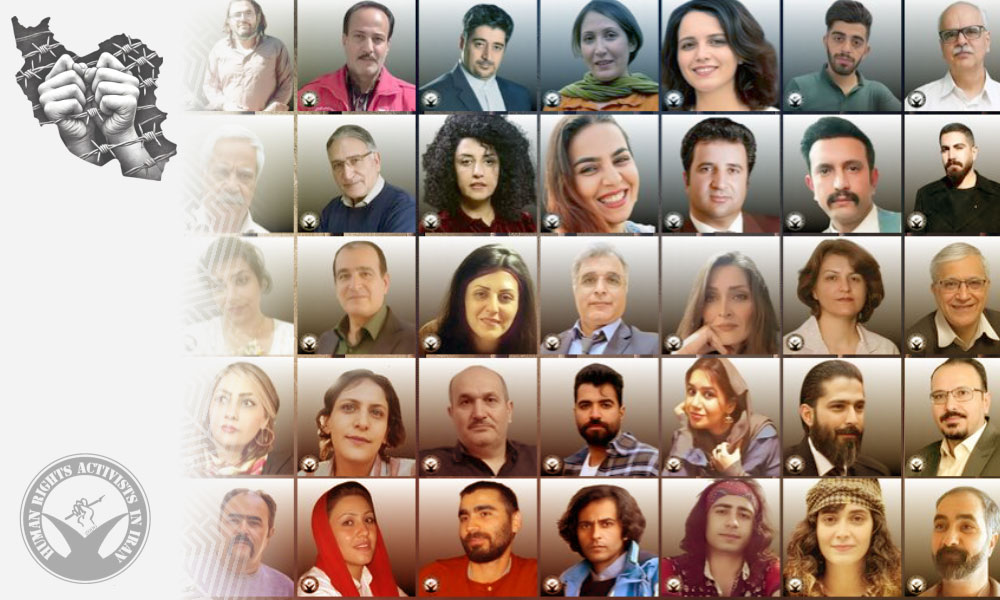
Human Rights Day: Introducing Imprisoned Civil Activists in Iran and Honoring Their Stand Against Human Rights Violations

Human Rights Day is also an opportunity to reexamine the values that form the foundation of human dignity, values such as justice, freedom, and equality, rooted in international documents and human experience

HRANA News Agency –Human Rights Day is an opportunity to reflect on the condition of imprisoned civil activists in Iran, individuals who are behind bars solely for defending fundamental human rights. HRANA, by publishing a list of these brave activists, calls on the international community to amplify their voices and demand the immediate release of advocates for freedom and justice.

This day serves as a moment to reconsider the role of human rights defenders and civil activists in societies where fundamental rights are still subject to structural violations. Marked annually on the global calendar, it commemorates the principles laid out in the Universal Declaration of Human Rights, adopted on December 10, 1948, principles that recognize freedom of expression, the prohibition of torture, the right to a fair trial, and human dignity as inalienable rights of all individuals. Nevertheless, the current reality in Iran highlights a stark gap between these international standards and the domestic situation.

In Iran, many human rights defenders, civil society activists, trade unionists, environmentalists, and advocates for fundamental freedoms face the threat of arrest, harsh sentences, and long-term deprivation, even for entirely peaceful activities conducted within the framework of domestic laws. These individuals, who constitute a significant part of the country’s civil society fabric, consistently encounter security pressures, broad restrictions, and systematic rights violations in their pursuit of transparency, justice, and equality. Most have been sentenced following closed-door trials, with limited access to legal counsel and based on vague or unsubstantiated charges, a process that not only contradicts Iran’s international obligations but also deeply impacts the civic space in the country.

In this report, HRANA publishes a list of over 61 imprisoned human rights defenders and civil activists in Iran, including 8 of whom currently being held in pretrial detention. This list is the result of ongoing collection, verification, and documentation efforts, aiming to provide a clear representation of the various dimensions of human rights violations against these defenders. The publication of this list is not merely the release of names; it tells a part of the story of Iranian civil society, in which the struggle to defend human rights can come at the cost of one’s freedom, health, and personal security.

Beyond commemorating foundational principles, Human Rights Day is also an occasion to consider the role of society and international institutions in supporting these defenders. Raising public awareness, demanding accountability from authorities, and supporting activists’ efforts are essential tools for advancing human rights in Iran. Through this report.

This report, in addition to documenting and reporting on these individuals’ conditions, is a step toward transparent and continuous documentation, aimed at preserving the truth, preventing collective amnesia, and laying the groundwork for accountability. Despite pressures and restrictions, human rights defenders in Iran remain a vital part of the collective effort to achieve a freer and more just society. Human Rights Day is a moment to once again bring their names and efforts to the forefront.

List of names:
Mohammad Najafi1. Mohammad Najafi, Civil Rights Activist

Charges:
Sending a voice message from Arak Prison and expressing support for the 2022 nationwide protests; spreading falsehoods; propaganda against the regime; insulting the Supreme Leader.
Conviction: At least six separate cases totaling more than 24 years in prison.
Place of imprisonment: Evin Prison.
sharifeh mohammadi2. Sharifeh Mohammadi, labor activist

Charges: Propaganda against the regime; acting against national security; baghi (armed rebellion) through membership in one of the opposition groups.
Conviction: Following an order by the head of the judiciary, her sentence was reduced by one degree and changed to 30 years in prison.
Place of imprisonment: Lakan Prison in Rasht.

3. Fatemeh Sepehri, civil activist

Charges: Cooperation with hostile governments; assembly and collusion; insulting the Supreme Leader; propaganda against the regime; spreading falsehoods and disturbing public opinion.
Conviction: In five separate cases, a total of 41 years and 9 months in prison plus a monetary fine.
Place of imprisonment: Vakilabad Prison in Mashhad.

4. Golrokh Iraee, civil activist

Charges: Assembly and collusion against national security; propaganda against the regime; disrupting public order.
Conviction: Five years in prison and social deprivations.
Place of imprisonment: Evin Prison.

5. Maryam Akbari Monfared, civil activist

Charges: Propaganda against the regime and assembly and collusion against national security.
Conviction: Two years in prison.
Place of imprisonment: Qarchak Prison in Varamin.

6. Zartosht Ahmadi Ragheb, civil activist

Charges: Propaganda against the regime; assembly and collusion to commit crimes against internal and external security.
Conviction: In two separate cases, a total of six years and eight months in prison, social deprivations, and exile.
Place of imprisonment: Ghezel Hesar Prison in Karaj.

7- Payam Vali, Baha’i civil activist

Charges: Cooperation with hostile governments; inciting or persuading people to war and killing each other; propaganda against the regime.
Conviction: In three separate cases, 11 years and 5 months in prison, social deprivations, and exile.
Place of imprisonment: Karaj Central Penitentiary.

8. Mohammad Davari, labor activist

Charges: Insulting the Supreme Leader and propaganda against the regime in favor of anti-regime groups on the Internet.
Conviction: Four years and six months in prison, social deprivations, and exile.
Place of imprisonment: Adelabad Prison in Shiraz.

9. Hashem Khastar, civil activist

Charges: Insulting the founder of the Islamic Republic; insulting sacred values; insulting the Supreme Leader; disturbing public opinion; cooperation with foreign media; participating in unlawful gatherings; and propaganda against the regime.
Conviction: In two separate cases, a total of 18 years and six months in prison, social deprivations, and exile.
Place of imprisonment: Vakilabad Prison in Mashhad.

10. Anisha Asadollahi, labor activist

Charges: Assembly and collusion against national security and propaganda against the regime.
Conviction: Five years and eight months in prison.
Place of imprisonment: Evin Prison.

11- Mehran Raoof, labor activist

Charges: Participation in running an unlawful group and propaganda against the regime.
Conviction: Seven years and six months in prison.
Place of imprisonment: Evin Prison.

12- Mohammad Nourizad, civil activist

Charges: Sending an audio file out of Evin Prison; disrupting public order; spreading falsehoods; insulting the founder of the Islamic Republic; insulting sacred values; insulting the Supreme Leader; disturbing public opinion; cooperation with foreign media; participating in unlawful gatherings; propaganda against the regime; and damaging the door and window of the ward chief’s office.
Conviction: In six separate cases, a total of 28 years and 9 months in prison, 148 lashes, and exile.
Place of imprisonment: Evin Prison.

13- Saeed Madani, civil activist

Charges: Forming and administering anti-regime groups.
Conviction: Four years in prison.
Place of imprisonment: Damavand Prison.

14. Ahmadreza Haeri, civil activist

Charges: Assembly and collusion with the intent to commit a crime against national security; propaganda activities against the regime; and spreading falsehoods.
Conviction: In two separate cases, a total of six years and three months in prison.
Place of imprisonment: Ghezel Hesar Prison in Karaj.

15. Reza (Gholamreza) Aghdasi, labor activist

Charges: Propaganda against the regime and assembly and collusion with the intent to commit a crime against national security.
Conviction: Four years and three months in prison.
Place of imprisonment: Evin Prison

16. Arman Shadivand, environmental activist

Charges: Propaganda against the regime and insulting the Supreme Leader.
Conviction: Two years in prison.
Place of imprisonment: Darreh Shahr Prison.

17. Narges Mansouri, civil activist

Charges: Assembly and collusion against national security, and propaganda against the regime.
Conviction: Nine years in prison.
Place of imprisonment: Evin Prison.

18. Abbas Vahedian Shahroudi, civil activist

Charges: Forming a group with the intent to act against national security, and cooperating with groups opposing the regime.
Conviction: A total of 24 years in prison and two years of exile in three separate cases.
Place of imprisonment: Vakilabad Prison in Mashhad.

19. Mohammad Abolhasani, civil activist

Charges: Disrupting public order; assembly and collusion against national security; and propaganda activities against the regime.
Conviction: In three separate cases, a total of five years and three months in prison, social deprivations, and 12 lashes. The flogging sentence has been carried out.
Place of imprisonment: Choubindar Prison in Qazvin.

20- Taher Naghavi, attorney and civil activist

Charges: Propaganda against the regime and assembly and collusion with the intent to disrupt national security.
Conviction: Six years in prison and social deprivations.
Place of imprisonment: Evin Prison.

21- Maryam Jalal Hosseini, civil activist

Charges: Inciting and persuading people to war and violence against one another with the intent to disrupt national security; propaganda against the regime; insulting the Supreme Leader; and forming a group aimed at undermining national security.
Conviction: Six years in prison and exile.
Place of imprisonment: Kachouei Prison in Karaj.

22- Shakila Monfared, civil activist

Charges: Membership in anti-regime groups; destruction of public property; disrupting public order and public peace; propaganda activities against the regime; and insulting Islamic sacred values.
Conviction: In four separate cases, a total of 15 years and five months in prison, ten lashes, social deprivations, and exile.
Place of imprisonment: Evin Prison.

23- Morteza Seydi, labor activist

Charges: Forming a group under the name of a labor union with the intent to disrupt national security.
Conviction: Two years in prison.
Place of imprisonment: Evin Prison.

24. Nasrollah Amirloo, labor activist

Charges: Forming a group under the name of a labor union with the intent to disrupt national security.
Conviction: Two years in prison.
Place of imprisonment: Evin Prison.

25. Morteza Parvin, Azerbaijani-Turk activist

Charges: Propaganda against the regime and assembly and collusion with the intent to disrupt national security.
Conviction: Six years in prison.
Place of imprisonment: Evin Prison.

 26. Foad Fathi, labor activist

Charges: Membership in anti-regime groups; acting against national security; and propaganda against the regime.
Conviction: Four years in prison.
Place of imprisonment: Evin Prison.

27. Abdolrasoul Mortazavi, civil activist

Charges: Insulting the founder of the Islamic Republic; insulting sacred values; insulting the Supreme Leader; disturbing public opinion; cooperating with foreign media; participating in unlawful gatherings; propaganda against the regime; and disrupting public order.
Conviction: In three separate cases, 30 years in prison, with the maximum cumulative sentence stated as 15 years in prison.
Place of imprisonment: Dastgerd Prison in Isfahan.

28. Fariba Kamalabadi, Baha’i civil activist

Charges: Administering an organization described by authorities as a “deviant and misguided sect” with the aim of disrupting national security.
Conviction: Ten years in prison.
Place of imprisonment: Evin Prison.

29. Javad La’al-Mohammadi, civil activist

Charges: Giving interviews to foreign media and membership in anti-regime groups.
Conviction: In three separate cases, a total of 23 years in prison.
Place of imprisonment: Vakilabad Prison in Mashhad.

30- Golareh Abbasi, civil activist

Charges: Assembly and collusion against national security, and propaganda against the regime.
Conviction: 33 months in prison.
Place of imprisonment: Evin Prison.

31. Arsham Rezaei, civil activist

Charges: Assembly and collusion with the intent to commit a crime against national security; propaganda activities against the regime; inciting people to clashes and bloodshed; acquiring illicit gains; and spreading falsehoods.
Conviction: In two separate cases, a total of 15 years in prison, a monetary fine, 50 lashes, and social deprivations.
Place of imprisonment: Ghezel Hesar Prison in Karaj.

32- Vadood Asadi, Azerbaijani-Turk activist

Charges: Propaganda against the regime; membership in opposition groups; insulting the Supreme Leader; and assembly and collusion against national security.
Conviction: In two separate cases, a total of six years and three months in prison.
Place of imprisonment: Evin Prison.

33- Salar Taher Afshar, Azerbaijani-Turk activist

Charges: Assembly and collusion against national security.
Conviction: Five years in prison.
Place of imprisonment: Evin Prison.

34. Abdolaziz Azimi-Ghadim, Azerbaijani-Turk activist

Charges: Propaganda against the regime and assembly, and collusion against national security.
Conviction: Six years in prison.
Place of imprisonment: Evin Prison.

35. Elham Salehi, civil activist

Charges: Propaganda activities against the regime; spreading falsehoods; and appearing in public without a hijab.
Conviction: One year in prison and complementary punishments.
Place of imprisonment: Qarchak Prison in Varamin.

36. Abolfazl Khoran, teachers’ union activist

Charges: Insulting sacred values and disrupting public order and public peace.
Conviction: A total of six years in prison, 74 lashes, and a 40 million toman fine in two separate cases.
Place of imprisonment: Arak Prison.

37- Masoud Farhikhteh, teachers’ union activist

Charges: Assembly and collusion with the intent to commit crimes against the country’s internal security, and propaganda activities against the regime.
Conviction: Four years, one month, and 17 days in prison.
Place of imprisonment: Karaj Central Penitentiary.

38- Reza Mohammad-Hosseini, civil activist

Charges: Membership in anti-regime groups with the aim of disrupting national security; assembly and collusion to commit a crime against national security; and propaganda activities against the regime.
Conviction: Initially 41 years and six months, later reduced to five years in prison at the appeals stage.
Place of imprisonment: Ghezel Hesar Prison in Karaj.

39- Mahboobeh Rezaei, civil activist

Charges: Membership in anti-regime groups with the aim of disrupting national security; assembly and collusion with the intent to commit a crime against national security; propaganda activities against the regime; insulting Islamic sacred values; unveiling (appearing without hijab); and displaying immoral behavior in cyberspace.
Conviction: Initially 19 years and 9 months, later reduced to five years in prison at the appeals stage.
Place of imprisonment: Evin Prison.

40. Abbas Lessani, Azerbaijani-Turk activist

Charges: Forming an unlawful group; assembly and collusion against national security; and disrupting public order.
Conviction: He is being held in pretrial detention and has not yet been tried.
Place of imprisonment: Evin Prison.

41. Farhad Fahandej, Baha’i civil activist

Charges: No information has yet been made available regarding the charges brought against Mr. Fahandej.
Conviction: He is being held in pretrial detention and has not been tried.
Place of imprisonment: A Ministry of Intelligence’s detention facilities in Gorgan.

42. Jahangir Rostami, teachers’ union activist

Charges: No information has yet been made available regarding the charges brought against Mr. Rostami.
Conviction: He is being held in pretrial detention and has not been tried.
Place of imprisonment: The Ministry of Intelligence’s detention facility, known as Ward 209 of Evin Prison.

43. Ehsan Rostami, cultural activist

Charges: No information has yet been made available regarding the charges brought against Mr. Rostami.
Conviction: He is being held in pretrial detention and has not been tried.
Place of imprisonment: The Ministry of Intelligence’s detention facility, known as Ward 209 of Evin Prison.

44. Hassan Tozandehjani, cultural activist

Charges: No information has yet been made available regarding the charges brought against Mr. Tozandehjani.
Conviction: He is being held in pretrial detention and has not been tried.
Place of imprisonment: The Ministry of Intelligence’s detention facility, known as Ward 209 of Evin Prison.

45. Ramin Rostami, cultural activist

Charges: No information has yet been made available regarding the charges brought against Mr. Rostami.
Conviction: He is being held in pretrial detention and has not been tried.
Place of imprisonment: The Ministry of Intelligence’s detention facility, known as Ward 209 of Evin Prison.

46. Nima Mahdizadegan, cultural activist

Charges: No information has yet been made available regarding the charges brought against Mr. Mahdizadegan.
Conviction: He is being held in pretrial detention and has not been tried.
Place of imprisonment: The Ministry of Intelligence’s detention facility, known as Ward 209 of Evin Prison.

47. Mehdi Farrahi Shandiz, teachers’ union activist

Charges: No information has yet been made available regarding the charges brought against Mr. Farrahi Shandiz.
Conviction: He is being held in pretrial detention and has not been tried.
Place of imprisonment: Evin Prison.

The following list includes activists who are currently outside prison due to a suspension of their sentences, furlough, or other similar circumstances:


1. Narges Mohammadi, Nobel Peace Prize laureate and human rights activist

Charges: Propaganda activities against the Islamic Republic of Iran through publishing a statement (the statement against executions); staging a sit-in inside the prison office; disobeying the prison warden and officials (for refusing to end the protest sit-in); breaking windows; defamation and causing bodily harm; confrontation with an officer and disobedience; and additional propaganda activities against the regime.
Conviction: In seven separate cases, a total of 15 years and six months in prison, 74 lashes, exile, and social deprivations.
Place of imprisonment: Evin Prison (currently on medical furlough with the execution of her sentence temporarily suspended).

2- Amirsalar Davoudi, attorney and human rights activist

Charges: Insulting the Supreme Leader; disturbing public opinion; and forming an anti-security group.
Conviction: 14 years in prison.
Case status: Following the Supreme Court’s Branch 39 decision to accept his request for retrial and refer the case to a parallel branch, the enforcement of his sentence has been halted.

3- Fatemeh (Mojgan) Tadrisi, civil activist

Charges: Inciting and persuading people to war and violence against one another with the intent to disrupt national security; propaganda against the regime; insulting the Supreme Leader; and forming a group aimed at undermining national security.
Conviction: Six years in prison and exile.
Place of imprisonment: Kachouei Prison in Karaj (currently on medical furlough).

4. Peyman Farhangian, labor activist

Charges: Propaganda against the regime and forming a group with the intent to disrupt public order.
Conviction: In two separate cases, a total of 11 years in prison and social deprivations.
Place of imprisonment: Azbaram Prison in Lahijan (currently on furlough).

5. Jelveh Javaheri, women’s rights activist

Charges: Propaganda against the regime.
Conviction: One year in prison.
Case status: Following the request for retrial at the Supreme Court, the execution of her sentence has been temporarily halted, and she has been released on bail pending review.

6. Yasamin Heshdari, women’s rights activist

Charges: Membership in a group and assembly and collusion with the intent to disrupt national security.
Conviction: Six years, one month, and 17 days in prison.
Case status: Following the request for retrial at the Supreme Court, the execution of her sentence has been temporarily halted, and she has been released on bail.

7- Sara Jahani, women’s rights activist

Charges: Membership in a group and assembly and collusion with the intent to disrupt national security.
Conviction: Six years, one month, and 17 days in prison.
Case status: Following the request for retrial at the Supreme Court, the execution of her sentence has been temporarily halted, and she has been released on bail.

8- Matin Yazdani, women’s rights activist

Charges: Membership in a group and assembly and collusion with the intent to disrupt national security.
Conviction: Six years, one month, and 17 days in prison.
Case status: Following the request for retrial at the Supreme Court, the execution of her sentence has been temporarily halted, and she has been released on bail.

9- Negin Rezaei, women’s rights activist

Charges: Membership in a group and assembly and collusion with the intent to disrupt national security.
Conviction: Six years, one month, and 17 days in prison.
Case status: Following the request for retrial at the Supreme Court, the execution of her sentence has been temporarily halted, and she has been released on bail.

10- Forough Sami-Nia, women’s rights activist

Charges: Membership in a group and assembly and collusion with the intent to disrupt national security.
Conviction: Six years, one month, and 17 days in prison.
Case status: Following the request for retrial at the Supreme Court, the execution of her sentence has been temporarily halted, and she has been released on bail.

11- Shiva Shah-Siah, women’s rights activist

Charges: Membership in a group and assembly and collusion with the intent to disrupt national security.
Conviction: Six years, one month, and 17 days in prison.
Case status: Following the request for retrial at the Supreme Court, the execution of her sentence has been temporarily halted, and she has been released on bail.

12- Azadeh Chavoshian, women’s rights activist

Charges: Membership in a group and assembly and collusion with the intent to disrupt national security.
Conviction: Six years, one month, and 17 days in prison.
Case status: Following the request for retrial at the Supreme Court, the execution of her sentence has been temporarily halted, and she has been released on bail.

13- Zohreh (Fatemeh) Dadras, women’s rights activist

Charges: Forming a group with the aim of disrupting national security, and assembly and collusion with the intent to disrupt national security.
Conviction: Nine years, six months, and two days in prison.
Case status: Following the request for retrial at the Supreme Court, the execution of her sentence has been temporarily halted, and she has been released on bail.

14. Zahra Dadras, women’s rights activist

Charges: Membership in a group and assembly, and collusion with the intent to disrupt national security.
Conviction: Six years, one month, and 17 days in prison.
Case status: Following the request for retrial at the Supreme Court, the execution of her sentence has been temporarily halted, and she has been released on bail.

Human Rights Day is also an opportunity to re-examine the values that form the foundation of human dignity, values such as justice, freedom, and equality, rooted in international documents and human experience. The names recorded in this report reflect only a portion of a broader reality, one in which human rights defenders and civil activists in Iran, solely for their commitment to human principles and peaceful activities, face deprivation of liberty, security pressures, and fundamental rights violations.

These individuals, despite the limitations and high costs, embody values recognized by the international community. Silence or indifference toward their condition is not only a disregard for human suffering but also a dismissal of the principles on which the international system is built. In this context, on Human Rights Day, the following are demanded from Iranian authorities and the international community:

• Immediately and unconditionally release all individuals detained for the peaceful exercise of their rights, and review all related convictions to vacate unjust charges and ensure reparations for victims.

• End unlawful restrictions on the freedom of expression, association, assembly, and civic engagement, and halt the use of vague national security charges that criminalize peaceful dissent.

• Guarantee due process and fair trial rights, including access to independent legal counsel from the moment of arrest, transparent legal proceedings, and full access to families, medical care, and communication.

• Prohibit torture and all forms of ill-treatment, end the use of coerced forced confessions, and allow independent monitoring and inspections of all detention facilities.

• Allow independent monitoring and international engagement, including granting access to the UN Fact-Finding Mission, Special Rapporteurs (Thematic and Geographic Mandates), and credible civil society organizations to assess conditions and investigate violations.

• Establish effective accountability and oversight mechanisms to prevent recurrence of abuses, ensure judicial independence, reform vague criminal provisions enabling arbitrary detention, and hold perpetrators who enable the cycle of abuse against activists, responsible.

Finally, civil society as well as citizens across the globe are called upon to continue their support, advocacy, and awareness-raising efforts, ensuring that the situation of these prisoners is not sidelined. Amplifying their voices and demanding adherence to human rights obligations are essential steps toward achieving lasting change and alleviating the suffering of those who have sacrificed their freedom in defense of human rights.

A Statistical Analysis of the Iranian Workers’ Situation in the Last Year

In observance of International Workers’ Day, this report by Human Rights Activists in Iran (HRA) provides statistics on the condition of Iranian workers over the past year, highlighting their ongoing struggle with violations of labor rights and unionization, low wages, wage arrears, and workplace safety concerns.

Workplace Accidents

According to the Statistics and Publication Center of HRA, in the past twelve months (from May 1, 2023, to April 27, 2024), at least 9,879 workers have been killed or injured in workplace accidents based on reports made by either state media or workers’ rights organizations.

According to HRA’s Statistics and Publication Center, over the past twelve months (from May 1, 2023, to April 27, 2024), at least 9,879 workers have been killed or injured in workplace accidents as reported by either state media or workers’ rights organizations.

During this period, at least 1,680 workers died in work-related accidents, with 1,514 deaths reported by ten official sources and the remaining 166 deaths reported by independent organizations. These statistics are likely underestimations due to the lack of transparency from relevant institutions and their failure to release information to the public.

Additionally, 3,066 workers were injured at work, with 2,333 cases mentioned in six official reports or statements made by officials at the national or provincial level. Civil and labor rights associations reported the remaining 733 cases.

Here is a breakdown of the types of accidents:

   . 23.87% were due to falls from height
   . 19.71% were caused by fires
   . 9.58% were related to construction accidents
   . 7.59% involved impacts from hard objects
   . 7.59% occurred in factories
   . 6.69% were linked to well accidents
   . 6.51% involved electrocutions
   . 4.70% were related to vehicle accidents
   . 4.16% occurred in mines
   . 3.80% were due to gas poisoning
   . 2.53% happened in petrochemical plants and refineries
   . 1.08% were due to drownings
   . 0.90% were related to agricultural accidents
   . 0.90% were caused by poisonings
   . 0.18% were due to heat strokes
   . 0.18% were caused by frostbites

Wage Arrears (Withheld wages) 

According to statistics from HRA’s Statistics and Publication Center, at least 84,226 workers are owed wage arrears totaling more than 1,052 combined monthly payments.

As Figure below indicates, public sector companies and organizations account for 54% of these wage arrears. The private sector is responsible for 31%, while the energy sector accounts for 4%. The type of organizations responsible for the remaining 11% of wage arrears is unknown.

Unfortunately, many official reports do not specify the number of workers waiting for wage arrears, making it difficult to provide an accurate figure.

Peaceful Assembly and Association

During the reporting period, media and civil society organizations have documented 428 workers’ protests and 1,448 trade union protests, marking increases of 100.5% and 90% respectively compared to the previous year. A significant portion of labor protests likely goes unreported.

Major labor events in the country over the past year include the workers’ protests of Haft Tappeh Sugarcane Company and Railway Services & Technical Construction Engineering, Iran National Steel Industrial Group, Aghajari Oil and Gas Exploitation Company, teachers and educators, civil servant pensioners and the pensioners from the Social Security Organization, national telecommunication company.

Over the past 12 months, numerous cities across the country witnessed a variety of labor protests with demands ranging from addressing insurance issues to resolving wage arrears, which sometimes accumulate up to 30 months. A total of 97 labor strikes and 37 union strikes were reported, representing a decrease of 14% and 90.6% respectively.

Iranian workers’ efforts to organize and persist in their demands have been remarkable. However, the suppression of unionization attempts, the arrest and imprisonment of labor activists, and the denial of workers’ rights to protest have led to some labor protests being sporadic and disorganized.

In Iran, traditional labor unions do not exist. Workers’ efforts to form independent unions are suppressed through security crackdowns and politically motivated allegations against workers’ rights activists, as seen in the cases of the Syndicate of Workers of Tehran and Suburbs Bus Company, Haft Tappeh Sugarcane Syndicate, the Coordination Council of Iranian Teachers’ Trade Associations, and the Independent Iranian Workers Union (IIWU).

Many workers have been summoned, arrested, or convicted for peaceful activities such as protesting low wages. In the past 12 months, at least 51 workers and workers’ rights activists have been arrested. The most notable cases include the arrest of 32 protesting workers in two mines at the Aq-Darreh gold mines and several contractors working at the South Pars/North Dome gas-condensate field located in Bushehr.

Currently imprisoned workers’ rights activists include Reza Shahabi, Hassan Saeedi, Nahid Khodajoo, Othman Esmaeili, Anisha Asadollahi, Keyvan Mohtadi, Nasrin Javadi, Yadi Bahari, Mehran Raoof, and union activists Rasoul Bodaghi, Mohammad Sadeghi, and Asghar Amirzadegan.

Additionally, 26 workers and workers’ rights activists have been sentenced to a total of 460 months in prison, 86 months of suspended sentences, 1,258 lashes, and fines totaling 42.5 million tomans.

In the reporting period, 10 workers committed suicide, including one self-immolation. Additionally, 48 workers faced arraignment, 5 verdicts were enforced, and 2 activists’ residences were searched. Ten workers were summoned by security or judicial institutions. In the same period, 47 factories were closed, 2,514 workers were laid off, 3,188 workers lost their jobs involuntarily, and 2,272,461 workers lacked any labor insurance scheme. Furthermore, 3,996 workers were suspended from work due to factory closures or other reasons for which the employer was responsible.

Moreover, 26 trade union activists were arrested, and 66 were sentenced to a total of 1,495 months in prison, 18 months of suspended sentences, 72 lashes, 24 months of exile, and fines totaling 185,700 tomans. Additionally, 57 trade union activists were summoned by security or judicial authorities, 130 were laid off, and 13 were forced into retirement and 11 were banned from leaving the country. Wage arrears of 335 months affected 13,600 workers. Security forces searched two activists’ residences, 9 verdicts were enforced, and 14 suicides were reported. Public Security Police or other authorities closed 2,049 businesses.

Over the past 12 months, retired and working teachers and educators from dozens of cities across the country have continued their protests, strikes, and rallies. They have staged numerous actions to demand improvements to their working conditions. The report recorded 44 protest gatherings and 4 labor strikes by teachers. As a result of these protests, 21 people were arrested, 49 were summoned, and 36 were convicted. Additionally, 10,600 people faced at least 48 months of wage arrears. Sixty-one teachers were laid off or banned from teaching, and 9 were forced into early retirement. Furthermore, 64 teachers and teachers’ union activists were sentenced to a total of 1,495 months in prison, 18 months of suspended sentences, 24 cases of social deprivations, 72 lashes, and fines totaling 125.7 million tomans.

The Economic Situation

Referring to the disparity between workers’ wages and inflation, as well as the devaluation of the national currency, Saeed Mostafa-Neajd, Executive Secretary of Worker House (Khaneh Kargar) in East Azerbaijan Province, stated that “If workers’ wages are not reconsidered, they will turn to jobs like motorcycle delivery and garbage collecting instead of remaining in manufacturing jobs. Their concerns have shifted from housing and cars to basic sustenance, worrying about having enough to eat for tomorrow.

In response to the “10% reduction in workers’ salaries due to closing on Thursdays,” Mohammad Chakoshian, Deputy Minister of Cooperatives, Labour, and Social Welfare, stated, “This plan cannot be implemented as it goes against labor law to reduce wages. If such a violation occurs, it must be addressed and prevented.”

The ILNA news agency reported that, given the current economic situation in the country, workers earning just $3 per day cannot afford a simple meal. Despite a 35% increase in minimum wages, the purchasing power of workers’ households has been greatly diminished by high inflation and the devaluation of the currency. To buy a basic car like the Pride, a worker would need to save 19 months’ worth of wages without spending any money.

Davoud Mirzaie, Executive Secretary of Worker House (Khaneh Kargar) in Saveh blamed secret collusion between members of parliament and the government for the difficult living conditions faced by the workers and pensioners. He stated that instead of fulfilling their empty promises, they imposed different policies on the representatives of workers in the Supreme Labor Council.

“The government and its economic team, along with members of parliament, have made it more difficult to retire by raising the retirement age and extending the required work record for retirement. They have also effectively abolished the law regarding difficult and hazardous occupations. The Ministry of Cooperatives, Labour, and Social Welfare has made decisions worse than in previous years, suppressing labor rights once again, which will worsen the living conditions of millions of retired workers,” Mirzaie added.

Criticizing the reduction in real wages, a board member of Worker House in Qom Province stated that this decrease will further impoverish workers. The minimum wages were set without accounting for real inflation. “The worker’s representative was not treated fairly in Supreme Labor Council meetings, and the government unilaterally made decisions regarding the minimum wage. The worker community has been trapped in a dire situation due to the wrong and unwise decisions of some officials.”

According to Nader Moradi, a workers’ rights advocate, the monthly cost of living for a worker’s household is at least 30 million tomans. With their current wages, workers can barely survive, and their monthly income may only cover expenses for one week. Workers cannot afford the costs of adequate food, medical expenses, and education. In an interview with ILNA, Moradi warned about the Supreme Labor Council’s decision: “This level of disregard for the law is unprecedented. If wages this year do not keep pace with inflation, the subsistence crisis will worsen, leaving no way out.”

Referring to the challenging situation faced by female workers in Iran, Binazir Jalahi, a former official from the Ministry of Cooperatives, Labour, and Social Welfare, confirmed that labor laws for women are largely not enforced. She also highlighted gender wage discrimination, noting that women earn less than men for the same work and do not receive child and guardian allowances.

Regarding the cost of living, the latest report from the Statistical Center of Iran indicates that the average cost of housing in Tehran is 80 million tomans per square meter. This amount, as estimated by the Entekhab website, is equivalent to a full-time worker’s entire annual income.

Tasnim News Agency reported that a directive from the Ministry of Education, which prohibits teachers from retiring during the school year and has been affirmed by the court of Administrative Justice, faced objections from some teachers. In the teachers’ appeal, they argued that the directive infringes on their rights since the retirement dates of many teachers fall within the school year. Teachers have traditionally retired at any semester, and they further objected that the directive limiting retirement after the start of the school year violates the law and the ministry’s justifications of potential disruptions in students’ education stem from its own mismanagement.

Regarding this year’s minimum wages, an official from the Social Security Retired Center of Tehran stated, “Since the workers’ representatives did not sign the resolution and the minimum wage for this year was set against legal criteria and without workers’ agreement, workers have the right to file a complaint.” The official added, “A 22% increase in pensions is insufficient and will push many pensioners from the Social Security Organization into absolute poverty. Article 96 of the Social Security law clearly states that pensions should increase in line with the cost of living. Therefore, the Supreme Labor Council’s resolution should not be followed for increasing pensions.”


Prohibition of child labor and the provision of free education for children, the establishment of the highest level of safety standards in the workplace, and the elimination of discriminatory laws for women and migrant workers are other demands of the working community.

Despite being a part of the cheapest labor force in the country, women’s labor situation is worse than men, with fewer benefits, lower wages, and a lesser degree of legal protection. Even worse, women have less bargaining power in the workplace.

Employers in manufacturing industries are less willing to recruit married women, and in some cases, single women’s recruitment is conditioned on not getting married or pregnant. Female workers’ situation in small workshops is far worse. Women comprise half of the workers occupied at bricklaying, a laborious and onerous work.

The ongoing privatization of government-owned industrial sectors has further degraded work conditions, job security, and benefits, leading to an increase in workers’ protests and strikes.

As Iranian workers celebrate International Workers’ Day there is little prospect of improvement through domestic reform or remedy. Nonetheless, the State must uphold its international human rights obligations under both the ICCPR and the ICESCR, ensuring that workers and labor rights activists are free to peacefully assemble and associate without fear of reprisal.


For further inquiries please contact Skylar Thompson, Senior Advocacy Coordinator Human Rights Activists in Iran (HRA) at [email protected]

A Statistical Analysis of the Iranian Workers’ Situation in the Last Year

As International Workers’ Day approaches, Human Rights Activists in Iran (HRA) shed light on the dire situation of Iranian workers over the past year. The HRA provides statistics on workers’ most pressing issues, including the denial of labor rights and unionization, low wages, wage arrears, and workplace safety issues.

Workplace Accidents

Iran ranks 102nd in the world in terms of occupational safety. According to the Statistics and Publication Center of HRA, in the past twelve months (from May 1, 2022, to April 27, 2023), at least 3576 workers have been killed or injured based on 2314 reports of work accidents made by either state media or workers’ rights organizations.

During this period, 3,066 workers were injured at work, with 2,333 cases mentioned in six official reports or comments made by officials at the national or provincial level. Civil and labor rights associations reported the remaining 733 cases.

At least 510 workers lost their lives in work-related accidents, with 250 deaths reported by eight official sources and the remaining 260 deaths reported by independent organizations. However, it is important to note that these statistics are likely an underestimation due to the lack of transparency of relevant institutions and their failure to disseminate information to the public.

Inconsistencies in official statements also suggest that official figures should be viewed with skepticism. For example, the Iranian Legal Medicine Organization stated that “during the last 10 years (2008-2018), 15,997 workers lost their lives in work accidents, of which 230 were women.” Considering these figures, the average number of work-related fatal casualties should be significantly higher than the officially-announced death toll of 250.

Falling from tall heights is the leading cause of death in work-related incidents, accounting for 41.5% of workplace deaths over the past ten years, according to official reports.

Occupational Accident Classification Chart

In the past year, based on data gathered by HRA’s Statistics and Publication Center, workplace accidents, illustrated by Figure 1, occurred in the following sectors: construction (20%), fires (19%), wells (9%), falling from tall heights (9%), being struck by hard objects (8%), factories (8%), motor vehicles (8%), electrocutions (6%), mines (6%), suffocation (5%), and petrochemical, oil, and gas refineries (2%).

Wage Arrears (Withheld wages) 

According to statistics compiled by HRA’s Statistics and Publication Center, at least 14,232 workers are owed wage arrears amounting to more than 712 combined monthly payments.

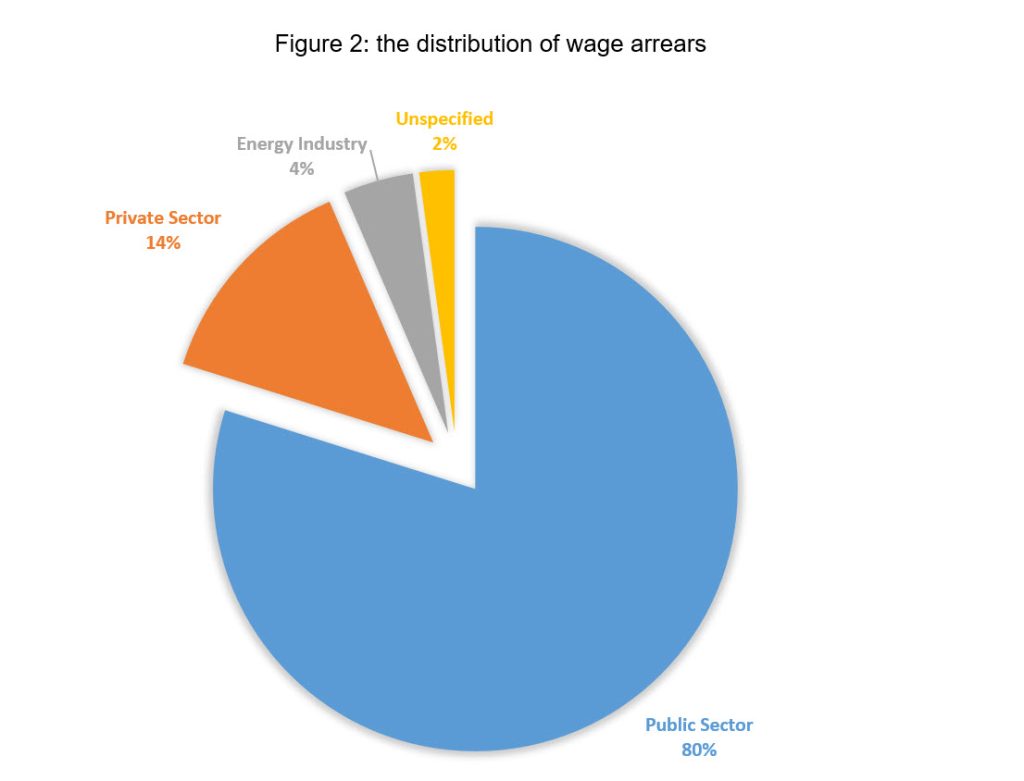
the distribution of wage arrears
As Figure 2 shows, public sector companies and organizations are responsible for 80% of these wage arrears. This figure is 14% for the private sector and 4% for the energy sector. The nature of the organizations responsible for 2% of these wage arrears remains unknown.
Unfortunately, many official reports fail to provide the number of workers awaiting wage arrears, which prevents the reporting of an accurate number.

Peaceful Assembly and Association

During the reporting period, a total of 1,616 reports on workers’ protest rallies and strikes were registered, indicating a decrease compared to previous years. This reduction can be partly attributed to the outbreak of nationwide protests sweeping across the country since September 17, 2022.

Media and civil society organizations have reported 225 workers’ protests and 772 trade union protests, which marks a 55% and 61% decrease, respectively, compared to the previous year.

Major labor events in the country over the past year include the workers’ protests of Haft Tappeh Sugarcane Company and Karun Agro-industry Company, farmers, teachers and educators, the pensioners from the Social Security Organization.

Over the past 12 months, numerous cities across the country witnessed a wide range of labour protests with various demands such as addressing insurance issues and wage arrears, the latter sometimes accumulating up to 30 months. In total, 113 labour strikes and 395 union strikes have been reported, showing a decrease of 70% and 50% respectively.

However, solidarity among workers to pursue their demands has been unprecedented. Suppression of any attempt toward unionization and forming independent labor organizations, the arrest and imprisonment of labor activists, and the denial of workers’ rights to protest are major reasons for making some workers’ protests sporadic and disorganized.

In Iran, there are no labor unions in the conventional sense. Workers’ efforts to form an independent workers union are suppressed by security and politically-tainted allegations against workers’ rights activists. This can be seen in the cases of the Syndicate of Workers of Tehran and Suburbs Bus Company, Haft Tappeh SugarCane Syndicate, the Coordination Council of Iranian Teachers’ Trade Associations, and the Independent Iranian Workers Union (IIWU).

Many workers have been summoned, arrested or convicted for peaceful activities such as protests against low wages, signing a petition in support of labour unions, posting photos of workers’ demonstrations on the internet or even receiving an invitation letter to attend world trade union meetings.

At least 49 workers and workers’ rights activists have been arrested in the past 12 months. The top three cases are the arrest of 16 protesting workers at Sungun copper mine in Varzeghan, 12 striking workers of the Tehran bus workers’ syndicate, and 7 protesting workers of Karun Cement Factory.

Many workers have been summoned, arrested or convicted for peaceful activities such as protests against low wages, signing a petition in support of labor unions, posting photos of workers’ demonstrations on the internet or even receiving an invitation letter to attend world trade union meetings. The most well-known imprisoned workers’ rights activists include Reza Shahabi, Keyvan Mohtadi, Nasrin Javadi, Arash Johari, Yadi Bahari, Mehran Raoof along with the trade union activists Mohammad Habibi, Jafar Ebrahimi, Rasoul Bodaghi, Esmail Abdi, Latif Roozikhah, and Mohammad-Reza Ramezanzadeh.

Additionally, 42 workers and workers’ rights activists have been sentenced to a combined total of 162 months imprisonment, 129 months of suspended imprisonment, a combined total of 510 lashes and paying a total fine of 51 million Tomans. In the reporting period, 6 workers committed self-immolation and 24 workers committed suicide. 21 were summoned by security or judicial institutions. 1,838 workers were subjected to layoffs; 4,228 involuntarily lost their jobs; 1,203,709 workers remain deprived of any labour insurance scheme; 2,783 workers were suspended from work due to factory closure or other reasons for which the employer is liable.

Moreover, 162 trade union activists were arrested. 34 trade union activists were sentenced to a combined total of 863 months imprisonment. 65 individuals were summoned by security or judicial authorities and 1,435 businesses were closed by Public Security Police or other authorities.

During the past 12 months, continuing their protests in the year before, retired and working teachers and educators from dozens of cities across the country staged numerous protests, strikes, and rallies to ask for their demands. 151 of their protest gatherings and 20 labour strikes have been recorded. Following these protests, 148 teachers were arrested, 55 were summoned, 38 were convicted. 11 protesting teachers were subjected to violence by police and security forces. 34 teachers and teachers union activists were sentenced to a combined total of 863 months in prison and a combined total fine of 40 million Tomans.

The Economic Situation

Hasan Habibi, a board member of the Supreme Center of Islamic Labor Councils informed the public about a sweeping wave of worker complaints regarding insufficient annual salaries. Workers are requesting repeal and re-adjustment with inflation. Habibi stated, “The annual salary increase enacted under the pressure of the government representatives at the Supreme Labor Council meeting is at variance with labor code. Although officially announced inflation was at least 50%, wages were only raised by 27% this year.”

Habibi also added, “It remains to be seen whether the court of Administrative Justice will compromise with the employers or rule in favor of workers. In the case of workplace safety and the repeal of petition 179, the complaints have gone nowhere. We hope their course of action will change this time.”

Nasrollah Daryabeigi, the Executive Secretary of the Workers’ House, which is the de facto national trade union center in Iran, pointed out that employers do not pay worker’s insurance in a timely manner, and 90% of workers currently have partial employment contracts.

The Executive Secretary of the Zanjan Workers’ House also asserted that the labor code, particularly Article 41, has been violated in the determination of annual wage increases. “While the government itself has set the poverty line at a monthly income of 14 million Tomans, it recognizes the minimum wage as half of this line,” he argues.

Faramarz Tofighi, the head of the Wage Committee at the Supreme Center of Islamic Labor Councils, pointed out that the delay in starting the work of this committee negatively affects workers’ living conditions. “The subsistence crisis has come to a head, and any increase in wages below one hundred percent never catches up with the livelihood expenses. To have a normal life, workers should earn two to three times more.”

Bahram Hasani-Nejad, a workers’ rights activist and the former head of the Chadormalu Mining Workers’ Association, clarifies that assuming the minimum standards for livelihood and basic needs, a household needs to earn 17 to 18 million monthly.

As many experts and workers’ rights activists have pointed out, the minimum wage, as announced by the Supreme Labor Council, falls lower than the actual inflation rate and consumption expenditure of households. This explains the increase in workers’ protests and their disempowerment to raise their voices.


Prohibition of child labor and the provision of free education for children, the establishment of the highest level of safety standards in the workplace, and the elimination of discriminatory laws for women and migrant workers are other demands of the working community.

Despite being a part of the cheapest labor force in the country, women’s labor situation is worse than men, with fewer benefits, lower wages, and a lesser degree of legal protection. Even worse, women have less bargaining power in the workplace.

Employers in manufacturing industries are less willing to recruit married women, and in some cases, single women’s recruitment is conditioned on not getting married or pregnant. Female workers’ situation in small workshops is far worse. Women comprise half of the workers occupied at bricklaying, a laborious and onerous work.

The ongoing privatization of government-owned industrial sectors has further degraded work conditions, job security, and benefits, leading to an increase in workers’ protests and strikes.

As Iranian workers celebrate International Workers’ Day there is little prospect of improvement through domestic reform or remedy. Nonetheless, the State must uphold its international human rights obligations under both the ICCPR and the ICESCR, ensuring that workers and labor rights activists are free to peacefully assemble and associate without fear of reprisal.


For further inquiries please contact Skylar Thompson, Senior Advocacy Coordinator Human Rights Activists in Iran (HRA) at [email protected]

 Imprisoned British-Iranian National Mehran Raoof: Double Nationals Denied Their Citizen Rights in Iranian Prisons

In an open letter, political prisoner Mehran Raoof sheds light on how he and other political and double national prisoners are denied their fundamental rights in Iranian prisons.

He highlights that governments often use double national prisoners as leverage in negotiations with other countries, so the recent pardon and commutation directive does not include them.

Raoof further speaks out against the violations of his rights during detention, stating that the IRGC intelligence unit held him in detention for eight months without any furlough or access to a lawyer, which is a clear violation of Iranian law. Moreover, for several months, his family was kept in the dark about his condition and whereabouts, and he was not even allowed to contact them.

He ends his letter with these statements:
“This clear discrimination and oppression are not unfamiliar to us, who have lived under the rule of the Islamic Republic for over 40 years. Many of us, including political prisoners, women’s rights activists, environmental activists, and workers’ rights activists are imprisoned on charges of having different beliefs and opinions and protesting against wrong and dictatorial policies and laws. We stand in solidarity with the nationwide protests, demanding the unconditional release of all political prisoners.”

In October 2020, IRGC intelligence agents arrested this 65-year-old British-Iranian national and held him for eight months in a detention facility known as Ward 2A in Evin Prison. Later, he was relocated to Ward 1. In August 2021, Branch 26 of the Tehran Revolutionary Court, presided over by Iman Afshari, sentenced him to ten years and eight months in prison, which was later reduced to seven years and six months.