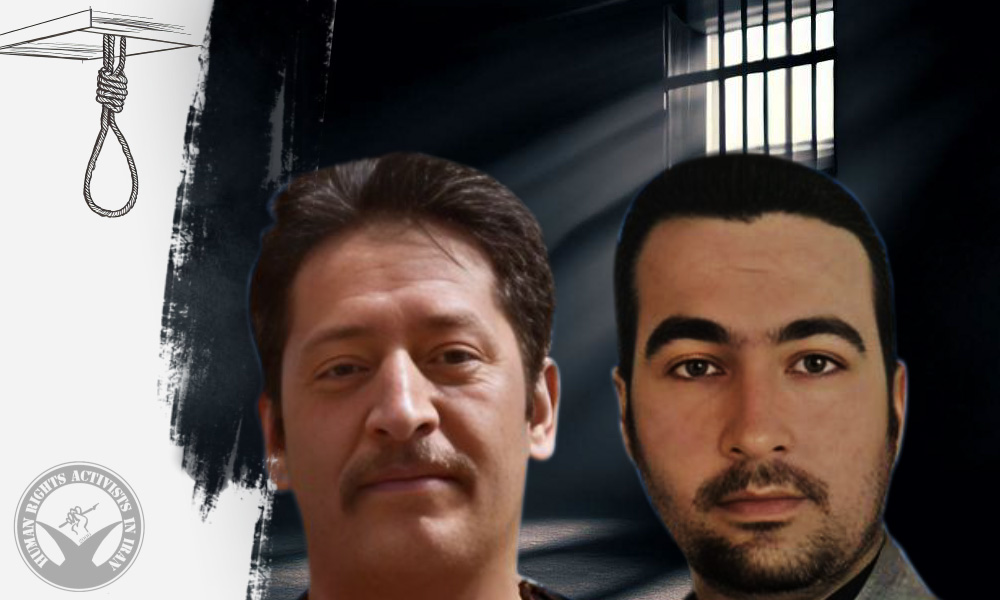
Two Prisoners Executed in Lakan Prison, Rasht

On November 7, 2024, the death sentences of two prisoners convicted of drug-related charges were carried out in Lakan Prison, Rasht.

One of the executed prisoners has been identified as Majid Jamali. The identity of the other prisoner, a woman, is still under investigation.

Based on information obtained by HRANA, the prisoners had been arrested on drug-related charges and sentenced to death by the judiciary.

As of the time of this report, prison authorities and relevant officials have not officially announced the executions.

According to latest HRANA’s annual report over between October 10, 2023, and October 8, 2024, at least 811 individuals were executed by hanging in Iran, rising to 23.06% compared to the same period last year. Of these executions, four were carried out in public. Many of the defendants were denied a fair trial.

Two Prisoners Executed in Zanjan Prison

The death sentences of two prisoners, previously convicted of murder, were carried out in Zanjan Prison.

HRANA has identified these executed prisoners as Soleiman Abbaspour and Ezzat Seyedi.

According to information obtained by HRANA, Soleiman Abbaspour, who had been arrested on murder charges and sentenced to death by the judiciary, was executed at dawn on Saturday, November 2, 2024.

Likewise, Ezzat Seyedi, also convicted of murder and sentenced to death, was hanged at dawn on Thursday, November 7, 2024.

As of this report, the executions have not been officially announced by prison authorities or other relevant officials.

According to latest HRANA’s annual report over between October 10, 2023, and October 8, 2024, at least 811 individuals were executed by hanging in Iran, rising to 23.06% compared to the same period last year. Of these executions, four were carried out in public. Many of the defendants were denied a fair trial.

Three Baha’i Citizens Arrested in Isfahan

On Saturday, November 2, security forces arrested three Baha’i citizens—Rashid Dehghani, Pedram Dehghani, and Parsa Dehghani—in the city of Tiran, Isfahan, and transferred them to an undisclosed location, according to Radio Farda. Rashid and Pedram are residents of Tehran, while Parsa resides in Karaj.

The three had traveled to Tiran in Isfahan to attend a Baha’i religious celebration, during which security forces detained them along with eight other Baha’i attendees. While the eight others have since been released, there is still no information on the whereabouts or condition of Rashid, Pedram, and Parsa Dehghani.

Baha’is are subjected to violations of their religious rights, comprising 82% of reports on infringements against religious minorities, according to HRA’s 2023 annual report.

The Baha’i faith is not recognized as a legitimate religion by Iranian authorities, leading to systematic and longstanding violations of the rights of Baha’is in the country. This includes the denial of their fundamental right to practice their religion, which constitutes a clear breach of both Article 18 of the Universal Declaration of Human Rights and Article 18 of the International Covenant on Civil and Political Rights. The United Nations covenant holds that every person has the right to freedom of religion, freedom of converting religion, as well as freedom of expression, individually or collectively; openly or secretly.

Two Prisoners Executed on Drug-Related Charges in Ahar and Khorramabad Prisons

On the morning of Wednesday, November 6, 2024, two prisoners previously sentenced to death on drug-related charges were executed in Ahar and Khorramabad prisons.

The Iran Human Rights Organization identified one of the prisoners as Yousef Ramezani, who was executed in Ahar Prison. Ramezani was arrested three years ago for trafficking 80 kilograms of methamphetamine and was subsequently sentenced to death by the judiciary.

The second prisoner, Hamed Darvishi, a 40-year-old resident of Borujerd, was hanged in Khorramabad Prison on the same morning. Darvishi had also been arrested three years ago on drug-related charges and received a death sentence.

At the time of this report, prison officials and other relevant authorities have yet to officially confirm these executions.

The reports from the Department of Statistics and Publication of Human Rights Activists for the year 2023 reveal a concerning prevalence of executions for drug offenses in Iran, constituting 56.4% of the total executions. For a comprehensive examination of the details and statistics surrounding the executions in Iran, refer to HRANA’s report.

Imprisoned Attorney Mohammad Najafi Transferred to Hospital Following Critical Health Deterioration

On Tuesday, November 5, Mohammad Najafi, an attorney detained in Evin Prison and suffering from a heart condition, was urgently transferred to Loghman Hakim Hospital in Tehran due to a sudden worsening of his health.

According to HRANA, the news agency of Human Rights Activists, Najafi experienced a severe health incident while receiving a family visit. A source close to his family told HRANA, “During the visit, Najafi suddenly showed symptoms resembling a heart attack. He was immediately taken to the prison’s medical clinic. Given the critical nature of his condition, he was then transferred to an outside hospital, arriving at Loghman Hakim Hospital in Tehran under heavy restraints.”

Najafi was previously released from prison in 2019 after serving time in an earlier case but was re-arrested just four days later on different charges and taken to Arak Prison. In May 2023, he was transferred from Arak Prison to Evin Prison in Tehran.

Throughout his time in prison, Najafi has faced numerous charges, resulting in multiple sentences. He is currently detained in Ward 4 of Evin Prison. His longest sentence—10 years, later reduced to four years and six months—stems from a charge of “assisting a hostile government through interviews with foreign media.”

Najafi’s combined sentences now total over 21 years across various cases involving 14 separate charges, with no consolidation of these sentences applied to date. At least five new cases have been filed against him during his imprisonment, including one initiated by the warden of Arak Prison, which led to a four-month sentence. Another case involves charges for allegedly releasing audio recordings from within Arak Prison.

Subscribe to Our Newsletter

Now is definitely not the time to stop reading!

Four Citizens, Including a Teenager, Detained in Sarvabad

Four citizens, including a teenager named Hamid Salehinejad, Jafar Ardalan, Mohammad Karimi, and Sina Asadi Hakim, were arrested by security forces in Sarvabad and taken to an undisclosed location.

According to Kurdpa, security forces detained these four individuals in Sarvabad,  Kurdistan province. Their identities have been reported as “Hamid Salehinejad, 27, Jafar Ardalan, 40, Mohammad Karimi, 31, and Sina Asadi Hakim, 15, residents of a village in Sarvabad County.”

The arrests took place early on Tuesday, November 5, with reports of violence occurring at their residences during the operation.

No information is yet available regarding the reasons for the arrests or the charges against these individuals.

According to data collected by the Department of Statistics and Publication of HRA in 2023, Kurdistan Province accounted for 8.3% of reported human rights violations, including instances of arbitrary detentions.

Lawyer Mohammadreza Faghihi Sentenced to 5 Years in Prison and Additional Restrictions

The Tehran Court of Appeals, Branch 36, has upheld the prison sentence and additional restrictions imposed on attorney Mohammadreza Faghihi. The initial ruling, issued by the preliminary court, sentenced Faghihi to five years in prison, a two-year travel ban, and a two-year prohibition from practicing law and participating in political groups.

The recent appellate ruling maintains these penalties, convicting Mr. Faghihi on charges of “assembly and collusion to act against national security.” In addition to the prison term, he faces a two-year ban on leaving the country, a two-year suspension from practicing law, and a two-year prohibition from participating in political organizations. The verdict was delivered to Faghihi’s legal team on November 4, and the case has since been sent to the enforcement branch for execution.

This decision echoes an earlier ruling from Branch 15 of Tehran’s Islamic Revolutionary Court, which imposed the same penalties.

Faghihi’s legal troubles trace back to October 12, 2022, when he, along with two other attorneys, was arrested by security forces during a protest held by lawyers outside the Central Bar Association in Argentina Square, Tehran. The protest called attention to the “violation of protesters’ rights and Article 27 of the Constitution.” Faghihi was released on bail on October 25, 2022, but has since faced additional legal challenges.

Mr. Faghihi has a prior history of arrests and convictions linked to his professional advocacy activities.

Individual Sentenced to Death in Urmia On Charges of “Espionage”

The judiciary’s news agency, Mizan, has reported that a citizen in Urmia has been sentenced to death by the Revolutionary Court on charges of “espionage for Israel.” Just a day earlier, the judiciary spokesperson announced that three others in Urmia had also been sentenced to death in a separate case on similar charges.

According to the judiciary’s media center, the accused had been under investigation for alleged “espionage for Israel and collaboration with the Mossad intelligence agency.” Following an indictment, the case was submitted to the Revolutionary Court in Urmia, where the defendant ultimately received a preliminary death sentence. The report did not disclose the identity of the accused.

In the separate case, the judiciary spokesperson claimed that, beyond “espionage,” the three other individuals were allegedly involved in “transferring assassination equipment” intended for a senior Iranian nuclear program official, under the cover of alcohol smuggling.

Although espionage charges are not classified as human rights violations, such accusations are often met with skepticism due to Iran’s history of leveraging espionage allegations against political dissidents, especially in cases where legal proceedings and case details remain opaque.

Three Prisoners Executed in Dastgerd Prison, Isfahan

Three prisoners previously convicted on drug-related charges and murder were executed in Dastgerd Prison, Isfahan, on November 2, 2024.

HRANA has identified the prisoners as Moaven Mirjahani, an Afghan national, Shahrokh Saeedkhani, and Mohammad-Javad Karami. Mirjahani and Saeedkhani were sentenced to death on drug-related charges, while Karami had been convicted of murder.

At the time of this report, prison authorities and related institutions have yet to officially confirm these executions.

In 2023, 66% of HRANA’s reports on executions lacked official announcements by judicial authorities and went unreported by media inside Iran, highlighting a troubling lack of transparency in due process.

According to latest HRANA’s annual report over between October 10, 2023, and October 8, 2024, at least 811 individuals were executed by hanging in Iran, rising to 23.06% compared to the same period last year. Of these executions, four were carried out in public. Many of the defendants were denied a fair trial.

Execution of Six Prisoners Carried Out in Mashhad

At dawn on November 5, six prisoners convicted of non-political offenses, primarily drug-related, were executed at Vakilabad Prison in Mashhad, according to Haal Vsh.

Four of the executed prisoners have been identified: Mahmoud Shahraki and Mohammad-Reza Davar, both from Zabol; Zaher Safari, an Afghan national; and Majid Ghadiri from Mashhad. All four had been sentenced to death on drug-related charges.

The identities and charges of the two remaining prisoners remain unknown.

As of this report, prison authorities and relevant institutions have not publicly confirmed the executions.

According to latest HRANA’s annual report over between October 10, 2023, and October 8, 2024, at least 811 individuals were executed by hanging in Iran, rising to 23.06% compared to the same period last year. Of these executions, four were carried out in public. Many of the defendants were denied a fair trial.