HRANA – At dawn today, the death sentences of at least 10 prisoners were carried out in the prisons of Gorgan, Qaemshahr, Dorud, Isfahan, Neyshabur, Kerman, Kashan, Saveh, Quchan, and Zanjan. These prisoners had previously been sentenced to death on charges related to drug offenses and murder.
Based on information received by HRANA, Ilya Saei was executed in Gorgan Prison; Navid Shahsavar in Qaemshahr Prison; Ali Safar Goodarzi in Dorud Prison; Saman Joozi in Isfahan Prison; Yaghoub Shafieizadeh in Neyshabur Prison; Heshmat Shokri in Kerman Prison; Sultan-Morad Shabani in Kashan Prison; and Keyvan Aminpour in Saveh Prison. These individuals had previously been arrested in separate cases on murder charges and sentenced to death by criminal courts.
Meanwhile, the executions of Siavash Amouzad in Quchan Prison and Roozbeh Zamani in Zanjan Prison were carried out on charges related to drug offenses.
As of the time of this report, prison officials and relevant authorities have not officially announced these executions.
According to HRA’s annual report, at least 2,063 individuals were executed in Iran during 2025. This represents a 119% increase in executions compared to 2024. In many of these cases, due to secrecy, prisoners were even deprived of the right to a final visit with their families.
HRANA – Mohammad Abbasi, one of those arrested during recent nationwide protests, has been sentenced to death by Branch 15 of the Tehran Revolutionary Court on the charge of moharebeh (“enmity against God”). His daughter, Fatemeh Abbasi, has also been sentenced by the same branch to 25 years in prison. Their case is currently under review at Branch 39 of the Supreme Court.
Ali Sharifzadeh Ardekani, an attorney, confirmed the news in an interview with Emtedad, stating that the sentences were issued by Branch 15 of the Tehran Revolutionary Court, presided over by Judge Abolghasem Salavati, in relation to the case concerning the killing of Lieutenant Colonel Shahin Dehghani Kakavandi during protests in Malard. The court sentenced Mr. Abbasi to death on the charge of moharebeh and his daughter to 25 years in prison. Following an appeal by the court-appointed lawyer, the case has been referred to Branch 39 of the Supreme Court.
According to Sharifzadeh Ardekani, Branch 39 of the Supreme Court has prevented him and another colleague from representing the defendants in this case, citing Note to Article 48 of the Criminal Procedure Code. He explained that this provision, which concerns lawyers approved by the Head of the Judiciary, applies only to national security cases during the preliminary investigation stage (prosecutor’s office).
The attorney further stated: “On Sunday, February 21, I personally went to Branch 39 to formally declare my representation, but after an hour they informed me that since the case was about to receive a ruling, it was not possible to accept my representation.”
The report adds that numerous ambiguities surround the case of these two defendants; however, independent lawyers have been unable to review the file due to lack of access.
Previously, the Judiciary’s Media Center had announced that a court session had been held to examine the charges against the defendants in this case.
HRANA – The Criminal Court Two of Shirvan County has rejected the appeal filed by 18-year-old protester Danial Niazi against his temporary detention order and upheld his continued detention in a case that includes charges such as moharebeh (“enmity against God”), an accusation that, if proven, can carry severe punishments, including the death penalty.
The case was initially opened at Branch Two of the Public and Revolutionary Prosecutor’s Office in Shirvan, North Khorasan province, where a temporary detention order was issued against him. According to available documents, the investigating judge has charged Mr. Niazi with offenses including “enmity against God” (moharebeh), “complicity in attempted intentional murder,” “complicity in intentional assault and battery,” “membership in a gathering of more than three persons against public order,” “disrupting public order,” and “propaganda against the regime.” These charges were brought based on a private complaint and a report by law enforcement authorities.
Following the defendant’s objection to his detention, the case was reviewed by Branch 103 of the Criminal Court Two of Shirvan. Citing Articles 241 and 242 of the Criminal Procedure Code, the court rejected the appeal and fully upheld the detention order.
In its ruling, the court referred to the “severity of the charges,” the “degree of punishment associated with the alleged crimes,” the “necessity of ensuring security and public order,” the “report of judicial officers,” the “severity of injuries inflicted on the complainants,” and the “risk of flight by the defendant,” and deemed the continued detention of the 18-year-old protester justified on these grounds.
However, at this stage, only serious charges have been brought against this protester, and the court has rejected his appeal against detention based on the gravity of these accusations and their potential penalties. A substantive hearing and final judgment on the charges have not yet taken place.
According to information received by HRANA, during his detention this citizen has been subjected to pressure in order to obtain forced confessions. HRANA’s findings indicate that these confessions were extracted under circumstances in which the young protester did not have free access to a lawyer of his choosing.
Danial Niazi, a resident of Shirvan, was arrested with the use of violence by security forces at his family home on January 12, 2026. As of the time of this report, no information has been obtained regarding his current place of detention.
It should be noted that gatherings and strikes by shopkeepers and bazaar merchants began on Sunday, December 28, 2025, in Tehran. After two days, the protests expanded beyond markets and commercial centers. With the participation of students, citizens, and various social groups, these demonstrations became one of the most widespread protests in recent years. Following the crackdown by security and law enforcement forces, thousands were killed or injured, and tens of thousands were arrested or summoned by security institutions. For more information about these protests, refer to HRANA’s comprehensive report.
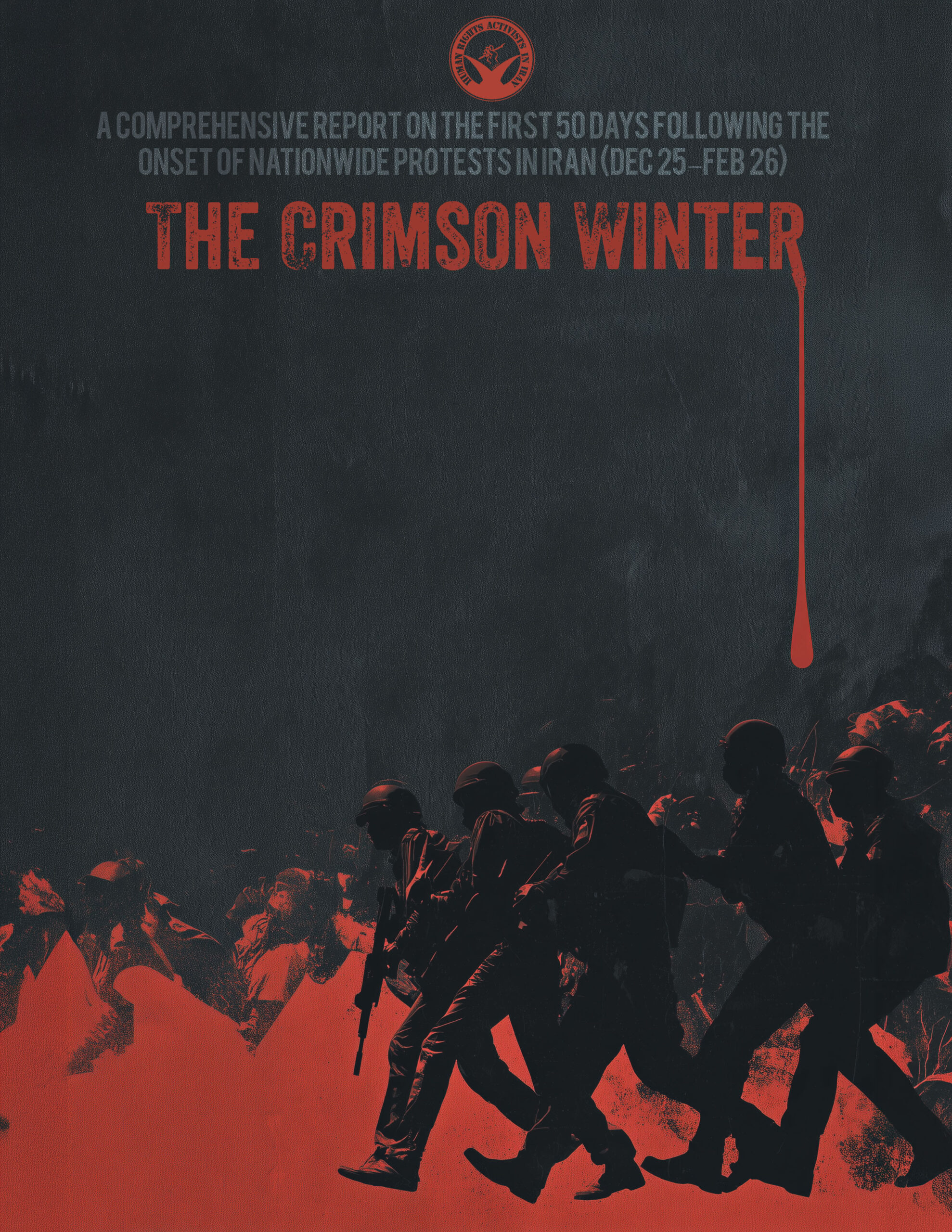
HRANA- Published today, this comprehensive report examines developments during the first fifty days following the eruption of nationwide protests in Iran on December 28, 2025, providing a detailed account of the unfolding events and the state response from December 2025 through February 2026.
Compiled through a coordinated, multi team documentation effort across HRA’s news agency HRANA, Spreading Justice, the Pasdaran Documentation Project, and the Statistics Department, the roughly 1,350 page report preserves a structured record of the opening phase of Iran’s 2025–2026 nationwide protests and the state response.
The findings are derived from more than 143,330 HRANA reports drawn from confidential and open sources, collected, verified, and analyzed during the 50-day window.
Download the full report in PDF format.
Why this report, and why now?
Large scale protest cycles generate two parallel dynamics: an unprecedented volume of documentation and a coordinated effort by state authorities to restrict communications, shape narratives, and intimidate sources. In this environment, the central risk is not only undercounting violations, but losing the ability to verify identities, locations, dates, and patterns while evidence remains recoverable.
This report adopts a disciplined human rights methodology centered on documenting minimum verifiable cases rather than publishing maximal estimates. It presents findings that can be substantiated through corroborated evidence, even where the broader scale of violations likely exceeds what can be confirmed in real time. The publication is intended both as a public record and as an archival foundation for legal analysis and future accountability processes.
What the report contains
The report maps the first fifty days of protests by addressing core accountability questions:
1. How did protests evolve and spread geographically
2. How did state forces respond, and through what structures
3. What forms of harm occurred
4. How did blackout conditions affect the availability, quality, and verification of information
5. How was content authenticated and cross checked in an environment shaped by surveillance, source risk, and restricted access
6. How were risks from manipulated, fabricated, or AI generated content identified and mitigated within the verification process
7. How can documented patterns be legally characterized
8. How can records, especially identities of victims and detainees, be preserved without increasing risk
Sections analyze protest trends and geography, university mobilization, slogans, the structure and tools of repression, patterns of violations including killings, injuries, arrests, coerced confessions, pressure on families, and attacks on medical neutrality, as well as legal analysis, international responses, and how HRA documentation initiatives mobilized.
At the center of the report are two core pillars: the verified accounting of those killed, including children, and the documented accounting of detainees, including minors, students, and individuals subjected to group arrests.
Key Findings
Geographic scope
• Total protest locations: 682
• Unique cities: 203
• Unique provinces: 31
The geographic distribution demonstrates that both protest activity and state response were nationwide in scope.
Student mobilization
• University protests documented: 55
• Protesting universities: 36
Universities emerged as central civic spaces within the broader protest movement and the state response.
Fatalities: scale and composition
Across the first fifty days covered by this report, consolidated documentation records:
• Protesters killed: 6,488
• Children killed, counted separately and not included among protesters: 236
• Civilians killed, non-protester: 76
• Military and government forces killed: 207
• Total fatalities: 7,007
An additional 11,744 cases remain under review and are not included in confirmed totals. Separately, HRA documented eight civilian deaths resulting from clashes between civilians in public. The categorical separation is deliberate. Distinguishing protesters, children, non-protester civilians, and government or pro-government fatalities prevents analytical conflation and enables clearer legal and statistical interpretation. The figures reflect a minimum verifiable record compiled under conditions where comprehensive access is not possible.
Injuries
• Injured military and security forces: 4,884
• Injured civilians: 25,846
These figures contextualize the breadth of harm beyond confirmed fatalities and illustrate the overall magnitude of violence.
Arrests
• Total arrests: 53,777
• Children, teenagers, and school students arrested: 555
• University students arrested: 147
Arrest figures include both individually identified cases and verified group arrests, reflecting documentation realities in which names are often unavailable or unsafe to publish.
Forced confessions
• Documented forced confessions: 369
The report treats coerced confessions as a systematic instrument of intimidation and narrative control within a heavily surveilled and restricted media environment.
Summonses
• Documented summonses: 11,053
Summonses function as a parallel mechanism of legal pressure, extending state control beyond those formally detained.
The List of the Deceased: Methodology and Protection
Appendix A contains the list of the deceased. Publication decisions are governed by a protection centered framework that weighs the public interest in disclosure against the risk of retaliation for relatives, witnesses, and HRANA’s network.
Where names are published, they are paired, where possible, with core identifiers including age, location, and documentation anchors used in verification. Entries are also paired with sources. Where a third-party source is listed as the primary source, HRANA has independently verified the information through its reporting network.
Where publication would create unacceptable risk, cases are reflected in verified totals and preserved within secure documentation systems for accountability purposes.
The list is the product of a structured, cross-checked verification methodology designed to preserve an accurate public record without increasing danger to those inside the country.
Legal Assessment and Accountability Relevance
The report includes a preliminary legal assessment, framing documented patterns as potential violations of international human rights law and, where applicable thresholds are met, international criminal law.
Patterns of lethal force, mass arrests, coerced confessions, and related violations are analyzed against legal standards governing the right to life, due process, freedom of expression and assembly, and protections against torture and cruel, inhuman, or degrading treatment.
By grounding its legal analysis with verified names, dates, locations, and corroborated patterns, the report connects documentation to concrete pathways for accountability.
HRANA – Abolfazl Salehi in Mashhad, Behrouz Izanlou in Bojnurd, Khan-Aziz Esmaili, a member of the Teachers’ Trade Association in Eslamabad-e Gharb, and Ahmad Hezbavi in Ahvaz have been arrested by security forces on different dates.
Based on information received by HRANA, Abolfazl Salehi, 20 years old, was arrested by security forces in January and transferred to an undisclosed location. At the same time, a video of his forced confessions was broadcast by official media outlets; however, it remains unclear under what circumstances the video was recorded. This has heightened concerns among his family and relatives.
Additionally, Ahmad Hezbavi was arrested on February 18 by security forces in Ahvaz while returning from a memorial ceremony marking the 40th day after the deaths of victims of the protests. No information is available regarding his place of detention.
Meanwhile, Kurdpa reported the continued detention of Behrouz Izanlou, a 39-year-old construction worker, father of two, and resident of Bojnord. According to the report, he was arrested on January 4 at his home without the presentation of a judicial warrant and was subjected to beating during the arrest. He was subsequently transferred to Bojnurd Prison and remains held there in a state of uncertainty. During his detention, Mr. Izanlou has been denied family visits and access to legal counsel.
Kurdpa also reported the arrest of Khan-Aziz Esmaili, a member of the Teachers’ trade Association of Eslamabad-e Gharb and a resident of the city. He was arrested on Sunday, February 22 at his home without a judicial warrant and transferred to an undisclosed location. During the arrest, security agents confiscated his mobile phone as well as the phones of all his family members.
Among these individuals, Khan-Aziz Esmaili has previously faced judicial action due to his activities.
As of the time of this report, no information has been obtained regarding the charges brought against these four citizens.
It should be noted that gatherings and strikes by shopkeepers and bazaar merchants began on Sunday, December 28, 2025, in Tehran. After two days, the protests expanded beyond markets and commercial centers. With the participation of students, citizens, and various social groups, these demonstrations became one of the most widespread protests in recent years. Following the crackdown by security and law enforcement forces, thousands were killed or injured, and tens of thousands were arrested or summoned by security institutions. For more information, you may refer to HRANA’s detailed report on the fiftieth day since the beginning of the protests.
HRANA – Ahmad Naderpour, Sedigh Parizad, and Amir Roshandel, residents of Kalat County; Ruhollah Naderi and his brother Saeed Naderi, residents of Shahriar County; and Meysam Chabok and Kamyar Rashidi, residents of Eslamabad-e Gharb County, have been arrested by security forces. So far, no information is available regarding their whereabouts.
According to HRANA, the news agency of the Human Rights Activists in Iran (HRAI), Ruhollah Naderi and his brother Saeed Naderi were arrested in Shahriar County.
Based on information received by HRANA, the two brothers, Ruhollah and Saeed Naderi, were arrested separately in the early hours of yesterday by IRGC Intelligence agents at their private residences in Shahriar County. During the arrest of Saeed Naderi, his home was also searched, and several personal items were confiscated, including his mobile phone and that of his wife.
Meanwhile, Kurdpa reported the arrest of five citizens in Kalat and Eslamabad-e Gharb counties.
The identities of these individuals have been reported as Ahmad Naderpour, Sedigh Parizad, and Amir Roshandel, residents of Layin Kalat village in Kalat County, as well as Meysam Chabok and Kamyar Rashidi, residents of Eslamabad-e Gharb.
According to this report, Mr. Naderpour, Mr. Parizad, and Mr. Roshandel were arrested on Sunday, January 25, at their private residences in Layin Kalat village, Kalat County, by security forces without the presentation of a judicial warrant. Additionally, on Saturday, February 21, Meysam Chabok and Kamyar Rashidi were arrested by security forces in Eslamabad-e Gharb County.
As of the time of this report, no information has been obtained regarding the charges against these citizens, the reasons for their arrest, or their place of detention.
It should be noted that gatherings and strikes by shopkeepers and bazaar merchants began on Sunday, December 28, 2025, in Tehran. After two days, the protests expanded beyond markets and commercial centers. With the participation of students, citizens, and various social groups, these demonstrations became one of the most widespread protests in recent years. Following the crackdown by security and law enforcement forces, thousands were killed or injured, and tens of thousands were arrested or summoned by security institutions. For more information, you may refer to HRANA’s detailed report on the fiftieth day since the beginning of the protests.
HRANA News Agency – Hossein Molaei-Pour, a disabled resident of Izeh, has been sentenced by Branch 1 of the Revolutionary Court of Ahvaz to more than two years in prison, a travel ban, and an obligation to report to the Intelligence Office.
Based on a verdict issued by Branch 1 of the Revolutionary Court of Ahvaz and formally communicated to his defense attorney, Hossein Ali Hatami, Mr. Molaei-Pour has been sentenced to two years and one day of imprisonment, a two-year travel ban, and an obligation to report to the Intelligence Office for a period of one year.
The ruling was issued on charges of propaganda against the regime and engaging in propaganda activity against the regime in support of Israel.
This citizen was arrested on September 27 of 2025 and was later released on bail on October 22.
Hossein Molaei-Pour, aged approximately 19, is a disabled resident of Izeh County.
HRANA – Today, Sunday, Nirvana Torbati-Nejad and her mother, Roghayeh (Sayeh) Amirkhani, were arrested by officers of the Public Security and Intelligence Police in Gorgan. Their arrest took place during the fortieth-day memorial ceremony of one of those killed in the protests.
Based on information received by HRANA, the two citizens were arrested today, February 22, 2026, by officers of the Golestan Province Public Security and Intelligence Police during the fortieth-day memorial ceremony for Hossein Soleimani, one of those killed in recent protests, in the city of Gorgan.
A source close to the family confirmed the news to HRANA and stated: “Nirvana’s arrest is unrelated to her previous case.”
As of the time of this report, no information is available regarding the reasons for their arrest, their place of detention, or the charges brought against them.
It is worth noting that in December of this year, Nirvana Torbati-Nejad was sentenced by Branch 1 of the Revolutionary Court of this city to six months of discretionary imprisonment. The appeal hearing in her case is scheduled to be held on February 24, 2026, at Branch 1 of the Golestan Province Court of Appeals.
Nirvana Torbati Nejad and her mother, Roghayeh (Sayeh) Amirkhani, are residents of Gorgan.
It should be noted that gatherings and strikes by shopkeepers and bazaar merchants began on Sunday, December 28, 2025, in Tehran. After two days, the protests expanded beyond markets and commercial centers. With the participation of students, citizens, and various social groups, these demonstrations became one of the most widespread protests in recent years. Following the crackdown by security and law enforcement forces, thousands were killed or injured, and tens of thousands were arrested or summoned by security institutions. For more information, you may refer to HRANA’s detailed report on the fiftieth day since the beginning of the protests.
HRANA – Yesterday, Behnam Ohadi, a psychologist, and Mohammad Shaeri, residents of Tehran, were arrested by security forces and transferred to Greater Tehran Prison.
An informed source, confirming the news, told HRANA: “On Thursday, February 19, the two citizens were arrested by security forces after attending the fortieth-day memorial ceremony for some of those killed during the recent protests at Behesht Zahra Cemetery in Tehran. They were subsequently transferred to Greater Tehran Prison.”
As of the time of this report, no information has been obtained regarding the charges brought against these two Tehran residents.
Behnam Ohadi, 52, a psychologist, has previously faced arrest and conviction due to his activities.
HRANA – Craig and Lindsay Foreman, two British nationals currently imprisoned in Iran, have been sentenced to 10 years in prison by Branch 15 of the Tehran Revolutionary Court, presided over by Judge Abolghasem Salavati, on charges of “espionage.”
According to HRANA News Agency, citing BBC Persian, Branch 15 of the Tehran Revolutionary Court, headed by Judge Abolghasem Salavati, sentenced the couple to 10 years in prison on charges of “espionage.”
The British couple stated that despite being present in court, no evidence was presented and they were given no opportunity to defend themselves.
Their son, Joe Bennett, has said that he is deeply concerned about their conditions of detention. The UK Foreign Secretary has also described the ruling as “appalling and unjustifiable.”
The report does not provide further details, including the date on which the verdict was issued.
The couple had previously gone on hunger strike in November of last year in protest against the lack of progress in their case.
Craig Foreman and Lindsay Foreman had entered Iran as part of a round-the-world motorcycle trip and were arrested in December 2024 by the IRGC Intelligence in Kerman. Judicial authorities had earlier accused them of “espionage,” alleging that they had gathered information in several provinces under the cover of tourism and research activities.
The then British ambassador to Iran also met with the two defendants at the Kerman Prosecutor’s Office in February of last year.
In recent years, Iranian authorities have detained several foreign nationals on charges such as espionage or cooperation with hostile states. Some of these detainees have later been released following political negotiations. Human rights organizations and some Western governments have accused Iran of using such arrests as a means of political leverage, allegations that Iranian authorities have consistently denied.