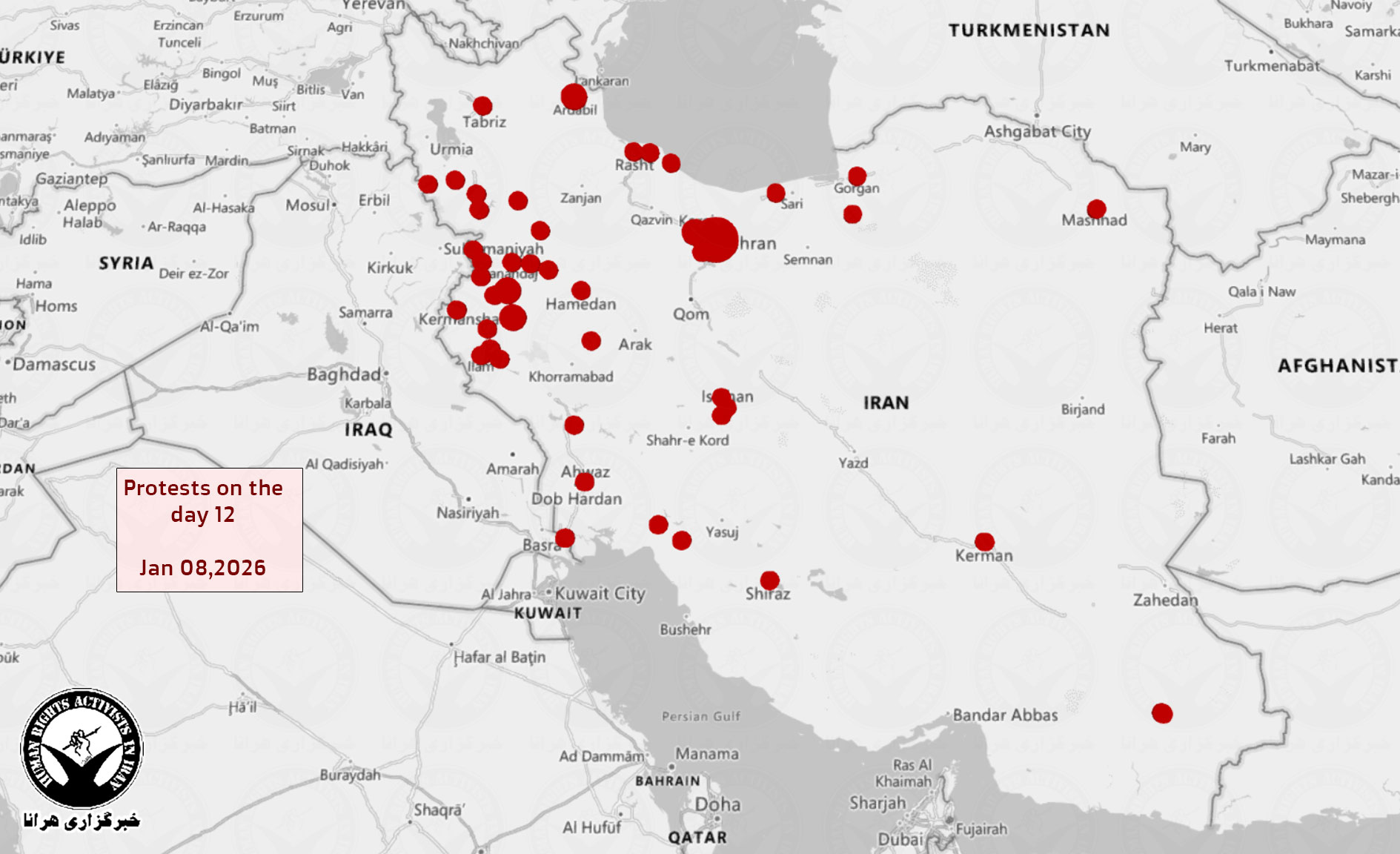
HRANA – Nationwide protests in Iran continued on their twelfth day, Thursday, January 8, 2026, according to reports collected by HRANA. Demonstrations and protest actions were recorded in at least 46 cities across 21 provinces. At the same time, a wave of strikes and market closures was reported, particularly in Kurdish regions, with dozens of cities in Kurdistan, West Azerbaijan, Kermanshah, and Ilam provinces joining the strikes.
On the twelfth day of the nationwide protests, at least 60 additional arrests were recorded. This brings the total number of detainees over the past 12 days to more than 2,277 individuals. Among those arrested, at least 166 were under the age of 18 and 48 were university students. During the same period, 45 cases of forced confessions were broadcast by state media.
Alongside these developments, reports indicated a nationwide internet shutdown on the twelfth night of protests, as well as targeted disruptions to infrastructure, including a sharp drop in IPv6 connectivity. These measures led to widespread disruptions in mobile internet access, internet-based calls, and the functioning of circumvention tools. The death toll from the past 12 days of protests has reached 42 people, including five minors under 18 and eight security personnel or officers.
Background of the Protests
The current protests began on December 28, 2025, amid accumulated social and economic grievances, and gradually expanded from trade- and market-based demands to street protests, later spreading into university spaces. Continued economic pressure, declining purchasing power, and a sense that public demands are being ignored, alongside a deep lack of trust in official accountability mechanisms, have been described as the main drivers behind this wave of unrest.
In the following days, the pattern of protests shifted from scattered gatherings to a network of demonstrations, nighttime chants, and market strikes. By the twelfth day, widespread strikes and shop closures, alongside street protests, had emerged as one of the most prominent features. At the same time, the increased presence of security forces and intensified crackdowns, including mass arrests, the airing of forced confessions, and restrictions on communications (internet shutdowns or signal disruptions), have pushed much of the situation into an environment marked by information disruption and competing narratives.
In parallel, reported slogans indicate that demands have not remained confined to economic issues. In many locations, they have evolved into political protests and structural criticism. Within this context, the twelfth day of protests can be seen as a continuation of a phase in which the street, the bazaar, and civil actions have operated simultaneously and in a complementary manner, while the government has sought to contain both the scope of the protests and their public reflection through a combination of on-the-ground control, judicial and security pressure, and communication restrictions.

Geographic Scope and Key Focal Points of the Protests
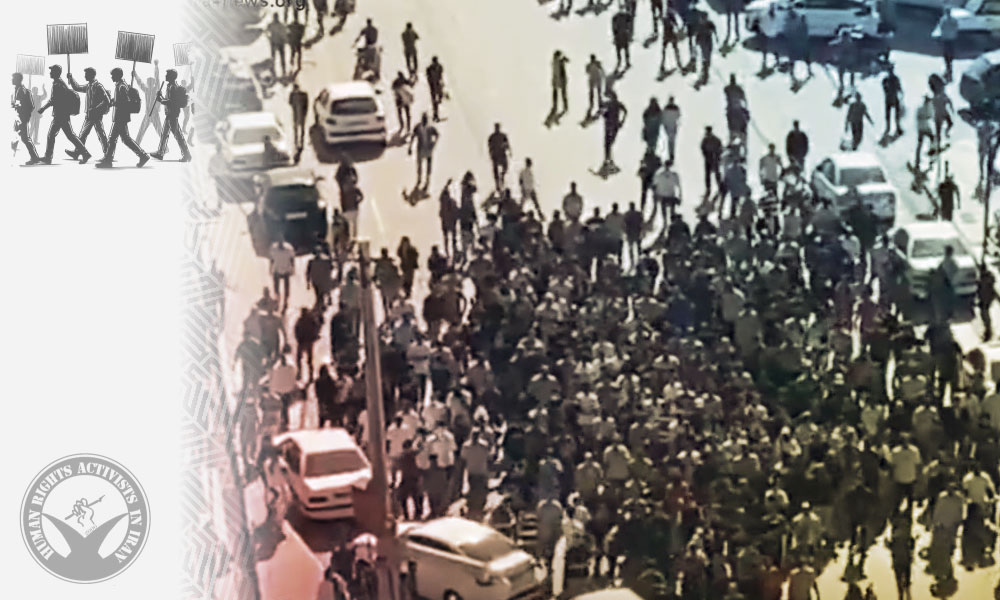
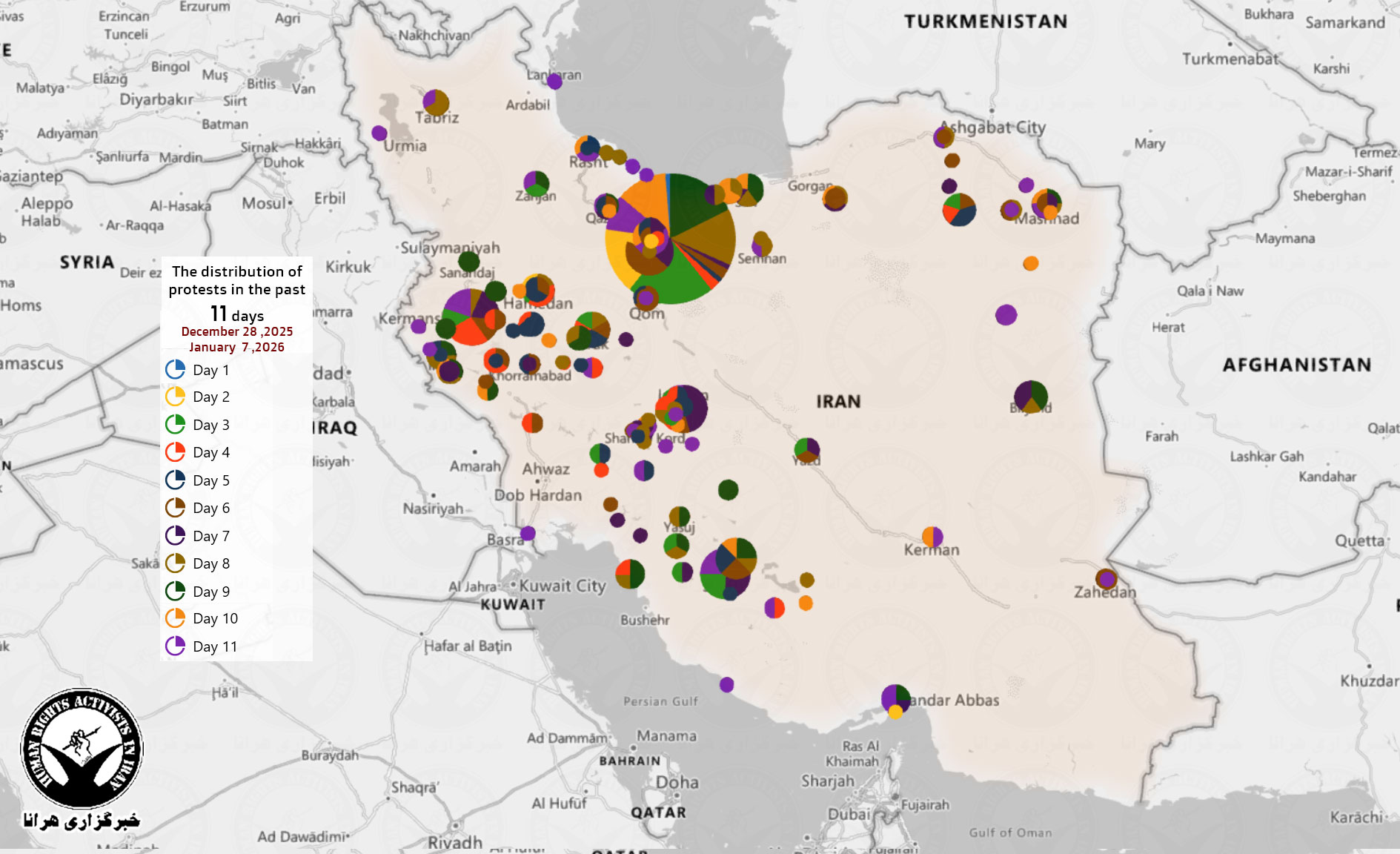
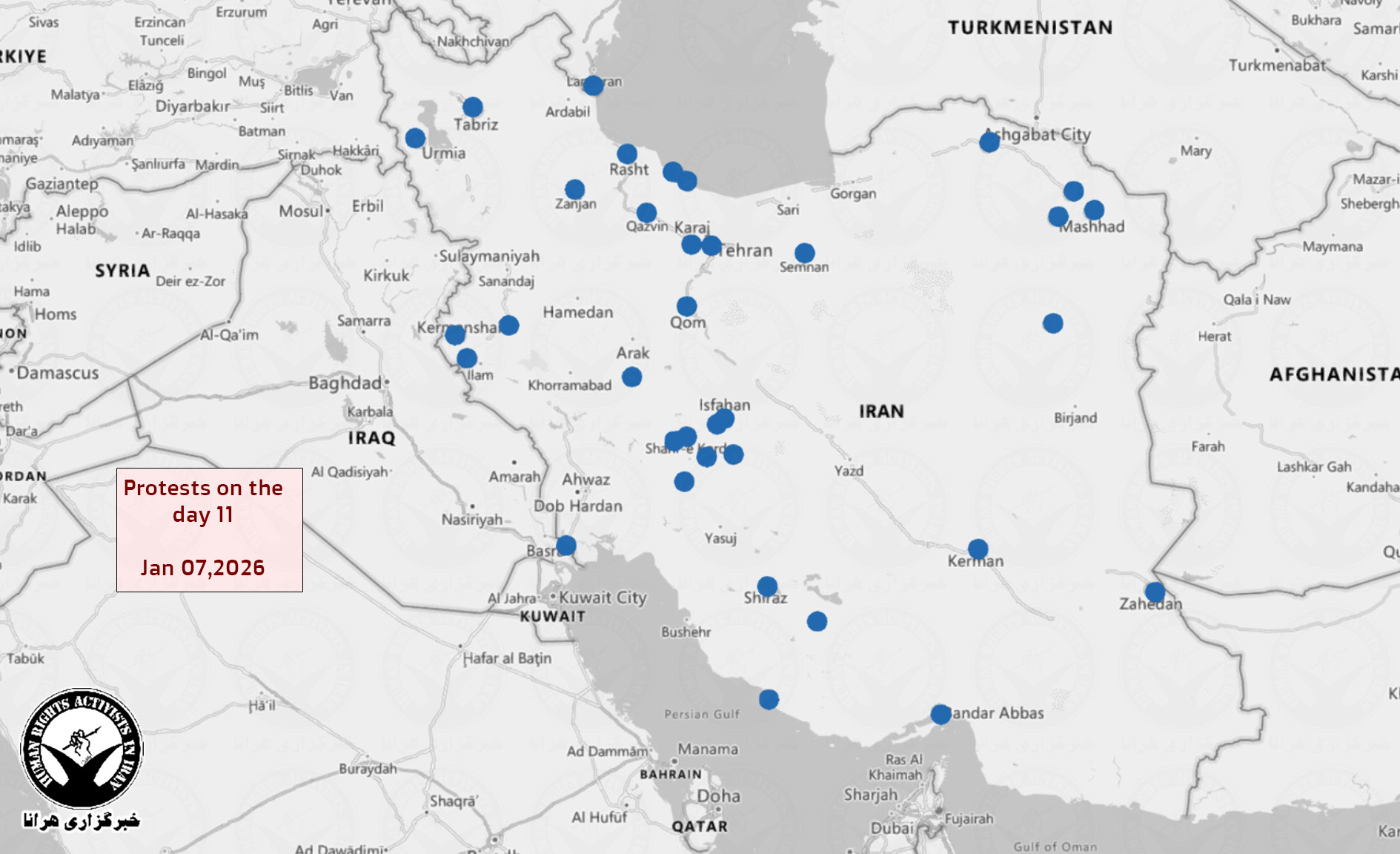
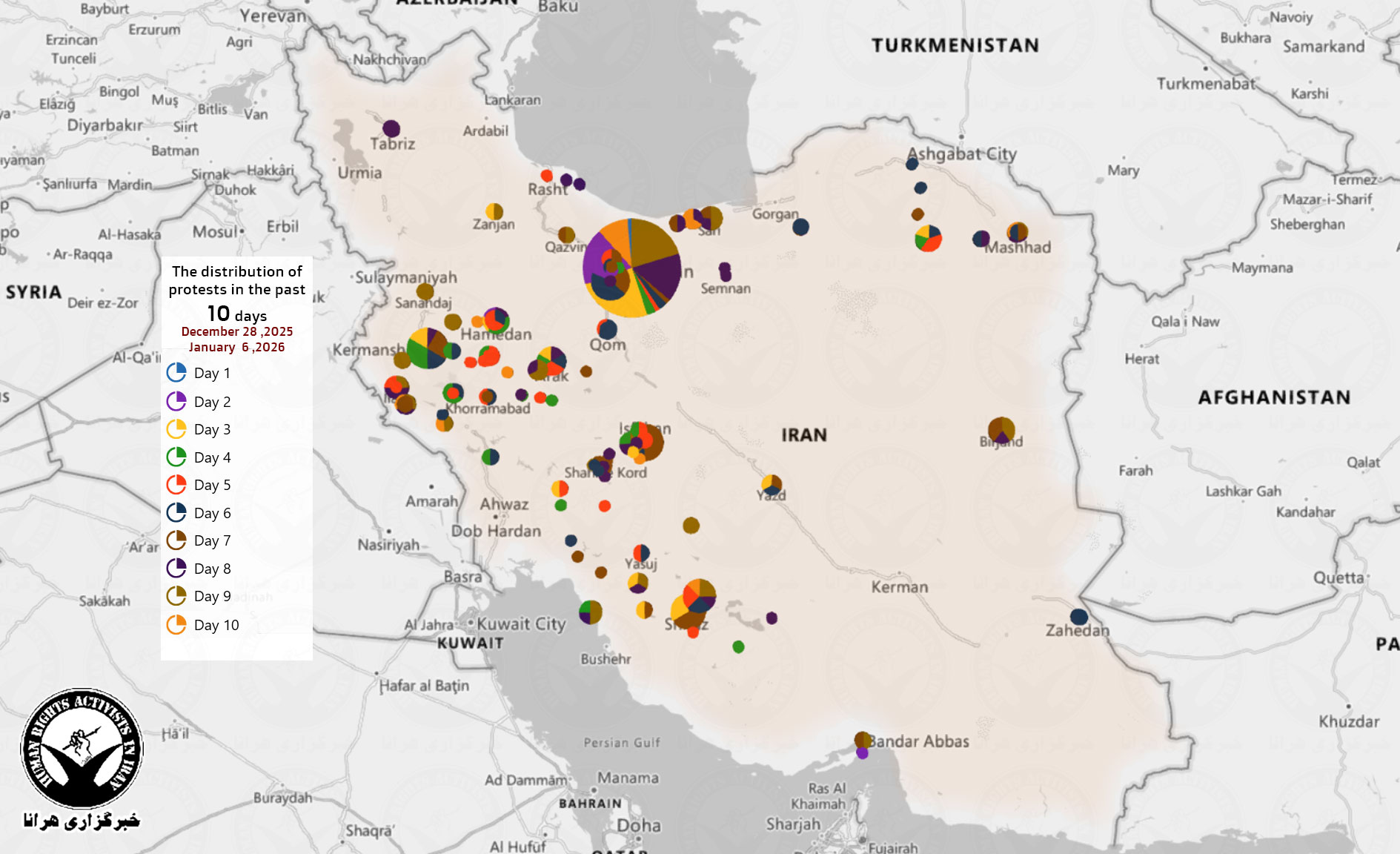
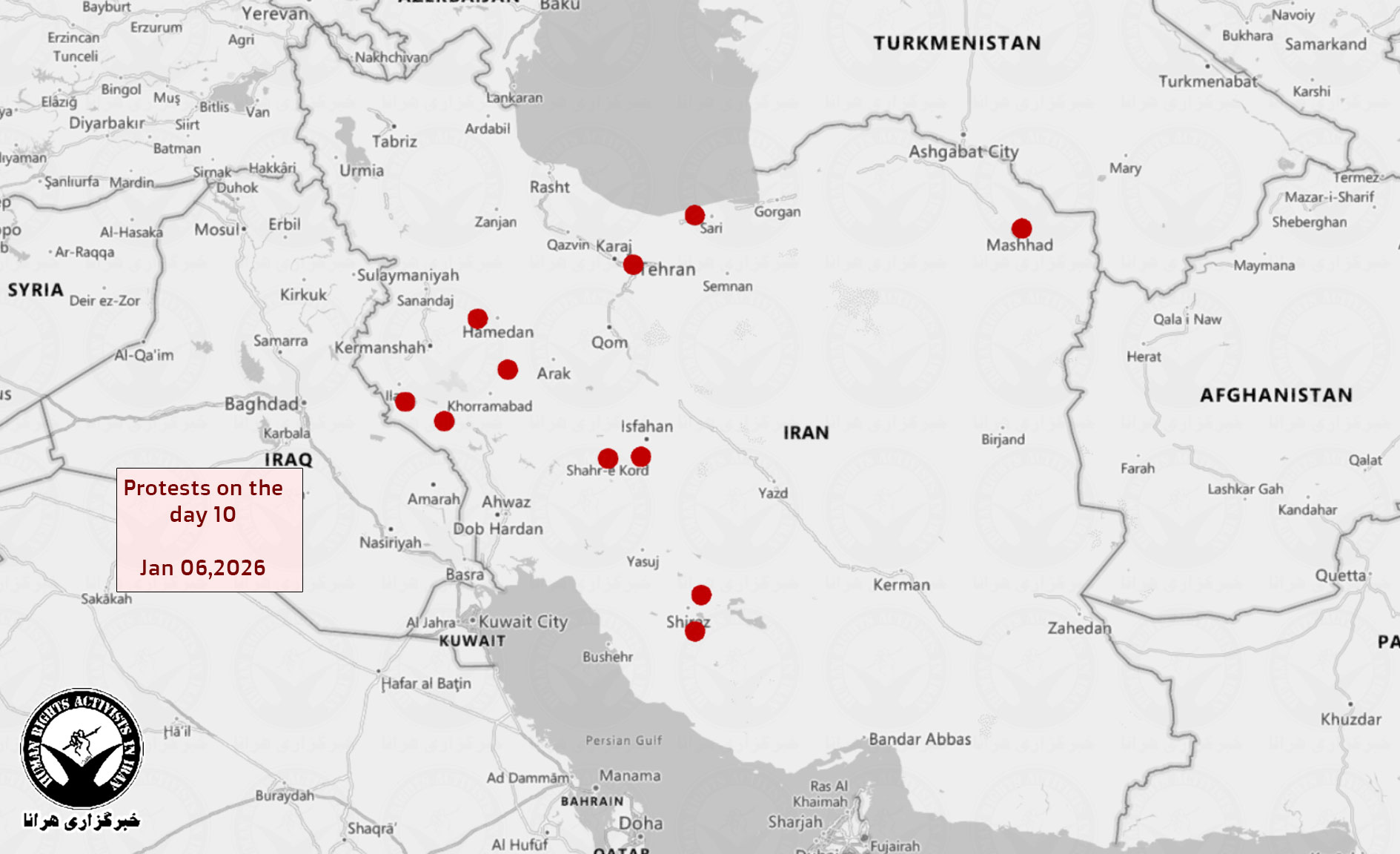
Reports collected from various sources indicate that on the twelfth day of the protests, demonstrations and protest activities continued in at least 46 cities across 21 provinces.
In Tehran, numerous locations were reported as sites of street presence and scattered gatherings by protesters. These included Aryashahr and Sadeghieh, Narmak, Valiasr, Keshavarz Boulevard, Yousef Abad, Azadi Street (Eskandari intersection), Tehranpars, Nazi Abad, Sattarkhan, Haft-Hoz, Gheytariyeh, Vanak, Punak (from Esfahani Square to Marzdaran), Kashani Boulevard, Taleghani Square, and Shahrak-e Azadi. In addition, reports were published of nighttime chanting from inside homes in the Heravi area, as well as neighborhood-based protests in Saadat Abad and Jannat Abad. Some reports also referred to street gatherings in Islamshahr.
Furthermore, HRANA received reports of shop closures and strikes in the Tehran Grand Bazaar and central districts of the city, coinciding with the concentration of security forces around Sabzeh Meydan, Amir Kabir Street, and along the metro route from 15 Khordad Station to the Naser Khosrow–Sabzeh Meydan intersection.
In a number of cities, reports were published of internet or electricity disruptions, as well as the sound of gunfire being heard.
According to the compilation of reports received by HRANA, gatherings and protests on the twelfth day took place in cities including Sanandaj, Kermanshah, Marivan, Kamyaran, Ravansar, Sarpol-e Zahab, Saqqez, Mahabad, Paveh, Hamedan, Bukan, Isfahan, Bijar, Dehgolan, Piranshahr, Eslamabad-e Gharb, Ardabil, Ilam, Takab, Sarableh, Sarvabad, Qorveh, Lumar, Pir Bakran, Borujerd, Kerman, Kalachay, Shiraz, Abadan, Astaneh Ashrafieh, Tehran, Gachsaran, Behbahan, Tabriz, Islamshahr, Mashhad, Karaj, Babol, Dezful, Shahin Shahr, Gorgan, Ahvaz, Rasht, Damghan, Iranshahr, and Robat Karim.
Fatalities and Victims of the Protests
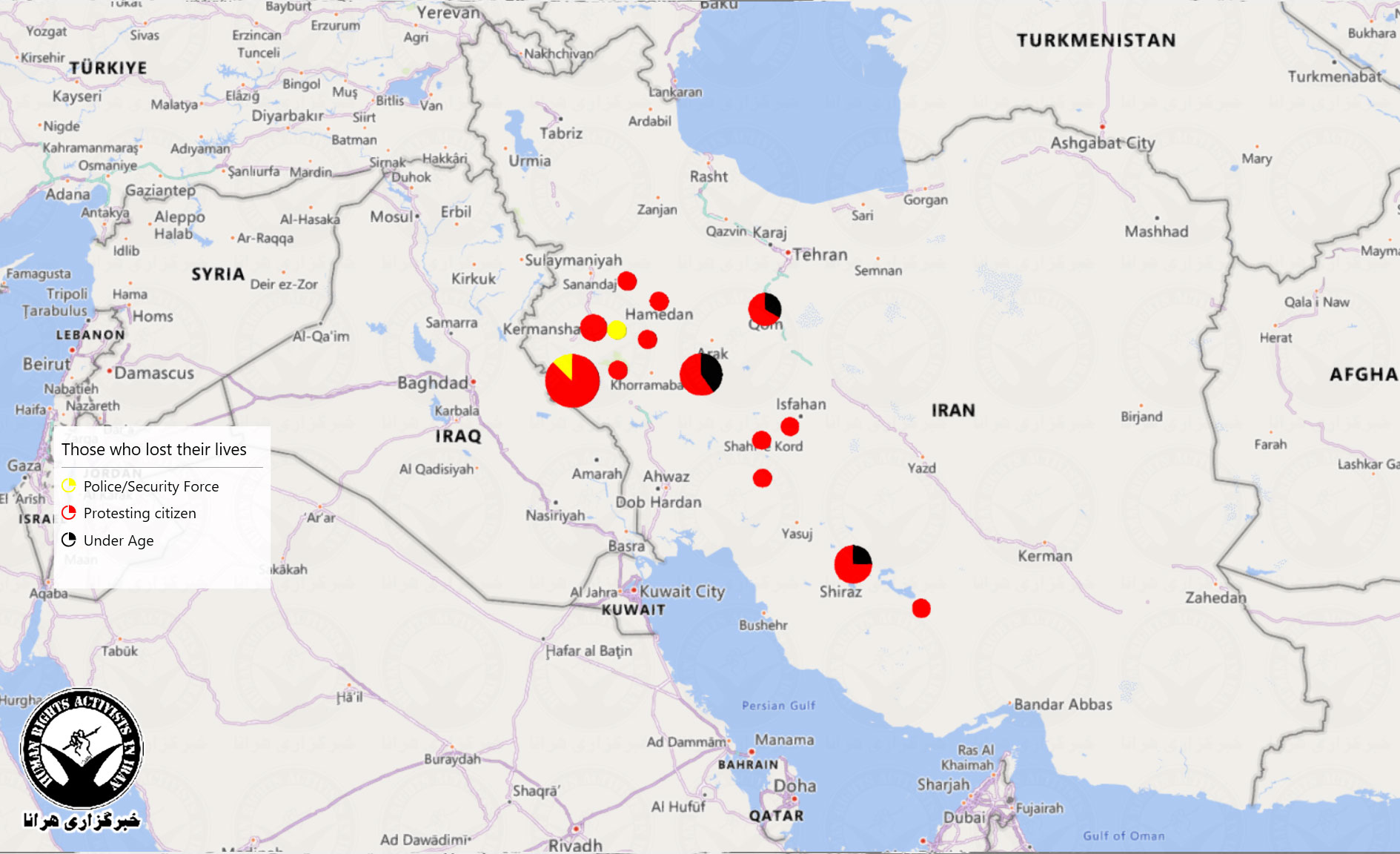
According to updated data, by the end of the twelfth day of the protests, at least 42 people had lost their lives. This figure includes:
• 29 protesting civilians
• 8 security–military forces
• 5 children and adolescents (under 18 years old)
The presence of children among those killed has once again highlighted serious concerns regarding how security forces are confronting the protests and whether the principle of proportionality in the use of force is being observed.
In addition to those killed, numerous reports have been published regarding citizens injured during street clashes and security operations. However, due to limited access to field information and ongoing communication disruptions, the exact number of injured individuals is still being compiled.
Universities and the Role of Students
Based on aggregated data, 34 universities have so far been involved in the protests, with a total of 46 gatherings held on university campuses. Nevertheless, no reports of demonstrations at universities were received today.
In terms of security responses, collected data indicate that over the past 12 days, at least 48 students have been arrested. Alongside this broader trend, notable developments in the university sphere today include the following:
• Amirkabir University of Technology: It was reported that end-of-term exams have been postponed for one week, citing the “current special circumstances.”
• Ministry of Health: An official source claimed that “only one medical sciences student” has been arrested, and that this arrest occurred “outside the university environment.”
• University of Tehran: The university’s Student Council reported the arrest of Parsa Ghobakhloo, an undergraduate student of electrical engineering, by security forces, stating that his whereabouts are unknown and that the detaining authority has not been identified.
Forms of Protest and Slogans
On the twelfth day of protests, forms of protest action remained diverse. Street gatherings and visible protest presence in urban centers, alongside strikes and market closures in a number of cities, were among the most prominent expressions of dissent. The continuation of this pattern,particularly during nighttime hours and under conditions where internet disruptions or outages and power blackouts were reported in some areas, indicates that the protests have not been confined to a single fixed form, but continue to reproduce themselves through varied methods.
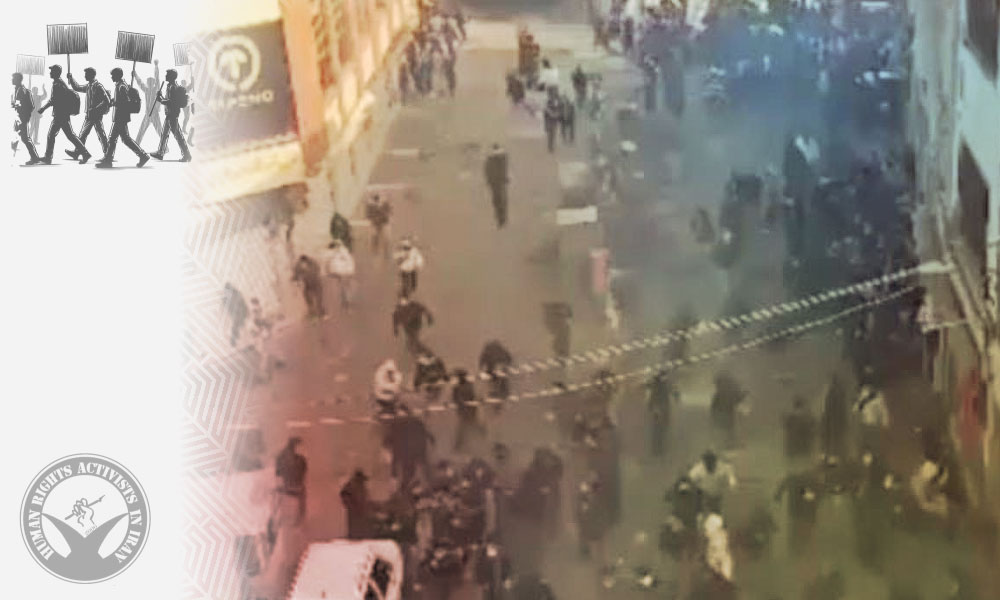
At the ground level, reports point to a combination of scattered and decentralized actions, including neighborhood-based protests, temporary blockages of certain routes and disruptions to traffic, as well as the use of symbolic and low-cost methods to express dissent. At the same time, in several cities, security forces were reported to have used tools such as tear gas to disperse gatherings, and in some areas, the sound of gunfire further intensified the security pressure surrounding the protests.
In terms of content, the slogans and messages raised can largely be categorized into two main themes: some reflect livelihood-related grievances and economic pressures, while others relate to structural and political criticism of governance, the lack of accountability of official institutions, opposition to state repression and violence, and demands for regime change. This simultaneity suggests that, in the minds of protesters, the economic crisis and the crisis of governance are understood as two interconnected aspects of the same underlying problem.
Arrests and Intensified Security Crackdowns
According to collected data, at least 60 additional arrests were reported or confirmed today. As a result, the total number of detainees over the past 12 days has risen to more than 2,277 people. However, due to limited access to field information and incomplete reporting from some areas, the actual number of arrests is likely significantly higher. During the same period, it has also been reported that 45 cases of forced confessions by detainees have been broadcast. Among those arrested, at least 48 are students and 166 are under the age of 18.
Alongside the increase in arrests, signs of escalated on-the-ground repression have been reported in several cities. Reports from Kermanshah indicate the violent arrest of protesters by plainclothes agents. In Behbahan and Ardabil, witnesses have also reported gunfire by security forces.
In addition to street-level crackdowns, a number of official and governmental actions and positions point to an expansion of security and judicial repression. Among these, security bodies in Azna (Lorestan Province) claimed to have arrested an “organized network,” attributing it to monarchist groups, and alleged that the network was involved in the “recruitment of young women” and the “distribution of Lion and Sun flags and promotional materials.” In Tehran, the judiciary announced the opening of cases against “certain individuals” as well as “brands and shops” on charges of direct or indirect support for protest calls. At the same time, reports cited an order by the Tehran prosecutor to monitor cyberspace and identify individuals or cases deemed to be in violation.
At the field level, reports have emerged of widespread use of tear gas, including in Shahin Villa (Karaj), Ghaemshahr, Khorramabad, and Maragheh, as well as gunfire in several cities. These include aerial gunfire in Bijar, reports of repeated gunshots in Khorramabad, and heavy gunfire in Behbahan. In Gohardasht, Karaj, severe communication disruptions and signal outages were also reported simultaneously with clashes.
Summonses and Security Pressure Beyond the Streets
Alongside street-level repression, reports from the twelfth day indicate an expansion of security and surveillance pressures beyond public demonstrations. These pressures range from media threats and psychological operations to judicial tools, phone calls, text messages, and informal summonses. Their stated aim has been described as controlling narratives, preventing the continuation of protests, and monitoring professional, labor, and media circles.
Within this framework, Tasnim News Agency (close to security institutions) published a threatening video attributed to the FARAJA Intelligence Organization, claiming that “individuals chanting slogans from inside their homes” had been identified, warned, and would be arrested “if necessary.” In a statement attributed to the same body, it was emphasized that “all activities are under intelligence surveillance” and that action against chanting from homes would continue.
At the same time, in the economic and trade sphere, reports indicate that The Ministry of Intelligence’s detention facility contacted some shopkeepers and threatened them to reopen their businesses.
In the realm of judicial pressure and digital surveillance, the opening of cases against certain individuals and brands or shops in Tehran has been cited as another example of repression outside the streets, an approach linked to monitoring cyberspace and efforts to curb direct or indirect support for protest calls.
Regarding narrative control and restrictions on content production, it has been reported that some protesters, civil activists, and journalists have been threatened or informally summoned through anonymous phone calls and text messages, warning them against taking positions or producing content related to the protests.
At the international level, in relation to the domestic media environment, the Committee to Protect Journalists (CPJ) has condemned the actions of security institutions in summoning and threatening journalists. The organization stated that following remarks by Ali Khamenei regarding repression, journalists were contacted and summoned to security bodies, including the IRGC.
Internet Disruptions and Communication Restrictions
On the twelfth night of the protests, it was reported that the internet was shut down nationwide, a situation that NetBlocks also confirmed as a widespread internet outage. In follow-up reports, NetBlocks warned that Tehran and several other cities were entering a state of “digital blackout,” and also reported a complete internet shutdown in Kermanshah Province. Within this framework, it was reported that on Thursday, January 8, disruptions, severe slowdowns, and repeated outages continued in a large number of cities.
At the same time, published technical data indicate a pattern of targeted disruption of IPv6. According to reports, Filterban announced that a significant portion of IPv6 connections went offline around 15:19 Tehran time, with the timing pattern suggesting a coordinated action. In the same vein, Cloudflare Radar reported that the volume of IPv6 addresses dropped by approximately 98.5%, and the share of IPv6 traffic fell from around 12% to about 1.8%. It was further emphasized that disruption of this protocol can directly affect mobile internet, modern browsers, applications, internet-based calls, and even the functioning of a significant number of VPNs and circumvention tools. According to these reports, some VPNs either failed to connect or effectively stopped working.
At the field level, and based on specific reports received for January 8, communication restrictions were reported in several cities as follows:
• Bijar (Imam Boulevard): Intermittent internet connectivity.
• Khorramabad: Reports of internet shutdown and inability to send videos.
• Neyshabur: Reports of a complete internet shutdown, with only text messages being sent with great difficulty.
• Karaj (Gohardasht): Initially a complete internet shutdown in the early evening hours; later, mobile phone signal was cut to the extent that calls and SMS stopped working, with reports indicating that only landline phones remained usable.
• Amol: In addition to communication disruptions, reports of power outages on main streets were raised, which as an environmental restriction further complicated communication and field coverage.
Strikes and Labor Protests
On the twelfth day of protests, alongside street demonstrations, an unprecedented expansion of strikes and market closures was reported. This pattern took shape from the early days, beginning with the protests on December 28 and reports of gatherings or protests by some shopkeepers in the Tehran Grand Bazaar, and then rapidly spread to numerous cities. On this day, strikes in many areas took the form of shop closures, market shutdowns, and merchants joining street protests.
Kurdish Regions and Kurdistan
Reports indicate widespread strikes in Kurdish- and Lur-inhabited areas, with dozens of cities across four provinces, Kurdistan, West Azerbaijan, Kermanshah, and Ilam, joining the strikes. At the city level, strikes by shopkeepers were reported in cities such as Sanandaj, Bukan, Kamyaran, Dehgolan, Saqqez, Qorveh, Paveh, Sarvabad, Ravansar, Eslamabad-e Gharb, Sarpol-e Zahab, and Kerend-e Gharb.
Tehran and the Bazaar Axis
In Tehran, reports point to the continued closure and stagnation of several markets and commercial centers, alongside the heavy deployment of security forces in parts of the city’s central and commercial districts. Some reports identified routes and locations such as Sabzeh Meydan, Amir Kabir Street, and the entrance of the 15 Khordad metro station up to the Naser Khosrow–Sabzeh Meydan intersection as focal points of security presence—conditions that, according to sources, could affect citizens’ movement and the normal functioning of the markets.
Cities and Markets Reported on Strike (Selected Examples)
In addition to Kurdish regions and Tehran, strikes and shop closures of varying scope were also reported in a range of other cities, including Arak, Hamedan, Khorramabad, Abyek (Qazvin), Borujerd, Qazvin, Isfahan, Ardabil, Bandar Abbas, Bandar Deylam (Bushehr), Shiraz, Khomeini Shahr, Karaj, Shahreza, Nurabad-e Mamasani, Kazerun, Tabriz, Urmia, and Zanjan.
International Reactions
As the protests continued, a number of international officials and figures responded to developments in Iran. Donald Trump warned on several occasions that if the Iranian government “starts killing people like it did in the past,” it would face a “severe blow,” and he emphasized the “value of freedom” in his remarks. Additionally, quoting a White House official (Wednesday, January 7), it was stated that the U.S. president had explicitly said that if the Iranian government shoots peaceful protesters or severely beats them, it will face a “severe blow,” describing this as a “promise.”
In the same context, J.D. Vance stated that “we stand with anyone who peacefully protests for their rights.” The House Foreign Affairs Committee of the U.S. House of Representatives (majority) also warned that if Tehran violently kills peaceful protesters, “justice will be swiftly served.”
The U.S. Department of State (including its Persian-language account) issued a travel advisory stating that Iran remains at Level 4 – Do Not Travel, urging U.S. citizens to “under no circumstances” travel to Iran. The advisory cited risks such as terrorism, unrest, kidnapping, and wrongful detention. It has also been reported that Australia has urged its citizens to leave Iran.
In Europe, Roberta Metsola, President of the European Parliament, expressed solidarity with protesters and, referring to reports of “30 killed,” emphasized that threats, prison, and tear gas cannot suppress the desire for freedom. Hannah Neumann (Chair of the European Parliament’s Iran delegation) also stated that people have returned to the streets and may face bullets, but for many, “silence is more dangerous,” stressing the need to “shine a light” on events in Iran.
Meanwhile, Canada’s foreign minister expressed support for the right to protest and voiced concern over repression and violent crackdowns. Germany’s foreign minister (Johann Wadephul) condemned the “excessive use of violence against protesters” and emphasized the right to peaceful protest and Iran’s obligation to uphold its international commitments.
Domestic (Governmental) Reactions
In response to the continuation of protests, a range of official and media positions were released at the level of the government, security–judicial institutions, and media close to the authorities. A significant portion of these responses focused on securitizing the protests and attributing them to foreign interference.
At the diplomatic level, Iran’s Ministry of Foreign Affairs described the support and positions of senior U.S. officials as “interventionist and deceptive,” claiming that the United States is pursuing a range of tools including psychological warfare, media operations, the spread of disinformation, threats, and incitement to violence. In the same framework, Abbas Araghchi emphasized that “Iran’s internal issues concern no one but the Iranian people,” framing the protests as “domestic affairs.” Along these lines, some official statements sought to portray the protests as purely economic demands, while simultaneously attributing part of the problems to U.S. sanctions.
In the media and propaganda sphere, the newspaper Kayhan, using labels such as “Mossad and ISIS agents,” attempted to portray protesters as a security threat, while also speaking of “harsh” judicial and security crackdown as the path forward. The repeated official dichotomy of “protest” versus “riot” was also highlighted in various statements as a red line in government discourse.
At the parliamentary and security-institution level, reports emerged of a closed-door parliamentary session attended by the government and security/law enforcement bodies, during which it was said that “statistics, charts, and provincial maps” of the protest situation were presented. In the narratives of some lawmakers, concepts such as “hybrid warfare” and “behind-the-scenes enemy planning” were emphasized, and it was claimed that the government had been “tasked with engaging in dialogue with the people and calming them.” It was also reported that one MP (Mohammad Bayat) claimed that “the use of weapons has occurred only in cases where the country was harmed”, a claim described as being in contradiction with field accounts and human rights reports, particularly regarding gunfire.
In statements by the government and the judiciary, Masoud Pezeshkian called on security forces to refrain from “targeting protesters,” while the government spokesperson used emotional language to describe the pain of “every drop of blood being spilled.” The head of the judiciary, addressing merchants’ strikes, described them as “defenders of the system” and sought to avoid framing strikes or discontent as opposition to the authorities. At the same time, in certain judicial-security measures, emphasis was placed on monitoring cyberspace and confronting the symbolic economy of protest, including opening cases against “brands or shops” and “public figures”, as tools to curb protest calls and indirect support.
Regarding the official narrative on casualties and security, the judiciary-affiliated outlet Mizan reported the killing of a police officer in Malard. In another reaction, the Ministry of Health claimed that arrests in university environments had been very limited and that only “one medical sciences student” had been arrested, and that this arrest had occurred “outside the university environment.”
Domestic Reactions (Civil Society, Labour Groups, and Public Figures)
As the protests continued, a series of statements by professional and civil groups, along with positions taken by critical cultural, sports, and political figures, were published. A shared theme across many of these responses was the condemnation of repression, an emphasis on the right to protest, and solidarity with protesters.
Statements and Organizations
In the field of arts and culture, 184 Iranian filmmakers issued a statement condemning the crackdown on protests, emphasizing that shooting unarmed people constitutes a “crime against the right to life,” and affirming their support for freedom of expression. The Iran Cinema House also stated in a separate declaration that people find no avenue other than the streets to voice their protests, describing violence against protesters as illegitimate, unlawful, and irrational.
Today, child rights organizations likewise condemned violence against children and called for the release of detained children and adolescents.
Regarding labor and professional protests, widespread strikes and shop closures were reported in Kurdish regions. These strikes were mainly documented in cities such as Ilam, Kermanshah, Sanandaj, Marivan, Saqqez, Mahabad, Bukan, Oshnavieh, and Sardasht.
Public Figures
Among well-known figures, a range of supportive and critical positions were expressed. Mohsen Makhmalbaf, in a supportive text, emphasized national solidarity and criticized individual dictatorship. Mohammad Fazeli proposed a “democratic bargain with the people” as a path forward. Parsa Pirouzfar, by raising a critical question about the “limits of humiliating and crushing people’s bodies and spirits,” reacted to the atmosphere of repression.
Among sports figures, Voria Ghafouri expressed solidarity and announced that he would close his café for today and tomorrow. Hamid Derakhshan, Mehdi Ghaedi, Mostafa Mastour, Alireza Faghani, and Rasoul Khadem also voiced support for the protests through messages or videos.
At the political and social level, Shirin Ebadi stressed solidarity and described the protests and strikes as unprecedented and nationwide. Azar Mansouri condemned the “repressive approach” toward protesters, described the situation as a “crisis of governance,” and called for the release of detainees, especially women, youth, adolescents, and students. Zahra Rahnavard, in a message using mournful language, referred to the “young lives cut down,” reiterated the slogan “Do not be afraid… we are all together,” and emphasized the transition to democracy.
In addition, references were made to positions and controversies surrounding Ali Daei, whose criticism of government performance and the economic situation, including remarks such as “eggs becoming a luxury item”, was met with reactions and media attacks. Mojtaba Mehrami also made statements expressing support for Mohammad Reza Shah and a positive view of the Pahlavi era.
Arrests
Individual Arrests with Confirmed Identities
1. Issa Foroughi – City of arrest: Dehdasht (Kohgiluyeh and Boyer-Ahmad Province), Gachi village – Place of detention: Unknown – Current status: Detained – Source: HRANA
2. Jaber Foroughi – City of arrest: Dehdasht (Kohgiluyeh and Boyer-Ahmad Province), Gachi village – Place of detention: Unknown – Current status: Detained – Source: HRANA
3. Iman Foroughi – City of arrest: Dehdasht (Kohgiluyeh and Boyer-Ahmad Province), Gachi village – Place of detention: Unknown – Current status: Detained – Source: HRANA
4. Jamal Askari – City of arrest: Dehdasht (Kohgiluyeh and Boyer-Ahmad Province), Gachi village – Place of detention: Unknown – Current status: Detained – Source: HRANA
5. Asghar Vahdat – City of arrest: Dehdasht (Kohgiluyeh and Boyer-Ahmad Province), Gachi village – Place of detention: Unknown – Current status: Detained – Source: HRANA
6. Pouya Barati – City of arrest: Dehdasht (Kohgiluyeh and Boyer-Ahmad Province), Gachi village – Place of detention: Unknown – Current status: Detained – Source: HRANA
7. Reza Moradi – City of arrest: Songhor (Kermanshah Province) – Place of detention: Unknown – Current status: Detained – Source: Kurdpa
8. Mostafa Golzar – City of arrest: Songhor (Kermanshah Province) – Place of detention: Unknown – Current status: Detained – Source: Kurdpa
9. Mohsen Kamyab – City of arrest: Songhor (Kermanshah Province) – Place of detention: Unknown – Current status: Detained – Source: Kurdpa
10. Mohammad Seyfouri – City of arrest: Songhor (Kermanshah Province) – Place of detention: Unknown – Current status: Detained – Source: Kurdpa
11. Ebrahim Pishvaei – City of arrest: Songhor (Kermanshah Province) – Place of detention: Unknown – Current status: Detained – Source: Kurdpa
12. Morteza Sarhadi – City of arrest: Songhor (Kermanshah Province) – Place of detention: Unknown – Current status: Detained – Source: Kurdpa
13. Amir Mozaheri – City of arrest: Songhor (Kermanshah Province) – Place of detention: Unknown – Current status: Detained – Source: Kurdpa
14. Ahad Seyfouri – City of arrest: Songhor (Kermanshah Province) – Place of detention: Unknown – Current status: Detained – Source: Kurdpa
15. Arman Masoudi – City of arrest: Songhor (Kermanshah Province) – Place of detention: Unknown – Current status: Detained – Source: Kurdpa
16. Setareh Farghei – City of arrest: Songhor (Kermanshah Province) – Place of detention: Unknown – Current status: Detained – Source: Kurdpa
17. Fariborz Abbasi – City of arrest: Songhor (Kermanshah Province) – Place of detention: Unknown – Current status: Detained – Source: Kurdpa
18. Yazdan Faalehgari – City of arrest: Songhor (Kermanshah Province) – Place of detention: Unknown – Current status: Detained – Source: Kurdpa
19. Kamal Mahdavi – City of arrest: Harsin (Kermanshah Province) – Place of detention: Unknown – Current status: Detained – Source: Kurdpa
20. Hassan Rostami Namdari – City of arrest: Kermanshah – Place of detention: Unknown – Current status: Detained – Source: Kurdpa
21. Pouria Bamkhasht – City of arrest: Kermanshah – Place of detention: Unknown – Current status: Detained – Source: Kurdpa – Notable point: Student
22. Mahan Dabiripour – City of arrest: Kermanshah – Place of detention: Unknown – Current status: Detained – Source: Kurdpa
23. Fatemeh Hataminejad – City of arrest: Sabzevar (Razavi Khorasan Province) – Place of detention: Unknown – Current status: Detained – Source: HRANA
24. Ahmadreza Farhadi Topkanlou – City of arrest: Sabzevar (Razavi Khorasan Province) – Place of detention: Unknown – Current status: Detained – Source: HRANA
25. Mahsa Basir Tavana – City of arrest: Rasht (Gilan Province) – Place of detention: Unknown – Current status: Released – Source: HRANA
26. Parsa Ghobakhloo – City of arrest: Tehran – Place of detention: Unknown – Current status: Detained – Source: Amirkabir Newsletter – Notable point: Student
27. Pezhman Parsa – City of arrest: Shiraz (Fars Province), Yaghtin Street – Place of detention: Unknown – Current status: Detained – Source: HRANA
28. Moslem Kamyab – City of arrest: Songhor (Kermanshah Province) – Place of detention: Songhor Prison – Current status: Detained – Source: HRANA
29. Amirhossein Takbaz – City of arrest: Karaj (Alborz Province) – Place of detention: Unknown – Current status: Detained – Source: HRANA
30. Asad Abedi – City of arrest: Yasuj (Kohgiluyeh and Boyer-Ahmad Province) – Place of detention: Unknown – Current status: Detained – Source: HRANA
31. Hamidreza Esmailpour – City of arrest: Bojnord (North Khorasan Province) – Place of detention: Unknown – Current status: Detained – Source: Baluch Activists Campaign
32. Sina Mohammadi – City of arrest: Dezful (Khuzestan Province) – Place of detention: Unknown – Current status: Detained – Source: HRANA
33. Amirparsa Neshat – City of arrest: Tehran, Shahrak-e Gharb – Place of detention: Unknown – Current status: Detained – Source: HRANA
34. Nasser Toghiri – City of arrest: Hamedan – Place of detention: The Ministry of Intelligence’s detention facility (Hamedan) – Current status: Detained – Source: HRANA – Notable point: Activist
35. Hassan Mohammadi Saghai – City of arrest: Behbahan (Khuzestan Province) – Place of detention: Unknown – Current status: Released – Source: HRANA
36. Sadrallah Mohammadi Saghai – City of arrest: Behbahan (Khuzestan Province) – Place of detention: Unknown – Current status: Released – Source: HRANA
Group or Unidentified Arrests
1. One citizen – City of arrest: Borujerd (Lorestan Province) – Place of detention: Unknown – Current status: Detained
2. Two citizens – City of arrest: Malard (Tehran Province) – Place of detention: Unknown – Current status: Detained – Notable point: Forced confessions
3. one citizen – City of arrest: Nurabad (Lorestan Province) – Place of detention: Unknown – Current status: Detained
4. ninw citizens – City of arrest: Mehriz (Yazd Province) – Place of detention: Unknown – Current status: Detained
5. onw citizen – City of arrest: Unknown – Place of detention: Unknown – Current status: Detained – Notable point: Forced confessions
6. one citizen – City of arrest: Baharestan (Tehran Province), Sabz Dasht – Place of detention: Unknown – Current status: Detained – Notable point: Under 18, forced confessions
7. onw citizen – City of arrest: Unknown – Place of detention: Unknown – Current status: Unknown
8. onw citizen – City of arrest: Azna (Lorestan Province) – Place of detention: Unknown – Current status: Detained
9. one citizen – City of arrest: Jahrom (Fars Province) – Place of detention: Unknown – Current status: Detained
10. one citizen – City of arrest: Mashhad (Razavi Khorasan Province) – Place of detention: Unknown – Current status: Detained
In Conclusion
Overall, the twelfth day of the protests was marked by the simultaneous convergence of three prominent trends: the continuation of scattered gatherings in numerous cities, the expansion of labor and professional strikes, particularly in Kurdish regions, and the intensification of security pressure accompanied by a new wave of arrests. Alongside these developments, widespread communication disruptions and a nationwide internet shutdown on the twelfth night further constrained the flow of information and intensified the battle over narratives. This combination indicates that, despite repression and restrictions, the protests continue to retain the capacity to regenerate and adapt, both in the streets and within the urban economy.