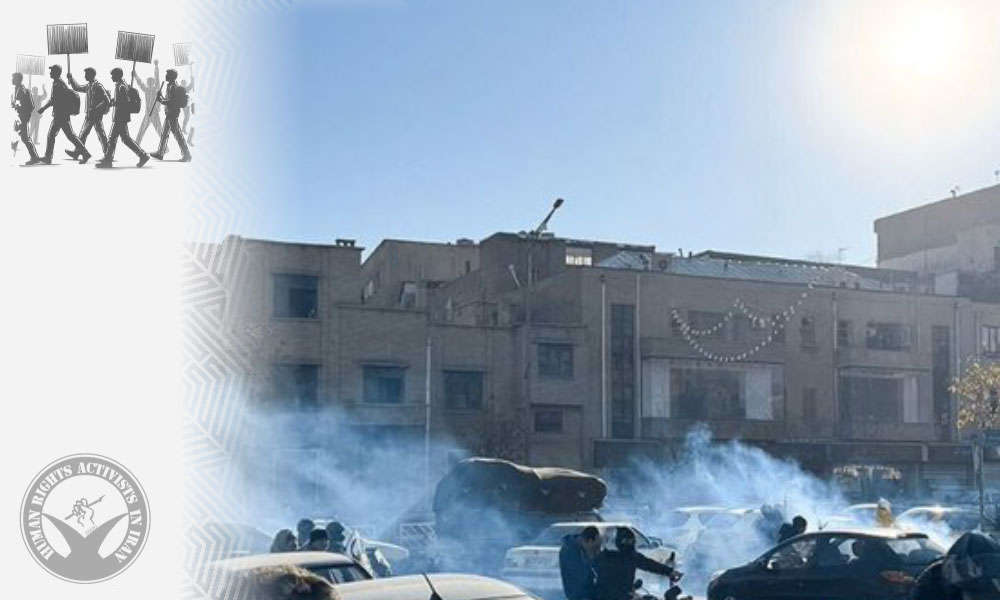
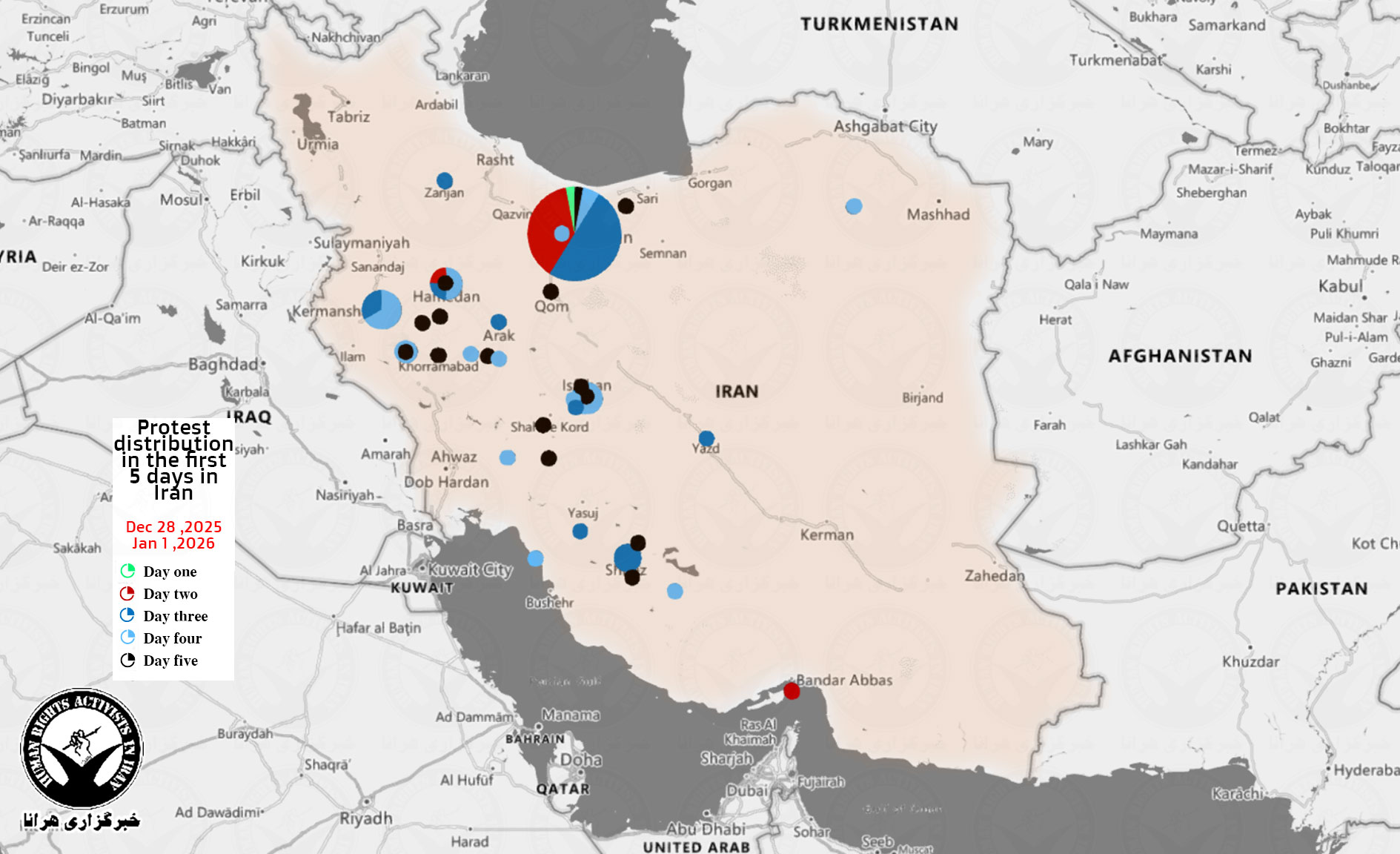
HRANA – During the first five days of protests and strikes in Iran, at least 119 citizens have been arrested, seven people have been killed, and at least 33 others injured. These protests, which began in Tehran, have spread over this period to at least 32 cities across various provinces. Alongside labor strikes and street gatherings, they have been marked by an escalation in security crackdowns, the use of weapons, and widespread pressure against protesters.
Protests that began on Sunday, December 28, with strikes and gatherings by bazaar merchants in Tehran continued today, Thursday, January 1, for a fifth consecutive day. As livelihood-related discontent persists, the security atmosphere has intensified in some cities, and security forces crackdowns against protesting citizens have taken on broader dimensions.
Background of the Protests
The protests of the past five days in Iran are rooted in a deep and structural crisis spanning economic conditions, livelihoods, and governance. Over recent months, this crisis has accelerated, manifesting in the continuous devaluation of the national currency, an unprecedented surge in foreign exchange rates, rising inflation, widespread market stagnation, and a sharp decline in citizens’ purchasing power. Under these conditions, many tradespeople and economic actors have reported an inability to cover operating costs, continue their activities, or maintain even minimal profitability.
According to data and reports published in the days leading up to the protests, the U.S. dollar in the open market reached approximately 140,000 tomans. This occurred alongside capital outflows from the stock market, a sharp drop in market indices, and increased movement of capital toward parallel markets such as currency and gold. Economic observers have assessed these developments as signs of widespread distrust in economic stability and the country’s future outlook.
Within this context, the Tehran bazaar strike on the first day of protests quickly spread to other professional sectors and geographic areas. Over the second to fourth days, the protests continued in the form of street gatherings, marches, shop strikes, and the participation of groups of students at some universities. At the same time, responses by law enforcement and security institutions included increased troop deployment, on-the-ground control of urban spaces, confrontations with protesters, and the arrest of citizens—a trend that, according to reports, continued and intensified on the fifth day as well.
Geography of the Protests
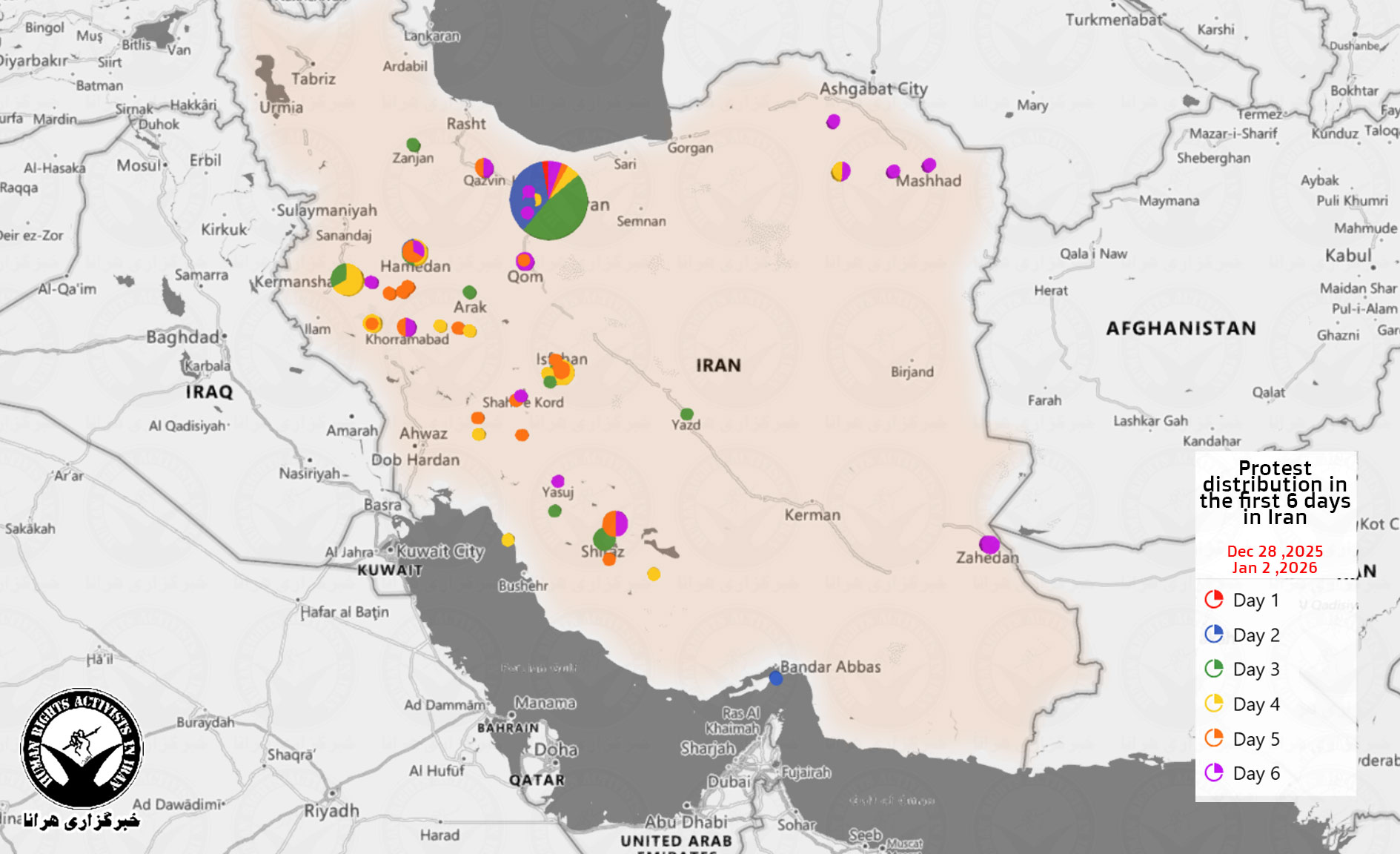
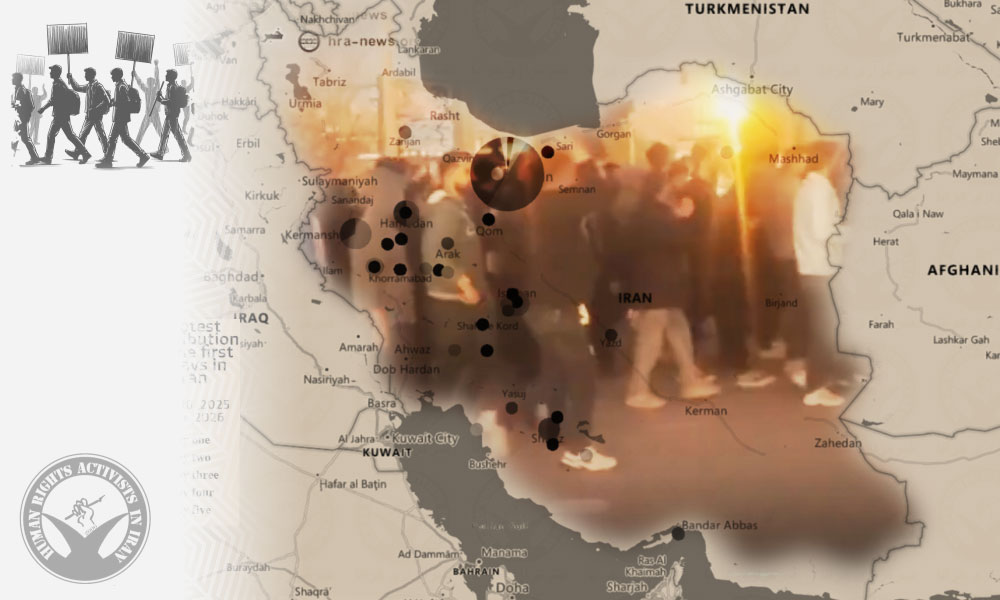
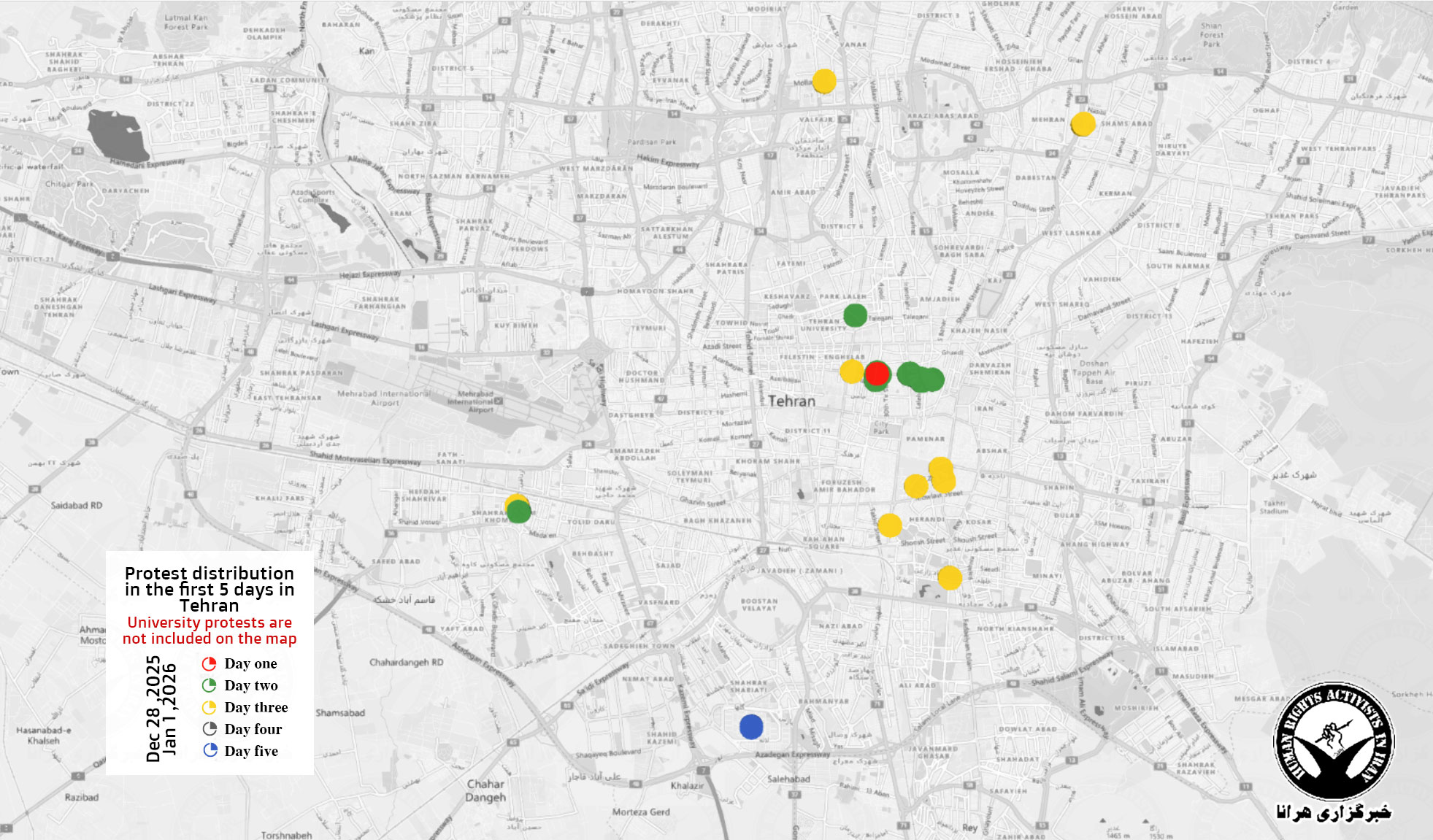
Information collected by HRANA indicates that on the fifth day of protests, protest gatherings and labor strikes were reported in the following cities and locations:
In Tehran, protest gatherings and activities were reported in the vicinity of the Fruit and Vegetable Market. This city, where the protests first began with the Tehran bazaar strike, has continuously witnessed various forms of protests, strikes, and a heavy presence of security forces over the past five days in areas including the Tehran Bazaar, Lalehzar Street, Valiasr Street, Yaftabad neighborhood, Imam Khomeini Street intersection, Jomhouri Street, Ferdowsi Street, Sabounian Street, Shadabad Street, Bani Hashem Street, Mollasadra Street, Khayyam Street, the Fruit and Vegetable Market, Qods City, and Malard.
In Fars Province, on the fifth day, protest gatherings by citizens were recorded in the cities of Marvdasht, Kavar, and Osan. In previous days, the province had also witnessed protests in Fasa (in front of the Governor’s Office), Shiraz, and Nurabad-e Mamasani.
In Chaharmahal and Bakhtiari Province, protests were reported in two cities. In Lordegan, protesters gathered from Municipality Square to in front of the Governor’s Office, where, according to reports, law enforcement forces used tear gas. Protest activities were also recorded in the city of Junqan.
In Hamedan Province, the continuation of strikes and protests was reported in the city of Hamedan, which had also been among the active protest locations in previous days.
The city of Babol, in Mazandaran Province, also witnessed public protests on the fifth day.
In Isfahan Province, shopkeepers’ strikes and protest gatherings took place in the city of Isfahan, while protesters held demonstrations in Shahin Shahr on the fifth day. During the second to fourth days, protests had also been reported in other parts of Isfahan Province, including Naqsh-e Jahan Square, the Ahmadabad neighborhood, Yakhchal Street, Fuladshahr, and Najafabad.
A review of the data shows that over five consecutive days, the protests have spread beyond Tehran to numerous provinces and cities. According to HRANA, the following cities and areas also witnessed protests, gatherings, or strikes during the first to fourth days: Isfahan, Fasa, Kuhdasht, Aligudarz, Dorud, Genaveh, Baghmalek, Hamedan, Kermanshah (Nobahar Street), Shiraz, Sabzevar, Zanjan, Qeshm, Yazd, Arak, Nurabad-e Mamasani, Fuladshahr, Najafabad, Qods City, and Malard. The continuation of protests on the fifth day reflects both the temporal continuity and geographic expansion of these protest activities across the country.
Universities Join the Protests and Student Demonstrations
Alongside street gatherings and labor strikes, universities have also played a significant role as centers of protest during the past five days. Based on recorded information, student activities began at the University of Tehran on the second day of protests. By the third day, these protests had expanded to University of Tehran, Shahid Beheshti University, Kharazmi University, Sharif University of Technology, Iran University of Science and Technology, Amirkabir University of Technology, University of Science and Culture, Isfahan University of Technology, Allameh Tabataba’i University, Yazd University, and University of Zanjan.
On the fourth day, reports were also published regarding the continuation of student activities at Isfahan University of Technology and at the Shahid Beheshti University dormitory in the Velenjak area. Among these, Isfahan University of Technology was identified as one of the main centers of student protests. Published videos show students holding gatherings, marching, and chanting protest slogans on campus. These activities took place simultaneously with labor strikes and street protests in the city of Isfahan.
Although no separate reports of new student gatherings were recorded on the fifth day, available data indicate that university protests formed part of the broader five-day protest movement and emerged from the same economic and social grievances. The continued security presence around universities and the heightened sensitivity of law enforcement and security institutions toward these spaces have been reported as consistent features over recent days.
Methods of Protest and Slogans
According to information compiled by HRANA, the protests continued into their fifth day, taking the form of a combination of labor strikes, protest gatherings, and street marches. The strike by shopkeepers and bazaar merchants, which began on the first day of the protests in Tehran’s Grand Bazaar, expanded to other cities in the following days and continued on the fifth day in a number of urban centers and local markets. Shop closures, refusal to engage in economic activity, and calls on other professional groups to join the strike were among the most prominent methods of protest during this period.
Alongside labor strikes, street gatherings and short protest marches were reported in various parts of cities. These gatherings were often sporadic and highly mobile, aimed at reducing direct confrontation with security forces. In many cases, protesters dispersed after chanting slogans, leaving the area before extensive intervention by security forces. In some cities, protests were also reported in front of government buildings, including governorates.
Based on reviews of videos and verified reports from the first five days of protests, the slogans chanted were largely focused on livelihood, economic, and political demands rooted in citizens’ fundamental rights. These slogans included criticism of the power structure, objections to restrictions on individual and social freedoms, demands for justice, and opposition to the prevailing economic and living conditions.
At the same time, in some gatherings, slogans with more diverse themes were also heard, reflecting the heterogeneous range of views and tendencies among protesters. Within the framework of its human rights mission, HRANA focuses its reporting on slogans and demands that are directly related to violations of, or demands for, human rights, fundamental freedoms, and civil rights.
The persistence and repetition of these slogans across different cities indicate an overlap between labor, livelihood, and political demands within the context of the ongoing protests, and reflect the depth of accumulated grievances within Iranian society.
Actions by Law Enforcement–Security Forces and Details of Violence
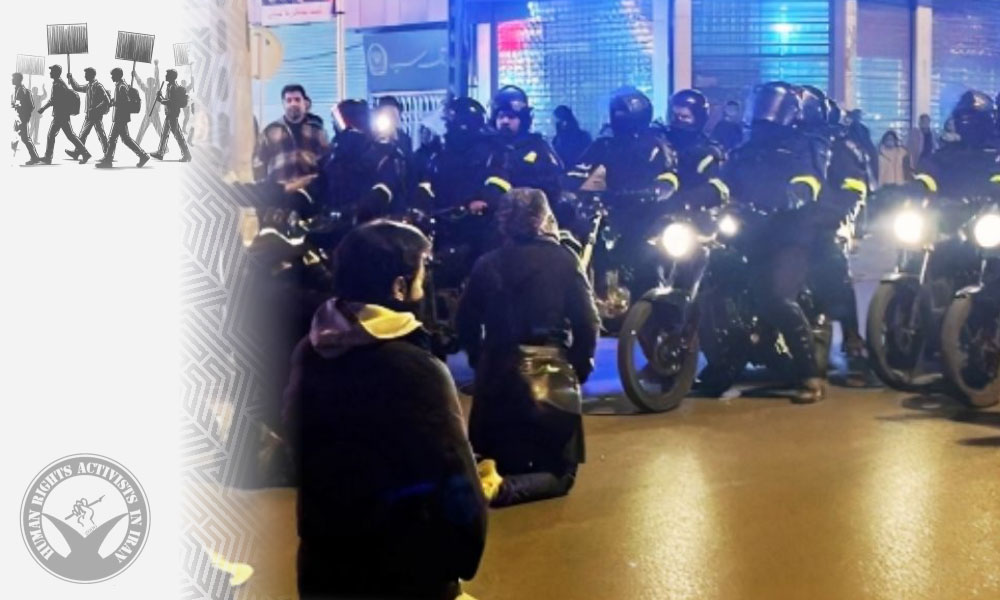
Reports received from the fifth day of protests indicate the continued and intensified presence of law enforcement and security forces in various urban areas. In Tehran and several provincial capitals, the deployment of riot control units, police vehicles, and plainclothes agents in squares, main streets, and around sensitive locations was reported. This widespread presence followed the pattern of the previous four days and aimed at controlling gatherings and preventing the spread of protests.
In some cities, confrontations between law enforcement–security forces and protesters led to the use of tear gas and crowd-control tools. For example, in Lordegan, a gathering of citizens between Municipality Square and the Governor’s Office was met with tear gas fired by law enforcement forces, resulting in the dispersal of protesters and the establishment of a heavy security atmosphere in the area.
In previous days, reports also documented gunfire toward protesters, physical assaults, and the pursuit of citizens. One such case occurred in Fasa, where on the fourth day of protests, clashes between law enforcement–security forces and protesters in front of the Governor’s Office escalated into violence. Images published from that day showed security forces firing at protesters. Similarly, in Kermanshah, at Mossadegh Square and in the Dabir-e Azam neighborhood, law enforcement and security forces opened fire on protesters. According to informed HRANA sources, officers in the city used pellet guns against protesting citizens. Local officials later denied the use of live ammunition, stating that plastic or pellet bullets had been employed.
On the fifth day of protests, reports indicate that law enforcement–security forces used gunfire and tear gas to disperse protesters in Nahavand. In Kuhdasht, officers used pellet weapons to scatter demonstrators. In addition, in the city of Osan, reports indicate that a group of individuals gathered in front of a police headquarters, after which clashes broke out between protesters and officers, resulting in the killing of three people and the injury of 17 others. Both cold weapons and firearms were reportedly used during these clashes.
Over the past five days, there have also been reports of citizens being arrested by plainclothes agents in public spaces and markets. In some videos, citizens can be heard describing attempts by security forces to detain protesters and calling on others to intervene to prevent the arrests. In many of these cases, precise information regarding the timing and identity of the arresting forces is not available; however, the reported behavior aligns with previously documented security practices.
Overall, these findings indicate that the response of law enforcement and security forces to the recent five days of protests has gone beyond on-the-ground control and the creation of a security atmosphere, and in numerous instances has involved the use of repressive measures, physical violence, and restrictions on the right to peaceful assembly.
Arrests, Victims, and Other Security Pressures
According to reports compiled by HRANA, the recent five days of protests have been accompanied by a significant increase in arrests, the deaths of protesters, injuries, and the application of various security pressures across different parts of the country. The information presented in this section is based on documented data and includes names, numbers, locations, and the current status of those affected.
Arrests:
During the first five days of the protests, at least 119 citizens were arrested in 24 separate incidents across multiple provinces and cities. This figure includes both individual and group arrests.
Individual Arrests with Identified Identities:
• Mehdi Beik, journalist, arrested in Tehran – released
• Abolfazl Marvati, student at Sharif University of Technology, arrested in Tehran (Azadi Street) – released
• Shahin Shokouhi, student at the University of Tehran, arrested in Tehran (Enghelab Street) – released
• Aref Hadi-Nejad, student at the University of Tehran, arrested in Tehran (Enghelab Street) – released
• Mobin Aminian, student, arrested in Tehran – released
• Mani Eydi, student, arrested in Tehran – released
• Amirhossein Gholizadeh, student, arrested in Tehran – released
• Hassan Mousavi, student, arrested in Tehran – released
• Serira Karimi, student, arrested in Tehran – released
• Ali Hassan-Bikian, student, arrested in Tehran
• Alireza Hammami, student, arrested in Tehran
• Elnaz Kari, arrested in Tehran – held in Evin Prison
• Negar Ghanbari, arrested in Tehran – held in Evin Prison
• Helena Rostami, arrested in Tehran – held in Evin Prison
• Masoumeh Nouri, arrested in Tehran – held in Evin Prison
• Fatemeh Hashem Pour, arrested in Tehran – held in Evin Prison
• Aida (surname unknown), arrested in Tehran – held in Evin Prison
in Khuzestan Province:
• Soltan Emamkhah, resident of Behbahan, arrested for issuing a protest call – released
• Amir Mehdi Razm, resident of Behbahan
• Abolfazl Jafsh, resident of Behbahan
• Abolfazl Ashnoud, resident of Behbahan
in Isfahan Province:
• Mahshad Keshani, resident of Isfahan, arrested on Qaemieh Street
Unidentified and Group Arrests:
• 11 citizens arrested in Tehran, Shoush Square, Sabounian Street
• 4 citizens arrested in Fasa, Fars Province, during protests in front of the Governor’s Office
• 7 citizens with unidentified identities (exact city and location not confirmed)
• 1 citizen with unidentified identity arrested in Tehran (Tehran Bazaar)
• 20 citizens arrested in Kuhdasht
• 7 citizens arrested in Kermanshah
• 14 citizens arrested in Alborz Province
• 1 citizen arrested in Isfahan (Qaemieh Street)
• 1 citizen arrested in Khorramabad
• 30 citizens arrested in Malard
In several cases, the place of transfer following arrest and the current legal status of detainees remain unknown. Additional information is under review and verification.
Victims:
During the fifth day of protests, at least seven citizens lost their lives. Details are as follows:
• Amirhesam Khodayari-Fard, civilian (Lorestan Province, Kuhdasht). Security institutions have claimed he was affiliated with the Basij, while local sources have identified him as a protester.
• Dariush Ansari Bakhtiarvand, civilian (Isfahan Province, Fuladshahr)
• Sajjad Valamanesh and Ahmad Jalil (Chaharmahal and Bakhtiari Province, Lordegan, in the area between Municipality Square and the Governor’s Office)
• Three citizens with unidentified identities (Fars Province, Osan, at a police headquarters)
Precise details regarding the circumstances of these deaths are still under verification.
Injuries and Other Security Pressures:
According to compiled reports, over the five days of protests, at least 33 cases of injury were recorded. These injuries were mainly caused by the use of tear gas, beatings, and crowd-control tools. In many cases, the identities of the injured individuals remain unknown.
Authorities in the cities of Fasa and Kuhdasht claimed that 16 of the injured in these cities were members of law enforcement–security forces.
Additionally, during the protests, Fariba Fereydouni, a resident of Khomein in Markazi Province, was summoned by the Ministry of Intelligence via phone on the third day of protests. The reason for the summons was cited as “publishing content related to the protests on social media.” She has not yet complied with the summons.
Beyond these cases, reports have been received of telephone or in-person threats, forced written commitments, security forces appearing at citizens’ residences, and pressure after release, indicating the continuation of security pressure outside the framework of formal detention.
Overall, these data indicate that the recent five days of protests have been accompanied by a broad pattern of human rights violations, including mass arrests, the deaths of citizens, injuries to protesters, and simultaneous security pressures. HRANA continues to collect, cross-check, and verify additional information and will publish updated reports should new data become available.
Reactions of Officials and State Media
In response to the recent five days of protests, government officials and media outlets close to security institutions have presented narratives aligned with the securitization of the protests, reducing them to so-called “riots,” while attempting to downplay the scale of repression and its human consequences.
Fars News Agency and Tasnim News Agency, both affiliated with security institutions and the Islamic Revolutionary Guard Corps, described protesters as “rioters” and claimed the protests involved “sabotage.” Fars reported the killing of two people during the Lordegan protests, stating that demonstrators had thrown stones at government buildings and that police used tear gas to disperse the crowd. The outlet also described the city’s situation as “calm.”
Tasnim News Agency reported the arrest of seven individuals in Kermanshah, claiming they intended to turn the protests violent and were affiliated with opposition groups abroad—claims made without independent evidence.
At the executive level, Mohammad Sadegh Motamedian, Governor of Tehran Province, stated that bazaar protests had been “managed in cooperation with FARAJA” and described law enforcement policy as one of “restraint.” He claimed confrontations occurred only in limited cases due to “disruption of public order” and that the city was being steered toward calm.
Meanwhile, Fatemeh Mohajerani, the government spokesperson, called on governors to hold meetings with representatives of guilds and bazaar merchants to facilitate “direct dialogue.” These remarks were made despite widespread reports of arrests, deaths, and violent برخورد with protesters.
Separately, Mohammad Saleh Jokar, head of the Majles Internal Affairs and Councils Commission, announced that following recent events, the review of the “Gatherings and Marches Bill” would be prioritized, legislation previously criticized by observers as a tool to restrict the right to peaceful assembly.
In the academic sphere, the Educational Vice Presidency of the University of Tehran announced that classes and exams would be held online until 18 Dey, citing “cold weather and energy imbalances.” This decision was made amid continued student protests and a heightened security atmosphere around universities.
Summary and Final Assessment of the Fifth Day
Protests that began with a bazaar strike in Tehran have, by their fifth day, evolved into a broad movement encompassing labor, livelihood, political, and student dimensions. The geographic expansion of protests, continued strikes, participation of universities, and repetition of political slogans reflect the depth of public dissatisfaction with economic conditions, the devaluation of the national currency, and the lack of livelihood prospects.
In contrast, the authorities’ response has largely focused on security-based crisis management, increased arrests, multilayered pressure, and media narrative-building. The documentation of at least 119 arrests, seven deaths, and dozens of injuries over five days underscores the heavy human cost borne by protesting citizens. At the same time, official efforts to label the protests as “riots” and to advance unsubstantiated claims about protesters’ affiliations stand in clear contrast to the scope of demands and the social composition of the movement.
HRANA continues to collect, verify, and cross-check information related to the protests, arrests, deaths, and other human rights violations, and will publish supplementary and updated reports should the protests continue or expand.