Qarchak Women’s Prison also known as Shahre Rey Penitentiary is located in Varamin and has 11 wards. Each ward in this prison holds several female prisoners, disregarding the rules of segregation of prisoners by age and crime.
Political prisoners are transferred to this prison to put them under more pressure. The lack of medical care, dental care, and regular checkups, poor hygiene, and a great number of prisoners has caused several issues. The poor quality of food, drug use and easily accessibility narcotics, not isolating prisoners with a contagious disease from others, rape, and negligence of the prison authorities are some of the issues of this prison.
This report that is gathered by Human Rights Activists (HRANA) examines the conditions in Qarchak Prison and as well, the condition of nine female political prisoners who were kept in this prison. In addition, this report is investigating the condition of arrestees of the recent protests in Iran who are kept in a separate ward of this prison.
The information of this report was gathered from the sources inside the prison. Several prisoners contacted HRANA while incarcerated in Qarchak Prison or after they were released.
Prisoners Classification Regulation
The prison hosts a large number of inmates despite its small size. The prison does not separate inmates according to the crimes committed and this leads to violence; thus, worsening the situation as they are not offered medical services and are subjected to torture.
More than 130 prisoners of this prison are infected with HIV or Hepatitis and are kept in the same ward with others, not having access to medical treatment or medicine. These inmates are usually charged with crimes such as prostitution or drug felony. They threaten other inmates by self-harming with a sharp object or threaten to infect other prisoners by injuring them with the same sharp object or their body. Other prisoners filed several complaints about this issue but were told by the head of the Medical Ward that these diseases are not transferable, and the routine to keep these prisoners with others is practiced all over the world.
The Quarantine Ward of the prison was shut down months ago and therefore, new inmates enter general wards without being tested for diseases. Also, if by any chance, they are tested a few days after they entered, they usually return to the ward from the Medical Ward regardless of the test result being positive or negative. The prisoners warned the prison authorities especially the head of the prison, Mehdi Mohammadi, and other authorities such as Sakineh Shahali, Zahra Mirzaei, and Maryam Mirzaei about the shortage of a Quarantine Ward but they never received any response.
A prisoner who was released recently from Qarchak Prison told HRANA that six women inmates have Scabies which is a contagious disease. She added that other inmates asked the prison authorities several times to transfer these six women to a separate ward since this disease is easily contagious through skin touch like shaking hands, sheets, or even from their clothes. The prison authorities’ responses were that this disease is not contagious.
Number of prisoners and prison’s area
According to the report, the prison’s seven sections contain more than 1400 prisoners with 120-300 prisoners held in each section, although the capacity of each section is 100 inmates. Some of these prisoners are incarcerated along with their children while the number of prisoners increases every year.
Each ward has 10 cubicles where each has four triple bunk beds. Several prisoners have to sleep on the floor.
Food
Food is one of the prison’s major problems as the food has a low quality and prison commissary sells low-quality food at a high price. The prison foods contain an unknown ingredient that causes extreme sourness in foods. The high level of acidity of these foods could cause hormonal diseases and other issues. To enrich the prison food with protein, oil cake (its common use is in animal feeding) has been replaced as the main ingredient.
15 prisoners are working in the kitchen from 7 am to 7 pm. They should receive a salary in return for their services but only a few of them received 100-150 thousand Toman [10-15 dollars] in total for six months. They do not have proper clothes, so they have to work with their everyday clothes in the kitchen that destroys their clothes due to the working condition.
Hygiene
At least 12 toilets and 10 bathrooms are in each ward. They are always not enough due to the high number of prisoners, facilities being out of order, and shortage of water. Cleaning the prison is prisoners’ responsibility but due to the lack of cleaning products, rubber gloves, and trash bags, inmates run out of these stuff in the first few days of the month and it leaves the bathrooms dirty with a lot of trash. As a result, infectious and skin diseases are common in this prison due to poor hygiene as well, roofless bathrooms increase the occurrence of cold and pneumonia during cold seasons.
In addition, there is no hot water running for the past two months although hot water used to run for one hour in the morning and one hour at night. The rest of the day, prisoners can only take a cold bath. Moreover, the prison water is coming from wells and it is not purified. The water is not proper for drinking and using it for bathing caused women-related diseases especially during menstruation. Even this water was shut off for a few hours in some days and sewer water comes up. Prisoners should buy drinking water from the prison commissary at a high price.
Overall, there are mothers and children in this prison who are suffering from nutrition deficiency, lack of access to child clothes, and poor hygiene. For example, in February 2019 during the prison wardens’ violent attack to this prison after the prisoners protested not having access to medical treatment and other issues in the prison, tear gas was fired in the prison and a 20-day old infant lost his/her life.
Visits
The telephone contact allowance of the prisoners is not controlled by the prison authorities which resulted in a chaos of selling and buying telephone allowance between inmates. Prisoners are unable to contact the prison’s supervision office to complain about the prison conditions. Visiting times are only 15 minutes and it should be granted at least two months after the prisoners started serving time there. The visitors can not sit close to the prisoner or hug them.
Air condition
Only half of each ward has a heater which forces the prisoner to walk in blankets. The only response the prisoners get when they complain about it is to put on more clothes which leads to another issue which is the difficulty of access to clothes. Bringing clothes to prison was forbidden and inmates should obtain their clothes from the prison commissary. The price of clothes is double or even triple of it outside of prison. Prisoners should purchase their pillow and blanket and the price of the cheapest pillow is 35 thousand Toman.
Because of housing more prisoners than the capacity, the air ventilation and the number of toilets is below the required standards.
Prison authorities
Sadegh Deldadeh, the judge supervisor of Branch 1 of Shahriar Court, reportedly insulted or threatened prisoners of Qarchak Prison during trials.
The social services department of Qarchak Prison is inactive, and prisoners could not follow up on their cases from inside the prison. For example, Simin Khosravi, a prisoner of Qarchak, sewed her lips protesting the situation of her case and its lengthy process. She wrote letters to judicial authorities requesting some attention to her case seven months ago and has recently figured out that none of those letters even left the prison. Three days later, she opened her lips after the prison authorities made promises to follow up on her requests.
Rape
In addition, several reports indicate that younger prisoners are raped by older prisoners who have more violent crimes. Prison authorities neglect these reports and even stop checking on the wards which have a high rate of violence. Atena Daemi and Monireh Arabshahi wrote open letters about their experience in these prison conditions especially sexual assaults and rapes.
Women prisoners arrested during recent protests
Women who were arrested during the last November and January protests were transferred to Qarchak Prison. In order to open up space for these new prisoners, prison authorities shut down the prison gym and place these prisoners there. This new ward does not have required facilities and standards such as proper air ventilation or air conditioning. As a result, 1400 prisoners of Qarchak are deprived of having a gym. Most of the prisoners of this ward were released on bail later but still, 11 prisoners were kept in this ward. Also, Zahra Sadeghi, Mary Mohammadi, and Elnaz Pakravan who were arrested during January protests are still in this ward.
Nine political prisoners of Qarchak Prison:
Elnaz Pakravan is an 18-year old prisoner of this prison. She was arrested on January 31, 2020, for attending a demonstration near the Turkish embassy in Tehran, protesting the arrest of an Iranian singer, Amir Hossein Maghsoudlo also known as Tataloo. She was charged with “propaganda against the state” and “assembly and collusion by having a leadership role in an unlawful protest”. She is in the new ward of Qarchak prison (Gym).
Maryam Ebrahimvand’s first arrest was on July 26, 2016, and she was transferred to the IRGC’s Intelligence detention center in Evin Prison. She was released on 300 million Toman [cash] bail after spending 35 days in solitary confinement. On July 22, 2018, she was arrested for the second time by the Intelligence Department officers on the charge of “publishing lies against the IRGC ”, and “using government properties and misusing it”. Her bail was set for 8 billion Toman. She is in Qarchak Prison in a limbo state without trial. She is now in ward 2 of the Qarchak Prison and was banned from entering the cultural part of the prison and receiving books.
Zahra Zare Seraji and her husband, Morteza Nazari Sedehi, were arrested on February 8, 2018. They were transferred to ward 209 of Evin Prison. She was transferred to the general ward of Evin Prison from February 26, 2018, till April 20, 2018, after initial investigations and interrogations. She was released on 200 million Toman bail from Evin Prison. In September 2018, Ms. Zare Seraji was tried along with three others including her husband. She was sentenced to eight years imprisonment and paying fines for the charges of “establishing illegal group”, “publishing lies in cyberspace”, and “propaganda against the state”. In February 2019, the appeals court reduced her sentences to two years imprisonment. She was arrested in September 2019 in Baharestan to serve her sentence. She is now in ward six of Qarchak Prison.
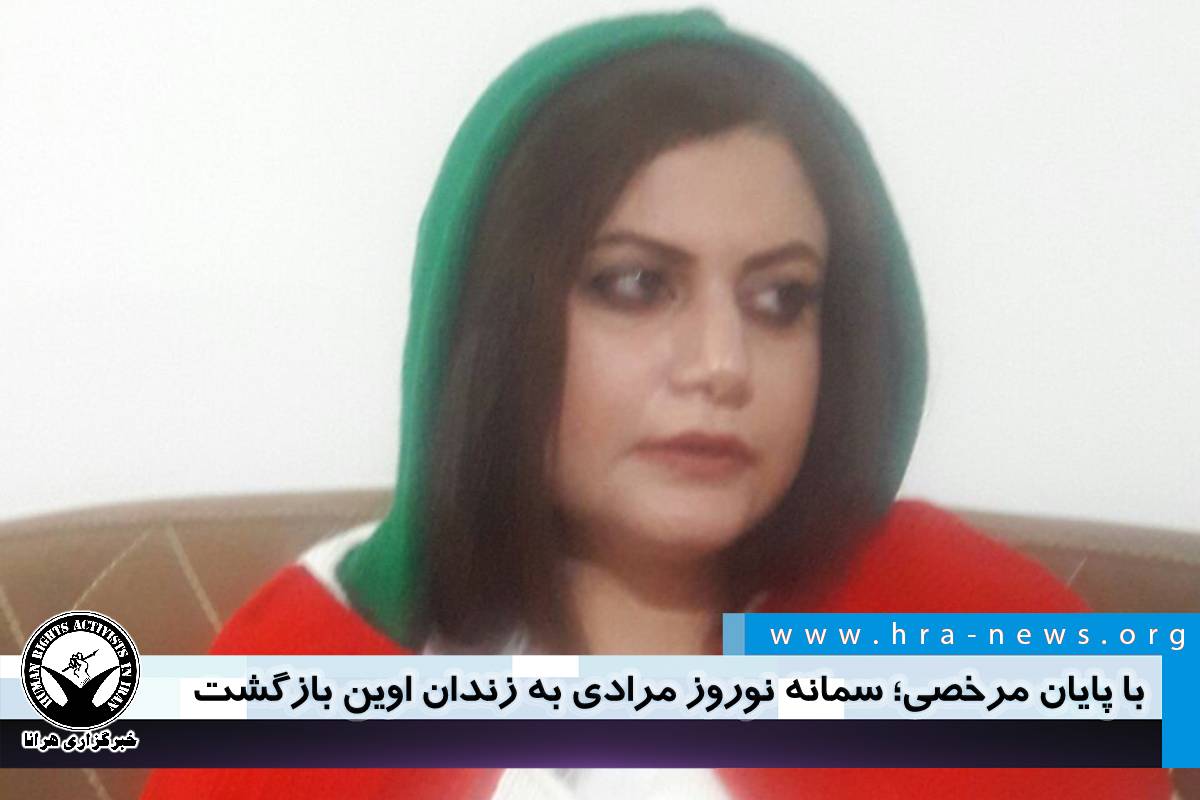
Zahra Sadeghi was an employee of the UN and traveled to Sudan and Iraq for her work. She was arrested by the security forces at the airport after returning from a trip to Iraq. On January 28, 2019, she was transferred to the ward 209 of the Evin Prison. In January 2020, she was transferred to Qarchak Prison. She was sentenced to 10 years imprisonment for the charge of espionage by Branch 15 of Tehran’s Revolutionary Court. Her sentence was reduced by an appeals court to three years. During her trial, none of her cooperation with the UN was mentioned in her accusations, and she was charged with espionage because of a trip to Turkey with a friend was considered as her accusations.
She was born in 1987 and she was arrested for the first time in 2014 by the Intelligence department agents and was released on bail from ward 209 of the Evin Prison after three months.
She is now in the new ward of Qarchak Prison (Gym).
Fatemeh (Mary) Mohammadi was arrested on January 12, 2020, during the wave of protests erupted in Tehran and other Iranian cities on January 11, after Iran admitted that it shot down a Ukrainian passenger jet, killing 176 people. She was arrested in Azadi square and was transferred to Vozara detention center. She was severely beaten both in Azadi square and at Vozara detention center. On February 26, Ms. Mohammadi was released from Qarchak Prison on 30 million Toman bail. Her trial is scheduled for March 2, 2020, at Branch 1167 of Tehran’s criminal court.
Fatemeh Mohammadi, a former prisoner, and Christian convert was arrested on November 18, 2017, for the first time. She was detained in Tehran and was transferred to Evin prison. On April 7, 2018, Mohammadi, who was 19 years old at that time, was sentenced by Branch 26 of the Revolutionary Court of Tehran, presided by judge Ahmadzadeh, to six months imprisonment for the charges of “membership in proselytizing groups,” “Christian activity,” and “acting against the national security through propaganda against the regime.” She was released from Evin Prison’s women’s ward in spring 2018 after completing her sentence. She was charged with “disturbing public order through attending an unlawful protest”. Her trial is not scheduled yet. Although her bail was set for 30 million Tomans [approx. $3000], the prosecutor did not accept her bail. She was being kept in a limbo state for a month. She is now in the new ward of Qarchak Prison (Gym).
Leila (Khadijeh) Mirghafari and six others were arrested by the security forces on December 4, 2019. On November 10, 2019, they were tried at Branch 15 of Tehran’s Revolutionary Court presided by Judge Abolghasem Salavati. Ms. Mirghafari was sentenced to five years imprisonment on the charge of “assembly and collusion”. On May 18, 2019, her appeal court hearing was in session without her attendance and the appeals court upheld her sentences in February 2020.
Leila Mirghafari was arrested on October 2, 2018, by the security forces for supporting people who are against mandatory vail and was released after one day. She was sentenced to pay three million and 220 thousand Toman fine and was forced to pay the fine on May 21, 2019.
She is now in the new ward 5 of Qarchak Prison.
Raha Ahmadi was arrested on August 4, 2019, by the security forces and was transferred to Qarchak Prison in Varamin in late August. She was initially charged with “propaganda against the state”, “assembly and collusion”, “cooperation with enemy states”, and “promoting corruption and prostitution” in her incitement at the prosecutor’s office of Evin Prison. Although her bail was set after two months, her 600 million Toman [approximately 55 thousand dollars] bail has never been accepted. On November 10, 2019, she was tried at Branch 15 of Tehran’s Revolutionary Court presided by Judge Abolghasem Salavati. Ms. Ahmadi was sentenced to two years imprisonment on the charge of “assembly and collusion”. On May 18, 2019, her appeal court hearing was in session without her attendance and the appeals court upheld her sentences in February 2020. A video was published earlier that shows Ms. Ahmadi handing out flowers and talking to people in the subway.
She is now in the new ward 5 of Qarchak Prison.
Marjan Davari was arrested on September 24, 2015, in Mehrshahr of Karaj. After spending one week in Rajai Shahr Prison, she was transferred to ward 209 of Evin Prison. She had been in solitary confinement from September 30 to January 3 (approximately 4 months) and then transferred to the women’s ward of Evin Prison.
She graduated from the Arts Department of Alzahra University in Tehran and is the translator of Islamic, esoteric and Illuminati books and a researcher of Rah-e-Marefat Institute for Metaphysical Studies and Research. She was arrested by the security forces after the Rah-e-Marefat Institute was shut down and its officials were arrested. Her court sessions were held at Branch 15 of the Revolutionary Court, presided by Judge Salavati, on 16, 17 and 18 October 2016, as well as on 11 and 12 December 2016. She was accused of “corruption on earth”, “adultery”, “assembly and collusion against the regime”, and “membership in Eckankar mystical sect”. Branch 15 of Tehran Revolutionary Court presided by Judge Salavati sentenced her to death. Her death sentence was rejected twice by the Supreme Court and was returned to Branch 23 of Tehran’s Revolutionary Court to try again. Her trial was on January 11, 2019, and she was sentenced to 75 years in prison by Branch 23 of Tehran’s Revolutionary Court. Based on Article 134 of Iran’s Islamic Penal Code, the charge with the highest penalty will be considered; this means that he should serve 25 years in prison. She is now in the new ward 1 of Qarchak Prison.
Golrokh Ebrahim Iraee was arrested along with her husband on September 6, 2014. First was held at an IRGC safe house for two days, then she spent 20 days in a solitary cell of Evin Prison’s ward 2A, under the IRGC jurisdiction, before being released on a bail of 80 million Toman [approximately $19,000 USD].
On October 24, 2016, the IRGC arrested Ms. Iraee again without a warrant. She was sentenced to six years in prison for “blasphemy” and “assembly and collusion against the state.” She was later granted amnesty per Article 134 of the Islamic Penal Code, which reduced her prison term to 2.5 years. After finishing her sentence, on April 8, 2019, she was released on bail for her new case.
While she was serving her time in prison, she was sentenced for another case to three years and seven months of imprisonment by Branch 26 of Tehran’s Revolutionary Court and she was banned for two years from membership in political groups and parties. Based on Article 134 of Iran’s Islamic Penal Code, the charge with the highest penalty will be considered; this means that she should serve two years and one month in prison. Her sentence was upheld by the appeals court without any hearing. On November 9, 2019, she was arrested without a warrant at her house in Tehran. According to judge Mohammad Berae’s verdict, she should have been transferred to Evin Prison but because Gholamreza Ziaei, the head of Evin Prison, refused to admit her, she was transferred to Qarchak Prison and her house was searched.
She is now in the new ward 1 of Qarchak Prison.