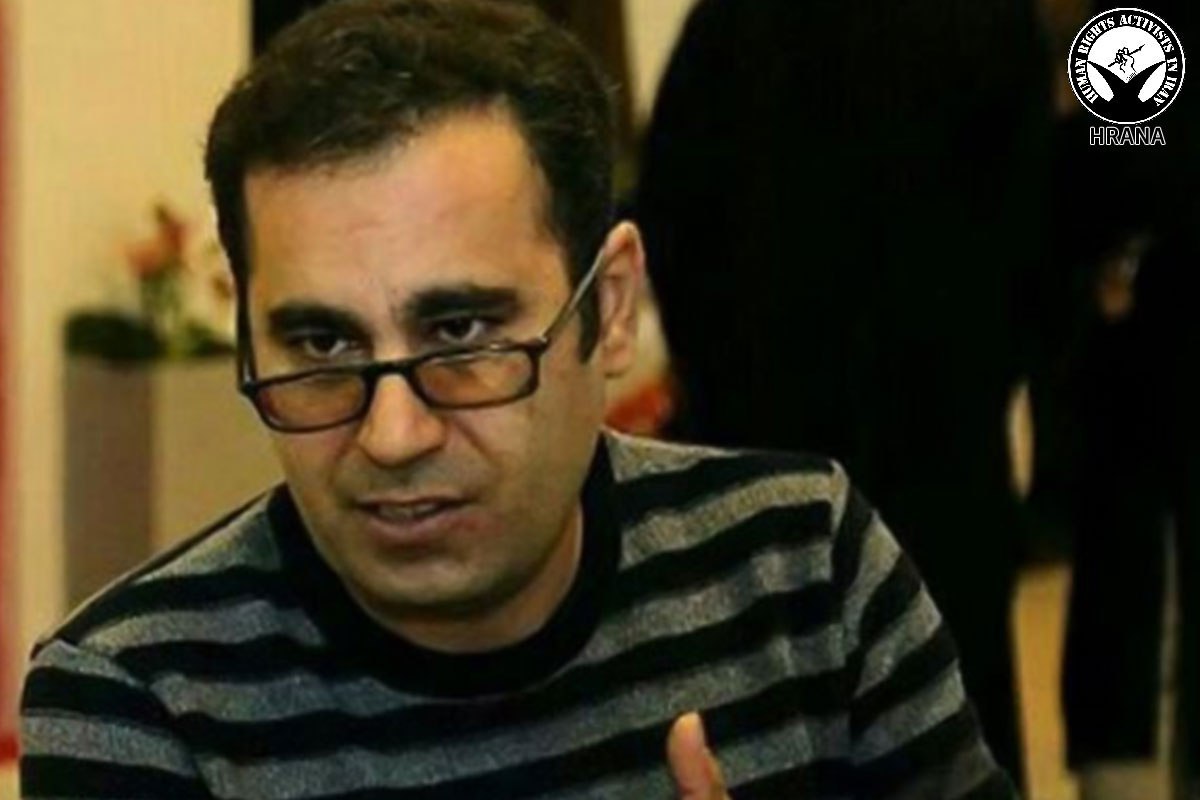
Human Rights Activists News Agency (HRANA) – A summary report on the most recent news of arrests, imprisonment, and executions in Iran from the the last week of July 2018 to August 7, 2018.
Iraj Mohammadi and Mohammad Amin Agoushi Released from Tabriz Prison 
Political prisoners Iraj Mohammadi and Mohammad Amin Agoushi were released from Tabriz Prison on Sunday, August 5, 2018, following the end of their judicial sentence. In September 2007, Mr Mohammadi and Mr Amin Agoushi were sentenced to a 10-year prison exile term each on the charge of “Acting against national security”.
Last week, HRANA reported on a hunger strike launched by Iraj Mohammadi in objection to the Iranian authorities preventing his release from prison despite reaching the end of his conviction.
Iranian authorities arrested Mohammad Amin Agoushi on September 23, 2007, on the charges of “Espionage” and “Cooperation with Iraqi Kurdistan”. In May 2008, branch 2 of the military court in Urmia charged him with “Moharebeh” (enmity against God) and transferred him to Urmia’s central prison. Four months later, Judge Hafiz Ghaffari sentenced him to death by a firing squad.
In 2010 the retrial request was approved and the case was sent to branch 31 of Iran’s Supreme Court where the sentence was reduced to ten years in prison exile. Iraj Mohammadi and Mohammad Amin Agoushi were transferred to Tabriz Prison from Zahedan in March.
In February 2017 Iraj Mohammadi explained some points in an open letter about rejecting his request for amnesty. Mr Mohammadi emphasized that the mentioned reasons were false, stating that he suffered from nervous and mental illnesses as a result of being held in solitary confinement for eight months and tortured at the onset of his arrest.
Sunni Prisoner Yasser Sharafipour Suffers from Medical Neglect
On Friday, August 3, 2018, the chest, abdomen and back of Yaser Sharafipoor, a Sunni prisoner in Karaj’s Rajai Shahr Prison, was burned with hot water.
An informed source told HRANA: “The burn was so severe that he had difficulty breathing. Prison authorities transferred him to the clinic but they only used burn ointment and returned him to the ward. When the prisoner protested, they sent him to the hospital with handcuffs and shackles. Despite the recommendation of the doctors to hospitalize him, he was returned to the prison.
Arraignment of Kamal Abdollahi in Urmia Court
Kamal Abdollahi, a citizen from Piranshahr who is held in Urmia’s central prison, was charged with “Acting against national security” by branch 6 of the Urmia Revolutionary Court on Wednesday, August 1, 2018. No information was given to Mr Abdollahi regarding the reason for the charge.
Iranian authorities arrested Mr Abdollahi on May 5, 2018, and held him for three months in a detention center operated by the Ministry of Intelligence in Urmia.
Five members of the Syndicate of Workers of Tehran and Suburbs Bus Company Arrested

On the morning of August 5, 2018, drivers of the United Bus Company of Tehran went to the company’s offices to track their housing situation in connection with issues such as the lack of delivery of housing to members despite paying all the agreed amounts in the contract. When they arrived, they were not allowed to enter, which sparked a protest that was cracked down by police forces. During the crackdown, five members of the Syndicate of Workers of Tehran and Suburbs Bus Company were arrested. The individuals are Hassan Saeedi, Davood Razavi, Atta Babakhani, Ali Ghorbanian and an unidentified person.
A close source tells HRANA: “Their detention was a result of a request by Mr Sanandaji, the President of the company. Members of the Syndicate of Workers of Tehran and Suburbs Bus Company gathered in front of branch 4 of Tehran’s security offices to support their detained colleagues until their release.”
The five workers were reportedly released hours after they were detained.
Intelligence Agents Arrest Young Man from Zarabad
According to HRANA’s sources and the Baloch Activists Campaign, a 35-year-old man by the name of Abdul Latif Miran Zehi was arrested by Intelligence agents on August 2, 2018, and transferred to Chabahar Prison.
An informed source said: “Abdul Latif Miran Zehi was getting his hair cut at a salon in Zarabad when he was arrested, handcuffed and taken by Intelligence agents who did not present an arrest warrant.”
No information about the reason for his arrest is available at this time and Mr Miran Zehi’s family is unaware of his condition following his arrest.
On May 25, 2018, a 23-year-old man by the name of Abdul Ghani Miran Zehi was arrested by Intelligence agents.
Gonabadi Dervish Maryam Farsiyabi Sentenced to Six Months in Prison

According to close sources and the Sufi news website Majzooban-e Noor, Maryam Farsiyabi, a Gonabadi Dervish, who is detained in Charchak Prison in Varamin, was sentenced to six months in prison and a two-year travel ban by branch 15 of the Tehran Revolutionary Court.
Ms Farsiyabi was arrested on February 20, 2018, during the “Golestan 7th Avenue Event” which she attended with her husband, Mohammad Karimayee, and hundreds of other Gonabadi Dervishes.
Ms Farsiyabi was beaten by Iranian authorities to the point that she suffered from a fracture to her hand and her jaw was dislocated.
Mr Karimayee was recently sentenced to seven years in prison by the Tehran Revolutionary Court.
Maryam Farsiyabi, along with other women Dervish prisoners, launched a hunger strike on June 15, 2018, in protest of a violent attack by the guards. They ended their hunger strike on June 30, 2018.
Mohammad Mozaffari lashed 74 times in Evin Prison

The 74 lashings sentence for Mohammad Mozaffari was reportedly carried out in Evin Prison on Sunday, August 5, 2018. Mr Mozaffari is a political activist who was sentenced to two years in prison, 74 lashes and a 20,000,000 Rial [approximately $200 USD] fine on the charge of “Propaganda against the regime”. The sentence was issued by Abolqasem Salavati, a judge in branch 15 of the Tehran Revolutionary Court.
On June 18, 2018, Mohammad Mozaffari was sent to Evin Prison to serve his two-year sentence.
Mr Mozaffari’s lawyers objected to his judicial sentence and the case was referred to the appeals court. Mr Mozaffari’s sentence was upheld by branch 36 of the Tehran Appeals Court.
Four prisoners were executed in Minab and Bandar Abbas
Iranian official sources have reported on the execution of three prisoners in Minab Prison on rape charges. The executions were reportedly carried out on the morning of Wednesday, August 8, 2018. According to an Iranian state-run news agency, the unidentified prisoners were accused of kidnapping and raping a woman in 2016 in the city of Minab.
Minab is one of the eastern cities of the Hormozgan province in southern Iran.
Prisoner at Bandar Abbas Central Prison Executed
On the morning of Tuesday, August 7, 2018, a prisoner convicted of “Murder” was reportedly executed in Bandar Abbas’s central prison. The prisoner, who has been identified as 46-year-old Amir Ali Kolivand, was arrested in June 2014.
Mr Kolivand was transferred from Haji Abad Prison to Bandar Abbas’s central prison on Monday, August 6. Haji Abad is the northernmost city of the Hormozgan province and is located near the Kerman province.
Regarding Mr Kolivand’s case, an informed told HRANA: “Amir Ali Kolivand was also charged with trafficking 5 kilograms of crystal meth, but he was executed on the charge of killing a bus driver.”
Mr Kolivand’s execution has not been announced by Iranian official sources.
According to Amnesty International’s annual report, Iran, in proportion to population per capita and executions, ranks first in the world in executions.
An annual report published by the Center of Statistics at Human Rights Activists in Iran (HRAI) states that more than 60% of executions in Iran are not reported by the state or the Judiciary. These executions are considered “secret executions”.
According to registered data from 2,945 reports by the Statistics, Publications and Achievements Division of HRAI, in the past year (from March 21, 2017, to March 18, 2018), at least 322 citizens were executed and 236 others were sentenced to death in Iran. Among these, there was the execution of four juvenile offenders and 23 public hangings.
Baha’i Citizen in Yazd Arrested
Mehran Bandi Amirabadi, a Bahai citizen, was arrested without a warrant by security forces on Tuesday, August 7, 2018, in the city of Yazd (conservative religious capital of the Yazd province).
A close source confirmed the news and told HRANA: “At noon, security forces arrested Mehran Bandi Amirabadi at his workplace.”
Mr Amirabadi was tried with six other Bahai citizens in branch 3 of the Yazd Appeals Court. Mr Amirabadi was sentenced to one and a half years in prison and one year in exile in Divandareh (a remote city in the Kurdistan province).
Iranian Baha’i citizens are systematically deprived of religious freedoms, while according to Article 18 of the Universal Declaration of Human Rights and Article 18 of the International Covenant on Civil and Political Rights, everyone is entitled to the right to freedom of religion and belief, and the right to adopt and manifest the religion of their choice either individually, in public or in private.
Based on unofficial sources, more than 300,000 Baha’is live in Iran. However, Iran’s Constitution only recognizes Islam, Christianity, Judaism, and Zoroastrianism and denies recognizing the Baha’i faith as an official religion. Consequently, the rights of Baha’is are systematically violated in Iran.
Political Activist Mokhtar Zarei Temporarily Released from Prison

According to close sources and the Kurdistan Center for Democracy and Human Rights, political prisoner Mokhtar Zarei was temporarily released on bail from Sanandaj Prison on Tuesday, August 7, 2018, after 17 days of detention.
Mr Zarei was reportedly arrested on Saturday, July 23, 2018, and summoned to court.
A few days before his arrest, Mr Zarei claimed the reason for his arrest is his criticisms against Ali Khamenei, the Supreme Leader of Iran, and the human rights violations in Iran.
Environmental Activist Yousef Farhadi Babadi Summoned to Court

Environmental activist Yousef Farhadi Babadi was reportedly summoned to branch 118 of the Isfahan Criminal Court regarding Dr Abedi’s (parliament representative of Isfahan) lawsuit. Mr Babadi was released on bail from Isfahan prison on March 12, 2018.
On March 5, 2018, Mr Babadi received a subpoena and a call from the Chaharmahal and Bakhtiari Province’s prosecutor’s office regarding his publication in a social media channel called “Sound of Water”, which mainly criticized the water situation in Iran. This subpoena was issued to him based on the charge of “Disseminating lies and disturbing public opinion in cyberspace”.
A Civil Rights Activist in Marivan and Two Others in Oshnavieh Arrested by Intelligence Agents, Transferred to Unknown Location
According to close sources and the Kurdistan Center for Democracy and Human Rights, in the last week of July 2018, Marivan intelligence agents arrested Arman Ghafouri, civil rights and environmental activist, and transferred him to an undisclosed location. Mr Ghafouri’s family has not been able to obtain any precise information about the reason for his arrest or the location where he is being held.
Previously, Armin Ghafouri and eight other civil rights activists were arrested on March 12, 2018, and interrogated by Iranian authorities regarding their participation in a gathering condemning the “Turkish military operation of Afrin”. army’s attack on the Afrin city”. They were subsequently released on bail.
During the past few days, Kamel Ahmadi and Tayyeb Bamorovat were arrested by Intelligence agents for the charge of “Cooperation with a Kurdish opposition party” and transferred to an unknown location. A total of seven citizens from Oshnavieh have been arrested for the same charge and the identity of only five of them has been identified thus far.
Category: Prisoners
Open Letter: Arash Sadeghi Sounds Alarm of Renewed Assassination Campaign
Human Rights Activists News Agency (HRANA) – From Karaj’s Rajai Shahr Prison, civil rights activist Arash Sadeghi has written an open letter in response to the assassination of Eqbal Moradi, an Iraqi Kurdistan political activist and the father of political prisoner Zanyar Moradi. In his letter, Sadeghi traces the domestic and foreign assassination campaigns that Iran has been orchestrating since February 1979.
As previously reported by HRANA, the dead body of Eqbal Moradi was found near the Iran-Iraq border in Penjwen, Iraqi Kurdistan. The three bullet wounds on his body marked the last of many attempts on his life.
The full text of Sadeghi’s letter, translated into English by HRANA, is below:
“The campaign to eliminate critics inside and outside the country started in the month of February 1979. It claimed the lives of hundreds of people associated with the previous regime, in addition to Sunnis, Baha’is, dissidents, and members of revolutionary political groups that challenged the new regime’s leadership. It continued during the vast oppression of the 1980’s, and with the mass murder of political prisoners in the Summer of 1988. After the [Iran/Iraq] war ended, it continued with a string of assassinations (known as ‘Chain Murders’) targeting the regime’s detractors and opponents.
Many names can be found on the blacklist: Mohammad Mokhtari, Dariush Forouhar, Parvaneh Eskandari, Mohammad Jafar Pooyandeh, Ali Akbar Sirjani, Pirooz Davani, Hamid and Karoon Hajizadeh, Masoumeh Mossadegh, Zohreh Izadi, and dozens of other dissidents.
But assassinations didn’t reserve themselves for critics and dissidents within Iran. In the past four decades, they followed dozens of opposition figures to European countries.
Ashraf Pahlavi’s son Shahriar Shafiq was the first to go down, killed in Paris in December of 1979. He had been convicted in absentia of “corruption on earth” [a capital crime in Iran] by Sadeq Khalkhali [a notorious judge of the early revolutionary period].
Abdul Rahman Ghassemlou and Abdollah Ghaderi were assassinated in Vienna, Austria during a negotiation with diplomats of the Islamic Republic.
Gholam Keshavarz was killed in Cyprus; Sedigh Kamangar in Ranya, Iraq; and Kazem Rajavi in Switzerland.
Efat Ghazi [spouse of a prominent Kurdish activist and daughter of the President of Iran’s ephemeral Republic of Mahabad] was assassinated in Vasteras, Sweden.
Abdolrahman Boroumand and Shapour Bakhtiar were killed in France.
Fereydoun Farrokhzad was assassinated in Bonn, Germany.
Mohammad Sadegh Sharafkandi, Fattah Abdoli, Homayoun Ardalan, and Noori Dehkordi were assassinated in a restaurant called Mykonos in Berlin. Then there was the bombing of the Jewish community center in Argentina…
Based on the statements of German prosecutors, the foreign-soil murders — right up to the Mykonos killings — were led by the [Iranian] regime’s top political figures. And it was only after trial, and the diplomatic crisis with European countries, that the assassination campaign came to a brief pause.
The chain murders came right behind the 1988 [mass] executions. It was only in the Khatami era, with its relatively open media atmosphere, that the public was sensitized to these murders. Ultimately it was declared that the assassinations were the work of high-ranking security officials, chiefly Saeed Emami. From the autumn of 1998, the murders carried on into the early 2000’s.
The overseas assassination campaign is back up and running; once again the alarm bell is sounding, and the campaign is accelerating forward.
This time around, they targeted Eqbal Moradi. We heard the shocking and bitter news of Eqbal’s death – he is the father of Zanyar Moradi, a political prisoner sentenced to death. [Eqbal] Moradi was an active human rights defender in the city of Penjwen. He collaborated with several human rights organizations, including the international “No To Executions” campaign, and raised funds for political prisoners and their families.
Rare is the human rights activist who hasn’t heard of Eqbal Moradi. I got to know him years ago, and I saw what he did for his dear son, his nephew (Loghman Moradi), and for all political prisoners. When Zanyar was 19 he was taken hostage with his cousin Loghman, simply because the Iranian security apparatus held a grudge against his father.
Zanyar and Loqman were sentenced to die without a fair trial. It’s now been ten years since they’ve been in prison. A flagrant injustice in the trial of Zanyar (a man I consider to be a symbol of resistance and honor): when witnesses were ready to attest to both [him and his cousin’s] innocence, the judge — who is but a rubber-stamp for the security apparatus — refused to accept their testimonies, without giving any legal reasons.
A flagrant injustice: they are hostages to a sinister plot of the security apparatus. Now the father is gone, and his death sounds the alarm of a renewed assassination campaign through Iraqi Kurdistan.
Make no mistake, the renewal of the assignation campaign in Iraqi Kurdistan would be rooted in the regime’s grudge against the opposition; they see the elimination of critics as legitimate, an expedient protection of the regime and of religious law. In the past year, four more Kurdish activists have been assassinated in Iraqi Kurdistan, in addition to Ahmad Mawlana Abu Nahez — known as Ahmad Neysi — an Ahwazi activist who was assassinated in the Netherlands.
Unfortunately, ever since the establishment of the Kurdish Regional Government (KRG), it has lacked a strong and independent government and suffered from partisan divisions. This, paired with the political-military presences in neighboring countries — especially the Islamic Republic, whose Hamzeh Base in Urmia [close to the border with Iraq] answers to the Quds Force, an operating arm of the assassination campaign abroad — has made Iraqi Kurdistan an easy target.
The silence of some countries in response to these assassination cases, or other countries’ official or unofficial endorsement of them, will empower Iran, with all of its human rights violations in-country, to eliminate dissidents abroad with greater ease.
This places a heavy burden on the officials of European countries.
In recent years, they’ve sent thousands of their own citizens to countries such as Iraq, Syria, and Afghanistan to show their commitment to fighting state-sponsored terrorism and human rights violations.
If Western officials are serious about this commitment, they cannot rightly plead economic and trade interests as an excuse to turn a blind eye to operatives of this overseas assassination campaign, the very same people who eliminate dissidents within Iran’s borders. Any kind of silence or cooperation with the Islamic Republic enables domestic oppression and threatens the opposition abroad.
Arash Sadeghi
Wednesday, August 1, 2018
Gohardasht [Rajai Shahr] Prison, Karaj
Dervish Woman Handed Prison Sentence on National Security Charges
Human Rights Activists News Agency (HRANA) When 324 members of the Dervish Muslim minority [1] were arrested February 3, 2018, Sepideh Moradi was among them. According to Human Rights Watch, a sense of injustice over intensified government surveillance of their spiritual leader prompted Moradi and her comrades to organize a protest, which flagged them as threats in the eyes of authorities.
Sure enough, Dervish news agency Majzooban Noor reported that when a detained Moradi–in protest of a lack of due process and legal representation for Dervishes–refused to attend her trial on July 28th, she was sentenced in absentia by Judge Salavati and is now beginning a five-year sentence at Gharchak Varamin Prison [2] for “Collusion to Act against National Security.”
Salavati leaned on section 23 of the Islamic Penal Code to stiffen Moradi’s sentence with two-year bans on travel, membership in political groups and parties, and media or cyber activity. She had already been barred from pursuing her master’s degree in Computer Science on a prior charge.
“The accused is the daughter of Hamidreza Moradi, an extremist figure and one of the directors of the Majzooban Noor website,” her verdict read. “She was raised in a dogmatic Dervish family, and joined the Gonabadi Dervish sect under the influence of their deviant beliefs.”
Moradi and her fellow women Dervishes reportedly endured mistreatment and torture over the course of their interrogation and detention. At one point Moradi went on hunger strike to protest a violent raid conducted June 13th by the Special Guard Force of the prison. HRANA previously published the identities of these attackers.
She received medical care from an outside facility on July 25th after weeks of follow-ups; as of the date of this report, no further information was available on her health condition.
Tehran General Prosecutor Jafari Dolatabadi announced on July 24th that 330 sentences had thus far been handed down in Dervish cases. He added: “In the cases of those 25 who refused to attend their court sessions in attempts to thwart trial proceedings, the court […] followed through with procedure. Their verdicts were delivered in person.”
[1] There are various divisions among Dervishes in Iran; those featured in this article are Nematollahi Gonabadis who consider themselves followers of Twelver Shia Islam, the official state religion in Iran. According to Human Rights Watch, Noor Ali Tabandeh, spiritual leader of the Nematollahi Gonabadi Dervish faith, published a video on March 8th stating that he is not allowed to leave his residence in Tehran.
[2] For more information on deplorable conditions in Gharchak prison, please refer to pages 18 to 20 of the following document compiled by UK Home Office:
https://assets.publishing.service.gov.uk/government/uploads/system/uploads/attachment_data/file/565834/CIG-Iran-Prison-Conditions-v1-February-2016.pdf
Status of Activist Molavi Nasser Rigi Still Unknown
Human Rights Activists News Agency (HRANA) – According to the Baluch Activists Campaign, though Sunni cleric Molavi Nasser Rigi was arrested by Revolutionary Guard agents more than three weeks ago, his whereabouts remain unknown.
Rigi is a civil rights activist and member of a charity called “School Ambassadors.” He was active in several social initiatives, including the collection signatures for a petition in support of the Iranshahr girls.
He was arrested July 15th in response to allegedly fake social media accounts created in his name, which indicate he is a member of “SAHAB” (Baluchistan Protest Coordinator organization) and responsible for torching the Pasteur Pharmacy in Iranshahr (in Sistan and Baluchestan province). He denied the accusations, demanding the arrest of those responsible for disseminating the misinformation.
Iranshahr residents previously held mass protests in response to the statements of Sunni Imam Molavi Tayeb, who announced after leading a Friday prayer that 41 girls from Iranshahr had been abducted and raped. Security forces detained many of the protesters, including Abdullah Bozorgzadeh.
Telegram Activist Transferred to Intelligence Ward in Evin Prison
Human Rights Activists News Agency (HRANA) – Alireza Tavakoli, a Telegram activist who was held in Tehran’s Evin Prison for more than two years, was transferred yesterday from Ward 8 to a ward in the prison known as “209”, which is operated by the Ministry of Intelligence and does not fall under prison jurisdiction.
A source close to Mr Tavakoli told HRANA: “Alireza Tavakoli was transferred from Ward 8 to Ward 209, and the Ministry of Intelligence is likely to open a new prosecution against him.”
In July, Mr Tavakoli had written an open letter to Seyed Mahmoud Alavi, a cleric and Intelligence Minister appointed by Hassan Rouhani, regarding his five-year prison sentence, calling the verdict “outrageous”.
Alireza Tavakoli was arrested in 2016 on blasphemy charges along with two other Telegram activists, Mohammad Mohajer and Mohammad Mehdi Zaman Saleh. They were sentenced to a 12-year prison term each, but their sentences were reduced by an appeals court to five years each.
Mr Tavakoli suffers from joint and intestinal pain. Recently, judicial authorities opposed a request by the Ministry of Intelligence to conditionally release Alireza Tavakoli, Mohammad Mohajer and Mohammad Mehdi Saleh.
The Case of Ahmadinejad’s Former VP Sent to Revolutionary Court
Human Rights Activists News Agency (HRANA) – Abbas Pouriani, the head of Iran’s Revolutionary Courts, has announced that the case file for Esfandiar Rahim Mashaei was sent to the Revolutionary Court, according to the state-run news agency, Young Journalists Club. Mr Mashaei is a close ally of Mahmoud Ahmadinejad and his former Vice President.
Earlier, Adel Heidari, Mr Mashaei’s lawyer, had stated: “After the prosecution was completed and the indictment was issued, I was not given the opportunity to access [my client’s case] or meet with my client, despite several follow-ups.”
“My client was arrested after setting the judicial verdict for Hamid Baghaie on fire in front of the British embassy. He has been detained for almost four months and the response we received to our objection to his arrest was the approval of [my client’s] continued detention. Due to the termination of an investigation by the Prosecutor’s office…[my] client should have been released. His continued detention is no longer justified,” said Mr Heidari.
On March 17, 2018, the Public and Revolutionary Prosecutor’s office announced Mr Mashaei’s arrest by police forces for the purpose of conducting further investigation on his case. On July 1, 2018, Abbas Jafari Dolatabadi, the Tehran Prosecutor, announced that the indictment of Rahim Mashaei had been issued.
Two days before his arrest, Mr Mashaei demonstrated in front of the British embassy in Tehran in objection to the judicial verdict issued to his ally, Hamid Baghaei, Mr Ahmadinejad’s former deputy president. Mr Mashaei accused Iran’s Judiciary of taking orders from Britain and the Queen of England to issue the verdict against Mr Baghaei.
Three released, 16 arrested and interrogated in string of crackdowns across northwestern Iran
Human Rights Activists News Agency (HRANA) – Three detained residents of Kermanshah, Paveh, and Marivan have been released on bail. In Oshnavieh, Kamyaran, Ravansar, Urmia, and Marivan, at least 16 individuals were arrested on charges of membership in Kurdish opposition parties.
According to the Center for Democracy and Human Rights of Kurdistan, on Sunday, August 6, 2018, Amir Hossein Darabi, a news correspondent from Kermanshah, was released on a bail of approximately $1,900 USD. Security forces had arrested Darabi Tuesday, June 26th for “criticizing officials of the Islamic Republic” by “investing and squandering money in countries like Yemen”.
Meanwhile in Marivan, Atta Fatahi, who had been arrested on July 11th for “cooperating with one of the Kurdish opposition parties,” was released on bail after 25 days of detention.
Soran Ahmadi from Paveh province had been arrested on the same charges on July 12th. He posted bail and was released Saturday, August 11th.
The same charge would also be the cause of more detentions on August 4th in Oshnavieh, where the Intelligence Office arrested Yousef Ahmadi from Tajoddinabad, Kurosh Azizi from Qarehsoghol, Mansour Omarzadeh from Dashtibil, Maqdir Mohammadzad from Singan village, and Abu Bakr Minapak from Sujeh.
In Urmia, Anzal resident Mohsen Alipour was arrested by security forces and transferred to an undisclosed location on charges of “propagating in favor of Kurdish opposition parties.”
A few days ago, plainclothes Kamyaran intelligence forces arrested two individuals — Farouk Mohammadi from Shahu village and Rahim Khateri from Shirvaneh village — for “contacting Kurdish opposition parties.” They were transferred to an undisclosed location.
Last week, Bagher Safari, 60, was summoned and interrogated at the Intelligence Office of Ravansar province.
In the first week of August, several more were arrested following inspections of their homes, according to numerous reports from Marivan: Mohammad Mamlekati, Mohammad Irankhah, and Mohammad Hosseini from Dari village; Osman Delaoviz and Mohammad Karami from Gouveizeh Kaviri village; Akbar Samadi and Jamal Ebrahimi from Marivan.
Report: New Wave of Mass Protests in Iran
Human Rights Activists News Agency (HRANA) – A new wave of widespread protests that began on Tuesday, continued across Iran through the week for six days. Protesters included merchants, shopkeepers and other citizens who gathered in objection to the worsening economic conditions in Iran. Their main concerns were centered around the issues of unemployment and the rising of prices and exchange rates. Rising prices, inflation, and unemployment have led to protests since December 2017.

First Day of Protests
Tuesday, July 31, 2018
Protests in Isfahan on Shapur Jadid Street began with a strike by merchants and shopkeepers, which led to other citizens joining in on the protest. The gathering quickly turned violent when security forces attempted to disperse the crowd with tear gas and gunshots.
In Karaj, people gathered in Gohardasht Square to hold a protest rally. According to reports, many women participated. Some protesters were reportedly arrested by security and plainclothes forces and are currently held at a Basij-operated center in the Gohardasht neighborhood.
Second Day of Protests
Wednesday, August 1, 2018
Protests in Rasht and Shiraz were accompanied by the heavy presence of security forces. Some of the videos from Shiraz indicate that a 7-year-old was shot with tear gas by police forces.
Protesters in these burned tires on the streets to counter the effects of tear gas and chanted slogans including “Our enemy is right here, they are lying claiming it’s the U.S.”, “Guns and tanks are no longer effective, mullahs should get lost,” “No to Gaza, no to Lebanon — I give my life only for Iran,” “The nation begs while *He acts like he’s God” and “Down with high prices”.
Mass protests also occurred in Isfahan and Karaj.
Third Day of Protests
Thursday, August 2, 2018
Protests were reported in twelve Iranian cities: Isfahan, Shahinshahr, Najafabad, Karaj, Mashhad, Shiraz, Sari, Tehran, Ahvaz, Kermanshah, Qahderijan and Arak.
Peaceful protests turned violent in Isfahan and Shiraz when security, plainclothes and Basij forces shot at the protesters with guns and tear gas. In the videos from Thursday, protesters are seen throwing rocks at the Iranian authorities in response to the gunshots. Protesters are also seen starting fires in order to counter the effects of the tear gas.
Many protesters were reportedly arrested in Mashhad and Shiraz.
Fourth Day of Protests
Friday, August 3, 2018
Protests occurred in five different cities: Karaj, Qahderijan, Tehran, Qazvin and Kermanshah.
Fifth Day of Protests
Saturday, August 4, 2018
Since the early hours of Saturday, a strong presence of security forces had created an ambience of intimidation in many of the Iranian cities. Reports indicate that large protests were held in the central city of Qom, Karaj and Tehran.
People were heard chanting “Iranians, it is time to demand your rights from this regime”, “Down with the dictator”, “Don’t let fear conquer, we are all together”, “The nation begs while He acts like he’s God”.
Some reports claim that 50 of the female protesters were arrested in recent days and transferred to the quarantine ward in *Varamin’s Garchak Prison.
Many of the state-run media or news agencies with ties to the government have either denied the existence of protests or play them down as rallies incited by opposition or simply gatherings with strictly syndical demands.
The police forces in the cities of Mahdasht and Gohardasht (both located in the Alborz province) imposed restrictions on traffic and banned driving after 6PM in these areas.
Reports from sources close to security institutions, one person was shot dead in Karaj and at least 20 others were wounded.
Ali Hendiani, the director of the seminary in Eshtehard county, said: “Protesters threw stones at the seminary building and broke the prayer room’s windows…These people were dispersed by the anti-riot security forces, and the police have identified them and are on the search for them. Some have been arrested, and the mission to find the other protesters continues.”
Sixth Day of Protests
Sunday, August 5, 2018
Despite the persistence of security measures and the heavy presence of security forces aimed at intimidating citizens, protests were held in the city of Kazerun (located in the Fars province).
There are reports that protesters attempted to rally in Shiraz (capital of the Fars province), Tehran, Karaj and Qom, but strong police presence prevented these rallies from taking shape.
Mobile Services Cut Off
Subscribers of Irancell, an Iranian telecommunication service provider, reported that mobile services in parts of central Tehran and the city of Zanjan were interrupted. Some of the clients of Operator Network, another cell phone service provider, reported that they received a message regarding a temporary and nation-wide interruption to their service. It is not yet clear whether this stoppage is part of the Iranian security apparatus’ attempt to control the protests. In previous protests, there was precedence in taking such measures to curb protests.
Protester Death
Reza Shakarami, General Prosecutor for the Alborz province, denied reports attributed to him about the death of a young man from Karaj during a night protest. “The shooting [leading to the protester’s death] and the circumstances surrounding it are under investigation. Any quote cited from me regarding the murder of the victim by the rioters or any other individual is denied,” he said. The victim referred to by Mr. Shakarami was identified on social media as Reza Otadi.
Salman Samani, the Interior Ministry spokesperson, has reacted to online invitations to assemble. “In the last month, dozens of invitations and calls to protest rising prices, inflation and living conditions have been widely distributed. The source of the majority of such calls is outside Iran, but the invitations have been reposted and shared by people inside Iran,” he said.
Reactions from Iranian Authorities
Ali Motahari, Member of Parliament for Tehran, told a state-run newspaper that the authorities are trying hard to resolve the issues [the protesters have voiced their concerns about], and if the people wait and be patient a few more months, the conditions will improve. He also blamed certain movements who made attempts for the Iran Nuclear Deal to fail and whose actions paved the way for a Trump presidency, the pretext to withdraw from the **Deal.
Meanwhile, Kheirollah Tarkhani, a security official in the Alborz province, stated: “We have been trying to appease the protesters and listen to them. However, we have realized that their protests are not about economic demands and are aimed at the political structure. The small, scattered protests are not the sum of the people’s economic grievances and demands.”
——
* Reference to Iranian Supreme Leader, Ali Khamenei
** Gharchark is a women’s prison south east of Tehran; reports point to prisoners facing deplorable conditions in this prison (https://www.en-hrana.org/comprehensive-report-womens-ward-evin-prison)
*** Ali Motahari is implicitly referring to the Revolutionary Guards commanders and some hardliners whose interference in neighboring countries coupled with their push for an aggressive missile program created the conditions for Trump’s withdrawal from the JCPOA (Joint Comprehensive Plan of Action, aka Iran Nuclear Deal)
Prominent Human Rights Lawyer Granted Furlough Following Daughter’s Death
Human Rights Activists News Agency (HRANA) – Abdolfattah Soltani, imprisoned human rights lawyer and activist, was granted temporary release from Tehran’s Evin Prison today to attend the funeral of his 27-year-old daughter, Homa Soltani, who died suddenly on August 3, 2018, from a heart attack.
A group of political and civil rights activists visited Mr Soltani’s home to convey their condolences to him and his family.
Abdolfatath Soltani is serving his seventh year of a ten-year prison sentence. During his incarceration, poor prison conditions, malnutrition, and lack of access to clean water led to various health problems for Mr Soltani including a broken tooth, psychological stress, irregular blood pressure, anaemia, and acute nervous colitis (nervous colon syndrome). His previous request for conditional release had been denied, and his appeals for a new hearing were ignored by the Iranian authorities.
Mr Soltani was arrested on September 10, 2011, and was subsequently sentenced to 18 years in prison and barred from practicing law for 20 years for accepting the International Nuremberg Human Rights Award in 2009, conducting interviews with media regarding his clients [who were mostly human rights, civil rights, student and political activists], and being a founding member of Defenders of Human Rights Centre. His sentence was eventually reduced by an appeals court to a 10-year prison term and a 2-year ban from practising law.
The following video shows the moment Abdolfattah Soltani stepped into his home after years in prison:
Meet the Leading Human Rights Violators in Iran’s Rajai Shahr Prison
Human Rights Activists News Agency (HRANA) – Rajai Shahr Prison, located in the city of Karaj, is among the most deplorable prisons in Iran. According to Iran’s Prisons Organization, Rajai Shahr is intended to hold detainees convicted of violent crimes. Despite this, for years the Iranian authorities have been using Rajai Shahr to exile prisoners with a variety of charges, including political prisoners.
In recent years, there have been numerous reports about the unlawful actions of authorities at this prison. Such actions include colluding with organized crime, smuggling, organizing targeted assassinations, working closely with the prison mafia and ignoring the unlawful actions of security agents.
Based on thousands of published reports in the last four years and interviews with dozens of victims, HRANA has been able to identify the main human rights violators at Rajai Shahr Prison. The list includes authorities ranging from the head of the prison to the clerk of the prison shop.
Many of the problems in Rajai Shahr are rooted in the activities of criminal gangs inside the prison who are backed by the prison’s highest ranking authorities. Many of the Rajai Shahr Prison authorities adhere to the unlawful agendas of security agents for financial gain. Extrajudicial actions against political prisoners that are caused by this relationship include the denial of medical care, which can lead to death or the contraction of serious illnesses.
The list has been compiled based on thousands of reports in the last four years and interviews with dozens of victims.
Mostafa Mohebbi

Mostafa Mohebi is the head of all prisons in the Tehran province. Irregular inspections and the humiliation of political prisoners and their families are some of the unlawful acts under his direct order.
On July 30, 2017, more than 50 political prisoners were forcefully transferred from Hall 12, Section 4 of Rajai Shahr to Hall 10 (which is used to hold Sunni prisoners). During the transfer, prisoners were beaten up and their personal belongings were confiscated. The violent transfer occurred under the authority of Mr Mohebbi and Mohammad Mardani, then head of Rajai Shahr. While, according to the testimonials of some of the prisoners who were transferred, black market items such as television sets, refrigerators and food are regularly sold to prisoners with nonpolitical charges.
The living conditions for prisoners in Hall 10, Section 4 borders a crisis. Following a visit to this section of the prison by an official from the Prosecutor’s Office, it was ordered for the prisoners to be supplied with basic amenities immediately, but the order was ignored by prison authorities. When the prisoners protested against the neglect, they were informed that Mr Mohebbi had opposed the order from the Prosecutor’s office.
Mr Mardani and Gholamreza Ziyayi (Mr Mardani’s successor) say that limits forced on political prisoners and the confiscation of belongings were as a result of orders issued by Mr Mohebbi.
Mohammad Mardani

Mohammad Mardani is the former head of Rajai Shahr Prison who was promoted to a position in the Prisons Organization but still continues to have influence inside the prison. Many counts of human rights violations were reported during Mr Mardani’s time at Rajai Shahr. It was, for instance, reported that he had deliberately situated prisoners next to each other in order to instigate violence, which led to cases of suicide.
“Mardani is an intransigent dictator who uses various excuses to gain money from prisoners via the prison staff,” a prisoner tells HRANA. “For instance, if a prisoner does not wish to be transferred to a different hall, he can prevent the transfer by bribing prison staff with money to speak to Mardani on his behalf.”
According to reports, Mr Mardani was also known for preventing letters written by prisoners to reach the security department of the Prisons Organization.
Rostami

Rostami is the Deputy Prosecutor for political and security-related prisoners at Rajai Shahr. Mr Rostami only responds to the families of prisoners two days a week in addition to accepting monetary bribes from the families for small favors, such as sending a letter. Mr Rostami is known for rarely permitting visits to the hospital for ailing prisoners. In the first session of the trial of those charged with the armed attack in Tehran, Mr Rostami appeared as the Prosecutor’s representative and as a result, prisoners were able to identify him.
Hossein Ajak

Hossein Ajak is known to be in charge of the executions at Rajai Shahr and is notorious for beating up prisoners. He reportedly covers his face when executing prisoners, but those who were saved from execution were able to confirm his identity in interviews with HRANA. Mr Ajak is one of the two prison authorities who was recently tasked with transferring three political prisoners from Rajai Shahr to Imam Khomeini hospital and beating them up with a baton without any prior warning. The political prisoners reportedly issued a complaint against Mr Ajak to the hospital’s security department, but the prison authorities were able to justify their behaviour to the authorities at the hospital. In the trial for the political prisoner, Mohammad Salas, Mr Ajak was sitting with Mr Salas and was able to be identified as a result.
Vali Ali Mohammadi

Also known as Ali Mohammadi, he is the internal manager and head of Section four of Rajai Shahr. Some prisoners claim that Mr Ali Mohammadi smuggles drugs into the prison by cooperating with criminal groups.
Prisoners claim that Mr Ali Mohammadi takes part in the beating of political prisoners and the destruction of their personal possessions. Mr Ali Mohammadi is also known for placing political prisoners with regular prisoners and tearing up books. Mr Ali Mohammadi reportedly works under the direct orders of He also says these are all done by direct orders of Mostafa Mohebbi.
Major Maghsood Zolfali

Major Maghsood Zolfali is the head of the special guard forces at Rajai Shahr. This security apparatus has repeatedly attacked different halls in Rajai Shahr under the direction of Major Zolfali. During inspections, Major Zolfali is known for beating up prisoners and destroying their personal possessions.
Darzi
Darzi is in charge of prison inspections. Drugs are known to be widespread in Rajai Shahr Prison – especially heroine, methamphetamine and opium. Prisoners claim that it is the staff at Rajai Shahr who smuggle the drugs into the prison. Prisoners have told HRANA that Mr Darzi works with Mr Ali Mohamamdi and Mr Faraji (below) to smuggle drugs in via the prison shop and they divide the profits.
HRANA has obtained testimonies of former members of the prison gangs who have agreed to testify.
Faraji
Faraji is in charge of the prison shop. Prisoners have told HRANA that Mr Faraji sells shop items at trumped up prices and sells some items only to select prisoners who aide him in his unlawful activities. It has been reported that the shop at Rajai Shahr lacks fruits and vegetables while drugs are smuggled in and sold easily. Furthermore, Mr Faraji is known for helping smuggle in mobile phones for some prisoners.
Bagheri
Bagheri is in charge of carrying out executions at Rajai Shahr and is known as “The Executioner” by prisoners.
“There is an official in the prison named Bagheri who personally moves prisoners to solitary confinement in preparation for execution,” a prisoner tells HRANA. “On execution days, he personally takes the prisoners from solitary confinement to the gallows, places the noose around their necks and kicks away the chair.”
Nematollah Saadat Rasool
Nematollah Saadat Rasool is the head of the prison’s security department. In January 2018, HRANA had reported that prison authorities intended to place additional pressure on prisoners by refusing to provide them with heaters.
Prisoners claim that two other prison staff members, Keyvani and an unidentified individual, also smuggle drugs into the prison. This has been reported to Mr Saadat Rasool and Mr Bahraini, who is in charge of security at the Prisons Organization, but they have refused to conduct a follow-up investigation. Prisoners believe that Mr Saadat Rasool and Mr Bahraini are complicit in the smuggling of drugs into the prison.
Hassan Gord (Kordi)
Hassan Gord is the head of section 1 of Rajai Shahr. Mr Gord works with gangs inside the prison and has helped instigate clashes that have led to murder. In 2016, HRANA had documented the case of the prisoner, Babak Ghiasi, who was murdered in a prison fight. The latest case is prisoner and gang member, Vahid Moradi, who was murdered in Section 1 under the supervision of Mr Gord.
Mr Gord is known to be close to the head of a rival gang to that of Mr Moradi’s. On the morning of Mr Moradi’s murder, Mr Gord placed Sayid Salehi, one of the main suspects in the case of Moradi’s murder, in section 1. Prisoners in this section have testified that Mr Moradi was knifed and his transfer to the clinic was deliberately delayed, which led to severe blood loss and his death.
Gholmareza Ziyayi

Gholamreza Ziyayi worked at Rajai Shahr from September to October 2017 as the prison’s chief. Only a week after his appointment Mr Ziyayi took an unprecedented action of ordering the transfer of Baha’i prisoners to a section of the prison known as the “Annex”. This section was reportedly built to further punish select prisoners.
During his time at Rajai Shahr, Mr Ziyayi had reportedly boasted to prisoners that he was formerly in charge of the infamous Kahrizak Prison. Multiple political prisoners died and many were tortured in Kahrizak under his supervision.
Since December 2018, Gholamreza Ziyayi has been on the US sanctions list due to human rights violations.