Human Rights Activists News Agency (HRANA)- On the World Day against the Death Penalty, the Center of Statistics of Human Rights Activists in Iran (HRA) has published its annual report in an effort to sensitize the public about the death penalty situation in Iran, particularly thousands of death-row convicts awaiting their looming executions.
HRA’s Statistics Center relies on the work of HRANA reporters, as well as a network of independent and verifiable sources. It also incorporates the judicial authorities’ announcements or confirmations of prisoner executions on media, and as such, is exposed to a margin of error representing efforts by the Iranian authorities to omit, conceal, or restrict the collection of such data.
Click on the picture to download the report in PDF format
Between October 10, 2022, and October 8, 2023, at least 659 convicts were executed by hanging in Iran, rising to 24% compared to the same period last year. Of these executions, Seven were carried out in public. Many of the defendants were denied a fair trial and due process.
HRANA obtained 580 reports regarding executions and the death penalty in Iran during this period. The identified executed individuals, include 17 women and 1 juvenile offender under the age of 18 at the time of the alleged crime. Compared to the last period, the execution of female offenders has decreased 15%.
According to the reports obtained by HRANA, over this period, Iranian authorities sentenced at least 164 defendants to the death penalty, including at least 5 women, and 2 public executions. Issuing death sentences rose by 84% compared to the last year.
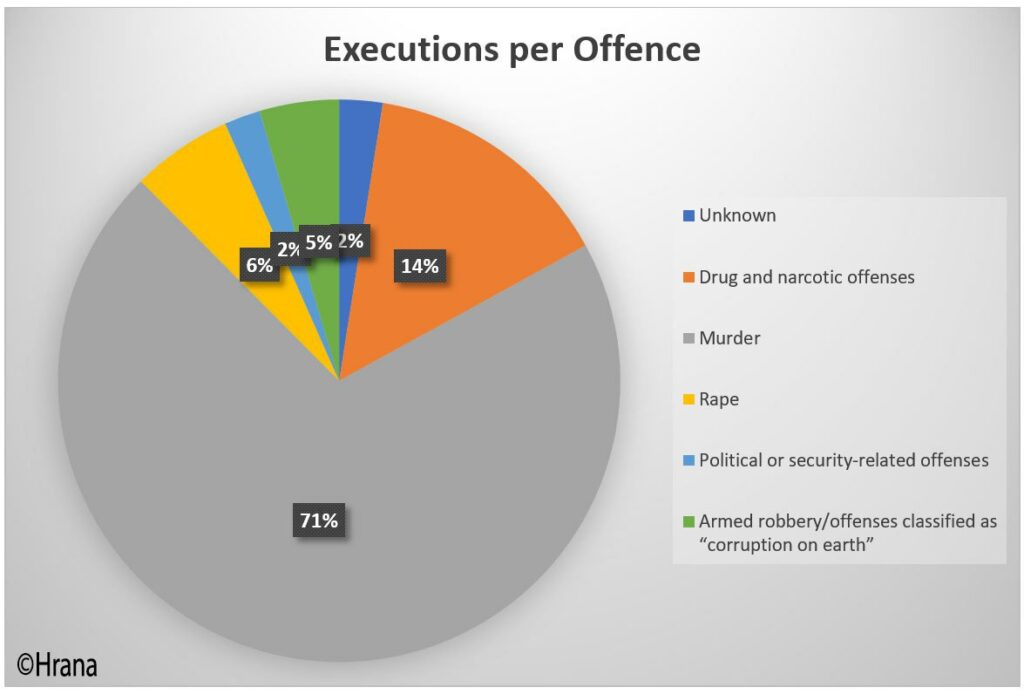
As the chart below shows a breakdown of executions by capital offense: 56.60% for drug and narcotic offenses, 35.05% for murder, 2.58% for rape, 2.28% for unknown reasons, 1.21% for political or security-related offenses, 0.61% for “Corruption on Earth”, 0.61% for spying, terror, and bombing, 0.46% for “Corruption on Earth” (non-political), 0.46% for ideological, political, or religious reasons, 0.15% for Adultery – Types of consensual sexual relations
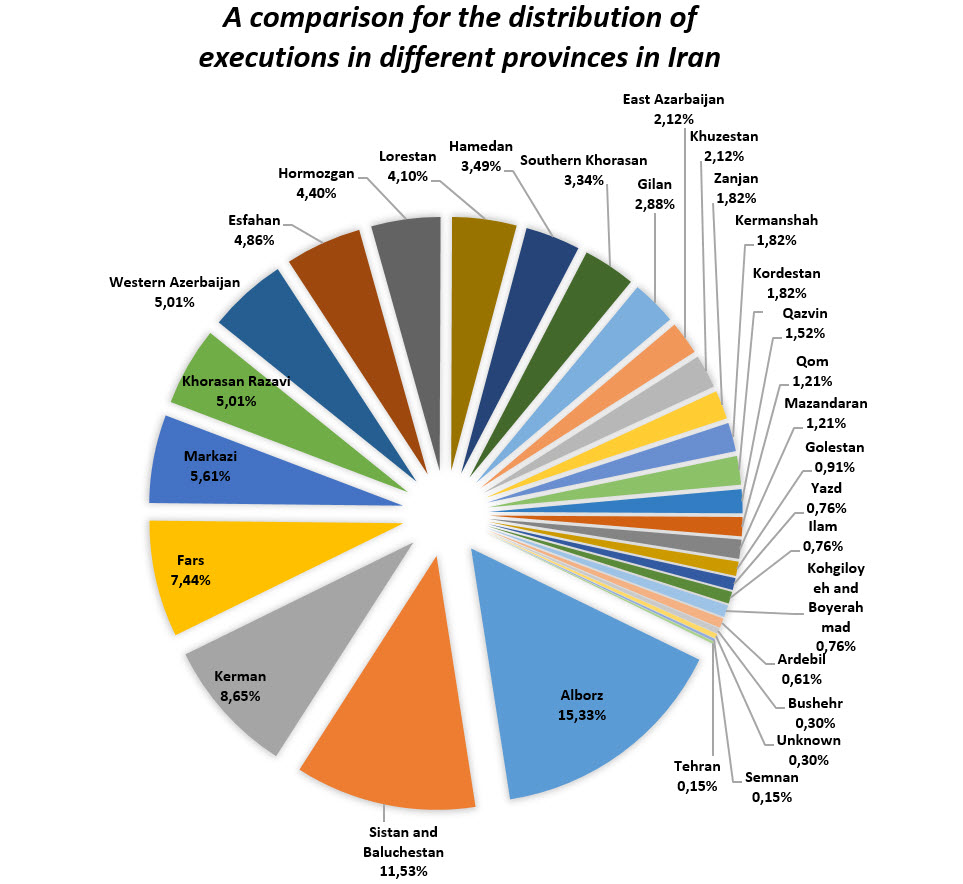
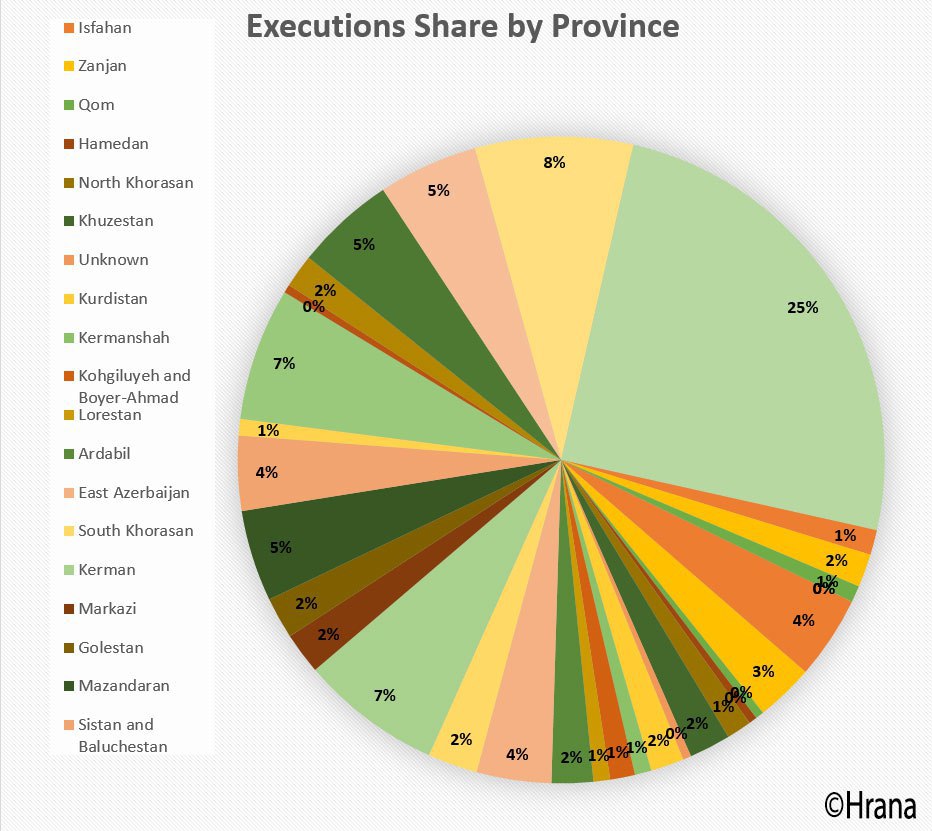
The pie chart below displays execution numbers by the province in which they took place. According to this chart, the Alborz (where three overcrowded prisons are located) had the highest number of executions at 15.33%. Sistan and Baluchestan and Kerman Provinces come second and third, with 11.53% and 8.65%, respectively.
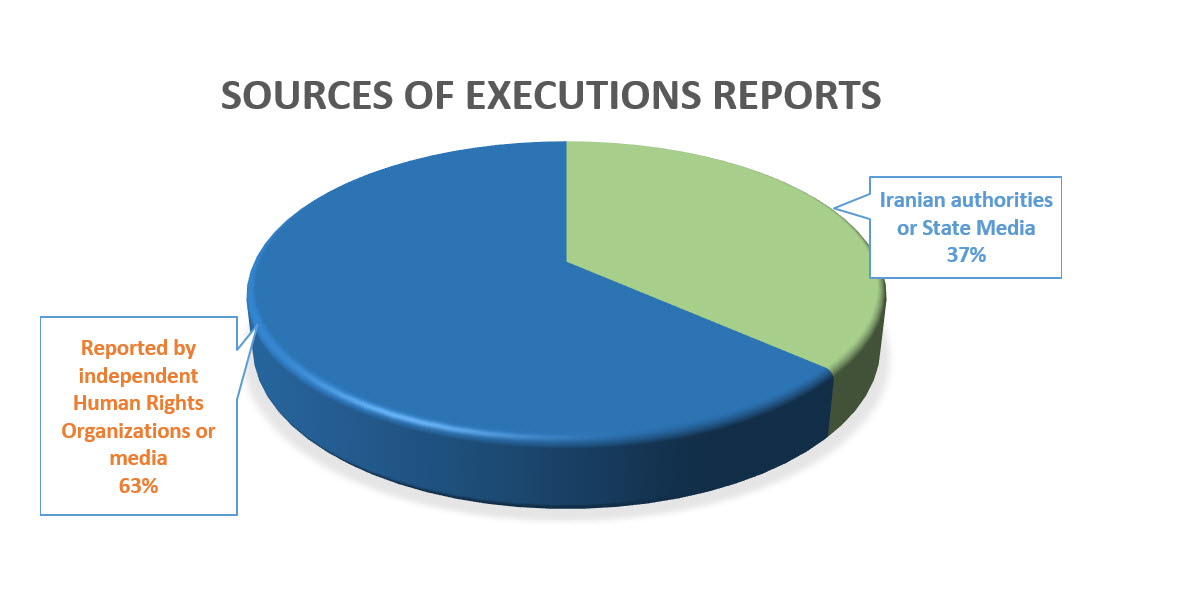
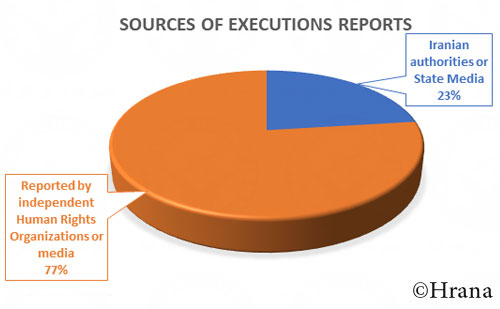
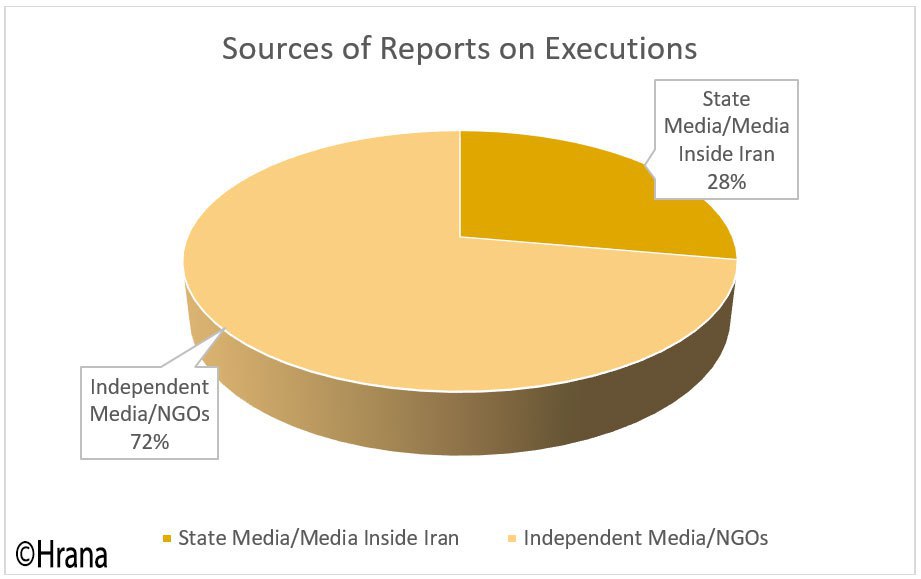
The chart below depicts the distribution of execution information sources. The chart indicates that 63% of HRANA-confirmed executions were not announced by official Iranian sources. Undisclosed executions are referred to as “secret” executions.
The chart down shows the execution numbers by gender.
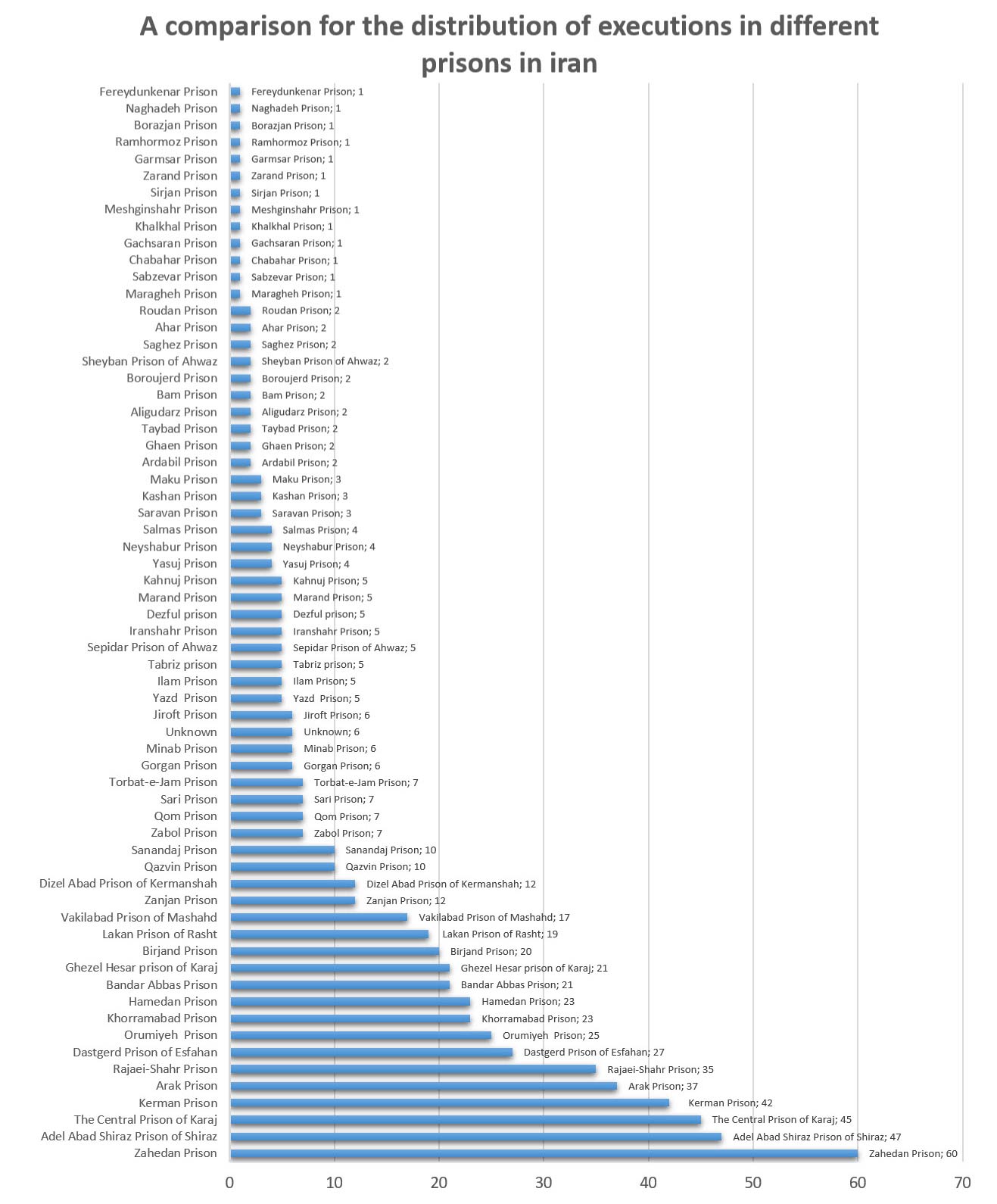
The chart below displays execution numbers by the prison where the executions were carried out. The Zahedan Prison And Adel Abad of Shiraz officials have carried out the highest number.
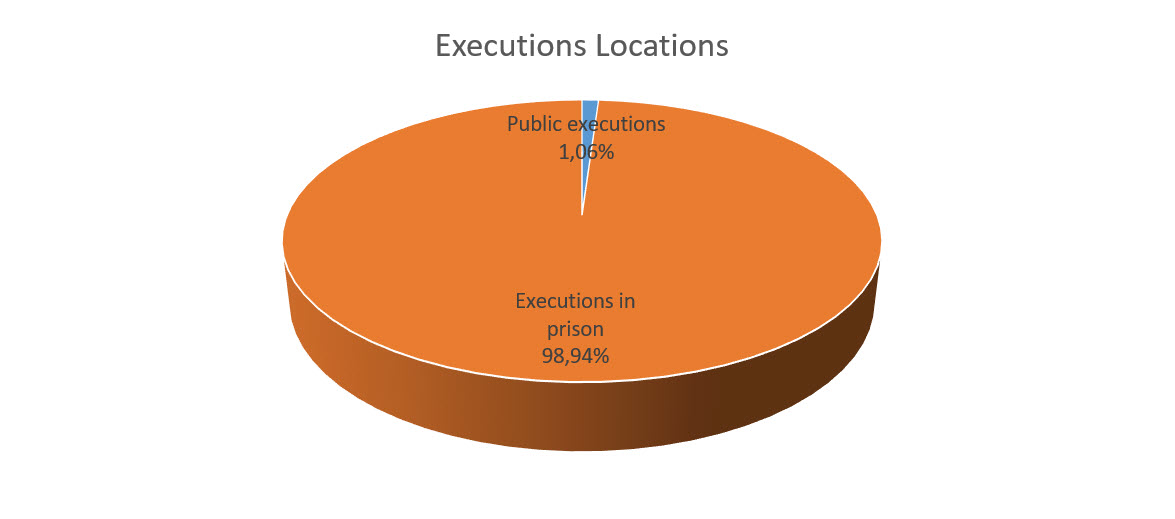
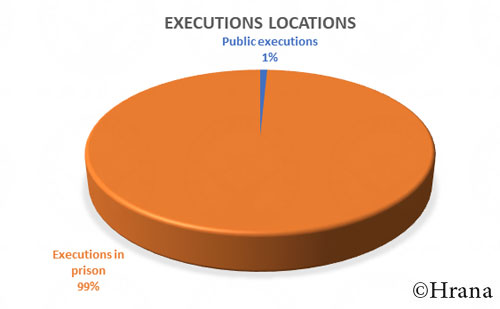
The chart below displays the percentage of executions carried out in public Vs the number of executions that were carried out in prison. According to statistics, 1.06% of the executions in Iran were carried out in public.
This leaflet contains the Annual Analytical and Statistical Report on Human Rights in Iran for the year 2022. The report, prepared by the Department of Statistics and Publications of Human Rights Activists in Iran (HRA), is the result of daily effort on the part of the organization and its members, and as part of a daily statistic and census project that started in 2009 by this organization.
This annual report on human rights violations in Iran is the result of collection, analyzation, and documentation of 13342 reports concerning human rights, gathered from 267 news sources during 2022 [January 1st to December 20th]. 55% of reports analyzed came from sources gathered and reported by Human Rights Activists News Agency (HRANA), while 13% came from official Iranian government sources or sources close to the government. 32% of reports came from other human rights news agencies.
This is the brief version and the full report is available for download in PDF format. Click here
The following 62-pages include statistical overviews and related charts regarding women’s rights, children’s rights, prisoners’ rights, etc. Despite a 128% increase in reports of human rights violations from provinces other than Tehran when compared to last year’s Annual Report, yet data from this year still indicates that smaller cities lack adequate reporting and monitoring of human rights.
This report is the result of the work of courageous human rights activists in Iran who pay a very high cost for striving to enact their humanitarian beliefs. However, for obvious reasons (i.e. existing governmental limitations, bans on the free exchange of information and government interference with the existence of human rights organizations in the country), this report by no means is free of errors and cannot solely reflect the actual status of human rights in Iran. Having said that, it should be emphasized that this report is considered one of the most accurate, comprehensive, and authentic reports on human rights conditions in Iran. It serves as an informative resource for human rights activists and organizations working on Iran who seek to better understand the challenges and opportunities that they may face.
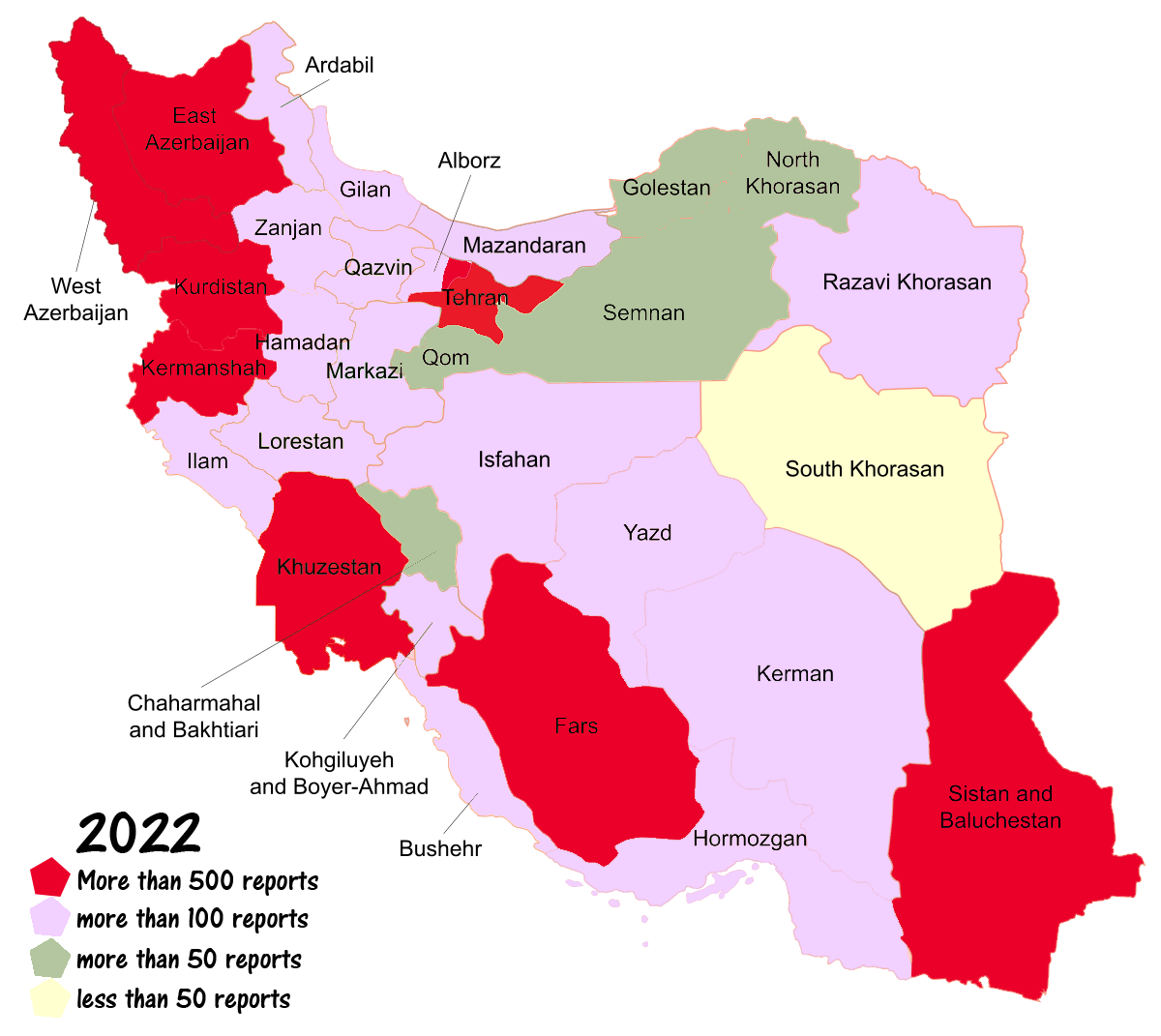
The following map illustrates the number of reports per province made by human rights organizations and news agencies. This is a direct reflection of each province’s civil rights capacities in 2022.
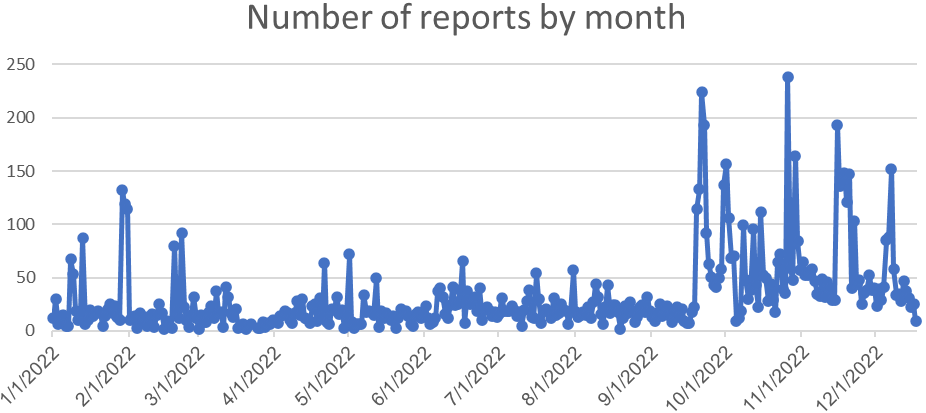
The highest number of reports were published in November, while the lowest number of reports published occurred in April.
55% of reports analyzed came from sources gathered and reported by Human Rights Activists News Agency (HRANA), while 13% came from official Iranian government sources or sources close to the government. 32% of reports came from other human rights news agencies.
In 2022, at least 3046 protests were held across 31 provinces. Of these, 1,289 were union rallies, 266 were workers’ rallies, 149 were rallies related to economic hardship, 1297 were rallies against the suppression of freedom of expression, and were 26 union student demands rallies, 1 gathering in the field of children and 18 gatherings in the field of the environment. In addition to the rallies, there were also 94 labor strikes and 225 union strikes, and 344 non-union strikes as well.
As indicated in the distribution map, there exists a major discrepancy between the capital Tehran, and other parts of the country in terms of the number of published reports. This is while the census of 2021 reported a population of 9,039,000 in Tehran, compared to a population of 75,016,000 in the rest of the country.
Statistics indicate that, the focus or ability to report of the human rights reporters has been 20% in the Tehran and 80% in the other parts of the country.
Categories of human rights violations based on the number of reports in 2022
To study categories of human rights violations in Iran, it is important to initially compare the categories based on the number of reports made in each category in the past year.
ETHNIC RIGHTS
In the field of ethnic and national rights, a total of 205 reports was registered by the Department of Statistics and Publication of Human Rights Activists in Iran (HRA) in 2022. According to these reports, at least 225 people were arrested, 73 of whom were arrested without a legal arrest warrant. It should be noted that, even though the charges against 164 of these detainees remain unknown yet based on other indications and precedent cases they have been considered in this category.
A total of 12 people were sentenced to 751 months in prison, which breaks down to 726 months of imprisonment and 25 months of suspended imprisonment. A total of 68 individuals were summoned by the security and judicial institutions. In addition, 3 people were fined two hundred and seventy million Rials.
In addition, the following reports have been registered; Trial of 8 people in security-judicial institutions, 1 case of travel ban outside the country, 16 cases of beatings, 33 cases of house searches, and 2 cases of carrying out imprisonment sentences.
Compared to the previous year there has been a 49% decrease in the arrest of ethnic minorities and an 80% decrease in prison sentences.
The highest number of violations occurred in the month of July while the lowest occurred in the month of November
RELIGIOUS RIGHTS
In this category, 199 reports have been registered by the Department of Statistics in 2022. These reports include 140 arrests, 102 summons by judicial and security institutions, 64 cases of deprivation from education, and 94 cases of police home raids.
More so, there has been 2 cases of demolition of religious sites, 39 cases of imprisonment, 51 issuances of travel bans (which violate of freedom of movement,) and 11 cases of individuals brought to trial for their religious beliefs.
79 members of religious minorities were sentenced by judicial institutions to a total of 3432 months of imprisonment (1921 months of imprisonment and 11 months of suspended inprisonment) and 888 months of exile. In addition, 23 people were fined three billion five hundred and ninety million Rials, 1 person was sentenced to 74 lashes, and 10 people were deprived of social rights.
The number of citizens arrested in the category of religious minorities has Increase by 145% in 2022 compared to 2021, and the prison sentences issued by the judiciary have Decrease by 2%
The highest number of violations have been reported in August, while the lowest occurred in March.
From the total human rights reports regarding the violation of religious minorities rights, 64.63% belonged to the violation of the rights of Baha’is, while 20.84% of the reports indicated violation of the rights of Christians, 8.84% Yarsanis, 4.63% Sunnis, and 0.63% “Others”, 0.42% Dervishes. Note that reports labeled as “Other” are those that did not belong to a specific group of religious minorities.
FREEDOM OF EXPRESSION
6311 reports of violations against freedom of thought and expression have been registered by the Department of Statistics in 2022. These violations included 22655 individuals arrested, 331 summons to judiciary and security authorities, 2 reports of publications banned, and 12 convictions for publications.
In this category, reports of the 201 trials were published including; 31 travel bans issued, 65 carrying out prison sentences, 34 house searches, 94 internet disruption, 140 beatings, 1297 assembly, 344 strikes.
In 2022, 711 arrestees were sentenced to at least a total of 14,896 months of imprisonment. This breaks down to 9720 months in prison and 376 months of suspended prison terms. It should be noted that 1815 months of this amount have been issued by the Court of Appeal.
Also, 62 people were sentenced to five billion and five hundred and ninety million Rials in fines, 35 people were sentenced to 1,824 lashes and 37 were deprived of social rights. Additionally, 2 people received a total of 99 lashes. Compared to 2021, reports regarding violations of freedom of expression have increased by 2000%, sentences issued by the judiciary have increased by 230% based on the number of people tried, and prison sentences increased by 46%.
TRADE UNIONS AND ASSOCIATIONS
2071 reports were registered by the Department of Statistics and Publications related to the rights of trade unions and other associations, that includes arrest of 309 members of trade unions, 123 summons to judicial and security institutions, trials for 37 individuals were held, 10030 individuals were fired or suspended, at least 124 months of wages were deferred, 3 cases of suicide, and 3834 facilities were shutdown.
Also, 25 people were sentenced to 940 months of imprisonment, of which 696 months are imprisonment and 244 months of suspended imprisonment. In addition, 252 months of this amount have been issued by the Court of Appeal. Additionally, A fine of 40 million Rials and 74 lashes has been issued for 1 person.
In 2022, at least 1289 protests and 225 union strikes were held. There were 43 reported instances of prevention of protest gatherings. Most of these protests were related to salary/wage demands from corporations, bad economic conditions, and lack of proper management of corporations.
In reports related to trade unions and associations compared to the previous year, there has been a 1000% Increase in the number of arrests, an 1150% Increase in sentences issued compared, and a 1300% increase in imprisonment sentences.
The highest number of violations occurred in the month of January while the lowest is in September.
ACADEMIA/ RIGHT TO EDUCATION
The Department of Statistics and Publication of Human Rights Activists in Iran registered 126 reports related to violations of academic rights in 2022. Accordingly, 10 students were arrested, and as mentioned in the religious rights section of this report, 64 students were prevented from continuing their education because of their religion. More so, there has been 5 other cases of hindering of education, and one person was sentenced to 12 months of imprisonment and 74 lashes.
In the category of academia and the right to education, there has been a 233% increase in the number of arrests and a 85% decrease in the issuance of prison sentences compared to the previous year.
For the school students there has been, 61 cases of preventing education, 6 cases of physical punishment, 7 cases of rape and sexual abuse, 2 cases of suicide, and 65 cases of poisoning. In addition, in the last year, at least 780,000 students dropped out of school.
The highest number of violations occurred in the month of August while the lowest instance is observed in the month of February.
RIGHT TO LIFE (DEATH PENALTY)
The Department of Statistics and Publication of Human Rights Activists in Iran registered 457 reports related to the death penalty in 2022. This included 92 death sentences, including the conviction of 6 people to public execution and 565 execution sentences were carried out, 2 of which have been carried out in public. Based on the announced identifications of some of the executed individuals, 501 were male and 11 were female. In addition, 5 juvenile offenders were executed in 2022, meaning they were under the age of 18 at the time they committed the crime.
According to these reports, 48.67% of the executions were based on murder charges, while 42.83% were related to drug-related charges, 2.65% were for sexual offenses, and 2.48% of the charges are unknown, 1.77% were executed on charges of Moharebeh (non-political), 1.06% on security charges (espionage, terror, or bombing), 0.53% on charges of Moharebeh or Baghi (political-security) in Iran.
The highest number of violations occurred in July while the lowest number occurred in April.
The following pie chart illustrates the number of death sentences issued and carried out across the country in 2022. The majority of death sentences were based on murder charges (48.67%), followed by drug charges (42.83%).
The execution of death sentences across Iran’s provinces in 2022, Sistan and Baluchestan province with 18.58% has the highest number of executions, followed by Alborz province which has two of the most populated prisons in Iran with 16.11% of the executions.
Rajai Shahr and Zahedan Prisons carried out the most death sentences.
Of those executed in 2022, 2% were female, and 89% were male, while the gender of the other 9% is unknown.
These executions are reported by independent sources and human rights organizations, indicating that 65% of executions are carried out in secret or without any public notice.
Executions carried out in 2022 compared to 2021 increased by 88%. The number of death sentences issued increased by 8%.
CULTURAL RIGHTS
The Department of Statistics and Publication of Human Rights Activists in Iran registered 17 reports related to violations of cultural rights in 2022. This included reports of 7 arrests, 27 individuals summoned to judicial and security organizations, 4 trials held, 1 house search, 4 cases of obstruction and interference with publications, 1 case of stopping an event and speech, 2 cases of confiscation of property and belongings.
In this category, arrests have increased by 16% compared to the previous year.
In a monthly comparison, the highest number of violations were reported in May, while the highest increase of number of reports were in January, February, September, October, November, and December.
The number of violations of cultural rights in 2022 compared to 2021.
WORKERS’ RIGHTS
The Department of Statistics of Human Rights Activists in Iran registered 1056 reports of violations of workers’ rights in 2022. This included 53 arrests. 36 workers activists or workers were sentenced to 117 months in prison, 510 lashes and 51,000,000 tomans in fines, and 31 people were summoned to judicial and security organizations.
Additionally, 14 cases of trials by judicial authorities, 10 cases of suicide, 5 cases of self-immolation, 1 cases of beatings, 12 cases of house searches, and 5 cases of carrying out imprisonment sentences, have been reported.
During 2022, a total of 1048 months of overdue payment of salaries to workers was reported, 8353 workers were laid off or fired, 9038 people reported unemployment, 1720742 lacked work insurance, 9168 workers were waiting for work-related decisions, and 14 factories were shut down.
In addition, 354 people have lost their lives in work-related accidents, and 1497 workers have been injured while at work. On a global scale amongst other counties, Iran ranks 102nd in work safety.
In a monthly comparison of workers’ rights violations in 2022, the highest number of violations happened January and the lowest in November.
Based on collected reports work accidents in the past year have been 17% due to fires, 16% in constructions, 11% in factories, 10% workers falling from heights, 10% accidents, 9% hard object hitting the victim, 8% falling during excavation and in wells, 5% electrocutions, 5% chocking, 4% in mines, 2% in farming, 1% in petrochemical and refineries, 1% heat strokes, 1% frostbites.
In 2022, there were at least 266 worker protests, with 2 reported of preventing the protests, and 96 workers strike took place. The majority of these protests were regarding wages.
Based on these reports, the arrest of workers has decreased by 17% compared to 2021. However, the issuance of prison sentences has increased by 300% compared to the previous year.
CHILDREN’S RIGHTS
A total of 434 reports of violations of children’s rights in 2022 were registered by the Department of Statistics of Human Rights Activists in Iran. However, it should be mentioned because of secrecy regarding these incidents, leading to underreporting, there is no accurate statistic in this field. Reports included at least 21564 cases of child abuse, 23 cases of rape and sexual abuse, 41 murders of children, 5 self-immolation, 54 cases of child suicide, 1 case of honor killing, and 43268 cases of child laborer.
In addition, there were more than 200,000 instances of child marriage and 5 million students are deprived of primary education. Many students in Iran have been deprived of education due to lack of access to e-learning facilities, as well as child marriages, poverty, cultural issues.
As mentioned in the section on the death penalty, at least 5 juvenile offenders have been executed in 2022.
There are no reliable statistics regarding the arrest of minors during the nation-wide protests, however from arrestees whose identities have been confirmed at least 167 were children.
In the monthly comparison in this category, the highest number of violations were reported in November and the lowest number in February.
WOMEN’S RIGHTS
The Department of Statistics of Human Rights Activists in Iran registered 124 reports of violations of women’s rights in 2022, including; 64 cases of domestic violence, 14 cases of rape and sexual harassment, 32 case of murder, 26 cases of honor killing (including murder of 4 men), 4 self-immolations, 5 cases of acid attacks, 5 cases of suicide, and 1708 cases where women’s rights activists were summoned to judicial and security organizations, 1701 Hijab related cases, 4 cases of imprisonment sentences being carried out and 62 cases of discrimination in social environments.
Based on this report, 322 women have been detained for reasons related to women’s rights. At least 3 women’s rights activists were sentenced to 64 months in prison and a fine of eighty million rials
Based on the number of reports per month, the highest number of reports were in July and the lowest in December.
The number of violations of human rights in the category of women’s rights in 2022 compared to 2021.
PRISONERS’ RIGHTS
The Department of Statistics of Human Rights Activists in Iran registered 1127 reports of violations of prisoner’s rights in 2022 including; 133 physical assault of prisoners, 4322 of deprivation of medical care, 204 of illegal transfer to solitary confinement, 102 of attempted hunger strikes, 166 of forced transportation or exile, 4983 of threats against prisoners, 46 of banning prisoners from having visitors, 652 of psychological and physical torture, 20 prisoners died due to illness, 2 arrestees were killed by prison authorities, and 14 prisoners committed suicide.
There were also 206 cases where prisoners lacked lawyers, 5977 reports of prisoners being held in unsuitable circumstances, 391 cases of forced confessions, 3523 cases of non-segregation of prisoners based on crimes, 2805 cases of denial of sick leave, and 362 cases of denial of having contact with outside the prison.
In this category, there have also been 405 cases of prisoners kept in an unsure state regarding their sentence and 954 cases of lack of adequate information on the prisoner.
The highest number of reports of violations of prisoner’s rights occurred in December and the lowest in March.
SECURITY FORCES’ VIOLENCE AND CITIZENS’ SAFETY
Death of civilians
This section is dedicated to the killing or injury of civilians by police or military institutions. In 2022, a total of 845 people were shot by military forces. At least 571 of the victims lost their life. This includes 22 Kolbar, 9 fuel carriers, and 540 civilians. 274 people were injured by military forces open fire, including 134 Kolbar, 128 civilians, and 12 fuel carriers.
Additionally, 39 Kolbars were affected by climate and geographic factors such as freezing and falling from heights, 34 of whom were injured, and 5 were killed.
Victims of landmines and explosions
The landmines left from the war threaten the lives of civilians living in border cities each year. The Iranian government continues to manufacture and plant anti-personnel mines against international agreements, arguing that the use of these type of landmines is the only effective way to keep its vast borders safe.
Based on reports, at least 5 civilians in the past year have lost their lives to landmines in border areas, while 32 other civilians have been injured.
Floggings
The International Covenant on Civil and Political Rights (ICCPR) has explicitly banned the use of inhuman or degrading punishments such as flogging. However, based on the reports gathered in 2022, flogging sentences were carried out for at least 9 accused, who were sentenced to a total of 317 floggings.
It should be noted that the judiciary issued at least a total of 12512 flogging sentences in the past year.
Intervention in personal affairs of civilians
In 2022, at least 64 civilians were arrested for attending or hosting personal gatherings and parties.
Victims of credit-financial and investment institutions
In 2022, at least 149 groups of civilians –mostly consisting of those who have lost money due to poor economic conditions, or those whose rights have been violated– have organized protests. These protests took place in 24 provinces. The provinces with the most protests were Tehran, Eastern Azerbaijan, Khuzestan, and Khorasan Razavi.
The highest number of reports related to violence from security forces and citizens’ safety occurred in September and the lowest was in December.
The number of Military violence in 2022 in comparison with 2021
SENTENCES
The judiciary of the Iranian government, including both in initial trial and appeal, issued 17872 months of imprisonment in 2022. These reports included 751 months of imprisonment for ethnic minorities, 3432 months of imprisonment for religious minorities, 14896 months of imprisonment related to freedom of expression, 940 months of imprisonment related to union activity, 117 months of imprisonment for workers, 64 months of imprisonment in women’ rights category, 12 months of imprisonment for students, and 2460 months in prison for Environmental activists were sentenced. Also, these citizens were sentenced to one billion and eleven million Toman in fines and 12512 lashes.
These statistics only include the court sentences that indicated detailed information or characteristics of the verdicts.
The highest number of reports was in December and the lowest in July.
In 2022, the number of convictions of citizens and activists increase by 37%. However, the convictions in the following categories decreased: Religious Minorities by 2%, Ethnic Minorities by 80%, Women’s Rights by 25% and Students by 85%.
The following categories saw an increase in convictions: Freedom of Expression by 230%, Unions by 1150% and, Workers by 300%.
ARRESTS
In 2022, security forces arrested 23977 individuals due to political or civil rights-related activities.
The statistical analysis exhibited 309 cases of arrest in the trade union category, 225 arrests in the category of ethnic minorities, 140 arrests in the category of religious minorities, 22655 arrests in the category of freedom of expression, 167 arrests related to children’s rights, 10 arrests of university students, 7 arrests in the field of cultural rights, 53 arrests in the category of workers’ rights, and 23 arrests in the field of Environment.
324 women were prosecuted for their activities, including the promotion of their desired lifestyle. Also, 64 citizens have been arrested for organizing or participating in a private party.
Based on the number of reports per month, the highest number of reports in this category fell in October and the lowest in March.
In 2022, the number of arrests increased by 1330% in total. Broken into categories, the number of arrests decreased in the Ethnic Minority category by 49%, in Cultural rights increased by 16%, Religious minorities increased by 145%, Unions increased by 1000%, Students increased by 233%, Workers’ Rights decreased by 17%, and Freedom of Expression increased by 2000%.
SEXUAL AND GENDER MINORITIES
The rights of sexual and gender minorities have been analyzed in this Annual Report of Human Rights Activists in Iran as a subset of other categories. The main reason for this is that the small handful of reports in this regard do not allow analysis.
Creating an independent categorization, even with a small number of reports, is in fact an attempt to increase surveillance of this group.
The rights of sexual and gender minorities in the country are systematically violated in various ways. The criminalization of homosexuality and the non-recognition of transgender identity before gender reassignment procedures are two of many systematic violations that are codified into domestic law.
There are many obstacles in reporting on this topic, including open hatred against members of the community, cultural taboos, legal barriers, and the weakness of Iranian civil rights organizations in monitoring and reporting violations. The government’s policy in dealing with sexual minority issues in Iran exacerbates the vulnerability of these groups.
Among the few reports published in this area, we can mention 2 cases of assaults and 1 case of suicide, that have directly been linked to the sexual orientation of the victim.
In some cases, security and law enforcement agencies acknowledge the detention and harassment of members of this community. For example, in June of this year, Reza Molouki, head of the FATA police in the east of Tehran Province announced the identification and arrest of a citizen on charges of “corruption on earth”, calling his relationship with a homosexual illegitimate.
Trans citizens face legal problems in addition to cultural issues in the process of changing their identity documents or seeking exemption from conscription. In one report, a citizen living in Tehran, after obtaining a military exemption due to their gender identity, lost their employment and was unable to renew their license as an expert of the Food and Drug Administration.
In 2019, the World Health Organization updated its guidelines on disorders related to sexuality and gender identity in the ICD-11. In doing so, transgender identity was no longer recognized as a “disorder” by the WHO.
This is the brief version and the full report is available for downloadin PDF format.
_________________________
For further inquiries please contact Skylar Thompson, Senior Advocacy Coordinator Human Rights Activists in Iran (HRA) at [email protected]
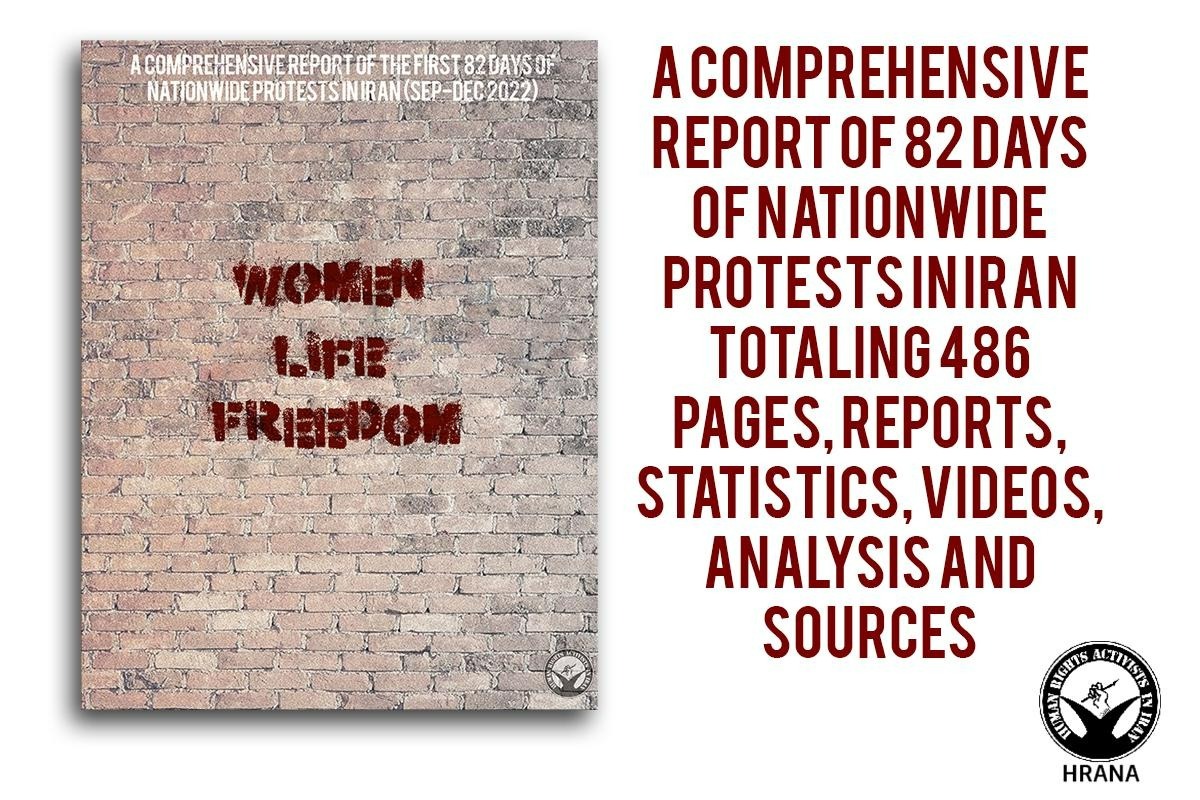
HRANA – Mahsa Amini, a 22-year-old young woman, was arrested by the morality police for the crime of improper hijab. Her arrest and death in detention fueled nationwide protests in Iran. Protesters came to the streets with the central slogan “Women, Life, Freedom” in protest against the performance, laws, and structure of the regime. The following 486-page report is dedicated to the statistical review, analysis, and summary of the first eighty-two days of the ongoing protests (September 17 to December 7, 2022). In this report, in addition to the geographic analysis and the presentation of maps and charts, the identity of 481 deceased, including 68 children and teenagers, an estimated of 18,242 arrested along with the identity of 3,670 arrested citizens, 605 students and 61 journalists or activists in the field of information is compiled. In addition, the report includes a complete collection of 1988 verified video reports by date and topic. The report examines protests across 1115 documented gatherings in all 31 provinces of the country, including 160 cities and 143 universities.
Summary
Mahsa (Zhina) Amini, a young 22-year-old woman from Saqqez, Kurdistan was visiting Tehran, when she was taken into custody on Tuesday, September 13, 2022, by the Morality Police officers at the Haqqani metro station in Tehran. The reason for her arrest: not properly observing the strict Islamic dress code. Mahsa/Zhina was taken to the infamous detention center of Moral Security Police known as Vozara.
Shortly after Mahsa’s arrest, she went into a coma with level three concussion, and her partially alive body was transferred to the intensive care unit of Kasra Hospital. Given the track record of the police and Guidance Patrols in mistreating the arrestees and similar previous incidents, with the believe that Mahsa was beaten during the arrest people were outraged.
Download full report in PDF format
Unpersuasive explanations given by the Central Command of the Islamic Republic Police Force (FARAJA) in defense of its actions regarding the death of Mahsa, the past performance of the police force, along with widespread dissatisfaction with the existence of a body called the Moral Security Police, fueled widespread protests in Iran.
The widespread protests sparked at the time Mahsa Amini was announced dead in front of Kasra Hospital on Argentina Street in Tehran, and then quickly spread to the streets despite the intimidating presence of Iran’s security forces. The protests intensified after Mahsa’s burial in a Saqqez cemetery. To the extent that after eighty-two days of nationwide protests between September 17, 2022, to December 7, 2022, they have spread to Iran’s all 31 provinces, 160 cities, and 143 major universities.
The protests did not stay limited to Mahsa’s death, it rather, quickly targeted the Iranian government’s political and ideological foundations. These protests were violently quashed by the anti-riot police and Iran’s militia force (Basij). teargas, pellets, and live ammunition were used in the repression of protestors. This widespread crackdown has led to the death of dozens of people and the wounding of hundreds of protestors.
Despite sever communication restrictions imposed by the Islamic Republic, this report attempts to give a clearer picture of the first 82 days of the protests between September 17, to December 7, 2022. It’s worth mentioning at the time of this report the protests are still ongoing in various forms.
Human Rights Activists News Agency (HRANA)- On the World Day against the Death Penalty, the Center of Statistics of Human Rights Activists in Iran (HRA) has published its annual report in an effort to sensitize the public about the death penalty situation in Iran, particularly thousands of death-row convicts awaiting their looming executions.
HRA’s Statistics Center relies on the work of HRANA reporters, as well as a network of independent and verifiable sources. It also incorporates the judicial authorities’ announcements or confirmations of prisoner executions on media, and as such, is exposed to a margin of error representing efforts by the Iranian authorities to omit, conceal, or restrict the collection of such data.
Between October 10, 2021, and October 7, 2022, at least 528 convicts were executed by hanging in Iran, rising to 98% compared to the same period last year. Of these executions, one was carried out in public. Many of the defendants were denied a fair trial and due process.
Click here to download report in PDF format
HRANA obtained 439 reports regarding executions and death penalty in Iran during this period. The identified executed individuals, include 20 women and 6 juvenile offenders under the age of 18 at the time of alleged crime. Compared to the last period, the execution of female offenders has raised 55%.
According to the reports obtained by HRANA, over this period, Iranian authorities sentenced at least 89 defendants to death penalty, including at least 5 women, and 7 public executions. Issuing death sentence decreased by 1% compared to the last year.
As the chart below shows a breakdown of executions by capital offense: 50.38% were charged with murder, 41.29% with drug and narcotic offenses, 3.03% with rape, 1.70% with non-political armed robbery/offenses classified as “corruption on earth,” and 0.38% with political or security-related offenses. Moreover, 0.38% were convicted of security charges (spying, terror, and bombing), 0.38% were convicted of armed robbery, and 2.46% of charges are unknown.
The pie chart below displays execution numbers by the province in which they took place. According to this chart, the Sistan and Baluchestan Province had the highest number of executions at 16%. Alborz (where three overcrowded prisons are located) and Fars Provinces come second and third, with 16.48% and 11.93%, respectively.
The chart below depicts the distribution of executions’ information sources. The chart indicates that 70% of HRANA-confirmed executions were not announced by the official Iranian sources. Undisclosed executions are referred to as “secret” executions.
The chart above shows the execution numbers by gender.
The pie chart below displays execution numbers by the prison where the executions were carried out. The Rajai-Shahr Prison officials have carried out the highest number of executions with 14.42%. Zahedan Prison ranks second with 12,33% executions.
The chart below displays percentage of executions carried out in public Vs. the number of executions that were carried out in prison. According to statistics, 0.19% of the executions in Iran were carried out in public.
This leaflet contains the Annual Analytical and Statistical Report on Human Rights in Iran for the year 2021. The report, prepared by the Department of Statistics and Publications of Human Rights Activists in Iran (HRA), is the result of daily effort on the part of the organization and its members, and as part of a daily statistic and census project that was started by this organization in 2009.
This annual report on human rights violations in Iran collects, analyzes, and documents 5683 reports concerning human rights, gathered from various news sources during 2021 [January 1st to December 20th]. 38% of reports analyzed came from sources gathered and reported by Human Rights Activists News Agency (HRANA), while 38% came from official Iranian government sources or sources close to the government. 24% of reports came from other human rights news agencies.
This is the brief version and the full report is available for download in PDF format. Click here
The following 53-pages include statistical overviews and related charts regarding women’s rights, children’s rights, prisoners’ rights, etc. Despite the 1.5% increase in reports of human rights violations in provinces other than Tehran from last year’s Annual Report, data from this year indicates that smaller cities lack adequate reporting and monitoring of human rights.
This report is the result the work of courageous human rights activists in Iran who pay a very high cost for as they strive to enact their humanitarian beliefs. However, for obvious reasons (i.e. existing governmental limitations, bans on the free exchange of information and government interference with the existence of human rights organizations in the country), this report by no means is free of errors and cannot solely reflect the actual status of human rights in Iran. Having said that, it should be emphasized that this report is considered one of the most accurate, comprehensive, and authentic reports on human rights conditions in Iran. It serves as a very informative resource for human rights activists and organizations working on Iran who seek to better understand the challenges and opportunities that they may face.
MONITORING
The following map illustrates the number of reports per province made by human rights organizations and news agencies. This is a direct reflection of each province’s current capacity for civil rights (2021).
The highest number of reports were published in December, while the lowest number of reports published occurred in April.
38% of reports analyzed came from sources gathered and reported by Human Rights Activists News Agency (HRANA), while 38% came from official Iranian government sources or sources close to the government. 24% of reports came from other human rights news agencies.
In 2021, at least 2,300 protest rallies were held across 24 provinces. Of these, 1,261 were union rallies, 618 were workers’ rallies, 301 were rallies related to economic hardship, 77 were rallies against the suppression of freedom of expression, and 43 were student rallies. In addition to the rallies, there were also 339 labor strikes and 192 union strikes.
As indicated in the distribution map, there exists a major discrepancy between the capital Tehran, and other parts of the country in terms of the number of published reports. This is while the census of 2016 reported a population of 13,267,637 in Tehran, compared to a population of 66,658,633 in the rest of the country.
ETHNIC MINORITIES
In the field of violations of rights for national and ethnic minorities, a total of 390 reports were registered by the Department of Statistics and Publication of Human Rights Activists in Iran (HRA) in 2021. According to these reports, at least 445 people were arrested. It should be noted that the charges against 409 of these detainees remain unknown.
A total of 61 people were sentenced to 1348 months in prison, which breaks down to 1171 months of imprisonment and 177 months of suspended imprisonment. A total of 103 individuals were summoned by the security and judicial institutions.
Compared to the previous year there has been a 55% increase in the arrest of ethnic minorities and a 21% decrease in prison sentences.
As the following bar graph illustrates, the highest number of violations occurred in the month of January while the lowest occurred in the month of December.
RELIGIOUS MINORITIES
In this category, 144 reports have been registered by the Department of Statistics in 2021. These reports include 57 arrests, 11 cases where religious minorities were prevented from economic activities, 39 summons by judicial and security institutions, 24 cases of deprivation from education, and 60 cases of police home raids.
Judicial authorities have registered 2 cases of desecration, 4 cases of imprisonment, 5 issuances of travel bans (which violate of freedom of movement,) and 6 cases of individuals brought to trial on the basis of religious belief.
81 members of religious minorities were sentenced by judicial institutions to a total of 4174 months of imprisonment. In addition, 4 people were fined one hundred and eighty million tomans (42840 USD), 1 person was sentenced to 74 lashes, and 10 people were deprived of social rights.
The number of citizens arrested in the category of religious minorities has decreased by 25% in 2021 compared to 2020, and the prison sentences issued by the judiciary have decreased by 17%
The highest number of violations have been reported in April, while the lowest occurred in December.
71.77% of human rights reports regarding violations against religious minorities related to violations against Baha’is, 14.29% to Christians, 7.48% to Sunnis 2.04% to Yarsans 1.02% to Dervishes, 0.34% to Jews, and 3.06% to “Others”. Note that reports labeled as “Other” are those that did not belong to a specific group of religious minorities.
FREEDOM OF EXPRESSION
674 reports of violations against freedom of thought and expression have been registered by the Department of Statistics this year. These violations included 1043 individual arrests, 256 summons to judiciary and security authorities, 2 reports of publications banned, and 21 convictions for publications.
111 cases were tried by judicial authorities. 17 cases involved the issuance of travel bans, 64 involved execution of prison sentences, 34 involved house searches, 17 involved internet disruption, 2 involved telecommunication disruptions, 39 involved beatings, 44 involved harassment in the form of threats and intimidation, 77 involved assembly, and 26 involved preventing assembly.
In 2021, 215 arrestees were sentenced to a total of 10140 months of imprisonment. This breaks down to 9541 months in prison and 599 months of suspended prison terms.
Additionally, 24 people were fined a total of 603,575,000 tomans (143,650.85 USD), 16 people were sentenced to a total 998 lashes, and there were 22 cases of deprivation from civil rights.
Compared to 2020, reports regarding violations of freedom of expression have increased by 12%, sentences issued by the judiciary have decreased by 48% based on the number of people tried, and prison sentences decreased by 54%.
Below are charts highlighting violations of the right to freedom of expression.
TRADE UNIONS AND ASSOCIATIONS
1173 reports were registered by the Department of Statistics and Publications related to the rights of trade unions and other associations. 26 members of trade unions were arrested, and 2 individuals were sentenced to a total of 67 months in prison. There were 8 summons to judicial and security institutions, and 23 cases where facilities were closed.
Also reported were instances where 3 people were fined a total 23,500,000 tomans (5593 USD), 3 people received a total of 74 lashes, as well as 2 cases of suicide, 4 cases of houses searched and 5 cases of harassment in the form of beatings. 4 cases were tried by judicial authorities, 405 cases were dismissed, with 147 months of deferral.
In 2021, at least 1261 protests and 192 union strikes were held. There were 4 reported instances of suppression of assembly. Most of these protests were related to salary/wage demands from corporations, bad economic conditions, and lack of proper management of corporations.
It should be noted that due to the compulsory military service for men in Iran and its classification as a job in the annual budget of the country, this group was also examined. In the past year, at least 4 soldiers committed suicide. Various reasons for this are cited, including conscription itself, the high pressure military environment, forced labor, and denial of human dignity.
In reports related to trade unions and associations there has been a 44% decrease in the number of arrests and an 87% decrease in sentences issued compared to the previous year.
ACADEMIA/ RIGHT TO EDUCATION
The Department of Statistics and Publication of Human Rights Activists in Iran registered 56 reports related to violations of academic rights in 2021. 3 students were arrested, and as, as mentioned in the religious rights section of this report, 24 students were prevented from continuing their education because of their religion.
In the category of academia and the right to education, there has been a 50% decrease in the number of arrests. Per our reports, 7 students were sentenced to 160 months in prison and 74 lashes.
Monthly comparisons of the violation of academic rights based on the number of reports, as the following graph illustrates, reveals the highest number of violations occurred in the month of September while the lowest instance is observed in the month of March.
RIGHT TO LIFE (DEATH PENALTY)
288 reports related to the death penalty were have been registered by the Department of Statistics and Publication of Human Rights Activists Association in Iran in 2021. This included 85 death sentences and 299 executions. Based on the announced identifications of some of the individuals executed, 259 were male and 15 were female.
In addition, 4 juvenile offenders were executed in 2021, meaning they were under the age of 18 at the time they committed the crime.
According to these reports, 51% of the executions were based on murder charges, while 40% were related to drug-related charges. 4% of individuals executed were charged with “waging war against God” and 3% were charged with rape. For 2% of executions the charges were unknown.
Of those executed in 2021, 5% were female, and 87% were male, while the gender of the other 8% is unknown.
Executions carried out in 2021 compared to 2020 increased by 26%. The number of death sentences issued decreased by 10%.
CULTURAL RIGHTS
23 reports were registered by the Department of Statistics and Publication of Human Rights Activists Association in Iran related to violations of cultural rights in 2021. This included reports of 6 arrests, as well as the report that 2 individuals were sentenced to 84 months of imprisonment. 7 individuals were summoned to judicial and security organizations. 1 license was revoked and 1 person was banned from working.There were also 4 trials by judicial authorities, 1 house search, 4 cases of obstruction and interference with publications, and 1 case of the destruction of a historical site.
In this category, arrests have decreased by 77% compared to the previous year.
In a monthly comparison, the highest number of violations were reported in May, while the lowest were reported in April, October, and December.
WORKERS’ RIGHTS
The Department of Statistics of Human Rights Activists Association in Iran registered 1474 reports of violations of workers’ rights in 2021. This included 64 arrests. 9 workers activists or workers were sentenced to 276 months in prison, 124 lashes and 23,000,000 tomans (5474 USD) in fines. 42 people were summoned to judicial and security organizations.
The Department also registered 7 cases of trials by judicial authorities, 10 cases of suicide, 7 cases of self-immolation, 9 cases of beatings, 3 cases of house searches, 2 cases of curfew imposition, and 2 cases of imprisonment.
During 2021, a total of 1247 months of overdue payment of salaries to workers was reported. 2073 workers were laid off or fired, 3332 people reported unemployment, 6404884 lacked work insurance, 5434 workers were waiting for work-related decisions. There were also a reported 68 factory closures.
In addition, 616 people have lost their lives in work-related accidents, and 5584 workers have been injured while at work. On a global scale amongst other counties, Iran ranks 102nd in work safety.
In a monthly comparison of workers’ rights violations in 2021, the highest number of violations happened May, with the lowest in December.
In 2021, there were at least 618 worker protests, with 9 reported instances of suppression in this regard, and 339 workers strike took place. The majority of these protests were regarding wages. Based on these reports the arrest of workers has increased by 53% compared to 2020.
CHILDREN’S RIGHTS
A total of 186 reports of violations of children’s rights in 2021 were registered by the Department of Statistics. However, it should be mentioned because of secrecy regarding these incidents, leading to underreporting, there is no accurate statistic in this field. Reports included at least 2117 cases of child abuse, 15 cases of rape and sexual abuse of children, 11 murders of children, 1 self-immolation, 54 cases of child suicide, 1 case of honor killing, 2 cases of acid attacks, 29 cases of sale and trafficking of children and 1448 cases of child abuse in economic activity. In addition, there were more than 9000 instances of child marriage.
3 million students are deprived of the right to education.
Many students in Iran have been denied access to education due to lack of access to e-learning facilities, as well as child marriages, poverty, cultural issues.
As mentioned in the section on the death penalty, at least 4 minors were executed for various offenses during 2021.
During the nation-wide protests, 25 children were arrested.
In monthly comparison in this category, the highest number of violations were reported in January and the lowest number in August.
WOMEN’S RIGHTS
The Department of Statistics Registered 90 reports of violations of women’s rights in 2021. At least 43 women reported physical and sexual abuse. There were also 24 cases of honor-killings, 8 self-immolations, 3 cases of acid attacks, and 4 cases where women’s rights activists were summoned to judicial and security organizations. In addition, there were 20,187 cases of domestic abuse against women and 13 murders.
Based on this report, 7 women have been detained for reasons related to women’s rights. At least 4 women’s rights activists were sentenced to 282 months in prison.
As the following bar graph illustrates, based on the number of reports per month, the highest number of reports were in November and the lowest in April and May.
PRISONERS’ RIGHTS
575 reports of violations of prisoner’s rights were registered in 2021. 26 of these reports were of physical assault of prisoners, 232 of deprivation of medical care, 136 of illegal transfer to solitary confinement, 131 of attempted hunger strikes, 77 of forced transportation or exile, 246 of threats against prisoners, 26 of banning prisoners from having visitors, 23 of torture, 20 of deaths by diseases. 5 arrestees were killed by prison authorities and 5 prisoners committed suicide. There were also 68 cases where prisoners lacked lawyers, 495 reports of prisoners being held in unsuitable circumstances, and 1 case of self-immolation.
In this category, there have also been 272 cases of prisoners kept in an unsure state regarding their sentence and 172 cases of keeping prisoner in conditions of indecision.
As the following bar graph illustrates, the highest number of reports of violations of prisoner’s rights occurred in June and September and lowest in November.
SECURITY FORCES’ VIOLENCE AND CITIZENS’ SAFETY
Death of civilians
This section is dedicated to the killing or injury of civilians by police or military institutions. In 2021, a total of 242 people were shot by military forces. 94 of the victims lost their life. This includes 23 kolbar, 31 fuel carriers and 40 civilians. 148 people were injured by military fire, including 81 kolbar, 51 civilians, and 16 fuel carriers.
Additionally, 28 kolbar were affected by climate and geographic factors such as freezing and falling from heights. 16 of these kolbar were injured and 12 were killed.
Victims of landmines and explosions
The landmines left from the war threaten the lives of civilians living in border cities each year. The Iranian government continues to manufacture and plant anti-personnel mines against international agreements, arguing that the use of these type of landmines is the only effective way to keep its vast borders safe.
Based on reports, at least 15 civilians in the past year have lost their lives to landmines in border areas, while 30 other civilians have been injured.
Floggings
The International Covenant on Civil and Political Rights (ICCPR) has explicitly banned the use of inhuman or degrading punishments such as flogging. However, based on the reports gathered in 2021, flogging sentences were carried out for at least 3 accused. These accused were sentenced to a total of 214 floggings.
It should be noted that the judiciary issued a total of 6982 flogging sentences in the past year.
Intervention in personal affairs of civilians
In 2021, at least 68 civilians were arrested for attending or hosting personal gatherings and parties. This number is based on 5 official reports in the country.
In 2021, at least 301 groups of civilians –mostly consisting of those who have lost money due to poor economic conditions, or those whose rights have been violated– have organized protests. These protests took place in 24 provinces. The provinces with the most protests were Tehran, Eastern Azerbaijan, Khuzestan, and Khorasan Razavi.
As the following bar graph illustrates, the highest number of reports related to violence from security forces and citizens’ safety occurred in January and the lowest in August.
SENTENCES
The judiciary of the Iranian government, including both in initial trial and appeal, issued 16531 months of imprisonment in 2021. These reports included 1348 months of imprisonment for ethnic minorities, 4174 months of imprisonment for religious minorities, 10140 months of imprisonment related to freedom of expression, 67 months of imprisonment related to union activity, 276 months of imprisonment for workers, 84 months of imprisonment related to cultural rights, 282 months of imprisonment in women’ rights category, and 160 months of imprisonment for students.
These statistics only include the court sentences that indicated detailed information or characteristics of the verdicts.
As the following bar graph illustrates, the highest number of reports was in January and the lowest in September.
Courts sentenced defendants to a total of 787,875,000 tomans (187,514.25 USD) in fines and 2900 lashes in 2021.
In 2021, the number of convictions of citizens and activists decreased by 44%. Moreover, the convictions in the following categories decreased: Religious Minorities by 4%, Ethnic Minorities by 25%, Freedom of Expression by 54%, Unions by 87%, and Cultural Rights by 67%. The following categories saw an increase in convictions: Workers by 50%, Women’s Rights by 56%, and Students by 62%.
ARRESTS
In 2021, security forces arrested 1676 individuals due to political or civil rights-related activities.
The statistical analysis exhibited 26 case of arrest in the trade union category, 445 arrests in the category of ethnic minorities, 57 arrests in the category of religious minorities, 1043 arrests in the category of freedom of expression, 25 arrests related to children’s rights, 3 arrests of students related to the right to education, 6 arrests in the field of cultural rights, and 64 arrests in the category of workers’ rights.
6 women were prosecuted for their activities, including the promotion of their desired lifestyle. 5 of these women were arrested for modeling, and 1 for activism in this area.
As the following bar graph illustrates, based on the number of reports per month, the highest number of reports in this category fell in November and the lowest in December.
In 2021, the number of arrests increased by 14% in total. Broken into categories, the number of arrests increased in the Ethnic Minority category by 55%, Culture decreased by 77%, Religious minorities decreased by 25%, Unions decreased by 44%, Students decreased by 50%, Workers’ Rights increased by 53%, and Freedom of Expression increased by 12%.
SEXUAL AND GENDER MINORITIES
The rights of sexual and gender minorities have previously been analyzed in the Annual Report of Human Rights Activists in Iran as a subset of other categories. The main reason for this was that the small handful of reports in the area did not allow analysis.
Creating an independent categorization, even with a small number of reports, is in fact an attempt to increase surveillance of this group.
The rights of sexual and gender minorities in the country are systematically violated in various ways. The criminalization of homosexuality and the non-recognition of transgender identity before gender reassignment procedures are two of many systematic violations that can seen codified into domestic law.
There are many obstacles in reporting on this topic, including open hatred against members of the community, cultural taboos, legal barriers, and the weakness of Iranian civil rights organizations in monitoring and reporting violations. The government’s policy in dealing with sexual minority issues in Iran exacerbates the vulnerability of these groups.
Of the few reports published in this area, it should be noted that HRANA reported 15 prisoners with uncertain judicial status accused of having homosexual relationships in Wards 2 and 10 of Rajai Shahr Prison in Karaj.
The detention of these citizens was directly related to having a homosexual relationship.
In some cases, security and law enforcement agencies acknowledge the detention and harassment of members of this community. For example, in June of this year, Reza Molouki, head of the FATA police in the east of Tehran Province announced the identification and arrest of a citizen on charges of “corruption on earth”, calling his relationship with a homosexual illegitimate.
Trans citizens face legal problems in addition to cultural issues in the process of changing their identity documents or seeking exemption from conscription. In another report, a citizen living in Tehran, after obtaining a military exemption due to his gender identity, lost his employment and was unable to renew his license as an expert of the Food and Drug Administration.
In 2019, the World Health Organization updated its guidelines on disorders related to sexuality and gender identity in the ICD-11. In doing so, transgender identity was no longer recognized as a “disorder” by the WHO.
This is the brief version and the full report is available for download in PDF format.
_________________________
For further inquiries please contact Skylar Thompson, Senior Advocacy Coordinator Human Rights Activists in Iran (HRA) at [email protected]
On the World Day Against the Death Penalty, the Center of Statistics of Human Rights Activists in Iran (HRAI) has published its annual report , in efforts to sensitize the public about the situation of the death penalty in Iran.
HRANA’s Statistics Center relies on the work of HRANA reporters, as well as a network of independent and verifiable sources. It also incorporates disclosures to the media by judicial authorities announcing or confirming prisoner executions, and as such is exposed to a margin of error representing efforts by the Iranian authorities to omit, conceal, or restrict the collection of such data.
Between October 8, 2020, and October 9, 2021, executions and the death penalty have been the focus of 253 HRANA reports. Over this time period, the Iranian authorities issued the death penalty sentence to 90 individuals and have already carried out 266 executions.
Women account for only 9 of the 266 HRANA-confirmed execution victims this year. In addition, 3 juvenile offenders, under the age of 18 when they allegedly committed the crime they were charged with, were executed.
The report includes a breakdown of executions by capital offense: 55.8% were charged with murder, 33.5% were charged with drug and narcotic offenses, 3.4% were charged with Rape, 4.8% were charged with armed robbery/offenses classified as “corruption on earth”, 1.5% were charged with political or security-related offenses, and 0.74% had unknown charges.
The chart below displays execution numbers by the province in which they took place. According to this chart, Khorasan Razavi had the highest number of executions at 17.7%. Alborz and Sistan and Baluchestan came in second and third, with 13.2% and 9.4% respectively.
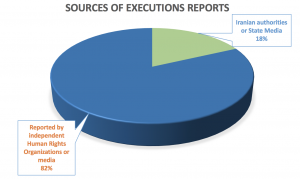
The chart below depicts the distribution of executions’ information sources. The chart indicates that 82% of HRANA-confirmed executions were not announced by the official Iranian sources. Undisclosed executions are referred to as “secret” executions.
This report contains the 2020’s analytical and statistical annual report on human rights in Iran, prepared by the Department of Statistics and Publications of Human Rights Activists (HRA). This statistical analysis report presented by HRAI is the result of the daily efforts of this organization and its dedicated members as part of a daily statistic and census project that started in 2009 by this organization.
This annual report on human rights violations in Iran (2020) is the collection, analysis, and documentation of 4472 reports concerning human rights, gathered from various news sources during 2020 [January 1st to December 20th]. Human Rights Activists News Agency (HRANA) has gathered and reported 42%, official or close to the Iranian government sources 45% and other human rights news agencies 13% of all the reports analyzed in this Annual Report.
The following 45-pages includes statistical overviews and related charts on various sections regarding women’s rights, children’s rights, prisoners’ rights, etc. Based on this report, despite the 4% decrease in human rights violations reports in provinces other than Tehran, compared to the last year’s annual report, there is still a major concern on lack of proper reporting and monitoring of the human rights by the civil society in the smaller cities.
This report is the result of endeavors made by courageous human rights activists in Iran who pay a very high cost for the realization of their humanitarian beliefs. However, for obvious reasons (i.e. existing governmental limitations and ban on the free exchange of information and government preventing the existence of human right organizations in the country), this report by no means is free of errors and cannot alone be a reflection on the actual status of human right in Iran. Having said that, it should be emphasized that this report is considered as one of the most accurate, comprehensive, and authentic reports on the human rights conditions in Iran and it can serve as a very informative source of information for human rights activists and organizations working on Iran, to better understand the challenges and opportunities that they may face.
Download the full version of the report
Monitoring
The following map illustrates the number of reports per province made by the human rights organizations and news agencies, this is a direct reflection of the capability of the civil society in each province of the country (2020).
As indicated in the distribution map, there exists a major discrepancy between Tehran, the capital, and other parts of the country in terms of the number of published reports. This is while the census of 2016 reported a population of 13,267,637 in Tehran, compared to a population of 66,658,633 in the rest of the country.
Ethnic Minorities
In the field of national and ethnic minorities’ rights, a total of 234 reports registered by the department of the statistics and publication of Human Rights Activists in Iran (HRAI) in 2020. According to these reports, at least 286 people were arrested, and 39 people were sentenced to a total of 1721 months of prison term. from the total of 1721 months of prison terms issued, 1699 months were imprisonment sentences for 36 individuals, and 22 months were suspended imprisonment sentences for 3 individuals. And a total of 88 individuals were summoned by the security and judicial institutions.
Compared to the previous year there has been a 16.6% decrease in the arrest of ethnic minorities and a35 % decrease in imprisonment sentences.
Religious Minorities
In this category, 136 reports have been registered by the Department of Statistics in 2020. According to these reports, 77 arrests, 49 cases of prevention from economical activities, 126 cases of summon by the judicial and security institutions, and 22 cases of depriving and preventing from education, and 69 cases of police home raids, has taken place.
98 individuals of the religious minorities were sentenced by the judicial institutions to a total of 4351 months of imprisonment. Additionally, the ministry of cultural heritage of Tehran and the Municipality of Tehran demolished the Adventist church of Tehran in the past year.
In the field of religious minorities, the Baha’is constitute the highest of the Human Rights reports on religious minority violations with 45%, Sunnis 26%, Christians 15%, Dervishes 4%, Jews and Yarsans 1%, and others 9%, of the total reports. Note that the reports labeled as “Others” are those that did not belong to a specific group of religious minorities.
The number of citizens arrested in the category of religious minorities has decreased by42 % in 2020 compared to 2019, and the imprisonment sentences issued by the judiciary has increased by28.9 %.
Freedom of Expression
In the category of freedom of thought and expression, in 2020, 883 reports have been registered by the Department of Statistics that included 928 arrested individuals; 287 summonses to the judiciary and security authorities; 4 reports of publication banning; 8 cases of conviction for publications.
In 2020, 420 arrestees were sentenced to a total of 22271 months of imprisonment, that includes 386 individuals sentenced to a total 21523 months in prison and 34 individuals received a total of 748 months of suspended prison terms.
34 people to 191 billion and 765 million rials in financial fines, 85 people get 5844 lashes, and 21 cases of deprivation from civil rights have been reported in this category. Additionally, there has been 40 police home raids recorded.
In the field of Freedom of Expression, there has been a decreased of88.8 % in the reports of arrests compared to the previous year. Similarly, sentences issued by the judiciary have increased by46.5 % based on the number of people being tried, and imprisonment sentences were increased by 52.9 % compared to 2019.
Trade Unions and Associations
In the category of the rights of associations and trade unions in 2020, 359 reports have been registered by the Department of Statistics and Publications. This includes 47 members of the trade union were reported being arrested. Also, in this category, 10 individuals have been sentenced to a total of 554 months in prison, 51 cases of summoning to the judicial and security institutions, and 3930 cases of closing the facilities have been reported.
In 2020, at least 329 protests and 3 union strikes were held. Most of these protests were related to salary/wage demands from corporations, bad economic conditions, and lack of proper management of corporations.
In the category of Trade Unions and Associations, there has been a 31 % decrease in the number of arrests and there has been an 89 % increase in the issue of sentences compared to the previous year.
Academia/ Right to education
In the category of violations of academic rights in 2020, 24 reports have been registered by the Department of Statistics and Publication of Human Rights Activists in Iran. This includes 6 students arrested, 20 students were suspended, and as it was also mentioned in the religious rights section of this report 22 students were prevented from continuing their education because of their religion.
In the category of academia and the right to education, there has been a a94 % decrease in the number of arrests. And based on these reports 1 student was sentenced to 60 months in prison.
Right to Life (Death Penalty)
In the category of right to life, in 2020, 241 reports have been registered by the Department of Statistics and Publication of Human Rights Activists Association in Iran. This included 95 death sentences, 236 death sentences were carried out (including 1 execution in public). Based on the announced identifications of some of the individuals executed, 205 were male and 8 were female.
In addition, 2 juvenile offenders have also been executed in 2020 who were under the age of 18 at the time of committing the crime.
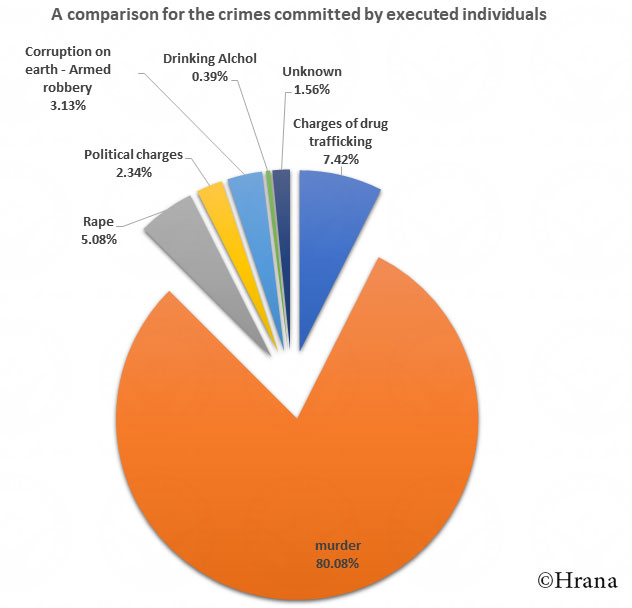
According to these reports, 80% of the executions were based on murder charges. Moreover, 5% charged with rape, another 9% with drug-related charges. 4% were charged with “Waging war against God”, also 1% charged with armed robbery,1% Consumption of alcohol.
The highest number of all death sentences issued are comprised of 80% on murder charges, followed by Drugcharges which make up 9% of the cases.
The province of Alborz ranking first in death sentences in Iranian provinces with 19% of all the death sentences issued, that is due to its two populated and important prisons, followed by Razavi Khorasan province with 12% of all the cases.
The Rajai Shahr prison and Vakil Abad Prison holding the highest number of executions in all prisons in Iran.
According to the statistics, about 0.42% of the executions were carried out in public.
Of those executed in 2020, 3% were female, and 87% were male, while the gender of the other 10% is unknown.
These executions reported by independent sources and human rights associations, indicating that 72% of executions are carried out in secret or without any public notice.
In the category of the death penalty, the execution carried out in comparison to 2019 has decreased by4.8 %. The number of execution sentences issued also has decreased by 12%, and the number of public executions has decreased by 92%.
Cultural Rights
In the category of violations of cultural rights in 2020, 21 reports have been registered by the Department of Statistics and Publication of Human Rights Activists Association in Iran. This included reports on 27 arrests and 4 individuals were sentenced to 257 months of imprisonment, from this number 3 individuals were sentenced to 253 months of imprisonment, while 1 person was sentenced to 4 months of suspended prison term.
1 individual was summoned to the judiciary and security organizations. Moreover, 2 licenses were revoked, 1 person was banned from public speaking or performing, and 1 person was banned from working.
In this category, arrests have increased by51 % compared to the previous year.
Workers’ Rights
In the category of violations of workers’ rights in 2020, 1318 reports have been registered by the Department of Statistics and Publication of Human Rights Activists Association in Iran. This included 30 arrests. 45 workers activists or workers were sentenced to 183 months in prison, and 42 people received 3108 lashes, and 42 people were summoned to judiciary and security organizations.
During 2020, a total of 2011 months of overdue payment of salaries to workers has been reported. 2105 workers were laid off or fired, 2240 cases of unemployment, 18049 lacked work insurance, 3082 workers waiting for work-related decisions. In addition, 1187 people have lost their lives in work-related accidents, and 3259 workers have been injured while at work. On a global scale amongst other counties, Iran ranks 102nd in work safety.
Also, in 2020, at least 473 worker protests and 99 workers strike took place. most of these protests were regarding wages.
Based on these reports the arrest of workers has increased by56 % compared to 2019.
Children’s Rights
In the category of violations of children’s rights in 2020, a total of 176 reports have been registered by the Department of Statistics, however, it should be mentioned because of secretly in the matter of reporting these incidents there is no accurate statistic in this field. These reports included at least 2205 cases of child abuse, 9 cases of rape and sexual abuse of children, 9 cases of murder of childre, 2 self-immolation, 94 cases of child suicide, and more than
1 million students are deprived of education.
Lack of access to devices for virtual education, Child marriages, poverty, cultural context, population density, etc. in Khuzestan province has led to the highest number of deprivations from education in the country.
As mentioned in the right to the life section, at least 2 minor offenders have been executed in Iran during 2020. Additionally, 3 teenagers were sentenced to a total of 264 months of imprisonment.
During the nation-wide protests, 19 children and 1 children’s rights activist were arrested.
Women’s Rights
In the category of violations of women’s rights in 2020, a total of 81 reports have been registered by the Department of Statistics. These reports reflected. At least 572 women were physically and sexually abused, 13 cases of honor-killings,6 self-immolation, 4 cases of acid attacks, and 1 cases of summoned women’s rights activists to judiciary and security organs.
Based on this report 5 women have been detained for reasons related to women’s rights. At least 2 women’s rights activists were sentenced to 180 months in prison.
Prisoners’ Rights
In the category of violations of prisoners’ rights in 2020, a total of 542 reports have been registered, 53 reports on physical assault of prisoners, 366 reports of deprivation
/neglected of medical care, 109 reports of illegal transfer to solitary confinement, 533 attempted hunger strikes, 289 cases of forced transportation or exile, 228 cases of threatening prisoners, 126 cases of banning prisoners of having visitors, 18 cases of torture, 25 case of deaths by diseases,10 arrestees were killed by prison authorities, and 17 prisoners committed suicide, 40 cases of lack of access to lawyers, 1678 reports of prisoners being held in unsuitable circumstances. Also, in this category, there have been 147 cases of keeping prisoners in an unsure state about their sentence and situation.
Security Forces’ Violence and Citizens’ Safety
Death of civilians
This section is dedicated to the killing or injuring of civilians by the police or military institutions. In 2020, a total of 204 people were shot by the military forces; 74 of the victims lost their life including, 36 Kulbar, 5 fuel-Carriers, 33 civilians. 130 people were also injured by the shots of the military forces, including 109 Kulbar, 16 civilian, 5 Fuel-carriers. Addititonally, 9 Kulbers were affected by climate and geographical factors such as freezing and falling from heights, 4 of whom were injured and 5 Kulber lost his life.
Victims of landmines and explosions
The landmines left from the war threaten the lives of civilians of the border cities each year. Iranian government continues manufacture and planting of the anti-personnel mines, and against the international agreements, it believes that the use of these type of landmines is the only effective way in keeping its vast borders safe.
Based on reports, in the past year at least 10 civilians have lost their lives by landmines in the border areas and 14 other civilians have been injured.
Floggings
The International Covenant on civil and Political Rights (ICCPR) has explicitly banned the use of inhuman, or degrading punishments, such as flogging. However, based on the gathered reports in 2020, flogging sentences were carried out for at least 14 accused who were sentenced to a total of 874 floggings. The sentence of 3 of the accused for a total of 222 floggings were carried out in public.
It should be noted that, the judiciary has also issued a total of 23946 flogging sentences in the past year.
Intervention in personal affairs of civilians
In 2020, at least 209 civilians were arrested for attending or hosting personal gatherings and parties. This number is based on 8 official reports of the country.
Additionally, in 2020, at least 180 group of civilians –mostly consist of those who have lost money (exacerbated economically) or those whose civilian rights have been violated– have organize protests for not being able to fulfill their asking and demands. These protests took place in 24 provinces. Tehran, Eastern Azerbaijan, Khuzestan, and Khorasan Razavi were the provinces with most protests.
Sentences
In 2020, the judiciary of the Iranian government, including the initial court and appeal, issued 29841 months of imprisonment. These reports included; 1721 months of imprisonment for the ethnic minorities, 4351 months of imprisonment for religious minorities; 22271 months of imprisonment in the category of freedom of expression, 554 months of imprisonment in the category of Unions, 183 months of imprisonment for workers, 257 months of imprisonment in cultural category, 264 months of imprisonment in children’s rights category, 180 months of imprisonment in women’s rights category, and 60 months of imprisonment for students.
These statistics only include the court sentences that indicated detailed information or characteristics of the verdicts.
A total of One hundred and ninety-four billion and seven hundred and forty-six million rials in fines and 9182 lashes has been issued in 2020.
In 2020, the number of convictions of citizens or activists has increased by35 %. Moreover, the convictions of religious minorities increased by 28.9%, ethnic minorities decreased by 35%, and freedom of expression has been increased by 52.9%, unions increased by 89%, in the cultural field increased by 38%, workers decreased by 73%, women’s rights decreased by 80%, and in the students category decreased by 89%.
Arrests
In 2020, the security forces arrested 1426 individuals because of political or civil rights-related activities.
The statistical analysis exhibited 47 case of arrest in the trade union category, 286 arrests in the category of ethnic minorities, 77 arrests in the category of religious minorities, 928 arrests in the category of freedom of expression, in the children’s rights category 20 arrests, 6 arrests of students in the category of Academia/right to education, 27 arrests in the field of culture, and 30 arrests in the category of workers’ rights.
Moreover, 5 women were prosecuted for their activities, and promotion of their lifestyle; 3 of whom were arrested for modeling, and the other two for participating in sports.
In 2020, the number of arrests decreased by84 %. According to these reports, the number of arrests decreased in ethnic minorities by 16.6%, culture increased by 51%, religion minorities decreased by 42%, unions decreased by 31%, students decreased by 94%, workers’ rights increased by 56%, and in the category of freedom of expression decreased by 88.8%.
This is the brief version and the full report is available for download in PDF format.
Human Rights Activists (in Iran)
Department of Statistics and Publications
December 2020
For media inquiries please contact Skylar Thompson, [email protected]
Human Rights Activists News Agency (HRANA)- On the World Day Against the Death Penalty, the Center of Statistics of Human Rights Activists in Iran (HRAI) has published its annual report, in efforts to sensitize the public about the situation of the death penalty in Iran.
HRANA’s Statistics Center relies on the work of HRANA reporters, as well as a network of independent and verifiable sources. It also incorporates disclosures to the media by judicial authorities announcing or confirming prisoner executions, and as such is exposed to a margin of error representing efforts by the Iranian authorities to omit, conceal, or restrict the collection of such data.
Between October 10, 2019, and October 8, 2020, the death penalty and executions have been the focus of 264 HRANA reports. Over this time period, the Iranian authorities issued the death penalty sentence to 96 individuals and have already carried out 256 executions including 2 public executions.
Click here to download report in PDF format
While execution numbers went down by 2% in comparison to the same time last year, Iranian courts have issued 16% less death sentences. Public hangings and executions of women have decreased by 78% and increased 12%, respectively.
Females account for only 15 of the 256 HRANA-confirmed execution victims this year. . In addition, 2 juvenile offenders, under the age of 18 when they allegedly committed the crime they were charged with, were executed.
The report includes a breakdown of executions by capital offense: 80.08% were charged with murder, 7.42% were charged with drug and narcotic offenses, 5.08% were charged with Rape, 2.34% were charged with armed robbery/offenses classified as “corruption on earth”, 3.13% were charged with political or security-related offenses, 0.39% were charged with drinking alcohol and 1.56% had unknown charges.
The chart below displays execution numbers by the province in which they took place. According to this chart, Alborz had the highest number of executions at 16%. Khorasan Razavi and West Azerbaijan come second and third, with 11% and 9% respectively.
The chart below is a distribution of execution information sources. The chart indicates that 77% of HRANA-confirmed executions were not announced by the official Iranian sources. Undisclosed executions are referred to as “secret” executions.
The chart below displays execution numbers by their location in prison or public. According to statistics, 1% of the executions in Iran were carried out in public.
This leaflet contains the 2019’s analytical and statistical annual report on human rights in Iran, prepared by the Department of Statistics and Publications of Human Rights Activists in Iran (HRAI). This statistical analysis report presented by HRAI is the result of the daily efforts of this organization and its dedicated members as part of a daily statistic and census project that started in 2009 by this organization.
This annual report on human rights violations in Iran (2019) is the collection, analysis, and documentation of 4259 reports concerning human rights, gathered from various news sources during 2019 [January 1st to December 20th]. Human Rights Activists News Agency (HRANA) has gathered and reported 41%, official or close to the Iranian government sources 53% and other human rights news agencies 6% of all the reports analyzed in this Annual Report.
The following 42-pages includes statistical overviews and related charts on various sections regarding women’s rights, children’s rights, prisoners’ rights, etc. Based on this report, despite the 10% increase in human rights violations reports in provinces other than Tehran, compared to the last year’s annual report, there is still a major concern on lack of proper reporting and monitoring of the human rights by the civil society in the smaller cities.
This report is the result of endeavors made by courageous human rights activists in Iran who pay a very high cost for the realization of their humanitarian beliefs. However, for obvious reasons (i.e. existing governmental limitations and ban on the free exchange of information and government preventing the existence of human right organizations in the country), this report by no means is free of errors and cannot alone be a reflection on the actual status of human right in Iran. Having said that, it should be emphasized that this report is considered as one of the most accurate, comprehensive, and authentic reports on the human rights conditions in Iran and it can serve as a very informative source of information for human rights activists and organizations working on Iran, to better understand the challenges and opportunities that they may face.
This is the brief version and the full report is available for download in PDF format.
The following map illustrates the number of reports per province made by the human rights organizations and news agencies, this is a direct reflection of the capability of the civil society in each province of the country (2019).
As indicated in the distribution map, there exists a major difference between Tehran, the capital, and other parts of the country in terms of the number of published reports. This is while the population of Tehran has been reported on the census of 2017 as 15270000 people, compared to the population of other parts of the country being 81160000 people.
Ethnic Minorities
In the field of national and ethnic minorities’ rights, a total of 309 reports regarding 343 individuals have been registered by the department of the statistics and publication of human rights activists in Iran (HRAI) in 2019. According to these reports, at least 1171 people were arrested, and 60 people were sentenced to 2698 months of imprisonment. Compared to the previous year there has been a 70% decrease in the arrest of ethnic minorities and a 13% increase in imprisonment sentences. The highest number of violations occurred in the month of June, in contrast, the highest decline is observed in the month of December.
Religious Minorities
In this category, 162 reports have been registered by the Department of Statistics in 2019, According to these reports, 135 civilians were arrested, 13 cases of prevention from economical activities, 90 cases were summoned to the judicial and security institutions, and 36 cases of depriving and preventing from education. 76 individuals of the religious minorities were arrested and sentenced by the judicial institutions to a total of 2983 months of imprisonment.
The highest number of violations occurred in the month of January, in contrast, the highest decline is observed in the month of April. In the field of religious minorities, the Baha’is constitute the highest of the Human Rights reports on religious minority violations with 54%, Sunnis 30%, Christians 9%, Dervishes 2%, Jews 1%, Yarsans 1%, and others 5%, of the total reports. The number of citizens arrested in the category of religious minorities has decreased by 78% in 2019 compared to 2018, and the imprisonment sentences issued by the judiciary has decreased by 82%.
Freedom of Speech
In the category of freedom of speech, in 2019, 529 reports have been registered by the Department of Statistics that included 8293 arrested individuals; 274 summonses to the judiciary and security authorities; 4 cases of Internet website filtering, 1 case of nationwide internet shutdown, 1 case of cell phones shut down, 5 reports of publication banning; 17 cases of conviction for publications; 14 cases of intimidation and threats. In 2019, 292 arrestees were sentenced to a total of 10474 months of imprisonment, 4 billion and 278 million and 350 thousand Rials in financial fines, 3470 lashes, and 13 cases of deprivation from civil rights have been reported in this category. In the field of Freedom of Speech, there has been an increase of 51% in the reports of arrests compared to the previous year. Similarly, sentences issued by the judiciary have decreased by 11% based on the number of people being tried, and imprisonment sentences were increased by 40% compared to 2018.
The nation-wide protests of November are one of the most significant events of 2019 in this category. During the November protests that lasted more than 10 days simultaneously in 719 parts of the country. At least 7133 people were arrested, and hundreds died on the streets. The highest number of violations in this category occurred in the months of December, in contrast, the highest decline is observed in the month of March.
Trade Unions and Associations
the category of the rights of associations and trade unions in 2019, 339 reports have been registered by the Department of Statistics and Publications. This includes 69 members of the trade unions who reported being arrested. Also, in this category, 10 individuals have been sentenced to a total of 56 months in prison, 17 cases of summoning to the judicial and security institutions, and 1931 cases of closing the facilities have been reported. In 2019, at least 273 protests and 15 union strikes were held. Most of these protests were related to salary/wage demands from corporations, bad economic conditions, and lack of proper management of corporations.
In the category of Trade Unions and Associations, there has been an 83% decrease in the number of arrests and there has been a 72% decrease in the issue of sentences compared to the previous year. Moreover, the highest number of violations occurred in the month of July, in contrast, the highest decline is observed in December.
Right to Education
the category of violations of academic rights in 2019, 50 reports have been registered by the Department of Statistics and Publication of Human Rights Activists in Iran. This includes 104 students arrested, 1 student has been summoned to the court, 1 student banned from continuing their education, as it was also mentioned in the religious rights section of this report 34 students were prevented from continuing their education because of their religion. In the category of right to education, there has been a 6% decrease in the number of arrests. And based on these reports 11 students were sentenced to 570 months in prison. The highest number of violations occurred in the month of October, in contrast, the highest decline is observed in the month of April.
Right to Life
In the category of right to life in 2019, 246 reports have been registered by the Department of Statistics and Publication of Human Rights Activists Association in Iran. This included 108 death sentences, execution of 248 people with death sentences (including 13 executions in public). Based on the announced identifications of some of the individuals executed, 231 were male and 15 were female. In addition, 4 juvenile offenders have also been executed in 2019 who were under the age of 18 at the time of committing the crime. According to these reports, 79% of the executions were based on murder charges. Moreover, 5% charged with rape, another 12.5% with drug-related charges. 1% were charged with “waging war against God”, also 2% charged with armed robbery. The highest number of violations occurred in the month of August, in contrast, the highest decline is observed in the month of March. The highest number of convictions compromised of 79% of all death sentences are on murder charges and followed by rape charges which are 12.5% of the cases. The highest number of death penalty sentences were issued in Alborz province with 27% due to its two populated and important prisons, followed by Fars province with 10% of the cases. In addition, Rajai Shahr prison and Central Urmia Prison holding the highest number of death sentences. The province of Fars and Kohgiluyeh and Boyerr-ahmad have the highest number of executions in public each with 23% of total executions in public.
According to the statistics, about 5% of the executions were carried out in public and 95% were carried out in prison. Secret executions reported by independent sources and human rights association, indicating that 75% of executions are carried out in secret or without any public notice. In the category of right to life, the execution carried out in comparison to 2018 has decreased by 5%. The number of execution sentences issued also has decreased by 44% and the number of public executions has not changed. In addition, 6% of the executed individuals were female, 93% men.
Cultural Rights
the category of violations of cultural rights in 2019, 64 reports have been registered by the Department of Statistics and Publication of Human Rights Activists Association in Iran. This included 13 arrests, 38 people were sentenced to 186 months imprisonment, and 27 individuals were summoned to judiciary and security organizations. Moreover, 4 cultural materials publication were declined, 13 licenses were revoked, 6 people were banned from public speaking or performing, 4 historical places were damaged, 2 historical places were neglected, confiscated 38000 copies of books. In this category, arrests have decreased by 87% compared to the previous year. The highest number of violations have been reported in January, in contrast to the lowest number in September.
Workers’ Rights
the category of violations of workers’ rights in 2019, 1088 reports have been registered by the Department of Statistics and Publication of Human Rights Activists Association in Iran. This included 143 arrests. 33 workers activists or workers were sentenced to 696 months in prison, and 176 months of suspended sentences and 762 lashes, and 198 people were summoned to judiciary and security organizations. During 2019, a total of 799 months of overdue payment of salaries to workers has been reported. 4746 workers were laid off or fired, 10571 cases of unemployment, 50050 lacked work insurance, 199 workers waiting for work-related decisions. In addition, 1412 people have lost their lives in work-related accidents, and 14245 workers have been injured while at work. On a global scale amongst other counties, Iran ranks 102nd in work safety. Also, in 2019, at least 279 worker protests and 21 workers strike took place. most of these protests were regarding wages. Moreover, the arrest of workers has decreased by 35% compared to 2018. In the monthly comparison of workers’ rights violations in 2018, the highest number of violations per month have been in July, in contrast with the lowest being in April.
Women’s Rights
In the category of violations of women’s rights in 2019, a total of 103 reports have been registered by the Department of Statistics. At least 335 women were physically and sexually abused, 12 cases of honor-killings, and 19 cases of summoned women’s rights activists to judiciary and security organs. At least 19 women’s rights activists and 86 others were arrested during the women’s march. At least 13 women’s rights activists were sentenced to 926 months in prison. The highest number of reports in women’s rights violations was in May and June and the highest decline in reports is observed in January.
Prisoners’ Rights
In the category of violations of prisoners’ rights in 2019, a total of 540 reports have been registered, 104 reports on physical assault of prisoners, 141 reports of deprivation/neglected of medical care, 151 reports of illegal transfer to solitary confinement, 302 attempted hunger strikes, 415 cases of forced transportation or exile, 71 cases of threatening prisoners, 67 cases of banning prisoners of having visitors, 7 cases of torture, 14 case of deaths by diseases, 65 cases of lack of access to lawyers, 742 reports of prisoners being held in unsuitable circumstances. Also, in this category, there have been 71 cases of keeping prisoners in an unsure state about their sentence and situation. Based on the number of reports per month, the highest number of reports in prisoners’ rights violations has been in July and the highest decline in reports is observed in December.
Sentences
2019, the judiciary of the Iranian government, including the initial court and appeal, issued 19111 months of imprisonment. These reports included; 2698 months of imprisonment for the ethnic minorities, 2983 months of imprisonment for religious minorities; 10474 months of imprisonment in the category of freedom of speech—it should be noted, these statistics only include the court sentences that indicated detailed information or characteristics of the verdicts. The highest number of reports in this category has been in July and the highest decline in reports is observed in May. In addition, a total of 5 billion and 152 million and 350 thousand Rials in fines and 4676 lashes has been issued in 2019. In 2019, the number of convictions of citizens or activists has decreased by 31%. Moreover, the convictions of religious minorities decreased by 82%, ethnic minorities increased by 13%, and freedom of expression has been increased by 40%.
Arrests
In 2019, the security forces arrested 9201 individuals because of political or civil rights-related activities. The statistical analysis exhibited 69 case of arrest in the trade union category, 343 arrests in the category of ethnic minorities, 135 arrests in the category of religious minorities, 8293 arrests in the category of freedom of speech, 100 arrests of students in the category of right to education, 13 arrests in the field of culture, and 143 arrests in the category of workers’ rights. The highest number of reports in this category has been in November and the highest decline in reports is observed in July. In 2019, the number of arrests increased by 12%. According to these reports, the number of arrests decreased in ethnic minorities by 70%, culture by 87%, religion minorities 78%, unions 83%, students 6%, workers’ rights 35%, and in the category of freedom of speech increased by 51%.
Human Rights Activists News Agency (HRANA)- On the World Day Against the Death Penalty, the Center of Statistics of Human Rights Activists in Iran (HRAI) has published its annual report, in efforts to sensitize the public about the situation of the death penalty in Iran.
HRANA’s Statistics Center relies on the work of HRANA reporters, as well as a network of independent and verifiable sources. It also incorporates disclosures to the media by judicial authorities announcing or confirming prisoner executions, and as such is exposed to a margin of error representing efforts by the Iranian authorities to omit, conceal, or restrict the collection of such data.
From October 10, 2018, to October 8, 2019, the death penalty and executions have been the focus of 250 HRANA reports. Over this time period, the Iranian authorities issued the death penalty sentence to 134 individuals and have already carried out 242 executions including 16 public executions.
While execution numbers went down by 5.4% in comparison to the same time last year, Iranian courts have issued 47.6% less death sentences. Public hangings and executions of women have raised 6.6% and 140%, respectively.
Females account for only 12 of the 242 HRANA-confirmed execution victims this year. In addition, five juvenile offenders who were under the age of 18 when they allegedly committed the crime they were charged with, were executed.
The report includes a breakdown of executions by capital offense: 71% were charged with murder, 14% were charged with drug and narcotic offenses, 6% were charged with rape, 5% were charged with armed robbery/offenses classified as “corruption on earth”, 2% were charged with political or security-related offenses, and 2% had unknown charges.
The chart below displays execution numbers by their location in prison or public. According to statistics, 7% of the executions in Iran were carried out in public.
The chart below displays execution numbers by the province in which they took place. According to this chart, Alborz with 25% has the highest number of executions and West Azerbaijan 8% and Kerman 7% are second and third.
The chart below is a distribution of execution information sources. The chart indicates that 72% of HRANA-confirmed executions were not announced by the official Iranian sources. Undisclosed executions are referred to as “secret” executions.